Showing posts with label Terrorism. Show all posts

Monday, April 28, 2025

Pahalgam Attack: Why is the Indian Media Not Asking Hard Questions?

A recent terrorist attack on April 22 in Kashmir has killed 26 Indian tourists. Prime Minister Narendra Modi's Hindu Nationalist government took no time to blame Pakistan for the attack and vowed to "punish" the neighbor for it. Indian media, also derisively known as "Godi media", immediately went into overdrive to demand action against Pakistan. New Delhi followed up with suspending the Indus Basin Water treaty from the 1960s which guarantees 80% of the water from the three western rivers (Chenab, Jhelum and Indus rivers) to Pakistan, while India gets the exclusive use of the water from three eastern rivers (Beas, Ravi and Sutlej rivers). India also ordered Pakistani visitors to leave the country and reduced Pakistani diplomatic staff posted in India. Pakistan responded by suspending Simla Agreement and banning overflights of Indian civilian and military aircraft through its airspace. Pakistan warned India that any attempt to block its share of water from the three western rivers will be an "act of war", adding that it was prepared to respond, “with full force across the complete spectrum of national power”. Pakistan is a nuclear-armed country, as is India. Pakistan's nuclear doctrine calls for the use of nuclear weapons if its national existence is threatened by any country. 

Shankaracharya Swami Avimukteshwaranand Saraswati


The Indian mainstream media has amplified the Modi government's propaganda and abandoned its role of asking the hard questions to get at the truth. Among the few who have raised serious doubts about Delhi's  narrative is a Hindu religious leader named Shankaracharya Swami Avimukteshwaranand Saraswati. In a viral video, the holy man has asked the following questions:

1. Shouldn't our "chowkidar"  (Modi has called himself  chowkidar in the past) be held accountable for any attacks on our home? 

2. How did the attackers manage to come in, carry out the attack without any resistance and safely escape?

3. How did you so quickly determine that the attackers came from Pakistan? And if you are so good at reaching this conclusion so quickly, why were you unable to stop the attack in the first place. 

4. Can India really cut off water flow instantly to Pakistan to "punish" it? Experts say it will take at least 20 years if India allocated unlimited funds to make it happen as fast as possible. It will require building dams, water reservoirs and canals to divert the water from Pakistan. 

Pakistani journalist Najam Sethi sees the hand of "Indian deep state" at work in Pahalgam, carried out while the US Vice President JD Vance in India. Sethi recalls what former American Secretary of State Madeleine Albright wrote in her memoirs titled "Mighty Almighty" about the killing of 35 Sikh villagers in Kashmir that India blamed on Pakistan during US President Bill Clinton's India visit in March, 2000. She said Clinton suspected the hand of Hindu extremists in the Chittisinghpura incident. She quoted him saying that if he hadn’t made the trip, the victims would have still been alive. 

Among the Indian journalists, only Bharat Bhushan has raised some questions about his country's government narrative. He thinks India violated the back-channel agreement between Modi's NSA Ajit Doval and Pakistan's then NSA Moeed Yusuf reached after 2019 to spare the civilians on both sides in any proxy attacks. Bhushan points out a warning from Lt General Ahmad Sharif that “the (Jaafar Express) train attack (in Balochistan) has changed the rule of the game”. 

Bhushan's op ed mentions Modi's muscular policy toward people he sees as "terrorists".  Canada, Pakistan and the United States have all accused the Indian government of a campaign of international assassinations. He writes: "Another development has been the targeted killings of terrorists and militants — both Kashmir and Sikhs, that Pakistan alleges have been initiated by Indian intelligence agencies after the Pulwama terrorist strike in 2019 when 40 paramilitary personnel were killed. India was allegedly inspired to undertake extra-judicial killings on foreign soil, from the example of Russia’s KGB, Israel’s Mossad, and the assassination of dissident journalist Jamal Khashoggi by Saudi Arabia". 

Bhushan concludes his Op Ed in Deccan Herald as follows: "How will India react now to what it believes to be Pakistan-sponsored terrorism? The bravado about punishing every terrorist act with greater-than-expected force is not going to be easy to put in action. Geopolitical circumstances have changed since 2019.  Public sentiment cannot be the sole basis of military strikes. Thankfully, no crucial election is in the offing where assuaging public emotions becomes an issue. India will also have to provide proof to the world that Pakistan was indeed involved. This would require the arrest and questioning of the terrorists involved. That may take time. Only the tacit approval of the US can ensure that a strike against Pakistan does not spin out of control". 

Related Links:

Haq's Musings

Karan Thapar Dismantles Official Indian Narrative on Kulbhushan Jadhav

How Long Can Modi Escape Accountability For Murder? 

Is Modi's India a Paper Elephant?

US Government Brackets Modi With Murderous Dictators

Ex India Spy Documents Successful RAW Ops in Pakistan

London Police Document Confirms MQM-RAW Connection Testimony

India's Ex Spooks Blame Kulbhushan Jadhav For Getting Caught

Ajit Doval Lecture on "How to Tackle Pakistan" 

Indian Analyst Bharat Kanad to Modi: Use TTP Terrorists to Attack Pakistan


Friday, May 3, 2024

India's Modi Brags About Ordering Transnational Assassinations

In a campaign speech on May 1, Indian Prime Minister Narendra Modi bragged about his campaign of transnational assassinations of individuals he has labeled "terrorists". “Today, India doesn't send dossiers to the masters of terrorism, but gives them a dose and kills them on their home turf", he is reported to have said, according to a tweet posted by his BJP party. Last month, Indian Defense Minister Rajnath Singh made a similar admission. “If any terrorist from a neighboring country tries to disturb India or carry out terrorist activities here, he will be given a fitting reply. If he escapes to Pakistan we will go to Pakistan and kill him there,” Singh said in an interview to Indian TV news network News18. 

Indian Prime Minister Narendra Modi at a BJP Campaign Rally. Source: BJP

Earlier, Pakistan government accused India of carrying out assassinations of Sikh and Kashmiri separatists on Pakistani soil. “We have documentary, financial and forensic evidence of the involvement of the two Indian agents who masterminded these assassinations,” Pakistan's Foreign Secretary Sajjad Qazi said at a news conference in Islamabad.

Pakistan is not alone in accusing India of assassinating dissidents overseas. Canada and the United States are also investigating murders allegedly carried out by Indian agents on their soil. Indian spies have also been kicked out of Australia after being caught monitoring Indian diaspora in the country. "They monitored their country's diaspora community, according to  the Australian Security Intelligence Organization (ASIO) Director-General Mike Burgess  as reported by the Australian Broadcasting Corp (ABC). "They asked a public servant to provide information on security protocols at a major airport."

Derek Grossman on India's Spy Agency RAW. Source: X

Commenting on the news fromAustralia, a US analyst Derek Grossman posted on X:  "Indian RAW gets exposed again, this time in Australia. Maybe, just maybe, they aren’t very good at the spy game". 

Gerry Shih of the Washington Post appears to concur with Derek Grossman's assessment of the incompetence of the Indian spy agencies. Referring to RAW's assassination plot against Sikh activist Gurpatwant Singh Pannun, a US citizen, Shih reported as follows: 

"After the plot against Pannun failed, the decision to entrust (Vikram) Yadav with the high-risk mission sparked recriminations within the agency, former officials said. Rather than joining RAW as a junior officer, Yadav had been brought in midcareer from India’s less prestigious Central Reserve Police Force, said one former official. As a result, the official said, Yadav lacked training and skills needed for an operation that meant going up against sophisticated U.S. counterintelligence capabilities". 

Back in 2018, India's former RAW officers, including one ex chief, have blamed Indian spy Kulbhushan Jadhav, arrested by Pakistan in 2016, for getting caught in Pakistan as a "result of unprofessionalism", according to a report in India's "The Quint" owned and operated by a joint venture of Bloomberg News and Quintillion Media. The report that appeared briefly on The Quint website was later removed, apparently under pressure from the Indian government.


Monday, August 21, 2023

Pakistan's Political Crisis: Did Washington Cause "Regime Change" in Islamabad?

Did the U.S. make it clear to Pakistan in 2022 that Imran Khan was not acceptable as the prime minister of the South Asian country? Did the Pakistani military then use the Opposition parties led by Nawaz Sharif and Asif Ali Zardari to remove Imran Khan from power through a successful No-Confidence vote in the parliament? The answer to both of these questions appears to be a resounding "yes" based on the leaked contents of a secret diplomatic cable, the actions of the Opposition politicians and the attempts to dismantle the Pakistan Tehreek-e-Insaf (PTI) and the jailing of Imran Khan on trumped-up charges. These events have created significant political instability in the country and prompted former US National Security Advisor John Bolton to urge the Biden administration to take a clear position before the “terrorists, China and Russia take advantage” of the situation.

Former Prime Minister Imran Khan (L) and General Asim Munir

Diplomatic Cable:

A leaked diplomatic cable from Pakistani Ambassador Asad Majeed Khan quotes Donald Lu, Assistant Secretary of State for South Asia in the Biden Administration, as saying,  “I think if the no-confidence vote against the Prime Minister succeeds, all will be forgiven in Washington because the Russia visit is being looked at as a decision by the Prime Minister. Otherwise, I think it will be tough going ahead.”

In answer to a question at a recent press conference, the US State Department spokesman Mathew Miller has essentially confirmed the contents of the diplomatic cable. 

This appears to have been enough for the then Pakistan Army Chief General Bajwa to orchestrate the passage of the No-Confidence Motion against Prime Minister Imran Khan with the help of Nawaz Sharif, Asif Ali Zardari and other politicians who ganged up on Imran Khan. 

PTI Dismantled, Imran Khan Jailed:

The Pakistani military did not just content itself with removing Imran Khan from power. A campaign to dismantle Khan's political party, the largest party in the country that ruled the country and two of its four provinces, is in full swing. A Gallup poll in February this year reported that 61% of voters approved of Imran Khan. His support is the strongest among young people who make up the bulk of the population. 

The jailing of Imran Khan and mass arrests of his party members are sending a clear signal that Pakistan's most popular leader, based on recent polls, is no longer acceptable to the military. The US government has remained silent in the middle of this mass crackdown in Pakistan. Washington appears to be unconcerned about civil liberties and democracy in Pakistan. 

US Interests in South Asia:

Are the US interests in South Asia best served by destabilizing strategically-located nuclear-armed Pakistan? Polls indicate that Imran Khan remains the most popular politician in Pakistan. The removal of his government from power and the dismantling of his party are increasingly turning ordinary Pakistanis against the United States. 

In an interview with Voice of America (VOA) Urdu service this week, former National Security Advisor John Bolton said he “worries about” the Biden administration’s foreign policy about South Asia because “it’s not clearly defined”.  

Replying to another question asked by VOA, Mr Bolton said Biden administration officials “don’t know what their strategic imperatives are. And it’s been confused and inarticulate on the situation in Pakistan”.

Here's a video clip of US State Department Mathew Miller's Press Conference:

https://youtu.be/g6vvj2zveOQ


 Related Links:


Friday, December 16, 2022

Pakistan FM Bilawal Bhutto Zardari Lashes Out At Indian EAM Subramanyam Jaishankar

“If the FM (foreign minister) of India (Jaishankar) was being honest, then he knows as well as I, that the RSS (India's militant Hindu organization) does not believe in Gandhi, in his ideology. They do not see this individual as the founder of India, they hero-worship the terrorist that assassinated Gandhi", said Pakistan's Foreign Minister Bilawal Bhutto Zardari at a press conference at the United Nations Headquarters in New York City. "Osama Bin Laden is dead but the butcher of Gujarat lives and he is the prime minister of India", he added. Mr. Bhutto Zardari was responding to a question from the media asked at the behest of the Indian Foreign Minister Subramanyam Jaishankar.  Earlier at the UNSC, Indian External Affairs Minister Subramanyam Jaishankar had unveiled a statue of Mohandas K. Gandhi at the UN and accused Pakistan of "hosting Osama Bin Laden". Gandhi was assassinated by Nathuram Godse, a member of the militant Hindu organization RSS. Indian Prime Minister Narendra Modi is a member of the RSS. 

Pakistan Foreign Minister Bilawal Bhutto Zardari at the United Nations Headquarters in New York

Here are some excerpts of what Bilawal Bhutto Zardari said at the media briefing at the UN:  

“He [Narendra Modi] was banned from entering this country [the United States]....these are the prime minister and foreign minister of the RSS (India's right-wing Hindu nationalist organization)....The RSS draws its inspiration from Hitler’s SS (the German Nazi Party’s militant wing Schutzstaffel)...(According to the RSS) we (Muslims) are terrorists whether we are Muslims in Pakistan and we’re terrorists whether we’re Muslims in India.....They (Modi and BJP) are not even attempting to wash the blood of the people of Gujarat off their hand..."Butcher of Gujarat” was now the “Butcher of Kashmir”". 

Last month,  the US State Department bracketed Indian Prime Minister Modi with murderous dictators like Congo's Laurent Kabila and Zimbabwe's Robert Mugabe. Speaking about the US decision to grant immunity to Saudi Crown Prince Mohammad Bin Salman, State Department spokesperson Vedant Patel said that it was “not the first time” that the US government has designated immunity to foreign leaders and listed four cases. “Some examples: President Aristide in Haiti in 1993; President Mugabe in Zimbabwe in 2001; Prime Minister Modi in India in 2014; and President Kabila in the DRC in 2018. This is a consistent practice that we have afforded to heads of state, heads of government, and foreign ministers,” he said. 

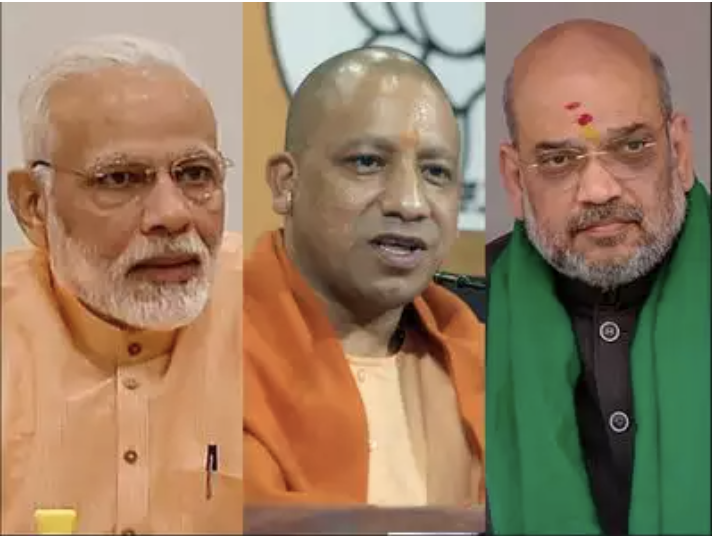
BJP HIndutva Leaders Modi, Yogi and Shah

Prime Minister Narendra Modi of India was barred from entering the United States from 2005 to 2014 for his involvement in the massacre of thousands of Muslims in Gujarat in 2002.  In 2015, a US judge dismissed a lawsuit against Modi after the US government argued that he is immune to accusations as a sitting head of government. While Modi has denied any involvement in the Gujarat anti-Muslim pogrom, he has never even expressed any regret over the killings in Gujarat when he was the Chief Minister of the Indian state. 

While Modi has refused to accept any responsibility for the massacre of over 2,000 Muslims in Gujarat in 2002, his party BJP's leaders have not shied away from claiming "credit" for it. Just yesterday, Modi's right-hand man and current Home Minister Amit Shah said Muslims were "taught a lesson" in 2002. He said that "after they were taught a lesson in 2002, these elements left that path (of violence). They refrained from indulging in violence from 2002 till 2022. BJP has established permanent peace in Gujarat by taking strict action against those who used to indulge in communal violence". 

In 2002 when Narendra Modi was chief minister of the Indian state of Gujarat, hundreds of young Muslim girls were sexually assaulted, tortured and killed.  These rapes were condoned by the ruling BJP, whose refusal to intervene lead to the rape and killing of thousands and displacement of 200,000 Muslims.

In 2012, a former Chief Minister of Gujarat Mr. Shankersinh Vaghela accused Modi's state government of having blood on its hand: "2002 me jo katl-e-aam hua uspe wo sarkar bani hai. Iske baad encounter hui, uske upar ye sarkar bani thi. Sarkar banti hai, lekin ye jo conspiracy karke sarkar banana hai, ye Gujarat aur desh ki janata jaanti hai aur aaj wo repeat nah o, iske liye hum janata ko request karte hain (The foundation of this (Modi) government rests on the 2002 carnage. Governments are made, but not on conspiracies. And the people of Gujarat know this, and that's why we are requesting the people for a change)," Mr Vaghela said.

Since his election to India's top elected office, Modi has elevated fellow right-wing Hindu extremists to positions of power in India. Yogi Adiyanath, known for his highly inflammatory anti-Muslim rhetoric, was hand-picked in 2016 by Modi to head India's most populous state of Uttar Pradesh.

Adiyanath's supporters brag about digging up Muslim women from their graves and raping them. In a video uploaded in 2014,  he said, “If [Muslims] take one Hindu girl, we’ll take 100 Muslim girls. If they kill one Hindu, we’ll kill 100 Muslims.”

Yogi wants to "install statues of Goddess Gauri, Ganesh and Nandi in every mosque”.  Before his election, he said, “If one Hindu is killed, we won’t go to the police, we’ll kill 10 Muslims”.  He endorsed the beef lynching of Indian Muslim Mohammad Akhlaque and demanded that the victim's family be charged with cow slaughter.

Madhav S. Golwalkar, considered among the founders of the Hindu Nationalist movement in India, saw Islam and Muslims as enemies. He said: “Ever since that evil day, when Moslems first landed in Hindusthan, right up to the present moment, the Hindu Nation has been gallantly fighting to shake off the despoilers".

In his book We, MS Golwalkar wrote the following in praise of what Nazi leader Adolf Hitler did to Jews as a model for what Hindus should do to Muslims in India: "To keep up the purity of the Race and its culture, Germany shocked the world by her purging the country of the Semitic races -- the Jews. Race pride at its highest has been manifested here. Germany has also shown how well-nigh impossible it is for races and cultures, having differences going to the root, to be assimilated into one united whole, a good lesson for us in Hindusthan to learn and profit by."

Paul Richard Brass, professor emeritus of political science and international relations at the Henry M. Jackson School of International Studies, University of Washington, has spent many years researching communal riots in India. He has debunked all the action-reaction theories promoted by Hindu Nationalists like Modi. He believes these are not spontaneous but planned and staged as "a grisly form of dramatic production" by well-known perpetrators from the Sangh Parivar of which Prime Minister Modi has been a member since his youth.

Here's an excerpt of Professor Brass's work:

"Events labelled “Hindu-Muslim riots” have been recurring features in India for three-quarters of a century or more. In northern and western India, especially, there are numerous cities and town in which riots have become endemic. In such places, riots have, in effect, become a grisly form of dramatic production in which there are three phases: preparation/rehearsal, activation/enactment, and explanation/interpretation. In these sites of endemic riot production, preparation and rehearsal are continuous activities. Activation or enactment of a large-scale riot takes place under particular circumstances, most notably in a context of intense political mobilization or electoral competition in which riots are precipitated as a device to consolidate the support of ethnic, religious, or other culturally marked groups by emphasizing the need for solidarity in face of the rival communal group. The third phase follows after the violence in a broader struggle to control the explanation or interpretation of the causes of the violence. In this phase, many other elements in society become involved, including journalists, politicians, social scientists, and public opinion generally. At first, multiple narratives vie for primacy in controlling the explanation of violence. On the one hand, the predominant social forces attempt to insert an explanatory narrative into the prevailing discourse of order, while others seek to establish a new consensual hegemony that upsets existing power relations, that is, those which accept the violence as spontaneous, religious, mass-based, unpredictable, and impossible to prevent or control fully. This third phase is also marked by a process of blame displacement in which social scientists themselves become implicated, a process that fails to isolate effectively those most responsible for the production of violence, and instead diffuses blame widely, blurring responsibility, and thereby contributing to the perpetuation of violent productions in future, as well as the order that sustains them."

"In India, all this takes place within a discourse of Hindu-Muslim hostility that denies the deliberate and purposive character of the violence by attributing it to the spontaneous reactions of ordinary Hindus and Muslims, locked in a web of mutual antagonisms said to have a long history. In the meantime, in post-Independence India, what are labelled Hindu-Muslim riots have more often than not been turned into pogroms and massacres of Muslims, in which few Hindus are killed. In fact, in sites of endemic rioting, there exist what I have called “institutionalized riot systems,” in which the organizations of militant Hindu nationalism are deeply implicated. Further, in these sites, persons can be identified, who play specific roles in the preparation, enactment, and explanation of riots after the fact. Especially important are what I call the “fire tenders,” who keep Hindu-Muslim tensions alive through various inflammatory and inciting acts; “conversion specialists,” who lead and address mobs of potential rioters and give a signal to indicate if and when violence should commence; criminals and the poorest elements in society, recruited and rewarded for enacting the violence; and politicians and the vernacular media who, during the violence, and in its aftermath, draw attention away from the perpetrators of the violence by attributing it to the actions."

Related Links:


Friday, July 10, 2020

India-Iran-Afghanistan Axis Against Pakistan?

A JIT (Joint Investigation Team) report recently released by Sindh government in Pakistan has revealed that the infamous Karachi gangster Uzair Baloch worked for Iranian intelligence. Apparently, Uzair Baloch was also in contact with Indian intelligence agents working in Iran, according to Indian media reports. Baloch's interrogation led to the discovery and arrest of Indian undercover agent Kulbhushan Jadhav in Balochistan shortly after Baloch's arrest. Kulbhushan Jadhav has confessed to orchestrating deadly terror attacks in Balochistan and Karachi.
He has said that India's RAW funneled money through Indian consulates in Jalalabad, Kandhar (Afghanistan) and  Zahidan (Iran) to BLA and TTP for terror attacks in Balochistan and Karachi. Targets of terror attacks included people, mosques, roads, port and Balochistan's Hazara Shia community.

L to R: Indian Prime Minister Modi, Iranian President Rouhani and Afghan President Ghani


Chabahar vs Gwadar:

Chabahar is a port being constructed by Indians in Iran. The stated goal of this project is to bypass Pakistan for India's trade with Afghanistan and Central Asia via Iran. Indian media have promoted Chabahar as a competitor to Gwadar Port which is a part of the China-Pakistan Economic Corridor (CPEC).  Indian government is openly hostile to CPEC and declared support for Baloch insurgents.  The leaders of Afghanistan, India and Iran have held regular summit meetings to promote Chabahar port project.

4,000 Indians in Chabahar:

There are 4,000 Indians working in Chabahar, Iran, according to Indian journalist Karan Thapar. Some of them, like Kulbhushan Jadhav, work undercover for Indian intelligence agency RAW.  It is hard to believe that the Iranian intelligence is not aware of the presence of undercover Indian agents among the 4,000 Indians working in Chabahar. After all, Jadhav had two passports, one in his own name and another in the name of Hussein Mubarak Patel. The Indian Express and Asian Age, both Indian publications, suggest that Jadhav had links with Uzair Baloch who has been convicted by for working for the Iranian intelligence in Pakistan.  Kulbhushan Jadhav has confessed to orchestrating deadly terror attacks in Balochistan and Karachi. He has said that India's RAW funneled money through Indian consulates in Jalalabad, Kandhar (Afghanistan) and  Zahidan (Iran) to BLA and TTP for terror attacks in Balochistan and Karachi. Targets of terror attacks included people, mosques, roads, port and Balochistan's Hazara Shia community.

Pakistan's Complaint to Iran:

Paskistan has complained to Iran about allowing Baloch insurgents to use Iranian territory to launch terrorist attacks in Pakistan after an attack  killed 14 people along Pakistan’s coast in 2019, according to Reuters.

“The training camps and logistical camps of this new alliance...are inside the Iranian border region,” Pakistan Foreign Minister Shah Mahmood Qureshi told reporters in Islamabad. Qureshi said he has spoken to his Iranian counterpart, Mohammad Javad Zarif, and conveyed to him the “anger of Pakistani nation”.

Karachi Stock Market Attack:

Four terrorists belonging to Baloch Liberation Army attacked the Pakistani stock exchange in Karachi on June 29, 2020, killing two guards and a policeman and wounding seven others before being shot dead. Pakistan believes that the attackers came from southeastern Afghanistan where they enjoy safe havens with the support of intelligence agencies like Afghan NDS and Indian RAW.

Qasem Soleimani:

Iranian Revolutionary Guard Corp (IRGC) commander General Qasem Soleimani who was assassinated by the United States in drone strike was particularly hostile toward Pakistan. In February, 2019, Soleimani threatened Pakistan. He boasted about Iran's "independent power and honor". Soleimani, known to be close to Supreme Leader Ayatollah Khanenai, reportedly had serious policy disagreement with the Rouhani government.  He said:

"I warn you not to test Iran and anyone who has tested Iran has received firm response. We are speaking to Pakistan with a friendly tone and we are telling that country not to allow their borders to become a source of insecurity for the neighboring countries..... Iran enjoys independent power and honor. Some countries have wealth, but no prowess. Trump tells the Al-Saud that if it hadn't been for the US support, Saudi Arabia would not have survived and Saudi Arabia's coalitions in the region have all ended in failure."

Soleimani's tone in this message to Pakistan is anything but "friendly".

Summary:

Recent release of Sindh government report reveals that Karachi gangster Uzair Baloch spied for Iran in Pakistan.  There are 4,000 Indians working in Chabahar, Iran, according to Indian journalist Karan Thapar. Some of them, like Kulbhushan Jadhav, work undercover for Indian intelligence agency RAW.  Chabahar is a port being constructed by Indians in Iran. The stated goal of this project is to bypass Pakistan for India's trade with Afghanistan and Central Asia via Iran. Indian media have promoted Chabahar as a competitor to Gwadar Port which is a part of the China-Pakistan Economic Corridor (CPEC). The Indian Express and Asian Age, both Indian publications, suggest that Jadhav had links with Uzair Baloch.  Kulbhushan Jadhav has confessed to orchestrating deadly terror attacks in Balochistan and Karachi. He has said that India's RAW funneled money through Indian consulates in Jalalabad, Kandhar (Afghanistan) and  Zahidan (Iran) to BLA and TTP for terror attacks in Balochistan and Karachi. Targets of terror attacks included people, mosques, roads, port and Balochistan's Hazara Shia community.

Here's Kulbhushan Jadhav's confession video:

https://youtu.be/nVp62OinTeU


Related Links:

Haq's Musings

South Asia Investor Review

General Soleimani's Hardline Against Pakistan

Iran-Pakistan Ties

Iran's Chabahar and Pakistan's Gwadar Ports

Indian RAW Agent Kulbhushan Jhadav Used Chabahar

Iran-Saudi Conflict

Pakistan's Nuclear Program

Iran Nuclear Deal

1971 India-Pakistan War

Chabahar vs Gwadar Ports

Did America Contribute to the Rise of ISIS?

Riaz Haq's YouTube Channel

PakAlumni Social Network

Wednesday, May 8, 2019

Pakistan ISPR On Pashtun Tahaffuz Movement (PTM)

Who is Manzoor Pashteen? What is Pashtun Tahaffuz Movement (PTM)?  What is Pashtun Nationalism?  Why did Pakistan ISPR spokesman Gen Asif Ghafoor warn them in a recent press conference? What are PTM demands? Did the Pakistani military action in FATA help or hurt the vast majority of FATA residents? Who are the "missing person"? Why are they missing? What must be done to resolve this issue? Is PTM insincere in using this issue as cover to attack the military? How has RK Yadav, retired officer of Indian RAW,  documented India's support of Pashtun Nationalists and other secessionist movements in Pakistan? Is PTM supported by foreign intelligence agencies to re-ignite insurgency in FATA?

Terror Death in FATA. Source: South Asia Terrorism Portal


Terror Deaths Across Pakistan. Source: South Asia Terrorism Portal

Why was Masood Azhar declared a "terrorist" by the UNSC sanctions committee? Is this a win for India's Modi? Did China abandon Pakistan by letting it happen as UNSC Permanent Member? Or did China coordinate its action with Pakistan to have references to Kashmir and Pulwama removed from the declaration?

Azad Labon Kay Sath (ALKS) host Faraz Darvesh discusses these questions with Sabahat Ashraf (ifaqeer) and Riaz Haq (www.riazhaq.com)

https://youtu.be/rA68tYE4rV0


Related Links:

Haq's Musings

South Asia Investor Review

PTM: The Lowdown on Manzoor Pashteen

History of Pashtun Nationalism and Afghanistan-Pakistan Relations

Ex-RAW Officer RK Yadav's "Mission RAW"

Social Media: Blessing or Curse For Pakistan?

Planted Stories in Media

Indian BJP Troll Farm

Kulbhushan Jadhav Caught in Balochistan

The Story of Pakistan's M8 Motorway

What Can Pakistan Learn From Sri Lanka?

Riaz Haq's Youtube Channel

Wednesday, May 1, 2019

Easter Bombings in Sri Lanka; Belt Road Forum 2019 in Beijing

Who carried out the Easter Sunday terrorist attacks at churches and hotels in Sri Lanka? Why? Is it a domestic group with outside help? What is India's role in it? Why did the attackers use India as their training base? Did ISIS inspire the attackers? With Muslims facing revenge attacks, what will happen to inter-ethnic and inter-religious relations in the island nation at the Southern tip of India? Will there be a renewed civil war? How will it affect South India and the South Asia region?

Tamil Population in India and Sri Lanka


What was the agenda of the Belt and Road Forum 2019 attended by 37 world leaders including Pakistan Prime Minister Imran Khan in Beijing? What did President Xi Jinping, Prime Minister Imran Khan and other world leaders say at this summit? How will this affect the next phase of China-Pakistan Economic Corridor (CPEC), a flagship project of BRI (Belt Road Initiative)? How will concerns ranging from debt sustainability and inclusive growth to environmental impact be addressed?

Pakistan Prime Minister Imran Khan at BRF 2019 in Beijing

Viewpoint From Overseas host Faraz Darvesh discusses these questions with Misbah Azam and Riaz Haq (www.riazhaq.com)


https://youtu.be/O6pTJXIf7g0


Related Links:

Haq's Musings

South Asia Investor Review

Indian Agent Kulbhushan Jadhav Operated From Iran

What Can Pakistan Learn From Sri Lanka?

China-Pakistan Economic Corridor: Myths and Facts

Chabahar vs Gwadar Ports


Riaz Haq's YouTube Channel

PakAlumni Social Network

Tuesday, April 23, 2019

State of Pakistan's Relations With Iran and India

What does Pakistan Prime Minister Imran Khan hope to accomplish during his Iran visit? What are the key issues bedeviling Iran-Pakistan relations? Cross-border terrorism alleged by both? Pakistan's relations with the Gulf Arabs? CPEC? Afghanistan? Gwadar? Chabahar? Indian RAW's use of Iran to launch terror attacks in Pakistani Balochistan? Who calls the shots in Iran? President Rouhani or the hardline Iranian Revolutionary Guard leaders?


Why is Indian Prime Minister Narendra Modi continuing to threaten Pakistan with use of force, including use of nuclear weapons? Is this part of his election campaign to appeal to his base? Or will this intimidation go beyond elections if he wins a second term? Is Pakistan Prime Minister's hope of better ties with India under BJP just a mirage? Are analysts like Moeed Yusuf right about India waiting it out to achieve overwhelming superiority to eventually dictate term to Pakistan?

Viewpoint From Overseas host Faraz Darvesh discusses these questions with Misbah Azam and Riaz Haq (www.riazhaq.com)

https://youtu.be/seNerO7_KsM


Related Links:

Haq's Musings

South Asia Investor Review

Indian Agent Kulbhushan Jadhav Operated From Iran

Modi's India: A Paper Elephant?

Dr. Moeed Yusuf on Future of India-Pakistan Conflict

Iran-Pakistan Ties

Iran-Saudi Conflict

Pakistan's Nuclear Program

Iran Nuclear Deal

1971 India-Pakistan War

Chabahar vs Gwadar Ports

Did America Contribute to the Rise of ISIS?

Saturday, March 23, 2019

Christchurch Massacre: Best and Worst of Humanity

Has the world seen the best and the worst of humanity since the Christchurch mosque massacre in New Zealand? How did New Zealand Prime Minister Jacinda Ardern handle the aftermath of the tragedy? Is her genuine compassion and decisiveness a shining example of leadership? How was the response to the tragedy from major world leaders like US President Donald Trump, Indian Prime Minister Narendra Modi and Prime Minister Imran Khan? What does it say about them?

Who came out to show support for Muslim communities around the world? How did New Zealanders show solidarity with Muslims? How did Muslims in Silicon Valley deal with the aftermath of the tragedy? Who joined them in mourning?

Who celebrated the massacre of innocent Muslims and why? What do White Nationalism and Hindu Nationalism have in common? Are these two sides of the same coin? Who was BS Moonje and why did he meet Mussolini? Who was Golwalkar and why did he admire Hitler? What is Modi's connection with Golwalkar's RSS movement? What did he say about Hitler's treatment of Jews as "a good lesson for us in Hindustan to learn and profit by"?

What did Norwegian terrorist Anders Breivik say about Hindu Nationalists in his manifesto? Are White Nationalists and Hindu Nationalists reinforcing each other on social media platforms? What role does social media play in promoting extremist ideologies? What can be done to manage this problem?

Viewpoint From Overseas host Misbah Azam discusses these questions with Sabahat Ashraf (ifaqeer) and Riaz Haq (www.riazhaq.com)


https://youtu.be/BXGWZvTNOkk


Related Links:

Haq's Musings

South Asia Investor Review

Hindu Nationalists Love Nazis

Islamophobia Goes Mainstream in 2017

A Conversation With White Nationalist Jared Taylor on Race in America

Lynchistan: India is the Lynching Capital of the World

Modi and Trump

Anders Breivik: Islamophobia in Europe and India

Hindu Nationalism Goes Global

Hindutva: The Legacy of the British Raj

Sunday, March 10, 2019

India: Rising Great Power or Paper Tiger?

Is India what The Economist magazine describes a "paper elephant" in spite of huge increases in its military spending? Has this perception been reinforced by post-Pulwama events between India and Pakistan? Have the failures of Indian military in Balakot and Kashmir caused a reassessment of the western narrative that says "India is a rapidly rising and Pakistan is collapsing"?

India-Pakistan Military Spending: Infographic Courtesy The Economist

Do Indians, particularly its Hindu Nationalists, suffer from what Indian diplomat and politician Sashi Tharoor has described as "India's Israel Envy"? Is the Hindu Supremacist ideology similar to Naziism and Fascism? Does it represent a serious threat to world peace? Can it lead to a global disaster with billions dead if the two South Asian nations target each other with nuclear weapons?

Have post-Pulwama events brought Kashmir on the international agenda? New York Times editorial board has written: "As long as #India and Pakistan refuse to deal with their core dispute — the future of #Kashmir, India’s only Muslim-majority state — they face unpredictable, possibly terrifying, consequences." Does this suggest that Kashmir issue is back on the agenda? IOC, the world's second largest organization of 57 countries, has condemned “in the strongest possible terms recent wave of Indian terrorism in occupied Jammu and Kashmir that has resulted in the deaths of 48 people in the month of November alone, making 2018 one of the deadliest years." Is this a rejection of Indian position on Kashmir?

Viewpoint From Overseas host Misbah Azam discusses these questions with Sabahat Ashraf (iFaqir) and Riaz Haq (www.riazhaq.com).

https://youtu.be/Xc2oHd-T5qs


Haq's Musings

South Asia Investor Review

Rise of "Hindu Nazis" in India

Balakot and Kashmir: Fact Checkers Expose Indian Lies

Is Pakistan Ready for War with India?

Pakistan-Made Airplanes Lead Nation's Defense Exports

Modi's Blunders and Delusions 

India's Israel Envy: What If Modi Attacks Pakistan?

Project Azm: Pakistan to Develop 5th Generation Fighter Jet

Pakistan Navy Modernization

Pakistan's Sea-Based Second Strike Capability

Who Won the 1965 War? India or Pakistan?

Friday, February 22, 2019

Indian Analyst Bharat Karnad to Modi: Use TTP Terrorists to Attack Pakistan

With the home-grown resistance of a new generation of Kashmiris against India's brutal military occupation turning into a full-blown insurgency, Indian Prime Minister Narendra Modi's right-wing Hindu Nationalist government is trying desperately to divert attention from its human rights abuses by blaming Pakistan for Pulwama attack. Mr. Modi and his ministers are making war threats to "punish" Pakistan for Pulwama attack carried out by a local Kashmiri young man using explosives obtained locally. How will Mr. Modi "punish" Pakistan? Will India launch a full-frontal attack? Or do another "surgical strike" that Pakistan can deny? Or opt for covert warfare using its terrorist proxies?

Bharat Karnad
In a recently published Bloomberg Quint Op Ed on Pulwama attack in Indian Occupied Kashmir, a top Indian analyst Bharat Karnad has said that "it (TTP) is an asset for India to support and grow with moral and materiel support, and to develop". "Indeed, TTP’s fighting qualities are sufficiently developed and effective to simultaneously fight the Pakistan army in Pakistan and the U.S.-led NATO forces in Afghanistan", Karnad adds.

During former US Defense Secretary James Mattis' visit to New Delhi in 2017, Bharat Karnad had also acknowledged TTP-RAW link in a Hindustan Times Op Ed in the following words:

"Mattis’ request that India moderate its support for TTP will put Delhi in a fix because TTP is useful as an Indian counterpart of the Hizbul Mujahideen, Lashkar-e-Toiba, and Jaish-e-Mohammad deployed by the Pakistan Inter-Services Intelligence (ISI) in Jammu and Kashmir. Severing relations with TTP will mean India surrendering an active card in Pakistan and a role in Afghanistan as TTP additionally provides access to certain Afghan Taliban factions. This, together with the Abdul Ghani regime’s desire for India’s presence and the tested friendship with Abdul Rashid Dostum and his Tajik-dominated ‘Northern Alliance’, ensures that no solution for peace in Afghanistan can be cobbled together without India’s help."

Bharat Karnad is a Research Professor in National Security Studies at the Centre for Policy Research, New Delhi. But Bharat Karnad is not alone in advocating the use of India's terrorist proxies against Pakistan. Since 2013, India's current National Security Advisor Ajit Doval has been talking about "Pakistan's vulnerabilities" to terrorism and India's ability to take advantage of it. Here are excerpts of his speech at Sastra University:

"How do you tackle Pakistan?.....We start working on Pakistan's vulnerabilities-- economic, internal security, political, isolating them internationally, it can be anything..... it can be defeating Pakistan's policies in Afghanistan...... You stop the terrorists by denying them weapons, funds and manpower. Deny them funds by countering with one-and-a-half times more funding. If they have 1200 crores give them 1800 crores and they are on our side...who are the Taliban fighting for? It's because they haven't got jobs or someone has misled them. The Taliban are mercenaries. So go for more of the covert thing (against Pakistan)..." Ajit Doval, India's National Security Advisor

Based on recent comments from Indian analysts and past pronouncements of senior India officials like Ajit Doval, I expect India to intensify its proxy war of terror against Pakistan.


Here's a video of Ajit Doval explaining his "Doval Doctrine":

https://youtu.be/eYRuk8H5M9E


Related Links:

Haq's Musings

700,000 Indian Soldiers vs 10 Million Kashmiris

Why is India Sponsoring Terror in Pakistan?

Can Modi Isolate Pakistan?

MQM-RAW Link

India's Pakistan Obsession

China-Pakistan Economic Corridor

RK Yadav's Mission RAW

Planted Stories in Indian Media

Doval Doctrine

India's Israel Envy

Saturday, January 26, 2019

Part 2: History of Top Leadership Blunders in Pakistan

What are the key sources of the current crises faced by Pakistan? Can any of these be traced to blunders committed years ago by Pakistani leaders? Here's part 2 of the discussion started earlier.

Was it a blunder for General Zia to join the United States and Saudi Arabia in support of the Afghan Jihad against the Soviet Union in 1980s?  Did it help achieve Pakistan's objective of weakening the Pashtun Nationalists led by Abdul Ghaffar Khan's son Abdul Wali Khan who opposed the creation of Pakistan?  What if Pakistan had not supported the Afghan Resistance in 1980s? Did it promote militarization of religious fanatics in Pakistan? Was it a mistake for Benazir Bhutto to give birth to the Taliban?

Was General Musharraf's seizure of Kargil heights in 1999 in Kashmir a blunder? How was it different from India's seizure of Siachen Glacier from Pakistan in 1984? If these were similar actions, why was India's and the world's reaction so different?  Coming soon after Indian Prime Minister Atal Bihari Vajpayee's Lahore visit and the signing of the Lahore Declaration, how did Kargil change the course of India-Pakistan history?

Did Kargil lead to the 1999 Coup against Prime Minister Nawaz Sharif?  Did Sharif err by firing General Musharraf while he was representing Pakistan overseas and then denying landing permission to  the PIA commercial flight brining General Musharraf home?  Was the coup staged by General Pervez Musharraf or the Pakistan Army Corps Commanders while he was still in the air? Did Nawaz Sharif's failure to manage civil-military relations contribute to his problems and the coup?

Did Musharraf blunder by siding with the United States after Sept 11, 2001 terror attacks in America? What was the alternative? How would the US react if Musharraf had refused to cooperate? Would the porous Afghan-Pakistan border allow Pakistan to be a silent observer?

Azad Labon Ke Sath host Faraz Darvesh discusses these questions with panelists Misbah Azam and Riaz Haq (www.riazhaq.com)

https://youtu.be/grLQJa-QygA


Related Links:

Haq's Musings

South Asia Investor Review

US Aid to Pakistan

1971 Debacle in East Pakistan

Is it 1971 Moment in Pakistan's History?

Mission RAW by RK Yadav: India in East Pakistan

Benazir Bhutto Gave Birth to Taliban

What if Musharraf Had Said No to US After 911?

Riaz Haq Youtube Channel

VPOS Youtube Channel

Sunday, July 15, 2018

Pakistan Elections 2018 Predictions; Nawaz Sharif's Future

What will be the impact of tragic terror attacks with mass casualties on Pakistan's July 25, 2018 general elections? How does the current situation compare with the situation in 2013 elections? Will the elections proceed as scheduled?

Pakistan Elections 2018 Forecast by  Intermarket and Exotix Investment Firms

Which party is likely to get the most votes and parliamentary seats in Pakistan's July 25, 2018 general elections? Will one party get a clear majority? Who will form the new government? Is PTI Chief Imran Khan likely to be the next prime minister of Pakistan? Will it be a coalition government? How can a weak coalition government implement a radical reform agenda proposed by Imran Khan?

Why did former prime minister of Pakistan Mr. Nawaz Sharif, convicted recently by a Pakistani court on charges of having assets beyond income, come back to Lahore to face certain arrest? What is his strategy? What is Nawaz Sharif's future in Pakistani politics after his conviction and arrest? How will PMLN fare in 2018 and future elections? Will the disgraced Sharif be able to rehabilitate himself and reclaim the mantle of national leadership? Will future judges of Pakistan Supreme Court set aide his conviction to clear the way for him to become Pakistan's prime minister for the fourth time?

Viewpoint From Overseas host Faraz Darvesh discusses these questions with panelists Misbah Azam and Riaz Haq (www.riazhaq.com)

https://youtu.be/4jcH3CMYc5w


Here's Urdu version streamed live on Facebook:

https://youtu.be/v9PQGN0Is50


Related Links:

Haq's Musings

South Asia Investor Review

Nawaz Sharif's Report Card 2013-18

CPEC Transforming Pakistan's Least Developed Regions

Pakistan: The Other 99% of the Pakistan Story

How Pakistan's Corrupt Elite Siphon Off Public Funds

Bumper Crops and Soaring Credit Drive Tractor Sales

Panama Leaks

How West Enables Corruption in Developing Countries

Declining Terror Toll in Pakistan

Riaz Haq's YouTube Channel

Wednesday, February 7, 2018

Karachi's Safety Ranking Climbs Amid Declining Crime Rates

Karachi, one of world's fastest growing megacities, has seen its crime index ranking improve dramatically from 6 in 2013 to 50 in 2017, according to a survey of 327 world cities conducted by Numbeo.  Karachi was ranked 47 in 2016.  Reduction in violence is helping revive Pakistan's economy, making it the third fastest growing trillion dollar economy among the top 25 world economies by purchasing power parity.

Comparison to Major Cities:

Creek Vista, Karachi, Pakistan
In South Asia region, Karachi, now ranked 50, is safer than Bangladeshi capital Dhaka ranked 18 and the Delhi suburb of Gurgaon ranked 40.  Delhi is ranked 60, Lahore 138, Mumbai 160 and Islamabad 226.

Karachi is also safer than American cities of Detroit, MI (17),  Baltimore, MD (20), New Orleans, LA (21), Albuquerque, NM (27), St. Louis, MO (30) Oakland, CA (33) and Milwaukee, WI (46).

The year 2013 marked the beginning of the deployment of Pakistan Rangers in Karachi to fight rampant extortion, terrorism and violence by armed gangs patronized by some political parties.  Evidence suggests that some of the politicians involved had links to Indian intelligence.

Impact on National Economy: 

Reduction in violence in Karachi is helping revive Pakistan's economy, making it the third fastest growing trillion dollar economy among the top 25 world economies by purchasing power parity.

In a recent article titled "Pakistan Keeps Terrorists on the Run and Economy on a Roll", leading Japanese publication Nikkei Asia Review reported from Karachi that the negative perception of "terrorism, corruption, misrule" are "becoming  outdated, and businesses are taking notice... thanks to sweeping operations by the army and a powerful paramilitary force".  Here's a more extended excerpt of the Nikkei story:

"The Pakistan Rangers, a paramilitary law enforcement organization overseen by the military and the Interior Ministry, set out to tackle the violence head-on. In 2013, the Rangers Sindh -- which operate in Sindh Province, including Karachi -- mobilized 15,000 troops. The provincial legislature granted them broad powers to search homes and make arrests, enabling them to quickly turn the tide. In 2017, there were zero bombings and only five kidnappings, according to Saeed, who serves as director general of the Rangers Sindh. This is no small feat in a city with a swelling population of 17 million -- perhaps even 20 million if migrants from rural areas are factored in. "We destroyed all of the terrorists' pockets," he said, adding that hotel occupancy rates are over 90%."

Summary: 

Karachi, one of world's fastest growing megacities, has seen its crime index ranking improve dramatically from 6 in 2013 to 50 in 2017, according to a survey of 327 world cities conducted by Numbeo.  Last year, Karachi was ranked 47. Reduction in violence is helping revive Pakistan's economy, making it the third fastest growing trillion dollar economy among the top 25 world economies by purchasing power parity.  As the country's largest city and its financial capital and economic hub, a safe and healthy Karachi bodes well for Pakistan's future. The Pakistani military has played a crucial role in securing the nation's future by bringing peace to Karachi.

Here's a video of a Karachi mall:

https://youtu.be/KeKmj28m2-c


Related Links:

Haq's Musings

Gangs of Karachi

Gangster Politicians of Karachi

Karachi is World's Fastest Growing Megacity

Karachi's Human Development Index

Pakistan Rising or Failing: Reality vs Perception

Pakistan's Trillion Dollar Economy Among top 25

MQM-RAW Link

Saturday, December 2, 2017

Terror in Peshawar; Obama in India; Tillerson Exit?

Who was behind the terror attack at Peshawar Agriculture University? Is it the Tehrik-e-Taliban Pakistan (TTP) that claimed responsibility? Will this attack harden Pakistan's position vis-a-vis TTP sanctuaries in Afghanistan? Will it make less likely for Pakistan to cooperate with the US and Afghanistan? Are Pakistani security forces getting better in dealing with such attacks?

Why is former US President Obama in India? What did he say about Pakistan and its alleged role in hiding Osama Bin Laden? Why is Obama advising Indian Prime Minister Modi to abandon Hindu Nationalists' politics of hate and division along religious lines?

Is the US Secretary of State Rex Tillerson really on his way out? If so, why? How is the uncertainty impacting American diplomacy abroad? Is President Trump too focussed on building up and funding the military at the expense of diplomacy? Will it backfire?

Viewpoint From Overseas host Faraz Darvesh discusses these questions with Misbah Azam and Riaz Haq (www.riazhaq.com)

https://youtu.be/Em8-PX2WAJY


Related Links:

Haq's Musings

Wave of Terror in Pakistan

Seeing Bin Laden's Death in Wider Perspective

India is Lynching Capital of the World

Tillerson in South Asia

Talk4Pak Youtube Channel

Riaz Haq's Youtube Channel