Showing posts with label Karachi. Show all posts

Thursday, October 1, 2026

Tata's Boardroom Crisis: Will it Impact Philanthropy in India?

India's Tata Group is going through a major boardroom crisis. Noel Tata, the Chairman of the Tata holding company, has been removed from the Tata Group's board by N. Chandrasekaran, chairman of Tata Sons. Noel Tata has declared the decision illegal, a stance the board disputes. The crisis has been precipitated by a 2022 decision by India’s central bank to order the company to seek a stock market listing for Tata Sons, to comply with new rules governing systemically important investment firms. Tata Sons is considered an investment firm because it holds stakes in Tata subsidiaries and can inject capital into them. Noel Tata, who heads the bloc of charities that owns two-thirds of Tata Sons, vehemently opposes a listing.

Ratan and Noel Tata

India's Tata Group is known for its deep philanthropic engagement in the country. Tata patriarch Jamsetji Tata, who laid the foundations of large-scale steel manufacturing in colonial-era India about a century ago, created trusts that would hold controlling stakes in the Tata Group, thus capping Tata family members' personal wealth.  As a result of that decision, none of the Tatas' names show up among India's billionaires, even though the group's 26 listed firms had a market capitalization of nearly $280 billion in March this year. In recent weeks, the boardroom battle has dragged down the share prices of some group firms.  The trusts receive hundreds of millions of dollars in dividends from Tata Sons. In the year ended March 2025, they spent more than $100 million on education, health and other social programs, according to the Wall Street Journal. Listing of Tata Sons as a public company could significantly reduce Tata Son's philanthropic spending. 

Tatas are Parsees, a Zoroastrian minority that migrated to South Asia centuries ago. The Parsee community became very wealthy under the British Raj. They were licensed by the British colonial government to export opium to China and sell cotton to Britain when the American Civil War dried up supplies. These two activities helped them accumulate enormous wealth. But they have also used some of this wealth to fund charities. The Tata group was “conceived as national service carried on through business…and the structure of its ownership is what has allowed it to remain so,”  Noel Tata has been quoted as saying at the board meeting. 

Parsee community is also known for its philanthropy in Pakistan. NED Engineering University, my alma mater in Karachi, is named after a Parsee gentleman Nadirshaw Edulji Dinshaw (N.E.D.), who initially funded the institution at its founding in 1921. NED, now a university, still has reserved seats for Parsee students recommended by the Dinshaw family. I had several Parsee classmates when I attended it. In addition to reserved seats, Parsees also compete for admissions on general seats. 

In 1925,  Framroze Edulji Dinshaw of the Dinshaw family bailed out Tatas by loaning Rs 20 million to the Tata Group to rescue its troubled Tata Hydro and Tata Steel. 

Some Parsee leaders, like Dadabhai Naoroji (1825-1917), participated in India's independence movement. Naoroji was among the founding members of the Indian National Congress and served as its President on three occasions, from 1886-87, 1893-94 and 1906-07.  He was an early political mentor and major influence on Pakistan's founding father Quaid-e-Azam Muhammad Ali Jinnah during his formative years in public life. A major street that passes near Quaid-e-Azam Mohammad Ali Jinnah’s mausoleum is named Dadabhai Naotoji Road in Karachi. 

Today, Tata is Apple’s only homegrown assembler of iPhones in India. The company faces heavy expenses from its efforts to turn around loss-making flagship carrier Air India, according to the Wall Street Journal. For now, Tata is heavily reliant on the profits of its cash cow, outsourcing firm Tata Consultancy Services (TCS).

Companies listed on public stock exchanges focus primarily on delivering  short-term profits for shareholders and higher stock price, not for the benefit society at large. This is the main reason why Noel Tata is resisting pressure for listing his holding company.  As he put it at the board meeting, the Tata Sons’ “dividends fund hospitals, universities and research for which no shareholder will ever be repaid. Its capital has repeatedly been placed at risk for reasons no analyst would have endorsed and from which the country has nonetheless benefited.”

Related Links:

Haq's Musings

South Asia Investor Review

NED University Ranked Among Top 200 For Impact

Quaid-e-Azam Mohammad Ali Jinnah's City of Birth

Abandoned Baby Girl, Now 28, Eulogizes Bilquis Edhi (1947-2022)

Maneckshaw: India's War Hero

Pakistanis Rank High on Philanthropy

History of Pakistan's Business and Industry

Remembering Ardeshir Cowasjee (1926-2012)

Pakistan Rising or Failing: Reality vs Perception

Edhi's Life Showed the Meaning of Huqooq-ul-Ibad (Human Rights) in Islam

CPEC Myths and Facts

Gwadar Port

Riaz Haq's Youtube Channel

PakAlumni Social Network

Monday, November 10, 2025

NED University Alum's Chip Startup Acquired by ARM For $265 Million

DreamBig, a fabless semiconductor company founded by NED University alumnus Sohail Syed, has been acquired by Advanced RISC Machines (ARM) for $265 million. The Silicon Valley-based startup is developing networking chips for data centers, with hardware specifically designed to run AI applications. The startup  does not manufacture its own chips but instead licenses its designs to other semiconductor companies. It has had a partnership with Samsung’s foundry division to bring its hardware to market. 

Sohail Syed, Founder and CEO of DreamBig Semiconductors

Here's how DreamBig Semiconductor describes itself on its website:

"DreamBig Semiconductor is a chiplet-based networking company dedicated to providing comprehensive, high throughput solutions for the AI, Datacenter, edge compute and Automotive markets. Headquartered in San Jose, CA, USA, we have over 200 employees globally and partnerships with the largest semiconductor companies in the world.  Founded by RDMA experts and chiplet innovators, DreamBig removes the bottlenecks to on- and off-chip networking, transforming the most important applications on the planet". 

Nvidia and several other AI chip companies have licensed ARM's processor core technology for use it in products. Major tech companies including Amazon, Apple, Google, Qualcomm and Samsung are among the ARM licensees.  ARM's processor cores are known for their energy efficiency and are widely used in mobile devices, but are increasingly found in servers, desktops, and other applications that require good performance-per-watt. Examples include the Apple M-series processors, which are custom ARM-based CPUs for Macs. Most of the advanced semiconductor chips are manufactured by TSMC (Taiwan Semiconductor Manufacturing Corp) in its fabs located in Taiwan. 

DreamBig Semiconductor has established a design center in Pakistan in collaboration with the National University of Sciences and Technology (NUST), which includes a chip design and training center and a chip testing lab. It is a part of Pakistan's broader effort to develop its semiconductor industry, and DreamBig has also sponsored training workshops at universities like the NED University in Karachi and the University of Engineering and Technology (UET) Lahore. 

Pakistan has recently launched The INSPIRE Pakistan initiative to train a new generation of semiconductor professionals and enter the global chip design and research market. The initiative, formally named Initiative to Nurture Semiconductor Professionals for Industry, Research & Education, is a five-year plan designed to train over 7,200 professionals and establish Integrated Circuit (IC) labs in universities across the country. It aims to bridge the gap between academia and industry, develop local tech capacity, and position Pakistan as a player in the global semiconductor ecosystem. 

Dr. Naveed Sherwani, an NED University alumnus and a serial Silicon Valley entrepreneur, has been instrumental in launching INSPIRE Pakistan initiative. He headed the task force that recommended the initiative to the Pakistani government. Dr. Sherwani is currently the head of the National Semiconductor Hub in Saudi Arabia which aims to attract and develop semiconductor design industry in the Kingdom. 

Semiconductors power modern life, forming the core of everything from computers and networking to smartphones and military weapons. Countries such as Pakistan need the knowledge and the human capital trained in semiconductor technology for their long-term economic prosperity and national security. The global semiconductor market size is currently about $600 billion and it is growing rapidly. 


Tuesday, July 8, 2025

Pakistani Prosthetics Startup Aiding Gaza's Child Amputees

While the Israeli weapons supplied by the "civilized" West are destroying the lives and limbs of thousands of Gaza's innocent children, a Pakistani startup is trying to provide them with free custom-made prostheses, according to media reports. The Karachi-based startup Bioniks was founded in 2016 and has sold prosthetics that use AI and 3D scanning for custom designs. 

Gaza's Child Amputee Sidra Al Bordini with Bioniks CEO Anaz Niaz. Source: Instagram


Bioniks has recently delivered its first prosthetics made for Gaza's children using remote imaging to design custom arms at low cost.  The demand for such prosthetics is high because, according to the United Nations, Gaza has 4500 new amputees since October 7, 2023 Hamas attack which triggered Israel's brutal response and started the ongoing genocide in Gaza. 

A recent Reuters story cites the examples of two girls,  three-year-old Habebat Alla and 8 year-old Sidra Al Bordini, who recently received artificial limbs made by Bioniks. Both were severely injured in Israeli air strikes. Sidra and Habebat Allah, who lost both her arms and a leg in Gaza, went through days of remote consultations and virtual fittings. Then Niaz flew from Karachi to Amman, Jordan to meet the girls and make his company's first overseas delivery. children need lighter limbs and replacements every 12–18 months as they grow.  Niaz said the company was exploring funding options for Sidra and Habebat's future replacements, adding the cost wouldn't be too high.

The company used a smartphone app to take pictures from different angles and created a 3D model to print custom prosthetics. Bioniks CEO Anas Niaz said the social enterprise startup had fit more than 1,000 custom-designed arms inside Pakistan since 2021 - funded through a mix of patient payments, corporate sponsorship, and donations - but this was its first time providing prosthetics to those impacted in conflict, according to Reuters. 

Here's how the company describes itself on its website: "At Bioniks, we believe in turning disabilities into possibilities. Founded with a mission to empower individuals with disabilities, we are pioneers in advanced prosthetics and assistive technologies in Pakistan. Our innovative solutions are designed to restore mobility, independence, and dignity to those who need it most. Bioniks revolutionizes the field of healthcare through advanced-level prosthesis and surgical planning tools that are created using state of the art technologies and designing techniques. We at Bioniks aim to provide healthcare solutions that bring measurable value to those who use it and are shaped keeping their precise needs in mind."

Earlier this year, the startup was recognized for contributions to advancing the United Nations Convention on the Rights of Persons with Disabilities, placing it among the world’s most “impactful and scalable” technology. It is the first Pakistani company to win the Zero Project Award, according to media reports. 

Related Links:


Haq's Musings

South Asia Investor Review

Modi and Netanyahu: Two Sides of the Same Coin

Israel's Gaza Attack is Criminal, Not Defensive

Pictorial Review of Israel's Young Gaza Victims

American College Campuses Rise Up Against Israel's Genocidal War on Gaza

Israeli Settler Colonialism

Islamophobia Driving US Policy in the Middle East and South Asia?

Israeli Scholars Offer Insights into Zionist Psyche

Total, Extended Lockdown in Indian Occupied Kashmir

What is India Hiding From the UN Human Rights Team?

Indian JNU Professor on Illegal Indian Occupation of Kashmir, Manipur, Nagaland

Riaz Haq Youtube Channel

PakAlumni: Pakistani Alumni Social Network


Sunday, December 1, 2024

IDEAS 2024: Pakistan Defense Industry's New Drones, Missiles and Loitering Munitions

The recently concluded IDEAS 2024, Pakistan's Biennial International Arms Expo in Karachi, featured the latest products offered by Pakistan's defense industry. These new products reflect new capabilities required by the Pakistani military for modern war-fighting to deter external enemies. The event hosted 550 exhibitors, including 340 international defense companies, as well as 350 civilian and military officials from 55 countries. 

Pakistani defense manufacturers highlighted their latest products, including armed UAVs, air-launched cruise missiles, smart munitions and main battle tanks. A Pakistani defense official said a large number of memoranda of understanding (MOUs) were signed with foreign military officials which could potentially lead to $36 billion in future sales. 

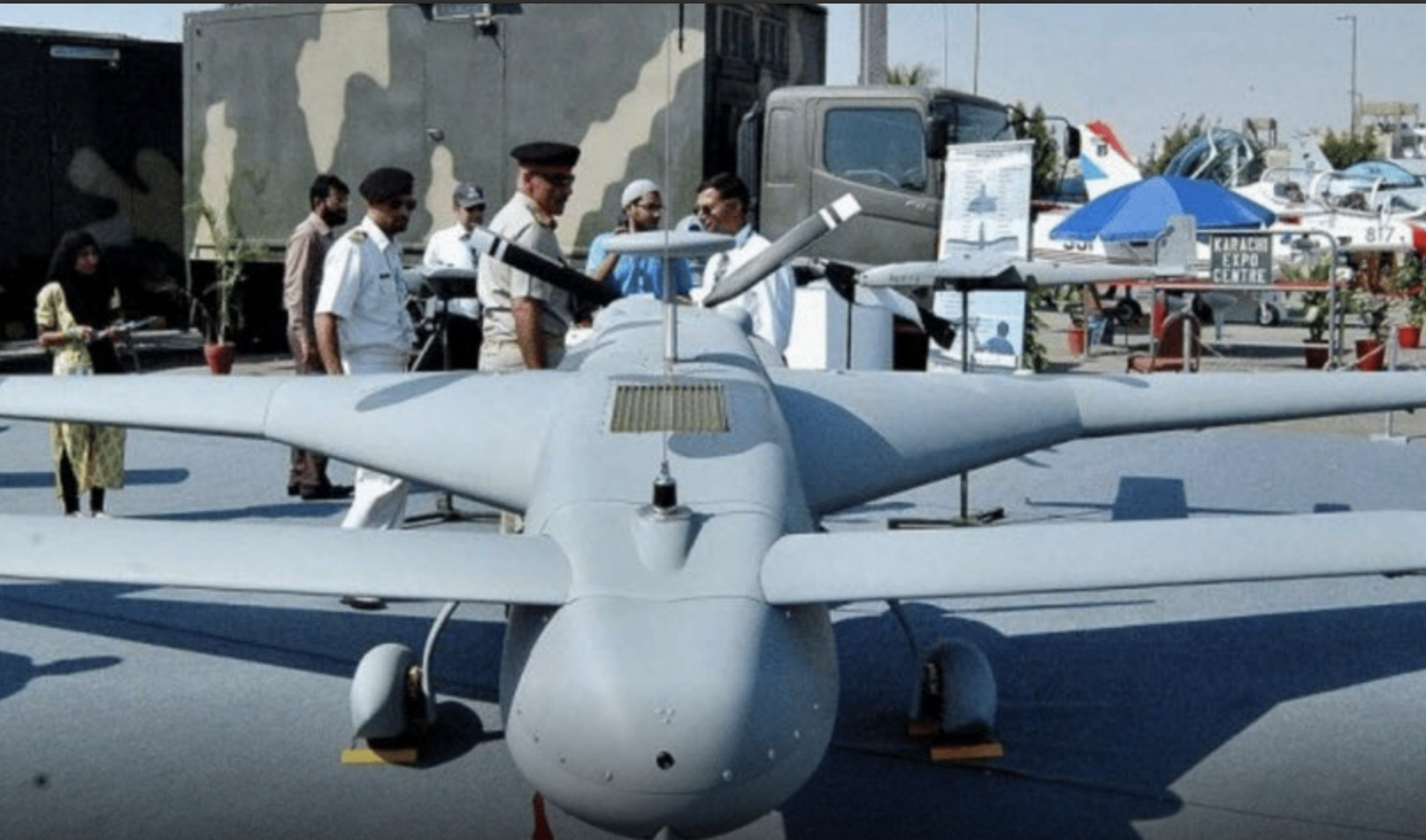
Pakistan Shahpar III UAV. Source: @ZARRAR3D


Pakistan's state-owned defense conglomerate Global Industrial & Defense Solutions (GIDS) displayed a new medium-altitude long-endurance (MALE) unmanned aerial vehicle (UAV) – Shahpar III – at the IDEAS 2024 which was held at the Karachi Expo Center from November 24 to 27, 2024.  Shahpar III features longer endurance, weapon carrying capacity, and service ceiling over the earlier platforms in the Shahpar family of UAVs. The Shahpar III will have a maximum take-off weight of 1,650 kg and can carry multiple weapons on six underwing hardpoints. It will feature domestically developed avionics and be equipped with a dual-redundant flight control computer (US MIL-STD-1553 architecture), enhancing the aircraft's reliability, according to Jane's Defense. 

Sarkash Kamikaze Drone On Display at IDEAS 2024. Source: Global Defense Agency


GIDS also introduced a new Kamikaze (suicide) drone "Sarkash" at the event. The drone has a maximum range of 1,000 km, endurance of over 2 hours, a 50 kg warhead, and a total weight of 175 kg, powered by a turbojet engine. GIDS is also working on the Sarkash-1, a long-range loitering munition.

Pakistan's Blaze Loitering Munitions. Source: Quwa


GIDS also unveiled the Blaze Series of loitering munitions, including Blaze 25, Blaze 50, and Blaze 75 at IDEAS 2024. The lightest of the series, the 25 kg Blaze 25 is ideal for short-range anti-tank operations with a range of 75 km and an endurance of 60 minutes, leaving minimal acoustic and thermal signature thanks to its electric propulsion system, according to OVD. In contrast, the Blaze 50, with its 50 kg weight, 180 km range, and 20 kg warhead, is an intermediate solution for medium-range attacks and reconnaissance missions. Designed for strategic, long-range engagements, the Blaze 75, the heaviest and most powerful model, boasts a 500 km range and a 30 kg warhead. It is powered by a gasoline engine for long-term endurance. 

Azb-81 LR Small Diameter Bomb. Source: Quwa


Qaswa Industries showcased its AZB-81LR Small Diameter Bomb (SDB) at IDEAS 2024. It is  a stand-off weapon (SOW) with a range of 200 km. The precision-guided munition has a 250 lbs weight and has a standoff attack range of 200 kilometers, with an imaging infrared (IIR) seeker, according to defense publication Quwa.  

Quwa also reported on a new Air Launched Cruise Missile (ALCM) displayed at Expo. Using a stealthy low-observable (LO) airframe, the Rasoob-250 offers a range of 350 km with a cruising speed of Mach 0.7 and accuracy of within 5 m CEP (circular error probable). Including a booster, it has a total mass of 285 kg, with the semi-armor piercing warhead taking up 75 kg. It can be launched from drones, helicopters, and maritime patrol aircraft (MPA). 

Pakistan PFX Concept Fighter. Source: Raksha Anirveda

The Pakistan Air Force (PAF) publicly revealed for the first time a model of the next generation of its Pakistan Aeronautical Complex (PAC)/Chengdu Aircraft Corporation (CAC) JF-17 ‘Thunder' fighter aircraft.  Known as the JF-17 PFX (Pakistan Fighter Experimental), the model was displayed at the event in Karachi. Pakistani officials at IDEAS 2024 described the JF-17 PFX as a 4.5-plus generation twin-engine fighter aircraft. They also said that development of the type is expected to be completed before the end of the decade, according to Jane's. 

Related Links:

Haq's Musings

South Asia Investor Review

Pakistan-China Defense Industry Collaboration Irks West

Pakistan's Cyber Attack and Defense Capability

Is India a Paper Elephant?

Pakistan's Aircraft Exports

Pakistan Navy Modernization

West's Technological Edge in Geopolitical Competition

Pakistan Defense Industry

Silicon Valley Book Launch of "Eating Grass"

Ukraine's Lesson For Pakistan: Never Give Up Nukes!

Pakistan Economy Nears Trillion Dollars

Pakistan's Sea-Based Second Strike Capability

Riaz Haq Youtube Channel

VPOS Youtube Channel


Friday, July 26, 2024

Can Urban Forests Beat the Heat in Pakistani Cities?

Recent heat-sensing satellite images of Lahore posted by NASA show that "green spaces such as wooded areas, grassy areas, parks, and farm fields were significantly cooler than densely developed areas".  NASA experts explain it as follows: Vegetation and bodies of water do not absorb and re-emit heat as easily as common building materials such as concrete, asphalt, and steel.

Lahore Vegetation (Left) and Surface Temp (Right). Source: NASA

A NASA post titled "Beating the Heat in Pakistan" says that "Differences in surface temperatures between developed and natural areas, known as surface urban heat islands, tend to be more pronounced than temperature differences associated with atmospheric heat islands, particularly during the daytime".    “Surface urban heat islands exacerbate air temperatures by trapping heat and releasing it slowly, especially at night,” explained Muhammad Nasar-u-Minallah, a geographer at the University of the Punjab in Lahore. “The lack of green spaces and vegetation in urban settings further limits natural cooling mechanisms, such as shade and evapotranspiration, intensifying the heat.”

Rapid urbanization and intense development activities in Pakistani cities have worsened the effects of climate change by making the summer heat unbearable.  In response, several urban forest plantation  campaigns have been launched in major Pakistani cities like Lahore and Karachi by both government and non-government entities. 

Nestlé Pakistan launched its first urban forest tree plantation activity at Allama Iqbal Interna­tional Airport with 25,000 trees, under its Nestlé Cares initiative to support endeavors to reduce carbon footprint in its ambition to achieve net zero by 2050, according to media reports.  Leading the volunteer effort, Jason Avanceña, Chief Execu­tive Officer, Nestlé Pakistan has said, “Forests are the lungs of our planet, playing a crucial role in mitigating climate change and preserving biodiversity. How­ever, deforestation and urban­ization have led to the loss of green spaces, impacting our en­vironment and the well-being of our communities. It is our re­sponsibility to reverse this trend and create a more sustainable and livable future.” “We will ac­complish this with additional plantation activities in Lahore, Kabirwala and Sheikhupura. Our strategy aims to help restore for­ests and protect natural habitats while promoting sustainable livelihoods,” he added.

A rundown park in Clifton district of Karachi has seen a new urban forest thriving in the middle of Pakistan's largest city, according to Euronews. "Transformed into a haven for wildlife, the urban forest now boasts 55 different species of plants within just over a hectare of land", says a report published in Euronews. 

The Urban Forest team that planted the Clifton urban forest says they have already created eight mini tree-filled hubs in Karachi and a further 2 in Lahore. And they have plans to expand to other cities in the country. Families living near the forest were among those that offered financial support alongside companies and the German and US consulates in Karachi.

In addition to the urban forests, Pakistan is also planting the world's largest man-made mangrove forest known as Delta Blue Carbon Project. This mangroves plantation will eventually cover 350,000 hectares of Tidal Wetlands on the south-east coast of Sindh. Currently, Pakistan is estimated to have 600,000 hectares of mangrove forest. Mangroves absorb hundreds of millions of tons of atmospheric carbon, reduce the impact of storms on human lives and economic assets, and provide a habitat for fish, birds and other plants supporting biodiversity. It is funded by sales of carbon credits to global polluting industries such as those involved in fossil fuels trade. 


Wednesday, December 6, 2023

COP28: Pakistan Planting World's Largest Mangrove Forest

Pakistan, which contributes less than 1% of global carbon emissions, is among the countries considered most vulnerable to climate change. About a third of the country was devastated by massive floods in 2022. The nation committed continued pursuit of nature-based solutions to the problem at COP26 in Glasgow in 2021. As part of this commitment, the country is planting one of the world's largest mangrove forests in the Indus River Delta, a key component of its Ten Billion Tree Tsunami campaign launched by former Prime Minister Imran Khan. 

Pakistan Mangroves Plantation Project. Source: Delta Blue Carbon


Mangrove Forest:

Also known as Delta Blue Carbon Project, the mangroves plantation will eventually cover 350,000 hectares of Tidal Wetlands on the south-east coast of Sindh. Currently, Pakistan is estimated to have 600,000 hectares of mangrove forest. Mangroves absorb hundreds of millions of tons of atmospheric carbon, reduce the impact of storms on human lives and economic assets, and provide a habitat for fish, birds and other plants supporting biodiversity. It is funded by sales of carbon credits to global polluting industries such as those involved in fossil fuels trade. 

Pakistan NDCs (Nationally Determined Contributions) For Climate Goals. Source: UN


Massive Floods of 2022:

More than a year after the unprecedented floods of 2022, Pakistan is still dealing with the havoc they wreaked.  Over a thousand Pakistanis died. About 33 million people in two southern provinces became homeless. Sindh was inundated with 784% of normal rainfall in the year. Balochistan saw 522% of average rainfall. Both provinces suffered their worst ever heatwave prior to this unprecedented deluge. Nearly a million livestock were lost, over two million acres of farmland came underwater and 90% of the crops in Sindh and Balochistan were damaged. This was a massive humanitarian crisis. 

Nature Based Solutions:

How are nature based solutions different from man made solutions? Here's how the World Bank explains the difference: 

"Nature-based solutions are actions to protect, sustainably manage, or restore natural ecosystems, that address societal challenges such as climate change, human health, food and water security, and disaster risk reduction effectively and adaptively, simultaneously providing human well-being and biodiversity benefits. For example, a common problem is the flooding in coastal areas that occurs as a result of storm surges and coastal erosion. This challenge, traditionally tackled with manmade (grey) infrastructure such as sea walls or dikes, coastal flooding, can also be addressed by actions that take advantage of ecosystem services such as tree planting. Planting trees that thrive in coastal areas – known as mangroves -- reduces the impact of storms on human lives and economic assets, and provides a habitat for fish, birds and other plants supporting biodiversity" 

Karachi Mangroves Exhibit. Source: Magnifiscience Center


Saving Karachi:

One of the objectives of restoring mangroves is to prevent a climate disaster in Karachi, Pakistan's largest city and the country's economic hub. Mangroves in Karachi are a unique marine ecosystem fringing the coast, and they provide both a vital spawning area for ocean fish and protection from periodic tsunamis and storm surges. 

Karachi's Magnifiscience Center has a special exhibit to help teach citizens the importance of restoring this marine ecosystem. Here's an excerpt of a recent Time Magazine report on the subject:

"On a recent Tuesday morning, several dozen Pakistani schoolchildren barreled down a wooden walkway into a thicket of mangroves. They jostled for space at a small viewing platform and eagerly pointed out fish darting between the exposed tree roots. As the rising tide inched ever closer to the crabs and mudskippers resting on shore, the children’s guide launched into a detailed explanation of the unique marine ecosystem fringing the coast, and how it provided both a vital nursery for ocean fish and protection from tsunamis and storm surges. If mangroves are so important, wondered one child out loud, “Why are they in here, and not out there?” By in here, she meant the soaring glass atrium of Karachi’s newly opened MagnifiScience Centre, where the high-tech centerpiece is the living mangrove exhibit—complete with real trees, live fish, plastic crabs, and an accelerated tidal ebb and flow maintained by underground water pumps. Out there is the crowded coastal megacity of Karachi, where all but a few of the mangrove forests that once defined this Indus Delta port town have been chopped down, paved over, and developed into ocean-view high-rises, golf courses, and container ports". 


Saturday, March 11, 2023

Guess Why Pakistani Analyst Uzair Younus is Making Headlines in India!

Pakistani analyst Uzair Younus has recorded personal impressions of his recent India visit on his YouTube channel, as well as in an interview on another YouTube channel called "Pakistan Experience".  Indian media have gleefully jumped on it with headlines like "Visiting India Was Like Stepping Into The Future" and a "Pakistani analyst" talking of India's "communal harmony". It has helped Younus' channel draw its highest ever views, and inundated it with Indian trolls' comments praising Hindu Nationalist Prime Minister Narendra Modi and denouncing Pakistan.  This is yet another confirmation of what former US President Barack Obama wrote in his book "A Promised Land": “Expressing hostility toward Pakistan was still the quickest route to national unity (in India)”. 

Indians See Uzair Younus Endorsing Indian PM Modi's Policies


Digital Payments: 

Younus' "stepping into the future" comment refers primarily to the ubiquity of QR codes for retail digital payments that he observed in India. He said the currency in circulation accounts for 13% (actual: 13.7%) of India's GDP, versus 20% of GDP (actual: 18%) in Pakistan. He also saw the GST (Goods and Services Tax) numbers displayed at all retailers, and the GST taxes being paid everywhere. 

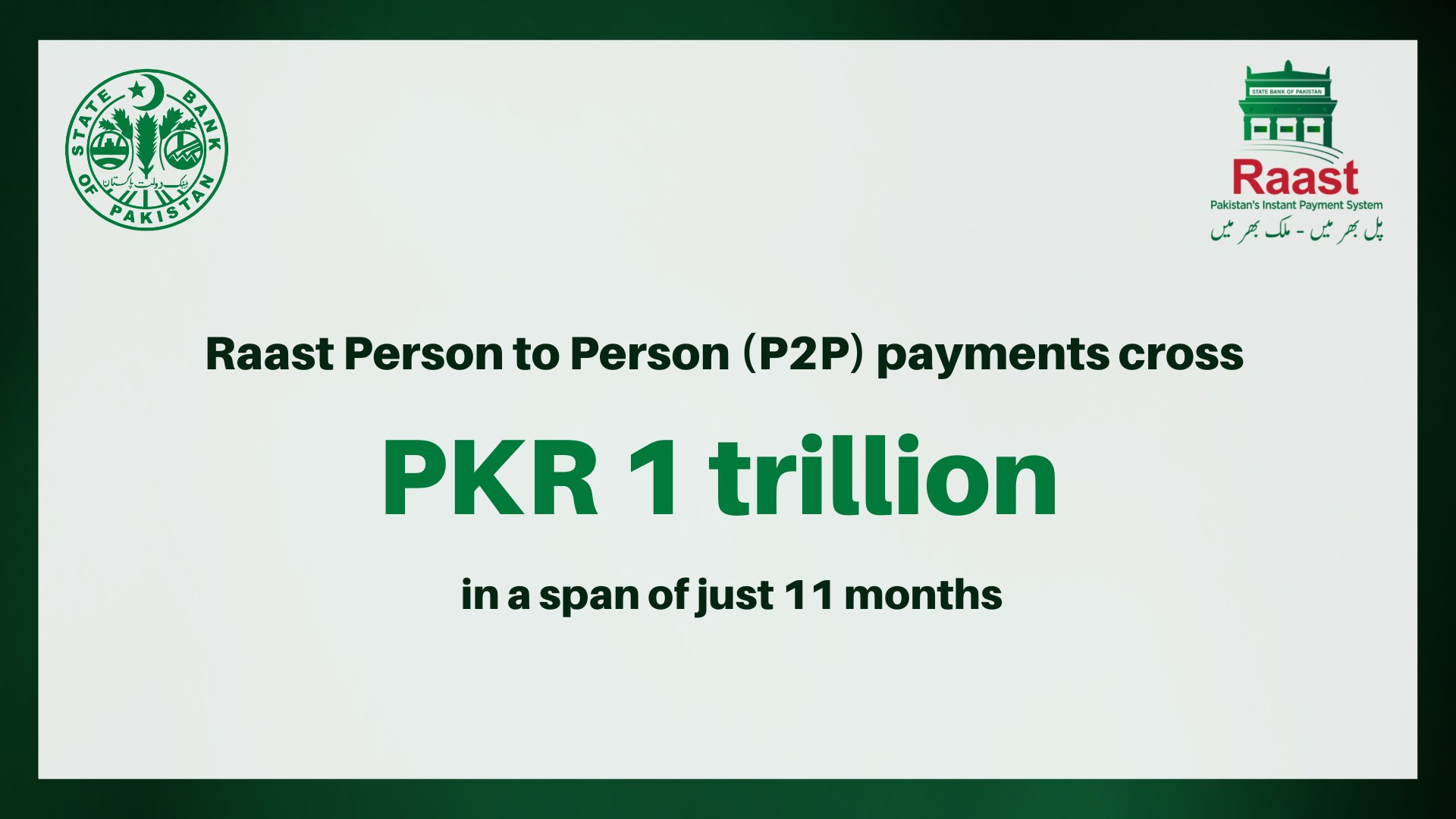
Pakistan's RAAST P2P System Taking Off. Source: State Bank of Pakistan


There's no question that India has made significant strides in digitizing payments in recent years. However, it should be noted here that Pakistan, too, is making progress in digital payments. Raast, Pakistan's P2P payments equivalent of India's UPI, has crossed Rs. one trillion mark in payments in 11 months, according to the State Bank of Pakistan.  Pakistan is also among the world's top 10 smartphone markets. 

Pakistan Among World's Top 10 Smartphone Markets. Source: NewZoo


Infrastructure: 

Younus also praised India's growing infrastructure and compared it with Pakistan's, claiming that the Pakistani infrastructure is better but it only serves the rich. He cited the example of driving time to Islamabad International Airport (serving 5 million population in the metro area) in Pakistan being much shorter than the driving time to Delhi Airport (serving 33 million+ population in the metro area) in India, claiming that it is because only the rich use the Islamabad Airport. This makes me wonder if the 5 million passengers who traveled in and out of Islamabad last year are all rich? 

Communal Harmony: 

Uzair cited the example of a Muslim peer's shrine in Rajkot being looked after by Hindus which the Indian media interpreted as "communal harmony" in its reporting. The fact is that India is ranked as the world's worst in terms of religious hostilities, particularly against Muslims, according to a Pew Survey.  Scoring a high 9.5 on a scale of 10, India’s score is found to be worse than all the South Asian countries, including Pakistan, which scores 7.7, followed by Bangladesh 7.2, Afghanistan 6.5, Burma (Myanmar). 5.9, Sri Lanka 5.6, Nepal 2.6, China 1.3 and Bhutan 0.4.


India Tops Social Hostilities. Source: Telegraph India

National Debt and Deficits: 

Uzair Younus argues that the Indian infrastructure is not built with loans while Pakistan takes on debt to build its infrastructure. It seems that the esteemed Pakistani analyst is unaware of the fact that India is the world's biggest borrower of infrastructure loans from various international financial institutions such as the World Bank, the Asian Development and the Asian Infrastructure Investment Bank. 

India's external debt to GDP ratio is about 20% while Pakistan's is 34%.  In addition, both India and Pakistan also run twin deficits: budget deficit and current account deficit (CAD). India's fiscal deficit is about 6.4% and its CAD is 3.3% of GDP. Corresponding figures for Pakistan are 7.9% and 4.6%. 

India has perennially run huge trade and budget deficits. But substantial western capital inflows since the end of the Cold War have helped India avoid a balance of payments crisis. So, India's economic success is in part due to the change in global geopolitics in this century. In short, the West, led by the United States, is boosting India to counter China. 

India is now emerging as the biggest beneficiary of the Ukraine War and the US efforts to check China's rise. Indian businesses are busting US sanctions to take advantage of the vacuum left in Russia by the exit of western businesses since the start of the Ukraine War.  At the same time, the US is rewarding India by promoting it as an alternative to China in the global supply chain.  Meanwhile, Beijing is warning New Delhi that India "will be the biggest victim" of America's "proxy war" against China. 

Women at Work:

Younus saw many women at work in Indian cities, some engaged in constructions, other riding scooters to work. He compares it to what he perceives as absence of women in the workplace in Pakistan. What he misses is the fact that the female labor participation rate in India is, in fact, lower than in Pakistan, according to the International Labor Organization data.  

Female labor force participation rate in India has recently fallen to just 19%, the second lowest after Afghanistan's 15% in the South Asia region. By contrast, Pakistan's women's labor force participation rate is 21%, Sri Lanka's 31% and Bangladesh's 35%. Prime Minister Narendra Modi's mishandling of the COVID19 pandemic has hit Indian women particularly hard, with 90% of those who lost their jobs now shut out of the workforce. 

Female Labor Force Participation Rate in South Asia. Source: World Bank


The precipitous loss of women workers is disastrous news for India's economy, which had started slowing before the COVID19 pandemic, according to a Bloomberg report. Rosa Abraham, an economics professor at Azim Premji University in Bengaluru, tracked more than 20,000 people as they navigated the labor market during the pandemic.. She found that after the first lockdown, women were several times more likely to lose their jobs than men and far less likely to recover work after restrictions were lifted. "When men are faced with this kind of a huge economic shock, then they have a fallback option," Abraham told Bloomberg. "They can navigate to different kinds of work. But for women, there is no such fallback option. They can't negotiate the labor market as effectively as men do." 

Optimism: 

Based on the small sample of people he met in India and Pakistan, Uzair concludes that people in India are very optimistic while those in Pakistan are despondent. Results of a recent Gallup International Poll of 64 nations differ from his conclusion. 

Doing Better Than Parents. Source: Gallup International

Pakistan is in the middle of multiple serious crises. But the vast majority of Pakistanis feel that they have better lives than their parents did, and they think their children will have even better lives than theirs, according to a Gallup International Poll of 64 countries conducted from August to October last year. The poll asked two questions: 1) Do you feel your life is better, worse or roughly similar to that  of your parents? and 2) Do you think your children will have a better, worse or roughly the same life as you? The answers to these questions reveal that Pakistanis are among the top 5 most positive nations among 64 countries polled by Gallup International. Anecdotal evidence in terms of packed shopping malls and restaurants in Pakistan's major cities confirms it. Such positivity augurs well for Pakistan's prospects of successfully dealing with the current crises. It will drive the nation's recovery. 

Nearly two-thirds (65%) of Pakistanis said they live better than their parents did. And 69% of Pakistani parents think their children will have better lives than they do. In neighboring India, 54% of respondents feel their lives are better than their parents' while only 43% say their children will have better lives than theirs'.  The global average for the former is 51% and it is 44% for the latter. The poll results put Pakistanis among the world's five most hopeful nations. 

Uzair Younus' Background:

Uzair talks about his family's humble beginnings in a small Gujarati village near Rajkot which he visited during his India tour. His grandparents fled to Pakistan in search of better lives. He grew up in Clifton, an upscale neighborhood of Karachi. 

In his effusive praise of the neighboring country that has twice elected Modi, Uzair completely missed the fact that Narendra Modi, now India's prime minister, is widely believed to be the perpetrator of a anti-Muslim pogrom in 2002 when he was the chief minister of Gujarat. The Muslim survivors of the 2002 massacre are still languishing near a mountain of trash on the outskirts of Ahmedabad, battling poverty and disease. Uzair Younus should have paid a visit to show solidarity with them. 

Related Links:


Wednesday, February 22, 2023

Pakistan: Startups Incubated at Karachi's NED University Got the Highest Funding in 2022

Karachi-based start-ups raised $236.7 million in 2022, accounting for two-thirds of Pakistan's total startup funding and almost double the previous year, according to Data Darbar.  Karachi, Pakistan's largest city, is followed by Lahore with $69.2 million and Islamabad with $41.6 million. Nationally, the total funds raised by startups have been declining after hitting the peak of $173 million in Q1/2022. 

City-wise Startup Funding of Pakistani Startups. Source: Data Darbar via FDI Intelligence


National Incubation Center, located at Karachi's NED University of Engineering and Technology (NEDUET), has incubated more than 250 start-ups so far.  These include ride-hailing app Bykea and London-based proptech platform Gridizen. Kamran Mahmood, the CEO of Gridizen, who recently returned to Pakistan to join NIC Karachi, says he has found it even easier to meet decision makers at large companies in Pakistan than the UK, according to a report in FDI Intelligence. “Karachi really offers the best chance for Pakistan to catch up with other start-up ecosystems,” says Rabeel Warraich, the founder and CEO of Sarmayacar, a Pakistani early stage VC fund set up in 2018. 

Since the start of 2018, the total VC funding in Pakistan soared more than 20-fold to reach an all-time high of $333m in 2022, according to Magnitt, an emerging market data platform. Most of the funding has gone to e-commerce and fintech start-ups, including Karachi-based online marketplace Bazaar Technologies, salary advance app Abhi and Lahore-based e-commerce platform Jugnu.

NIC Karachi is funded by Ignite, the country's national technology fund, and operated by LMKT, a private tech company which runs two other NICs in the cities of Hyderabad and Peshawar.  “The level of funding and support has improved a lot in recent years,” Sana Shah, the program manager at the National Incubation Center (NIC) in Pakistan's most populous city Karachi,  told FDI Intelligence. It is one of eight public-private tech innovation hubs established across Pakistan since 2016.  
Startup Funding Trend in Pakistan. Source: Data Darbar via FDI Intelligence


Across Pakistan, the total funds raised by startups have been declining since hitting the peak of $173 million in Q1/2022.  Start-ups raised just over $15m in Q4/22, the lowest figure since the first quarter of 2020 and 79% lower than the same period a year earlier, according to Data Darbar, which tracks the Pakistani start-up scene. This downward trend is at least partly due to Pakistan's current economic crisis. It also reflects a global decline in VC investments in startups. 

Related Links:


NED Alum Raises $190 Million to Challenge ARM's Dominance

Pakistan Broadband Subscriptions Pass 100 Million

NED University Ranked Among World's Top 200 For Impact

Pakistan's Computer Services Exports Jump 26% Amid Coronavirus Lockdown

Pakistan Gig Economy Among World's Fastest Growing

NED Alum Sells Silicon Valley Company For $7.5 Billion

Pakistan's Demographic Dividend

Over a Million Pakistani University Students Enrolled in STEM Education

State Bank Targets Fully Digital Economy in Pakistan

NED University Alum Raises $100 Million For His Silicon Valley Fintech Startup

Digital Pakistan: Broadband Penetration Reaches 90% of 15+ Population

E-Commerce in Pakistan

2021: A Banner Year For Pakistani Tech Startups

NED Alum's AI Startup Startup Named Most Innovative at RSA Conference

Karachi-Born NED Alum Leads Mercedes' Entry into Electric Vehicle Market

AI Research Funded by NED Alum at His Alma Mater

Riaz Haq's Youtube Channel


Wednesday, February 15, 2023

NAPA Academy: Enduring Legacy of Zia Mohyeddin and Pervez Musharraf

Veteran Pakistani performing artist Zia Mohyeddin (1931-2023) passed away this week. May his soul rest in peace. Amen. Among the most enduring legacies he has left behind is the National Academy of Performing Arts (NAPA) he helped establish in Karachi in 2005 with the support and funding provided by former President Pervez Musharraf (1943-2023). Zia Mohyeddin not only inspired generations of young Pakistanis aspiring to become performing artists, he also helped build NAPA as an institution where they are formally trained in film, television, dance, theater, music and other performing arts.  

Zia Mohyeddin (1931-2023)

Popular Pakistani actor Fawad Khan, a NAPA graduate who was inspired by Mohyeddin, told Al Jazeera the thespian’s death felt like he had lost his own father. “I don’t have enough words to express my words and sorrow at his passing. He helped me at every stage. His life was all about theatre, the all-encompassing passion he had for it. It kept him alive,” Khan said.


National Academy of Performing Arts, Karachi, Pakistan

Zia Mohyeddin was President Emeritus of NAPA at the time of his death. In 2005, he was handpicked by late President Pervez Musharraf to establish and lead a national institution for arts and music. He was trained at the Royal Academy of Dramatic Art in London. He performed in several Broadway and West End theater productions. He made his West End debut in A Passage to India as Dr. Aziz. His acting credits include roles in Lawrence of Arabia (1962), Behold the Pale Horse (1964), Bombay Talkie (1970) and The Jewel in the Crown (1984).  

In 2015, President Pervez Musharraf attended NAPA's 10th anniversary celebration of its founding. Zia Mohyeddin thanked Musharraf for founding NAPA and for selecting him to run it, according to a report in Business Recorder newspaper. "To be a part of NAPA's 10th founding anniversary is a very gratifying experience," he said. "I never imagined myself being around long enough to be a part of the celebrations, and see the seed that we planted grow into a healthy plant and about to become a tree."

Urdu monologues delivered by Zia Mohyeddin became the main draw at popular events in Pakistan and around the world.  Rekhta.org, a popular web library of Urdu poetry, has hailed them for "taking the art of recitation to unprecedented heights".  His performance at the 2011 NED Alumni Association Convention in New Jersey was the the biggest highlight of the event. My friend and fellow NED alumnus Ali Hasan Cemendtaur reported it in the Pakistan Link as follows: 

"It doesn't happen often that a thespian keeps redefining himself to remain in demand as he progresses through years.  Actors should learn from Zia Mohyeddin how to be successful at such a transformation.  Turning 80 in a couple of years, this theater and film actor of yesteryear now uses his deep theatrical voice to recite fine Urdu literature and enthrall crowds.  At the NED Convention 2011, Zia Mohyeddin did something new: besides reading masterpieces of known writers, Mohyeddin read a piece he himself authored". 

Related Links:

Haq's Musings

South Asia Investment Review

Pakistan Fashion Week

Pakistan Media Revolution

Obituary of Pervez Musharraf (1943-2023)

Pakistani Film Cake Breaks Sindhi Stereotypes

Indian Bollywood Seeks Cultural Dominance

Today's Pakistan: Conservative or Progressive?


Tuesday, November 29, 2022

Karachi Defense Expo 2022: Pakistan Military's Focus on AI, Connectivity and Drone Warfare

Pakistan displayed its latest drones at IDEAS 2022 (International Defence Exhibition and Seminar) Defense Expo held in November in Karachi. It also presented sessions on artificial intelligence (AI), machine learning (ML) and connectivity. The event attracted more than 50 countries, including large pavilions set up by Pakistan's closest friends China and Turkey.  The four-day IDEAS 2022 opened on November 15, 2022 at Karachi Expo Centre, bringing together 300 leading national and international defense manufacturers and over 300 foreign delegates from 57 countries.

Pakistan's Shahpar 2 Attack Drone

Shahpar 2 Drone:

On display at IDEAS 2022 was Shahpar-2 Medium Altitude Long Endurance (MALE) attack drone  produced by Global Industrial and Defense Solutions (GIDS), a Pakistani state-owned defense conglomerate. It can fly at a maximum speed of around 222 kilometers per hour (kph) with maximum range of around 1,050 kilometers, and the data link range of 300 kilometers. It can contact satellites in day or night operations.   

Shahpar 2 drone can locate, surveil, track and attack targets.  Its Zumr-II (EO/IR) turret is an improved and lighter version of Zumr-I (EP) turret. It can also be equipped with SAR, COMINT/ELINT payload. For sensors and targeting systems drone has an internal hard-point where it carry 50 kg (110 lb) payload. (Zumr-I weighs 36.5 kg (80 lb) while Zumr-II weighs 49 kg (108 lb)). The drone has two external hard-points where it can carry laser guided weapons, AGMs 60 kg (130 lb) each. Shapar 2 has already been inducted into service with Pakistan’s Army, Navy, and Air Force. 

Pakistan Navy's Cruise Missiles: Babur, Harba and Zarb. Source: Quwa

Also on display were advanced Harbah anti-ship cruise missiles made by Pakistan's state-owned Global Industrial and Defence Solutions (GIDS) and electronic warfare system produced by National Radio and Telecommunication Corporation (NRTC). The locally developed Al-Khalid tanks and modern assault rifles manufactured by Pakistan Ordinance Factories (POF) were also exhibited. Visitors also got a close look at the Pakistan Air Force (PAF) JF-17 Thunder fighter jets produced jointly by China and Pakistan. 

JF-17 Block III: 

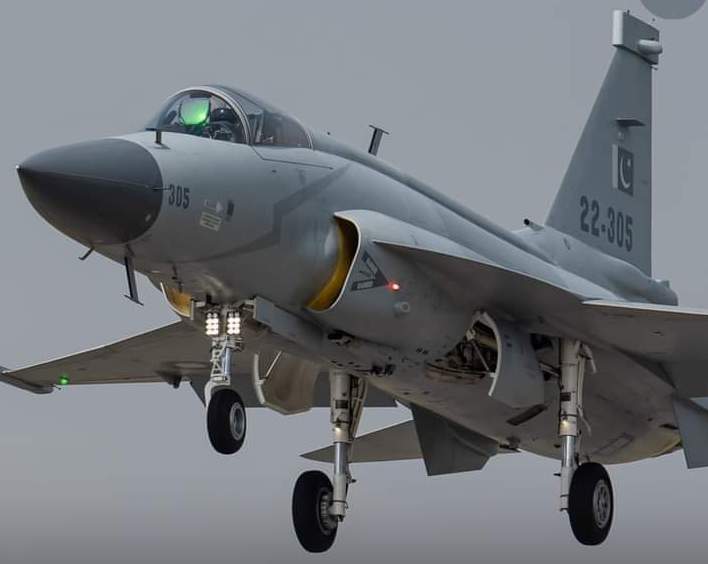
JF-Block-III is a BVR (Beyond Visual Range) multi-role fighter jet capable of firing long range air-to-air missiles like China's PL-10 and PL-15. It features active electronically scanned array (AESA) radar system, making it Pakistan Air Force’s first AESA-equipped fighter aircraft. Combination of AESA radar and 120-mile range PL-15 missiles make the JF-17 Block 3 an extremely lethal fighter for beyond visual range combat, considerably more capable than any fighter in Pakistani service including the F-16.  It also has a new electronic warfare system, upgraded avionics including a three-axis fly-by-wire digital flight control system, and a helmet-mounted display and sight (HMDS) system. With its new integrated sensor package, the aircraft will have the capability for quick information sharing and network-enabled operations that facilitate earlier detection and interception of enemy aircraft. 

Pakistan JF-17 Block 3 Fighter Jet


Chinese and Turkish Pavilions:

Pakistan’s longtime allies China and Turkey had the largest foreign presence at IDEAS 2022. Chinese state-run defense conglomerate China North Industries Group Corporation Limited (NORINCO) displayed missiles and weapon systems including the Red Arrow 9A anti-tank guided missile.  

Turkey displayed a scale model of its fifth-generation fighter, codenamed the TF-X, at Pakistan’s IDEAS expo 2022. Over two dozen Turkish defense manufacturers participated in Pakistan’s IDEAS defense expo this year. 

Top Turkish defense manufacturers, including Roketsan, state-run STM and ASFAT, showcased their products ranging from modern armed drones to tactical mini-UAV systems. Turkish Aerospace exhibited the models of the T129 ATAK helicopter, Gokbey multirole helicopter, Gokturk-2 observation satellite, as well as Anka unmanned aerial vehicle (UAV) and Aksungur medium-altitude long-range endurance (MALE) UAV.

AI and Connectivity:   

Pakistan Air Force (PAF) launched a Cognitive Electronic Warfare (CEW) program in 2020 at its Center for Artificial Intelligence and Computing (CENTAIC). Modern connected weapon systems generate vast amounts of data requiring artificial intelligence and machine learning software for speedy analysis and rapid decision-making on the battlefield.  

A seminar titled ‘Artificial Intelligence (AI) in Defence Market: A Paradigm Shift in Military Strategy and National Security’ was organized as part of IDEAS-22. Also discussed was ‘One Network’, an advanced communication project, under which 3,000 kilometers of underground fibre optic cable is being laid along the motorways in Pakistan.  

An example of connectivity and integration was demonstrated in Operation Swift Retort against India in February 2019. The success of this operation was the result of combat-proven PAF fighters which are fully integrated with the air defense system (e.g. AWACS), and are mutually data-linked, alongside all AEW (Airborne Early Warning) and ground sensors. 

Rethink After Ukraine War:

The war in Ukraine is forcing a defense strategy rethink in countries around the world. This is particularly true of  countries such as India that rely mainly on Russian equipment and training. Hindustan Times has quoted an unnamed former Indian Army Chief as saying:  “War videos available show that the Russian Army has tactical issues in Ukraine war. Tell me, which tank formation goes to war in a single file without air or infantry cover when the opponent is equipped with the best anti-tank guided missile like Javelin or Turkish Bayraktar TB2 missile firing drones? There is question on Russian air supremacy with Ukraine Army armed with shoulder fired Stinger surface to air missiles as well as the night fighting capability of the Russian Air Force.”