Showing posts with label UN. Show all posts

Wednesday, September 27, 2023

WB Poverty Update: India is the Biggest Contributor to Increased Global Poverty in 2023

At the $3.65 poverty line, India accounts for 40% of the slight upward revision of the global poverty rate from 23.6% to 24.1%, according to the World Bank September 2023 Global Poverty Update. It is the same update that made the following recent headline in the Indian and Pakistani media about Pakistan: "Pakistan's 40% Population Lives Below Poverty Line, Says World Bank". Fact: 45.9% of Indians and 39.4% of Pakistanis live below the $3.65 a day poverty line as of September, 2023, according to the the latest World Bank global poverty update that takes into account the impact of inflation on poverty rates. But neither the Pakistani media nor India's compliant "Godi Media" reported it. Nor did they question why poverty in India is growing despite the Modi government's claim to be "the world's fastest growing economy". 

Global Child Poverty Rate. Source: UNICEF


Another recent report by UNICEF that went unnoticed by the media is that the child poverty rate in India far exceeds the rate in Bangladesh and Pakistan: At $2.15 poverty level, India has 11.5% children under poverty, Pakistan 5.6% and Bangladesh 5.1%.  At $3.65 poverty level, India has 49.8% children under poverty, Pakistan 45% and Bangladesh 35.2%. 

Child Poverty Rate By Year By Region From 2013 to 2022. Source: UNICEF

The UNICEF data shows that the South Asia region's child poverty rate at $2.15 for any year since 2013 drops to about a half when India is excluded. 

The latest World Bank and UNICEF reports remind me of the famous Indian writer and poet Javed Akhtar who told his audience at a conference in Mumbai earlier this year that he saw "no visible poverty" in Lahore during his multiple visits to Pakistan over the last three decades. Responding to Indian novelist Chetan Bhagat's query about Pakistan's economic crisis at ABP's "Ideas of India Summit 2023" in Mumbai, Akhtar said: "Unlike what you see in Delhi and 

Mumbai, I did not see any visible poverty in Lahore".  This was Akhtar's first interview upon his return to India after attending "Faiz Festival" in Lahore, Pakistan. 
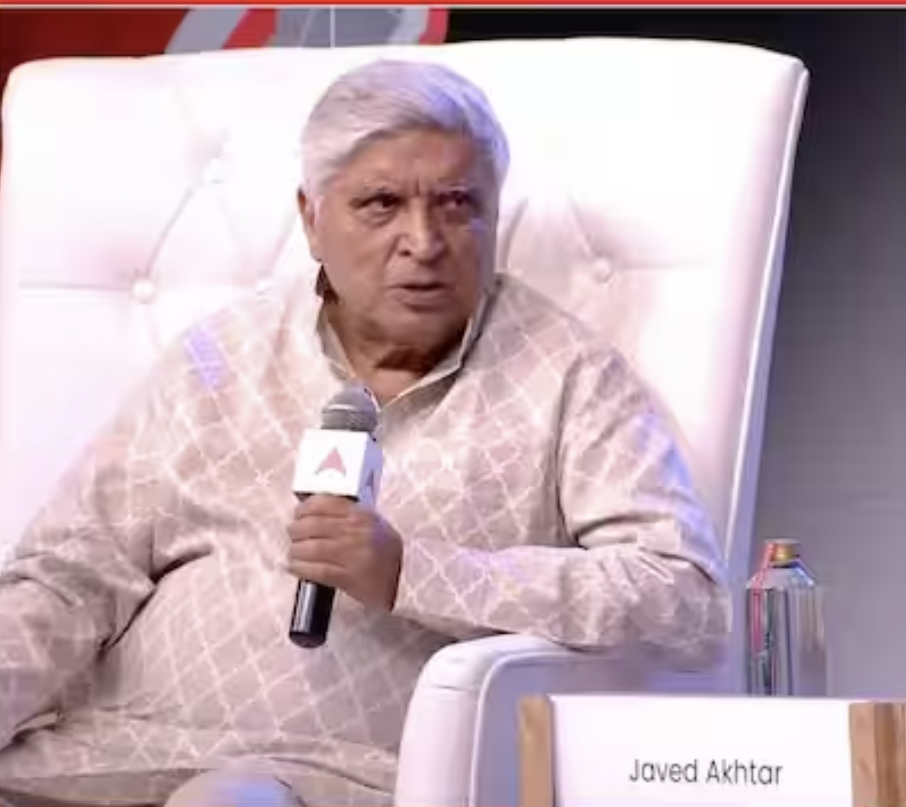
Javed Akhtar at ABP Ideas Summit in Mumbai

Chetan Bhagat began by talking about high inflation, low forex reserves and major economic crisis in Pakistan and followed it up by asking Javed Akhtar about its effects he saw on the people in Pakistan. In response, Akhtar said, "Bilkul Nahin (Not at all). In India you see poverty right in front of you, next door to a billionaire. Maybe it is kept back of the beyond. Only some people are allowed to enter certain areas. But you don't see it (poverty) on the streets. In India, it is right in front of you...amiri bhi or gharibi bhi (wealth and poverty). Sare kam apke samne hain (It's all in front of you). Wahan yeh dekhai nahin deta (you don't see it in Pakistan)". 

Alhamra Arts Center, Lahore, Pakistan

Disappointed by the response, Bhagat suggested that the Indian visitor could have been guided by his hosts through certain routes where he couldn't see any poverty. Javed Akhtar then said "it's not possible to hide poverty. I would have seen at least a "jhalak" (glimpse) of it as I always do in Delhi and Mumbai....I have been to Pakistan many times but I have not seen it". 

What Javed Akhtar saw and reported recently is obviously anecdotal evidence. But it is also supported by hard data. Over 75% of the world's poor deprived of basic living standards (nutrition, cooking fuel, sanitation and housing) live in India compared to 4.6% in Bangladesh and 4.1% in Pakistan, according to a recently released OPHI/UNDP report on multidimensional poverty.  Here's what the report says: "More than 45.5 million poor people are deprived in only these four indicators (nutrition, cooking fuel, sanitation and housing). Of those people, 34.4 million live in India, 2.1 million in Bangladesh and 1.9 million in Pakistan—making this a predominantly South Asian profile". 

Global Multidimensional Poverty Index 2022. Source: OPHI/UNDP

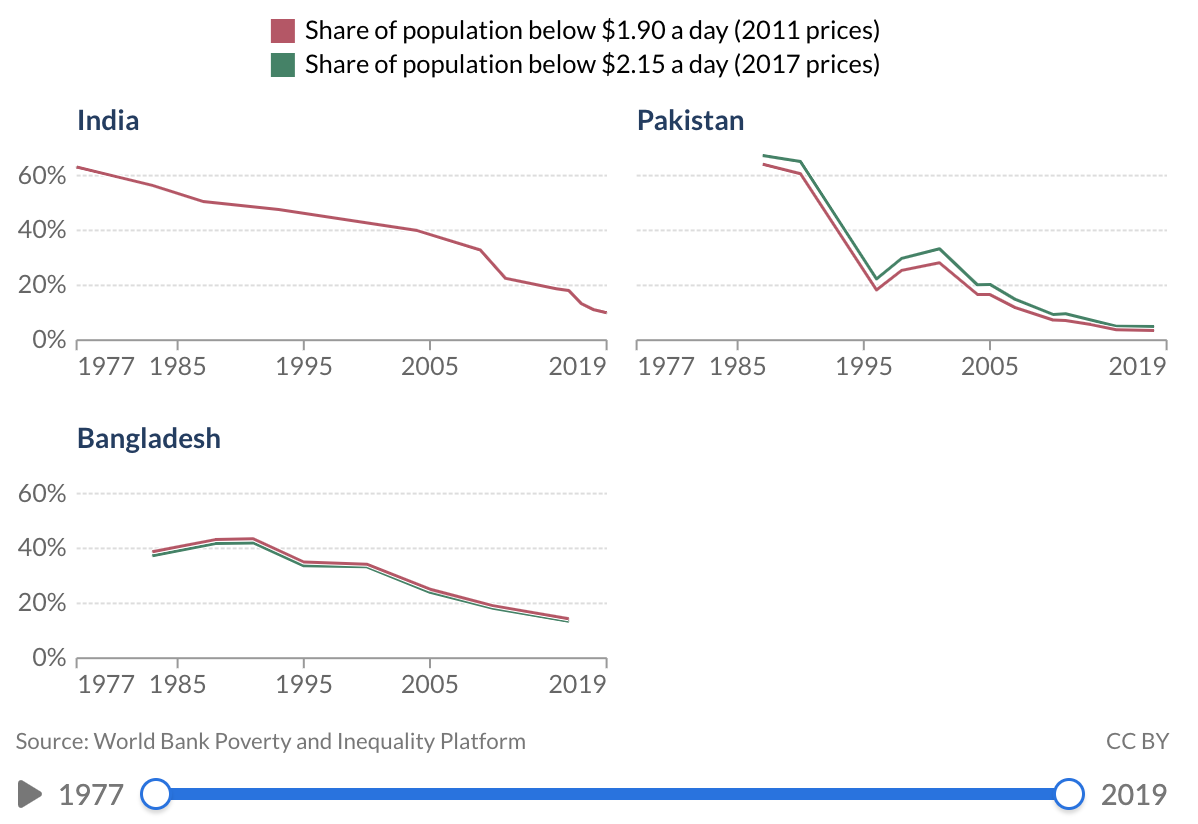
Income Poverty in Bangladesh, India and Pakistan. Source: Our World in Data


The UNDP poverty report shows that the income poverty (people living on $1.90 or less per day) in Pakistan is 3.6% while it is 22.5% in India and 14.3% in Bangladesh. In terms of the population vulnerable to multidimensional poverty, Pakistan (12.9%) does better than Bangladesh (18.2%) and India (18.7%)  However, Pakistan fares worse than India and Bangladesh in multiple dimensions of poverty. The headline multidimensional poverty (MPI) figure for Pakistan (0.198) is worse than for Bangladesh (0.104) and India (0.069). This is primarily due to the education and health deficits in Pakistan. Adults with fewer than 6 years of schooling are considered multidimensionally poor by OPHI/UNDP.  Income poverty is not included in the MPI calculations. The data used by OHP/UNDP for MPI calculation is from years 2017/18 for Pakistan and from years 2019/2021 for India. 

Multidimensional Poverty in South Asia. Source: UNDP

The Indian government's reported multidimensional poverty rate of 25.01% is much higher than the OPHI/UNDP estimate of 16.4%. NITI Ayog report released in November 2021 says: "India’s national MPI identifies 25.01 percent of the population as multidimensionally poor".
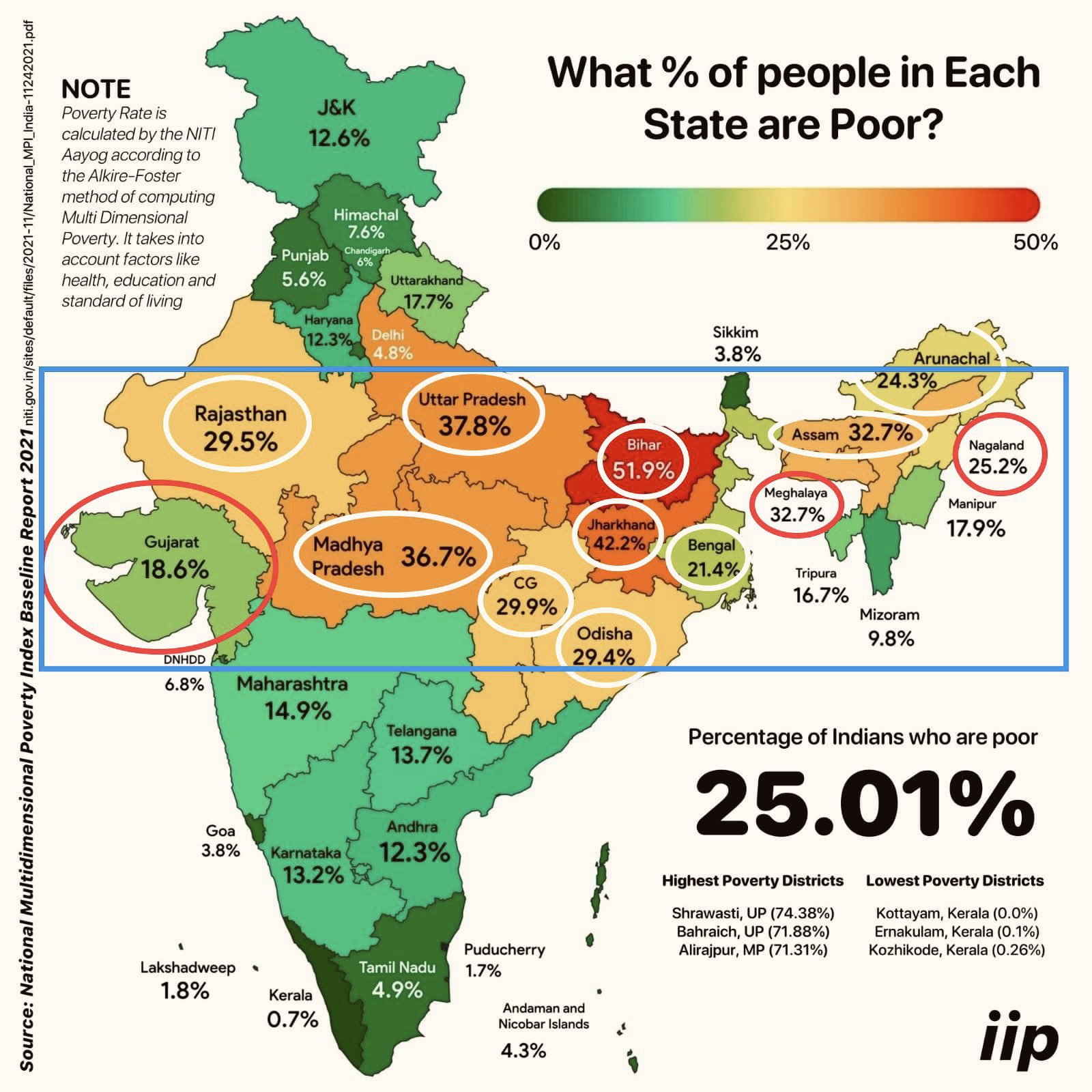
Multidimensional Poverty in India. Source: NITI Ayog via IIP

Earlier last year,  Global Hunger Index 2022 reported that  India ranks 107th for hunger among 121 nations. The nation fares worse than all of its South Asian neighbors except for war-torn Afghanistan ranked 109, according to the the report. Sri Lanka ranks 64, Nepal 81, Bangladesh 84 and Pakistan 99. India and Pakistan have levels of hunger that are considered serious. Both have slipped on the hunger charts from 2021 when India was ranked 101 and Pakistan 92. Seventeen countries, including Bosnia, China, Kuwait, Turkey and UAE, are collectively ranked between 1 and 17 for having a score of less than five.

Here's a video of Javed Akhtar's interview with Chetan Bhagat at ABP's "Ideas of India Summit 2023".  Please watch from 4:19 to 6:00 minutes. 

https://www.youtube.com/live/pZ5e81ysKGQ?feature=share


Related Links:


Haq's Musings

South Asia Investor Review

Pakistan Among World's Largest Food Producers

Pakistan Floods 2022

Food in Pakistan 2nd Cheapest in the World

India in Crisis: Unemployment and Hunger Persist After COVID

India Rising, Pakistan Collapsing

Record Number of Indians Seeking Asylum in US

Vast Majority of Pakistanis Support Imran Khan's Handling of Covid19 Crisis

Incomes of Poorest Pakistanis Growing Faster Than Their Richest Counterparts

Pakistanis Consuming More Calories, Fruits & Vegetables Per Capita 

How Grim is Pakistan's Social Sector Progress?

Pakistan Fares Marginally Better Than India On Disease Burdens

COVID Lockdown Decimates India's Middle Class

Pakistan Child Health Indicators

Pakistan's Balance of Payments Crisis

How Has India Built Large Forex Reserves Despite Perennial Trade Deficits

Riaz Haq's Youtube Channel

Wednesday, May 24, 2023

G20 Kashmir Meeting: Modi's PR Ploy Backfires!

Prime Minister Narendra Modi's campaign to show normalcy in the Indian occupied territory of Jammu and Kashmir has backfired.  Three member countries of the G20 boycotted the tourism event in Srinagar. The rest of them sent local embassy staff to attend. The event also drew negative worldwide media coverage of the brutality of India's "settler colonialism" in the disputed territory. It elicited strong condemnation from the United Nations. Prior to the event, India’s tourism secretary, Arvind Singh had promised that the meeting will not only “showcase (Kashmir’s) potential for tourism” but also “signal globally the restoration of stability and normalcy in the region.” The Modi government failed to achieve both of these objectives.

G20 Meeting in Indian Military Occupied Kashmir 


Meeting Boycott:

China, Saudi Arabia and Turkey did not attend the G20 event in Srinagar. Rest of the G20 members sent diplomats posted in New Delhi to attend it.  It's not unusual for foreign diplomats to visit disputed territories such as Jammu and Kashmir. Last year, Donald Blome, US Ambassador to Pakistan, visited what he called "Azad Jammu and Kashmir".  The G20 Tourism Working Group meeting in Kashmir drew condemnation from China and the United Nations. 

“China firmly opposes holding any form of G20 meetings on disputed territory. We will not attend such meetings,” said Chinese Foreign Ministry spokesperson  Wang Wenbin at a press briefing on May 19 in Beijing.  

Fernand de Varennes, U.N. special rapporteur on minority issues, criticized the meeting, saying that by hosting the session in Kashmir, “India is seeking to normalize what some have described as a military occupation by instrumentalizing a G20 meeting and portray an international 'seal of approval’.” 

The UN representative warned the G20 of “unwittingly providing a veneer of support to a facade of normalcy at a time when massive human rights violations, illegal and arbitrary arrests, political persecutions, restrictions and even suppression of free media and human rights defenders continue to escalate.”

Heavy Indian Security Presence at Dal Lake For G20 in Kashmir. Source: Washington Post 


International Media Coverage:

The global media coverage of the G20 meeting in Kashmir has largely been negative. It has highlighted the brutal occupation of the region by the Indian military. 

A piece in The Conversation accused India of "using the G20 summit to further its settler-colonial ambitions in Kashmir".  It pointed out that the "route to Gulmarg (G20 event location)  is lined with barbed wire. Armed soldiers keep watch from fortified bunkers".   The Conversation piece offers the following advice to anyone visiting Indian Occupied Kashmir:

"Those visiting  (Indian Occupied) Kashmir must first learn about the decolonial history of the region, one that honors Kashmiri calls for self-determination and sovereignty. They must follow the principle of do no harm by not visiting tourist sites or using tour operators run by Indian authorities. They should support local Kashmiri-run businesses as much as possible. There is no simple resolution for tourism on occupied lands. Tourism amid settler-colonialism manifests in exploitation, dispossession, commodification and other injustices and inequities. The goal of ethical travel is not immediate perfection or self-exoneration. It is an invitation to think about our own actions and complicity". 

A story in "The Guardian" noted that the G20 Kashmir meeting "required a large show of security at Srinagar international airport". It added: "India’s presidency of the G20 group of leading nations has become mired in controversy after China and Saudi Arabia boycotted a meeting staged in Kashmir, the first such gathering since India unilaterally brought Kashmir under direct control in August 2019". 

Voice of America reported that the "security moved into the background to give a sense of normalcy amid reports of mass detentions" as the event drew closer. 

Modi's Blunders:

Prime Minister Modi's PR campaign has clearly backfired. His government's actions have failed to project any sense of normalcy in the disputed region. In fact, Mr. Modi's blunders have helped internationalize the issue of Kashmir on the world stage. They have drawn China further into the Kashmir dispute, particularly in the Ladakh region where the Chinese troops have taken large chunks of what India claims as its territory. 

In an Op Ed for the Deccan Herald, Indian Journalist Bharat Bhushan has accused Modi government of "overplaying its hand in organizing a G20 event in Srinagar". He has summed up the fallout from the G20 Kashmir Meeting failure as follows:

"Prime Minister Narendra Modi’s upcoming State visit to the United States makes this rebuff on J&K by the international community, especially significant. What might have been ignored by India and perhaps down-played, at least publicly by the US, in the build-up to the Modi-Biden summit, will now become an additional irritant in the bilateral relationship. Did the Modi government bait fate by overplaying its hand in organizing a G20 event in Srinagar?"

Here's India's JNU Professor speaking about illegal Indian occupation of Kashmir, Manipur and Nagaland:

https://youtu.be/KWp1E8xrY5E


Related Links:

Haq's Musings

South Asia Investor Review

Pakistan's Bilawal Bhutto Lashes Out at India's Jaishankar

India: A Paper Elephant?

India-Pakistan Nuclear Arms Race

Kashmir: 700,000 Indian Soldiers vs 7 Million Kashmiris

Israeli Settler Colonialism

India Promotes Half Truths About UNSC Kashmir Resolutions

Pakistan-China-Russia Vs India-Japan-US

Total, Extended Lockdown in Indian Occupied Kashmir

What is India Hiding From UN Human Rights Team?

Indian JNU Professor on Illegal Indian Occupation of Kashmir, Manipur, Nagaland

Riaz Haq Youtube Channel

VPOS Youtube Channel


Friday, December 16, 2022

Pakistan FM Bilawal Bhutto Zardari Lashes Out At Indian EAM Subramanyam Jaishankar

“If the FM (foreign minister) of India (Jaishankar) was being honest, then he knows as well as I, that the RSS (India's militant Hindu organization) does not believe in Gandhi, in his ideology. They do not see this individual as the founder of India, they hero-worship the terrorist that assassinated Gandhi", said Pakistan's Foreign Minister Bilawal Bhutto Zardari at a press conference at the United Nations Headquarters in New York City. "Osama Bin Laden is dead but the butcher of Gujarat lives and he is the prime minister of India", he added. Mr. Bhutto Zardari was responding to a question from the media asked at the behest of the Indian Foreign Minister Subramanyam Jaishankar.  Earlier at the UNSC, Indian External Affairs Minister Subramanyam Jaishankar had unveiled a statue of Mohandas K. Gandhi at the UN and accused Pakistan of "hosting Osama Bin Laden". Gandhi was assassinated by Nathuram Godse, a member of the militant Hindu organization RSS. Indian Prime Minister Narendra Modi is a member of the RSS. 

Pakistan Foreign Minister Bilawal Bhutto Zardari at the United Nations Headquarters in New York

Here are some excerpts of what Bilawal Bhutto Zardari said at the media briefing at the UN:  

“He [Narendra Modi] was banned from entering this country [the United States]....these are the prime minister and foreign minister of the RSS (India's right-wing Hindu nationalist organization)....The RSS draws its inspiration from Hitler’s SS (the German Nazi Party’s militant wing Schutzstaffel)...(According to the RSS) we (Muslims) are terrorists whether we are Muslims in Pakistan and we’re terrorists whether we’re Muslims in India.....They (Modi and BJP) are not even attempting to wash the blood of the people of Gujarat off their hand..."Butcher of Gujarat” was now the “Butcher of Kashmir”". 

Last month,  the US State Department bracketed Indian Prime Minister Modi with murderous dictators like Congo's Laurent Kabila and Zimbabwe's Robert Mugabe. Speaking about the US decision to grant immunity to Saudi Crown Prince Mohammad Bin Salman, State Department spokesperson Vedant Patel said that it was “not the first time” that the US government has designated immunity to foreign leaders and listed four cases. “Some examples: President Aristide in Haiti in 1993; President Mugabe in Zimbabwe in 2001; Prime Minister Modi in India in 2014; and President Kabila in the DRC in 2018. This is a consistent practice that we have afforded to heads of state, heads of government, and foreign ministers,” he said. 

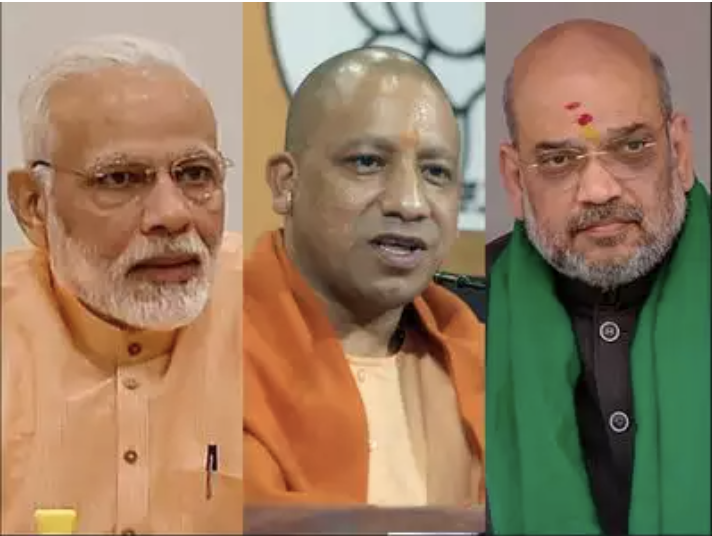
BJP HIndutva Leaders Modi, Yogi and Shah

Prime Minister Narendra Modi of India was barred from entering the United States from 2005 to 2014 for his involvement in the massacre of thousands of Muslims in Gujarat in 2002.  In 2015, a US judge dismissed a lawsuit against Modi after the US government argued that he is immune to accusations as a sitting head of government. While Modi has denied any involvement in the Gujarat anti-Muslim pogrom, he has never even expressed any regret over the killings in Gujarat when he was the Chief Minister of the Indian state. 

While Modi has refused to accept any responsibility for the massacre of over 2,000 Muslims in Gujarat in 2002, his party BJP's leaders have not shied away from claiming "credit" for it. Just yesterday, Modi's right-hand man and current Home Minister Amit Shah said Muslims were "taught a lesson" in 2002. He said that "after they were taught a lesson in 2002, these elements left that path (of violence). They refrained from indulging in violence from 2002 till 2022. BJP has established permanent peace in Gujarat by taking strict action against those who used to indulge in communal violence". 

In 2002 when Narendra Modi was chief minister of the Indian state of Gujarat, hundreds of young Muslim girls were sexually assaulted, tortured and killed.  These rapes were condoned by the ruling BJP, whose refusal to intervene lead to the rape and killing of thousands and displacement of 200,000 Muslims.

In 2012, a former Chief Minister of Gujarat Mr. Shankersinh Vaghela accused Modi's state government of having blood on its hand: "2002 me jo katl-e-aam hua uspe wo sarkar bani hai. Iske baad encounter hui, uske upar ye sarkar bani thi. Sarkar banti hai, lekin ye jo conspiracy karke sarkar banana hai, ye Gujarat aur desh ki janata jaanti hai aur aaj wo repeat nah o, iske liye hum janata ko request karte hain (The foundation of this (Modi) government rests on the 2002 carnage. Governments are made, but not on conspiracies. And the people of Gujarat know this, and that's why we are requesting the people for a change)," Mr Vaghela said.

Since his election to India's top elected office, Modi has elevated fellow right-wing Hindu extremists to positions of power in India. Yogi Adiyanath, known for his highly inflammatory anti-Muslim rhetoric, was hand-picked in 2016 by Modi to head India's most populous state of Uttar Pradesh.

Adiyanath's supporters brag about digging up Muslim women from their graves and raping them. In a video uploaded in 2014,  he said, “If [Muslims] take one Hindu girl, we’ll take 100 Muslim girls. If they kill one Hindu, we’ll kill 100 Muslims.”

Yogi wants to "install statues of Goddess Gauri, Ganesh and Nandi in every mosque”.  Before his election, he said, “If one Hindu is killed, we won’t go to the police, we’ll kill 10 Muslims”.  He endorsed the beef lynching of Indian Muslim Mohammad Akhlaque and demanded that the victim's family be charged with cow slaughter.

Madhav S. Golwalkar, considered among the founders of the Hindu Nationalist movement in India, saw Islam and Muslims as enemies. He said: “Ever since that evil day, when Moslems first landed in Hindusthan, right up to the present moment, the Hindu Nation has been gallantly fighting to shake off the despoilers".

In his book We, MS Golwalkar wrote the following in praise of what Nazi leader Adolf Hitler did to Jews as a model for what Hindus should do to Muslims in India: "To keep up the purity of the Race and its culture, Germany shocked the world by her purging the country of the Semitic races -- the Jews. Race pride at its highest has been manifested here. Germany has also shown how well-nigh impossible it is for races and cultures, having differences going to the root, to be assimilated into one united whole, a good lesson for us in Hindusthan to learn and profit by."

Paul Richard Brass, professor emeritus of political science and international relations at the Henry M. Jackson School of International Studies, University of Washington, has spent many years researching communal riots in India. He has debunked all the action-reaction theories promoted by Hindu Nationalists like Modi. He believes these are not spontaneous but planned and staged as "a grisly form of dramatic production" by well-known perpetrators from the Sangh Parivar of which Prime Minister Modi has been a member since his youth.

Here's an excerpt of Professor Brass's work:

"Events labelled “Hindu-Muslim riots” have been recurring features in India for three-quarters of a century or more. In northern and western India, especially, there are numerous cities and town in which riots have become endemic. In such places, riots have, in effect, become a grisly form of dramatic production in which there are three phases: preparation/rehearsal, activation/enactment, and explanation/interpretation. In these sites of endemic riot production, preparation and rehearsal are continuous activities. Activation or enactment of a large-scale riot takes place under particular circumstances, most notably in a context of intense political mobilization or electoral competition in which riots are precipitated as a device to consolidate the support of ethnic, religious, or other culturally marked groups by emphasizing the need for solidarity in face of the rival communal group. The third phase follows after the violence in a broader struggle to control the explanation or interpretation of the causes of the violence. In this phase, many other elements in society become involved, including journalists, politicians, social scientists, and public opinion generally. At first, multiple narratives vie for primacy in controlling the explanation of violence. On the one hand, the predominant social forces attempt to insert an explanatory narrative into the prevailing discourse of order, while others seek to establish a new consensual hegemony that upsets existing power relations, that is, those which accept the violence as spontaneous, religious, mass-based, unpredictable, and impossible to prevent or control fully. This third phase is also marked by a process of blame displacement in which social scientists themselves become implicated, a process that fails to isolate effectively those most responsible for the production of violence, and instead diffuses blame widely, blurring responsibility, and thereby contributing to the perpetuation of violent productions in future, as well as the order that sustains them."

"In India, all this takes place within a discourse of Hindu-Muslim hostility that denies the deliberate and purposive character of the violence by attributing it to the spontaneous reactions of ordinary Hindus and Muslims, locked in a web of mutual antagonisms said to have a long history. In the meantime, in post-Independence India, what are labelled Hindu-Muslim riots have more often than not been turned into pogroms and massacres of Muslims, in which few Hindus are killed. In fact, in sites of endemic rioting, there exist what I have called “institutionalized riot systems,” in which the organizations of militant Hindu nationalism are deeply implicated. Further, in these sites, persons can be identified, who play specific roles in the preparation, enactment, and explanation of riots after the fact. Especially important are what I call the “fire tenders,” who keep Hindu-Muslim tensions alive through various inflammatory and inciting acts; “conversion specialists,” who lead and address mobs of potential rioters and give a signal to indicate if and when violence should commence; criminals and the poorest elements in society, recruited and rewarded for enacting the violence; and politicians and the vernacular media who, during the violence, and in its aftermath, draw attention away from the perpetrators of the violence by attributing it to the actions."

Related Links:


Wednesday, September 14, 2016

Kashmir: What is India Hiding From UN Human Rights Team?

“Efforts to duck or refuse legitimate scrutiny raise an obvious question: What, precisely, are you hiding from us?....States may shut my office out, but they will not shut us up. Neither will they blind us.”   Zeid Ra’ad al-Hussein, the high commissioner for human rights at the United Nations, to India, as quoted by New York Times.

Indian Soldiers Assaulting Kashmiri Protesters Raising Pakistani Flag
Why is India refusing entry to UN Human Rights team in Indian-Occupied Kashmir? What is the Modi government hiding? Let's try and understand the answers to these question.

Armed Forces Special Powers Act:

When India's founding father Mohandas Gandhi started "Quit India" movement to seek India's independence from Britain, the colonial rulers of British India responded by imposing "The Armed Forces Special Powers Ordinance of 1942" on August 15, 1942.

After independence in 1947, the Indian government has made extensive use of the same colonial-era British law to crush legitimate demands for freedom by the peoples of Assam, Manipur, Kashmir and other regions. The Act has now been in force in Kashmir for 26 years.

While Indian government claims Kashmir as an integral part of India, it undermines its own claim by denying fundamental rights to Kashmiris, the rights that are granted by the Indian constitution to all Indian citizens.

Basic Rights Denied:

Not only is the Indian government denying the right of self-determination granted to Kashmiris by multiple UN Security Council Resolutions, New Delhi is also reneging on the commitments made by India's founder and first prime minister Jawaharlal Nehru to Kashmiris and the international community.

Indian Prime Minister Jawaharlal Nehru's Pledge

India is deploying 700,000 troops with extraordinary powers to detain, torture, blind, injure and kill any Kashmiri citizen with impunity under Armed Forces (Jammu and Kashmir) Special Powers Act 1990.

Deaths and Injuries:

In the latest Kashmir uprising triggered by the July 8 murder of young Kashmiri activist Burhan Wani by Indian military,  hundreds of protesters have been killed and thousands more injured in peaceful protests.

The extensive use pellet guns by Indian soldiers has blinded hundreds of young men and women, even children, during the current wave of mass protests.

Prior to casualties this latest round of protests, there have tens of thousands of civilians killed and hundreds of thousands injured by Indian military in Kashmir. Thousands of bodies have been found in mass graves in Bandipora, Baramulla, and Kupwara districts in Kashmir, according to The Hindu.

Kashmir Mass Graves:

Dr. Angana Chatterji, a professor of cultural and social anthropology at California Centre for Integral Studies who uncovered the mass graves, reported as follows:  “Of the 2700 graves, 2,373 (87.9 percent) were unnamed. 154 graves contained two bodies each and 23 contained more than two cadavers. Within these 23 graves, the number of bodies ranged from 3 to 17."

Scholars, she said, refer to mass graves as resulting from Crimes Against Humanity, War Crimes, or Genocide. “If the intent of a mass grave is to execute death with impunity, with intent to kill more than one, and to forge an unremitting representation of death, then, to that extent, the graves in Bandipora, Baramulla, and Kupwara are part of a collective burial by India’s military and paramilitary, creating a landscape of ‘mass burial.’

Dr. Chatterji said post-death, the bodies of the victims were routinely handled by military and paramilitary personnel, including the local police. She said that the bodies were then brought to “secret graveyards” primarily by personnel of the State Police.

The International Peoples' Tribunal on Human Rights and Justice, an independent group headed by Dr. Chatterji, alleged that the violence and militarization in Kashmir, between 1989-2009, have resulted in over 70,000 deaths, including through extrajudicial or “fake encounter” executions, custodial brutality, and other means. “In the enduring conflict, 6, 67,000 military and paramilitary personnel continue to act with impunity to regulate movement, law, and order across Kashmir,” she added.

Indian University Student Protest:

Many enlightened Indians like the Jawaharlal Nehru University students see the brutality and futility of Indian military occupation of Kashmir. At protests earlier this year, many chanted slogans in favor of Azadi for Kashmiris.  "Geelani bole azaadi, Afzal bole azaadi, jo tum na doge azaadi, toh chheen ke lenge azadi! (Geelani and Afzal demanded freedom. If freedom is denied, we will snatch it!)".

New Generation in Revolt: 

During the 26 years of Kashmir under Armed Forces Special Powers Act, an entire new generation of Kashmiris has grown up. This generation, represented by tech-savvy youngsters like Burhan Wani, has seen nothing but repression and violence committed by the Indian military against their people. They are more determined than ever to defy and defeat the illegal and immoral military occupation of their land by India.

Summary:

The use of brute force by 700,000 Indian troops over the last 26 years to crush the legitimate aspirations of millions of Kashmiris is backfiring.  The more Kashmiris Indian military detains, tortures, injures, blinds and kills under Armed Forces Special Powers Act, the less sustainable is its hold on the territory.  It is only a matter of time before India is forced to withdraw its troops and agree to let Kashmiris decide their own fate.


https://youtu.be/oKouqpQjEcg


Here's another video discussion on the subject:


https://www.youtube.com/watch?v=W_VAqyClS-0


https://vimeo.com/182288648

Did India beat Pakistan in the 1965 war from Ikolachi on Vimeo.

Related Links:

Haq's Musings

1965 India-Pakistan War

2016 Kashmir Uprising

Kashmir in Context

Arundhati Roy on Indian Military Occupation of Kashmir

JNU Anti-Modi Protests

Thursday, September 12, 2013

Pakistan Happiness Score Down But Still Tops Neighbors

Pakistan ranks 81 with a score of 5.292 on a list 156 countries in World Happiness Report 2013 released by UN Sustainable Development Solutions Network. The average score for all of the countries surveyed is 5.1 out of 10.

On a scale of 0 to 10, people in 156 countries, surveyed by Gallup over the period 2010-12, reveal a population-weighted average score of 5.1 (out of 10). Six key variables explain three-quarters of the variation in annual national average scores over time and among countries. These six factors include: real GDP per capita, healthy life expectancy, having someone to count on, perceived freedom to make life choices, freedom from corruption, and generosity.

Pakistan's score of 5.292 (ranked 81) puts it slightly above average (5.1).  It is higher than China's 4.978 (ranked 93), Bangladesh's 4.804 (ranked 108) and India's 4.772 (ranked 111). Denmark tops the list with a score of 7.693 while Togo is at the bottom with a score of 2.936. The top 10 countries ranked for happiness include Denmark (#1), Norway (#2), Switzerland (#3), Netherlands (#4), Sweden (#5), Canada (#6), Finland (#7), Austria (#8), Iceland (#9) and Australia (#10). UAE is ranked #14, USA #17 and UK #22.

Though Pakistan's happiness score (5.292) is down by 0.214 since the end of Musharraf years in 2008, it has not been affected as much as some of the other strife-torn nations like Syria ranking near the bottom at 148 (3.892), along with other countries including Iraq (105), Iran (115) and Afghanistan (143). India (111) lost 0.382 points off its happiness score during this period.

Among people with improved quality of life are those in Latin America and the Caribbean, while decrease in levels of happiness is seen in Western Europe, the Middle East and North African countries affected by the financial crisis and political and social instability. Other major countries surveyed include Brazil (24), France (No. 25), Germany (No. 26), Japan (No. 43), Italy (No. 45) and Russia (No. 68).

The measured decrease of 0.214 in Pakistan's happiness score since 2008 appears to be the result of economic stagnation, energy shortages, growing corruption and declining sense of security. It has already led to a massive defeat of the ruling Pakistan People's Party in the elections held in May of this year. Would the decrease of 0.382 in India's happiness score since 2008 lead to the ouster of India's ruling Congress party in next year's elections? Let's wait and see.

Related Links:

Haq's Musings

Pakistan Elections 2013 Results

Pakistan's Rural Economy

Political Patronage Trumps Public Policy in Pakistan

Dr. Ata-ur-Rehman Defends Pakistan's Higher Education Reforms

Twelve Years Since Musharraf's Coup

Musharraf's Legacy

Pakistan's Economic Performance 2008-2010

Resilient Pakistan Defies Doomsayers

Agriculture, Textiles Employ Most Indians and Pakistanis

New Index Finds Indians Poorer Than Africans, Pakistanis

Pakistan's Exports and Remittances Rise to New Highs

Sugar Crisis in Pakistan

Agricultural Growth in India, Pakistan and Bangladesh

Pakistanis Happier Than Neighbors


Sunday, July 21, 2013

Malala Day Missed Opportunity; Supreme Court Rejects Drones Plea

Discussion at Viewpoint from Overseas focused on two events last week: 1. Malala Day at the United Nations and 2. Pakistani Supreme Court's refusal to hear a petition against US drone strikes in FATA.

1. Malala Day:

Malala Day was celebrated at the United Nations at which Pakistani teenage schoolgirl Malala Yousufzai made a passionate appeal to the world to fully support girls' education in Pakistan and around the world. Pakistani leadership was conspicuously absent from this important event.

The vacuum left by the top political leadership of Pakistan was unfortunately filled by the Taliban sympathizers who spun various conspiracy theories to blame foreigners, particularly the West, for all of Pakistan's problems. While she was still speaking at the U.N., her detractors in Pakistani social media were denouncing her as a “CIA agent" or claiming that her wounds had been “faked.” There were those who said she had not been hurt at all, while others were suspicious of her global fame. The messages were in the thousands.

 Malala Day is a missed opportunity for Pakistani leaders to focus the attention of the people of Pakistan on two very important issues they face: the extremely serious threat of terrorism and the denial of education to girls in the country, particularly in western provinces of Khyber Pukhtunkhwa ruled by Imran Khan's Pakistan Tehreek-e-Insaf and Balochistan ruled by Nawaz Sharif's PML(N).

2. US Drones:

Pakistani Supreme Court refused to hear a petition seeking an order to declare US drone strikes in FATA illegal. The rejection was based on technical grounds. The Court said that “under Article 247 (7) of the constitution, neither the Supreme Court nor a high court shall exercise any jurisdiction in relation to tribal area, unless (Parliament) by law otherwise provides.”

This court has not hesitated to hear petitions based on such technical grounds in the past. Pakistan's High Treason Act, for example, clearly states that “No court shall take cognizance of an offense punishable under this act except upon a complaint in writing made by a person authorized by the Federal Government in this behalf.” But this language did not stop the Supreme Court judges from hearing a petition against Pervez Musharraf earlier this year.

It appears that there is more to the Supreme Court's rejection of petition against drones than meets the eye. Could it be that the Supreme Court judges, like many others in Pakistan, know that drone strikes are the only effective means of checking the TTP today?

Watch the following video for more on the above subjects:

http://vimeo.com/70684175


Pakistan's Reaction to UN Malala Day; Supreme Court Rejects Drone Plea from WBT TV on Vimeo.

Related Links:

Haq's Musings

UN Malala Day

Treason Trial of Musharraf

Does Sharif Have an Anti-Terror Policy?

Blowback of US Drones in Pakistan

Why is Democracy Failing in Pakistan?

Viewpoint From Overseas-Vimeo 

Viewpoint From Overseas-Youtube


Wednesday, December 10, 2008

Anti-Corruption Day, Blagojevich and Zardari


When Barack Obama was elected president, Governor Blagojevich of Illinois saw opportunity in the vacancy created in the U.S. Senate. "I've got this thing and it's f------ golden, and uh, uh, I'm just not giving it up for f------ nothing," he allegedly said, according to U.S. Atty. Patrick Fitzgerald of Chicago. Fitzgerald has the governor's recorded conversations demanding $500,000 to a million dollars to sell the senate seat.

How ironic! The governor of a major American state that is sending its senator to the White House as president got charged with massive corruption on Dec 9, 2008, the day designated as International Anti-Corruption Day by the United Nations.

This latest corruption scandal in the United States confirms that corruption exists in all parts of the world to varying degrees, including the industrialized world. However, this report also illustrates that, unlike Pakistan and many other less developed countries, there is greater accountability in the West for the people in power. Official corruption is almost universal but the extent of corruption and the strength of anti-corruption enforcement measures vary widely. It is not the constitution or the laws on the books that make a difference; it's the independence of the career civil servants and the judiciary that differentiates the US system from what is observed in Pakistan and other developing nations. The US attorneys, for example, pursue investigations and prosecutions independently of the politicians who appoint them. The judges are appointed for life and they do not take dictation from politicians and their appointees either.

At the time of the recent India-US nuclear deal approval, members of India's parliament, including convicts released on parole, were offered all kinds of incentives to vote in a certain way. Both the government and the opposition tried desperately to entice them with promises of largess, influence and plum jobs in return for their vote. The BJP opposition, however, could not match the resources of the governing Congress party and the deal was approved.

There have been significant bribery allegations involving Indian politicians and officials and corporations such as Bofors, Enron and Xerox. The Swedish firm Bofors AB allegedly paid Rs.640 million ($13 million) in bribes to middlemen to get the contracts for the deal signed in 1986. Nearly a decade later, Enron India spent US$ 20 million in "educating" Indian bureaucrats about the role of private companies in power generation, an euphemism for bribes. Two telecommunications companies, Essar and Swisscom, were alleged to have paid a former minister, Sukh Ram, a hefty amount during early 1996 to help change the original license conditions, which it had signed with the Department of Telecommunications. Except Bofors, none have been prosecuted to any extent. Meanwhile, India's spending on defense procurement and infrastructure spending involving foreign companies has increased several fold without much scrutiny of how the deals are made.

Not only is there lack of accountability in the developing nations, it seems that corrupt politicians such as Pakistan's President Zardari, widely known as Mr. Ten Percent, get rewarded with high offices by the illiterate electorate living in a feudal society, with the assistance of amnesties arranged by the United States. It is what President Bush often describes as "soft bigotry of low expectations" when the West pushes for the pardon of corrupt politicians in countries such as Pakistan, in clear violation of the UN Conventions against Corruption. What is worse, such policies of condoning corruption are pursued in the name of promoting democracy in the third world.

The behavior of condoning corruption in the third world extends to the private sector as well, with American and European companies routinely engaging in bribery in Africa, Middle East and Asia. For example, Forbes reported last year on Siemens involvement in bribery in the developing world as follows: "The World Bank is looking at an electrical power plant project in Pakistan concluded in the mid-1990s, which was built and later partially maintained by Siemens and financed by the World Bank. The World Bank is concerned that Siemens' costs for the project may have been overpriced.Siemens is currently engulfed in a slush-fund scandal, in which prosecutors allege that managers siphoned off hundreds of millions of euros in company money to obtain foreign contracts.Siemens' own internal investigation uncovered 420 mln euros in suspicious payments going back to 1999 which may have been made to obtain telecommunications equipment contracts in a range of foreign countries. The Bavarian State Prosecutors office has said the sum is estimated in the triple-digit millions of euros." Subsequent to these reports, Daniel Noa, Siemens' top anti-corruption chief, stepped down after only six months at the company, with little explanation given.

There have also been reports from Munich about Siemens pleading guilty to bribing politicians and officials in Nigeria, Russia and Libya. Last month, Siemens said it would take a charge of about 1 billion euros ($1.29 billion) this fiscal year as part of a settlement of bribery investigations by authorities in Germany and the United States.I believe such reports represent only the tip of the iceberg of corruption involving Western multi-nationals and politicians and officials in developing nations.

There are definitely laws on the books in the West such as the Foreign Corrupt Practices Act (FCPA) in the United States. Almost all ethics classes taught in the Western management schools and company training courses cover this topic. However, the question is whether these laws are really enforced and how often are the companies held accountable? Or do they simply rely on the foreign governments to report misbehavior? It would be a fantasy to expect the officials and politicians on the receiving end to report incidents of bribery as they are the main beneficiaries. But I think the German, French, US, British and other governments of developed nations who claim higher moral positions should be cracking down on these reprehensible practices just to enforce their own laws and live up to their own higher standards. While it may be argued and it is like putting the shoe on the wrong foot, I see it as the only hope we have of containing such widespread corruption in developing nations that is robbing their people blind.

Here's a video clip on global corruption by US corporations:


Related Links:

Bhutto Convicted in Switzerland

Corruption in Pakistan

Transparency International Survey 2007

Is Siemens Guilty?

Zardari Corruption Probe

Thursday, October 2, 2008

UN Millennium Goals in Pakistani Village


"We need a hospital," one man said, "and a school for girls. If something could be done about the drinking water, we'd be grateful."

"One day it's diarrhea, the next day it's fever, the next day, vomiting" said a village woman, speaking about her children.

These villagers reluctantly spoke to their feudal prince of Ratrian, a poor village in north of Pakistan, highlighted by TVE and BBC recently. The young prince is Rafeh Malik, the son of the feudal lord Malik Atta Mohammad, whose family's vast land holdings include this village. The prince took the initiative to ask for his villagers' opinions about what needs to be done to improve their lives.

Apparently, Prince Rafeh Malik has been influenced by the United Nations Millennial Development Goals (MDGs) and he wants to try and implement them within his domain. He has taken the initiative by convincing his father that it must be done.

Here's a brief overview of the UN MDGs:

1 Eradicate extreme poverty and hunger
2 Achieve universal primary education
3 Promote gender equality and empower women
4 Reduce child mortality
5 Improve maternal health
6 Combat HIV/Aids, malaria, and other diseases
7 Ensure environmental sustainability
8 Develop a global partnership for development

These goals can not be achieved by governments alone. In spite of Pakistani government's efforts and international assistance, Pakistan does not have a lot to show in terms of real progress toward UN MDGs. Ranked at 136 on a list of 177 countries, Pakistan's human development ranking remains very low. Particularly alarming is the low primary school enrollment for girls which stands at about 30% in rural areas, where the majority of Pakistanis live. In fact, the South Asia average of primary school enrollment is pulled down by Pakistan, the only country in all of Asia and the Pacific with the lowest primary enrollment rate of 70 per cent in 2005. This is 12 percentage points lower than that of Maldives, which, at 80 per cent, has the second lowest rate in Asia and the Pacific. However, whereas Pakistan is rapidly reducing the proportion of children out of primary school - the net enrollment rate was just 60 per cent in 2003 - the rate in Maldives actually dropped 18 percentage points between 1999 and 2005.

The government effort is necessary but the real success will require active participation of private Pakistani citizens of all classes in society. People, including young, educated and enlightened feudal princes, need to come together to light candles rather than curse darkness.

The mission that Rafeh Malik has embarked on is an extremely welcome and necessary effort to change the feudal attitudes toward the poor in Pakistan. There are obviously risks and fears associated with any change. But Rafeh Malik's work should be an inspiration to other young men and women of the feudal class in Pakistan. "I am scared," Rafeh told his friend Shehryar Mufti, a Dawn TV journalist, "but I'm willing to take the risk."

Let's hope Rafeh Malik, and others like him, succeed in bringing about peaceful and positive changes in Pakistani feudal-tribal society that will ultimately benefit all Pakistanis, including the villagers, the middle class and the feudal and tribal chiefs. It has been shown in many developed nations that peaceful transitions from traditional feudal societies to modern democratic, successful, industrialized societies have brought wealth, peace and prosperity for all. The children of the feudal lords in Europe benefited from better education and lucrative business investments to remain rich and powerful, without keeping their people impoverished and illiterate. The transitions were clearly win-win situations for both the rulers and the ruled. The alternatives to peaceful transitions will be far worse for the big zamindars and sardars in Pakistan. Resistance to change by of the feudal-tribal leaders will prove dangerous and futile over the long run.

Related Links:

Light a Candle, Do Not Curse Darkness

BBC News

Lifeline

United Nations Report on School Enrollment

Volunteerism in Pakistan