Showing posts with label Balochistan. Show all posts

Monday, April 28, 2025

Pahalgam Attack: Why is the Indian Media Not Asking Hard Questions?

A recent terrorist attack on April 22 in Kashmir has killed 26 Indian tourists. Prime Minister Narendra Modi's Hindu Nationalist government took no time to blame Pakistan for the attack and vowed to "punish" the neighbor for it. Indian media, also derisively known as "Godi media", immediately went into overdrive to demand action against Pakistan. New Delhi followed up with suspending the Indus Basin Water treaty from the 1960s which guarantees 80% of the water from the three western rivers (Chenab, Jhelum and Indus rivers) to Pakistan, while India gets the exclusive use of the water from three eastern rivers (Beas, Ravi and Sutlej rivers). India also ordered Pakistani visitors to leave the country and reduced Pakistani diplomatic staff posted in India. Pakistan responded by suspending Simla Agreement and banning overflights of Indian civilian and military aircraft through its airspace. Pakistan warned India that any attempt to block its share of water from the three western rivers will be an "act of war", adding that it was prepared to respond, “with full force across the complete spectrum of national power”. Pakistan is a nuclear-armed country, as is India. Pakistan's nuclear doctrine calls for the use of nuclear weapons if its national existence is threatened by any country. 

Shankaracharya Swami Avimukteshwaranand Saraswati


The Indian mainstream media has amplified the Modi government's propaganda and abandoned its role of asking the hard questions to get at the truth. Among the few who have raised serious doubts about Delhi's  narrative is a Hindu religious leader named Shankaracharya Swami Avimukteshwaranand Saraswati. In a viral video, the holy man has asked the following questions:

1. Shouldn't our "chowkidar"  (Modi has called himself  chowkidar in the past) be held accountable for any attacks on our home? 

2. How did the attackers manage to come in, carry out the attack without any resistance and safely escape?

3. How did you so quickly determine that the attackers came from Pakistan? And if you are so good at reaching this conclusion so quickly, why were you unable to stop the attack in the first place. 

4. Can India really cut off water flow instantly to Pakistan to "punish" it? Experts say it will take at least 20 years if India allocated unlimited funds to make it happen as fast as possible. It will require building dams, water reservoirs and canals to divert the water from Pakistan. 

Pakistani journalist Najam Sethi sees the hand of "Indian deep state" at work in Pahalgam, carried out while the US Vice President JD Vance in India. Sethi recalls what former American Secretary of State Madeleine Albright wrote in her memoirs titled "Mighty Almighty" about the killing of 35 Sikh villagers in Kashmir that India blamed on Pakistan during US President Bill Clinton's India visit in March, 2000. She said Clinton suspected the hand of Hindu extremists in the Chittisinghpura incident. She quoted him saying that if he hadn’t made the trip, the victims would have still been alive. 

Among the Indian journalists, only Bharat Bhushan has raised some questions about his country's government narrative. He thinks India violated the back-channel agreement between Modi's NSA Ajit Doval and Pakistan's then NSA Moeed Yusuf reached after 2019 to spare the civilians on both sides in any proxy attacks. Bhushan points out a warning from Lt General Ahmad Sharif that “the (Jaafar Express) train attack (in Balochistan) has changed the rule of the game”. 

Bhushan's op ed mentions Modi's muscular policy toward people he sees as "terrorists".  Canada, Pakistan and the United States have all accused the Indian government of a campaign of international assassinations. He writes: "Another development has been the targeted killings of terrorists and militants — both Kashmir and Sikhs, that Pakistan alleges have been initiated by Indian intelligence agencies after the Pulwama terrorist strike in 2019 when 40 paramilitary personnel were killed. India was allegedly inspired to undertake extra-judicial killings on foreign soil, from the example of Russia’s KGB, Israel’s Mossad, and the assassination of dissident journalist Jamal Khashoggi by Saudi Arabia". 

Bhushan concludes his Op Ed in Deccan Herald as follows: "How will India react now to what it believes to be Pakistan-sponsored terrorism? The bravado about punishing every terrorist act with greater-than-expected force is not going to be easy to put in action. Geopolitical circumstances have changed since 2019.  Public sentiment cannot be the sole basis of military strikes. Thankfully, no crucial election is in the offing where assuaging public emotions becomes an issue. India will also have to provide proof to the world that Pakistan was indeed involved. This would require the arrest and questioning of the terrorists involved. That may take time. Only the tacit approval of the US can ensure that a strike against Pakistan does not spin out of control". 

Related Links:

Haq's Musings

Karan Thapar Dismantles Official Indian Narrative on Kulbhushan Jadhav

How Long Can Modi Escape Accountability For Murder? 

Is Modi's India a Paper Elephant?

US Government Brackets Modi With Murderous Dictators

Ex India Spy Documents Successful RAW Ops in Pakistan

London Police Document Confirms MQM-RAW Connection Testimony

India's Ex Spooks Blame Kulbhushan Jadhav For Getting Caught

Ajit Doval Lecture on "How to Tackle Pakistan" 

Indian Analyst Bharat Kanad to Modi: Use TTP Terrorists to Attack Pakistan


Tuesday, November 19, 2024

Barrick Gold CEO "Super-Excited" About Reko Diq Copper-Gold Mine Development in Pakistan

Barrick Gold CEO Mark Bristow says he’s “super excited” about the company’s Reko Diq copper-gold development in Pakistan. Speaking about the Pakistani mining project at a conference in the US State of Colorado, the South Africa-born Bristow said “This is like the early days in Chile, the Escondida discoveries and so on”, according to Mining.com, a leading industry publication. "It has enormous upside potential". He was referring to Pakistan’s untapped discovery potential. Escondida was the first discovery of copper in Chile which is now the world's largest producer and exporter of copper. Last year, the South American country exported nearly $20 billion worth of copper. 

Barrick Gold CEO Mark Bristow in Balochistan, Pakistan. Source: Quetta Voice


“Copper has no substitutes,” Bristow continued. “It is as strategic as gold is precious, and we’re bringing new copper projects online just as the supply squeeze hits.” Comparing Reko Diq to Escondida, he said "walking across, there's more than one porphyry, significantly more than one, it's a real endowment for the people of Balochistan and greater Pakistan".  "It (Reko Diq) is world class, a gold mine on its own and a copper mine on its own". He expects a peak of 10,000 jobs during construction and 5,500-6,000 direct jobs to operate the Reko Diq mine afterwards. It will also create a lot of indirect job opportunities in the supply chain. "We are going to demonstrate (in Balochistan) that you can do something transformatory,  both socially and economically". 

Interest in developing Pakistan's Reko Diq copper and gold mines has grown with widening gap between demand and supply of the metals. Dennis Mark Bristow, CEO of the Canadian mining giant Barrick Gold Corporation, has said the Reko Diq mining project in Balochistan province is “absolutely on track” and would be able to begin production by 2028, according to news reports. Bristow said Reko Diq is an “enormous project” in which the company would be investing $10 billion.

Growing Copper Supply-Demand Gap 


Clean Energy Driving Global Copper Demand. Source: IEA Via Nikkei


New infrastructure development is underway to connect Reko Diq with the national highway network. Barrick is building a link road to connect the mining project site with N-40 Quetta-Taftan national highway. Barrick chief says the company looks at the project as a “multi-generational investment,” adding that it wants all children under the age of 10 in the Reko Diq region to be in school by the end of 2024.  Similar infrastructure projects to support coal mining in Thar desert have brought socioeconomic improvements and human development for the local villagers. 

Barrick is developing local Balochi human capital trained in modern mining. Dozens of selected candidates, including women, are undergoing an intensive two-year on-the-job training program at Barrick’s mine sites at of Veladero in Argentina and Lumwana in Zambia. This hands-on experience is designed to equip them with practical skills and insights into world-class mining operations. Upon completion of the program, graduates typically return to Barrick operations in their home country, contributing to driving positive change in their communities, according to Barrick Gold

The Reko Diq project is expected to employ thousands of workers during and after completion. Barrick has interviewed over 3,000 applicants from universities across Pakistan and selected 9 Baloch citizens, four women and five men, according to Bristow. “And they are now working on our mines in Argentina and they will go through a program of development and gaining experience from all our different operations around the world,” Bristow said, saying 30 such graduates would be employed in training programs with the company by the end of the year.  By Jan-Feb next year (2025), he said, 1,200 people would be employed, which would increase to 6,000 by 2026. “By the time we peak production, we will have employed 10,000 people,” Bristow told Arab News. 

Canadian mining giant Barrick Gold Corporation and the governments of Pakistan and Balochistan reached a deal to restart the Reko Diq mining project back in March 2022 on former Prime Minister Imran Khan's watch. Reko Diq is the world's 4th largest undeveloped copper-gold porphyry deposit with over 14 million tons of copper (worth $142 billion at $9,464 per ton) and 21 million ounces  (worth $50 billion at $2,367 per ounce) of gold. 

The project was abandoned in 2011 after a Pakistan Supreme Court bench headed by former Chief Justice Iftikhar Chaudhry canceled the mining license granted to Tethyan Copper Company (TCC), a joint venture between Canada's Barrick Gold and Antofagasta Minerals of Chile. TCC challenged the cancellation in the International Centre for Settlement of Investment Dispute (ICSID). On July 12, 2019, the ICSID Tribunal awarded TCC $5.894 billion plus interest of  $700,000 per day in damages against Pakistan. As of 1 March 2022, the award stood at $6.5 billion. The new agreement between Barrick Gold Corporation  and the governments of Pakistan and Balochistan does away with this award. It also increases the share of the project owned by Pakistan from 25% to 50%, brings in $10 billion investment, the largest single investment in the country, and creates 8,000 jobs. Reko Diq is part of the Tethyan metallogenic belt (TMB) that extends from the Balkans in Europe to Pakistan including Serbo-Macedonian, Anatolian, Takab, Kerman and Chagai metallogenic belts. It is believed to be rich in copper and gold deposits.

Related Links:

Haq's Musings

South Asia Investor Review

New Infrastructure Brings Socioeconomic Development to Thar Desert

Pakistan Revives Reko Diq Mining Project

Kachhi Canal and N-70 Projects Boost Pakistan's Balochistan

Iftikhar Chaudhry Scared Away Foreign Investors

Musharraf Earned Legitimacy by Good Governance

Vindictive Judges Pursue Musharraf

Rare Earths at Reko Diq?


Tuesday, May 28, 2024

Reko Diq: Value of Pakistan's Copper Deposits Soars Amid Surging Demand

The value of copper assets has surged 31.7% in the last six months, significantly surpassing the rise in tech stocks (20.2%) and gold (20%) in the same period. Growing demand for copper is mainly driven by increasing adoption of green technologies such as electric vehicles and growth in AI (artificial intelligence) data centers using the latest Nvidia chips. At current prices, the value of copper and gold deposits at Reko Diq in Balochistan province is nearly $200 billion.  

Comparing Asset Price Appreciation Over Last Six Months. Source: Wall Street Journal


Interest in developing Pakistan's Reko Diq copper and gold mines has also grown with widening gap between demand and supply of the metals. Dennis Mark Bristow, CEO of the Canadian mining giant Barrick Gold Corporation, has said the Reko Diq mining project in Balochistan province is “absolutely on track” and would be able to begin production by 2028, according to news reports. Bristow said Reko Diq is an “enormous project” in which the company would be investing $10 billion.

Growing Copper Supply-Demand Gap 


Clean Energy Driving Global Copper Demand. Source: IEA Via Nikkei


New infrastructure development is underway to connect Reko Diq with the national highway network. Barrick is building a link road to connect the mining project site with N-40 Quetta-Taftan national highway. Barrick chief says the company looks at the project as a “multi-generational investment,” adding that it wants all children under the age of 10 in the Reko Diq region to be in school by the end of 2024.  Similar infrastructure projects to support coal mining in Thar desert have brought socioeconomic improvements and human development for the local villagers. 

Reko Diq project is expected to employ thousands of workers during and after completion. Barrick has interviewed over 3,000 applicants from universities across Pakistan and selected 9 Baloch citizens, four women and five men, according to Bristow. “And they are now working on our mines in Argentina and they will go through a program of development and gaining experience from all our different operations around the world,” Bristow said, saying 30 such graduates would be employed in training programs with the company by the end of the year.  By Jan-Feb next year (2025), he said, 1,200 people would be employed, which would increase to 6,000 by 2026. “By the time we peak production, we will have employed 10,000 people,” Bristow told Arab News. 

Canadian mining giant Barrick Gold Corporation and the governments of Pakistan and Balochistan reached a deal to restart the Reko Diq mining project back in March 2022 on former Prime Minister Imran Khan's watch. Reko Diq is the world's 4th largest undeveloped copper-gold porphyry deposit with over 14 million tons of copper (worth $142 billion at $9,464 per ton) and 21 million ounces  (worth $50 billion at $2,367 per ounce) of gold. 

The project was abandoned in 2011 after a Pakistan Supreme Court bench headed by former Chief Justice Iftikhar Chaudhry canceled the mining license granted to Tethyan Copper Company (TCC), a joint venture between Canada's Barrick Gold and Antofagasta Minerals of Chile. TCC challenged the cancellation in the International Centre for Settlement of Investment Dispute (ICSID). On July 12, 2019, the ICSID Tribunal awarded TCC $5.894 billion plus interest of  $700,000 per day in damages against Pakistan. As of 1 March 2022, the award stood at $6.5 billion. The new agreement between Barrick Gold Corporation  and the governments of Pakistan and Balochistan does away with this award. It also increases the share of the project owned by Pakistan from 25% to 50%, brings in $10 billion investment, the largest single investment in the country, and creates 8,000 jobs. Reko Diq is part of the Tethyan metallogenic belt (TMB) that extends from the Balkans in Europe to Pakistan including Serbo-Macedonian, Anatolian, Takab, Kerman and Chagai metallogenic belts. It is believed to be rich in copper and gold deposits.

Related Links:

Haq's Musings

South Asia Investor Review

New Infrastructure Brings Socioeconomic Development to Thar Desert

Pakistan Revives Reko Diq Mining Project

Kachhi Canal and N-70 Projects Boost Pakistan's Balochistan

Iftikhar Chaudhry Scared Away Foreign Investors

Musharraf Earned Legitimacy by Good Governance

Vindictive Judges Pursue Musharraf

Rare Earths at Reko Diq?


Friday, January 19, 2024

Iran Chooses to Quickly De-escalate After Pakistan Hits Back Hard

Pakistan swiftly retaliated with "killer drones, rockets, loitering munitions and stand-off weapons" to an Iranian military provocation in Balochistan province this week, according to multiple media reports. Pakistanis felt it was necessary to hit back hard to send a loud and clear message to the Iranians to respect Pakistan's national sovereignty. Within hours of the strong Pakistani military response, the foreign ministers of the two neighbors agreed to de-escalate tensions in a phone call. The Pakistani foreign ministry sent out the following tweet after this phone conversation: "Foreign Minister @JalilJilani spoke with the Foreign Minister of Iran, @Amirabdolahian today. Foreign Minister Jilani expressed Pakistan’s readiness to work with Iran on all issues based on the spirit of mutual trust and cooperation. He underscored the need for closer cooperation on security issues". 

Pakistan Foreign Minister Jalil Abbas Jilani (L), Iranian Foreign Minister Amir-Abdollahian


In the early hours of Tuesday, Iran fired missiles and drones at an armed group Jaish al-Adl in Pakistan’s southwestern border province of Balochistan. Pakistan in turn struck anti-Pakistan Baloch militant targets inside Iran on Thursday. Pakistan also recalled its ambassador from Tehran and blocked the return of Iran’s envoy to Islamabad. 

The Iranian attack on Pakistan came without warnings at multiple forums where the two sides were engaging each other. Just prior to the Iranian provocation, the Iranian Foreign Minister met Pakistani Prime Minister Anwarul Haq Kakar at the World Economic Forum in Davos, Switzerland. There were also joint navy drills taking place which were quickly abandoned after the surprise attack. 

The only way to explain it is that the IRGC, the Islamic Revolutionary Guard Corps, initiated the attack on Pakistan without consulting with the Iranian government of President Ebrahim Raisi. The IRG also targeted locations in Iraq and Syria. The IRGC works independently of the Government in Tehran. Its commander reports directly to Iran's Supreme Leader Ayatollah Ali Khamenei. 

Late IRGC Commander General Qassem Soleimani 

IRGC appears have been personified by its former leader General Qassem Soleimani who was assassinated by the US military on former President Donald Trump's orders. He was known for his independence from the Tehran government. There were reports in 2018 of then President Hassan Rouhani lashing out at Soleimani during a meeting with several senior IRGC officers in attendance,  accusing him of hiding the truth from the president and even from the supreme leader. Soleimani left the room in anger. Earlier, when the two met during Friday prayers, Soleimani warned the president about the “folly of not increasing the budget allotted to Quds.

Soleimani sat by Imam Khamenei’s side at key meetings, conveying his importance in the eyes of the spiritual leader. He met Syrian leader Bashar Al-Assad in February 2019 together with the supreme leader — but without Iran’s Foreign Minister Mohammad Javad Zarif, triggering resignation threats by Iran's top diplomat at the time. 

In February, 2019, Soleimani threatened Pakistan. He boasted of Iran's "independent power and honor". He said: "I warn you not to test Iran and anyone who has tested Iran has received a firm response. We are speaking to Pakistan with a friendly tone and we are telling that country not to allow their borders to become a source of insecurity for the neighboring countries..... Iran enjoys independent power and honor. Some countries have wealth, but no prowess. Trump tells the Al-Saud that if it hadn't been for the US support, Saudi Arabia would not have survived and Saudi Arabia's coalitions in the region have all ended in failure." Soleimani's tone in this message to Pakistan is anything but "friendly".

Related Links:

Haq's Musings

South Asia Investor Review

General Soleimani's Hardline Against Pakistan

Iran-Pakistan Ties

Iran's Chabahar and Pakistan's Gwadar Ports

Indian RAW Agent Kulbhushan Jhadav Used Chabahar

Iran-Saudi Conflict

Pakistan's Nuclear Program

Iran Nuclear Deal

1971 India-Pakistan War

Chabahar vs Gwadar Ports

Did America Contribute to the Rise of ISIS?

Riaz Haq's YouTube Channel

PakAlumni Social Network

Thursday, September 22, 2022

Angelina Jolie Using Her Star Power to Help Pakistan Flood Victims

Beautiful Hollywood star Angelina Jolie is known for her international humanitarian work as the United Nations Goodwill Ambassador. A winner of multiple awards including one Oscar and three Golden Globes, she is among the highest paid actors in the world. Jolie is currently visiting Pakistan to bring global attention to the immense suffering caused by devastating floods in the country, particularly in its southern Sindh province.  

Angelina Jolie

Pakistan is dealing with the aftermath of the worst floods in the country's history. Over 1500 Pakistanis are dead. About 33 million people in two southern provinces are homeless. Sindh is inundated with 784% of normal rainfall so far this year. Balochistan has seen 522% of average rainfall. Both provinces suffered their worst ever heatwave prior to this unprecedented deluge. Nearly a million livestock have been lost, over two million acres of farmland is underwater and 90% of the crops in Sindh and Balochistan have been damaged. 

UN Sec Gen Antonio Guterres

The United Nations Secretary General Antonio Guterres has described the unprecedented flooding in Pakistan as “a monsoon on steroids" that has created a massive humanitarian crisis. The country can not deal with it alone. He said Pakistan "is drowning not only in floodwater, but in debt.” Mr. Guterres has called for debt relief for developing nations such as Pakistan. “The Debt Service Suspen­sion Initiative should be ex­tended – and enhanced. We also need an effective mechanism of debt relief for developing coun­tries – including middle income countries – in debt distress. Creditors should consider debt reduction mechanisms such as debt-climate adaptation swaps.

It will take hundreds of millions of dollars to provide immediate relief to 33 million people, followed by tens of billions of dollars in assistance to rebuild the lives and livelihoods and the infrastructure destroyed by this catastrophe. Pakistan's gross capital formation is only 15% of its GDP. Among the world’s top 20 economies by population, only Egypt has a lower rate of gross capital formation than Pakistan, according to Bloomberg. It is time for the rich industrialized world to help developing nations such as Pakistan to deal with the massive impact of climate change. 

Low Gross Capital Formation in Pakistan. Source: Bloomberg 

Pakistan's population is about 2.6% of the world population. The nation has contributed just 0.28% of the cumulative global carbon emissions since 1750. It lacks the resources needed to deal with the consequences of this man-made disaster. The Industrial Revolution in Europe and the United States was fueled mainly by fossil fuels such as coal and oil believed to be responsible for climate change. 

Cumulative CO2 Emissions Since 1750. Source: Our World in Data

Below is a map from Professor Jason Hickel showing that the countries in the global north are the biggest polluters while those in the global south are the most vulnerable to the effects of climate change.  

Climate Injustice: Low Emitters Global South vs Big Polluters in Industrial North. Source: Prof J. Hickel

After viewing the flood disaster in Pakistan Jolie said: "I have never seen anything like this. I have been to Pakistan many times. I came because of the generosity that Pakistani people have shown to the people of Afghanistan. Oftentimes those who have less give more than so many other countries. The climate change is not only real but it's here.  This is a wakeup call to the world about where we are. The countries that have not done as much damage to climate are the ones that are bearing the brunt. The needs in Pakistan are now so great. I appeal to the world to help. Many of the victims here will not make it without a lot of help."

Here are some more excerpts from her press conference in Pakistan: 

"I feel overwhelmed but I feel it is not fair to say that since I am not living this." 

"I've never seen anything like this and I have been to Pakistan many times"

"I came  because of  the generosity that Pakistani people have shown to the people of Afghanistan over the years...My heart is very very much with people at this time.”

"It is often seen that the countries that don't have as much give more than so many other countries"

"I am absolutely with you in pushing the international community to do more. I feel that we say that often... we speak of aid appeals, relief and support but this is something very, very different"

"Climate change is not only real and it is not only coming, it is here,"

"I've seen the lives that were saved but I've also seen... I've been speaking to people and thinking that if enough aid doesn't come they won't be here in next few weeks... they won't make it"

"Even if they make it next few months with the winter coming and the destruction of the crops and the hard reality ... I am overwhelmed but I feel it is not fair to say that because I am not living this so I simply try to speak out for help. I can't even imagine what it feels like to be there"

"I will return and continue to return and my heart is very, very much with the people at this time"

https://youtu.be/tsHpbzF_Olg


Saturday, September 3, 2022

Climate Change: Pakistan Requires Massive Assistance to Recover From Catastrophic Floods

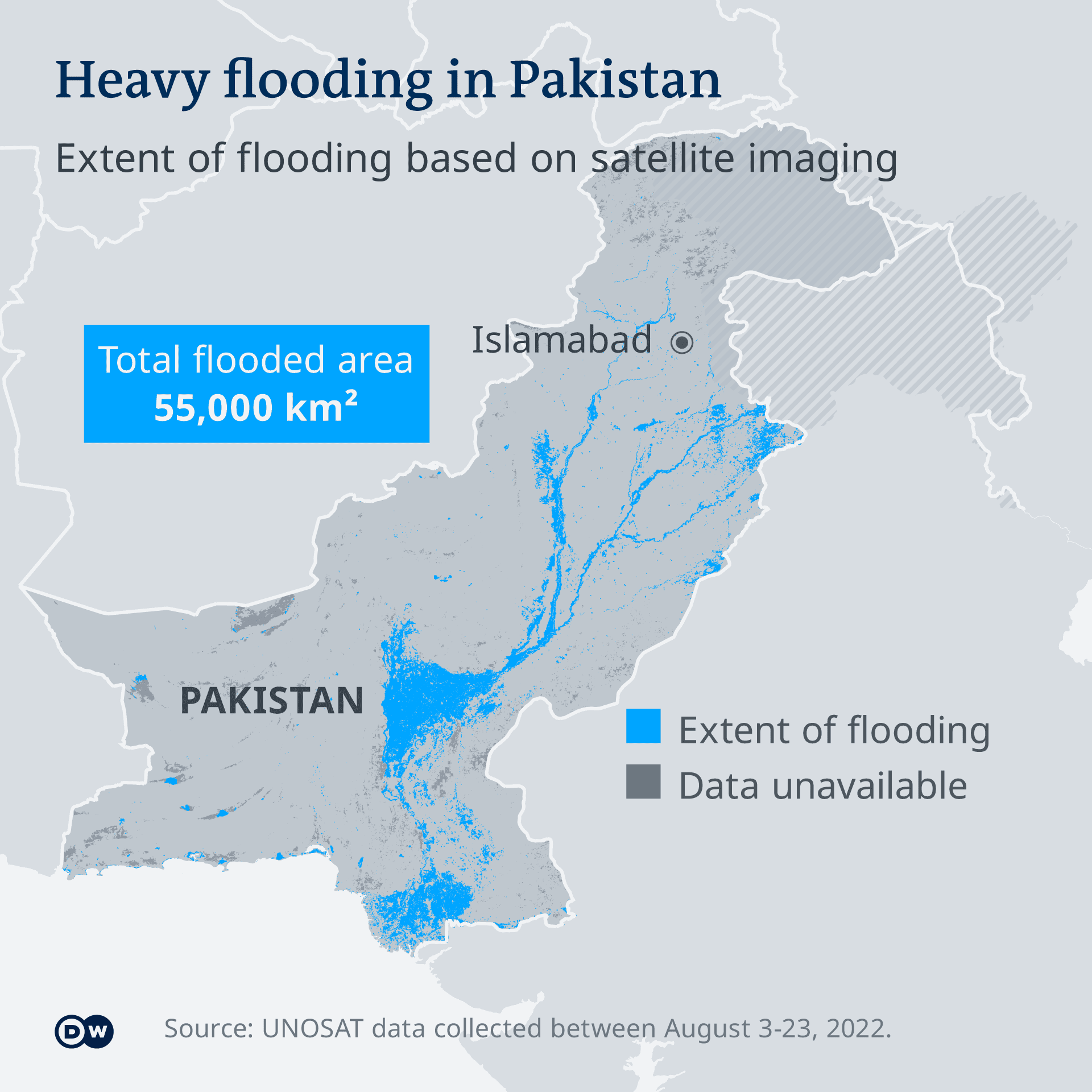
Pakistan is dealing with the aftermath of the worst floods in the country's history.  Over a thousand Pakistanis are dead. About 33 million people in two southern provinces are homeless. Sindh is inundated with 784% of normal rainfall so far this year. Balochistan has seen 522% of average rainfall. Both provinces suffered their worst ever heatwave prior to this unprecedented deluge. Nearly a million livestock have been lost, over two million acres of farmland is underwater and 90% of the crops in Sindh and Balochistan have been damaged. This is a massive humanitarian crisis. Pakistan can not deal with it alone.

Pakistan Flood 2022 Map. Source: DW

Satellite Image of Qambar, Sindh Before/After Floods 2022. Source: NASA

Satellite Image of Shikarpur, Sindh Before/After Floods 2022. Source: NASA


Balochistan and Sindh Worst Affected by Monsoon22. Source: The Economist

Pakistan's population is about 2.6% of the world population. The nation contributes less than 1% of the global carbon emissions. It lacks the resources needed to deal with the consequences of this man-made disaster. The Industrial Revolution in Europe and the United States was fueled mainly by fossil fuels such as coal and oil believed to be responsible for climate change.  The following map from Professor Jason Hickel shows that the countries in the global north are the biggest polluters while those in the global south are the most vulnerable to the effects of climate change. 

Climate Injustice: Low Emitters Global South vs Big Polluters in Industrial North. Source: Prof J. Hickel
Average Annual Cost of Floods in Vulnerable Countries. Source: Bloomberg


Comparison of 2022 and 2010 Floods in Pakistan. Source: WWF

It will take hundreds of millions of dollars to provide immediate relief to 33 million people, followed by tens of billions of dollars in assistance to rebuild the lives and livelihoods and the infrastructure destroyed by this catastrophe. Pakistan's gross capital formation is only 15% of its GDP. Among the world’s top 20 economies by population, only Egypt has a lower rate of gross capital formation than Pakistan, according to Bloomberg. It is time for the rich industrialized world to help developing nations such as Pakistan to deal with the massive impact of climate change. 

Low Gross Capital Formation in Pakistan. Source: Bloomberg 


All Pakistanis and non-Pakistanis need to pitch in with donations to help finance immediate disaster relief activities. Beyond that, Pakistan will have to be helped by international experts to build disaster preparedness capacity. The new housing and infrastructure will have to be funded and built to ensure its resilience in future climate disasters which are likely to occur more often with greater intensity. There is an urgent  need to prepare western and multilateral financial institutions to deal with such climate catastrophes in developing nations. Mechanisms also need to be put in place to provide and manage funding of these projects in a transparent manner. 

Wednesday, April 6, 2022

Gallup Pakistan Poll: Over Two-thirds Support Imran Khan's Decision to Dissolve National Assembly

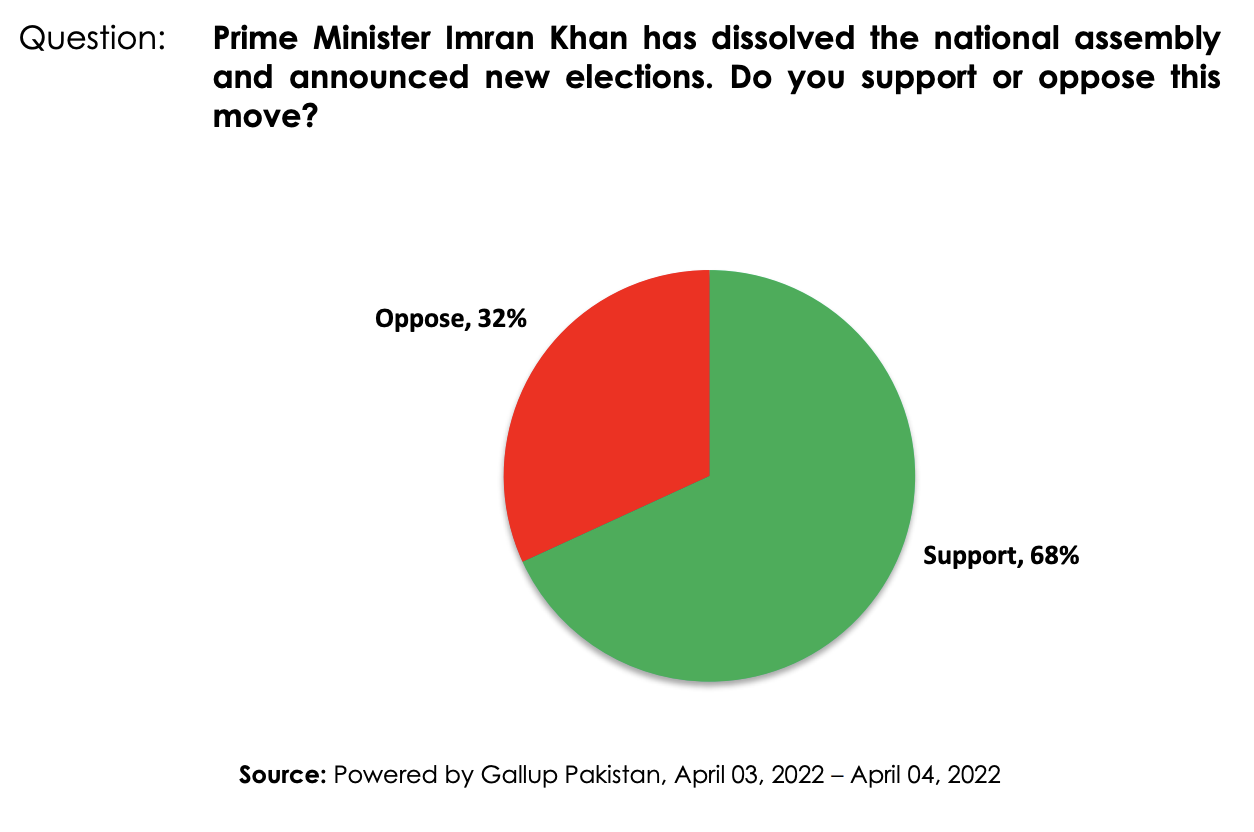
A snap poll conducted by Gallup Pakistan on April 3 and 4 shows broad support for Prime Minister Imran Khan's decision to seek dissolution of the National Assembly and call fresh elections.  Support for the decision is nationwide with 66% in Punjab, 69% in Sindh and 78% in KPK province. It is the strongest among those identifying themselves as PTI voters with 95% of them approving the decision. Among the Opposition parties, 44% of PMLN voters and 50% of PPP voters agree with the decision.  

Source: Gallup Pakistan

Here are the key findings of the Gallup Pakistan Poll

1) Widespread support for dissolution of National Assembly in Pakistan

Respondents were asked ‘ PM has dissolved the national assembly and called for fresh elections. Do you Support or are you against this’ To this question a wide majority 68% say they support and 32% say they oppose PM Imran Khan’s move.

Source: Gallup Pakistan

2) Majority don’t believe in US Conspiracy to remove Imran Khan, although split exists along party lines.Significant majority 64% responded to this question and say that Imran Khan was being ousted because of inflation and not because of a foreign conspiracy.

3) Public Opinion split over performance of Imran Khan

Respondents were asked ‘ Imran Khan ruled for 3.5 years. Are you satisfied with the performance of their government or not satisfied?

To this question 54% said they are dissatisfied and 46% said they are satisfied’

4) Anti Americanism: Only 1 in 3 consider the US to be a friend

Respondents were asked: Some people think that America is a friend of Pakistan, and some people think it is an enemy. what is your opinion?

Almost 2 in 3 Pakistanis(72%) think US to be an enemy. Anti Americanism was highest among PTI Supporters (80% thought America was an enemy) and lowest among PML-N voters (65%) 

The poll included a random sample of 800 households (18+ males and females) interviewed by telephone on April 3 and 4, 2022. Provincial breakdown: 66% Punjab, 18% Sindh, 13% KPK and 4% Balochistan. Urban 34%, rural 64%. Margin of error: +-3-5%, 95% Confidence Level. 

Gallup Pakistan's note on Sample Size: The sample size used in this survey is quite adequate even in comparison to international standards. Gallup US Daily poll is 500 and the Gallup Poll Social Series is 1000, both having a track record of reliable predictability for the USA (a country nearly 100 million larger in population of Pakistan). According to Five Thirty-Eight, one of the most credible sources on polling in the US: "Surveying 2,000 voters substantially reduces error compared with surveying 400 of them, but surveying 10,000 voters will produce only marginal improvements in accuracy compared with the 2,000- person survey".

Related Links:


Monday, March 21, 2022

Pakistan Revives Reko Diq: One of The World's Largest Undeveloped Copper-Gold Deposits

Canadian mining giant Barrick Gold Corporation and the governments of Pakistan and Balochistan have reached a deal to restart the Reko Diq mining project. Reko Diq is the world's 4th largest undeveloped copper-gold porphyry deposit with over 14 million tons of copper and 21 million ounces of gold. The project was abandoned in 2011 after a Pakistan Supreme Court bench headed by former Chief Justice Iftikhar Chaudhry canceled the mining license granted to Tethyan Copper Company (TCC), a joint venture between Canada's Barrick Gold and Antofagasta Minerals of Chile. TCC challenged the cancellation in the International Centre for Settlement of Investment Dispute (ICSID). On July 12, 2019, the ICSID Tribunal awarded TCC $5.894 billion plus interest of  $700,000 per day in damages against Pakistan. As of 1 March 2022, the award stood at $6.5 billion. The new agreement between Barrick Gold Corporation  and the governments of Pakistan and Balochistan does away with this award. It also increases the share of the project owned by Pakistan from 25% to 50%, brings in $10 billion investment, the largest single investment in the country, and creates 8,000 jobs. Reko Diq is part of the Tethyan metallogenic belt (TMB) that extends from the Balkans in Europe to Pakistan including Serbo-Macedonian, Anatolian, Takab, Kerman and Chagai metallogenic belts. It is believed to be rich in copper and gold deposits.

Reko Diq Copper-Gold Mine

New Reko Diq Deal: 

The new agreement to start Reko Diq waives the ICISD award. In the reconstituted project, Barrick will have 50% ownership and Pakistan 50%, comprising a 10% free-carried, non-contributing share held by the government of Balochistan, an additional 15% held by a special purpose company owned by the government of Balochistan and 25% owned by other federal state-owned enterprises. The federal government’s shares of 25% will be divided equally amongst three state-owned entities (SOE): Oil & Gas Development Corporation Limited (OGDCL), Pakistan Petroleum Limited (PPL), and Government Holdings Pakistan Limited (GHPL). This is a huge improvement over the prior deal that gave the Balochistan government 25% stake in the project, with Tethyan holding the remaining 75%.

A separate agreement provides for Barrick’s partner Antofagasta PLC to be replaced in the project by the Pakistani parties, according to a statement released by Barrick Gold Corporation. Pakistan will buy out Antofagasta’s interest in the mine for $900 million, according to the two companies and the government. 

Production Targets/Social Infrastructure Projects:

When the project goes into production in 5 or 6 years time of development, it will produce 200,000 tons of copper and 250,000 ounces of gold a year for more than half a century. At current prices, the annual copper output will be $2 billion and gold output $500 million. 

The project’s development will bring in investment of approximately $10 billion in Balochistan, including $1 billion which would be invested in social uplift projects such as roads, schools, hospitals, and the creation of a technical training institute for mining. The investment is also said to result in the creation of over 8,000 jobs, according to a report in The Express Tribune newspaper. 

Future Potential:

Reko Diq is part of the Tethyan metallogenic belt (TMB) that extends from the Balkans in Europe to Pakistan including Serbo-Macedonian, Anatolian, Takab, Kerman and Chagai metallogenic belts. It is believed to be rich in copper and gold deposits. 

“Reko Diq could also be the springboard for further exploration and other mineral discoveries along the highly prospective Tethyan Metallogenic Belt,” said Barrick Gold CEO Mark Bristow. 

Foreign Direct Investment:

After reaching a peak of over $5 billion in 2007, foreign direct investment (FDI) in Pakistan has plummeted. It is at least in part attributable to bad decisions by the Pakistan Supreme Court headed by Chief Justice Iftikhar Chaudhry. Cancellation of the Pakistan Steel Mills privatization by the Chaudhry court in 2006. That decision alone has cost Pakistani taxpayers $100 million a year.  Then came the Chaudhry court's decision cancelling the Reko Diq license and the $6.5 billion award against Pakistan. These decisions had a chilling effect on foreign investment in Pakistan. Let us hope the revival of the Reko Diq project helps restore confidence of foreign investors in the country. Let us also hope that this history of unwise court decisions serves as a reminder to the Pakistani judiciary to be more careful in deciding such cases in future. 

Related Links:

Haq's Musings

South Asia Investor Review

Shaukat Aziz's Economic Legacy in Pakistan

Saving Pakistan's Education, Steel Mill, Railway and PIA

Politics of Patronage Trumps Public Policy 

Iftikhar Chaudhry Scared Away Foreign Investors

Musharraf Earned Legitimacy by Good Governance

Vindictive Judges Pursue Musharraf

Rare Earths at Reko Diq?


Monday, September 13, 2021

Can Afghanistan Satisfy Tech Industries' Insatiable Appetite For Rare Earths?

Afghanistan is rich! The world's "poorest country" is known to have trillions of dollars worth of rare earths and other minerals buried underground. Rare earths are essential for the global supply chain of the technology industry. They are considered a "critical resource" for US national security.  


Afghan Mineral Resources. Source: Aljazeera

A US Defense Department report has described Afghanistan as "Saudi Arabia of Lithium". Pakistan, too, is believed to be rich in rare earths. Peace and security are key to unlocking the potential mineral riches in both Afghanistan and Pakistan. That is where both nations need to focus for a brighter future for their peoples.

Uses of Rare Earth Elements. Source: Natural Resources of Canada

Rare earth elements (REEs) are a group of 15 elements referred to as the lanthanide series in the periodic table of elements. Scandium and yttrium, while not true REEs, are also included in this categorization because they exhibit similar properties to the lanthanides and are found in the same ore bodies. REEs are key components in many electronic devices that we use in our daily lives, as well as in a variety of industrial applications, according to the Natural Resources of Canada website


Rare Elements in the Periodic Table

Rare earth elements go into a variety of industrial applications, including electronics, clean energy, aerospace, automotive and defense. Permanent magnets alone account for 38% of total forecasted demand for rare earths. Rapid growth in Lithium-Ion batteries for electric vehicles (EVs) represents another major opportunity for Afghanistan. The Chinese appear ready to invest billions of US dollars in Afghanistan to extract this wealth. The extension of the China Pakistan Economic Corridor (CPEC) infrastructure into Afghanistan can facilitate the export of these minerals through Pakistani ports in Gwadar and Karachi. 

The Afghan mineral wealth was first discovered and mapped by Russian geologists during the Soviet occupation of the country in the 1980s. These maps were used by American geologists from the US Geological Survey in 2010 to conduct aerial surveys using P-3 Orion naval patrol aircrafts equipped with sensors. A US Defense Department report written soon after this discovery called Afghanistan "Saudi Arabia of Lithium".  

With the Taliban request to join China Pakistan Economic Corridor (CPEC),  China appears to be the leading candidate to win mining rights for rare earths in Afghanistan. Already, China has acquired rights to develop copper mining at Aynak Copper Field in Afghanistan. Back in 2007, China Metallurgical Group agreed to invest billions of dollars in the project and related infrastructure development -- including the construction of a coal-fired electrical power plant and what would be Afghanistan's first freight railway, according to a Radio Free Europe report.  Geologists estimate that Aynak is the world's largest undeveloped copper field.    

Pakistan's Balochistan province, too, is believed to be rich in rare earth elements. Here is how an expert who asked not to be named explained the mining potential in Balochistan: 

"The Pegmatite rock that covers much of Balochistan (and other parts of Pakistan as well) has several different gems, in it which have been mined for a long time. These are easy to visualize as they differ in color from the rest of the rock, and can be removed with a small geologist's hammer. Pegmatite, though, also contains uranium which can be separated using a Geiger Counter, and rare metals and rare earths. Some of these like Lithium can be separated relatively easily. Others like Samarium and Dysprosium are vastly more difficult to separate because you need X-Ray equipment to help identify them. Also, their presence is very small - that is why they are classed as "rare." The presence of many of these metals was not known to science until recently and until the Japanese began to use them in electronics, hardly any effort was made to mine them. Now, of course, they are all the rage because they have been found especially useful in the latest "green" generation equipment as well as in defense and other applications. Indeed, until China banned their sale to Japan, no one really even bothered about them - it suited the Japanese to remain quiet as they were getting very good prices for these resources from an unaware Chinese, and the same thing is now happening in other parts of the world, in Pakistan in this case. Much of the testing that is involved here is difficult and requires very advanced technical equipment, and even methods like gas spectrometry etc may not help identify materials that exist in extremely small percentages in soil or rock. In India for example, some of these metal reserves were not known until the USGS first and then the Russians helped analyze soil and rocks across the country. If nothing else, the Indians formed a government owned company called Indian Rare earths Limited which comes under the Atomic Energy Commission and is directly under the Prime Minister of India. They do seem to have handled the conservation and exploitation of these reserves far better than is being done in Pakistan." 

Peace and security are key to unlocking the potential mineral riches in both Afghanistan and Pakistan. That is where both nations need to focus on for a brighter future for their peoples. 

Related Links:

Haq's Musings

South Asia Investor Review

Rare Earths in Pakistan?

Finding Pakistan's Mineral Wealth From the Sky

Brief History of Pakistan Economy 

Can Pakistan Avoid Recurring IMF Bailouts?

History of Pakistan Business and Industry

CPEC Financing: Is China Ripping Off Pakistan?

Pakistan's Lagging Industrial Output

Pakistan is 5th Largest Motorcycle Market

"Failed State" Pakistan Saw 22% Growth in Per Capita Income in Last 5 Years

CPEC Transforming Pakistan

Pakistan's $20 Billion Tourism Industry Boom

Home Appliance Ownership in Pakistani Households

Riaz Haq's YouTube Channel

PakAlumni Social Network

Thursday, April 23, 2020

Incomes of Pakistan's Poorest Rising Faster Than Richest Pakistanis'

Pakistan Living Standards Measurement Survey (PSLM/HIES) of 2018-19 has revealed that the incomes of the poorest Pakistanis are rising much faster than the those of their richest counterparts. The survey measures changes in incomes, expenditures and living standards of the population by quintiles on a periodic basis. The survey provides detailed outcome indicators on education, health, population welfare, housing, water sanitation and hygiene, information communication and technology (ICT), food insecurity experience scale (FIES) and income and expenditure.

Average Monthly Income Growth By Quintiles. Courtesy: Bilal Gilani of Gallup Pakistan

PSLM/HIES 2018-19 compares incomes with those reported in PSLM/HIES 2015-16.  It shows that the average household monthly income in Pakistan has jumped 16.5% to Rs. 41,545.  It also shows that the average monthly income of the lowest quintile (Q1) in Pakistan rose 17.5% and that of the second lowest quintile (Q2) grew 22%, significantly faster than 11.7% for the middle quintile (Q3) and 12% and 5.1% for the top two quintiles (Q4 and Q5) respectively.

The average monthly income of Q1, the poorest quintile, stands at Rs. 23,192 in 2018-19. The second-lowest quintile’s income is Rs. 29,049. The middle-income group (Q3) is Rs. 31,373. The higher middle-income group’s average monthly income has increased to Rs. 37,643. The average monthly income of the top income group (Q4) is estimated at Rs. 63,544.
Monthly Household Incomes By Provinces. Source: PLSM/HIES 2018-19

Average monthly household income in Balochistan is Rs. 36,387, the lowest among the provinces. However, it has grown 21.2% since 2015-16,  much faster than Punjab's 18.3%, KP's 11.4% and Sindh's 15.1%.

Change in Share of Income From 1990 To 2015 in Poorest (Left) & Richest (Right) Quintiles. Source: UNESCAP

Pakistan's latest PSLM/HIES survey confirms long term trend of the lower quintiles gaining an increasing share of the national income.  Earlier in 2015, the United Nations Economic and Social Commission for Asia and Pacific (NESCAP) Statistical Yearbook for 2015 showed that the share of national income of Pakistan's poorest 20% of households increased from 8.1% to 9.6% in 1990-2015.  It was the highest share of income for the bottom income quintile reported in the region.


Related Links: