Riaz Haq writes this data-driven blog to provide information, express his opinions and make comments on many topics. Subjects include personal activities, education, South Asia, South Asian community, regional and international affairs and US politics to financial markets. For investors interested in South Asia, Riaz has another blog called South Asia Investor at http://www.southasiainvestor.com and a YouTube video channel https://www.youtube.com/channel/UCkrIDyFbC9N9evXYb9cA_gQ
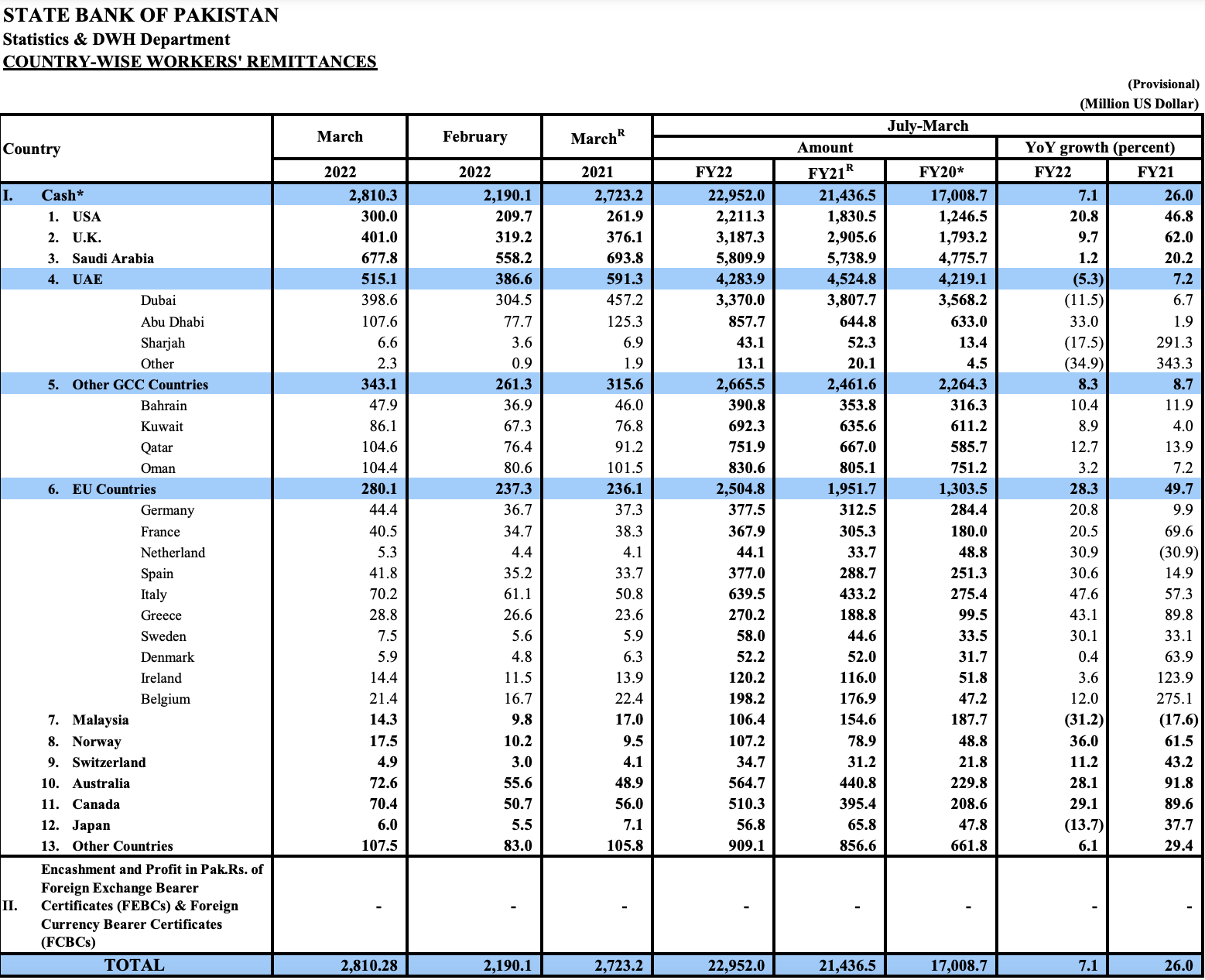
Remittances from the European Union (EU) to Pakistan soared 49.7% in FY 21 and 28.3% in FY22, according to the State Bank of Pakistan. With $2.5 billion remittances in the first 9 months (July-March) of the current fiscal year, the EU ($2.5 billion) has now surpassed North America ($2.2 billion) to become the third largest source of inflows to Pakistan after the Middle East and the United Kingdom. Remittances from the US have grown 21%, second fastest after the EU (28.3%) in the first 9 months of the current fiscal year.
The population of Pakistan-born migrants to European Union countries has been growing in recent years. With over 120,000 Pakistani migrants, Italy is the most popular destination for Pakistanis in the EU.
Italy is followed by Germany with 75,495 Pakistani migrants. Then comes Spain with 61,953 migrants, France 21,900 (2017), Sweden 11,674, Denmark 10,669, Ireland 7,351 (2016), Belgium 5,927, Portugal 5,310, Norway 5,157, Netherlands 4,723 and Austria 4,112. There are smaller populations of Pakistanis in several other European countries.
With $5.74 billion in the first 9 months of current fiscal year FY22, Saudi Arabia remains the top source of remittances to Pakistan, followed by $4.28 billion from the United Arab Emirates (UAE). However, the Saudi remittances are essentially flat while those from the UAE have declined 5.3% in this period. Pakistani diaspora is sending home over $30 billion a year, about 10% of the country's GDP. It is badly needed foreign exchange to balance Pakistan's external accounts.
Over 10 million Pakistanis are currently working/living overseas, according to the Bureau of Emigration. Before the COVID19 pandemic hit in 2020, more than 600,000 Pakistanis left the country to work overseas in 2019. The average yearly outflow of Pakistani workers to OECD countries (mainly UK and US) and the Middle East has been over half a million in the last decade.
Pakistan’s economy created 5.5 million domestic jobs during the past three years –on an average 1.84 million jobs a year, which is far higher than yearly average of creation of new jobs during the 2008-18 decade, according to the Labor Force Survey (LFS) published by the Pakistan Bureau of Statistics (PBS).
Pakistan ranks 6th among the top worker remittance recipient countries in the world. India and China rank first and second, followed by Mexico 3rd, the Philippines 4th, Egypt 5th and Pakistan 6th.
Pakistan Demographics
Pakistan's Demographic Dividend:
About two million Pakistanis are entering the workforce every year. The share of the working age population in Pakistan is increasing while the birth rate is declining. This phenomenon, known as demographic dividend, is coinciding with declines in working age populations in developed countries. It is creating an opportunity for over half a million Pakistani workers to migrate and work overseas, and send home record remittances. These overseas Pakistanis are now sending home over $30 billion a year, about 10% of the country's GDP. It is badly needed foreign exchange to balance Pakistan's external accounts.
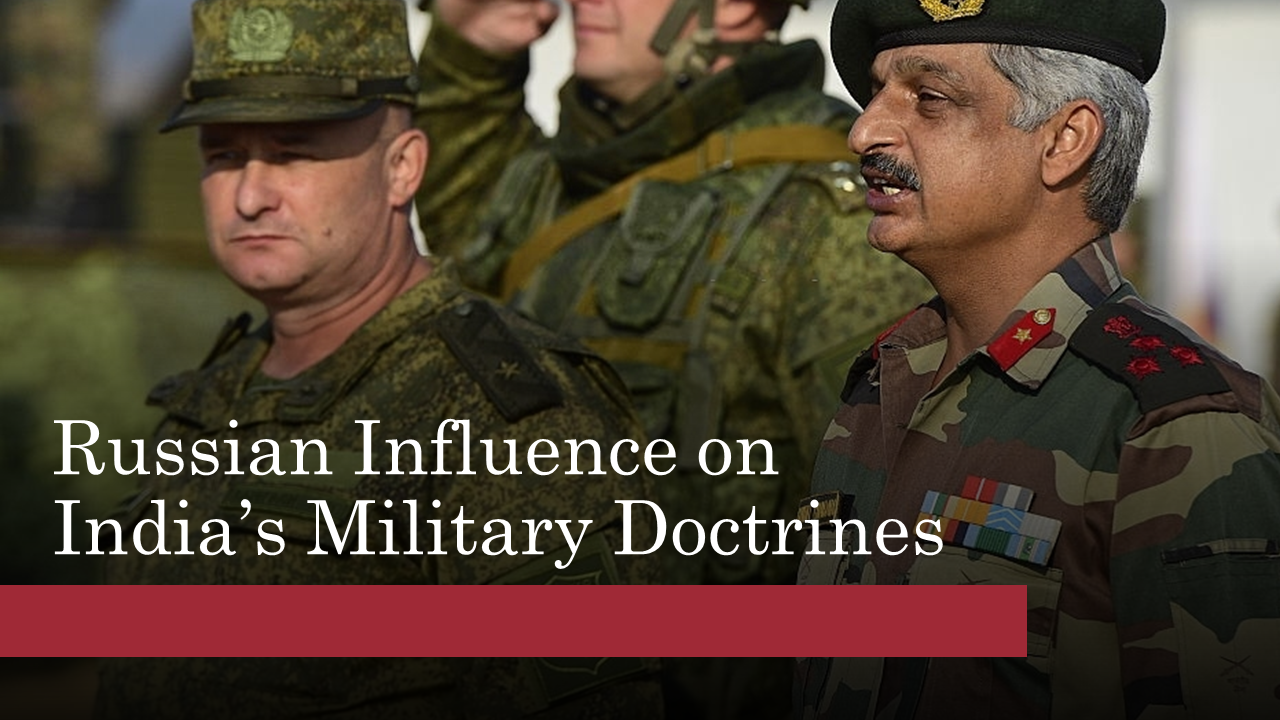
India's Russian-equipped and trained military is watching with great concern Russia's losses in the Ukraine war. Moscow has lost 20,000 soldiers, nearly 500 main battle tanks and a large warship so far, according to media reports. Ukraine's use of Turkish drones, US-made anti-tank guided missiles (ATGMs) Javelins and Ukrainian anti-ship Neptune missiles has taken a heavy toll on the Russian Army and Navy. It is notable that India's Cold Start Doctrine against Pakistan is modeled on the Russian formation known as the “operational maneuver group” (OMG).
It is well known that the Indian Army relies on Russian tanks, artillery, rockets, and ammunition. The Indian Navy uses Russian ships, submarines and missiles and the Russian Su-30 MKI forms the backbone of the Indian Air Force. Like Russia, the Indian military doctrine is based on deploying large platforms (tanks, artillery, ships and fighter-bombers) with massive firepower. Here's an excerpt of an article by Dr. Vipin Narang, an Indian-American analyst, on the subject:
"In terms of doctrine and strategy, although it may be difficult to trace direct influence and lineage between Russia and India, there are several pieces in India’s conventional and nuclear strategy that at least mirror Russia’s behavior. On the conventional side, the core formation in the quick-strike concept known as “Cold Start” or “proactive strategy options” was modeled on the Russian formation known as the “operational maneuver group” (OMG). The idea was to have a formation that could be rapidly assembled from tank and armored divisions that could break through reinforced defenses—NATO for Russia, and Pakistan’s I and II Corps in the plains and desert sectors for India.
"On the nuclear side, India is currently seized with the same dilemma as the Soviet Union was during the Cold War: both NATO and Pakistan threaten battlefield nuclear weapons against conventional thrusts (India, at least, presumably would be retaliating following a Pakistan-backed provocation). While both states refined their conventional concept of operations, there may have also been corresponding adjustments to their nuclear strategies. It was long believed that, in response to NATO threats to use nuclear weapons first on the battlefield, the Soviet Union had strong preemptive counterforce elements in its strategy to try to at least disarm the United States of its strategic nuclear weapons for damage limitation. It is increasingly evident that at least some serious Indian officials are interested in developing the same sort of option: preemptive counterforce against Pakistan’s strategic nuclear forces, both for damage limitation and to reopen India’s conventional superiority. It is no surprise perhaps, then, that India chose to go ahead with acquiring Russia’s S-400 missile and air defense system, despite the threat of Countering America's Adversaries Through Sanctions Act (CAATSA) sanctions from the United States: the S-400 is key to India’s damage limitation strategy, capable of potentially intercepting residual ballistic and cruise missiles that a counterforce strike might miss".
Turkish Bayraktar TB2 has been highly effective in destroying Russian tanks and armor in Ukraine. It is playing a key role in Ukraine's counter offensives against Russia's invasion. It is proving so effective that "Ukrainian forces are singing its praises, literally", according to a CNN report.
Indian Army has nearly 6,000 tanks of Russian origin. These tanks are just as vulnerable to drone and anti-tank missiles as the Russian tanks that perished in Ukraine.
Pakistan has developed Baktar Shikan, a second-generation man-portable anti-tank guided missile (ATGM) system which uses optical aiming, IR tracking, remotely controlled and wire transmitted guidance signals. It can also be mounted on attack helicopters and Armored Personnel Carriers (APCs). Its long range, penetration power and a powerful anti-jamming capability form a potent defense against armored targets.
Pakistan is also reported to have already acquired Turkish Bayraktar TB2 drones recently. It was displayed in the Pakistan Day Parade on March 23, 2022, along with other military equipment acquired recently by the Pakistani defense forces.
Anti-Ship Missiles:
Ukraine claims that its Neptune anti-ship missiles hit and sank Moskva in Black Sea. It was a large 10,000-ton guided missile cruiser of the Russian Navy that was launching cruise missiles on targets in Eastern and Southern Ukraine. It is the largest warship to have been sunk in action since WWII.
Vast majority of Indian Navy ships, including its aircraft carriers and missile frigates, are designed, built and equipped by Russians.
Pakistan recently showcased its anti-ship missile Harbah at DIMDEX 2022, a defense expo in Qatar. It is a medium range ship launched subsonic cruise missile system capable of targeting sea as well as land targets in “all weather operation” at a maximum range of 280 kilometers, according to a report in NavalNews. The missile is fire and forget type. It relies on inertial navigation technologies with GPS and GLONASS systems. According to its manufacturer GIDS, the missile features the following guidance systems: a DSMAC camera, imaging infrared seeker, and radar seeker.
Summary:
The war in Ukraine is forcing a defense strategy rethink in countries such as India which rely on Russian equipment and training. Hindustan Times has quoted an unnamed former Indian Army Chief as saying: “War videos available show that the Russian Army has tactical issues in Ukraine war. Tell me, which tank formation goes to war in a single file without air or infantry cover when the opponent is equipped with the best anti-tank guided missile like Javelin or Turkish Bayraktar TB2 missile firing drones? There is question on Russian air supremacy with Ukraine Army armed with shoulder fired Stinger surface to air missiles as well as the night fighting capability of the Russian Air Force.”
Pakistan poverty headcount, as measured at the lower-middle-income class line of US$3.20 PPP 2011 per day, declined from 37% in FY2020 to 34% in FY2021 in spite of the COVID19 pandemic, according to the World Bank's Pakistan Development Update 2022 released this month. The report said Pakistan's real GDP shrank by 1% in FY20, followed by 5.6% growth in FY21. The report highlights high inflation and low savings rate as key economic issues.
The report credited the PTI government led by former Prime Minister Imran Khan for timely policy measures, particularly the Ehsaas program, for mitigating the adverse socioeconomic impacts of the COVID-19 pandemic. Here's an excerpt of the report titled Pakistan Development Update 2022:
"The State Bank of Pakistan (SBP) lowered the policy rate and announced supportive measures for the financial sector to help businesses and the Government expanded the national cash transfer program (Ehsaas) on an emergency basis. These measures contributed to economic growth rebounding to 5.6 percent in FY21. However, long-standing structural weaknesses of the economy, particularly consumption-led growth, low private investment rates, and weak exports have constrained productivity growth and pose risks to a sustained recovery. Aggregate demand pressures have built up, in part due to previously accommodative fiscal and monetary policies, contributing to double-digit inflation and a sharp rise in the import bill with record-high trade deficits in H1 FY22 (Jul–Dec 2021). These have diminished the real purchasing power of households and weighed on the exchange rate and the country’s limited external buffers."
The report cites high rates of inflation hurting the people, particularly the poor who spend about half of their income on food. Here's an excerpt:
"Headline inflation rose to an average of 9.8 percent y-o-y in H1 FY22 from 8.6 percent in H1 FY21, driven by surging global commodity and energy prices and a weaker exchange rate. Similarly, core inflation has been increasing since September 2021. Accordingly, the State Bank of Pakistan (SBP) has been unwinding its expansionary monetary stance since September 2021, raising the policy rate by a cumulative 525 basis points (bps) and banks’ cash reserve requirement by 100 bps"
The World Bank report highlights the low level of personal savings and investments as a key impediment to economic growth. Here's an excerpt:
"The savings challenge has only been exacerbated by the low level of financial inclusion in the country, where even those who save are not saving with the financial system, and as such savings are not being fully leveraged to support capital formation. Only 21 percent of the population has access to an account and only 18 percent of the population uses digital payments. There are also large gaps in financial inclusion, with vulnerable segments having limited access at high prices. In terms of access to accounts, 7 percent of adult women have access compared to 35 percent of adult men, and 15 percent of young adults (ages 15–24) have access compared to 25 percent of older adults. It should be highlighted, however, that Pakistan has made notable gains on the financial inclusion agenda in recent years, supported by policy reforms and holistic strategies such as the National Financial Inclusion Strategy. However, despite the progress made, Pakistan underperforms on key metrics of financial inclusion in comparison to its peer comparators. Estimates suggest that less than 50 percent of domestic savings find their way to the financial sector, with the rest used in real estate, being intermediated through informal channels, or are soaked up directly by the government through National Savings. The incentive system is skewed such that savings flow outside of the financial sector. The large quantum of currency in circulation (CiC) in the economy is also indicative of this trend. The CiC/M2 ratio, which averaged 22 percent till June 2015 has increased to over 28 percent as of June 2021. The increase in CiC/M2 ratio translates into excess CiC of PKR1.4 trillion. These are resources that could have been intermediated for productive uses by the financial sector but are currently outside the sector."
Rabia Bano Osman, a baby girl abandoned by her parents 28 years ago in Karachi, has paid glowing tributes to Bilquis Edhi who died recently in Karachi, Pakistan. Rabia was found by Bilquis Edhi in one of several cradles (jhoolas) placed outside Edhi Foundation's office for parents to anonymously leave babies, mostly girls, they did not want or could not raise. She is now a well-educated and successful career woman working as a lawyer for Nike, the American athletic apparel giant with offices in San Diego, California. In a post on LinkedIn, Rabia who goes by Rabi B.O. writes: "Because of you, a little Pakistani girl orphaned at birth dared to dream. Because of you I am an independent woman with a graduate level education and a place in the world to call my own. You gave me opportunity. You awarded me a chance to dream, and you presented me with freedom". Rabia has a Master's degree in Cybersecurity and Data Privacy Law from New York's Albany Law School.
Rabia Bano Osman
Bilquis Edhi dedicated her entire life to Edhi Foundation, a charitable organization she founded with her husband Abdul Sattar Edhi who passed away in 2016. The foundation runs orphanages, shelter homes, langars (soup kitchens), senior care centers, morgues, funeral homes and the largest nationwide ambulance service, all funded by public donations.
Anatol Lieven, author of Pakistan: A Hard Country, describes Edhi Foundation as follows: "There is no sight in Pakistan more moving than to visit some dusty, impoverished small town in an arid wasteland, apparently abandoned by God and all sensible men and certainly abandoned by the Pakistani state and its elected representatives - and to see the flag of Edhi Foundation flying over a concrete shack with a telephone, and the only ambulance in town standing in front. Here, if anywhere in Pakistan, lies the truth of human religion and human morality."
Twenty-eight years ago I was abandoned in a baby carriage at the #EdhiOrphanage located in Karachi, Pakistan. You found me, you named me after your mother Rabia Bano, you forged my identity, then you gave me a home. Because of you today…I am a somebody, I have an identity, and I have loving parents to call my own. You fought for woman’s rights, you were an activist, a philanthropist, a rebel for the good cause. You taught me the power of woman, to always have an unwavering sense of self and to be unapologetically ambitious.
Because of you, a little Pakistani girl orphaned at birth dared to dream. Because of you I am an independent woman with a graduate level education and a place in the world to call my own. You gave me opportunity. You awarded me a chance to dream, and you presented me with freedom.
To the world you were Bilquis Edhi, but to me you were Bari Amma (Elder mother). Thanks to you I have two loving parents who made sure I had everything a little girl could have ever asked for. I went to a great high school, got scholarships throughout college, did an internship in NYS Assembly, Bronx District Attorney’s Office, U.S Congress, U.S Senate and went to law school to purse a masters in Cybersecurity and Data Privacy Law. All. Because. Of. You.
For those of you who are reading about Bilquis Edhi for the first time… I want you to know who she was to me, and to all of Pakistan. #BilquisEdhi was a hero, she was a mother to so many orphans (like me) and a powerhouse for humanity.
Losing Bare Abbu (#AbdulSattarEdhi) was tough, but your loss has made me feeling orphaned again today…
My name is Rabia Bibi Osman, and I will forever be a proud #Edhi baby.
Akhil Bharatiya Pratinidhi Sabha (ABPS), the top decision-making body of India's RSS (Rashtriya Swayamsevak Sangh), says that “the young generation is suffering from unemployment and the pandemic has made things even grim... We cannot turn a blind eye to unemployment. It is a crisis and it needs to be addressed.” The RSS was apparently reacting to the falling labor participation rate in India relative to Pakistan and the global averages. The RSS leadership wants the government of Prime Minister Narendra Modi to focus on helping small and medium sized enterprises (SMEs) to create jobs. RSS likes Modi government's ‘Make in India’ initiative “but it needs to be sharpened even more and get more investment.” The resolution is titled, ‘The need to promote work opportunities to make Bharat self-reliant’. The solution offered by ABPS resolution: Take agro-based local initiatives to promote rural areas and create jobs, according to Ram Madhav, a member of the RSS executive committee.
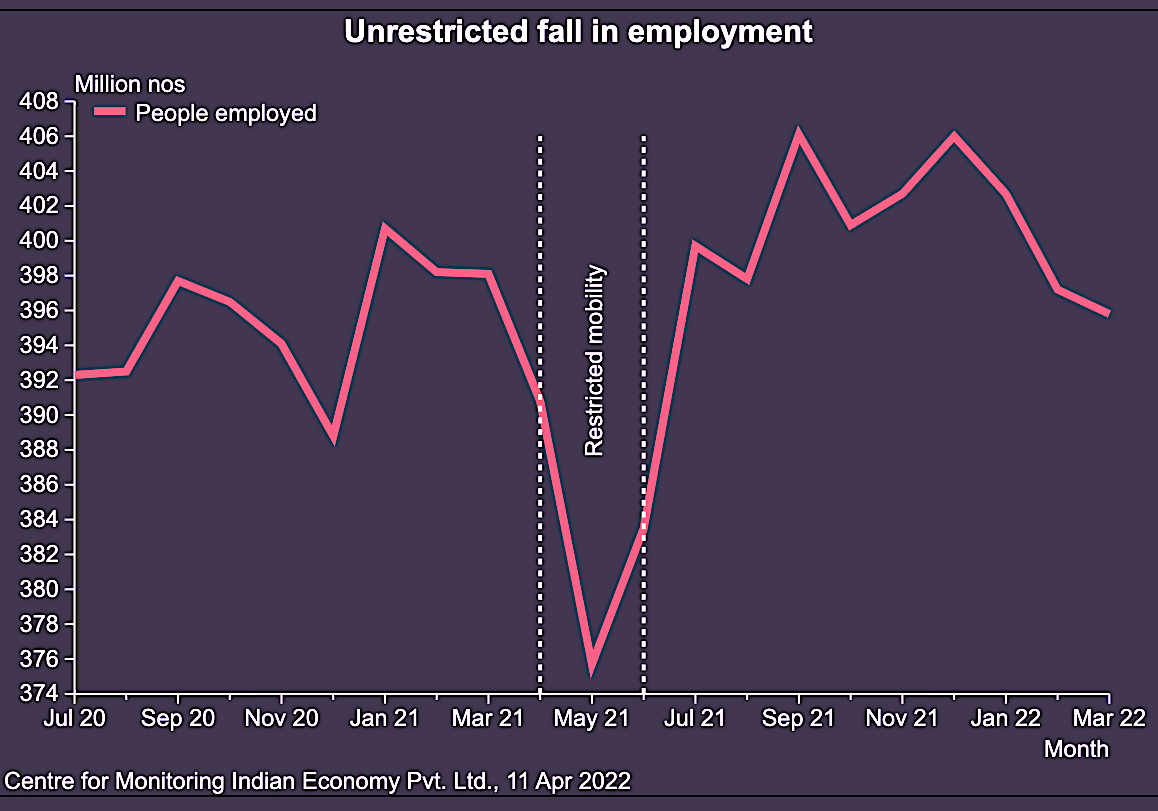
India's labor participation rate (LPR) fell to 39.5% in March 2022, as reported by the Center for Monitoring Indian Economy (CMIE). It dropped below the 39.9% participation rate recorded in February. It is also lower than during the second wave of Covid-19 in April-June 2021. The lowest the labor participation rate had fallen to in the second wave was in June 2021 when it fell to 39.6%. The average LPR during April-June 2021 was 40%. March 2022, with no Covid-19 wave and with much lesser restrictions on mobility, has reported a worse LPR of 39.5%.
Youth unemployment for ages15-24 in India is 24.9%, the highest in South Asia region. It is 14.8% in Bangladesh 14.8% and 9.2% in Pakistan, according to the International Labor Organization and the World Bank.
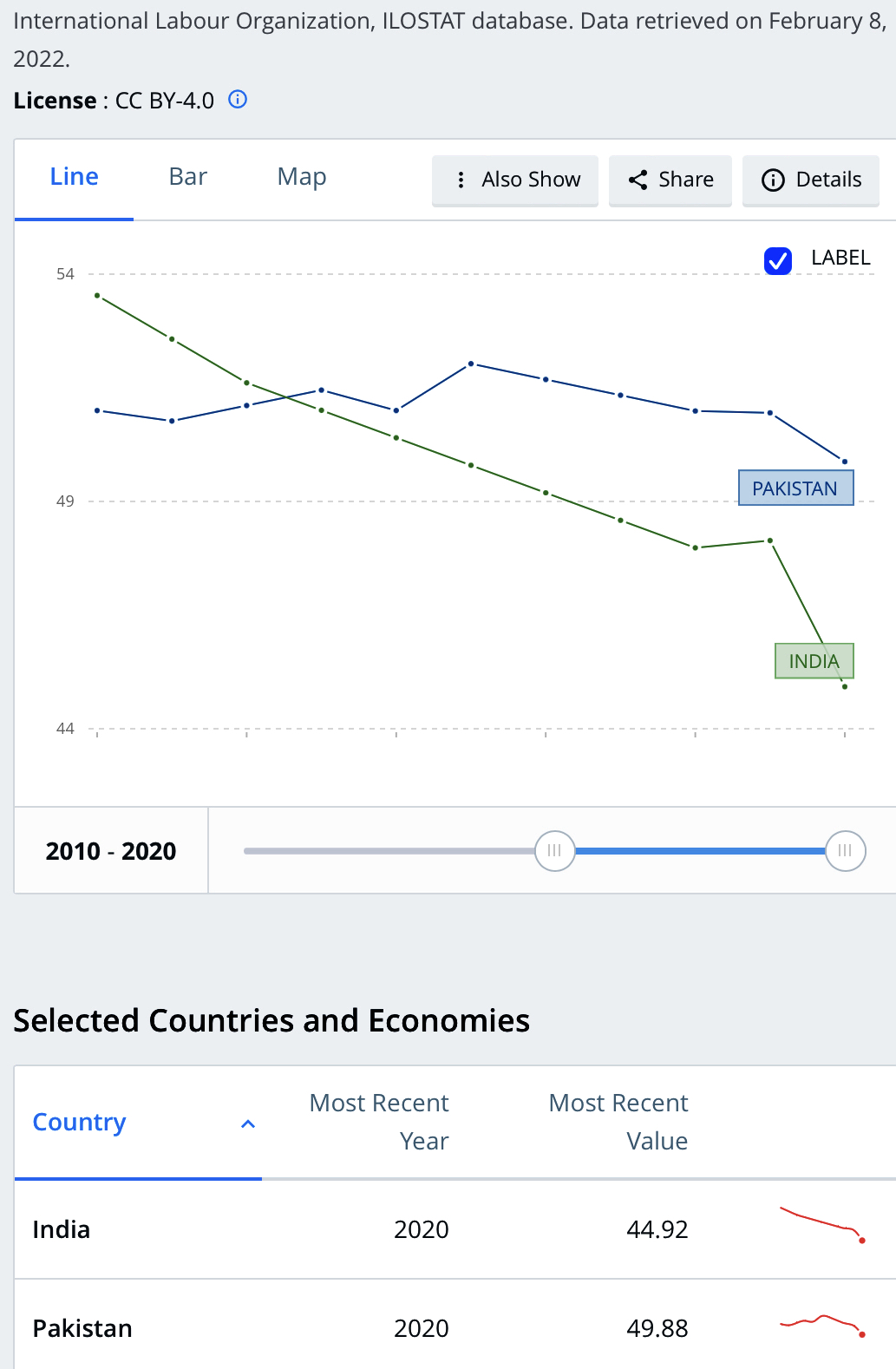
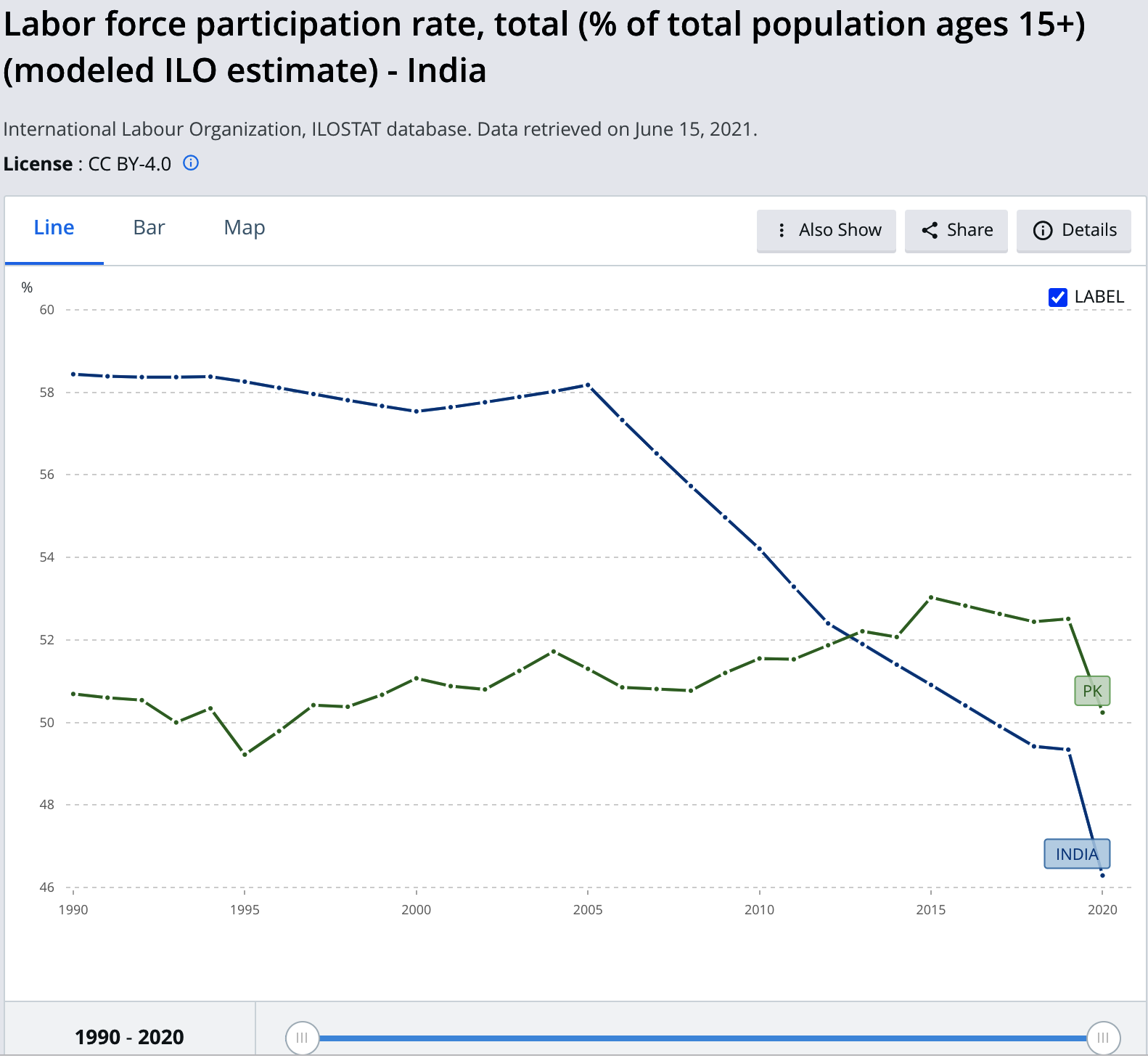
In spite of the headline GDP growth figures highlighted by the Indian and world media, the fact is that it has been jobless growth. The labor participation rate (LPR) in India has been falling for more than a decade. The LPR in India has been below Pakistan's for several years, according to the International Labor Organization (ILO).
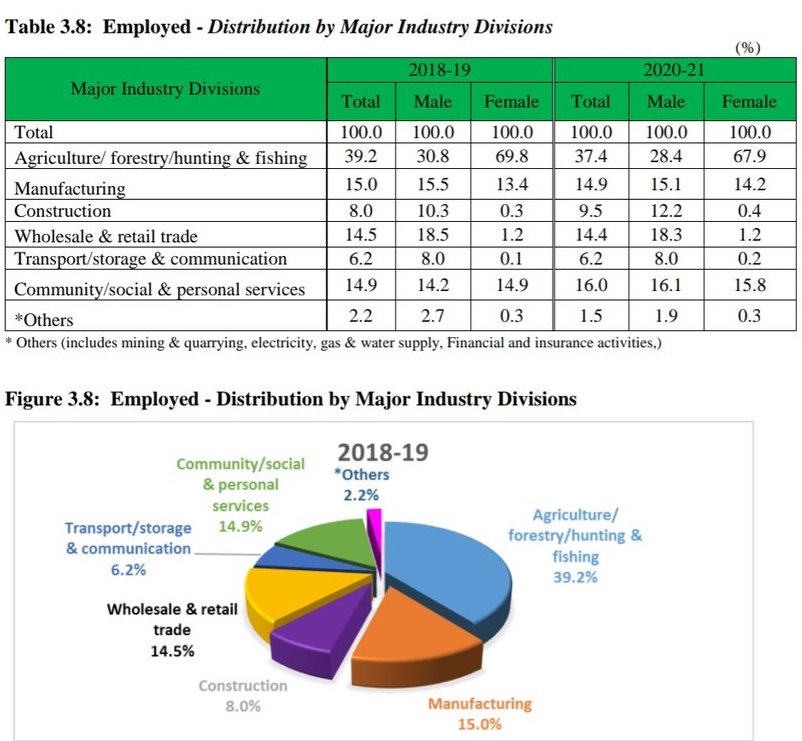
Construction and manufacturing sectors in India have been shedding jobs while the number of people working in agriculture has been rising, according to CMIE.
It is important to note that Pakistan’s economy has created 5.5 million jobs during the past three years – 1.84 million jobs a year, significantly higher than yearly average of new jobs created during the 2008-18 decade, according to the findings of Labor Force Survey (LFS) as reported by the Express Tribune paper. The biggest jump in share of employment (1.5%) was in the construction sector, spurred by Naya Pakistan construction incentives offered by the PTI government.
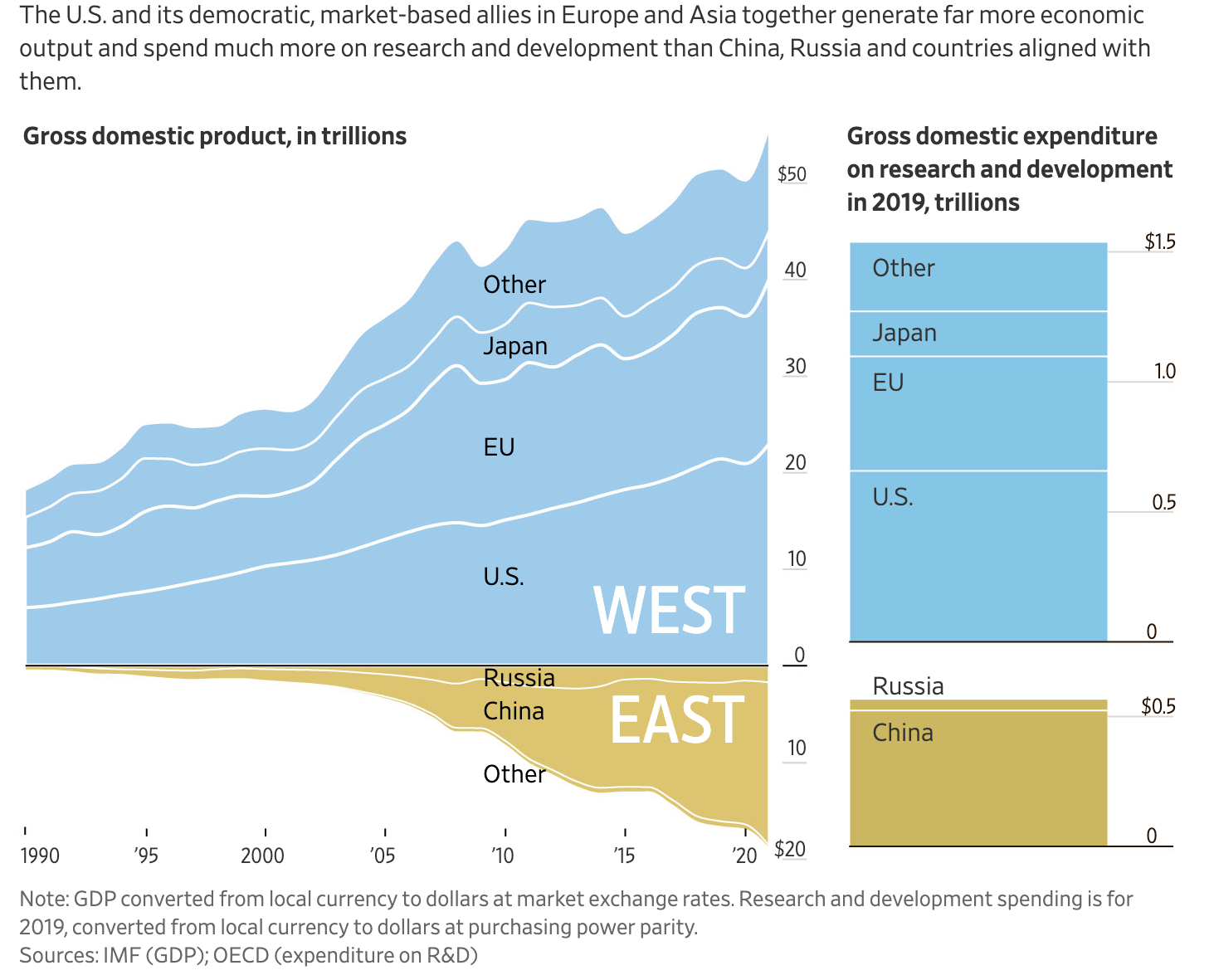
The US and its allies enjoy a significant technological advantage over China and Russia. The Chinese are working hard to catch up but the West is not standing still. It is making huge investments in research and development to maintain this edge as it becomes increasingly clear that the outcome of the ongoing international geopolitical competition will largely be determined by technology.
In 2019, the United States and its allies invested $1.5 trillion in research and development, far outpacing the combined Chinese and Russian R&D investment of half a trillion USD. This gap will likely narrow if the East's GDP continues to grow faster than the West's, allowing for higher investment in technology.
After the Russian invasion of Ukraine, the US, EU, Japan, South Korea and Taiwan have made it clear that the Western allies can and will use technology sanctions to control the behavior of China and Russia.
Taiwan Semiconductor Manufacturing Company (TSMC) will no longer fabricate computer chips for Russia, according to media reports. The ban will particularly affect Russia's Elbrus and Baikal processors, unless China agrees to step in to manufacture these chips, and risk additional US sanctions itself. Both Russian processors use mature 28 nm technology. The world's most advanced TSMC fabrication technology today is 5 nanometers. The best US-based Intel can do today is 7nm technology. China's SMIC (Semiconductor Manufacturing International Corporation) has the capability to produce chips using 14 nm technology. Semiconductor chips form the core of all modern systems from automobiles to airplanes to smartphones, computers, home appliances, toys, telecommunications and advanced weapons systems.
While China is the biggest volume producer of semiconductor components in the world, the Chinese design centers and fabs rely on tools and equipment supplied by the West to deliver products. Western companies dominate all the key steps in this critical and highly complex industry, from chip design (led by U.S.-based Nvidia, Intel, Qualcomm and AMD and Britain’s ARM) to the fabrication of advanced chips (led by Intel, Taiwan’s TSMC and South Korea’s Samsung ) and the sophisticated machines that etch chip designs onto wafers (produced by Applied Materials and Lam Research in the U.S., the Netherlands’ ASML Holding and Japan’s Tokyo Electron ), according to the Wall Street Journal.
There is no question that the current western technology sanctions can seriously squeeze Russia. However, overusing such sanctions could backfire in the long run if the US rivals, particularly China and Russia, decide to invest billions of dollars to build their own capacity. This would seriously erode western technology domination and result in major market share losses for the US tech companies, particularly those in Silicon Valley.
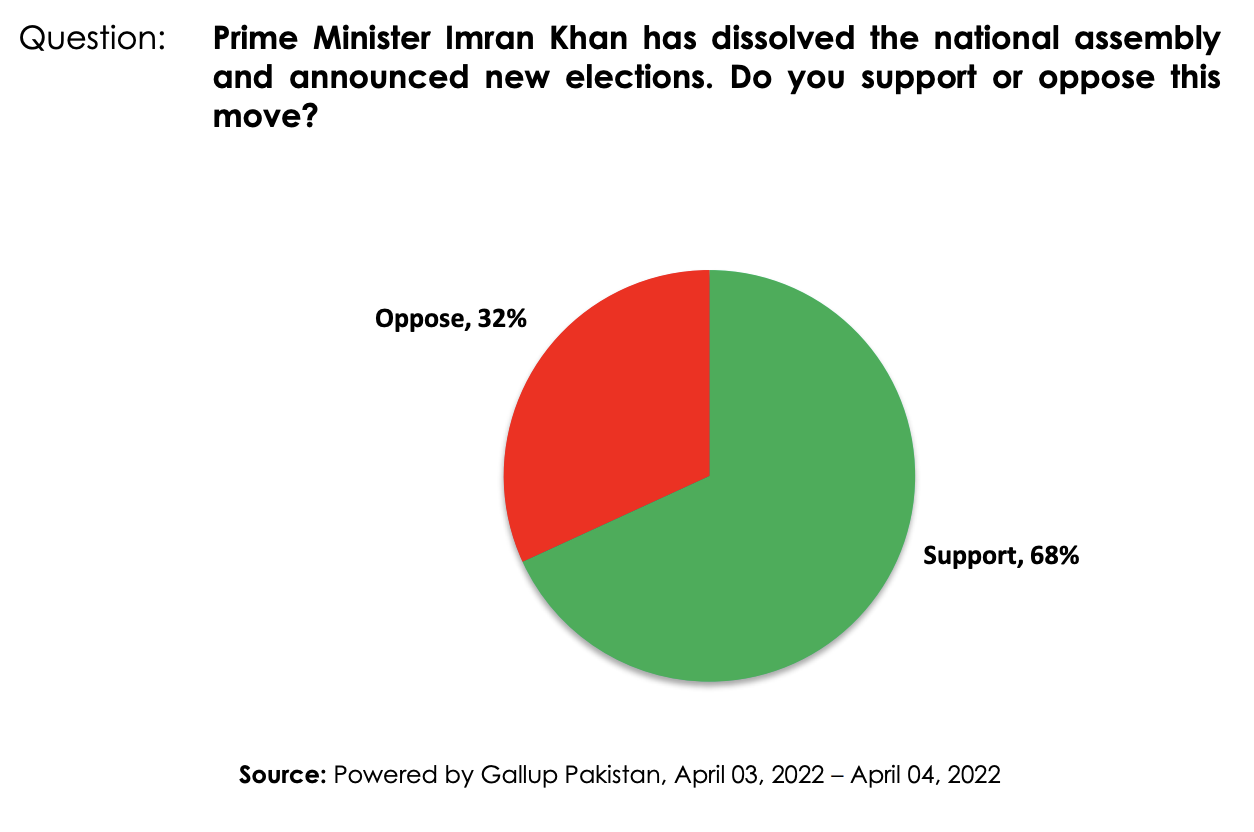
A snap poll conducted by Gallup Pakistan on April 3 and 4 shows broad support for Prime Minister Imran Khan's decision to seek dissolution of the National Assembly and call fresh elections. Support for the decision is nationwide with 66% in Punjab, 69% in Sindh and 78% in KPK province. It is the strongest among those identifying themselves as PTI voters with 95% of them approving the decision. Among the Opposition parties, 44% of PMLN voters and 50% of PPP voters agree with the decision.
1) Widespread support for dissolution of National Assembly in Pakistan
Respondents were asked ‘ PM has dissolved the national assembly and called for fresh elections. Do you Support or are you against this’ To this question a wide majority 68% say they support and 32% say they oppose PM Imran Khan’s move.
2) Majority don’t believe in US Conspiracy to remove Imran Khan, although split exists along party lines.Significant majority 64% responded to this question and say that Imran Khan was being ousted because of inflation and not because of a foreign conspiracy.
3) Public Opinion split over performance of Imran Khan
Respondents were asked ‘ Imran Khan ruled for 3.5 years. Are you satisfied with the performance of their government or not satisfied?
To this question 54% said they are dissatisfied and 46% said they are satisfied’
Respondents were asked: Some people think that America is a friend of Pakistan, and some people think it is an enemy. what is your opinion?
Almost 2 in 3 Pakistanis(72%) think US to be an enemy. Anti Americanism was highest among PTI Supporters (80% thought America was an enemy) and lowest among PML-N voters (65%)
The poll included a random sample of 800 households (18+ males and females) interviewed by telephone on April 3 and 4, 2022. Provincial breakdown: 66% Punjab, 18% Sindh, 13% KPK and 4% Balochistan. Urban 34%, rural 64%. Margin of error: +-3-5%, 95% Confidence Level.
Gallup Pakistan's note on Sample Size: The sample size used in this survey is quite adequate even in comparison to
international standards. Gallup US Daily poll is 500 and the Gallup Poll Social
Series is 1000, both having a track record of reliable predictability for the USA (a
country nearly 100 million larger in population of Pakistan). According to Five
Thirty-Eight, one of the most credible sources on polling in the US: "Surveying
2,000 voters substantially reduces error compared with surveying 400 of them,
but surveying 10,000 voters will produce only marginal improvements in
accuracy compared with the 2,000- person survey".
Multiple media reports and analysts have suggested that there is civil-military divide in Pakistan on the question of relations with the United States. These reports cite General Bajwa's statement that "We share a long history of excellent and strategic relationship with the United States" and the fact that this statement came a day after the government of Prime Minister Imran Khan formally protested to the United States for allegedly backing his opponents in a parliamentary no-confidence vote seeking his ouster from power. However, a look at more detailed remarks by General Bajwa at the Islamabad Security Dialogue 2022 (ISD20222) lead to an entirely different conclusion: There is no civil-military divide in Islamabad on the question of US-Pakistan ties.
Prime Minister Imran Khan (L) with General Bajwa
Answering a question about US-Pakistan ties at the Islamabad Security Dialogue 2022, Pakistan Army Chief General Qamar Javed Bajwa said China is "off course our neighbor, a very important neighbor, and our military ties are growing".
He complained about the US denying helicopter engines for T129's Pakistan ordered from Turkey. Similarly, he said France & Germany denied submarine engines for Pakistan under Indian pressure.
He said Pakistan wants good relations with the US & western Europe but it is being left no choice but to seek its military hardware from China & Russia. He encouraged Western participants at the Islamabad conference to think about these things.
The ISD 2022 hosted 17 foreign speakers from the US, China, UK, Russia, European Union, Japan, and elsewhere.
Bajwa reminded the West that Pakistan was a part of US-led military alliances SEATO & CENTO. He said Pakistan helped the West dismantle the Soviet Union.
“Our commitment to defeat terrorism remains unwavering,” he said, adding that with the help of security and law enforcement agencies, Pakistan has made significant gains against terrorism.
“Pakistan, as a country located at the crossroads of economic and strategic confronts, is navigating these shared challenges in our immediate region and through our partnership in the international community,” he said.
“It [National Security Policy] recognizes the symbiotic relationship between the economic, human and traditional security, placing economic security at the core,” he said.
“It is our collective responsibility towards the people of Afghanistan to ensure timely and adequate flow of humanitarian aid into the country; however, the world, especially the west is preoccupied with the humanitarian crisis unfolding in Ukraine,” he stated, reminding that we must not forget the 40 million Afghans during these times.
“Inability to address the humanitarian crisis in Afghanistan will not only lead to the refugee crisis but will again make Afghanistan an epicenter of terrorism where Daesh — which has a global agenda — flourishes which may result in more than one 9/11s,” he said.
“Good or bad, it is important for the international community to keep the Afghan government’s nose above the water.”
Mentioning the performance of the interim Afghan government, he said: “The performance of the present Afghan government is not satisfactory, to say the least, but we have to be patient and accommodative.”
“Instead of imposing sanctions, which have never worked, we must incentivize Afghans for their positive work and behavioral change,” he said, reiterating that disengagement with Afghanistan is “not an option.”
“India’s indifferent attitude in not informing Pakistan immediately about an irrelevant launch of a missile is equally concerning,” he said, hoping that the international community will realize that this incident could have resulted in the loss of lives in Pakistan or an accidental shooting down of a passenger plane that was flying along the path of the cruise missile.
“On our part, like early 2019, when Pakistan demonstrated its role as a responsible member of the international community by returning the captured pilot of an intruding fighter aircraft we have once again demonstrated maturity and responsibility in our response,” he said.
Bajwa reiterated: “Pakistan continues to believe in using dialogue and diplomacy to resolve all outstanding issues including the Kashmir dispute and is ready to move forward in this front if India agrees to do so with one-third of the world in the Gulf region involved in some sort of conflict and war it is important that we keep the flames of fire away from our region.”
“I believe it is time for the political leadership of the region to rise above their emotional and perceptional biases and break the shackles of history to bring peace and prosperity to almost three billion people of the region,” he said, highlighting the intransigent behavior of the Indian leaders.
“While with Russia, Pakistan had cold relations for a long time due to numerous reasons; however, recently there have been some positive developments in this regard,” he said.
“Sadly, the Russian invasion is very unfortunate as thousands of people have been killed, millions made refugees and half of Ukraine destroyed,” he said, stressing the need to address the issue “immediately”.
“Pakistan has consistently called for an immediate ceasefire […] we support immediate dialogue between all sides to find a lasting solution to the conflict,” he said, highlighting the humanitarian assistance sent to Ukraine from Pakistan.
“The continuation or expansion of the conflict in Ukraine will not serve the interest on any side least of all the developing countries which will continue to face the social-economic cost of the conflict — a conflict that can easily get out of hand,” the COAS said.
“Pakistan today has a unique position where it has very cordial historic relation with both the camps,” he said.
Here's a short clip of General Bajwa's remarks at ISD2022:
Pakistani-American singer Arooj Aftab's rendition of “Mohabbat” won the prize for Best Global Music Performance at the 2022 Grammys. The Brooklyn based singer won the category ahead of Femi Kuti (“Pà Pá Pà”), Wizkid and Tems (“Essence”), Angélique Kidjo and Burna Boy (“Do Yourself”) and Yo-Yo Ma and Angélique Kidjo (“Blewu”).
The lyrics of "Mohabbat", part of her album "Vulture Prince", go like this: "mohabbat karne vaale kam na hoñge/ tirī mahfil meñ lekin ham na hoñge ". It is a ghazal originally written by Hafeez Hoshiarpuri.
محبت کرانیوالی کم نا ہونگے تیری محفل میں لیکن ہَم نا ہونگے
محبت کرانیوالی کم نا ہونگے
زمانے بھر كے غم یا اک تیرا غم یہ غم ہو گا تو کتنے غم نا ہونگے
“I think I’m gonna faint. Wow thank you so much. I feel like this category in and of itself has been so insane,” Arooj said, accepting her award at the Grammy Award 2022 show in Las Vegas, Nevada. “Burna Boy, Wizkid, Femi Kuti, Angélique Kidjo—should this be called Best World Music Performance? I feel like it should be called ‘yacht party category.’ But, anyway, thank you so much to everyone who helped me make this record, all my incredible collaborators, for following me and making this music I made about everything that broke me and put me back together. Thank you for listening to it and making it yours.”
Arooj Aftab was born in Saudi Arabia, raised in Lahore and now lives in the United States. After an early taste of viral fame with a tender cover of Leonard Cohen’s Hallelujah when she was in her teens, she won a scholarship to attend Boston’s Berklee College of Music, ranked among the top music schools in the United States. She earned a degree in music production and engineering at Berklee. Graduating in the throes of the 2008 recession, she landed in New York to begin her career, according to The Guardian newspaper.
Arooj sings mostly in Urdu. Her lyrics come from centuries-old poetry. Her music draws from seemingly everywhere. She brings in non-traditional instruments like synthesizer and lever harp to a traditional South Asian poetic form like the ghazal. She's even given her style its own name: neo-Sufi, according to an interview with the PBS. "It's not South Asian classical music with — like fused with jazz. It's like it's living in its own world of, like, a marriage of many roots and heritages. So I was kind of like, I need to, like, name this right now, you know?"
Prime Minister Imran Khan has effectively led Pakistan through multiple crises in the last 4 years. Khan inherited dangerously low forex reserves in 2018 which are now at $23 billion, near the highest level in the nation's history. The COVID pandemic that hampered Pakistan's recovery has been handled well with the fully vaccinated rate for the eligible population at more than 75%. Not only has Khan deftly navigated his nation through these crises but his government has also revived the country's economy and grown exports by 26%. Domestic savings rate recovered to nearly 17% after plunging to a low of 12% in 2018. The year 2021 was a banner year for Pakistan's technology startups that raised over $350 million in funding, more than the amount raised in the previous 5 years. Manufacturing and construction industries are enjoying a boom last seen during the Musharraf years in 2000-2007.
Pakistan has pursued an independent foreign policy under the PTI government. The nation has maintained friendly ties with all great powers, including China, Russia and the United States, as well the Islamic world. At a recent OIC foreign ministers' summit in Islamabad, Chinese foreign minister Wang Yi attended and endorsed OIC's support for the movement for “right to self-determination” in Jammu and Kashmir.
Rising prices of food and fuel are still a major issue for the people of Pakistan and the rest of the world. Recent geopolitical crisis with the Russian invasion of Ukraine has only served to accelerate global inflation. It presents a serious challenge to the governments in Pakistan and elsewhere in the world.
Pakistan's opposition parties have recently come together to try to topple Prime Minister Imran Khan's government. These opposition parties have little in common other than their hunger for power. If they succeed, the country will plunge into yet another period of instability and uncertainty that will reverse progress made in the last few years to stabilize the country's economy.
Pakistan's Exports:
Pakistan's exports of goods and services have jumped 26% to $25 billion in the first 8 months of the current fiscal year, up from $20 billion in the same period last year. A key reason for recurring balance of payments crises and IMF bailouts has been the lack of growth in Pakistan's exports.
The 26% export growth is particularly welcome after several years of stagnation seen during the PML N government of Prime Minister Nawaz Sharif.
Job Creation:
Pakistan’s economy created 5.5 million jobs during the past three years –on an average 1.84 million jobs a year, which is far higher than yearly average of creation of new jobs during the 2008-18 decade, according to the Labor Force Survey (LFS) published by the Pakistan Bureau of Statistics (PBS).
For the first time in recorded history, the labor force participation rate in Pakistan is now higher than in India, according to the ILO/World Bank estimates.
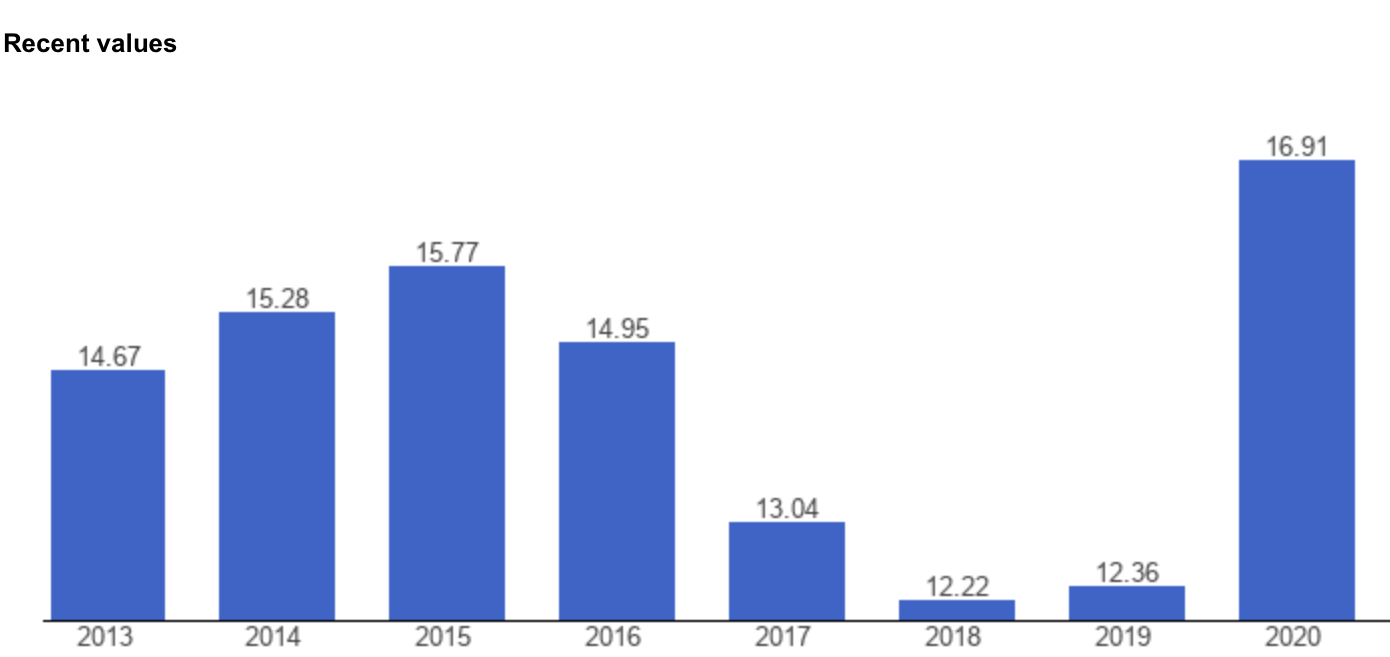
Pakistan's domestic savings rate recovered to nearly 17% after plunging to a low of 12% in 2018. Savings are extremely important for increased investment to spur GDP growth in any country, including Pakistan.
Pakistan's forex reserves were running dangerously low forcing the country to seek a $6 billion IMF bailout in 2018 to avoid default. The total reserves now exceed $22 billion.
Prime Minister Imran Khan's government recently resolved an $11 billion in damages that the country faced for improperly canceling a huge copper-gold mining deal in Balochistan.
Reko Diq is the world's 4th largest undeveloped copper-gold porphyry deposit with over 14 million tons of copper and 21 million ounces of gold. The project was abandoned in 2011 after a Pakistan Supreme Court bench headed by former Chief Justice Iftikhar Chaudhry canceled the mining license granted to Tethyan Copper Company (TCC), a joint venture between Canada's Barrick Gold and Antofagasta Minerals of Chile. TCC challenged the cancellation in the International Centre for Settlement of Investment Dispute (ICSID). On July 12, 2019, the ICSID Tribunal awarded TCC $5.894 billion plus interest of $700,000 per day in damages against Pakistan. As of 1 March 2022, the award stood at $6.5 billion. The new agreement between Barrick Gold Corporation and the governments of Pakistan and Balochistan does away with this award. It also increases the share of the project owned by Pakistan from 25% to 50%, brings in $10 billion investment, the largest single investment in the country, and creates 8,000 jobs. Reko Diq is part of the Tethyan metallogenic belt (TMB) that extends from the Balkans in Europe to Pakistan including Serbo-Macedonian, Anatolian, Takab, Kerman and Chagai metallogenic belts. It is believed to be rich in copper and gold deposits.
Manufacturing and Construction Boom:
Large scale manufacturing grew by 8.2% in February 2022, after posting 7.6% growth during July-Jan FY22.
Pakistan Large Scale Manufacturing Index. Source: Mettis Global
The LSMI Quantum Index Number (QIM) hit an all-time high of 136.2 points in January, 2022. It averaged 120 points during July-January (2021-22), up from 111.5 points during July-January (2020-21), showing growth of 7.6%, according to latest PBS data.
Pakistan cement production has increased by double digits to respond to demand for housing and infrastructure construction on Prime Minister Imran Khan's watch.
Technology Boom:
The year 2021 was a banner year for technology startups in Pakistan. There was a 437% jump in investments in the startups, raising a total of $352 million across 72 deals in 2021, according to Aljazeera.
Pakistan technology exports have soared 30% to $1.7 billion in the first 8 months of the current fiscal year, according to the State Bank of Pakistan.
Expansion of Social Safety Net:
Pakistan's PTI government has built South Asia’s first digital National Socio-Economic Registry (NSER) as a part of its ambitious effort to build a basic social safety net. The Ehsaas (also known as BISP- Benazir Income Support)) program's socio-economic registry includes household information by geography, age, income, education, health, disability, employment, energy consumption, land and livestock holdings etc. Ehsaas Programs include both Unconditional Cash Transfers (UCT) and Conditional Cash Transfers (CCT). Unconditional Cash Transfers are made only to people living in extreme poverty or distress. Conditional Cash Transfers like Waseela-e-Taleem and Nashonuma are given for education and nutrition respectively. In addition, there are feeding centers (langars) for the hungry and shelters (panahgahs) for the homeless.
OIC Foreign Ministers in Islamabad:
Recent conference of Islamic countries foreign ministers hosted by Pakistan in Islamabad was attended by 56 nations. Chinese foreign minister Wang Yi attended as a special guest. Here's an excerpt of the Islamabad Declaration issued at the conclusion of the two-day conference:
“We declare that the final settlement of the Jammu and Kashmir dispute in accordance with UN Security Council resolutions is indispensable for durable peace in South Asia. We reiterate our call on India to: a) reverse its unilateral and illegal measures instituted since 5th August 2019; b) cease its oppression and human rights violations against the Kashmiris in IIOJK; c) halt and reverse attempts to alter the demographic structure and to redraw electoral constituencies in IIOJK; and d) take concrete and meaningful steps for full implementation of the UN Security Council resolutions on Jammu and Kashmir,”
Response to Indian hostility:
Prime Minister Imran Khan's government won praise for its handling of India's aggression with unprovoked air strikes in Balakot in February 2019. Pakistan responded with "Operation Swift Retort", shot down two Indian fighter jets and captured an Indian Air Force pilot. But Khan's government avoided further escalation of the incident. Similarly, Pakistan responded calmly to the "accidental firing" of Indian Brahmos cruise missile into Pakistan that could have easily escalated into a full-scale war between two nuclear-armed neighbors.
No-Confidence Vote:
Pakistan's opposition parties have recently come together to try to topple Prime Minister Imran Khan's government. These opposition parties have little in common other than their hunger for power. If they succeed, the country will plunge into yet another period of instability and uncertainty that will reverse progress made in the last few years to stabilize the country's economy.