Showing posts with label Technology. Show all posts

Friday, June 12, 2026

Quantum Computing IPO Makes A British Pakistani Billionaire

Ilyas Khan, the British Pakistan founder of Quantinuum, became a billionaire in the company’s IPO on NASDAQ last week. Khan is a pioneer in the revolutionary field of quantum computing which could speed up computing by orders of magnitude. It will have a huge impact in AI and encryption. Dr. Irfan Siddiqui, a Pakistani-American professor of Physics at University of California at Berkeley, is another top expert in quantum computing. 

Ilyas Khan, British Pakistani Founder of Quantinuum. Source: 2023 BLOOMBERG FINANCE LP


Quantinuum raised $1.68 billion in an initial public offering last week, making its founder Illyas Khan a billionaire, according to Forbes. The listing, which is the largest to date for a quantum startup, valued Quantinuum at over $15.6 billion after it sold 28 million shares at $60 each on June 3. Its shares opened at $58 per share on June 9. Khan, who owns around 15% of the company, is now worth $2.2 billion. Quantinuum uses a new type of quantum computer; rather than running on silicon chips, it instead uses ions trapped in place with lasers to execute computations. 

Ilyas Khan is the founder and former CEO of Cambridge Quantum, which merged with Honeywell's quantum division to form Quantinuum, now regarded as a global leader in quantum technologies valued at over $15 billion. He is involved directly in Pakistan's technology sector, where he provides guidance on integrating high-level quantum technologies into Pakistan's growing tech infrastructure.

Dr. Irfan Siddiqui, Professor at UC Berkeley


In quantum computing, a qubit or quantum bit is the basic unit of quantum information—the quantum version of the classical binary bit physically realized with a two-state device. Here's how Dr. Siddiqui explained quantum computing in an interview with Design News:

"For me, any quantum technology, including quantum computing, is something that takes advantage of entanglement. And entanglement is the idea that if you have different pieces of matter and you put them together, they behave as a single unit. So, for example, each of the bits in a classical computer are independent of each other. If you flip one, it doesn't affect the one next to it. In quantum computers all of these bits have correlation with each other so they're all tied together like one big mass. In fact, the number of states that they can occupy is exponentially larger because of these linkages between neighboring elements. Quantum computing is the science of manipulating this entangled set of bits for some particular problem of interest in either fundamental science and computation or to do a simulation of the natural world."

Four of Ten Pakistani-American Founders of Unicorns


Pakistanis' footprint is growing in the western tech ecosystem. Ten Pakistani immigrants are included among founders or co-founders of unicorns in America, according to  a recent study by the National Foundation for American Policy (NFAP). A unicorn is a startup with a valuation of at least one billion U.S. dollars. Immigrant entrepreneurs of US unicorns are diverse, hailing from 76 different countries. India, with 96 companies, is the leading country of origin for the immigrant founders of U.S. billion-dollar companies. Immigrants from Israel founded the second-most billion-dollar companies with 60, followed by the United Kingdom (47), China (41), Canada (30), Russia (23), France (21), Germany (18), Ukraine (16), Australia (14), Pakistan (10) and Romania (10). Some companies were founded by entrepreneurs from the same country or immigrants from multiple countries.

Related Links: 


Monday, June 8, 2026

Ten Pakistanis Among Unicorn Founders in America

There are ten Pakistani immigrants included among founders or co-founders of unicorns in America, according to  a recent study by the National Foundation for American Policy (NFAP). A unicorn is a startup with a valuation of at least one billion U.S. dollars. Immigrant entrepreneurs of US unicorns are diverse, hailing from 76 different countries. India, with 96 companies, is the leading country of origin for the immigrant founders of U.S. billion-dollar companies. Immigrants from Israel founded the second-most billion-dollar companies with 60, followed by the United Kingdom (47), China (41), Canada (30), Russia (23), France (21), Germany (18), Ukraine (16), Australia (14), Pakistan (10) and Romania (10). Some companies were founded by entrepreneurs from the same country or immigrants from multiple countries.

Four of Ten Pakistani-American Founders Listed Among Unicorns


Why are Indian entrepreneurs leading the pack of unicorn founders/co-founders in America?  The key reason is that “the great Indian brain drain” is accelerating with the country rapidly losing its best and brightest to the West, particularly the United States. Large presence of the Indian immigrant unicorn founders in America is attributed to the fact that most immigrant founders come to the U.S. as students or H1B workers, categories dominated by Indians. Over 80% of the H1B visas go to Indian applicants. India also leads in sending students to study in US universities. 

Unicorns in America. Source: NFAP

Pakistan, too, is suffering brain drain but not on the same scale as India. Most prominent among Pakistan-origin unicorn founders/cofounders are Karachi-born Sualeh Asif, Lala Moosa-born Qasar Younis, Karachi’s NED University alumnus Rehan Jalil and Pakistani-American serial entrepreneur Zia Chishti. 

26 year old Karachi born Sualeh Asif, cofounder of Cursor (Anysphere) recently joined the list of Forbes Billionaires after Cursor reached a $29.3 billion valuation in November 2025, according to Forbes magazine. 

43 year old Qasar Younis, a Lala Moosa born Harvard-educated Pakistani-American, is the CEO of  Applied Intuition, a physical AI and autonomous vehicle software firm valued at $15 billion. Younis's resume includes his role as Chief Operating Officer of Y-Combinator, a spawning ground for tech giants Dropbox, Airbnb, and Stripe in Silicon Valley, according to Fortune Magazine.

Rehan Jalil, a fellow alumnus of NED University in Karachi, founded AI-powered data privacy and governance platform Security.AI. The startup has now been acquired by Veeam for $1.725 billion.

Zia Chishti is a serial entrepreneur from Pakistan. He founded Afiniti.AI which reached a $1.6 billion valuation back in 2017. founded his first company Align Technology in 1997 in Silicon Valley. It creates clear plastic braces for straightening teeth by using advanced 3-D computer imaging. The technology now trademarked as Invisalign has helped millions of people straighten their teeth for a beautiful smile without enduring the pain and unsightly looks of the traditional steel brackets and wires used in orthodontics. Align Technology is now valued at $10 billion.

The NFAP study found that immigrants have founded or co-founded 59% (455 of 775) of America’s privately held startup companies valued at $1 billion or more. That is an increase from 55% in NFAP reports released in 2018 and 2022. 

Approximately two-thirds (66%) of U.S. billion- dollar companies (unicorns) were founded or cofounded by immigrants or the children of immigrants. Nearly 80% of America’s unicorn companies (privately held, billion-dollar companies) have an immigrant founder or an immigrant in a key leadership role, such as CEO or vice president of engineering. Almost one in four U.S. billion- dollar companies, or 24%, have a founder who came to America as an international student. The research shows the importance of immigrants in cutting-edge companies and the U.S. economy at a time when U.S. immigration policies have grown more restrictive.

The collective value of the 455 immigrant-founded billion-dollar companies is $5.0 trillion, which is more than the total market value of companies listed on stock markets in all but 7 countries, including the UK and Germany, and a demonstration of the wealth-creating power of immigrants. The collective value of immigrant-founded billion-dollar companies rises to over $5.8 trillion if one includes unicorn companies that have gone public since 2016.

Related Links: 

Tuesday, July 8, 2025

Pakistani Prosthetics Startup Aiding Gaza's Child Amputees

While the Israeli weapons supplied by the "civilized" West are destroying the lives and limbs of thousands of Gaza's innocent children, a Pakistani startup is trying to provide them with free custom-made prostheses, according to media reports. The Karachi-based startup Bioniks was founded in 2016 and has sold prosthetics that use AI and 3D scanning for custom designs. 

Gaza's Child Amputee Sidra Al Bordini with Bioniks CEO Anaz Niaz. Source: Instagram


Bioniks has recently delivered its first prosthetics made for Gaza's children using remote imaging to design custom arms at low cost.  The demand for such prosthetics is high because, according to the United Nations, Gaza has 4500 new amputees since October 7, 2023 Hamas attack which triggered Israel's brutal response and started the ongoing genocide in Gaza. 

A recent Reuters story cites the examples of two girls,  three-year-old Habebat Alla and 8 year-old Sidra Al Bordini, who recently received artificial limbs made by Bioniks. Both were severely injured in Israeli air strikes. Sidra and Habebat Allah, who lost both her arms and a leg in Gaza, went through days of remote consultations and virtual fittings. Then Niaz flew from Karachi to Amman, Jordan to meet the girls and make his company's first overseas delivery. children need lighter limbs and replacements every 12–18 months as they grow.  Niaz said the company was exploring funding options for Sidra and Habebat's future replacements, adding the cost wouldn't be too high.

The company used a smartphone app to take pictures from different angles and created a 3D model to print custom prosthetics. Bioniks CEO Anas Niaz said the social enterprise startup had fit more than 1,000 custom-designed arms inside Pakistan since 2021 - funded through a mix of patient payments, corporate sponsorship, and donations - but this was its first time providing prosthetics to those impacted in conflict, according to Reuters

Here's how the company describes itself on its website: "At Bioniks, we believe in turning disabilities into possibilities. Founded with a mission to empower individuals with disabilities, we are pioneers in advanced prosthetics and assistive technologies in Pakistan. Our innovative solutions are designed to restore mobility, independence, and dignity to those who need it most. Bioniks revolutionizes the field of healthcare through advanced-level prosthesis and surgical planning tools that are created using state of the art technologies and designing techniques. We at Bioniks aim to provide healthcare solutions that bring measurable value to those who use it and are shaped keeping their precise needs in mind."

Earlier this year, the startup was recognized for contributions to advancing the United Nations Convention on the Rights of Persons with Disabilities, placing it among the world’s most “impactful and scalable” technology. It is the first Pakistani company to win the Zero Project Award, according to media reports

Related Links:


Haq's Musings

South Asia Investor Review

Modi and Netanyahu: Two Sides of the Same Coin

Israel's Gaza Attack is Criminal, Not Defensive

Pictorial Review of Israel's Young Gaza Victims

American College Campuses Rise Up Against Israel's Genocidal War on Gaza

Israeli Settler Colonialism

Islamophobia Driving US Policy in the Middle East and South Asia?

Israeli Scholars Offer Insights into Zionist Psyche

Total, Extended Lockdown in Indian Occupied Kashmir

What is India Hiding From the UN Human Rights Team?

Indian JNU Professor on Illegal Indian Occupation of Kashmir, Manipur, Nagaland

Riaz Haq Youtube Channel

PakAlumni: Pakistani Alumni Social Network


Friday, June 20, 2025

Pakistani-American Entrepreneur's AI Startup Commands $18 Billion Valuation

Anysphere, founded in 2022 by Sualeh Asif, Arvid Lunnemark, Aman Sanger and Michael Truell, has been approached by investors about a deal that would more than double its valuation in a new funding round to $18 to $20 billion, according to BloombergSualeh Asif, 25, the Chief Product Officer and co-founder, hails from Karachi, Pakistan.  He studied at Nixor College in Karachi before going to the United States in 2018. He met the other three co-founders while studying at the Massachusetts  Institute of Technology (MIT). One-half (Sualeh Asif and Aman Sanger) of the startup’s founding team is of South Asian origin. The company moved to San Francisco soon after its founding in 2022. 

Sualeh Asif, Anyshphere Inc's Pakistani-American Founder


Anysphere’s lead product is an AI code editor called Cursor AI.  It works as an AI assistant that writes code and also anticipates code developer's needs, identifies inefficiencies, and helps solve complex problems with relative ease. On his personal website sualehasif.me, Sualeh says: "I’m building Cursor to discover a new way to write code. I owe much of my fun to my friends and MIT. I am extremely excited about the new capabilities of LLMs and applications to code tools". 

In early 2024, Anysphere raised $60 million in a Series A financing (co-led by Andreessen Horowitz and Thrive Capital and included Patrick Collison, CEO of Stripe) at a $400 million post-money valuation, according to TechCrunch. It was followed by a $105 million Series B funding round in December 2024. Earlier this month, Anysphere said it raised $900 million at a valuation of $9.9 billion, including the new investment, in a round led by Thrive Capital. Andreessen Horowitz, Accel and DST Global also participated. 

Several investors have recently floated a funding offer that would value Anysphere at $18 billion to $20 billion, according to Bloomberg.  The startup's revenue has recently surpassed $500 million on an annualized basis. 

“We have not engaged with or spoken with any investors about financing since our Series C,” Chief Executive Officer Michael Truell wrote to Bloomberg in response to a query. “We’re not focused on fundraising and have lots to do on building the technology, product, and team. Cursor can be made much more useful, and we’re spending time on that.”


Friday, May 9, 2025

Pakistan Downs India's French Rafale Fighter Jets in History's Largest Aerial Battle

Pakistan Air Force (PAF) pilots flying Chinese-made J10C fighter jets shot down at least two Indian Air Force's French-made Rafale jets in history's largest ever aerial battle involving over 100 combat aircraft on both sides, according to multiple media reports. India had 72 warplanes on the attack and Pakistan responded with 42 of its own, according to Pakistani military. The Indian government has not yet acknowledged its losses but senior French and US intelligence officials have confirmed that at least one Indian Rafale jet was shot down by Pakistan on May 7, 2025. Reports of  more Rafale downings are being investigated by western intelligence officials. This marks the first time that the sophisticated French-made warplane has been lost in combat.


Rafale is the most advanced French 4.5 generation fighter plane. Indian Prime Minister Narendra spoke about India's need for Rafale back in 2019 after the last IAF-PAF dogfight and said: "We (Indians) acutely felt the absence of Rafale today.....if we had Rafale today the results would have been very different....desh ka bahut nuksaan hua hai"  Then Mr. Modi proceeded to spend $7.4 billion to purchase 26 Rafale fighter jets from France in the hope of achieving air superiority over Pakistan.  Each Rafale cost Indian taxpayers $288 million. 

Military aviation analysts conclude from the results of the air battle that the Chinese technology is as good, if not better than, the western technology. However, men count as much, if not more than, the machines.  The legendary US Air Force pilot Chuck Yeager called Pakistan Air Force pilots "the best in the world".  In another tweet in 2015, Yeager said "they (PAF pilots) kicked the Indians butt". 

In the 1980s, the Pakistan Air Force pilots went head-to-head with Russian combat pilots in Afghanistan. The Pakistan Air Force (PAF) has the distinction of being the only air force that has engaged and shot down multiple Russian fighter pilots in combat since WWII.  The most prominent among those shot down by PAF was Colonel Alexander Rutskoy who ejected over Pakistani soil and was captured by Pakistan. After his release, Rutskoy was decorated as a hero of the Soviet Union and went onto become vice president of Russia under Boris Yeltsin, before leading an attempted coup in 1993, according to The National Interest publication. 

The aerial battle between Pakistani and Indian fighter jets, which Pakistani officials claim downed five Indian planes, was one of the “largest and longest in recent aviation history,” a senior Pakistani security source told CNN.  Over 100 combat planes battled for over an hour, with neither side leaving its own airspace, according to the CNN source who detailed that the missile exchanges were happening at distances sometimes greater than 160 kilometers (100 miles).  The entire air battle was conducted using BVR (beyond visual range) radars/sensors with stand-off weapons. 

Global militaries and defense analysts are now studying the India-Pakistan aerial battle on May 7, 2025, according to Reuters. Here's an excerpt of the Reuters' report: 

"Experts said the live use of advanced weapons would be analyzed across the world, including in China and the United States which are both preparing for a potential conflict over Taiwan or in the wider Indo-Pacific region. One U.S. official, speaking on condition of anonymity, told Reuters there was high confidence that Pakistan had used the Chinese-made J-10 aircraft to launch air-to-air missiles against Indian fighter jets". 

Here's Prime Minister Modi Speaking of India's Acute Need For Rafale in 2016:

https://youtu.be/QIt0EAAr3PU?si=KpcJW60jvD9r0xeQ


Related Links:

Haq's Musings

South Asia Investor Review

US Missile Sanctions: Is Pakistan Really Developing ICBMs?

Pakistan's Cyber Attack and Defense Capability

IDEAS2024: Pakistan Defense Industry Expo

Pakistan's Aircraft Exports

Pakistan Navy Modernization

West's Technological Edge in Geopolitical Competition

Modi's India: A Paper Elephant?

Pahalgam Attack: Why is the Indian Media Not Asking Hard Questions?

Ukraine's Lesson For Pakistan: Never Give Up Nukes!

Pakistan Economy Nears Trillion Dollars

Pakistan's Sea-Based Second Strike Capability

Riaz Haq Youtube Channel

VPOS Youtube Channel

Tuesday, March 4, 2025

Growing China-Pakistan Space Cooperation

A Pakistani astronaut is scheduled to be the first non-Chinese person to go to Tiangong, the Chinese Space Station, according to media reports. Last year, China put a Pakistani satellite ICUBE-Q aboard its historic Chiang’e 6 mission into the moon’s orbit, designed to retrieve samples from the little explored far side of the moon. Weeks later, Beijing put another Pakistani communication satellite into orbit. The two sides have also announced that China’s Chang’e 8 moon lander mission in 2028 will carry a Pakistani rover to explore the moon's surface. 


Space science is a lot more than rocket science. It goes well beyond building booster rockets for satellite launches. It includes various fields like physics, astronomy, biology, chemistry, and engineering to study phenomena in space and collect and analyze data about activities on earth.  Pakistan-China space cooperation is yet another confirmation of the close and growing scientific ties between the two countries. Tens of thousands of Pakistani students are currently attending Chinese universities which are among the best in the world. Thousands of Pakistani engineers and scientists are closely working with their Chinese counterparts on multiple projects. It is great opportunity for Pakistanis to learn from astounding scientific and technological achievements of their Chinese counterparts. 

Chinese researchers dominate global AI research, according to Marco Polo which tracks global AI talent. China dominates the top 10 science institutions, with the Chinese Academy of Sciences (CAS), the University of Science and Technology of China (USTC) and Tsinghua University taking the top three spots, according to the Science Journal Nature. Only two non-Chinese institutions broke into the top 10 – the Max Planck Society in Germany at No 4 and the French National Center for Scientific Research at No 10. The top three US institutions – the Massachusetts Institute of Technology, Harvard University and Stanford University – were ranked at 13th, 16th and 20th, respectively.

Analysts believe that China's real focus is on industrial applications for Artificial Intelligence (AI) rather than chatbots like ChatGPT or DeepSeek. Chinese are working to use the underlying technology to develop affordable, commercially viable business solutions, according to Jacob Dreyer who recently wrote an article for science journal Nature. "Its applications can then be exported, especially to lower-income countries. In other words, China’s target is not necessarily ‘frontier AI’, but ‘mass-market AI’. Its emerging AI playbook mirrors its approach to other technologies, such as electric vehicles and clean energy: not the first to innovate, but the first to make them affordable for widespread use". 


Sunday, October 6, 2024

Is Pakistan Getting Ready For AI Revolution?

Generative artificial intelligence (GenAI) has taken the world by a storm. It has drawn the attention of academia, businesses and governments around the world.  This technology is expected to transform almost every sector from business and commerce to government, industries and defense. Are Pakistanis aware of its potential?  Is Pakistan getting ready for what is being described as the "AI Revolution"? Let's examine the answers to these questions. 


AI awareness is rising among Pakistan’s general public. The country ranks third with 76% of people being aware of ChatGPT, according to Stanford University’s AI Index Report 2024 covering a survey of 31 countries, including the United States, Europe and East Asia.  India (82%), Kenya (81%), Indonesia (76%), and Pakistan (76%) have the highest awareness rates in the world.  Brazil and Canada have 64% awareness, UK and Japan 61%, China, Germany and France 60% and the US 55%. Poland reported the lowest awareness, at 43%. Globally, 17% of users utilize it daily, 36% weekly, and 16% monthly. India (36%), Pakistan (28%), and Kenya(27%) report the highest levels of daily usage. 

Pakistan is among the top 4 countries for enrollment in Coursera online GenAI courses, according to Jeff Maggioncalda, CEO of Coursera. India, Egypt, Pakistan, and Brazil, make up more than half (52%) of GenAI enrollments on Coursera. It offers more than 4,600 courses and 55 Professional Certificates in up to 21 popular languages, including Arabic, Hindi, and Spanish.  Coursera, a global online education platform, was launched in 2012 by two Stanford Computer Science professors, Andrew Ng and Daphne Koller. 

Pakistan's HEC (Higher Education Commission) has established a partnership with Coursera to give access to online quality education in Pakistan.  As a result, more than 200 universities have gained access to Coursera’s library of courses.  Over 267,000 courses have been completed with students logging over 1.4 million learning hours. More than 45,000 learners have achieved deep-skills specialized certifications from internationally recognized institutions, the most popular specializations being Communication, Data Analysis, and Leadership and Management, according to Coursera

Ashar Aziz Foundation, created and funded by Pakistani-American technology entrepreneur Ashar Aziz, has sponsored Advanced AI Bootcamps at the National University of Science and Technology (NUST) in Islamabad.  The bootcamp series not only provides theoretical knowledge but also emphasizes practical, project-based learning, according to NUST. 

The first AI bootcamp, which focused on Deep Neural Networks (DNNs), was successfully completed at NUST in November 2023. The second bootcamp provided participants with in-depth knowledge and hands-on experience in the development and application of LLMs (Large Language Models). Ghulam Ishaq Khan Institute of Engineering Sciences & Technology (GIKI) also joined this initiative in 2024, conducting its own DNN-focused bootcamp. Participants have the opportunity to work with advanced technologies, including access to a 10xH100 NVIDIA GPU AI supercomputer, ensuring they are well-prepared to tackle real-world challenges in AI. As part of its ongoing efforts, NUST plans to partner with additional universities across Pakistan to further scale this initiative, ensuring that more students have access to high-quality AI training, according to NUST

Smaller towns in Pakistan are also setting up AI programs with the help of Pakistani-Americans. For example, Stanford educated AI expert Shoaib Lari and Silicon Valley based technology executive Jalil Shaikh have helped Islamia University Bahawalpur start an AI program. Jalil Shaikh is now working with US-based companies to place the first group of graduates from this program. 

STEM education underlies Artificial Intelligence. Pakistan stands 4th in the world with 642,562 students enrolled in STEM courses– behind Nigeria (675,371), the US (4,639,771) and India (6,000,967), according to Coursera's Global Skills Report 2023. My own estimate based on HEC data is that STEM enrollment in Pakistan exceeds one million. 

The Pakistan government has released its National AI Policy Draft for comments. It focuses on how AI can help the country promote its national competitiveness and improve the lives of its citizens by outlining a wide range of developmental initiatives necessary for awareness and adoption of AI, reimagining the transparent and fair use of personal data using AI, and stimulating innovation through industry-academia collaborations and investments in AI-led initiatives. The Pakistan government has set up a National Center for Artificial Intelligence (NCAI) at the National University of Science and Technology (NUST). NCAI has created a a consortium model consisting of 6 public sector universities with 9 specialized research centers spread across Islamabad, Lahore, Karachi, Peshawar. 

Pakistan has also seen several private-sector led initiatives to create greater awareness of AI. For instance, Karachi.AI is recognized as a premier community for Applied AI practitioners. Established in 2017, the community proudly hosts over 10,000 members representing various domains. Its mission revolves around three central pillars: raising awareness, promoting engagement, and driving execution. Karachi. AI hosts regular meetups in Karachi, which are also live streamed on its YouTube channel, along with other educational content about AI.  

In addition to skilled human capital, the GenAI apps require a lot of digital public infrastructure, powerful computers and large data centers to securely store and rapidly access vast amounts of data. A number of private investors are jumping in to build data centers in Pakistan. Mari Petroleum Company Limited (MPCL) is planning to develop data centers across the country as part of an expansion into digital infrastructure.  Chakwal Spinning Mills Limited, has recently said it was pivoting to develop data centers.


Friday, February 16, 2024

Pakistan Elections: Imran Khan's Supporters Skillfully Used Tech to Defy Powerful Military

Independent candidates backed by the Pakistan Tehreek e Insaf (PTI) party emerged as the largest single block with 93 seats in the nation's parliament in the general elections held on February 8, 2024.  This feat was accomplished in spite of huge obstacles thrown in front of the PTI's top leader Imran Khan and his party leaders and supporters by Pakistan's powerful military to prevent their victory. 

Pakistan's Official Election Results 2024. Source: Aljazeera 

Imran Khan and his top party leaders were thrown in jail on trumped up charges, his party was denied a unified electoral symbol of cricket bat, his supporters' rallies were banned, the mainstream media were prevented from carrying PTI leaders' speeches and the Internet was repeatedly blocked when the party held online events. So how did they succeed in spite of it? The answer lies in how skillfully the PTI activists used technology to get the party's messages out to the country's young electorate. 

Well over 90% of Pakistan's adults have access to the Internet. This allows them to use a variety of  apps ranging from TikTok and YouTube to Facebook, Instagram and X. The PTI supporters used AI (Artificial Intelligence) to produce Imran Khan's speeches using his own voice and words and made them go viral. They used X Spaces to engage with the public. Here's how Uzair Younus, a Pakistani-American analyst at The Atlantic Council, a Washington-based Think Tank, describes what occurred:

"The result of PTI’s technological campaign strategy was a more engaged and informed electorate, which translated into significant electoral gains. Khan’s PTI managed to galvanize a significant part of the electorate, and the party’s success demonstrates the potential of digital tools to democratize political participation and challenge entrenched power structures". 

When it became clear that the PTI was headed for a massive victory with more than half of the 264 National Assembly seats as live results from the polling started to pour in on the evening of February 8, there was a sudden mysterious delay in real time reporting. Most political analysts in Pakistan believe that this delay was ordered by the Pakistani military to rig the results.  This belief is confirmed by the reports that the total votes reported cast for PTI  by the polling stations on "Form 45" add up to a lot more votes than those reported cast on "Form 47" for over 55 constituencies of the National Assembly. These 55 seats plus the officially reported 93 seats add up to 148 seats giving PTI more than half of the total 264 directly elected members in the National Assembly. 

Any coalition government formed by the PTI opponents is unlikely to be stable or long lasting. This unstable situation will likely prolong the deep economic crisis the country now faces. The best course of action for the Pakistani military is to release Imran Khan from jail and allow his party to form the next government. 

Related Links:


Saturday, July 8, 2023

Are India's Leaders Uneducated? What is Modi's Education Level?

Bollywood star Kajol has said at a recent event that Indian political leaders are uneducated. Though she did not name anyone, she is facing vicious attacks by Modi Bhakts, a label embraced by the staunch supporters of Indian Prime Minister Narendra Modi. Here's what she said, "Change especially in a country like India is slow. It’s very very slow because for one we are steeped in our tradition, steeped in our thought process and, of course, it has to be with tradition. You have political leaders who do not have educational system background. I’m sorry I’m going to go out and say that.”   “We are being ruled by leaders, so many of them, who do not have that viewpoint which I think education gives you”, she added. 


Copies of Modi's Degrees. Source: BJP


There have long been questions about the educational qualifications of Mr. Modi who has talked about his humble origins as chaiwalla (tea seller) . These questions have been stoked by contradictory assertions by Mr. Modi and his closest lieutenants in the BJP party. First, Mr. Modi allegedly said in a 1990s interview, well before he ascended to the office of the prime  minister, that he did not have any formal education. In multiple video clips that circulated on social media, most of them before the 2014 general election, Modi mocked himself for being ‘uneducated’.  But in 2016, Amit Shah and Arun Jaitley showed copies certifying that Mr. Modi was awarded a BA (division III) from Delhi University in 1978 and Gujarat University gave him an MA (division I) in Entire Political Science in 1983 as an external candidate. In response to an RTI (right to information) query, seeking a list of students who had qualified for a BA degree in 1978, the SOL (School of Open Learning) said, "The data is not maintained in the branch in the order as desired by the applicant." It should be noted that there's no such discipline as "Entire Political Science" offered at Gujarat University.  

Attempts by Delhi Chief Minister and Aam Admi Party (AAP) Chief Arvind Kejriwal to get Gujarat University to confirm the BJP leaders' claim have so far failed. The AAP chief has now filed a review petition after the High Court set aside an order from the Central Information Commission (CIC) that had directed the university to "search for information" regarding PM Modi's degree, according to ANI reports

In an open letter,  Aam Aadmi Party leader Manish Sisodia has warned that Prime Minister Narendra Modi’s “lack of educational qualification” was dangerous for India. “Modi does not understand science…” Sisodia alleged. “He does not understand the importance of education. It is necessary to have an educated prime minister for the progress of India.”

The Indian Prime Minister's poor education is reflected in his lack of understanding of the complexity of the idea of Indian nationhood and its long contentious history. It also shows in his poor decision-making processes in demonetization and nation-wide covid lockdown.  

Modi's attempts to forge India's new Hindutva identity as a Hindu Rashtra are raising serious doubts about maintaining its unity. Hatred against religious minorities,  particularly Muslims, has reached new heights. In a recent Op Ed,  Mr. Shashi Tharoor summed it up in the following words:  "The BJP’s belligerent Hindutva nationalism – which promotes a narrow interpretation of history and demonizes India’s minorities, particularly Muslims – can be likened to a toxin injected into the veins of Indian society". 

Gopal Krishna Pillai, one of India’s most highly regarded former home secretaries, says “secular Hindus are uncomfortable, frustrated” adding “and don’t know what should we do in Modi’s India”. He told Karan Thapar in a recent interview that India could be 10 years away from danger point which he described as “civil disturbance” if the present treatment of Muslims is not checked and reversed,  At one point in the interview he even briefly accepted that India could face “civil war”.

In a recent interview to CNN, former US President Barack Obama has pointed out the consequences of BJP's anti-Muslim policies. “If the (US) President meets with Prime Minister Modi, then the protection of the Muslim minority in a Hindu majority India is worth mentioning. If I had a conversation with Prime Minister Modi, who I know well, part of my argument would be that if you don't protect the rights of ethnic minorities in India, there is a strong possibility that India would at some point start pulling apart,” Obama had said. “We have seen what happens when you start getting those kinds of large internal conflicts. So that would be contrary to the interests of not only the Muslim India but also the Hindu India. I think it is important to be able to talk about these things honestly,” said Mr. Obama.

The poor handling of demonetization and the Covid pandemic by the Modi government have caused untold suffering for the Indian people, particularly the poor. Modi's attempts to accelerate the documentation of the Indian economy have killed the informal sector which employs the bulk of India's workers, causing persistently high unemployment.  Nationwide COVID lockdown has further exacerbated the situation for India's poor. It has resulted in worsening inequality in the country.  A recent survey found that the income of the poorest 20% of the country declined by 53% over the last 5 years. The survey, conducted by the People's Research on India's Consumer Economy (PRICE), a Mumbai-based think tank, also shows that in contrast, the same period saw the annual household income of the richest 20% grow by 39%, according to a report The Indian Express

Modi's false claims of India's glorious Hindu past seems to have been accepted by his followers without question. These claims include the inventions of computers, rockets, spacecraft, the internet, plastic surgery and nuclear weapons in ancient India—long before Western science came on the scene. Here's an excerpt of a report on Indian Science Congress held in 2019: 

"The most widely discussed talk at the Indian Science Congress..... celebrated a story in the Hindu epic Mahabharata about a woman who gave birth to 100 children, citing it as evidence that India's ancient Hindu civilization had developed advanced reproductive technologies. Just as surprising as the claim was the distinguished pedigree of the scientist who made it: chemist G. Nageshwar Rao, vice-chancellor of Andhra University in Visakhapatnam. "Stem cell research was done in this country thousands of years ago," Rao said". 

Hindutva ideologues are now in charge of school textbooks. They are deleting references to India's long Muslim history, particularly the Mughal period that produced top tourist attractions like the Taj Mahal in Agra and the Red Fort in Delhi. 

India has also dropped Darwin's theory of evolution and the periodic table of elements from some school textbooks, part of a widening campaign by Modi's Hindu nationalist government that has prompted warnings from educators about the impact on teaching and the country's vital technology sector, according to media reports

Prime Minister Modi's poor education was obvious when he addressed the joint session of the US Congress during his recent state visit to Washington D.C. He had trouble reading his speech from a teleprompter. He said "investigate" instead of "invest" in girls. He incorrectly read "optical" fiber as "political" fiber. He pronounced "relationship" as "relasonsippi". It's amazing how wildly popular he is with the Indian diaspora, particularly in the United States where Indians are considered to be the best educated ethnic group. 


Monday, June 12, 2023

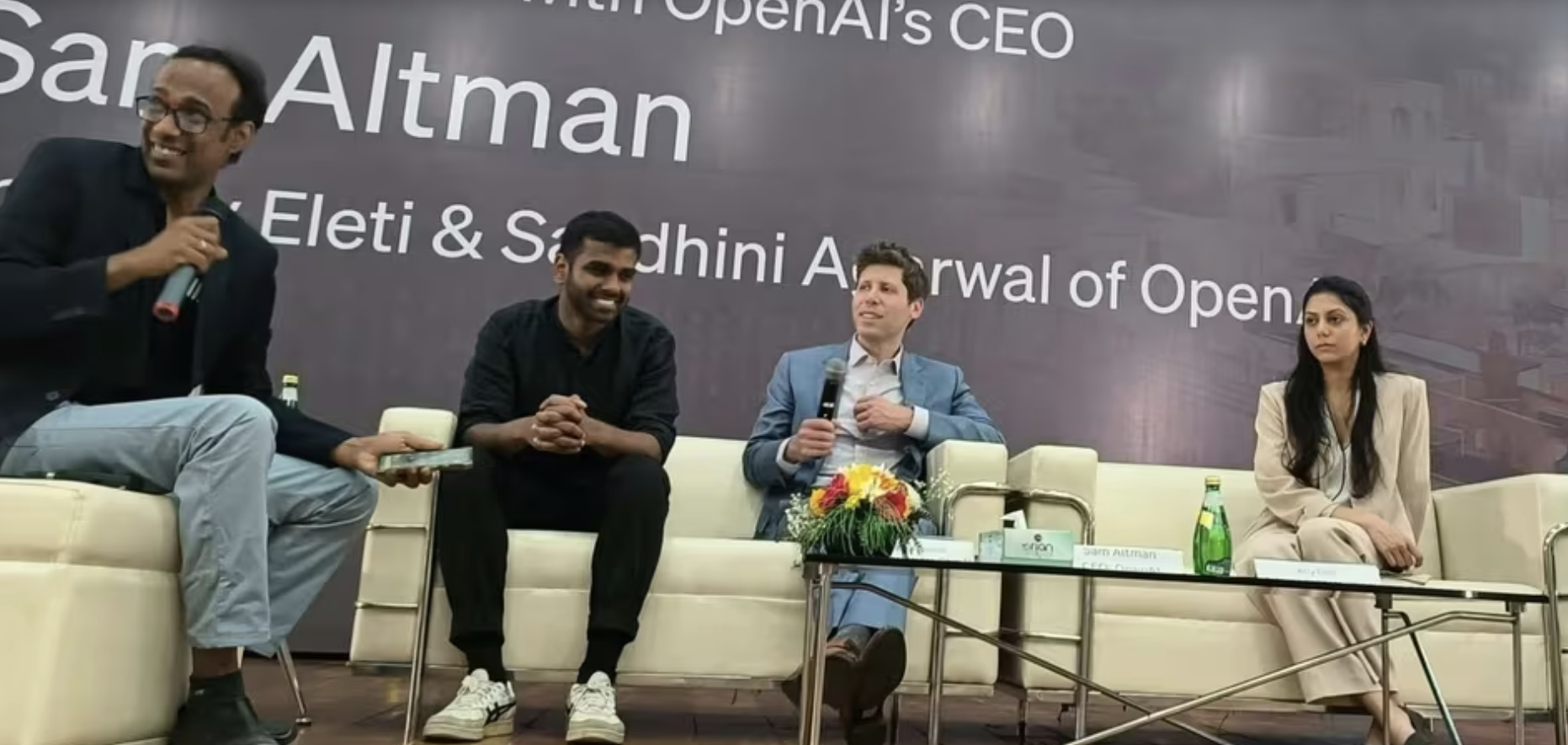
OpenAI CEO Sam Altman Says India's AI Startup Potential "Totally Hopeless"

Responding candidly to a question in the Indian capital New Delhi, OpenAI CEO Sam Altman said: "The way this works is we're going to tell you, it's totally hopeless to compete with us on training foundation models you shouldn't try, and it's your job to like try anyway. And I believe both of those things. I think it is pretty hopeless." This occurred at an event organized by The Economic Times where Altman answered a question by Rajan Anandan, a former Vice President of Google in India and South East Asia and current venture capitalist.  

OpenAI CEO Sam Altman in India

Altman in Delhi: 

Sam Altman, the young CEO of OpenAI, the company that recently launched its revolutionary Generative AI app ChatGPT, was in India as part of a six-nation tour to discuss AI regulation.  ChatGPT has been trained on massive amounts of data and text from the internet, textbooks, newspapers, magazines and academic journals. It can write computer code and carry on sophisticated conversations on a lot of different subjects. Altman is also visiting China. He was invited to speak at an event sponsored by Indian publication Economic Times.  Here's the full exchange between Anandan and Altman about the potential for an Indian AI startup:

Anandan: "Sam, we have got a very vibrant ecosystem in India but specifically focussing on AI, are there spaces where you see a startup from India building foundational (AI) models; how should we think about that. Where is it that a team from India, with three super-smart engineers having not 100, but USD 10 million each could actually build something truly substantial?"

Altman: "The way this works is, we're going to tell you. It's totally hopeless to compete with us on training foundation models. You shouldn't try, and it's your job to like trying anyway. And I believe both of those things. I think it is pretty hopeless."

Challenge Accepted:

Judging by social media responses, most Indians reacted angrily to Altman's negative remarks. They accused him of "arrogance". Others saw his statement as a challenge and responded by accepting the challenge. 

Tech Mahindra CEO CP Gurnani said he accepts the challenge.  “OpenAI founder Sam Altman said it's pretty hopeless for Indian companies to try and compete with them. Dear Sam Altman, from one CEO to another...CHALLENGE ACCEPTED,” tweeted Gurnani.

India's Tech Industry:

Americans like Sam Altman know that India's tech industry is made up mainly of companies that are essentially body shops. These companies like Infosys, TCS and others supply Indian H1B workers to perform routine tasks in IT operations departments of western companies. These companies' revenue, labeled India's "IT exports", comes from the substantial cuts they keep from the wages of millions of Indian H1B workers. These workers replace higher-paid American employees.  Rapid developments in AI technology are now threatening such jobs

In 2016, India filed a complaint with the World Trade Organization (WTO) when the US raised visa fees to $4000 for each H1B worker visa. Indian government argued that it is discriminatory to the country under its trade agreement with the US.

Indian startups are not based on any original ideas born in India. They are essentially copies of similar e-commerce or logistics or payments startups in the western world. 

Altman in China:

Altman is also visiting China this week. “China has some of the best AI talent in the world and fundamentally, given the difficulties in solving alignment for advanced AI systems, this requires the best minds from around the world,” Altman told participants at the event hosted by the Beijing Academy of Artificial Intelligence.

Western Media:

Indians were justifiably very proud of their great scientific achievement when the India Space Agency ISRO successfully launched the nation's Mars Mission back in 2013. The New York Times, America's leading newspaper, mocked India with a cartoon depicting the country as a dhoti-wearing farmer with his cow knocking on the door of the Elite Space Club. 

New York Times Cartoon
Der Spiegel's Cartoon Comparing India and China


In an article titled "Paper Elephant", the Economist magazine talked about how India has ramped up its military spending and emerged as the world's largest arms importer. "Its military doctrine envisages fighting simultaneous land wars against Pakistan and China while retaining dominance in the Indian Ocean", the article said. It summed up the situation as follows: "India spends a fortune on defense and gets poor value for money".

After the India-Pakistan aerial combat over Kashmir, New York Times published a story from its South Asia correspondent headlined: "After India Loses Dogfight to Pakistan, Questions Arise About Its Military".  Here are some excerpts of the report:

"Its (India's) loss of a plane last week to a country (Pakistan) whose military is about half the size and receives a quarter (a sixth according to SIPRI) of the funding is telling. ...India’s armed forces are in alarming shape....It was an inauspicious moment for a military the United States is banking on to help keep an expanding China in check".

Der Spiegel Cartoon:

In April this year, German publication Der Spiegel published a cartoon as India surpassed China as the world's most populous nation. The cartoon poked fun at India's lack of progress relative to its northern neighbor. It shows jubilant Indians on an old and overcrowded train – many on the roof – as it overtakes a sleek Chinese bullet train.

German Cartoon Comparing China and India. Source: Der Spiegel

Spanish Newspaper Cartoon:'

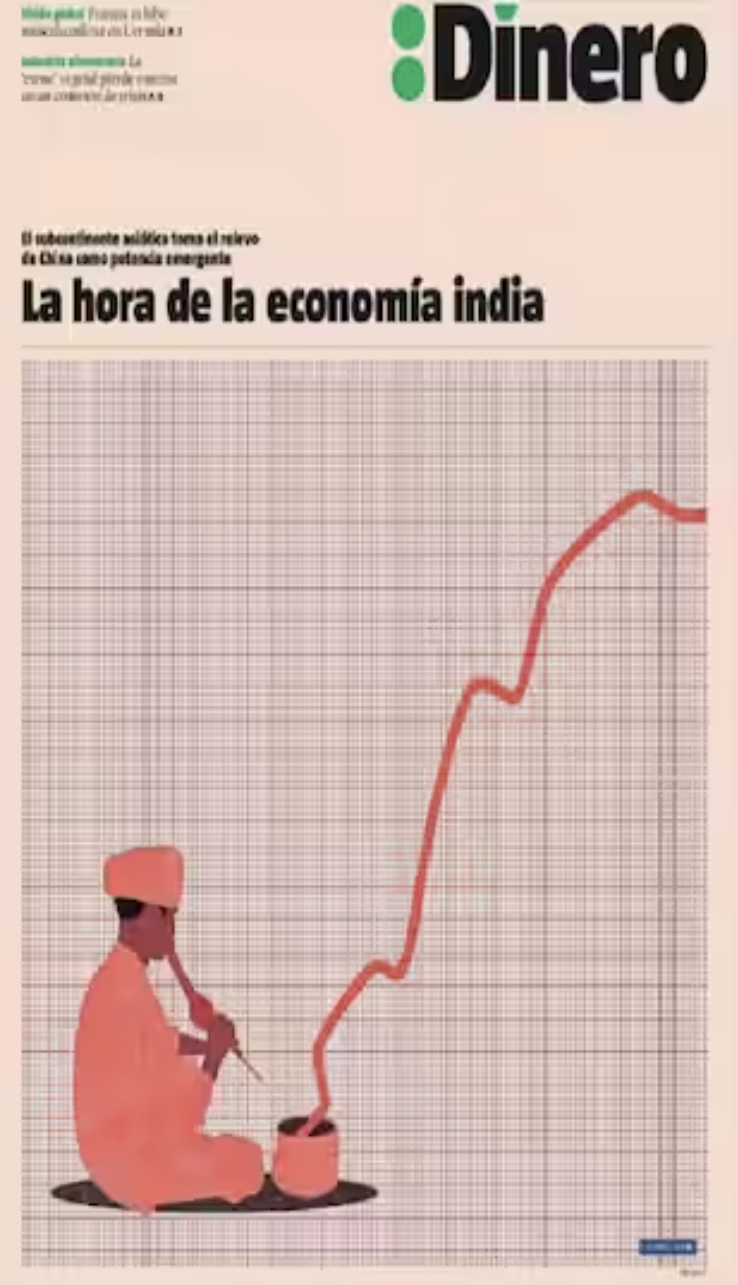
In May 2022, Spanish newspaper La Vanguardia published a story titled "La hora de la economia India" along with a cartoon showing an Indian snake charmer. Indian media reacted angrily to what they saw as a racist stereotype. 


Spanish Cartoon on Indian Economy. Source: La Vanguardia


US Disrespects India: 

Notwithstanding the geopolitically-motivated public rhetoric of US presidents and other western leaders, the fact is that they do  not respect India. "One hard truth that Indians have to contend with is that America has also had difficulty treating India with respect", writes former Singaporean diplomat Kishore Mahbubani in his latest book "Has China Won?". "If America wants to develop a close long-term relationship with India over the long run, it needs to confront the deep roots of its relative lack of respect for India", adds Ambassador Mahbubani. It's not just Mahbubani who suspects the United States leadership does not respect India. Others, including former President Bill Clinton, ex US President Donald Trump, former Secretary of State Hillary Clinton and CNN GPS host Fareed Zakaria have expressed similar sentiments. 


Source: @BeltandRoadDesk


Trump and Clinton:

There is some evidence to support Ambassador Mahbubani's assertion about America's lack of respect for India. For example,  ex US President Bill Clinton said in 1990s that India has a Rodney Dangerfield problem: It can’t get no respect, according to his deputy secretary of state Strobe Talbott. In a diplomatic cable released by WikiLeaks in 2010, Hillary Clinton referred to India as "a self-appointed frontrunner for a permanent UN security council seat."

More recently, US President Donald Trump mocked Indian Prime Minister Narendra Modi about Indian contribution to Afghanistan.  Trump said he got along very well with Prime Minister Narendra Modi, but the Indian leader was "constantly telling me he built a library in Afghanistan". "That's like five hours of what we spend... And we are supposed to say, 'oh, thank you for the library'. I don't know who is using it in Afghanistan," Trump said.


Wednesday, May 31, 2023

Pakistan's Large and Growing Civil Nuclear Program

Pakistan's nuclear weapons program gets a lot of global attention. But the country also has a large and growing civil nuclear program which has added over 3,500 MW of low-carbon electricity to the national grid. It also supports a variety of agricultural, biological and medical applications. The program relies  particularly on the expertise and contributions of nuclear scientists trained at the Pakistan Institute of Nuclear Science and Technology (PINSTECH) founded in 1965 by Dr. Ishrat Husain Usmani.  Dr. Usmani graduated from Aligarh Muslim University and later did his doctoral research at London's Imperial College under the supervision of Nobel Laureate Niels Bohr. The entire civilian nuclear program in Pakistan operates under the International Atomic Energy Agency's safeguards.
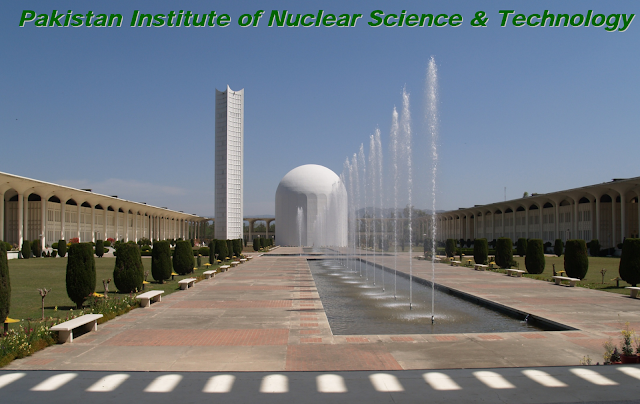
PINSTECH, Pakistan

Pakistan Nuclear Science and Technology History:  

Pakistan started its nuclear program in the 1950s under the United States’ “Atoms for Peace” program, which was designed to promote peaceful uses of nuclear technology. In 1956, the Pakistani government created the Atomic Energy Commission (PAEC) to lead the new program. The United States gave Pakistan its first reactor—the five megawatt Pakistan Atomic Research Reactor (PARR-1)—in 1962.

During this early period, PAEC chairman Dr. Ishrat Husain Usmani devoted government resources to train the next generation of Pakistani scientists. Usmani founded the Pakistan Institute of Nuclear Sciences and Technology (PINSTECH) in 1965 and sent hundreds of young Pakistani students to be trained abroad.

Pakistan Nuclear Power Generation Growth

Nuclear Power Generation:

Pakistan has installed over 3,500 MW of low-carbon nuclear power generating capacity. Nuclear power plants in Pakistan generated 15,540 GWH of electricity in 2021, a jump of 66% over 2020. 

Overall, Pakistan's power plants produced 136,572 GWH of power, an increase of 10.6% over 2020, indicating robust economic recovery amid the COVID19 pandemic.  Nuclear offers the lowest cost of fuel for electricity (one rupee per KWH) while furnace oil is the most expensive (Rs. 22.2 per KWH). 

Construction of two 1,100 MW nuclear power reactor K2 and K3 units in Karachi was completed by China National Nuclear Corporation in 2022, according to media reports. Chinese Hualong One reactors installed in Pakistan are based on improved Westinghouse AP1000 design which is far safer than Chernobyl and Fukushima plants.  

Nuclear Medicine:

Currently, there are 51 nuclear medicine centers in Pakistan, according to National Institutes of Health (NIH). Pakistan Atomic Energy Commission (PAEC) is the largest single contributor with 18 centers spread across the length and breadth of the country, including some remote towns. In terms of radionuclide therapeutic radioiodine for outpatient treatment of hyperthyroidism is more widely available across Pakistan. Inpatient facilities for delivering high-dose are limited, but given the spread of centers across the country, a large extent of the country’s landscape is covered. 

Shaukat Khanum Cancer Hospital founded by former Prime Minister Imran Khan was the first PET-CT service in Pakistan introduced in the private sector in Lahore in 2009. At present 6 PET/CT centers are operational, 2 in Lahore , 4 in Karachi backed by 5 hospital-based cyclotrons (Lahore 2, Karachi 3). 

 A cyclotron is a type of particle accelerator which repeatedly propels a beam of charged particles (protons) in a circular path. Medical radioisotopes are made from non-radioactive materials (stable isotopes) which are bombarded by these protons. In the next 2 to 6 months, first PET/CT with onsite cyclotron is expected to commission in Rawalpindi along with a scanner in Peshawar and Lahore taking the total tally to 9 scanners. A fourth cyclotron is expected to be operational in Karachi in the same period. All cyclotrons are used for F-18 labeled FDG as it remains the work horse of PET imaging. The optimal half-life, simple chemistry, and tons of experience and literature makes it ideal to make a successful enterprise. At present, there is no registry for the utilization of PET-CT across Pakistan; however, institutional clinical experience is increasingly shared at national and international conferences and published in literature, according to the NIH.  

Agriculture Applications:

Pakistan Atomic Energy Commission (PAEC) has established agriculture and biotechnology centers in the country: Nuclear Institute for Agriculture (NIA) at Tandojam, Sindh (1962), Nuclear Institute for Agriculture & Biology (NIAB) (1972), National Institute of Biotechnology & Genetic Engineering (NIBGE) (1994) at Faisalabad, Punjab, and Nuclear Institute for Food & Agriculture (NIFA), in Peshawar, Khyber Pakhtunkhwa (1982). These institutes focus on crop improvement, pest control, livestock health, food and environmental protection, and soil-water and plant nutrition management. 

The research by agriculture and biotech centers has produced several new varieties of wheat, cotton, rice, mung bean, chickpea, lentil, sugarcane, castor bean, kinnow, sesame, tomato, and brassica. These varieties are high-yielding, heat tolerant, insect and disease resistant, and have more nutritional value.

According to a report from the IAEA, mutant varieties of cotton in Pakistan have improved the quality traits of crops. The mutations in the crop varieties have led to “decrease[d] use of pesticides (due to increased disease resistance), a reduction in using fertilizers and consumption of water (due to the highly efficient nutrient intake and better tolerance to drought), superior quality, and higher crop yields,” the report states.

] The new varieties developed now account for 40% of all cotton produced in Pakistan, up from just 25% two years ago and from nonexistent yield in 2016, according to Nuclear NewsWire

International Atomic Energy Agency: 

Recently, the IAEA Director General Rafael Mariano Grossi visited Pakistan to meet with Pakistani officials in charge of the civilian nuclear program. Here's a press release of the IAEA about the visit:

The Islamic Republic of Pakistan and the IAEA will increase collaboration in peaceful applications of nuclear science and technology, particularly in agriculture and medicine, to the benefit of the country and its neighbours. That was the outcome of Director General Rafael Mariano Grossi’s two-day trip to Pakistan this week, during which he met with the country’s leadership — including its Prime and Foreign Ministers — and visited numerous nuclear facilities across the country, some of which he inaugurated.

Mr Grossi began his visit by meeting with Prime Minister Muhammad Shehbaz Sharif. The two spoke about the worsening effects of climate change on Pakistan and how nuclear science and IAEA support is helping the country.

For decades Pakistan has been ranked as one of the 10 most vulnerable countries to climate change, and last summer, was inundated with climate-change linked flooding which caused mass displacement of people and economic damages to the tune of USD 40 billion. The IAEA and Food and Agriculture Organization of the United Nations (FAO), in coordination and consultation with Pakistani authorities developed an emergency support package to assist the country in applying nuclear science to better understand the flood’s impact on soils, crops and the potential spread of animal and zoonotic diseases.

The Prime Minister expressed his desire to strengthen collaboration with the IAEA in agriculture and medicine and his support  to the Agency’s efforts to promote peace and development worldwide. The two also discussed nuclear safety and security Ukraine, where Mr Grossi is championing efforts to establish a protection zone around Ukraine’s Zaporizhzhya Nuclear Power Plant, a facility beset with nuclear safety and security challenges caused by the war in the country.

In a meeting with Foreign Minister Bilawal Bhutto Zardari, Mr Grossi said opportunities for the peaceful use of nuclear science and technology in Pakistan were plentiful, emphasizing how nuclear applications and IAEA initiatives are addressing climate change and issues of access to cancer care. Mr Bhutto Zardari said that Pakistan and the IAEA will further enhance cooperation and grow the role of nuclear applications in dealing with climate change, water, energy and food security.

In Islamabad, Mr Grossi met with the Minister of Planning and Development, Ahsan Iqbal, to discuss the role of nuclear applications in addressing Pakistan’s vulnerability to climate change. The Director General also met with Pakistani fellows of the IAEA Marie Sklodowska-Curie Fellowship Programme, an initiative seeking to help build gender-balanced capacities in the nuclear sector.

Nuclear for energy, food and health
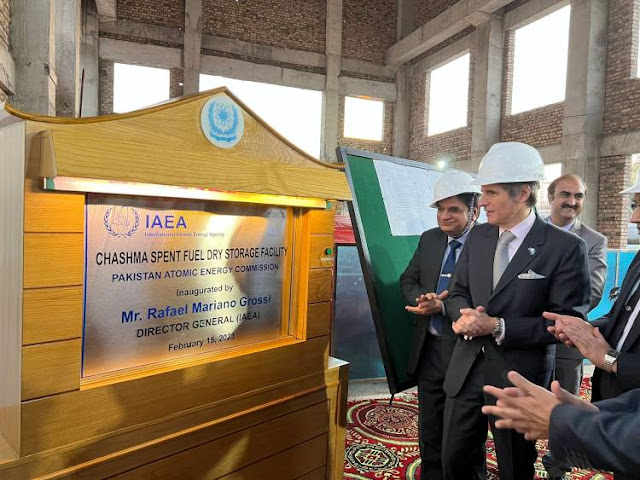
Director General Rafael Mariano Grossi inaugurates the new spent fuel dry storage facility at Chashma Nuclear Power Plant. (Photo: D. Candano/IAEA)

Pakistan currently operates six nuclear power reactors at two sites, that generate about 10 per cent of the country’s total and almost a quarter of its low-carbon electricity. During his trip, Mr Grossi visited one of those sites, Chashma Nuclear Power Plant, 250 kilometres south of Islamabad. Inaugurating the site’s new spent fuel dry storage facility, Mr Grossi highlighted the importance of managing spent fuel safely and securely.

Mr Grossi was welcomed at the Pakistan Institute of Nuclear Science and Technology (PINSTECH), an IAEA partner in work related to human health, nutrition and water analysis. At PINSTECH, Mr Grossi inaugurated a dosimetry laboratory. Mr Grossi also visited the Pakistan Centre of Excellence in Nuclear Security (PCENS), saying he was impressed by the high standard of the facility and that he looked forward to further collaboration.

At the Nuclear Medicine Oncology and Radiotherapy Institute in Islamabad, Mr Grossi inaugurated Cyberknife, a new cancer treatment facility that he described as a milestone for the country. He said Pakistan would be able to support its neighbours with regards to cancer treatment access by becoming a regional centre under Rays of Hope — an IAEA initiative seeking to increase cancer care access in low- and middle-income countries by helping to introduce and improve radiation medicine capacities and build the cancer care workforce.

In Faisalabad, Mr Grossi visited the Nuclear Institute for Agriculture and Biology (NIAB), designating it as an IAEA Collaborating Centre in agriculture and biotechnology. In a special ceremony, Mr Grossi planted a Sago Palm at the site and spoke about the IAEA’s collaboration with the facility in developing climate change resilient cotton varieties. NIAB is also a national laboratory under the IAEA’s ZODIAC initiative for combating zoonotic diseases and future pandemics.

Mr Grossi toured another IAEA Collaborating Centre, the National Institute of Safety and Security, when visiting the Pakistan Nuclear Regulatory Authority and meeting with its Chairman Faizan Mansoor. He was also honoured to inaugurate the National Radiation Emergency Coordination Centre (NRECC) in Islamabad.

Visiting the headquarters of the Pakistan Atomic Energy Commission (PAEC), Mr Grossi had a meaningful exchange with the Commission on the comprehensive and cohesive nature of the country’s peaceful nuclear programme. Mr Grossi's visit to Pakistan was on the invitation of PAEC Chairman Raja Ali Raza Anwar, whom he thanked for Pakistan's hospitality during the two days. The Director General concluded his visit in Islamabad with a seminar on climate change mitigation, during which he highlighted the role of the IAEA in supporting climate-vulnerable countries in addressing the climate crisis with nuclear science and technology.

Related Links: