Responding candidly to a question in the Indian capital New Delhi, OpenAI CEO Sam Altman said: "The way this works is we're going to tell you, it's totally hopeless to compete with us on training foundation models you shouldn't try, and it's your job to like try anyway. And I believe both of those things. I think it is pretty hopeless." This occurred at an event organized by The Economic Times where Altman answered a question by Rajan Anandan, a former Vice President of Google in India and South East Asia and current venture capitalist.
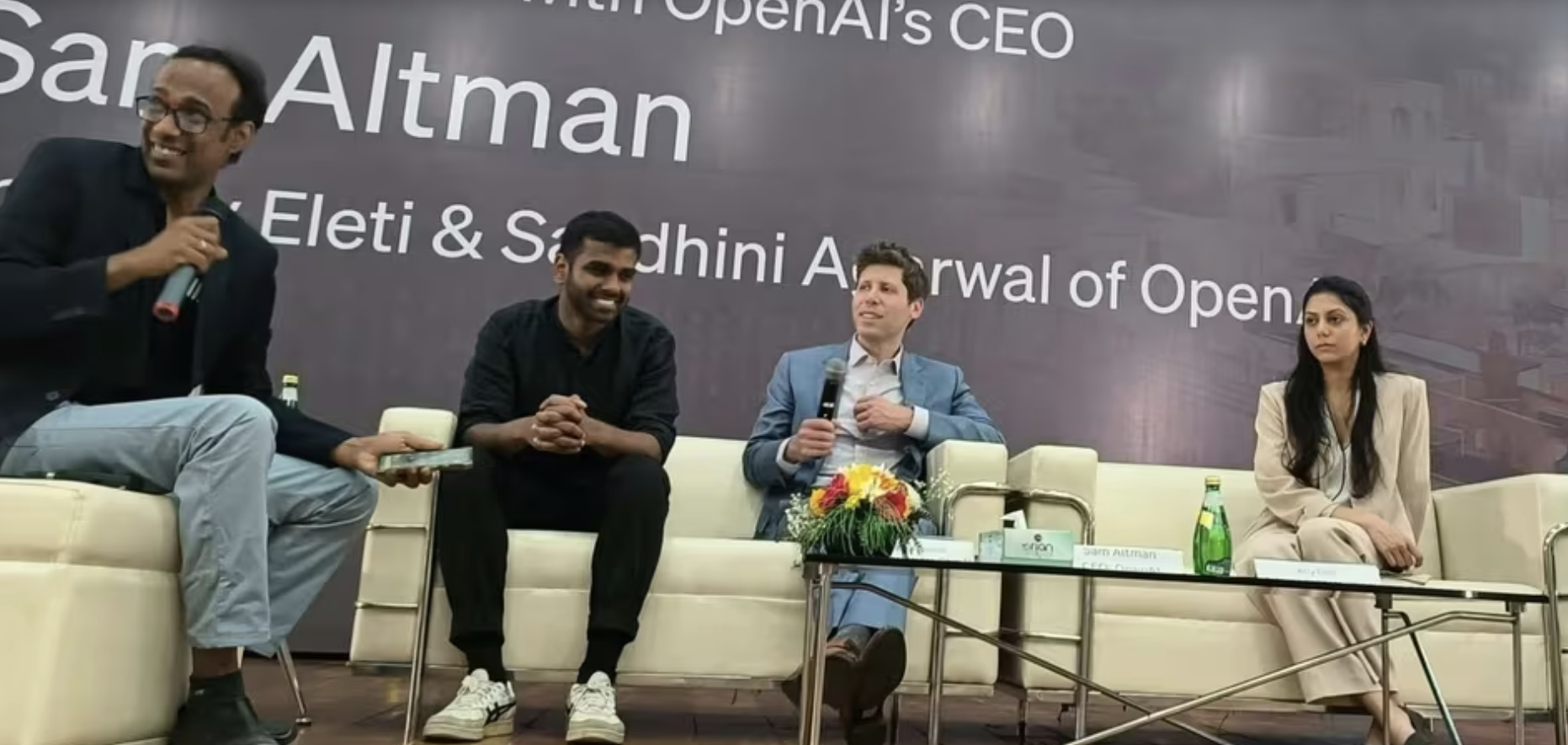 |
| OpenAI CEO Sam Altman in India |
Altman in Delhi:
Sam Altman, the young CEO of OpenAI, the company that recently launched its revolutionary Generative AI app ChatGPT, was in India as part of a six-nation tour to discuss AI regulation. ChatGPT has been trained on massive amounts of data and text from the internet, textbooks, newspapers, magazines and academic journals. It can write computer code and carry on sophisticated conversations on a lot of different subjects. Altman is also visiting China. He was invited to speak at an event sponsored by Indian publication Economic Times. Here's the full exchange between Anandan and Altman about the potential for an Indian AI startup:
Anandan: "Sam, we have got a very vibrant ecosystem in India but specifically focussing on AI, are there spaces where you see a startup from India building foundational (AI) models; how should we think about that. Where is it that a team from India, with three super-smart engineers having not 100, but USD 10 million each could actually build something truly substantial?"
Altman: "The way this works is, we're going to tell you. It's totally hopeless to compete with us on training foundation models. You shouldn't try, and it's your job to like trying anyway. And I believe both of those things. I think it is pretty hopeless."
Challenge Accepted:
Judging by social media responses, most Indians reacted angrily to Altman's negative remarks. They accused him of "arrogance". Others saw his statement as a challenge and responded by accepting the challenge.
Tech Mahindra CEO CP Gurnani said he accepts the challenge. “OpenAI founder Sam Altman said it's pretty hopeless for Indian companies to try and compete with them. Dear Sam Altman, from one CEO to another...CHALLENGE ACCEPTED,” tweeted Gurnani.
India's Tech Industry:
Americans like Sam Altman know that India's tech industry is made up mainly of companies that are essentially body shops. These companies like Infosys, TCS and others supply Indian H1B workers to perform routine tasks in IT operations departments of western companies. These companies' revenue, labeled India's "IT exports", comes from the substantial cuts they keep from the wages of millions of Indian H1B workers. These workers replace higher-paid American employees. Rapid developments in AI technology are now threatening such jobs.
In 2016, India filed a complaint with the World Trade Organization (WTO) when the US raised visa fees to $4000 for each H1B worker visa. Indian government argued that it is discriminatory to the country under its trade agreement with the US.
Indian startups are not based on any original ideas born in India. They are essentially copies of similar e-commerce or logistics or payments startups in the western world.
Altman in China:
Altman is also visiting China this week. “China has some of the best AI talent in the world and fundamentally, given the difficulties in solving alignment for advanced AI systems, this requires the best minds from around the world,” Altman told participants at the event hosted by the Beijing Academy of Artificial Intelligence.
 | |
New York Times Cartoon
|
"Its (India's) loss of a plane last week to a country (Pakistan) whose military is about half the size and receives a quarter (a sixth according to SIPRI) of the funding is telling. ...India’s armed forces are in alarming shape....It was an inauspicious moment for a military the United States is banking on to help keep an expanding China in check".
Der Spiegel Cartoon:
In April this year, German publication Der Spiegel published a cartoon as India surpassed China as the world's most populous nation. The cartoon poked fun at India's lack of progress relative to its northern neighbor. It shows jubilant Indians on an old and overcrowded train – many on the roof – as it overtakes a sleek Chinese bullet train.
 |
| German Cartoon Comparing China and India. Source: Der Spiegel |
Spanish Newspaper Cartoon:'
In May 2022, Spanish newspaper La Vanguardia published a story titled "La hora de la economia India" along with a cartoon showing an Indian snake charmer. Indian media reacted angrily to what they saw as a racist stereotype.
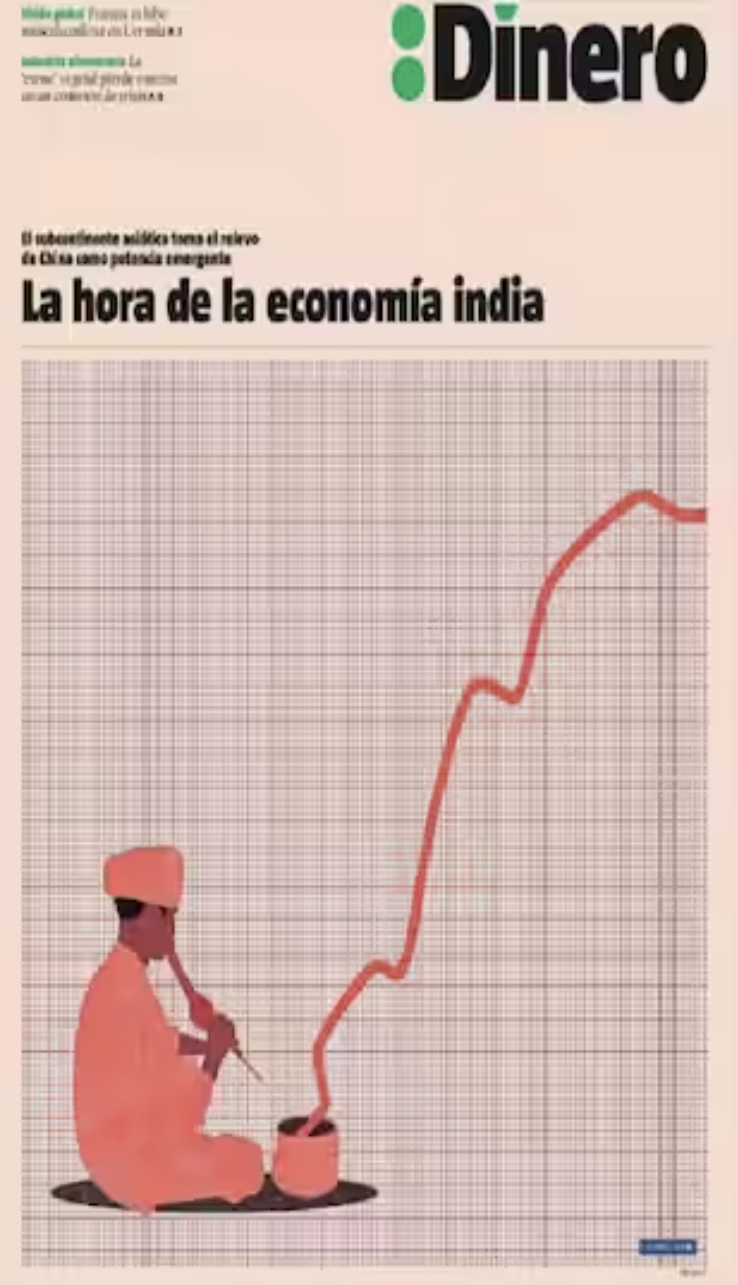 |
| Spanish Cartoon on Indian Economy. Source: La Vanguardia |
US Disrespects India:
Notwithstanding the geopolitically-motivated public rhetoric of US presidents and other western leaders, the fact is that they do not respect India. "One hard truth that Indians have to contend with is that America has also had difficulty treating India with respect", writes former Singaporean diplomat Kishore Mahbubani in his latest book "Has China Won?". "If America wants to develop a close long-term relationship with India over the long run, it needs to confront the deep roots of its relative lack of respect for India", adds Ambassador Mahbubani. It's not just Mahbubani who suspects the United States leadership does not respect India. Others, including former President Bill Clinton, ex US President Donald Trump, former Secretary of State Hillary Clinton and CNN GPS host Fareed Zakaria have expressed similar sentiments.
 |
| Source: @BeltandRoadDesk |
Related Links:
Why Does India Lag So Far Behind China?
Modi's "Make in India" Hype
Digital Pakistan 2022
2021: A Banner Year for Pakistani Startup Funding
India's IT Exports Highly Exaggerated
Unemployment Crisis in India
Afiniti: Pakistani-American AI Startup
Over A Million Pakistani University Students Enrolled in STEM Fields
Pakistani Military Launches Defense AI Program
Riaz Haq Youtube Channel
PakAlumni Social Network