Showing posts with label Punjab. Show all posts

Thursday, November 14, 2024

What Can Pakistan Do to Cut Toxic Smog in Lahore?

Citizens of Lahore have been choking from dangerous levels of toxic smog for weeks now. Schools have been closed and outdoor activities, including travel and transport, severely curtailed to reduce the burden on the healthcare system.  Although toxic levels of smog have been happening at this time of the year for more than a decade, this year appears to be particularly bad with hundreds of people hospitalized to treat breathing problems. Millions of Lahoris have seen their city's air quality index (AQI) cross the 1,000 mark several times this month - anything above 300 is considered dangerous.  What can Pakistan do to cut this level of air toxicity? Is there a silver bullet here? Let's try and understand the root causes of this problem to answer these questions. 

NASA Satellite Images of Fires and Smog Taken on Nov 6, 2024. Source: NASA


South Asia is particularly susceptible to pollutants that hang in the air for extended periods of time. The US National Aeronautics and Space Administration (NASA) satellite images show dull gray haze hovering over northern India and Pakistan, and parts of Bangladesh. It is believed that emissions from solid fuel burning, industrial pollutants and farm clearing fires get trapped along the southern edge of the Himalayas in winter time. NASA Earth Observatory explains this phenomenon as follows:

"The haze.... likely results from a combination of agricultural fires, urban and industrial pollution, and a regional temperature inversion. Most of the time, air higher in the atmosphere is cooler than air near the planet’s surface, and this configuration allows warm air to rise from the ground and disperse pollutants. In the wintertime, however, cold air frequently settles over northern India, trapping warmer air underneath. The temperature inversion traps pollutants along with warm air at the surface, contributing to the buildup of haze."

Trapped Smog in Lahore. Source: Aljazeera


The single biggest factor contributing to heavy smog in October-November period each year in Indian and Pakistani Punjab is the lighting of a huge number of fires to burn the agriculture waste to clear the land for planting winter crops. The Indian government estimates that 38% of the smog in the Indian capital New Delhi comes from stubble burning in Punjab. Government policies are needed to incentivize widespread use of machines to remove agriculture waste. This can be accomplished by subsidizing the purchase and/or rental of these machines in both India and Pakistan. There should also be heavy fines imposed on those farmers who insist on setting fires to clear the land. 

Other factors, such as emissions from vehicles and industrial units, also require better regulations and stricter enforcement. Coal-burning units such as brick kilns and cement factories should be moved further away from the population centers. Such measures can significantly cut toxic smog affecting people's health and productivity in the Punjab region straddling the India-Pakistan border. It will be helpful if Indian and Pakistan authorities can work together to solve this common problem. 

Related Links:

Haq's Musings

South Asia Investor Review

Pakistan's Response to Climate Change

Pakistan Electric Vehicle Policy

Cutting Methane Emissions From Cow Burps and Farts

Pakistan Planting World's Largest Mangroves Forest

Beating the Heat With Urban Forests in Pakistan

Pakistan EV Launches to Accelerate Clean Energy Transition

Diwali in Silicon Valley

India Leads the World in Open Defecation

Heavy Disease Burdens in South Asia


Wednesday, April 6, 2022

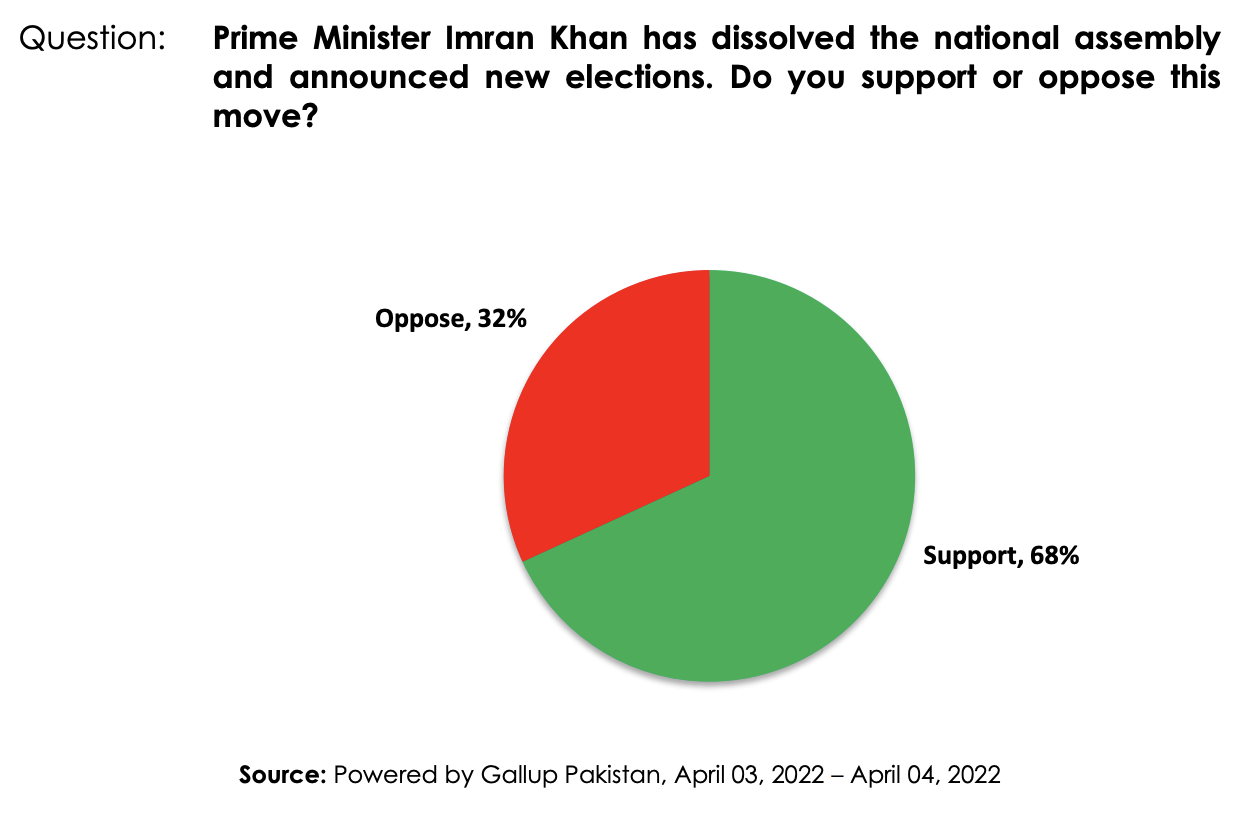
Gallup Pakistan Poll: Over Two-thirds Support Imran Khan's Decision to Dissolve National Assembly

A snap poll conducted by Gallup Pakistan on April 3 and 4 shows broad support for Prime Minister Imran Khan's decision to seek dissolution of the National Assembly and call fresh elections.  Support for the decision is nationwide with 66% in Punjab, 69% in Sindh and 78% in KPK province. It is the strongest among those identifying themselves as PTI voters with 95% of them approving the decision. Among the Opposition parties, 44% of PMLN voters and 50% of PPP voters agree with the decision.  

Source: Gallup Pakistan

Here are the key findings of the Gallup Pakistan Poll: 

1) Widespread support for dissolution of National Assembly in Pakistan

Respondents were asked ‘ PM has dissolved the national assembly and called for fresh elections. Do you Support or are you against this’ To this question a wide majority 68% say they support and 32% say they oppose PM Imran Khan’s move.

Source: Gallup Pakistan

2) Majority don’t believe in US Conspiracy to remove Imran Khan, although split exists along party lines.Significant majority 64% responded to this question and say that Imran Khan was being ousted because of inflation and not because of a foreign conspiracy.

3) Public Opinion split over performance of Imran Khan

Respondents were asked ‘ Imran Khan ruled for 3.5 years. Are you satisfied with the performance of their government or not satisfied?

To this question 54% said they are dissatisfied and 46% said they are satisfied’

4) Anti Americanism: Only 1 in 3 consider the US to be a friend

Respondents were asked: Some people think that America is a friend of Pakistan, and some people think it is an enemy. what is your opinion?

Almost 2 in 3 Pakistanis(72%) think US to be an enemy. Anti Americanism was highest among PTI Supporters (80% thought America was an enemy) and lowest among PML-N voters (65%) 

The poll included a random sample of 800 households (18+ males and females) interviewed by telephone on April 3 and 4, 2022. Provincial breakdown: 66% Punjab, 18% Sindh, 13% KPK and 4% Balochistan. Urban 34%, rural 64%. Margin of error: +-3-5%, 95% Confidence Level. 

Gallup Pakistan's note on Sample Size: The sample size used in this survey is quite adequate even in comparison to international standards. Gallup US Daily poll is 500 and the Gallup Poll Social Series is 1000, both having a track record of reliable predictability for the USA (a country nearly 100 million larger in population of Pakistan). According to Five Thirty-Eight, one of the most credible sources on polling in the US: "Surveying 2,000 voters substantially reduces error compared with surveying 400 of them, but surveying 10,000 voters will produce only marginal improvements in accuracy compared with the 2,000- person survey".

Related Links:


Thursday, April 23, 2020

Incomes of Pakistan's Poorest Rising Faster Than Richest Pakistanis'

Pakistan Living Standards Measurement Survey (PSLM/HIES) of 2018-19 has revealed that the incomes of the poorest Pakistanis are rising much faster than the those of their richest counterparts. The survey measures changes in incomes, expenditures and living standards of the population by quintiles on a periodic basis. The survey provides detailed outcome indicators on education, health, population welfare, housing, water sanitation and hygiene, information communication and technology (ICT), food insecurity experience scale (FIES) and income and expenditure.

Average Monthly Income Growth By Quintiles. Courtesy: Bilal Gilani of Gallup Pakistan

PSLM/HIES 2018-19 compares incomes with those reported in PSLM/HIES 2015-16.  It shows that the average household monthly income in Pakistan has jumped 16.5% to Rs. 41,545.  It also shows that the average monthly income of the lowest quintile (Q1) in Pakistan rose 17.5% and that of the second lowest quintile (Q2) grew 22%, significantly faster than 11.7% for the middle quintile (Q3) and 12% and 5.1% for the top two quintiles (Q4 and Q5) respectively.

The average monthly income of Q1, the poorest quintile, stands at Rs. 23,192 in 2018-19. The second-lowest quintile’s income is Rs. 29,049. The middle-income group (Q3) is Rs. 31,373. The higher middle-income group’s average monthly income has increased to Rs. 37,643. The average monthly income of the top income group (Q4) is estimated at Rs. 63,544.
Monthly Household Incomes By Provinces. Source: PLSM/HIES 2018-19

Average monthly household income in Balochistan is Rs. 36,387, the lowest among the provinces. However, it has grown 21.2% since 2015-16,  much faster than Punjab's 18.3%, KP's 11.4% and Sindh's 15.1%.

Change in Share of Income From 1990 To 2015 in Poorest (Left) & Richest (Right) Quintiles. Source: UNESCAP

Pakistan's latest PSLM/HIES survey confirms long term trend of the lower quintiles gaining an increasing share of the national income.  Earlier in 2015, the United Nations Economic and Social Commission for Asia and Pacific (NESCAP) Statistical Yearbook for 2015 showed that the share of national income of Pakistan's poorest 20% of households increased from 8.1% to 9.6% in 1990-2015.  It was the highest share of income for the bottom income quintile reported in the region.


Related Links:

Monday, May 27, 2019

The History of Punjabi Mexicans in California

It was in early 1980s when I was driving through Yuba City with a couple of friends. It was lunch time and we were looking for a halal restaurant when we spotted Rasul's. At the restaurant we met a man who introduced himself as Mohammad Ali Rasul. He spoke in Mexican accented English but he told us his father came from the Punjab region now in Pakistan and his mother was of Mexican ancestry.  There were 400 such marriages between Punjabi men and Mexican women by 1940, according to Professor Karen Leonard of UC Irvine. Rasul gave us a warm welcome when we told him him we are also originally from Pakistan. He offered us his "Roti Quesadilla" special without charge as a gift. The fusion dish is a variation on Queso Quesadilla made with Indian "nan"(flat bread) topped with traditional rich, melting cheese which originated in Mexico and Texas. I had forgotten all about it until memory was refreshed by a story titled "California’s Lost (and Found) Punjabi-Mexican Cuisine" by Sonia Chopra I read in Eater.com.

Early South Asians:

Currently, there are nearly 5 million people from Bangladesh, India, Pakistan and other South Asian nations in the United States. The earliest record of South Asians arriving in California is in the San Francisco Chronicle of April 6, 1899. It carried a story of the arrival of four Sikh men who were allowed to enter the United States in San Francisco, according to UC Davis Digital Archives.

Karen Leonard, a professor of anthropology at the University of California at Irvine and author of "Making Ethnic Choices: California’s Punjabi Mexican Americans", says that there were almost 2,000 Punjabi men living in California in the early 1900s, and approximately one-third of them married (or re-married) after settling in the state. Over 80% of the men were Sikh and most of the rest were Muslim. Almost all of them were from Central Punjab and came to California by ships from the then British Hong Kong via Vancouver in British Columbia in Canada. They had a choice between going to canal colonies of Lyallpur (now Faisalabad, Pakistan) and emigrating to North America. Most moved to canal colonies while the rest chose to go to the United States.

Punjabi Farmers:

While some Punjabis worked on building the transcontinental railroad along with Chinese immigrants, the vast majority of them chose farm work. While Punjabi men lived and worked on the farms with their Mexican spouses in several western states including Arizona and Texas, it was California that reminded them of their home in the Punjab, the land of five rivers. One of them described the similarity in the following words as narrated by Professor Karen Leonard:

"In my story of the Land of Five Rivers was Sacramento Valley. The river Sutlej was Feather River. The rest of the four rivers--American, Bear, Yuba, and Sacramento. My Bhaskhra (Dam), the Oroville Dam. Mu Govind Sagar, the Oroville Lake. The city of Anandpur Sahib, the nearby town of Paradise. The Shivaliks, the Sierra Foothills. There was Naina Devi, our Mount Shasta. And yes, the Ja- walamukhi, the Lassen Volcanic Park. Obviously, I was carried away by my imagination. Yet, the reality was not far behind. The water, like the water in the Punjab, had the same urge to run downward. The distant hills had the same charm. The fire in Ja- walamukhi and in the Lassen Volcano has the same way to burn."

Asians in America. Source: National Geographic

United States v. Bhagat Singh Thind:

South Asians, like their fellow Asians among the Chinese and the Japanese, faced widespread discrimination in the United States culminating in the Immigration Act of 1917. It was the second act, also known as the Literacy Act or the Asiatic Barred Zone Act after the Chinese Exclusion Act of 1882, aimed squarely at restricting immigration. An even stricter version of the US immigration law was passed in 1924 which was praised by Adolf Hitler in Mein Kampf, according to Daniel Okrent, author of The Guarded Gate: Bigotry, Eugenics and the Law That Kept Two Generations of Jews, Italians and Other European Immigrants Out of America.

Bhagat Singh Thind, a US Army veteran and a naturalized US citizen, was stripped of his citizenship under the Immigration Act of 1917. He sued to get his status restored. In a landmark case United States v. Bhagat Singh Thind,  Thind argued that as a descendent of Indian Aryans he was racially "white".  The US Supreme Court unanimously rejected Thind's argument and ruled that he was not white "in accordance with the understanding of the common man".

Thind ruling was followed by a tragedy when Vaishno Das Bagai from Peshawar committed suicide in 1928 after being denaturalized as a US citizen in Los Angeles.

Post-1965 Immigration:

The population of South Asians in America remained very low due to severe immigration restrictions from non-European countries until the US Immigration Act of 1965, also known as the Hart-Celler Act. This act opened up immigration from Asia, Africa and Latin America and significantly changed the US demographics in the last half century.

Most of the nearly 5 million South Asians in the United States today owe their presence in this country to the passage of this 1965 law passed by Democrats.  A large number of South Asians are engineers and technologists and many live in Silicon Valley. Over 500,000 Pakistani immigrants and their children live in the United States as of 2013, according to a report compiled by Migration Policy Institute. Of these, 273,000 were born in Pakistan and the remaining 180,000 are US-born. Pakistani-American population has more than doubled in the last decade due to increased immigration, according to US 2010 Census data.  Pakistani-Americans (pop: 450,000) are the seventh largest community among Asian-Americans, behind Chinese (3.8 million),  Filipinos (3.4 million), Indians (3.2 million), Vietnamese (1.74 million),  Koreans (1.7 million) and Japanese (1.3 million), according to Asian-American Center For Advancing Justice . They are still a minuscule fraction of the overall US population.

Trump's Anti-Immigration Policy:

The demographic changes since 1965 have angered many Republican white Americans who support immigration restrictions and voted for President Donald J. Trump in 2016 general election.  Trump has called Mexicans "criminals and rapists", complained about letting in people from "shit-hole" countries and imposed ban on entry of Muslims from several countries. His efforts to further restrict overall immigration have met with significant resistance from Congressional Democrats.

Here's a brief video clip of the documentary Roots in the Sand on Punjabi Mexicans:

https://youtu.be/236AWbnDtBc


Related Links:

Haq's Musings

South Asia Investor Review

New York's Little Pakistan

Pakistan is the 3rd Largest Source of Foreign Doctors in America

Pakistani-American Stars in "Big Sick" Movie

Pakistani-American Population Growth 2nd Fastest Among Asian-Americans

Muslims in Silicon Valley

Silicon Valley Pakistani-Americans

A Dozen British Pakistanis in UK Pariament

Trump and Modi

OPEN Silicon Valley Forum 2017: Pakistani Entrepreneurs Conference

Pakistani-American's Tech Unicorn Files For IPO at $1.6 Billion Valuation

Pakistani-American Cofounders Sell Startup to Cisco for $610 million

Pakistani Brothers Spawned $20 Billion Security Software Industry

Pakistani-American Ashar Aziz's Fireeye Goes Public

Pakistani-American Pioneered 3D Technology in Orthodontics

Pakistani-Americans Enabling 2nd Machine Revolution

Pakistani-American Shahid Khan Richest South Asian in America

Two Pakistani-American Silicon Valley Techs Among Top 5 VC Deals

Pakistani-American's Game-Changing Vision 


Sunday, March 20, 2016

Creation of Pakistan: A Great Blessing for Muslims of Sindh & Punjab

As Pakistanis celebrate their national day commemorating the Lahore Resolution of 23 March, 1940, let's look at how the Muslims of Sindh and Punjab, Pakistan's two largest provinces, have fared in the nation founded by Quaid-e-Azam Mohammad Ali Jinnah on August 14, 1947.

In 1947, most of the agricultural land in the largely agrarian provinces of Sindh and Punjab was owned by non-Muslims.  The urban elites of the major cities of Karachi and Lahore were almost entirely non-Muslims. Muslims were in majority in both provinces but they were mostly poor peasants.

Punjabi Muslims:

In Punjab, two-thirds of the land-holdings and 99% of bank deposits of Rs. 100 crore in Lahore were held by Hindus and Sikhs, according to the British archives researched by Dr. Kirpal Singh, author of "PARTITION of PUNJAB", published in 1972.

Only 3 out of 16 colleges in Lahore were run by Muslims. Of the 15 professional colleges, excluding 3 run by the government, all were run by non-Muslims. All 12 hospitals were operated by non-Muslims. Muslims in undivided Punjab had very low standards of living relative to Hindus and Sikhs, they were poor and backward, and there was no Muslim professional or business class in Lahore of 1947.

Sindhi Muslims: 

In Sindh province, about 60% of the agricultural land was owned by Hindus. The rest of the land was owned by big and small Muslim landowners but they were almost always in debt to Hindu moneylenders who exacted over 100% interest on the money they lent, according to The Imperial Gazeteer of India by W.W. Hunter. These massive debt burdens on Sindhi Muslims were removed when most of the Hindu moneylenders fled to India at the time of the partition in 1947.

Education and health care in Sindh were entirely controlled by non-Muslims, mainly Hindu Sindhis, according to The Imperial Gazeteer of India by W.W. Hunter and Nandita Bhavnani, author of "THE MAKING OF EXILE: SINDHI HINDUS AND THE PARTITION OF INDIA", published in 2014.  The educated elite, including the professional and business classes, were mostly Hindus and a few Parsees.

The partition in 1947 has been tremendous boon for both Sindhi and Punjabi Muslims of Pakistan. They have reaped great benefits from:

1. The departure of powerful non-Muslims landowners and moneylenders to India in 1947.

2.  Massive investments made by Pakistani government in major irrigation projects to create the world's largest contiguous irrigation system for farming since 1947.

3. Large investments in education, health care and urban development that have helped raise standards of living significantly as seen in various health (life expectancy) and wealth (per capita incomes)  indicators after 1947.

Mohajirs:

Mohajirs, the native Urdu speakers who migrated mainly from UP and Bihar to East & West Pakistan around 1947, and their relatives who stayed in India, have paid the biggest price for the partition. Many were killed during migration as detailed by Nisid Hajari in his recent book "MIDNIGHT FURIES".

 Mohajirs made up the backbone of the professionals, the businessmen, the industrialists and the civil servants Pakistan needed to function as an independent state in its early years after the partition.  Those left in East Pakistan after the creation of Bangladesh continue to languish to this day in camps for the "stateless persons". The Muslim relatives they left behind have now become the new untouchables in "Secular" India. Fortunately, Mohajirs and their children in Pakistan are able to help their Muslim relatives in India with remittances that added up to nearly $5 billion last year.

Summary:

The partition of 1947 has been a great blessing for the Muslims of Sindh & Punjab in terms of education and incomes. Both have enjoyed rising standards of living in Pakistan after the departure of powerful non-Muslim landlords who controlled most of the resources in 1947. Mohajirs have paid the biggest price but, fortunately, they are now in a position to help their poor Muslim relatives in India with billions of dollars in remittances every year.

Note: Balochistan and NWFP (KPK) are not discussed here because there was no Hindu domination in these provinces. Both were and are overwhelmingly Muslim.


Related Links:

Haq's Musings

Lahore Resolution of 1940

Midnight Furies of 1947

Pakistanis Remitted $5 billion to Relatives in India

Muslims: The New Untouchables in India

Rising College Enrollment in Pakistan

Wednesday, August 21, 2013

US Investigating Microsoft Bribery in Pakistan's Punjab

Executives of Microsoft Pakistan are facing allegations of bribery in Punjab, a violation of US Foreign Corrupt Practices Act (FCPA).

Reports in US media indicate that an unnamed provincial minister in Punjab government and his wife traveled to the United States in December 2009 to close a $9 million deal for Microsoft Office software. The trip was booked by a travel agent working for Microsoft. Microsoft paid the costs of business class fare and stay at a luxury hotel in the United States, according to the Wall Street Journal.

A similar investigation is underway by the US Justice Department into allegations of kickbacks given by Microsoft to officials in Russia.

Microsoft says it has also started an internal investigation into the corruption allegations which it takes very seriously.  It is the result of an email tip to Microsoft.

Under the US Foreign Corrupt Practices Act (FCPA), all American companies are required to provide details of illegal payments made in foreign countries.

Similar allegations surfaced in FCPA cases relating to Siemens, Paxar and other foreign entities in Pakistan. Paxar Corporation, a New York listed company acquired by Avery, acknowledged paying $30,000 to bribe Pakistani customs officials in 2008 through its local customs broker. Avery, a California-based company, manufactures and markets various office products in several dozen countries around the world.

Raymond Baker, author of "Capitalism's Achilles Heel", has detailed billions of dollars worth of bribes received by government leaders in several developing countries including Pakistan.  Here's a brief except from Baker's book on Sharif family:

"At least $160 million pocketed from a contract to build a highway from Lahore, his home town, to Islamabad, the nation’s capital. At least $140 million in unsecured loans from Pakistan’s state banks. More than $60 million generated from government rebates on sugar exported by mills controlled by Mr. Sharif and his business associates. At least $58 million skimmed from inflated prices paid for imported wheat from the United States and Canada. In the wheat deal, Mr. Sharif ’s government paid prices far above market value to a private company owned by a close associate of his in Washington, the records show. Falsely inflated invoices for the wheat generated tens of millions of dollars in cash."

Baker mentions the use of several offshore entities in British Virgin Islands and Channel Islands controlled by the family of Prime Minister Nawaz Sharif to launder billions of dollars received in bribes.

Similar details are offered in the book that explain how Bhutto-Zardari family have siphoned off money from deals made by Pakistan government. Here's a more extensive excerpt from Baker's book:

Upon taking office in 1988, Bhutto reportedly appointed 26,000 party hacks to state jobs, including positions in state-owned banks. An orgy of lending without proper collateral followed. Allegedly, Bhutto and Zardari “gave instructions for billions of rupees of unsecured government loans to be given to 50 large projects. The loans were sanctioned in the names of ‘front men’ but went to the ‘Bhutto-Zardari combine.’ ” Zardari suggested that such loans are “normal in the Third World to encourage industrialisation.” He used 421 million rupees (about £10 million) to acquire a major interest in three new sugar mills, all done through nominees acting on his behalf. In another deal he allegedly received a 40 million rupee kickback on a contract involving the Pakistan Steel Mill, handled by two of his cronies. Along the way Zardari acquired a succession of nicknames: Mr. 5 Percent, Mr. 10 Percent, Mr. 20 Percent, Mr. 30 Percent, and finally, in Bhutto’s second term when he was appointed “minister of investments,” Mr. 100 Percent. The Pakistan government’s largest source of revenues is customs duties, and therefore evasion of duties is a national pastime. Isn’t there some way to tap into this major income stream, pretending to fight customs corruption and getting rich at the same time? Of course; we can hire a reputable (or disreputable, as the case may be) inspection company, have the government pay the company about a one percent fee to do price checking on imports, and get multimillion-dollar bribes paid to us upon award of the contracts. Société Générale de Surveillance (SGS), headquartered in Switzerland, and its then subsidiary Cotecna, the biggest group in the inspection business, readily agreed to this subterfuge. Letters in 1994 promised “consultancy fees,” meaning kickbacks, of 6 percent and 3 percent to two British Virgin Island (BVI) companies, Bomer Finances Inc. and Nassam Overseas Inc., controlled by Bhutto and Zardari. Payments of $12 million were made to Swiss bank accountsof the BVI companies. SGS allegedly has paid kickbacks on other inspection contracts around the world. Upon being accused in the inspection kickback scheme, Bhutto sniffed, “I ran the government to the best of my honest ability. And I did it for nothing but acknowledgment and love.” Then there was the 1994 deal to import $83 million worth of tractors from Poland. Ursus Tractors allegedly paid a 7 percent commission to another of Zardari’s Caribbean companies, Dargal Associated. Bhutto waived import duties on the tractors, costing the Pakistani government some 1.7 billion rupees in lost revenues. Upon discovery of this scheme the Poles hastened to turn over 500 pages of documentation confirming the kickback. The Polish tractor deal was just a warm-up for the French fighter jet deal. After the U.S. government cancelled a sale of two squadrons of F-16s, Bhutto dangled a $4 billion contract for Mirages in front of the French—Dassault Aviation; Snecma, the engine manufacturer; and Thomson-CSF, producer of aviation electronics. Without missing a beat they allegedly agreed to pay a “remuneration” of 5 percent to Marleton Business S.A., yet another of Zardari’s British Virgin Island companies. This would have generated a tidy $200 million for the Bhutto-Zardari couple, but unfortunately for them she was driven from office before they could collect. Ah, but the gold deal gave some comfort to these aspiring kleptocrats. Gold is culturally important in the Asian subcontinent, in particular as a way for women to accumulate wealth. Upwards of $100 billion is invested in this unproductive asset in Pakistan, India, and surrounding countries. Smuggling is big business. Ostensibly to regulate the trade, a Pakistani bullion dealer in Dubai, Abdul Razzak Yaqub, asked Bhutto for an exclusive import license. In 1994, yet another Zardari offshore company, M.S. Capricorn Trading, was created in the British Virgin Islands. Later in the year, Jens Schlegelmilch, “a Swiss lawyer who was the Bhutto family’s attorney in Europe and close personal friend for more than 20 years,” opened an account for Capricorn Trading at the Dubai branch of Citibank. According to a 1999 U.S. Senate report: “Mr. Schlegelmilch did not reveal to the Dubai banker that Mr. Zardari was the beneficial owner of the PIC [private investment company], and the account manager never asked him the identity of the beneficial owner of the account. . . . Shortly after opening the account in Dubai, Mr. Schlegelmilch signed a standard referral agreement with Citibank Switzerland private bank guaranteeing him 20 percent of the first three years of client net revenues earned by the bank from each client he referred to the private bank.” In other words, Citibank was contracting to pay a finder’s fee for millions brought in from dubious sources. Citibank went on to open three accounts in Switzerland for Zardari, with Schlegelmilch as the signatory. In October 1994, Citibank records show that $10 million was deposited into Capricorn’s Dubai account by Razzak Yaqub’s company, A.R.Y. International Exchange. In December, Razzak Yaqub received an exclusive import license and proceeded over the next three years to ship more than $500 million in gold to Pakistan. Additional deposits flowed into the Dubai and Swiss Citibank accounts, and funds also were shifted to Citibank Channel Island subsidiaries. The original ceiling on the accounts of $40 million was reached quickly.

 Related Links:

Haq's Musings

FCPA Blog

Avery Acknowledges Bribing Pakistani Officials

FCPA Violations Involving Indian Entities

The Story of Graft

Anti-Corruption Day, Blagojevich and Zardari

Bhutto Convicted in Switzerland

Corruption in Pakistan

Transparency International Survey 2007

Is Siemens Guilty?

Zardari Corruption Probe

Thursday, June 27, 2013

Rasoolpur: A Model Village in Pakistan With 100% Literacy and No Crimes

Pakistan's sensational media coverage projects only the dark side of the country with a constant stream of news stories of militancy, illiteracy and deprivation. But BBC Urdu took a road less traveled and found a small village of Rasoolpur in the Punjab which demolishes some of the worst stereotypes of the country.


Here's how BBC describes it:
دور دراز علاقوں سے ایک تو خبر ہی مشکل سے آتی ہے۔آتی بھی ہے تو اکثر بری خبر ہی ہوتي ہے۔ شايد سی لیے رسول پور جیسے گاؤں، 99 فیصد شرح خواندگی اور زیرو جرائم کا ریکارڈ رکھنے کے باوجود سنسنسی زدہ میڈیا کے لیے خبر کا درجہ نہیں رکھتے۔۔
Translation: News from remote areas of Pakistan does not easily reach the urban press but when it does, any good news like 100% literacy and zero crime in Rasoolpur village is discarded by the sensational media as not newsworthy.

Rasoolpur is a village with a population of just 2000. Most of its residents are ethnic Baloch whose ancestors migrated from Pakistan's Balochistan province to Southern Punjab. It is located in Rajanpur district in the Seraiki speaking region. Its literacy rate is near 100%.  The United Nations defines literacy as the ability to sign one's name. But Rasoolpuris hold themselves to a much higher standard; they have all their children finish high school.

There are no children out of school. It is crime-free. It is clean. There are two high schools, one for the girls and other for the boys.

Here's a BBC Urdu video about Rasoolpur village:

Haq's Musings- Rasoolpur- A Model Village in... by xlnc

http://www.dailymotion.com/video/x4kj694


travelog rasoolpur. from sharjil baloch on Vimeo.

Related Links:

Haq's Musings

Karachi Slum Girl Goes to Harvard Business School

Educational Attainment in Pakistan

Upwardly Mobile Pakistan

Biotech and Genomics in Pakistan 

India & Pakistan Comparison Update 2011 

India and Pakistan Contrasted in 2010
  
Eating Grass-The Making of Pakistani Bomb
  
Educational Attainment Dataset By Robert Barro and Jong-Wha Lee 

Quality of Higher Education in India and Pakistan

Developing Pakistan's Intellectual Capital

Intellectual Wealth of Nations

Pakistan's Story After 64 Years of Independence

Pakistan Ahead of India on Key Human Development Indices

Wednesday, October 19, 2011

Sharifs' Folly Hurts Punjab's Poor

The Punjab government led by PML's Shahbaz Sharif spurned 20 billion rupees ($232.55 million) in US aid slated for welfare projects in Pakistan's most populous province in the next three years, according to a report in Dawn newspaper. The popular move was motivated by politics to capitalize on a wave of anti-American anger following the US raid that killed Osama Bin Laden in Abbottabad, Pakistan.


While the amount of aid rejected is relatively small, the decision's outsized impact on the poor is now coming to light. Here are some of the projects most impacted:

1. U.S. aid could have transformed Punjab Government's Lady Willingdon Hospital in Lahore, where rats run through the halls, patients sleep three to a bed, women who require C-sections aren't getting them because only one operating room is functioning, and premature babies risk death because of a shortage of incubators, according to the Associated Press.

The hospital struggles to provide even basic care. Built by the British in the 1930s before Pakistan's independence, it was meant for 80 patients. The country's population has since exploded, forcing officials to cram 235 patients into a facility that is now run-down. Paint peels off the concrete walls and black mold covers the ceilings. Patients are forced to share beds, and sometimes women who are close to giving birth have to sit on the floor for lack of space. It has only one functioning operating room, leaving women lined up to receive cesarean sections.

The hospital has only three working infant incubators, which were donated by NGOs. The hospital is forced to use overhead warmers for other infants, leaving them more exposed to disease. The $16 million offered by the U.S. would have been used to purchase 10 incubators, build a new 100-bed ward and expand the nursery and emergency facilities.

2. Another $100 million of US aid was to be used to rebuild schools in southern Punjab province that were destroyed by last year's devastating floods. An additional $10 million was meant to improve municipal services like clean water and sanitation.

3. The loss of aid for Shamaspura, a poor neighborhood in Lahore, means that its 15,000 residents will not get their only road paved, nor will they get a new sewer system.

Batool Akhtar, a poor but feisty woman quoted by the AP story, summed it up well when she said: "This is rich people denying aid meant for the poor. The government should have taken the money."

As Pakistan's ruling elite and its ghairat brigade, led by PML's Sharif brothers, engage in loud empty rhetoric about infringement of their national sovereignty by the United States, here is something to ponder:
Pakistan runs chronic budget deficits of around 5% of its GDP, and its government collects less than 10% of GDP in tax revenue which is among the lowest in the world. A big share of these deficits is funded by foreign aid and loans, making Pakistanis beholden to the interests and whims of major foreign donors and lenders.

Pakistan's tax policies are among the most regressive in the world. Direct taxes make up less than 3.5 percent of GDP, with wide ranging exemptions to powerful segments of society coupled with governance issues at Federal Board of Revenue, according to former finance minister Shaukat Tarin. The bulk of the tax receipts are collected in the form of sales tax, placing the heaviest burden on the lower-income people who spend almost all of their income on their basic needs.

Given the unwillingness of Pakistan's ruling elite to pay more in taxes, I agree with the decision of the other three provincial governments to continue to accept US economic aid. As the Punjab examples above show, refusing such aid clearly hurts the poor the most.

Pakistan would be well advised to not seek confrontation with Washington. Why? The reason is simply that the United States is the architect and the unquestioned leader of the international order that emerged after the WW II and this system still remains largely intact. Not only is the US currency the main reserve and trade currency of the world, the US also dominates world institutions like the UN and its agencies, the World Bank, the International Monetary Fund (IMF) and the World Trade Organization (WTO).

All foreign aid, regardless of its source, comes with strings attached. And those in Pakistan who think that China, undoubtedly a rapidly rising power, can replace US as a powerful friend in helping Pakistan now are deluding themselves. Today, China's power and influence in the world are not at all comparable to the dominant role of the United States. Chinese currency is neither a trade nor a reserve currency. Chinese themselves depended on the US agreement to be allowed to join the WTO after accepting terms essentially dictated by the United States in a bilateral agreement. Most of China's trade is still with the United States and its European allies. And the Chinese military power does not extend much beyond its region because it, unlike the United States, lacks the means to project it in other parts of the world.

Rather than alienate the United States and risk being subjected to international isolation and crippling sanctions like North Korea (a Chinese ally), Pakistanis must swallow their pride now and choose better ways of becoming more self-reliant in the long run.

Here are some of my recommendations for Pakistanis to move toward greater self-reliance:

1. They must all pay their fair share of taxes to reduce dependence on foreign aid and loans.

2. They must spend more on education and heath care and human development to develop the workforce for the 21st century.

3. They must invest in the necessary infrastructure in terms of energy, water, sanitation, communications, roads, ports, rail networks, etc, to enable serious industrial and trade development.

4. They must develop industries and offer higher value products and services for exports to earn the US dollars and Euros to buy what they need from the world without getting into debt as the Chinese have done.

No amount of empty rhetoric of the "ghairat brigade" can get Pakistanis to reclaim their pride unless they do the hard work as suggested above.

Related Links:

Haq's Musings

Can Pakistan Tell US to Take its Aid and Shove it?

Tax Evasion Fosters Foreign Aid Dependence

Aid, Trade, Investments and Remittances

Can Chinese Yuan Replace US Dollar?

Vito Corleone: Godfather Metaphor for Uncle Sam

Can US Aid Remake Pakistan?

South Asia Slipping in Human Development

Pakistan to Terminate IMF Bailout Early

Pakistani Military and Industrialization

Monday, March 9, 2009

Feudal Punjab Fertile Ground for Pakistani Jihadists?


The conventional wisdom holds that Pakistani jihadists come mainly from the radical Wahabi madrassas that proliferated in Pakistan's tribal belt near the Afghan border during the US-Saudi-Pakistani supported campaign against the former Soviet Union. Most of the world attention has, therefore, been focused on the efforts by US and Pakistan to try and contain the influence of NWFP's Deobandi Islam. Some of the madrassas have been forced to shut down while others have been attacked by US and Pakistan. As part of the effort to improve economic opportunities, Pakistan has set up FATA Development Authority and the US and international financial institutions are planning to fund reconstruction opportunity zones (ROZ) to deny recruits to the Jehadist outfits.

In addition to Shia Islam, which accounts for 15-20% of the population, there are primarily two schools of thought among Sunni Muslims in South Asia. Barelvi and Deobandi. Barelvi, or Ahle-Sunna, is a movement of Sunni Sufism that was founded by Ahmed Raza Khan of Bareilly, Rohilkhand India (hence the term Barelvi). Barelvis are a sizable portion of the Hanafi Muslim communities in India, Pakistan, Bangladesh, South Africa and the United Kingdom, besides having a presence in other places around the world. Deobandi is a Sunni Islamic revivalist movement which started in India and Pakistan and has more recently spread to other countries, such as Afghanistan, South Africa and the United Kingdom. The name derives from the town of Deoband, (Uttar Pradesh) India, where the school Darul Uloom Deoband is situated. Deobandis follow the fiqh of Abu Hanifa and the Aqidah of Abu Mansur Maturidi. Deobandi Islam is quite similar to the Wahabi Saudi Islam.

Punjab, the largest province in Pakistan, is considered the home of the followers of the sufi saints who taught a tolerant, loving version of Barelvi Islam. Deobandi Islam (patterned after Saudi Wahabism) is not common in Punjab's rural landscape. But Mumbai attacker Ajmal Qasab's story, published in March 16 issue of Time magazine, suggests that the rising expectations of young Pakistanis and the deprivations they suffer in feudal Punjab are helping the mainly NWFP-Deobandi-inspired Jihadi outfits in their recruiting efforts. Here's an excerpt from Time that implies feudalism drives young men like Qasab to join the terror outfits:

"Faridkot is not the hardscrabble village conjured up by common perceptions of extremist origins. It straddles a paved road about 2 1⁄2 hours' drive from Lahore, and two new gas stations mark the village boundaries. Beyond those are factories and fertile farmland. There is even BlackBerry service. But it is, undeniably, the sort of place that fosters frustration. Feudal landlords own the farmland, and villagers feel trapped by the status they are born into. The good life is tantalizingly close, yet for most residents still unattainable. For men like Qasab, one of the best ways out is jihad. "In a developing country, youngsters who are sensitive, concerned, they talk about 'How do we change what is going on here? How do we get rid of corruption?'" says (Pakistani psychologist Sohail) Abbas. "And if in some sense you find that jihad can help you in those aims, then why not?" It's a convolution of the adolescent craving to stand out. And Pakistani society, steeped in nihilistic passions fostered by the state sponsorship of jihad, condones it."


Like Ajmal Qasab, other unskilled and barely literate workers from rural Punjab are trying to find ways to escape the hard life under their feudal rulers. Some, like Qasab, go to major Pakistani cities in search of a better life and come in contact with Jihadi outfits like LeT. Others try and find employment in the Arab world, particularly Saudi Arabia. Dr. Pervez Hoodbhoy describes the impact of exposure to the Arab world as follows:

"Villages (in Punjab) have changed drastically; this transformation has been driven, in part, by Pakistani workers returning from Arab countries. Many village mosques are now giant madrassas that propagate hard-line Salafi and Deobandi beliefs through oversized loudspeakers. They are bitterly opposed to Barelvis, Shias and other sects, who they do not regard as Muslims. The Punjabis, who were far more liberal towards women than the Pukhtuns, are now beginning to take a line resembling that of the Taliban. Hanafi law has begun to prevail over tradition and civil law, as is evident from the recent decisions of the Lahore High Court."

It appears that the radical Islam is now spreading beyond its traditional home in NWFP and FATA to Pakistan's heartland of Punjab. It is also clear that the new generation of Pakistanis do not want to accept life under a feudal or tribal system that denies them basic human dignity.

While the efforts to create and fund reconstruction opportunity zones (ROZ) in FATA are desirable and welcome, what is really needed is an international Marshall Plan style effort toward transforming Pakistan from a feudal/tribal to an industrial society. Such an effort will face major hurdles from the feudal leadership of the major political parties in Pakistan. However, if it is successfully implemented, new opportunities will open up for the nation's young population to offer them better alternatives to joining Jihadi outfits or seeking work in countries like Saudi Arabia.

Related Links:

Qasab's Journey in Time Magazine

Feudal Shadow in Pakistan Elections

UN Millennium Goals in Pakistani Village

Saudi-ization of Pakistan

Pakistan's FATA Face-off Fears

FATA Reconstruction Opportunity Zones

Pakistan Power Centers: Feudals, Clergy and Military

Thursday, February 26, 2009

Zardari Government Survives Turbulent Year in Pakistan


Although recent polls indicate it is deeply unpopular, Pakistan People's Party's government appears to have survived a very turbulent first year in office. The future of this government, however, remains uncertain with the latest Supreme Court ruling making the opposition PML(N)'s Sharif brothers ineligible to hold office. Just prior to this Court ruling, an overwhelming majority of Pakistanis said the country was moving in the wrong direction and nearly 60 per cent would rather prefer PML-N chief Nawaz Sharif as President than Asif Ali Zardari, according to a survey conducted by International Republican Institute in December, 2008.

A lot has happened in a year since the PPP government took office. Here's a brief run-down:

1. President Musharraf was forced out of office and replaced by Asif Ali Zardari who won the parliamentary approval by an overwhelming majority.

2. With rising militancy in all parts of the country, suicide bombings in 2008 surpassed 2007 figures, with 61 attacks killing at least 889 people and injuring 2,072 others, according to Pakistan's investigation agencies.

3. Pakistan's economy suffered greatly as the confidence of consumers, businesses and investors in the country plummeted to new lows. Pakistan was forced to seek and accept an IMF bailout with stringent conditions and close scrutiny.

4. Barack Hussein Obama was elected first African-American president of the United States in a historic landslide. Obama signaled a renewed focus on the Afghan war and South Asia as his priority, and appointed Richard Holbrooke as America's special envoy to the region. With the continuation of Robert Gates as defense secretary, the CIA continued Predator strikes in FATA and the Pentagon started beefing up the US troops strength in Afghanistan.

5. With deepening distrust of the US and Karazi government among Afghans, increased funding from poppy cultivation and rising civilian casualties, the Taliban insurgents made significant gains in Afghanistan, controlling 72% of the territory and tightened their ring around Kabul, the capital of the country.

6. The US blamed Pakistan for providing sanctuaries to the Taliban in FATA region. The American forces in Afghanistan intensified air strikes and made ground incursions inside Pakistan to target the Taliban and Al-Qaeda fighters, killing many innocent civilians. The US military supply lines were repeatedly hit by the militants in Pakistan. Pakistan was forced to make peace with the Taliban in Swat valley by agreeing to implementation of Shariah law.

7. A British commander of NATO forces in Afghanistan told the press that "we can not win this war" in Afghanistan.

8. Pakistan's stock markets took a nose dive along with the major markets around the world. KSE-100 dropped to 5400 level, far below the peak of 15085.18 achieved while Musharraf was still in office.

9. The telecommunication, information technology, higher education, media and the middle class progress started during Musharraf-Aziz years continued to have its impact, in spite of horrible governance, lack of vision and absence of real leadership by corrupt and inept politicians.

10. Pakistan's food and energy crises took a turn for the worse as the prices soared. There were widespread blackouts and brownouts. Wheat shortages forced the expensive imports and the government had to cut back on subsidies as the foreign exchange reserves dwindled and the rupee rapidly lost its value.

11. History was made when Pakistan elected its first woman speaker of the National Assembly in 2008. But Pakistan's human rights and social justice situation continued to shock the conscience of the civilized world with the live burial of women by the tribesmen in Sind, the murder of Ahmadis encouraged by a fanatic TV host and the inclusion of some of the perpetrators as federal ministers in Prime Minister Gillani's cabinet.

12. Peaceful Kashmir protests erupted again after several years of quiet while President Musharraf attempted to settle the core issue between India and Pakistan. As usual, Indian security forces responded with lethal force, killing dozens of peaceful protesters.

13. People of Baluchistan continued to suffer as an earthquake struck and the local insurgency continued. Women and children were the worst affected among the victims. The Baloch insurgency still continues.

14. India blamed Pakistan as terror struck Mumbai, driving India-Pakistan relations down to a new low. War rhetoric pushed the solution to the major issues dividing India and Pakistan into the background. The Indian media whipped up the anti-Pakistan frenzy with the demands for "doing a Lebanon" in Pakistan. Some in India started talking about a limited war under "Cold Start" doctrine with "surgical strikes" inside Pakistan. In response, Pakistan put its military on alert with troop movements on the ground and fighter jets in the skies.

In a December, 2008 poll conducted by the US-based International Republican Institute (IRI), 88% of the respondents said Pakistan is moving in the wrong direction, while 73 per cent said the economic situation had worsened in the past year.

A total of 76 per cent rated the PPP-led government's performance on key issues as poor, up from 51 per cent in a survey conducted by IRI in June.

67 per cent replied in the negative when asked if things would be better now as there is a democratically elected Parliament and President in Pakistan.

While 59 per cent of Pakistanis surveyed said they would prefer Sharif as President, only 19 per cent backed Zardari for the job. 63 per cent also said they disapproved of Zardari's performance while only 19 per cent approved it.

In the wake of the court order barring Sharif brothers from holding elected office and the subsequent dismissal of the Punjab provincial government, the confrontation between Zardari and Sharif is likely to increase distraction from the nation's ailing economy, energy crisis and escalating insurgency of Al Qaeda and the Taliban that Washington was trying to persuade the government to focus on. It seems that Pakistan's political leaders lack any vision to see beyond their noses. Last year, Sharif was so consumed by his desire for revenge against President Musharraf that he joined forces with Zardari to oust him. Zardari took Sharif along for the ride when it suited him. Musharraf's presence as president stood in the way of absolute power for Zardari. However, the departure of Musharraf ensured that Zardari would now turn his attention to destroy PML(N) and Sharif brothers to consolidate his own power. Even Zardari's hand-picked prime minister Yousaf Raza Gillani is reportedly frustrated with his autocratic and divisive style. The sad truth is that if Zardari and Sharif had their roles reversed, the results would not have been any different. Their attitudes and actions are very short-sighted and reinforce those who believe Pakistan's politicians are too selfish, incompetent and corrupt to govern the country for the benefit of its people. Unfortunately, the people of Pakistan and the region are in for a continued rough ride for the foreseeable future. I do hope, however, that the people of Pakistan are sufficiently resilient to withstand the ongoing crises and emerge stronger as a nation.

Related Links:

IRI Pakistan Poll December, 2008

Pakistan Year 2008 in Review

Pakistan Accepts Indian Charges?

Musharraf's Economic Legacy

Tuesday, April 1, 2008

A New Deal For Pakistan

The province of Sindh in southern Pakistan is a rural region of dusty mudbrick villages, of white-domed blue-tiled Sufi shrines, and of salty desert scrublands broken, quite suddenly, by floodplains of wonderful fecundity. These thin, fertile belts of green—cotton fields, rice paddies, cane breaks, and miles of checkerboard mango orchards—snake along the banks of the Indus River as it meanders its sluggish, silted, café-au-lait way through the plains of Pakistan down to the shores of the Arabian Sea.

In many ways the landscape here with its harsh juxtaposition of dry horizons of sand and narrow strips of intensely fertile cultivation more closely resembles upper Egypt than the well-irrigated Punjab to its north. But it is poorer than either—in fact, it is one of the most backward areas in all of Asia. Whatever index of development you choose to dwell on—literacy, health care provision, daily income, or numbers living below the poverty line—rural Sindh comes bumping along close to the bottom. Here landlords still rule with guns and private armies over vast tracts of country; bonded labor—a form of debt slavery—leaves tens of thousands shackled to their places of work. It is also, in parts, lawless and dangerous to move around in, especially at night.

I first learned about the dacoits—or highwaymen—when I attempted to leave the provincial market town of Sukkur after dark a week before the recent elections. It was a tense time everywhere, and violence was widely expected. But in Sindh the tension had resolved itself into an outbreak of rural brigandage. We left Sukkur asking for directions to Larkana, the home village of the Bhutto family, only to be warned by people huddled in tea stalls shrouded under thick shawls that we should not try to continue until first light the following morning. They said there had been ten or fifteen robberies on the road in the last fortnight alone.

If it is dangerous to travel here at night, it is much more dangerous to declare openly for the candidates you support in the elections. The big landlords here—the zamindars—expect electoral loyalty from their tenants. As the Pakistani writer Ahmed Rashid put it, "In some constituencies if the feudals put up their dog as a candidate, that dog would get elected with ninety-nine per cent of the vote." Such loyalty can be enforced. In the more remote and lawless areas the zamindars and their thugs often bribe or threaten the polling agents, then simply stuff the ballot boxes with thousands of votes for themselves. This is sufficiently common for the practice to have its own descriptive term: "booth capturing."

Democracy has never thrived in Pakistan in part because landowning has traditionally been the social base from which most politicians emerge, especially in rural areas. Here Pakistan is quite different from India, where the urban middle class quickly gained control in 1947. That class has been largely excluded from Pakistan's political process, as, even more so, has the rural peasantry. There are no Pakistani equivalents of Indian peasant leaders such as Laloo Prasad Yadav, the village cowherd turned (former) chief minister of Bihar, or Mayawati, the dalit (untouchable) leader and current chief minister of Uttar Pradesh.

You can see the results of a system dominated by landowners in a town like Khairpur, a short distance from Sukkur in the northern part of Sindh. As you drive along, the turban-clad head of the local feudal lord, Sadruddin Shah, with a curling black mustache, sneers down from billboards placed every fifty yards along the road. Shah, who was standing, as usual, for no less than three different seats, is often held up in the liberal Pakistani press as the epitome of all that is worst about Pakistani electoral feudalism. After all, this is a man who goes electioneering not with leaflets setting out his program, but with five pickup trucks full of his men armed with pump-action shotguns and Kalashnikovs.

For generations the area has been dominated by Sadruddin's family, the head of whom—currently Sadruddin's father—is known as the Pir Pagara, "the Holy Man with the Turban." The Pir Pagaras are not only the largest and most powerful of the local feudal landowners, but they are also the descendants of the local Sufi saint. Normally Sufism is a force for peace and brotherhood—Islam at its most pluralistic and tolerant. At the other end of Sindh I have attended the annual 'urs—or shrine festival—of the Sufi saint Shah Abdul Latif, where there is ecstatic Sufi music, the singing of love poetry, and men and women dancing together—something that would horrify the orthodox 'ulema.

But Khairpur has a very different and more militant Sufi tradition. The Pir Pagaras have always had their own Hur militia, which once acted as a guerrilla force against the British and now acts as Sadruddin's private electoral army. The week I was in the district the local papers were full of stories of Sadruddin's gunmen shooting at crowds of little boys shouting slogans supporting the recently assassinated Benazir Bhutto, and burning down the houses of those of his tenants who had flown opposition flags.

The leaders of this feudal army were standing for election under the banner of their own pro-Musharraf faction of the Pakistan Muslim League (known as PML-F, in the alphabet soup of acronyms that characterizes Pakistani elections). Against them were ranged the forces of Benazir Bhutto's party, the Pakistan People's Party (PPP). Contrary to its socialist-sounding name, the PPP has traditionally also been very much a feudal party that has consistently failed to bring about any serious land reform that would break the power of the landowners. Benazir Bhutto herself was from a landowning feudal family in Sindh; so is Asif Ali Zardari, her widower and the current co-chairman of the PPP, which she left to him and their son Bilawal in her will as if it were a personal possession; so also is Makhdoom Amin Fahim, the most likely candidate for prime minister of the new PPP-dominated coalition.

But things are at last beginning to change in Pakistani politics, and here in Khairpur at least, the PPP candidates were largely middle-class—a new development in the region. Nafisa Shah, who was one of the candidates standing against Sadruddin, is the impeccably middle-class daughter of a local lawyer, who is currently at Oxford University writing a Ph.D. dissertation on honor killings.

Nafisa's campaign was hugely assisted by a wave of sympathy for Benazir: the day she was assassinated, Khairpur was consumed by riots, and for four days full-scale warfare broke out between Benazir supporters and the local administration, during which the election headquarters of the pro-Musharraf parties and several offices of the local government were burned down.

Partly because of this simmering discontent, outbreaks of violence were predicted on polling day, and everyone was anticipating widespread rigging by Musharraf and his intelligence agency cronies, something to which the Musharraf-appointed election commission was expected to turn a blind eye. This, it was predicted, would be followed by more riots organized by the discontented opposition parties who had been cheated of their votes.

In fact, however, serious violence did not materialize, either in Khairpur or elsewhere, and to general astonishment, Nafisa and her fellow PPP candidates had a remarkably strong victory, monitored and filmed by Pakistan's increasingly fearless and independent press and television. The PML-F was almost wiped out and Sadruddin Shah won only his own home seat—and that with the narrowest of margins.

What happened in Khairpur was a small revolution—a middle-class victory over the forces of reactionary feudal landlordism. More astonishingly, it was a revolution that was reproduced across the country. To widespread surprise, the elections in Pakistan were free and fair; and Pakistanis voted heavily in favor of liberal centrist parties opposed to both the mullahs and the army. Here, in a country normally held up in the more Islamophobic right-wing press of Western countries as the epitome of "what went wrong" in the Islamic world, a popular election resulted in an unequivocal vote for moderate, secular democracy.

For Pakistani liberals, 2007 was one of the worst years in their country's history. In early March, Musharraf suspended Pakistan's chief justice, Iftikhar Chaudhry, accusing him of using his position for personal gain. This was clearly not the case. Chaudhry had a reputation for both integrity and independence, and most assumed that Musharraf simply wanted to replace him with a more pliant judge who would not block his reelection as president.

Some were encouraged by the popular protests mounted by Pakistan's lawyers in response to Chaudhry's suspension—in city after city across the country lawyers took to the streets in their court robes, marching in orderly ranks, three abreast, like emperor penguins in a nature film. But any optimism was quickly dimmed by the heavy-handed response of Musharraf's riot police and the simultaneous growth of Islamist radicalism in the heart of the capital, Islamabad.

This took the form of the heavily veiled, black-clad "chicks with sticks" who, in April 2007, emerged in large numbers armed with bamboo canes from a mosque and madrasa complex in the city center, not far from the headquarters of Pakistan's powerful intelligence agency, the Inter-Services Intelligence (ISI). The young women then proceeded to ransack suspected brothels and smash video and music stores in the capital while the police watched, apparently helpless. The bloody storming by the army of their base, the Red Mosque, in early July was followed by an unprecedented wave of suicide bombings and Islamist revenge attacks against the army. In all there were sixty suicide bombings in Pakistan last year, leaving 770 people dead and nearly 1,600 injured.

By autumn the situation had become even worse, with a series of crushing military defeats inflicted on the Paki-stani army by the Taliban in Waziristan, the "extraordinary rendition" by Musharraf's officials of the former prime minister and opposition leader Nawaz Sharif back to Saudi Arabia after his return from exile, and the subsequent declaration of an emergency by President Musharraf, who put a number of dissenting lawyers, political opponents, and human rights activists under house arrest. The disasters reached a horrific climax in December with the assassination of Benazir Bhutto. This led many to predict that Pakistan was looking like a failed state stumbling toward collapse and civil war. The cruel contrast with India, then widely being celebrated as a future democratic superpower on its sixtieth birthday, was unmistakable.

Yet the widespread publicity given to the crisis obscured the important changes that had quietly taken place in Pakistani society during Musharraf's eight years in power. Pakistan's economy is currently in difficulty, with fast-rising inflation and shortages of electricity and flour; but between 2002 and 2006 it had grown almost as strongly as India's. Until the beginning of 2007, Pakistan had a construction and consumer boom, with growth approaching 8 percent; for several years its stock market was the fastest-rising in Asia.

As you travel around Pakistan today you can see the effects of the boom everywhere: in vast new shopping malls and smart roadside filling stations, in the cranes of the building sites and the smokestacks of factories, in the expensive new cars jamming the roads and in the ubiquitous cell-phone stores. In 2003 the country had fewer than three million cell phones; today apparently there are 50 million, while car ownership has been increasing at roughly 40 percent a year since 2001. At the same time foreign direct investment has risen from $322 million in 2002 to $3.5 billion in 2006.

Pakistan's cities, in particular, are fast changing beyond recognition. As in India, there is a burgeoning Pakistani fashion scene full of ambitious gay designers and amazingly beautiful models. There are also remarkable developments in publishing. In nonfiction, Ahmed Rashid's book Taliban became the essential primer on Afghanistan after 2001. Ayesha Siddiqa's Military Inc. and Zahid Hussain's Frontline Pakistan are two of the most penetrating recent studies of the country and essential for understanding the politics of Pakistan. Siddiqa is especially good on the economic and political power of the army, while Hussain's book is the best existing guide to Pakistan's jihadis. There have also been particularly impressive new works of fiction by Pakistani writers, among them Kamila Shamsie's Kartography and Broken Verses, Nadeem Aslam's Maps for Lost Lovers, and Moni Mohsin's End of Innocence. One of Daniyal Mueenuddin's short stories, his wonderfully witty "Nawabdin Electrician," was published in The New Yorker of August 27, 2007.

Recently Mohsin Hamid, author of the best-seller The Reluctant Fundamentalist,[2] wrote about this change in culture. Having lived as a banker in New York and London, he returned home to Lahore to find the country unrecognizable. He was particularly struck by the incredible new world of media that had sprung up..., a world of music videos, fashion programmes, independent news networks, cross-dressing talk-show hosts, religious debates, stock-market analysis.... Not just television, but also private radio stations and newspapers have flourished.... The result is an unprecedented openness.... Young people are speaking and dressing differently.... The Vagina Monologues was recently performed on stage in Pakistan to standing ovations.

Such reports are rare in the Western press, which prefers its stereotypes simple: India, successful and forward-looking; Pakistan, a typical Islamic failure. The reality is of course much less clear, and far more complex.

It was this newly enriched and empowered urban middle class that showed its political muscle for the first time with the organization of a lawyers' movement, whose protests against the dismissal of the chief justice soon swelled into a full-scale pro-democracy campaign, despite Musharraf's harassment and arrest of many lawyers. The movement represented a huge shift in Pakistani civil society's participation in politics. The middle class were at last moving from their living rooms onto the streets, from dinner parties into political parties.

February's elections dramatically confirmed this shift. The biggest electoral surprise of all was the success of Nawaz Sharif's conservative faction of the Muslim League, the PML-N. This is a solidly urban party, popular among exactly the sort of middle-class voters in the Punjab who have benefited most from the economic success of the last decade, and who have since found that status threatened by the recent economic slowdown and the sudden steep rises in the prices of food, fuel, and electricity.

The same is true of the success of the MQM, the Karachi-based party representing the Mohajirs, the emigrants who left India to come to Pakistan at the founding of the country in 1947. Like Nawaz Sharif's PML-N, it is an urban-based regional party attractive to middle-class voters. Almost 50 percent of Pakistan's population now lives in urban areas, and the center of gravity is shifting from the countryside to the large cities. The parties that appealed most successfully to this new demographic trend won the most convincing victories in the polls.

The rise of the middle class was most clear in the number of winning candidates who, for the first time, came from such a background. In Jhang district of the rural Punjab, for example, as many as ten out of eleven of those elected are the sons of revenue officers, senior policemen, functionaries in the civil bureaucracy, and so on, rather than usual feudal zamindars. This would have been unthinkable ten years ago.

Even the most benign feudal lords suffered astonishing electoral reverses. Mian Najibuddin Owaisi was not just the popular feudal lord of the village of Khanqah Sharif in the southern Punjab, he was also the sajjada nasheen, the descendant of the local Sufi saint, and so, like Sadruddin Shah, regarded as something of a holy man as well as the local landowner. But recently Najibuddin made the ill-timed switch from supporting Nawaz Sharif's PML-N to the pro-Musharraf Q-League. When I talked to people in the village bazaar, they all said that they did not like Musharraf, but they would still vote for their landlord.

"Prices are rising," said Hajji Sadiq, a cloth merchant, sitting amid bolts of textiles. "There is less and less electricity and gas."

"And what was done to Benazir was quite wrong," his friend Salman agreed.

"But Najib sahib is our protector," said Hajji. "Whatever party he chooses, we will vote for him. Even the Q-League."

"Why?" I asked.

"Because with him in power we have someone we can call if we are in trouble with the police, or need someone to speak to the administration."

"When we really need him he looks after us."

"We vote according to local issues only. Who cares about parties?"

Because of Najibuddin's personal popularity, his vote stood up better than many other pro-Musharraf feudal lords—and he polled 46,000 votes. But he still lost, to an independent candidate from a nonfeudal middle-class background named Amir Varan, who received 57,000 votes and ousted the Owaisi family from control of the constituency for the first time since they entered politics in the elections of 1975.

As well as a middle-class victory over a feudal past, in the west of the country the election was also an important vote for secularism over the Islamist religious parties.

In the last election of October 2002, thanks partly to their closeness to the ruling military government, and partly to their sympathy with al-Qaeda, the Islamist Muttehida Majlis Amal (MMA) alliance nearly tripled its representation in the national assembly from 4 to 11.6 percent, and swept the polls in the two key provinces bordering Afghanistan—Baluchistan and the North-West Frontier Province—where they went on to form Islamist provincial governments.

This time, however, religious parties sunk from fifty-six out of 272 seats in the national assembly to just five. In the North-West Frontier Province, the MMA has been comprehensively defeated by the overtly secular Awami National Party (ANP). This is a remnant of what was once a mighty force: the nonviolent and secular Red Shirts movement, which, before the creation of Pakistan, was originally led by Khan Abdul Ghaffar Khan, an important ally of Mahatma Gandhi from the North-West Frontier Province. Ghaffar Khan was locked up by one Pakistani general after another for much of the time between Partition and his death in 1988, but his political movement has survived both the generals and a succession of bomb blasts aimed at its party, and has now—after nearly fifty years in opposition—made a dramatic comeback under the leadership of Ghaffar Khan's grandson, Asfandyar Wali Khan.

"Before the Taliban," the North-West Frontier Province "used to be a very liberal area," he told me in Islamabad.

No one can force us to give up that culture—even the suicide bombers. There is a very clear polarization taking place...on one side those striving for peace, nonviolence, and a future of cooperation with the international community, and on the other those who stand for confrontation and hatred. They are men of violence, but we refuse to be cowed. We may lose, but we will make a stand.

In the election, Asfandyar's ANP routed the Islamists, demonstrating that contrary to their image as bearded bastions of Islamist orthodoxy, Pashtun tribesmen are as wary as anyone else of violence, extremism, and instability. Now the ANP is talking of extending the Pakistani political parties into the troubled northern tribal areas that are federally administered and act as the buffer zone between Pakistan and Afghanistan: "If I am prepared to take on the Maulvis in the tribal areas, why should the government stop me?" asked Asfandyar. "At the moment the tribal areas are just left to fester. We have to end that isolation and bring them forward."

The issues that mattered to voters in the frontier were those of incompetent governance by the MMA, increased insecurity, and especially the fear of constant suicide bombings. Like democratically elected parties anywhere else in the world, the electorate judged the MMA on its record, and threw it out for failing to deliver. There is a clear lesson for US policymakers here. The parties of political Islam are like any other democratic parties: they will succeed or fail on what they deliver. The best way of dealing with democratic Islamists, if Pakistan's experience is anything to go by, is to let them be voted into power and then reveal their own incompetence—mullah-fatigue will no doubt quickly set in. Besieging Islamist parties that have come to power through a democratic vote, as the US has done with Hamas, or allowing local proxies to rig the vote so as to deprive them of power, as happened in Egypt, only strengthens their hand and increases their popularity.

There is an additional reason for modest optimism about Pakistan's future at the moment. In recent years, the biggest threat to the country's stability has come from the jihadi groups created and nourished by the army and the ISI for selective deployment in Afghanistan and Kashmir, but which soon followed their own violent agendas within Pakistan itself. For the last decade, that threat has been exacerbated by the ambiguous attitude toward the jihadis maintained by the Pakistani army and its intelligence services. Some elements have been alarmed by the militants' violence and the effects that supporting these groups would have on the alliance with the US. Others saw them as useful irregulars that could still be drawn on to fight low-cost proxy wars for the army. That era of division and ambiguity now seems to be coming to a close.

On November 24, 2007, a suicide bomber detonated himself beside a bus at the entrance of Camp Hamza, the ISI's Islamabad headquarters. Around twenty people died in what is the first known attack by an Islamist cell against the Pakistani intelligence services. Many of the dead were ISI staffers. This event, coming as it did after three assassination attempts on General Musharraf, several other bomb attacks on army barracks, and the murder of many captured army personnel in Waziristan, is credited with persuading even the most stubbornly pro-Islamist elements in the Pakistani army that the monster they have created now has to be dispatched, and as quickly as possible.

Shuja Nawaz is a Washington-based specialist on the Pakistani army who comes from a prominent and well-connected military family and who is about to publish Crossed Swords, an important new book on the army.

The direct attacks on the army have shaken up the military at all levels. One of Musharraf's senior colleagues said he was changing his cars daily to avoid being identified when he hits the roads of Rawalpindi. The army brass has been told not to go out in uniforms. Soon, they may stop using their staff cars with flags and star plates.

This is obviously a radically new situation, and one that changes all previous calculations on the part of the military. The Pakistan expert Stephen P. Cohen of the Brookings Institution agrees with this assessment. He recently told me:

The senior leadership of the army under Musharraf now regards the threat from Islamic radicals as being far greater than the threat posed by India. That conviction has been hugely increased since the suicide bomb attacks on army staff and the intelligence agencies this past December.

This week the news came that the army had rounded up in Lahore an important cell of Lashkar-i-Jhangvi Islamist militants; many more such arrests are expected soon.

Over the last few years there has been something of an existential crisis in Pakistan, at the heart of which lay the question: What sort of country did Pakistanis want? Did they want a Western-style liberal democracy, as envisaged by the poet Iqbal, who first dreamed up the idea of Pakistan, and by the country's eventual founder, Muhammad Ali Jinnah? An Islamic republic like Mullah Omar's Afghanistan? Or a military-ruled junta of the sort created by Generals Ayyub Khan, Zia, and Musharraf, who, among them, have ruled Pakistan for thirty-four of its sixty years of existence?

Though turnout in the election was fairly low, partly owing to fear of suicide bombings, it is clear that Pakistanis have overwhelmingly rejected the military and Islamist options and chosen instead to back secular democracy. And if many stayed at home, no fewer than 36 million Pakistanis braved the threatened bombs to vote in an election which by South Asian standards was remarkably free of violence, corruption, ballot-stuffing, or "booth capturing."

A new coalition government now looks likely to come to power peacefully, bringing together Zadari's People's Party and Sharif's Muslim League, and will do so unopposed by the army. These developments should now lead commentators to reassess the country that many have long written off and caricatured as a terror-breeding swamp of Islamist iniquity.

The country I saw in February on a long road trip from Lahore in the Punjab down through rural Sindh to Karachi was not a failed state, or anything even approaching "the most dangerous country in the world...almost beyond repair" as the London Spectator recently suggested, joined in its view by The New York Times and The Washington Post among many others. On the contrary, the countryside I passed through was no less peaceful and prosperous than that on the other side of the Indian border; indeed its road networks are far more developed. It was certainly a far cry from the violent instability of post-occupation Iraq or Afghanistan.

On my travels I found a surprisingly widespread consensus that the mullahs should keep to their mosques, and the increasingly unpopular military should return to its barracks. The new army chief, General Ashfaq Kayani, who took over when Musharraf stepped down from his military role last year, seems to recognize this. He has repeatedly talked of pulling the army back from civilian life, and ordering his soldiers to stay out of politics. He has also ordered that no army officer may meet with President Musharraf without his personal approval. He also seems committed to maintaining tight security to protect Pakistan's nuclear arsenal.

Pakistan will not change overnight. Much violence and unrest no doubt lie ahead, as shown by the recent assassination by a suicide bomber in Rawalpindi of General Mushtaq Baig, the head of the Pakistan Army Medical Corps, and continuing bomb blasts in the troubled Swat Valley, once the country's most popular tourist destination. The country still has a vast problem with rural and urban poverty, and a collapsing education system. It also has serious unresolved questions about its political future. As Ahmed Rashid said in a recent interview:

The new coalition government will have to face continuing behind the scenes efforts by President Pervez Musharraf and the intelligence agencies to undermine them even before they are allowed to govern. Musharraf's agents backed by a section of the Washington establishment had been secretly trying to persuade Zardari to go into alliance with the former ruling party—the Pakistan Muslim League-Q group. The Q group has been decimated in the elections—23 ministers lost their seats and today it is leaderless, visionless and without an agenda—except it remains a pawn in the hands of Musharraf.

For many Pakistanis, there continues to be confusion and disillusion. Most of the country's impoverished citizens still live precarious and uncertain lives. A growing insurgency is spilling out of the tribal areas on the Afghan border. But Pakistan is not about to fall apart, or implode, or break out into civil war, or become a Taliban state with truckfuls of mullahs pouring down on Islamabad from the Khyber Pass. It is not at all clear whether the members of Pakistan's flawed and corrupt political elite have the ability to govern the country and seize the democratic opportunity offered by this election, rather than simply use it as an opportunity for personal enrichment. But they are unlikely ever again to have such a good opportunity to redefine this crucial strategic country as a stable and moderate Islamic democracy that can work out its own version of India's remarkable economic and political success.

By William Dalrymple
Lahore, March 3, 2008