Riaz Haq writes this data-driven blog to provide information, express his opinions and make comments on many topics. Subjects include personal activities, education, South Asia, South Asian community, regional and international affairs and US politics to financial markets. For investors interested in South Asia, Riaz has another blog called South Asia Investor at http://www.southasiainvestor.com and a YouTube video channel https://www.youtube.com/channel/UCkrIDyFbC9N9evXYb9cA_gQ
Citizens of Lahore have been choking from dangerous levels of toxic smog for weeks now. Schools have been closed and outdoor activities, including travel and transport, severely curtailed to reduce the burden on the healthcare system. Although toxic levels of smog have been happening at this time of the year for more than a decade, this year appears to be particularly bad with hundreds of people hospitalized to treat breathing problems. Millions of Lahoris have seen their city's air quality index (AQI) cross the 1,000 mark several times this month - anything above 300 is considered dangerous. What can Pakistan do to cut this level of air toxicity? Is there a silver bullet here? Let's try and understand the root causes of this problem to answer these questions.
South Asia is particularly susceptible to pollutants that hang in the air for extended periods of time. The US National Aeronautics and Space Administration (NASA) satellite images show dull gray haze hovering over northern India and Pakistan, and parts of Bangladesh. It is believed that emissions from solid fuel burning, industrial pollutants and farm clearing fires get trapped along the southern edge of the Himalayas in winter time. NASA Earth Observatory explains this phenomenon as follows:
"The haze.... likely results from a combination of agricultural fires, urban and industrial pollution, and a regional temperature inversion. Most of the time, air higher in the atmosphere is cooler than air near the planet’s surface, and this configuration allows warm air to rise from the ground and disperse pollutants. In the wintertime, however, cold air frequently settles over northern India, trapping warmer air underneath. The temperature inversion traps pollutants along with warm air at the surface, contributing to the buildup of haze."
The single biggest factor contributing to heavy smog in October-November period each year in Indian and Pakistani Punjab is the lighting of a huge number of fires to burn the agriculture waste to clear the land for planting winter crops. The Indian government estimates that 38% of the smog in the Indian capital New Delhi comes from stubble burning in Punjab. Government policies are needed to incentivize widespread use of machines to remove agriculture waste. This can be accomplished by subsidizing the purchase and/or rental of these machines in both India and Pakistan. There should also be heavy fines imposed on those farmers who insist on setting fires to clear the land.
Other factors, such as emissions from vehicles and industrial units, also require better regulations and stricter enforcement. Coal-burning units such as brick kilns and cement factories should be moved further away from the population centers. Such measures can significantly cut toxic smog affecting people's health and productivity in the Punjab region straddling the India-Pakistan border. It will be helpful if Indian and Pakistan authorities can work together to solve this common problem.
Recent heat-sensing satellite images of Lahore posted by NASA show that "green spaces such as wooded areas, grassy areas, parks, and farm fields were significantly cooler than densely developed areas". NASA experts explain it as follows: Vegetation and bodies of water do not absorb and re-emit heat as easily as common building materials such as concrete, asphalt, and steel.
A NASA post titled "Beating the Heat in Pakistan" says that "Differences in surface temperatures between developed and natural areas, known as surface urban heat islands, tend to be more pronounced than temperature differences associated with atmospheric heat islands, particularly during the daytime". “Surface urban heat islands exacerbate air temperatures by trapping heat and releasing it slowly, especially at night,” explained Muhammad Nasar-u-Minallah, a geographer at the University of the Punjab in Lahore. “The lack of green spaces and vegetation in urban settings further limits natural cooling mechanisms, such as shade and evapotranspiration, intensifying the heat.”
Rapid urbanization and intense development activities in Pakistani cities have worsened the effects of climate change by making the summer heat unbearable. In response, several urban forest plantation campaigns have been launched in major Pakistani cities like Lahore and Karachi by both government and non-government entities.
Nestlé Pakistan launched its first urban forest tree plantation activity at Allama Iqbal International Airport with 25,000 trees, under its Nestlé Cares initiative to support endeavors to reduce carbon footprint in its ambition to achieve net zero by 2050, according to media reports. Leading the volunteer effort, Jason Avanceña, Chief Executive Officer, Nestlé Pakistan has said, “Forests are the lungs of our planet, playing a crucial role in mitigating climate change and preserving biodiversity. However, deforestation and urbanization have led to the loss of green spaces, impacting our environment and the well-being of our communities. It is our responsibility to reverse this trend and create a more sustainable and livable future.” “We will accomplish this with additional plantation activities in Lahore, Kabirwala and Sheikhupura. Our strategy aims to help restore forests and protect natural habitats while promoting sustainable livelihoods,” he added.
A rundown park in Clifton district of Karachi has seen a new urban forest thriving in the middle of Pakistan's largest city, according to Euronews. "Transformed into a haven for wildlife, the urban forest now boasts 55 different species of plants within just over a hectare of land", says a report published in Euronews.
The Urban Forest team that planted the Clifton urban forest says they have already created eight mini tree-filled hubs in Karachi and a further 2 in Lahore. And they have plans to expand to other cities in the country. Families living near the forest were among those that offered financial support alongside companies and the German and US consulates in Karachi.
In addition to the urban forests, Pakistan is also planting the world's largest man-made mangrove forest known as Delta Blue Carbon Project. This mangroves plantation will eventually cover 350,000 hectares of Tidal Wetlands on the south-east coast of Sindh. Currently, Pakistan is estimated to have 600,000 hectares of mangrove forest. Mangroves absorb hundreds of millions of tons of atmospheric carbon, reduce the impact of storms on human lives and economic assets, and provide a habitat for fish, birds and other plants supporting biodiversity. It is funded by sales of carbon credits to global polluting industries such as those involved in fossil fuels trade.
Famous Indian writer and poet Javed Akhtar told his audience at a conference in Mumbai that he saw "no visible poverty" in Lahore during his multiple visits to Pakistan over the last three decades. Responding to Indian novelist Chetan Bhagat's query about Pakistan's economic crisis at ABP's "Ideas of India Summit 2023" in Mumbai, Akhtar said: "Unlike what you see in Delhi and Mumbai, I did not see any visible poverty in Lahore". This was Akhtar's first interview upon his return to India after attending "Faiz Festival" in Lahore, Pakistan.
Javed Akhtar at ABP Ideas Summit in Mumbai
Chetan Bhagat began by talking about high inflation, low forex reserves and major economic crisis in Pakistan and followed it up by asking Javed Akhtar about its effects he saw on the people in Pakistan. In response, Akhtar said, "Bilkul Nahin (Not at all). In India you see poverty right in front of you, next door to a billionaire. Maybe it is kept back of the beyond. Only some people are allowed to enter certain areas. But you don't see it (poverty) on the streets. In India, it is right in front of you...amiri bhi or gharibi bhi (wealth and poverty). Sare kam apke samne hain (It's all in front of you). Wahan yeh dekhai nahin deta (you don't see it in Pakistan)".
Alhamra Arts Center, Lahore, Pakistan
Disappointed by the response, Bhagat suggested that the Indian visitor could have been guided by his hosts through certain routes where he couldn't see any poverty. Javed Akhtar then said "it's not possible to hide poverty. I would have seen at least a "jhalak" (glimpse) of it as I always do in Delhi and Mumbai....I have been to Pakistan many times but I have not seen it".
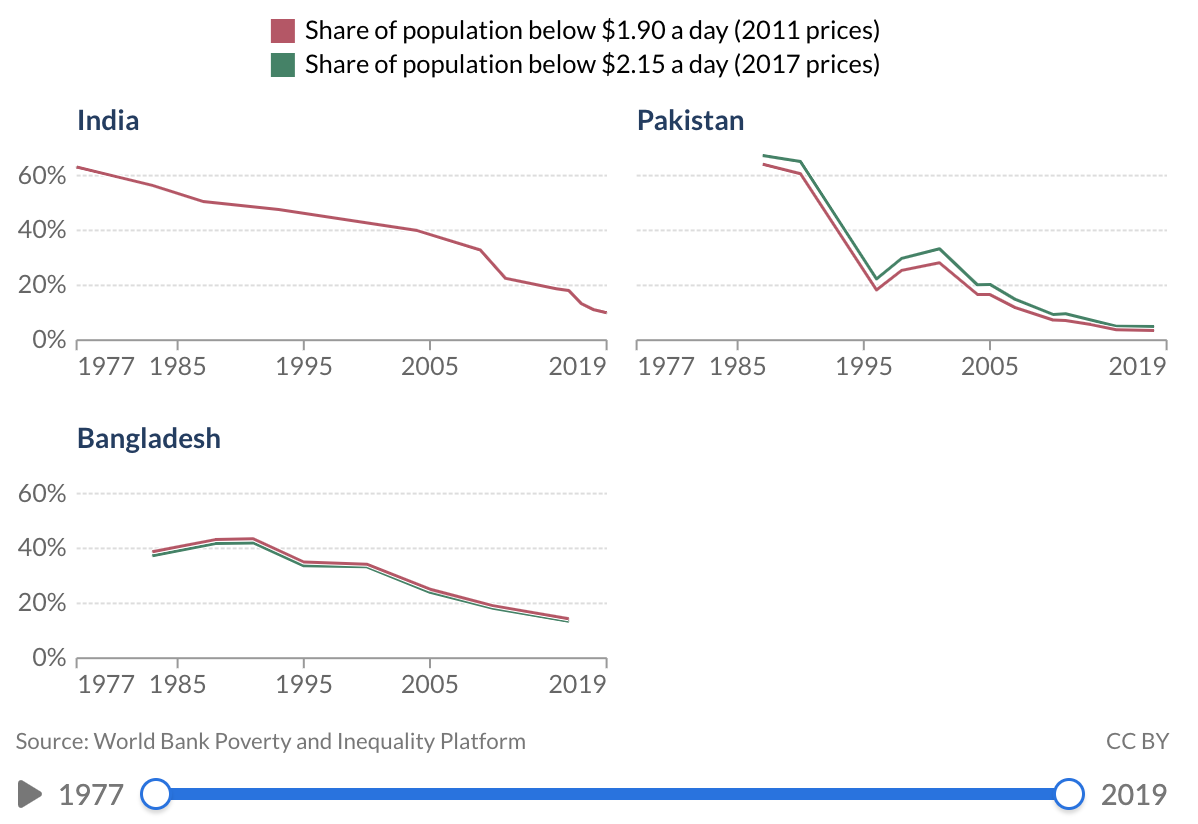
What Javed Akhtar saw and reported recently is obviously anecdotal evidence. But it is also supported by hard data. Over 75% of the world's poor deprived of basic living standards (nutrition, cooking fuel, sanitation and housing) live in India compared to 4.6% in Bangladesh and 4.1% in Pakistan, according to a recently released OPHI/UNDP report on multidimensional poverty. Here's what the report says: "More than 45.5 million poor people are deprived in only these four indicators (nutrition, cooking fuel, sanitation and housing). Of those people, 34.4 million live in India, 2.1 million in Bangladesh and 1.9 million in Pakistan—making this a predominantly South Asian profile".
The UNDP poverty report shows that the income poverty (people living on $1.90 or less per day) in Pakistan is 3.6% while it is 22.5% in India and 14.3% in Bangladesh. In terms of the population vulnerable to multidimensional poverty, Pakistan (12.9%) does better than Bangladesh (18.2%) and India (18.7%) However, Pakistan fares worse than India and Bangladesh in multiple dimensions of poverty. The headline multidimensional poverty (MPI) figure for Pakistan (0.198) is worse than for Bangladesh (0.104) and India (0.069). This is primarily due to the education and health deficits in Pakistan. Adults with fewer than 6 years of schooling are considered multidimensionally poor by OPHI/UNDP. Income poverty is not included in the MPI calculations. The data used by OHP/UNDP for MPI calculation is from years 2017/18 for Pakistan and from years 2019/2021 for India.
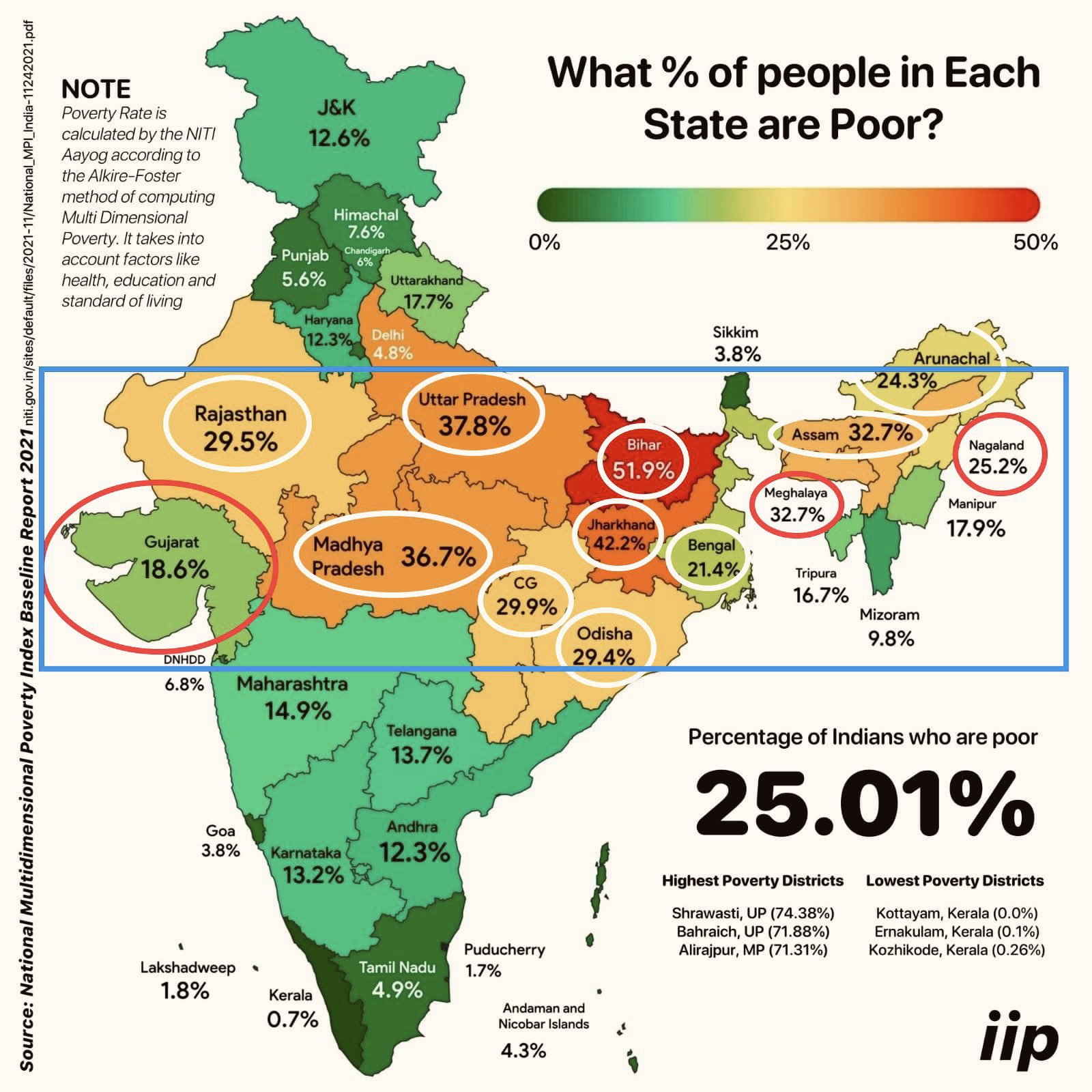
The Indian government's reported multidimensional poverty rate of 25.01% is much higher than the OPHI/UNDP estimate of 16.4%. NITI Ayog report released in November 2021 says: "India’s national MPI identifies 25.01 percent of the population as multidimensionally poor".
Earlier last year, Global Hunger Index 2022 reported that India ranks 107th for hunger among 121 nations. The nation fares worse than all of its South Asian neighbors except for war-torn Afghanistan ranked 109, according to the the report. Sri Lanka ranks 64, Nepal 81, Bangladesh 84 and Pakistan 99. India and Pakistan have levels of hunger that are considered serious. Both have slipped on the hunger charts from 2021 when India was ranked 101 and Pakistan 92. Seventeen countries, including Bosnia, China, Kuwait, Turkey and UAE, are collectively ranked between 1 and 17 for having a score of less than five.
Here's a video of Javed Akhtar's interview with Chetan Bhagat at ABP's "Ideas of India Summit 2023". Please watch from 4:19 to 6:00 minutes.
Karachi-based start-ups raised $236.7 million in 2022, accounting for two-thirds of Pakistan's total startup funding and almost double the previous year, according to Data Darbar. Karachi, Pakistan's largest city, is followed by Lahore with $69.2 million and Islamabad with $41.6 million. Nationally, the total funds raised by startups have been declining after hitting the peak of $173 million in Q1/2022.
National Incubation Center, located at Karachi's NED University of Engineering and Technology (NEDUET), has incubated more than 250 start-ups so far. These include ride-hailing app Bykea and London-based proptech platform Gridizen. Kamran Mahmood, the CEO of Gridizen, who recently returned to Pakistan to join NIC Karachi, says he has found it even easier to meet decision makers at large companies in Pakistan than the UK, according to a report in FDI Intelligence. “Karachi really offers the best chance for Pakistan to catch up with other start-up ecosystems,” says Rabeel Warraich, the founder and CEO of Sarmayacar, a Pakistani early stage VC fund set up in 2018.
Since the start of 2018, the total VC funding in Pakistan soared more than 20-fold to reach an all-time high of $333m in 2022, according to Magnitt, an emerging market data platform. Most of the funding has gone to e-commerce and fintech start-ups, including Karachi-based online marketplace Bazaar Technologies, salary advance app Abhi and Lahore-based e-commerce platform Jugnu.
NIC Karachi is funded by Ignite, the country's national technology fund, and operated by LMKT, a private tech company which runs two other NICs in the cities of Hyderabad and Peshawar. “The level of funding and support has improved a lot in recent years,” Sana Shah, the program manager at the National Incubation Center (NIC) in Pakistan's most populous city Karachi, told FDI Intelligence. It is one of eight public-private tech innovation hubs established across Pakistan since 2016.
Across Pakistan, the total funds raised by startups have been declining since hitting the peak of $173 million in Q1/2022. Start-ups raised just over $15m in Q4/22, the lowest figure since the first quarter of 2020 and 79% lower than the same period a year earlier, according to Data Darbar, which tracks the Pakistani start-up scene. This downward trend is at least partly due to Pakistan's current economic crisis. It also reflects a global decline in VC investments in startups.
The architecture of the New Gwadar International Airport (NGIA) is inspired by a rising Phoenix. It is Pakistan's second greenfield airport built from scratch in a new location. With a 3,650-meter long runway, it is a Class 4F airport. NGIA is scheduled to begin test flights in December this year. The only other airport with a 3,600-meter long runway is the New Islamabad International Airport that opened for commercial flights in 2018. Karachi and Lahore international airports have runways lengths of 3,400 meters and 3,360 meters respectively, putting them in 4E class. All four of these major Pakistani airports can handle landing of Airbus A380, the largest commercial airliner in operation today.
New Gwadar International Airport Architecture Inspired by A Rising Phoenix
New Gwadar International Airport (NGIA) is being built in Gwadar at a cost of $246 million on an area of 4,300 acres. Construction of NGIA started in October, 2019. The entire project is being built by the state-owned China Airport Construction Company funded by a Chinese government grant. It was originally scheduled for completion in 36 months. The work was slightly delayed due to the COVID19 pandemic. It is now expected to be ready for trial flights in December, 2022.
New Gwadar International Airport, Gwadar, Pakistan
NGIA is part of the China Pakistan Economic Corridor (CPEC) projects. Another key CPEC project recently completed in Gwadar is the 19-kilometer long six-lane East Bay Expressway. It was opened for traffic on June 3, 2022. East Bay Expressway connects to the Makran Coastal Highway which in turn is connected to the larger network of motorways and highways in the country as well as to China and the landlocked nations of Central Asia in CAREC.
East Bay Expressway, Gwadar, Pakistan
The completion of New Gwadar International Airport and East Bay Expressway is an indication that the Western and Indian media headlines about the death of CPEC are not credible. To the contrary, the continuing progress on CPEC projects confirms the strong commitment of both the Chinese and the Pakistan government to move forward with their broad-based cooperation. Just yesterday, Pakistan's new Prime Minister Shehbaz Sharif reaffirmed that his government is determined to complete all the projects under the multi-billion-dollar China-Pakistan Economic Corridor (CPEC). Earlier, Chinese Foreign Ministry Spokesman Zhao Lijian said China would continue to support its companies in investing and operating in Pakistan to realize win-win results and shared development.
Why does the air quality in New Delhi and Lahore ranks among the world's worst at this time of the year? The answer to this oft-repeated question can be found in the satellite maps constantly updated by the US National Aeronautics and Space Administration (NASA). Indian government recently estimated that 36% of pollution was contributed by farm fires. Here's how NASA Earth Observatory explains it: "The haze visible in this image likely results from a combination of agricultural fires, urban and industrial pollution, and a regional temperature inversion. Most of the time, air higher in the atmosphere is cooler than air near the planet’s surface, and this configuration allows warm air to rise from the ground and disperse pollutants. In the wintertime, however, cold air frequently settles over northern India, trapping warmer air underneath. The temperature inversion traps pollutants along with warm air at the surface, contributing to the buildup of haze."
The latest image downloaded from NASA's Fire Information for Resource Information System (FIRMS) show farm fires burning in both India and Pakistan. These fires are particularly intense in Indian and Pakistani provinces of the Punjab. These fires contribute significantly to the high level of particulates in Delhi and Lahore. Indian government recently estimated that 36% of the PM2.5 particulate matter was contributed by stubble burning by farmers.
South Asia's Vulnerability:
South Asia is particularly susceptible to pollutants that hang in the air for extended periods of time. The US National Aeronautics and Space Administration (NASA) satellite images show dull gray haze hovering over northern India and Pakistan, and parts of Bangladesh. It is believed that emissions from solid fuel burning, industrial pollutants and farm clearing fires get trapped along the southern edge of the Himalayas. NASA Earth Observatory explains this phenomenon as follows:
"The haze visible in this image likely results from a combination of agricultural fires, urban and industrial pollution, and a regional temperature inversion. Most of the time, air higher in the atmosphere is cooler than air near the planet’s surface, and this configuration allows warm air to rise from the ground and disperse pollutants. In the wintertime, however, cold air frequently settles over northern India, trapping warmer air underneath. The temperature inversion traps pollutants along with warm air at the surface, contributing to the buildup of haze."
6. Encourage the use of more renewable energy sources such as solar, wind, hydro, nuclear etc.
The cost of acting now may seem high but it will turn out to be a lot more expensive to deal with extraordinary disease burdens resulting from rising air pollution.
Malik Amin Aslam, Pakistan Prime Minister Imran Khan's special assistant on climate change, said recently in an interview with CNN that his country is seeking to change its energy mix to favor green. He said Pakistan's 60% renewable energy target would to be based on solar, wind and hydro power projects, and 40% would come from hydrocarbon and nuclear which is also low-carbon. “Nuclear power has to be part of the country’s energy mix for the future as a zero energy emission source for a clean and green future,” he concluded. Here are the key points Aslam made to Becky Anderson of CNN:
1. Pakistan wants to be a part of the solution even though it accounts for less than 1% of global carbon emissions.
2. Extreme weather events are costing Pakistan significant losses of lives and property. Pakistan is among the countries most vulnerable to the effects of climate change.
3. Pakistan is moving towards renewable energy by converting 60% of its energy mix to renewable by 2030. Electric vehicle (EV) transition is also beginning in his country.
4. Aslam said: “We are one of the world leaders on nature based solutions. However, the World Bank (WB) in its Report yesterday came up with really good numbers in a comparison of countries who are shifting their mainstream development towards environment friendly policies and Pakistan came atop among them,” the SAPM explained.
Summary: Movement of pollutants does not recognize national borders. It has severe consequences for both India and Pakistan. The only way to deal with it is for the two nations to cooperate to minimize this problem.
South Asia accounts for more than a third of all PM2.5 pollution related deaths in the world. The sources of particulate pollution range from solid fuel burning to crop clearing fires and use of dirty fuels in vehicles and industries. Recognition of the growing problem is urgent. Failure to act could be very costly in terms of impact on human health and economy. Pakistan needs to follow through on its commitments made at COP26 conference recently held in Glasgow, Scotland.
Here's a video of Malik Amin Aslam's interview with CNN"s Becky Anderson:
Security software pioneer John McAfee was found dead in his jail cell in Spain today. He was 75 years old. He started McAfee Associates in 1987 in his small house in Silicon Valley, in response to the news of a Pakistani computer virus called Pakistani Brain, thought to be the first to infect personal computers. Miko Hypponen, a top software expert, believes that "they (Pakistani brothers Amjad and Basit Alvi) never meant to destroy any data or cause any harm for anyone". He was fighting extradition to the United States from Spain to face federal charges of tax evasion. The US Justice Department indictment alleged that McAfee used cryptocurrency transactions to hide his earnings.
John McAfee (1945-2021)
Pakistani Brothers:
The year was 1986. Most personal computers used floppy disks to boot and to move files from one computer to another. Floppy disk was also the medium used by Amjad and Basit Alvi, two Pakistani brothers living in Lahore, to create and spread history's first known PC virus called "The Brain". Here's how Mikko Hypponen, a software security expert, described it in 2014 at DEF CON, world's largest hackers convention held in Las Vegas:
Creators of First PC Virus: Amjad Farooq and Basit Farooq Alvi
"It's surprisingly advanced, and it has surprising features, including a capability of hiding itself. So when your PC is infected by Brain, and you go and look at your floppies, you will not see Brain on the floppies. It's watching you watching it, and if you try to look at the copy of Brain, it fools you and gives you a clean image of a floppy instead. And we would call this a stealth virus, at the time.... These guys weren't evil at all. They weren't evil even then, 25 years ago, when they wrote the first PC virus. Their intention was never to cause harm to anybody, and they didn't, of course, realize that they made history when they wrote the first PC virus. But Brain was the only virus they ever wrote and they never meant to destroy any data or cause any harm for anyone".
The Brain, also known as The Pakistani Brain, is the virus that challenged John McAfee to develop anti-virus software. Later, John McAfee launched his company that was acquired in 2010 by Intel for $7.7 billion, then sold its majority stake to an investment firm six years later. McAfee is just one of several security software companies inspired by the Pakistani Brain virus. Security software market size is estimated at nearly $180 billion in 2021.
Pakistani Software Entrepreneurs:
There are several well-known Pakistani entrepreneurs in the security software industry. Among them is Ashar Aziz who founded Fire-eye. Massive cyberattack that recently targeted US government agencies and private companies, labeled the 'SolarWinds hack', was first discovered by US cybersecurity company FireEye, founded by a well-recognized Pakistani-American cybersecurity expert Ashar Aziz. Karachi-born Ashar served as the Chief Executive Officer (CEO) of Fireeye from 2004 to 2012. Ashar became the first Pakistani-American tech billionaire when the company stock soared after its initial public offering (IPO) in 2013. His net worth was last estimated at $268 million in 2015.
Ashar Aziz
Solar Winds Hack:
Solarwinds is a cybersecurity toolset used by multiple US government agencies to detect and stop cyberattacks. It is alleged by American government agencies that some Russian-sponsored hackers managed to compromise Solarwinds software by adding malware to updates distributed by the company to its customers. It only came to light when the perpetrators attempted to break into the cybersecurity firm FireEye, which first disclosed a breach on December 9. Here's how Fireeye describes it:
"FireEye has uncovered a widespread campaign, that we are tracking as UNC2452. The actors behind this campaign gained access to numerous public and private organizations around the world. They gained access to victims via trojanized updates to SolarWind’s Orion IT monitoring and management software. This campaign may have begun as early as Spring 2020 and is currently ongoing. Post compromise activity following this supply chain compromise has included lateral movement and data theft. The campaign is the work of a highly skilled actor and the operation was conducted with significant operational security".
Summary:
Security software pioneer John McAfee was found dead in his jail cell in Spain today. He was facing tax evasion charges in the United States. He started McAfee Associates in 1987 in his small house in Silicon Valley, in response to the news of a Pakistani computer virus called Pakistani Brain, thought to be the first to infect personal computers. "The Brain" was the first computer virus that infected large numbers of computers worldwide. It was developed by Amjad and Basit Alvi, two Pakistani brothers in Lahore, Pakistan. Miko Hypponen, a top software expert, believes that "they (Pakistani brothers) never meant to destroy any data or cause any harm for anyone".
Arslan Ash Siddique from Lahore, Pakistan has won three top ESports awards, including Player of the Year award for 2019, according to ESPN.com. In December awards, Aslan Ash won the Best Esports Player award under both the fan and ESPN choice categories. He was also the first-runner for Best Moment of the Year award in the fan poll. The nomination was based on his EVO wins.
Arslan Ash Siddique at EVO Japan 2019
Esports have risen to the level of other major international sports with multiple international tournaments. Esports leagues have sprung up in many countries including Pakistan. Esports Pakistan (ESPK) is a growing E-Gaming organization which organizes national esports competitions at its Gaming Arena at Royal Palm, Lahore.
Arslan put Pakistan on the esports map following his surprise first-place victory in Tekken 7 at EVO Japan 2019 and EVO 2019. Before October 2018, Ash, the Pakistani Tekken 7 phenom, had never competed in a major international tournament. Now, at the end of 2019, he is an international star and the only person to ever win the Evolution Championship Series Japan and its American counterpart in Las Vegas the same year.
Arslan is not the only successful Pakistani esports competitor on the world stage. Karachi-born Pakistani Syed Sumail Hasan, 19, is the world's youngest video gamer to surpass $1 million in earnings in esports. In fact, he has earned $3.6 million so far as an international Dota 2 player, ranking him the 10th biggest winner in the world, according to esportsearnings.com website which tracks players' earnings. Sumail started playing Dota 2 at the age of 7. He now lives in a Chicago suburb as a permanent resident of the United States.
Syed Sumail Hassan
Arsalan Ash Siddique, 23 years old player from Lahore, Pakistan, caused a stir in Fukuoka Japan when he defeated world's top players to win EVO championship in February, 2019, according to Asahi Shimbun. In his victory speech, Arslan acknowledged many unknown Pakistani players who are also quite strong but could not join the competition because they could not get the visa to travel to Japan.
It wasn't easy for Arsalan to reach Japan to participate in the contest. He had to jump through many hoops and travel through several transit countries each of which made it difficult for him. When he arrived at Haneda airport in Japan, he only had Pakistani rupees and no exchange would accept them. Hungry and tired he tried his luck at the food court but no one would accept the Pakistani currency. His next flight was from Narita airport an hour away by public transport. To travel he needed to buy a ticket but did not possess any local currency, according to SBS Urdu.
Arsalan Ash Siddique (Center)
Arsalan was exhausted and ready to give up his dream when he finally got through to his Japanese sponsors who helped him out. Needless to say he got no help from Pakistani diplomats through his challenging journey.
In spite of visa denials and other travel challenges faced by Pakistani players, the country ranks 25th in the world for players' earnings in 2019, according to esportsearnings.com. Ranked above Pakistan are mainly rich industrialized nations from North America, Europe and East Asia. All South Asian nations rank below Pakistan. Players from India rank 63rd, Sri Lanka 98th, Afghanistan 108th, Bangladesh 115th and Nepal 123rd.
On December 2, 3, 4 and 5, 2019, Pakistan played host to AdAsia 2019 after a gap of 30 years. It is the largest and most prestigious advertising industry conference in Asia – organized bi-annually by the Asian Federation of Advertising Associations (AFAA). It drew attendees from all over the world to Lahore, Pakistan. This conference has taken place at a time when Pakistan's 88 billion rupee media industry is in the midst of a major shakeout after a long period of rapid double-digit growth since the turn of the century. The only advertising segment still hot and growing at double digit rates is digital.
Pakistan President Arif Alavi delivered the closing keynote address. Other speakers included Sir Martin Sorrell, Founder, WPP; Philip Thomas, CEO, Cannes Lions; Randi Zuckerberg, CEO, Zuckerberg Media and former Director Market Development, Facebook; Kaveri Khullar, Marketing Director, Mastercard Southeast Asia; Fernando Machado, Global CMO, Burger King; Asad J. Malik, an artist specializing in augmented reality; Piyush Pandey, CCO Worldwide and Executive Chairman India, Ogilvy; Marcus Peffers, Global CEO, M and C Saatchi World Services; Stefan Sagmeister, Co-Founder Sagmeister and Walsh; Richard Quest of CNN Business; and Yasuharu Sasaki, ECD, the Dentsu Network.
Digital Advertising: Sessions on digital advertising were packed at the conference. This segment of advertising is growing rapidly amidst declining total ad spend in Pakistan.
Randi Zuckerberg, former executive at Facebook and sister of Mark Zuckerberg, was a featured speaker to talk about digital marketing. She shared her experience of how digital media became a powerful force for marketers. “15 years ago, my marketing budget for a whole year was one box of t-shirts,” she told the audience as she talked about her years at Facebook. “It’s really amazing to see how far the world can come in time,” she added.
Zuckerberg praised Pakistan as a country that honors women. “Pakistan has given us women such as Malala Yousafzai and Benazir Bhutto,” she said. “This shows that Pakistan is a country that really honors its women.”
Zuckerberg was followed by Tom Goodwin, head of innovation at Zenith Media. He focused on how our lives have been transformed by ongoing Digital Revolution. “Smartphones have become like fireplaces to people. People gather around their devices and their connection to the world becomes what gives them warmth,” Goodwin said.
Growth of broadband access in Pakistan is changing the country's media landscape. Digital advertising revenue is forecast to grow by 32% in 2019 to Rs. 10.8 billion ($103 million), 12% of total national advertising revenue (NAR), according to Magna Advertising. Digital marketing expert Lars Anthonisen believes Pakistan is quickly becoming a "digital first country". Anthonisen sees "new opportunities for brands to reach and engage with consumers who may have previously been overlooked". Overall ad spend in Pakistan is expected to rise by 15% in 2019 to Rs. 88.3 billion ($840 million) following a steep decline (-11%) in 2018, according to a Branding in Asia report. Growing availability of smartphones, tablets and mobile broadband is extending the reach of advertisers to digital media where it is possible to precisely target prospective customers.
Pakistan Media Industry:
Pakistan's 88 billion rupee media industry is in the midst of a major shakeout after a long period of rapid double-digit growth since the turn of the century. Hundreds of journalists and other staff have lost their jobs. At least one TV channel, Waqt News, has closed while several others are downsizing. While such consolidation was long overdue after nearly two-decade long period of explosive growth, the PTI government's decision to reduce advertising budget, which constitutes nearly a quarter of all ad spending in the country, appears to be the main trigger. Those affected by consolidation are accusing the government of exercising press censorship by cutting its ad spending.
Rapid Media Growth:
Rising buying power of rapidly expanding middle class in Pakistan drove the nation's media advertising revenue up 14% to a record Rs. 76.2 billion 2016 and another 12% to Rs. 88 billion in 2017, making the country's media market among the world's fastest growing media markets.
Industry Shakeout:
Massive commercial media growth in Pakistan has been most apparent in terms of private TV channels growing from just one in Year 2000 to over 100 today after President Musharraf's deregulation of electronic and other media.
Explosive growth with many new entrants is the fundamental business reason for the recent wave of consolidation and shakeout. Shakeout is a business term used to describe the consolidation of an industry or sector after it has experienced a period of rapid growth in demand followed by oversupply.
At least one TV channel, Waqt News owned by Nawai-Waqt Media Group, has closed while several others are downsizing. “We are trying to compile exact figures of the affected media persons. So far, we can say that around 1,000-1,500 workers have lost their jobs or faced cuts in salaries in the past few weeks,” Muhammad Afzal Butt, president of one the main factions of Pakistan Federal Union of Journalists (PFUJ) told The News Sunday (TNS) this week.
Government Spending:
About a quarter of Rs. 80 billion ad revenue comes from federal and provincial government ads in the media. Some of the TV channels receive as much as 50% of their revenue from the government.
"The government has cut its media spend by more than 70% and companies by almost 50%", according to a leading advertising agency owner who spoke to Dawn.
"The (federal) government used to spend some Rs. 10 billion on advertisements annually, which was increased up to Rs35 billion in the last years of the (Nawaz Sharif's PMLN) government," Fawad Chaudhry, federal minister of information, told The News Sunday (TNS). This tax-payers’ money, says the minister, was used by the previous government to bribe the media for favorable coverage.
Summary:
Pakistan has recently hosted AdAsia after a gap of 30 years. It is the largest and most prestigious advertising industry conference in Asia – organized bi-annually by the Asian Federation of Advertising Associations (AFAA). It drew attendees from all over the world to Lahore, Pakistan. This conference has taken place at a time when Pakistan's 88 billion rupee media industry is in the midst of a major shakeout after a long period of rapid double-digit growth since the turn of the century. One bright spot is digital advertising which is growing rapidly amidst the declining total ad spend in Pakistan. Significant reduction in government spending on advertising has triggered a long-overdue shakeout after almost two decades of rapid media growth in Pakistan. About a quarter of Rs. 80 billion ad revenue comes from federal and provincial government ads in the media. Some of the TV channels receive as much as 50% of their revenue from the government. Hundreds of journalists and other staff have lost their jobs. At least one TV channel, Waqt, has closed while several others are downsizing. Those affected by consolidation are accusing the government of exercising press censorship by cutting its ad spending.
Here's a video discussion on Pakistani media business with Misbah Azam, Sabahat Ashraf and Riaz Haq.
San Francisco based Cloudcade has announced it will invest $6 million to set up a game development studio in Lahore, Pakistan, according to Venturebeat.
The Lahore studio will be led by Ammar Zaeem, cofounder of Pakistan’s mobile game studio Caramel Tech which already has a team of 50 engineers. The move is a big investment into Pakistan as a tech hub, and it shows how the game business is expanding around the globe.
Cloudcade:
Founded by Di Huang in 2013, Cloudcade is known for its popular multiplayer game "Shop Heroes" that pits players against each other in a competition to create the best shop they can. If a player can make a better store and perform more tasks than his or her rivals, he or she wins.
The game is available on the Apple iOS App Store, Google Play, Samsung Galaxy Store, Amazon, Kongregate, and Facebook. It is now also supported on the Apple Watch.
In his report, Venturebeat's Dean Takahashi says that "Pakistan’s emergence as a software engineering and startup ecosystem has been powered by an emphasis on technology education and a generation of tech-savvy youth." The country is seeing a dramatic increase in tech startup investments in recent years and is supported by 90 universities, 25-plus country-specific accelerators, foundations, communities, and the government itself, Ammar Zaeem said in an interview with GamesBeat.
Tech Jobs Moving to Pakistan:
Late last year, Outlook India ran a story headlined "Noida to Islamabad". It suggested at least anecdotal evidence of information technology jobs beginning to move from India to Pakistan. The number of jobs was only 125 but could it be the tip of a larger iceberg. Are western companies finding Pakistan becoming more competitive with India in terms of cost and skills on offer? Let's try and answer these questions.
Noida to Islamabad:
Outlook India report said 125 employees at a US-based information technology service provider were laid off in Noida in New Delhi, India, and the very next day an equal number of workers started working for the company in Islamabad, Pakistan. Here's an excerpt of Outlook India story:
"On the night of November 1, stretching into early next morning, close to half the workforce at the Noida office of a US-based IT service provider was informed that their services were no longer needed. A former employee says salaries for the staff at the Noida office were declared delayed by a day on October 31. The official explanation was that the servers were not working. “They weren’t clear about how many people were going to be laid off,” he says. The next night, they “axed 125 people in half-an-hour.” They all got a severance package—a cheque for October and another two months of salary—and a termination letter. Rumors of layoffs had started doing the rounds four to five months ago. The talk was that the company was opening offices in a neighboring country. Curiously, the day the workforce in Noida was sacked, almost the same number of employees for the same low-level IT-enabled jobs logged into their systems, 676 kilometers away, in Islamabad, Pakistan. Job cuts have plagued the Indian IT sector for about two years now and have begun to get pretty serious from the start of this year. “Bloodbath in Bangalore” has been the recurring headline. But the trend of these jobs going to techies in Pakistan is more recent. Away from all the noise of ceasefire violations and surgical strikes, where Pakistan could really hurt India is in taking away low-end IT jobs. The neighbor has a budding IT industry, growing in its own space, looking to emulate the Indian IT success story where right now data operators and BPO callers come much cheaper."
The story did not identify the company by name.
Pakistan: The Next Software Hub?
There are tens of thousands of Pakistani IT engineers working in the West, particularly in Silicon Valley, the high-tech capital of the world. The popular entertainment industry recognizes this fact by featuring a Pakistani-American software engineer in lead role played by a real-life Pakistani-American Kumail Nanjiani in HBO's "Silicon Valley" serial. Articles like the New York Times Op Ed piece in 2015 titled "Pakistan, the Next Software Hub?" have helped raise the profile of Pakistan's information technology industry in the West.
Afiniti and Careem: Tech Unicorns Made in Pakistan:
Afiniti and Careem are two technology unicorns engineered in Pakistan by Pakistanis. AI (artificial intelligence) startup Afiniti software has largely been engineered in Lahore while taxi hailing service Careem's technology has mostly been developed in Karachi.
Careem is a taxi hailing app that is giving its American competitor Uber a run for its money in a region stretching from Pakistan to the Middle East and North Africa. The company cofounded by Mudassir Sheika, a Pakistani national, is headquartered in Dubai in the United Arab Emirates.
Careem's software has been developed by its technology partner VentureDive based in Karachi, Pakistan. VentureDive was started by serial Pakistani entrepreneur Atif Azim who sold his earlier startup Perfigo to network equipment giant Cisco for $74 million in 2004, according to a report in Tech in Asia.
Washington D.C. based AI technology firm Afiniti, founded by serial Pakistani-American entrepreneur Zia Chishti, has filed for initial public offering (IPO) at $1.6 billion valuation, according to VentureBeat. The company has grown out of the technology used in the Pakistan-based call center business of The Resource Group (TRG) also founded by Zia Chishti.
Bulk of the Afiniti development team is located in Thokar Niaz Baig, Lahore. In addition, the company has development team members in Islamabad and Karachi.
Numbers, Skills and Cost:
Pakistani universities are producing over 10,000 IT engineers annually. Many of them have demonstrated their quality and skills by freelancing for American and European companies. Pakistani freelancers consistently rank among the top three year after year.
In terms of cost, Pakistani engineers cost significantly less than engineers in India and elsewhere. The average salary of a software engineer ($110,000) in Silicon Valley is about 20X more than the average salaries in India ($6,875) and Pakistan ($4,770), according to Glassdoor.
Pakistan's emergence as a tech hub is drawing new entrants like San Francisco based Cloudcade with its investment in a game development studio. Recent move of 125 IT jobs from Noida to Islamabad in an indication that Pakistan is becoming an attractive destination for software and information technology companies looking for highly skilled talent at significant discounts. It is an emerging center of technology with at least two unicorns, Afiniti and Careem, engineered by Pakistanis in Pakistan. With growing numbers of young homegrown Pakistani technologists, a highly skilled diaspora and an evolving startup ecosystem with incubators, accelerators and investors, the country is beginning to demonstrate its vast potential as a vibrant technology hub of the future. Provincial governments, particularly those in Punjab and KP, are showing leadership in encouraging this trend. The main ingredients are all coming together to make things happen in Pakistan.