Showing posts with label RSS. Show all posts

Saturday, September 12, 2026

BAPS in France: Modi's Hindu Supremacy Boasts Come Under Scrutiny

"When you claim that your civilization is superior, is older, is the mother of democracy, is the mother of science....you antagonize others".  Christophe Jaffrelot, French Political Scientist, speaking to Indian journalist Karan Thapar after expressions of outrage against BAPS Hindu leader’s recent visit to Eiffel Tower. 

In an article published by Carnegie Endowment, Jaffrelot explained that "the majoritarian inferiority complex is to some extent irrational—in India like elsewhere. The Hindu complex of inferiority vis-à-vis others (including the Muslims) crystallized in the 19th century when the British not only emphasized the division of Hindus along caste lines and sectarian lines but also invented communal stereotypes". He has noted that Indian Prime Minister Narendra Modi has close ties to BAPS which is building massive temples around the world. Many of these temples have been inaugurated by Mr. Modi.

BAPS Guru’s Photo at Eiffel Tower, Paris, France


There has been a powerful backlash against Indian Hindu groups in the West after BAPS, an Indian Hindu religious group, demanded that women be kept out of sight during the Eiffel Tower visit by their leader. Arnaud Bertrand, a French Journalist, expressed the outrage shared by many in the West in an X post, excerpted below: 

"Long story short, they just opened a new mega-temple in France - specifically in Bussy-Saint-Georges (30km away from Paris) - presented as "the biggest Hindu temple built in continental Europe in a traditional style". Their guru was there for the inauguration and, as you do, wanted to visit the Eiffel Tower while in France. But, thing is, his doctrine dictates that women must not be in his presence.  And here is where it gets unreal: when his entourage requested a private visit, the Eiffel Tower's management actually agreed to the terms and ordered all female employees - including subcontractors - to hide. This was on Saturday and, France being France (in a good way), on Monday the women who'd been told to make themselves invisible made themselves very, very visible: the staff went on strike and shut down the Eiffel Tower. So there you have it, unreal but true: the Eiffel Tower, symbol of the French Republic, is closed because a 93-year-old Hindu guru refuses to be in the presence of women". 

Another top Hindu Indian leader Mohan Bhagwat, the chief of Hindu Nationalist organization Rashtriya Swayamsevak Sangh (RSS), has also been in the news recently. He visited New York as part of his organization's outreach in the West.  During his August, 2026 North America tour, Bhagwat faced major accusations of duplicity and deception. Bhagwat delivered the keynote address at the "One World, One Humanity" interfaith event in New York City on August 29, 2026, as part of his multi-nation tour across the United States, Canada, and the United Kingdom. Various US faith leaders invited to meet him said they were misled into attending an RSS-affiliated event in New York.  Critics called his speech at Madison Square Garden (MSG) in New York hypocritical and a public relations strategy that contrasts sharply with the divisive politics and violence linked to Hindu nationalist groups in India. The RSS is considered the ideological parent organization of India's ruling BJP party. 

Multiple polls indicate that the Indian diaspora supports Prime Minister Modi and the RSS/BJP ideology. Hateful Hindutva ideology is spreading rapidly among the Indian diaspora. Individuals and organizations connected to the RSS (Rashtriya Swayamsevak Sangh) are actively working to promote India's divisive Islamophobic politics among the Non Resident Indians (NRIs) and their children. Hundreds of the RSS shakhas (branches) are now found in at least 39 countries around the world. Hindutva is a Hindu supremacist ideology inspired by 20th century Fascism and Nazism in Europe; it is very different from the ancient Hindu faith, according to American history professor Audrey Truschke who teaches Indian history at Rutgers University in the US state of New Jersey. Top Indian economists have raised alarm about it. 
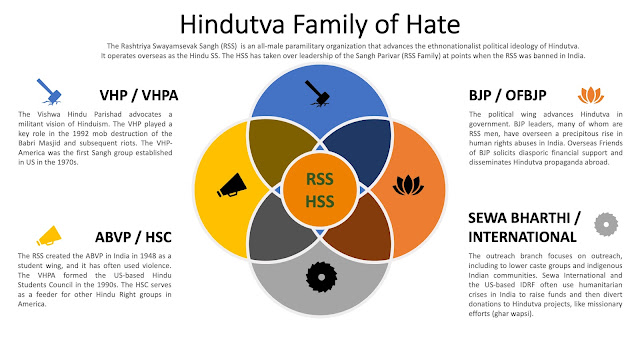
Global Hindutva Sangh Parivar. Source: Audrey Truschke

False narrative of victimhood underlies Hindutva ideology. Indian historian Aditya Mukherjee characterizes the Hindutva victimhood as follows: “The great achievements of the past are then contrasted with a false sense of victimhood, the concept of a great threat the majority is supposedly facing from the minority. This is how fascism works, globally".  "Hindutva was never meant to be understood as bounded by national borders; his (Savarkar's) ambition was always planetary", writes Vinayak Chaturvedi, author of "Hindutva and Violence". "He (Savarkar) gained notoriety for his programme to “Hinduise Politics and Militarise Hindudom” while also arguing for permanent war against Christians and Muslims", Chaturvedi adds. 

Prime Minister Modi's Hindutva rhetoric has influenced the behavior of the Indian diaspora in the US, UK and elsewhere. It has hurt India's international image.  In the United States, 45% of adults view India favorably while 50% view it unfavorably, according to the Pew Research Center Spring 2026 Global Attitudes Survey. The arrogance of the Indian diaspora was highlighted in 2024 when Vivek Ramaswamy, then a candidate for the Republican Party's presidential nomination,  said Americans don't have a good enough work ethic as American culture "venerated mediocrity over excellence." He offered it as a key justification to bring in more Indians to work in the United States. The backlash in the United States was immediate and strong.  The essence of the response to the Hindu supremacist criticism of the US culture went like this: People from India, a "shit-hole" country, are jealous of  America.  Earlier, Professor Amy Wax of University of Pennsylvania, told Tucker Carlsen that “the role of envy and shame in the way the third world [sic] regards the first world […] creates ingratitude of the most monstrous kind.” She also said that ‘Brahmin women’ of India are taught that they are better than everybody. 

Many liberal Indian intellectuals dismiss what is happening in India today under Hindu Nationalist Prime Minister Narendra Modi's leadership as a temporary aberration, not the norm. They long for a return to "Indian liberalism" which according to anthropologist Sanjay Srivastava "did not exist".  Others, such as Indian anthropologist Sanjay Srivastava, sum up the current situation as follows: 

"Our parents practiced bigotry of a quiet sort, one that did not require the loud proclamations that are the norm now. Muslims and the lower castes knew their place and the structures of social and economic authority were not under threat. This does not necessarily translate into a tolerant generation. Rather, it was a generation whose attitudes towards religion and caste was never really tested. The loud bigotry of our times is no great break from the past in terms of a dramatic change in attitudes – is it really possible that such changes can take place in such few years? Rather, it is the crumbling of the veneer of tolerance against those who once knew their place but no longer wish to accept that position. The great problem with all this is that we continue to believe that what is happening today is simply an aberration and that we will, when the nightmare is over, return to the Utopia that was once ours. However, it isn’t possible to return to the past that was never there. It will only lead to an even darker future. And, filial affection is no antidote for it".

In 2022, Dr Saiba Varma, Associate Professor of Anthropology at University of California in San Diego (UCSD), came under fire for hiding her familial ties to to a top RAW official while working on her book "The Occupied Clinic: Militarism and Care in Kashmir".  “As an upper-caste and upper-class Indian citizen and subject, I have actively and passively internalized anti-Muslim racism my entire life. I am complicit in the colonization of Kashmir and other regions forcibly incorporated into the Indian nation-state", she acknowledges in her book released in 2021.

In summary, what the world witnessing is a divide among the Indian elite over how India's identity should be projected abroad: whether its global prestige is best served by asserting its unique majoritarian civilizational heritage, or by reinforcing the pluralistic, secular democratic standards valued by international liberal institutions.


Friday, December 16, 2022

Pakistan FM Bilawal Bhutto Zardari Lashes Out At Indian EAM Subramanyam Jaishankar

“If the FM (foreign minister) of India (Jaishankar) was being honest, then he knows as well as I, that the RSS (India's militant Hindu organization) does not believe in Gandhi, in his ideology. They do not see this individual as the founder of India, they hero-worship the terrorist that assassinated Gandhi", said Pakistan's Foreign Minister Bilawal Bhutto Zardari at a press conference at the United Nations Headquarters in New York City. "Osama Bin Laden is dead but the butcher of Gujarat lives and he is the prime minister of India", he added. Mr. Bhutto Zardari was responding to a question from the media asked at the behest of the Indian Foreign Minister Subramanyam Jaishankar.  Earlier at the UNSC, Indian External Affairs Minister Subramanyam Jaishankar had unveiled a statue of Mohandas K. Gandhi at the UN and accused Pakistan of "hosting Osama Bin Laden". Gandhi was assassinated by Nathuram Godse, a member of the militant Hindu organization RSS. Indian Prime Minister Narendra Modi is a member of the RSS. 

Pakistan Foreign Minister Bilawal Bhutto Zardari at the United Nations Headquarters in New York

Here are some excerpts of what Bilawal Bhutto Zardari said at the media briefing at the UN:  

“He [Narendra Modi] was banned from entering this country [the United States]....these are the prime minister and foreign minister of the RSS (India's right-wing Hindu nationalist organization)....The RSS draws its inspiration from Hitler’s SS (the German Nazi Party’s militant wing Schutzstaffel)...(According to the RSS) we (Muslims) are terrorists whether we are Muslims in Pakistan and we’re terrorists whether we’re Muslims in India.....They (Modi and BJP) are not even attempting to wash the blood of the people of Gujarat off their hand..."Butcher of Gujarat” was now the “Butcher of Kashmir”". 

Last month,  the US State Department bracketed Indian Prime Minister Modi with murderous dictators like Congo's Laurent Kabila and Zimbabwe's Robert Mugabe. Speaking about the US decision to grant immunity to Saudi Crown Prince Mohammad Bin Salman, State Department spokesperson Vedant Patel said that it was “not the first time” that the US government has designated immunity to foreign leaders and listed four cases. “Some examples: President Aristide in Haiti in 1993; President Mugabe in Zimbabwe in 2001; Prime Minister Modi in India in 2014; and President Kabila in the DRC in 2018. This is a consistent practice that we have afforded to heads of state, heads of government, and foreign ministers,” he said. 

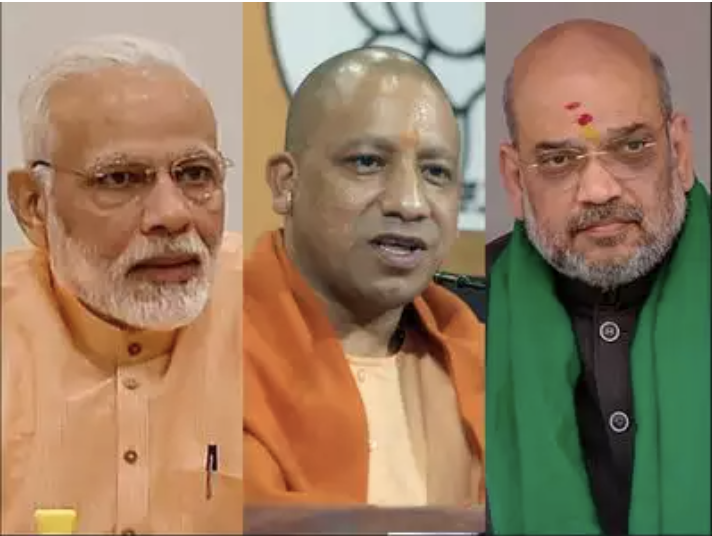
BJP HIndutva Leaders Modi, Yogi and Shah

Prime Minister Narendra Modi of India was barred from entering the United States from 2005 to 2014 for his involvement in the massacre of thousands of Muslims in Gujarat in 2002.  In 2015, a US judge dismissed a lawsuit against Modi after the US government argued that he is immune to accusations as a sitting head of government. While Modi has denied any involvement in the Gujarat anti-Muslim pogrom, he has never even expressed any regret over the killings in Gujarat when he was the Chief Minister of the Indian state. 

While Modi has refused to accept any responsibility for the massacre of over 2,000 Muslims in Gujarat in 2002, his party BJP's leaders have not shied away from claiming "credit" for it. Just yesterday, Modi's right-hand man and current Home Minister Amit Shah said Muslims were "taught a lesson" in 2002. He said that "after they were taught a lesson in 2002, these elements left that path (of violence). They refrained from indulging in violence from 2002 till 2022. BJP has established permanent peace in Gujarat by taking strict action against those who used to indulge in communal violence". 

In 2002 when Narendra Modi was chief minister of the Indian state of Gujarat, hundreds of young Muslim girls were sexually assaulted, tortured and killed.  These rapes were condoned by the ruling BJP, whose refusal to intervene lead to the rape and killing of thousands and displacement of 200,000 Muslims.

In 2012, a former Chief Minister of Gujarat Mr. Shankersinh Vaghela accused Modi's state government of having blood on its hand: "2002 me jo katl-e-aam hua uspe wo sarkar bani hai. Iske baad encounter hui, uske upar ye sarkar bani thi. Sarkar banti hai, lekin ye jo conspiracy karke sarkar banana hai, ye Gujarat aur desh ki janata jaanti hai aur aaj wo repeat nah o, iske liye hum janata ko request karte hain (The foundation of this (Modi) government rests on the 2002 carnage. Governments are made, but not on conspiracies. And the people of Gujarat know this, and that's why we are requesting the people for a change)," Mr Vaghela said.

Since his election to India's top elected office, Modi has elevated fellow right-wing Hindu extremists to positions of power in India. Yogi Adiyanath, known for his highly inflammatory anti-Muslim rhetoric, was hand-picked in 2016 by Modi to head India's most populous state of Uttar Pradesh.

Adiyanath's supporters brag about digging up Muslim women from their graves and raping them. In a video uploaded in 2014,  he said, “If [Muslims] take one Hindu girl, we’ll take 100 Muslim girls. If they kill one Hindu, we’ll kill 100 Muslims.”

Yogi wants to "install statues of Goddess Gauri, Ganesh and Nandi in every mosque”.  Before his election, he said, “If one Hindu is killed, we won’t go to the police, we’ll kill 10 Muslims”.  He endorsed the beef lynching of Indian Muslim Mohammad Akhlaque and demanded that the victim's family be charged with cow slaughter.

Madhav S. Golwalkar, considered among the founders of the Hindu Nationalist movement in India, saw Islam and Muslims as enemies. He said: “Ever since that evil day, when Moslems first landed in Hindusthan, right up to the present moment, the Hindu Nation has been gallantly fighting to shake off the despoilers".

In his book We, MS Golwalkar wrote the following in praise of what Nazi leader Adolf Hitler did to Jews as a model for what Hindus should do to Muslims in India: "To keep up the purity of the Race and its culture, Germany shocked the world by her purging the country of the Semitic races -- the Jews. Race pride at its highest has been manifested here. Germany has also shown how well-nigh impossible it is for races and cultures, having differences going to the root, to be assimilated into one united whole, a good lesson for us in Hindusthan to learn and profit by."

Paul Richard Brass, professor emeritus of political science and international relations at the Henry M. Jackson School of International Studies, University of Washington, has spent many years researching communal riots in India. He has debunked all the action-reaction theories promoted by Hindu Nationalists like Modi. He believes these are not spontaneous but planned and staged as "a grisly form of dramatic production" by well-known perpetrators from the Sangh Parivar of which Prime Minister Modi has been a member since his youth.

Here's an excerpt of Professor Brass's work:

"Events labelled “Hindu-Muslim riots” have been recurring features in India for three-quarters of a century or more. In northern and western India, especially, there are numerous cities and town in which riots have become endemic. In such places, riots have, in effect, become a grisly form of dramatic production in which there are three phases: preparation/rehearsal, activation/enactment, and explanation/interpretation. In these sites of endemic riot production, preparation and rehearsal are continuous activities. Activation or enactment of a large-scale riot takes place under particular circumstances, most notably in a context of intense political mobilization or electoral competition in which riots are precipitated as a device to consolidate the support of ethnic, religious, or other culturally marked groups by emphasizing the need for solidarity in face of the rival communal group. The third phase follows after the violence in a broader struggle to control the explanation or interpretation of the causes of the violence. In this phase, many other elements in society become involved, including journalists, politicians, social scientists, and public opinion generally. At first, multiple narratives vie for primacy in controlling the explanation of violence. On the one hand, the predominant social forces attempt to insert an explanatory narrative into the prevailing discourse of order, while others seek to establish a new consensual hegemony that upsets existing power relations, that is, those which accept the violence as spontaneous, religious, mass-based, unpredictable, and impossible to prevent or control fully. This third phase is also marked by a process of blame displacement in which social scientists themselves become implicated, a process that fails to isolate effectively those most responsible for the production of violence, and instead diffuses blame widely, blurring responsibility, and thereby contributing to the perpetuation of violent productions in future, as well as the order that sustains them."

"In India, all this takes place within a discourse of Hindu-Muslim hostility that denies the deliberate and purposive character of the violence by attributing it to the spontaneous reactions of ordinary Hindus and Muslims, locked in a web of mutual antagonisms said to have a long history. In the meantime, in post-Independence India, what are labelled Hindu-Muslim riots have more often than not been turned into pogroms and massacres of Muslims, in which few Hindus are killed. In fact, in sites of endemic rioting, there exist what I have called “institutionalized riot systems,” in which the organizations of militant Hindu nationalism are deeply implicated. Further, in these sites, persons can be identified, who play specific roles in the preparation, enactment, and explanation of riots after the fact. Especially important are what I call the “fire tenders,” who keep Hindu-Muslim tensions alive through various inflammatory and inciting acts; “conversion specialists,” who lead and address mobs of potential rioters and give a signal to indicate if and when violence should commence; criminals and the poorest elements in society, recruited and rewarded for enacting the violence; and politicians and the vernacular media who, during the violence, and in its aftermath, draw attention away from the perpetrators of the violence by attributing it to the actions."

Related Links:


Wednesday, May 11, 2022

WHO: India's 4.7 Million Excess Deaths Account For Nearly One-Third of the Global COVID Death Toll

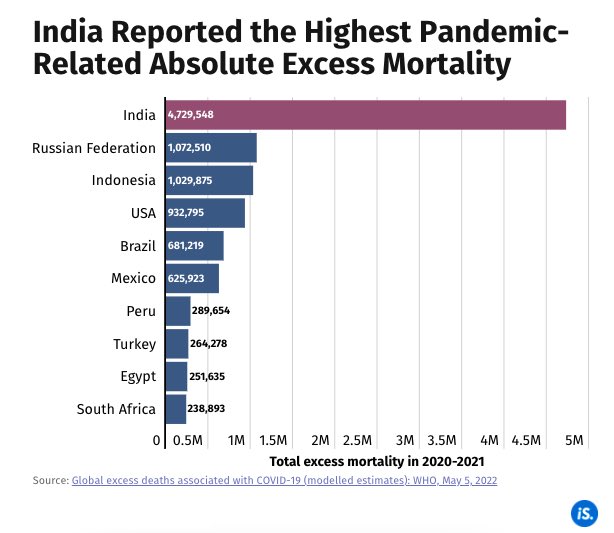
The World Health Organization estimates that India had 4.730 million COVID19-related  deaths in 2020-21, nearly a third of 15 million global excess deaths attributed to the pandemic. India is followed by Russia with 1.073 million deaths and Indonesia with 1.03 million deaths. The United States with 933,795 deaths and Brazil with 681,219 deaths round out the top 5 countries that suffered the heaviest losses of life believed to be related to the pandemic. Mexico (625,923 deaths), Peru (289,654 deaths), Turkey (264,279 deaths) Egypt (251,635 deaths) and South Africa (238,893 deaths) are ranked number 6 through 10 in the world for excess deaths in 2020-21 period. Although Pakistan too had 8 times the official figure, it still does not figure in WHO's top 10 list for total number of COVID deaths. 

Total Excess Deaths Recorded During the COVID-19 Pandemic in 2020-21. Source: WHO

Excess deaths measure how many more people died than expected compared with previous years. Although it is difficult to say with certainty how many of these deaths were due to Covid, they can be considered a measure of the scale and toll of the pandemic, according to the BBC. 

Although the government of Prime Minister Narendra Modi disputes the WHO estimates, the scenes of desperation and death all over India, including the streets of major cities during the pandemic, offer significant anecdotal evidence to support the WHO claim. Although Pakistan too had 8 times the official figure, it still does not figure in WHO's top 10 list for total number of COVID deaths. 

List of Countries with excess deaths during COVID19 pandemic. Source: WHO

Prime Minister Modi's mishandling of the COVID19 pandemic has left a lasting effect on India's economy. Akhil Bharatiya Pratinidhi Sabha (ABPS), the top decision-making body of India's Hindu right-wing RSS (Rashtriya Swayamsevak Sangh), says that “the young generation is suffering from unemployment and the pandemic has made things even grim... We cannot turn a blind eye to unemployment. It is a crisis and it needs to be addressed.” The RSS was apparently reacting to the falling labor participation rate in India relative to Pakistan and the global averages. The RSS leadership wants the government of Prime Minister Narendra Modi to focus on helping small and medium sized enterprises (SMEs) to create jobs.  RSS likes Modi government's ‘Make in India’ initiative “but it needs to be sharpened even more and get more investment.” The resolution is titled, ‘The need to promote work opportunities to make Bharat self-reliant’. The solution offered by ABPS resolution: Take agro-based local initiatives to promote rural areas and create jobs, according to Ram Madhav, a member of the RSS executive committee. 

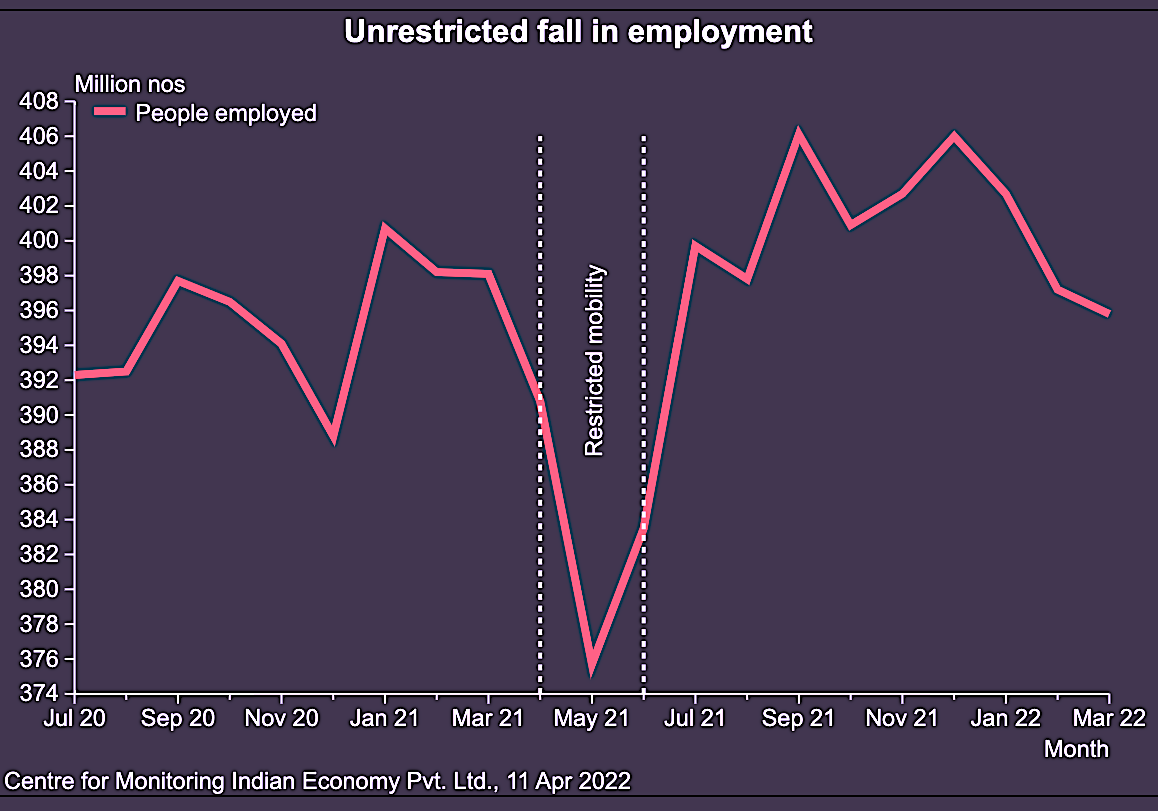
Falling Employment in India. Source: CMIE


India's labor participation rate (LPR) fell to 39.5% in March 2022, as reported by the Center for Monitoring Indian Economy (CMIE). It dropped below the 39.9% participation rate recorded in February. It is also lower than during the second wave of Covid-19 in April-June 2021. The lowest the labor participation rate had fallen to in the second wave was in June 2021 when it fell to 39.6%. The average LPR during April-June 2021 was 40%. March 2022, with no Covid-19 wave and with much lesser restrictions on mobility, has reported a worse LPR of 39.5%.

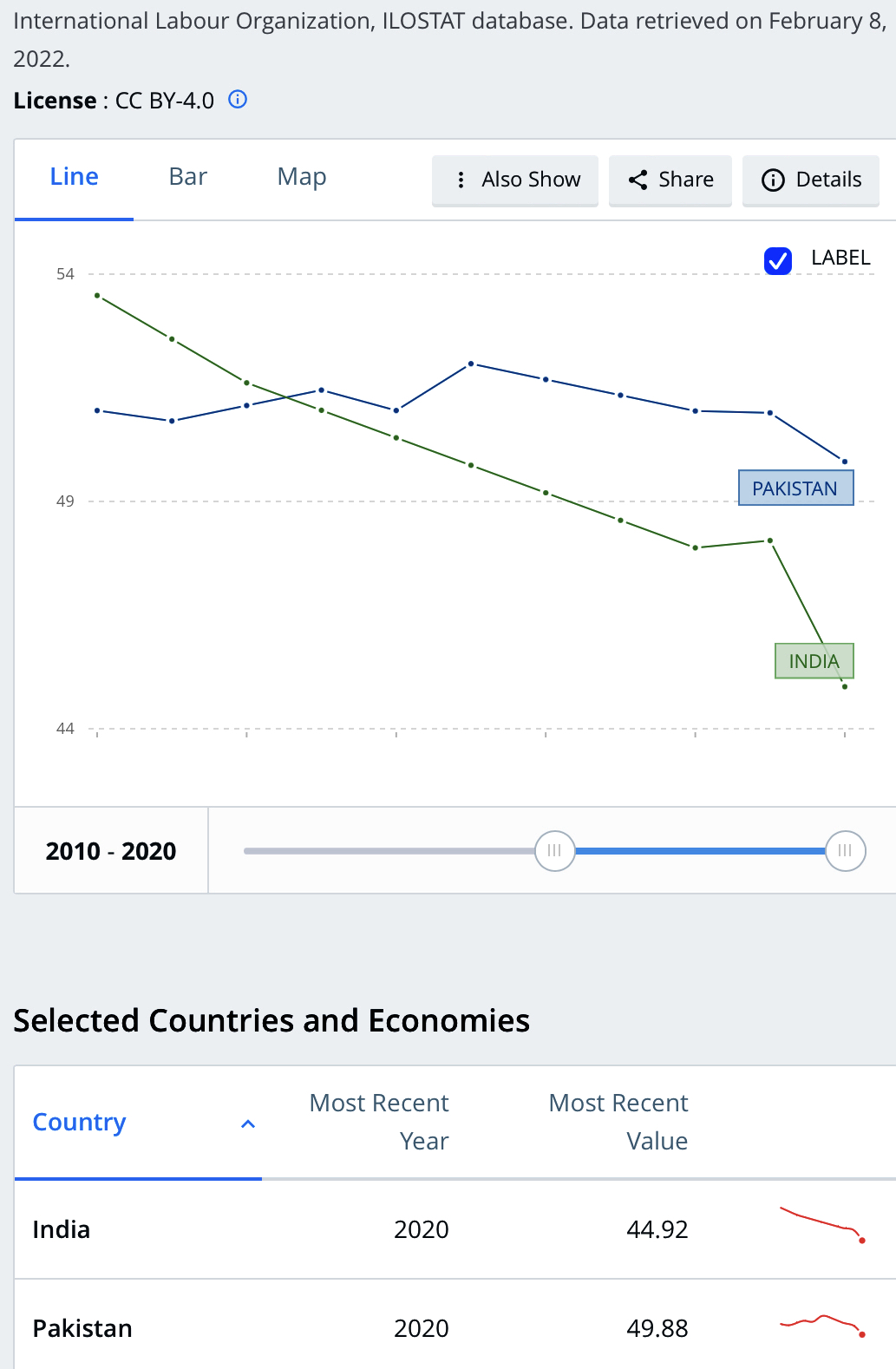
Labor Participation Rates in India and Pakistan. Source: ILO/World Bank

In spite of the headline GDP growth figures highlighted by the Indian and world media, the fact is that it has been jobless growth. The labor participation rate (LPR) in India has been falling for more than a decade. The LPR in India has been below Pakistan's for several years, according to the International Labor Organization (ILO). 

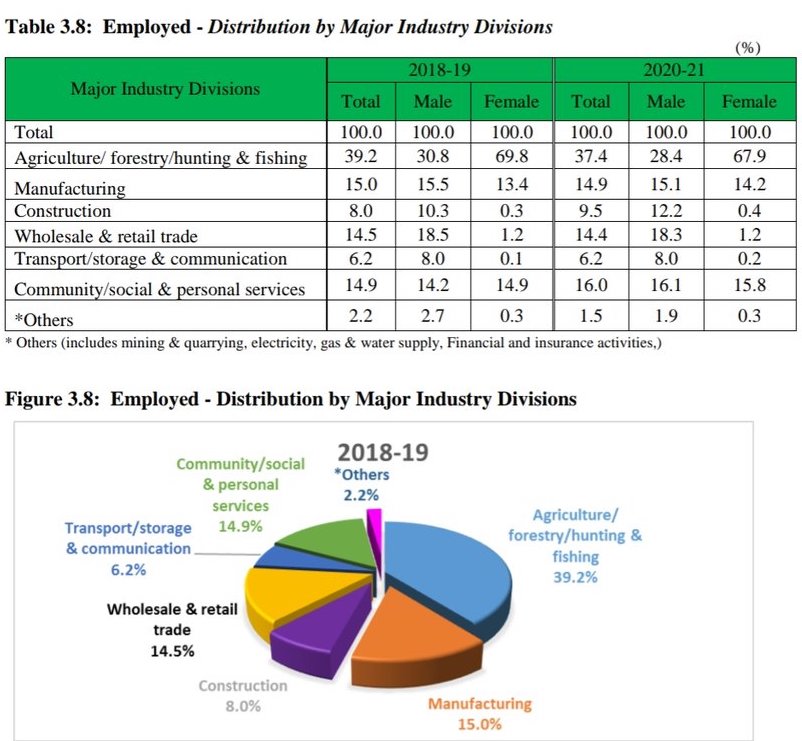
Indian Employment Trends By Sector. Source: CMIE Via Business Standard

Construction and manufacturing sectors in India have been shedding jobs while the number of people working in agriculture has been rising, according to CMIE. Job losses have caused a hunger crisis in India which now ranks 94th among 107 nations ranked by World Hunger Index in 2020. Other South Asians have fared better: Pakistan (88), Nepal (73), Bangladesh (75), Sri Lanka (64) and Myanmar (78) – and only Afghanistan has fared worse at 99th place. The COVID19 pandemic has worsened India's hunger and malnutrition. Tens of thousands of Indian children were forced to go to sleep on an empty stomach as the daily wage workers lost their livelihood and Prime Minister Narendra Modi imposed one of the strictest lockdowns in the South Asian nation. Pakistan's former Prime Minister Imran Khan opted for "smart lockdown" that reduced the impact on daily wage earners. China, the place where COVID19 virus first emerged, is among 17 countries with the lowest level of hunger. 


Related Links:

Haq's Musings

South Asia Investor Review

Pakistan Among World's Largest Food Producers

Naya Pakistan Housing Program

Food in Pakistan 2nd Cheapest in the World

Indian Economy Grew Just 0.2% Annually in Last Two Years

Pakistan to Become World's 6th Largest Cement Producer by 2030

Pakistan Reduced Poverty & Grew Economy During COVID Pandemic

Pakistan's Computer Services Exports Jump 26% Amid COVID19 Lockdown

Coronavirus, Lives and Livelihoods in Pakistan

Vast Majority of Pakistanis Support Imran Khan's Handling of Covid19 Crisis

Pakistani-American Woman Featured in Netflix Documentary "Pandemic"

Incomes of Poorest Pakistanis Growing Faster Than Their Richest Counterparts

Can Pakistan Effectively Respond to Coronavirus Outbreak? 

How Grim is Pakistan's Social Sector Progress?

Pakistan Fares Marginally Better Than India On Disease Burdens

Trump Picks Muslim-American to Lead Vaccine Effort

COVID Lockdown Decimates India's Middle Class

Pakistan Child Health Indicators

Pakistan's Balance of Payments Crisis

How Has India Built Large Forex Reserves Despite Perennial Trade Deficits

Conspiracy Theories About Pakistan Elections"

PTI Triumphs Over Corrupt Dynastic Political Parties

Strikingly Similar Narratives of Donald Trump and Nawaz Sharif

Nawaz Sharif's Report Card

Riaz Haq's Youtube Channel

Saturday, April 16, 2022

Hindu Nationalist RSS Leadership Criticizes Jobless Growth in India

Akhil Bharatiya Pratinidhi Sabha (ABPS), the top decision-making body of India's RSS (Rashtriya Swayamsevak Sangh), says that “the young generation is suffering from unemployment and the pandemic has made things even grim... We cannot turn a blind eye to unemployment. It is a crisis and it needs to be addressed.” The RSS was apparently reacting to the falling labor participation rate in India relative to Pakistan and the global averages. The RSS leadership wants the government of Prime Minister Narendra Modi to focus on helping small and medium sized enterprises (SMEs) to create jobs.  RSS likes Modi government's ‘Make in India’ initiative “but it needs to be sharpened even more and get more investment.” The resolution is titled, ‘The need to promote work opportunities to make Bharat self-reliant’. The solution offered by ABPS resolution: Take agro-based local initiatives to promote rural areas and create jobs, according to Ram Madhav, a member of the RSS executive committee. 

Falling Employment in India. Source: CMIE


India's labor participation rate (LPR) fell to 39.5% in March 2022, as reported by the Center for Monitoring Indian Economy (CMIE). It dropped below the 39.9% participation rate recorded in February. It is also lower than during the second wave of Covid-19 in April-June 2021. The lowest the labor participation rate had fallen to in the second wave was in June 2021 when it fell to 39.6%. The average LPR during April-June 2021 was 40%. March 2022, with no Covid-19 wave and with much lesser restrictions on mobility, has reported a worse LPR of 39.5%.

Labor Participation Rates in India and Pakistan. Source: ILO/World Bank


Youth  unemployment for ages15-24 in India is 24.9%, the highest in South Asia region. It is 14.8% in Bangladesh 14.8% and 9.2% in Pakistan, according to the International Labor Organization and the World Bank.  

Youth Unemployment in Bangladesh, India and Pakistan. Source: ILO, WB


In spite of the headline GDP growth figures highlighted by the Indian and world media, the fact is that it has been jobless growth. The labor participation rate (LPR) in India has been falling for more than a decade. The LPR in India has been below Pakistan's for several years, according to the International Labor Organization (ILO). 

Indian Employment Trends By Sector. Source: CMIE Via Business Standard

Construction and manufacturing sectors in India have been shedding jobs while the number of people working in agriculture has been rising, according to CMIE. 

Pakistan Employment By Sectors. Source: PBS via Bilal Gilani

It is important to note that Pakistan’s economy has created 5.5 million jobs during the past three years – 1.84 million jobs a year, significantly higher than yearly average of new jobs created during the 2008-18 decade, according to the findings of Labor Force Survey (LFS) as reported by the Express Tribune paper. The biggest jump in share of employment (1.5%) was in the construction sector, spurred by Naya Pakistan construction incentives offered by the PTI government. 


Related Links:

Haq's Musings

South Asia Investor Review

Pakistan Among World's Largest Food Producers

Naya Pakistan Housing Program

Food in Pakistan 2nd Cheapest in the World

Indian Economy Grew Just 0.2% Annually in Last Two Years

Pakistan to Become World's 6th Largest Cement Producer by 2030

Pakistan's 2012 GDP Estimated at $401 Billion

Pakistan's Computer Services Exports Jump 26% Amid COVID19 Lockdown

Coronavirus, Lives and Livelihoods in Pakistan

Vast Majority of Pakistanis Support Imran Khan's Handling of Covid19 Crisis

Pakistani-American Woman Featured in Netflix Documentary "Pandemic"

Incomes of Poorest Pakistanis Growing Faster Than Their Richest Counterparts

Can Pakistan Effectively Respond to Coronavirus Outbreak? 

How Grim is Pakistan's Social Sector Progress?

Pakistan Fares Marginally Better Than India On Disease Burdens

Trump Picks Muslim-American to Lead Vaccine Effort

COVID Lockdown Decimates India's Middle Class

Pakistan Child Health Indicators

Pakistan's Balance of Payments Crisis

How Has India Built Large Forex Reserves Despite Perennial Trade Deficits

Conspiracy Theories About Pakistan Elections"

PTI Triumphs Over Corrupt Dynastic Political Parties

Strikingly Similar Narratives of Donald Trump and Nawaz Sharif

Nawaz Sharif's Report Card

Riaz Haq's Youtube Channel

Sunday, September 29, 2019

Imran Khan's UNGA Speech on Hindutva, Islamophobia and Kashmir (Urdu)

How was Pakistan Prime Minister Imran Khan's UN General Assembly speech received? Was he right to tell the audience that Prime Minister Narendra Modi belongs to RSS, the right-wing Hindu Supremacist organization whose member killed Mahatma Gandhi? Does the world know that RSS founders were inspired by Nazism and Fascism? And the RSS members admire Gandhi's murderer Nathuram Godse? Is it hypocritical of Modi to exploit Gandhi's name in his UNGA speech and elsewhere in the West? Do Hindutva followers want to have it both ways? Benefit from Gandhi's name in the West while destroying Gandhi's legacy in India?


Why did Imran Khan talk about the connection between US war on terror after 911 and the rise of Islamophobia? How have countries like India exploited the war on terror to defame genuine Kashmiri resistance movement as terrorism?

What will happen when Modi lifts restrictions on 8 million Kashmiris living under total lock-down since August 5, 2019? Is Modi riding the tiger and afraid of getting off of it? Is Imran Khan right to fear a massacre by nearly million-strong Indian forces? Will India call it "cross-border terrorism" and blame it on Pakistan? Will Modi again try to pull a Balakot? Could it start India-Pakistan war? Would it escalate into a nuclear conflict killing billions around the world?

ALKS host Faraz Darvesh discusses these questions with Sabahat Ashraf (ifaqeer) and Riaz Haq (www.riazhaq.com)

https://youtu.be/Kz8S8z-ax1o


Related Links:

Haq's Musings

South Asia Investor Review

Rape as a Political Weapon Used By Hindutva

Hindu Nationalism Inspired By Nazism, Fascism

Rise of Islamophobia After Sept 11, 2001 Terrorist Attacks

700,000 Indian Soldiers Versus 7 Million Kashmiris

Modi's Kashmir Blunder and India-Pakistan Nuclear Conflict

Is India a Paper Elephant? 

Howdy Modi Rally Exposes Indian-Americans to Charges of Hypocrisy

Modi's Extended Lockdown in Indian Occupied Kashmir

Hinduization of India

Brievik's Hindutva Rhetoric

Indian Textbooks

India's RAW's Successes in Pakistan

Riaz Haq Youtube Channel

VPOS Youtube Channel

Sunday, August 13, 2017

India and Pakistan at 70; Nawaz Sharif Rallies; Korea Crisis

How are India and Pakistan doing 70 years after independence? What are their successes and failures? What challenges do they face? What does future hold for them? Can Pakistani democracy evolve and grow to serve all of its people? How will Hindu Nationalist Modi's rise impact South Asia? Is India's secular democracy under threat? Could it lead to war? Is there a way to manage tensions between the two rivals? Will there ever be durable peace in South Asia?

Has deposed PM Nawaz Sharif really accepted the Supreme Court verdict disqualifying him? Should he really accept the verdict as Al Gore accepted Bush v Gore verdict after 2000 US presidential elections and go home quietly? What does Nawaz Sharif hope to achieve by his daily political rallies as he makes his way from Islamabad to Lahore in a long convoy of vehicles? Will his continuing public attacks on the judiciary undermine democracy in Pakistan?

What is at the root of the Korea crisis? Is it Kim Jong Un's fear of regime change if he agrees to denuclearize? What lessons have Kim and others learned from the way US first denuclearized Saddam and Gaddafi and then removed them that led to their deaths? Is President Donald Trump's fiery rhetoric making the crisis worse? Should Trump listen to the advice of US allies to cool it?

Viewpoint From Overseas host Faraz Darvesh discusses these questions with Riaz Haq (www.riazhaq.com)

https://youtu.be/ffADNF3hgck


Related Links:

Haq's Musings

Pakistan Day: Freeing the Colonized Minds of the Elite

Pankaj Mishra's NY Times Op Ed on India at 70

Lynchistan: India is the Lynching Capital of the World

Nawaz Sharif Disqualified by Pakistan Supreme Court

North Korea Nukes and ICBM

Trump's White House

Talk4Pak Youtube Channel

Friday, August 5, 2016

IndoPak Saudi Workers Troubles; Trump's Popularity in India; GOP Infighting

What is happening to construction crews from India and Pakistan working in Saudi Arabia? Why are they going unpaid for months? Could problems for Indian and Pakistani expats get worse as oil prices stay low for extended period? Will remittances from GCC nations to India and Pakistan suffer? Will poverty increase in South Asia?

Why is Trump popular with Hindu Nationalists in India? Why are many right-wing Hindus praying for Trump's victory against Hillary in US elections? Will a Trump presidency be good for India? Is there anything in common between the Hindu Right's anti-Muslim bigotry and Trump's Islamophobia? Is Donald Trump spousing xenophobic and racist views similar to those of German Nazi leader Adolf Hitler and Indian RSS Guru Madhav Sadashiv Golwalkar?

Has Donald Trump been hurt by his war of words with the GoldStar family of Ghazala and Khizr Khan, the parents of the slain war hero US Army Captain Humayun Khan? Has this episode confirmed in the minds of many GOPers that Trump is temperamentally unfit to be in the Oval Office? Has it sparked a war within GOP with Republican leaders Paul Ryan and John McCain taking on the GOP top of the ticket? How will the repetition of such incidents affect the Trump campaign? Will the entire GOP ticket face historic defeat?

Viewpoint From Overseas host Misbah Azam discusses these questions with panelists Ali H. Cemendtaur and Riaz Haq (www.riazhaq.com)

https://youtu.be/6X2I6tBubH0


https://vimeo.com/177756879

IndoPak Saudi Workers Troubles; Trump's Popularity in India; GOP Infighting from Ikolachi on Vimeo.

Related Links:

Haq's Musings

Impact of Saudi Oil Revenue Slump

Hindu Nationalists Admire Hitler & Nazis

The Trump Phenomenon

Democratic National Convention

Talk4Pak Think Tank

VPOS Youtube Channel

VPOS Vimeo Channel


Monday, February 22, 2016

Tarek Fatah vs Riaz Haq on India, Pakistan and Muslims

Tarek Fatah, Canadian Muslim writer and broadcaster, and Riaz Haq, a Pakistani-American blogger, debate the following:


In a 2013 interview with Times of India, Tarek Fatah said, “Pakistan will soon disintegrate”. Is this a prediction or a wish? Why is he such a strong and vocal supporter of Baloch insurgents? If Pakistan does disintegrate, what will be its fall-out for the region and the world?


When Tarek Fatah was asked in an NDTV interview about Donald Trump’s Muslim Ban, why did he criticize Muslims, Obama and western liberals rather than address the question directly?

Why is Tarek Fatah seen in the company of well-known anti-Islam bigots like Robert Spencer and Frank Gaffney on Fox News and as a guest of honor of RSS student wing ABVP at JNU in India?

 Why does Tarek Fatah pander to the Indian Hindu Nationalists and western Islamophobes? Why does he not condemn Islamophobia?

Viewpoint From Overseas host Faraz Darvesh moderated the debate.

https://www.youtube.com/watch?v=XbD7_K1ABao&feature=youtu.be


https://vimeo.com/156225342

Tarek Fatah vs Riaz Haq on India, Pakistan and Muslims from WBT Productions on Vimeo.

http://www.dailymotion.com/video/x3tjgtg


Tarek Fatah vs Riaz Haq on India, Pakistan and... by ViewpointFromOverseas

Related Links:

Haq's Musings

India's Proxy War Against Pakistan

Hinduization of India

Hindu Nationalists Admire Hitler, Nazis

Western Islamophobia Industry

Trump's Muslim Ban

Talk4Pak Think Tank

Wednesday, December 23, 2015

India's Hindu Nationalists Going Global

India's top Hindu Nationalist group Rashtriya Swayamsevak Sangh (RSS) has gone global with shakhas (branches) in 39 countries, including the United States, the United Kingdom and several Islamic middle eastern nations, according to Indian media reports.


In the United States alone, the RSS has 146 active chapters spread over all 50 states, according to Satish Modh who has been associated with RSS work abroad for over 25 years.

While shakhas in India take place in open public spaces, most shakhas meet on university campuses on hired parking lots in the US, says Modh.  Most overseas shakhas are held once a week. In London, they are held twice a week. The UK has 84 shakhas.

RSS in US:

A US report entitled "Hindu Nationalism in the United States: A Report on Non-Profit Groups" disclosed the following findings regarding the strength and nature of the Hindu nationalist movement in the United States:

 a. Over the last three decades, a movement toward Hinduizing India--advancing the status of Hindus toward political and social primacy in India-- has continued to gain ground in South Asia and diasporic communities. The Sangh Parivar (the Sangh "family"), the network of groups at the forefront of this Hindu nationalist movement, has an estimated membership numbering in the millions, making the Sangh one of the largest voluntary associations in India. The major organizations in the Sangh include the Rashtriya Swayamsevak Sangh (RSS), Vishwa Hindu Parishad (VHP), Bajrang Dal, and Bharatiya Janata Party (BJP).

b. Hindu nationalism has intensified and multiplied forms of discrimination, exclusion, and gendered and sexualized violence against Muslims, Christians, other minorities, and those who oppose Sangh violations, as documented by Indian citizens and international tribunals, fact-finding groups, international human rights organizations, and U.S. governmental bodies.

c. India-based Sangh affiliates receive social and financial support from its U.S.-based wings, the latter of which exist largely as tax-exempt non-profit organizations in the United States: Hindu Swayamsevak Sangh (HSS), Vishwa Hindu Parishad of America (VHPA), Sewa International USA, Ekal Vidyalaya Foundation-USA. The Overseas Friends of the Bharatiya Janata Party - USA (OFBJP) is active as well, though it is not a tax-exempt group.

Influencing Thought and Policies:

The RSS is actively working to influence thought and policies in the West. Examples include the contents of the manifesto of the Norway mass murderer Breivik and attempts to influence California textbooks.

Breivik's Hindutva Rhetoric:

The Norwegian white supremacist terror suspect Anders Behring Breivik's manifesto against the "Islamization of Western Europe" was heavily influenced by the kind of anti-Muslim rhetoric which is typical of the Nazi-loving Hindu Nationalists like late Madhav Sadashiv Golwalkar (1906-1973), and his present-day Sangh Parivar followers and sympathizers in the Bharatiya Janata Party (BJP) who currently rule several Indian states. This Hindutva rhetoric which infected Breivik has been spreading like a virus on the Internet, particularly on many of the well-known Islamophobic hate sites that have sprouted up in Europe and America in recent years. In fact, much of the Breivik manifesto is cut-and-pastes of anti-Muslim blog posts and columns that validated his worldview.


"It is essential that the European and Indian resistance movements learn from each other and cooperate as much as possible. Our goals are more or less identical," Breivick wrote in his manifesto. The Christian Science Monitor has reported that "in the case of India, there is significant overlap between Breivik’s rhetoric and strains of Hindu nationalism – or Hindutva – on the question of coexistence with Muslims. Human rights monitors have long decried such rhetoric in India for creating a milieu for communal violence, and the Norway incidents are prompting calls here to confront the issue."


Hindu nationalists in India have a long history of admiration for Adolf Hitler, and his "Final Solution". In his book "We" (1939), Madhav Sadashiv Golwalkar, the leader of the Hindu Nationalist RSS (Rashtriya Swayamsevak Sangh) wrote, "To keep up the purity of the Race and its culture, Germany shocked the world by her purging the country of the Semitic races -- the Jews. Race pride at its highest has been manifested here. Germany has also shown how well-nigh impossible it is for races and cultures, having differences going to the root, to be assimilated into one united whole, a good lesson for us in Hindusthan to learn and profit by."

California Textbooks:

Not only have the BJP led governments in India fundamentally altered India's history textbooks, the BJP allies around the world are attempting to the same in textbooks as far as California.

Here are some excerpt from "HISTORY TEXTBOOKS IN INDIA: NARRATIVES OF RELIGIOUS NATIONALISM" by K.N.PANIKKAR:

"The introduction of new textbooks by the NCERT (under BJP) was inspired by the political purpose of seeking rationale from history for constructing India as a Hindu nation. The textbooks were, therefore, recast as narratives of Hindu religious nationalism. Claimed as an effort to retrieve the true nationalist history from the motivated distortions of colonial historiography they attribute to Indian nation an exclusively Hindu character."

"During this period the political climate in the country turned in favour of the Hindu fundamentalist forces, which enabled them in 1998 to lead a coalition government in which the Ministry of Human Resource Development which dealt with education was headed by a long standing cadre of the Hindu fundamentalist organization, Rashtriya Swayam Sevak Sangh( RSS). Under his stewardship the government spared no effort to change the content and character of education, of which the introduction of new textbooks, was perhaps the most prominent and indeed controversial."

"The idea of India being a Hindu civilisational state runs through all the texts, either directly expressed or indirectly suggested. The question of the indigenous origin of Aryans and the identity of Harappan civilization with the Vedic society has some bearing on this issue. The former is quite central to the fundamentalist agenda of claiming the nation as Hindu, as the migration theory would deprive the Hindus of indigenous lineage. Therefore, against the widely held scholarly opinion Aryans are credited with indigenous origins, subscribing in the bargain to the colonial view of Aryan race. In the former case the textbooks put forward the view that the Aryans were indigenous to India and that the opinion widely held by scholars about their migration dismissed as inconsequential. In defense of indigenous origin no substantial evidence is adduced, except negative reasoning. It is asserted that the ‘the oldest surviving records of the Aryans, the Rig Veda, does not give even an inkling of any migration. It does not have any knowledge even of the geography beyond the known boundaries of Ancient India.’ It further says: ‘Many scholars think that the Aryans were originally inhabitants of India and did not come from outside. It has been argued by such scholars that there is no archeological or biological evidence, which could establish the arrival of any new people from outside between 5000 B.C and 800 B.C. This means that if at all there was any migration of Aryans or for that matter of any other people in India, it may have taken place at least eight or nine thousand years ago or after 800 B.C. to both of which there is no evidence. Further, the skeletal remains found from various Harappan sites resemble the skeletons of the modern population of the same geographical area.'"


The fanatic Hindu nationalists tried to do in California what their Indian counterparts have already done in India. They attempted to pollute California history textbooks in 2006, when they argued unsuccessfully to include lies like the indigenous origins of Aryans and tried to deny the terrible impact on hundreds of millions of Indians of the caste system and misogyny prevalent in Hindu texts and Aryan culture.

Hundreds of history scholars from US and South Asia helped defeat this reprehensible attempt by Hindu American Foundation (HAF) and its allies in the United States.

While the biggest victims of Hindu fundamentalists are the women and the Dalits of India, non-Hindu minorities and the neighboring states have not been spared either.

They are cowards and they prey upon unarmed Muslim, Christian and Sikh minorities in organized pogroms in what American scholar Paul Brass calls "production of violence" in India with many Indian intellectuals and some in the Indian press justifying the actions of the murderers.

The big brothers of these fanatic Hindutva terrorists occupy high positions in the Indian security establishment, according to former Maharashtra police chief SM Mushrif. These Hindutva allies in Indian government conduct covert warfare via terrorist actions in neighboring states including Pakistan through RAW.

Summary:

The Indian Hindu Nationalists are rapidly increasing their global reach. The hate-filled ideology they preach is a growing potential threat to peace and stability of many nations where they operate. Breivik's actions represent only the tip of a much larger and growing iceberg of death and destruction that lies just beneath the surface.

Related Links:

Haq's Musings

Hinduization of India

Brievik's Hindutva Rhetoric

Indian Textbooks

India's RAW's Successes in Pakistan


Thursday, June 17, 2010

Hindu Nationalists Admire Nazis and Israel in India?

Nazi memorabilia, including Adolf Hitler's biography Mein Kampf, are growing in popularity in India, according to the BBC. The marketing chief of Crossword, a national chain of book stores in India, told the BBC that Mein Kampf has "been a consistent bestseller for us."

At Mumbai bookstores located in upscale neighborhoods, the Hitler book sales have risen sharply from 40-50 copies a year to several hundred copies annually in each store. It's not just the autobiography - books on the Nazi leader, T-shirts, bags, bandanas and key-rings are also in demand. A shop in Pune, called Teens, says it sells nearly 100 T-shirts a month with Hitler's image on them.

A Bollywood film "Dear Friend Hitler" is due to be released at the end of this year, according to news reports. The movie director Rakesh Ranjan Kumar says his film "shows Hitler's love for India and how he indirectly contributed to Indian independence".

Hindu nationalists in India have a long history of admiration for the Nazi leader, including his "Final Solution". In his book "We" (1939), Madhav Sadashiv Golwalkar, the leader of the Hindu Nationalist RSS (Rashtriya Swayamsevak Sangh) wrote, "To keep up the purity of the Race and its culture, Germany shocked the world by her purging the country of the Semitic races -- the Jews. Race pride at its highest has been manifested here. Germany has also shown how well-nigh impossible it is for races and cultures, having differences going to the root, to be assimilated into one united whole, a good lesson for us in Hindusthan to learn and profit by." (We, p.35/p.43)


There may have been mutual admiration between the upper caste Hindu Nationalists and the Nazis since the 1940s. After all, the Nazis adopted the Swastika, a symbol commonly used by Brahmans in India, because it was understood as an Aryan symbol indicating racial purity and superiority. The Nazis knew that the early Aryans of India were white invaders.

On the surface, it appears that Indians are schizophrenic. It is hard to reconcile the right-wing Hindus' growing admiration for the Nazis with their new-found love of Israel. But there is evidence to suggest that both trends are real. Along with rising sales of the Nazi merchandise, there have also been calls in India to "do Gaza" in Pakistan, and the Indian police discovered a conspiracy by a serving Indian Army officer to set up a radical Hindu government in exile in Israel. Both of these trends seem to be driven mainly by the rising hatred of minorities, particularly Muslims, in India.

A 13-nation poll conducted on behalf of Israel last year found that Israel's approval ratings in India are the highest in the world. According to the poll, which was unprecedented in scope and was undertaken by an international market research company, 58% of Indian respondents showed sympathy to the Jewish State. The United States came in second, with 56% of American respondents sympathizing with Israel. The study was conducted as part of the "Branding Israel" project and aimed at looking into Israel's international stature at what researchers characterized as the world's 13 most important countries, including the US, Canada, Britain, France, China, and Russia. A total of 5,215 people took part in the study.

Other countries that showed significant sympathy to Israel included Russia (52%) Mexico (52%) and China (50%). At the bottom of the list, the study ranked Britain (34%) France (27%) and Spain (23%) as the least sympathetic countries towards Israel.

There are no global sales figures available for Mein Kampf, but India is not alone in the rising sales of the Hitler biography. In the US, it sold 26,000 copies last year. In 2005 it sold 100,000 copies in Turkey in just a few months. The Arabic imprint is popular in the Palestinian territories.

The Hindu Nationalist attitudes seem to reflect a combination of deep animosity toward minorities as demonstrated by Hitler, and a desire to emulate Israelis in dealing with Muslims in and around India. No matter how one looks at it, these growing trends in India constitute a grave threat to peace in South Asia and the Middle East regions.

Related Links:

Haq's Musings

Radical Hindu Government in Exile in Israel

Can India Do a Lebanon in Pakistan?

Israeli Approval Ratings Highest in India

India's Washington Lobby Collaborates with Israel Lobby

Enraged Hindu Nationalists Gang Up on Musharraf

Gandhi Opposed Creation of Israel

Hitler Memorabilia Attracts Young Indians

Hindutva Terror Can Spark Indo-Pakistan War?

India-Israel-US Axis

India's Israel Envy

Friday, May 8, 2009

Arundhati Roy in Pakistan


Indian author and activist Arundhati Roy is currently visiting Pakistan. “An individual resorts to taking up weapons only when he does not get justice in society,” she said. Here's a report on what she is saying to her Pakistani audience:

Is there a threat of Talibanization engulfing the entire region?

I think it has already engulfed our region. I think there’s a need for a very clear thinking (on this issue of Talibanization). In India, there are two kinds of terrorism: one is Islamic terrorism and the other Maoist terrorism. But this term terrorism, we must ask, what do they mean by it.

In Pakistan, I’m here to understand what they mean by this term. When we say we must fight the Taliban or must defeat them, what does it mean? I’m here to understand what you mean when you say Taliban. Do you mean a militant? Do you mean an ideology? Exactly what is it that is being fought? That needs to be clarified.

I think both needs to be fought. But if it’s an ideology it has to be fought differently, while if it’s a person with a gun then it has to be fought differently. We know from the history of the war on terror that a military strategy is only making matters worse all over the world. The war on terror has made the world a more dangerous place. In India, they have been fighting insurgencies military since 1947 and it has become a more dangerous place.

Swat and the Taliban boy

It is very important for me to understand what exactly is going in Swat. How did it start? A Taliban boy asked me why women can’t be like plastic bags and banned. The point is that the plastic bag was made in a factory but so was the boy. He was made in a factory that is producing this kind of mind(set). (The question is) who owns that factory, who funds it? Unless we deal with that factory, dealing with the boy doesn’t help us.

Water is the main issue

One danger in Pakistan is that we talk about the threat of Taliban so much that other important issues lose focus. In my view, the problem of water in the world will become the most important problem. I think big dams are economically unviable, environmentally unsustainable and politically undemocratic. They are a way of taking away a river from the poor and giving it to the rich. Like in India, there’s an issue of SEZs (Special Economic Zones), whereby the land of the people are given to corporations. But the bigger problem is that there are making dams and giving water to the industries. This way the people who live in villages by the streams and rivers have no water for themselves. So building dams is one of the most ecologically destructive things that you can do.

Fight over Siachen glacier

There are thousands of Pakistani and Indian soldiers deployed on the Siachen glacier. Both of our countries are spending billions of dollars on high altitude warfare and weapons. The whole of the Siachen glacier is sort of an icy monument to human folly. Each day it is being filled with ice axes, old boots, tents and so on. Meanwhile, that battlefield is melting. Siachen glacier is about half its size now. It’s not melting because the Indian and Pakistani soldiers are on it. But it’s because people somewhere on the other side of the world are leading a good life….in countries that call themselves democracies that believe in human rights and free speech. Their economies depend on selling weapons to both of us. Now, when that glacier melts, there will be floods first, then there will be a drought and then we’ll have even more reasons to fight. We’ll buy more weapons from those democracies and in this way human beings will prove themselves to be the stupidest animals on earth.

Money and the Indian elections

Whatever system of government you have, whether it is a military dictatorship or a democracy, and you have that for a long time, eventually big money manages to subvert it. That has begun to happen even in a democracy (like India). For example, political parties need a lot of publicity, but the media is also run by corporate money. If you look at the big political parties like the Congress and the BJP, you see how much money is being put out just in their advertising budgets. Now where does all that come from?

RSS and the Indian establishment

The RSS has infiltrated everything to a great extent. In India, we have 120-150 million Muslims and it’s considered a minority…It’s impossible to not belong to a minority of some sort in India. Caste or ethnicity or religion or whatever, in some way everyone belongs to a minority. The fights that many of us are waging against the RSS and against the BJP are to say that we live in a society which accommodates everybody. Everybody doesn’t have to love everybody, but everybody has to be accommodated. The RSS has infiltrated the (Indian) army as much as various kinds of Wahabism or other kinds of religious ideology have infiltrated the ISI or the armed forces in Pakistan. They are human beings like everyone else and they too get influenced.

Indian media and sensationalizing of news coming out from Pakistan

I think the media in both countries play this game. Whenever something happens here, they hype it up there, while when something happens there, they hype the news here. We say that we live in times of an information revolution and free press, but even then nobody gets to know the complete picture…

The Pakistani media is a little different from the Indian media. They stand on a slightly different foundation. But both share the problem of a lack of accountability…The trouble in India is that 90 per cent of their revenue comes from the corporate sector…there’s increasing privatization and corporatization of governance, education, health, infrastructure and water management. So in India you see an open criticism of governance, but very rarely criticism of corporations. It’s a structural problem. It’s not about good people or bad people. It’s just that you can’t expect a company to work against itself. This is a very serious issue which needs to be sorted out.

Is the Indian army a sacred cow?

The Indian army is quite a sacred cow especially on TV and Bollywood. But at the same time if you talk to the people in the Indian army, they say that they feel that the media is very critical of them. I don’t share that view. I think it is a sacred cow. People are willing to give them a lot of leeway.

Women and their fight for justice

When women fight for justice, we must fight for every kind of justice…We must fight for justice for men and justice for children. Because if you fight for one kind of justice and you tolerate another, then it’s a pretty hollow fight. You may not be able to fight every battle, but you should be able to put yourself on the line and say I believe this.

Source: Dawn.com

Related Links:

Arundhati Roy on Mumbai

Arundhati Roy on Kashmir