Showing posts with label France. Show all posts

Saturday, August 20, 2022

PEACE Cable: Pakistan's Tenth High Bandwidth Submarine Cable Ready to Go Live

Pakistan and East Africa Connecting Europe (PEACE) cable, a  96 TBPS (terabits per second), 15,000 km long submarine cable, is now ready for service. This brings to 10 the total number of submarine cables currently connecting or planned to connect Pakistan with the world: TransWorld1, Africa1 (2023), 2Africa (2023), AAE1, PEACE,  SeaMeWe3, SeaMeWe4, SeaMeWe5, SeaMeWe6 (2025) and IMEWE. PEACE cable has two landing stations in Pakistan: Karachi and Gwadar. SeaMeWe stands for Southeast Asia Middle East Western Europe, while IMEWE is India Middle East Western Europe and AAE1 Asia Africa Europe 1. 

PEACE Cable. Source: Cybernet

PEACE is a privately owned submarine cable that originates in Karachi, Pakistan and runs underwater all the way to Marseilles, France via multiple points in the continent of Africa.  It is being built as part of the Digital Silk Road sponsored by China. Cybernet is the local landing and global connectivity partner of PEACE Cable System in Pakistan. It is designed to enable high-speed access to a variety of content, cloud computing, gaming and video streaming platforms.  


Map of Submarine Cable Connections to Karachi, Pakistan. Source: TeleGeography

The PEACE Pakistan-Egypt segment connects Karachi, Pakistan and Zafarana, Egypt, spanning a total length of 5,800 km. The landings of Karachi and Zafarana were completed in March and December 2021 respectively, according to a press release of PEACE Cable International Network Co., Ltd. In addition, the Mediterranean segment of PEACE linking Marseille, France, to Abu Talat, Egypt, a 3,200km long project, has also achieved RFS in March 2022. Therefore, the route from Pakistan to France of the PEACE cable system is now fully constructed and ready for use.

Telecom Services Subscriptions in Pakistan as of June, 2022. Source: PTA


Number of broadband subscribers and demand for data has seen rapid double digit growth in Pakistan over the last several years. Number of broadband subscriptions has grown to 119 million, representing 53.92% of population. Per user data consumption has nearly tripled from 2.1 gigabytes per month in 2017-18 to 6.1 gigabytes per month in 2020-21. As of June 2022, it exceeds 7 GB per subscriber per month. Telecom service providers are responding to it by increasing the capacity of the Internet by laying more and higher bandwidth fiber cables and adding faster speed equipment. Ookla’s data reveals that the median mobile internet connection speed in Pakistan increased by 3.43 Mbps (+26.5%) in the twelve months to the start of 2022.
Per User Data Demand Growth. Source: Pakistan Telecom Authority 


Pakistan Per Subscriber Per Month Data Use

Worldwide Mobile Data Use Per Subscriber Per Month. Source: Statista

Cybernet, the landing partner of PEACE in Pakistan, claims it has built the country’s state-of-the-art, Cable Landing Station in Karachi, which will allow global carriers, Content Delivery Networks (CDNs), content providers and virtually all IT-enabled firms to tap into the submarine cable capacity at easily accessible interconnect points across Pakistan. 


Sunday, May 1, 2022

European Union: Fastest Growing Source of Remittances to Pakistan

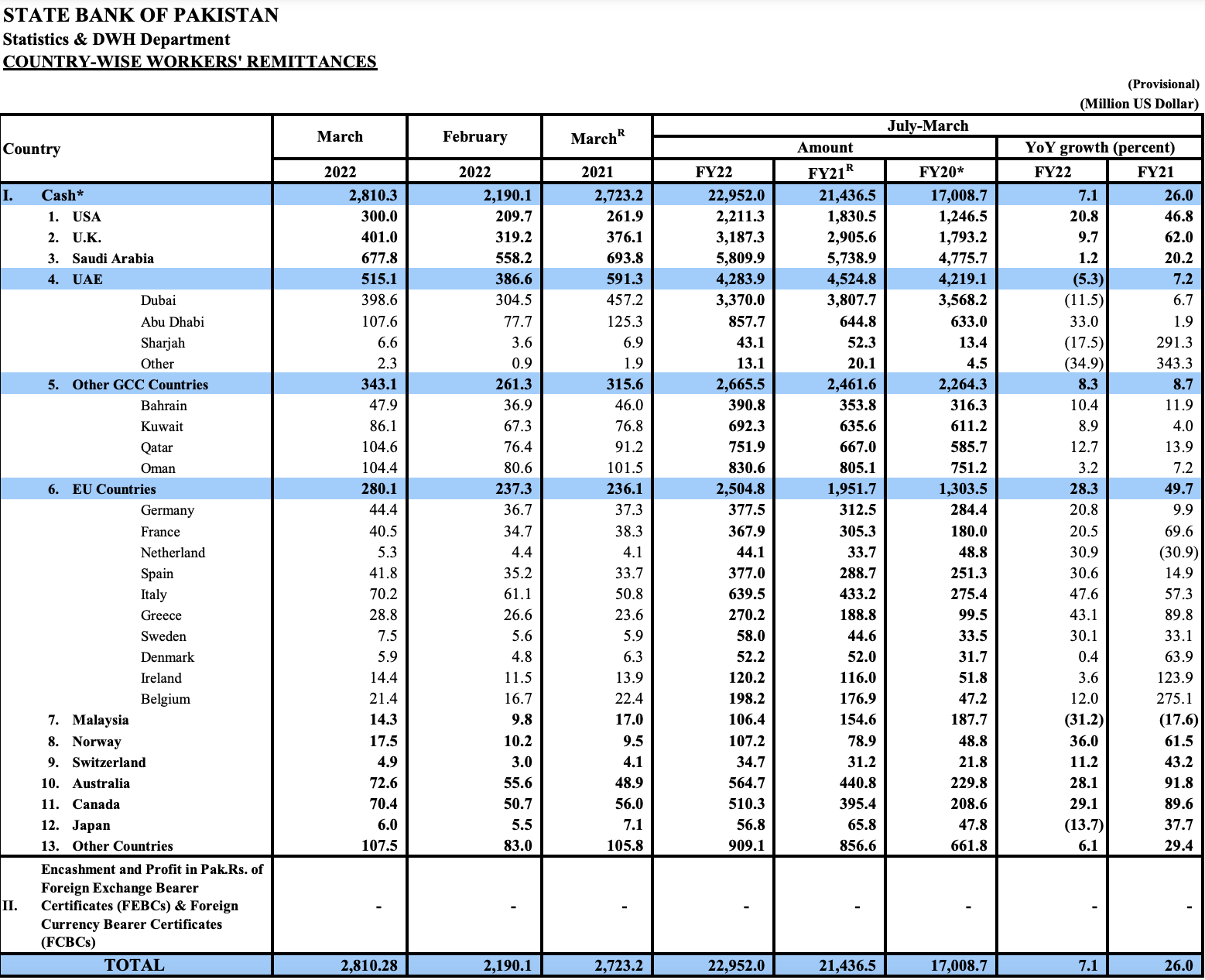
Remittances from the European Union (EU) to Pakistan soared 49.7% in FY 21 and 28.3% in FY22, according to the State Bank of Pakistan. With $2.5 billion remittances in the first 9 months (July-March) of the current fiscal year, the EU ($2.5 billion) has now surpassed North America ($2.2 billion) to become the third largest source of inflows to Pakistan after the Middle East and the United Kingdom. Remittances from the US have grown 21%, second fastest after the EU (28.3%) in the first 9  months of the current fiscal year. 

Country-wise Remittance Inflows in Pakistan. Source: State Bank of Pakistan

Pakistanis in European Union: 

The population of Pakistan-born migrants to European Union countries has been growing in recent years. With over 120,000 Pakistani migrants, Italy is the most popular destination for Pakistanis in the EU. 

Italy is followed by Germany with 75,495 Pakistani migrants. Then comes Spain with 61,953 migrants, France 21,900 (2017), Sweden 11,674, Denmark 10,669, Ireland 7,351 (2016), Belgium 5,927, Portugal 5,310, Norway 5,157, Netherlands 4,723 and Austria 4,112. There are smaller populations of Pakistanis in several other European countries. 

Pakistan-born Migrants in European Union. Source: OECD

With $5.74 billion in the first 9 months of current fiscal year FY22, Saudi Arabia remains the top source of remittances to Pakistan, followed by $4.28 billion from the United Arab Emirates (UAE). However, the Saudi remittances are essentially flat while those from the UAE have declined 5.3% in this period.  Pakistani diaspora is sending home over $30 billion a year, about 10% of the country's GDP. It is badly needed foreign exchange to balance Pakistan's external accounts.  

Pakistanis in Italy. Source: Italian Government


Pakistan's Worldwide Diaspora:

Over 10 million Pakistanis are currently working/living overseas, according to the Bureau of Emigration. Before the COVID19 pandemic hit in 2020,  more than 600,000 Pakistanis left the country to work overseas in 2019. The average yearly outflow of Pakistani workers to OECD countries (mainly UK and US) and the Middle East has been over half a million in the last decade.  

Pakistan’s economy created 5.5 million domestic jobs during the past three years –on an average 1.84 million jobs a year, which is far higher than yearly average of creation of new jobs during the 2008-18 decade, according to the Labor Force Survey (LFS) published by the Pakistan Bureau of Statistics (PBS). 

Pakistan ranks 6th among the top worker remittance recipient countries in the world.  India and China rank first and second, followed by Mexico 3rd, the Philippines 4th, Egypt 5th and Pakistan 6th.  

Pakistan Demographics
Pakistan's Demographic Dividend: 

About two million Pakistanis are entering the workforce every year. The share of the working age population in Pakistan is increasing while the birth rate is declining. This phenomenon, known as demographic dividend, is coinciding with declines in working age populations in developed countries. It is creating an opportunity for over half a million Pakistani workers to migrate and work overseas, and send home record remittances. These overseas Pakistanis are now sending home over $30 billion a year, about 10% of the country's GDP. It is badly needed foreign exchange to balance Pakistan's external accounts.  

Projected Population Decline in Emerging Economies. Source: Nikkei Asia


Saturday, September 18, 2021

AUKUS: An Anglo Alliance Against China?

In the recently announced AUKUS alliance, the US has joined the United Kingdom to arm Australia with nuclear-powered submarines to check China's rise. This announcement has not only upset the Chinese but it has also enraged France. The French are angry because AUKUS has scuttled Australia's earlier agreement to purchase diesel-powered submarines from France. 

President Biden Announcing Australia-UK-US (AUKUS) Alliance

India, a member of the anti-China QUAD alliance, has welcomed AUKUS. Although AUKUS appears to be de-emphasizing QUAD that includes India and Japan, the Indians see it as a green-light from the United States for them to pursue expansion of their nuclear submarine fleet.  China could respond to this growing threat by arming its ally Pakistan with nuclear-powered submarines

“This looks like a new geopolitical order without binding alliances,” said Nicole Bacharan, a researcher at Sciences Po in Paris. France's foreign minister, Jean-Yves Le Drian, called the decision a “knife in the back.” Benjamin Haddad, from the Atlantic Council, in Washington, said it had set relations between the US and France back to their lowest point since the Iraq War.  Bruno Tertrais, an analyst at France’s Foundation for Strategic Research think tank, went even further, calling it a “Trafalgar strike”,  a reference to the 1805 naval battle between the British Royal Navy and the combined fleets of the French and Spanish Navies that was won by the British. “To confront China, the United States appears to have chosen a different alliance, with the Anglo-Saxon world separate from France.” She predicted a “very hard” period in the old friendship between Paris and Washington, according to a report in the New York Times. 

Nicole Bacharan's reference to the "Anglo-Saxon world" is not just an angry outburst. A real life example of the Anglo-Saxon alliance is "Five Eyes", an intelligence alliance among Australia, Canada, New Zealand, the United Kingdom, and the United States. Ex NSA contractor Edward Snowden has called "Five Eyes" as a "supra-national intelligence organization that does not answer to the known laws of its own countries".  

Part of the motivation for the Anglo-Saxon AUKUS alliance is that France and the rest of the European Union do not want a direct confrontation with China. This was underscored in a recent policy paper titled the “E.U. Strategy for Cooperation in the Indo-Pacific". French President Emanuel Macron has been talking about "European strategic autonomy".  He has spoken about an autonomous Europe operating “beside America and China.”  

Although the AUKUS announcement does not explicitly mention China, it has drawn a strong response from Beijing. Chinese Foreign Ministry Spokesman Zhao Lijian has said,"The international community, including neighboring countries, have risen to question [Australia’s] commitment to nuclear non-proliferation." “China will closely monitor the situation", he added. 


A piece titled "China--a lonely superpower" by Henry Storey in Lowy Institute's "The Interpreter" has speculated about a “new Quad” led by China and featuring Iran, Pakistan and Russia, all members of Shanghai Cooperation Council (SCO). Here is an excerpt of it:

"As the United States, United Kingdom and Australia move to form a new AUKUS grouping, various reports have emerged of a “new Quad” led by China and featuring Iran, Pakistan and Russia......Despite bombastic talk of an “iron brother” bond, Islamabad is deeply reluctant to become – or be perceived to be – a Chinese vassal state. These concerns explicitly motivated Pakistan to seek a moderate rapprochement with India and explain Pakistan’s ongoing efforts to rebuild ties with the United States".

Friday, January 24, 2020

Why is America So Deeply Involved in the Middle East? Energy? Geography?

What is the importance of the Middle East for the West? Is it energy resources to fuel the industrialized West? Or the key trade and shipping routes passing through the Persian Gulf and the Suez Canal used by ships to sail from Asia to Europe and North America?

Map of Greater Middle East (Morocco to Pakistan)

Why is oil, the most traded commodity, priced and traded in US Dollars? Does oil trade help maintain the US Dollar as the international trade and reserve currency and solidify US control of the global financial system, giving the US a very powerful tool to control the world?

What is the history of West's involvement in the Middle East? Can it be traced back to the fall of the Ottoman Empire in early 20th century?

When did the United States take over where Britain and France left off? Cold War? Iranian leader Mosaddegh's overthrow by CIA? Suez Crisis?

Energy revolution is in full swing in Silicon Valley with widespread use of solar panels, electric vehicles and storage batteries. Like other technologies emerging from Silicon Valley, this energy revolution will spread to the rest of the United States and the world in the next decades. How will it change US policy and posture in the Middle East?

Does the US involvement in the Middle East pose a threat to Pakistan? Is Pakistan next after Iran? Will Pakistan's nuclear weapons help keep Pakistan secure? What economic and other powerful tools does the United States have to put pressure on Pakistan or any other country?

ALKS host Faraz Darvesh discusses these questions with Misbah Azam and Riaz Haq (www.riazhaq.com).

https://youtu.be/DQIUue1tb4A


Related Links:

Haq's Musings

South Asia Investor Review

Muslims in Silicon Valley

US Dollar as International Trade/Reserve Currency

Soleimani Was the Hardest of the Hardliner

Sykes-Picot Agreement in Middle East

Confessions of an Economic Hitman

Putin Challenges American Exceptionalism

Remittances to Pakistan Up 21X Since Year 2000

Modi's Kashmir Blunder

Godfather Metaphor for Uncle Sam

Clean Energy Revolution

Destructive Power of Drone Swarm on Saudi Oil Installation

US Dominates List of World's Top Universities

Indian RAW Agent Kulbhushan Jhadav Used Chabahar

Iran-Saudi Conflict

Pakistan's Nuclear Program

Iran Nuclear Deal

1971 India-Pakistan War

Chabahar vs Gwadar Ports

Did America Contribute to the Rise of ISIS?

Riaz Haq's YouTube Channel

PakAlumni Social Network

Saturday, May 6, 2017

French Elections; Militant Hindu Threats Against Pak Children; Panama JIT

What do we know about French presidential run-off election candidates Emmanuel Macron and Marine Le Pen? What is at stake for France in the elections? What if the Islamophobic, anti-Europe, anti-trade, racist candidate Marine Le Pen wins? Will French elections be impacted by Brexit and Trump victories in recent votes?  How would it affect France's standing in the world? How would it affect Europe if she follows through on her promise to leave the European Union?

Why were 50 Pakistani children invited to India by an Indian NGO returned without completing their visit? Why did Hindu militants affiliated with the ruling BJP threaten the NGO that invited them? Why is Prime Minister Modi silent on rising attacks by Hindutva outfits on minorities, particularly Muslims, in India? Is India heading to a long period of religious violence and instability?

Does the Joint Investigating team (JIT) set up the Pakistan Supreme Court after Panama verdict have the independence or the skills to investigate financial crimes possibly committed by Prime Minister Nawaz Sharif and his family? Will it be able to reach any conclusions based on evidence? Will the JIT itself and/or its findings become controversial in Pakistan's polarized and low-trust society?

How did the border violence between Afghanistan and Pakistan start near Chaman? Where is Afghanistan headed? What is the Trump administration strategy there? Will US send more troops? Is a negotiated settlement even possible under the current circumstances with Afghan president refusing to visit Pakistan? Would the Afghan government be able to implement any agreements it makes with Pakistan or any other party or entity?

Viewpoint From Overseas host Faraz Darvesh discusses these questions with panelists Misbah Azam and Riaz Haq (www.riazhaq.com)


https://youtu.be/Sd9RIFqhV2E


Related Links:

Haq's Musings

I am not Charlie (Hebdo); I am Ahmed

GOP's Dog Whistle Politics Produced Donald Trump

Hinduization of India Under Modi

Muslim Victims of Gujarat Riots

Panama Verdict

Are Iran and Russia Supporting the Afghan Taliban?

Talk4Pak Youtube Channel

Tuesday, May 17, 2016

Sykes Picot Centenary: Did the West Sow the Seeds of ISIS?

The Middle East continues to threaten global peace a century after British and French representatives, Sir Mark Sykes and Francois Georges Picot, signed the Sykes-Picot agreement named after them. This accord, concluded on May 19, 1916, divided the region extending from the Persian Gulf to the Mediterranean between the two colonial powers.


Following the fall of the Ottoman Empire after the first World War, the British and the French colonial masters created a variety of states whose borders were drawn with little regard for ethnic, tribal, religious or linguistic considerations.

Today, Daish (ISIS) militants are erasing the border between Iraq and Syria and pushing to get rid of all the region's frontiers created by Sykes-Picot. It is ironic that the Kurdish foes of ISIS share the goal of dismantling the borders that divide ethnic Kurds into several nations today.

The West's actions since Sykes-Picot have further exacerbated the wounds inflicted on the peoples of the region during the European Colonial rule of the Middle East. Examples include the CIA-supported restoration of the Shah of Iran to power, the creation and the unconditional support of the State of Israel, the Suez crisis and the US invasions of Iraq.

In an interview with Vice News, President Barack H. Obama acknowledged that the rise of ISIS was directly linked to the 2002 American invasion and occupation of Iraq during President George W. Bush's administration.

 “Two things: One is, ISIL is a direct outgrowth of Al-Qaeda in Iraq that grew out of our invasion,” Obama said in an interview with VICE News. “Which is an example of unintended consequences. Which is why we should generally aim before we shoot.”


In an earlier testimony to the US Congress, former Secretary of State Hillary Clinton said very candidly that "the terrorists we are fighting today we funded 20 years ago".

I hope the Sykes-Picot centenary causes the West, particularly the United States as its leader, to introspect about the West's actions in the Middle East in the past and the dangerous consequences of such actions we together face today.  I hope the leaders of the West will ponder the unintended consequences before starting more wars in the region.


Related Links:

Haq's Musings

Unintended Consequences of Charlie Wilson's War

Jihadis Growing After Afghan & Iraq Wars

US Invasion of Iraq

Global Power Shift After Industrial Revolution

Seeing Bin Laden's Death in Wider Perspective

Straight Talk by Gates on Pakistan

What If Musharraf Had Said No to US After 911? 

Who Are the Haqqanis?

Creation of the State of Israel

Saturday, April 9, 2016

Does Pakistan Really Need F-16s to Fight Terror?

Pakistan is looking to buy more F-16s from the United States. There's mounting opposition to such sales as witnessed recently when President Barack Obama approved the sale of just 8 F-16s to the country.

India Lobby:

This decision by the Obama administration's decision triggered the Indian spin machine to go into high gear. The campaign orchestrated by the Indian government included placement of favorable news stories, TV analysts' commentaries, newspaper columns and magazine Op-Eds (including one by Husain Haqqani), think tank reports and speeches by the members of the India Caucus in the US Congress.  They all blatantly toed the Indian line that these 8 F-16s would be used against India, not in Pakistan's ongoing counter-insurgency operations. The biased nature of all of these efforts can be gauged by the following facts that were completely ignored by them:

Damocles Multi-Function Targeting Pod Source: Defense News
1. Pakistan, like the United States elsewhere, has been using F-16s in Operation Zarb e Azb against militants hiding out in Pakistan tribal belt along the border with Afghanistan. The key reason for the choice of F-16s is its sophisticated precision targeting pod that is not available on China-Pakistan jointly developed JF-17 fighter aircraft.

2. There is a huge imbalance in the conventional defense capabilities between India and Pakistan as laid out by GlobalFirePower.com.  It ranks India at number 4 in the world while Pakistan is way down at number 17 in 2016. India's defense spending of $51.1 billion is higher than the defense budgets of much richer nations like France ($50.9 billion), Germany ($47 billion) and Japan ($46 billion), and about 6 times higher than Pakistan's $9 billion, according to SIPRI as reported by the media.

3. India is world's largest importer of sophisticated weapons, including fighter aircraft, according to Stockholm International Peace Research Institute (SIPRI). Here's what it says about the import of weapons between 2011 and 2015: India (14 per cent of global arms imports), China (4.7 per cent), Australia (3.6 per cent), Pakistan (3.3 per cent), Viet Nam (2.9 per cent) and South Korea (2.6 per cent).

I did not see a single piece in the US media supporting Pakistani position in this battle.  It was completely one-sided. They succeeded in forcing a US Senate vote to block the sale. Luckily for Pakistan, Obama administration barely succeeded in overcoming this Indian campaign to do something as trivial as selling just a few F-16s to Pakistan this time.

Precision Targeting Pod:

PAF currently relies heavily on a fleet of about 70 US-made Lockheed Martin F-16s with its Sniper Targeting Pods, which are solely capable of carrying out precision targeting to hit militants while minimizing civilian deaths. However, Pakistan's continuous use of F-16s for precision targeting in FATA is reducing their effective lives as air to air combat aircraft.

The latest version of precision targeting pod being used with F-16s is Sniper XR. In addition Northrup Grumman also supplies an Israeli designed LITENING Pod to some of its customers.

While Pakistan is still pursuing purchase of additional F-16s, the nation is also looking to enhance precision targeting capability of JF-17. Pakistan Air Force (PAF) is assessing the French Thales-made Damocles targeting pod for mounting on its JF-17 aircraft, according to Defense News.

Thales has a newer Talios targeting. These systems are being continuously improved with day/night targeting with FLIR sensors, CCD cameras, weapon delivery, target updates, target tracking at altitudes, air speeds and slant ranges consistent with tactical weapon delivery maneuvers.

Pakistan Air Force deputy chief Muhammad Ashfaque Arain is currently visiting France to discuss the acquisition of the Damocles pod. He has been quoted by Reuters as saying, “the Damocles is a battle- proven system and the other options are not. If we do not get the Damocles pod for example, then we will need to look for alternate options that may not be proven.”

The addition of a precision targeting pod on JF-17 will improve its mission capabilities as well as reduce the burden on F-16. Another reason why Pakistan is seeking these pods is that they are already being integrated to Russian aircraft(s) and will be produced under license in Russia. So there is a path there for JF-17 aircraft integration.

Pakistan is in the process of retiring hundreds of aging fighter aircraft in its fleet, mainly 40-year-old French-made Mirage jet and 25-year-old Chinese-made F-7s, over the next few years. Islamabad has decided to bet on the JF-17 fighter, jointly developed by China and Pakistan, rather than spending billions on fifth-generation multi-role aircraft like Dassault's Rafale, which rival India is buying, or the Russian Su-35.

India's Opposition:

If Pakistan's efforts to acquire French precision target pods make any headway, I fully expect India to mobilize opposition to any deal. India may use its purchase of additional Rafale jet as a lever to get France to end any further discussion of Damocles sale to Pakistan.

Summary:

Pakistan is currently engaged in Operation Zarb-e-Azb, the world's largest anti-terror military campaign with over 180,000 ground troops and dozens of aircraft involved in it.  Pakistan's need for F-16s to fight terror is genuine, as is its desire to acquire precision targeting enhancement for JF-17s. Failure to meet Pakistan's need for precision targeting and other related equipment would hamper its ability to win the war against terror along the border between Pakistan and Afghanistan.

Related Links:

Haq's Musings

India's Spin Machine

Has Modi Stepped Up Proxy War in Pakistan?

India's Israel Envy: What if Modi Attacks Pakistan?

Pakistan Army at the Gates of Delhi

India's War Myths

India-Pakistan Military Balance

Pakistan Army Capabilities

Modi's Pakistan Policy

India's Israel Envy

Can India Do a Lebanon in Pakistan?


Sunday, March 27, 2016

Indian Spy Arrest in Balochistan; Rouhani in Pakistan; Brussels Attacks

What was an Indian RAW agent doing in Balochistan, Pakistan? How did he enter Pakistan? Was he facilitated by Iran? Why does India have a big consulate in Zahedan where few visas are issued? How will this arrest impact India-Pakistan dialog? Will Pakistan insist on ending the ongoing India-Pakistan proxy war, aka terrorism, at the NSA-level talks between Nasser Janjua and Ajit Doval?

Why is Iran’s President Hassan Rouhani visiting Pakistan? What’s on the agenda? Energy? Trade? Security? Will Pakistan and Iran have a frank dialog at the highest level on India’s use of Iranian territory to foment terror by Baloch insurgents and sectarian militants in Pakistan? What will Iran demand in exchange?

Why is home-grown terror rising in Europe? Why are young Muslims born, raised and educated in Belgium, France and elsewhere in Europe so prone to recruitment by ISIS for violence in their own lands of birth? Are the European leaders introspecting about the causes? How will they end the anger and alienation felt by European Muslim youth? What lessons can the US learn from Europe to prevent similar situation?

Viewpoint From Overseas host Faraz Darvesh discusses these questions with panelists Misbah Azam and Riaz Haq (www.riazhaq.com)

https://www.youtube.com/watch?v=VHgkHscv0IA&feature=youtu.be


http://www.dailymotion.com/video/x40awnf


Indian Spy Arrest in Balochistan; Rouhani in... by ViewpointFromOverseas

https://vimeo.com/160524075


Indian Spy Arrest in Balochistan; Rouhani in Pakistan; Brussels Attacks from Ikolachi on Vimeo.


Related Links:

Haq's Musings

Has Modi Stepped Up India's Proxy War Against Pakistan

Ex Indian Spy Documents RAW's Successful Ops in Pakistan

Iran-Saudi Relations

Tarek Fatah vs Riaz Haq on India, Pakistan and Muslims

I am not Charlie!

China-Pakistan Economic Corridor

Can Saudi Arabia Change Peacefully?

Talk4Pak Think Tank

VPOS Youtube Channel

VPOS Vimeo Channel

Sunday, November 22, 2015

West’s Reaction to Paris Attacks; Gen Raheel Sharif in US; Modi’s World Tour

Will West’s reaction to Paris attacks weaken or strengthen ISIS and other Middle East terror groups? Should Muslim refugees coming to Europe and US be punished for such attacks? Will it make the Syrian refugee crisis much worse? How will further alienation of already marginalized Muslims in France affect security in Europe?


Why is General Raheel Sharif in Washington? Do such visits weaken Prime Minister Nawaz Sharif’s government? Are there any implications for the future civil-military ties in Pakistan?

What does the Badin sweep of Zulfiqar Mirza’s anti-PPP candidates in local elections mean for Sindh politics? Is it a reflection of the power of local feudal electoral politics in Pakistan?

Why has Narendra Modi chosen to focus on foreign relations with 30 foreign visits in just over a year since he became Prime Minister of India? Is it all about photo ops and PR to project himself as a world leader? Can India really become a significant global power with its poorly educated and unhealthy labor force? Shouldn’t Modi pay more attention to India’s serious social, economic and development issues at home?

Viewpoint From Overseas host Misbah Azam discusses these questions with Ali H. Cemendtaur and Riaz Haq (www.riazhaq.com)

https://vimeo.com/146561295


West's Reaction to Paris Attacks; Gen Raheel Sharif in US; Modi's World Tour from WBT 
Productions on Vimeo.

http://dai.ly/x3f6k54


West's Reaction to Paris Attacks; Gen Raheel... by ViewpointFromOverseas
https://youtu.be/dhzuj3g0Zqc


Related Links:

Haq's Musings

I am Ahmad; I am not Charlie

Feudal Power Dominates Pakistan Elections

Growing ISIS Threat

Modi's Superpower Delusions

Talk4Pak Think Tank

VPOS Youtube Channel

VPOS Vimeo Channel

VPOS Dailymotion Channel

Monday, April 6, 2009

Vatican Recommends Islamic Finance For Western Banks

In yet another act of conciliation on the part of Western religions towards Islam, the Vatican newspaper Osservatore Romano has voiced its approval of Islamic finance. The Vatican paper wrote that banks should look at the rules of Islamic finance to restore confidence amongst their clients at a time of global economic crisis. “The ethical principles on which Islamic finance is based may bring banks closer to their clients and to the true spirit which should mark every financial service,” the Osservatore Romano said. “Western banks could use tools such as the Islamic bonds, known as sukuk, as collateral”. Sukuk may be used to fund the “‘car industry or the next Olympic Games in London,” the article says.

The Vatican article is only one of many articles that have recently appeared on the acceptance by Western governments and bankers of an Islamic financing system. More than accepting it, they seem to be welcoming it, though they are certainly being pressured into this by unnamed forces bowing to the dictates of Islam.

Last December, the French Senate looked at ways to eliminate legal hurdles, particularly levies, for Islamic financial services and products in France and the potential for listing companies on the Paris Stock Exchange. Senate sources said that this area of the financial market is worth from 500 to 600 billion dollars and could grow by an average 11 percent a year.

French Finance Minister Christine Lagarde has announced France’s intention to make Paris “the capital of Islamic finance” and announced several Islamic banks would open branches in the French capital in 2009.

This hearkens back to a video from November 26, 2008 that was posted at many French websites showing Madame Lagarde announcing with (according to some bloggers) visible embarrassment the decision to allow Islamic financing in France. Whether or not this move is constitutional is apparently not even an issue, since European countries change their laws to accommodate Islam. If the “sacred” law separating Church and State can be violated, any law can. The video, with its very soft audio, shows the minister in a strange garb, and struggling to present a happy countenance. There is no way of knowing if this is merely the quality of the video, or an indication of her emotional state. An article from Le Parisien dated November 27, 2008 provides the following information, in addition to the facts presented above:

A revolution in the banking world. After London, where the first Islamic bank opened its doors in September 2004, France could authorize banks respecting sharia law to open in 2009 (...) Hervé de Charette, president of the Franco-Arab Chamber of Commerce emphasizes that “importing Islamic banking into France would help the integration process”. The main obstacle: “Islamic banking arouses fear because it is associated, wrongly, with religious fundamentalism, even with the financing of terrorism,” deplores Elyès Jouini, professor of economics at the University of Paris. (...)

The world economic crisis has changed the ball game. From New York to Hong Kong, all the financial centers on the planet are grabbing the billions of dollars amassed by the oil-rich monarchies of the Gulf. To tap into this manna (...) is the stated goal of Christine Lagarde. “We are determined to make of Paris a great center for Islamic finance,” declared the Finance Minister as she inaugurated the second French forum on Islamic banking.

For another longer English-language article, visit Islam On Line. This article goes back to July 2008, showing that even before the crisis, France had initiated a policy favoring Islamic banking.

Source: Brussels Journal

Related Links:

Will American Capitalism Survive?

Islamic Finance Products

Vatican Says Islamic Finance May Help Western Banks in Crisis

Easing Limits on Islamic Finance in France

Video of Christine LeGarde on Islamic Finance

Blame for Global Financial Crisis

Islamic Banking Principles