Showing posts with label Remittances. Show all posts

Wednesday, January 28, 2026

EU-India Trade Deal: "Uncapped" Mass Migration of Indians?

The European Union (EU) and India have recently agreed to a trade deal which includes an MOU to allow “an uncapped mobility for Indian students”, according to officials, allowing Indians greater ease to travel, study and work across EU states. India's largest and most valuable export to the world is its people who last year sent $135 billion in remittances to their home country. Going by the numbers, the Indian economy is a tiny fraction of the European Union economy. Indians make up 17.8% of the world population but contribute only 3.3% of the global GDP. The European Union, on the other hand, has just 5.6% of the global population and produces 17.8% of the world's economic output. 

Indian Economy Dwarfed by EU. Source: DW

If finally signed and implemented, this "uncapped mobility" for Indians will probably become the most significant part of the deal.  “More than 800,000 Indians are living and actively contributing to the countries of the European Union", according to Indian Prime Minister Narendra Modi.  The two sides welcomed the conclusion of the India‑EU Comprehensive Framework of Cooperation on Mobility, in line with the national competences of EU Member States and India and domestic legislation of both parties. They applauded the launch of the first pilot European Legal Gateway Office, as a one‑stop hub to provide information and support the movement of workers, starting with the ICT sector. 

Indians are currently the seventh-largest migrant group in Germany. Just the talk of "uncapped mobility" from India will trigger a backlash across Europe where far-right parties opposed to all immigration are gaining popularity. There have been high-profile hate incidents against Indians in several European countries recently.  While the rise of the AfD (Alternative for Germany) has increased hatred against Indian migrants, the arrival of the far-right in the mainstream political system in Germany has also started a conversation on racism that otherwise would have been swept under the rug. 

EU-India Migration Agreement Tweeted by Modi

Undaunted by the anti-immigrant sentiments, the Indian government has quietly signed labor mobility agreements with at least 20 countries over the past half-dozen years — in Europe and Asia, including the Persian Gulf — all with developed economies and most without much history of hiring Indian workers, according to the New York Times.  Arnab Bhattacharya, the chief executive of the "Global Access to Talent From India Foundation" think tank, estimates that India could double its current export of 700,000 workers a year to 1.5 million by 2030. His country, he told the NY Times, “has a workforce that should be servicing the world and not just India.” Their real aim is to deal with the ongoing unemployment crisis in India. 

EU-India Migration Agreement Tweeted by Modi

Indian economy is not generating enough jobs for the nation's growing working age population. Corporate profits of Indian firms are growing at a much slower pace than the 8.2% GDP growth in its most recent quarter. Net income for Nifty 50 Index firms likely rose 1.1% in the three months through Dec. 31 from a year earlier, according to analyst estimates compiled by Bloomberg. That would be the slowest pace in five quarters, weighed down by deteriorating margins for banks. Falling profits and declining currency are causing foreign capital to flee Indian markets. Foreign Portfolio Investors (FPIs) pulled out over $20 billion from Indian equities in 2025, marking a severe, sustained withdrawal that has continued into 2026.  Net Foreign Direct Investment (FDI) has seen consecutive monthly outflows, including $1.67 billion in October and $446 million in November 2025. Investment banker Ruchir Sharma wrote about it in a Financial Times op ed titled "India needs to import more capital and export fewer workers". Ruchir wrote: "Most strikingly, corporate revenue normally grows (or shrinks) with the economy — in any country. But last year corporate revenue growth for listed companies in India decelerated to barely half the GDP growth rate"

Related Links:


Wednesday, December 7, 2022

Goldman Sachs Projects Pakistan Economy to Become the World's 6th Largest by 2075

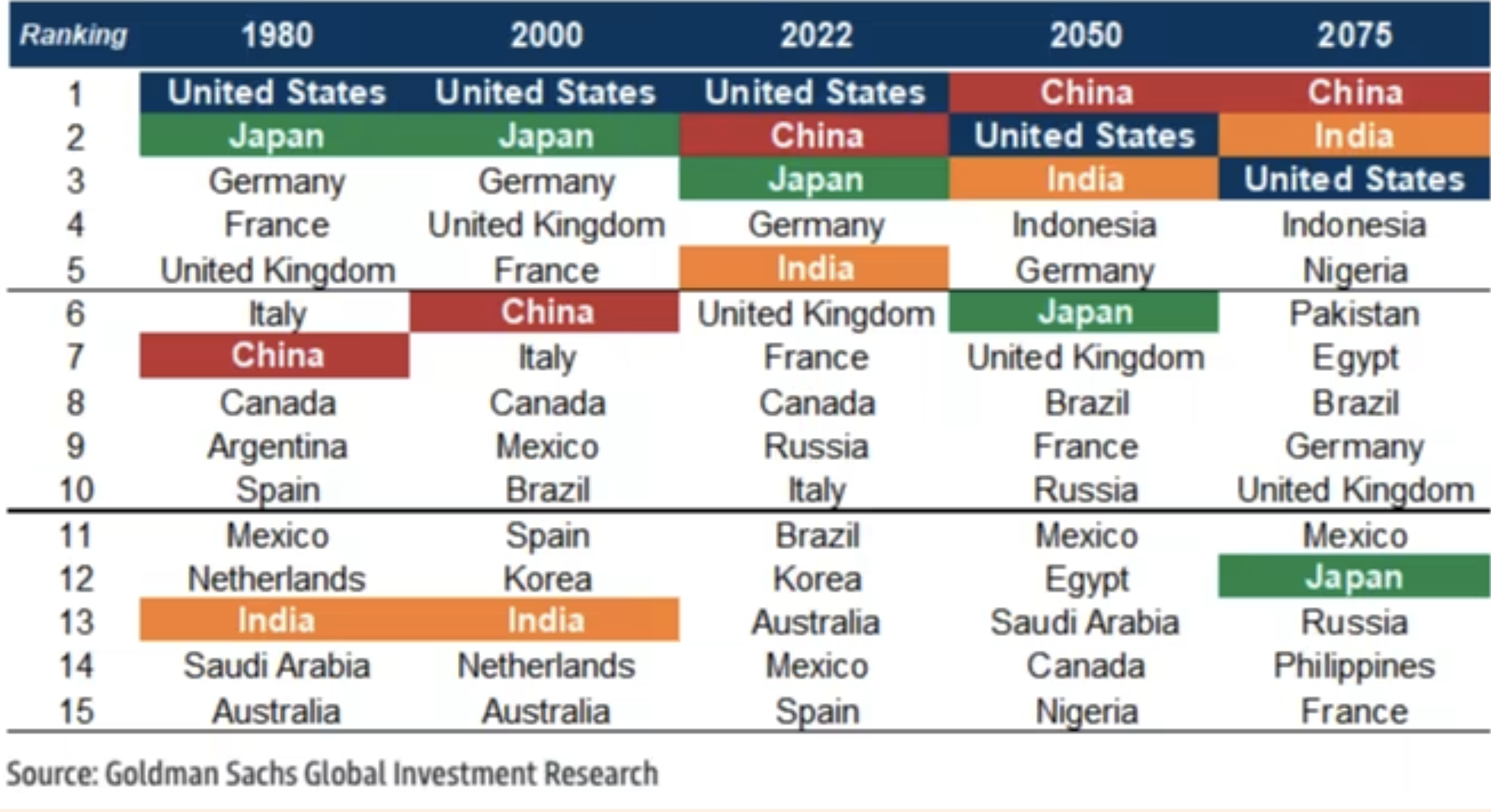
Goldman Sachs analysts Kevin Daly and  Tadas Gedminas project Pakistan's economy to grow to become the world's sixth largest by 2075.  In a research paper titled "The Path to 2075", the authors forecast Pakistan's GDP to rise to $12.7 trillion with per capita income of $27,100.  India’s GDP in 2075 is projected at $52.5 trillion and per capita GDP at $31,300.  Bangladesh is projected to be a $6.3 trillion economy with per capita income of $31,000.  By 2075, China will be the top global economy, followed by India 2nd, US 3rd, Indonesia 4th, Nigeria 5th and Pakistan 6th. The forecast is based primarily on changes in the size of working age populations over the next 50 years.  

GDP Ranking Changes Till 2075. Source: Goldman Sachs Investment Research 


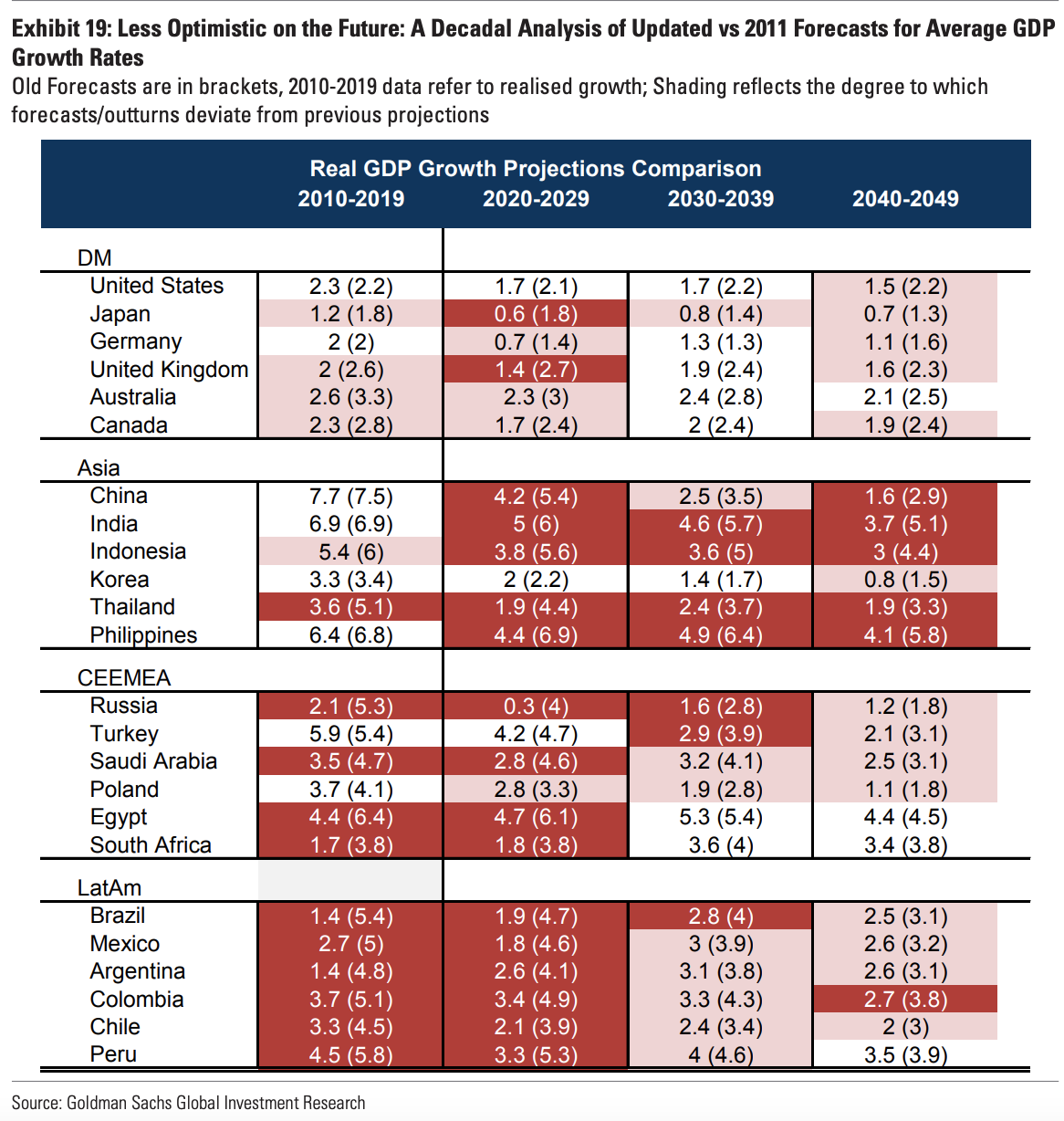
Economic Growth Rate Till 2075. Source: Goldman Sachs Investment Research 

Economic Impact of Slower Population Growth: 

Daly and Gedminas argue that slowing population growth in the developed world is causing their economic growth to decelerate. At the same time, the economies of the developing countries are driven by their rising populations.  Here are four key points made in the report:

 1) Slower global potential growth, led by weaker population growth. 

2) EM convergence remains intact, led by Asia’s powerhouses. Although real GDP growth has slowed in both developed and emerging economies, in relative terms EM growth continues to outstrip DM growth.

3) A decade of US exceptionalism that is unlikely to be repeated. 

4) Less global inequality, more local inequality. 

Goldman Sachs' Revised GDP Projections. Source: The Path to 2075

Demographic Dividend: 

With rapidly aging populations and declining number of working age people in North America, Europe and East Asia, the demand for workers will increasingly be met by major labor exporting nations like Bangladesh, China, India, Mexico, Pakistan, Russia and Vietnam. Among these nations, Pakistan is the only major labor exporting country where the working age population is still rising faster than the birth rate. 

Pakistan Population Youngest Among Major Asian Nations. Source: Nikkei Asia

World Population 2022. Source: Visual Capitalist

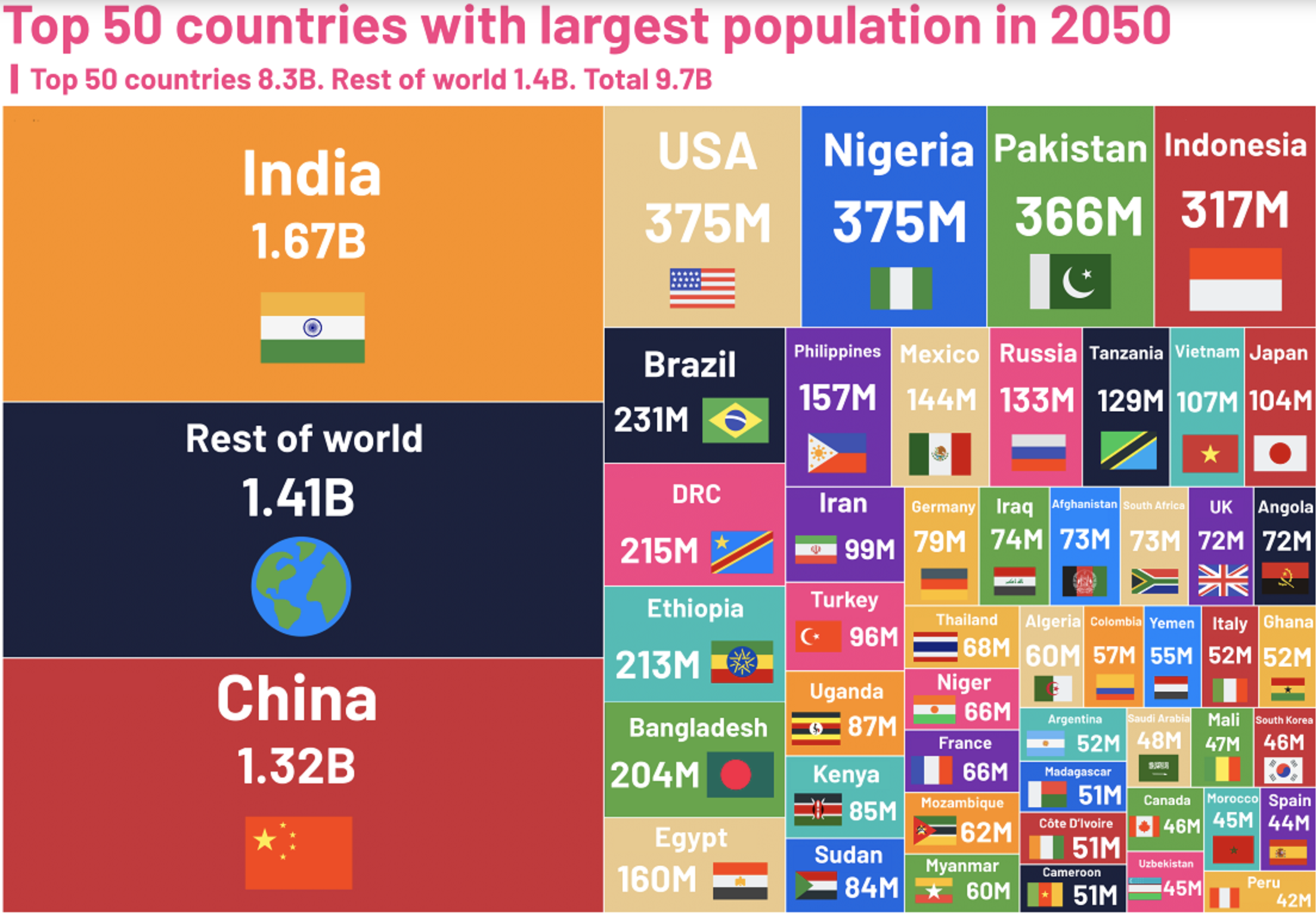
World Population 2050. Source: Visual Capitalist

Over 10 million Pakistanis are currently working/living overseas, according to the Bureau of Emigration. Before the COVID19 pandemic hit in 2020,  more than 600,000 Pakistanis left the country to work overseas in 2019. Nearly 700,000 Pakistanis have already migrated in this calendar year as of October, 2022. The average yearly outflow of Pakistani workers to OECD countries (mainly UK and US) and the Middle East was over half a million in the last decade. 

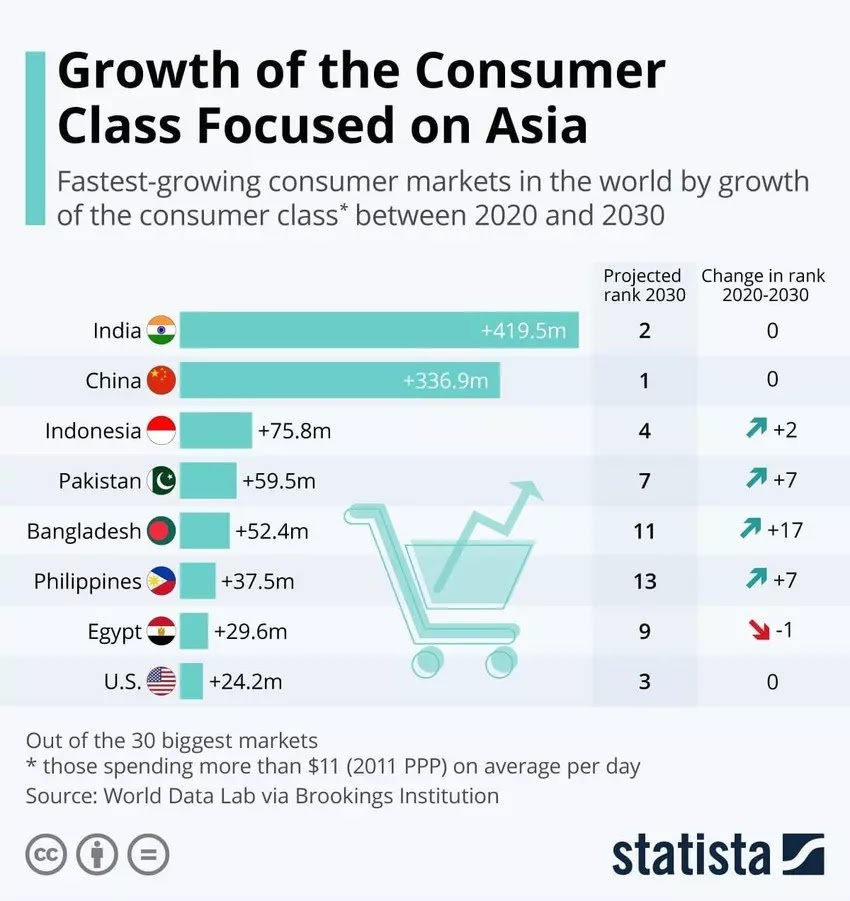
Consumer Markets in 2030. Source: WEF


World's 7th Largest Consumer Market:

Pakistan's share of the working age population (15-64 years) is growing as the country's birth rate declines, a phenomenon called demographic dividend. With its rising population of this working age group, Pakistan is projected by the World Economic Forum to become the world's 7th largest consumer market by 2030. Nearly 60 million Pakistanis will join the consumer class (consumers spending more than $11 per day) to raise the country's consumer market rank from 15 to 7  by 2030. WEF forecasts the world's top 10 consumer markets of 2030 to be as follows: China, India, the United States, Indonesia, Russia, Brazil, Pakistan, Japan, Egypt and Mexico.  Global investors chasing bigger returns will almost certainly shift more of their attention and money to the biggest movers among the top 10 consumer markets, including Pakistan.  Already, the year 2021 has been a banner year for investments in Pakistani technology startups. 

Record Remittances From Overseas Pakistanis:

Pakistan is already seeing high levels of labor export and record remittances of over $30 billion pouring into the country. Saudi Arabia and the United Arab Emirates(UAE) are the top two sources of remittances but the biggest increase (58%) in remittances is seen this year from Pakistanis in the next two sources: the United Kingdom and the United States.

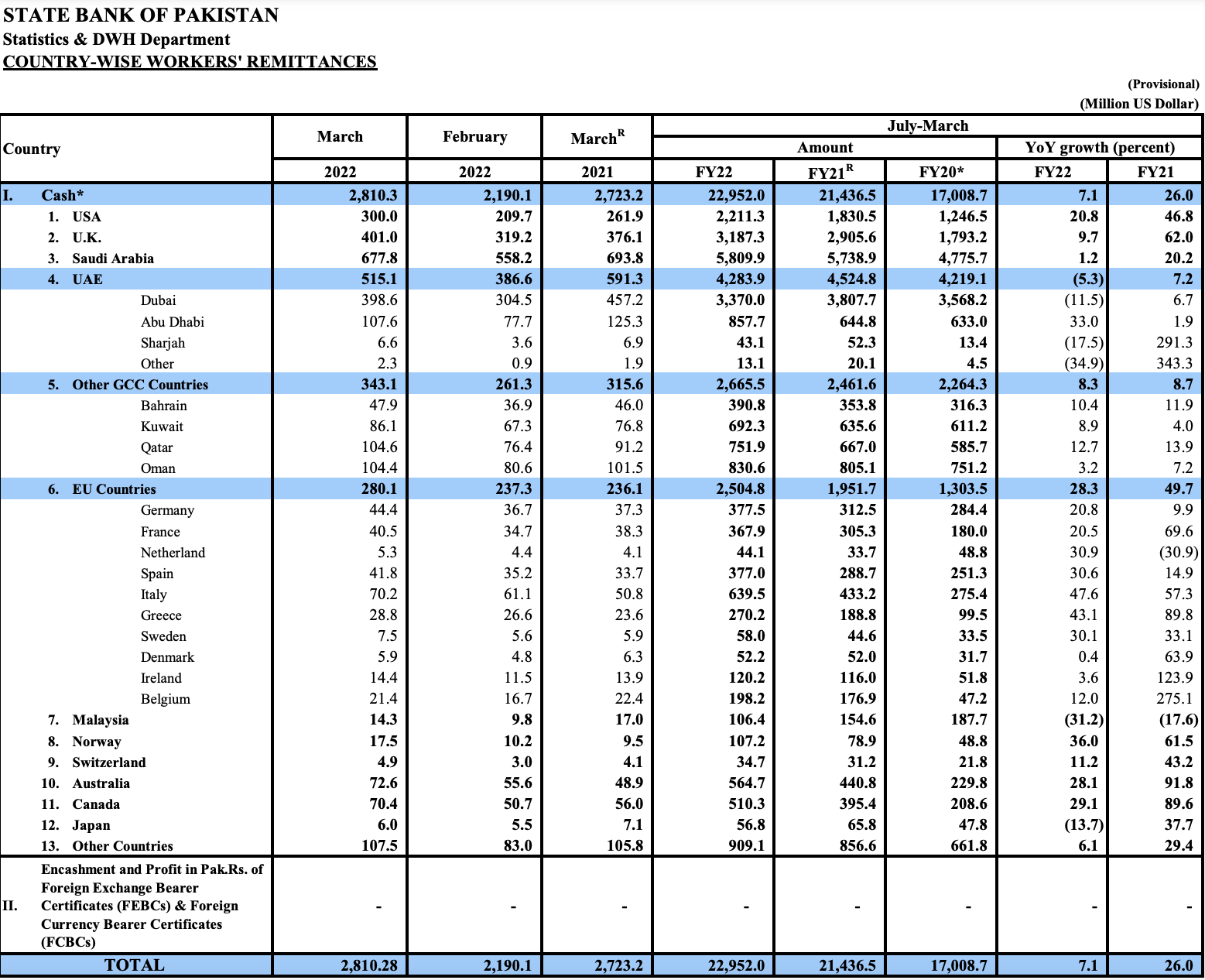
Remittances from the European Union (EU) to Pakistan soared 49.7% in FY 21 and 28.3% in FY22, according to the State Bank of Pakistan. With $2.5 billion remittances in the first 9 months (July-March) of the current fiscal year, the EU ($2.5 billion) has now surpassed North America ($2.2 billion) to become the third largest source of inflows to Pakistan after the Middle East and the United Kingdom. Remittances from the US have grown 21%, second fastest after the EU (28.3%) in the first 9  months of the current fiscal year. 

Pakistan ranks 6th among the top worker remittance recipient countries in the world.  India and China rank first and second, followed by Mexico 3rd, the Philippines 4th, Egypt 5th and Pakistan 6th.  

Pakistan Demographics

About two million Pakistanis are entering the workforce every year. The share of the working age population in Pakistan is increasing while the birth rate is declining. This phenomenon, known as demographic dividend, is coinciding with declines in working age populations in developed countries. It is creating an opportunity for over half a million Pakistani workers to migrate and work overseas, and send home record remittances. 

Sunday, July 17, 2022

UN Report: Last Decade Saw 16.5 Million Pakistanis Migrate Overseas

Among 10 countries with the estimated net outflow of migrants exceeding 1 million over the period from 2010 through 2021, Pakistan saw 16.5 million migrants move overseas, the highest in the world, according to a report titled "World Population Prospects 2022" released by the United Nations Department of Economic and Social Affairs (UN DESA). 

Pakistani Workers' Overseas Migration Data (2010-2021). Source: Bureau of Emigration


In many of these countries with more than one million people leaving, the outflows were due to temporary labor movements, such as for Pakistan (net outflow of 16.5 million), India (3.5 million), Bangladesh, (2.9 million), Nepal (1.6 million) and Sri Lanka (1.0 million).  The report also said that India's population will surpass China's in 2023. Over half of the global population increase up to 2050 will be in just 8 countries: Democratic Republic of Congo, Egypt, Ethiopia, India, Nigeria, Pakistan, the Philippines & Tanzania.

Population Sizes of China, India and Pakistan 1950-2099. Source: Our World in Data

The figure of 16.5 million migrants outflow from Pakistan is much higher than the numbers reported by the Bureau of Emigration & Overseas Employment of the Government of Pakistan. A possible source of discrepancy is the uncounted numbers of the family members who accompany workers going abroad for work.  

Between 2010 and 2021, 40 countries or territories have experienced a net inflow of more than 200,000 migrants; in 17 of those, the total net inflow exceeded 1 million people. In 2020, Turkey hosted the largest number of refugees and asylum seekers worldwide (nearly 4 million),followed by Jordan (3 million), the State of Palestine (2 million) and Colombia (1.8 million). Other major destination countries of refugees, asylum seekers or other persons displaced abroad were Germany,  Lebanon, Pakistan, Sudan, Uganda and the United States of America. 

Top Remittance Receiving Countries in 2021. Source: World Bank

Pakistan has received nearly $31 billion in worker remittances in 2021, up a whopping 20% from the prior year, according to the World Bank. This is a new record representing nearly 10% of the country's gross domestic product (GDP). This money helps the nation cope with its perennial current account deficits. It also provides a lifeline for millions of Pakistani families who use the money to pay for food, education, healthcare and housing. This results in an increase in stimulus spending that has a multiplier effect in terms of employment in service industries ranging from retail sales to restaurants and entertainment. 

Remittances from the European Union (EU) to Pakistan soared 49.7% in FY 21 and 28.3% in FY22, according to the State Bank of Pakistan. With $2.5 billion remittances in the first 9 months (July-March) of the current fiscal year, the EU ($2.5 billion) has now surpassed North America ($2.2 billion) to become the third largest source of inflows to Pakistan after the Middle East and the United Kingdom. Remittances from the US have grown 21%, second fastest after the EU (28.3%) in the first 9  months of the current fiscal year. 

Pakistan's share of the working age population (15-64 years) is growing as the country's birth rate declines, a phenomenon called demographic dividend. This dividend is manifesting itself in high levels of worker exports and record remittances pouring into the country. Saudi Arabia and the United Arab Emirates(UAE) are the top two sources of remittances but the biggest increase (58%) in remittances is seen this year from Pakistanis in the next two sources: the United Kingdom and the United States. 

Over 10 million Pakistanis are currently working/living overseas, according to the Bureau of Emigration. Before the COVID19 pandemic hit in 2020,  more than 600,000 Pakistanis left the country to work overseas in 2019. The average yearly outflow of Pakistani workers to OECD countries (mainly UK and US) and the Middle East has been over half a million in the last decade. 

Pakistan ranks 6th among the top worker remittance recipient countries in the world.  India and China rank first and second, followed by Mexico 3rd, the Philippines 4th, Egypt 5th and Pakistan 6th.  

Pakistan Demographics

About two million Pakistanis are entering the workforce every year. The share of the working age population in Pakistan is increasing while the birth rate is declining. This phenomenon, known as demographic dividend, is coinciding with declines in working age populations in developed countries. It is creating an opportunity for over half a million Pakistani workers to migrate and work overseas, and send home record remittances. 

Projected Population Decline in Emerging Economies. Source: Nikkei Asia

A common myth about emigration is that it is driven by poverty. But the fact is that the poorest and least developed people tend to stay put where they are; they do not migrate. It's only people who have a certain level of income and skills who are more likely to migrate to other countries for better opportunities. This fact has been well-established by multiple studies conducted in Africa.

Here's an except of African Development Bank report on migration:

"Results show that despite increase in the absolute number of migrants, Africa, particularly SubSaharan Africa has one of the lowest rate of emigration in the world .... Poorer countries generally have lower rate of emigration ......Bad socio-economic conditions generally seem to lead to higher rate of emigration by highly skilled individuals. Generally, migration is driven by motives to improve livelihoods with notable evidence on changes in labor market status. Often, self-employed or unemployed émigré ended up in wage employment. The paper outlines policy issues emerging from the migration trend in Africa."

Migration vs Human Development Source: Hein de Haas


Data shows that increased human and economic development is initially associated with increasing emigration. Any form of development in the poorest countries of the world is therefore likely to lead to accelerating emigration. Such findings contradict conventional thinking and force us to radically change our views on migration. Such rethinking can be achieved by learning to see migration as an intrinsic part of broader development processes rather than as a problem to be solved, or the temporary response to development “disequilibria”, according to The Conversation, a US publication.

Tuesday, June 7, 2022

Islamophobia: Can Modi's India Afford to Alienate the Entire Arab Muslim Middle East?

Last week, two official spokespersons of India's ruling BJP party insulted Prophet Muhammad (PBUH) on an Indian television channel known for promoting Islamophobia. Mohammad Zubair, an Indian Muslim journalist, tweeted a video clip of the TimesNow primetime show featuring BJP's official spokeswoman Nupur Sharma attacking the Prophet (SAW) revered by more than a billion Muslims around the world. As the video clip went viral, a long a growing list of Muslim countries has officially protested to the Indian government. The UAE, Oman, Indonesia, Malaysia, Iraq, the Maldives, Jordan, Libya, Bahrain and Pakistan have now joined Kuwait, Iran and Qatar, calling Indian ambassadors to register their protest, and Saudi Arabia has issued a strongly worded statement. "The Ministry of Foreign Affairs expressed its condemnation and denunciation of the statements made by the spokeswoman of the BJP,"  the Saudi statement said.

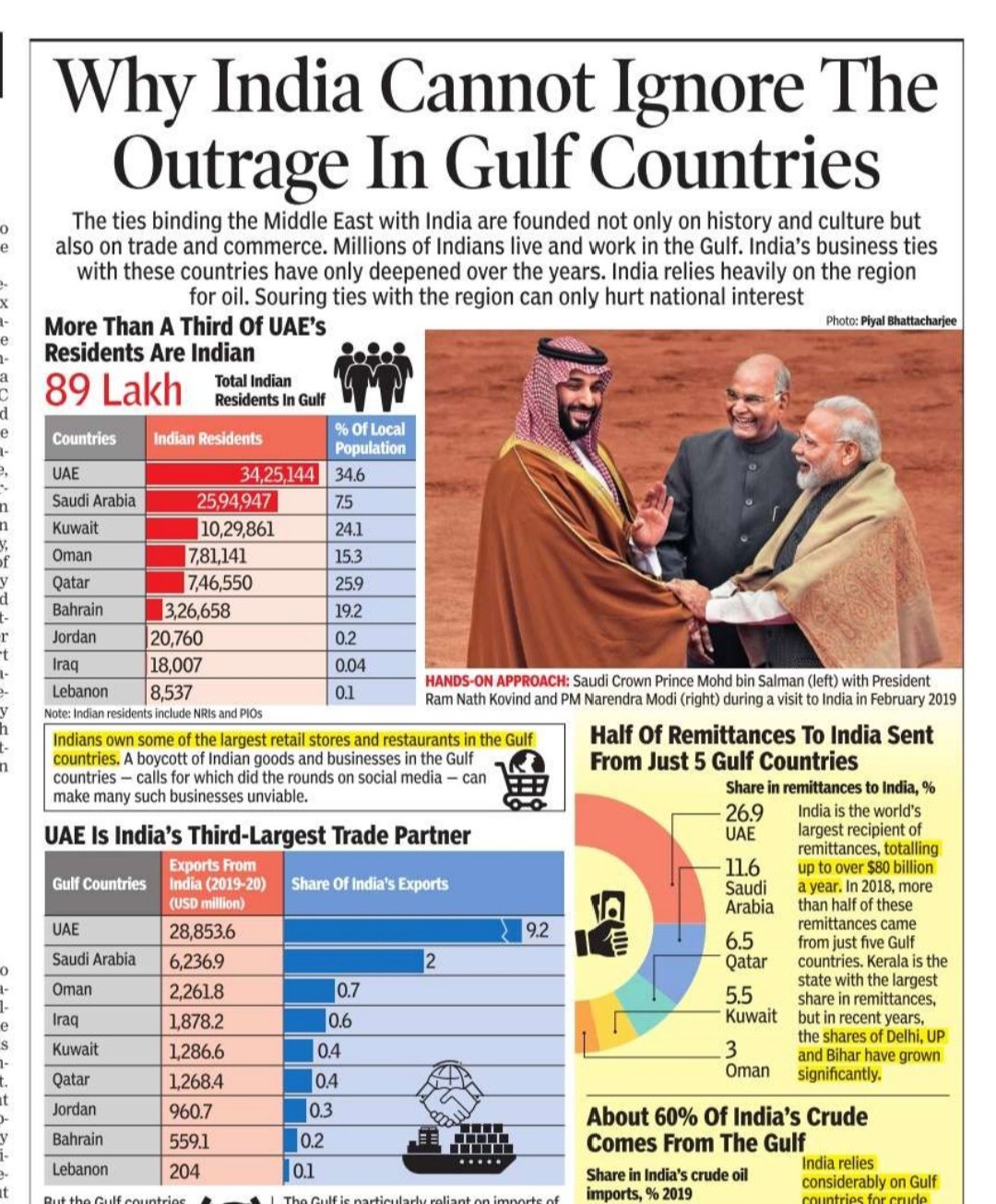
India's Ties to the GCC Nations. Source: Advaid


The BJP's entire domestic politics is built on the hatred of Islam and Muslims. At the same time, Prime Minister Narendra Modi who many hold primarily responsible for promoting Islamophobia in India, wants to have strong economic ties with the Arab Muslim Gulf states. This latest crisis has exposed the built-in contradictions in the BJP's domestic and international agenda.  Indian analyst Aakar Patel calls the ruling BJP party "a party of bigots". Here is his analysis of the situation:

"The (Modi) government has not bulldozed properties of Muslims for resisting rioting; it has conducted civic acts related to unauthorized construction. India is not targeting its Muslims through CAA-NRC pincer; it is only showing solidarity with non-Muslims from neighboring nations. Allowing mobs to prevent congregational prayers in designated spaces is really to ensure traffic flows smoothly. There can not be many who are innocent of what is going on. Certainly, there are none among the votaries of Hindutva. The problem is having democratized violence against Muslims across the country, and having been electorally rewarded for this, Modi must consider what it means for India. He has been given a taste of that this week, and as the sequence of events shows, he has not found it appealing. Trouble on this front will return unless Hindutva retreats and returns India to its normative secular state its Constitution prescribes. This is not going to happen under Modi, of course. The next best thing is to backpedal Hindutva a bit and calibrate Hindutva to a level where it pleases its constituency but doesn't offend the world. This will not be easy as we are about to find out". 


It is important to note that nearly 9 million Indians work in the Arab Gulf nations, 60% India's crude oil comes from the Middle East and the UAE is India'a third largest trading partner. Half of all remittances to India ( nearly $40 billion) come from just 5 Gulf nations of the GCC. 

The Hindu Nationalists led by Prime Minister Modi are particularly hostile toward Muslims but also other Abrahamic faiths and the West. American journalist Walter Russell Mead described it in a recent Wall Street Journal Op Ed as follows: "Many BJP supporters want the Indian government to defend India’s Hindu civilization and culture from Islam, Christianity and Western secular liberalism. This form of Hindu nationalism leads to controversial policy initiatives". The fact that the United Arab Emirates has joined to protest is particularly significant. The Arab Muslim UAE, a grouping of  seven Arab Muslim kingdoms, has now become the number one destination for education and employment of people from Hindu India, according to the government data from the two countries. 

India is now ruled by the right-wing Hindu BJP party headed by Prime Minister Narendra Modi whose entire politics is based on extreme hatred of Islam and Muslims. In 2020, Emirati Princess Sheikha Hend bint Faisal al-Qasimi strongly criticized Islamophobia in India. She also expressed solidarity and sympathies with Indian Muslims and Kashmiris.

Indians Students Abroad. Source: Economic Times

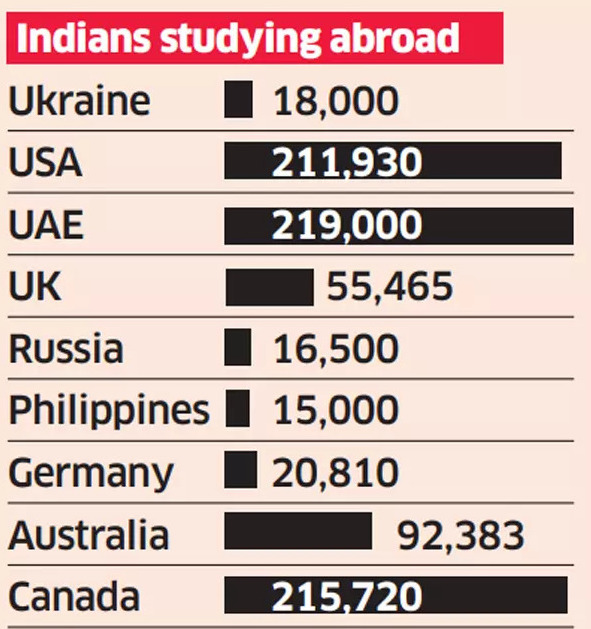
Over 1.2 million Indian students are now studying overseas, twice more than a decade ago. The UAE has 219,000 Indian students, Canada 215,720, the US 211,930, Australia 92,383, Saudi Arabia 80,800, Britain 55,465, and Oman 43,600, according to the data from India's Ministry of External Affairs. 


UAE Expat Population. Source: Global Media Insight

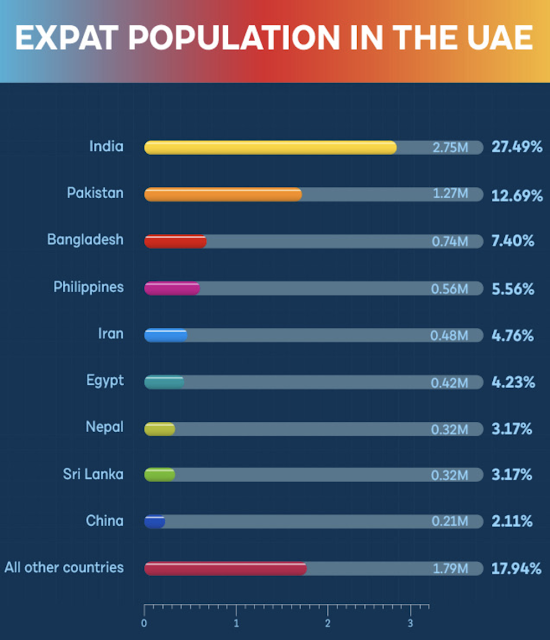
In addition to students, there are millions of foreigners working in the UAE. Currently, the Indian population in UAE is the highest with 2.75 million, followed by Pakistanis with 1.27 million. The UAE has around 0.75 million Bangladeshi nationals, 0.56 million Filipinos, and 0.48 million Iranians. There are also people from Egypt (0.42 million), Nepal (0.32 million), Sri Lanka ( 0.32 million), China (0.21 million) and the rest of the world (1.79million).

Last year, India received $43 billion in remittances from the UAE. Total worker remittances to India reached $87 billion last fiscal year, making it the world's largest recipient of these remittances. 

The United States was the second largest destination for Indian students. China maintained its top position among the leading places of origin for international students, with 35% of all international students in the 2020-21 school year hailing from the country, according to the data released by the United States government.  The second most common place of origin was India (18%), followed by South Korea (4%) and Canada (3%). Some of these countries also experienced the largest year-over-year declines in the number of students who enrolled at US institutions. The largest such percentage decreases occurred in South Korea (-21%), China (-15%) and India (-13%).

Related Links:

Sunday, May 1, 2022

European Union: Fastest Growing Source of Remittances to Pakistan

Remittances from the European Union (EU) to Pakistan soared 49.7% in FY 21 and 28.3% in FY22, according to the State Bank of Pakistan. With $2.5 billion remittances in the first 9 months (July-March) of the current fiscal year, the EU ($2.5 billion) has now surpassed North America ($2.2 billion) to become the third largest source of inflows to Pakistan after the Middle East and the United Kingdom. Remittances from the US have grown 21%, second fastest after the EU (28.3%) in the first 9  months of the current fiscal year. 

Country-wise Remittance Inflows in Pakistan. Source: State Bank of Pakistan

Pakistanis in European Union: 

The population of Pakistan-born migrants to European Union countries has been growing in recent years. With over 120,000 Pakistani migrants, Italy is the most popular destination for Pakistanis in the EU. 

Italy is followed by Germany with 75,495 Pakistani migrants. Then comes Spain with 61,953 migrants, France 21,900 (2017), Sweden 11,674, Denmark 10,669, Ireland 7,351 (2016), Belgium 5,927, Portugal 5,310, Norway 5,157, Netherlands 4,723 and Austria 4,112. There are smaller populations of Pakistanis in several other European countries. 

Pakistan-born Migrants in European Union. Source: OECD

With $5.74 billion in the first 9 months of current fiscal year FY22, Saudi Arabia remains the top source of remittances to Pakistan, followed by $4.28 billion from the United Arab Emirates (UAE). However, the Saudi remittances are essentially flat while those from the UAE have declined 5.3% in this period.  Pakistani diaspora is sending home over $30 billion a year, about 10% of the country's GDP. It is badly needed foreign exchange to balance Pakistan's external accounts.  

Pakistanis in Italy. Source: Italian Government


Pakistan's Worldwide Diaspora:

Over 10 million Pakistanis are currently working/living overseas, according to the Bureau of Emigration. Before the COVID19 pandemic hit in 2020,  more than 600,000 Pakistanis left the country to work overseas in 2019. The average yearly outflow of Pakistani workers to OECD countries (mainly UK and US) and the Middle East has been over half a million in the last decade.  

Pakistan’s economy created 5.5 million domestic jobs during the past three years –on an average 1.84 million jobs a year, which is far higher than yearly average of creation of new jobs during the 2008-18 decade, according to the Labor Force Survey (LFS) published by the Pakistan Bureau of Statistics (PBS). 

Pakistan ranks 6th among the top worker remittance recipient countries in the world.  India and China rank first and second, followed by Mexico 3rd, the Philippines 4th, Egypt 5th and Pakistan 6th.  

Pakistan Demographics
Pakistan's Demographic Dividend: 

About two million Pakistanis are entering the workforce every year. The share of the working age population in Pakistan is increasing while the birth rate is declining. This phenomenon, known as demographic dividend, is coinciding with declines in working age populations in developed countries. It is creating an opportunity for over half a million Pakistani workers to migrate and work overseas, and send home record remittances. These overseas Pakistanis are now sending home over $30 billion a year, about 10% of the country's GDP. It is badly needed foreign exchange to balance Pakistan's external accounts.  

Projected Population Decline in Emerging Economies. Source: Nikkei Asia


Friday, March 4, 2022

Arab Muslim UAE Is Top Education and Employment Destination For Indians From Modi's Hindu Rashtra

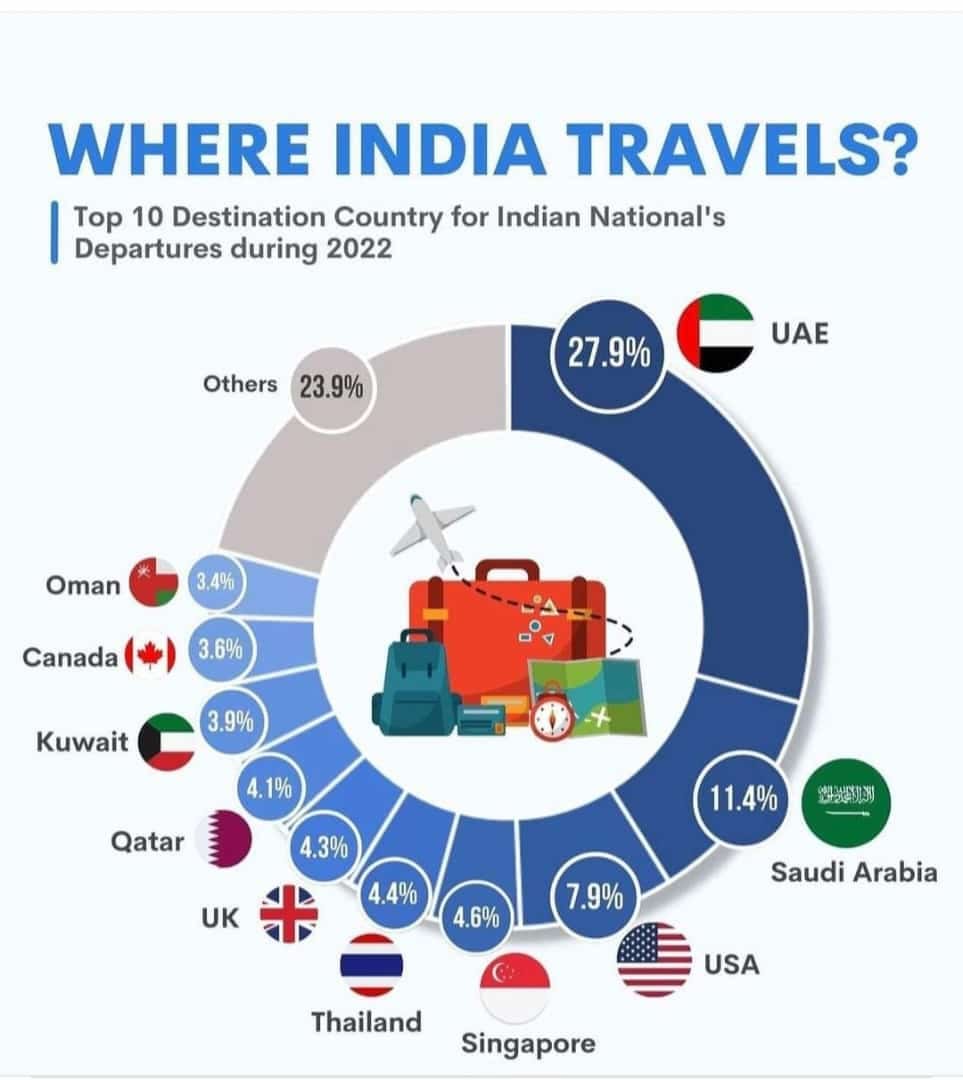
The United Arab Emirates, a grouping of  seven Arab Muslim kingdoms, has now become the number one destination for education and employment of people from Hindu India, according to the government data from the two countries. 

Indians' Foreign Travel Destinations. Source: Indian Government

India is now ruled by the right-wing Hindu BJP party headed by Prime Minister Narendra Modi whose entire politics is based on extreme hatred of Islam and Muslims. In 2020, Emirati Princess Sheikha Hend bint Faisal al-Qasimi strongly criticized Islamophobia in India. She also expressed solidarity and sympathies with Indian Muslims and Kashmiris.

Indians Students Abroad. Source: Economic Times

Over 1.2 million Indian students are now studying overseas, twice more than a decade ago. The UAE has 219,000 Indian students, Canada 215,720, the US 211,930, Australia 92,383, Saudi Arabia 80,800, Britain 55,465, and Oman 43,600, according to the data from India's Ministry of External Affairs. 


UAE Expat Population. Source: Global Media Insight

In addition to students, there are millions of foreigners working in the UAE. Currently, the Indian population in UAE is the highest with 2.75 million, followed by Pakistanis with 1.27 million. The UAE has around 0.75 million Bangladeshi nationals, 0.56 million Filipinos, and 0.48 million Iranians. There are also people from Egypt (0.42 million), Nepal (0.32 million), Sri Lanka ( 0.32 million), China (0.21 million) and the rest of the world (1.79million).

Last year, India received $43 billion in remittances from the UAE. Total worker remittances to India reached $87 billion last fiscal year, making it the world's largest recipient of these remittances. 

The United States was the second largest destination for Indian students. China maintained its top position among the leading places of origin for international students, with 35% of all international students in the 2020-21 school year hailing from the country, according to the data released by the United States government.  The second most common place of origin was India (18%), followed by South Korea (4%) and Canada (3%). Some of these countries also experienced the largest year-over-year declines in the number of students who enrolled at US institutions. The largest such percentage decreases occurred in South Korea (-21%), China (-15%) and India (-13%).

Related Links:

Tuesday, October 19, 2021

Pakistan's Quarterly Tech Exports Have Jumped Over 6-Fold Since 2010

Pakistan's quarterly technology exports reached $635 million in the first quarter of the current fiscal year 2021-22, up more than 6 times since the first quarter of fiscal year 2009-10. The nation's overall quarterly merchandise exports have been relatively flat at about $6 billion average during this period. 

Pakistan's Tech Exports 2010-2021. Source: Arif Habib

Monthly technology exports soared 36% YoY to $ 215 million in September, 2021 from $158 million in the same month last year.  During 1QFY22, technology recorded exports of worth $ 635 million (40% of overall services’ exports), up by 43% YoY. 


Recent Tech Exports FY 2021-22. Source: Arif Habib. 


Pakistan also recorded the highest ever monthly exports average of $2.23 billion in fiscal year 2020-21 as textile and garment exports jumped 22.94% to reach $15.4 billion in Fiscal Year 2020-21 (July 2020-June 2021), according to data from Pakistan Bureau of Statistics.  At the same time, the country's technology exports surged 47% to set a new record of $2.12 billion for the last fiscal year that ended in June 2021. Pharmaceutical exports also saw 25.3% growth to $241 million in the first 11months of FY 2021, indicating Pakistan's export diversification with higher value added goods and services. 

Overall Monthly Exports 2007 to 2021


Overall, Pakistan's exports of goods for fiscal 2020-21 rose 13.7% to $25.63 billion. The nation's service exports increased 9.2% to $5.93 billion in fiscal 2021. Combined exports of goods and services added up to $31.56 billion in July 2020 to June 2021 period. 

Pakistan Tech Exports. Source: Arif Habib Ltd. 


Imports grew 23.2%, much faster than exports as the economy recovered from the COVID-induced slump, widening the trade gap in the process. Energy demand drove imports of oil and gas to new highs. 

Pakistan Current Account Balance. Source: Arif Habib Ltd. 

During the last two fiscal years,  Karachi has accounted for 51% of Pakistan’s exports, Lahore came in 2nd with 18%, Faisalabad 3rd with 12% and Sialkot 4th with 8.5%. 

Pakistan's Exports by Cities. Source: FBR

Record inflow of nearly $30 billion in remittances from overseas Pakistanis helped reduce the current account deficit to $1.85 billion in FY 2020-21. It's down 58.4% from $4.45 billion in FY 2019-20. 

Overseas Pakistanis' remittances represent 10% of the country's gross domestic product (GDP). This money helps the nation cope with its perennial current account deficits. It also provides a lifeline for millions of Pakistani families who use the money to pay for food, education, healthcare and housing. This results in an increase in stimulus spending that has a multiplier effect in terms of employment in service industries ranging from retail sales to restaurants and entertainment. 

Over 10 million Pakistanis are currently working/living overseas, according to the Bureau of Emigration. Before the COVID19 pandemic hit in 2020,  more than 600,000 Pakistanis left the country to work overseas in 2019. The average yearly outflow of Pakistani workers to OECD countries (mainly UK and US) and the Middle East has been over half a million in the last decade. 


Pakistan ranks 6th among the top worker remittance recipient countries in the world.  India and China rank first and second, followed by Mexico 3rd, the Philippines 4th, Egypt 5th and Pakistan 6th.  

Pakistan's technology sector is in the midst of an unprecedented boom. It is being fueled by the country's growing human capital and rising investments in technology startups. A recent tweet by Swedish fund manager Mattias Martinsson captured it well when he wrote, "Have followed Pakistan for 15 years. Can't recall any time time when VC activity was anywhere near we've seen in the last few months. Impact of reforms kicking in?".  New laws have made it easier to create startups and offered greater protection to investors.  Digital infrastructure has expanded with over 100 million smartphones and an equal number of broadband subscriptions. 

Soaring LNG prices are now adversely affecting Pakistan's balance of payments and threatening the nation's post-COVID economic recovery.  Pakistan's trade deficit has widened to nearly $12 billion in July-September 2021 quarter, up more than 100% from the same period last year. The nation's heavy reliance on expensive imported energy has been the main cause of prior balance of payments crises that have forced it to seek IMF bailouts more than a dozen times in the last 70 years. 

Related Links:

Haq's Musings

South Asia Investor Review

Soaring Prices of LNG Imports Threaten Pakistan's Economic Recovery

Declining Investment Hurting Pakistan's Economic Growth

Brief History of Pakistan Economy 

Can Pakistan Avoid Recurring IMF Bailouts?

Unprecedented Boom in Pakistan Tech Sector

CPEC Financing: Is China Ripping Off Pakistan?

Information Tech Jobs Moving From India to Pakistan

Pakistan is 5th Largest Motorcycle Market

"Failed State" Pakistan Saw 22% Growth in Per Capita Income in Last 5 Years

CPEC Transforming Pakistan

Pakistan's $20 Billion Tourism Industry Boom

Home Appliance Ownership in Pakistani Households

Riaz Haq's YouTube Channel

PakAlumni Social Network