Showing posts with label Diaspora. Show all posts

Thursday, December 25, 2025

PIA Privatization: Can it Bring Back Pakistan National Airline's Glory Days?

After decades of failed attempts, the Government of Pakistan has finally privatized the Pakistan International Airline (PIA) under intense pressure from the International Monetary Fund (IMF). Nonetheless, it is a deal that will give the national airline not only a chance to survive but to thrive in the long run. As part of structuring the sale for Rs. 135 billion, the government has assumed Rs. 654 billion in debt and pension obligations. The government gets only Rs. 10 billion in cash but it gives the new owners a clean balance sheet in return for a commitment to invest Rs. 125 billion of the Rs. 135 billion sale price in the carrier. 

PIA Privatization Deal Structure. Source: Standard Capital Securities Pvt Ltd.


Pakistani politicians have used state-owned enterprises like the PIA as a vehicle for doling out political patronage. They have given jobs, including top jobs, to political cronies who have neither the experience nor the inclination to run these PSUs like businesses. Their focus has been on extracting as much financial gains as possible, and sharing some of these gains with their political patrons. 

Privatization will save Pakistan’s taxpayers tens of billions of rupees each year, and raise the prospect of the PIA becoming a contributor rather than a continuous drain on the national  treasury. Prior experience with privatizations of state-owned units like banks and the telecom company has shown that this is a realistic expectation. Taxpayer money saved can be used to fund education, healthcare and critical infrastructure. 

The PIA has a huge potential to succeed as an airline business. It has lucrative routes and landing rights which it is currently unable to fully utilize. It has a small aging fleet of 32 aircraft. Half of the fleet is out of service at any given time due to maintenance issues. 

Arif Habib, the head of the buying consortium which was advised by New York-based Seabury Aviation Partners, has committed to hiring a professional management team to run the PIA as a business to serve its customers and shareholders. He has announced plans to grow the PIA fleet from around 15-18 operational aircraft to 38 in the first phase, then potentially reaching 64-65 aircraft within a few years, essential for reclaiming international routes and improving service by adding more planes and restoring operational strength. 

Pakistan has the world's 6th largest diaspora. In addition, millions of Pakistanis travel for Hajj and Umrah pilgrimage to Saudi Arabia each year. Majority of the overseas Pakistanis and pilgrims would choose to travel by PIA if it offered convenient schedules and better service with direct flights to Pakistan. 

A successful national airline can make a significant contribution to the nation's economy by improving connectivity for tourism, trade and investment in the country. Business people, in particular, value their time.  Operating direct, non-stop flights to destinations in Pakistan from major international airports are essential for serving this customer base. 

Related Links:

Haq's Musings

South Asia Investor Review

Pakistan Air Travel Market

Pakistan $20 Billion Tourism Industry Booming

Saving PIA, Railways and Education in Pakistan

Pakistan: Political Patronage Trumps Public Policy

Riaz Haq's Youtube Channel


Saturday, May 28, 2022

Pakistan's Global Fashion Brands Creating Other Branded Exports Opportunities

Pakistan is moving to higher value-addition in textile sector with branding. Khaadi, Gul Ahmed, J. by Junaid Jamshed, Sapphire, Sana Safinaz and others growing into global brands by expanding into countries with large Pakistani diaspora. Other Pakistani companies that have gained international brand recognition include Shan Masala, Pakola, Tapal Tea and K&N Frozen Foods. These companies are helping boost much needed exports to narrow Pakistan's growing current account deficits. 

Pakistani Global Brands. Source: Pakistan & Gulf Economist


As the Pakistani diaspora has grown to nearly 10 million in recent years, several Pakistani clothing and food brands have entered markets in the United States, United Kingdom, European Union and the Middle East. These markets create opportunities to build more Pakistani global brands, create jobs and grow Pakistan's exports. 

Khaadi Store, Package Mall, Lahore, Source: Wikimedia


Khaadi, which specializes in women's apparel, has attracted $25 million investment from International Finance Corporation (IFC) to help the company expand its business, create jobs, promote gender equality, and support the country’s crucial textiles sector after the COVID pandemic. Khaadi has established country-specific online stores for Canada, EU, Qatar, UAE, UK, US and Pakistan. In addition, the company has 57 physical retail outlets across Pakistan, UK and GCC countries. Investment Monitor, one of a network of 30+ proprietary B2B websites, has acknowledged the potential for Pakistani fashion brands in the following words:

"Despite its difficulties, Pakistan does have strong and innovative manufacturers, notably those developing their own apparel brands have emerged. Some of this has been based on advances in the Pakistan production of fine weave lawn cloth. And Pakistan consumers are becoming more brand conscious, being happy to seek out and wear local labels. Apparel brands, such as Khaadi (of Karachi); Sapphire (Lahore) and Sana Safinaz (Karachi), have focused on value addition and with Pakistan consumers prepared to pay for local quality, high profits have followed, including by developing exports".  

K&N Foods, a Pakistani branded poultry company, has recently started a poultry processing plant in New York. The company will sell Halal chicken products in the United States and Canada under the brand name of “K&N's Foods USA, LLC”. Beginning in the spring of 2013, the company invested more than $5 million in the purchase and renovation of a former Birds Eye plant which will employ almost 200 people in the Fulton area. Initially, K&N will focus on value-added processing of poultry purchased from other slaughter plants. The target market for these products will be specialty ethnic stores, supermarkets, and food service operations. 

Brands add value to the product being sold. This added value is effectively the difference between a product's price to consumers and the cost of producing it. Value can be added in several different ways, such as adding and promoting a brand name to a generic product or assembling a product in an innovative way. Brand marketing is done to create a consumer preference based on actual or perceived features or quality of what they buy from the store shelves. 

Developing countries like Pakistan manufacture products like ready-made garments for brand-name companies like Nike, Adidas, Levy's, etc. These garments are sold at a huge mark-up in the United States, and only tiny fraction of the money goes to Pakistan. 

Another global sector dominated by Pakistani manufacturers is surgical instruments. These precision instruments are sold by German companies under German labels with no mention of them having been made in Pakistan. Bulk of the money earned by selling goes goes into the pockets of German companies whose brand names appear on these surgical instruments. 

Manufacturers can earn much more by either building their own brands by spending a lot of money over a long time on advertising and marketing or by acquiring existing brands. Chinese manufacturers have been both in recent years to claim a much bigger share of profits generated by selling their products. Pakistani manufacturers can learn from the Chinese experience to do the same.

Related Links:

Haq's Musings

South Asia Investor Review

European Union: Fastest Growing Source of Remittances to Pakistan

Pakistani-Americans: Young, Well-educated and Prosperous

Ready-Made-Garments/Textile Boom in Pakistan

Fashion Week Karachi 2016

Pakistani Halal Meat Industry Experiencing Strong Growth

Over Half A Million Pakistanis Migrating Overseas Each Year

Pakistan Most Urbanized in South Asia

Pakistan Forecast to Become World's 7th Largest Consumer Market By 2030

Amazon Expands Pakistani Exports Opportunities


Sunday, May 1, 2022

European Union: Fastest Growing Source of Remittances to Pakistan

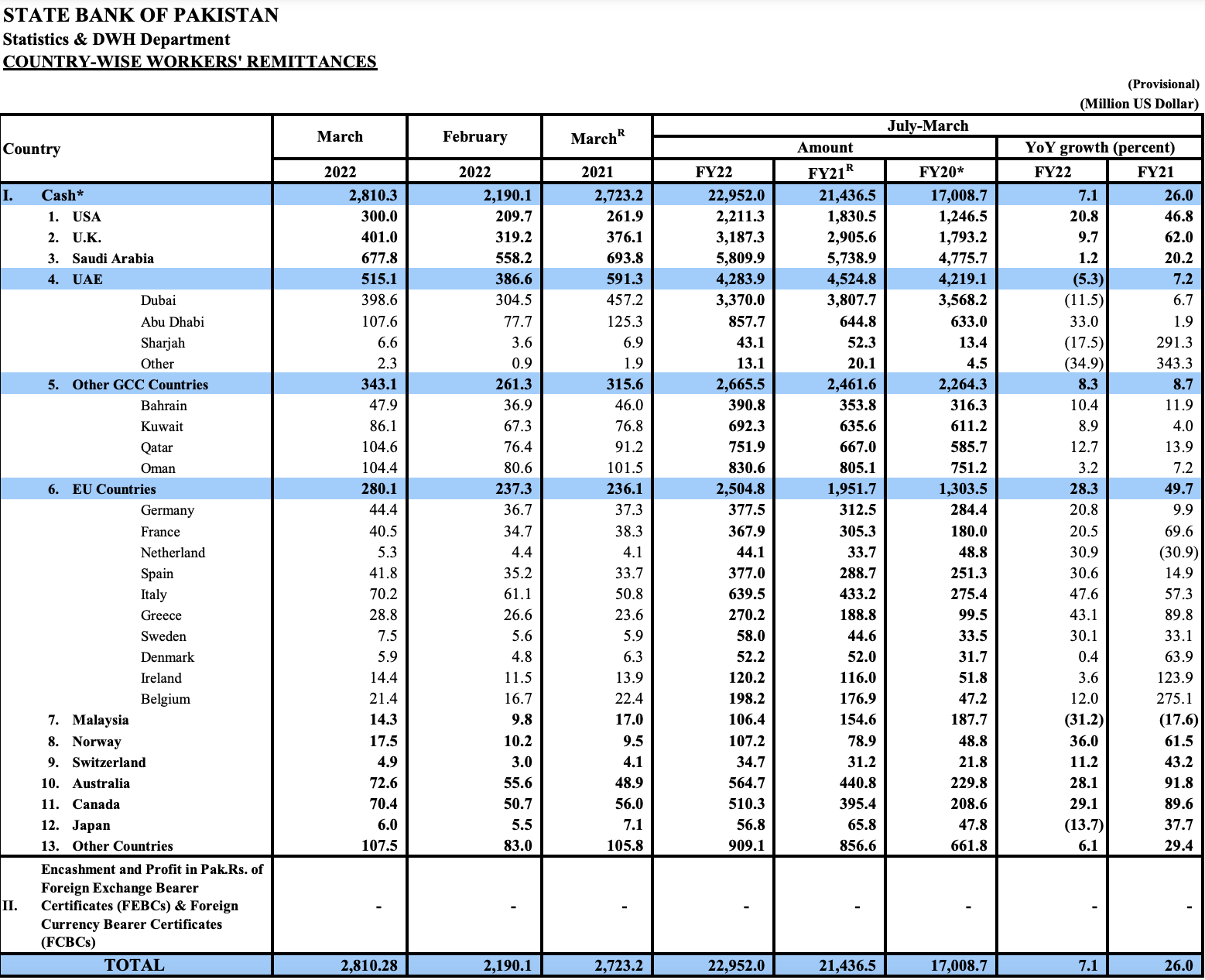
Remittances from the European Union (EU) to Pakistan soared 49.7% in FY 21 and 28.3% in FY22, according to the State Bank of Pakistan. With $2.5 billion remittances in the first 9 months (July-March) of the current fiscal year, the EU ($2.5 billion) has now surpassed North America ($2.2 billion) to become the third largest source of inflows to Pakistan after the Middle East and the United Kingdom. Remittances from the US have grown 21%, second fastest after the EU (28.3%) in the first 9  months of the current fiscal year. 

Country-wise Remittance Inflows in Pakistan. Source: State Bank of Pakistan

Pakistanis in European Union: 

The population of Pakistan-born migrants to European Union countries has been growing in recent years. With over 120,000 Pakistani migrants, Italy is the most popular destination for Pakistanis in the EU. 

Italy is followed by Germany with 75,495 Pakistani migrants. Then comes Spain with 61,953 migrants, France 21,900 (2017), Sweden 11,674, Denmark 10,669, Ireland 7,351 (2016), Belgium 5,927, Portugal 5,310, Norway 5,157, Netherlands 4,723 and Austria 4,112. There are smaller populations of Pakistanis in several other European countries. 

Pakistan-born Migrants in European Union. Source: OECD

With $5.74 billion in the first 9 months of current fiscal year FY22, Saudi Arabia remains the top source of remittances to Pakistan, followed by $4.28 billion from the United Arab Emirates (UAE). However, the Saudi remittances are essentially flat while those from the UAE have declined 5.3% in this period.  Pakistani diaspora is sending home over $30 billion a year, about 10% of the country's GDP. It is badly needed foreign exchange to balance Pakistan's external accounts.  

Pakistanis in Italy. Source: Italian Government


Pakistan's Worldwide Diaspora:

Over 10 million Pakistanis are currently working/living overseas, according to the Bureau of Emigration. Before the COVID19 pandemic hit in 2020,  more than 600,000 Pakistanis left the country to work overseas in 2019. The average yearly outflow of Pakistani workers to OECD countries (mainly UK and US) and the Middle East has been over half a million in the last decade.  

Pakistan’s economy created 5.5 million domestic jobs during the past three years –on an average 1.84 million jobs a year, which is far higher than yearly average of creation of new jobs during the 2008-18 decade, according to the Labor Force Survey (LFS) published by the Pakistan Bureau of Statistics (PBS). 

Pakistan ranks 6th among the top worker remittance recipient countries in the world.  India and China rank first and second, followed by Mexico 3rd, the Philippines 4th, Egypt 5th and Pakistan 6th.  

Pakistan Demographics
Pakistan's Demographic Dividend: 

About two million Pakistanis are entering the workforce every year. The share of the working age population in Pakistan is increasing while the birth rate is declining. This phenomenon, known as demographic dividend, is coinciding with declines in working age populations in developed countries. It is creating an opportunity for over half a million Pakistani workers to migrate and work overseas, and send home record remittances. These overseas Pakistanis are now sending home over $30 billion a year, about 10% of the country's GDP. It is badly needed foreign exchange to balance Pakistan's external accounts.  

Projected Population Decline in Emerging Economies. Source: Nikkei Asia


Sunday, September 24, 2017

Pakistani-American to Fellow Overseas Pakistanis: Go Back and Visit

Guest Post by Rashid Ahmad

You should go back and visit. You would be surprised!

Pakistan in your mind may be frozen in time, but real Pakistan has moved on. Everything has changed.

Pakistani Capital Islamabad

You will find both familiarity and alienness there. It would appear to you like a dream. Or perhaps like being on Star Trek Holodeck, where things are familiar but there are new actors on the deck, and you are bit of a stranger.

First thing that would hit you would be the increase in population. Too many people every where, compared to the time you left Pakistan. Some areas that were farms and free spaces when you were there would now be occupied by new housing developments.

The physical appearances would have changed. There would not be any complete transformation to prosperity, but new buildings replacing the old ones, and new motorways, would change the physical reality.

You would find distances have shrunk. The places that seemed far away because you walked to them or went on bicycle, would appear to be so near because now you would travel by car.

Something would sting your heart a bit. Your home where you grew up, would now belong to someone else. When you were growing there, everybody knew it as your father's home, your home, but now if you were to ask directions to your home in your own Mohalla, they will refer to it as some strange family's home! It is your home only in your childhood memories.

You would meet someone, with white beard, bald head, missing teeth, and perhaps walking with a cane, who be introduced to you as your classmate. You would be blown away by the ravages of time, and be grateful for your own health.

A middle aged woman with young children would come to visit you. And she will turn out to be the daughter of a cousin or a friend, who was just an infant at the time you left Pakistan.

Almost anybody you meet would be younger than you!

And finally, as you relive the memories of your childhood, you may find a reason to visit again and again.

Author Rashid Ahmad is a Pakistani-American civil engineer with a Master's degree from UC Davis. Ahmad came to the United States in 1970 and has since been living in Sacramento-Davis area in California. 

Related Links:

Haq's Musings

Pakistani Diaspora in America

Pakistan's Modern Infrastructure

Rising College Enrollment Rate in Pakistan

Pakistan Population Bomb

Upwardly Mobile Pakistan

The Rise of Gated Communities in Pakistan

Rising Standards of Living in Pakistan

Tuesday, August 22, 2017

Pakistani Diaspora Thriving in America

Nearly half a million people of Pakistani origin call America home. Pakistani-Americans' education and income levels are significantly higher than those of the general population of the United States. Among them are doctors, engineers, lawyers, accountants, journalists, politicians, business executives, professional sports team managers and owners, artists, actors, entrepreneurs, salespeople, policemen, soldiers, convenience store clerks and taxi, bus and truck drivers. United States is the 5th most popular destination for Pakistani-born international migrants and the 6th largest source of remittances to Pakistan. In addition to participating in local philanthropy and community activities, several Pakistani-American organizations help raise funds for schools, hospitals and other human welfare projects in Pakistan.

Pakistani-American Population:

Over 450,000 Pakistani immigrants and their children live in the United States as of 2013, according to a report compiled by Migration Policy Institute. Of these, 273,000 were born in Pakistan and the remaining 180,000 are US-born. Pakistani-American population has more than doubled in the last decade due to increased immigration, according to US Census data.

Origins of Foreign-Born Americans. Source: Pew Research


Pakistani-Americans (pop: 450,000) are the seventh largest community among Asian-Americans, behind Chinese (3.8 million),  Filipinos (3.4 million), Indians (3.2 million), Vietnamese (1.74 million),  Koreans (1.7 million) and Japanese (1.3 million), according to Asian-American Center For Advancing Justice . They are still a minuscule fraction of the overall US population.

Source: Migration Policy Institute 

Education and Income Levels:

56% of Pakistani-Americans have at least a bachelor's degree, much higher than 33% of Americans with college degrees. Among Pakistani-American college grads, 33% have a bachelor's degree while 23% have master's or Ph.Ds.

Median annual income of Pakistani-American households is $60,000, higher than the $50,000 median household income of all Americans. 33% of Pakistani-American households earn at least $90,000 while 18% earn more than $140,000.

Pakistani Doctors in America:

Pakistan is the third biggest source of foreign doctors who make up a third of all practicing physicians in the United States, according to OECD. Vast majority of Muslim doctors in America are of Pakistani origin.  Among them is Dr.Mark Humayun who was awarded top US medal for technology by President Barack Obama in 2016.

About 30% of the 800,000 doctors, or about 240,000 doctors, currently practicing in America are of foreign origin, according to Catholic Health Association of the United States. Predictions vary, but according to the American Association of Medical Colleges, by 2025 the U.S. will be short about 160,000 physicians. This gap will most likely be filled by more foreign doctors.

Foreign Doctors in US, UK. Source: OECD


As of 2013, there are over 12,000 Pakistani doctors, or about 5% of all foreign physicians and surgeons, in practice in the United States.  Pakistan is the third largest source of foreign-trained doctors. India tops with 22%, or 52,800 doctors. It is followed by the Philippines with 6%, or 14,400 foreign-trained doctors. India and Pakistan also rank as the top two sources of foreign doctors in the United Kingdom.

Pakistanis in Silicon Valley:

is home to 12,000 to 15,000 Pakistani Americans. Thousands of them are working at Apple, Cisco, Facebook, Google, Intel, Oracle, Twitter and hundreds of other high-tech companies from small start-ups to large Fortune 500 corporations. Pakistani-Americans are contributing to what Erik Brynjolfsson and Andrew McAfee describe as "The Second Machine Age" in a recent book with the same title.

A Representative Sample of Pakistani-American Entrepreneurs in Silicon Valley
Pakistani-Americans are the largest foreign-born Muslim group in San Francisco Bay Area that includes Silicon Valley, according to a 2013 study. The study was commissioned by the One Nation Bay Area Project, a civic engagement program supported by Silicon Valley Community Foundation, The San Francisco Foundation, Marin Community Foundation and Asian Americans/Pacific Islanders in Philanthropy.

 Overall, US-born Muslims make up the largest percentage at 34% of all Muslims in the Bay Area, followed by 14% born in Pakistan, 11% in Afghanistan, 10% in India, 3% in Egypt and 2% each in Iran, Jordan, Palestine and Yemen.

Pakistani-American entrepreneurs, advisers, mentors, venture capitalists, investment bankers, accountants and lawyers make up a growing ecosystem in Silicon Valley. Dozens of Pakistani-American founded start-ups have been funded by top venture capital firms. Many such companies have either been acquired in M&A deals or gone public by offering shares for sale at major stock exchanges. Organization of Pakistani Entrepreneurs (OPEN) has become a de facto platform for networking among Pakistani-American entrepreneurs in Silicon Valley. It holds an annual event called OPEN Forum which attracts over 500 attendees.

Entertainment and Sports:

Kumail Nanjiani, a Pakistani-American actor-comedian, recently made news with the successful release of his feature film The Big Sick on hundreds of screens across the United States.  It is a cross-culture romantic comedy based on actual events that breaks new ground by casting a brown-skinned Pakistani-American in a lead role in a movie produced and widely screened in the United States. Acquired by Amazon Studios for $12 million after a bidding war at Sundance film festival, the film has already grossed over $36 million so far.

Shahid Khan, a Pakistani-American engineer who made his multi-billion dollar fortune in auto industry, became only non-white owner of an NFL franchise team when he bought Jacksonville Jaguars for $760 million in 2011.

Major League Baseball's Los Angeles Dodgers franchise general manager is a Pakistani-American named Farhan Zaidi, an MIT and Berkeley-educated economist.

Kamala Khan is a new Ms. Marvel comic book character created by Pakistani-American Sana Amanat for Marvel Entertainment. Kamala is both female and Muslim. It is part of the American comic giant's efforts to reflect a growing diversity among its readers.

Academy Award winning Hollywood hits Frozen, Life of Pi and The Golden Compass have one thing in common:  Each used extensive computer-generated imagery (CGI) created by Pakistani-American Mir Zafar Ali who won Oscar statuettes for "Best Visual Effects" in each of them.

Pakistani-American Organizations:

Rockefeller Foundation-Aspen Institute Diaspora (RAD) program identified 79 Pakistani-American organizations. Of these, 5 organizations had revenue exceeding $1m while two had over $200,000 in their most recent fiscal year. The top organizations are The Citizens Foundation (TCF), the Association of Physicians of Pakistani Descent in North America (APNA) and the Organization of Pakistani Entrepreneurs (OPEN). Other large organizations are American Pakistan Foundation, Imran Khan Cancer Foundation and Human Development Foundation (HDF). These organization help raise funds for education, health care and other development and human welfare activities in Pakistan.

Trump's America:

Some Pakistani-Americans, like members of other ethnic and religious minorities, are alarmed by the increasing bigotry in America since the election of President Donald Trump. This is particularly true of places like New York's Little Pakistan were Pakistanis were targeted after 911 terrorist attacks. At the height of the sweep, over 20,000 people in Brooklyn’s South Asian communities left the United States, a COPO survey found, according to Gotham Gazette, a New York City publication. Many sought political asylum in Canada and Australia, and some returned to Pakistan and other countries. A number of them never returned. Many had their legitimate US immigration applications pending at the time. Others had their cases in immigration courts and they were waiting for disposition by judges.

Summary:

With few exceptions, most Pakistani-Americans, making up a tiny fraction of the US population, are thriving. They have significantly higher incomes and education levels than the general US population.  Pakistani-Americans are engaged in diverse occupations ranging from doctors, engineers and lawyers to large and small business owners and drivers. In addition to participating in local philanthropic and community activities, several Pakistani-American organizations help raise funds for schools, hospitals and other human welfare activities in Pakistan.

Related Links:

Haq's Musings

New York's Little Pakistan

Pakistan is the 3rd Largest Source of Foreign Doctors in America

Pakistani-American Stars in "Big Sick" Movie

Pakistani-American Population Growth 2nd Fastest Among Asian-Americans

Silicon Valley Pakistani-Americans

A Dozen British Pakistanis in UK Pariament

Trump and Modi

OPEN Silicon Valley Forum 2017: Pakistani Entrepreneurs Conference

Pakistani-American's Tech Unicorn Files For IPO at $1.6 Billion Valuation

Pakistani-American Cofounders Sell Startup to Cisco for $610 million

Pakistani Brothers Spawned $20 Billion Security Software Industry

Pakistani-American Ashar Aziz's Fireeye Goes Public

Pakistani-American Pioneered 3D Technology in Orthodontics

Pakistani-Americans Enabling 2nd Machine Revolution

Pakistani-American Shahid Khan Richest South Asian in America

Two Pakistani-American Silicon Valley Techs Among Top 5 VC Deals

Pakistani-American's Game-Changing Vision 


Thursday, December 15, 2011

Pakistani-American: First Non-White NFL Owner

NFL owners are the oldest and whitest of old white guy clubs. Drew Magary

Pakistani-American Shahid Khan made history this week by becoming the first minority owner of a National Football League team. All 31 other owners of NFL teams are white. The deal to purchase Jacksonville Jaguar is for an estimated $760 million and the ownership transfer will be complete Jan. 4, 2012, according to Associated Press. Earlier, Khan agreed in February 2010 to buy a controlling interest in the St. Louis Rams before billionaire Stan Kroenke exercised an option to purchase the 60 percent of the club he didn’t own.

NFL has highly lucrative business because of the extraordinary popularity of football in the United States. Over nine years, starting in 2014, CBS, Fox and NBC will together will pay an average of about $3 billion a year, more than 50 percent higher than their current deals, according to a report in New York Times. Altogether, the four networks, in addition to DirecTV, which pays $1 billion a year for its Sunday Ticket satellite package, will pay the N.F.L. more annually in TV rights than any sports league has ever been paid.


Shahid Khan, a mechanical engineering graduate of University of Illinois, Urbana-Champaign, made his fortune in the auto business. Almost two-thirds of all North American-built pick- up trucks and sports utility vehicles have bumper systems based on Khan’s designs, according to figures released by the Jaguars. Khan bought Flex-N-Gate in 1980 and the company now has more than 10,000 employees at 48 manufacturing plants with annual sales exceeding $3 billion.

Shahid Khan joins the illustrious list of Pakistani-Americans that includes Shering-Plough CEO Fred Hassan, Edible Arrangements Founder & CEO Tariq Farid, former CEO of Healthnet Dr. Malik Hasan, global hedge fund manager Mansoor Ijaz, Founder and Former CEO of AST Research Safi Qureshi, Mayor Haroon Saleem of of Granite Falls, Washington, Hilary Clinton aide Huma Abedin Weiner, novelists Bapsi Sidhwa and Daniyal Mueenuddin, Emmy nominee singer-songwriter Nadia Ali, and many other prominent Pakistani-American business executives, entrepreneurs, public servants, politicians and performers who have made their name in their adopted country.


Although Pakistani-Americans are still a miniscule fraction of the overall US population, their numbers have more than doubled in the last decade due to increased immigration, according to US Census 2010 data. With 100% increase since 2000, Pakistanis are the second fastest growing Asian immigrant group in the United States.


Here are some of the highlights of Pakistani-American data from US Census 2010 as gleaned from a report titled "A Community of Contrasts Asian Americans in the United States: 2011" published by Asian-American Center For Advancing Justice:

1. There are 409,163 Pakistani-Americans in 2010, the 7th largest Asian-American community in America.

2. Pakistani-American population doubled from 2000 (204,309) to 2010 (409,163), the second largest percentage increase after Bangladeshis' 157% increase in the same period.

3. 6% of Pakistani-American population is mixed race.

4. 65% of Pakistanis in America are foreign-born. 57% of foreign-born Pakistani-American population is made up of naturalized citizens.

5. There are 120,000 Pakistani legal permanent residents of which 42% are eligible to naturalize.

6. There were 69,202 immigrant visas issued to Pakistanis from 2001 to 2010, the 5th highest among Asian nations.

7. 28% of Pakistanis have limited English proficiency.

8. Average per capita income of Pakistani-Americans is $24,663.00

9. 15% of Pakistanis are classified as poor; only 1% of them are on public assistance.

10. 8% of Pakistanis are unemployed, a figure lower than the general population of Americans.

11. 55% of Pakistanis own their own homes.

12. 55% of Pakistanis have a bachelor's degree or higher.

13. Median age of Pakistanis in America is only 29 years, lower than most of the Asian groups and the national median age of 36.8 years.

Pakistani-American community is still relatively young when compared with other immigrant groups. More of the Pakistanis in America are college educated than the general population of whites and various immigrant groups. The youthful energy and higher education levels of Pakistani-Americans are opening doors for them to rise and shine in America, in spite of the current economic difficulties in their adopted land of opportunities.

Related Links:

Haq's Musings

Pakistani-American in $500 Million Deal to Buy St. Louis Rams

Edible Arrangements- A Pakistani-American's Success Story

Pakistani Diaspora World's 7th Largest

Pakistani-American's Game-Changing Vision

OPEN Forum 2010

Is Pakistan Too Big to Fail?

Pakistani-American Elected Mayor

Huma Abedin Calm Amid Twittergate

Silicon Valley Summit of Pakistani Entrepreneurs

Pakistan's Multi-Billion Dollar IT Industry

Media and Telecom Sectors Growing in Pakistan

Pakistan's Middle Class Growth in 1999-2009

Social Entrepreneurs Target India, Pakistan

Friday, September 2, 2011

Pakistani Diaspora is the World's 7th Largest

Nearly 5 million Pakistani emigrants make up the world's 7th largest disapora, according to the World Bank Factbook 2011. Adding the foreign-born children of these Pakistani emigres to the tally pushes the total figure up to about 7 million. The top five nations that the Pakistani diaspora calls home include the United Kingdom (1.2 million), The Kingdom of Saudi Arabia (1.2 million), the United Arab Emirates (1.1 million), the United States (700,000) and Canada (300,000), according to Pakistan's Dawn newspaper.

The nations ranking ahead of Pakistan are Mexico at #1, India at #2, Russia at #3, China at #4, Ukraine at #5 and Bangladesh at #6. Both the UK and Pakistan are tied at #7 with 4.7 million emigres, according to the World Bank.

World's Top 10 Diasporas:

Here are the top 10 national diasporas:

1. Mexico 11.9 million

2. India 11.4 million

3. Russia 11.1 million

4. China 8.3 million

5. Ukraine 6.6 million

6. Bangladesh 5.4 million

7. Pakistan 4.7 million

7. United Kingdom 4.7 million

8. Philippines 4.3 million

8. Turkey 4.3 million

9. Egypt 3.7 million

9. Kazakhstan 3.7 million

10. Germany 3.5 million

10. Italy 3.5 million

Diaspora Remittances:

The World Bank's Migration and Remittances Factbook 2011 ranks Pakistan at #11 in 2010 for remittances of $9.4 billion sent home by its diaspora. The State Bank of Pakistan reported that overseas Pakistanis sent home $5.291 billion during six months from July to Dec, 2010, an increase of $761 million or 17 per cent year over year, according to Pakistan's Dawn newspaper.

India tops this list with remittances of $55 billion sent home in 2010, followed by China ($51 billion), Mexico ($22.6 billion), Philippines ($21.3 billion), France ($15.9 billion), Germany ($11.6 billion), Bangladesh ($11.1 billion), Belgium ($10.4 billion), Spain ($10.2 billion), Nigeria ($10 billion) and Pakistan ($9.4 billion).

Per Capita Remittances:

In terms of per capita remittances based the World Bank data, China leads the world with an average of $6,100 sent home by each member of the Chinese diaspora, followed by the Philippines ($4,953), India ($4,824), Bangladesh ($2055), Pakistan ($2000), Mexico ($1904), UK ($1,574), Ukraine ($803) and Russia ($504). These per capita figures are an indication of the wealth of each diaspora and the extent of the brain drain experienced by these nations.

Top Immigration Countries:

With 42.8 million immigrants, the United States is home to the world's largest immigrant population. India and Pakistan also have the distinction of being on the list with 5.4 million immigrants in India at #10 and Pakistan with 4.2 million immigrants at #13. Other nations on this list include Russia at #2 (12.3 million immigrants), Germany at #3 (10.8 million), Saudi Arabia at #4 (7.3 million), Canada at #5 (7.2 million), the UK at #6 (7 million), Spain at #7 (6.9 million), France at #8 (6.7 million) and Australia at #9 (5.5 million).

Examples of Diaspora's Role:

Diasporas of various nations are mutually beneficial to both the sending and the receiving countries. They send home the money to help their families and friends financially. And they often acquire advanced education and technical, professional and managerial skills and contribute to solving problems in their host nations in the West. And given the right political and policy context, the members of the diaspora can also help their countries of origin by using their deep knowledge of their home countries and by offering advanced skills, experience and knowledge acquired in more developed nations.

In terms of development help with the skills and capital of the diaspora for their home nations, there are three examples of fairly old and mature diasporas: China, India and Armenia. While China and India have benefited greatly from their diasporas, Armenia has lagged badly, according to a World Bank report titled "Work Globally, Develop Locally: Diaspora Networks as Springboards of Knowledge-Based Development".

Pakistani Diaspora's Role:

In Pakistan's case, growing remittances amounting to 5% of its gdp in 2010 from the nation's diaspora provided an important lifeline for the state of Pakistan in funding its large current account deficit and in helping the individuals and families receiving the funds to supplement their incomes.

Remittances are a source of income for households in Khyber Pakhtunkhwa (KP) and other provinces in Pakistan, according to a 2010 World Bank report titled "Poverty fell in Pakistan in 2001-08 partly because of remittances". A recent Asian Development Bank study found that foreign remittances constituted 9.4 percent of household income in KP, compared to 5.1% for Punjab, 1.5% for Baluchistan, and 0.7% for Sindh.

Beyond the remittances, can Pakistan also benefit from its growing diaspora like India and China have from theirs? With millions of Pakistanis in Europe and America, many of them highly skilled entrepreneurs and business and technology professionals, Pakistani diaspora can be very helpful to their home country in its business, economic, social, political, educational and technological development. The realization of such great potential will only be possible if Pakistani government's public policy, public-private partnerships and state-to-state relations with the West create the necessary conditions for it to happen. Existing organizations of Pakistanis, such as OPEN Silicon Valley, APPNA, and PakAlumni Worldwide, can be helpful in such an endeavor.


Among the emerging diaspora networks, the effort of South African Network of Skills Abroad (SANSA), established by the University of Cape Town’s Science and Technology Policy Research Center, is worth watching. SANSA aims to promote collaboration between highly skilled expatriate scientists and technologists and their counterparts in South Africa. The target group is alumni of all major South African universities working in the West.

Related Links:

Haq's Musings

PakAlumni Worldwide

Pakistani-American's Game-Changing Vision

OPEN Forum 2010

Pakistani-American in $500 Million NFL Deal

Is Pakistan Too Big to Fail?

Pakistani-American Elected Mayor

Fighting Poverty Through Microfinance in Pakistan

Silicon Valley Summit of Pakistani Entrepreneurs

Pakistan's Multi-Billion Dollar IT Industry

Media and Telecom Sectors Growing in Pakistan

Pakistan's Middle Class Growth in 1999-2009

Social Entrepreneurs Target India, Pakistan