Showing posts with label Energy. Show all posts

Wednesday, October 21, 2026

Can Pakistan Scale Up Affordable Energy Availability to Achieve Prosperity?

Pakistan is currently classified as a lower middle-income country, with the ambition to become a high-income country. Its policymakers now recognize that no country has transitioned from middle-income to high-income status without generating substantial electricity at affordable rates. The link between energy and prosperity has been well-established since the advent of the Industrial Revolution. The AI Revolution has further reinforced it. Can Pakistan make the transition to a high-income country by developing indigenous energy resources to minimize dependence on expensive imports amid geopolitical uncertainty? 

Pakistan Developing Indigenous Energy Sources


All high-income countries are high-energy countries. Empirical data from the Energy for Growth Hub confirms that high-income, low-energy nations do not exist. A strong positive correlation (R² ≈ 0.83) ties per capita income and electricity consumption globally, meaning economic development requires scaling up energy availability. 


Electricity-Income Correlation. Source: ToddMoss Substack


Recognizing the importance of scaling up electricity generation, Pakistan is undergoing a major transformation in its power sector. Driven by the need to combat a volatile import bill and stabilize its finances, the nation is aggressively shifting away from expensive imported fuels toward a mix grounded in clean energy (solar, hydro, nuclear and wind) and domestic coal. 

Currently, about one-half of the installed base consists of clean and low-carbon sources while the other half relies on fossil fuels. The actual power generation relies more heavily on clean sources. For example, hydropower contributes 36.6% of total generation, while coal generates 26.3% overall, split between local Thar coal and imported coal. Nuclear adds14.3% of the output and  solar and wind account for approximately 4.3% on-grid, though private behind-the-meter installations have surged exponentially in recent years.

To reduce dependence on fossil fuel imports, Pakistan is tapping into the massive lignite coal reserves in the Thar Desert. Projects operating in Block I and Block II utilize domestic mining to provide reliable baseload power without draining foreign exchange reserves.

Major hydropower facilities like the Tarbela 5th Extension and ongoing mega-projects like Dasu and Diamer-Bhasha are expanding generation potential past 11,600+ MW. The Karachi Nuclear Power Plant (KANUPP K-2 and K-3) reactors supply crucial emissions-free base-load power to the southern grid network. Prompted by steep tariff hikes, private rooftop solar installations continue to surge across the industrial, agricultural and household sectors.

Pakistan has no choice but to make electricity cheap and plentiful to increase the productivity of its people. It is the best way for it to transition from a lower middle-income country to a high-income country. 

Tuesday, June 30, 2026

Pakistan Electricity Consumption Up 21% in Just Two Years

Pakistan is experiencing soaring demand for electricity across all of the sectors of its economy. The new demand is being met by rapidly growing deployment of distributed solar, estimated at 38 GW as of June, 2025. In 2025, 44% of solar deployment was residential, followed by industry (26%), agriculture (21%) and commercial users (9%). The expansion of distributed solar has enhanced electrification across the economy, lifting Pakistan's electrification rate to 21.7% in FY2025 from 17% in FY2023, close to the global average of 22%. This surge to over 200 terawatt-hours of electricity is not reflected in official data, according to a report by Ember Energy titled "The solarization of Pakistan's energy economy". 


The solar energy revolution in Pakistan is led by consumers. Driven by soaring electricity costs, unreliable grid infrastructure, and cheap imported solar panels, millions of households and businesses have installed rooftop solar. This rapid transition to solar has transformed the country's energy landscape.  According to the report, Pakistan’s total electricity demand increased by 33 terawatt-hours (TWh) between fiscal years 2023 and 2025. Distributed solar generation alone grew by 36 TWh during the same period, making it the primary driver of electricity demand growth and offsetting declines elsewhere in the power system.


"Pakistan has a thirst for energy, and solar is providing it," said Dave Jones, Chief Analyst at Ember. "Distributed solar is so fast and cheap to build, that it is actually driving up electricity demand."  The newly added solar capacity has saved more than US$12 billion in oil and gas imports by February, 2026, Ember said, as well as enabling growth in the agriculture, industrial and commercial parts of Pakistan’s economy.

Actual Solar Deployment in Pakistan Far Exceeds Official Stats. Source: Ember

The report shows that net metered solar is a “minority” of Pakistan’s current capacity, with far more behind-the-meter and off-grid capacity than registered net metering solar. Distributed solar has ramped up rapidly. In just two years, 27 GW of distributed solar was installed, the same amount of operating coal, gas and oil plants built in Pakistan ever. Distributed solar is also cheaper — residential solar with a medium battery makes electricity at around PKR 20/KWh, half the PKR 40 price for grid electricity. The government statistics only capture the net-metered part of the solar electricity. 

During the first nine months of 2025-26 fiscal year, Pakistan’s energy sector saw steady improvement, with hydro, renewable and nuclear sources overtaking fossil-fuel-based thermal power in installed generation capacity for the first time, according to the Pakistan Economic Survey for 2025-26. 


Monday, May 11, 2026

Is the India Growth Story Over?

In a television speech to the nation, Indian Prime Minister Narendra Modi urged his people to make sacrifices by spending less on fuel, fertilizer, and travel. He also asked them not to buy gold for a year. “To save foreign exchange, we must accept the challenge of patriotism,” he said. It appears that India's problems do not just stem from the effects of the US-Iran war; India's problems started well before that. Flight of foreign capital has put the Indian currency under tremendous pressure, with the Indian rupee falling nearly 10% in recent months. Many analysts believe that the Indian IT services exports could fall significantly as the artificial intelligence (AI) models begin to replace the IT workers. It could create a balance of payments crisis that could force India to seek the IMF bailout in the not too distant future.  Already, the Indian economy has slipped to the sixth-largest economy by nominal GDP, dropping from previous projections that had it at fourth.


Indian Economy Drops From 4th to 6th Rank. Source: IndMoneyApp

Energy Crisis:

India is facing a serious energy crisis driven by the closure of the Strait of Hormuz that has disrupted global oil and gas supplies. While the government has assured citizens that there are no immediate shortages of petroleum or natural gas, the escalating costs of imports are putting extreme pressure on the nation's foreign exchange reserves. 

AI Challenge: 

Indian IT firms are cutting staff to prepare for the expected disruption from the adoption of AI. For example, the IT services firm Cognizant is planning major workforce reductions that could impact between 12,000 and 15,000 employees globally, with India expected to account for the majority of the cuts, according to a report. 

A US-based investment research firm Citrini Research is forecasting a significant disruption to India's traditional IT services sector by 2027-2028, driven by the collapsing cost of AI coding agents. Here's an excerpt of the Citrini research report:

"The country’s IT services sector exported over $200 billion annually, the single largest contributor to India’s current account surplus and the offset that financed its persistent goods trade deficit. The entire model was built on one value proposition: Indian developers cost a fraction of their American counterparts. But the marginal cost of an AI coding agent had collapsed to, essentially, the cost of electricity. TCS, Infosys and Wipro saw contract cancellations accelerate through 2027. The rupee fell 18% against the dollar in four months as the services surplus that had anchored India’s external accounts evaporated. By Q1 2028, the IMF had begun “preliminary discussions” with New Delhi". 

Stocks Selloff: 

Sensing the growing crisis, Indian stock market investors are selling off their holdings. IN particular, foreign investors have accelerated their exit from Indian equities in early 2026, selling over $20 Billion in the first four months, driving 14-year low ownership levels. Triggered by Middle East conflicts, rising oil prices, and rupee depreciation, this record exodus—marking the worst quarterly selloff in March—was driven by outflows in banking, financial services, and IT.

Investors see the writing on the wall. The Indian economy has already dropped from the 4th to the 6th rank in the world. The Indian currency is under a lot of pressure. India's current account deficit will worsen with the loss of IT services exports. 

Related Links:


Haq's Musings

South Asia Investor Review

Builder.AI: Yet Another Global Indian Scam?

India's Ex Chief Economic Advisor: Indian GDP is 22% to 31% Smaller Than Official Claim

India's AI Spectacle of Chaos and Deception

Has the Modi Government's Politics Hurt India's International Image?

Pakistan's Official GDP Figures Ignore Fast Growing Sectors

India's "Firehose of Falsehoods"

State Bank Says Pakistan's Official GDP Under-estimated

Pakistan's Growing Middle Class

Pakistan's GDP Grossly Under-estimated; Shares Highly Undervalued

Fast Moving Consumer Goods Sector in Pakistan

Retail Investor Growth Drives Pakistan's Bull Market


Thursday, February 19, 2026

Modi's AI Spectacle: Chaos and Deception in New Delhi

The India AI Impact Summit 2026, held at Bharat Mandapam in New Delhi, has been marred by chaos, confusion and deception. The events on the ground have produced unintended media headlines for India's Prime Minister Narendra Modi who wants to be seen as the "vishwaguru" (teacher of the world) in the field of artificial intelligence as well. First, there was massive chaos on the opening day, with long lines and sudden unannounced evacuation of exhibitors and attendees from the show floor for several hours. This, the Indian government said, was done for "VIP" security, a euphemism for Mr. Modi's "photo op" as he walked the venue halls alone for the benefit of the cameras for self-promotion. Mr. Modi then declared that "India is not just a part of the AI revolution, but is leading and shaping it". To support such claims, an Indian University presented a "robodog" bought from China as its "innovation", a blatant lie that was immediately caught by people on the social media, leading to the expulsion of the institution from the show. 

5-Layer AI Stack


Let's examine Mr. Modi's claim to be "leading and shaping" the AI revolution. The artificial intelligence technology is a 5-layer stack, consisting of energy, AI chips, infrastructure, AI models and applications. Only two nations, the United States and China, have their own full 5-layer stacks. It's hard to see India as leading in any one of these layers. 

Currently, the AI space is dominated by China, the US and a handful of hyperscalers like Amazon, Google, Microsoft, etc. Any country wanting to jump on the AI bandwagon has to choose between the American and Chinese giants. Bloomberg put it best as follows:

"This, fundamentally, is a matter of sovereignty: Whether a nation’s AI systems can be independent of foreign authority. That danger was showcased in 2024, when members of Australia’s UniSuper pension fund had access to their accounts cut off due to a Google cloud misconfiguration. In October, Amazon.com Inc.’s cloud services — the world’s largest — also suffered a major shutdown, damaging its reputation". 

Strict security restrictions at the Indian AI summit caused significant limitations on carrying personal items, including laptops and other electronic devices.  In spite of such "strict security", some participants reported their exhibits and personal items stolen at the event. The fact that only cash was accepted for food and other services at the venue for the AI Summit makes a mockery of the Modi government's hype about India's digital public infrastructure (DPI). 

India's Galgotias University of Uttar Pradesh Showed Chinese Robodog as its Own


There is a significant presence of Americans at the AI Summit in New Delhi. Major "hyperscalers" like Anthropic, Google and OpenAI and Microsoft executives are all attending. The American agenda at the conference was put very succinctly by Sriram Krishnan, Senior White House Policy Advisor on Artificial Intelligence, who said, "...We want to make sure that the world uses the American AI stack...We also want the world to use our AI model...We want all our allies, including India, to leverage our AI infrastructure."

Major US technology firms have announced plans to build large multi-gigawatt AI data centers in India that make enormous demands on energy and water for powering and cooling the energy-hungry beasts. They are facing strong resistance in US cities and towns because of concerns that they will divert precious water and power, increase the rates they have to pay and cause pollution. India appears to be welcoming them for the investment they bring, in spite of significant health and safety concerns. But the Americans will not guarantee "data sovereignty" to the Indian government for Indian consumers' data stored in these data centers. 

President Donald Trump has recently scrapped greenhouse gas emission regulations to enable the use of fossil fuels to power AI data centers in the United States. But the local opposition by cities and towns continues to gather steam. 


Friday, January 3, 2025

Pakistan Stock Market Among World's Best Performers in 2024

Pakistan's KSE-100 index soared 86% in 2024, making it the second best among major indexes, according to Bloomberg News. The 2024 performance of KSE-100 represents its best year since 2002 when it shot up 112%. The top 3 performing stock markets in 2024 were Argentina (114%), Pakistan (88%) and Kenya (79%), according to Topline Securities. The US markets posted double digit gains with the AI-driven tech-heavy NASDAQ-100 up 27.6%. Small and medium US companies performed well with the Russell 2000 Index edging out India's Sensex with an 8.9% return.  

Pakistan Among Top Performing Stock Markets in 2024. Source: Bloomberg


Clearly, the $7 billion IMF program helped restore some investor confidence in Pakistan's economy in 2024. It was also boosted by remittances from overseas Pakistanis in  July-October 2024 which soared nearly 35% YoY to $11.8 billion as compared to $8.8 billion in July-Oct 2023. The fact that the KSE100 shares valuations relative to earnings still remain at historic lows (PE ratio of just 5.9) is an indication that investors have doubts about the sustainability of the economic improvements in the country. Among the top investor concerns appear to be worsening internal security situation and rising political instability. 


History of Pakistan's KSE-100 Returns Since 1995. Source: Bloomberg


Pakistan's macroeconomic indicators have significantly improved in 2024. Inflation has come down dramatically, from 29.7% in December 2023 to 4.1% in December 2024, resulting in aggressive monetary easing of 900 bps by the State Bank of Pakistan (SBP). The current account deficit has turned into a surplus of $729 million in November 2024 and the currency has remained stable.  In spite of the run-up, the KSE-100 2025 forward PE ratio of 5.9x is still substantially below the 10-year average P/E of 8.2x. 

Pakistan Shares Index PE Ratio. Source: Arif Habib

Pakistan's exports grew to $16.56 billion, an increase of 10.52% in July-Dec period in 2024 over the same period in 2023, while  imports grew 6.11% to $27.73 billion in this period. Pakistan's textile exports grew 9.7% in the first six months of the current fiscal year. The trade deficit in July-December FY25 increased 0.18% to $11.17 billion from $11.15 billion over the prior year. In December, the deficit jumped 34.80% to $2.44 billion from $1.82 billion in December 2023. The trade gap contracted to $24.08 billion in FY24 from $27.47 billion in the preceding year. The current account improvement was helped by remittances from overseas Pakistanis in  July-October 2024 which soared nearly 35% YoY to $11.8 billion as compared to $8.8 billion in July-Oct 2023.

Pakistan Textile Exports. Source: Arif Habib


In 2024, Pakistan began to make some progress to resolve the economic impact of high electricity rates and rising debt (PKR 2.1 trillion) owed to the independent power producers (IPPs). While the government terminated or renegotiated power purchase contracts (PPAs) with some IPPs, the consumers took matters into their own hands and started an unprecedented solar energy revolution. 

As a result of the latest round, PPAs with five IPPs were terminated as a first step. Two of the five IPPs took haircut deals, accepting a discount of up to PKR 20 billion. 18 other IPPs face possible conversion to take-and-pay contracts, whereby the state-owned off-taker will only be liable to pay for energy consumed by the grid, eliminating capacity charges, according to a report by the Institute for Energy Economics and Financial Analysis. 

Pakistan Solar Projects Seen From Satellites. Source: Atlas Via Bloomberg


High power prices are fueling a massive solar buildout across Pakistan, according to a Yale360 report. Solar imports from China so far this year have already outstripped imports across all of last year, Bloomberg reports. Panels purchased in 2024 amount to 17 gigawatts of capacity, enough to raise Pakistan's total power capacity by a third. A satellite data analysis done in April by Norwegian firm Atlas revealed around 400 solar plants across the country, clustered mostly in industrial hubs. But many more installations went undetected, the geospatial analysis firm said. Most panels have been deployed almost equally across homes, factories, and farms, solar distributors say. 

Related Links:

Wednesday, May 17, 2023

India-Russia Trade: Is Indian Rupee Worthless For Cross-Border Transactions?

What good is a currency in global trade if it can not be used to buy products and services from other nations that a country needs?  The answer to this question came when Russia said it has accumulated billions of rupees in Indian banks which it can not use. “This is a problem”,  Russian Foreign Minister Sergei Lavrov told reporters in India’s Western state of Goa on the sidelines of the Shanghai Cooperation Organization meeting.  “We need to use this money. But for this, these rupees must be transferred in another currency, and this is being discussed now”.  Russia has decided it won't take any more Indian rupees. Moscow has rejected New Delhi's proposal for the Kremlin to invest rupees from oil and military equipment payments back into Indian capital markets so the currency doesn't pile up.

Global Export Map 2023. Source: World Population Review


Only the currencies issued by the governments of the world's largest exporters are useful for buying products and services on the world markets. China, United States, Germany, Japan and the United Kingdom are the world's top 5 exporting nations as of 2020. This makes Chinese Yuan, US Dollar, European Euro, Japanese Yen and British Pound the most important international trade currencies. Of these currencies, only the Chinese Yuan is not impacted by the western sanctions on trade with Russia. Russia wants India to convert Indian Rupees to Chinese Yuan to pay for energy and military equipment imports from Russia. 

Yuan vs Dollar in Chinese Cross-Border Trade. Source: Bloomberg 


The share of the Chinese Yuan in international trade has been increasing since the US imposed sanctions on the use of the US dollar in trade with Russia. Earlier this year, the Chinese Yuan eclipsed the US dollar as the most used currency for Chinese cross-border transactions, according to Market Insider. The Yuan's use in cross-border payments and receipts rose to 48.4% at the end of March while the dollar's share slid to 46.7%, according to a Reuters calculation of data from China's State Administration of Foreign Exchange. The yuan's use in global trade finance remains low, though it has shown steady increases. Data from SWIFT showed that the Chinese yuan's share of global currency transactions for trade finance rose to 4.5% in March, while the US dollar accounted for 83.71%, according to Reuters. 

Related Links:

Haq's Musings

South Asia Investor Review

Impact of Russia Sanctions on US Dollar

India Biggest Winner of Russia Sanctions and US-China Tensions

Ukraine Resists Russia Alone: A Tale of West's Broken Promises

Ukraine's Lesson For Pakistan: Never Give Up Nuclear Weapons

Pakistani-American Heads SWIFT

Russia Sanction: India Profiting From Selling Russian Oil

Indian Diplomat on Pakistan's "Resilience", "Strategic CPEC"

Why Does India Lag So Far Behind China?

Sunday, June 26, 2022

Modi's India Busting Western Sanctions, Funding Russia's War On Ukraine

India, a western ally, is openly buying Russian coal, oil and weapons worth tens of billions of dollars at deep discounts. These actions amount to busting western sanctions and financing President Vladimir Putin's war on Ukraine. Many smaller developing countries, including Bangladesh and Pakistan, are abiding by these sanctions and suffering from the consequences in terms of high prices of fuel and food. Why these double standards? Do these policy contractions serve the broader US interests in the Asia region? 

India's Russian Imports Soaring Since the Start of Ukraine War. Source: Reuters

India's Russian coal imports are up 6-fold from May 27 to June 15, 2022, according to Reuters. Delhi's Russian oil buying has jumped 31-fold in this period.  Bulk shipments of Russian thermal coal to India began in the third week of May, 2022. 

India is defying western sanctions to buy millions of barrels of discounted Russian crude oil, hiding their origin and exporting refined petroleum products with a big markup to make a huge profit. China has yet to increase its oil imports from Russia, according to news reports. Meanwhile, India's neighbors Bangladesh and Pakistan are abiding by western sanctions and paying much higher market prices to buy oil for their domestic needs, and hurting their people. Such double standards are not going unnoticed. 

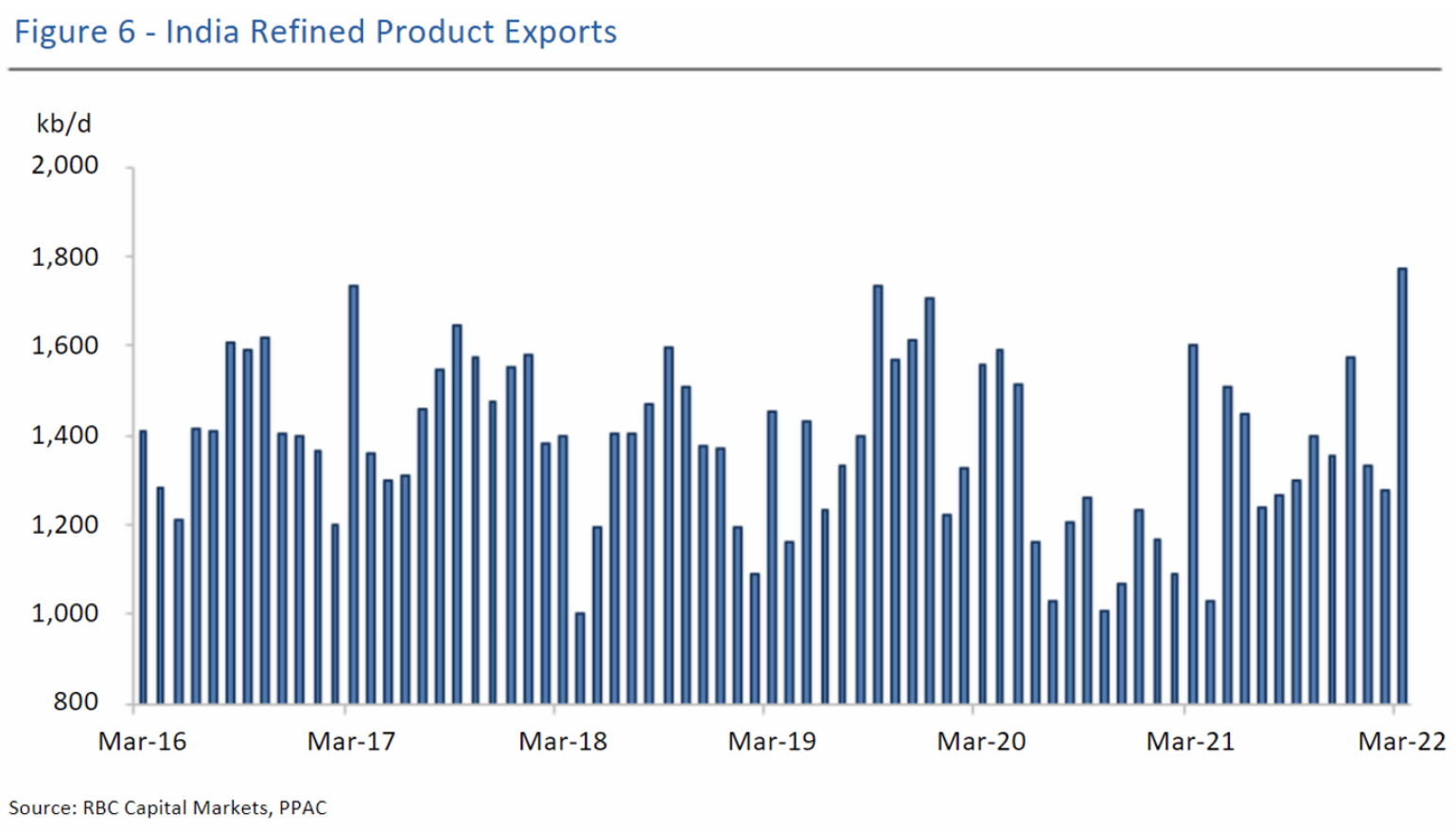
India's Refined Petroleum Exports.Source: MarketWatch


India is importing large amounts of deeply discounted Russian crude, running its refiners well above capacity, and capturing the economic rent of sky-high crack spreads and exporting gasoline and diesel to Europe, according to MarketWatch.  “As the EU weans from Russian refined products, we have a growing suspicion that India is becoming the de facto refining hub for Europe,” said Michael Tran, global energy strategist at RBC Capital Markets, in a Tuesday note. Here’s how the puzzle pieces fit together, according to Tran:

"India is buying record amounts of severely discounted Russian crude, running its refiners above nameplate capacity, and capturing the economic rent of sky-high crack spreads and exporting gasoline and diesel to Europe. In short, the EU policy of tightening the screws on Russia is a policy win, but the unintended consequence is that Europe is effectively importing inflation to its own citizens. This is not only an economic boon for India, but it also serves as an accelerator for India’s place in the new geopolitically rewritten oil trade map. What we mean is that the EU policy effectively makes India an increasingly vital energy source for Europe. This was historically never the case, and it is why Indian product exports have been clocking in at all-time-high levels over recent months". 

Bangladesh and Pakistan are afraid to buy Russian oil for fear of western sanctions while American ally India feels free to do so.  Pakistan's Imran Khan sought to buy Russian oil and gas before he was removed from power in early April. Pakistani Finance Minister Miftah Ismail told CNN's Becky Anderson in a recent interview, “It is very difficult for me to imagine buying Russian oil. At this point I think that it would not be possible for Pakistani banks to open LCs or arrange to buy Russian oil". Similarly, Bangladeshi foreign minister AK Abdul Momen said, “Russia has offered to sell oil and wheat to us, but we can’t do it out of fears of sanctions. We asked [India] how they did it [import oil from Russia]. They [India] said they have found some tricks,” Momen added. 

The West, particularly the United States, is turning a blind eye to India's actions when it comes to busting sanctions on Russia. Indian Prime Minister Narendra Modi is openly funding the war in Ukraine by buying weapons and energy from Russia. At the same time, India's smaller neighbors feel intimidated by the threat of western sanctions if they follow Modi's example. Such double standards are not going unnoticed. 

Related Links:

Haq's Musings

South Asia Investor Review

Pakistani-American Banker Heads SWIFT, the World's Largest Interbank Payment System

Pakistani-Ukrainian Billionaire Zahoor Sees "Ukraine as Russia's Afghanistan"

Ukraine Resists Russia Alone: A Tale of West's Broken Promises

Ukraine's Lesson For Pakistan: Never Give Up Nuclear Weapons

Can the Chinese Yuan Replace the US Dollar?

Russia Sanction: India Profiting From Selling Russian Oil

Ukraine's Muslim Billionaire Akhmetov Holds Balance of Power

Ukraine's Muslims Oppose Russia


Friday, January 21, 2022

Pakistan Nuclear Power Generation Soared 66% in 2021

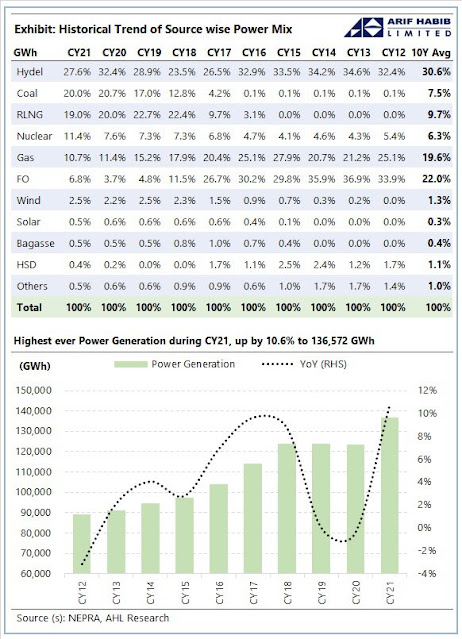
Nuclear power plants in Pakistan generated 15,540 GWH of electricity in 2021, a jump of 66% over 2020. Overall, Pakistan's power plants produced 136,572 GWH of power, an increase of 10.6% over 2020, indicating robust economic recovery amid the COVID19 pandemic. 

Pakistan Electric Power Generation. Source: Arif Habib


Hydroelectric dams contributed 37,689 GWH of electricity or 27.6% of the total power generated, making hydropower the biggest contributor to power generated in the country. It is followed by coal (20%), LNG (19%) and nuclear (11.4%). 


Cost Per Unit of Electricity in Pakistan. Source: Arif Habib

Nuclear offers the lowest cost of fuel for electricity (one rupee per KWH) while furnace oil is the most expensive (Rs. 22.2 per KWH). 
 
Pakistan Electric Power Generation Fuel MiX. Source: Arif Habib

Construction of 1,100 MW nuclear power reactor K2 unit in Karachi was completed by China National Nuclear Corporation in 2019, according to media reports. Fuel is being loaded in a similar reactor unit K3 which will add another 1,100 MW of nuclear power to the grid in 2022. Chinese Hualong One reactors being installed in Pakistan are based on improved Westinghouse AP1000 design which is far safer than Chernobyl and Fukushima plants.  

The biggest and most important source of low-carbon energy in Pakistan is its hydroelectric power plants, followed by nuclear power. Pakistan ranked third in the world by adding nearly 2,500 MW of hydropower in 2018, according to Hydropower Status Report 2019.  China added the most capacity with the installation of 8,540 megawatts, followed by Brazil (3,866 MW), Pakistan (2,487 MW), Turkey (1,085 MW), Angola (668 MW), Tajikistan (605 MW), Ecuador (556 MW), India (535 MW), Norway (419 MW) and Canada (401 MW).

New Installed Hydroelectric Power Capacity in 2018. Source: Hydroworld.com


Hydropower now makes up about 28% of the total installed capacity of 33,836 MW as of February, 2019.   WAPDA reports contributing 25.63 billion units of hydroelectricity to the national grid during the year, “despite the fact that water flows in 2018 remained historically low.” This contribution “greatly helped the country in meeting electricity needs and lowering the electricity tariff for the consumers.”

Pakistan's Current Account Balance vs International Oil Prices. Source: Arif Habib


Recent history shows that Pakistan's current account deficits vary with international oil prices.  Pakistan's trade deficits balloon with rising imported energy prices. One of the keys to managing external account balances lies in reducing the country's dependence on foreign oil and gas. 


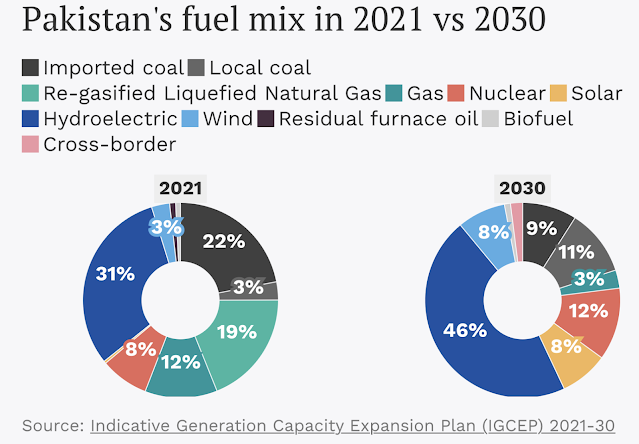
Pakistan Power Generation Fuel Mix. Source: Third Pole

It is true that Pakistan has relied on imported fossil fuels to generate electricity. The cost of these expensive imported fuels like furnace oil mainly used by independent power producers (IPPs) has been and continues to be a major contributor to the "exaggerated external demand driven by its rentier economy" referred to by Atif Mian in a recent tweet. However, Pakistan has recently been adding hydro, nuclear and indigenous coal-fired power plants to gradually reduce dependence on imported fossil fuels. 

Related Links:


Haq's Musings

South Asia Investor Review

Pakistan Among World's Largest Food Producers

Naya Pakistan Housing Program

Food in Pakistan 2nd Cheapest in the World

Indian Economy Grew Just 0.2% Annually in Last Two Years

Pakistan to Become World's 6th Largest Cement Producer by 2030

Has Bangladesh Surged Past India and Pakistan in Per Capita Income?

Pakistan's Computer Services Exports Jump 26% Amid COVID19 Lockdown

Coronavirus, Lives and Livelihoods in Pakistan

Vast Majority of Pakistanis Support Imran Khan's Handling of Covid19 Crisis

Pakistani-American Woman Featured in Netflix Documentary "Pandemic"

Incomes of Poorest Pakistanis Growing Faster Than Their Richest Counterparts

Can Pakistan Effectively Respond to Coronavirus Outbreak? 

How Grim is Pakistan's Social Sector Progress?

Double Digit Growth in Pakistan's Energy Consumption Confirms Economic Recovery


Trump Picks Muslim-American to Lead Vaccine Effort

COVID Lockdown Decimates India's Middle Class

Pakistan to be World's 7th Largest Consumer Market by 2030

Pakistan's Balance of Payments Crisis

How Has India Built Large Forex Reserves Despite Perennial Trade Deficits

Conspiracy Theories About Pakistan Elections"

PTI Triumphs Over Corrupt Dynastic Political Parties

Strikingly Similar Narratives of Donald Trump and Nawaz Sharif

Nawaz Sharif's Report Card

Riaz Haq's Youtube Channel


Tuesday, January 18, 2022

Pakistan Economy "Not in a Good Place"? Atif Mian's Gloom Justified?

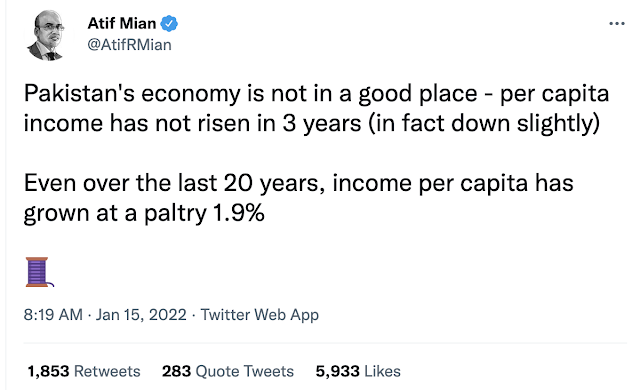
Pakistani-American economist Atif Mian has recently analyzed Pakistan's economy in a series of tweets. He has said "Pakistan's economy is not in a good place", adding that the nation's "per capita income has not risen in 3 years (in fact down slightly)". He has particularly mentioned the country's "exaggerated external demand driven by its rentier economy", "flawed energy policy" and "a broken economic decision system" among the main causes for poor economic performance.  Is Atif Mian's diagnosis correct? Is the official reported data Atif Mian using accurate? What is the current PTI government doing or not doing to correct the problems identified by Mr. Mian? Let's try and assess the situation. 

Economist Atif Mian's Tweet on Pakistan Economy


Per Capita Income:

Pakistan's officially reported GDP and per capita incomes are grossly understated. These are based on the last economic census that was done from April 2003 to December 2003 and published in 2005. The last agriculture census was in 2010, and livestock census in 2006, according to Dr. Ishrat Husain, former governor of The State Bank of Pakistan. The country's economy has changed significantly since then, adding several new economic activities while others have become less important.  For example, the Quantum Index of Large Scale Manufacturing (QIM) with 2005-06 base year gives a weight to textiles of 20.9% (Yarn 13.7 and cloth 7.2). But the textile industry has moved up to higher value added products as reflected in its exports. The value added textiles (non-yarn and non-cloth) now make almost 80% of the total textile exports. These changes are not reflected in current GDP calculations. 

In its 2014 annual report, the State Bank of Pakistan talked about a number of new sectors that are either under-reported or not covered at all: "In terms of LSM growth, a number of sectors that are showing strong performance; (for example, fast moving consumer goods (FMCG) sector; plastic products; buses and trucks; and even textiles), are either under reported, or not even covered. The omission of such important sectors from official data coverage, probably explains the apparent disconnect between overall economic activity in the country and the hard numbers in LSM."

Bangladesh just rebased its GDP in 2020-21 to 2015-16. This has boosted its per capita income by double digits for every year since 2015-16.  Bangladesh's per capita income for the 2015-16 fiscal year has now gone up to $1,737 from $1,465 in the old calculation. For the 2019-2020 fiscal, the per capita income has gone up to $2,335 from $2,024.  The new GDP estimate covers 21 sectors, up from 15 sectors previously.  India last rebased its GDP in 2015, a change that bumped up its per capita GDP by double digits. Nigeria's last rebasing in 2012 increased the size of its economy (GDP) by nearly 90%. Pakistan's current base year is 2005-6. Rebasing which is now long overdue will almost certainly increase Pakistan's per capita income by double digits. 

In this age of big data, it is important for Pakistan to ensure that its bureaucracy at Pakistan Bureau of Statistics (PBS) keeps the national economic data as current as possible. PBS should release the results of the Census of Manufacturing Industries CMI 2015-16 and the finance ministry should rebase Pakistan's economy to year 2015-16 to better reflect the current economic realities. This data is extremely important for businesses, investors, lenders and policymakers. 

Energy Mix:

It is true that Pakistan has relied on imported fossil fuels to generate electricity. The cost of these expensive imported fuels like furnace oil mainly used by independent power producers (IPPs) has been and continues to be a major contributor to the "exaggerated external demand driven by its rentier economy" referred to by Atif Mian. However, Pakistan has recently been adding hydro, nuclear and indigenous coal-fired power plants. 
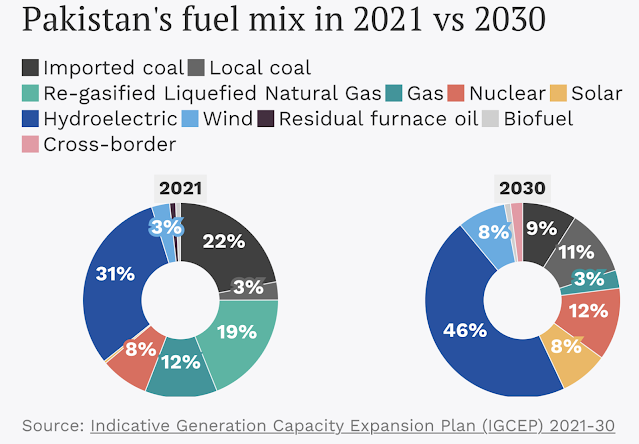
Pakistan Power Generation Fuel Mix. Source: Third Pole


Construction of a 1,100 MW nuclear power reactor K2 unit in Karachi has been completed by China National Nuclear Corporation, according to media reports. A similar reactor unit K3 will add another 1,100 MW of nuclear power to the grid, bringing the total nuclear power installed capacity of Pakistan to 3,630 MW (12% of total power) by the end of 2022.  Hualong One reactors being installed in Pakistan are based on improved Westinghouse AP1000 design which is far safer than Chernobyl and Fukushima plants.  In addition, Pakistan is also generating  9,389  MW (about 28% of total power) of low-carbon hydroelectric power in response to rising concerns about climate change. 

Hydroelectric dams contributed 37,689 GWH of electricity or 27.6% of the total power generated, making hydropower the biggest contributor to power generated in the country. It is followed by coal (20%), LNG (19%) and nuclear (11.4%). 


Cost Per Unit of Electricity in Pakistan. Source: Arif Habib

Nuclear offers the lowest cost of fuel for electricity (one rupee per KWH) while furnace oil is the most expensive (Rs. 22.2 per KWH). 


Pakistan Exports Trend 2011-21. Courtesy of Ali Khizer


External Accounts Balance:

Pakistan is the world's sixth largest labor exporter with nearly 10 million Pakistanis working overseas. These workers sent home $31 billion in remittances calendar year 2021 (CY2021), up 19% from CY2020. In addition, Pakistan merchandise exports hit a new record of $28.3 billion in CY2021. Together, Pakistan's merchandise exports and overseas worker remittances added up to nearly $60 billion in 2021. 

Pakistan Textile Exports Trend 2011-21. Courtesy of Ali Khizer


Exports of textiles that make up the bulk of Pakistani exports jumped 32% from $13.1 billion in CY2020 to $17.3 billion in CY2021. The country's technology exports soared 40% to $2.5 billion in CY2021.  “So far, (the) country’s exports of non-traditional products, including information technology, have grown by 60 percent in the last four months," says Special Assistant to the Prime Minister on Commerce and Investment Abdul Razak Dawood. 

Pakistan's Higher Value Added Exports. Source: Dr. Ishrat Husain


Pakistan's textile manufacturing and exports are moving from yarn and fabric toward higher value added products like readymade garments. The value added textiles (non-yarn and non-cloth) now make almost 80% of the total textile exports, according to Dr. Ishrat Husain. 

Pakistan's Current Account Balance vs International Oil Prices. Source: Arif Habib


Recent history shows that Pakistan's current account deficits vary with international oil prices.  Pakistan's trade deficits balloon with rising imported energy prices. One of the keys to managing external account balances lies in reducing the country's dependence on foreign oil and gas. 

Summary:

Professor Atif Mian's criticism of Pakistan's economy is partially valid but his pessimism is unwarranted. He is working with flawed data based on an economic census conducted more than 15 years ago.  This data does not truly reflect current economic activities, per capita incomes and productivity. Pakistani bureaucracy needs to ensure that the underlying data for GDP and productivity is regularly updated to inform businessmen, investors, lenders and policymakers. Pakistan is also significantly boosting its foreign exchange earnings through exports and remittances from overseas workers. The issue of reliance on expensive fossil fuel imports is also being addressed by building more hydro, nuclear and renewable energy. At the same time, indigenous coal-fired power plants are also being added. Unlike Atif Mian, I do see light at the end of the tunnel. 

Related Links:


Haq's Musings

South Asia Investor Review

Pakistan Among World's Largest Food Producers

Naya Pakistan Housing Program

Food in Pakistan 2nd Cheapest in the World

Indian Economy Grew Just 0.2% Annually in Last Two Years

Pakistan to Become World's 6th Largest Cement Producer by 2030

Has Bangladesh Surged Past India and Pakistan in Per Capita Income?

Pakistan's Computer Services Exports Jump 26% Amid COVID19 Lockdown

Coronavirus, Lives and Livelihoods in Pakistan

Vast Majority of Pakistanis Support Imran Khan's Handling of Covid19 Crisis

Pakistani-American Woman Featured in Netflix Documentary "Pandemic"

Incomes of Poorest Pakistanis Growing Faster Than Their Richest Counterparts

Can Pakistan Effectively Respond to Coronavirus Outbreak? 

How Grim is Pakistan's Social Sector Progress?

Double Digit Growth in Pakistan's Energy Consumption Confirms Economic Recovery


Trump Picks Muslim-American to Lead Vaccine Effort

COVID Lockdown Decimates India's Middle Class

Pakistan to be World's 7th Largest Consumer Market by 2030

Pakistan's Balance of Payments Crisis

How Has India Built Large Forex Reserves Despite Perennial Trade Deficits

Conspiracy Theories About Pakistan Elections"

PTI Triumphs Over Corrupt Dynastic Political Parties

Strikingly Similar Narratives of Donald Trump and Nawaz Sharif

Nawaz Sharif's Report Card

Riaz Haq's Youtube Channel


Wednesday, January 5, 2022

Double Digit Rise in Energy Consumption Confirms Pakistan's Economic Recovery in 2021

Oil consumption in Pakistan jumped 19% to 20.8 million tons in 2021, a strong indication of the country's economic recovery from the COVID-impacted 2020. In addition to oil, Pakistanis also consumed nearly 4 billion cubic foot of natural gas every day. Energy is fundamental to the functioning of any economy. 

Pakistan Oil Consumption. Source: Arif Habib

Pakistan's furnace oil consumption has been declining for several years as power producers continued to switch fuel to liquified natural gas (LNG) in recent years. However, the sudden jump in LNG prices forced them to use more furnace oil in year 2021 than in 2020. There was also a big jump in diesel (HSD) and petrol (MS) with a rise in number of vehicles on the nation's roads. 

Pakistan LNG Imports 2017-2021 in million tons 


Pakistan Natural Gas Consumption in Billion Cubic Feet Per Day


“Year 2021 proved to be remarkable for the automobile sector as there was a volumetric sales growth of 90% on a year-on-year basis to 210,048 units compared to 110,540 units in 2020,” said Arif Habib Limited analyst Arsalan Hanif.

Pakistan Auto Sales. Source: Arif Habib


Motorcycle sales in the first 9 months of CY 2-21 were 1.4 million units, up 37.5% vs the 2020 and 13.0% vs the 2019. Atlas Honda dominated the motorcycle market with sales up 52.2%.  Soaring cement consumption, rising auto sales and double digit increase in energy consumption in Pakistan in 2021 confirm that Pakistan's recovery from the COVID-induced slump is well underway.  


Barring any adverse impact of the Omicron variant of the COVID 19 virus, Pakistan's GDP is likely to grow at least 5% in the current fiscal year ending in June, 2022. The country's average economic growth of 5% a year has been faster than the global average since the 1960s. However, it has been slower than that of its peers in East Asia. It has essentially been constrained by Pakistan's recurring balance of payment (BOP) crises as explained by Thirlwall's Law. Pakistan has been forced to seek IMF bailouts 14 times in the last 70 years to deal with its BOP crises. This has happened in spite of the fact that remittances from overseas Pakistanis have grown 30X since 2000. Every time Pakistan has faced a balance of payments crisis, the result has been massive currency devaluation, high inflation and slower growth for a period of multiple years. This is exactly what Pakistan's current government led by Prime Minister Imran Khan is dealing with right now.  This pain is the result of years of flat exports, soaring imports and excessive debt taken on during former Prime Minister Nawaz Sharif's PMLN government from 2013 to 2018.  The best way for Pakistan to accelerate its growth beyond 5% is to boost its exports by investing in export-oriented industries, and by incentivizing higher savings and investments.