Showing posts with label Agriculture. Show all posts

Tuesday, June 30, 2026

Pakistan Electricity Consumption Up 21% in Just Two Years

Pakistan is experiencing soaring demand for electricity across all of the sectors of its economy. The new demand is being met by rapidly growing deployment of distributed solar, estimated at 38 GW as of June, 2025. In 2025, 44% of solar deployment was residential, followed by industry (26%), agriculture (21%) and commercial users (9%). The expansion of distributed solar has enhanced electrification across the economy, lifting Pakistan's electrification rate to 21.7% in FY2025 from 17% in FY2023, close to the global average of 22%. This surge to over 200 terawatt-hours of electricity is not reflected in official data, according to a report by Ember Energy titled "The solarization of Pakistan's energy economy". 


The solar energy revolution in Pakistan is led by consumers. Driven by soaring electricity costs, unreliable grid infrastructure, and cheap imported solar panels, millions of households and businesses have installed rooftop solar. This rapid transition to solar has transformed the country's energy landscape.  According to the report, Pakistan’s total electricity demand increased by 33 terawatt-hours (TWh) between fiscal years 2023 and 2025. Distributed solar generation alone grew by 36 TWh during the same period, making it the primary driver of electricity demand growth and offsetting declines elsewhere in the power system.


"Pakistan has a thirst for energy, and solar is providing it," said Dave Jones, Chief Analyst at Ember. "Distributed solar is so fast and cheap to build, that it is actually driving up electricity demand."  The newly added solar capacity has saved more than US$12 billion in oil and gas imports by February, 2026, Ember said, as well as enabling growth in the agriculture, industrial and commercial parts of Pakistan’s economy.

Actual Solar Deployment in Pakistan Far Exceeds Official Stats. Source: Ember

The report shows that net metered solar is a “minority” of Pakistan’s current capacity, with far more behind-the-meter and off-grid capacity than registered net metering solar. Distributed solar has ramped up rapidly. In just two years, 27 GW of distributed solar was installed, the same amount of operating coal, gas and oil plants built in Pakistan ever. Distributed solar is also cheaper — residential solar with a medium battery makes electricity at around PKR 20/KWh, half the PKR 40 price for grid electricity. The government statistics only capture the net-metered part of the solar electricity. 

During the first nine months of 2025-26 fiscal year, Pakistan’s energy sector saw steady improvement, with hydro, renewable and nuclear sources overtaking fossil-fuel-based thermal power in installed generation capacity for the first time, according to the Pakistan Economic Survey for 2025-26. 


Wednesday, October 22, 2025

HS-1 Satellite: Pakistan's Eye in the Sky

HS-1 is Pakistan's first hyper-spectral  satellite which is equipped with advanced hyperspectral imaging sensors capable of capturing data across hundreds of narrow spectral bands.  The satellite lifted off from China’s Jiuquan Satellite Launch Center on a Kinetica-1 rocket. It is expected to boost Pakistan's national capacities in areas such as precision agriculture, environmental monitoring, urban planning, and disaster management. Its high-resolution data will support improved resource management and strengthen Pakistan’s resilience to climate-related challenges. 


Though the HS-1 satellite is primarily aimed at civilian applications, it will also have significant intelligence, surveillance and reconnaissance (ISR) capability for military applications. It is much more advanced than Pakistan's PRSS-1 satellite launched in 2018 which senses objects on earth in the optical RGB (Red-Green-Blue) range. The HS-1's high-resolution data will support improved resource management and assist the Pakistani military's efforts to monitor events on the ground. 

In addition to the HS-1 satellite, Pakistan has signed a $406 million deal with China’s PIESAT for a constellation of over 20 imaging and communication satellites, a move that signals a profound shift in its strategic posture, according to defense site Quwa.  The deal includes a full transfer-of-technology (ToT) for in-country satellite manufacturing. It is poised to provide the Pakistani military with a sovereign, persistent imaging intelligence (IMINT) capability. Here's an excerpt from the Quwa website: 

"While PIESAT’s official data states a resolution of 0.5 meters, Chinese media reports indicate a larger 54-satellite version of the constellation could achieve a global revisit rate of just 60 minutes. For Pakistan, its initial 20-satellite acquisition implies a clear intent to establish a persistent regional surveillance net with revisit rates well under one day, fundamentally changing its ability to monitor adversary movements". 

Space science is a lot more than rocket science. It goes well beyond building booster rockets for satellite launches. It includes various fields like physics, astronomy, biology, chemistry, and engineering to study phenomena in space and collect and analyze data about activities on earth.  Pakistan-China space cooperation is yet another confirmation of the close and growing scientific ties between the two countries. Tens of thousands of Pakistani students are currently attending Chinese universities which are among the best in the world. Thousands of Pakistani engineers and scientists are closely working with their Chinese counterparts on multiple projects. It is a great opportunity for Pakistanis to learn from astounding scientific and technological achievements of their Chinese counterparts. 

Chinese researchers dominate global AI research, according to Marco Polo which tracks global AI talent. China dominates the top 10 science institutions, with the Chinese Academy of Sciences (CAS), the University of Science and Technology of China (USTC) and Tsinghua University taking the top three spots, according to the Science Journal Nature. Only two non-Chinese institutions broke into the top 10 – the Max Planck Society in Germany at No 4 and the French National Center for Scientific Research at No 10. The top three US institutions – the Massachusetts Institute of Technology, Harvard University and Stanford University – were ranked at 13th, 16th and 20th, respectively.

Analysts believe that China's real focus is on industrial applications for Artificial Intelligence (AI) rather than chatbots like ChatGPT or DeepSeek. Chinese are working to use the underlying technology to develop affordable, commercially viable business solutions, according to Jacob Dreyer who recently wrote an article for science journal Nature. "Its applications can then be exported, especially to lower-income countries. In other words, China’s target is not necessarily ‘frontier AI’, but ‘mass-market AI’. Its emerging AI playbook mirrors its approach to other technologies, such as electric vehicles and clean energy: not the first to innovate, but the first to make them affordable for widespread use". 


Thursday, November 7, 2024

Pakistan to Develop Urdu LLM for Generative AI

National University of Science and Technology (NUST), National Information Technology Board (NITB) and Telecom network operator Jazz have signed a Memorandum of Understanding (MOU) to develop Pakistan’s first indigenous Large Language Model (LLM) with focus on Urdu, including datasets for Pashto and Punjabi languages. It is aimed at empowering individuals, businesses, and organizations with advanced AI tools in their native languages. The envisioned LLM is expected to drive innovation in Generative AI applications, boosting productivity and accessibility in critical sectors like healthcare, education, and agriculture.

GPT-4 Accuracy Scores. Source: The Economist


Generative AI tools such as ChatGPT are powered by large language models, or LLMs. These models need to be trained on vast amounts of data in specific languages to be useful. Unfortunately, the Urdu content of the Internet is less than 0.1%. This will present a challenge for the developers of Urdu LLMs.

Online Content of Various Languages. Source: W3Techs 


Lack of Urdu content available for training ChatGPT affects the accuracy of the results for Urdu language users. For example, the GPT-4 accuracy score in question-answer tests in Urdu is just over 70%, compared with 85% accuracy score in the English language, according to data from OpenAI. Other South Asian languages, including Hindi, Bengali, Punjabi, Marathi and Telugu, suffer from the same problem. 

It's not just a South Asian problem. These challenges exist in the developing world. Non-European languages are generally poorly represented online. It's a major obstacle for non-European nations in developing their own generative artificial-intelligence (AI) models, which rely on vast amounts of training data. Generative artificial intelligence (AI) can produce biased results due to a number of factors, including the data it's trained on, the algorithms used, and how it's deployed. 

The use of AI in developing nations such as Pakistan will remain limited to a small number of people proficient in the use of the English language. Broadening the adoption of AI applications will require LLMs trained on local language content. The absence of this development could cost Pakistan the opportunity to take full advantage of the AI Revolution


Friday, September 6, 2024

Shifting Monsoon Pattern: Is Arid Pakistan Turning Wet?

Semi-arid Pakistan, with its farmlands predominantly irrigated by the world's largest contiguous canal system, has experienced an increasing amount of annual rains and floods for several years. Even the desert regions of the country, like the vast Thar desert straddling India-Pakistan border, have recently been turning green. Now a study has found that  "the mean rainfall over the semi-arid northwest parts of India and Pakistan has increased by 10%–50% during 1901–2015 and is expected to increase by 50%–200%" by the end of the current century. The authors of this study published by Advanced Earth and Space Science conclude as follows: "While an adaptation strategy to increased hydrological disasters is a must, harnessing the augmented rainfall would lead to a substantial boost in food productivity, bringing transformative changes in the socio-economic condition of people in the region". 

Annual Summer Monsoon Rainfall in Millimeters For 1979-2015. Source: AGU

Already, the satellite images shared by the US National Aeronautics and Space Administration (NASA) show that greenery in Pakistan has been growing at double digit rates over the last few decades. All of this rapid greening of the country is the result of intensive agriculture in Punjab and Sindh provinces.

Greening Trends in Asia. Source: NASA Earth Observatory

Recent economic data from Pakistan lends credence to the findings of the latest study that the region will see  "substantial boost in food productivity, bringing transformative changes in the socio-economic condition of people". Pakistan's agriculture sector grew 6.3% in 2023-24, far outpacing the overall economy that grew just 2.38%, according to the Economic Survey of Pakistan 2023-24. Pakistan’s agricultural exports reached a record $8 billion in FY 2023-24. This is good news for about 40% of the country's population working in the agriculture sector. By contrast, India's agriculture growth slowed to 1.2% in recent quarters. Studies have shown that strong growth in agriculture helps reduce poverty in developing nations like India and Pakistan. 

Projected Percentage Change in South Asia Rainfall By End of 21st Century. Source: AGU

The study highlights shifting monsoon patterns bringing more rainfall in northwestern India and Pakistan which is explained as follows: "The warming of the western Indian Ocean and Arabian Sea strengthens winds that cross the equator, which increases evaporation and the amount of moisture carried from the ocean to the land. This leads to increased monsoon rainfall."  "On the other hand, the oceanic rain belt between the equator and 10°S shows weakening, with a decrease in mean rainfall from the eastern IO (Indian Ocean) extending up to the maritime continent", it adds. 

A major downside of the increased rainfall from shifting monsoon patterns is frequent flooding in both rural and urban Pakistan. The country experienced the worst floods in its history in 2022.  Over a thousand Pakistanis died. About 33 million people in two southern provinces became homeless. Sindh was inundated with 784% of normal rainfall. Balochistan saw 522% of average rainfall. Both provinces suffered their worst ever heatwave prior to this unprecedented deluge. Nearly a million livestock were lost, over two million acres of farmland went underwater and 90% of the crops in Sindh and Balochistan were damaged. It was a massive humanitarian crisis. 

Such extreme weather events like the floods of 2022 are likely to recur and cause widespread devastation unless measures are taken to build back better. Part of the new infrastructure needed to deal with it includes better rainwater harvesting and improved drainage systems. This is what the authors of the study refer to when they say that "harnessing the augmented rainfall would lead to a substantial boost in food productivity, bringing transformative changes in the socio-economic condition of people in the region". 

Related Links:

Thursday, June 13, 2024

Agriculture: A Rare Bright Spot in Pakistan's Economy

Pakistan's agriculture sector grew 6.3% in 2023-24, far outpacing the overall economy that grew just 2.38%, according to the Economic Survey of Pakistan 2023-24.  This is good news for about 40% of the country's population working in the agriculture sector. By contrast, India's agriculture growth slowed to 1.2% in recent quarters. Studies have shown that strong growth in agriculture helps reduce poverty in developing nations like India and Pakistan. 

Snapshot of Pakistan's Economy. Source: Economic Survey of Pakistan 2023-24


The agriculture growth in Pakistan was the highest in 19 years. All major crops saw significant increases. Wheat output jumped 11.6% from 28.2 million tons last year to 31.4 million tons this year, the economic survey said. Cotton, severely damaged by floods and rains last year, reached 10.2 million bales compared to 4.9 million bales last year, growing by 108.2%. Rice output also saw a significant increase — up by 34.8% — reaching 9.9 million tons compared to 7.3 million tons. 

Strong crop output is in part the result of higher yields from increased water and fertilizer availability to farmers, according to the economic survey. 

The survey said the water availability during Kharif 2023 increased to 61.9 million acre-feet (MAF) from 43.3 MAF in Kharif 2022 (when the floods hit). For Rabi 2023-24, the water availability was 30.6 MAF, showing an increase of 4.1% over Rabi 2022-23.

Domestic fertilizer production during FY24 (July-March) rose by 17.3% to 3.25 million tons compared to 2.77 million tons in the same period of FY23. Fertilizer imports also increased by 23.7%, reaching 524,000 ton­s. The availability of fertilizer increased by 18.1% to 3.77 million tons. 

Pakistan's Rice Exports Soared 80% in Current Fiscal Year. Source: FT

The value of Pakistan’s rice exports soared to $3.6 billion over the last 11 months, up from $2 billion in July to May 2022-23. Its previous record for was 4.8 million metric tons of rice exports, valued at about $2.5 billion in 2021-22, according to the Financial Times

Pakistan is among the world's largest food producing countries. It produces large and growing quantities of cereals, meat, milk, fruits and vegetables. Currently, Pakistan produces about 38 million tons of cereals (mainly wheat, rice and corn), 17 million tons of fruits and vegetables, 70 million tons of sugarcane, 60 million tons of milk and 4.5 million tons of meat.  Total value of the nation's agricultural output exceeds $70 billion.  Improving agriculture inputs and modernizing value chains can help the farm sector become much more productive to serve both domestic and export markets.  

Agriculture is considered a key tool for reducing poverty in developing countries like Pakistan. It employs almost half of the rural workforce, contributes around 20% to the country's GDP, and provides raw materials for agro-based industries, according to a study by Yaping Liu, Asad Amin, Samma Faiz Rasool, and Qamar Uz Zaman.  However, some studies suggest that agriculture may only help mitigate rural poverty in the long term, while other sources say that sustainable agriculture practices can significantly improve agricultural production and reduce poverty.

Related Links:

Friday, March 29, 2024

Agriculture, Caste, Religion and Happiness in South Asia

Pakistan's agriculture sector GDP grew at a rate of 5.2% in the October-December 2023 quarter, according to the government figures. This is a rare bright spot in the overall national economy that showed just 1% growth during the quarter. Strong performance of the farm sector gives the much needed boost for about 37% of Pakistan's workforce engaged in agriculture. It helps the country's rural economy improve their living standards. In the same period, India's agriculture sector that employs 43% of the workforce slowed to 1.2% growth. This could be one possible contributing factor for Pakistan (rank108) significantly outperforming India (rank 126) on the World Happiness Index once again. 

World Happiness Map 2023. Source: Gallup

Pakistan has seen bumper crops of rice, corn, wheat, sugar and cotton this fiscal year after the devastation caused by massive floods in the prior year. During the first six months of the current fiscal year 2023-24, exports of agro and food products from Pakistan have soared by 64% as compared to the same period during 2022-2023. In the month of December alone, there was a growth of 118%, as $882 million of food was exported as compared  to $404 million in the same month in 2022-23. Pakistan's gains in the food export market have come at a time when India has had to limit or ban exports of rice, corn, sugar and other commodities due to crop failures.  

The World Happiness Report attributes India's poor ranking in the Index to widespread caste discrimination in the country. Older Indians belonging to upper castes, and “never experience[d] discrimination or ill-treatment” were “more satisfied with their lives”, according to the report.

Caste discrimination contributed “significantly to the caste-based discrepancies in life satisfaction”, the research showed. Caste backgrounds determined access to education, social services, health care or financial security in India.  Individuals with secondary or higher education, and those of higher social castes reported higher life satisfaction than those without access to formal education and those from Scheduled Castes (SC) and Scheduled Tribes (ST).

Another factor contributing to India's unhappiness is the ruling party's targeting of its minorities, including Christians, Muslims and Sikhs. Here's an excerpts from Rohit Khanna's piece in The Quint describing this issue:

"In recent years, 20 percent of India, our minorities, have been targeted – economically, socially, and physically. We have all seen multiple viral videos calling for the economic boycott of Muslims, of them being mob-lynched on the roads, of their homes being bulldozed, of inter-faith marriages being targeted as ‘love-jihad’ and more. We have seen videos of Christian pastors and congregations being roughed up, and of church buildings being vandalised. We have seen protesting Sikh farmers being vilified on communal lines as ‘Khalistanis’". 

Average MPCE (Monthly Per Capita Consumption Expenditure) for Indian Muslims is only Rs. 2,170.  Average MPCE for upper caste Hindus is Rs. 3,321, the highest of all groups. Lower caste Hindus fare much worse than upper caste Hindus, according to Indian government data

Average Monthly Per Capita Consumption Expenditure by Caste in India. Source: Hindustan Times

India is almost totally dominated by the upper caste Hindus. It is not just the 220 million Dalits (untouchables), or the 190 million Muslims, or the 110 million from “scheduled tribes” (Adivasis)  who are under-represented in positions of power and privilege, but also the 40-50% of Hindus who come from the widest tier of the pyramid, the shudras or laboring castes, known as Other Backwards Classes (OBCs), according to a report in The Economist Magazine.

Some Indians claim without evidence that the Indian Muslims are richer than Pakistani Muslims. The fact is that the average monthly per capita expenditure (MPCE) in Pakistan was PKR 5,959 in 2019-20, the year closest to the 2021-22 for which the Indian MPCE data is available. Using the 2019 average exchange rate of 2.136 PKR to INR, this works out to MPCE of INR 2,789 in Pakistan, higher than for Indian Hindus (INR 2,470) and Muslims (INR 2,170).  As to the cost of living in the two countries, Pakistan is 15.8% cheaper than India without rent and 20.1% cheaper with rent, according to Numbeo

While it is true the Pakistani currency has suffered significant devaluation in the last couple of years, there have been large increases in wages. Pakistan's minimum wage has increased 14 times since 2001, from 14% to 67%. The minimum wage for unskilled workers in 2023 is 32,000 Pakistani rupees per month, up from 25,000 rupees in 2022. The cost of living has been a key factor in determining the new rate. 

Income Poverty in Bangladesh, India and Pakistan. Source: Our World in Data


Over 75% of the world's poor deprived of basic living standards (nutrition, cooking fuel, sanitation and housing) live in India compared to 4.6% in Bangladesh and 4.1% in Pakistan, according to a recently released OPHI/UNDP report on multidimensional poverty.  Here's what the report says: "More than 45.5 million poor people are deprived in only these four indicators (nutrition, cooking fuel, sanitation and housing). Of those people, 34.4 million live in India, 2.1 million in Bangladesh and 1.9 million in Pakistan—making this a predominantly South Asian profile". 

Related Links:

Saturday, January 13, 2024

Pakistan to Set New Record For Rice Exports in 2023-24

The United States Department of Agriculture is forecasting that Pakistan's rice exports will set a new record of 5 million metric tons in 2023-24.  This is nearly 30% more than the 3.9 million tons Pakistan exported last year. It is being attributed to a bumper rice crop in the country and strong global demand after India imposed restrictions on its exports. A large exportable surplus has helped Pakistani exporters to offer competitive prices in the international market, but prices are likely to remain high due to an increase in demand, according to S&P Global Commodity Insights. European Union and Middle East are the main export markets for Pakistani Basmati rice while Africa and the Far East have emerged as the key export destinations for non-Basmati rice from Pakistan. 

Top Rice Exporting Countries. Source: Aljazeera

Pakistan is the world's fourth largest exporter of rice after India, Thailand and Vietnam. Last year (2022-23), India exported an estimated 20.5 million tons of rice, almost 2.5 times that of the second largest exporter, Thailand with 8.5 million tons. Thailand was followed by Vietnam (7.9 million tons), Pakistan (3.6 million tons) and the United States (2.1 million tons).

Pakistan Rice Exports. Source: S&P Global


Pakistan is among the world's largest food producing countries. It produces large and growing quantities of cereals, meat, milk, fruits and vegetables. Currently, Pakistan produces about 38 million tons of cereals (mainly wheat, rice and corn), 17 million tons of fruits and vegetables, 70 million tons of sugarcane, 60 million tons of milk and 4.5 million tons of meat.  Total value of the nation's agricultural output exceeds $50 billion.  Improving agriculture inputs and modernizing value chains can help the farm sector become much more productive to serve both domestic and export markets.  

One of the objectives of Pakistan government's Special Investment Facilitation Council (SIFC) is to bring in new investments to modernize farming.  Already, Pakistan has signed a memorandum of understanding with Kuwait for $10 billion worth of projects, including some focused on food security. The government is also collaborating with China Machinery Engineering Corp., an engineering and construction heavyweight, and China’s Famsun, an agriculture equipment company, according to a presentation about the initiative in November seen by Bloomberg

The initial focus of the Green Pakistan program is on transforming parts of the Cholistan desert to farms and fruit orchards As much as 4.8 million acres of the desert may be allocated fir this purpose.  Many parcels of land available for lease are in arid and underdeveloped regions, supporting irrigation initiatives. Some farmers are already working on their own to implement drip irrigation in Cholistan. Back in 2019, Zofeen Ibrahim of The Third Pole publication met one such farmer named Hasan Abdullah. He uses a measured amount of water mixed with fertilizer via drip irrigation to precisely irrigate his 50 acre citrus farm located on the sand dunes. As much as 60% of the cost of installing drip irrigation system has come from the provincial government. 

Related Links:

Haq's Musings

South Asia Investor Review

Chicken Cheaper Than Daal

Meat Industry in Pakistan

Bumper Crops and Soaring Tractor Sales in Pakistan

Meat and Dairy Revolution in Pakistan

Pakistanis Consuming More Calories, Fruits and Vegetables

Eid ul Azha: Multi-Billion Dollar Urban-to-Rural Transfer

Pakistan's Rural Economy

Pakistan Among World's Largest Food Producing Countries

Median Incomes in India and Pakistan

Tuesday, August 8, 2023

USDA Forecasts Bumper Harvest of Major Crops in Pakistan For 2023/24

The United States Department of Agriculture (USDA) is forecasting bumper harvest of all major crops in Pakistan for 2023/24. Major crops in the country include wheat, rice, sugarcane, corn and cotton. These offer welcome relief for Pakistani farmers who suffered devastating losses in the epic floods of 2022.   

Major Crops Produced in Pakistan. Source: USDA

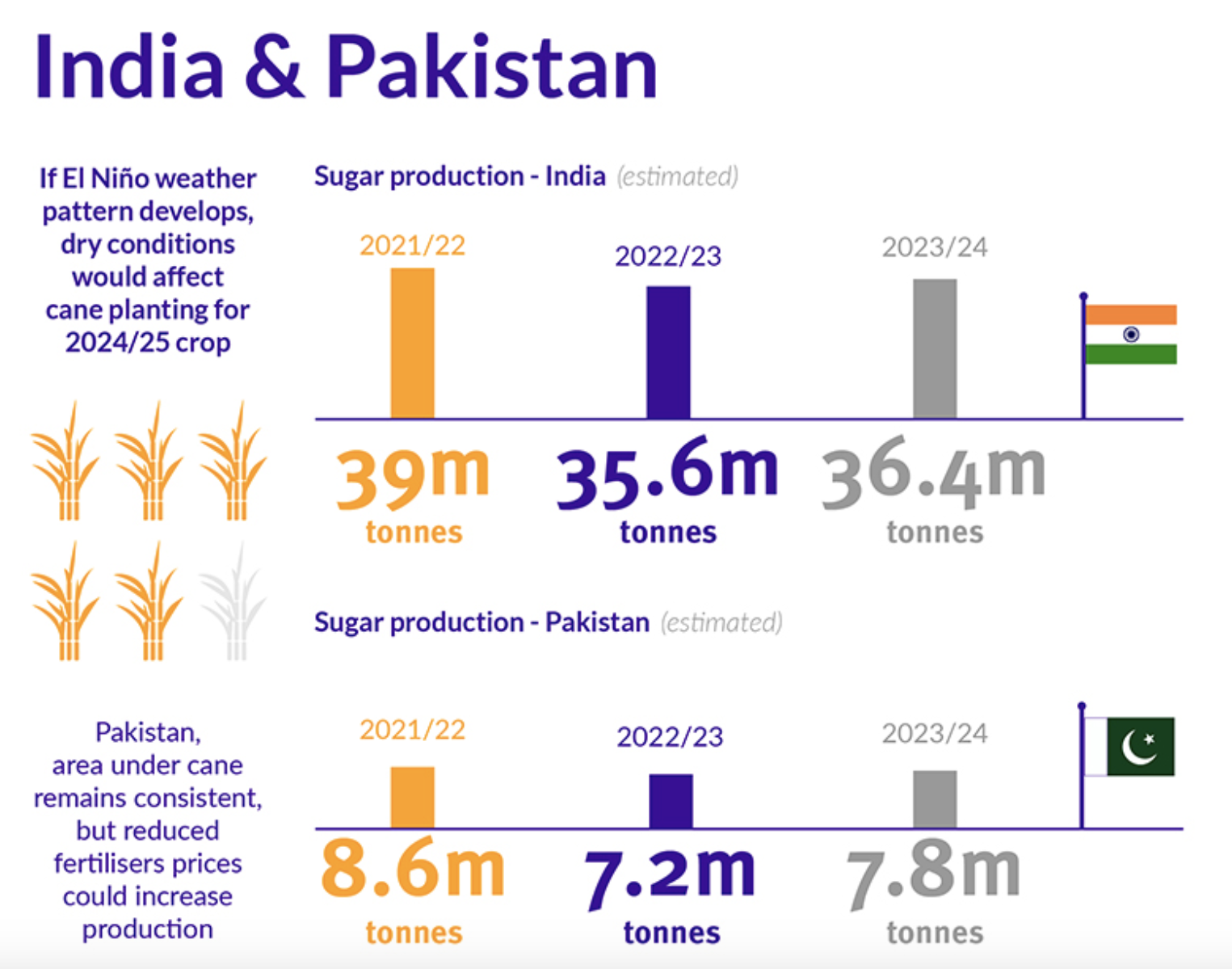
Pakistan is projected to produce 28 million tons of wheat,  10.5 million tons of corn (maize), 9 million tons of rice, 6.5 million bales of cotton, 7.8 million tons of sugar and 540,000 tons of rapeseed (canola) in 2023/24. Each of these production figures is significantly higher than last year's, and higher than the last 5-year average (2018-22) for the country. Potato production jumped 50% to 7.74 million tons in 2022, according to PotatoBusiness.  

Sugar Production in India and Pakistan. Source: Ragus


Pakistan will still need to import wheat but a lower amount than last year, according to a Global Agricultural Information Network report from the Foreign Agricultural Service (FAS) of the US Department of Agriculture. The record harvest will help lower the country’s forecasted import needs from 3 million to 2 million tons in 2023-24 even as total consumption grows to 30.2 million tonnes from 29.2 million tons. Pakistan imported 2.6 million tons last marketing year.

Higher cotton production in Pakistan will result in 2.3 million tons of cottonseed oil in 2023/24, a 34% increase over the 2022/23 output. This increase reflects expectations for a recovery in yield following the flood-damaged 2022/23 output. This will help reduce cooking oil imports, the country's largest food import, this year. Last year, Pakistan imported $4.5 billion worth of edible oil

Pakistan expects to export 5 million tons of rice worth $3 billion this year. India's ban on non-basmati rice exports will likely help Pakistani exporters fetch higher prices on the world market. 

Global Rice Market 2023. Source: Reuters


Pakistan's agriculture output is the 10th largest in the world. The country produces large and growing quantities of cereals, meat, milk, fruits and vegetables. Currently, Pakistan produces over 40 million tons of cereals (mainly wheat, rice and corn), 17 million tons of fruits and vegetables, 70 million tons of sugarcane, 60 million tons of milk and 4.5 million tons of meat.  Total value of the nation's agricultural output exceeds $50 billion. Improving agriculture inputs and modernizing value chains can help the farm sector become much more productive to serve both domestic and export markets.  

Related Links:


Haq's Musings

South Asia Investor Review

Chicken Cheaper Than Daal

Meat Industry in Pakistan

Pakistan Among World's Largest Food Producers

Meat and Dairy Revolution in Pakistan

Pakistan Floods of 2022

Eid ul Azha: Multi-Billion Dollar Urban-to-Rural Transfer

Pakistan's Rural Economy

Pakistan Leads South Asia in Agriculture Value Addition

Median Incomes in India and Pakistan

Wednesday, May 31, 2023

Pakistan's Large and Growing Civil Nuclear Program

Pakistan's nuclear weapons program gets a lot of global attention. But the country also has a large and growing civil nuclear program which has added over 3,500 MW of low-carbon electricity to the national grid. It also supports a variety of agricultural, biological and medical applications. The program relies  particularly on the expertise and contributions of nuclear scientists trained at the Pakistan Institute of Nuclear Science and Technology (PINSTECH) founded in 1965 by Dr. Ishrat Husain Usmani.  Dr. Usmani graduated from Aligarh Muslim University and later did his doctoral research at London's Imperial College under the supervision of Nobel Laureate Niels Bohr. The entire civilian nuclear program in Pakistan operates under the International Atomic Energy Agency's safeguards.
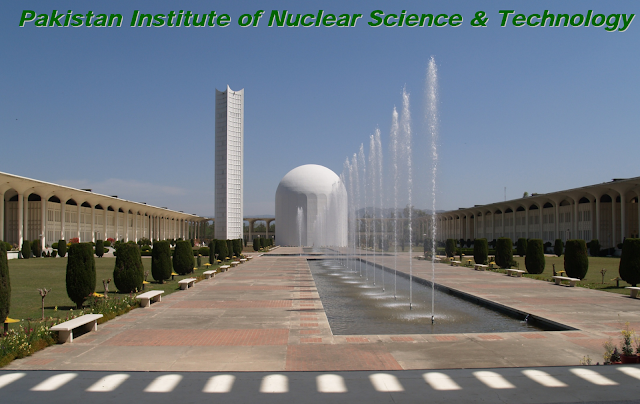
PINSTECH, Pakistan

Pakistan Nuclear Science and Technology History:  

Pakistan started its nuclear program in the 1950s under the United States’ “Atoms for Peace” program, which was designed to promote peaceful uses of nuclear technology. In 1956, the Pakistani government created the Atomic Energy Commission (PAEC) to lead the new program. The United States gave Pakistan its first reactor—the five megawatt Pakistan Atomic Research Reactor (PARR-1)—in 1962.

During this early period, PAEC chairman Dr. Ishrat Husain Usmani devoted government resources to train the next generation of Pakistani scientists. Usmani founded the Pakistan Institute of Nuclear Sciences and Technology (PINSTECH) in 1965 and sent hundreds of young Pakistani students to be trained abroad.

Pakistan Nuclear Power Generation Growth

Nuclear Power Generation:

Pakistan has installed over 3,500 MW of low-carbon nuclear power generating capacity. Nuclear power plants in Pakistan generated 15,540 GWH of electricity in 2021, a jump of 66% over 2020. 

Overall, Pakistan's power plants produced 136,572 GWH of power, an increase of 10.6% over 2020, indicating robust economic recovery amid the COVID19 pandemic.  Nuclear offers the lowest cost of fuel for electricity (one rupee per KWH) while furnace oil is the most expensive (Rs. 22.2 per KWH). 

Construction of two 1,100 MW nuclear power reactor K2 and K3 units in Karachi was completed by China National Nuclear Corporation in 2022, according to media reports. Chinese Hualong One reactors installed in Pakistan are based on improved Westinghouse AP1000 design which is far safer than Chernobyl and Fukushima plants.  

Nuclear Medicine:

Currently, there are 51 nuclear medicine centers in Pakistan, according to National Institutes of Health (NIH). Pakistan Atomic Energy Commission (PAEC) is the largest single contributor with 18 centers spread across the length and breadth of the country, including some remote towns. In terms of radionuclide therapeutic radioiodine for outpatient treatment of hyperthyroidism is more widely available across Pakistan. Inpatient facilities for delivering high-dose are limited, but given the spread of centers across the country, a large extent of the country’s landscape is covered. 

Shaukat Khanum Cancer Hospital founded by former Prime Minister Imran Khan was the first PET-CT service in Pakistan introduced in the private sector in Lahore in 2009. At present 6 PET/CT centers are operational, 2 in Lahore , 4 in Karachi backed by 5 hospital-based cyclotrons (Lahore 2, Karachi 3). 

 A cyclotron is a type of particle accelerator which repeatedly propels a beam of charged particles (protons) in a circular path. Medical radioisotopes are made from non-radioactive materials (stable isotopes) which are bombarded by these protons. In the next 2 to 6 months, first PET/CT with onsite cyclotron is expected to commission in Rawalpindi along with a scanner in Peshawar and Lahore taking the total tally to 9 scanners. A fourth cyclotron is expected to be operational in Karachi in the same period. All cyclotrons are used for F-18 labeled FDG as it remains the work horse of PET imaging. The optimal half-life, simple chemistry, and tons of experience and literature makes it ideal to make a successful enterprise. At present, there is no registry for the utilization of PET-CT across Pakistan; however, institutional clinical experience is increasingly shared at national and international conferences and published in literature, according to the NIH.  

Agriculture Applications:

Pakistan Atomic Energy Commission (PAEC) has established agriculture and biotechnology centers in the country: Nuclear Institute for Agriculture (NIA) at Tandojam, Sindh (1962), Nuclear Institute for Agriculture & Biology (NIAB) (1972), National Institute of Biotechnology & Genetic Engineering (NIBGE) (1994) at Faisalabad, Punjab, and Nuclear Institute for Food & Agriculture (NIFA), in Peshawar, Khyber Pakhtunkhwa (1982). These institutes focus on crop improvement, pest control, livestock health, food and environmental protection, and soil-water and plant nutrition management. 

The research by agriculture and biotech centers has produced several new varieties of wheat, cotton, rice, mung bean, chickpea, lentil, sugarcane, castor bean, kinnow, sesame, tomato, and brassica. These varieties are high-yielding, heat tolerant, insect and disease resistant, and have more nutritional value.

According to a report from the IAEA, mutant varieties of cotton in Pakistan have improved the quality traits of crops. The mutations in the crop varieties have led to “decrease[d] use of pesticides (due to increased disease resistance), a reduction in using fertilizers and consumption of water (due to the highly efficient nutrient intake and better tolerance to drought), superior quality, and higher crop yields,” the report states.

] The new varieties developed now account for 40% of all cotton produced in Pakistan, up from just 25% two years ago and from nonexistent yield in 2016, according to Nuclear NewsWire

International Atomic Energy Agency: 

Recently, the IAEA Director General Rafael Mariano Grossi visited Pakistan to meet with Pakistani officials in charge of the civilian nuclear program. Here's a press release of the IAEA about the visit:

The Islamic Republic of Pakistan and the IAEA will increase collaboration in peaceful applications of nuclear science and technology, particularly in agriculture and medicine, to the benefit of the country and its neighbours. That was the outcome of Director General Rafael Mariano Grossi’s two-day trip to Pakistan this week, during which he met with the country’s leadership — including its Prime and Foreign Ministers — and visited numerous nuclear facilities across the country, some of which he inaugurated.

Mr Grossi began his visit by meeting with Prime Minister Muhammad Shehbaz Sharif. The two spoke about the worsening effects of climate change on Pakistan and how nuclear science and IAEA support is helping the country.

For decades Pakistan has been ranked as one of the 10 most vulnerable countries to climate change, and last summer, was inundated with climate-change linked flooding which caused mass displacement of people and economic damages to the tune of USD 40 billion. The IAEA and Food and Agriculture Organization of the United Nations (FAO), in coordination and consultation with Pakistani authorities developed an emergency support package to assist the country in applying nuclear science to better understand the flood’s impact on soils, crops and the potential spread of animal and zoonotic diseases.

The Prime Minister expressed his desire to strengthen collaboration with the IAEA in agriculture and medicine and his support  to the Agency’s efforts to promote peace and development worldwide. The two also discussed nuclear safety and security Ukraine, where Mr Grossi is championing efforts to establish a protection zone around Ukraine’s Zaporizhzhya Nuclear Power Plant, a facility beset with nuclear safety and security challenges caused by the war in the country.

In a meeting with Foreign Minister Bilawal Bhutto Zardari, Mr Grossi said opportunities for the peaceful use of nuclear science and technology in Pakistan were plentiful, emphasizing how nuclear applications and IAEA initiatives are addressing climate change and issues of access to cancer care. Mr Bhutto Zardari said that Pakistan and the IAEA will further enhance cooperation and grow the role of nuclear applications in dealing with climate change, water, energy and food security.

In Islamabad, Mr Grossi met with the Minister of Planning and Development, Ahsan Iqbal, to discuss the role of nuclear applications in addressing Pakistan’s vulnerability to climate change. The Director General also met with Pakistani fellows of the IAEA Marie Sklodowska-Curie Fellowship Programme, an initiative seeking to help build gender-balanced capacities in the nuclear sector.

Nuclear for energy, food and health
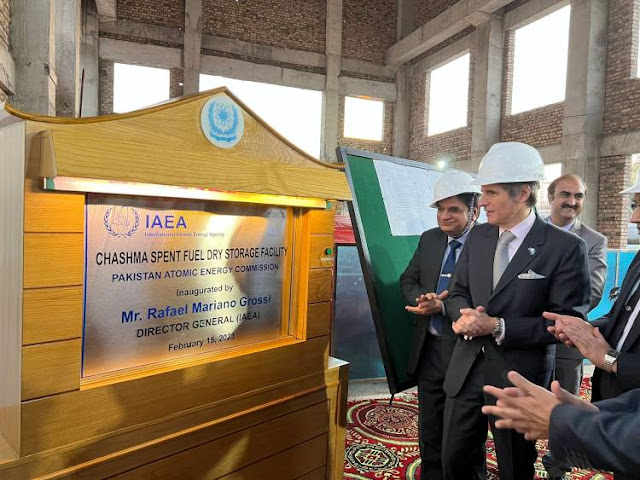
Director General Rafael Mariano Grossi inaugurates the new spent fuel dry storage facility at Chashma Nuclear Power Plant. (Photo: D. Candano/IAEA)

Pakistan currently operates six nuclear power reactors at two sites, that generate about 10 per cent of the country’s total and almost a quarter of its low-carbon electricity. During his trip, Mr Grossi visited one of those sites, Chashma Nuclear Power Plant, 250 kilometres south of Islamabad. Inaugurating the site’s new spent fuel dry storage facility, Mr Grossi highlighted the importance of managing spent fuel safely and securely.

Mr Grossi was welcomed at the Pakistan Institute of Nuclear Science and Technology (PINSTECH), an IAEA partner in work related to human health, nutrition and water analysis. At PINSTECH, Mr Grossi inaugurated a dosimetry laboratory. Mr Grossi also visited the Pakistan Centre of Excellence in Nuclear Security (PCENS), saying he was impressed by the high standard of the facility and that he looked forward to further collaboration.

At the Nuclear Medicine Oncology and Radiotherapy Institute in Islamabad, Mr Grossi inaugurated Cyberknife, a new cancer treatment facility that he described as a milestone for the country. He said Pakistan would be able to support its neighbours with regards to cancer treatment access by becoming a regional centre under Rays of Hope — an IAEA initiative seeking to increase cancer care access in low- and middle-income countries by helping to introduce and improve radiation medicine capacities and build the cancer care workforce.

In Faisalabad, Mr Grossi visited the Nuclear Institute for Agriculture and Biology (NIAB), designating it as an IAEA Collaborating Centre in agriculture and biotechnology. In a special ceremony, Mr Grossi planted a Sago Palm at the site and spoke about the IAEA’s collaboration with the facility in developing climate change resilient cotton varieties. NIAB is also a national laboratory under the IAEA’s ZODIAC initiative for combating zoonotic diseases and future pandemics.

Mr Grossi toured another IAEA Collaborating Centre, the National Institute of Safety and Security, when visiting the Pakistan Nuclear Regulatory Authority and meeting with its Chairman Faizan Mansoor. He was also honoured to inaugurate the National Radiation Emergency Coordination Centre (NRECC) in Islamabad.

Visiting the headquarters of the Pakistan Atomic Energy Commission (PAEC), Mr Grossi had a meaningful exchange with the Commission on the comprehensive and cohesive nature of the country’s peaceful nuclear programme. Mr Grossi's visit to Pakistan was on the invitation of PAEC Chairman Raja Ali Raza Anwar, whom he thanked for Pakistan's hospitality during the two days. The Director General concluded his visit in Islamabad with a seminar on climate change mitigation, during which he highlighted the role of the IAEA in supporting climate-vulnerable countries in addressing the climate crisis with nuclear science and technology.

Related Links:


Tuesday, August 16, 2022

Have Deadly Monsoon Floods Replenished Groundwater to End Long Drought in Pakistan?

Pakistan has seen unprecedented rains followed by massive floods in the current monsoon season. Hundreds of people have lost their lives and tens of thousands have been rendered homeless. After the unfolding of the tragedy, it's now time for renewal. New green shoots are sprouting in Thar desert, indicating the end of the long-running drought in Pakistan. The large Indus Basin aquifer has been significantly recharged. Groundwater has been replenished to a large extent for many years to come, raising hopes for more water for growing crops and raising livestock.  


Sunset in Lush Green Thar Desert After Monsoon 2022. Credit: Emmanuel Guddu

Greening of Thar Desert in Sindh, Pakistan. Source: Emmanuel Guddu


The heavy monsoon rains will help to kick-start the sowing of major Kharif (autumn) crops including rice, cotton, sugarcane and corn after about a month's delay.  “There was 40% less water available for the Kharif season (during May-June 2022),” an official of the Ministry of National Food Security and Research said while talking to The Express Tribune on Saturday. Earlier in March this year, Pakistan's Federal Committee on Agriculture (FCA) had said “for the Kharif year 2022, the water availability in canals head will be 65.84 million acre feet (MAF) against last year’s 65.08 MAF”. Recent rains have helped fill up major water reservoirs across the country.  About 150,000 cubic feet per second of water is being released from Pakistan's largest Tarbela dam which is more than the combined irrigation needs of the two provinces.  It is also generating over 3,000 MW of electricity, media reports.
 

Pakistan Monsoon Rainfall July 2022. Source: PMD

Pakistan Drought Monitor. Source: NDMC, PMD

Pakistan Meteorological Department data shows that Pakistan has seen far more rainfall than normal. About 178 mm of rain has fallen in the country, an increase of 180.5% of normal for the month of July. 

NASA Groundwater Map of August 8, 2022. Source: NASA GRACE

Recent satellite maps from the United States National Aeronautics and Space Administration (NASA) confirm significant groundwater growth in Pakistan. The improvement becomes much more apparent when the latest map is compared with one from 2014.
 
Satellite Groundwater Map of 2014. Source: NASA

Pakistan’s Indus Basin Irrigation System is the world's largest artificial groundwater recharge system, according to the World Bank.  A network of canals dug since the 16th century has recharged the Indus Basin aquifer in Pakistan which now has about 1.2 million tube wells extracting 50 million acre feet of water every year.  NASA satellite maps show that Pakistan is among the places worst affected by rapid depletion of groundwater.  Improved groundwater management is crucial for a healthy, prosperous, and green Pakistan. It appears that the groundwater in the Indus Basin has been replenished to a large extent for many years to come, raising hopes for more water for farmers to grow crops to feed and clothe people and raise livestock. 

Related Links: