Showing posts with label Gas. Show all posts

Sunday, June 26, 2022

Modi's India Busting Western Sanctions, Funding Russia's War On Ukraine

India, a western ally, is openly buying Russian coal, oil and weapons worth tens of billions of dollars at deep discounts. These actions amount to busting western sanctions and financing President Vladimir Putin's war on Ukraine. Many smaller developing countries, including Bangladesh and Pakistan, are abiding by these sanctions and suffering from the consequences in terms of high prices of fuel and food. Why these double standards? Do these policy contractions serve the broader US interests in the Asia region? 

India's Russian Imports Soaring Since the Start of Ukraine War. Source: Reuters

India's Russian coal imports are up 6-fold from May 27 to June 15, 2022, according to Reuters. Delhi's Russian oil buying has jumped 31-fold in this period.  Bulk shipments of Russian thermal coal to India began in the third week of May, 2022. 

India is defying western sanctions to buy millions of barrels of discounted Russian crude oil, hiding their origin and exporting refined petroleum products with a big markup to make a huge profit. China has yet to increase its oil imports from Russia, according to news reports. Meanwhile, India's neighbors Bangladesh and Pakistan are abiding by western sanctions and paying much higher market prices to buy oil for their domestic needs, and hurting their people. Such double standards are not going unnoticed. 
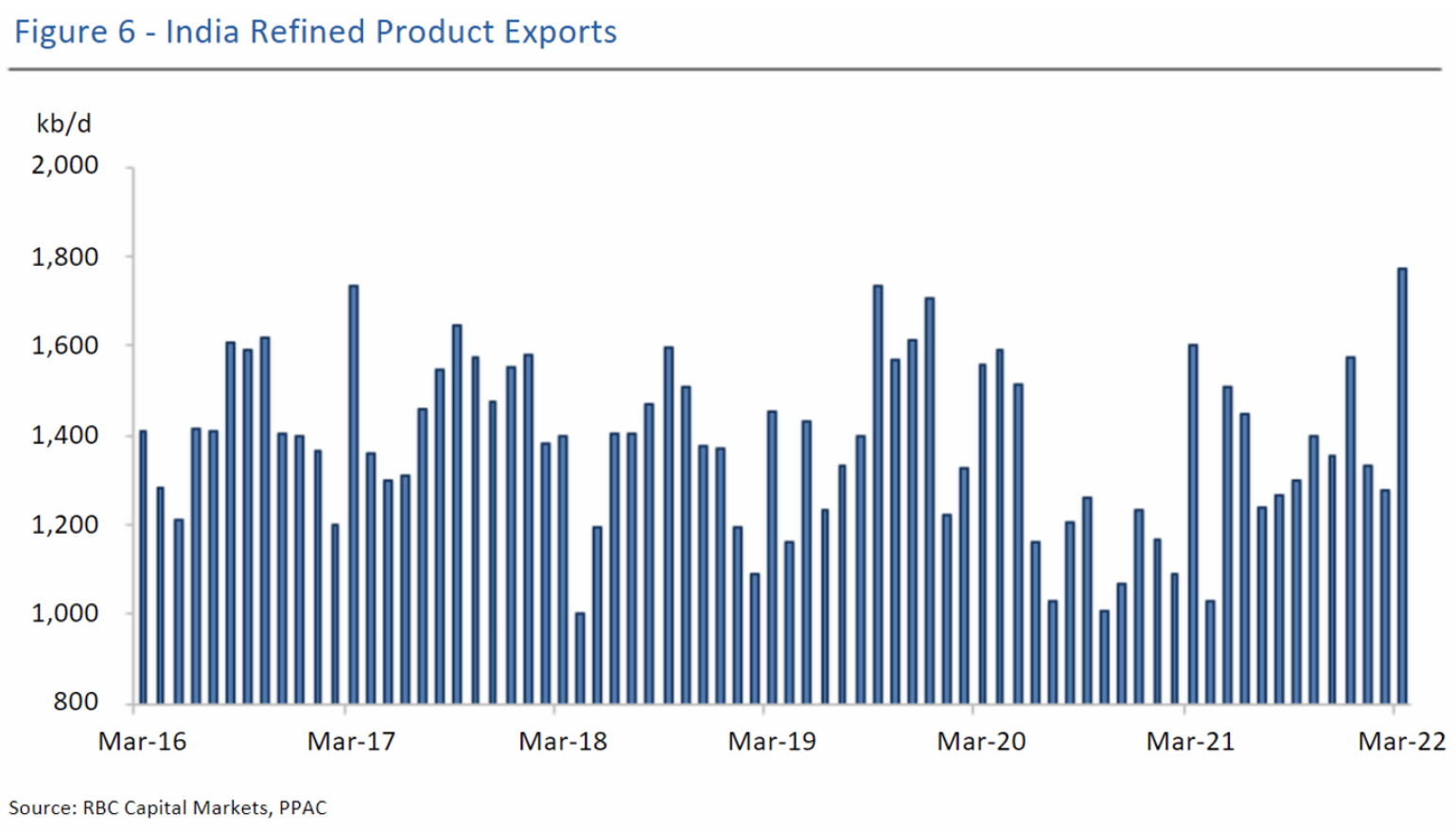
India's Refined Petroleum Exports.Source: MarketWatch


India is importing large amounts of deeply discounted Russian crude, running its refiners well above capacity, and capturing the economic rent of sky-high crack spreads and exporting gasoline and diesel to Europe, according to MarketWatch.  “As the EU weans from Russian refined products, we have a growing suspicion that India is becoming the de facto refining hub for Europe,” said Michael Tran, global energy strategist at RBC Capital Markets, in a Tuesday note. Here’s how the puzzle pieces fit together, according to Tran:

"India is buying record amounts of severely discounted Russian crude, running its refiners above nameplate capacity, and capturing the economic rent of sky-high crack spreads and exporting gasoline and diesel to Europe. In short, the EU policy of tightening the screws on Russia is a policy win, but the unintended consequence is that Europe is effectively importing inflation to its own citizens. This is not only an economic boon for India, but it also serves as an accelerator for India’s place in the new geopolitically rewritten oil trade map. What we mean is that the EU policy effectively makes India an increasingly vital energy source for Europe. This was historically never the case, and it is why Indian product exports have been clocking in at all-time-high levels over recent months". 

Bangladesh and Pakistan are afraid to buy Russian oil for fear of western sanctions while American ally India feels free to do so.  Pakistan's Imran Khan sought to buy Russian oil and gas before he was removed from power in early April. Pakistani Finance Minister Miftah Ismail told CNN's Becky Anderson in a recent interview, “It is very difficult for me to imagine buying Russian oil. At this point I think that it would not be possible for Pakistani banks to open LCs or arrange to buy Russian oil". Similarly, Bangladeshi foreign minister AK Abdul Momen said, “Russia has offered to sell oil and wheat to us, but we can’t do it out of fears of sanctions. We asked [India] how they did it [import oil from Russia]. They [India] said they have found some tricks,” Momen added. 

The West, particularly the United States, is turning a blind eye to India's actions when it comes to busting sanctions on Russia. Indian Prime Minister Narendra Modi is openly funding the war in Ukraine by buying weapons and energy from Russia. At the same time, India's smaller neighbors feel intimidated by the threat of western sanctions if they follow Modi's example. Such double standards are not going unnoticed. 

Related Links:

Haq's Musings

South Asia Investor Review

Pakistani-American Banker Heads SWIFT, the World's Largest Interbank Payment System

Pakistani-Ukrainian Billionaire Zahoor Sees "Ukraine as Russia's Afghanistan"

Ukraine Resists Russia Alone: A Tale of West's Broken Promises

Ukraine's Lesson For Pakistan: Never Give Up Nuclear Weapons

Can the Chinese Yuan Replace the US Dollar?

Russia Sanction: India Profiting From Selling Russian Oil

Ukraine's Muslim Billionaire Akhmetov Holds Balance of Power

Ukraine's Muslims Oppose Russia


Wednesday, January 5, 2022

Double Digit Rise in Energy Consumption Confirms Pakistan's Economic Recovery in 2021

Oil consumption in Pakistan jumped 19% to 20.8 million tons in 2021, a strong indication of the country's economic recovery from the COVID-impacted 2020. In addition to oil, Pakistanis also consumed nearly 4 billion cubic foot of natural gas every day. Energy is fundamental to the functioning of any economy. 

Pakistan Oil Consumption. Source: Arif Habib

Pakistan's furnace oil consumption has been declining for several years as power producers continued to switch fuel to liquified natural gas (LNG) in recent years. However, the sudden jump in LNG prices forced them to use more furnace oil in year 2021 than in 2020. There was also a big jump in diesel (HSD) and petrol (MS) with a rise in number of vehicles on the nation's roads. 

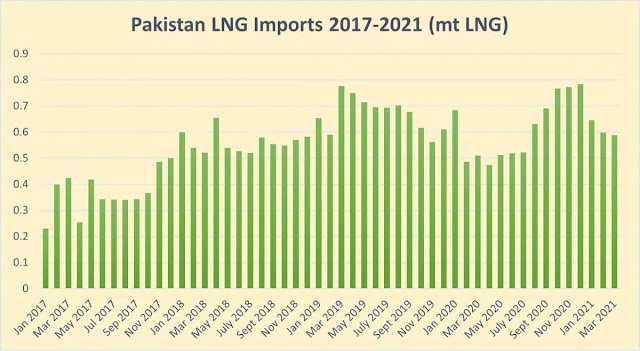
Pakistan LNG Imports 2017-2021 in million tons 


Pakistan Natural Gas Consumption in Billion Cubic Feet Per Day


“Year 2021 proved to be remarkable for the automobile sector as there was a volumetric sales growth of 90% on a year-on-year basis to 210,048 units compared to 110,540 units in 2020,” said Arif Habib Limited analyst Arsalan Hanif.

Pakistan Auto Sales. Source: Arif Habib


Motorcycle sales in the first 9 months of CY 2-21 were 1.4 million units, up 37.5% vs the 2020 and 13.0% vs the 2019. Atlas Honda dominated the motorcycle market with sales up 52.2%.  Soaring cement consumption, rising auto sales and double digit increase in energy consumption in Pakistan in 2021 confirm that Pakistan's recovery from the COVID-induced slump is well underway.  


Barring any adverse impact of the Omicron variant of the COVID 19 virus, Pakistan's GDP is likely to grow at least 5% in the current fiscal year ending in June, 2022. The country's average economic growth of 5% a year has been faster than the global average since the 1960s. However, it has been slower than that of its peers in East Asia. It has essentially been constrained by Pakistan's recurring balance of payment (BOP) crises as explained by Thirlwall's Law. Pakistan has been forced to seek IMF bailouts 14 times in the last 70 years to deal with its BOP crises. This has happened in spite of the fact that remittances from overseas Pakistanis have grown 30X since 2000. Every time Pakistan has faced a balance of payments crisis, the result has been massive currency devaluation, high inflation and slower growth for a period of multiple years. This is exactly what Pakistan's current government led by Prime Minister Imran Khan is dealing with right now.  This pain is the result of years of flat exports, soaring imports and excessive debt taken on during former Prime Minister Nawaz Sharif's PMLN government from 2013 to 2018.  The best way for Pakistan to accelerate its growth beyond 5% is to boost its exports by investing in export-oriented industries, and by incentivizing higher savings and investments. 

Tuesday, October 12, 2021

Soaring Prices of Imported LNG Threaten Pakistan's Economic Recovery

Soaring LNG prices are adversely affecting Pakistan's balance of payments and threatening the nation's post-COVID economic recovery.  Pakistan's trade deficit has widened to nearly $12 billion in July-September 2021 quarter, up more than 100% from the same period last year. The nation's heavy reliance on expensive imported energy has been the main cause of prior balance of payments crises that have forced it to seek IMF bailouts more than a dozen times in the last 70 years. 


Global LNG Prices. Source: The Peninsula Qatar 


Pakistan: World's Fastest Growing LNG Market. Source: Bloomberg


Global Commodity Price Increases


The average LNG price for November delivery into Northeast Asia was estimated at about $32 per metric million British thermal units (mmBtu), up nearly 20 percent from the previous week, according to the Peninsula Qatar publication. Price agency S&P Global Platts said on Thursday that its Japan-Korea-Marker, which is widely used as a benchmark for spot LNG contracts, rose to $34.47 per mmBtu.       

Pakistan Trade Stats. Source: Topline Securities

Rising LNG prices have forced power generating companies in Pakistan, Bangladesh and the Middle East to start switching fuels pushing oil prices higher.  About 60% of Pakistan's current LNG needs are covered by long-term contracts at significantly lower prices than the current spot prices. US crude closed above $80 for the first time since late in 2014, bringing its climb since the end of last October to 125%, according to the Wall Street Journal. 

Pakistan Coal Power Plants Under CPEC. Source:China's Global Power Database

All Pakistani Power Plants Under CPEC. Source: China's Global Power Database


The key to Pakistan managing its current accounts lies in reducing reliance on imported energy and dramatically increasing its exports. Pakistan already faces climate change pressures forcing it to change its energy mix to reduce the use of fossil fuels. 

Pakistan's Malik Amin Aslam with CNN's Becky Anderson 

Malik Amin Aslam, Pakistan Prime Minister Imran Khan's special assistant on climate change, said recently in an interview with CNN that his country is seeking to change its energy mix to favor green.  He said Pakistan's 60% renewable energy target would to be based on solar, wind and hydro power projects, and 40% would come from hydrocarbon and nuclear which is also low-carbon. “Nuclear power has to be part of the country’s energy mix for future as a zero energy emission source for clean and green future,” he concluded. Here are the key points Aslam made to Becky Anderson of CNN:

1. Pakistan wants to be a part of the solution even though it accounts for less than 1% of global carbon emissions. 

 2. Extreme weather events are costing Pakistan significant losses of lives and property. Pakistan is among the countries most vulnerable to the effects of climate change. 

3. Pakistan is moving towards renewable energy by converting 60% of its energy mix to renewable by 2030. Electric vehicle (EV) transition is also beginning in his country. 

4. Aslam said:  “We are one of the world leaders on nature based solutions. However, the World Bank (WB) in its Report yesterday came up with really good numbers in a comparison done of countries who are shifting their mainstream development towards environment friendly policies and Pakistan came atop among them,” the SAPM explained. 

900 MW Zonergy Solar Park in Bhawalpur, Pakistan


To a question on Pakistan’s capacity to make investments in nature based solutions, he said, “We cannot afford not to do it….that’s a cliche in our country and we are living that cliche in Pakistan. We are not just talking the climate talk rather doing climate action in Pakistan.” 

1,100 MW Karachi Nuclear Power Plant Unit 2


To a question on the 26th Conference of Parties (COP-26) under the United Nations Framework Convention on Climate Change, Amin said his country’s revised "national determined contributions" (NDCs) are going to be released next week. “….that’s going to clearly tell the world that this (money) we had spent in nature and could do further and that was also our direction,” he added. The SAPM informed that Pakistan was going to COP 26 with a very clear message that the country has been affected by climate change, climate injustice, adding, “but we are one of the countries that are leading the way to nature based solutions.” 

Pakistan Among Top 3 Countries For Newly Installed Hydro


He cited the WB Report and said 44% of the country’s mainstream development was climate friendly investment and it had doubled in the past one year. He said 60% renewable energy target would to be based on solar, wind and hydro power projects, and 40% would come from hydrocarbons and nuclear which is also low-carbon. “Nuclear power has to be part of the country’s energy mix for future as a zero energy emission source for clean and green future,” he concluded.

Installed Wind Power in Pakistan. Source: Modor Intelligence 


It's noteworthy that Pakistan's neighbor India currently generates 70% of its electricity from coal extracted from Indian coal mine.  It is aiming for renewables and nuclear energy to account for 40% of its installed electricity capacity by 2030.   

Pakistan NDCs (Nationally Determined Contributions) For Climate Goals. Source: UN


Here's a video of Malik Amin Aslam's interview with CNN"s Becky Anderson:

https://youtu.be/Q_s4kQXChuM


Wednesday, May 1, 2019

Massive Oil Discovery in Pakistan: Hype vs Reality

Prime Minister Imran Khan has recently raised Pakistanis' hopes of ExxonMobil and ENI being on the verge of a massive discovery of offshore oil and gas reserves in Pakistan. Is this real? Or mostly hype? What is the size of these reserves? Will it be more than sufficient to meet Pakistan's current needs of over 200 million barrels of oil per year? Will Pakistan become a net exporter of oil and gas like major OPEC nations?

Top 3 Offshore Drilling Sites in Asia-Pacific. Source: Bloomberg


Why is it taking so long to get confirmation from the companies involved? What are the technical issues in getting confirmation of these huge reserves? Why is there such a big concern about blow-out? Is it because the 1.5 billion barrels pre-drill estimate of Kekra-1 well in block G of the Indus basin off the Karachi coast? Could such a large reserve cause a major blow-out accident like the one British Petroleum had in Gulf of Mexico near Louisiana in the United States? How long will it take to fix the blow-out preventer (BOP) and complete drilling of the remaining 600-800 meters of the total depth of over 5,500 meters deep in the Arabian Sea?


Offshore Blowout Preventer Stack. Courtesy: British Petroleum

Azad Labon Kay Sath host Faraz Darvesh discusses these questions with Misbah Azam and Riaz Haq (www.riazhaq.com)

https://youtu.be/02oKLNPmUdk


Related Links:

Haq's Musings

South Asia Investor Review

Pakistan's Insatiable Appetite For Energy

US EIA Estimates of Oil and Gas in Pakistan

Pakistan's Debt Crisis

Can Pakistan Avoid Recurring IMF Bailouts?

Pakistan is the 3rd Fastest Growing Trillion Dollar Economy

CPEC Financing: Is China Ripping Off Pakistan?

Information Tech Jobs Moving From India to Pakistan

Methane Hydrate Release After Balochistan Quake

Thar Coal Development

Why Blackouts and Bailouts in Energy-Rich Pakistan?

Riaz Haq's Youtube Channel

Saturday, April 27, 2019

Blowout Concerns Delay Confirmation of Pakistan Offshore Oil Discovery

Blowout concerns have stopped offshore drilling in Pakistan yet again. It was underway to confirm discovery of oil and gas in at Kekra-1 well in G-bloc with pre-drill estimate of over 1.5 billion barrels of oil. It was scheduled to restart on April 20, 2019 after pause of 12 days, according to Pakistani media reports. Now it is delayed until the blowout preventer equipment is fixed and ready to use again.

Offshore Blowout Preventer Stack. Courtesy: British Petroleum

Blowout Preventer Problem: 

The drilling was stopped on April 8 at the depth of 4,810 meters for cementing and casing process which took almost 12 days to complete. Now there are concerns about the proper functioning of the blowout preventer (BOP). Once the BOP repair is completed, Mobile Exxon and ENI as joint operators at Kekra-1 well will resume drilling of the remaining 650-800 meters.

Time required to drill the remaining 650-800 meters will depend on the rate of penetration (RoP).  Pakistan petroleum ministry officials were quoted by The News as saying that they "don’t yet have precedents to form a reliable estimate for the RoP for offshore Indus-G, where Kekra-01 is being drilled. An RoP of 10 meters per hour (generally considered low) would mean that it would take 80 hours or a little more than three days to reach the target depth.’’

Top 3 Offshore Drilling Sites in Asia-Pacific. Source: Bloomberg

Exxon-Mobil's Entry in Pakistan:

American energy giant Exxon-Mobil has joined the offshore oil and gas exploration efforts started by Oil and Gas Development Corporation (OGDC), Pakistan Petroleum Limited (PPL) and Italian energy giant ENI, according to media reports.

Each company will have 25% stake in the joint venture under an agreement signed at the Prime Minister’s Secretariat in May among ExxonMobil, Government Holdings Private Limited (GHPL), PPL, ENI and OGDC.

Exxon-Mobile's entry in Pakistan brings deep offshore drilling technology, its long experience and financial resources to the country. It is expected to accelerate exploration and more discoveries.

Pakistan Oil Basins:

A Pakistan Basin Study conducted in 2009 found that the country has six onshore and two offshore basins; offshore basins being the Indus basin and the Makran basin in the Arabian Sea.

The Indus offshore basin is a rift basin that geologists say developed after the separation of the Indian Plate from Africa in the late Jurassic period. It is believed to be the second largest submarine fan system in the world after the Bay of Bengal with high probability of hydrocarbon discoveries.

The Makran Offshore basin is separated from the Indus Offshore basin by Murray ridge, according to Syed Mustafa Amjad's report in Dawn. It is an oceanic and continental crust subduction zone with deepwater trenches and volcanic activity. The basin consists of oceanic crust and periodic emergence of temporary mud islands along the coast suggesting strong evidence of large hydrocarbon deposits.

Pakistan Hydrocarbon Potential:

The United States Energy Information Administration (EIA) estimates that Pakistan has 586 TCF (trillion cubic feet) of gas in Pakistan of which 105 TCF is technically recoverable.

In addition to gas deposits, US EIA estimates there are 227 billion barrels of oil in Pakistan with 9.1 billion barrels being technically recoverable.

Pakistan also has 185 billion tons of coal deposits in Thar desert which are just beginning to be extracted by Sindh Engro Coal Mining Corporation.

Oil and Gas exploration and production companies are currently planning to drill 90 wells in different parts of  the country. Under the plan, as many as 50 exploratory and 40 development wells would be drilled in a bid to make the country self-sufficient in the energy sector, according to media reports.

During the last five years, the sources said the exploration and production companies drilled 445 new wells, out of which 221 were exploratory, adding that the increased exploration activities resulted in 116 new oil and gas discoveries.

Current Account Deficits:

Energy imports make up a big chunk of Pakistan's total imports. Bulk of the annual 200 million barrels of oil demand has to be imported. Rising oil prices worsen the current account deficit and put pressure on Pakistan's reserves, forcing the country to seek periodic IMF bailouts.

Pakistan's trade deficit is nearly $40 billion a year and debt service costs are about $11 billion a year. How can Pakistan fund this balance of payments deficit of about $50 billion? Remittances of $21 billion in current FY2019 from Pakistani diaspora are expected to reduce it to $30 billion. PTI government has taken on billions of dollars in loans from Gulf Arabs and China. Given the low rates of foreign investments in the country, a big chunk of the remaining deficit will have to be met by borrowing even more funds which will further increase future debt service costs.

Pakistan's Current Account Deficit. Source: Trading Economics

As a result, Pakistan is now battling massive twin deficits, deteriorating foreign currency reserves, low exports, diminishing tax revenues, a weak currency, onerous external debt payments, and soaring sovereign debt. This crises has forced the country to seek IMF (International Monetary Fund) bailout, the 13th such request in Pakistan's 72 year history.

Summary:

Blowout concerns have stopped offshore drilling in Pakistan yet again. It was underway to confirm discovery of oil and gas in at Kekra-1 well in G-bloc with pre-drill estimate of over 1.5 billion barrels. Pakistan made 2 key oil and gas discoveries in 3rd quarter and another 3 discoveries in the 4th quarter of 2017. These discoveries appear to have prompted US-based Exxon-Mobil to join off-shore drilling efforts in Pakistan.  American energy giant's entry in Pakistan brings advanced ultra deep sea drilling technology, its long experience in offshore exploration and financial resources to the country. It is expected to accelerate exploration and lead to more discoveries.  US Energy Information Administration (EIA) estimates that Pakistan has technically recoverable deposits of 105 trillion cubic feet (TCF) of gas and 9.1 billion barrels of oil. Reducing energy imports by increasing domestic production will likely ease Pakistan's current account deficits and reduce its need to seek repeated IMF bailouts.

Here's a discussion on the subject:

https://youtu.be/7o2MbUs2U38


Here's a video explaining offshore drilling for oil and gas:

https://youtu.be/anM9hZDA_cE


Related Links:

Haq's Musings

South Asia Investor Review

US EIA Estimates of Oil and Gas in Pakistan

Pakistan's Debt Crisis

Can Pakistan Avoid Recurring IMF Bailouts?

Pakistan is the 3rd Fastest Growing Trillion Dollar Economy

CPEC Financing: Is China Ripping Off Pakistan?

Information Tech Jobs Moving From India to Pakistan

Methane Hydrate Release After Balochistan Quake

Thar Coal Development

Why Blackouts and Bailouts in Energy-Rich Pakistan?

Riaz Haq's Youtube Channel

Thursday, November 15, 2018

Pakistan's Insatiable Appetite For Energy

Pakistan's consumption of oil and gas has rapidly grown over the last 5 years, an indication of the nation's accelerating economic growth. Pakistan is among the fastest growing LNG markets, according to Shell 2017 LNG report.

Pakistan Oil Consumption in Barrels Per Day. Source: CEIC.com

Oil consumption in Pakistan has shot up about 50% from 400,000 barrels per day in 2012 to nearly 600,000 barrels per day in 2017. During the same period, Pakistan's gas consumption has risen from 3.5 billion cubic feet per day to nearly 4 billion cubic feet per day, according to British Petroleum data.

Pakistan is among the fastest growing LNG markets, according to Shell 2017 LNG report.  The country has suffered a crippling energy shortage in recent years as demand has risen sharply to over 6 billion cubic feet per day,  far outstripping the domestic production of about 4 billion cubic feet per day. Recent LNG imports are beginning to make a dent in Pakistan's ongoing energy crisis and helping to boost economic growth. Current global oversupply and low LNG prices are helping customers get better terms on contracts.

Pakistan Gas Consumption in Billions of Cubic Feet Per Day. Source: CEIC.com

Since the middle of the 18th century, the Industrial Revolution has transformed the world. Energy has become the life-blood of modern economies. Energy-hungry machines are now doing more and more of the work at much higher levels of productivity than humans and animals who did it in pre-industrial era.

Every modern, industrial society in history has gone through a 20-year period where there were extremely large investments in the energy sector, and availability of ample electricity made the transition from a privilege of an urban elite to something every family would have. It seems that Pakistan is beginning to recognize it. If Pakistan wishes to join the industrialized world, it will have to continue to do this by having a comprehensive energy policy and making large investments in the power sector. Failure to do so would condemn Pakistanis to a life of poverty and backwardness.

Pakistan is heavily dependent on energy imports to drive its economy. These energy imports put severe strain on the country's balance of payments and forces it to repeatedly seek IMF bailouts.

Pakistan needs to develop export orientation for its economy and invest more in its export-oriented industries to earn the hard currencies it needs for essential imports including oil and gas. At the same time, Pakistan is stepping up its domestic oil and gas exploration efforts.  American energy giant Exxon-Mobil has joined the offshore oil and gas exploration efforts started by Oil and Gas Development Corporation (OGDC), Pakistan Petroleum Limited (PPL) and Italian energy giant ENI.

Related Links:

Haq's Musings

South Asia Investor Review

Pakistan Oil and Gas Exploration

US EIA Estimates of Oil and Gas in Pakistan

Pakistan Among Fastest Growing LNG Markets

Methane Hydrate Release After Balochistan Quake

Thar Coal Development

Why Blackouts and Bailouts in Energy-Rich Pakistan?

Riaz Haq's Youtube Channel

Monday, June 18, 2018

Pakistan Among Top 5 Countries to Discover Oil and Gas in 2017

Pakistan made two key oil and gas discoveries in the third quarter and another three discoveries in the fourth quarter of 2017. These discoveries may have prompted the US-based Exxon-Mobil to join off-shore drilling efforts in Pakistan. American energy giant's entry in Pakistan brings advanced deep sea drilling technology, its long experience in offshore exploration and production and its deep pockets to the country. US Energy Information Administration (EIA) estimates that Pakistan has technically recoverable deposits of 105 trillion cubic feet (TCF) of gas and 9.1 billion barrels of oil. Exxon-Mobil is expected to accelerate exploration and lead to more discoveries and increased domestic oil and gas production.

Top Countries Discovering Oil and Gas:

Russia led with 10 discoveries, followed by Australia with seven discoveries and Colombia with four discoveries. Pakistan and the UK each had three discoveries in the fourth quarter of 2017, according to Global Oil and Gas Discoveries Review.

Oil and Gas Discoveries 2H/17. Source: Offshore Technology

In fourth quarter of 2017, the Former Soviet Union leads with 12 discoveries, followed by Asia with eight discoveries, and Oceania with seven discoveries. Europe and South America had five discoveries each, followed by North America with two discoveries, while the Middle East and Africa had one discovery each in the quarter, according to Offshore Technology website.

Top 3 Offshore Drilling Sites in Asia-Pacific. Source: Bloomberg

Exxon-Mobil's Entry in Pakistan:

American energy giant Exxon-Mobil has joined the offshore oil and gas exploration efforts started by Oil and Gas Development Corporation (OGDC), Pakistan Petroleum Limited (PPL) and Italian energy giant ENI, according to media reports.

Each company will have 25% stake in the joint venture under an agreement signed at the Prime Minister’s Secretariat in May among ExxonMobil, Government Holdings Private Limited (GHPL), PPL, ENI and OGDC.

Exxon-Mobile's entry in Pakistan brings deep offshore drilling technology, its long experience and financial resources to the country. It is expected to accelerate exploration and more discoveries.

Pakistan Oil Basins:

A Pakistan Basin Study conducted in 2009 found that the country has six onshore and two offshore basins; offshore basins being the Indus basin and the Makran basin in the Arabian Sea.

The Indus offshore basin is a rift basin that geologists say developed after the separation of the Indian Plate from Africa in the late Jurassic period. It is believed to be the second largest submarine fan system in the world after the Bay of Bengal with high probability of hydrocarbon discoveries.

The Makran Offshore basin is separated from the Indus Offshore basin by Murray ridge, according to Syed Mustafa Amjad's report in Dawn. It is an oceanic and continental crust subduction zone with deepwater trenches and volcanic activity. The basin consists of oceanic crust and periodic emergence of temporary mud islands along the coast suggesting strong evidence of large hydrocarbon deposits.

Pakistan Hydrocarbon Potential:

The United States Energy Information Administration (EIA) estimates that Pakistan has 586 TCF (trillion cubic feet) of gas in Pakistan of which 105 TCF is technically recoverable.

In addition to gas deposits, US EIA estimates there are 227 billion barrels of oil in Pakistan with 9.1 billion barrels being technically recoverable.

Pakistan also has 185 billion tons of coal deposits in Thar desert which are just beginning to be extracted by Sindh Engro Coal Mining Corporation.

Oil and Gas exploration and production companies are currently planning to drill 90 wells in different parts of  the country. Under the plan, as many as 50 exploratory and 40 development wells would be drilled in a bid to make the country self-sufficient in the energy sector, according to media reports.

During the last five years, the sources said the exploration and production companies drilled 445 new wells, out of which 221 were exploratory, adding that the increased exploration activities resulted in 116 new oil and gas discoveries.

Current Account Deficits:

Energy imports make up a big chunk of Pakistan's total imports. Rising oil prices worsen the current account deficit and put pressure on Pakistan's reserves, forcing the country to seek periodic IMF bailouts.

Pakistan’s current account deficit has jumped by 50% to a record high of $14.03 billion in the first 10 months of the current fiscal year 2018, according to the State Bank of Pakistan.  The country imported $12 billion worth of energy in 2017. The bill is likely to grow with increasing demand and rising prices in 2018.

Reducing energy imports by increasing domestic production will likely ease Pakistan's current account deficits and reduce its chances of going back to the IMF again and again.

Summary:

Pakistan made 2 key oil and gas discoveries in 3rd quarter and another 3 discoveries in the 4th quarter of 2017. These discoveries appear to have prompted US-based Exxon-Mobil to join off-shore drilling efforts in Pakistan.  American energy giant's entry in Pakistan brings advanced deep sea drilling technology, its long experience in offshore exploration and financial resources to the country. It is expected to accelerate exploration and lead to more discoveries.  US Energy Information Administration (EIA) estimates that Pakistan has technically recoverable deposits of 105 trillion cubic feet (TCF) of gas and 9.1 billion barrels of oil. Reducing energy imports by increasing domestic production will likely ease Pakistan's current account deficits and reduce its need to seek repeated IMF bailouts.

Related Links:

Haq's Musings

South Asia Investor Review

US EIA Estimates of Oil and Gas in Pakistan

Methane Hydrate Release After Balochistan Quake

Thar Coal Development

Why Blackouts and Bailouts in Energy-Rich Pakistan?

Riaz Haq's Youtube Channel

Friday, September 29, 2017

Pakistan Among Fastest Growing LNG Markets in the World

Pakistan joined the list of LNG importers last year and promptly became one of the world's fastest growing LNG markets, according to Shell 2017 LNG report.  The South Asian nation has suffered a crippling energy shortage as demand has risen sharply to over 6 billion cubic feet per day,  far outstripping the domestic production of about 4 billion cubic feet per day. Recent LNG imports are beginning to make a dent in Pakistan's ongoing energy crisis and helping to boost economic growth. Current global oversupply and low LNG prices are helping customers get better terms on contracts.

Pakistan Gas Market Forecast. Source: Platts

Global LNG Market:

Pakistan, Egypt and Jordan together imported 13.9 million tons of LNG, more than the combined increase of 11.9 million tons by the most populous nations of China and India.

The biggest increase in LNG exports in 2016 came from Australia, where exports increased by 15 MT to a total of 44.3 MT. It was also a significant year for the USA, after 2.9 MT of LNG was delivered from the Sabine Pass terminal in Louisiana. Qatar remained the world’s largest LNG exporting country, accounting for around 30% of global trade of 258 MT by exporting 77.2 MT, according to International Gas Union report 2017.

LNG Demand in Pakistan:

Pakistan has been a big consumer of natural gas since the discovery of Sui gas fields in Balochistan in 1952. Sui now accounts for just 6% of natural gas domestically produced in Pakistan. The rest of the 94% comes from gas fields in other parts of Pakistan. Among the various provinces, Sindh is now the biggest producer of natural gas. Demand has risen sharply to over 6 billion cubic feet per day,  far outstripping the domestic production of about 4 billion cubic feet per day.

Pakistan is currently importing 2 million MT (96 billion cubic feet) of LNG and negotiating to secure an additional 3 million MT in long-term contracts by the end of 2017 to supply its new LNG floating terminal due to arrive by December, according to M. Adnan Gilani, chief operating officer with Pakistan LNG Ltd, as reported by Platts.

New supply agreements will increase Pakistan's total LNG contracts total to more than 11 million MT per year, as the country aims to resolve a decade-long energy crisis, driven by growing gas consumption and falling domestic production.

In addition to government-to-government contracts, there are also private and public companies negotiating deals to import LNG. For example, Karachi-based power generator K-Electric is seeking supply for its 900-megawatt, $1-billion Port Qasim Power Station which will start-up in two phases, in mid-2018 and the end of 2019, according to Reuters news agency.

In the longer term, Pakistan aims to allocate a quarter of its LNG purchases to the spot and short-term markets, Pakistan LNG Ltd's Adnan Gilani told Platts. "Initially, our goal is to solve our energy crisis. We have long-term downstream commitments, so we do not mind going to mid-to-long term initially," he said. "Over the course of time, we will be able to cater to our variable non-cyclical demand... and allocate about a quarter of our portfolio to spot and short term. PLL is currently purchasing four cargoes per month on a short-term basis as it awaits the start of new term volumes.

By 2022, Pakistan expects to import 30 million MT (1,440 billion cubic feet) of LNG, according to Adnan Gilani of PLL.

LNG Infrastructure:

There is one LNG terminal currently operational at Port Qasim and 5 more are planned in Pakistan over the next two years to deal with rising volume of LNG imports. New pipelines are planned by South Sui Gas and Northern Sui Gas companies to transmit regasified LNG to various parts of the country to meet demand.

Summary:

Pakistan is among the fastest growing LNG markets, according to Shell 2017 LNG report.  The country has suffered a crippling energy shortage in recent years as demand has risen sharply to over 6 billion cubic feet per day,  far outstripping the domestic production of about 4 billion cubic feet per day. Recent LNG imports are beginning to make a dent in Pakistan's ongoing energy crisis and helping to boost economic growth. Current global oversupply and low LNG prices are helping customers get better terms on contracts.

Related Links:


Friday, February 19, 2016

Can Pakistan Use Qatar LNG Price Leverage For Better Iran Gas Deal?

Pakistan has recently negotiated a good bargain with Qatar for importing $16 billion worth of liquified natural gas (LNG).

Pakistan will import as much as 20 million tons of the super-chilled gas annually from various sources including Qatar, enough to fuel about two-thirds of Pakistan’s power plants. Gas shortage has idled half the nation’s generators. A 75 percent drop in LNG prices since 2014 has  dramatically reduced the cost of the South Asian country’s energy needs, according to a Bloomberg report.

LNG arriving in Pakistan from Qatar will fetch 13.37% of the preceding three-month average price of a Brent barrel (considering the present Brent price as a proxy, that would equate to $167.5 per 1000 cubic meters), according to a report in Azerbaijan's Trend News.  It translates to $4.50 per million BTUs.

A comparison with Iran's gas deals with Turkey and Iraq indicates that Iranian gas will not be competitive with Qatari LNG on Pakistani market. In 2014 Iran was exporting gas to Turkey at above $420 per 1000 cubic meters, but the figure plunged to $225, or $6 per million BTUs, currently due to low oil price. Iran previously said that the price of gas for Iraq would be similar to Turkey's price.

International Chamber of Commerce (ICC) arbitration court has recently ordered Iran to reduce its gas price to Turkey by 15% after Turkey complained. It's not clear if Iran will comply but even if it does, its price will still be $5.10 per million BTUs, much higher than the Qatari LNG price of $4.50 per million BTUs for Pakistan.

As recently as two years ago, LNG shipped to big North Asian consumer like Japan and Korea sold at around $15 to $16 a million British thermal units. Late last year, the price hit $6.65 a million BTUs, down 12% from September, according to research firm Energy Aspects. It expects prices to fall further in Asia this year, to under $6 per million BTUs, as a wave of new gas supply in countries from the U.S. to Angola to Australia comes on line, according to Wall Street Journal.

 Petronet LNG Ltd, India’s biggest importer of liquefied natural gas (LNG), is saving so much money buying the commodity from the spot market that it’s willing to risk penalties for breaking long-term contracts with Qatar.

Will Pakistan be able to negotiate a better price with Iran? It seems difficult given the fact that Iranians have a reputation of being very difficult to deal with. Here's an excerpt about Iranians' negotiating style from Iranian-American author Vali Nasr's book "The Dispensable Nation":

"I remember a conversation in 2006 with Jack Straw, who was then Britain’s foreign secretary, about his time talking to Iran. He said, People think North Koreans are difficult to negotiate with. Let me tell you, your countrymen [Iranians] are the most difficult people to negotiate with. Imagine buying a car. You negotiate for a whole month over the price and terms of the deal. You reach an agreement and go to pick up the car. You see it has no tires. “But the tires were not part of the discussion,” the seller says. “We negotiated over the car.” You have to start all over again, now wondering whether you have to worry about the metal rim, screws, or any other unknown part of the car. That should give you a sense of what talking to Iran looks like".


Source: US EIA
Regardless of whether Pakistan succeeds in using Qatar price leverage with Iran. it's good to see Pakistan finally beginning to take advantage of historic low gas prices to alleviate its severe load-shedding of gas and electricity.

Growing Demand-Supply Gap in Pakistan

In addition to signing the Qatar LNG deal, Pakistan has launched its first LNG import terminal in Karachi and started receiving shipments from Qatar. Pakistan has also signed a $2 billion deal with Russians to build a north-south pipeline from Gwadar to Lahore. But the country needs to rapidly build up capacity to handle imports and distribution of significant volumes of LNG needed to resolve its acute long-running energy crisis.


Here's a related video discussion:
http://dai.ly/x3ccasi


Pakistan Local Elections; Indian Hindu... by ViewpointFromOverseas


https://vimeo.com/144586144


Pakistan Local Elections; Indian Hindu Extremism; LNG Pricing; Imran-Reham Split from WBT TV on Vimeo.


https://youtu.be/LZavD-tkReg


Related Links:

Haq's Musings

Can Pakistan Take Advantage of Historic Low LNG Prices?

Pakistan's Twin Energy Crises of Gas and Electricity

Affordable Fuel For Pakistan's Power Generation

Pakistan Shale Oil and Gas Deposits

China-Pakistan Economic Corridor 

Blackouts and Bailouts in Energy Rich Pakistan

Pakistanis Suffer Load Shedding While IPPs Profits Surge

Thursday, July 11, 2013

Why Blackouts and Bailouts in Energy-Rich Pakistan?

Frequent IMF bailouts and power blackouts in energy-rich Pakistan are closely tied. One of the key reasons for recurring balance-of-payment crises is the country's rapidly rising oil import bill. The lack of sufficient fuel exacerbates load shedding, negatively impacts economy, reduces tax revenue growth and worsens current account and budget deficits. This requires repeated injections of IMF loans in US dollars to meet import requirements and deal with budget shortfalls.

Pakistan Energy Infrastructure (Source: PPEPCA)


Pakistan's Untapped Energy Riches:

1. Shale Oil:

A recent US EIA report released in June 2013 estimates Pakistan's total shale oil  reserves at 227 billion barrels of which 9.1 billion barrels are technically recoverable with today's technology. In fact, US EIA (Energy Information Administration) puts Pakistan among the top ten countries by recoverable shale oil reserves. These include Russia (75 billion barrels), United States (58 billion barrels), China (32 billion barrels), Argentina (27 billion barrels), Libya (26 billion barrels), Venezuela (13 billion barrels), Mexico (13 billion barrels), Pakistan (9.1 billion barrels), Canada (8.8 billion barrels) and Indonesia (7.9 billion barrels).

2. Shale Gas:

The latest US EIA report has raised estimates of Pakistan's recoverable shale gas reserves from 51 trillion cubic feet to 105 trillion cubic feet. It says Pakistan has 586 trillion cubic feet of shale gas of which 105 trillion cubic feet (up from 51 trillion cubic feet reported in 2011) is technically recoverable with current technology.

3. Tight Gas:

Rough estimates indicate the presence of at least 33 trillion cubic feet of unconventional gas reserves trapped in tight sands, according to an ENI Pakistan report. Another report by Shahab Alam, technical director of Pakistan Petroleum Concessions, puts the estimate at 40 trillion cubic feet of tight gas reserves in the country. These unconventional gas reserves are in addition to the remaining conventional proven gas reserves of over 30 trillion cubic feet.

4. Conventional Gas:

In addition to unconventional oil and gas resources, Pakistan also has about 30 trillion cubic feet of remaining conventional natural gas.

5. Thar Coal:

Pakistan's coal reserves in the Thar desert are estimated at 175 billion tons, according to  Geological Survey of Pakistan. It's low BTU content coal.  The carbon content of Thar lignite is around 60-80%; the rest is composed of water, air, hydrogen, and sulfur. It's hard to transport it but it can used to generate electricity in an integrated mining-generation facility.

6. Hydro:

Pakistan's hydroelectric potential is over 100,000 MW of electricity of which 59,000 MW can come from currently identified sites by the nation's Water and Power Development Authority (WAPDA).

7. Wind:

According to data published by Miriam Katz of Environmental Peace Review, Pakistan is fortunate to have something many other countries do not, which are high wind speeds near major centers. Near Islamabad, the wind speed is anywhere from 6.2 to 7.4 meters per second (between 13.8 and 16.5 miles per hour). Near Karachi, the range is between 6.2 and 6.9 (between 13.8 and 15.4 miles per hour). In only the Balochistan and Sindh provinces, sufficient wind exists to power every coastal village in the country. There also exists a corridor between Gharo and Keti Bandar that alone could produce between 40,000 and 50,000 megawatts of electricity, says Ms. Katz who has studied and written about alternative energy potential in South Asia.

8. Solar:

Pakistan is an exceptionally sunny country. If 0.25% of Balochistan was covered with solar panels with an efficiency of 20%, enough electricity would be generated to cover all of Pakistani demand. Solar energy makes much sense for Pakistan for several reasons: firstly, very large population lives in 50,000 villages that are very far away from the national grid, according to a report by the Solar Energy Research Center (SERC). Connecting these villages to the national grid would be very costly, thus giving each house a solar panel would be cost efficient and would empower people both economically and socially.

Summary:

Pakistan's frequent bailouts and blackouts are clearly related. The key to solving these interlinked crises is to put high priority on developing the country's vast but untapped domestic energy resources identified above. These include shale oil, shale gas, tight gas, Thar coal, hydro and renewables like solar and wind. Reducing Pakistan's dependence on energy imports is also the key to making the nation less vulnerable to recurring external shocks from energy prices which vary wildly with international political and economic events and crises.

Related Links:

Haq's Musings

US EIA Estimates Pakistan's Shale Oil Reserves at 9.1 Billion Barrels

Pakistan's Vast Shale Gas Reserves

Pakistan's Energy History

Cheap Coal Electricity

Potential Renewable Energy Resources in Pakistan

Hydroelectricity Potential in Pakistan

US EIA Shale Oil and Gas Report 2013