Showing posts with label LNG. Show all posts

Friday, January 21, 2022

Pakistan Nuclear Power Generation Soared 66% in 2021

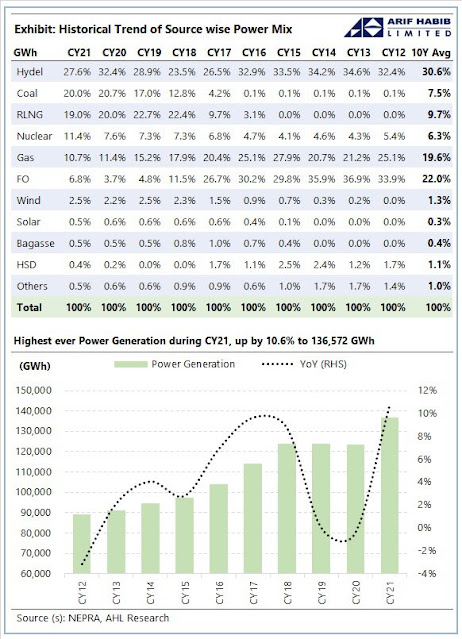
Nuclear power plants in Pakistan generated 15,540 GWH of electricity in 2021, a jump of 66% over 2020. Overall, Pakistan's power plants produced 136,572 GWH of power, an increase of 10.6% over 2020, indicating robust economic recovery amid the COVID19 pandemic. 

Pakistan Electric Power Generation. Source: Arif Habib


Hydroelectric dams contributed 37,689 GWH of electricity or 27.6% of the total power generated, making hydropower the biggest contributor to power generated in the country. It is followed by coal (20%), LNG (19%) and nuclear (11.4%). 


Cost Per Unit of Electricity in Pakistan. Source: Arif Habib

Nuclear offers the lowest cost of fuel for electricity (one rupee per KWH) while furnace oil is the most expensive (Rs. 22.2 per KWH). 
 
Pakistan Electric Power Generation Fuel MiX. Source: Arif Habib

Construction of 1,100 MW nuclear power reactor K2 unit in Karachi was completed by China National Nuclear Corporation in 2019, according to media reports. Fuel is being loaded in a similar reactor unit K3 which will add another 1,100 MW of nuclear power to the grid in 2022. Chinese Hualong One reactors being installed in Pakistan are based on improved Westinghouse AP1000 design which is far safer than Chernobyl and Fukushima plants.  

The biggest and most important source of low-carbon energy in Pakistan is its hydroelectric power plants, followed by nuclear power. Pakistan ranked third in the world by adding nearly 2,500 MW of hydropower in 2018, according to Hydropower Status Report 2019.  China added the most capacity with the installation of 8,540 megawatts, followed by Brazil (3,866 MW), Pakistan (2,487 MW), Turkey (1,085 MW), Angola (668 MW), Tajikistan (605 MW), Ecuador (556 MW), India (535 MW), Norway (419 MW) and Canada (401 MW).

New Installed Hydroelectric Power Capacity in 2018. Source: Hydroworld.com


Hydropower now makes up about 28% of the total installed capacity of 33,836 MW as of February, 2019.   WAPDA reports contributing 25.63 billion units of hydroelectricity to the national grid during the year, “despite the fact that water flows in 2018 remained historically low.” This contribution “greatly helped the country in meeting electricity needs and lowering the electricity tariff for the consumers.”

Pakistan's Current Account Balance vs International Oil Prices. Source: Arif Habib


Recent history shows that Pakistan's current account deficits vary with international oil prices.  Pakistan's trade deficits balloon with rising imported energy prices. One of the keys to managing external account balances lies in reducing the country's dependence on foreign oil and gas. 
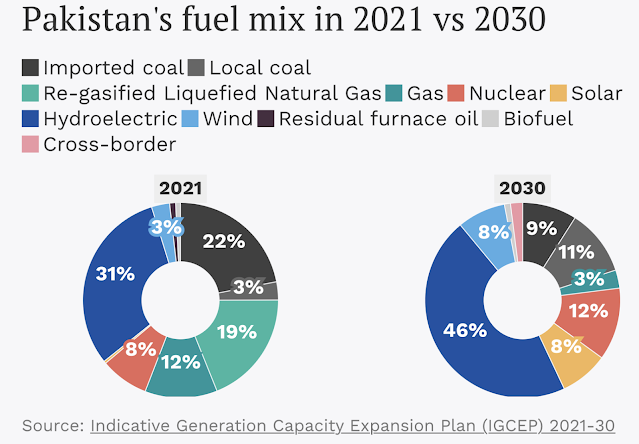

Pakistan Power Generation Fuel Mix. Source: Third Pole

It is true that Pakistan has relied on imported fossil fuels to generate electricity. The cost of these expensive imported fuels like furnace oil mainly used by independent power producers (IPPs) has been and continues to be a major contributor to the "exaggerated external demand driven by its rentier economy" referred to by Atif Mian in a recent tweet. However, Pakistan has recently been adding hydro, nuclear and indigenous coal-fired power plants to gradually reduce dependence on imported fossil fuels. 

Related Links:


Haq's Musings

South Asia Investor Review

Pakistan Among World's Largest Food Producers

Naya Pakistan Housing Program

Food in Pakistan 2nd Cheapest in the World

Indian Economy Grew Just 0.2% Annually in Last Two Years

Pakistan to Become World's 6th Largest Cement Producer by 2030

Has Bangladesh Surged Past India and Pakistan in Per Capita Income?

Pakistan's Computer Services Exports Jump 26% Amid COVID19 Lockdown

Coronavirus, Lives and Livelihoods in Pakistan

Vast Majority of Pakistanis Support Imran Khan's Handling of Covid19 Crisis

Pakistani-American Woman Featured in Netflix Documentary "Pandemic"

Incomes of Poorest Pakistanis Growing Faster Than Their Richest Counterparts

Can Pakistan Effectively Respond to Coronavirus Outbreak? 

How Grim is Pakistan's Social Sector Progress?

Double Digit Growth in Pakistan's Energy Consumption Confirms Economic Recovery


Trump Picks Muslim-American to Lead Vaccine Effort

COVID Lockdown Decimates India's Middle Class

Pakistan to be World's 7th Largest Consumer Market by 2030

Pakistan's Balance of Payments Crisis

How Has India Built Large Forex Reserves Despite Perennial Trade Deficits

Conspiracy Theories About Pakistan Elections"

PTI Triumphs Over Corrupt Dynastic Political Parties

Strikingly Similar Narratives of Donald Trump and Nawaz Sharif

Nawaz Sharif's Report Card

Riaz Haq's Youtube Channel


Wednesday, January 5, 2022

Double Digit Rise in Energy Consumption Confirms Pakistan's Economic Recovery in 2021

Oil consumption in Pakistan jumped 19% to 20.8 million tons in 2021, a strong indication of the country's economic recovery from the COVID-impacted 2020. In addition to oil, Pakistanis also consumed nearly 4 billion cubic foot of natural gas every day. Energy is fundamental to the functioning of any economy. 

Pakistan Oil Consumption. Source: Arif Habib

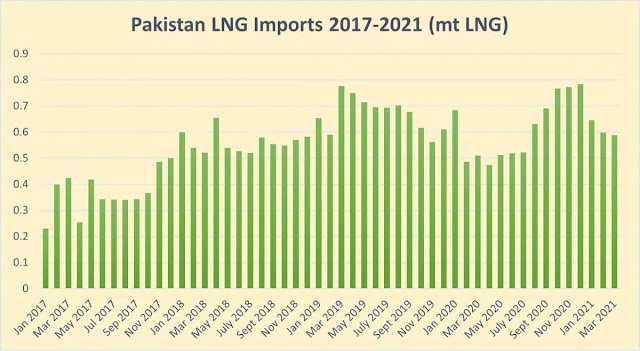
Pakistan's furnace oil consumption has been declining for several years as power producers continued to switch fuel to liquified natural gas (LNG) in recent years. However, the sudden jump in LNG prices forced them to use more furnace oil in year 2021 than in 2020. There was also a big jump in diesel (HSD) and petrol (MS) with a rise in number of vehicles on the nation's roads. 

Pakistan LNG Imports 2017-2021 in million tons 


Pakistan Natural Gas Consumption in Billion Cubic Feet Per Day


“Year 2021 proved to be remarkable for the automobile sector as there was a volumetric sales growth of 90% on a year-on-year basis to 210,048 units compared to 110,540 units in 2020,” said Arif Habib Limited analyst Arsalan Hanif.

Pakistan Auto Sales. Source: Arif Habib


Motorcycle sales in the first 9 months of CY 2-21 were 1.4 million units, up 37.5% vs the 2020 and 13.0% vs the 2019. Atlas Honda dominated the motorcycle market with sales up 52.2%.  Soaring cement consumption, rising auto sales and double digit increase in energy consumption in Pakistan in 2021 confirm that Pakistan's recovery from the COVID-induced slump is well underway.  


Barring any adverse impact of the Omicron variant of the COVID 19 virus, Pakistan's GDP is likely to grow at least 5% in the current fiscal year ending in June, 2022. The country's average economic growth of 5% a year has been faster than the global average since the 1960s. However, it has been slower than that of its peers in East Asia. It has essentially been constrained by Pakistan's recurring balance of payment (BOP) crises as explained by Thirlwall's Law. Pakistan has been forced to seek IMF bailouts 14 times in the last 70 years to deal with its BOP crises. This has happened in spite of the fact that remittances from overseas Pakistanis have grown 30X since 2000. Every time Pakistan has faced a balance of payments crisis, the result has been massive currency devaluation, high inflation and slower growth for a period of multiple years. This is exactly what Pakistan's current government led by Prime Minister Imran Khan is dealing with right now.  This pain is the result of years of flat exports, soaring imports and excessive debt taken on during former Prime Minister Nawaz Sharif's PMLN government from 2013 to 2018.  The best way for Pakistan to accelerate its growth beyond 5% is to boost its exports by investing in export-oriented industries, and by incentivizing higher savings and investments. 

Tuesday, October 12, 2021

Soaring Prices of Imported LNG Threaten Pakistan's Economic Recovery

Soaring LNG prices are adversely affecting Pakistan's balance of payments and threatening the nation's post-COVID economic recovery.  Pakistan's trade deficit has widened to nearly $12 billion in July-September 2021 quarter, up more than 100% from the same period last year. The nation's heavy reliance on expensive imported energy has been the main cause of prior balance of payments crises that have forced it to seek IMF bailouts more than a dozen times in the last 70 years. 


Global LNG Prices. Source: The Peninsula Qatar 


Pakistan: World's Fastest Growing LNG Market. Source: Bloomberg


Global Commodity Price Increases


The average LNG price for November delivery into Northeast Asia was estimated at about $32 per metric million British thermal units (mmBtu), up nearly 20 percent from the previous week, according to the Peninsula Qatar publication. Price agency S&P Global Platts said on Thursday that its Japan-Korea-Marker, which is widely used as a benchmark for spot LNG contracts, rose to $34.47 per mmBtu.       

Pakistan Trade Stats. Source: Topline Securities

Rising LNG prices have forced power generating companies in Pakistan, Bangladesh and the Middle East to start switching fuels pushing oil prices higher.  About 60% of Pakistan's current LNG needs are covered by long-term contracts at significantly lower prices than the current spot prices. US crude closed above $80 for the first time since late in 2014, bringing its climb since the end of last October to 125%, according to the Wall Street Journal. 

Pakistan Coal Power Plants Under CPEC. Source:China's Global Power Database

All Pakistani Power Plants Under CPEC. Source: China's Global Power Database


The key to Pakistan managing its current accounts lies in reducing reliance on imported energy and dramatically increasing its exports. Pakistan already faces climate change pressures forcing it to change its energy mix to reduce the use of fossil fuels. 

Pakistan's Malik Amin Aslam with CNN's Becky Anderson 

Malik Amin Aslam, Pakistan Prime Minister Imran Khan's special assistant on climate change, said recently in an interview with CNN that his country is seeking to change its energy mix to favor green.  He said Pakistan's 60% renewable energy target would to be based on solar, wind and hydro power projects, and 40% would come from hydrocarbon and nuclear which is also low-carbon. “Nuclear power has to be part of the country’s energy mix for future as a zero energy emission source for clean and green future,” he concluded. Here are the key points Aslam made to Becky Anderson of CNN:

1. Pakistan wants to be a part of the solution even though it accounts for less than 1% of global carbon emissions. 

 2. Extreme weather events are costing Pakistan significant losses of lives and property. Pakistan is among the countries most vulnerable to the effects of climate change. 

3. Pakistan is moving towards renewable energy by converting 60% of its energy mix to renewable by 2030. Electric vehicle (EV) transition is also beginning in his country. 

4. Aslam said:  “We are one of the world leaders on nature based solutions. However, the World Bank (WB) in its Report yesterday came up with really good numbers in a comparison done of countries who are shifting their mainstream development towards environment friendly policies and Pakistan came atop among them,” the SAPM explained. 

900 MW Zonergy Solar Park in Bhawalpur, Pakistan


To a question on Pakistan’s capacity to make investments in nature based solutions, he said, “We cannot afford not to do it….that’s a cliche in our country and we are living that cliche in Pakistan. We are not just talking the climate talk rather doing climate action in Pakistan.” 

1,100 MW Karachi Nuclear Power Plant Unit 2


To a question on the 26th Conference of Parties (COP-26) under the United Nations Framework Convention on Climate Change, Amin said his country’s revised "national determined contributions" (NDCs) are going to be released next week. “….that’s going to clearly tell the world that this (money) we had spent in nature and could do further and that was also our direction,” he added. The SAPM informed that Pakistan was going to COP 26 with a very clear message that the country has been affected by climate change, climate injustice, adding, “but we are one of the countries that are leading the way to nature based solutions.” 

Pakistan Among Top 3 Countries For Newly Installed Hydro


He cited the WB Report and said 44% of the country’s mainstream development was climate friendly investment and it had doubled in the past one year. He said 60% renewable energy target would to be based on solar, wind and hydro power projects, and 40% would come from hydrocarbons and nuclear which is also low-carbon. “Nuclear power has to be part of the country’s energy mix for future as a zero energy emission source for clean and green future,” he concluded.

Installed Wind Power in Pakistan. Source: Modor Intelligence 


It's noteworthy that Pakistan's neighbor India currently generates 70% of its electricity from coal extracted from Indian coal mine.  It is aiming for renewables and nuclear energy to account for 40% of its installed electricity capacity by 2030.   

Pakistan NDCs (Nationally Determined Contributions) For Climate Goals. Source: UN


Here's a video of Malik Amin Aslam's interview with CNN"s Becky Anderson:

https://youtu.be/Q_s4kQXChuM


Saturday, August 1, 2020

Pakistan: Hopes Rise For Cheap and Abundant Electricity

Pakistani power sector is continuing its march toward cheap indigenous sources of electricity. Hydropower component has increased 22%, coal 57% and nuclear 8% while oil is down 54% and natural gas and LNG are down 32% and 15% respectively, according to Bloomberg. These changes in power mix are expected to help significantly reduce power subsidies that run into hundreds of billions of rupees contributing to large annual budget deficits.

Data From NEPRA. Courtesy Pakistan Today

Coal's contribution to power mix now stands at just 21%, in spite of 57% increase in use of coal in Fiscal Year 2020. It is still almost half of the global average of 38% of electricity produced from coal. Overall, the contribution of fossil fuels in electricity generation is now about 54%, down from nearly 66% a few years ago.

Pakistan Power Generation Mix. Source: Bloomberg

Hydropower and natural gas now contribute 32% each, making them the biggest sources of electricity in Pakistan. Coal comes next at 21%, followed by nuclear at 8%.

Pakistan Power Generation Plan 2019-2040. Courtesy of World Economic Forum

One of the biggest economic challenges Pakistan faces is it growing debt and deficit from subsidies to the power sector. Often referred to as "circular debt" in Pakistan, the government owes Rs. 1.6 trillion ($7.2 billion) to power sector at the end of June 2019. Pakistan government is now is committed to improving the situation by its development of an Indicative Generation Capacity Expansion Plan (IGCEP) that runs until 2040.


Change in Sources of Electricity in 2020. Source: Bloomberg

Pakistan recent efforts to diversify its fuel mix for cost reduction are raising hopes for cheap and abundant electricity needed for its industries and residential consumers.  Already, the electricity generation cost is down 11% and current account deficit has declined 78%. There is a plan called "Indicative Generation Capacity Expansion Plan" in place. Execution is the key to making the power sector greener, cheaper and more reliable.

Fuel Mix For Power Generation in Pakistan. Source: Third Pole

Thursday, January 25, 2018

Electric Power Rates in India and Pakistan

Pakistan National Electric Power Regulatory Authority (NEPRA) has cut electricity price by 2.99 rupees (2.7 U.S. cents) per unit under the fuel adjustment for the month of December, 2017, according to news reports. This reduction brings the price per kilowatt-hour to Rs. 5.11 (4.60 US cents), down from Rs. 8.10 (7.30 US cents).

Power Rate in Pakistan:

Reduction brings the price per kilowatt-hour to Rs. 5.11 (4.60 US cents), down from Rs. 8.10 (7.30 US cents). The CPPA (Central Power Purchasing Authority) said total energy was generated at the cost of Rs. 25.24 billion, or Rs. 3.52/unit for the month of November, 2017.

The reduction in the actual generation cost is mainly because of a decline in fuel prices, zero use of high-speed diesel in the power plants and higher contribution from the cheapest source – hydropower. The furnace oil (Rs. 9.03 per unit) has been replaced by domestic natural gas at Rs. 4.49 per unit and liquified natural gas (LNG) at Rs. 6.33 per unit.
 
This decision will not affect K-Electric consumers which is privately owned and generates its own power for residents of Karachi. K-Electric currently charges significantly higher rates of Rs. 12.77 per unit (11.50 US cents per unit).

Comparison With India:

Across the border in India, the nation's Central Electricity Regulatory Commission (CERC) has set the national average power purchase cost (APPC) at INR 3.48 (5.43 cents), barring a few states for open access. The APPC will apply during the financial year (FY) 2017-18 and until further orders for deviation settlement with respect to open access, according to Indian media reports.

The latest round of power rate cuts in Pakistan has brought the average electricity unit price (4.60 US cents) lower than that in neighboring India (5.43 US cents).

Future Power Rates: 

The average cost per unit of power produced by new power plants being built in Pakistan as part of CPEC will likely be higher. It's mainly due to higher depreciation cost of new plant and equipment and higher guaranteed return on equity (ROE) of 17% for Chinese IPPs (Independent Power Producers). The 17% return on equity in Pakistan is higher than 4% to 15% ROE for power companies in India.

The average return on equity for almost 8,000 large US firms is 14.49%. The power utility companies – with an average of 10.13% – are on the lower end of the spectrum because they are viewed as less risky investments.

In the United States, the rate of return varies significantly from state to state, as each state regulator has exclusive authority to regulate utility operations as they choose.

In Advance Energy Economy (AEE) Power Portal database, which tracks ROE for over 100 investor-owned utilities across the country, the highest allowed ROE belongs to Alabama Power Co., at 13.75% and the lowest to United Illuminating Co. (CT) at 9.15%.

Within the US states, Alabama being seen as relatively less safe for investment, offers 13.75% return. So why is it such a surprise to see Pakistani regulator offer Chinese investors a higher rate of return of 17%?

Summary:

The current per unit average cost of electricity to consumers in Pakistan is 4.60 US cents while the average in India is 5.43 US cents. Per unit cost of electricity in Pakistan is likely to be  bit higher with new capacity being built as part of China Pakistan Economic Corridor due to higher guaranteed rates of return offered to attract Chinese investors.  However, plentiful supply of electricity from CPEC power projects will significantly boost economic growth and create millions of new jobs.

Related Links:

Haq's Musings

CPEC Financing: Is Pakistan Being Ripped Off?

Will Pakistan Benefit From Historic Low LNG Prices? 

Pakistan Among Fastest LNG Markets in the World

Campaign of Fear, Uncertainty and Doubt About CPEC

CPEC Will Create Over 2 Million New Jobs

CPEC is Transforming Least Developed Parts of Pakistan

Pakistan Rising or Falling? Perception vs Reality

Riaz Haq's YouTube Channel

PakAlumni Social Network

Thursday, December 28, 2017

GE Turbine Problems Hit Power Generation at 3 Pakistani Plants

Pakistan's Central Power Purchasing Agency's report shows that General Electric's 9HA-Class turbines produced only half of their capacity this August, according to Reuters. Power executives and government officials in the country said the GE turbines had operational issues like long outages and production delays.

GE Turbine Problems:

Bhikki Power Plant, Punjab, Pakistan
The GE turbine problems affected three key plants – Bhikki of Punjab government and Balloki and Haveli Bahadur Shah of the federal government – with a total capacity of 3,600MW that are considered crucial to end load shedding within the ruling PMLN's 5-year term ending middle of 2018.

Consequences For Pakistan:

Pakistan's government is failing to deliver on its promise to end load-shedding this year because of serious issues with GE's 9HA-Class turbine.

"It had terrible consequences because we lost a lot of power which would have come to the grid during the peak summer," Yousuf Naseem Khokhar, a top official in Pakistan's Energy Ministry's power division, told Reuters. "It is now up to General Electric to rise to the challenge and to take care of these issues ... before next summer starts," he said.

Pakistan is recognized as a major growth market for power turbine makers because its booming economy has a well-developed gas infrastructure. General Electric has lost a lot of credibility after its failure to deliver in Pakistan. The country awarded its most recent power contract to Siemens, after bidding by several companies, including GE.

Impact on GE Business:

General Electric claims its 9HA-Class turbines are highly efficient turbines which have secured place in the Guinness World Records of 2016, for the amount of electricity they have produced from natural gas at a power plant in Bouchain, France. The Bouchain plant has had 26 forced outages in the 15 months ending November, according to data published by operator Electricite de France (EDF).

JPMorgan analyst Stephen Tusa has warned GE's Pakistan problems could affect other plants around the world, where GE has already "sold" 30 units. GE dismissed criticism, saying the turbines were merely experiencing setup challenges. But the problem could be another setback in a year of plunging stock and "horrible" third-quarter results for the company whose stock has already suffered a major decline this year.

Summary: 

General Electric 9HA-Class gas turbines are not delivering the power Pakistan was counting on to end unscheduled power outages in the country.  These problems could hurt election prospects for Pakistan's ruling PMLN party if they are not fixed soon and the party fails to keep its promise to end electricity load-shedding.

Related Links:

Haq's Musings

Pakistan Among Fastest Growing LNG Markets

PMLN to End Load Shedding 

CPEC to Create 2 Million New Jobs

Pakistan's Booming Economy


Friday, September 29, 2017

Pakistan Among Fastest Growing LNG Markets in the World

Pakistan joined the list of LNG importers last year and promptly became one of the world's fastest growing LNG markets, according to Shell 2017 LNG report.  The South Asian nation has suffered a crippling energy shortage as demand has risen sharply to over 6 billion cubic feet per day,  far outstripping the domestic production of about 4 billion cubic feet per day. Recent LNG imports are beginning to make a dent in Pakistan's ongoing energy crisis and helping to boost economic growth. Current global oversupply and low LNG prices are helping customers get better terms on contracts.

Pakistan Gas Market Forecast. Source: Platts

Global LNG Market:

Pakistan, Egypt and Jordan together imported 13.9 million tons of LNG, more than the combined increase of 11.9 million tons by the most populous nations of China and India.

The biggest increase in LNG exports in 2016 came from Australia, where exports increased by 15 MT to a total of 44.3 MT. It was also a significant year for the USA, after 2.9 MT of LNG was delivered from the Sabine Pass terminal in Louisiana. Qatar remained the world’s largest LNG exporting country, accounting for around 30% of global trade of 258 MT by exporting 77.2 MT, according to International Gas Union report 2017.

LNG Demand in Pakistan:

Pakistan has been a big consumer of natural gas since the discovery of Sui gas fields in Balochistan in 1952. Sui now accounts for just 6% of natural gas domestically produced in Pakistan. The rest of the 94% comes from gas fields in other parts of Pakistan. Among the various provinces, Sindh is now the biggest producer of natural gas. Demand has risen sharply to over 6 billion cubic feet per day,  far outstripping the domestic production of about 4 billion cubic feet per day.

Pakistan is currently importing 2 million MT (96 billion cubic feet) of LNG and negotiating to secure an additional 3 million MT in long-term contracts by the end of 2017 to supply its new LNG floating terminal due to arrive by December, according to M. Adnan Gilani, chief operating officer with Pakistan LNG Ltd, as reported by Platts.

New supply agreements will increase Pakistan's total LNG contracts total to more than 11 million MT per year, as the country aims to resolve a decade-long energy crisis, driven by growing gas consumption and falling domestic production.

In addition to government-to-government contracts, there are also private and public companies negotiating deals to import LNG. For example, Karachi-based power generator K-Electric is seeking supply for its 900-megawatt, $1-billion Port Qasim Power Station which will start-up in two phases, in mid-2018 and the end of 2019, according to Reuters news agency.

In the longer term, Pakistan aims to allocate a quarter of its LNG purchases to the spot and short-term markets, Pakistan LNG Ltd's Adnan Gilani told Platts. "Initially, our goal is to solve our energy crisis. We have long-term downstream commitments, so we do not mind going to mid-to-long term initially," he said. "Over the course of time, we will be able to cater to our variable non-cyclical demand... and allocate about a quarter of our portfolio to spot and short term. PLL is currently purchasing four cargoes per month on a short-term basis as it awaits the start of new term volumes.

By 2022, Pakistan expects to import 30 million MT (1,440 billion cubic feet) of LNG, according to Adnan Gilani of PLL.

LNG Infrastructure:

There is one LNG terminal currently operational at Port Qasim and 5 more are planned in Pakistan over the next two years to deal with rising volume of LNG imports. New pipelines are planned by South Sui Gas and Northern Sui Gas companies to transmit regasified LNG to various parts of the country to meet demand.

Summary:

Pakistan is among the fastest growing LNG markets, according to Shell 2017 LNG report.  The country has suffered a crippling energy shortage in recent years as demand has risen sharply to over 6 billion cubic feet per day,  far outstripping the domestic production of about 4 billion cubic feet per day. Recent LNG imports are beginning to make a dent in Pakistan's ongoing energy crisis and helping to boost economic growth. Current global oversupply and low LNG prices are helping customers get better terms on contracts.

Related Links:


Friday, February 19, 2016

Can Pakistan Use Qatar LNG Price Leverage For Better Iran Gas Deal?

Pakistan has recently negotiated a good bargain with Qatar for importing $16 billion worth of liquified natural gas (LNG).

Pakistan will import as much as 20 million tons of the super-chilled gas annually from various sources including Qatar, enough to fuel about two-thirds of Pakistan’s power plants. Gas shortage has idled half the nation’s generators. A 75 percent drop in LNG prices since 2014 has  dramatically reduced the cost of the South Asian country’s energy needs, according to a Bloomberg report.

LNG arriving in Pakistan from Qatar will fetch 13.37% of the preceding three-month average price of a Brent barrel (considering the present Brent price as a proxy, that would equate to $167.5 per 1000 cubic meters), according to a report in Azerbaijan's Trend News.  It translates to $4.50 per million BTUs.

A comparison with Iran's gas deals with Turkey and Iraq indicates that Iranian gas will not be competitive with Qatari LNG on Pakistani market. In 2014 Iran was exporting gas to Turkey at above $420 per 1000 cubic meters, but the figure plunged to $225, or $6 per million BTUs, currently due to low oil price. Iran previously said that the price of gas for Iraq would be similar to Turkey's price.

International Chamber of Commerce (ICC) arbitration court has recently ordered Iran to reduce its gas price to Turkey by 15% after Turkey complained. It's not clear if Iran will comply but even if it does, its price will still be $5.10 per million BTUs, much higher than the Qatari LNG price of $4.50 per million BTUs for Pakistan.

As recently as two years ago, LNG shipped to big North Asian consumer like Japan and Korea sold at around $15 to $16 a million British thermal units. Late last year, the price hit $6.65 a million BTUs, down 12% from September, according to research firm Energy Aspects. It expects prices to fall further in Asia this year, to under $6 per million BTUs, as a wave of new gas supply in countries from the U.S. to Angola to Australia comes on line, according to Wall Street Journal.

 Petronet LNG Ltd, India’s biggest importer of liquefied natural gas (LNG), is saving so much money buying the commodity from the spot market that it’s willing to risk penalties for breaking long-term contracts with Qatar.

Will Pakistan be able to negotiate a better price with Iran? It seems difficult given the fact that Iranians have a reputation of being very difficult to deal with. Here's an excerpt about Iranians' negotiating style from Iranian-American author Vali Nasr's book "The Dispensable Nation":

"I remember a conversation in 2006 with Jack Straw, who was then Britain’s foreign secretary, about his time talking to Iran. He said, People think North Koreans are difficult to negotiate with. Let me tell you, your countrymen [Iranians] are the most difficult people to negotiate with. Imagine buying a car. You negotiate for a whole month over the price and terms of the deal. You reach an agreement and go to pick up the car. You see it has no tires. “But the tires were not part of the discussion,” the seller says. “We negotiated over the car.” You have to start all over again, now wondering whether you have to worry about the metal rim, screws, or any other unknown part of the car. That should give you a sense of what talking to Iran looks like".


Source: US EIA
Regardless of whether Pakistan succeeds in using Qatar price leverage with Iran. it's good to see Pakistan finally beginning to take advantage of historic low gas prices to alleviate its severe load-shedding of gas and electricity.

Growing Demand-Supply Gap in Pakistan

In addition to signing the Qatar LNG deal, Pakistan has launched its first LNG import terminal in Karachi and started receiving shipments from Qatar. Pakistan has also signed a $2 billion deal with Russians to build a north-south pipeline from Gwadar to Lahore. But the country needs to rapidly build up capacity to handle imports and distribution of significant volumes of LNG needed to resolve its acute long-running energy crisis.


Here's a related video discussion:
http://dai.ly/x3ccasi


Pakistan Local Elections; Indian Hindu... by ViewpointFromOverseas


https://vimeo.com/144586144


Pakistan Local Elections; Indian Hindu Extremism; LNG Pricing; Imran-Reham Split from WBT TV on Vimeo.


https://youtu.be/LZavD-tkReg


Related Links:

Haq's Musings

Can Pakistan Take Advantage of Historic Low LNG Prices?

Pakistan's Twin Energy Crises of Gas and Electricity

Affordable Fuel For Pakistan's Power Generation

Pakistan Shale Oil and Gas Deposits

China-Pakistan Economic Corridor 

Blackouts and Bailouts in Energy Rich Pakistan

Pakistanis Suffer Load Shedding While IPPs Profits Surge

Wednesday, November 4, 2015

Pakistan Local Elections; Indian Hindu Extremism; LNG Pricing; Imran-Reham Split

What message do voters send in local body elections in Pakistan? Are recent results unexpected? What do the results mean for PTI? What impact does Imran-Reham Khan divorce news have on PTI's politics and prospects?

Why is Pakistan government trying to sign LNG contract with Qatar when the spot price is falling and forecast to fall even further? Why not buy at spot prices and wait for a better opportunity to sign a more favorable contract in future?

Why are Indian economists warning PM Narendra Modi of the negative impact of Hindu extremism in India? Why are they so concerned?

Is ISIS gaining strength in Middle East? Could the ISIS terrorists have brought down Russian passenger jet near Sharm al Sheikh in Egypt?

Viewpoint From Overseas host Faraz Darvesh discusses these questions with panelists Misbah Azam and Riaz Haq (www.riazhaq.com)

http://dai.ly/x3ccasi


Pakistan Local Elections; Indian Hindu... by ViewpointFromOverseas


https://vimeo.com/144586144


Pakistan Local Elections; Indian Hindu Extremism; LNG Pricing; Imran-Reham Split from WBT TV on Vimeo.


https://youtu.be/LZavD-tkReg


Related Links:

Haq's Musings

Potential Economic Impact of Hindu Extremism in India

Pakistan-Qatar LNG Deal

Growing ISIS Threat

Talk4Pak Think Tank

VPOS Youtube Channel

VPOS Vimeo Channel

VPOS Dailymotion Channel

Friday, October 30, 2015

Will Pakistan Benefit From LNG Glut Pushing Prices to New Lows?

LNG spot prices hit a new low of $4 per mmBTU as the supply continues to significantly outstrip demand. It's creating opportunities for Pakistan to get access to large supply of cheap fuel for its power generation.

With softening demand from China and 130 million tons per year (mmpta) of additional LNG supply set to reach market over the next five years, gas research firm Wood Mackenzie sees continuing downward pressure on global LNG spot prices.

LNG Price History Source: WSJ


“The entire industry is worried because it is hard to tell when China’s demand will pick up again,” said an LNG strategist at a Malaysian energy company who attended the Wood Mackenzie conference in Singapore, according to Wall Street Journal. “Rising demand from smaller countries such as Pakistan, Egypt and Bangladesh is not enough to offset the declining demand from north Asia.”

As recently as two years ago, LNG shipped to big North Asian countries like Japan and Korea sold at around $15 to $16 a million British thermal units. This month, the price has already hit $6.65 a million BTUs, down 12% from September, according to research firm Energy Aspects. It expects prices to fall further in Asia next year, to under $6 per million BTUs, as a wave of new gas supply in countries from the U.S. to Angola to Australia comes on line, according to Wall Street Journal.

Petronet LNG Ltd, India’s biggest importer of liquefied natural gas (LNG), is saving so much money buying the commodity from the spot market that it’s willing to risk penalties for breaking long-term contracts with Qatar.

This is a great opportunity for Pakistan to take advantage of historically low LNG prices to alleviate its severe load-shedding of gas and electricity.  Recently, Pakistan has launched its first LNG import terminal in Karachi and started receiving shipments from Qatar.  Pakistan has also signed a $2 billion deal with Russians to build a north-south pipeline from Gwadar to Lahore. But the country needs to rapidly build up capacity to handle imports and distribution of significant volumes of LNG needed to resolve its acute long-running energy crisis.

Here's a related video discussion:
http://dai.ly/x3ccasi


Pakistan Local Elections; Indian Hindu... by ViewpointFromOverseas


https://vimeo.com/144586144


Pakistan Local Elections; Indian Hindu Extremism; LNG Pricing; Imran-Reham Split from WBT TV on Vimeo.


https://youtu.be/LZavD-tkReg


Related Links:

Haq's Musings

Pakistan's Twin Energy Crises of Gas and Electricity

Affordable Fuel For Pakistan's Power Generation

Pakistan Shale Oil and Gas Deposits

China-Pakistan Economic Corridor 

Blackouts and Bailouts in Energy Rich Pakistan

Pakistanis Suffer Load Shedding While IPPs Profits Surge