Showing posts with label Productivity. Show all posts

Tuesday, January 18, 2022

Pakistan Economy "Not in a Good Place"? Atif Mian's Gloom Justified?

Pakistani-American economist Atif Mian has recently analyzed Pakistan's economy in a series of tweets. He has said "Pakistan's economy is not in a good place", adding that the nation's "per capita income has not risen in 3 years (in fact down slightly)". He has particularly mentioned the country's "exaggerated external demand driven by its rentier economy", "flawed energy policy" and "a broken economic decision system" among the main causes for poor economic performance.  Is Atif Mian's diagnosis correct? Is the official reported data Atif Mian using accurate? What is the current PTI government doing or not doing to correct the problems identified by Mr. Mian? Let's try and assess the situation. 
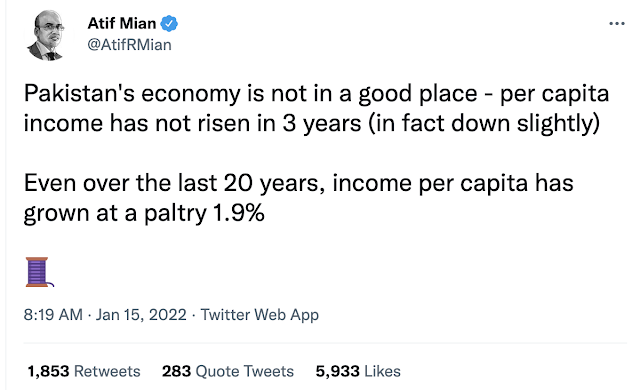
Economist Atif Mian's Tweet on Pakistan Economy


Per Capita Income:

Pakistan's officially reported GDP and per capita incomes are grossly understated. These are based on the last economic census that was done from April 2003 to December 2003 and published in 2005. The last agriculture census was in 2010, and livestock census in 2006, according to Dr. Ishrat Husain, former governor of The State Bank of Pakistan. The country's economy has changed significantly since then, adding several new economic activities while others have become less important.  For example, the Quantum Index of Large Scale Manufacturing (QIM) with 2005-06 base year gives a weight to textiles of 20.9% (Yarn 13.7 and cloth 7.2). But the textile industry has moved up to higher value added products as reflected in its exports. The value added textiles (non-yarn and non-cloth) now make almost 80% of the total textile exports. These changes are not reflected in current GDP calculations. 

In its 2014 annual report, the State Bank of Pakistan talked about a number of new sectors that are either under-reported or not covered at all: "In terms of LSM growth, a number of sectors that are showing strong performance; (for example, fast moving consumer goods (FMCG) sector; plastic products; buses and trucks; and even textiles), are either under reported, or not even covered. The omission of such important sectors from official data coverage, probably explains the apparent disconnect between overall economic activity in the country and the hard numbers in LSM."

Bangladesh just rebased its GDP in 2020-21 to 2015-16. This has boosted its per capita income by double digits for every year since 2015-16.  Bangladesh's per capita income for the 2015-16 fiscal year has now gone up to $1,737 from $1,465 in the old calculation. For the 2019-2020 fiscal, the per capita income has gone up to $2,335 from $2,024.  The new GDP estimate covers 21 sectors, up from 15 sectors previously.  India last rebased its GDP in 2015, a change that bumped up its per capita GDP by double digits. Nigeria's last rebasing in 2012 increased the size of its economy (GDP) by nearly 90%. Pakistan's current base year is 2005-6. Rebasing which is now long overdue will almost certainly increase Pakistan's per capita income by double digits. 

In this age of big data, it is important for Pakistan to ensure that its bureaucracy at Pakistan Bureau of Statistics (PBS) keeps the national economic data as current as possible. PBS should release the results of the Census of Manufacturing Industries CMI 2015-16 and the finance ministry should rebase Pakistan's economy to year 2015-16 to better reflect the current economic realities. This data is extremely important for businesses, investors, lenders and policymakers. 

Energy Mix:
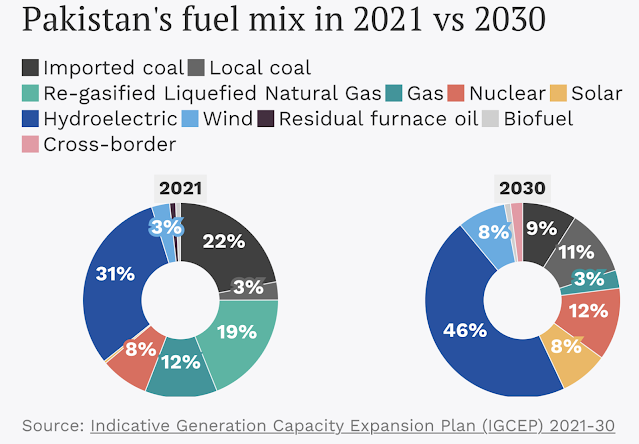
It is true that Pakistan has relied on imported fossil fuels to generate electricity. The cost of these expensive imported fuels like furnace oil mainly used by independent power producers (IPPs) has been and continues to be a major contributor to the "exaggerated external demand driven by its rentier economy" referred to by Atif Mian. However, Pakistan has recently been adding hydro, nuclear and indigenous coal-fired power plants. 

Pakistan Power Generation Fuel Mix. Source: Third Pole


Construction of a 1,100 MW nuclear power reactor K2 unit in Karachi has been completed by China National Nuclear Corporation, according to media reports. A similar reactor unit K3 will add another 1,100 MW of nuclear power to the grid, bringing the total nuclear power installed capacity of Pakistan to 3,630 MW (12% of total power) by the end of 2022.  Hualong One reactors being installed in Pakistan are based on improved Westinghouse AP1000 design which is far safer than Chernobyl and Fukushima plants.  In addition, Pakistan is also generating  9,389  MW (about 28% of total power) of low-carbon hydroelectric power in response to rising concerns about climate change. 

Hydroelectric dams contributed 37,689 GWH of electricity or 27.6% of the total power generated, making hydropower the biggest contributor to power generated in the country. It is followed by coal (20%), LNG (19%) and nuclear (11.4%). 


Cost Per Unit of Electricity in Pakistan. Source: Arif Habib

Nuclear offers the lowest cost of fuel for electricity (one rupee per KWH) while furnace oil is the most expensive (Rs. 22.2 per KWH). 


Pakistan Exports Trend 2011-21. Courtesy of Ali Khizer


External Accounts Balance:

Pakistan is the world's sixth largest labor exporter with nearly 10 million Pakistanis working overseas. These workers sent home $31 billion in remittances calendar year 2021 (CY2021), up 19% from CY2020. In addition, Pakistan merchandise exports hit a new record of $28.3 billion in CY2021. Together, Pakistan's merchandise exports and overseas worker remittances added up to nearly $60 billion in 2021. 

Pakistan Textile Exports Trend 2011-21. Courtesy of Ali Khizer


Exports of textiles that make up the bulk of Pakistani exports jumped 32% from $13.1 billion in CY2020 to $17.3 billion in CY2021. The country's technology exports soared 40% to $2.5 billion in CY2021.  “So far, (the) country’s exports of non-traditional products, including information technology, have grown by 60 percent in the last four months," says Special Assistant to the Prime Minister on Commerce and Investment Abdul Razak Dawood. 

Pakistan's Higher Value Added Exports. Source: Dr. Ishrat Husain


Pakistan's textile manufacturing and exports are moving from yarn and fabric toward higher value added products like readymade garments. The value added textiles (non-yarn and non-cloth) now make almost 80% of the total textile exports, according to Dr. Ishrat Husain. 

Pakistan's Current Account Balance vs International Oil Prices. Source: Arif Habib


Recent history shows that Pakistan's current account deficits vary with international oil prices.  Pakistan's trade deficits balloon with rising imported energy prices. One of the keys to managing external account balances lies in reducing the country's dependence on foreign oil and gas. 

Summary:

Professor Atif Mian's criticism of Pakistan's economy is partially valid but his pessimism is unwarranted. He is working with flawed data based on an economic census conducted more than 15 years ago.  This data does not truly reflect current economic activities, per capita incomes and productivity. Pakistani bureaucracy needs to ensure that the underlying data for GDP and productivity is regularly updated to inform businessmen, investors, lenders and policymakers. Pakistan is also significantly boosting its foreign exchange earnings through exports and remittances from overseas workers. The issue of reliance on expensive fossil fuel imports is also being addressed by building more hydro, nuclear and renewable energy. At the same time, indigenous coal-fired power plants are also being added. Unlike Atif Mian, I do see light at the end of the tunnel. 

Related Links:


Haq's Musings

South Asia Investor Review

Pakistan Among World's Largest Food Producers

Naya Pakistan Housing Program

Food in Pakistan 2nd Cheapest in the World

Indian Economy Grew Just 0.2% Annually in Last Two Years

Pakistan to Become World's 6th Largest Cement Producer by 2030

Has Bangladesh Surged Past India and Pakistan in Per Capita Income?

Pakistan's Computer Services Exports Jump 26% Amid COVID19 Lockdown

Coronavirus, Lives and Livelihoods in Pakistan

Vast Majority of Pakistanis Support Imran Khan's Handling of Covid19 Crisis

Pakistani-American Woman Featured in Netflix Documentary "Pandemic"

Incomes of Poorest Pakistanis Growing Faster Than Their Richest Counterparts

Can Pakistan Effectively Respond to Coronavirus Outbreak? 

How Grim is Pakistan's Social Sector Progress?

Double Digit Growth in Pakistan's Energy Consumption Confirms Economic Recovery


Trump Picks Muslim-American to Lead Vaccine Effort

COVID Lockdown Decimates India's Middle Class

Pakistan to be World's 7th Largest Consumer Market by 2030

Pakistan's Balance of Payments Crisis

How Has India Built Large Forex Reserves Despite Perennial Trade Deficits

Conspiracy Theories About Pakistan Elections"

PTI Triumphs Over Corrupt Dynastic Political Parties

Strikingly Similar Narratives of Donald Trump and Nawaz Sharif

Nawaz Sharif's Report Card

Riaz Haq's Youtube Channel


Monday, May 11, 2015

Pakistan 2.0: Technology Driving Productivity

Introduction of green revolution technologies drove Pakistan's rapid GDP growth in 1960s and 1970s when it was essentially an agricultural economy. The decade of 1980s saw livestock revolution that helped increase farm productivity. Will rapid absorption of information and communication technology (ICT) do the same in coming decades?

Abundance of historical data on educational attainment shows that young Pakistanis are more literate and better educated than their parents and grandparents. And recent data confirms that they are rapidly embracing new technologies. Technology, particularly ICT, is increasingly visible among consumers, industries and public sector.  As a result, Pakistan today stands at the threshold of soaring productivity and rising standards of living over the next several decades. The basic requirements for it to materialize are maintenance of peace and security and  increasing investments in education, health care, energy and infrastructure.

3G, 4G Mobile Broadband Rollout:

The launch of 3G and 4G networks has accelerated the growth of Internet users in Pakistan. More than a million subscribers are signing up every month since the 3G and 4G rollout in the country last year. These new users are generating more and more data traffic requiring rapid increases in available bandwidth.


Pakistan ended March 2015 with over 12.07 million 3G/4G subscribers, up from 10.34 million in February, according to data from Pakistan Telecommunications Authority (PTA). Telenor led the 3G/4G market with over 3.53 million subscribers, followed by CMPak (2.95 million 3G/4G subscribers), Mobilink (2.86 million 3G subscribers), and Ufone (2.66 million 3G subscribers). Warid had 66,140 LTE network subscribers at 31 March.

Thousands of kilometers long fiber network is currently in place to deal with the growing domestic bandwidth demand. Several projects are underway to grow this network further.

Consumer Applications:

Young entrepreneurs are developing and launching mobile apps for everything from sports and entertainment to education, ride-sharing and e-commerce.

Pepper.pk has topped BlackBerry’s Appworld with their game Ninja Fruit Bash, TenPearls won Nokia and ATT Innovators 2011 contest through their game Animal 101, start-ups such as PiLabs also made their mark with mobile games such as ‘Field Garfield’ which is an official Garfield game.

A ride-sharing app called savaree, photo-sharing app Groopic and custom shoes app Markhor have been making news lately in Pakistan and overseas.

E-commerce is taking off in Pakistan with companies such as Home shopping, Shophive, daraz.pk and Symbios are becoming popular for online shopping.

Spurred by a favorable regulatory and technology environment, Pakistan is witnessing dramatic growth in mobile banking.  Four out of five cellular mobile companies currently operating in Pakistan have launched m-money systems in partnership with financial institutions. The m-money market volume reached 153 million annual transactions worth US$ 6.2 billion as of 2013.

Industrial Applications:

Information and communications technology is being deployed in Pakistan's energy sector.

In addition to automatic reading of smart meters at the customer premises, smart meters have been installed with the support of USAID on incoming and outgoing feeders at all nine government-owned electric utilities. These will help move the system toward building of a smart national grid to better manage power generation, transmission and distribution in the country.

A captive power plant owned by Sapphire Group textile mill in Muridke Lahore is using hundreds of embedded sensors and other digital instruments in power turbines, analyzing the data they collect, and using the information to improve the plant’s performance, optimize production and reduce unplanned downtime. US-based General Electric is paying for the sensors and the software. The company will be paid by splitting all benefits with Sapphire under a win-win scenario, according to GE Reports website.

Public Sector Applications:

IT projects ranging from automated meter reading and computerized land records management to online education and mobile banking are now at various stages of implementation across Pakistan.  In a report released last year, the World Bank called these projects "unprecedented in the public sector in developing countries". The objective of these efforts is to reduce corruption, increase productivity and improve service delivery in both private and public sectors.

The Punjab government is deploying smartphone applications to crack down on absentee mobile government workers and their corrupt practices. As part of this project, the government employee must send his or her picture and a report of interaction with citizens along with GPS coordinates. For example, a agricultural pest control official required to visit farmers must file reports of his findings and actions in real time via a smartphone app.

An SMS soliciting feedback from citizens is sent out after each such visit or interaction. Responses from users are logged into a central database, and the data then analyzed and mapped. Call centers have also been trained to contact those who do not respond or are unable to read the text due to illiteracy. More than three million users of public services have so far been contacted since the summer of 2012, with both positive and negative feedback, according to the World Bank report. “Sir, we went to the hospital yesterday. They asked for 1500 rupees [in bribes]. We didn’t have the money so we left,” reads one of the reports about a hospital in Lahore, the provincial capital. The feedback is actively monitored by the office the Chief Secretary – the top civil servant in the province – to manage the performance of officials.

Summary:

Pakistan today stands at the threshold of soaring productivity and rising standards of living over the next several decades. The basic requirements for it to materialize are maintenance of peace and security and  increasing investments in education, health care, energy and infrastructure.

Related Links:

Haq's Musings

High-Speed Fiber Optic Connectivity in Pakistan

E-Commerce in Pakistan

Public Sector Apps in Pakistan

History of Educational Attainment in Pakistan

Online Education in Pakistan

Value Added Agriculture in Pakistan

Upwardly Mobile Pakistan


Sunday, August 23, 2009

Is Ramadan a Break from Work in Pakistan?


By Nisar Abbas Mirza

We know how the world works. In that we are like the little boy who used to pray to God to give him a bicycle. Very soon he realized that God doesn’t work this way so he stole a bicycle and prayed to God for forgiveness

From the 1st of Ramadan to the 10th of Muharram, that’s about four months in the Islamic calendar. In this period the country is in no mood to work. This is the annual sabbatical when the faithful and the unfaithful pretending to be faithful take a break, a long break, a four-month-long break from work.

Not that we are renowned for work ethics and hard work, but what we accomplish in these four months is so puny and pathetic that it makes us look good in the remaining eight months in the calendar.

In Ramadan the working hours are nine to one. That’s it. And in these four hours work is the last thing on the workers’ mind. Go to any government office during these four hours and you will encounter a grouchy, lazy and sick-of-life person with bad breath (apparently even brushing your teeth in the morning is not kosher if you are fasting). No matter how urgent your work, leave the place and come back after two and a half months in the third week of Muharram. This man is in no mood to do anything. He’d rather go home and watch an Indian movie till he breaks fast.

This person, and millions of others like him, wants the world to be eternally grateful to him for his fasting. The entire humanity is indebted to him for the good religious duty he is fulfilling. Don’t mess with any such person.

It is almost a sin to exhort someone to work during the month of Ramadan because his or her indolence comes with a divine sanction. You may feel like kicking, caning or whipping people to get to work but you dare not try it. Don’t even say anything because you may end up being burned alive or stoned to death or just plain murdered like Najeeb Zafar, the leather factory owner in Muridke. Poor fellow, he just wanted people to get back to work after an ‘overly extended’ Friday prayer break. (RH Note: The Human Rights Commission of Pakistan claims that the factory clerk played a vital role in deteriorating the situation and told the protesters that Najeeb Zafar had committed blasphemy of the verses of the Holy Quran written on a wall calendar.)

Everything else except work goes on. People get busy with religious and festive activities. Attendance in mosques increases, tarawih, mahafil and dars are daily affairs. Since we are such crooked and corrupt souls during the rest of the year that people go all out in beseeching God’s forgiveness in this month — Ramadan is, after all, the month of maghfirat (repentance).

On the festive side Iftar parties were always in vogue but now Sehr get-togethers are catching up fast with Iftar parties. Restaurants are open all night because people stay up all night. Meet up at a Sehr party and then sleep. Other than that, one line dominates the workplace, “We will see what we can do about it; come after Eid”.

All the overt praying, charity and piety aside, we don’t actually become good during this month. Can’t afford to. We carry on with what we do best: lie, cheat, bribe, rob, extort, etc, but since it is Ramadan, we repent in earnest. We know how the world works. In that we are like the little boy who used to pray to God to give him a bicycle. Very soon he realized that God doesn’t work this way so he stole a bicycle and prayed to God for forgiveness. We are past masters at this and we do it all the time, only more so in Ramzan.

Contrary to the spirit of the month, for us this is a month of indulgence in every sense of the word. Be it religious indulgence, spending indulgence or eating indulgence, we go the whole hog. This is a uniquely Pakistani phenomenon. In ten hours or so people take three meals and none of them is a healthy meal. The three meals comprise only three ingredients: sugar (hence the sugar crisis), wheat (hence the atta crisis) and oil (hence the ghee crisis). All across the Muslim world there is less consumption of eatables and as a result prices come down. Read a newspaper or watch any tv channel to see what is happening in Pakistan these days.

It may be a holy month but our rules of business are clear: God and Mammon have to be served simultaneously. We do it without even a hint of compunction.

Indulgence exerts its ugly head in religious anarchy too. Selling food and eating food are a crime punishable by vigilantes on the spot. The faithful can, and do, disrupt normal course of life anywhere at any time as a matter of right. Airport lounges, aircraft aisles, railway stations or main roads, can all be blocked for, say, prayers. Who is to stop them? Loudspeakers in the mosques? Who can silence them?

To cut the long story short, the first twenty-odd days of Ramadan are spent working three or four hours every day. Towards the end, you may take full time off for umra (if you can afford it), or itikaaf, or both.

At the end of Ramadan the nation takes a seven to ten days holiday. Then slowly people drag themselves to work. It takes a lot of yawning, stretching and scratching for them to get back in the nine to five rhythm but they finally do get back in work mode. A few weeks later it is the Haj and Eid-ul-Azha season. That’s another week off.

The last two holidays in this 110-day sabbatical are the ninth and tenth of Muharram. Interspersed, of course, are our Gregorian calendar holidays — 23rd March, 14th August, 25th December and so on. They too need to be accounted for. All in all, this ends up as a period of extremely low productivity and low efficiency. If you are so inclined, take out the calculator and do the maths yourself. I am too lazy to do that; I am too lethargic to do anything. I am practicing for the days to come.

Source: Daily Times