Showing posts with label manufacturing. Show all posts

Tuesday, March 18, 2025

Pakistan Purchasing Managers Index (PMI) Points to Growth in Manufacturing

Pakistan Purchasing Managers Index (PMI), jointly launched by Habib Bank (HBL) and S&P Global, is showing sustained growth in manufacturing for the last several months.  It has been consistently above 50, indicating expansion. This indicator disagrees with contraction reported by Pakistan Bureau and Statistics (PBS) Large Scale Manufacturing (LSM) indicator. What accounts for this discrepancy? Is it because the LSM tracks only a subset of industries tracked by PMI? Is there a difference in methodology? 

Pakistan PMI Trend. Source: S&P Global

Here's one plausible explanation offered by analyst Humaira Qamar at HBL: "As per the Pakistan Bureau of Statistics, Large scale manufacturing (LSM) contracted 1.8% in the latter half of 2024. However, excluding the hefty decline in the low-weight furniture segment, LSM trended positively. Our PMI release suggests that the recovery has extended into 2025, with demand-side conditions taking cue from a sharp reduction in the policy rate". 

Another possible explanation for the discrepancy between PMI and LSM can be seen in the fact that power generation for the grid, a key component of the LSM indicator, is in constant and substantial decline. However, the power generation data tracked by PBS excludes rapidly rising solar electricity production by consumers, including industrial consumers in the country.  Pakistan's grid-connected electricity production and electricity consumption are given as around 110 TWh for 2024, but appear to be declining compared to 2023, which contradicts expectations of increasing demand, but could be a sign of the massive expansion of solar energy, according to an article in PV magazine titled  ‘The Solar Blitz’: How crisis-ridden Pakistan is leading the world on the ‘Solar March’.  Based on rather imprecise Chinese solar panel export figures and extensive satellite imagery, Bloomberg energy analyst Jenny Chase has concluded that rapid solar expansion in Pakistan is real. 

In August 2024, Chase tweeted as follows: "Pakistan's energy regulator, NEPRA, notes that power consumption is down 9.1% year on year in 2023. NEPRA attributes the drop mainly to high power prices cutting economic activity and making residential consumers curb consumption, with rooftop solar only a third factor. But NEPRA doesn't know how much solar the country has, either. We think it has about 12.7GW of solar already (compared with 50GW on-grid power capacity) and will add 10-15GW of solar in 2024". 

In addition to the decline in grid power generation, the reported drag in LSM growth is primarily due to a few low-weight sub-sectors, which have more than offset positive momentum in key sub-sectors such as textiles, pharmaceuticals, automobiles, and POL (petroleum, oils and lubricants), according to the State Bank of Pakistan, as reported by the Express Tribune

Pakistan Manufacturing Orders, Output and Employment. Source: S&P Global


High-frequency data like monthly PMI help in gauging real time economic activity in terms of orders, output and employment in the manufacturing sector. Here's an excerpt of the HBL/S&P Global PMI report for February 2025 published in March:

Manufacturers in Pakistan also responded to strengthened operating conditions by raising their staffing levels in February, marking the second increase in as many months. Several firms commented that they required additional capacity in response to higher production requirements, while others mentioned longer operating hours. Increased capacity allowed firms to stay on top of outstanding business in February, as indicated by a sustained and steeper fall in backlogs of work. The latest depletion was the most pronounced in five months. Finally, companies expressed confidence in the future path for output during February, with optimism remaining marked overall. This optimism was underpinned by hopes for further new product launches and improvements in product quality, alongside expectations of softer price pressures.

Related Links:

Tuesday, February 7, 2023

Remembering Pervez Musharraf (1943-2023): A True Patriot Who Made Pakistan Stronger

President Pervez Musharraf of Pakistan passed away this week. May his soul rest in peace. Amen. He was a true patriot who honestly served his country to the best of his ability. He strengthened his country's economy, society and military. Per capita incomes of Pakistanis doubled on his watch, lifting the country from a low-income to a middle-income country. His government liberalized media and telecommunications, leading to rapid growth in both industries.  President Musharraf dramatically accelerated his people's human development by investing heavily in education and healthcare. After what has transpired in recent years, most Pakistanis will remember his time in office as a golden age for the country. 

President Pervez Musharraf 1943-2023


Higher education reform backed by huge increases in spending led to a large increase in college and university enrollment and graduation rates. He halved Pakistan's debt burden and doubled exports during his 8 years in office. Pakistan built up credible nuclear deterrence by ensuring development of a variety of nuclear-capable missiles of various ranges. Pakistan developed the JF-17, its first indigenous fighter jet aircraft with China, and the Pakistan Air Force started deploying it during the Musharraf years.  He negotiated the upgrade of PAF F-16s and acquisition of dozens of new F-16s. 

Pakistan Debt and Fiscal Deficit Trend 2000-2020

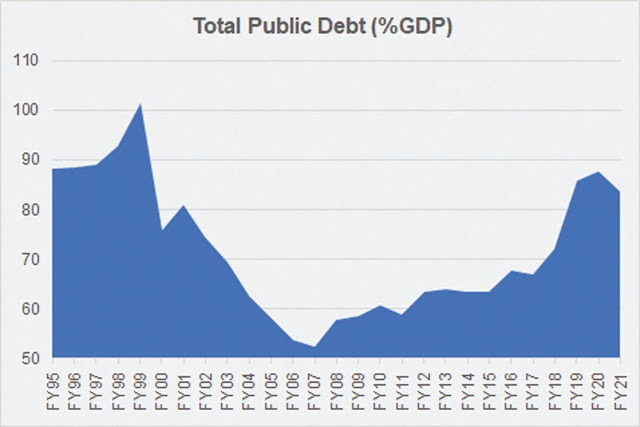
In 1999, President Pervez Musharraf inherited a massive debt of 100% of GDP run up by the Pakistan Peoples Party and the Pakistan Muslim League (Nawaz) governments in the 1990s. Musharraf's policies not only revived the bankrupt economy but also brought down debt to 52% of GDP by 2007. 

Pakistan Debt to GDP 1995-2021. Source: IMF


PPP Government's 2008 Letter to IMF:

In a letter to the International Monetary Fund in 2008, the PPP government hailed Musharraf's economic record without mentioning his name in the following words:

"Pakistan's economy witnessed a major economic transformation in the last decade (2000-2008). The country's real GDP increased from $60 billion to $170 billion, with per capita income rising from under $500 to over $1000 during 2000-07.....the volume of international trade increased from $20 billion to nearly $60 billion. The improved macroeconomic performance enabled Pakistan to re-enter the international capital markets in the mid-2000s. Large capital inflows financed the current account deficit and contributed to an increase in gross official reserves to $14.3 billion at end-June 2007. Buoyant output growth, low inflation, and the government's social policies contributed to a reduction in poverty and improvement in many social indicators". (see MEFP, November 20, 2008, Para 1).

Pakistan Manufacturing Value Added 2000-2021. Source: World Bank


Savings and Investments:

Domestic savings rate reached 18% of the GDP and foreign direct investment (FDI) hit a record level of $5.4 billion in 2007-8. This combination of domestic and foreign investments nearly tripled the size of the economy from $60 billion in 1999 to $170 billion in 2007, according to IMF. Exports nearly tripled from about $7 billion in 1999-2000 to $22 billion in 2007-2008, adding millions of more jobs. Pakistan was lifted from a poor, low-income country with per capita income of just $500 in 1999 to a middle-income country with per capita income exceeding $1000 in 2007.

FDI in the Musharraf years came in many sectors, ranging from telecommunications to manufacturing.
Several mobile phone and Internet service operators built networks worth billions of dollars. Without this telecom infrastructure, there would be no tech industry, no freelancers and no fast-growing tech exports today.

New cement plants met growing demand that more than doubled cement consumption, FMCG (fast moving consumer goods) sector took off to meet demand from growing middle class and production of cars and motorcycles jumped. 


Human Capital Development: 

In addition to the economic revival, Musharraf focused on the social sector as well. Pakistan's Human Development Index (HDI) score grew an average rate of 2.7% per year under President Musharraf from 2000 to 2007, and then its pace slowed to 0.7% per year in 2008 to 2012 under elected politicians, according to the 2013 Human Development Report titled “The Rise of the South: Human Progress in a Diverse World”.


Primary Enrollment Source: Economic Survey of Pakistan

Youth Literacy Rate Source: Economic Survey of Pakistan


Pakistan University Enrollment Jumped in Musharraf Years. Source: World Bank


Overall, Pakistan's human development score rose by 18.9% during the Musharraf years and increased just 3.4% under elected leadership since 2008. The news on the human development front got even worse in the last three years, with HDI growth slowing down as low as 0.59% — a paltry average annual increase of under 0.20 per cent. Going further back to the  decade of 1990s when the civilian leadership of the country alternated between PML (N) and PPP,  the increase in Pakistan's HDI was 9.3% from 1990 to 2000, less than half of the HDI gain of 18.9% on Musharraf's watch from 2000 to 2007.

R&D Spending Jumped 7-fold as % of GDP 1999-2007 Source: World Bank

Acceleration of HDI growth during the Musharraf years was not an accident.  Not only did Musharraf's policies accelerate economic growth, helped create 13 million new jobs, cut poverty in half and halved the country's total debt burden in the period from 2000 to 2007, his government also ensured significant investment and focus on education and health care. The annual budget for higher education increased from only Rs 500 million in 2000 to Rs 28 billion in 2008, to lay the foundations of the development of a strong knowledge economy, according to former education minister Dr. Ata ur Rehman. Student enrollment in universities increased from 270,000 to 900,000 and the number of universities and degree awarding institutions increased from 57 in 2000 to 137 by 2008. Government R&D spending jumped from 0.1% of GDP in 1999 to 0.7% of GDP in 2007. In 2011, a Pakistani government commission on education found that public funding for education has been cut from 2.5% of GDP in 2007 to just 1.5% - less than the annual subsidy given to the various PSUs including Pakistan Steel and PIA, both of which  continue to sustain huge losses due to patronage-based hiring.

Pakistan's High-Tech Exports Tripled as % of Manufactured Exports. Source: World Bank

Pakistan textile exports more than doubled from $5.2 billion to more than $11 billion during the Musharraf years. Exports soared 19.43% in 2001, 20% in 2004, 24.5% in 2005 and 11.23% in 2006, all on President Musharraf's watch, according to "The Rise and Fall of Pakistan's Textile Industry: An Analytical View" published by Javed Memon, Abdul Aziz and Muhammad Qayyum.     


Pakistan Textile Exports Growth. Source: Javed Memon

Pakistan experienced rapid economic and human capital growth in the years 2000 to 2008 on President Pervez Musharraf's watch. Savings, investments and exports hit new records and the rate of increase in human development reached new highs not seen before or since this period.  Without this human capital, there would be no tech industry, no freelancers and no fast-growing tech exports today.

Employment Growth in South Asia. Source: World Bank

Pakistan's employment growth was the highest in the South Asia region in 2000-2010, followed by Nepal, Bangladesh, India, and Sri Lanka in that order, according to a World Bank report titled "More and Better Jobs in South Asia".

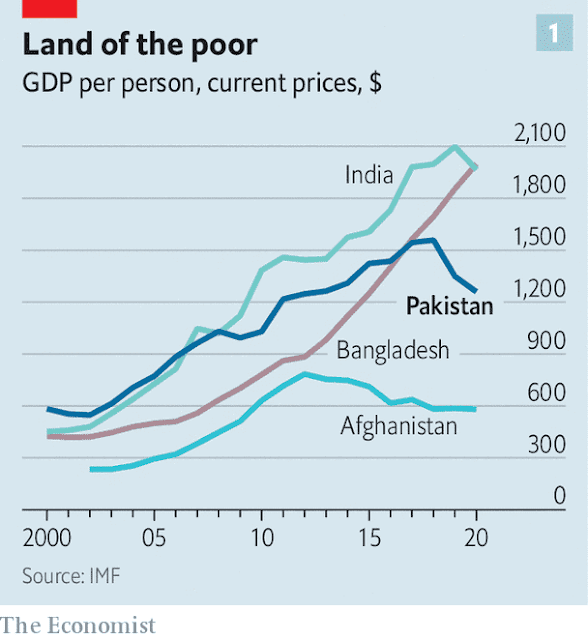
Comparing Per Capita GDP Trajectory in South Asia. Source: The Economist

Until 2010, Bangladesh was a laggard in the South Asia region. Its per capita income was about half of Pakistan's. Now Bangladesh's per capita GDP is higher than both India's and Pakistan's. What changed? The biggest change is Bangladeshi leader Shaikh Hasina's decision to stifle the unruly Opposition and the media to bring political and economic stability to the South Asian nation of 160 million people. It has eliminated a constant sense of crisis and assured investors and businesses of continuity of government policies. With development taking precedence over democracy, Shaikh Hasina followed the example of Asian Tigers  by focusing on export-led economic growth of her country. She incentivized the export-oriented garment industry and invested in human development. Bangladesh now outperforms India and Pakistan in a whole range of socioeconomic indicators: exports, economic growth, infant mortality rate, primary school enrollment, fertility rate and life expectancy.    

Related Links:


Tuesday, August 2, 2022

Pakistan: The Next Electronics Manufacturing Hub?

Soaring demand for consumer electronics and low labor costs are attracting major global smartphone manufacturers like Samsung to Pakistan. In 2021, local manufacturers produced 25 million handsets, up a whopping 88% increase from 13 million produced in 2020. A key factor credited for this rapid production ramp-up is the new Mobile Device Manufacturing Policy announced and implemented by former Prime Minister Imran Khan's government in 2020. It imposes high tariffs on the import of mobile phone sets and offers tax rebates for local manufacturing. The policy set a 49% localization target by June 2023, including 10% localization of components on the motherboard and 10% localization of batteries.  Pakistan is forecast to be the world's 7th largest consumer market by 2030. The key to attracting more manufacturing in Pakistan lies in continuation of pro-investment policies and a measure of political stability. 

Pakistan Going From Imports to Exports of Mobile Handsets. Source: PIDE

The local manufacturing plants have assembled 14.08 million mobile phone handsets in the first six months (January-June) of 2022, while imports declined to 1.14 million handsets, according to the Pakistan Telecommunication Authority (PTA). Implementation of Device Identification Registration and Blocking System (DIRBS) and conducive government policies including the Mobile Device Manufacturing Policy 2020 have created a favorable environment for mobile device manufacturing in Pakistan.

Pakistan Mobile Phone Market. Source: PIDE

In addition to Samsung, a number of Chinese mobile handset manufacturers are investing in Pakistan to ramp up local production. Itel has manufactured 3.91 million mobile devices followed by VGO Tel's 2.97 million, Infinix 2.65 million, Vivo 2.45 million, Techno 1.87 million, QQMEE 0.86 million and Oppo 0.67 million. After the export of the first lot of 4G smartphones to the UAE in 2022, Pakistan has now set $1 billion target for mobile phone exports for the current fiscal year. 

Pakistan Telecom Indicators. Source: PTA

Pakistan wants to emulate Vietnam which has emerged as one of the leading countries in the assembly and export of smartphones and other consumer electronics devices in the past decade. Apple has recently moved part of its iPad manufacturing to Vietnam from China, where Covid lockdowns have disrupted supply chains.  TRT World has recently quoted Quentin D’Silva, the head of Lucky's smartphone division in Pakistan, as saying, “It’s only in the last five to seven years that the smartphone business has mushroomed in developing countries like ours". 


Tuesday, March 29, 2022

Pakistan Prime Minister Imran Khan Demonstrated Effectiveness as Crisis Leader

Prime Minister Imran Khan has effectively led Pakistan through multiple crises in the last 4 years. Khan inherited dangerously low forex reserves in 2018 which are now at  $23 billion, near the highest level in the nation's history. The COVID pandemic that hampered Pakistan's recovery has been handled well with the fully vaccinated rate for the eligible population at more than 75%. Not only has Khan deftly navigated his nation through these crises but his government has also revived the country's economy and grown exports by 26%.  Domestic savings rate recovered to nearly 17% after plunging to a low of 12% in 2018.  The year 2021 was a banner year for Pakistan's technology startups that raised over $350 million in funding, more than the amount raised in the previous 5 years. Manufacturing and construction industries are enjoying a boom last seen during the Musharraf years in 2000-2007. 

Pakistan has pursued an independent foreign policy under the PTI government. The nation has maintained friendly ties with all great powers, including China, Russia and the United States, as well the Islamic world. At a recent OIC foreign ministers' summit in Islamabad, Chinese foreign minister Wang Yi attended and endorsed OIC's support for the movement for “right to self-determination” in Jammu and Kashmir.

Historic Inflation Rates in India & Pakistan. Source: World Bank


Rising prices of food and fuel are still a major issue for the people of Pakistan and the rest of the world. Recent geopolitical crisis with the Russian invasion of Ukraine has only served to accelerate global inflation. It presents a serious challenge to the governments in Pakistan and elsewhere in the world. 

Pakistan's opposition parties have recently come together to try to topple Prime Minister Imran Khan's government. These opposition parties have little in common other than their hunger for power. If they succeed, the country will plunge into yet another period of instability and uncertainty that will reverse progress made in the last few years to stabilize the country's economy. 

Pakistan's Exports:

Pakistan's exports of goods and services have jumped 26% to $25 billion in the first 8 months of the current fiscal year, up from $20 billion in the same period last year. A key reason for recurring balance of payments crises and IMF bailouts has been the lack of growth in Pakistan's exports. 

Pakistan Exports in First 8 Months (July 21-Feb 22) in FY 22. Source: Razzak Dawood


The 26% export growth is particularly welcome after several years of stagnation seen during the PML N government of Prime Minister Nawaz Sharif. 

Job Creation: 

Pakistan’s economy created 5.5 million jobs during the past three years –on an average 1.84 million jobs a year, which is far higher than yearly average of creation of new jobs during the 2008-18 decade, according to the Labor Force Survey (LFS) published by the Pakistan Bureau of Statistics (PBS). 

Pakistan Employment By Sectors. Source: Pakistan Bureau of Statistics

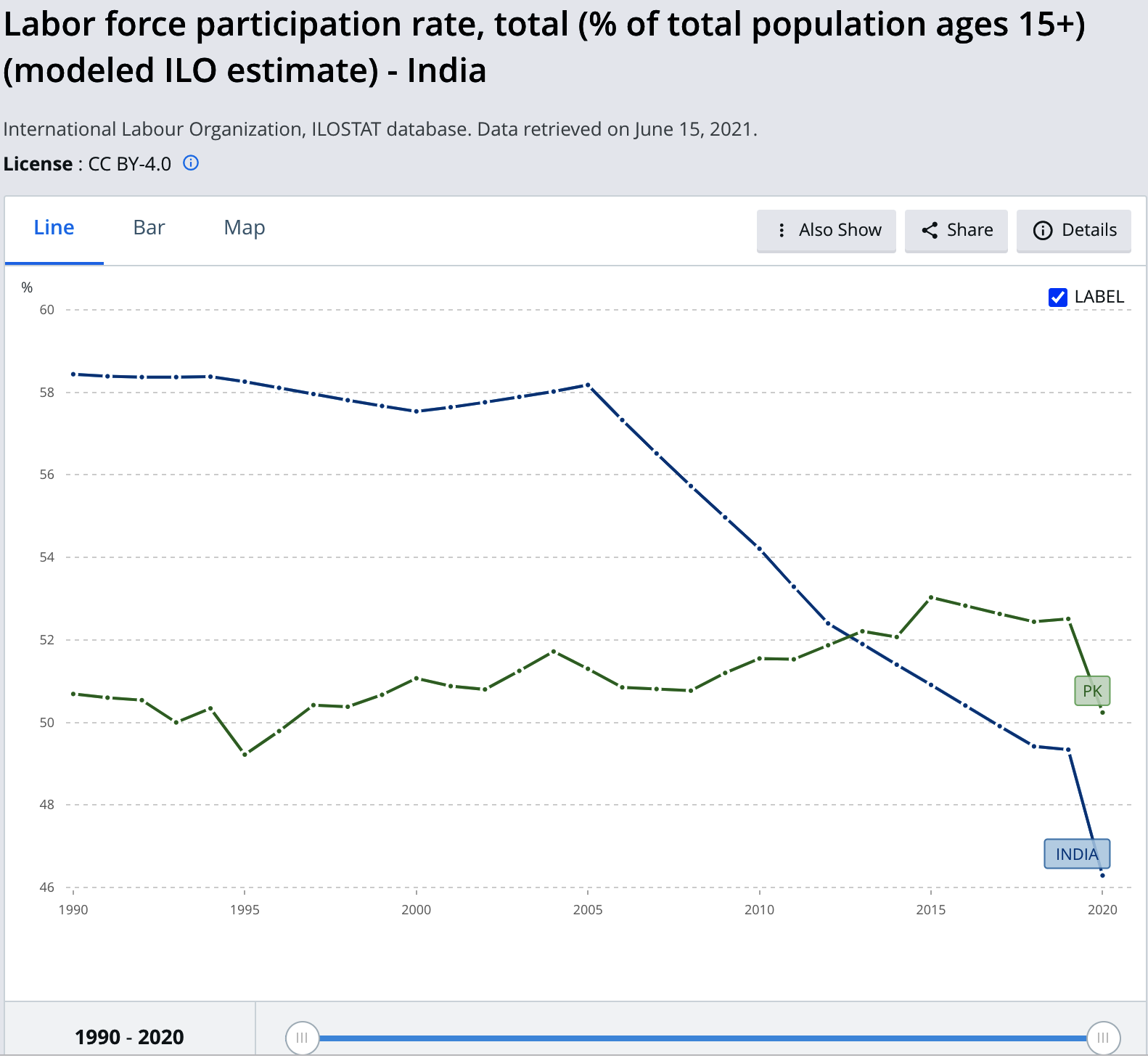
For the first time in recorded history, the labor force participation rate in Pakistan is now higher than in India, according to the ILO/World Bank estimates.


Labor Participation Rates in India and Pakistan. Source: World Bank/ILO


Unemployment rate in Pakistan is just 4.3% in spite of COVID19 pandemic. Jobless rate in India is 8%, much higher than in Pakistan. 

Unemployment Rate in India and Pakistan. Source: ILO/World Bank


Savings Rate:

Pakistan's domestic savings rate recovered to nearly 17% after plunging to a low of 12% in 2018. Savings are extremely important for increased investment to spur GDP growth in any country, including Pakistan.

Pakistan Savings Rate. Source: Global Economy

IMF Bailout:

Pakistan's forex reserves were running dangerously low forcing the country to seek a $6 billion IMF bailout in 2018 to avoid default.  The total reserves now exceed $22 billion.

Reko Diq Mining Deal Revival: 

Prime Minister Imran Khan's government recently resolved an $11 billion in damages that the country faced for improperly canceling a huge copper-gold mining deal in Balochistan.  

Reko Diq is the world's 4th largest undeveloped copper-gold porphyry deposit with over 14 million tons of copper and 21 million ounces of gold. The project was abandoned in 2011 after a Pakistan Supreme Court bench headed by former Chief Justice Iftikhar Chaudhry canceled the mining license granted to Tethyan Copper Company (TCC), a joint venture between Canada's Barrick Gold and Antofagasta Minerals of Chile. TCC challenged the cancellation in the International Centre for Settlement of Investment Dispute (ICSID). On July 12, 2019, the ICSID Tribunal awarded TCC $5.894 billion plus interest of  $700,000 per day in damages against Pakistan. As of 1 March 2022, the award stood at $6.5 billion. The new agreement between Barrick Gold Corporation  and the governments of Pakistan and Balochistan does away with this award. It also increases the share of the project owned by Pakistan from 25% to 50%, brings in $10 billion investment, the largest single investment in the country, and creates 8,000 jobs. Reko Diq is part of the Tethyan metallogenic belt (TMB) that extends from the Balkans in Europe to Pakistan including Serbo-Macedonian, Anatolian, Takab, Kerman and Chagai metallogenic belts. It is believed to be rich in copper and gold deposits.

Manufacturing and Construction Boom: 

Large scale manufacturing grew by 8.2% in February 2022,  after posting 7.6% growth during July-Jan FY22.  

QIM Index 2019-22. Source: APP

Pakistan Large Scale Manufacturing Index. Source: Mettis Global

The LSMI Quantum Index Number (QIM) hit an all-time high of 136.2 points in January, 2022. It averaged 120 points during July-January (2021-22), up from 111.5 points during July-January (2020-21), showing growth of 7.6%, according to latest PBS data.

Cement shipments in Pakistan. Source: All Pakistan Cement Manufacturers Association


Pakistan cement production has increased by double digits to respond to demand for housing and infrastructure construction on Prime Minister Imran Khan's watch. 

Technology Boom:

The year 2021 was a banner year for technology startups in Pakistan.  There was a 437% jump in investments in the startups, raising a total of $352 million across 72 deals in 2021, according to Aljazeera

Pakistan Startup Investments. Source: Aljazeera

Pakistan technology exports have soared 30% to $1.7 billion in the first 8 months of the current fiscal year, according to the State Bank of Pakistan

Expansion of Social Safety Net:

Pakistan's PTI government has built South Asia’s first digital National Socio-Economic Registry (NSER) as a part of its ambitious effort to build a basic social safety net. The Ehsaas (also known as BISP- Benazir Income Support)) program's socio-economic registry includes household information by  geography, age, income, education, health, disability, employment, energy consumption, land and livestock holdings etc. Ehsaas Programs include both Unconditional Cash Transfers (UCT) and Conditional Cash Transfers (CCT). Unconditional Cash Transfers are made only to people living in extreme poverty or distress. Conditional Cash Transfers like Waseela-e-Taleem and Nashonuma  are given for education and nutrition respectively.  In addition, there are feeding centers (langars) for the hungry and shelters (panahgahs) for the homeless. 

OIC Foreign Ministers in Islamabad:

Recent conference of Islamic countries foreign ministers hosted by Pakistan in Islamabad was attended by 56 nations. Chinese foreign minister Wang Yi attended as a special guest. Here's an excerpt of the Islamabad Declaration issued at the conclusion of the two-day conference:

“We declare that the final settlement of the Jammu and Kashmir dispute in accordance with UN Security Council resolutions is indispensable for durable peace in South Asia. We reiterate our call on India to: a) reverse its unilateral and illegal measures instituted since 5th August 2019; b) cease its oppression and human rights violations against the Kashmiris in IIOJK; c) halt and reverse attempts to alter the demographic structure and to redraw electoral constituencies in IIOJK; and d) take concrete and meaningful steps for full implementation of the UN Security Council resolutions on Jammu and Kashmir,”

Response to Indian hostility:

Prime Minister Imran Khan's government won praise for its handling of India's aggression with unprovoked air strikes in Balakot in February 2019. Pakistan responded with "Operation Swift Retort", shot down two Indian fighter jets and captured an Indian Air Force pilot. But Khan's government avoided further escalation of the incident. Similarly, Pakistan responded calmly to the "accidental firing" of Indian Brahmos cruise missile into Pakistan that could have easily escalated into a full-scale war between two nuclear-armed neighbors. 

No-Confidence Vote:

Pakistan's opposition parties have recently come together to try to topple Prime Minister Imran Khan's government. These opposition parties have little in common other than their hunger for power. If they succeed, the country will plunge into yet another period of instability and uncertainty that will reverse progress made in the last few years to stabilize the country's economy. 

Saturday, February 27, 2021

Construction and Manufacturing Driving Double-Digit Growth in Pakistan Cement and Steel Production

Pakistan steel production grew by 13.3% in 2020,  the second fastest among the top 40 steel producing countries, according to data published by the World Steel Association. At the same time, Pakistan Bureau of Statistics revealed that the nation's steel imports rose by 18% year-over-year. The demand for steel was driven by construction and manufacturing sectors which are leading Pakistan's economic recovery. 

World Steel Production. Source: World Steel Association

Pakistan steel-makers produced 3.7 million tons of steel in 2020, up 13.2% from 3.2 million tons in 2019. Neighboring India saw 10.6% decline in steel production in the same period. Global steel production declined 0.9% in 2020. Pakistan also imported $2.1 billion worth of iron, steel and scrap in the first 7 months (July 2020- January 2021) of the current fiscal year.  It's a jump of 18% from the same period in prior fiscal year.  Pakistan steel industry reached peak production of 5 million tons in 2017 before declining to 4.7 million tons in 2018 and 3.3 million tons in 2019. 

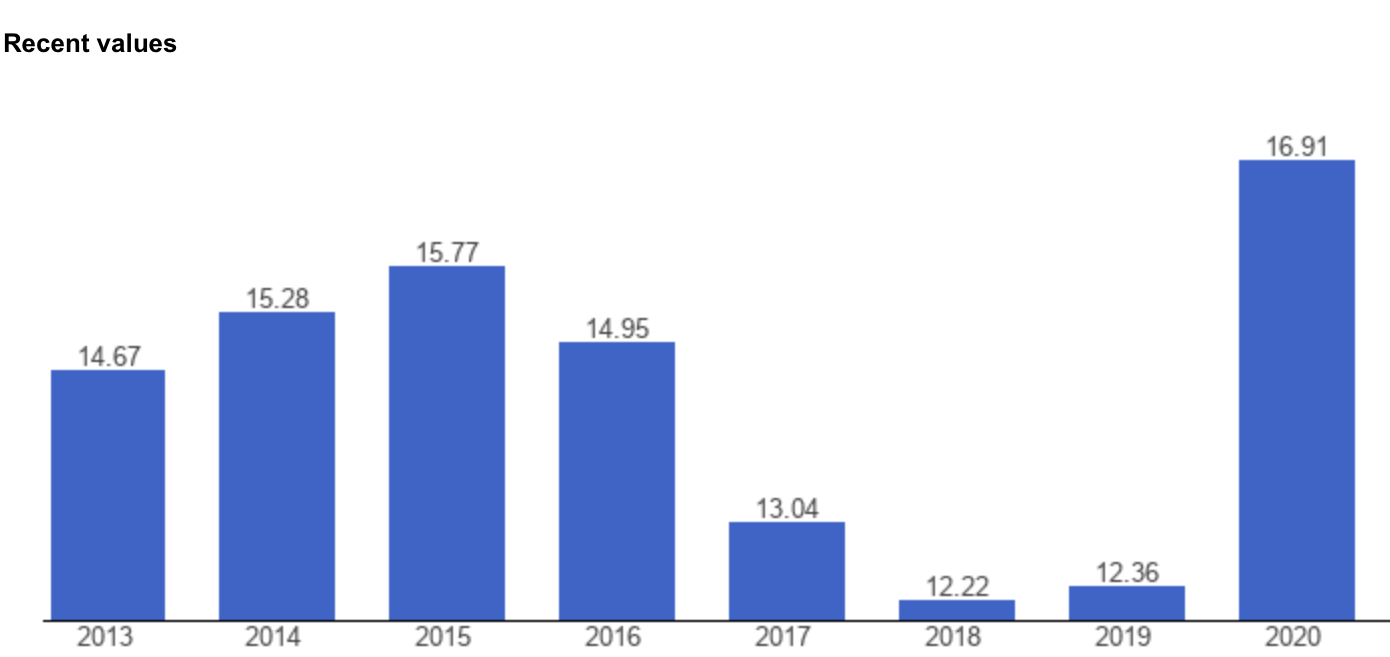
Construction boom helped Pakistan grow its domestic cement consumption by 17% in the first 7 months (July 2020-January 2021) of the current fiscal year. Domestic cement sales rose to 27.65 million tons in this period, while exports grew by 10.23% to 5.71million tons from 5.186 million tons in the same period last year.  The total cement sales (local and exports) were 33.36 million tons,  up 15.77% over the corresponding period of the last fiscal year.  

Related Links: 

Haq's Musings

South Asia Investor Review

Pakistan to Become World's 6th Largest Cement Producer By 2030

Naya Pakistan Housing Program

Pakistan's Response to COVID19 Pandemic

Pakistan Tech Exports

Pakistan Digital Economy Surged 69% Amid Covid19 Pandemic

Soaring Food Prices Hurting Pakistanis

Najam Sethi on Desperation in PDM Ranks

India's Firehose of Falsehoods Against Pakistan

Pakistan Launches Defense AI Program

Riaz Haq's Youtube Channel

PakAlumni Social Network

Sunday, February 21, 2021

Imran Khan Government's Midterm Review: Economy and Foreign Policy

Imran Khan's government has completed about half of its 5-year term it won in 2018. What are its accomplishments? Where has it failed in terms of economy and foreign policy. 

Economy:

Imran Khan inherited a serious balance of payments crisis cased by flat exports and record high imports in 2013-2018 period under Pakistan Muslim League (Nawaz) government. while the PTI government was still dealing with it, the country and the world were hit by COVID19 pandemic that devastated the global economy. 

Pakistan's Trade July2020-Jan2021. Source: Arif Habib


The 2019 International Monetary Fund's bailout required the PTI government to significantly devalue the Pakistani rupee to make exports competitive, and to raise interest rates to slow down imports. These actions triggered inflation, particularly food inflation, as energy and fertilizer prices rose. 

Export Growth in South Asia. Source: Wall Street Journal

The global COVID19 pandemic hit Pakistan and the world while the PTI government was still trying to stabilize the economy. The global economy slowed down as a result of lockdowns imposed around the world to slow the spread of the novel coronavirus. It impacted South Asian economies but Pakistan was thankfully spared the worst of it. 
Pakistan Vehicle Sales 1H FY20-21. Source: Arif Habib


Now Pakistani economy is finally stabilizing and a strong recovery is underway. The recovery is led particularly by the construction and manufacturing sector as evident from double digit increases in cement consumption and large scale manufacturing growth. 

Cement Sales in Pakistan. Source: Bloomberg


Foreign Policy:

One of Pakistan's key foreign policy successes is the US-Taliban Peace Deal. But now there is uncertainty surrounding it with the inauguration of President Joseph Biden. Biden's election and the growing rivalry between US and rising China have changed the calculus in South Asia and the Middle East regions, impacting Pakistan. Former President Trump's erratic behavior has also contributed to it. 

Based on Biden's record as Obama's vice president, it is expected that the new US president will continue to support a stable Pakistan. A suggestion that has been made by former State Department officials Shumaila Chaudhry and Vali Nasr is for the US to take advantage of Pakistan's free trade deal with China by setting up value-added re-export units in the country. 

Please watch this discussion with Faraz Darvesh as host and Dr. Owais Saleem, Sabahat Ashraf and Riaz Haq as panelists:

https://youtu.be/Cse9j72H1cU


Related Links:


How "Illiterate" Are Pakistan's "Illiterate" Cell Phone Users?


Sunday, September 27, 2020

UNIDO 2020: Pakistan Industrial Output Lags Behind Peers in South Asia

Manufacturing in Pakistan lags behind Bangladesh, India and Sri Lanka in terms of manufacturing value added per capita as well as per capita exports of manufactured products, according to Competitive Industrial Performance Report 2020 released by United Nations Industrial Development Organization (UNIDO). 


Pakistan's Competitive Industrial Performance. Source: UNIDO


On the competitive Industrial Performance (CIP) Index, Pakistan ranks 82 among 152 countries, well behind India at 42, Bangladesh at 70 and Sri Lanka at 75. Only Maldives (144) and Nepal (135) rank lower than Pakistan. Bangladesh has built a very successful garments manufacturing and export business that rivals China's. The country is now focusing on building mobile phones and consumer electronics industry.  

India's Competitive Industrial Performance. Source: UNIDO


Only 1.3% of Pakistan's manufacturing is high-tech and 9% medium tech, better than Bangladesh's 0.4% high-tech and 1.5% medium tech, but considerably worse than India's 9.4% high tech and 25.4% medium tech. 

Bangladesh's Competitive Industrial Performance. Source: UNIDO

Nearly 40% of India's manufacturing output is based on locally extracted natural resources like iron ore and coal, much higher than Pakistan's 9.7% and Bangladesh's 1.9%. Pakistan's per capita manufactured exports add up to only $87 per capita, well behind Bangladesh $198 and India $208. Per capita manufactured output in Pakistan is $178 versus Bangladesh's $281 and India's $299. 

China's Competitive Industrial Performance. Source: UNIDO


The most successful example of a manufactured exports-driven economy in Asia is China, ranked number 2 in the world, just behind top-ranked Germany. China's per capita manufacturing value added is $2,726 and its per capita manufactured exports add up to $1,685. High-tech manufactured products account for 30.6% of Chinese manufacturing output while its resource-based manufacturing is just 9.3% of its output.

Pakistan's Manufacturing Output Trend Since 2000. Source: World Bank


Manufacturing industries are defined by the International Standard Industrial Classification (ISIC).  Value added is the net output of a sector after adding up all outputs and subtracting intermediate inputs. 

Here's Pakistan's manufacturing output in current U.S. dollars:

Pakistan manufacturing output for 2019 was $34.66B, a 9.57% decline from 2018. In 2018, it was $38.33B, a 4.88% increase from 2017. Pakistan manufacturing output for 2017 was $36.54B, a 8.56% increase from 2016. It was $33.66B in 2016, a 2.73% decline from 2015.

 
Pakistan Manufacturing Output Peer Ranking 2019. Source: World Bank

Pakistan’s overall exports have continued to lag behind those of its South Asian counterparts since the early 1990s. Bangladesh’s exports have increased by 6.2 times compared to Pakistan’s, measured in terms of exports per capita, and that of India by 6.8 times, according to Princeton's Pakistani-American economist Atif Mian. 


Pakistan's average economic growth of 5% a year has been faster than the global average since the 1960s, it has been slower than that that of its peers in East Asia. It has essentially been constrained by Pakistan recurring balance of payment (BOP) crises as explained by Thrilwal's Law. Pakistan has been forced to seek IMF bailouts 13 times in the last 70 years to deal with its BOP crises. This has happened in spite of the fact that remittances from overseas Pakistanis have grown 24X since year 2000. The best way for Pakistan to accelerate its growth beyond 5% is to boost its exports by investing in export-oriented manufacturing industries, and by incentivizing higher savings and investments.