Showing posts with label Food. Show all posts

Tuesday, January 6, 2026

Pakistan Household Survey HIES 2024-25 Raises More Questions Than It Answers

Recently released HIES 2024-25 household integrated economic survey by Pakistan Bureau of Statistics (PBS)  raises more questions than it answers. For example, it shows that Pakistani households are buying lower amounts of basic food ingredients like wheat, meat and eggs in the last four years, implying that people are eating less to cover other expenses, like electricity and gas. But it doesn't explain why the households have reported significantly lower purchases of these items than production reported recently by the PBS. What is the source of this discrepancy? Is the data flawed? Or, is it missing a new trend toward less home cooking? Is the young urbanized population buying more  prepared foods? Are they ordering out more often using ubiquitous food delivery services?  Let us try and understand it in more detail. 

21% Pakistanis Buy Tandoori Nan. Source: Gallup Pakistan


Data Discrepancy: 

There is a significant discrepancy in household data for per capita monthly consumption of basic food ingredients like wheat, meat and eggs. For example, the HIES 2024-25 reports 6.59 Kg of wheat consumption per capita per month, which translates into 79 Kg per person per year. The wheat production data from PBS shows 30 million tons or 120 Kg per capita in 2025.  We know that Pakistan did not export wheat last year. So what happened to the 41 Kg per capita difference? It is 30% of the total production reported, too large to be explained away as waste in the system. It was most probably bought by food businesses and eventually consumed by Pakistani households. There are similar discrepancies in meat, eggs and other food data, with reported household consumption being far below production. 

Household Food Items Purchase Data. Source: HIES 2024-25 

Prepared Foods:

A 2025 Gallup survey revealed that 21% of Pakistanis buy tandoori naan. Pakistan's prepared food market is experiencing robust growth, with the Convenience Food sector valued at $6.91 billion in 2025, projected to grow at 5% annually, driven by Ready-to-Eat (RTE) meals and frozen foods, especially RTE/RTC (Ready-to-Cook) products like frozen snacks. Key trends include rising demand for time-saving, convenient options due to urbanization, growing health consciousness (organic/natural), and dominance by flexible packaging, with online delivery also expanding rapidly.

Urbanization in Pakistan. Source: World Bank

Urbanization:

The World Bank researchers have recently concluded that 88% live in urban areas. Their conclusion is based on satellite imagery and the Degree of Urbanization (DoU) methodology. The official Pakistani figures released by the Pakistan Bureau of Statistics (PBS) put the current level of urbanization at 39%. The source of this massive discrepancy is the government's reliance on administrative boundaries rather than population density and settlement patterns, according to the World Bank working research paper titled  "When Does a Village Become a Town?". 

Ultra-Processed Foods:

Ultra-processed foods (UPFs) like biscuits, sugary drinks, chips, and packaged snacks, are a growing concern in Pakistan. Such foods are contributing to rising obesity, diabetes, and heart disease. Obesity causes non-communicable diseases (NCD) which are now among the leading causes of death in Pakistan.

To deal with the obeseity crisis, several Pakistani pharmaceutical companies have started domestic production of generic versions of GLP-1 (Glucagon-Like Peptide-1) drugs Ozempic/Wegovy (Semaglutide) and Mounjaro/Zeptide (Tirzepatide). 

Food Delivery Services:

Pakistan's food delivery market is experiencing rapid growth, projected to hit $2.35 billion in 2025, driven by high smartphone penetration, a young urban population, and increased convenience-seeking, with Foodpanda dominating but facing a growing trend of direct restaurant ordering and a demand for diverse, tech-enabled options despite past economic challenges.

Street Food Growth:

With rising urbanization, the street food sector in Pakistan is vibrant and growing. It is crucial for livelihoods and affordable food. Deeply embedded in culture, choices range from savory samosas and chaat to bun kebabs, pakoras, pani puri, and biryani, popular for convenience and taste.

Fast Food Boom:

Pakistan’s fast food industry is experiencing rapid growth, making it the 8th largest fast food market globally. With a large consumer base, the demand for fast food continues to grow, contributing to the economy in significantly. The industry’s annual growth rate stands at 20%, highlighting its rapid expansion and increasing consumer preference for quick-serve meals.

Summary:

The HIES 2024-25 report recently issued by Pakistan Bureau of Statistics implies that Pakistani households are eating less to save money to pay for rising energy bills. I think this is misleading for two reasons: 1. It does not explain why reported household consumption figures are significantly lower than per capita production of these food items and 2. It completely ignores the impact of rapid urbanization that is causing Pakistanis to change their eating habits, such as consuming increasing amounts of prepared foods. 

Related Links:

Haq's Musings

South Asia Investor Review

Pakistanis Happier Than Neighbors

Tipping Point: Pakistan Middle Class Grows to 55% of the Population

Karachi Safety Ranking Rising

Urbanization in Pakistan Highest in South Asia

Agriculture Sector in Pakistan

Karachi is World's Fastest Growing Megacity

Karachi's Human Development Index

Pakistan Rising or Failing: Reality vs Perception

Pakistan's Trillion Dollar Economy Among top 25

CPEC Myths and Facts

Gwadar Port

Riaz Haq's Youtube Channel

PakAlumni Social Network


Saturday, August 2, 2025

Pakistan Ranked Among Top Donors to UN's World Food Program

The United Nations World Food Program has ranked Pakistan fourth among donor countries and sixth overall in 2024.  Among the largest 15 donors worldwide, the United States topped the list with $4.45 billion, followed by Germany ($995 million), the United Kingdom ($610 million), European Union ($593 million), private donors ($335 million), Pakistan ($228 million), South Korea ($203 million), France ($196 million), Sweden ($183 million), Canada ($166 million), Norway ($158 million), Japan ($155 million), UN Central Emergency Fund ($135 million), other UN agencies ($120 million) and Switzerland ($88 million), according to the World Food Program

Top Donors to World Food Program in 2024. Source: WFP

The World Food Program says that 319 million people in 67 countries are facing acute hunger, and the scale of the current global hunger and malnutrition crisis is massive. "A total of 1.9 million people are in the grips of catastrophic hunger – primarily in Gaza and Sudan but also in pockets of South Sudan, Haiti and Mali. They are teetering on the brink of famine. In Zamzam camp in northern Sudan, famine has been confirmed. Many food crises involve multiple overlapping issues that are building year on year". 

Pakistan, being a generous nation and ranked among the top 10 food producing countries, feels a special responsibility to step up and feed as many hungry people as possible. Pakistan is a major global food producer, particularly in several key areas. It ranks among the top ten countries in the world for the production of wheat, rice, cotton, sugarcane, mangoes, dates, and kinnow oranges. It also produces large quantities of cereals, meat, milk, fruits, and vegetables. Specifically, Pakistan is the 8th largest producer of wheat and 10th largest producer of rice globally. 

World Giving Index has ranked Pakistan among the most generous generations in the past. A Michigan State University (MSU) study of 63 countries found that Pakistanis have higher empathy for others than people in their neighboring countries.  Philanthropy is part of the faith for most Pakistanis:

"Righteousness is not that ye turn your faces towards the east or the west, but righteousness is, one who believes in God, and the last day, and the angels, and the Book, and the prophets, and who gives wealth for His love to kindred, and orphans, and the poor, and the son of the road, beggars, and those in captivity; and who is steadfast in prayers, and gives alms." Quran 2:177

Related Links:

Saturday, January 13, 2024

Pakistan to Set New Record For Rice Exports in 2023-24

The United States Department of Agriculture is forecasting that Pakistan's rice exports will set a new record of 5 million metric tons in 2023-24.  This is nearly 30% more than the 3.9 million tons Pakistan exported last year. It is being attributed to a bumper rice crop in the country and strong global demand after India imposed restrictions on its exports. A large exportable surplus has helped Pakistani exporters to offer competitive prices in the international market, but prices are likely to remain high due to an increase in demand, according to S&P Global Commodity Insights. European Union and Middle East are the main export markets for Pakistani Basmati rice while Africa and the Far East have emerged as the key export destinations for non-Basmati rice from Pakistan. 

Top Rice Exporting Countries. Source: Aljazeera

Pakistan is the world's fourth largest exporter of rice after India, Thailand and Vietnam. Last year (2022-23), India exported an estimated 20.5 million tons of rice, almost 2.5 times that of the second largest exporter, Thailand with 8.5 million tons. Thailand was followed by Vietnam (7.9 million tons), Pakistan (3.6 million tons) and the United States (2.1 million tons).

Pakistan Rice Exports. Source: S&P Global


Pakistan is among the world's largest food producing countries. It produces large and growing quantities of cereals, meat, milk, fruits and vegetables. Currently, Pakistan produces about 38 million tons of cereals (mainly wheat, rice and corn), 17 million tons of fruits and vegetables, 70 million tons of sugarcane, 60 million tons of milk and 4.5 million tons of meat.  Total value of the nation's agricultural output exceeds $50 billion.  Improving agriculture inputs and modernizing value chains can help the farm sector become much more productive to serve both domestic and export markets.  

One of the objectives of Pakistan government's Special Investment Facilitation Council (SIFC) is to bring in new investments to modernize farming.  Already, Pakistan has signed a memorandum of understanding with Kuwait for $10 billion worth of projects, including some focused on food security. The government is also collaborating with China Machinery Engineering Corp., an engineering and construction heavyweight, and China’s Famsun, an agriculture equipment company, according to a presentation about the initiative in November seen by Bloomberg

The initial focus of the Green Pakistan program is on transforming parts of the Cholistan desert to farms and fruit orchards As much as 4.8 million acres of the desert may be allocated fir this purpose.  Many parcels of land available for lease are in arid and underdeveloped regions, supporting irrigation initiatives. Some farmers are already working on their own to implement drip irrigation in Cholistan. Back in 2019, Zofeen Ibrahim of The Third Pole publication met one such farmer named Hasan Abdullah. He uses a measured amount of water mixed with fertilizer via drip irrigation to precisely irrigate his 50 acre citrus farm located on the sand dunes. As much as 60% of the cost of installing drip irrigation system has come from the provincial government. 

Related Links:

Haq's Musings

South Asia Investor Review

Chicken Cheaper Than Daal

Meat Industry in Pakistan

Bumper Crops and Soaring Tractor Sales in Pakistan

Meat and Dairy Revolution in Pakistan

Pakistanis Consuming More Calories, Fruits and Vegetables

Eid ul Azha: Multi-Billion Dollar Urban-to-Rural Transfer

Pakistan's Rural Economy

Pakistan Among World's Largest Food Producing Countries

Median Incomes in India and Pakistan

Tuesday, August 8, 2023

USDA Forecasts Bumper Harvest of Major Crops in Pakistan For 2023/24

The United States Department of Agriculture (USDA) is forecasting bumper harvest of all major crops in Pakistan for 2023/24. Major crops in the country include wheat, rice, sugarcane, corn and cotton. These offer welcome relief for Pakistani farmers who suffered devastating losses in the epic floods of 2022.   

Major Crops Produced in Pakistan. Source: USDA

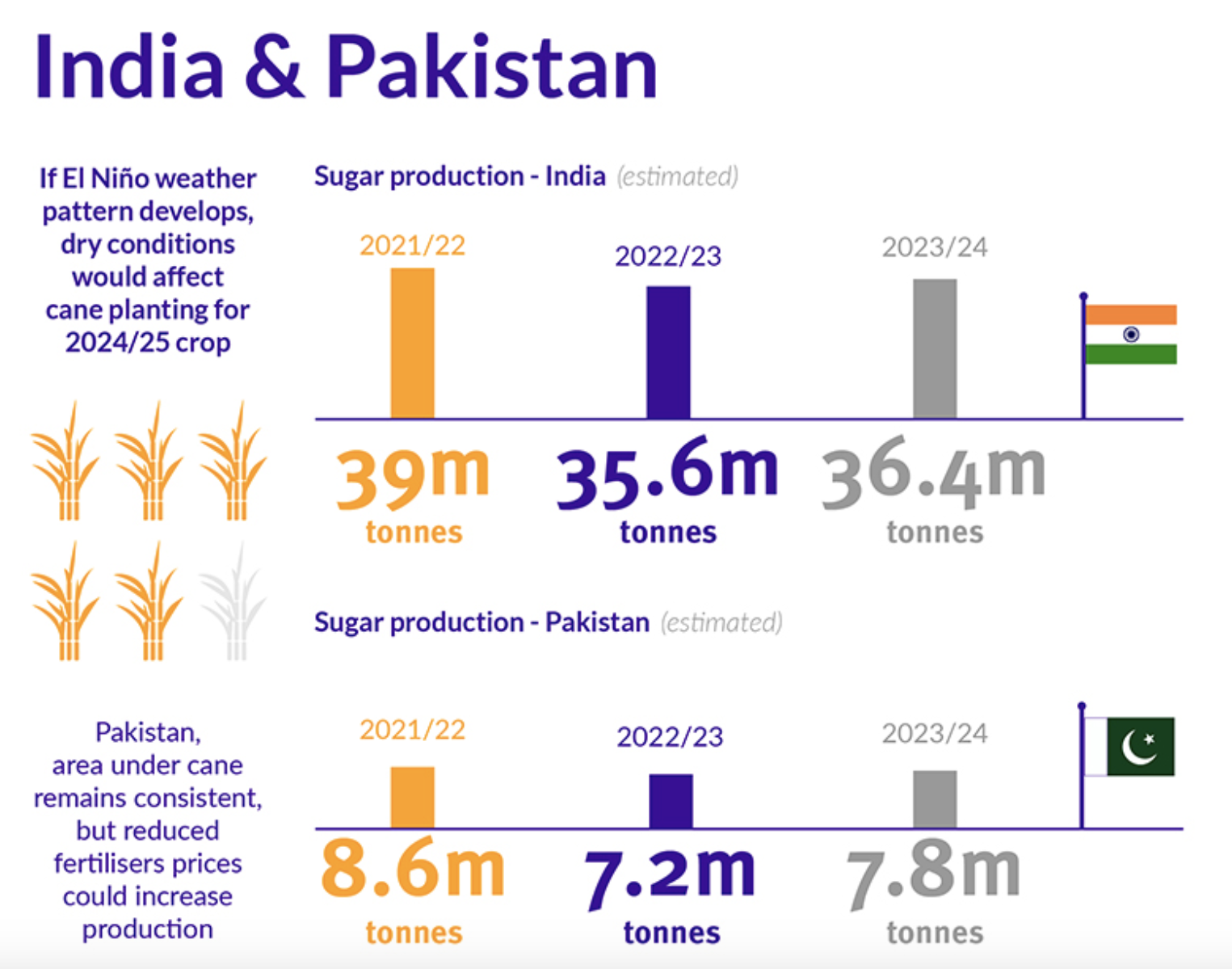
Pakistan is projected to produce 28 million tons of wheat,  10.5 million tons of corn (maize), 9 million tons of rice, 6.5 million bales of cotton, 7.8 million tons of sugar and 540,000 tons of rapeseed (canola) in 2023/24. Each of these production figures is significantly higher than last year's, and higher than the last 5-year average (2018-22) for the country. Potato production jumped 50% to 7.74 million tons in 2022, according to PotatoBusiness.  

Sugar Production in India and Pakistan. Source: Ragus


Pakistan will still need to import wheat but a lower amount than last year, according to a Global Agricultural Information Network report from the Foreign Agricultural Service (FAS) of the US Department of Agriculture. The record harvest will help lower the country’s forecasted import needs from 3 million to 2 million tons in 2023-24 even as total consumption grows to 30.2 million tonnes from 29.2 million tons. Pakistan imported 2.6 million tons last marketing year.

Higher cotton production in Pakistan will result in 2.3 million tons of cottonseed oil in 2023/24, a 34% increase over the 2022/23 output. This increase reflects expectations for a recovery in yield following the flood-damaged 2022/23 output. This will help reduce cooking oil imports, the country's largest food import, this year. Last year, Pakistan imported $4.5 billion worth of edible oil

Pakistan expects to export 5 million tons of rice worth $3 billion this year. India's ban on non-basmati rice exports will likely help Pakistani exporters fetch higher prices on the world market. 

Global Rice Market 2023. Source: Reuters


Pakistan's agriculture output is the 10th largest in the world. The country produces large and growing quantities of cereals, meat, milk, fruits and vegetables. Currently, Pakistan produces over 40 million tons of cereals (mainly wheat, rice and corn), 17 million tons of fruits and vegetables, 70 million tons of sugarcane, 60 million tons of milk and 4.5 million tons of meat.  Total value of the nation's agricultural output exceeds $50 billion. Improving agriculture inputs and modernizing value chains can help the farm sector become much more productive to serve both domestic and export markets.  

Related Links:


Haq's Musings

South Asia Investor Review

Chicken Cheaper Than Daal

Meat Industry in Pakistan

Pakistan Among World's Largest Food Producers

Meat and Dairy Revolution in Pakistan

Pakistan Floods of 2022

Eid ul Azha: Multi-Billion Dollar Urban-to-Rural Transfer

Pakistan's Rural Economy

Pakistan Leads South Asia in Agriculture Value Addition

Median Incomes in India and Pakistan

Friday, October 14, 2022

World Food Day 2022: India Tops Hunger Charts in South Asia

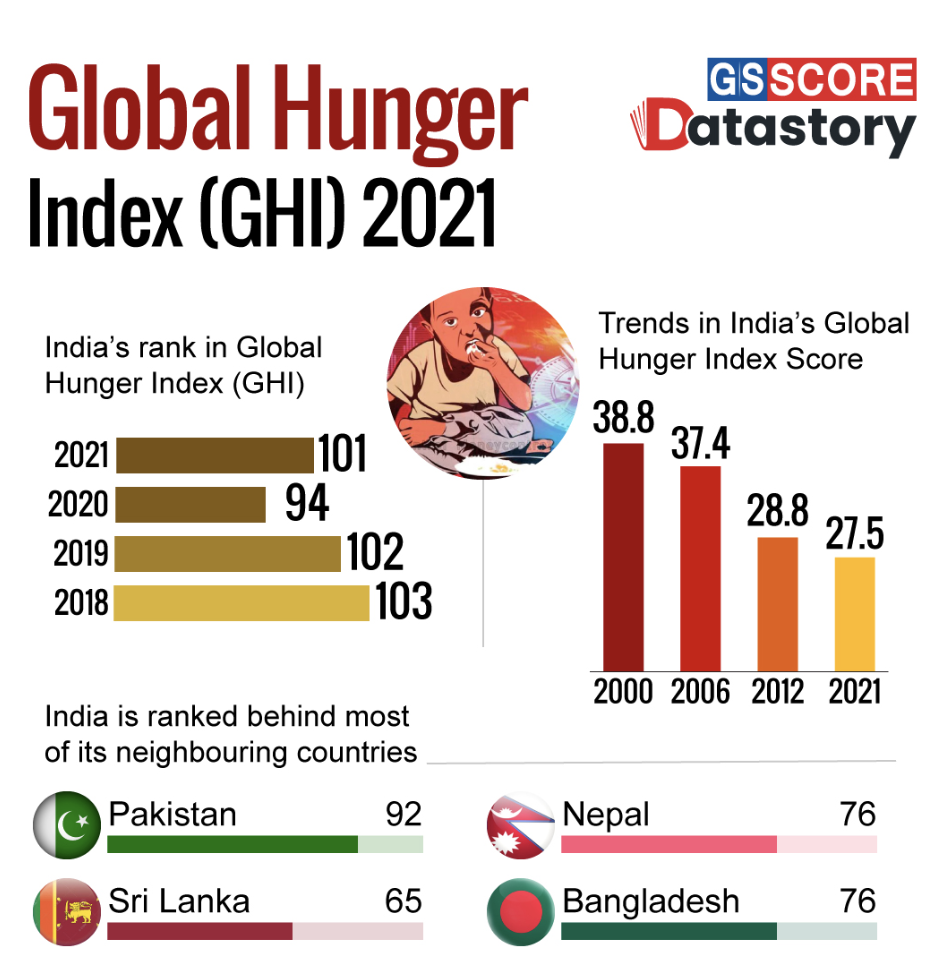
India ranks 107th for hunger among 121 nations. The nation fares worse than all of its South Asian neighbors except for war-torn Afghanistan ranked 109, according to the Global Hunger Index 2022. Sri Lanka ranks 64, Nepal 81, Bangladesh 84 and Pakistan 99. India and Pakistan have levels of hunger that are considered serious. Both have slipped on the hunger charts from 2021 when India was ranked 101 and Pakistan 92.  Seventeen countries, including Bosnia, China, Kuwait, Turkey and UAE, are collectively ranked between 1 and 17 for having a score of less than five.

South Asia Hunger Rankings. Source: GHI/IASScore


India’s child wasting rate (low weight for height), at 19.3%, is worse than the levels recorded in 2014 (15.1%) and even 2000 (17.15), and is the highest for any country in the world and drives up the region’s average owing to India’s large population, according to The Hindu newspaper. The child hunger situation has gotten worse since Mr. Narendra Modi was elected Prime Minister of India in 2014.  Earlier this year, Prime Minister Modi offered to "feed the world" in the aftermath of the Ukraine war.  Within weeks of this pledge he ended making an about-face.  On World Food Day 2022, the United Nations World Food Program has warned of another year of global record hunger looms amid food and climate crisis. 

India Hunger Trends. Source: GHI


Pakistan Hunger Trends. Source: GHI

Pakistan has a score of 26.1 and ranks 99th out of the 121 countries on Global Hunger Index rankings. India's GHI score is 29.1 and it ranks 107th. Hunger could worsen in Pakistan in the aftermath of the worst-ever flooding that has destroyed wheat and rice crops in southern Sindh province. Flood waters have not yet drained from the fields and standing water is preventing planting of the Rabi (winter) crop now. Here's an excerpt of USDA Food and Grain report on the wheat situation in Sindh:

"Farmers normally begin planting the wheat crop in mid-October and November in Sindh and Punjab, respectively. Sindh province usually accounts for almost twenty percent of national wheat production. However, large areas of Sindh typically planted to wheat are still submerged, and it may be several months before the flood waters recede. With Sindh’s flat terrain, poor drainage, and current high-water table, flood waters are receding slowly. As a result, seeding the 2023/24 wheat crop in Sindh is likely to be delayed and some areas may possibly remain unseeded. Even where the waters recede, farmers are likely to face difficulties in wheat planting as the floods washed away on-farm wheat seed stock in many areas. Additionally, farmers’ purchasing power in the affected areas is severely compromised making it difficult for them to buy fertilizers and other inputs".  

The number of hungry people around the world has shot up from 282 million to around 345 million since the beginning of 2022, and by mid-year, according to the United Nations World Food Program. “We are facing an unprecedented global food crisis and all signs suggest we have not yet seen the worst”, said WFP Executive Director David Beasley. “For the last three years hunger numbers have repeatedly hit new peaks. Let me be clear: things can and will get worse unless there is a large scale and coordinated effort to address the root causes of this crisis. We cannot have another year of record hunger”.

Related Links:


Haq's Musings

South Asia Investor Review

Pakistan Among World's Largest Food Producers

Pakistan Floods 2022

Food in Pakistan 2nd Cheapest in the World

India in Crisis: Unemployment and Hunger Persist After COVID

Impact of Russia Sanctions on Food, Fuel Availability

Record Number of Indians Seeking Asylum in US

Vast Majority of Pakistanis Support Imran Khan's Handling of Covid19 Crisis

Incomes of Poorest Pakistanis Growing Faster Than Their Richest Counterparts

Pakistanis Consuming More Calories, Fruits & Vegetables Per Capita 

How Grim is Pakistan's Social Sector Progress?

Pakistan Fares Marginally Better Than India On Disease Burdens

COVID Lockdown Decimates India's Middle Class

Pakistan Child Health Indicators

Pakistan's Balance of Payments Crisis

How Has India Built Large Forex Reserves Despite Perennial Trade Deficits

Riaz Haq's Youtube Channel

Tuesday, July 26, 2022

Pakistan Agriculture: Record Harvests Forecast After Heavy Monsoon Rains

In the first few months of 2022,  Pakistan has exported more rice to China than Vietnam, the historic top supplier, according to the United States Department of Agriculture (USDA).  Pakistan's total rice exports are forecast to jump by 450,000 tons to 4.8 million tons, almost 30% higher than the prior year. 

Women Farmers Planting Rice in Pakistan. Source: Reuters


Pakistan experienced broad-based economic growth across all key sectors in FY 21-22; manufacturing posted 9.8% growth, services 6.2% and agriculture 4.4%. The 4.4% growth in agriculture is particularly welcome; it helps reduce rural poverty.  The country is expected to have yet another record year for agriculture in 2022-23 after heavy monsoon rains. Rice is an important food crop in Pakistan  but wheat is the principal grain consumed domestically. Unfortunately, the same hot and dry planting conditions that delayed planting of the 2022 rice crop in Punjab and Sindh provinces have adversely affected Pakistan’s wheat production. This has forced the government to import wheat at a time of high prices amid the war in Ukraine, a major wheat exporter. 

A Cotton Field in Pakistan


The recent monsoon rains will help to kick-start the sowing of major Kharif (autumn) crops including rice, cotton, sugarcane and corn after about a month's delay.  “There was 40% less water available for the Kharif season (during May-June 2022),” an official of the Ministry of National Food Security and Research said while talking to The Express Tribune on Saturday. Earlier in March this year, Pakistan's Federal Committee on Agriculture (FCA) had said “for the Kharif year 2022, the water availability in canals head will be 65.84 million acre feet (MAF) against last year’s 65.08 MAF”. Recent rains have helped fill up major water reservoirs across the country.  About 150,000 cubic feet per second of water is being released from Pakistan's largest Tarbela dam which is more than the combined irrigation needs of the two provinces.  It is also generating over 3,000 MW of electricity, according to media reports

Heavy 2022 Monsoon Rainfall. Source: Pakistan Met Office 


“Cotton production is expected to improve to 9.5-10 million bales (one bale weighs 170 kg) in the wake of ongoing rainfall in cotton belts in Punjab and Sindh,” said Pakistan Central Cotton Committee Vice President Dr Muhammad Ali Talpur. “Cotton production will remain high, as farmers have improved crop management in the backdrop of higher prices in the domestic (and international) market.”

Drought Map of Pakistan. Source: Relief Web

Pakistan's agriculture output is the 10th largest in the world. The country produces large and growing quantities of cereals, meat, milk, fruits and vegetables. Currently, Pakistan produces about 38 million tons of cereals (mainly wheat, rice and corn), 17 million tons of fruits and vegetables, 70 million tons of sugarcane, 60 million tons of milk and 4.5 million tons of meat.  Total value of the nation's agricultural output exceeds $50 billion.  Improving agriculture inputs and modernizing value chains can help the farm sector become much more productive to serve both domestic and export markets.  

Pakistan's Thar Desert After Monsoon 2022. Source: Emmanuel Guddu 


Pakistanis are eating more and healthier foods, according to the Economic Survey of Pakistan 2021-22. Per capita average daily calorie intake in Pakistan has jumped to 2,735 calories in FY 2021-22 from 2,457 calories in 2019-20. The biggest contributor to it is the per capita consumption of fresh fruits and vegetables which soared from 53.6 Kg to 68.3 Kg, less than half of the 144 Kg (400 grams/day) recommended by the World Health Organization. Healthy food helps cut disease burdens and reduces demand on the healthcare system. Under former Prime Minister Imran Khan's leadership, Pakistan succeeded in achieving these nutritional improvements in spite of surging global food prices amid the Covid19 pandemic

Investments in modernization of the agriculture production process and farm-to-market value chain will require major reforms to ensure growers get a bigger share of the value. The extraordinary power of the middlemen (arthis) as financiers needs to be regulated. This can not happen without legislation in close consultation with the growers. Improving agriculture inputs and modernizing value chains can help raise the productivity of the farm sector for it to serve both domestic and export markets better.  

Related Links:


Haq's Musings

South Asia Investor Review

Chicken Cheaper Than Daal

Meat Industry in Pakistan

Bumper Crops and Soaring Tractor Sales in Pakistan

Meat and Dairy Revolution in Pakistan

Pakistanis Consuming More Calories, Fruits and Vegetables

Eid ul Azha: Multi-Billion Dollar Urban-to-Rural Transfer

Pakistan's Rural Economy

Pakistan Among World's Largest Food Producing Countries

Median Incomes in India and Pakistan

Sunday, June 26, 2022

Modi's India Busting Western Sanctions, Funding Russia's War On Ukraine

India, a western ally, is openly buying Russian coal, oil and weapons worth tens of billions of dollars at deep discounts. These actions amount to busting western sanctions and financing President Vladimir Putin's war on Ukraine. Many smaller developing countries, including Bangladesh and Pakistan, are abiding by these sanctions and suffering from the consequences in terms of high prices of fuel and food. Why these double standards? Do these policy contractions serve the broader US interests in the Asia region? 

India's Russian Imports Soaring Since the Start of Ukraine War. Source: Reuters

India's Russian coal imports are up 6-fold from May 27 to June 15, 2022, according to Reuters. Delhi's Russian oil buying has jumped 31-fold in this period.  Bulk shipments of Russian thermal coal to India began in the third week of May, 2022. 

India is defying western sanctions to buy millions of barrels of discounted Russian crude oil, hiding their origin and exporting refined petroleum products with a big markup to make a huge profit. China has yet to increase its oil imports from Russia, according to news reports. Meanwhile, India's neighbors Bangladesh and Pakistan are abiding by western sanctions and paying much higher market prices to buy oil for their domestic needs, and hurting their people. Such double standards are not going unnoticed. 

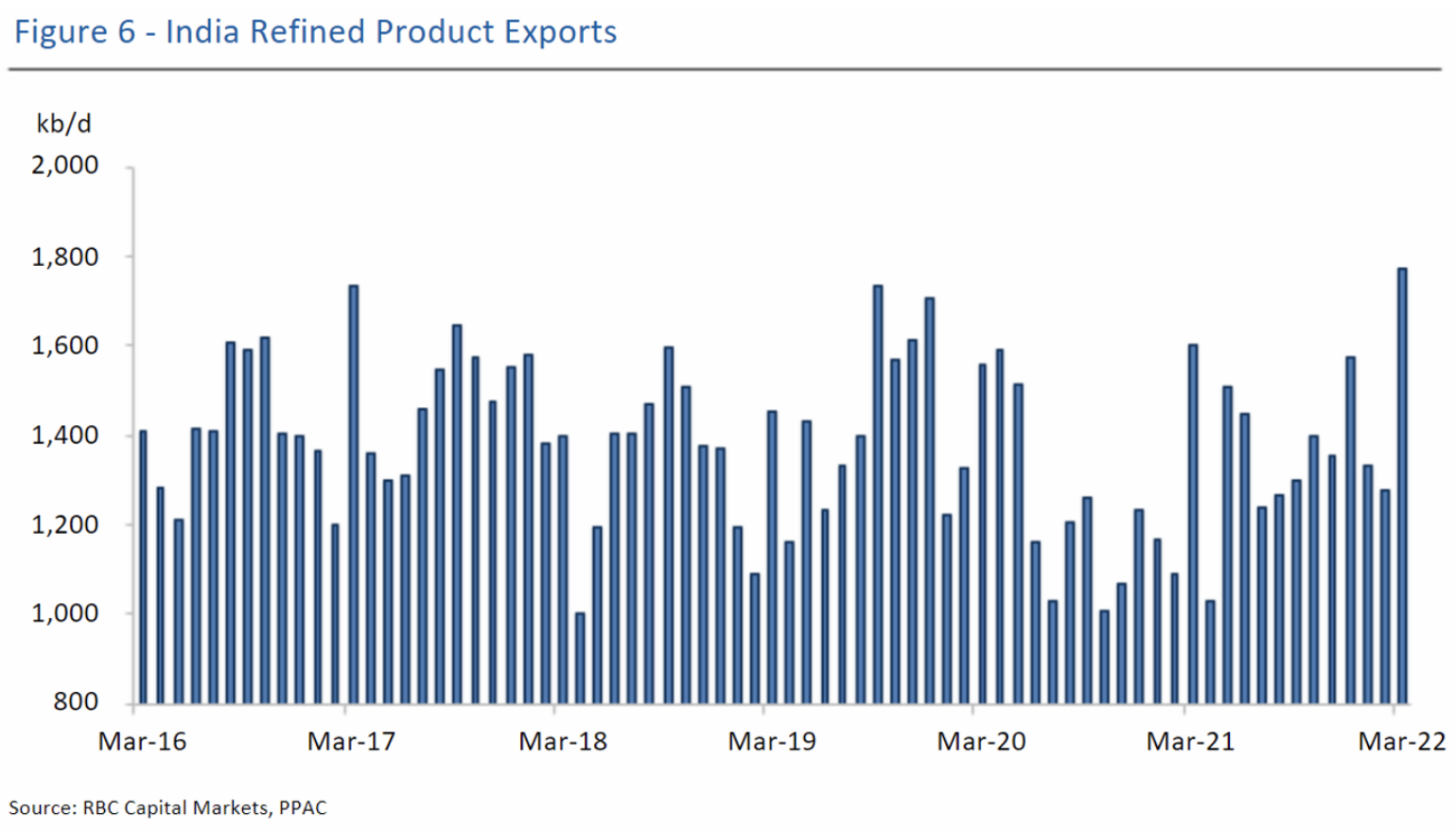
India's Refined Petroleum Exports.Source: MarketWatch


India is importing large amounts of deeply discounted Russian crude, running its refiners well above capacity, and capturing the economic rent of sky-high crack spreads and exporting gasoline and diesel to Europe, according to MarketWatch.  “As the EU weans from Russian refined products, we have a growing suspicion that India is becoming the de facto refining hub for Europe,” said Michael Tran, global energy strategist at RBC Capital Markets, in a Tuesday note. Here’s how the puzzle pieces fit together, according to Tran:

"India is buying record amounts of severely discounted Russian crude, running its refiners above nameplate capacity, and capturing the economic rent of sky-high crack spreads and exporting gasoline and diesel to Europe. In short, the EU policy of tightening the screws on Russia is a policy win, but the unintended consequence is that Europe is effectively importing inflation to its own citizens. This is not only an economic boon for India, but it also serves as an accelerator for India’s place in the new geopolitically rewritten oil trade map. What we mean is that the EU policy effectively makes India an increasingly vital energy source for Europe. This was historically never the case, and it is why Indian product exports have been clocking in at all-time-high levels over recent months". 

Bangladesh and Pakistan are afraid to buy Russian oil for fear of western sanctions while American ally India feels free to do so.  Pakistan's Imran Khan sought to buy Russian oil and gas before he was removed from power in early April. Pakistani Finance Minister Miftah Ismail told CNN's Becky Anderson in a recent interview, “It is very difficult for me to imagine buying Russian oil. At this point I think that it would not be possible for Pakistani banks to open LCs or arrange to buy Russian oil". Similarly, Bangladeshi foreign minister AK Abdul Momen said, “Russia has offered to sell oil and wheat to us, but we can’t do it out of fears of sanctions. We asked [India] how they did it [import oil from Russia]. They [India] said they have found some tricks,” Momen added. 

The West, particularly the United States, is turning a blind eye to India's actions when it comes to busting sanctions on Russia. Indian Prime Minister Narendra Modi is openly funding the war in Ukraine by buying weapons and energy from Russia. At the same time, India's smaller neighbors feel intimidated by the threat of western sanctions if they follow Modi's example. Such double standards are not going unnoticed. 

Related Links:

Haq's Musings

South Asia Investor Review

Pakistani-American Banker Heads SWIFT, the World's Largest Interbank Payment System

Pakistani-Ukrainian Billionaire Zahoor Sees "Ukraine as Russia's Afghanistan"

Ukraine Resists Russia Alone: A Tale of West's Broken Promises

Ukraine's Lesson For Pakistan: Never Give Up Nuclear Weapons

Can the Chinese Yuan Replace the US Dollar?

Russia Sanction: India Profiting From Selling Russian Oil

Ukraine's Muslim Billionaire Akhmetov Holds Balance of Power

Ukraine's Muslims Oppose Russia


Friday, June 10, 2022

Economic Survey: Pakistanis Consuming More Calories, Fruits and Vegetables

Pakistanis are eating more and healthier foods, according to the Economic Survey of Pakistan 2021-22. Per capita average daily calorie intake in Pakistan has jumped to 2,735 calories in FY 2021-22 from 2,457 calories in 2019-20. The biggest contributor to it is the per capita consumption of fresh fruits and vegetables which soared from 53.6 Kg to 68.3 Kg, less than half of the 144 Kg (400 grams/day) recommended by the World Health Organization. Healthy food helps cut disease burdens and reduces demand on the healthcare system. Under former Prime Minister Imran Khan's leadership, Pakistan succeeded in achieving these nutritional improvements in spite of surging global food prices amid the Covid19 pandemic

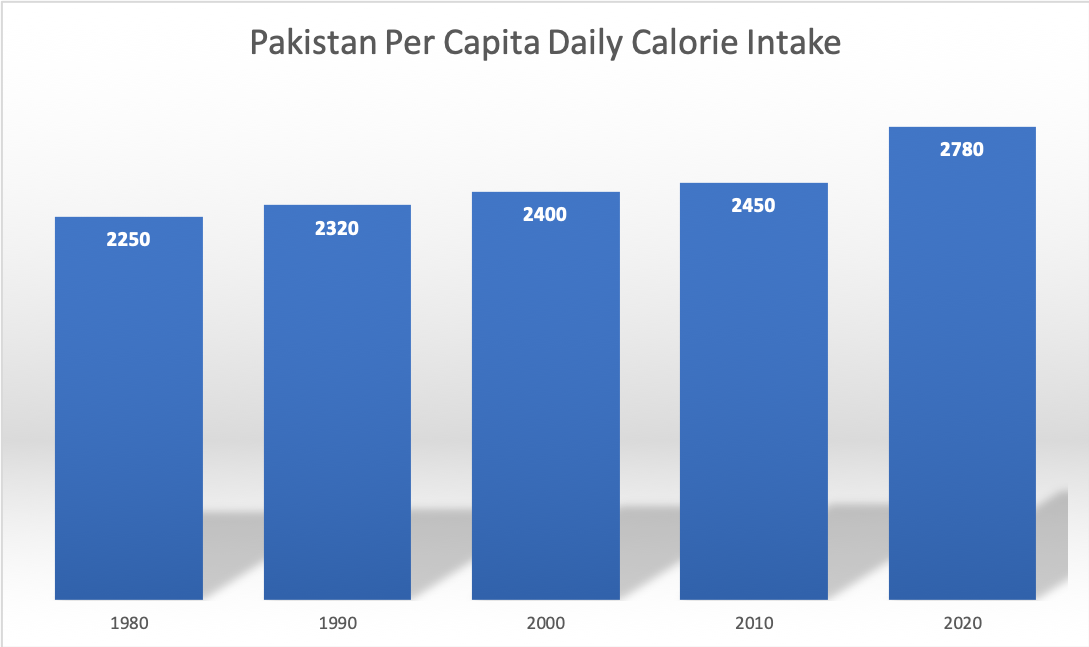
Pakistan Per Capita Daily Calorie Consumption. Source: Economic Surveys of Pakistan


The trend of higher per capita daily calorie consumption has continued since the 1950s. It has risen from about 2,078 in 1949-50 to 2,400 in 2001-02 and 2735 in 2021-22. The per capita per day protein intake in grams increased from 63 to 67 to about 75 during these years. Health experts recommend that women consume at least 1,200 calories a day, and men consume at least 1,500 calories a day, says Harvard Health Publishing.  The global average has increased from 2360 kcal/person/day in the mid-1960s to 2900 kcal/person/day currently, according to the Food and Agricultural Organization (FAO). The USDA (United States Department of Agriculture) estimates that most women need 1,600 to 2,400 calories, while the majority of men need 2,000 to 3,000 calories each day to maintain a healthy weight. Global Hunger Index defines food deprivation, or undernourishment, as consumption of fewer than 1,800 calories per day.

Share of Overweight or Obese Adults. Source: Our World in Data

The share of overweight or obese adults in Pakistan's population is estimated by the World Health Organization at 28.4%. It is 20% in Bangladesh, 19.7% in India, 32.3% in China, 61.6% in Iran and 68% in the United States.   

Major Food Items Consumed in Pakistan. Source: Economic Survey of Pakistan 2021-22

The latest edition of the Economic Survey of Pakistan estimates that per capita calories come from the annual per capita consumption of  164.7 Kg of cereals, 7.3 Kg of pulses (daal), 28.3 Kg of sugar, 168.8 liters of milk, 22.5 Kg of meat, 2.9 Kg of fish, 8.1 dozen eggs, 14.5 Kg of ghee (cooking oil) and 68.3 Kg of fruits and vegetables.  Pakistan's economy grew 5.97% and agriculture outputs increased a record 4.4% in FY 2021-22, according to the Economic Survey. The 4.4% growth in agriculture has boosted consumption and supported Pakistan's rural economy.  

Pakistan Growth Indicators. Source: Economic Survey 2021-22

The minimum recommended food basket in Pakistan is made up of basic food items (cereals, pulses, fruits, vegetables, meat, milk, edible oils and sugar) to provide 2150 kcal and 60gram protein/day per capita. 

The state of Pakistan's social sector is not as dire as the headlines suggest. There are good reasons for optimism. Key indicators show that nutrition and health in Pakistan are improving but such improvements need to be accelerated. 

Related Links:

Saturday, May 28, 2022

Pakistan's Global Fashion Brands Creating Other Branded Exports Opportunities

Pakistan is moving to higher value-addition in textile sector with branding. Khaadi, Gul Ahmed, J. by Junaid Jamshed, Sapphire, Sana Safinaz and others growing into global brands by expanding into countries with large Pakistani diaspora. Other Pakistani companies that have gained international brand recognition include Shan Masala, Pakola, Tapal Tea and K&N Frozen Foods. These companies are helping boost much needed exports to narrow Pakistan's growing current account deficits

Pakistani Global Brands. Source: Pakistan & Gulf Economist


As the Pakistani diaspora has grown to nearly 10 million in recent years, several Pakistani clothing and food brands have entered markets in the United States, United Kingdom, European Union and the Middle East. These markets create opportunities to build more Pakistani global brands, create jobs and grow Pakistan's exports

Khaadi Store, Package Mall, Lahore, Source: Wikimedia


Khaadi, which specializes in women's apparel, has attracted $25 million investment from International Finance Corporation (IFC) to help the company expand its business, create jobs, promote gender equality, and support the country’s crucial textiles sector after the COVID pandemic. Khaadi has established country-specific online stores for Canada, EU, Qatar, UAE, UK, US and Pakistan. In addition, the company has 57 physical retail outlets across Pakistan, UK and GCC countries. Investment Monitor, one of a network of 30+ proprietary B2B websites, has acknowledged the potential for Pakistani fashion brands in the following words:

"Despite its difficulties, Pakistan does have strong and innovative manufacturers, notably those developing their own apparel brands have emerged. Some of this has been based on advances in the Pakistan production of fine weave lawn cloth. And Pakistan consumers are becoming more brand conscious, being happy to seek out and wear local labels. Apparel brands, such as Khaadi (of Karachi); Sapphire (Lahore) and Sana Safinaz (Karachi), have focused on value addition and with Pakistan consumers prepared to pay for local quality, high profits have followed, including by developing exports".  

K&N Foods, a Pakistani branded poultry company, has recently started a poultry processing plant in New York. The company will sell Halal chicken products in the United States and Canada under the brand name of “K&N's Foods USA, LLC”. Beginning in the spring of 2013, the company invested more than $5 million in the purchase and renovation of a former Birds Eye plant which will employ almost 200 people in the Fulton area. Initially, K&N will focus on value-added processing of poultry purchased from other slaughter plants. The target market for these products will be specialty ethnic stores, supermarkets, and food service operations. 

Brands add value to the product being sold. This added value is effectively the difference between a product's price to consumers and the cost of producing it. Value can be added in several different ways, such as adding and promoting a brand name to a generic product or assembling a product in an innovative way. Brand marketing is done to create a consumer preference based on actual or perceived features or quality of what they buy from the store shelves. 

Developing countries like Pakistan manufacture products like ready-made garments for brand-name companies like Nike, Adidas, Levy's, etc. These garments are sold at a huge mark-up in the United States, and only tiny fraction of the money goes to Pakistan. 

Another global sector dominated by Pakistani manufacturers is surgical instruments. These precision instruments are sold by German companies under German labels with no mention of them having been made in Pakistan. Bulk of the money earned by selling goes goes into the pockets of German companies whose brand names appear on these surgical instruments. 

Manufacturers can earn much more by either building their own brands by spending a lot of money over a long time on advertising and marketing or by acquiring existing brands. Chinese manufacturers have been both in recent years to claim a much bigger share of profits generated by selling their products. Pakistani manufacturers can learn from the Chinese experience to do the same.

Related Links:

Haq's Musings

South Asia Investor Review

European Union: Fastest Growing Source of Remittances to Pakistan

Pakistani-Americans: Young, Well-educated and Prosperous

Ready-Made-Garments/Textile Boom in Pakistan

Fashion Week Karachi 2016

Pakistani Halal Meat Industry Experiencing Strong Growth

Over Half A Million Pakistanis Migrating Overseas Each Year

Pakistan Most Urbanized in South Asia

Pakistan Forecast to Become World's 7th Largest Consumer Market By 2030

Amazon Expands Pakistani Exports Opportunities


Saturday, May 21, 2022

International Tea Day: Pakistan is the World's Largest Tea Importer

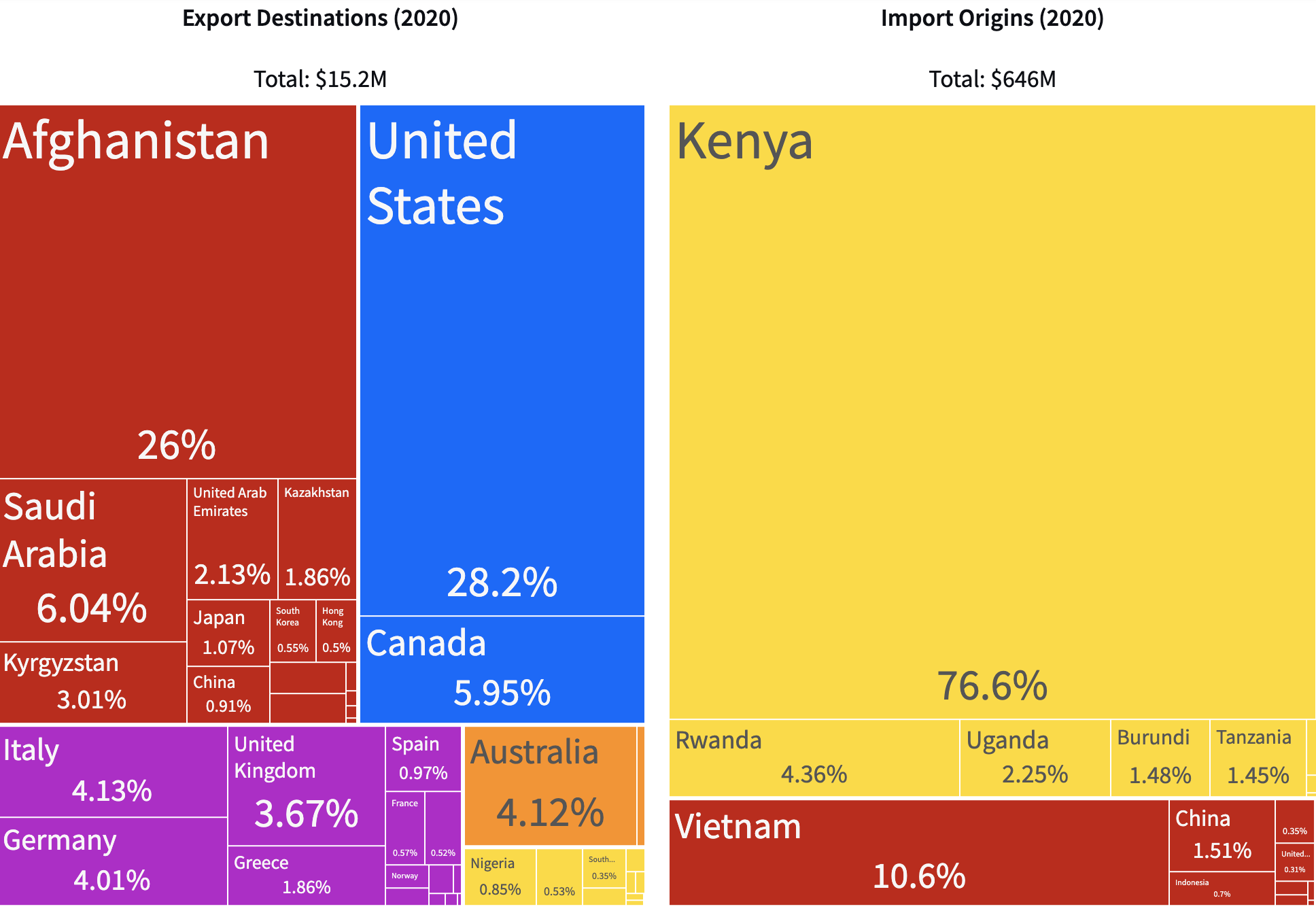
Pakistan does not produce tea but it is the most popular beverage among Pakistanis.  The country is ranked as its largest importer in the world.  In 2020, Pakistan imported $646 million (9% of global tea imports) worth of tea and exported $15.2 million in branded blends of tea such as Tapal Tea. Pakistan tea imports grew 19.8% from 2019 to 2020. 

Pakistan Tea Trade. Source: The Observatory of Economic Complexity


Other major tea importers in 2020 were as follows: United States: $473.8 million (7.1%) Russia: $412.2 million (6.2%) United Kingdom: $348.7 million (5.2%) Saudi Arabia: $243.6 million (3.7%) Iran: $236.3 million (3.5%) Hong Kong: $221.8 million (3.3%) Morocco: $202.3 million (3%) Egypt: $197.2 million (3%) Germany: $195 million (2.9%) China: $180 million (2.7%) France: $168.1 million (2.5%) United Arab Emirates: $164.9 million (2.5%) Japan: $156.6 million (2.4%) Iraq: $134.7 million (2%).  Global purchases of imported tea totaled US$6.7 billion in 2020. Of these countries, 4 markets for tea imports grew since 2019 namely: Hong Kong (up 19%), Pakistan (up 18.7%), Saudi Arabia (up 2.9%)  and France (up 0.7%).

Tea is popular in Pakistan and many other parts of the world for many reasons. A British study found that tea provides as much day-time stimulation as coffee, despite having half the caffeine. But tea was less likely to disrupt sleep. A Japanese study reported that plant compounds found in regular black tea – called theaflavins – were found to kill off oral bacteria linked with tooth and gum disease in a clinical trial with adults. A team of American scientists in Baltimore reviewed the evidence on tea and heart health, reporting that tea polyphenols have a direct impact on heart muscle contractions by controlling the flow of calcium ions into the muscle cells. The TAP (Tea Advisory Panel) data review reveals that more than half of Brits agree that tea is good for the heart.

World's Top Tea Importing Countries. Source: Statista

Last year, the PTI government headed by former Prime Minister Imran Khan decided to push domestic cultivation of tea in Pakistan with the help of Chinese experts. Already, trials have been conducted for growing tea in Mansehra, Battagram, Swat and Azad Kashmir regions which are considered to have the right climate for it. About 25,000 acres of government land has been allocated for tea cultivation along the China-Pakistan Economic Corridor (CPEC). 

“This year we are going to approve a project where we are growing tea on an area of 25,000 acres; we are creating history; we plan to complete the proposed tea plantations over the next five years,” said Special Assistant to Prime Minister on Food Security Jamshed Iqbal Cheema during his 2021 visit to the National Tea and High-Value Crops Research Institute (NTHRI) at Shinkiari, Mansehra in Khyber-Pakhtunkhwa province. Cheema said Pakistan has great potential for growing tea.  The country has 178,000 acres of tea cultivable land. “Pakistan can grow its own tea,” he said, adding that the country imported 30 million tonnes of tea each year from 15 different tea-producing countries.

Tuesday, February 1, 2022

US Says NO to Food as Human Right While Afghanistan Suffers Under Sanctions

On November 9, 2021, the United States, the world's most vocal supporter of human rights, voted against a United Nations committee's draft on the right to food which passed by 180 votes in favor to 2 against (Israel, United States). The UN committee expressed alarm that in 2020, "the number of people lacking access to adequate food rose by 320 million ‑ to 2.4 billion ‑ amounting to nearly a third of the world’s population, and that between 720 million and 811 million people faced hunger". Currently, the hunger situation in Afghanistan is the most acute with over half the population suffering from extreme levels of hunger. Afghanistan has been subjected to US sanctions since the US loss to the Taliban in 2021. 

UN Vote on Food as Human Right


 “Hunger is a violation of human dignity”, Cuba’s delegate said while addressing the UN Committee meeting. Presenting the draft, he voiced concern that the United States has blocked consensus on the text for four years in a row. The United States representative — highlighting conditions in the Lake Chad Basin, Yemen and Somalia ‑ said the draft contains unbalanced and inaccurate positions that her delegation simply cannot support. The concept of food sovereignty could justify food protectionism, negatively impacting food security, she explained, adding that the United States does not recognize the right to food, as it lacks a definition in international law.    

Meanwhile, Shelley Thakral, the World Food Program spokesperson for Afghanistan, says more than half the population — some 23 million Afghans — are facing what the WFP calls extreme levels of hunger. Malnutrition is soaring. Food prices have risen. And the WFP's surveys show the overwhelming majority of Afghans, 98% of the population, lack enough food to eat. Many are surviving on limited diets with less fresh vegetables, dairy or meat – or none at all, according to an NPR report

Afghanistan is not the first example of the US sanctions resulting in mass hunger and starvation. The reality is that the United States' sanctions over the years have denied many people around the world their basic right to food.The sanctions do not just hit the current generation of people experiencing hunger.  Sanctions permanently damage the social and economic fabric of the targeted nations. The effects of hunger last multiple generations in terms of their sub-par physical and mental development. 

In a recent article published in The Guardian, Nicholas Mulder, author of "The Economic Weapon: The Rise of Sanctions as a Tool of Modern War" has criticized the use of sanctions. He has said  "Promoting economic stimulus at home while enforcing deprivation abroad is a self-defeating way to seek world stability". Here is an except from Mulder's "The Economic Weapon": 

"As sanctions have become an accepted tool of liberal international institutions, the threshold for using them has declined. How to respond to the violation of norms remains, ultimately, a political question. In the spring of 1919, Robert Cecil waved away protests against using blockade to overthrow Bolshevism by responding that he saw “no other alternative.” Many of today’s internationalists, too, see few alternatives. This perception has driven some of the most grievously counterproductive uses of sanctions, most prominently against Iraq in the 1990s, when its strangulation at the hands of the UN Security Council cost hundreds of thousands of lives and permanently damaged the country’s social and economic fabric. These humanitarian nightmares are an important reminder of the lethal early twentieth-century origins of sanctions. But most economic sanctions used today are far more mundane in character. In 2015 a UN official estimated that one-third of the world’s population lives in countries that are under some form of economic sanctions. These range from the specific, such as individual travel bans and asset freezes, to more general measures, such as technological and trade restrictions. Today’s omnipresent sanctions have traveled a long way from their interwar purpose of preventing war".

As far back as 1924, famous British economist John Maynard Keynes  had argued that aiding our allies is more effective than sanctioning our foes. Mulder reminds the great powers of today, particularly the United States, that Keynes' lesson should be heeded now. 

Related Links:


Haq's Musings

South Asia Investor Review

Pakistan Among World's Largest Food Producers

Naya Pakistan Housing Program

Food in Pakistan 2nd Cheapest in the World

Hunger Worsens in India Amid COVID Pandemic

Pakistan to Become World's 6th Largest Cement Producer by 2030

Pakistan's 2012 GDP Estimated at $401 Billion

US Defeat By The Afghan Taliban

Coronavirus, Lives and Livelihoods in Pakistan

Vast Majority of Pakistanis Support Imran Khan's Handling of Covid19 Crisis

Pakistani-American Woman Featured in Netflix Documentary "Pandemic"

Incomes of Poorest Pakistanis Growing Faster Than Their Richest Counterparts

Can Pakistan Effectively Respond to Coronavirus Outbreak? 

How Grim is Pakistan's Social Sector Progress?

Pakistan Fares Marginally Better Than India On Disease Burdens

Trump Picks Muslim-American to Lead Vaccine Effort

COVID Lockdown Decimates India's Middle Class

Pakistan Child Health Indicators

Pakistan's Balance of Payments Crisis

How Has India Built Large Forex Reserves Despite Perennial Trade Deficits

Conspiracy Theories About Pakistan Elections"

PTI Triumphs Over Corrupt Dynastic Political Parties

Strikingly Similar Narratives of Donald Trump and Nawaz Sharif

Nawaz Sharif's Report Card

Riaz Haq's Youtube Channel