Showing posts with label World Food Program. Show all posts

Saturday, August 2, 2025

Pakistan Ranked Among Top Donors to UN's World Food Program

The United Nations World Food Program has ranked Pakistan fourth among donor countries and sixth overall in 2024.  Among the largest 15 donors worldwide, the United States topped the list with $4.45 billion, followed by Germany ($995 million), the United Kingdom ($610 million), European Union ($593 million), private donors ($335 million), Pakistan ($228 million), South Korea ($203 million), France ($196 million), Sweden ($183 million), Canada ($166 million), Norway ($158 million), Japan ($155 million), UN Central Emergency Fund ($135 million), other UN agencies ($120 million) and Switzerland ($88 million), according to the World Food Program

Top Donors to World Food Program in 2024. Source: WFP

The World Food Program says that 319 million people in 67 countries are facing acute hunger, and the scale of the current global hunger and malnutrition crisis is massive. "A total of 1.9 million people are in the grips of catastrophic hunger – primarily in Gaza and Sudan but also in pockets of South Sudan, Haiti and Mali. They are teetering on the brink of famine. In Zamzam camp in northern Sudan, famine has been confirmed. Many food crises involve multiple overlapping issues that are building year on year". 

Pakistan, being a generous nation and ranked among the top 10 food producing countries, feels a special responsibility to step up and feed as many hungry people as possible. Pakistan is a major global food producer, particularly in several key areas. It ranks among the top ten countries in the world for the production of wheat, rice, cotton, sugarcane, mangoes, dates, and kinnow oranges. It also produces large quantities of cereals, meat, milk, fruits, and vegetables. Specifically, Pakistan is the 8th largest producer of wheat and 10th largest producer of rice globally. 

World Giving Index has ranked Pakistan among the most generous generations in the past. A Michigan State University (MSU) study of 63 countries found that Pakistanis have higher empathy for others than people in their neighboring countries.  Philanthropy is part of the faith for most Pakistanis:

"Righteousness is not that ye turn your faces towards the east or the west, but righteousness is, one who believes in God, and the last day, and the angels, and the Book, and the prophets, and who gives wealth for His love to kindred, and orphans, and the poor, and the son of the road, beggars, and those in captivity; and who is steadfast in prayers, and gives alms." Quran 2:177

Related Links:

Friday, October 14, 2022

World Food Day 2022: India Tops Hunger Charts in South Asia

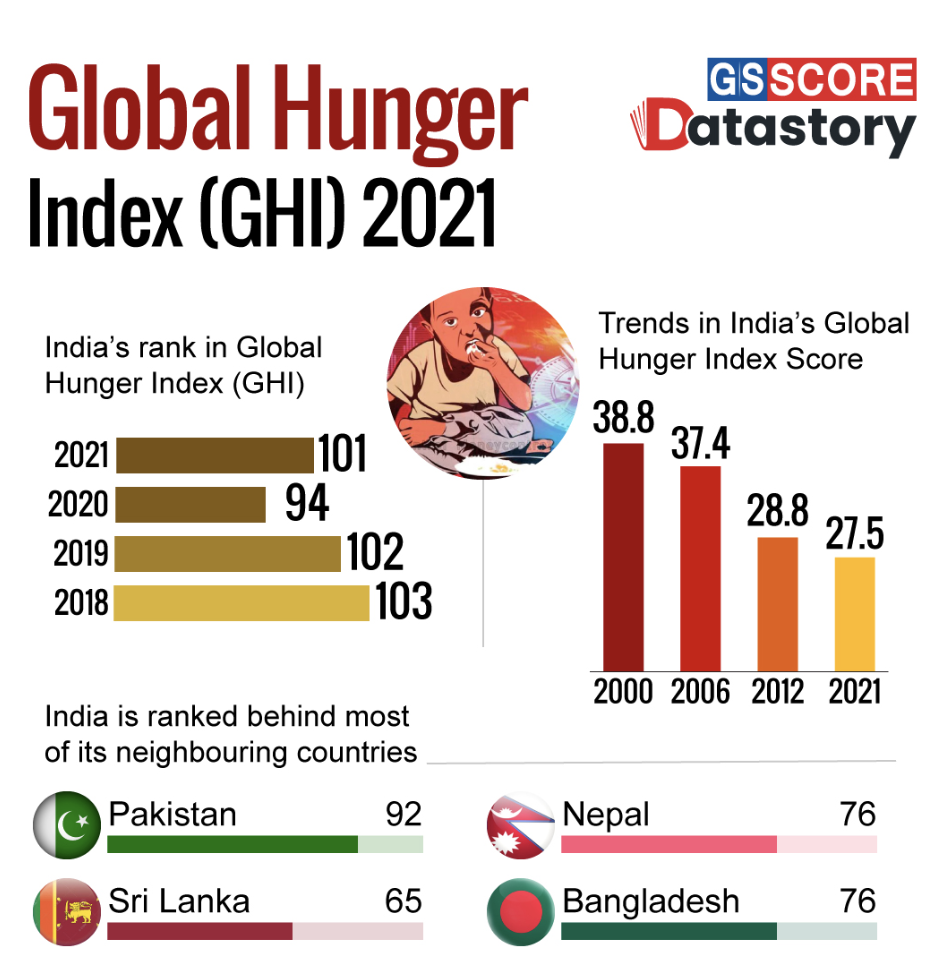
India ranks 107th for hunger among 121 nations. The nation fares worse than all of its South Asian neighbors except for war-torn Afghanistan ranked 109, according to the Global Hunger Index 2022. Sri Lanka ranks 64, Nepal 81, Bangladesh 84 and Pakistan 99. India and Pakistan have levels of hunger that are considered serious. Both have slipped on the hunger charts from 2021 when India was ranked 101 and Pakistan 92.  Seventeen countries, including Bosnia, China, Kuwait, Turkey and UAE, are collectively ranked between 1 and 17 for having a score of less than five.

South Asia Hunger Rankings. Source: GHI/IASScore


India’s child wasting rate (low weight for height), at 19.3%, is worse than the levels recorded in 2014 (15.1%) and even 2000 (17.15), and is the highest for any country in the world and drives up the region’s average owing to India’s large population, according to The Hindu newspaper. The child hunger situation has gotten worse since Mr. Narendra Modi was elected Prime Minister of India in 2014.  Earlier this year, Prime Minister Modi offered to "feed the world" in the aftermath of the Ukraine war.  Within weeks of this pledge he ended making an about-face.  On World Food Day 2022, the United Nations World Food Program has warned of another year of global record hunger looms amid food and climate crisis. 

India Hunger Trends. Source: GHI


Pakistan Hunger Trends. Source: GHI

Pakistan has a score of 26.1 and ranks 99th out of the 121 countries on Global Hunger Index rankings. India's GHI score is 29.1 and it ranks 107th. Hunger could worsen in Pakistan in the aftermath of the worst-ever flooding that has destroyed wheat and rice crops in southern Sindh province. Flood waters have not yet drained from the fields and standing water is preventing planting of the Rabi (winter) crop now. Here's an excerpt of USDA Food and Grain report on the wheat situation in Sindh:

"Farmers normally begin planting the wheat crop in mid-October and November in Sindh and Punjab, respectively. Sindh province usually accounts for almost twenty percent of national wheat production. However, large areas of Sindh typically planted to wheat are still submerged, and it may be several months before the flood waters recede. With Sindh’s flat terrain, poor drainage, and current high-water table, flood waters are receding slowly. As a result, seeding the 2023/24 wheat crop in Sindh is likely to be delayed and some areas may possibly remain unseeded. Even where the waters recede, farmers are likely to face difficulties in wheat planting as the floods washed away on-farm wheat seed stock in many areas. Additionally, farmers’ purchasing power in the affected areas is severely compromised making it difficult for them to buy fertilizers and other inputs".  

The number of hungry people around the world has shot up from 282 million to around 345 million since the beginning of 2022, and by mid-year, according to the United Nations World Food Program. “We are facing an unprecedented global food crisis and all signs suggest we have not yet seen the worst”, said WFP Executive Director David Beasley. “For the last three years hunger numbers have repeatedly hit new peaks. Let me be clear: things can and will get worse unless there is a large scale and coordinated effort to address the root causes of this crisis. We cannot have another year of record hunger”.

Related Links:


Haq's Musings

South Asia Investor Review

Pakistan Among World's Largest Food Producers

Pakistan Floods 2022

Food in Pakistan 2nd Cheapest in the World

India in Crisis: Unemployment and Hunger Persist After COVID

Impact of Russia Sanctions on Food, Fuel Availability

Record Number of Indians Seeking Asylum in US

Vast Majority of Pakistanis Support Imran Khan's Handling of Covid19 Crisis

Incomes of Poorest Pakistanis Growing Faster Than Their Richest Counterparts

Pakistanis Consuming More Calories, Fruits & Vegetables Per Capita 

How Grim is Pakistan's Social Sector Progress?

Pakistan Fares Marginally Better Than India On Disease Burdens

COVID Lockdown Decimates India's Middle Class

Pakistan Child Health Indicators

Pakistan's Balance of Payments Crisis

How Has India Built Large Forex Reserves Despite Perennial Trade Deficits

Riaz Haq's Youtube Channel

Friday, October 16, 2009

Persistent Hunger on World Food Day in South Asia


Marking World Food Day today, October 16, 2009, the United Nations World Food Program (WFP) called on the world to remember the more than one billion urgently hungry people, nearly half of them in India, with inadequate access to food.

“World Food Day is actually "No Food Day" for almost one out of every six people around the world this year,” WFP executive director Josette Sheeran said in Rome. “Our challenge is to turn ‘No Food Day’ back into ‘World Food Day’ for the hundreds of millions without food on their table tonight.”

Babu Matthew, country director for ActionAid India, said: "The dark side of India's economic growth has been that the excluded social groups have been further marginalized, compounding their hunger, malnutrition and even leading to starvation deaths."

Among the developing countries ranked by Action Aid for Hunger, Brazil wins the top spot with B grade (no country gets an A on a scale from A to E), with the aid agency praising President Luiz Inacio Lula da Silva's support for land reform and community kitchens for the poor.

ActionAid said Brazil's success shows "what can be achieved when the state has both resources and political will to tackle hunger".

China (B grade) is also gets high marks for cutting the number of hungry by 58 million in 10 years through strong state support for smallholder farmers.

But the report is critical of resurgent India, which receives the lowest possible E (essentially an F) grade for hunger. It says 30 million Indians have been added to the ranks of the hungry since the mid-1990s and 46% of children are underweight. Pakistan, with grade D, is also ranked low, with 31% of its children underweight. Bangladesh, receiving C grade, is praised for reducing the number of chronically food-insecure people from 40 million to 27 million in the past 10 years and for improving childhood nutrition in the past two decades. But the report says Bangladesh has a long way to go to reduce overall malnutrition and build a sustainable agricultural system.

A recent British government report has described India as nutritional weakling. There is widespread hunger and malnutrition in all parts of India. India ranks 66th on the 2008 Global Hunger Index of 88 countries while Pakistan is slightly better at 61 and Bangladesh slightly worse at 70. The first India State Hunger Index (Ishi) report in 2008 found that Madhya Pradesh had the most severe level of hunger in India, comparable to Chad and Ethiopia. Four states — Punjab, Kerala, Haryana and Assam — fell in the 'serious' category. "Affluent" Gujarat, 13th on the Indian list is below Haiti, ranked 69. The authors said India's poor performance was primarily due to its relatively high levels of child malnutrition and under-nourishment resulting from calorie deficient diets.

According to Economic Survey 2008-09, presented by Finance Minister Shaukat Tarin, Pakistan's economy grew by a mere 2.0 percent, barely keeping pace with population growth. The growth fell significantly short of the 4.5 percent target for the year, which was already very modest compared with an average of 7% economic growth witnessed from 2001-2008. As a result of the nation's economic troubles, there have been massive job losses and significant anecdotal evidence of increase in poverty and hunger. The lines for free food paid for by charities have been growing, with a sense of desperation not seen before, brought in sharp focus by the shameful deaths of several destitute women in Karachi scrambling to grab free wheat bags.

The ActionAid hunger score card is a sobering reminder for both India and Pakistan of how the nuclear armed neighbors lag most of the nations of the world in meeting the basic nutritional requirements of their people. Particularly disturbing are the high rates of underweight children at 44% in India and 31% in Pakistan. This egregious neglect of children by South Asians amounts to condemning their future generations to permanent brain damage.

Related Links:

India Tops World Hunger Chart

Food, Clothing and Shelter in India and Pakistan

Mixed Messages in Hunger Report

ActionAid's World Hunger Score Card

World Food Program in India

World Food Program Pakistan