Showing posts with label UK. Show all posts

Sunday, October 19, 2025

Improved US-Pakistan Ties: F-1 Visas For Pakistani Students Soaring

The F-1 visas for Pakistani students are soaring amid a global decline, according to the US government data. The US visas granted to Pakistani students climbed 44.3% in the first half of Fiscal Year 2025 (October 2024 to March 2025) with warming relations between the governments of the two countries. The number of visas granted to Indian students declined 44.5%, compared to  20% fewer US visas given to students globally in this period.  The number of US visas granted to Pakistani students in the current year is on track to reach 5,800 which will be an all-time high.  

F-1 Student Visa Trend For Pakistan 2018-2025. Source: ApplyBoard


In Pakistan, 3,322 F-1 student visas were granted in fiscal year 2023. The number of F-1 visas issued in the first half of fiscal year 2025 was 1,928, an increase of 44.3% compared to the same period in the previous year. While the final numbers for fiscal year 2025 are not yet complete, Pakistan is on track to issue a high number of F-1 visas, possibly reaching an all-time high. From October 2024 to May 2025, nearly 3,000 Pakistani students received F-1 visas, a figure that was expected to significantly increase during the peak summer months, according to ApplyBoard

Beyond the ‘Big Four’(Australia, Canada, UK and US), other destinations have seen increased interest from Pakistani students since the pandemic. In Europe, Germany has emerged as a major destination for Pakistani students seeking education abroad. 

Pakistani Studying in Germany. Source: ApplyBoard


Pakistan is third, after only China and India, in terms of the size of its college-aged population, according to the United Nations. The British Council expects growth in Pakistani outbound mobility to be among highest in the world over the next decade, along with China, India, Nigeria, and Bangladesh.Pakistanis pursuit of international education is largely focused on pursuing studies in high-demand fields like science, technology, engineering, and mathematics (STEM). 

Acceptance rate in Pakistani universities and degree colleges was just 13.5% in 2022. Only 541,043 students were accepted from 4,085,185 students who applied. The country produced 471,306 university graduates in 2020-21. Of these, 157,102 were in STEM fields, including 43,000 graduates in information technology (IT).  

Pakistan’s gross tertiary enrollment (GER) ratio was only 13% in 2023, according to UNESCO. This is much lower than in India, and lower than in Bangladesh and Sri Lanka as well. Of 109 countries UNESCO profiled in 2021, Pakistan’s tertiary GER was 100th. Given Pakistan’s huge college-aged population, there is serious unmet demand for higher education, according to the ICEF Monitor. 

Recent data on which destinations are hosting the most Pakistani students include:

UK: 34,690 in 2022/23 (+50% y-o-y)

China: 28,000 before the pandemic

UAE: 24,865 in 2020 according to UNESCO

Australia: 23,380 in 2023 (+49%)

US: 10,165 in 2022/23 (+16%)

Germany: 8,210 in 2022/23 (+22%)

Kyrgyzstan: 6,000 in 2020 according to UNESCO

Malaysia: 5,000 in 2023

Canada: 4,750 in 2023 (+101%)

Turkey: 2,385 in 2020 according to UNESCO

Saudi Arabia, South Korea, Sweden, Qatar: At least 4,000 in 2020 according to UNESCO


Saturday, August 2, 2025

Pakistan Ranked Among Top Donors to UN's World Food Program

The United Nations World Food Program has ranked Pakistan fourth among donor countries and sixth overall in 2024.  Among the largest 15 donors worldwide, the United States topped the list with $4.45 billion, followed by Germany ($995 million), the United Kingdom ($610 million), European Union ($593 million), private donors ($335 million), Pakistan ($228 million), South Korea ($203 million), France ($196 million), Sweden ($183 million), Canada ($166 million), Norway ($158 million), Japan ($155 million), UN Central Emergency Fund ($135 million), other UN agencies ($120 million) and Switzerland ($88 million), according to the World Food Program

Top Donors to World Food Program in 2024. Source: WFP

The World Food Program says that 319 million people in 67 countries are facing acute hunger, and the scale of the current global hunger and malnutrition crisis is massive. "A total of 1.9 million people are in the grips of catastrophic hunger – primarily in Gaza and Sudan but also in pockets of South Sudan, Haiti and Mali. They are teetering on the brink of famine. In Zamzam camp in northern Sudan, famine has been confirmed. Many food crises involve multiple overlapping issues that are building year on year". 

Pakistan, being a generous nation and ranked among the top 10 food producing countries, feels a special responsibility to step up and feed as many hungry people as possible. Pakistan is a major global food producer, particularly in several key areas. It ranks among the top ten countries in the world for the production of wheat, rice, cotton, sugarcane, mangoes, dates, and kinnow oranges. It also produces large quantities of cereals, meat, milk, fruits, and vegetables. Specifically, Pakistan is the 8th largest producer of wheat and 10th largest producer of rice globally. 

World Giving Index has ranked Pakistan among the most generous generations in the past. A Michigan State University (MSU) study of 63 countries found that Pakistanis have higher empathy for others than people in their neighboring countries.  Philanthropy is part of the faith for most Pakistanis:

"Righteousness is not that ye turn your faces towards the east or the west, but righteousness is, one who believes in God, and the last day, and the angels, and the Book, and the prophets, and who gives wealth for His love to kindred, and orphans, and the poor, and the son of the road, beggars, and those in captivity; and who is steadfast in prayers, and gives alms." Quran 2:177

Related Links:

Tuesday, July 15, 2025

Pakistani International Students Flocking to European Universities

Recent data shows that there are nearly 10,000 Pakistani students attending colleges and universities in Germany. This figure is second only to the United Kingdom which issued over 35,000 student visas to Pakistanis in 2024. The second most popular destination for Pakistani students is Australia which is hosting nearly 24,000 students from Pakistan as of 2023, according to the ICEF Monitor

Top Countries of Origin For International Students in Germany 2024. Source: Study in Germany


Here's a list of the top 15 countries of origin of foreign students in Germany in 2024: 

India 49,008

China 38,687

Turkey 18,084

Austria 15,379

Iran 15,159

Syria 13,379

Russia 10,593

Italy 10,154

Ukraine 9,914

Pakistan 9,873

Egypt 8,060

Morocco 7,398

Tunisia 6,852

Cameroon 6,789

France 6,759

This year, Pakistani students won 114 Erasmus Mundus EU Scholarships, the highest number in the world. This makes Pakistan the top country receiving these scholarships for the fourth consecutive year. The Erasmus Mundus Scholarship is a prestigious European scholarship program for graduates, funding joint master's degrees at prestigious universities across multiple countries.

Pakistani Students Received the Highest Number of EU Scholarships in 2025. Source: EU


Here's the list of top countries of EU Scholarship Winners in 2025: 

1. 🇵🇰 Pakistan: 114

2. 🇮🇳 India: 96

3. 🇧🇩 Bangladesh: 95

4. 🇲🇽 Mexico: 93

5. 🇳🇬 Nigeria: 75

6. 🇧🇷 Brazil: 73

7.  🇪🇸 Spain: 65

8. 🇺🇸 USA: 62

9. 🇪🇬 Egypt: 61

10. 🇩🇪 Germany: 61

Pakistan is third, after only China and India, in terms of the size of its college-aged population, according to the United Nations. The British Council expects growth in Pakistani outbound mobility to be among highest in the world over the next decade, along with China, India, Nigeria, and Bangladesh.

Acceptance rate in Pakistani universities and degree colleges was just 13.5% in 2022. Only 541,043 students were accepted from 4,085,185 students who applied. The country produced 471,306 university graduates in 2020-21. Of these, 157,102 were in STEM fields, including 43,000 graduates in information technology (IT).  

Pakistan’s gross tertiary enrollment (GER) ratio was only 13% in 2023, according to UNESCO. This is much lower than in India, and lower than in Bangladesh and Sri Lanka as well. Of 109 countries UNESCO profiled in 2021, Pakistan’s tertiary GER was 100th. Given Pakistan’s huge college-aged population, there is serious unmet demand for higher education, according to the ICEF Monitor. 

Recent data on which destinations are hosting the most Pakistani students include:

UK: 34,690 in 2022/23 (+50% y-o-y)

China: 28,000 before the pandemic

UAE: 24,865 in 2020 according to UNESCO

Australia: 23,380 in 2023 (+49%)

US: 10,165 in 2022/23 (+16%)

Germany: 8,210 in 2022/23 (+22%)

Kyrgyzstan: 6,000 in 2020 according to UNESCO

Malaysia: 5,000 in 2023

Canada: 4,750 in 2023 (+101%)

Turkey: 2,385 in 2020 according to UNESCO

Saudi Arabia, South Korea, Sweden, Qatar: At least 4,000 in 2020 according to UNESCO


Thursday, September 21, 2023

Canadian Sikh's Murder: How Long Will Modi Continue to Escape Accountability?

Canadian Prime Minister Justin Trudeau has accused the Indian government of involvement in the murder of a Canadian Sikh leader on Canadian soil. Trudeau announced this week that Canada was "actively pursuing credible allegations" that Indian intelligence agents had potentially been involved in the murder of Canadian citizen Hardeep Singh Nijjar in June, 2023. Canada, a member of the "Five Eyes" intelligence alliance with Australia, New Zealand, UK and the US, is reported to have shared intelligence on the incident with Washington.  The US and UK say they are "deeply concerned" and encourage Indian officials to cooperate in any investigation. There have been similar "mysterious" assassinations of Sikh leaders in Pakistan and the UK this year. Can the West afford to ignore these assassinations? Will Modi government be emboldened to continue its campaign of murder of more leaders of the significant Sikh diaspora in the West if the US fails to hold Modi to account now? 

Three Sikh Leaders Assassinated in 2023

Since the 2020-21 farmers' protests in Delhi, the Sikh diaspora has staged massive rallies at Indian diplomatic missions across western capitals. These rallies were followed by systematic, and near-simultaneous, killings of various Sikh leaders in Canada, Pakistan and UK. On May 6, 2023, Paramjit Singh Panwar was killed in Lahore, Pakistan. Avtar Singh Khanda was assassinated in Birmingham, England. on June 11. On June 18, Hardeep Singh Nijjar was murdered in Surrey, British Columbia, Canada. 

Reacting to the report of Trudeau's allegation against the Indian government, Pakistan Foreign Secretary Syrus Qazi said: “We are aware of the nature of our eastern neighbor, we know what they are capable of … so it is not a surprise for us. “We caught [one of their] serving naval intelligence officers on our soil. He (Kulbhushan Jadhav) is in our custody and admitted that he came here to create instability and spread evil,” he added. 

Pakistan foreign office spokesperson Mumtaz Zahra Baloch said her country remained a “target of a series of targeted killings and espionage by (Indian Intelligence Agency) RAW".  “In December last year, Pakistan released a comprehensive dossier providing concrete and irrefutable evidence of India’s involvement in the Lahore attack of June 2021. The attack was planned and executed by Indian intelligence,” she said, adding that in 2016, a high-ranking Indian military officer Kulbhushan Jadhav confessed to his involvement in directing, financing and executing terror and sabotage in Pakistan.

Narendra Modi has a long history of murdering minorities in his country. After the Gujarat anti-Muslim pogrom of 2002, Narendra Modi made the cover of India Today magazine with the caption "Hero of Hatred". Modi was denied a visa to visit the United States.  The US visa ban on Modi was lifted in 2014 after he became prime minister. Since then,  Narendra Modi's image has been rehabilitated by the West as the US and Western Europe seek allies in Asia to counter the rise of China.  However, Modi's actions on the ground in India confirm that he remains "Hero of Hatred" and "Divider In Chief" at his core.  A recent two-part BBC documentary explains this reality in significant detail. The first part focuses on the 2002 events in Gujarat when Modi as the state chief minister ordered the police to not stop the Hindu mobs murdering Muslims and burning their homes and businesses.  The second part looks at Modi government's anti-Muslim policies, including the revocation of Kashmir's autonomy (article 370) and a new citizenship law (CAA 2019) that discriminates against Muslims. It shows the violent response by security forces to peaceful protests against the new laws, and interviews the family members of people who were killed in the 2020 Delhi riots orchestrated by Modi's allies. 

Having been caught by Ottawa in the act of murdering one of its citizens, the Indian government has reacted angrily, calling the Canadian allegations "absurd". In fact, India has labeled victims of assassination campaign "terrorists".  The Indian response will only force Canada to publicly share evidence of wrongdoing by New Delhi. Such public disclosures will expose India's links to similar recent "mysterious" murders in Pakistan and the UK.  It will also force London and Washington to confront the issue because the UK and the US also have hundreds of thousands of Sikh citizens whose leaders will be vulnerable to potential assassinations by the Modi government. 

Here's Indian National Security Advisor on how to use Taliban to attack Pakistan:

https://youtu.be/eYRuk8H5M9E?si=ZB1c7Dd8ntQdKeFi


 Related Links:

Haq's Musings

Karan Thapar Dismantles Official Indian Narrative on Kulbhushan Jadhav

Why is India Sponsoring Terror in Pakistan? 

Indian Agent Kubhushan Yadav's Confession

Has Modi Stepped Up India's Covert War in Pakistan?

Ex India Spy Documents Successful RAW Ops in Pakistan

London Police Document Confirms MQM-RAW Connection Testimony

India's Ex Spooks Blame Kulbhushan Jadhav For Getting Caught

Ajit Doval Lecture on "How to Tackle Pakistan" 

Mohan Lal Bhaskar: An Indian Raw Agent in Pakistan


Saturday, July 22, 2023

Pakistani Students Account For Largest Share of Increase in Interest in Europe

Interest in studying in Europe  is growing in certain key markets like Pakistan and Bangladesh in particular, according to a recent report on foreign students coming to Europe. Although India generates the largest share of relative demand, this fluctuates drastically and has gradually declined overall in recent years, the report adds.  

Interest in Bachelor's Programs. Source: StudyPortals.com


The chart above shows the top origin countries for interest in Bachelor’s programs in Europe, as well as the evolution of that interest over the last four years. 

Interest in Bachelor's Programs. Source: StudyPortals.com


Bangladesh and Pakistan also show strong demand in Master’s programs, alongside students in Turkey and Iran. The report reveals widening European interest and shift towards STEM

Among 2,835 students from 143 countries selected for the Erasmus Mundus Joint Masters program, Pakistani students rank at the top with 192 scholarships, followed by India 174, Bangladesh 140, Mexico 118, and Nigeria 109, according to an EU tweet. Currently, there are 7.114 Pakistani students studying in Germany. 

The United Kingdom emerged as the top destination for Pakistani students with 28,188 student visas granted in 2022,  up 95% from the previous year. The UK has now surpassed China has the biggest draw for Pakistani students after the COVID19 pandemic.  Of the 486,868 UK student visas granted (to both main applicants and their dependents), 117,965 went to Indian nationals. This is an increase of 80,569 (+215%) compared to 2019, and slightly more than the 115,056 granted to Chinese nationals — but Pakistani nationals saw a bigger increase in approvals for their UK student visas at 377% compared to India’s 215%, according to Study International

Foreign Students in the US. Source: Open Doors


The US also reported a 17.4% increase in the number of Pakistani students studying in the United States during 2021-22. This brought their number to 8,772, according to Open Doors. The Open Doors Report identified China and India as the largest sources of international students to the United States. During 2021-22, China sent 290,086 students, which is 30.6% of the total number of international students in the US, a decline of 8.6% from the previous year. India, which sent 199,183 students this year — 21% of the total — saw a 19% year-over-year increase. Toge­ther, China and India make up more than half of all international students in the United States.

The number of Pakistani students studying in Australia has also increased 21% to 20,935 in 2022.  The number of first-time enrollments of Pakistanis jumped 71% in the year, according to ICEF Monitor

Offsetting a decline in Chinese enrollments in Australia (177,470 in 2022, down 11% y-o-y) and zero momentum from India (128,980, up .03%) were notable enrollment increases from:

Thailand, the 6th largest market, up 61% to 25,792

Nepal, the 3rd largest market, up 21% to 71,805

Colombia, the 4th largest market, up 21% to 28,435

Pakistan, the 9th largest market, up 21% to 20,935

Related Links:


Pakistani Students Biggest Winners of EU Scholarships Among 143 Countries

Pakistan Broadband Subscriptions Pass 100 Million

NED University Ranked Among World's Top 200 For Impact

Over a Million Pakistan University Students Enrolled in STEM Programs

Pakistan Gig Economy Among World's Fastest Growing

NED Alum Sells Silicon Valley Company For $7.5 Billion

Pakistani Student Team Among Top 3 Winners Invited to CERN

Over a Million Pakistani University Students Enrolled in STEM Education

State Bank Targets Fully Digital Economy in Pakistan

NED University Alum Raises $100 Million For His Silicon Valley Fintech Startup

Digital Pakistan: Broadband Penetration Reaches 90% of 15+ Population

Pakistan's Large and Growing Civil Nuclear Program

2021: A Banner Year For Pakistani Tech Startups

NED Alum's AI Startup Startup Named Most Innovative at RSA Conference

Karachi-Born NED Alum Leads Mercedes' Entry into Electric Vehicle Market

AI Research Funded by NED Alum at His Alma Mater

Riaz Haq's Youtube Channel


Monday, June 26, 2023

Pakistani Students Win Highest Number of US and EU Scholarships Among 143 Countries

Pakistani students have received more EU-funded Erasmus scholarships and US-sponsored Fulbright scholarships this year than students from any other country in the world. These are fully-funded scholarships for recipients to study at universities in the European Union and the United States. Pakistan has also seen a post-pandemic surge  of student visas to study in Australia, the US and UK this year. 

EU Scholarships. Source: EU Pakistan

Among 2,835 students from 143 countries selected for the Erasmus Mundus Joint Masters program, Pakistani students rank at the top with 192 scholarships, followed by India 174, Bangladesh 140, Mexico 118, and Nigeria 109, according to an EU tweet

Within the EU, Germany is hosting 7,114 Pakistani students, according to Erudera. Among the major countries of origin of foreign students in Germany are: China 40,055, India 33,753, Syria 16,712,  Iran 11,625, Russia 10,739, Italy 9,887, Cameroon 7,692 and Egypt 7,214.  

The Fulbright scholarship program of the United States Government has awarded 189 scholarships for Pakistanis to study at US universities. Fulbright is the flagship scholarship program of the United States Government, operating in 160 countries.  Pakistan has the largest Fulbright program in the world in terms of U.S. government contribution, with $18.44 million dollars this year to support 189 students, according to the US Embassy in Islamabad, Pakistan. 

The United Kingdom emerged as the top destination for Pakistani students with 28,188 student visas granted in 2022,  up 95% from the previous year. The UK has now surpassed China has the biggest draw for Pakistani students after the COVID19 pandemic.  Of the 486,868 UK student visas granted (to both main applicants and their dependents), 117,965 went to Indian nationals. This is an increase of 80,569 (+215%) compared to 2019, and slightly more than the 115,056 granted to Chinese nationals — but Pakistani nationals saw a bigger increase in approvals for their UK student visas at 377% compared to India’s 215%, according to Study International

Foreign Students in the US. Source: Open Doors

The US also reported a 17.4% increase in the number of Pakistani students studying in the United States during 2021-22. This brought their number to 8,772, according to Open Doors. The Open Doors Report identified China and India as the largest sources of international students to the United States. During 2021-22, China sent 290,086 students, which is 30.6% of the total number of international students in the US, a decline of 8.6% from the previous year. India, which sent 199,183 students this year — 21% of the total — saw a 19% year-over-year increase. Toge­ther, China and India make up more than half of all international students in the United States.

The number of Pakistani students studying in Australia has also increased 21% to 20,935 in 2022.  The number of first-time enrollments of Pakistanis jumped 71% in the year, according to ICEF Monitor

Offsetting a decline in Chinese enrollments in Australia (177,470 in 2022, down 11% y-o-y) and zero momentum from India (128,980, up .03%) were notable enrollment increases from:

Thailand, the 6th largest market, up 61% to 25,792

Nepal, the 3rd largest market, up 21% to 71,805

Colombia, the 4th largest market, up 21% to 28,435

Pakistan, the 9th largest market, up 21% to 20,935

Related Links:


NED Alum Raises $190 Million to Challenge ARM's Dominance

Pakistan Broadband Subscriptions Pass 100 Million

NED University Ranked Among World's Top 200 For Impact

Covid Impact: Pakistani Student Enrollment Declines in US, China

Pakistan Gig Economy Among World's Fastest Growing

NED Alum Sells Silicon Valley Company For $7.5 Billion

Pakistan's Demographic Dividend

Over a Million Pakistani University Students Enrolled in STEM Education

State Bank Targets Fully Digital Economy in Pakistan

NED University Alum Raises $100 Million For His Silicon Valley Fintech Startup

Digital Pakistan: Broadband Penetration Reaches 90% of 15+ Population

E-Commerce in Pakistan

2021: A Banner Year For Pakistani Tech Startups

NED Alum's AI Startup Startup Named Most Innovative at RSA Conference

Karachi-Born NED Alum Leads Mercedes' Entry into Electric Vehicle Market

AI Research Funded by NED Alum at His Alma Mater

Riaz Haq's Youtube Channel


Saturday, April 15, 2023

Pakistan is the Second Biggest Source of Foreign Doctors in US and UK

When US Ambassador Richard Holbrooke suffered a massive heart attack in 2010, the doctors who responded to this emergency were both foreign: one from India and the other from Pakistan. Dr. Farzad Najam, a graduate of King Edward Medical College in Lahore, was the chief heart surgeon at George Washington University Hospital at the time. Dr. Monica Mukherjee, a junior cardiologist at the hospital, assisted Dr. Najam in the operating theater. This episode illustrates the high profile presence of South Asian doctors in the United States. 

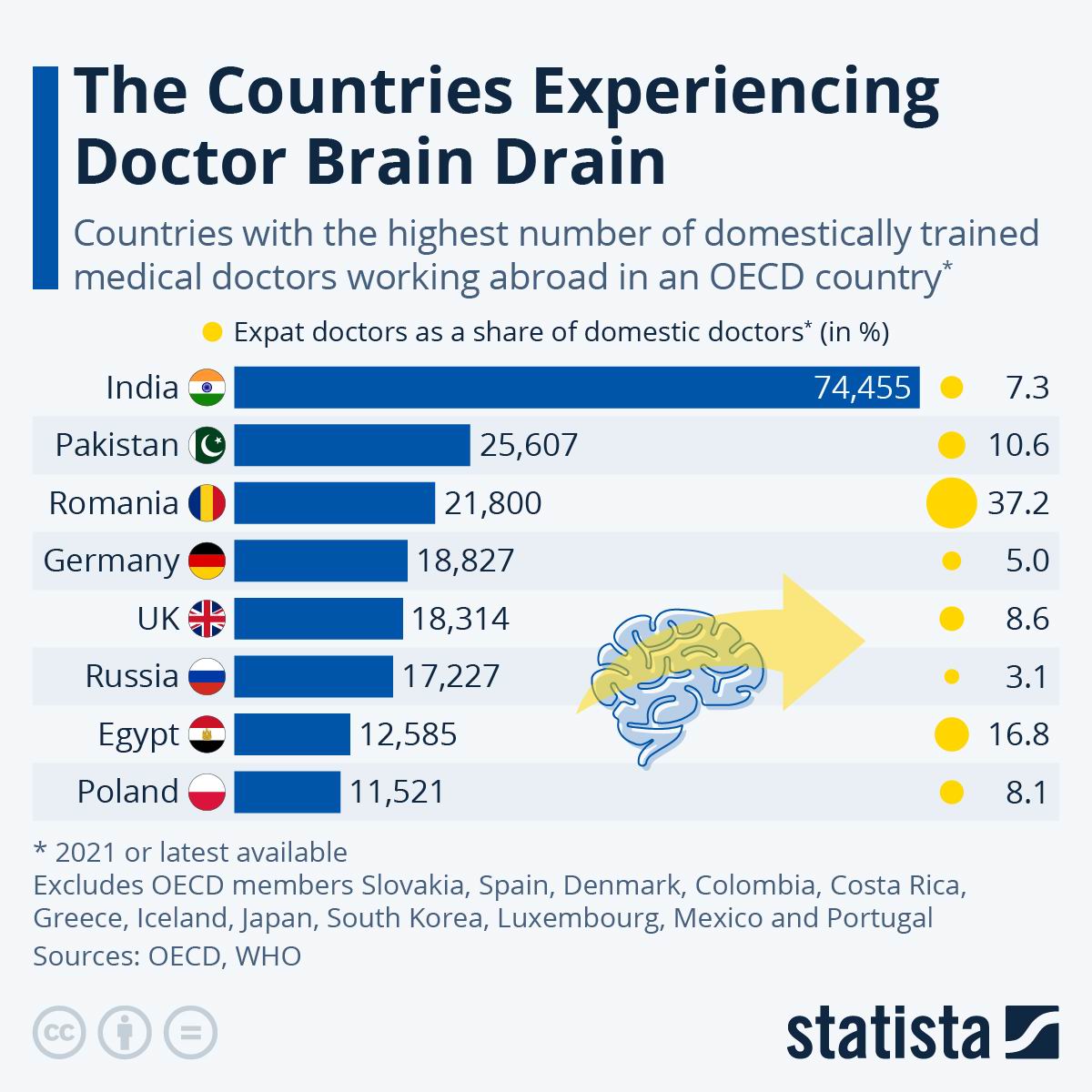
Doctor Brain Drain. Source: Statista

More recently, Dr. Mansoor Mohiuddin, a 1989 graduate of Karachi's Dow Medical College, made global headlines when he implanted a pig heart in a patient at University of Maryland School of Medicine. Considered one of the world’s foremost experts on transplanting animal organs, known as xenotransplantation, Muhammad M. Mohiuddin, MD, Professor of Surgery at UMSOM, joined the UMSOM faculty five years ago and established the Cardiac Xenotransplantation Program with Dr. Griffith. Dr. Mohiuddin serves as the program’s Scientific/Program Director and Dr. Griffith as its Clinical Director.    

Top Countries of Origin of Foreign Doctors in the US. Source: OECD


The pervasive presence of South Asian doctors in the United States is confirmed by OECD (Organization for Cooperation and Development) statistics on foreign doctors in OECD member nations. While India has remained the top source of foreign doctors since 2013, Pakistan has moved up from third to second spot in this period.  As of 2016, there were  45,830 Indian doctors  and 12,454 Pakistani doctors among 215,630 foreign doctors in the United States. India (45,830) and Pakistan (12,454) are followed by Grenada (10,789), Philippines (10,217),  Dominica (9,974), Mexico (9,923), Canada (7,765), Dominican Republic (6,269), China (5,772), UAE (4,635) and Egypt (4,379). 

In percentage terms, 21% of foreign doctors come from India, 6% from Pakistan, 5% each from Grenada, Philippines and Dominica and 4% from Mexico.

Pie Chart of Origins of Foreign Medical Graduates in US. Source: OECD


Many of these "foreign doctors" are US citizens, born and raised in the United States, who travel abroad to study at foreign medical schools. Their reasons vary from ease of admissions to lower costs. This is particularly true of the medical schools  in the Caribbean nations.  

Many Caribbean nations have established medical schools to especially cater to the demand from the United States. In 2007, Pakistan, too, set up Dow International Medical College as part of Dow University of Health Science (DUHS). 

Indians and Pakistanis also make up the top two nationalities among 66,211 foreign doctors in the United Kingdom. There are 18,953 doctors from India, 8,026 from Pakistan, 4.880 from Nigeria and 4,471 from Egypt in the UK.

The list of 25,400 foreign doctors in Canada is topped by South Africans (2,604) followed by Indians (2,127), Irish (1,942), British (1,923), Americans (1,263) and Pakistanis (1,087). 

There are 25,607 Pakistani medical school graduates currently working in all of the OECD member countries which are considered the rich industrialized nations. These Pakistani doctors account for 10.6% of 242,000 Pakistan-trained doctors practicing now. 74,455 Indian doctors working in OECD nations make up 7.3% of about 1,020,000 of all India-trained doctors in practice. 

In spite of losing 10.6% of its doctors to "brain drain" compared to India's 7.3%, Pakistan still has more doctors per capita (1.1 per 1000 population) than India (0.7 doctors per 1000 population), according to the World Bank.  Pakistani medical colleges admit 16,000 students a year compared to 92,000 in India.

As the populations age and demand for medical services grows in the West, more and more of it is being met by recruiting health care workers, including doctors and nurses, from the developing world. 

Related Links:

Haq's Musings

South Asia Investor Review

Pakistani-American Health Professional Featured in Netflix Documentary "Pandemic"

Pakistan is the 3rd Largest Source of Foreign Doctors in America

Pakistani-Americans Largest Foreign-Born Muslim Group in Silicon Valley

Racial Slurs Hurled at Pakistani-American Doctor in St. Louis, Missouri

Islamophobia in America

Silicon Valley Pakistani-Americans

Pakistani-American Leads Silicon Valley's Top Incubator

Silicon Valley Pakistanis Enabling 2nd Machine Revolution

Pakistani-American Surgeon Implants Pig Heart in Human

Pakistani-American Ashar Aziz's Fire-eye Goes Public

Pakistani-American Doctor Honored By President Obama

Pakistani-American's Game-Changing Vision 

Minorities Are Majority in Silicon Valley 

Over A Million Pakistani University Students Enrolled in STEM Fields


Sunday, January 29, 2023

India at WEF2023: UP CM Yogi Adityanath Feared Arrest, Canceled Davos Visit

Yogi Adityanath, the radical Hindu Chief Minister of the Indian state of Uttar Pradesh, canceled his plans to lead a delegation to the 2023 World Economic Forum at Davos, Switzerland. The cancellation came after a criminal complaint was filed against the Hindu Nationalist leader who is widely seen as Prime Minister Modi's successor. 

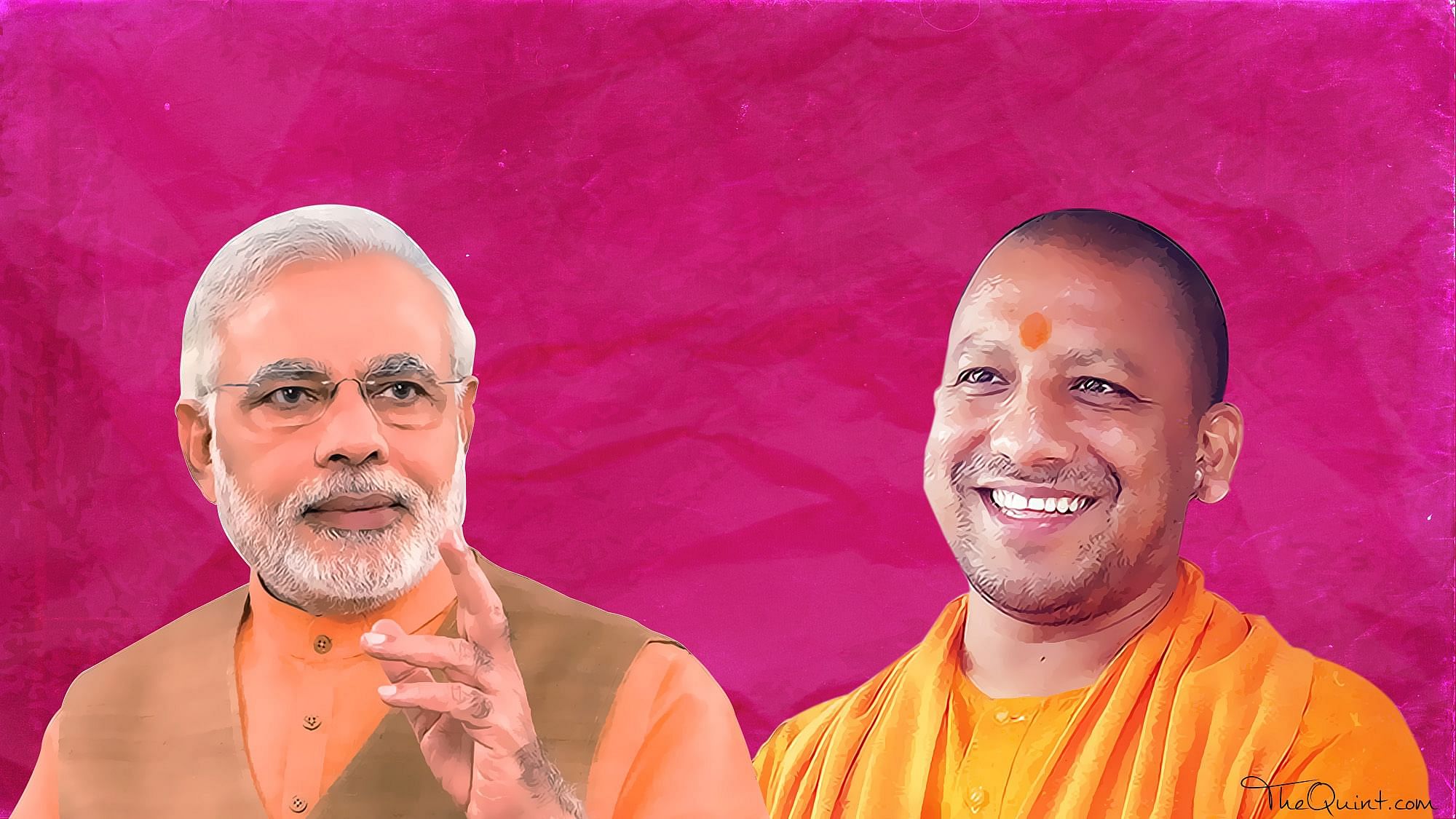
Indian Prime Minister Narendra Modi (L), UP Chief Minister Yogi Adityanath (R)


Adityanath was planning to lead a delegation to the World Economic Forum-2023 meeting at Davos, Switzerland, according to reports in the Indian news media. The state government put up a pavilion to showcase Uttar Pradesh as “the best investment destination”.

The complaint was filed under the principle of “universal jurisdiction” by law firm Guernica 37. It alleges that Adityanath ( real name Ajay Singh Bisht) “ordered the false imprisonment, torture and murder of civilians between December 2019 and 2020” and that “these acts may amount to crimes against humanity.”   

Guernica 37 (G37) describes itself as a "Specialist Group of International Criminal and Human Rights Lawyers with a Socially Committed and Multi-Disciplinary Outlook".  It claimed that the chief minister does not enjoy diplomatic immunity, and hopes the filing will have a cooling effect on WEF attendance in the future by any political or business figures alleged to have committed criminal acts.

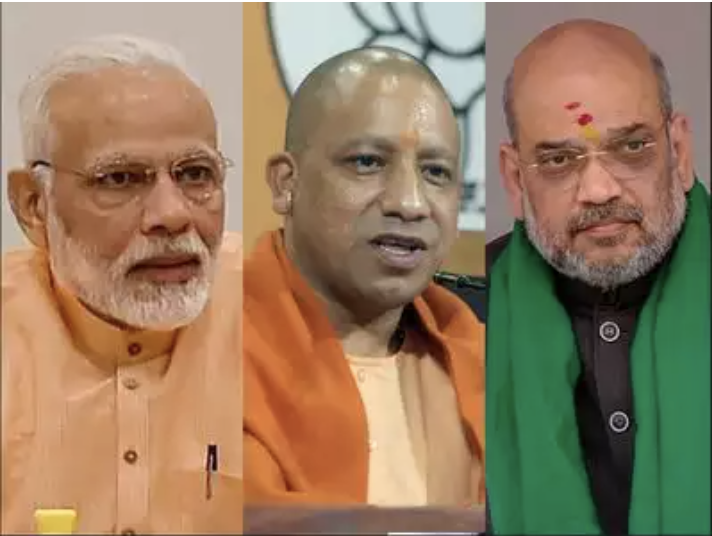
Top Radical Hindu Leaders: Modi (Left), Yogi (Middle) and Shah (Right)

Prior to being elected Prime Minister of India, Modi was barred from visiting the United States and the United Kingdom for his role in the anti-Muslim pogrom in Gujarat in 2002. Speaking about the US decision to grant immunity to Saudi Crown Prince Mohammad Bin Salman, State Department spokesperson Vedant Patel said that it was “not the first time” that the US government has designated immunity to foreign leaders and listed four cases. “Some examples: President Aristide in Haiti in 1993; President Mugabe in Zimbabwe in 2001; Prime Minister Modi in India in 2014; and President Kabila in the DRC in 2018. This is a consistent practice that we have afforded to heads of state, heads of government, and foreign ministers,” he said. 

Like his leader Modi, Yogi is a highly divisive Indian Hindu politician. His incendiary anti-Muslim rhetoric and bulldozing of Muslim homes have won him popular Hindu support in India. He is also very popular among the Hindu Indian diaspora.  

"We are all with you Modiji and Yogiji", shouted an Indian American man who tweeted a video clip of a a 2022 car rally in Silicon Valley, California. Rally participants can be seen carrying pictures of Prime Minister Narendra Modi and Uttar Pradesh Chief Minister Yogi Adityanath. Some also carried BJP's lotus flags. Hindu Americans enjoy the freedom to practice their faith and culture in the United States while at the same time they support Hindutva fascist rule in their country of origin. 

Related Links:


Friday, May 20, 2022

Pakistanis Are Third Largest Foreign Investors in Dubai Real Estate

Pakistanis have invested $10.6 billion in Dubai real estate, ranking them as the third largest investors in the city on the Gulf. Indian investors lead Dubai real estate investments with $29.8 billion, followed by British investors' $14.7 billion investment. 

Wealth From Top 20 Countries Invested in Dubai Real Estate. Source: EU Tax Observatory

With at least $146 billion in foreign wealth invested, the Dubai property market is now the world's largest offshore investment market for foreign investors. It is now twice as large as the London real estate market in terms of wealth invested by foreigners through shell companies. There are nearly 20,000 unique foreign owners of Dubai real estate from Pakistan, the third largest number behind almost 35,000 Indian owners and about 23,000 owners from the United Kingdom, according to the EU Tax Observatory.


Unique Entities From Top 20 Countries Owning Dubai Real Estate. Source: EU Tax Observatory


The record flow of foreign wealth into Dubai real estate has drawn the attention of the FATF (the Financial Action Task Force), the global anti-money-laundering  watchdog. The UAE is now "under increased monitoring” (often referred to as the grey list) by the FATF.  It is widely accepted that real estate is used for money laundering and hiding wealth from tax authorities.

Money Laundering Risk. Source: FATF


Many rich Pakistanis, including top politicians and their family members, own real estate in Dubai, according to press reports. Most of the top politicians from Pakistani political parties like PPP, PML-N, ANP and MQM own Dubai real estate.  A 2020 Transparency International report said the following about Dubai's attraction to foreign unexplained wealth: 

"The UAE’s booming construction and real estate sector emerges as another major weakness. It accounts for a fifth of the Emirates’ GDP, but remains incredibly vulnerable to money laundering. Complex ownership structures can be used to obscure the identity of those buying property, as well as where their money is coming from".

"Despite the UAE’s role as a major international hub for finance and trade, the report concludes that authorities there are not cooperating with international partners. This could make the Emirates an attractive location in which “criminals could operate, maintain their illegal proceeds, or use it as a safe haven.”

"The FATF report confirms what investigative journalists, anti-corruption activists and whistleblowers have been saying for years: the UAE is a key piece in the global money-laundering puzzle. Its susceptibility to money laundering has seen it appear time and again in major cross-border corruption scandals". 

Monday, May 16, 2022

Pakistan: The Only Country in Asia With Birthright Citizenship

Pakistan is the only country in Asia that recognizes citizenship as a birthright. Only one in four nations in the world grant citizenship to all those born within their borders, according to a review of the nationality laws reviewed by EUI Global Citizenship Observatory.  Instead of birthright citizenship, the majority of countries today have citizenship by blood, in which children inherit citizenship from their parents. 

Citizenship as Birthright. Source: Quartz

Based on a review of the nationality laws of 174 nations, only 39, or about 1 in 4, grant citizenship to people born in the country, barring exceptions to children of diplomat parents, according to an article published in QUARTZ.  

Pakistan stands out as the only nation in Asia that grants citizenship as birthright.  It is the most common practice for the countries in the Americas: Canada, Mexico, Argentina, Brazil, among others, all follow this practice. Birthright citizenship is seen as a key measure of a nation's openness to immigrants.

Birthright citizenship didn’t exist in the US at the time of its founding. It was granted as part of the Civil Rights Act of 1866, followed by the Fourteenth Amendment and the 1898 Supreme Court decision in United States v. Wong Kim Ark, which led to the racial and ethnic diversity in the United States today.

The United Kingdom used to recognize birthright citizenship but the British government removed unconditional citizenship by birth in the British Nationality Act of 1981. Children born in the UK today can get citizenship only if they have at least one parent who’s a citizen or is a resident of the British territories. Germany loosened its policy in 2000, replacing the parent’s citizenship requirement with residency. Children born to a parent who has a German resident permit or has lived in Germany for at least eight years can get German citizenship.

Related Links:

Haq's Musings

South Asia Investor Review

Pakistan is the 7th Largest Source of Migrants in OECD Nations

Pakistani-Americans: Young, Well-educated and Prosperous

Inspirational Story of Karachi Rickshaw Driver's Daughters

Pakistan Remittance Soar 21X

Pakistan's Growing Human Capital

Two Million Pakistanis Entering Job Market Every Year

Pakistan Most Urbanized in South Asia

Hindu Population Growth Rate in Pakistan

Do South Asian Slums Offer Hope?


Thursday, February 24, 2022

Ukraine's Lesson For Pakistan: Never Give Up Nuclear Weapons

Commenting on Ukraine, Russian analyst  Alexey Kupriyanov told Indian journalist Nirupama Subramanian: "For us, Ukraine is the same as Pakistan for India". What he failed to mention is that Pakistan has developed and retains its nuclear arsenal while Ukraine gave up its nukes in the 1990s after the fall of the Soviet Union. Many Ukrainians now regret this decision. Ukrainians know that no country with nuclear weapons has ever been physically invaded by a foreign military. They now understand the proven effectiveness of nuclear deterrence.  They realize that all the talk about "rules-based order" is just empty rhetoric. The reality is the Law of the Jungle where the strong prey on the weak. The US military invasions of Afghanistan and Iraq have shown that Washington is just as guilty of violating the "rules-based order" as Moscow. 

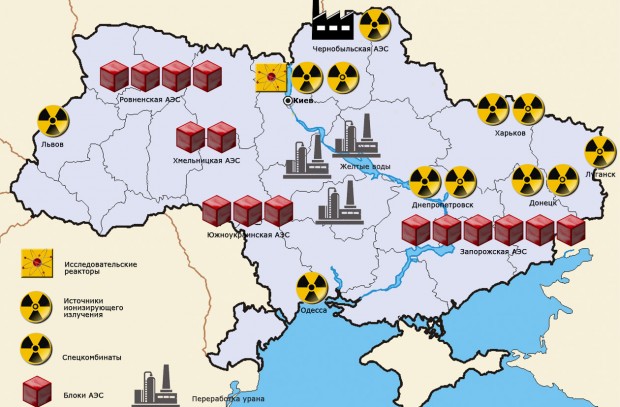
Ukraine Gave Up Nukes in 1990s. Source: Utica Phoenix


Denuclearization of Ukraine:

When Ukraine became independent in the early 1990s,  it was the third-largest nuclear power in the world with thousands of nuclear arms. In the years that followed, Ukraine made the decision to denuclearize completely based on security guarantee from the U.S., the U.K. and Russia, known as the Budapest Memorandum.  Ukrainian analyst Mariana Budjeryn explained in an interview with NPR's Mary Louise Kelly as follows: 

"It is clear that Ukrainians knew they weren't getting the exactly - sort of these legally binding, really robust security guarantees they sought. But they were told at the time that the United States and Western powers - so certainly, at least, the United States and Great Britain, they take their political commitments really seriously. This is a document signed at the highest level by the heads of state".

US Efforts to Stop Pakistan's Nukes:

The order to conduct Pakistan's nuclear tests came from Mr. Nawaz Sharif who was Pakistan's prime minister in 1998. It came on May 28, just over two weeks after India's nuclear tests conducted May 11 to May 13, 1998. Pakistan went ahead with the tests in spite of the US pressure to abstain from testing.  US President Bill Clinton called Prime Minister Nawaz Sharif immediately after the Indian tests to urge restraint.  It was followed up by Deputy Secretary of State Strobe Talbott's visit to Islamabad on May 16, 1998.

In his 2010 book titled "Engaging India: Diplomacy, Democracy, and the Bomb", Secretary Talbott has described US diplomatic efforts to dissuade Pakistan in the two weeks period between the Indian and Pakistani nuclear tests. Here are a few excerpts of the book divided into four sections covering Clinton's call to Sharif, Talbott's visits to the Foreign Office (FO), general headquarters (GHQ) and Prime Minister's House:


Clinton's Call to Sharif: 

Clinton telephoned Sharif, the Pakistani PM, to whet his appetite for the planes, huge amounts of financial aid, and a prize certain to appeal to Sharif—an invitation for him to make an official visit to Washington.

“You can almost hear the guy wringing his hands and sweating,” Clinton said after hanging up.

Still, we had to keep trying. Our best chance was an emergency dose of face-to-face diplomacy. It was decided that I would fly to Pakistan and make the case to Nawaz Sharif.

Meeting at Foreign Office in Islamabad:

On arrival in Islamabad, we had about an hour to freshen up at a hotel before our first official meeting, which was with the foreign minister, Gohar Ayub Khan, and the foreign secretary (the senior civil servant in the ministry), Shamshad Ahmad.

When we got to the foreign ministry, we found that the Pakistani civilian leaders had finally figured out how to handle our visit, and the result was a bracing experience. My two hosts rolled their eyes, mumbled imprecations under their breath, and constantly interrupted.

They accused the United States of having turned a blind eye to the BJP’s preparations for the test.

As for the carrots I had brought, the Pakistanis gave me a version of the reaction I had gotten from General Wahid five years earlier. Offers of Pressler relief and delivery of “those rotting and virtually obsolete air- planes,” said Gohar Ayub, were “shoddy rugs you’ve tried to sell us before.” The Pakistani people, he added, “would mock us if we accepted your offer. They will take to the streets in protest.”

I replied that Pakistanis were more likely to protest if they didn’t have jobs. Gohar Ayub and Shamshad Ahmad waved the point aside. The two Pakistani officials were dismissive. The current burst of international outrage against India would dissipate rapidly, they predicted.

Visit to General Headquarter (GHQ) in Rawalpindi:

We set off with police escort, sirens blaring, to (Chief of Army Staff) General Karamat’s headquarters in Rawalpindi.

Karamat, who was soft-spoken and self-confident, did not waste time on polemics. He heard us out and acknowledged the validity of at least some of our arguments, especially those concerning the danger that, by testing, Pakistan would land itself, as he put it, “in the doghouse alongside India.”

His government was still “wrestling” with the question of what to do he said, which sounded like a euphemism for civilian dithering. There was more in the way Karamat talked about his political leadership, a subtle but discernible undertone of long-suffering patience bordering on scorn.   For example, he noted pointedly “speculation” that Pakistan was looking for some sort of American security guarantee, presumably a promise that the US would come to Pakistan’s defense if it was attacked by India, in exchange for not testing. “You may hear such a suggestion later,” Karamat added, perhaps referring to our upcoming meeting with Nawaz Sharif. I should not take such hints seri- ously, he said, since they reflected the panic of the politicians. Pakistan would look out for its own defense.

What Pakistan needed from the United States was a new, more solid relationship in which there was no “arm- twisting” or “forcing us into corners.” By stressing this point, Karamat made clear that our arguments against testing did not impress him.

Meeting at Prime Minister's House:

I shared a car back to Islamabad with Bruce Riedel and Tom Simons to meet Nawaz Sharif.

What we got from the Prime Minister was a Hamlet act, convincing in its own way—that is, I think he was genuinely feeling torn—but rather pathetic.

On this occasion Nawaz Sharif seemed nearly paralyzed with exhaustion, anguish, and fear. He was—literally, just as Clinton had sensed during their phone call—wringing his hands. He had yet to make up his mind, he kept telling us. Left to his own judgment, he would not test.

His position was “awkward.” His government didn’t want to engage in “tit-for-tat exchanges” or “act irresponsibly.” The Indian leaders who had set off the explosion were “madmen” and he didn’t want “madly to follow suit.”

But pressure was “mounting by the hour” from all sides, including from the opposition led by his predecessor and would-be successor, Benazir Bhutto. “I am an elected official, and I cannot ignore popular sentiment.” Sharif was worried that India would not only get away with what it had done but profit from it as well. When international anger receded, the sanctions would melt away, and the BJP would parlay India’s new status as a declared nuclear weapons state into a permanent seat on UN SC. I laid out all that we could do for Pakistan, although this time I tried to personalize the list a bit more.

Clinton told me two days before that he would use Sharif’s visit to Washington and Clinton’s own to Pakistan to “dramatize” the world’s gratitude if Sharif refrains from testing. This point aroused the first flicker of interest I’d seen. Nawaz Sharif asked if Clinton would promise to skip India on his trip and come only to Pakistan. There was no way I could promise that. All I could tell Nawaz Sharif was that Clinton would “recalibrate the length and character” of the stops he made in New Delhi and Islamabad to reflect that Pakistan was in favor with the United States while India was not. Sharif looked more miserable than ever.

Toward the end of the meeting, Sharif asked everyone but me to wait outside. (Foreign Secretary) Shamshad (Ahmad) seemed miffed. He glanced nervously over his shoulder as he left. When we were alone I gave the prime minister a written note from Secretary Albright urging him to hold firm against those clamoring to test.  The note warned about the economic damage, to say nothing of the military danger, Pakistan faced from an escalating competition with India. Sharif read the note intently, folded the paper, put his head in his hands for a moment, then looked at me with desperation in his eyes.

At issue, he said, was his own survival. “How can I take your advice if I’m out of office?” If he did as we wanted, the next time I came to Islamabad, I'd find myself dealing not with a clean-shaven moderate like himself but with an Islamic fundamentalist “who has a long beard.” He concluded by reiterating he had not made up his mind about testing. “If a final decision had been reached I'd be in a much calmer state of mind. Believe me when I tell you that my heart is with you. I appreciate and would even privately agree with what you're advising us to do.”

Summary:

After the Russian invasion of Ukraine, many Ukrainians are now regretting the decision to give up their nuclear weapons in 1990s based on western security assurances. In 1998, Pakistan flatly refused to do what the Ukrainians did. It is clear from Secretary Talbot's description that Prime Minister Nawaz Sharif did not want to go forward with the nuclear tests but he had no choice. Fearing that he would be removed from office if he decided not to conduct atomic test, he told Talbott, “How can I take your advice if I’m out of office?”  Summing up the failure of the US efforts to stop Pakistan's nuclear tests, US Ambassador to Pakistan Ann Patterson said the following in a cable to Washington in 2009 :  "The Pakistani establishment, as we saw in 1998 with the nuclear test, does not view assistance -- even sizable assistance to their own entities -- as a trade-off for national security vis-a-vis India".

Related Links:

Haq's Musings

South Asia Investor Review

US-Pakistan Civilian Nuclear Deal?

India's Hostility Toward Pakistan 

Modi's India: A Paper Elephant?

Debunking Haqqani's Op Ed: "Pakistan's Elusive Quest For Parity

Eating Grass: The Making of the Pakistani Bomb

Cyberwars Across India, Pakistan and China

Pakistan's Defense Industry Going High-Tech

Pakistan's Space Capabilities

India-Pakistan Military Balance

Scientist Reveals Indian Nuke Test Fizzled

The Wisconsin Project

The Non-Proliferation Review Fall 1997

India, Pakistan Comparison 2010

Can India "Do a Lebanon" in Pakistan?

Global Firepower Comparison

Evaluation of Military Strengths--India vs. Pakistan

Only the Paranoid Survive

India Races Ahead in Space

21st Century High-Tech Warfare'