Showing posts with label UAE. Show all posts

Wednesday, March 11, 2026

US-Israeli Military Use of AI: Iran Targets Data Centers

As the war enters 12th day, both the Israeli and the US militaries are using AI to accelerate decision-making, analyzing vast amounts of intelligence data for generating targets, and optimizing logistics, shifting toward AI-enabled command structures to maintain battlefield superiority. Almost all major US AI data center operators have signed contracts to provide AI tools and services to both the Pentagon and the IDF. This arrangement has not gone unnoticed by the Iranians who are now targeting AI data centers in the Middle East. 

Data Centers in Gulf States. Source: Bloomberg

Last week, three data centers operated by AmazonWeb Services (AWS), two in the United Arab Emirates and one in Bahrain, were struck by Iranian drones or missiles. The attacks forced the facilities offline and led to service outages affecting banking, payments, delivery apps, and enterprise software across the region, according to a Fortune magazine report.  The U.S. military uses AWS to run some of its workloads, including running Anthropic’s AI model Claude for some intelligence functions, and Iran’s Fars News Agency said on Telegram that the Bahrain facility had been deliberately targeted “to identify the role of these centers in supporting the enemy’s military and intelligence activities.” 

American hyperscalers like Amazon and Google have flocked to the Gulf states in recent years to take advantage of the region’s ample cheap energy, vast pools of investment capital, and real estate. Most of their operations are run through partnerships with local data center firms, and so it’s not always clear which ones are associated with US companies. Of the approximately 230 data centers that are built or in development in a half dozen Arab countries bordering the Gulf, only a handful are wholly owned and operated by a US tech giant, Amazon, according to researcher DC Byte. Three of those are the centers that were hit, according to Bloomberg.

With the growing use of AI in warfare, the digital infrastructure and the data centers are increasingly being targeted by belligerents. Data centers are sprawling, visible complexes dependent on exposed infrastructure—such as cooling units, diesel generators, and gas turbines—that can be disabled without a direct hit on the servers themselves. “If you knock out some of the chillers you can take them fully offline,” Sam Winter-Levy, a fellow at the Carnegie Endowment for International Peace, told the Financial Times.  The threat of multiple data centers coming under attack at once during wartime is forcing companies to rethink their strategies, including securing data centers against missiles or drones, according to Bloomberg. 

Friday, August 2, 2024

Growing Demand For Pakistani Workers in Gulf Arab Kingdoms

Millions of Pakistani workers have been participating in the development of Saudi Arabia, United Arab Emirates and other Gulf nations over many decades. They have been doing so in spite of the almost complete absence of basic human rights and harsh working conditions. A recent Pakistani government report appears to negate their enormous contribution to the Arab Gulf region. Instead of highlighting their positive role and defending their rights, the report by the secretary of Ministry of Overseas Pakistanis and Human Resource De­­velopment reinforces the bigoted negative stereotypes of overseas Pakistanis. 

Emigration of Pakistani Workers. Source: Pakistan Bureau of Emigration


This report and other past unfounded negative statements seem to indicate that Pakistani officials are the worst enemies of their own people. An example of such reckless behavior of Pakistani officials came in 2020 when a Pakistani minister claimed without evidence or investigation that most Pakistani pilots had fake pilot licenses. While the statement was later proved to be wrong, it caused enormous damage to the PIA, Pakistani flag carrier, when its flights were banned in Europe and North America. 

The claim by Pakistan's labor secretary about the Gulf nations not wanting Pakistani workers is contradicted by the government's own data showing that 426,951 Pakistanis were hired by Saudi employers in 2023-24.  During the same period, another 230,000 Pakistanis were offered jobs in the UAE and 60,000 Pakistanis found employment in Qatar.  

Year-wise, the number of Pakistanis hired by Saudi employers declined from 514,725 in 2022 to 426,951 in 2023. But those recruited in UAE increased from 128,477 in 2022 to 229,894 in 2023, according to the Bureau of Emigration. Overall, in 2022, 832,339 Pakistanis went to work abroad, which increased to 862,625 in 2023, according to the Bureau of Emigration and Overseas Employment.

These Pakistani workers in the Gulf region are also making a huge contribution to Pakistan's economy by sending home large remittances. Pakistanis in the UAE remitted $3.7 billion during the July-March 2024 fiscal year. Saudi led with $5.1 billion, followed by the UK ($3.2 billion), the US ($2.5 billion), other GCC countries ($2.3 billion), EU ($2.6 billion), Australia ($0.5 billion) and other countries ($1.3 billion).

Pakistan's weak economy is not creating enough jobs for the nation's growing working age population. Overseas employment helps relieve the pressure. There are over 10 million Pakistanis working overseas and growing. To ensure that this avenue of employment remains open, the Pakistani leaders should be promoting, or at least not denigrating, Pakistanis working overseas. 

The story of Pakistanis' pivotal role in the development of UAE is illustrated by two high-profile examples: Emirates Airline and Burj Khalifa.  

Emirates Airlines flights numbers are preceded by EK which harkens back to the carrier's first flight from Emirates to Karachi. Flight EK600 was flown by Captain Fazl Ghani Mian on 25 October 1985. PIA provided technical and management assistance to the new carrier and leased a new Boeing 737—300 and an Airbus A300B4-200. 

Burj Khalifa, the  world's tallest building, was designed using software developed by Ashraf Habibullah, a fellow NED University alumnus who founded Computer Structures Inc of Berkeley, California.  The Dubai landmark was built by thousands of construction workers from Pakistan. 


Related Links:


Tuesday, June 7, 2022

Islamophobia: Can Modi's India Afford to Alienate the Entire Arab Muslim Middle East?

Last week, two official spokespersons of India's ruling BJP party insulted Prophet Muhammad (PBUH) on an Indian television channel known for promoting Islamophobia. Mohammad Zubair, an Indian Muslim journalist, tweeted a video clip of the TimesNow primetime show featuring BJP's official spokeswoman Nupur Sharma attacking the Prophet (SAW) revered by more than a billion Muslims around the world. As the video clip went viral, a long a growing list of Muslim countries has officially protested to the Indian government. The UAE, Oman, Indonesia, Malaysia, Iraq, the Maldives, Jordan, Libya, Bahrain and Pakistan have now joined Kuwait, Iran and Qatar, calling Indian ambassadors to register their protest, and Saudi Arabia has issued a strongly worded statement. "The Ministry of Foreign Affairs expressed its condemnation and denunciation of the statements made by the spokeswoman of the BJP,"  the Saudi statement said.

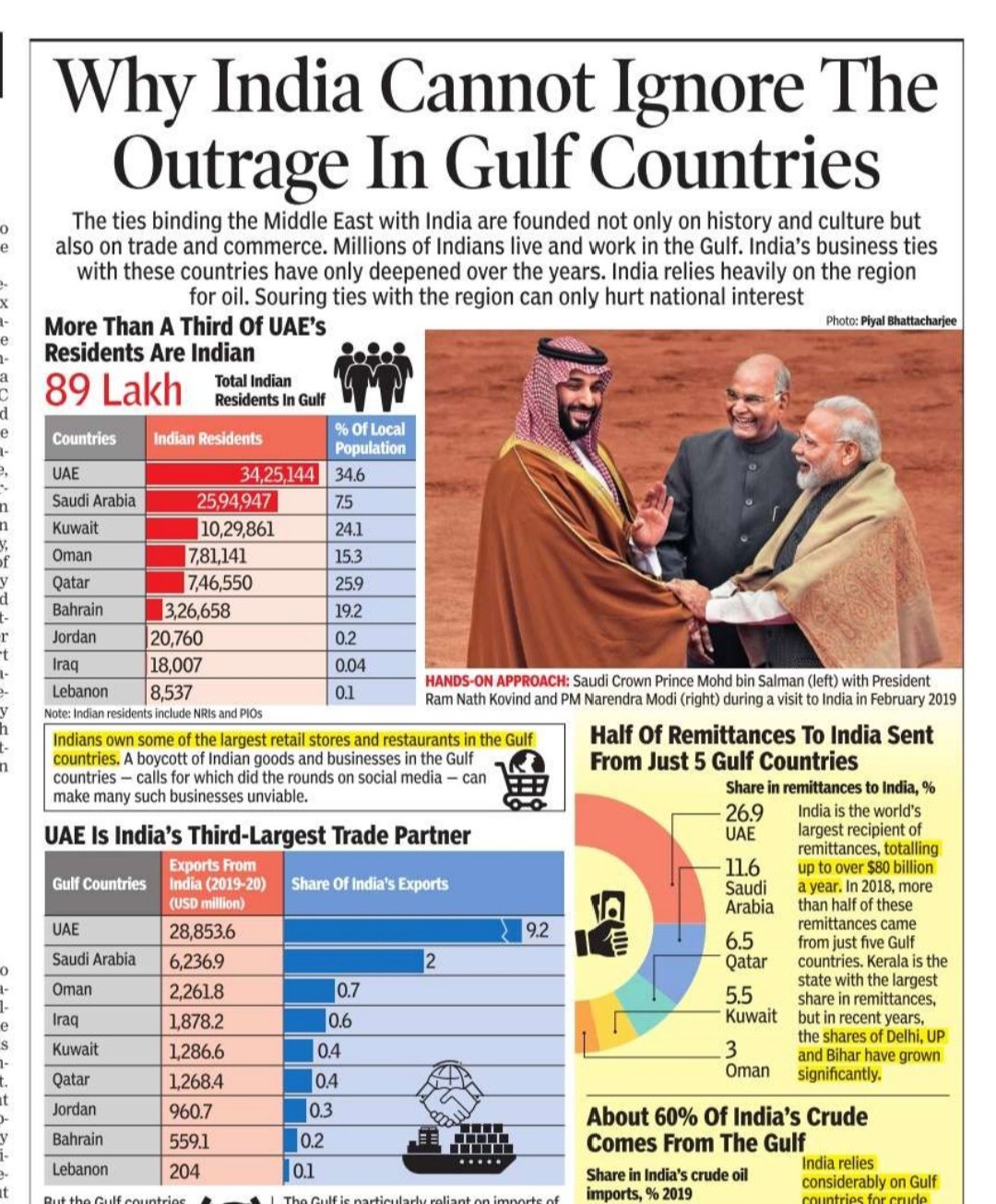
India's Ties to the GCC Nations. Source: Advaid


The BJP's entire domestic politics is built on the hatred of Islam and Muslims. At the same time, Prime Minister Narendra Modi who many hold primarily responsible for promoting Islamophobia in India, wants to have strong economic ties with the Arab Muslim Gulf states. This latest crisis has exposed the built-in contradictions in the BJP's domestic and international agenda.  Indian analyst Aakar Patel calls the ruling BJP party "a party of bigots". Here is his analysis of the situation:

"The (Modi) government has not bulldozed properties of Muslims for resisting rioting; it has conducted civic acts related to unauthorized construction. India is not targeting its Muslims through CAA-NRC pincer; it is only showing solidarity with non-Muslims from neighboring nations. Allowing mobs to prevent congregational prayers in designated spaces is really to ensure traffic flows smoothly. There can not be many who are innocent of what is going on. Certainly, there are none among the votaries of Hindutva. The problem is having democratized violence against Muslims across the country, and having been electorally rewarded for this, Modi must consider what it means for India. He has been given a taste of that this week, and as the sequence of events shows, he has not found it appealing. Trouble on this front will return unless Hindutva retreats and returns India to its normative secular state its Constitution prescribes. This is not going to happen under Modi, of course. The next best thing is to backpedal Hindutva a bit and calibrate Hindutva to a level where it pleases its constituency but doesn't offend the world. This will not be easy as we are about to find out". 


It is important to note that nearly 9 million Indians work in the Arab Gulf nations, 60% India's crude oil comes from the Middle East and the UAE is India'a third largest trading partner. Half of all remittances to India ( nearly $40 billion) come from just 5 Gulf nations of the GCC. 

The Hindu Nationalists led by Prime Minister Modi are particularly hostile toward Muslims but also other Abrahamic faiths and the West. American journalist Walter Russell Mead described it in a recent Wall Street Journal Op Ed as follows: "Many BJP supporters want the Indian government to defend India’s Hindu civilization and culture from Islam, Christianity and Western secular liberalism. This form of Hindu nationalism leads to controversial policy initiatives". The fact that the United Arab Emirates has joined to protest is particularly significant. The Arab Muslim UAE, a grouping of  seven Arab Muslim kingdoms, has now become the number one destination for education and employment of people from Hindu India, according to the government data from the two countries. 

India is now ruled by the right-wing Hindu BJP party headed by Prime Minister Narendra Modi whose entire politics is based on extreme hatred of Islam and Muslims. In 2020, Emirati Princess Sheikha Hend bint Faisal al-Qasimi strongly criticized Islamophobia in India. She also expressed solidarity and sympathies with Indian Muslims and Kashmiris.

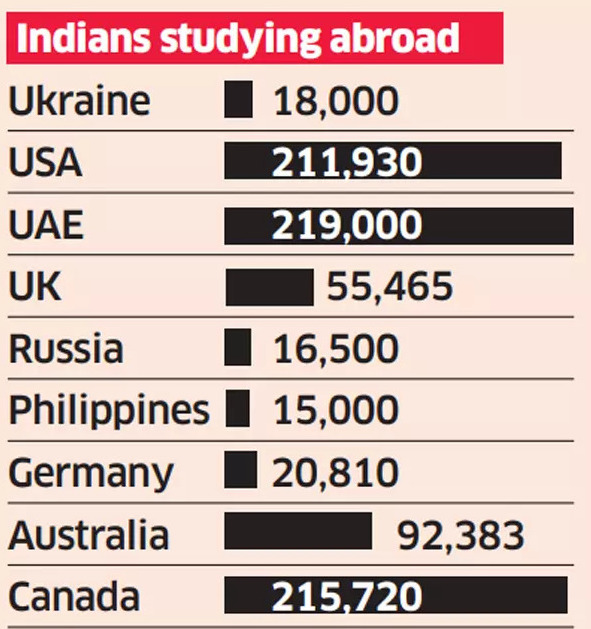
Indians Students Abroad. Source: Economic Times

Over 1.2 million Indian students are now studying overseas, twice more than a decade ago. The UAE has 219,000 Indian students, Canada 215,720, the US 211,930, Australia 92,383, Saudi Arabia 80,800, Britain 55,465, and Oman 43,600, according to the data from India's Ministry of External Affairs. 


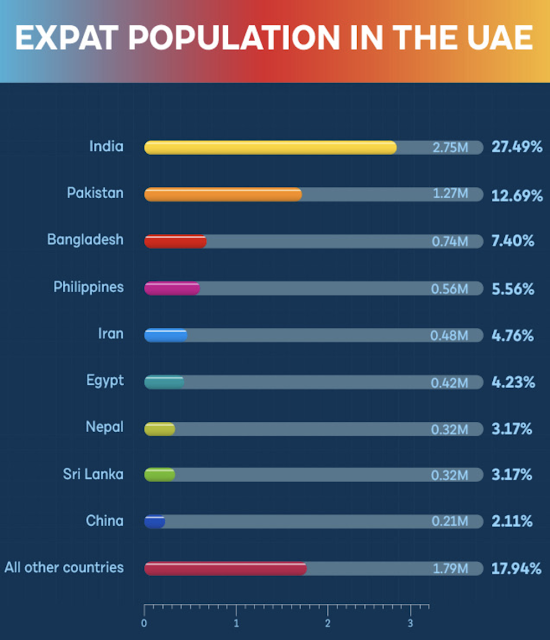
UAE Expat Population. Source: Global Media Insight

In addition to students, there are millions of foreigners working in the UAE. Currently, the Indian population in UAE is the highest with 2.75 million, followed by Pakistanis with 1.27 million. The UAE has around 0.75 million Bangladeshi nationals, 0.56 million Filipinos, and 0.48 million Iranians. There are also people from Egypt (0.42 million), Nepal (0.32 million), Sri Lanka ( 0.32 million), China (0.21 million) and the rest of the world (1.79million).

Last year, India received $43 billion in remittances from the UAE. Total worker remittances to India reached $87 billion last fiscal year, making it the world's largest recipient of these remittances. 

The United States was the second largest destination for Indian students. China maintained its top position among the leading places of origin for international students, with 35% of all international students in the 2020-21 school year hailing from the country, according to the data released by the United States government.  The second most common place of origin was India (18%), followed by South Korea (4%) and Canada (3%). Some of these countries also experienced the largest year-over-year declines in the number of students who enrolled at US institutions. The largest such percentage decreases occurred in South Korea (-21%), China (-15%) and India (-13%).

Related Links:

Friday, May 20, 2022

Pakistanis Are Third Largest Foreign Investors in Dubai Real Estate

Pakistanis have invested $10.6 billion in Dubai real estate, ranking them as the third largest investors in the city on the Gulf. Indian investors lead Dubai real estate investments with $29.8 billion, followed by British investors' $14.7 billion investment. 

Wealth From Top 20 Countries Invested in Dubai Real Estate. Source: EU Tax Observatory

With at least $146 billion in foreign wealth invested, the Dubai property market is now the world's largest offshore investment market for foreign investors. It is now twice as large as the London real estate market in terms of wealth invested by foreigners through shell companies. There are nearly 20,000 unique foreign owners of Dubai real estate from Pakistan, the third largest number behind almost 35,000 Indian owners and about 23,000 owners from the United Kingdom, according to the EU Tax Observatory.


Unique Entities From Top 20 Countries Owning Dubai Real Estate. Source: EU Tax Observatory


The record flow of foreign wealth into Dubai real estate has drawn the attention of the FATF (the Financial Action Task Force), the global anti-money-laundering  watchdog. The UAE is now "under increased monitoring” (often referred to as the grey list) by the FATF.  It is widely accepted that real estate is used for money laundering and hiding wealth from tax authorities.

Money Laundering Risk. Source: FATF


Many rich Pakistanis, including top politicians and their family members, own real estate in Dubai, according to press reports. Most of the top politicians from Pakistani political parties like PPP, PML-N, ANP and MQM own Dubai real estate.  A 2020 Transparency International report said the following about Dubai's attraction to foreign unexplained wealth: 

"The UAE’s booming construction and real estate sector emerges as another major weakness. It accounts for a fifth of the Emirates’ GDP, but remains incredibly vulnerable to money laundering. Complex ownership structures can be used to obscure the identity of those buying property, as well as where their money is coming from".

"Despite the UAE’s role as a major international hub for finance and trade, the report concludes that authorities there are not cooperating with international partners. This could make the Emirates an attractive location in which “criminals could operate, maintain their illegal proceeds, or use it as a safe haven.”

"The FATF report confirms what investigative journalists, anti-corruption activists and whistleblowers have been saying for years: the UAE is a key piece in the global money-laundering puzzle. Its susceptibility to money laundering has seen it appear time and again in major cross-border corruption scandals". 

Sunday, May 1, 2022

European Union: Fastest Growing Source of Remittances to Pakistan

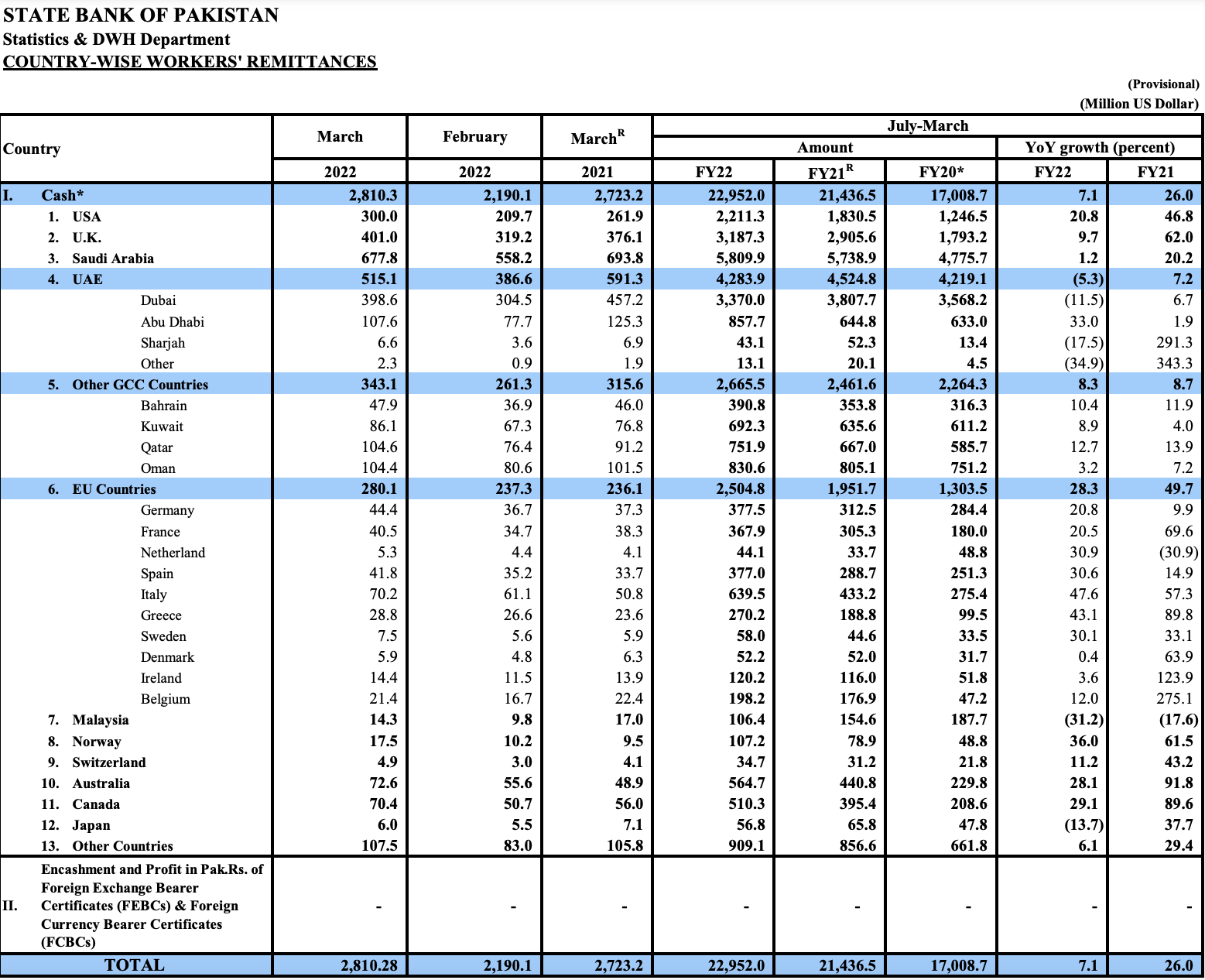
Remittances from the European Union (EU) to Pakistan soared 49.7% in FY 21 and 28.3% in FY22, according to the State Bank of Pakistan. With $2.5 billion remittances in the first 9 months (July-March) of the current fiscal year, the EU ($2.5 billion) has now surpassed North America ($2.2 billion) to become the third largest source of inflows to Pakistan after the Middle East and the United Kingdom. Remittances from the US have grown 21%, second fastest after the EU (28.3%) in the first 9  months of the current fiscal year. 

Country-wise Remittance Inflows in Pakistan. Source: State Bank of Pakistan

Pakistanis in European Union: 

The population of Pakistan-born migrants to European Union countries has been growing in recent years. With over 120,000 Pakistani migrants, Italy is the most popular destination for Pakistanis in the EU. 

Italy is followed by Germany with 75,495 Pakistani migrants. Then comes Spain with 61,953 migrants, France 21,900 (2017), Sweden 11,674, Denmark 10,669, Ireland 7,351 (2016), Belgium 5,927, Portugal 5,310, Norway 5,157, Netherlands 4,723 and Austria 4,112. There are smaller populations of Pakistanis in several other European countries. 

Pakistan-born Migrants in European Union. Source: OECD

With $5.74 billion in the first 9 months of current fiscal year FY22, Saudi Arabia remains the top source of remittances to Pakistan, followed by $4.28 billion from the United Arab Emirates (UAE). However, the Saudi remittances are essentially flat while those from the UAE have declined 5.3% in this period.  Pakistani diaspora is sending home over $30 billion a year, about 10% of the country's GDP. It is badly needed foreign exchange to balance Pakistan's external accounts.  

Pakistanis in Italy. Source: Italian Government


Pakistan's Worldwide Diaspora:

Over 10 million Pakistanis are currently working/living overseas, according to the Bureau of Emigration. Before the COVID19 pandemic hit in 2020,  more than 600,000 Pakistanis left the country to work overseas in 2019. The average yearly outflow of Pakistani workers to OECD countries (mainly UK and US) and the Middle East has been over half a million in the last decade.  

Pakistan’s economy created 5.5 million domestic jobs during the past three years –on an average 1.84 million jobs a year, which is far higher than yearly average of creation of new jobs during the 2008-18 decade, according to the Labor Force Survey (LFS) published by the Pakistan Bureau of Statistics (PBS). 

Pakistan ranks 6th among the top worker remittance recipient countries in the world.  India and China rank first and second, followed by Mexico 3rd, the Philippines 4th, Egypt 5th and Pakistan 6th.  

Pakistan Demographics
Pakistan's Demographic Dividend: 

About two million Pakistanis are entering the workforce every year. The share of the working age population in Pakistan is increasing while the birth rate is declining. This phenomenon, known as demographic dividend, is coinciding with declines in working age populations in developed countries. It is creating an opportunity for over half a million Pakistani workers to migrate and work overseas, and send home record remittances. These overseas Pakistanis are now sending home over $30 billion a year, about 10% of the country's GDP. It is badly needed foreign exchange to balance Pakistan's external accounts.  

Projected Population Decline in Emerging Economies. Source: Nikkei Asia


Friday, March 4, 2022

Arab Muslim UAE Is Top Education and Employment Destination For Indians From Modi's Hindu Rashtra

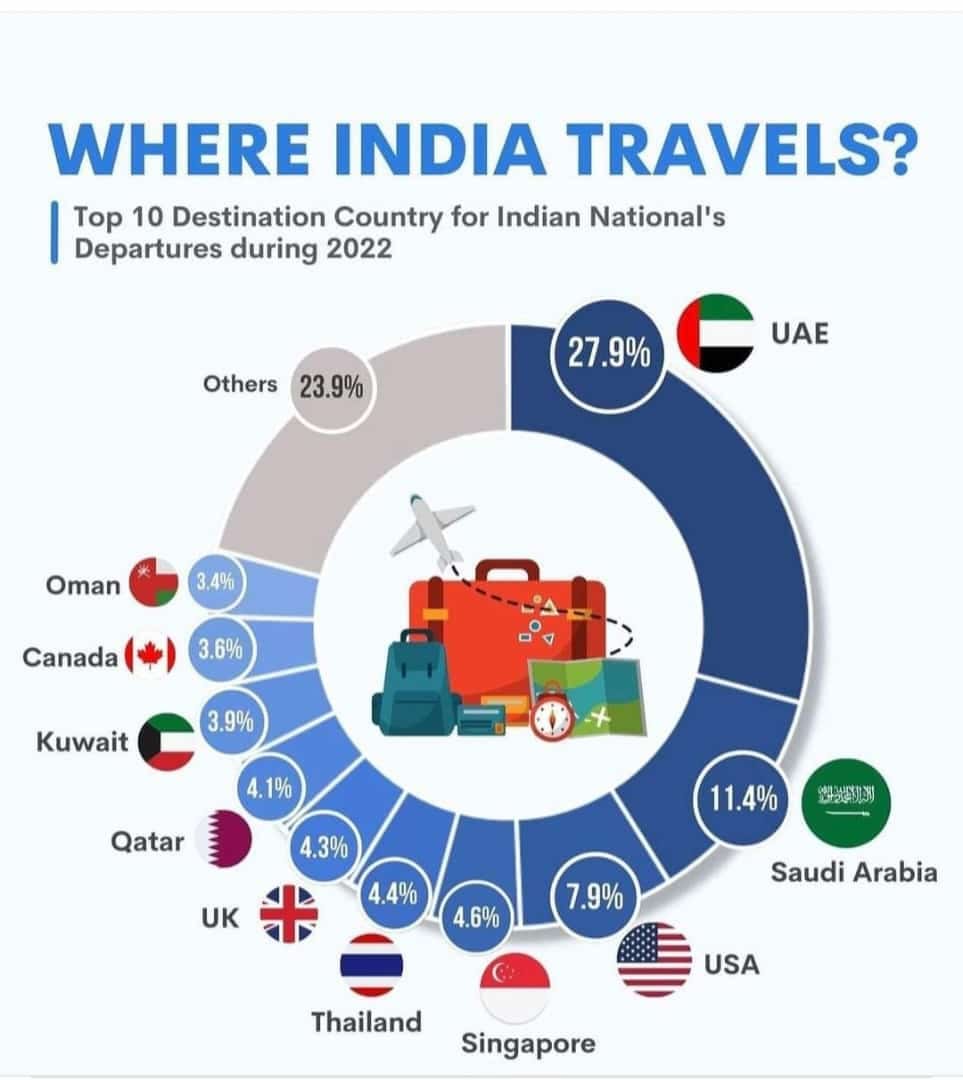
The United Arab Emirates, a grouping of  seven Arab Muslim kingdoms, has now become the number one destination for education and employment of people from Hindu India, according to the government data from the two countries. 

Indians' Foreign Travel Destinations. Source: Indian Government

India is now ruled by the right-wing Hindu BJP party headed by Prime Minister Narendra Modi whose entire politics is based on extreme hatred of Islam and Muslims. In 2020, Emirati Princess Sheikha Hend bint Faisal al-Qasimi strongly criticized Islamophobia in India. She also expressed solidarity and sympathies with Indian Muslims and Kashmiris.

Indians Students Abroad. Source: Economic Times

Over 1.2 million Indian students are now studying overseas, twice more than a decade ago. The UAE has 219,000 Indian students, Canada 215,720, the US 211,930, Australia 92,383, Saudi Arabia 80,800, Britain 55,465, and Oman 43,600, according to the data from India's Ministry of External Affairs. 


UAE Expat Population. Source: Global Media Insight

In addition to students, there are millions of foreigners working in the UAE. Currently, the Indian population in UAE is the highest with 2.75 million, followed by Pakistanis with 1.27 million. The UAE has around 0.75 million Bangladeshi nationals, 0.56 million Filipinos, and 0.48 million Iranians. There are also people from Egypt (0.42 million), Nepal (0.32 million), Sri Lanka ( 0.32 million), China (0.21 million) and the rest of the world (1.79million).

Last year, India received $43 billion in remittances from the UAE. Total worker remittances to India reached $87 billion last fiscal year, making it the world's largest recipient of these remittances. 

The United States was the second largest destination for Indian students. China maintained its top position among the leading places of origin for international students, with 35% of all international students in the 2020-21 school year hailing from the country, according to the data released by the United States government.  The second most common place of origin was India (18%), followed by South Korea (4%) and Canada (3%). Some of these countries also experienced the largest year-over-year declines in the number of students who enrolled at US institutions. The largest such percentage decreases occurred in South Korea (-21%), China (-15%) and India (-13%).

Related Links:

Sunday, January 12, 2020

Are Pakistani Leaders Slaves of Arab Royals?

Are Pakistani leaders slaves of Arab Royals? Or simply doing what is in Pakistan's best interest?

Prime Minister Imran Khan Driving Prince Mohammad Bin Salman in Islamabad

Why did Imran Khan not attend the Kuala Lumpur Islamic Summit that was organized by Malaysian Prime Minister Mahathir Mohammad and attended by Turkish President Erdogan and Iranian President Hasan Rouhani? Why did he yield to Saudi pressure to skip it?

What are Pakistan's key economic and security interests in Gulf Cooperation Countries (GCC)? Is labor Pakistan's biggest export earning over $20 billion a year? What is the biggest export market for Pakistan's labor? What would happen if Pakistan joined Malaysia and Turkey in creating a new Muslim bloc competing with the Arab-led Organization of Islamic Countries (OIC)? Will OIC try to live up to Pakistan's expectation of a tougher stance against India's Modi vis a vis Indian Occupied Kashmir and Indian Muslims?

Who makes Pakistan's foreign and security policies? How influential is Pakistani military in making these policies? Is Imran Khan free to pursue whatever policies he personally prefers? Would any other Prime Minister have pursued a different policy with GCC nations?

ALKS host Faraz Darvesh discusses these questions with Sabahat Ashraf (ifaqeer) and Riaz Haq (www.riazhaq.com).


https://youtu.be/ylEor2XPblQ


Related Links:

Haq's Musings

South Asia Investor Review

Soleimani Was the Hardest of the Hardliner

Confessions of an Economic Hitman

Putin Challenges American Exceptionalism

Remittances to Pakistan Up 21X Since Year 2000

Modi's Kashmir Blunder

Godfather Metaphor for Uncle Sam

Seeing Bin Laden's Death in Wider Perspective

Destructive Power of Drone Swarm on Saudi Oil Installation

US Dominates List of World's Top Universities

Indian RAW Agent Kulbhushan Jhadav Used Chabahar

Iran-Saudi Conflict

Pakistan's Nuclear Program

Iran Nuclear Deal

1971 India-Pakistan War

Chabahar vs Gwadar Ports

Did America Contribute to the Rise of ISIS?

Riaz Haq's YouTube Channel

PakAlumni Social Network

Friday, December 16, 2016

International Migrants Day: India Tops Labor Export, Pakistan Ranks 6th

India is the world's largest exporter of labor with 15.8 million Indians working in other countries. Bangladesh ranks 5th with 7.2 million Bangladeshis working overseas while Pakistan ranks 6th with 5.9 million Pakistanis working overseas, according to Pew Research report released ahead of International Migrants Day observance on Sunday, December 18, 2016.

International Migration: 

Countries of Origin of Migrants to the United States Source: Pew Research


Pew Research reports that nearly 3.5 million Indians lived in the UAE, the world’s second-largest migration corridor in 2015. While most of the migration is from low and middle income countries to high-income countries, the top 20 list of migrants' origins also includes rich countries like the United States (ranked 20), United Kingdom (11), Germany (14), Italy (21) and South Korea (25).

Top 25 Sources of Migrants:

Here is the list of top 20 countries of origin for international migrants:


1. India 15.9 million

2. Mexico 12.3 million

3. Russia 10.6 million

4. China 9.5 million

5. Bangladesh 7.2 million

6. Pakistan 5.9 million

7. Ukraine 5.83 million

8.  Philippines 5.32 million

9.  Syria 5.01 million

10. Afghanistan 4.84 million

11. United Kingdom 4.92 million

12. Poland 4.45 million

13. Kazakstan 4.08 million

14. Germany 4.0 million

15. Indonesia 3.88 million

16. Palestine 3.55 million

17. Romania 3.41 million

18. Egypt 3.27 million

19. Turkey 3.11 million

20. United States 3.02 million

21. Italy 2.9 million

22. Burma (Myanmar) 2.88 million

23. Colombia 2.64 million

24. Vietnam 2.56 million

25. South Korea 2.35 million

Declining Labor Pool in Developed Economies: 

The world population is aging with slowing labor force growth. It is particularly true of the more developed nations with aging populations and declining birth rates.  In an recent report titled "Asian Economic Integration Report", the Asian Development argued that migration within Asia can help deal with regional labor imbalances. It said as follows:

"In Asia and the Pacific, many economies could expand their role as the source or host economy for migrant workers.

Labor supply is still growing in developing economies—such as Cambodia, Indonesia, the Lao People’s Democratic Republic, Mongolia, Myanmar, India, Pakistan, and the Philippines—and they could export labor across the region. In contrast, developed but aging economies such as Hong Kong, China; the Republic of Korea; Japan; and Singapore are unable to meet labor demand with their dwindling workforce.

Hence, these economies would benefit from immigrant labor. Kang and Magoncia (2016) further discuss the potential for migration to reallocate labor from surplus to deficit economies and offer a glimpse of how the demographic shift will frame Asia’s future population structure, particularly the future working age population. Among the issues explored is the magnitude of labor force surpluses and deficits within different economies in Asia."

Pakistan's Growing Labor Force:

Pakistan has the world’s sixth largest population, sixth largest diaspora and the ninth largest labor force with growing human capital. With rapidly declining fertility and aging populations in the industrialized world, Pakistan's growing talent pool is likely to play a much bigger role to satisfy global demand for workers in the 21st century and contribute to the well-being of Pakistan as well as other parts of the world.


With half the population below 20 years and 60 per cent below 30 years, Pakistan is well-positioned to reap what is often described as "demographic dividend", with its workforce growing at a faster rate than total population. This trend is estimated to accelerate over several decades. Contrary to the oft-repeated talk of doom and gloom, average Pakistanis are now taking education more seriously than ever. Youth literacy is about 70% and growing, and young people are spending more time in schools and colleges to graduate at higher rates than their Indian counterparts in 15+ age group, according to a report on educational achievement by Harvard University researchers Robert Barro and Jong-Wha Lee. Vocational training is also getting increased focus since 2006 under National Vocational Training Commission (NAVTEC) with help from Germany, Japan, South Korea and the Netherlands.


Pakistan's work force is over 60 million strong, according to the Federal Bureau of Statistics. With increasing female participation, the country's labor pool is rising at a rate of 3.5% a year, according to International Labor Organization.

With rising urban middle class, there is substantial and growing demand in Pakistan from students, parents and employers for private quality higher education along with a willingness and capacity to pay relatively high tuition and fees, according to the findings of Austrade, an Australian government agency promoting trade. Private institutions are seeking affiliations with universities abroad to ensure they offer information and training that is of international standards.


Trans-national education (TNE) is a growing market in Pakistan and recent data shows evidence of over 40 such programs running successfully in affiliation with British universities at undergraduate and graduate level, according to The British Council. Overall, the UK takes about 65 per cent of the TNE market in Pakistan.

It is extremely important for Pakistan's public policy makers and the nation's private sector to fully appreciate the expected demographic dividend as a great opportunity. The best way for them to demonstrate it is to push a pro-youth agenda of education, skills development, health and fitness to take full advantage of this tremendous opportunity. Failure to do so would be a missed opportunity that could be extremely costly for Pakistan and the rest of the world.

Growth Forecast 2014-2050. Source: EIU


In the high fertility countries of Africa and Asia family sizes are continuing to decline. And in low fertility countries family sizes will continue to remain below replacement levels. Why? Because the same juggernaut forces are operating: increasing urbanization, smaller and costly housing, expanding higher education and career opportunities for women, high financial costs and time pressures for childrearing and changing attitudes and life styles.

Source: BBC


Countries With Declining Populations:

115 countries, including China (1.55), Hong Kong (1.17),  Taiwan (1.11) and Singapore (0.8) are well below the replacement level of 2.1 TFR.  Their populations will sharply decline in later part of the 21st century.

 United States is currently at 2.01 TFR, slightly below the replacement rate.  "We don't take a stance one way or the other on whether it's good or bad," said Mark Mather, demographer with the Population Reference Bureau. Small year-to-year changes like those experienced by the United States don't make much difference, he noted. But a sharp or sustained drop over a decade or more "will certainly have long-term consequences for society," he told Utah-based Desert News National.

Japan (1.4 TFR) and Russia (1.6 TFR) are experiencing among the sharpest population declines in the world. One manifestation in Japan is the data on diaper sales: Unicharm Corp., a major diaper maker, has seen sales of adult diapers outpace infant diapers since 2013, according to New York Times.

Median Age Map: Africa in teens, Pakistan in 20s, China, South America and US in 30s, Europe, Canada and Japan in 40s.


The Russian population grew from about 100 million in 1950 to almost149 million by the early 1990s. Since then, the Russian population has declined, and official reports put it at around 144 million, according to Yale Global Online.

Reversing Trends:

Countries, most recently China, are finding that it is far more difficult to raise low fertility than it is reduce high fertility. The countries in the European Union are offering a variety of incentives, including birth starter kits to assist new parents in Finland, cheap childcare centers and liberal parental leave in France and a year of paid maternity leave in Germany, according to Desert News. But the fertility rates in these countries remain below replacement levels.

Summary:

Overzealous Pakistani birth control advocates need to understand what countries with sub-replacement fertility rates are now seeing: Low birth rates lead to diminished economic growth. "Fewer kids mean fewer tax-paying workers to support public pension programs. An "older society", noted the late Nobel laureate economist Gary Becker, is "less dynamic, creative and entrepreneurial." Growing labor force n Pakistan can not only contribute to Pakistan's prosperity but also help alleviate the effects of aging populations and declining labor pools in more developed economies. I believe that Pakistan's growing population and young demographics should be seen as a blessing, not a curse.

Related Links:

Haq's Musings

Pakistan's Expected Demographic Dividend

Pakistan's Growing Human Capital

Upwardly Mobile Pakistan

Pakistan Most Urbanized in South Asia

Hindu Population Growth Rate in Pakistan

Do South Asian Slums Offer Hope?

How "Illiterate" Are Pakistan's "Illiterate" Cell Phone Users?

Tuesday, August 26, 2014

Did Pakistan Pilots Carry Out UAE AF Air Strikes in Libya?

UAE fighter jets flying from bases in Egypt carried out airstrikes in Libya a week ago, according to US media reports. Question: Did Pakistani pilots working for UAE participate in these missions?

 Targets were hit in the Libyan capital of Tripoli  secretly without without informing the Obama administration beforehand. The first wave of airstrikes hit positions in Tripoli controlled by insurgent militias, including a small weapons depot. The second wave targeted rocket launchers and military vehicles owned by militias, the New York Times reports.

UAE Air Force F-16E Block 60 
It is widely known that the vast majority of pilots working for the UAE Air Force are Pakistanis. The involvement of Pakistan Air Force in UAE began in 1970s with a training mission in the Gulf nation. Some of the serving PAF officers are on deputation, but most are on civilian contracts with the Air Force Headquarters in Abu Dhabi. Officers of other nationalities have also trained UAE pilots, among them Moroccans, Canadians, Jordanians, and South Africans.

After 1998 US-sanctions on Pakistan following its nuclear tests, the United States objected to plans by the United Arab Emirates air force to contract up to 200 Pakistan air force fighter pilots to fly F-16D Block 60 fighters it had ordered from Lockheed Martin. The deal was significantly delayed as UAE threatened to re-open the fighter competition to choose alternate suppliers. It was eventually resolved and the US agreed to deliver the purchased F-16s to UAE.

If Pakistanis indeed took part in these missions, it would raise several serious questions:

1. Were these PAF's serving pilots on deputation with UAE Air Force? Or retired officers on contract? If they were on deputation, did they seek permission from Pakistani government to accept these missions?

2.  Will such missions drag Pakistan into ongoing Middle East conflicts and hurt Pakistan's interests in the region?

3. Will those targeted seek revenge against Pakistanis?

Related Links:

Haq's Musings

Pakistan Army at the Gates of Delhi 

"Eating Grass" Book Launch in Silicon Valley

Demolishing Indian War Myths 

Kashmiris Remain Defiant

India-Pakistan Military Balance

Assessing Pakistan Army Capabilities

Can India "Do a Lebanon" in Pakistan?

Pakistan's Defense Industry Going High-Tech

Friday, June 6, 2008

Foreign Investors Buying Pakistani Farmland

One of the Middle East's largest private equity firms has been quietly buying up farmland in Pakistan as part of plans by the United Arab Emirates to increase food security and to control inflation, according to a gulf website arabbuild.net. Please read prior blog posts on this subject.

Dubai-based Abraaj Capital says it is working with the UAE government on the strategic agribusiness investments in Pakistan. The government in Abu Dhabi has been holding talks with Islamabad about a framework for investment in its agricultural sector as it seeks to secure cheaper long-term supplies of staples such as wheat and rice.

The UAE investments appear to be part of a pattern of international investments in agriculture. Record prices of wheat and various grains have been attracting hundreds of billions of dollars from hedge funds and other speculators to the commodity futures markets (particularly wheat and rice futures) in recent months. A NY Times report now says that the investors are starting to make longer term commitments in food and agriculture sector including farmland, fertilizer, grain elevators and shipping equipment.

"Our aim is not to do away with precious farmland but in fact to raise the productivity of our farms and turn barren land in to fertile farmland," said a senior Pakistani official familiar with negotiations between Pakistan and UAE, according to a report in Financial Times.

Abraaj Capital, with $5bn of assets spread across the Middle East, North Africa and the South Asia, has been buying farmland in Pakistan during the past year, a company official said. UAE state and private entities planning to build agribusinesses in Pakistan have acquired as much as 800,000 acres of land, he said. Other companies participating in farming investments in Pakistan include Emirates Investment Group and the Abu Dhabi Group.

Similar farmland purchase or lease deals are being reported in Brazil, Canada, the United States, and the former Soviet Republics. Farmland prices have spiked up as a result of new money and growing interest in farmland.

At a recent Middle East-Pakistan Agriculture and Dairy Investment Forum in Dubai, Huma Fakhar, an adviser to the Government of Bahrain on Bahrain-US free trade agreement, said Arab nations are suffering from declining farm exports and rapid growth in population, leading to an increase in their imports of food products. Regarding investment commitments from the GCC investors in Pakistan's agriculture, livestock and dairy sectors, she termed the forum a success. "Major groups from GCC in general and the UAE in particular are willing to avail the opportunity and commit significant investment in Pakistan’s agriculture sector for the first time" she said.

Belal Pasha, Commercial Attache at Pakistan Embassy in the UAE, said five to 10 major UAE groups will explore Pakistan’s agriculture sector by making significant investment in corporate farming, livestock and dairy sectors. However, he didn’t name any group. In reply to a question, he said Pakistan could get significant share of GCC farm imports worth $200 billion if sizable investment is made in its agriculture sector.

The NY Times report raises concerns about the commodity speculators jumping into the fray. By owning land and other parts of the agricultural business, the investors, including sovereign funds, are freed from rules aimed at curbing the number of speculative bets that they and other financial investors can make in commodity markets. “I just wonder if they need some sheep’s clothing to put on,” said Jeffrey Hainline, president of Advance Trading, a 28-year-old commodity brokerage firm and consulting service in Bloomington, Illinois in the United States.

Concerns such as Mr. Hainline's make it necessary for countries such as Pakistan to be deliberative in crafting land sales/lease agreements. Any lease or sales of farmland must be carefully regulated to ensure that the country's food security is not jeopardized by the investors interest in making the biggest possible returns on their investments. The interests of the consumers and the investors must be carefully balanced.

The new agriculture investments and modernization of farming in Pakistan can potentially raise farm productivity and help stabilize prices to adequately feed the growing population as well as increase agricultural exports to earn foreign exchange.
At the same time, Pakistan can follow the Brazilian model of growing and using sugarcane for producing ethanol to reduce its dependence on imported oil. However, this must be done with a sound plan to ensure Pakistan's food security and sovereignty remain intact.

Sources: NY Times
Arab Build
Financial Times
Fresh Plaza