Showing posts with label United Nations. Show all posts

Wednesday, March 15, 2023

The United Nations Joins Battle Against Islamophobia

The United Nations has declared March 15 the "International Day to Combat Islamophobia".  Former Pakistani Prime Minister Imran Khan was the first world leader who highlighted the global rise in Islamophobia in a speech in September, 2021 at the United Nations General Assembly (UNGA). Khan's speech was followed by the adoption of a Pakistani resolution at the UNGA co-sponsored with the Organization of Islamic Countries (OIC) on March 15, 2022 to observe "International Day to Combat Islamophobia" on March 15 every year.  

Ex Prime Minister Imran Khan Speaking at the United Nations. 

In his September 2021 speech at UNGA,  Imran khan said that “the worst and most pervasive form” of Islamophobia “now rules India”. The “Hindutva ideology” being promoted by the Narendra Modi Government has unleashed “a reign of fear and violence” against India’s 200-million Muslims.


India is the Largest Contributor to Islamophobia on Social Media. Source: TRT World

India has just 5.75% of global Twitter users but the country accounts for 55% of all anti-Muslim tweets, according to a recent report entitled "Islamophobia in the Digital Age" published by the Islamic Council of Victoria (ICV). It also found that the US, the UK, and India contributed a staggering 86% of anti-Muslim content on Twitter during a three-year period. It should be noted that both the US and the UK have a sizable  Indian diaspora infected by hateful Hindutva ideology. 

The growing hate that Muslims face is not an isolated development, UN Secretary-General António Guterres told attendees at a a high-level March 10 event at the UN Headquarters in New York. “It is an inexorable part of the resurgence of ethno-nationalism, neo-Nazi white supremacist ideologies, and violence targeting vulnerable populations including Muslims, Jews, some minority Christian communities and others,” he said. 

The UN HQ event was co-convened by Pakistan, whose Foreign Minister, Bilawal Bhutto Zardari, underscored that Islam is a religion of peace, tolerance and pluralism. Although Islamophobia is not new, he said it is “a sad reality of our times” that is only increasing and spreading.

“Since the tragedy of 9/11, animosity and institutional suspicion of Muslims and Islam across the world have only escalated to epidemic proportions. A narrative has been developed and peddled which associates Muslim communities and their religion with violence and danger,” said Mr. Zardari, who is also Chair of the Organization of Islamic Cooperation (OIC) Council of Foreign Ministers. “This Islamophobic narrative is not just confined to extremist, marginal propaganda, but regrettably has found acceptance by sections of mainstream media, academia, policymakers and state machinery,” he added.

Related Links:


Monday, January 9, 2023

Climate "Loss and Damage": Pakistan Gets Flood Aid Pledges of $10 Billion

Pakistan has received pledges of $10 billion worth of loans and grants to rebuild after devastating floods last year, according to Bloomberg News. The amount pledged exceeds the $8 billion that Pakistan sought at the United Nations Donors Conference that concluded today in Geneva, Switzerland. The massive floods affected 33 million people living on vast swathes of land in rural Sindh and Balochistan. The flood waters killed an estimated 1700 people and  millions of animals. The floods also washed away millions of acres of standing crops, tens of thousands of homes and thousands of kilometers of roads. The total flood damage is estimated at $33 billion in economic losses, and cost of rebuilding is estimated at $16.5 billion. Prime Minister Shahbaz Sharif and U.N. Secretary-General António Guterres attended in-person, while world leaders such as French President Emmanuel Macron and Turkish President Recep Tayyip Erdoğan took part virtually. 

UN Donors Conference For Pakistan Flood Aid in Geneva, Switzerland. Source: Reuters

UN Secretary General  António Guterres has passionately advocated for immediate help for the people in Pakistan affected by the severe floods resulting from climate change.  “We need to be honest about the brutal injustice of loss and damage suffered by developing countries because of climate change,” he told the gathering in Geneva. “If there is any doubt about loss and damage – go to Pakistan. There is loss. There is damage. The devastation of climate change is real.” Mr. Guterres added that people in South Asia are 15 times more likely to die from climate impacts than elsewhere, and his “heart broke” when he saw the devastation left behind from Pakistan’s floods. “No country deserves to endure what happened to Pakistan,” he said. “But it was especially bitter to watch that country’s generous spirit being repaid with a climate disaster of monumental scale.”  

After receiving the pledges, Prime Minister Sharif assured all donors and lenders that "every penny will be used in a transparent fashion. He said his government has prepared a comprehensive “4RF” framework, to strive for “recovery, rehabilitation, reconstruction and resilience”. 

Jeddah-based Islamic Development Bank pledged $4.2 billion accounting for the largest share of the total amount of $10 billion. The World Bank pledged $2 billion, Asian Development Bank $1.5 billion, France $345 million, China $100 million, US $100 million, European Union $93 million, Germany $88 million and Japan $77 million. 

At COP27, the United Nations climate summit, Pakistan led the fight for funding to compensate nations for “loss and damage”. Pakistan had the support of 134 developing nations. Earlier at COP26 in Scotland, discussions were mainly focused on funding "mitigation" and "adaptation", not compensation for "loss and damage".  

Pakistan Pavilion at COP27 Conference in Sharm Al-Sheikh, Egypt

The "loss and damage" agenda item was first proposed by Pakistan during talks at Bonn after the country suffered heavy losses in unprecedented floods that hit a third of the country.  “My country, Pakistan, has seen floods that have left 33 million lives in tatters and have caused loss and damage amounting to 10% of the GDP,” said Ambassador Munir Akram, the 2022 chair of the G77—a group of 134 developing countries, at the opening session of COP27 at Sharm al-Sheikh, Egypt. 

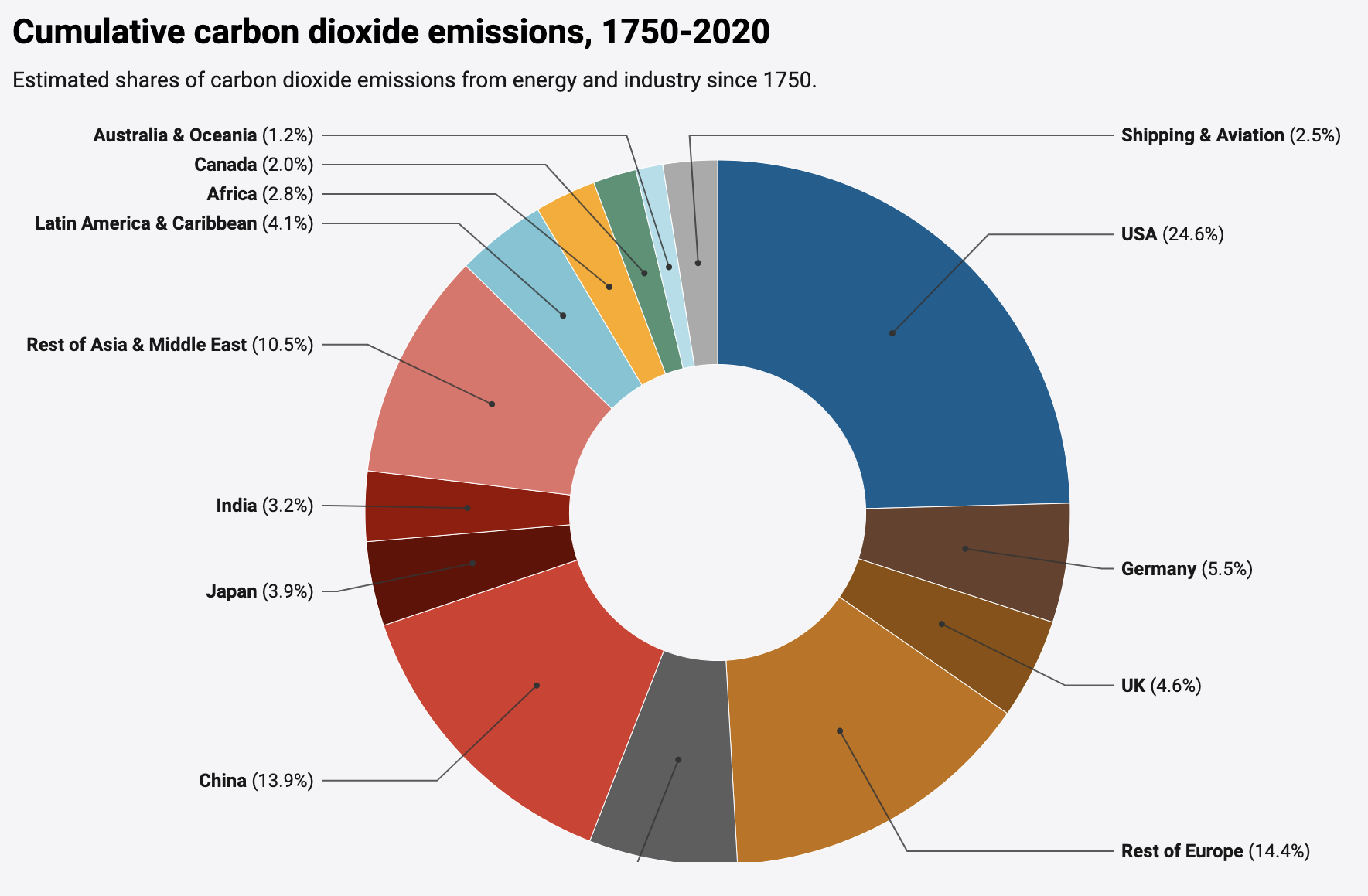
Cumulative CO2 Emissions By Country/Region. Source: The World

Pakistan has contributed only 0.28% of the CO2 emissions but it is among the biggest victims of climate change. The US, Europe, India, China and Japan, the world's biggest polluters, must accept responsibility for the catastrophic floods in Pakistan and climate disasters elsewhere. A direct link of the disaster in Pakistan to climate change has been confirmed by a team of 26 scientists affiliated with World Weather Attribution, a research initiative that specializes in rapid studies of extreme events, according to the New York Times. 

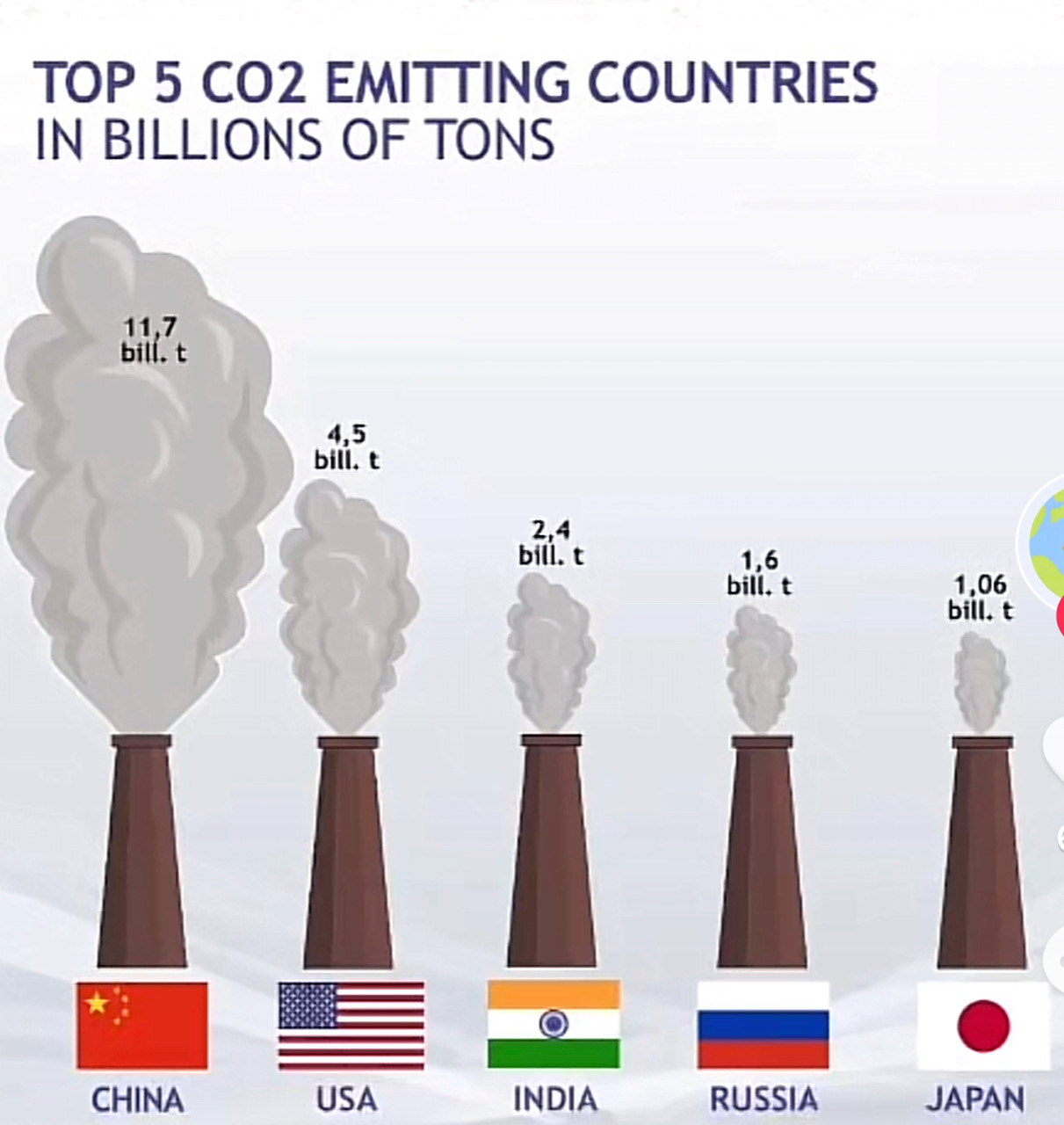
Top 5 Current Polluters. Source: Our World in Data


Currently, the biggest annual CO2 emitters are China, the US, India and Russia. Pakistan's annual CO2 emissions add up to just 235 million tons. On the other hand, China contributes 11.7 billion tons, the United States 4.5 billion tons, India 2.4 billion tons, Russia 1.6 billion tons and Japan 1.06 billion tons. 

Pakistan's Annual CO2 Emission. Source: Our World in Data

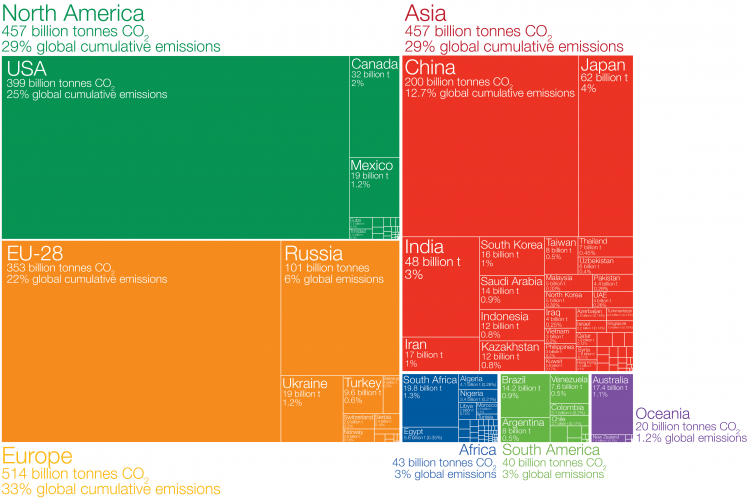
The United States has contributed 399 billion tons (25%) of CO2 emissions, the highest cumulative carbon emissions since the start of the Industrial Revolution in the late 18th century. The 28 countries of the European Union (EU28), including the United Kingdom, come in second with 353 billion tons of CO2 (22%), followed by China with 200 billion tons (12.7%). 

Cumulative CO2 Emissions. Source: Our World in Data

Pakistan's cumulative CO2 contribution in its entire history is just 4.4 billion tons (0.28%). Among Pakistan's neighbors, China's cumulative contribution is 200 billion tons (12.7%),  India's 48 billion tons (3%) and Iran's 17 billion tons (1%).  

Developing Asian Nations' CO2 Emissions. Source: Our World in Data

Pakistan has contributed little to climate change but it has become one of its biggest victims. In the 2015 Paris agreement on climate change, signatories agreed to recognize and “address” the loss and damage caused by those dangerous climate impacts, according to the Washington Post. In 2021, at the major U.N. climate conference in Glasgow, Scotland, negotiators from developing countries tried to establish a formal fund to help the countries like Pakistan most affected by climate disasters. It was blocked by rich countries led by the Biden administration. Pakistan finally succeeded in acceptance of "loss and damage" at COP27 conference in 2022. The UN-sponsored Pakistan Donors Conference in Geneva this year is an important milestone and a good start toward practically helping the victims of climate change in developing nations.   


Tuesday, February 1, 2022

US Says NO to Food as Human Right While Afghanistan Suffers Under Sanctions

On November 9, 2021, the United States, the world's most vocal supporter of human rights, voted against a United Nations committee's draft on the right to food which passed by 180 votes in favor to 2 against (Israel, United States). The UN committee expressed alarm that in 2020, "the number of people lacking access to adequate food rose by 320 million ‑ to 2.4 billion ‑ amounting to nearly a third of the world’s population, and that between 720 million and 811 million people faced hunger". Currently, the hunger situation in Afghanistan is the most acute with over half the population suffering from extreme levels of hunger. Afghanistan has been subjected to US sanctions since the US loss to the Taliban in 2021. 

UN Vote on Food as Human Right


 “Hunger is a violation of human dignity”, Cuba’s delegate said while addressing the UN Committee meeting. Presenting the draft, he voiced concern that the United States has blocked consensus on the text for four years in a row. The United States representative — highlighting conditions in the Lake Chad Basin, Yemen and Somalia ‑ said the draft contains unbalanced and inaccurate positions that her delegation simply cannot support. The concept of food sovereignty could justify food protectionism, negatively impacting food security, she explained, adding that the United States does not recognize the right to food, as it lacks a definition in international law.    

Meanwhile, Shelley Thakral, the World Food Program spokesperson for Afghanistan, says more than half the population — some 23 million Afghans — are facing what the WFP calls extreme levels of hunger. Malnutrition is soaring. Food prices have risen. And the WFP's surveys show the overwhelming majority of Afghans, 98% of the population, lack enough food to eat. Many are surviving on limited diets with less fresh vegetables, dairy or meat – or none at all, according to an NPR report. 

Afghanistan is not the first example of the US sanctions resulting in mass hunger and starvation. The reality is that the United States' sanctions over the years have denied many people around the world their basic right to food.The sanctions do not just hit the current generation of people experiencing hunger.  Sanctions permanently damage the social and economic fabric of the targeted nations. The effects of hunger last multiple generations in terms of their sub-par physical and mental development. 

In a recent article published in The Guardian, Nicholas Mulder, author of "The Economic Weapon: The Rise of Sanctions as a Tool of Modern War" has criticized the use of sanctions. He has said  "Promoting economic stimulus at home while enforcing deprivation abroad is a self-defeating way to seek world stability". Here is an except from Mulder's "The Economic Weapon": 

"As sanctions have become an accepted tool of liberal international institutions, the threshold for using them has declined. How to respond to the violation of norms remains, ultimately, a political question. In the spring of 1919, Robert Cecil waved away protests against using blockade to overthrow Bolshevism by responding that he saw “no other alternative.” Many of today’s internationalists, too, see few alternatives. This perception has driven some of the most grievously counterproductive uses of sanctions, most prominently against Iraq in the 1990s, when its strangulation at the hands of the UN Security Council cost hundreds of thousands of lives and permanently damaged the country’s social and economic fabric. These humanitarian nightmares are an important reminder of the lethal early twentieth-century origins of sanctions. But most economic sanctions used today are far more mundane in character. In 2015 a UN official estimated that one-third of the world’s population lives in countries that are under some form of economic sanctions. These range from the specific, such as individual travel bans and asset freezes, to more general measures, such as technological and trade restrictions. Today’s omnipresent sanctions have traveled a long way from their interwar purpose of preventing war".

As far back as 1924, famous British economist John Maynard Keynes  had argued that aiding our allies is more effective than sanctioning our foes. Mulder reminds the great powers of today, particularly the United States, that Keynes' lesson should be heeded now. 

Related Links:


Haq's Musings

South Asia Investor Review

Pakistan Among World's Largest Food Producers

Naya Pakistan Housing Program

Food in Pakistan 2nd Cheapest in the World

Hunger Worsens in India Amid COVID Pandemic

Pakistan to Become World's 6th Largest Cement Producer by 2030

Pakistan's 2012 GDP Estimated at $401 Billion

US Defeat By The Afghan Taliban

Coronavirus, Lives and Livelihoods in Pakistan

Vast Majority of Pakistanis Support Imran Khan's Handling of Covid19 Crisis

Pakistani-American Woman Featured in Netflix Documentary "Pandemic"

Incomes of Poorest Pakistanis Growing Faster Than Their Richest Counterparts

Can Pakistan Effectively Respond to Coronavirus Outbreak? 

How Grim is Pakistan's Social Sector Progress?

Pakistan Fares Marginally Better Than India On Disease Burdens

Trump Picks Muslim-American to Lead Vaccine Effort

COVID Lockdown Decimates India's Middle Class

Pakistan Child Health Indicators

Pakistan's Balance of Payments Crisis

How Has India Built Large Forex Reserves Despite Perennial Trade Deficits

Conspiracy Theories About Pakistan Elections"

PTI Triumphs Over Corrupt Dynastic Political Parties

Strikingly Similar Narratives of Donald Trump and Nawaz Sharif

Nawaz Sharif's Report Card

Riaz Haq's Youtube Channel

Saturday, April 8, 2017

US Missile Strikes in Syria; US Mediation in India-Pakistan Dispute; Bannon’s Future

Did Syrian President Bashar Al-Assad really use chemical weapons against his own people? Are US Missile Strikes on Syrian Shayrat airbase justified? Why did Russian President Vladimir Putin stand by and watch his Syrian ally punished by US missile strikes? What is President Trump’s strategy in Syria beyond these limited strikes? How will the Trump Administration deal with ISIS in Syria? How will Russia and Iran react to further US involvement against their ally Assad?

What did United States’ UN Ambassador Nikki Haley say about the Trump administration mediating between India and Pakistan? Why did India immediately reject it? Where will this initiative go from here? How will Lisa Curtis’s appointment as South Asia director of US National Security Council impact President Trump’s policy in South Asia given that she co-wrote a paper with Husain Haqqani that is highly critical of Pakistan? Would President Trump's Pakistan policy be better or worse or the same as President Obama's?

Why has President Trump’s close aide Steve Bannon been bumped from the US National Security Council headed by General HR McMaster? Is there any truth in rumors of Bannon’s clash with President Trump’s son-in-law Jared Kushner? Is Bannon about to be completely eased out of the White House? How will such an exit change the White House?

Viewpoint From Overseas host Faraz Darvesh discusses these questions with regular panelists Misbah Azam and Riaz Haq (www.riazhaq.com)

https://youtu.be/wN5B7QWKT1Q


Related Links:

Haq's Musings

Trump Administration's Policy Toward Muslims, India and Pakistan

Is Husain Haqqani Advising Trump?

Obama's Parting Shot Against Pakistan

Does the US Share Responsibility For the Rise of ISIS?

Impact of Trump Appointment on US Domestic and Foreign Policy

Iran-Saudi Conflict

Talk4Pak Youtube Channel


Monday, July 15, 2013

Pakistani Government and Top Politicians Ignore Malala Day

Prime Minister Nawaz Sharif and other top politicians in Pakistan reacted negatively or buried their heads in the sand as the world greeted Malala Yousufzai's powerful speech on Friday, July 12, 2013, her 16th birthday, declared by the United Nations as Malala Day. In her speech, Malala said, "I am not against anyone. Neither am I here to speak in terms of personal revenge against the Taliban or any other terrorists group. I am here to speak up for the right of education of every child. I want education for the sons and the daughters of all the extremists especially the Taliban. I do not even hate the Talib who shot me. Even if there is a gun in my hand and he stands in front of me. I would not shoot him. This is the compassion that I have learnt from Muhammad-the prophet of mercy, Jesus Christ and Lord Buddha."

The only top politician who broke  this conspicuous silence more than 24 hours after Malala's UN speech was Imran Khan who tweeted “Malala’s courage and commitment to the cause of education, especially girls, is admirable” on Saturday evening.

However, the PTI-led government of Khyber Pukhtoonkhwa, the home of Malala Yousufzai and the place where she was shot in the head by the Taliban, still remained indifferent.

In Pakistan's largest province of Punjab, a tweet from Chief Minister Shehbaz Sharif  (Prime Minister Nawaz Sharif's brother and closest adviser) said Malala’s speech was for "global consumption".  He was criticized for the tweet which he later deleted.

Pakistani civil society did try to partially fill the vacuum left by organizing events to celebrate Malala Day in major urban centers like Karachi and Lahore. In KPK, the province most affected by terrorism and gender bias in education,  ANP was the only political party that held ceremonies in Peshawar and in Malala’s hometown, Mingora, to mark the day. Malala was shot when ANP was in power, but it defended the teen and never showed reluctance in taking on the Taliban.

The vacuum left by the top political leadership of Pakistan was unfortunately filled by the Taliban sympathizers who spun various conspiracy theories to blame foreigners, particularly the West,  for all of Pakistan's problems. While she was still speaking at the U.N., her detractors in Pakistani social media  were denouncing her as a “CIA agent" or claiming that her wounds had been “faked.” There were those who said she had not been hurt at all, while others were suspicious of her global fame. The messages were in the thousands.

Malala Day was a missed opportunity for Pakistani leaders to focus the attention of the people of Pakistan on two very important issues they face: the extremely serious threat of terrorism and the denial of education to girls in the country, particularly in western provinces of Khyber Pukhtunkhwa ruled by Imran Khan's Pakistan Tehreek-e-Insaf and Balochistan ruled by Nawaz Sharif's PML(N).

It's hard to explain the behavior of Pakistan's ruling politicians. They are  failing to condemn the Taliban for the brutal slaughter of innocent civilians. Their silence is being interpreted as their abject weakness and extreme fear of the terrorists.  This is creating even more space for the Taliban and their sympathizers to continue to challenge the writ of the Pakistani state.

It's hard to imagine how the cowardly leaders of Pakistan can solve many of the serious problems, including crises such as energy shortages and economic stagnation, if they lack the basic courage to speak out against the terrorists who are continuing their daily campaign of murder and mayhem unhindered by the Pakistani state.

Lack of real leadership coupled with growing sense of denial makes it difficult for Pakistan to confront its enemies at home. While Nawaz Sharif's government continues to harp on peace talks, the Taliban have intensified their campaign of terror. In the few weeks Sharif has been in office, 32 terrorist attacks have claimed over 250 lives. The only way to begin to stop it is for Pakistanis to see beyond the conspiracy theories. It is impossible to solve a problem that is not even openly and fully acknowledged.

Here's a video of Malala's UN Speech on Friday, July 12, 2013:


Related Links:

Haq's Musings

Nawaz Sharif's Silence on Terrorism

Respecting Huqooq-ul-Ibad in Ramadan

Does Nawaz Sharif Have an Anti-Terrorism Strategy?

Malala Moment: Profiles in Courage?

Imran Khan Draws 500 Pakistani-Americans in Silicon Valley

Saturday, April 17, 2010

UN Says Pak Needs Truth, Reconciliation and Reform After Bhutto's Murder

In its 65 page report released recently, the United Nations' Commission of Inquiry holds the Musharraf government primarily responsible for security lapses in protecting Benazir Bhutto, and blames federal, provincial and district governments for failing to to protect her or properly investigate her tragic assassination.

Plenty of Blame To Assign

In addition to assigning primary responsibility to the Musharraf administration, the commission concludes that there is plenty of blame to go around all of the players involved in Benazir Bhutto's security. The report says that Pakistan suffers from deep, long-standing and systematic problems in terms of the lack of basic professionalism, and the absence of overall competence at all levels of the government. Along with the incompetence and unprofessional conduct of the officials, the report also finds that "the PPP’s security for Ms Bhutto was characterized by a lack of direction and professionalism". Mr. Rehman Malik, the man in charge of Benazir Bhutto's security, is now in charge of Pakistan's internal security as the country's interior minister since 2008, in the midst of the worst ever carnage unfolding on the nation's street.

The UN commission report expresses its dismay at the absence of any serious investigation into her death by her own party's government headed by her widower during the last two years. It says, "Ms Bhutto was killed more than two years ago. A government headed by her party, the PPP, has been in office for most of that time, and it only began the further investigation, a renewal of the stalled official investigation in October 2009. This is surprising to the Commission."

Tension Between PPP and Police

The report suggests that there was tension between police and the PPP workers when the police struggled to control a mass of PPP members attempting to climb on the stage at Liaquat Bagh on the day of the Bhutto murder. The Commission finds that the police were indeed passive in their security role after the scuffle with some of the PPP members on securing the stage. The commission "believes it was unprofessional if the Rawalpindi District Police reduced their level of alert to any degree as a result of wounded pride".

Benazir Bhutto's Responsibility

The commission members hold Benazir Bhutto at least partially responsible for ignoring the advice of Major Imtiaz who was assigned by the Musharraf government as a security officer to be with her at all times. She also disregarded warnings from the ISI chief about risks to her life at Liaquat Bagh. The report says that Major Imtiaz "advised Ms Bhutto on her own security responsibilities. He noted that he had advised her many times not to expose herself by standing through the escape hatch of her armoured car to wave to the crowds, but she would usually ignore his advice and sometimes express anger at being told what to do. On the day of her assassination, Major Imtiaz did not advise Ms Bhutto not to stand up through the escape hatch." However, the report says that the then intelligence chief General Nadeem Taj "met with Ms Bhutto in the early morning hours of 27 December at Zardari House in Islamabad" and "urged her to limit her public exposure and to keep a low profile at the campaign event at Liaquat Bagh later that day".

Pakistan's History of Political Assassinations

The report recognizes that the Bhutto assassination on December 27, 2007, was not the first in Pakistan's history of political assassinations which have remained unsolved. The report puts it as follows:

"Ms Bhutto’s assassination was not the first time in Pakistan’s brief national history that a major political figure had been killed or died in an untimely fashion. The country’s first prime minister, Liaquat Ali Khan, was assassinated in 1951 in the same park where Ms Bhutto was assassinated; the assassin was killed by police on the spot, but broader responsibilities, including who might have been behind the killing have never been established. Ms Bhutto’s father, Zulfiqar Ali Bhutto, president of Pakistan from 1971-73 and prime minister from 1973-77, was deposed in a military coup in 1977, charged with the murder of a political opponent’s father and hanged in 1979. Many believe that the judicial process against Mr Bhutto was deeply flawed and politically-motivated. Later, General Zia ul Haq, the military leader who deposed Mr Bhutto and ruled Pakistan for 11 years, died in a plane crash together with the United States Ambassador to Pakistan in 1988; investigations by the United States and Pakistan into the crash came to conflicting conclusions, and it remains the object of much speculation. Other killings of political figures that have never been solved include the deaths of Ms Bhutto’s two brothers, Shahnawaz, who was killed in France in 1985 and Murtaza, killed in Pakistan in 1997. The list continues to grow, more recently with the killings, among others, of Nawab Akbar Bugti, a 79-year old Balochi nationalist leader in a military operation in August 2006 and three other Balochi nationalist leaders in April 2009, including Ghulam Mohammed Baloch."

Botched CSI or Cover-up?

The report specifically refers to the botched crime scene investigation (CSI) after the assassination. “The collection of 23 pieces of evidence was manifestly inadequate in a case that should have resulted in thousands,” it said. “The one instance in which the authorities reviewed these actions, the Punjab (provincial) committee of inquiry into the hosing down of the crime scene was a whitewash. Hosing down the crime scene so soon after the blast goes beyond mere incompetence; it is up to the relevant authorities to determine whether this amounts to criminal responsibility.”

While UN commission sees the hosing down of the crime scene "soon after the blast" as "whitewash", any cursory look at the standard CSI practice in hundreds of murder cases in Pakistan would suggest otherwise. In a post on this subject back in January, 2008, here is what I wrote:

"There is a total lack of professionalism in the way the law-enforcement agencies in Pakistan go about their business. Even a cursory review by a lay person who has watched CSI:Miami or other US police shows on TV can see that no established crime scene procedures are understood or followed in Pakistan. The police do not immediately seal off the crime scenes. The police do not take time to carefully collect and preserve crime scene evidence such as detailed pictures, sketches, weapons, bullet fragments, explosives residues, blood swatches, fibers, vehicles etc. The police do not immediately contact the people present in the vicinity, interrogate them professionally and record their statements. They do not order an immediate autopsy in murder cases. They let the media and even ordinary folks just walk into the crime scene, disturb it and take pictures etc. They order that the crime scene be hosed down as quickly as possible even before it is scrutinized adequately for clues."

Corruption, Incompetence of Police Force

"The Contours of Police Integrity" by Carl Klockars, et al, talks about the lack of professionalism among Pakistani police officials as follows:

"The causes of police misconduct in Pakistani society are deeply embedded in the country's socioeconomic and political structure. To begin with, the society is highly tolerant of corruption in general, as indicated by Transparency International....A police officer is expected to posses a high degree of intelligence and the interpersonal skills required to exercise in enforcing the law. However, the level required of the constables, who (together with head constables) comprise 89% of the police force (Chaudhry, 1997, p. 101), is matriculation or even less. Such educational requirements have created a situation in which the majority of the police force have a low level of education. The education of a typical constable can not support the the demands of the job; the constable is therefore someone who is trained to serve as a mechanical functionary obeying the orders of those more senior rather than an officer using personal judgment to solve policing issues....Both police officers' importance as members of government apparatus and their influence as a result of their estimated illegal income make policing such an attractive profession that people are willing to pay any price to get their dear ones positions in the police force. Politicians attach such importance to police service that even the members of National Assembly get their close relatives (such as sons and brothers) inducted into the police service as deputy superintendent of police-by direct notification of the prime minister and without any exam or procedure."

In what Newsweek recently called "transfer industry" in South Asia, the bribe-rich police precincts ( called thanas) in Pakistan are "sold" to the highest bidder to become the station house officer (SHO or thanedar), who then has a "license" to recoup what the appointee paid and make additional "profit" for himself and his superiors. Such appointments encourage continuing massive corruption and incompetence in the police departments.

The fact is that a large number of police officers are recruited because of their political connections rather than their competence. It is hard to expect such a police force to be either professional or competent, as has been demonstrated time and again in a recent spate of violence, including political assassinations such as Benazir Bhutto's.

The three-member UN panel, led by Chilean Ambassador to UN Heraldo Muñoz and included Marzuki Darusman, former attorney-general of Indonesia, and Peter Fitzgerald, a veteran official of the Irish National Police, has urged the Government of Pakistan to undertake police reform in view of its “deeply flawed performance and conduct.”

Need For Truth, Reconciliation and Reform

Instead of engaging in media spin to politicize the Commission's report to settle political scores, the PPP government should immediately begin in earnest the long overdue process to change the culture of corruption, incompetence and impunity.

The report recommends the establishment of a fully independent Truth and Reconciliation Commission to investigate political killings, disappearances and terrorism in Pakistan in recent years in view of the backdrop of a history of political violence carried out with impunity.

The first serious police reform effort since independence was launched during the Musharraf years that was widely applauded, even embraced briefly by Punjab Chief Minister Shahbaz Sharif until it caught the eye of the Musharraf critics. The draft of Pakistan Police Ordinance 2001 was aimed at organizing a police system, which is “independently controlled, politically neutral, non-authoritarian, people friendly and professionally efficient.” Even though the text of the 2001 Ordinance has been significantly altered since then, first by the Police Order of 2002 and then by the Police Order (Amendment) Ordinance of 2004, the initiative still retains a fairly good blueprint for police reforms. It is as of now referred to as the Police Order 2002. Unfortunately, there has been no progress on it in the last few years.

Unfortunately, the hopes of reform in Pakistan are already being dismissed by key officials. “I have witnessed history in my country for the last 60 years and nothing is ever taken to conclusion,” Pakistan's UN Ambassador Abdullah Hussain Haroon said in an interview with Businessweek. “We have had great trauma in Pakistan that did not lead to reform.”


Hope For the Future

Talking about her husband and current president Asif Ali Zardari, Benazir Bhutto reportedly told senator and family friend Dr. Abdullah Riar that "Time will prove he is the Nelson Mandela of Pakistan". Let us see if Zardari can live up to his late wife's expectations of him by taking the UN advice on launching a South African style "Truth and Reconciliation Commission" in Pakistan.

Related Links:

Zardari: Nelson Mandela of Pakistan?

CSI: Pakistan?

Police Reform in Pakistan

Reforming Police in South Asia

Intelligence Failures Amidst Daily Carnage in Pakistan

Incompetence Worse Than Corruption in Pakistan

CSI Training in Pakistan

UN Report on Bhutto Assassination

The Contours of Police Integrity