Riaz Haq writes this data-driven blog to provide information, express his opinions and make comments on many topics. Subjects include personal activities, education, South Asia, South Asian community, regional and international affairs and US politics to financial markets. For investors interested in South Asia, Riaz has another blog called South Asia Investor at http://www.southasiainvestor.com and a YouTube video channel https://www.youtube.com/channel/UCkrIDyFbC9N9evXYb9cA_gQ
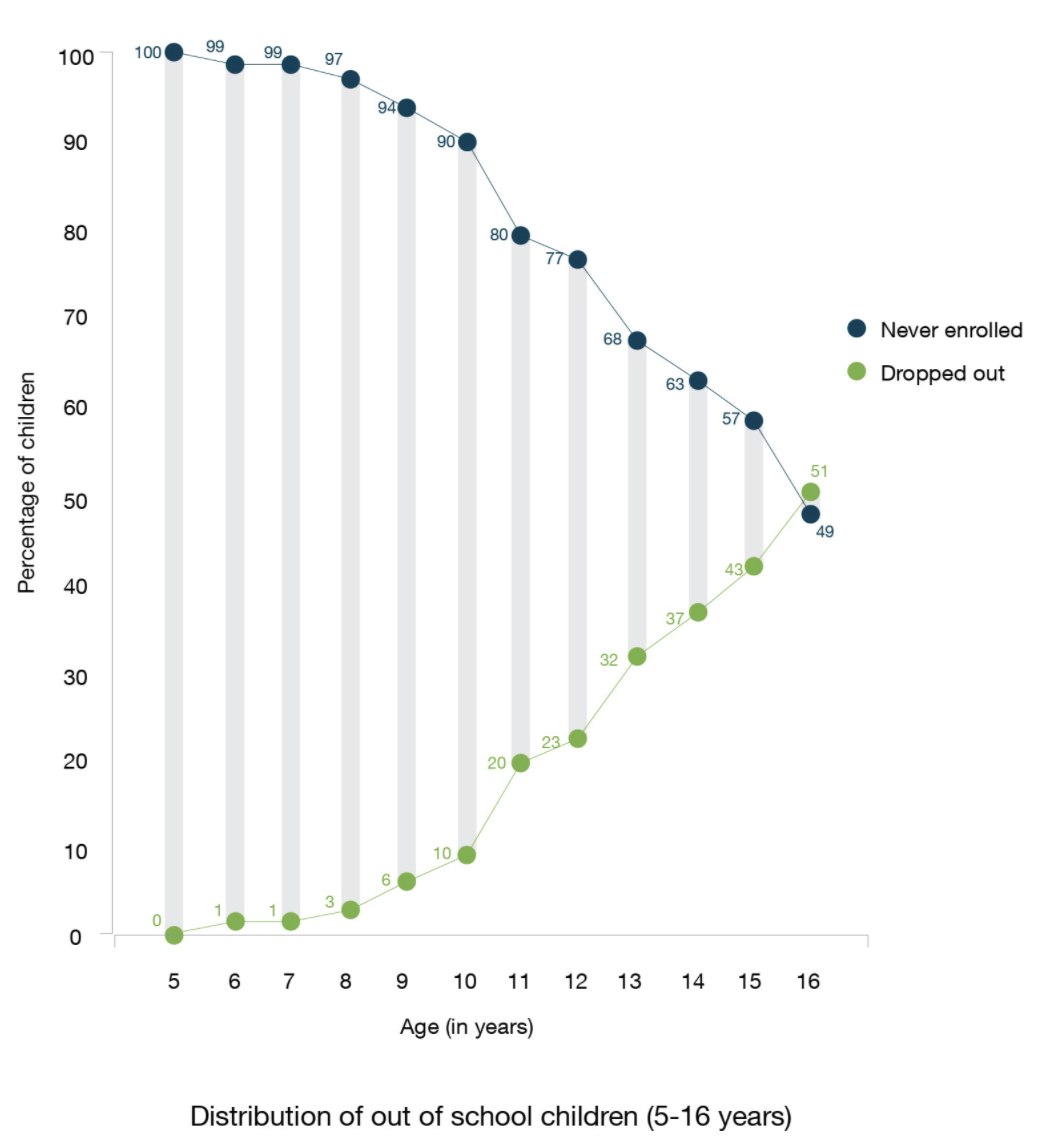
The Annual Status of Education Report (ASER) Pakistan 2025 national report, officially released on March 26, 2026, shows that the number of "Out of School Children" (OOSC) aged 6-16 years in Pakistan is now 5 million, not 25 million generally reported. "The findings on access are encouraging. Enrollment levels are high, with 92.2 percent of children aged 6–16 in school and only 7.7 percent out of school", says the ASER Pakistan 2025 report. ASER Pakistan is a citizen-led initiative, primarily led by Idara-e-Taleem-o-Aagahi (ITA) in collaboration with various national and international partners to promote foundational learning. It also works closely with over 10,000 volunteers and numerous local civil society organizations such as the Aga Khan Foundation (AKF), PAL Network (People's Action for Learning), UNESCO and federal and provincial government departments in Pakistan.
The latest ASER report contains a table showing that the 6 to 16 age group has around 66 million boys and girls. Based on these numbers, the out of school children's population is now 5.3 million. Of the total number of enrollees, 62% attend government schools and 27% are in private schools.
The number of out-of-school Pakistani preschoolers in the 3-5 years age group is 41%, according to the ASER Pakistan 2025 Report. It indicates that most Pakistani parents do not send their children to school before age 6.
Earlier, the Household Integrated Economic Survey (HIES) released by the Pakistan Bureau of Statistics (PBS) in December 2025 put the OOSC figure for children 5-16 years at 20 million. One important difference is the age bracket: ASER's figure of 5 million is for 6-16 years while the HIES figure of 20 million is for 5-16 years.
While the public spending on education remains low in Pakistan, the private sector spending is higher. Recent data indicates annual education expenditure exceeds Rs. 5 trillion ($18 billion), driven by roughly Rs. 2.8 trillion in household spending (private) and Rs. 2.23 trillion in government (public) funding, highlighting a major shift towards private financing.
The total (public+private) spending on education has been rising. In 2024-25 it was $18 billion in USD terms, twice the national defense budget of Pakistan. This appears to be driving higher school enrollment. In addition to increasing access, the key challenges for Pakistan include improving learning outcomes and reducing drop-out rates at higher grade levels.
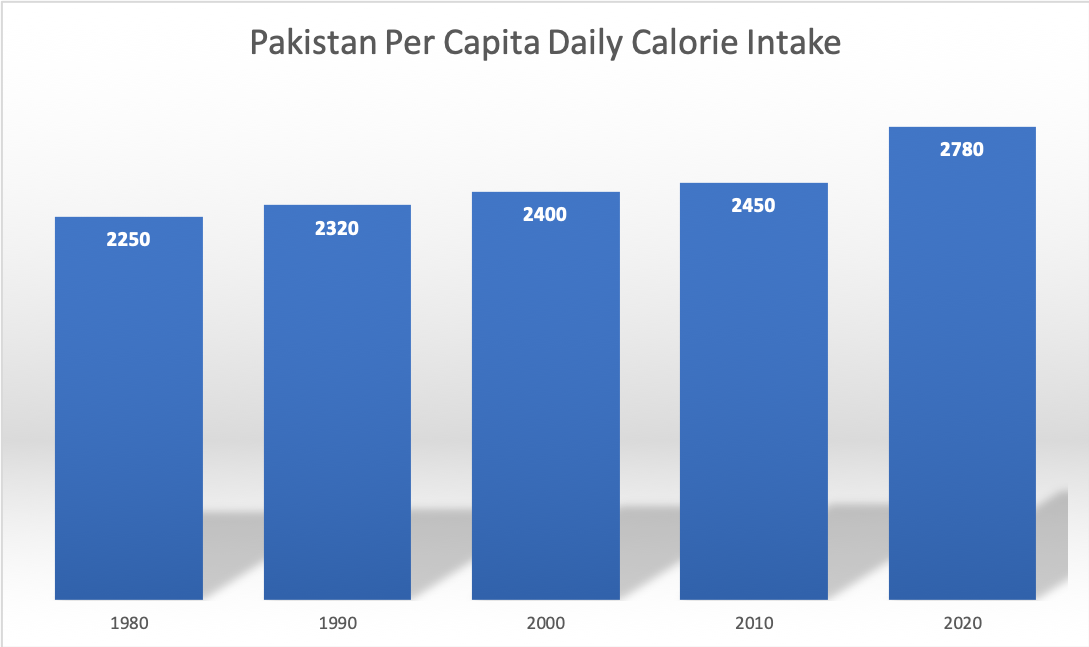
Pakistanis are eating more and healthier foods, according to the Economic Survey of Pakistan 2021-22. Per capita average daily calorie intake in Pakistan has jumped to 2,735 calories in FY 2021-22 from 2,457 calories in 2019-20. The biggest contributor to it is the per capita consumption of fresh fruits and vegetables which soared from 53.6 Kg to 68.3 Kg, less than half of the 144 Kg (400 grams/day) recommended by the World Health Organization. Healthy food helps cut disease burdens and reduces demand on the healthcare system. Under former Prime Minister Imran Khan's leadership, Pakistan succeeded in achieving these nutritional improvements in spite of surging global food prices amid the Covid19 pandemic.
Pakistan Per Capita Daily Calorie Consumption. Source: Economic Surveys of Pakistan
The trend of higher per capita daily calorie consumption has continued since the 1950s. It has risen from about 2,078 in 1949-50 to 2,400 in 2001-02 and 2735 in 2021-22. The per capita per day protein intake in grams increased from 63 to 67 to about 75 during these years. Health experts recommend that women consume at least 1,200 calories a day, and men consume at least 1,500 calories a day, says Harvard Health Publishing. The global average has increased from 2360 kcal/person/day in the mid-1960s to 2900 kcal/person/day currently, according to the Food and Agricultural Organization (FAO). The USDA (United States Department of Agriculture) estimates that most women need 1,600 to 2,400 calories, while the majority of men need 2,000 to 3,000 calories each day to maintain a healthy weight. Global Hunger Index defines food deprivation, or undernourishment, as consumption of fewer than 1,800 calories per day.
The share of overweight or obese adults in Pakistan's population is estimated by the World Health Organization at 28.4%. It is 20% in Bangladesh, 19.7% in India, 32.3% in China, 61.6% in Iran and 68% in the United States.
The latest edition of the Economic Survey of Pakistan estimates that per capita calories come from the annual per capita consumption of 164.7 Kg of cereals, 7.3 Kg of pulses (daal), 28.3 Kg of sugar, 168.8 liters of milk, 22.5 Kg of meat, 2.9 Kg of fish, 8.1 dozen eggs, 14.5 Kg of ghee (cooking oil) and 68.3 Kg of fruits and vegetables. Pakistan's economy grew 5.97% and agriculture outputs increased a record 4.4% in FY 2021-22, according to the Economic Survey. The 4.4% growth in agriculture has boosted consumption and supported Pakistan's rural economy.
The minimum recommended food basket in Pakistan is made up of basic food items (cereals, pulses, fruits, vegetables, meat, milk, edible oils and sugar) to provide 2150 kcal and 60gram protein/day per capita.
The state of Pakistan's social sector is not as dire as the headlines suggest. There are good reasons for optimism. Key indicators show that nutrition and health in Pakistan are improving but such improvements need to be accelerated.
Prime Minister Imran Khan launched Sehat Card in Punjab, Pakistan 's largest province, on International Universal Healthcare Day 2021. This is essentially a government-funded health insurance program run by insurance companies to cover up to one million rupees worth of care each year at government certified public and private clinics and hospitals. It represents a major expansion of this program which was first introduced in Khyber-Pakhtunkhwa province. It is now available to residents of Khyber Pakhtunkhwa, Punjab, Balochistan, Gilgit Baltistan, Azad Kashmir, and Tharparkar district in Sindh under the Sehat Sahulat Program.
Speaking at the launch event in Lahore, Prime Minister Imran Khan said, “This is a landmark. This is a defining moment towards our course to make Pakistan a welfare state.” “This is not (just) a health insurance (but) rather a health system. Now (the) private sector will build hospitals even in villages where the basic health units remain vacant as no doctor desires to be posted there. Now (the) private sector will come and (the) poorest of the poor will get free treatment,” he added.
Pakistan Sehat Card
Sehat card was first introduced in Khyber Pakhtunkhwa (KP) by Taimur Jhagra, a former McKinsey consultant who now holds both the health and finance ministry portfolios in the province. Talking with The Telegraph newspaper reporters, he said: “It shows us we can do big things in this country in a short amount of time". He went on: “It's giving quality access to those that tend to be viewed by many as second class citizens and deserving of only second class facilities.”
The Sehat Card program will fund both public and private healthcare, Mr. Jhagra said. “We are not funding the private sector, we are funding health care for our citizens, wherever they want.,” he said. The Telegraph has spoken with patients using the program in KP. They say it has delivered them from the worry of medical debt, where serious illness often means having to sell land or livestock, or take out loans, to pay medical bills.
Sehat card is being widely used in Khyber Pakhtunkhwa province with a population of over 30 million. There is data available to understand how the program is being funded. Here's an excerpt of The Telegraph story on it: "Treatment is provided through approved public or private hospitals and the comparatively low cost of healthcare in Pakistan has meant the state-owned insurance provider has been able to provide cover at around £3 ($3.97) per head. The card is currently costing 22bn rupees (£93m or $123m) out of a total health budget in the province of 146bn rupees (£620m or $820m)"
The final hold-out in Pakistan is Sindh province with its nearly 50 million people. Prime Minister Imran Khan has urged Sindh's ruling party, the Pakistan Peoples Party (PPP), to launch Sehat Card and other social sector programs in Sindh as well.
Ehsaas Program was established by Prime Minister Imran Khan in 2019. Aimed at helping the poor and the needy, it has several elements ranging from cash hand-outs and education to health and nutrition.
A recent survey conducted by Gallup Pakistan confirms that the program is very popular among the people. Nearly 3 out of 4 Pakistanis (76%) have a good opinion about the Ehsaas program. Nearly 9 in 10 (89%) Pakistanis who have received assistance from the program are satisfied with the amount of money received. 90% of Pakistanis believe that the program should be expanded to include more people, according to the survey.
Three daughters of a Karachi rickshaw driver named Amjad Ali are attending top universities in Pakistan. All three graduated from The Citizens Foundation's K-12 schools located across Pakistan, including poor districts of Pakistan's megacity of nearly 20 million residents. Amina Amjad, the eldest is studying at Dow University of Health Sciences (DUHS) to become a medical doctor, the second daughter is enrolled in Shaheed Zulfikar Ali Bhutto Institute of Science and Technology (SZBIST) to become an engineer and the third Muskan Amjad is going to the Institute of Business Administration (IBA), Karachi's top business school on a full scholarship.
Girls' Education:
Muskan Amjad
This would be unusual for a poor man's children attending top universities regardless of gender. What makes it particularly noteworthy is that these are daughters of a poor man in a country where girls' education is often ignored. “People often mocked and criticized me, saying that girls are bound to get married and move out and to stop wasting my hard-earned money on my daughters,” Amjad Ali told hosts of Samaa TV, a private television channel in Pakistan. The Citizens Foundation (TCF) making it possible by making K-12 education accessible and affordable for Pakistan's disadvantaged children. There are many success stories of TCF alumni posted on TCF's Facebook page.
Back in 2013, another TCF alumna Anum Fatima, a resident of Ibrahim Goth slum located near Karachi's Steel Town, made history; she went to Harvard Business School as part of a student exchange program.
Anum's father is employed as a driver and her mother works as a maid. The slum school she attended is run by The Citizen's Foundation (TCF), a private foundation.
Karachi Rickshaw Driver Amjad Ali and Family
The Citizens Foundation:
The Citizens Foundation (TCF) is a non-profit organization, and operates one of the largest privately owned networks of low-cost formal schools in Pakistan. The Foundation runs 1,567 school units, educating 252,000 students through 12,000 teachers and principals, with over 17,400 employees. It has very low overhead by Pakistani NGO's standards. Approximately 94% of the Foundation's expenditure is allocated to the Education program.
Pakistan Truck Art Message From A Girl: "Let me Study; Let me Advance"
TCF plays a very important role in the lives of its students during school and after they graduate. It runs an Alumni Development Program (ADP) where successful alumni inspire and mentor students and fellow TCF alumni. Muskan Amjad volunteers for ADP.
If you read Pakistan media headlines and donation-seeking NGOs and activists' reports these days, you'd conclude that the social sector situation is entirely hopeless. However, if you look at children's education and health trend lines based on data from credible international sources, you would feel a sense of optimism. This exercise gives new meaning to what former US President Bill Clinton has said: Follow the trend lines, not the headlines. Unlike the alarming headlines, the trend lines in Pakistan show rising school enrollment rates and declining infant mortality rates.
Key Social Indicators:
The quickest way to assess Pakistan's social sector progress is to look at two key indicators: School enrollment rates and infant mortality. These basic social indicators capture the state of schooling, nutrition and health care. Pakistan is continuing to make slow but steady progress on both of these indicators. Anything that can be done to accelerate the pace will help Pakistan move up to higher levels as proposed by Dr. Hans Rosling and adopted by the United Nations.
Rising Primary Enrollment:
Gross enrollment in Pakistani primary schools exceeded 97% in 2016, up from 92% ten years ago. Gross enrollment rate (GER) is different from net enrollment rate (NER). The former refers to primary enrollment of all students of all ages while the latter counts enrolled students as percentage of students in the official primary age bracket. The primary NER in Pakistan is significantly lower but the higher GER indicates many of these kids eventually enroll in primary schools albeit at older ages.
The infant mortality rate (IMR), defined as the number of deaths in children under 1 year of age per 1000 live births in the same year, is universally regarded as a highly sensitive (proxy) measure of population health. A declining rate is an indication of improving health. IMR in Pakistan has declined from 86 in 1990-91 to 74 in 2012-13 and 62 in the latest survey in 2017-18.
During the 5 years immediately preceding the survey, the infant mortality rate (IMR) was 62 deaths per 1,000 live births. The child mortality rate was 13 deaths per 1,000 children surviving to age 12 months, while the overall under-5 mortality rate was 74 deaths per 1,000 live births. Eighty-four percent of all deaths among children under age 5 in Pakistan take place before a child’s first birthday, with 57% occurring during the first month of life (42 deaths per 1,000 live births).
Human Development Ranking:
It appears that improvements in education and health care indicators in Pakistan are slower than other countries in South Asia region. Pakistan's human development ranking plunged to 150 in 2018, down from 149 in 2017. It is worse than Bangladesh at 136, India at 130 and Nepal at 149. The decade of democracy under Pakistan People's Party and Pakistan Muslim League (Nawaz) has produced the slowest annual human development growth rate in the last 30 years. The fastest growth in Pakistan human development was seen in 2000-2010, a decade dominated by President Musharraf's rule, according to the latest Human Development Report 2018.
UNDP’s Human Development Index (HDI) represents human progress in one indicator that combines information on people’s health, education and income.
Pakistan saw average annual HDI (Human Development Index) growth rate of 1.08% in 1990-2000, 1.57% in 2000-2010 and 0.95% in 2010-2017, according to Human Development Indices and Indicators 2018 Statistical Update. The fastest growth in Pakistan human development was seen in 2000-2010, a decade dominated by President Musharraf's rule, according to the latest Human Development Report 2018.
Pakistan@100: Shaping the Future:
Pakistani leaders should heed the recommendations of a recent report by the World Bank titled "Pakistan@100: Shaping the Future" regarding investments in the people. Here's a key excerpt of the World Bank report:
"Pakistan’s greatest asset is its people – a young population of 208 million. This large population can transform into a demographic dividend that drives economic growth. To achieve that, Pakistan must act fast and strategically to: i) manage population growth and improve maternal health, ii) improve early childhood development, focusing on nutrition and health, and iii) boost spending on education and skills for all, according to the report". Summary:
The story of Muskan Amjad shows that the state of Pakistan's social sector is not as dire as the headlines suggest. There's reason for optimism. Key indicators show that education and health care in Pakistan are improving but such improvements are slower than in other countries in South Asia region. Pakistan's human development ranking plunged to 150 in 2018, down from 149 in 2017. It is worse than Bangladesh at 136, India at 130 and Nepal at 149. The decade of democracy under Pakistan People's Party and Pakistan Muslim League (Nawaz) has produced the slowest annual human development growth rate in the last 30 years. The fastest growth in Pakistan human development was seen in 2000-2010, a decade dominated by President Musharraf's rule, according to the latest Human Development Report 2018. One of the biggest challenges facing the PTI government led by Prime Minister Imran Khan is to significantly accelerate human development rates in Pakistan.
Here's a video clip of Amjad Ali and his family's appearance on Samaa TV's Naya Din show:
If you read Pakistan media headlines and donation-seeking NGOs and activists' reports these days, you'd conclude that the social sector situation is entirely hopeless. However, if you look at children's education and health trend lines based on data from credible international sources, you would feel a sense of optimism. This exercise gives new meaning to what former US President Bill Clinton has said: Follow the trend lines, not the headlines. Unlike the alarming headlines, the trend lines in Pakistan show rising school enrollment rates and declining infant mortality rates.
Key Social Indicators:
The quickest way to assess Pakistan's social sector progress is to look at two key indicators: School enrollment rates and infant mortality. These basic social indicators capture the state of schooling, nutrition and health care. Pakistan is continuing to make slow but steady progress on both of these indicators. Anything that can be done to accelerate the pace will help Pakistan move up to higher levels as proposed by Dr. Hans Rosling and adopted by the United Nations.
Gross enrollment in Pakistani primary schools exceeded 97% in 2016, up from 92% ten years ago. Gross enrollment rate (GER) is different from net enrollment rate (NER). The former refers to primary enrollment of all students of all ages while the latter counts enrolled students as percentage of students in the official primary age bracket. The primary NER in Pakistan is significantly lower but the higher GER indicates many of these kids eventually enroll in primary schools albeit at older ages.
The infant mortality rate (IMR), defined as the number of deaths in children under 1 year of age per 1000 live births in the same year, is universally regarded as a highly sensitive (proxy) measure of population health. A declining rate is an indication of improving health. IMR in Pakistan has declined from 86 in 1990-91 to 74 in 2012-13 and 62 in the latest survey in 2017-18.
During the 5 years immediately preceding the survey, the infant mortality rate (IMR) was 62 deaths per 1,000 live births. The child mortality rate was 13 deaths per 1,000 children surviving to age 12 months, while the overall under-5 mortality rate was 74 deaths per 1,000 live births. Eighty-four percent of all deaths among children under age 5 in Pakistan take place before a child’s first birthday, with 57% occurring during the first month of life (42 deaths per 1,000 live births).
It appears that improvements in education and health care indicators in Pakistan are slower than other countries in South Asia region. Pakistan's human development ranking plunged to 150 in 2018, down from 149 in 2017.
Expected Years of Schooling in Pakistan by Province
There was a noticeable acceleration of human development in #Pakistan during Musharraf years. Pakistan HDI rose faster in 2000-2008 than in periods before and after. Pakistanis' income, education and life expectancy also rose faster than Bangladeshis' and Indians' in 2000-2008.
Now Pakistan is worse than Bangladesh at 136, India at 130 and Nepal at 149. The decade of democracy under Pakistan People's Party and Pakistan Muslim League (Nawaz) has produced the slowest annual human development growth rate in the last 30 years. The fastest growth in Pakistan human development was seen in 2000-2010, a decade dominated by President Musharraf's rule, according to the latest Human Development Report 2018.
UNDP’s Human Development Index (HDI) represents human progress in one indicator that combines information on people’s health, education and income.
Pakistan saw average annual HDI (Human Development Index) growth rate of 1.08% in 1990-2000, 1.57% in 2000-2010 and 0.95% in 2010-2017, according to Human Development Indices and Indicators 2018 Statistical Update. The fastest growth in Pakistan human development was seen in 2000-2010, a decade dominated by President Musharraf's rule, according to the latest Human Development Report 2018.
Pakistani leaders should heed the recommendations of a recent report by the World Bank titled "Pakistan@100: Shaping the Future" regarding investments in the people. Here's a key excerpt of the World Bank report:
"Pakistan’s greatest asset is its people – a young population of 208 million. This large population can transform into a demographic dividend that drives economic growth. To achieve that, Pakistan must act fast and strategically to: i) manage population growth and improve maternal health, ii) improve early childhood development, focusing on nutrition and health, and iii) boost spending on education and skills for all, according to the report".
The state of Pakistan's social sector is not as dire as the headlines suggest. There's reason for optimism. Key indicators show that education and health care in Pakistan are improving but such improvements are slower than in other countries in South Asia region. Pakistan's human development ranking plunged to 150 in 2018, down from 149 in 2017. It is worse than Bangladesh at 136, India at 130 and Nepal at 149. The decade of democracy under Pakistan People's Party and Pakistan Muslim League (Nawaz) has produced the slowest annual human development growth rate in the last 30 years. The fastest growth in Pakistan human development was seen in 2000-2010, a decade dominated by President Musharraf's rule, according to the latest Human Development Report 2018. One of the biggest challenges facing the PTI government led by Prime Minister Imran Khan is to significantly accelerate human development rates in Pakistan.