Showing posts sorted by date for query global hindu. Sort by relevance Show all posts

Saturday, August 29, 2026

Nepal Tragedy Raises Fears of Massive Glacier Melt in Pakistani Mountains

Northern Pakistan is home to over 13,000 glaciers which pose a risk of catastrophic flash floods similar to the recent flash floods in Nepal. Pakistani officials have warned that shifts in glacier behavior are increasing the risk of glacial lake outburst floods (GLOF), particularly in Gilgit-Baltistan and Khyber Pakhtunkhwa, where communities face growing exposure to sudden flooding and landslides. 

Glacial Lake in Pakistan's Gilgit-Baltistan Region. Source: AIGEO360


Pakistan is actively monitoring its glaciers using real-time weather tracking and roughly 350 sensor devices installed by the National Disaster Management Authority (NDMA) and the Pakistan Meteorological Department (PMD) to mitigate glacial flash flood risks. 

This year, the PMD reported record-breaking summer heat across northern valleys (such as Chilas reaching 48.5°C and Bunji hitting 46.1°C), accelerating ice melt in Gilgit-Baltistan region and Khyber Pakhtunkhwa province. The heat triggered two major GLOF events that were officially recorded during the 2026 monsoon season in Gilgit-Baltistan, causing localized road and infrastructure damage but no casualties due to early siren activation and community alerts. 

Pakistani lawmakers and committees argue that the current count of 350 sensors remains critically low for tracking the vast Hindu Kush–Karakoram–Himalayan (HKH) glacier network. They are calling for expanded international support to significantly increase the number of sensors to enhance monitoring network. 

Hasanabad Bridge Collapse in Pakistan


Earlier in 2022, record-high temperatures in Pakistan's northern region caused Shisper glacier to melt rapidly, triggering the collapse of the Hassanabad Bridge along the Karakoram Highway. 

Pakistan is in the midst of a major solar energy revolution led by consumers. Driven by soaring electricity costs, unreliable grid infrastructure, and cheap imported solar panels, millions of households and businesses have installed rooftop solar. This rapid transition to solar has transformed the country's energy landscape.  According to the report, Pakistan’s total electricity demand increased by 33 terawatt-hours (TWh) between fiscal years 2023 and 2025. Distributed solar generation alone grew by 36 TWh during the same period, making it the primary driver of electricity demand growth and offsetting declines elsewhere in the power system.

Pakistan, which contributes less than 1% of global carbon emissions, is among the countries considered most vulnerable to climate change. About a third of the country was devastated by massive floods in 2022. The nation committed continued pursuit of nature-based solutions to the problem at COP26 in Glasgow in 2021. As part of this commitment, the country is planting one of the world's largest mangrove forests in the Indus River Delta, a key component of its Ten Billion Tree Tsunami campaign launched by former Prime Minister Imran Khan. 

The United States, Europe, India, China and Japan, the world's biggest polluters, must accept responsibility for the catastrophic floods in Pakistan and climate disasters elsewhere. A direct link of the disaster in Pakistan to climate change has been confirmed by a team of 26 scientists affiliated with World Weather Attribution, a research initiative that specializes in rapid studies of extreme events, according to the New York Times


Related Links:

Haq's Musings

South Asia Investor Review

Pakistan's Energy Imports

Ten Billion Tree Tsunami: Olive Revolution in Pakistan

Rooftop Solar Net Metering Growth in Pakistan 

Climate Change "Loss and Damage"

Pakistan is the 3rd Fastest Growing Trillion Dollar Economy

CPEC Financing: Is China Ripping Off Pakistan?

Pakistan Ramps Up Nuclear Power Generation

Is Pakistan Ready For Clean Energy Revolution?

China Global Power Database on Power Plants in Pakistan

CPEC Transforming Pakistan

Pakistan's $20 Billion Tourism Industry Boom

Pakistan Among Top 3 Countries For New Hydro Installed Capacity

Riaz Haq's YouTube Channel

PakAlumni Social Network

Saturday, March 14, 2026

India Hosts "Proud Islamophobe" Laura Loomer in New Delhi

Self-described "Proud Islamophobe" Laura Loomer was invited to speak this weekend at India Today Conclave, an annual conference sponsored by an Indian publication. Her speech focussed on what she called "Islamic Terrorism". She also apologized for anti-India racists X posts. To further please her Indian audience, she also engaged in Pakistan bashing. "Pakistan's biggest export to the world is Islamic terrorism, and I don't believe the US should be cozying up to the Pakistani government at all," she said. 

Loomer is known to be very close to President Donald Trump. In her social media posts, she is also known for viciously attacking India and Indians almost as much as Muslims. But at the conference in Delhi, she apologized for her anti-India posts. She also deleted most or all such posts prior to showing up in India. 

A Collage of Laura Loomer's anti-India Posts. Source: OpIndia


Loomer has described Indians as “third-world invaders” and questioned their place in the United States, claiming that America was built by “white Europeans.” She also mocked India’s sanitation practices. In one of the widely shared X messages, she questioned why Indians “still [defecate] in the water they bathe and drink from,” while another post mocked Indian immigrants as so-called “high-skilled” workers who supposedly come from a country without basic facilities. In her posts, she has referred to the “rape culture” in India. She asserts that Indians have a low IQ of just 76. 

It was her "proud Islamophobe" label and her views on "Islamic terrorism" that attracted many Indians to find her fit to be given a spotlight in the Indian capital. When X briefly made users’ countries of origin public, several prominent pro-Israel accounts were found to be run from India, according to France24

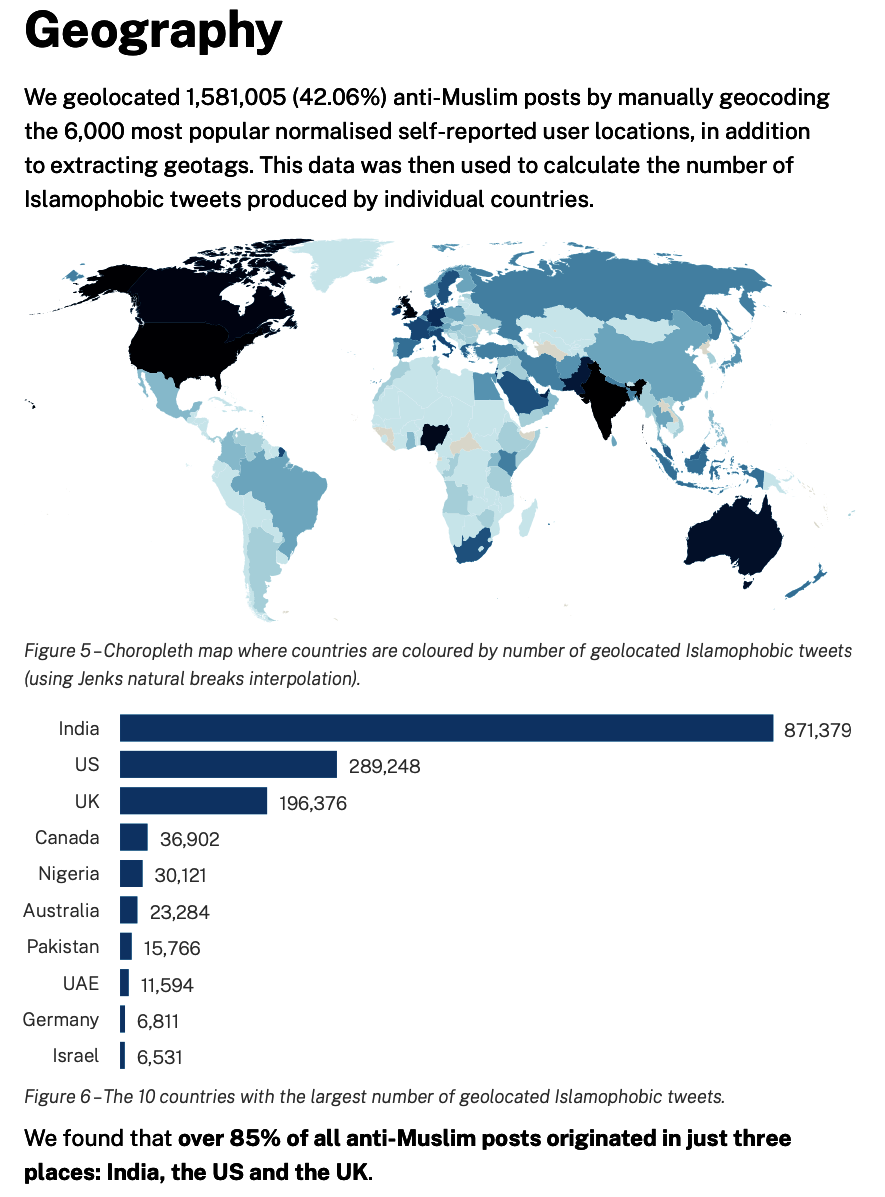
India has just 5.75% of global Twitter users but the country accounts for 55% of all anti-Muslim tweets, according to a report entitled "Islamophobia in the Digital Age" published by the Islamic Council of Victoria (ICV) in 2022. It also found that the US, the UK, and India contributed a staggering 86% of anti-Muslim content on Twitter during a three-year period. It should be noted that both the US and the UK have a sizable  Indian diaspora infected by hateful Hindutva ideology. 

India Accounts For 55% of Islamophobic Tweets. Source: ICV


Individuals and organizations connected to the RSS (Rashtriya Swayamsevak Sangh) are active users of social media. They are working to promote India's divisive Islamophobic politics among the Non Resident Indians (NRIs) and their children. Hundreds of the RSS shakhas (branches) are now found in at least 39 countries around the world. Hindutva is a Hindu supremacist ideology inspired by 20th century Fascism and Nazism in Europe; it is very different from the ancient Hindu faith, according to American history professor Audrey Truschke who teaches Indian history at Rutgers University in the US state of New Jersey. Top Indian economists have raised alarm about it.  

India has only 23 million Twitter users, 5.75% of 400 million Twitter users worldwide, but Indians generate more than half of all Islamophobic tweets in the world.  Numbers published in Twitter’s advertising resources indicate that Twitter had 3.40 million users in Pakistan in early 2022. ICV counted 15,766 Islamophobic tweets geolocated to Pakistan in a three year period.

Executives at Meta, the parent company of Facebook, recently told human rights groups that they wouldn’t release the full India Hate Speech study for their own security. An earlier 2020 company study concluded that Hindutva groups support violence against Muslims and Christians & should be banned from the platform, according to the Wall Street Journal. Here's an excerpt of the Wall Street Journal story:

"Meta has for years faced criticism from rights groups and has been probed by authorities regarding the presence of hate speech on its platforms in India, where more than 300 million people use Facebook and more than 400 million are on its WhatsApp messaging service. Meta has said it invests significantly in technology to find hate speech across languages in India. In 2020, Meta’s safety team concluded that a Hindu nationalist organization in India supported violence against minorities and likely qualified as an organization that should be banned from Facebook, the Journal reported that year. Facebook didn’t remove the group following internal security-team warnings that doing so might endanger both its business prospects and staff in India". 


Monday, December 15, 2025

WIR 2026: Income and Wealth Inequality in India, Pakistan and the World

The top 1% of Indians own 40.1% of the nation's wealth, higher than the 37% global average. This makes India one of the world's most unequal countries, according to the World Inequality Report. By contrast, the top 1% own 24% of the country's wealth in Pakistan, and 23.9% in Bangladesh. Tiny groups of wealthy elites (top 1%) are using their money to buy mass media to manipulate public opinion for their own benefit. They are paying politicians for highly favorable laws and policies to further consolidate their power. It is a phenomenon known as "elite capture". 

Wealth Inequality. Source: World Inequality Report 2026

"Extreme wealth inequality is persistent and increasing" in all parts of the world, says the report published by World Inequality Lab of the Paris School of Economics. This has serious economic, political and social implications. It is undermining democracies and empowering billionaires at the expense of the common people, including the middle class (middle 40%) and the poor (bottom 50%). 

Income Inequality. Source: World Inequality Report 2026


Income inequality is trending in the same way as wealth inequality. The income of the top 1% of Indians  stands at 22.6% of the national income. The income of the top 1% of Pakistanis is 16.2% of the country's income, significantly lower than the 20% global average. The income and wealth distribution in Bangladesh is similar to Pakistan's. 


Widening Income Gap in India. Source: WIR2026


Persistent Income Gap in Pakistan. Source: WIR2026


The global average monthly income is 1200 Euros but there are huge differences among various regions of the world. The South and South East Asia region remains among the poorest, but its average monthly income of 600 Euros is twice that of sub-Saharan Africa. North America's monthly income of 3,800 Euros is the highest while sub-Saharan Africa's 300 Euros is the lowest in the world. 


Regional Income Disparities. Source: WIR2026 


Global Inequality Change From 1980 to 2025. Source: Bloomberg


The report documents how the global financial system reinforces inequality. Wealthy economies continue to benefit from an “exorbitant privilege”: each year, around 1% of global GDP (approximately three times as much as development aid) flows from poorer to richer nations through net foreign income transfers associated with persistent excess yields and lower interest payments on rich-country liabilities. Reversing this dynamic is central to any credible strategy for global equity.

Related Links:


Haq's Musings

South Asia Investor Review

India Muslims: The Poorest Group in Modi's Hindu Rashtra

Elite Capture in South Asia

Food in Pakistan 2nd Cheapest in the World

India in Crisis: Unemployment and Hunger Persist After COVID

IMF Questions Modi's GDP Data

Record Number of Indians Seeking Asylum in US

Ambani Wedding, Indian Billionaires and Bollywood

Incomes of Poorest Pakistanis Growing Faster Than Their Richest Counterparts

Pakistanis Consuming More Calories, Fruits & Vegetables Per Capita 

How Grim is Pakistan's Social Sector Progress?

Pakistan Fares Marginally Better Than India On Disease Burdens

COVID Lockdown Decimates India's Middle Class

Pakistan Child Health Indicators

Pakistan's Balance of Payments Crisis

How Has India Built Large Forex Reserves Despite Perennial Trade Deficits

Riaz Haq's Youtube Channel

Saturday, October 11, 2025

Major Hindu American Group Distances Itself From Modi's India

"We are not proxies for India in the US", wrote Suhag Shukla, co-founder and executive director of the Hindu American Foundation (HAF) in a recent article for The Print, an Indian media outlet.  This was written in response to Indian diplomat-politician Shashi Tharoor's criticism that the Indian-American diaspora was largely silent on the Trump administration policies hurting India.  After a meeting with a US congressional delegation in September 2025, Tharoor had questioned why the Indian diaspora appeared apathetic to US policies affecting India, including H-1B visa fees and tariffs.

Suhag Shukla (L) and Shashi Tharoor

The HAF is seen by Prime Minister Narendra Modi's critics and human rights advocates as an American proxy for the Hindutva movement and its Hindu Supremacist ideology. HAF spun off in 2003 from the American branch of the Vishwa Hindu Parishad (VHP), an organization with ties to anti-Muslim violence in India. HAF co-founder Mihir Meghani published a manifesto praising the demolition of the Babri Mosque by a Hindu mob in 1992. 

HAF's Shukla's article has been published amid a growing backlash against the Indian diaspora in Australia, Canada, Europe, the United Kingdom and the United States. All of these countries and regions have seen very public expressions of disgust at the behavior of Indians in these countries. This is in part attributed to the politics of Indian Prime Minister Narendra Modi has proclaimed his country as "Vishwaguru", meaning the world's guru. It is often seen as an expression of Hindu Supremacy and denigration of all others. 

The arrogance of the Indian diaspora was highlighted last year when Vivek Ramaswamy, then a candidate for the Republican Party's presidential nomination,  said Americans don't have a good enough work ethic as American culture "venerated mediocrity over excellence." He offered it as a key justification to bring in more Indians to work in the United States. The backlash in the United States was immediate and strong.  The essence of the response to the Hindu supremacist criticism of the US culture went like this: People from India, a "shit-hole" country, are jealous of  America.  Earlier, Professor Amy Wax of University of Pennsylvania, told Tucker Carlsen that “the role of envy and shame in the way the third world [sic] regards the first world […] creates ingratitude of the most monstrous kind.” She also said that ‘Brahmin women’ of India are taught that they are better than everybody. 

American social media, particularly Trump's MAGA base, have turned against India and Indians, making them the most hated diaspora in the United States.  They are getting a taste of the kind of hate that the BJP, India's ruling party, has been promoting against Muslims. Anti-Indian slurs like "pajeet", "dirty Indian" and "coolie" have become common. 

Ashley Tellis, a strongly pro-India analyst in the United States, recently published an essay for Foreign Affairs magazine titled "India's Great Power Delusions" in which he wrote that "the country (India) is shedding one of its main sources of strength—its liberal democracy—by embracing Hindu nationalism. This evolution could undermine India’s rise by intensifying communal tensions and exacerbating problems with its neighbors, forcing it to redirect security resources inward to the detriment of outward power projection. The country’s illiberal pivot further undermines the rules-based international order that has served it so well". 

The U.S. Embassy in New Delhi has warned Indians traveling to the United States they could have their American visas revoked if they commit serious crimes on American soil. The advisory was issued days after police bodycam footage of an Indian woman allegedly shoplifting goods worth around $1,300 from a Target store in Illinois was widely shared online, according to The Independent

In recent years, India has emerged as a major hub for global scams. The US government has alleged in court documents that a large enterprise originating from India was involved in stealing nearly $1.5 billion from elderly Americans. Recently, two Indian nationals, Pranay Mamindi and Kishan Patel, were found guilty of participating in a money laundering conspiracy, concealing the source of the money, and using the illegally gained money to further promote a criminal enterprise.  Six other defendants from India also pleaded guilty and are awaiting sentencing. 

These global scams appear to have started amid widespread unemployment in India. Many of the scammers previously worked in call centers where they learned to use computers and telecommunications networks to reach out and talk to Americans. In 2022, U.S. citizens fell victim to a massive loss of over $10 billion from phishing calls orchestrated by illegal Indian call centers, according to data from the Federal Bureau of Investigation (FBI). 

Indian-Americans, too, have been found guilty in a number of high-profile scams. A federal jury convicted former Theranos executive Ramesh "Sunny" Balwani, an Indian-American entrepreneur, on all 12 counts of fraud in 2022. Balwani was born in 1965 in Pakistan to a Sindhi Hindu family. His one-time girlfriend and partner Elizabeth Holmes, the founder of Theranos, was convicted on similar charges earlier that year. Both face up to 20 years in prison. 

Last year, a federal judge sentenced former Outcome Health CEO Rishi Shah, an Indian-American, to 7½ years in prison for a massive fraud scheme that prosecutors say enabled a “jet-set lifestyle” featuring private aircraft, yachts and a tony Chicago home.

In 2020, Dr. John Nath Kapoor, Indian-American CEO of Insys Therapeutics, was found guilty of conspiring to recklessly and illegally boost profits from the opioid painkiller Subsys, a fentanyl spray designed to be absorbed under the tongue, according to multiple media reports.

Rajat Gupta, an Indian-American former global head of McKinsey & Company, was convicted of insider trading in 2012. He was charged with passing on confidential business information about Goldman Sachs to hedge fund manager Raj Rajaratnam. Gupta was found guilty on multiple counts of conspiracy and securities fraud and served a two-year prison sentence. 

India Ranks Number One For Misinformation and Disinformation


Beyond the hub of scams and frauds, it seems that India has earned a reputation as the epicenter of misinformation and disinformation. According to experts surveyed for the World Economic Forum’s 2024 Global Risk Report, India was ranked highest for the risk of misinformation and disinformation.  This was on full display during the recent conflict with Pakistan. 

After the recent Pahalgam militant attack in Kashmir, the Indian government immediately blamed it on Pakistan without any investigation or evidence. More than a month later, the perpetrators have neither been clearly identified nor apprehended. And yet, the government of Prime Minister Modi proceeded with air strikes inside Pakistan. Pakistan retaliated and shot down several Indian fighter jets, including its most advanced French Rafales. The conflict began to quickly escalate with strikes and counter-strikes, with the world fearing a nuclear exchange. This prompted the United States and several other countries to intervene and force a ceasefire in less than 4 days of armed conflict. 

During this short 4-day period, the Indian mainstream media was filled with lies. Here's how the Washington Post reported this: "Times Now Navbharat reported that Indian forces had entered Pakistan; TV9 Bharatvarsh told viewers that Pakistan’s prime minister had surrendered; Bharat Samachar said he was hiding in a bunker. All of them, along with some of the country’s largest channels — including Zee News, ABP News and NDTV — repeatedly proclaimed that major Pakistani cities had been destroyed". 

It is unfortunate but true: Fraud and falsehood have become endemic in Indian society.  Part of the blame falls squarely on the ruling BJP party which promotes falsehoods. In 2018, Indian Prime Minister Narendra Modi's right-hand man and home minister Amit Shah told his party's volunteers commonly known as Modi Bhakts: "We can keep making messages go viral, whether they are real or fake, sweet or sour". "Keep making messages go viral. We have already made a WhatsApp group with 32 lakh people in Uttar Pradesh; every morning they are sent a message at 8 am", Shah added, according to a report in Dainik Bhaskar, an Indian Hindi-language daily newspaper.

Related Links:


Haq's Musings

South Asia Investor Review

Indian-American COVID19 Researchers Face Fraud Charges

Indian-American Operator Charged With Fraud By US Federal Prosecutors

Lying Indian Media Caught Red Handed

India's Firehose of Falsehoods

Padlocked Grave Story Confirms Yet Again India's Status as the Hub of Fake News

H1-B Visa Abuse By Indian-American Body Shops

India: A Rogue State Ruled By Gangsters?

Riaz Haq's Youtube Channel


Monday, September 15, 2025

Modi's Hindutva: Has BJP's Politics Hurt India's International Image?

The Indian cricket team's crass behavior after defeating the Pakistani team at the Asia Cup 2025 group encounter has raised eyebrows among sports fans around the world. Not only did Suryakumar Yadav, the Indian team captain, refuse to do the customary handshake before and after the match in Dubai but he also made controversial statements linking the match with the recent India-Pakistan conflict. “A few things in life are above sportsman’s spirit ......We stand with all the victims of the Pahalgam terror attack and with their families, and dedicate this win to our brave armed forces who took part in Operation Sindoor”, he said. 

Indian Prime Minister Narendra Modi


This latest incident in the UAE illustrates one of the reasons why there is a growing backlash against the Indian diaspora in Australia, Canada, Europe, the United Kingdom and the United States. All of these countries and regions have seen very public expressions of disgust at the behavior of Indians in these countries. This is in part attributed to the politics of Indian Prime Minister Narendra Modi has proclaimed his country as "Vishwaguru", meaning the world's guru. It is often seen as an expression of Hindu Supremacy and denigration of all others. 

The arrogance of the Indian diaspora was highlighted last year when Vivek Ramaswamy, then a candidate for the Republican Party's presidential nomination,  said Americans don't have a good enough work ethic as American culture "venerated mediocrity over excellence." He offered it as a key justification to bring in more Indians to work in the United States. The backlash in the United States was immediate and strong.  The essence of the response to the Hindu supremacist criticism of the US culture went like this: People from India, a "shit-hole" country, are jealous of  America.  Earlier, Professor Amy Wax of University of Pennsylvania, told Tucker Carlsen that “the role of envy and shame in the way the third world [sic] regards the first world […] creates ingratitude of the most monstrous kind.” She also said that ‘Brahmin women’ of India are taught that they are better than everybody. 

American social media, particularly Trump's MAGA base, have turned against India and Indians, making them the most hated diaspora in the United States.  They are getting a taste of the kind of hate that the BJP, India's ruling party, has been promoting against Muslims. Anti-Indian slurs like "pajeet", "dirty Indian" and "coolie" have become common. 

Ashley Tellis, a strongly pro-India analyst in the United States, recently published an essay for Foreign Affairs magazine titled "India's Great Power Delusions" in which he wrote that "the country (India) is shedding one of its main sources of strength—its liberal democracy—by embracing Hindu nationalism. This evolution could undermine India’s rise by intensifying communal tensions and exacerbating problems with its neighbors, forcing it to redirect security resources inward to the detriment of outward power projection. The country’s illiberal pivot further undermines the rules-based international order that has served it so well". 

The U.S. Embassy in New Delhi has warned Indians traveling to the United States they could have their American visas revoked if they commit serious crimes on American soil. The advisory was issued days after police bodycam footage of an Indian woman allegedly shoplifting goods worth around $1,300 from a Target store in Illinois was widely shared online, according to The Independent

In recent years, India has emerged as a major hub for global scams. The US government has alleged in court documents that a large enterprise originating from India was involved in stealing nearly $1.5 billion from elderly Americans. Recently, two Indian nationals, Pranay Mamindi and Kishan Patel, were found guilty of participating in a money laundering conspiracy, concealing the source of the money, and using the illegally gained money to further promote a criminal enterprise.  Six other defendants from India also pleaded guilty and are awaiting sentencing. 

These global scams appear to have started amid widespread unemployment in India. Many of the scammers previously worked in call centers where they learned to use computers and telecommunications networks to reach out and talk to Americans. In 2022, U.S. citizens fell victim to a massive loss of over $10 billion from phishing calls orchestrated by illegal Indian call centers, according to data from the Federal Bureau of Investigation (FBI). 

Indian-Americans, too, have been found guilty in a number of high-profile scams. A federal jury convicted former Theranos executive Ramesh "Sunny" Balwani, an Indian-American entrepreneur, on all 12 counts of fraud in 2022. Balwani was born in 1965 in Pakistan to a Sindhi Hindu family. His one-time girlfriend and partner Elizabeth Holmes, the founder of Theranos, was convicted on similar charges earlier that year. Both face up to 20 years in prison. 

Last year, a federal judge sentenced former Outcome Health CEO Rishi Shah, an Indian-American, to 7½ years in prison for a massive fraud scheme that prosecutors say enabled a “jet-set lifestyle” featuring private aircraft, yachts and a tony Chicago home.

In 2020, Dr. John Nath Kapoor, Indian-American CEO of Insys Therapeutics, was found guilty of conspiring to recklessly and illegally boost profits from the opioid painkiller Subsys, a fentanyl spray designed to be absorbed under the tongue, according to multiple media reports.

Rajat Gupta, an Indian-American former global head of McKinsey & Company, was convicted of insider trading in 2012. He was charged with passing on confidential business information about Goldman Sachs to hedge fund manager Raj Rajaratnam. Gupta was found guilty on multiple counts of conspiracy and securities fraud and served a two-year prison sentence. 

India Ranks Number One For Misinformation and Disinformation


Beyond the hub of scams and frauds, it seems that India has earned a reputation as the epicenter of misinformation and disinformation. According to experts surveyed for the World Economic Forum’s 2024 Global Risk Report, India was ranked highest for the risk of misinformation and disinformation.  This was on full display during the recent conflict with Pakistan. 

After the recent Pahalgam militant attack in Kashmir, the Indian government immediately blamed it on Pakistan without any investigation or evidence. More than a month later, the perpetrators have neither been clearly identified nor apprehended. And yet, the government of Prime Minister Modi proceeded with air strikes inside Pakistan. Pakistan retaliated and shot down several Indian fighter jets, including its most advanced French Rafales. The conflict began to quickly escalate with strikes and counter-strikes, with the world fearing a nuclear exchange. This prompted the United States and several other countries to intervene and force a ceasefire in less than 4 days of armed conflict. 

During this short 4-day period, the Indian mainstream media was filled with lies. Here's how the Washington Post reported this: "Times Now Navbharat reported that Indian forces had entered Pakistan; TV9 Bharatvarsh told viewers that Pakistan’s prime minister had surrendered; Bharat Samachar said he was hiding in a bunker. All of them, along with some of the country’s largest channels — including Zee News, ABP News and NDTV — repeatedly proclaimed that major Pakistani cities had been destroyed". 

It is unfortunate but true: Fraud and falsehood have become endemic in the Indian society.  Part of the blame falls squarely on the ruling BJP party which promotes falsehoods. In 2018, Indian Prime Minister Narendra Modi's right-hand man and home minister Amit Shah told his party's volunteers commonly known as Modi Bhakts: "We can keep making messages go viral, whether they are real or fake, sweet or sour". "Keep making messages go viral. We have already made a WhatsApp group with 32 lakh people in Uttar Pradesh; every morning they are sent a message at 8 am", Shah added, according to a report in Dainik Bhaskar, an Indian Hindi-language daily newspaper.

Related Links:


Haq's Musings

South Asia Investor Review

Indian-American COVID19 Researchers Face Fraud Charges

Indian-American Operator Charged With Fraud By US Federal Prosecutors

Lying Indian Media Caught Red Handed

India's Firehose of Falsehoods

Padlocked Grave Story Confirms Yet Again India's Status as the Hub of Fake News

H1-B Visa Abuse By Indian-American Body Shops

India: A Rogue State Ruled By Gangsters?

Riaz Haq's Youtube Channel


Sunday, June 8, 2025

Builder.AI: Yet Another Global Indian Scam?

A London-based startup builder.ai, founded by an Indian named Sachin Dev Duggal,  recently filed for bankruptcy after its ‘neural network’ was discovered to be 700 Indians coding in India. The company promoted its "code-building AI" to be as easy as "ordering pizza".  It was backed by nearly half a billion dollar investment by top tech investors including Microsoft. The company was valued at $1.5 billion. This is the latest among a series of global scams originating in India. 


In recent years, India has emerged as a major hub for global scams. The US government has alleged in court documents that a large enterprise originating from India was involved in stealing nearly $1.5 billion from elderly Americans. Recently, two Indian nationals, Pranay Mamindi and Kishan Patel, were found guilty of participating in a money laundering conspiracy, concealing the source of the money, and using the illegally gained money to further promote a criminal enterprise.  Six other defendants from India also pleaded guilty and are awaiting sentencing. 

These global scams appear to have started amid widespread unemployment in India. Many of the scammers previously worked in call centers where they learned to use computers and telecommunications networks to reach out and talk to Americans. In 2022, U.S. citizens fell victim to a massive loss of over $10 billion from phishing calls orchestrated by illegal Indian call centers, according to data from the Federal Bureau of Investigation (FBI). 

Indian-Americans, too, have been found guilty in a number of high-profile scams. A federal jury convicted former Theranos executive Ramesh "Sunny" Balwani, an Indian-American entrepreneur, on all 12 counts of fraud in 2022. Balwani was born in 1965 in Pakistan to a Sindhi Hindu family. His one-time girlfriend and partner Elizabeth Holmes, the founder of Theranos, was convicted on similar charges earlier that year. Both face up to 20 years in prison. 

Last year, a federal judge sentenced former Outcome Health CEO Rishi Shah, an Indian-American, to 7½ years in prison for a massive fraud scheme that prosecutors say enabled a “jet-set lifestyle” featuring private aircraft, yachts and a tony Chicago home.

In 2020, Dr. John Nath Kapoor, Indian-American CEO of Insys Therapeutics, was found guilty of conspiring to recklessly and illegally boost profits from the opioid painkiller Subsys, a fentanyl spray designed to be absorbed under the tongue, according to multiple media reports.

Rajat Gupta, an Indian-American former global head of McKinsey & Company, was convicted of insider trading in 2012. He was charged with passing on confidential business information about Goldman Sachs to hedge fund manager Raj Rajaratnam. Gupta was found guilty on multiple counts of conspiracy and securities fraud and served a two-year prison sentence. 

India Ranks Number One For Misinformation and Disinformation


Beyond the hub of scams and frauds, it seems that India has earned a reputation as the epicenter of misinformation and disinformation. According to experts surveyed for the World Economic Forum’s 2024 Global Risk Report, India was ranked highest for the risk of misinformation and disinformation.  This was on full display during the recent conflict with Pakistan. 

After the recent Pahalgam militant attack in Kashmir, the Indian government immediately blamed it on Pakistan without any investigation or evidence. More than a month later, the perpetrators have neither been clearly identified nor apprehended. And yet, the government of Prime Minister Modi proceeded with air strikes inside Pakistan. Pakistan retaliated and shot down several Indian fighter jets, including its most advanced French Rafales. The conflict began to quickly escalate with strikes and counter-strikes, with the world fearing a nuclear exchange. This prompted the United States and several other countries to intervene and force a ceasefire in less than 4 days of armed conflict. 

During this short 4-day period, the Indian mainstream media was filled with lies. Here's how the Washington Post reported this: "Times Now Navbharat reported that Indian forces had entered Pakistan; TV9 Bharatvarsh told viewers that Pakistan’s prime minister had surrendered; Bharat Samachar said he was hiding in a bunker. All of them, along with some of the country’s largest channels — including Zee News, ABP News and NDTV — repeatedly proclaimed that major Pakistani cities had been destroyed". 

It is unfortunate but true: Fraud and falsehood have become endemic in the Indian society.  Part of the blame falls squarely on the ruling BJP party which promotes falsehoods. In 2018, Indian Prime Minister Narendra Modi's right-hand man and home minister Amit Shah told his party's volunteers commonly known as Modi Bhakts: "We can keep making messages go viral, whether they are real or fake, sweet or sour". "Keep making messages go viral. We have already made a WhatsApp group with 32 lakh people in Uttar Pradesh; every morning they are sent a message at 8 am", Shah added, according to a report in Dainik Bhaskar, an Indian Hindi-language daily newspaper.

Related Links:


Haq's Musings

South Asia Investor Review

Indian-American COVID19 Researchers Face Fraud Charges

Indian-American Operator Charged With Fraud By US Federal Prosecutors

Lying Indian Media Caught Red Handed

India's Firehose of Falsehoods

Padlocked Grave Story Confirms Yet Again India's Status as the Hub of Fake News

H1-B Visa Abuse By Indian-American Body Shops

India: A Rogue State Ruled By Gangsters?

Riaz Haq's Youtube Channel


Tuesday, October 29, 2024

Will India Grow Old Before it Gets Rich?

India's population has aged faster than expected while its economic growth has slowed over the last decade. This raises the obvious questions: Will India get old before it gets rich? Is India getting poorer relative to its peers in the emerging markets? 

India's Population Aging. Source: Semafor

As India's birth rate declines rapidly, the proportion of people age 60 and over is rising in the general population. This is particularly true of the southern states like Kerala and Tamil Nadu. Meanwhile, the expected demographic dividend from the youth bulge in the country has yet to materialize. High youth unemployment is threatening to cause serious social instability in the world's most populous country. It is also causing a massive brain drain.  

India's GDP Per Capita Compared to Emerging Markets Average. Source: IMF

India is losing its best and brightest to the West, particularly to the United States, at an increasingly rapid pace. A 2023 study of the 1,000 top scorers in the 2010 entrance exams to the Indian Institutes of Technology (IIT) — a network of prestigious institutions of higher learning based in 23 Indian cities — revealed the scale of the problem. Around 36% migrated abroad, and of the top 100 scorers, 62% left the country, according to a report in the science journal Nature.  Nearly two-thirds of those leaving India are highly educated, having received academic or vocational training. This is the highest for any country, according to the Organization for Economic Co-operation and Development.

Annual Population Growth Rapidly Falling Across India. Source: Semafor

India has the lowest GDP per capita among the 5 BRICS nations. The country's GDP growth rate is much slower than the average for emerging markets. It means that India is becoming poorer relative to the rest of the developing world. 

GDP Per Capita Map 2024. Source: IMF
India's GDP Per Capita is Very Low. Source: BBC

The north-side geographic divide in India is growing. The southern five of India’s 28 states (Andhra Pradesh, Karnataka, Kerala, Tamil Nadu and Telangana) contain 20% of the population and contribute 31% of the GDP, according to The Economist magazine. Among startups, 46% of tech “unicorns” are southerners, particularly from Bangalore. The five southern states provide 66% of the it-services industry’s exports. The latest craze is for “global capability centers”, where multinationals assemble their global auditors, lawyers, designers, architects and other professionals: 79% of these hubs are in the south.

Indian Parliament Seats Based on Current Population. Source: National Herald

There has always been a north-south divide in India in terms of population and wealth. The south has been wealthier and less populous than the north. But the political power is still concentrated in the poorer and more populous northern states. This situation serves Prime Minister Narendra Modi and his BJP party well. But it also creates significant resentment in southern states. 

In his book "The Raisina Model", British Lord Meghand Desai says that India's breakup can not be ruled out. Specifically, he points to three issues that could lead to it:

1.  Cow protection squads are killing Muslims and jeopardizing their livelihoods.  The current agitation about beef eating and gau raksha is in the Hindi belt just an excuse for attacking Muslims blatantly. As most slaughterhouses in UP are Muslim-owned, owners and employees of these places are prime targets.

2. India has still not fashioned a narrative about its nationhood which can satisfy all. The two rival narratives—secular and Hindu nation—are both centered in the Hindi belt extending to Gujarat and Maharashtra at the most. This area comprises 51% of the total population and around 45% of the Muslims in India.

3. India has avoided equal treatment of unequal units. Representation in the Rajya Sabha (Upper House of Parliament) is proportional to population size. The larger states dominate both Houses of Parliament. It would be difficult for small states to object, much less initiate reform. In future, small states could unite to present their case for better treatment. 

Related Links:

Haq's Musings

South Asia Investor Review

Guess Why Pakistani Analyst Uzair Younus is Making Headlines in India!

Ambassador Kishore Mahbubani: America Does Not Respect India

World Happiness Report: India Among Saddest Nations of the World

Balakot and Kashmir: Fact Checkers Expose Indian Lies

WB Poverty Update: India Biggest Contributor to Increase in Poverty

India in Crisis: Unemployment, Hunger Persist After Waves of Covid

Modi's Blunders and Delusions 

India's Israel Envy: What If Modi Attacks Pakistan?

Project Azm: Pakistan to Develop 5th Generation Fighter Jet

Pakistan Navy Modernization

Pakistan's Sea-Based Second Strike Capability

Who Won the 1965 War? India or Pakistan?

Is the West Unwittingly Helping Modi Realize His Akhand Bharat Hindutva Dream?

Has Pakistan Lost All Wars? 


Monday, July 15, 2024

Ambani Wedding: Billionaires, BJP and Bollywood

Last few months have seen a grotesque display of obscene wealth in India, a country with well-documented levels of extreme povertyhunger and unemployment. Indian billionaire Mukesh Ambani has splurged hundreds of millions of dollars on his son's wedding attended by top politicians including Prime Minister Narendra Modi, Hollywood and Bollywood celebrities and Ambani's fellow billionaires who have accumulated vast amounts of wealth in one of the world's most unequal countries.  Experts blame it on Mr. Modi's policies promoting crony capitalism.  Viral Acharya, former deputy governor of Reserve Bank of India, told the BBC that their ability to acquire large distressed companies, a growing appetite for mergers and acquisitions, and India's conscious industrial policy of creating "national champions via preferential allocation of projects and in some cases regulatory agencies turning a blind eye to predatory pricing".

Indian Prime Minister Modi at the Ambani Wedding in Mumbai. Source: ANI

Between 2014-15 and 2022-23 on Mr. Modi's watch, the rapid rise in inequality in India has been particularly striking in terms of wealth concentration, according to World Inequality Lab. The top 1% now control over 40% of total wealth in India, up from 12.5% in 1980, and they earn 22.6% of total pre-tax income, up from 7.3% in 1980.  Almost 90% of the country's billionaire wealth has been found concentrated in the hands of the upper castes. The Inequality Report concludes: "This spectacular rise of inequality (in India) makes the “Billionaire Raj” headed by India’s modern bourgeoise more unequal than the British Raj headed by the colonialist forces. It also squarely places India among the most unequal countries in the world". 

Bollywood, the powerful Indian film industry, has become a key enabler of BJP's billionaire-friendly and   Islamophobic policies. In a piece titled “India's theatrical politics: Bollywood, billionaires and the BJP", authors Sehr Rushmeen and Wanya Sidhu write: "By shaping narratives that subtly endorse “Hindutva” ideologies, sometimes even employing Muslim actors to deliver skewed messages, Bollywood contributes to a socio-political echo chamber in favor of Modi’s BJP...... Bollywood movies transcend mere entertainment; they convey narratives cleverly crafted to align with the BJP’s political agenda. By consistently portraying Muslims and Pakistan in a negative spotlight, these Indian blockbusters perpetuate a cycle of fear and nationalistic fervor to garner votes for the BJP while discarding the imperative of forging national unity".

Meanwhile, India's child-wasting rate of 18.7% is the highest in the world, according to the Global Hunger Index (GHI) 2023 released last year.  The South Asian country’s child wasting rate is higher than that of war-torn Yemen (at 14.4%) and Sudan (at 13.7%), which are ranked second and third in the world. Pakistan's child wasting rate is 8%.  It represents the share of children under age five who have low weight for their height, reflecting acute undernutrition.  The child wasting rate of the South Asia region is 14.8%, the highest of any world region and more than twice the child wasting rate of Africa. India is home to a quarter of the world's most undernourished people. According to the United Nations, India has nearly 195 million undernourished people. This is more than any other country, including China. 

India Tops in Child Wasting Rate. Source: The Wire


India Tops the World in Child Wasting. Source: Global Hunger Index 2023


India's Hindu Nationalist government  of Prime Minister Narendra Modi wants to project India as a superpower launching moon missions and hosting G20 summits. Since the GHI 2023 report runs counter to this PR exercise, New Delhi has rejected its findings. But its own National Family Health Survey 5 (NFHS 5) says that "Thirty-six percent of children under age five years are stunted; 19 percent are wasted; 32 percent are underweight; and 3 percent are overweight. Children born to mothers with no schooling and children in the lowest wealth quintile are most likely to be undernourished". 

Overall, India ranks at the 111th position out of 124 countries, with neighboring Pakistan (102nd), Bangladesh (81st), Nepal (69th) and Sri Lanka (60th) faring better than India in the index. India has slipped four notches from its 107th position in 2022.

India has slipped 4 places, from 107 in 2022 to 111 in 2023, on GHI. Pakistan's ranking has also slipped 3 places, from 99 to 102.  It is not a huge surprise since the country is still facing the aftermath of the disastrous floods of 2022. It is also suffering from a serious economic crisis. Meanwhile, India's Modi government is making claims to being the world's fastest growing economy. And yet, Indian children are the most malnourished in the world. 

India Malnutrition Indicator Trends. Source GHI 2023

Pakistan Malnutrition Indicator Trends. Source GHI 2023


There's a close relationship between hunger and poverty. At the $3.65 poverty line, India accounts for 40% of the slight upward revision of the global poverty rate from 23.6% to 24.1%, according to the World Bank September 2023 Global Poverty Update. It is the same update that made the following recent headline in the Indian and Pakistani media about Pakistan: "Pakistan's 40% Population Lives Below Poverty Line, Says World Bank". Fact: 45.9% of Indians and 39.4% of Pakistanis live below the $3.65 a day poverty line as of September, 2023, according to the latest World Bank global poverty update that takes into account the impact of inflation on poverty rates. But neither the Pakistani media nor India's compliant "Godi Media" reported it. Nor did they question why poverty in India is growing despite the Modi government's claim to be "the world's fastest growing economy". 

Related Links:


Haq's Musings

South Asia Investor Review

Pakistan Among World's Largest Food Producers

Pakistan Floods 2022

Food in Pakistan 2nd Cheapest in the World

India in Crisis: Unemployment and Hunger Persist After COVID

India Rising, Pakistan Collapsing

Record Number of Indians Seeking Asylum in US

Vast Majority of Pakistanis Support Imran Khan's Handling of Covid19 Crisis

Incomes of Poorest Pakistanis Growing Faster Than Their Richest Counterparts

Pakistanis Consuming More Calories, Fruits & Vegetables Per Capita 

How Grim is Pakistan's Social Sector Progress?

Pakistan Fares Marginally Better Than India On Disease Burdens

COVID Lockdown Decimates India's Middle Class

Pakistan Child Health Indicators

Pakistan's Balance of Payments Crisis

How Has India Built Large Forex Reserves Despite Perennial Trade Deficits

Riaz Haq's Youtube Channel

Thursday, June 20, 2024

Are Some Pakistanis Feeding into Indian Delusions of Grandeur?

Many Pakistanis are singing effusive praises of India on social media platforms and racking up millions of views, according to a report in the Indian  mainstream media. These Pakistanis are boosting their earnings by feeding into the Indians' delusions. The "India Today" report claims that, in the last 6 months alone, the number of channels using the hashtag #pakistanireactiononindia on YouTube increased by 1,000, and the number of videos by 5,000. Calling it an "industry" is an acknowledgment of the profit motive of the Pakistani YouTubers. These YouTubers steer clear of anything that even remotely challenges their unadulterated praise of India. For example, they make no mention of India ranking worse than Pakistan on income poverty, hunger and overall happiness. Nor do they talk about thousands of Indian farmers killing themselves every year.  Nor do they mention extremely high levels of unemployment in Modi's India. 

Modi Claims "chhappan inch ki chhati" (56 inch chest)

India's Population:

India is the world's most populous country with a population (1.4 billion) over 6 times larger than Pakistan's (230 million). India has the world's largest number of social media users and hundreds of millions of book readers. The profit motive for praising India extends beyond just the social media. It also includes book publishers and authors who see an opportunity to profit from it. India's English language book market is the world's third largest, behind that of the United States at the top and of the United Kingdom at number 2.  It is the fastest growing market today which will make India the world's number 1 market in the next ten years.  It could happen sooner if the book sales in the US and the UK decline faster or those in India grow more rapidly than they are already.

Indian Delusions: 

Delusions are a symptom of mental disorders, and are characterized by a belief in something that is not true. Here's how India Today describes what it calls "The Praise India Industry" and how it is received by Indians: 

"Indians love people from abroad lauding their achievements, but seem to derive the biggest satisfaction when Pakistanis gush over India's success. Pakistanis have understood that and have tapped into that, creating an entire industry of YouTubers in Pakistan". 

India's leaders and their western boosters have been promoting the country as an emerging superpower to counter rising China. They cite the size of India's economy, demography, military and consumer market to back up their assertions. These claims are challenged by India's former chief economic advisor Arvind Subramanian and Josh Felman, former head of IMF in India, in an article titled "India's Size Illusion".  In a similar article titled "The Chinese Threat No One Is Talking About — And How to Counter It", Sameer Lalwani, a senior fellow for Asia strategy at the Stimson Center, has raised serious questions about India's ability to counter China in the Indian Ocean region. 

Akhand Bharat (Greater India) Mural in India's New Parliament Building

Modi's 56 inch Chest:

"Desh ka bahut nuksaan hua hai", acknowledged Indian Prime Minister Narendra Modi after his military's 2019 failures against Pakistan in Balakot and Kashmir. This marked a major shift in Modi's belligerent tone that has been characterized by his boasts of "chhappan inch ki chhati" (56 inch chest) and  talk of  "munh tor jawab" (jaw-breaking response) and "boli nahin goli" (bullets, not talks) to intimidate Pakistan in the last few years.  These events should force India's western backers to reassess their strategy of boosting India as a counterweight to China.

India's Illusions:

Indian government's former Chief Economic Advisor Arvind Subramanian has enumerated and challenged arguments for what he calls "India's Size Illusion" as follows:

1. India’s economic size has not translated into commensurate military strength. Part of the problem is simple geography. (German Chancellor Otto Von) Bismarck (1815-1898) supposedly said that the US is bordered on two sides by weak neighbors and on two sides by fish. India, however, does not enjoy such splendid isolation. Ever since independence, it has been confronted on its Western frontier by Pakistan, a highly armed, chronically hostile, and often military-ruled neighbor. More recently, India’s northern neighbor, China, also has become aggressive, repudiating the territorial status quo, occupying contested land in the Himalayas, reclaiming territory in the east, and building up a large military presence along India’s borders. So, India may have fish for neighbors along its long peninsular coast, but on land it faces major security challenges on two fronts.

2.  Then there is the question of market size. As Pennsylvania State University’s Shoumitro Chatterjee and one of us (Subramanian) have shown, India’s middle-class market for consumption is much smaller than the $3 trillion headline GDP number suggests, because many people have limited purchasing power while a smaller number of well-off people tend to save a lot. In fact, the effective size of India’s consumer market is less than $1 trillion, far smaller than China’s and even smaller relative to the potential world export market of nearly $30 trillion.

Indo-Pacific Dominance:

In an article titled "The Chinese Threat No One Is Talking About — And How to Counter It", Sameer Lalwani, a senior fellow for Asia strategy at the Stimson Center, has raised serious doubts about India's ability to counter China in the Indian Ocean region. Here are a couple of excerpts from the article:

1. China has been building dozens of advanced warships that seem poised to head toward the vast body of water through which 80 percent of global seaborne trade transits.....Indeed, a deeper (US) partnership with India — the world’s largest democracy, on an upward economic trajectory, seemingly perfectly positioned to counter China on land and at sea — has been something of a holy grail for at least four U.S. administrations.......Yet what former Secretary of State Hillary Clinton a decade ago called a “strategic bet” on India does not seem to be paying off. Indian naval and political power in the Indian Ocean region is faltering, giving way to influence by Beijing. Many of these problems are of India’s own making.

2. There is increasing discussion and advocacy among China’s foreign policy scholars and former officials about an Indian Ocean fleet. Indeed, the idea is consistent with China’s efforts to acquire military facilities in the Horn of Africa, on Pakistan’s Indian Ocean coast, in Myanmar and in the UAE, which offers access to the Persian Gulf. China has also engaged in intelligence collection efforts in the region and increased its port visits and diplomatic presence.

India's "Accidental" Missile Firing:

India's March 9 "accidental firing" of Brahmos nuclear-capable supersonic cruise missile into Pakistan has raised serious questions about the safety of the Indian nuclear arsenal. Do the people in charge of India's nukes have basic competence to handle such weapons? Was this really an "unauthorized" or "accidental" firing? Why was there a long delay by New Delhi in acknowledging the incident?  Could Pakistan be blamed if it assumed that extremist right-wing Hindu elements had taken control of the missile system in India and fired it deliberately into Pakistani territory? Has the Indian government risked the lives of 1.6 billion people of South Asia?

Could this "errant" missile have brought down commercial passenger planes that were in the air at the time of this "accidental" firing? Here's an excerpt from Bloomberg detailing air traffic in the flight path of the Indian Brahmos:

"Several planes passed through the direct trajectory of the missile that day, which flew from the Indian garrison town of Ambala and ended up in Mian Channu in Eastern Pakistan. They included a Flydubai jet heading to Dubai from Sialkot, an IndiGo plane going from Srinagar to Mumbai and an Airblue Ltd. flight from Lahore to Riyadh. All crossed the missile’s trajectory within an hour of its accidental launch, data from flight-tracking application Flightradar24 show.  Other international flights in the vicinity of the missile’s trajectory -- and within its range -- included a Kuwait Airways Co. jet heading to Guangzhou, China from Kuwait City, a Saudi Arabian Airlines flight to Riyadh from New Delhi, and a Qatar Airways service from Kathmandu to Doha, the data show. No advisory to pilots operating in the vicinity -- known as a notice to airmen or NOTAM -- was issued". 

India: A Paper Elephant:

In an article titled "Paper Elephant", the Economist magazine talked about how India has ramped up its military spending and emerged as the world's largest arms importer. "Its military doctrine envisages fighting simultaneous land wars against Pakistan and China while retaining dominance in the Indian Ocean", the article said. It summed up the situation as follows: "India spends a fortune on defense and gets poor value for money".

After the India-Pakistan aerial combat over Kashmir in 2019, New York Times published a story from its South Asia correspondent headlined: "After India Loses Dogfight to Pakistan, Questions Arise About Its Military".  Here are some excerpts of the report:

"Its (India's) loss of a plane last week to a country (Pakistan) whose military is about half the size and receives a quarter (a sixth according to SIPRI) of the funding is telling. ...India’s armed forces are in alarming shape....It was an inauspicious moment for a military the United States is banking on to help keep an expanding China in check".

Related Links:

Haq's Musings

South Asia Investor Review

Guess Why Pakistani Analyst Uzair Younus is Making Headlines in India!

Ambassador Kishore Mahbubani: America Does Not Respect India

World Happiness Report: India Among Saddest Nations of the World

Balakot and Kashmir: Fact Checkers Expose Indian Lies

WB Poverty Update: India Biggest Contributor to Increase in Poverty

India in Crisis: Unemployment, Hunger Persist After Waves of Covid

Modi's Blunders and Delusions 

India's Israel Envy: What If Modi Attacks Pakistan?

Project Azm: Pakistan to Develop 5th Generation Fighter Jet

Pakistan Navy Modernization

Pakistan's Sea-Based Second Strike Capability

Who Won the 1965 War? India or Pakistan?

Is the West Unwittingly Helping Modi Realize His Akhand Bharat Hindutva Dream?

Has Pakistan Lost All Wars?