Showing posts with label Billionaires. Show all posts

Monday, July 15, 2024

Ambani Wedding: Billionaires, BJP and Bollywood

Last few months have seen a grotesque display of obscene wealth in India, a country with well-documented levels of extreme poverty, hunger and unemployment. Indian billionaire Mukesh Ambani has splurged hundreds of millions of dollars on his son's wedding attended by top politicians including Prime Minister Narendra Modi, Hollywood and Bollywood celebrities and Ambani's fellow billionaires who have accumulated vast amounts of wealth in one of the world's most unequal countries.  Experts blame it on Mr. Modi's policies promoting crony capitalism.  Viral Acharya, former deputy governor of Reserve Bank of India, told the BBC that their ability to acquire large distressed companies, a growing appetite for mergers and acquisitions, and India's conscious industrial policy of creating "national champions via preferential allocation of projects and in some cases regulatory agencies turning a blind eye to predatory pricing".

Indian Prime Minister Modi at the Ambani Wedding in Mumbai. Source: ANI

Between 2014-15 and 2022-23 on Mr. Modi's watch, the rapid rise in inequality in India has been particularly striking in terms of wealth concentration, according to World Inequality Lab. The top 1% now control over 40% of total wealth in India, up from 12.5% in 1980, and they earn 22.6% of total pre-tax income, up from 7.3% in 1980.  Almost 90% of the country's billionaire wealth has been found concentrated in the hands of the upper castes. The Inequality Report concludes: "This spectacular rise of inequality (in India) makes the “Billionaire Raj” headed by India’s modern bourgeoise more unequal than the British Raj headed by the colonialist forces. It also squarely places India among the most unequal countries in the world". 

Bollywood, the powerful Indian film industry, has become a key enabler of BJP's billionaire-friendly and   Islamophobic policies. In a piece titled “India's theatrical politics: Bollywood, billionaires and the BJP", authors Sehr Rushmeen and Wanya Sidhu write: "By shaping narratives that subtly endorse “Hindutva” ideologies, sometimes even employing Muslim actors to deliver skewed messages, Bollywood contributes to a socio-political echo chamber in favor of Modi’s BJP...... Bollywood movies transcend mere entertainment; they convey narratives cleverly crafted to align with the BJP’s political agenda. By consistently portraying Muslims and Pakistan in a negative spotlight, these Indian blockbusters perpetuate a cycle of fear and nationalistic fervor to garner votes for the BJP while discarding the imperative of forging national unity".

Meanwhile, India's child-wasting rate of 18.7% is the highest in the world, according to the Global Hunger Index (GHI) 2023 released last year.  The South Asian country’s child wasting rate is higher than that of war-torn Yemen (at 14.4%) and Sudan (at 13.7%), which are ranked second and third in the world. Pakistan's child wasting rate is 8%.  It represents the share of children under age five who have low weight for their height, reflecting acute undernutrition.  The child wasting rate of the South Asia region is 14.8%, the highest of any world region and more than twice the child wasting rate of Africa. India is home to a quarter of the world's most undernourished people. According to the United Nations, India has nearly 195 million undernourished people. This is more than any other country, including China. 

India Tops in Child Wasting Rate. Source: The Wire


India Tops the World in Child Wasting. Source: Global Hunger Index 2023


India's Hindu Nationalist government  of Prime Minister Narendra Modi wants to project India as a superpower launching moon missions and hosting G20 summits. Since the GHI 2023 report runs counter to this PR exercise, New Delhi has rejected its findings. But its own National Family Health Survey 5 (NFHS 5) says that "Thirty-six percent of children under age five years are stunted; 19 percent are wasted; 32 percent are underweight; and 3 percent are overweight. Children born to mothers with no schooling and children in the lowest wealth quintile are most likely to be undernourished". 

Overall, India ranks at the 111th position out of 124 countries, with neighboring Pakistan (102nd), Bangladesh (81st), Nepal (69th) and Sri Lanka (60th) faring better than India in the index. India has slipped four notches from its 107th position in 2022.

India has slipped 4 places, from 107 in 2022 to 111 in 2023, on GHI. Pakistan's ranking has also slipped 3 places, from 99 to 102.  It is not a huge surprise since the country is still facing the aftermath of the disastrous floods of 2022. It is also suffering from a serious economic crisis. Meanwhile, India's Modi government is making claims to being the world's fastest growing economy. And yet, Indian children are the most malnourished in the world. 

India Malnutrition Indicator Trends. Source GHI 2023

Pakistan Malnutrition Indicator Trends. Source GHI 2023


There's a close relationship between hunger and poverty. At the $3.65 poverty line, India accounts for 40% of the slight upward revision of the global poverty rate from 23.6% to 24.1%, according to the World Bank September 2023 Global Poverty Update. It is the same update that made the following recent headline in the Indian and Pakistani media about Pakistan: "Pakistan's 40% Population Lives Below Poverty Line, Says World Bank". Fact: 45.9% of Indians and 39.4% of Pakistanis live below the $3.65 a day poverty line as of September, 2023, according to the latest World Bank global poverty update that takes into account the impact of inflation on poverty rates. But neither the Pakistani media nor India's compliant "Godi Media" reported it. Nor did they question why poverty in India is growing despite the Modi government's claim to be "the world's fastest growing economy". 

Related Links:


Haq's Musings

South Asia Investor Review

Pakistan Among World's Largest Food Producers

Pakistan Floods 2022

Food in Pakistan 2nd Cheapest in the World

India in Crisis: Unemployment and Hunger Persist After COVID

India Rising, Pakistan Collapsing

Record Number of Indians Seeking Asylum in US

Vast Majority of Pakistanis Support Imran Khan's Handling of Covid19 Crisis

Incomes of Poorest Pakistanis Growing Faster Than Their Richest Counterparts

Pakistanis Consuming More Calories, Fruits & Vegetables Per Capita 

How Grim is Pakistan's Social Sector Progress?

Pakistan Fares Marginally Better Than India On Disease Burdens

COVID Lockdown Decimates India's Middle Class

Pakistan Child Health Indicators

Pakistan's Balance of Payments Crisis

How Has India Built Large Forex Reserves Despite Perennial Trade Deficits

Riaz Haq's Youtube Channel

Thursday, December 23, 2021

India Is Among The World's Most Unequal Countries

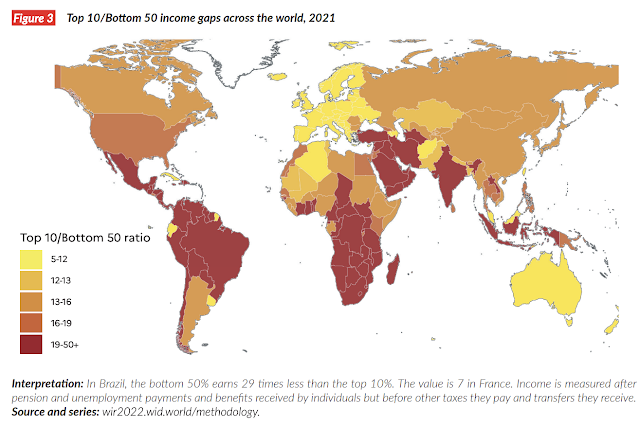
India is one of the most unequal countries in the world, according to the World Inequality Report 2022. There is rising poverty and hunger. Nearly 230 million middle class Indians have slipped below the poverty line, constituting a 15 to 20% increase in poverty. India ranks 94th among 107 nations ranked by World Hunger Index in 2020. Other South Asians have fared better: Pakistan (88), Nepal (73), Bangladesh (75), Sri Lanka (64) and Myanmar (78) – and only Afghanistan has fared worse at 99th place. Meanwhile, the wealth of Indian billionaires jumped by 35% during the pandemic. 

Income Inequality Map. Source: World Inequality Report 2022

Unemployment Crisis: 

India lost 6.8 million salaried jobs and 3.5 million entrepreneurs in November alone. Many among the unemployed can no longer afford to buy food, causing a significant spike in hunger. The country's economy is finding it hard to recover from COVID waves and lockdowns, according to data from multiple sources. At the same time, the Indian government has reported an 8.4% jump in economic growth in the July-to-September period compared with a contraction of 7.4% for the same period a year earlier.  

Income Inequality By Regions. Source: World Inequality Report 2022


Income & Wealth Inequality. Source: World Inequality Report 2022


Rising Poverty:

Nearly 230 million middle class Indians have slipped below the poverty line, constituting a 15 to 20% increase in poverty since Covid-19 struck last year, according to Pew Research. Middle class consumption has been a key driver of economic growth in India. Erosion of the middle class will likely have a significant long-term impact on the country's economy. “India, at the end of the day, is a consumption story,” says Tanvee Gupta Jain, UBS chief India economist, according to Financial Times. “If you never recovered from the 2020 wave and then you go into the 2021 wave, then it’s a concern.”

Increasing Hunger:  

India ranks 94th among 107 nations ranked by World Hunger Index in 2020. Other South Asians have fared better: Pakistan (88), Nepal (73), Bangladesh (75), Sri Lanka (64) and Myanmar (78) – and only Afghanistan has fared worse at 99th place. The COVID19 pandemic has worsened India's hunger and malnutrition. Tens of thousands of Indian children were forced to go to sleep on an empty stomach as the daily wage workers lost their livelihood and Prime Minister Narendra Modi imposed one of the strictest lockdowns in the South Asian nation. Pakistan's Prime Minister Imran Khan opted for "smart lockdown" that reduced the impact on daily wage earners. China, the place where COVID19 virus first emerged, is among 17 countries with the lowest level of hunger. 

Rich Getting Richer:

The wealth of Indian billionaires increased by 35% during the lockdown and by 90 per cent since 2009 to $422.9 billion, ranking India sixth in the world after the US, China, Germany, Russia, and France, according to Oxfam. 

India’s 100 top billionaires saw their fortunes increase by Rs 12,97,822 crore since March last year when the Covid-19 pandemic hit the country and this amount is enough to give 138 million poorest Indians a cheque for Rs 94,045 each, according to a report in The Business Standard. 

Share of Income of Richest 1% in South Asia
Inequality in Pakistan:

A United Nations report on inequality in Pakistan published in April 2021 revealed that the richest 1% Pakistanis take 9% of the national income.  A quick comparison with other South Asian nations shows that the 9% income share for the top 1% in Pakistan is lower than 15.8% in Bangladesh and 21.4% in India. These inequalities result mainly from a phenomenon known as "elite capture" that allows a privileged few to take away a disproportionately large slice of public resources such as public funds and land for their benefit. 

Income Distribution by Quintiles in Pakistan. Source: UNDP

Elite Capture:

Elite capture, a global phenomenon,  is a form of corruption. It describes how public resources are exploited by a few privileged individuals and groups to the detriment of the larger population. 

A recently published report by the United Nations Development Program (UNDP) has found that the elite capture in Pakistan adds up to an estimated $17.4 billion - roughly 6% of the country's economy. 

Pakistan's most privileged groups include the corporate sector, feudal landlords, politicians and the  military. The UN Development Program's NHDR for Pakistan, released last week, focused on issues of inequality in the country of 220 million people. 

Ms. Kanni Wignaraja, assistant secretary-general and regional chief of the UNDP, told Aljazeera that Pakistani leaders have taken the findings of the report “right on” and pledged to focus on prescriptive action. “My hope is that there is strong intent to review things like the current tax and subsidy policies, to look at land and capital access", she added. 

Inequality in Pakistan. Source: UNDP

Income Inequality:

The richest 1% of Pakistanis take 9% of the national income, according to the UNDP report titled "The three Ps of inequality: Power, People, and Policy". It was released on April 6, 2021. Comparison of income inequality in South Asia reveals that the richest 1% in Bangladesh and India claim 15.8% and 21.4% of national income respectively.

In addition to income inequality, the UNDP report describes the inequality of opportunity in terms of access to services, work with dignity and accessibility. It is based on exhaustive statistical analysis at national and provincial levels, and includes new inequality indices for child development, youth, labor and gender. Qualitative research, through focus groups with marginalized communities, has also been undertaken, and the NHDR 2020 Inequality Perception Survey conducted. The NHDR 2020 has been guided by a diverse panel of Advisory Council members, including policy makers, development practitioners, academics, and UN representatives.

Summary:

Neoliberal policies in emerging markets like India have spurred economic growth in last few decades. However, the gains from this rapid growth have been heavily skewed in favor of the rich. The rich have gotten richer while the poor have languished. The average per capita income in India has tripled in recent decades but the minimum dietary intake has fallen. According to the World Food Program, a quarter of the world's undernourished people live in India. The COVID19 pandemic has further widened the gap between the rich and poor. 

Related Links:

Haq's Musings

South Asia Investor Review

Pakistan Among World's Largest Food Producers

Naya Pakistan Housing Program

Food in Pakistan 2nd Cheapest in the World

Indian Economy Grew Just 0.2% Annually in Last Two Years

Pakistan to Become World's 6th Largest Cement Producer by 2030

Pakistan's 2012 GDP Estimated at $401 Billion

Pakistan's Computer Services Exports Jump 26% Amid COVID19 Lockdown

Coronavirus, Lives and Livelihoods in Pakistan

Vast Majority of Pakistanis Support Imran Khan's Handling of Covid19 Crisis

Pakistani-American Woman Featured in Netflix Documentary "Pandemic"

Incomes of Poorest Pakistanis Growing Faster Than Their Richest Counterparts

Can Pakistan Effectively Respond to Coronavirus Outbreak? 

How Grim is Pakistan's Social Sector Progress?

Pakistan's Sehat Card Health Insurance Program

Trump Picks Muslim-American to Lead Vaccine Effort

COVID Lockdown Decimates India's Middle Class

Pakistan Child Health Indicators

Pakistan's Balance of Payments Crisis

How Has India Built Large Forex Reserves Despite Perennial Trade Deficits

India's Unemployment and Hunger Crises"

PTI Triumphs Over Corrupt Dynastic Political Parties

Strikingly Similar Narratives of Donald Trump and Nawaz Sharif

Nawaz Sharif's Report Card

Riaz Haq's Youtube Channel


Wednesday, February 23, 2011

Philanthropy Lagging in India and Pakistan

Indian billionaire Azim Premji and Pakistani billionaire Malik Riaz Husain have recently made news by their generous pledges to help their disadvantaged fellow South Asians.

While Premji, the third richest among India's 50-odd billionaires, has announced $2 billion donation to improve public education, billionaire Malik Riaz has pledged 75% of his wealth to help Pakistan's flood victims rebuild.

Prior to Premji's $2 billion pledge, the biggest philanthropist in India was Bill Gates, an American, whose foundation is contributing $1.6 billion to help India's poor.


Beyond these high-profile pledges, the state of philanthropy in South Asia, especially in India, is not particularly healthy. Charity contributions in India make up only 0.6% of GDP, significantly lagging behind 2.2% in the United States, 1.3% in the UK, 1.2% in Canada, and 1% of GDP in Pakistan, according to data reported by Bain & Company, and Pakistan Center for Philanthropy.


Pakistanis contributed Rs.140 billion (US$1.7 billion), nearly 1% of the nation's gross domestic product of $170 billion in 2009, according to PCP. Their donations help organizations like Khana Ghar that feeds the hungry, Edhi Foundation which operates non-profit ambulance service and Human Development Foundation which builds and operates schools and clinics for the poor.


Indians gave $7.5 billion to charities, about 0.6% of India's GDP. The donations supported Indian organization like Akshaya Patra which feeds the hungry, and Premji's Foundation that is helping improve primary education to shift away from rote learning to creative thinking.

One of the measures of the goodness of a nation, particularly its middle class, is its level of civic engagement.

By this measure, advanced western nations lead the pack with the United States in #1 position, followed by Ireland, Australia, New Zealand, Britain, Holland, Canada, and lo and behold! Sri Lanka.

In South Asia, Pakistan is a distant second to Sri Lanka's 51% participation rate. Pakistan's participation rate of 42% ranks it at 27, the same as Israel.

India lags far behind with the participation rate of only 28% ranking it at 48 among 130 nations, according to a recent Gallup poll on civic engagement that included 130 nations.

While 53% of Sri Lankans gave money to charity and 53% volunteered time, 51% of Pakistanis contributed money and 27% volunteered time. In India, 28% donated money and 18% volunteered time. Comparable figures for the top-ranking United States are 65% and 43%.

Although South Asians are more generous than the Brazilians (0.3% of GDP) and the Chinese (0.1% of GDP), charity continues to lag in South Asia (Pakistan 1%, India 0.6%) in spite of the rising number of high net worth individuals and families. Bain research shows that nearly 40 percent of India's wealth is controlled by the top 5 percent of India's households. And the top 1% of Indians control about 16% of India's wealth.

The growing disparities created by the heavily skewed benefits of economic growth accruing to a few creates the potential for serious social unrest, unless the newly rich begin to share their wealth to address the widespread hunger, poverty and deprivation in South Asia. I think it is time for the rich in India and Pakistan to begin to emulate the fine example of generosity being set by Premji and Malik Riaz.

Here's a video clip of Malik Riaz's interview with CNN:


Related Links:

Haq's Musings

How Can Overseas Pakistanis Help Flood Victims?

Light a Candle, Don't Curse Darkness

Pakistan Center for Philanthropy

An Overview of Indian Philanthropy

Aaker Patel on Philathropy

Orangi Pilot Project

Three Cups of Tea

Volunteerism in America

Dr. Akhtar Hamid Khan's Vision

Thursday, March 6, 2008

New Indian Billionaires And Growing Rich-Poor Gap

The booming Bombay stock market in 2007 and the benefits of globalization have seen India's billionaires list swell to 40 on the Forbes Billionaires List. The Indian billionaires combined wealth has more than doubled from $170 billion to $351 billion in 2007. While Bill Gates has slipped to number three spot from number one, the number 4, 5, 6 and 8 spots in the top 10 are now occupied by Lakshmi Mittal, Mukesh Ambani, Anil Ambani and KP Singh from India.

The news of the newly-minted Indian billionaires is bringing sharper focus on the growing rich-poor gap in India. The Times of India reports Communist Party leader Sitaram Yechury claiming that on the one hand, 36 Indian billionaires constituted 25% of India’s GDP while on the other, 70% of Indians had to do with Rs 20 a day. "A farmer commits suicide every 30 minutes. The gap between the two Indias is widening," he said.

The growing wealth gap is also a big concern in other BRIC countries such as China and Russia. Fully a third of the new billionaires come from Russia (35), China (28) and India (19). The Chinese government is trying to tackle the growing rich-poor, urban-rural divide, a major cause of the rise in incidents of social unrest and violence in the world's most populous nation. The estimates of the urban-rural income gap vary by anywhere from 3 times to six times.

It is not unusual to see the rich-poor gap in the early stages of explosive growth in economies where the focus is on wealth creation rather than distribution. However, if this continues for an extended period of time, there is significant potential for widespread social unrest and serious political insatiability that can threaten the very foundations of a nation. From the recent speeches by the political leadership in India and China, it is clear that there is an acknowledgment of the issues and willingness to work on more equitable distribution of the fruits of progress.

Click here for complete list of Forbes Billionaire.

Here's a video clip of Prof Jayati Ghosh of Nehru University talking about growing rich-poor gap in India: