Showing posts with label Unemployment. Show all posts

Tuesday, June 2, 2026

Growing Fan Base of Cockroach Janata Party in India

"Indians live like cockroaches and die like cockroaches", argued Jayant Bhandari in an X post in April this year. "They vote for bottom of the barrel cockroaches as rulers, who rightly treat them as cockroaches", he added, faulting the people of India for this state of affairs. More recently, Indian Supreme Court Chief Justice Surya Kant said during a hearing that certain unemployed youth were "like cockroaches" who enter professions with fake degrees or become social media and RTI activists attacking the system.  Abhijeet Dipke, a 30-year-old Indian graduate of the public relations program at Boston University, picked up on it. He posted on X on May 16: “What if all cockroaches came together?” Dipke created a political party, named it Cockroach Janata Party (CJP), a parody of the ruling Bhartiya Janata Party (BJP), and established a website that quickly gained tens of millions of followers, according to the New York Times

Cockroach Janata Party Logo. Source: CJP Website


Dipke embraced “cockroach” in the party’s name to reinforce the fact that the insect, which arouses visceral disgust in many people, is also nearly indestructible. “What was thrown at them as an insult, now they are carrying it with pride,” he said. 


The group of Indians described by the Indian Chief Justice as "cockroaches" is made up of over 100 million young people aged 15-29 years who are not in education, employment or training (NEET) as estimated by the World Bank. They make up the world's largest NEET population in any country. Such massive numbers threaten the country’s demographic dividend, risking long-term economic stagnation, widening gender disparities, and severe social instability. They represent a massive reservoir of untapped human potential that drains productivity. 

As a result of failed policies and lack of opportunities at home, India is driving its best and brightest to the West, particularly to the United States, at an increasingly rapid pace. A 2023 study of the 1,000 top scorers in the 2010 entrance exams to the Indian Institutes of Technology (IIT) — a network of prestigious institutions of higher learning based in 23 Indian cities — revealed the scale of the problem. Around 36% migrated abroad, and of the top 100 scorers, 62% left the country, according to a report in the science journal Nature.  Nearly two-thirds of those leaving India are highly educated, having received academic or vocational training. This is the highest for any country, according to the Organization for Economic Co-operation and Development.


Monday, September 8, 2025

Trump's Tariffs on India: Can China or Russia Make Up For Lost Exports to US?

The United States is the biggest export market for India. Among its top 5 trading partners, the US is also the only country with which India runs a trade surplus. This surplus is now at risk with the 50% tariff recently imposed by President Donald Trump on imports from India. Can Prime Minister Narendra make up for it by cozying up to China and Russia? Recent trade data shows he can't. 


While India has enjoyed a significant surplus in trade with the US,  the South Asian nation has been running large trade deficits with China and Russia. Last year, for example, India had a $100 billion trade deficit with China and a $62 billion deficit with Russia. On the other hand, India ran over a $40 billion trade surplus with the US. Given these figures, it's hard to understand what India hopes to achieve by getting closer to Beijing and Moscow. The fact is that the US is the world's biggest economy that offers the largest and most profitable export market for most countries. Loss of the US export market spells major trouble for any economy in the world. President Donald Trump knows this and he is using it to make new trade deals to America's advantage. Europeans, Japanese and Koreans have essentially accepted higher tariffs in return for continued access to the US market, while China is negotiating a trade deal with Washington. 

The loss of the US export market also means heavy job losses in India's major sectors like textiles, shoes, gems and jewelry and shrimps exports. Christopher Wood, the global head of equity strategy at the investment bank Jefferies, puts the economic blow at £41 billion-£45 billion, according to the Guardian newspaper. He singles out textiles, footwear, jewelry and gems, all of which are highly labour-intensive, as “the most negatively impacted”. Tens of millions of jobs are at risk in these industries.  "The stakes for India’s government are political as well as economic. The prime minister, Narendra Modi, has pitched manufacturing as a way to provide jobs to the millions of young Indians who join the labour force each year. These industries employ tens of millions, directly and indirectly", the Guardian reports. 

Explaining the punitive India tariffs, US Treasury Secretary Scott Bessent has said: "India came to the table early. They’ve been slow rolling things. So I think that the president, the whole trade team has been frustrated with them. And also, you know, India, India has been a large buyer of sanctioned Russian oil that they then resell as refined products. So, you know, they have not been a great global actor". 

Indian Prime Minister Narendra Modi clearly misjudged what he needed to do with Trump 2.0. He continued business as usual, counting on his "bromance" with the US president to get a favorable deal. He thought the US policy of "strategic altruism" with India will continue as it had under the Trump 1.0 and Biden administrations. Modi let his billionaire friends Adani and Ambani rake in billions in profits on Russian oil trade. The discounted Russian oil Adani and Ambani bought was refined and exported for a huge profit to buyers around the world. Now the ordinary Indians are paying the price for Modi's folly. 

Worried about a slowing economy, the Modi government is now trying to stimulate domestic consumption by cutting GST (general sales taxes). It is a good move but it will not make up for dollars lost from the precipitous fall in exports to the US market. This fear is causing the Indian currency to fall against the US dollar. There are tough times ahead for the Indian economy. 

Related Links:

Haq's Musings

India's Unemployment Crisis

How Long Can Modi Escape Accountability For Murder? 

Modi-Trump Bromance Over

US Government Brackets Modi With Murderous Dictators

Asley Tellis Wants the US to Continue its Policy of Strategic Altruism with India

India Tariffs: Does Trump Have a Grand Strategy?

India's Ex Spooks Blame Kulbhushan Jadhav For Getting Caught

Ajit Doval Lecture on "How to Tackle Pakistan" 

Mohan Lal Bhaskar: An Indian Raw Agent in Pakistan


Saturday, March 22, 2025

World Happiness Report 2025: Poor Ranking Makes Indians Very Unhappy

Pakistan has outranked India yet again on the World Happiness Index, making Indians very very unhappy. Indian media commentators' strong negative emotional reaction to their nation's poor ranking  betrays how unhappy they are even as they insist they are happier than their neighbors. Coming from the privileged upper castes, these commentators call the report "absurd", citing India's higher per capita incomes and its space program. They seem detached from the real conditions in which the vast majority of Indians find themselves. They fail to acknowledge the high levels of inequality and unemployment prevalent in their country. A CNBC report last year found that one billion Indians have a per capita income of just $1,000 a year, lower than that of sub-Saharan Africans. 92.5% of Indians live in conditions similar to or worse than those experienced by the poorest countries in sub-Saharan Africa. No wonder India ranks alongside the poorest sub-Saharan African nations in the World Happiness Report 2025. 

World Happiness Map. Source: World Happiness Report 2025


Pakistan (109) has not only outranked India (118) but also ranked higher than Sri Lanka (133) and Bangladesh (134). The authors of the 2035 happiness report said new evidence indicates that engaging in acts of generosity and believing in the kindness of others are “significant predictors of happiness, even more so than earning a higher salary”.  The family is a source of joy and support for most people, the report found. Couples who live with at least one child, or couples who live with children and members of their extended family, have especially high average life satisfaction.

Income Inequality in India


An inequality report on India found that 92.5% of Indians live in economic conditions similar to those found in the poorest nations of sub-Saharan Africa. Only 0.5% of Indians enjoy incomes comparable to average Singaporeans, while 2% have incomes of average Polish citizens and 5% similar to Mexicans. 

India Among Most Unequal Nations. Source: World Inequality Report


Finland tops the World Happiness Report 2025 rankings, making it the happiest country for the eighth year in a row. It is followed by Denmark and Iceland. Other nations in the top 15 include Sweden, the Netherlands, Costa Rica, and Norway.

Wealth Held By Top 1% in Asian Countries. Source: Credit Suisse Global Wealth Report 2024


Even the higher-income Indians are unhappy. Millions of them are voting with their feet and leaving their country of birth in droves. India is losing its best and brightest to the West, particularly to the United States, at an increasingly rapid pace. A 2023 study of the 1,000 top scorers in the 2010 entrance exams to the Indian Institutes of Technology (IIT) — a network of prestigious institutions of higher learning based in 23 Indian cities — revealed the scale of the problem. Around 36% migrated abroad, and of the top 100 scorers, 62% left the country, according to a report in the science journal Nature.  Nearly two-thirds of those leaving India are highly educated, having received academic or vocational training. This is the highest for any country, according to the Organization for Economic Co-operation and Development.

Example of The Great Indian Brain Drain. Source: Boston Political Review

Brain drain is defined as the loss of precious human capital of a nation. It is a “consequence of an education system designed for ‘selecting’ the best and brightest in an economy that is still too controlled and cannot create opportunities for its best and brightest”, according to Indian economist Shruti Rajagopalan. High-profile examples of India's human capital loss include Satya Nadella (Microsoft), Sundar Pichai (Google), Shantanu Narayen (Adobe), Arvind Krishna (IBM) and Ajay Banga (World Bank). 

Foreign-Born STEM Workers in America. Source: American Immigration Council


Growing number of Indian students are going abroad for higher education each year and 90% of them never return home after completing their studies.  In 2022, the number of Indian students leaving the country for higher education reached a six-year high of 770,000. And a 2021 report estimated that around two million Indian students would be studying abroad by 2024. 

Many developing countries are experiencing brain drain. But India is losing its best brightest at a much faster rate than others. Some call it "The Great Indian Brain Drain". This is the reason why Indians in the United States are the best educated and the highest earning group.  In a recently published book titled "The Other One Percent", authors Sanjoy Chakravorty, Devesh Kapur and Nirvikar Singh explain this phenomenon. 

Related Links:

Haq's Musings

South Asia Investor Review

Guess Why Pakistani Analyst Uzair Younus is Making Headlines in India!

Ambassador Kishore Mahbubani: America Does Not Respect India

World Happiness Report: India Among Saddest Nations of the World

Balakot and Kashmir: Fact Checkers Expose Indian Lies

WB Poverty Update: India Biggest Contributor to Increase in Poverty

India in Crisis: Unemployment, Hunger Persist After Waves of Covid

Modi's Blunders and Delusions 

India's Israel Envy: What If Modi Attacks Pakistan?

Project Azm: Pakistan to Develop 5th Generation Fighter Jet

Pakistan Navy Modernization

Pakistan's Sea-Based Second Strike Capability

Are Some Pakistanis Feeding Modi's Delusions of Grandeur?

Is the West Unwittingly Helping Modi Realize His Akhand Bharat Hindutva Dream?

Has Pakistan Lost All Wars? 


Thursday, February 6, 2025

US Deports Indian Illegal Immigrants in Handcuffs and Chains Aboard Military Aircraft

 A US Air Force transport plane landed in India today with 104 illegal Indian immigrants in handcuffs and shackles, according to media reports. Speaking with reporters, a deportee said: “For 40 hours, we were handcuffed, our feet tied with chains and were not allowed to move an inch from our seats. After repeated requests, we were allowed to drag ourselves to the washroom. The crew would open the door of the lavatory and shove us in.”

Illegal Indian Immigrants Deported in Handcuffs and Chains. Source: News18

The inhumane treatment meted out to citizens of India, a US ally, has sparked a lot of anger against Prime Minister Narendra Modi's government. The critics are citing the example of Colombia, a small South American nation, whose president protested similar treatment of its citizens by the Trump administration. Colombian President Gustavo Petro turned back the US military planes carrying deportees and then sent his own aircraft to transport them back home in Colombia. 

Illegal immigration from India to the US has dramatically increased on Prime Minister Modi's watch. A Pew Research Center report said that as of 2022, India ranked third, after Mexico and El Salvador, on the list of countries with the largest number of undocumented immigrants — 725,000 — living in the U.S.

India has a serious unemployment problem, particularly for the young people entering the job market by the millions each year. This problem is concealed by headline  economic growth figures highlighted by the Modi government. At the same time, India is losing its best and brightest in a massive brain drain. 

"Leave India! It's High Time!!" screams out a recent Reddit post that has gone viral! The poster who claims to be an Indian entrepreneur warns of impending "terrible economic collapse" with a "massive depreciation of the Indian rupee".  

The now-deleted post, written by a user named ‘u/anonymous_batm_an,’ urges high-earning professionals, especially innovators, to leave India for countries with better opportunities and governance, as reported by the Times of India.  It recommends the UAE or Thailand as alternative destinations . The sentiments expressed in the post are already resonating with a large number of Indians.  The non-resident Indians now constitute the world's largest overseas diaspora. Every year, 2.5 million Indians leave their country of birth, making India the nation with the highest annual number of emigrants in the world. 

New Company Registrations in Dubai. Source: Khaleej Times


Indian investors continued to top the list of new non-Emirati companies joining the Dubai Chamber of Commerce during the first nine months of 2024. A total of 12,142 new Indian companies joined the chamber during the period, data showed on Monday, according to the Khaleej TimesPakistan ranked second on the list with 6,061 new companies joining between Q1-Q3 2024, while Egypt followed with 3,611 new companies registering as members of the chamber. The number of new Syrian companies joining the chamber during the first nine months of the year reached 2,062, placing the country fourth among the top nationalities of new member companies.

India is losing its best and brightest to the West, particularly to the United States, at an increasingly rapid pace. A 2023 study of the 1,000 top scorers in the 2010 entrance exams to the Indian Institutes of Technology (IIT) — a network of prestigious institutions of higher learning based in 23 Indian cities — revealed the scale of the problem. Around 36% migrated abroad, and of the top 100 scorers, 62% left the country, according to a report in the science journal Nature.  Nearly two-thirds of those leaving India are highly educated, having received academic or vocational training. This is the highest for any country, according to the Organization for Economic Co-operation and Development.

Example of The Great Indian Brain Drain. Source: Boston Political Review

Brain drain is defined as the loss of precious human capital of a nation. It is a “consequence of an education system designed for ‘selecting’ the best and brightest in an economy that is still too controlled and cannot create opportunities for its best and brightest”, according to Indian economist Shruti Rajagopalan. High-profile examples of India's human capital loss include Satya Nadella (Microsoft), Sundar Pichai (Google), Shantanu Narayen (Adobe), Arvind Krishna (IBM) and Ajay Banga (World Bank). 

Foreign-Born STEM Workers in America. Source: American Immigration Council


Growing number of Indian students are going abroad for higher education each year and 90% of them never return home after completing their studies.  In 2022, the number of Indian students leaving the country for higher education reached a six-year high of 770,000. And a 2021 report estimated that around two million Indian students would be studying abroad by 2024. 

Many developing countries are experiencing brain drain. But India is losing its best brightest at a much faster rate than others. Some call it "The Great Indian Brain Drain". This is the reason why Indians in the United States are the best educated and the highest earning group.  In a recently published book titled "The Other One Percent", authors Sanjoy Chakravorty, Devesh Kapur and Nirvikar Singh explain this phenomenon. 

Related Links:

Haq's Musings

South Asia Investor Review

Guess Why Pakistani Analyst Uzair Younus is Making Headlines in India!

Ambassador Kishore Mahbubani: America Does Not Respect India

World Happiness Report: India Among Saddest Nations of the World

Balakot and Kashmir: Fact Checkers Expose Indian Lies

WB Poverty Update: India Biggest Contributor to Increase in Poverty

India in Crisis: Unemployment, Hunger Persist After Waves of Covid

Modi's Blunders and Delusions 

India's Israel Envy: What If Modi Attacks Pakistan?

Project Azm: Pakistan to Develop 5th Generation Fighter Jet

Pakistan Navy Modernization

Pakistan's Sea-Based Second Strike Capability

Are Some Pakistanis Feeding Modi's Delusions of Grandeur?

Is the West Unwittingly Helping Modi Realize His Akhand Bharat Hindutva Dream?

Has Pakistan Lost All Wars? 


Friday, February 2, 2024

Soaring Illegal Immigration of Indians into the United States

Illegal immigration from India to the United States is soaring. A record 96,917 Indians were detained while attempting to enter the US illegally from October 2022 to September 2023, representing a 50% jump from the corresponding period in the prior year. Vast majority of the arrested Indians came from Prime Minister Modi's state of Gujarat while others came from the state of Punjab. There are about 725,000 undocumented Indian immigrants in the US – the third-largest population of illegal immigrants after Mexicans and El Salvadorans – according to a Pew Research Centre report. 

Illegal Immigration to the US From India. Source: Strait Times

The number of Indians attempting to cross into the United States illegally has accelerated in recent years on Prime Minister Modi's watch. These immigrants take the Latin American route to reach the US-Mexico border before making a run for the US. They cross the Darien Gap, a dangerous thick forest region between Colombia and Panama, taking three days to a week while taking huge risks ranging from lack of food and drinking water, wild animals and violent gangs. 

There are multiple drivers of mass illegal migration of Indians to other countries. These include increasing violence under Mr. Modi's Hindutva rule and lack of jobs for thee growing working-age population. Human traffickers are exploiting these conditions to profit from vulnerable groups most impacted by political and economic problems in the country. 

Christians, low caste Hindus, Muslims and Sikhs are among the main targets of the far-right Hindu mob attacks across India. In 2023, the Modi government’s discriminatory and divisive policies led to  growing violence against minorities, creating a pervasive environment of fear and a chilling effect on government critics, Human Rights Watch said in its World Report 2024

India's labor force participation rate (LPR) has been declining for several years. Centre For Monitoring Indian Economy (CMIE) data shows that the labor participation rate fell to 39.5% in 2022-23, from an already low 40.1% in 2021-22. This indicates that more than half of India’s working age population is not employed. This is especially the case for women 90% of whom are out of the labor force. India’s LPR is among the lowest in the world. The global average LPR is 60%.

Labor Participation Rate in India. Source: CMIE Via Reuters

The rapid GDP growth claimed by India is not creating enough jobs for its massive young population. The much-hyped "Make in India" initiative of the Modi government is just not working well enough to keep pace with the demand for jobs. Manufacturing’s contribution to India’s GDP has declined from 17% two decades ago to just 13% in 2022, according to the World Bank. India has added only 5 million factory jobs since Mr. Modi was first elected, for a total of 65 million such jobs now, according to the Wall Street Journal. Unable to find jobs in cities, a very large number of Indians are going back to subsistence farming to eke out a meager living.  

Indian economist Ritesh Kumar recently wrote a piece for Nikkei Asia titled "Few are benefiting from India's rapid GDP growth".  His conclusion: What India really needs is a growth trajectory that is inclusive, sustainable and can foster shared prosperity across all segments of the economy rather than benefiting only a privileged few.


Related Links:


Wednesday, March 22, 2023

World Happiness Report 2023: India Among World's Saddest Nations

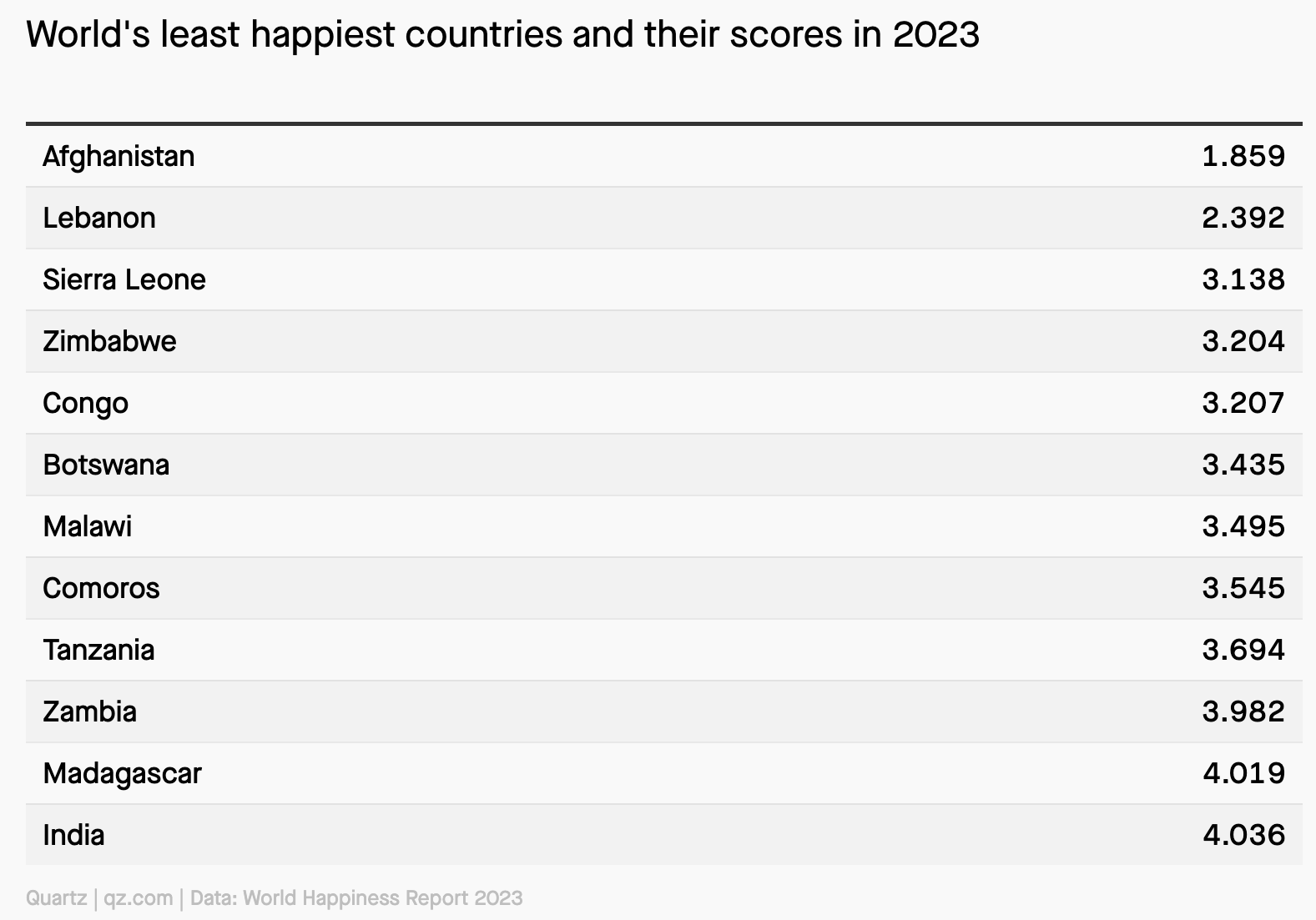
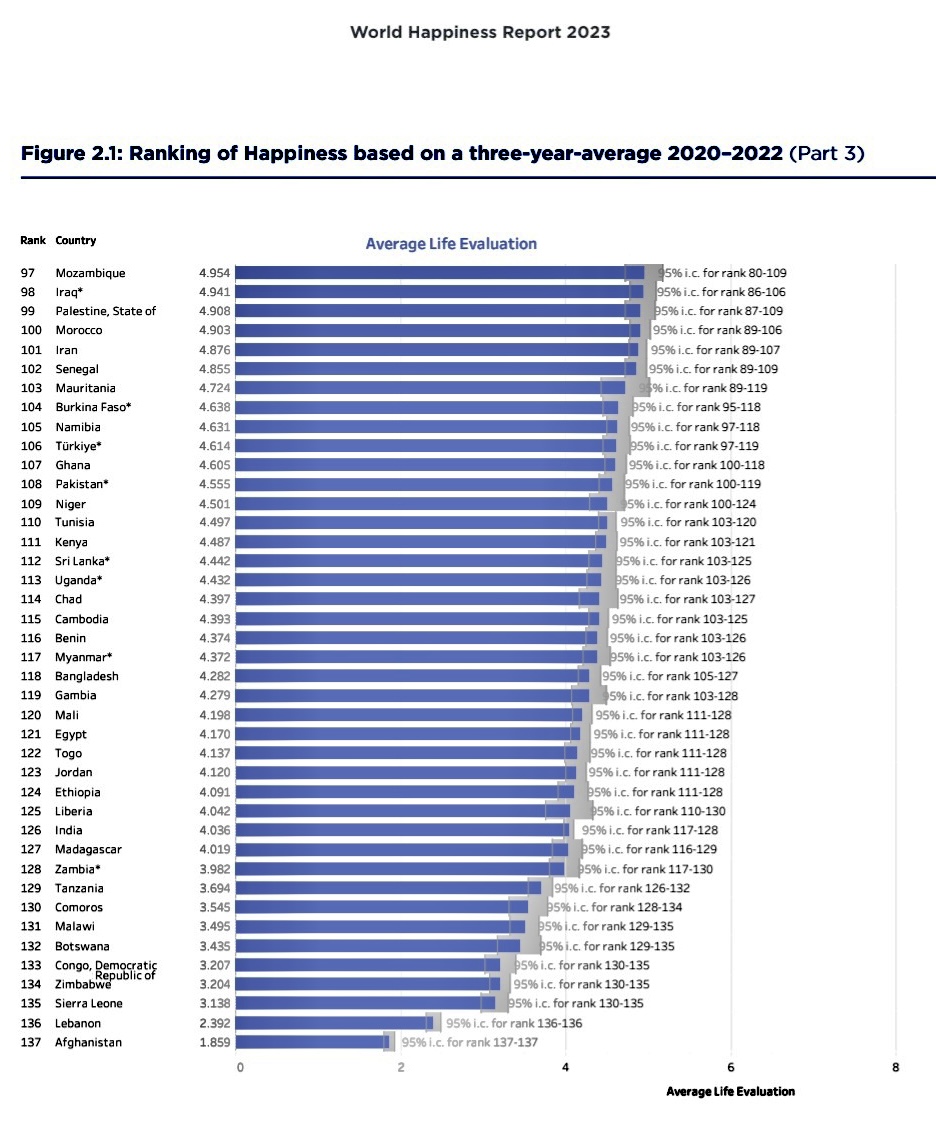
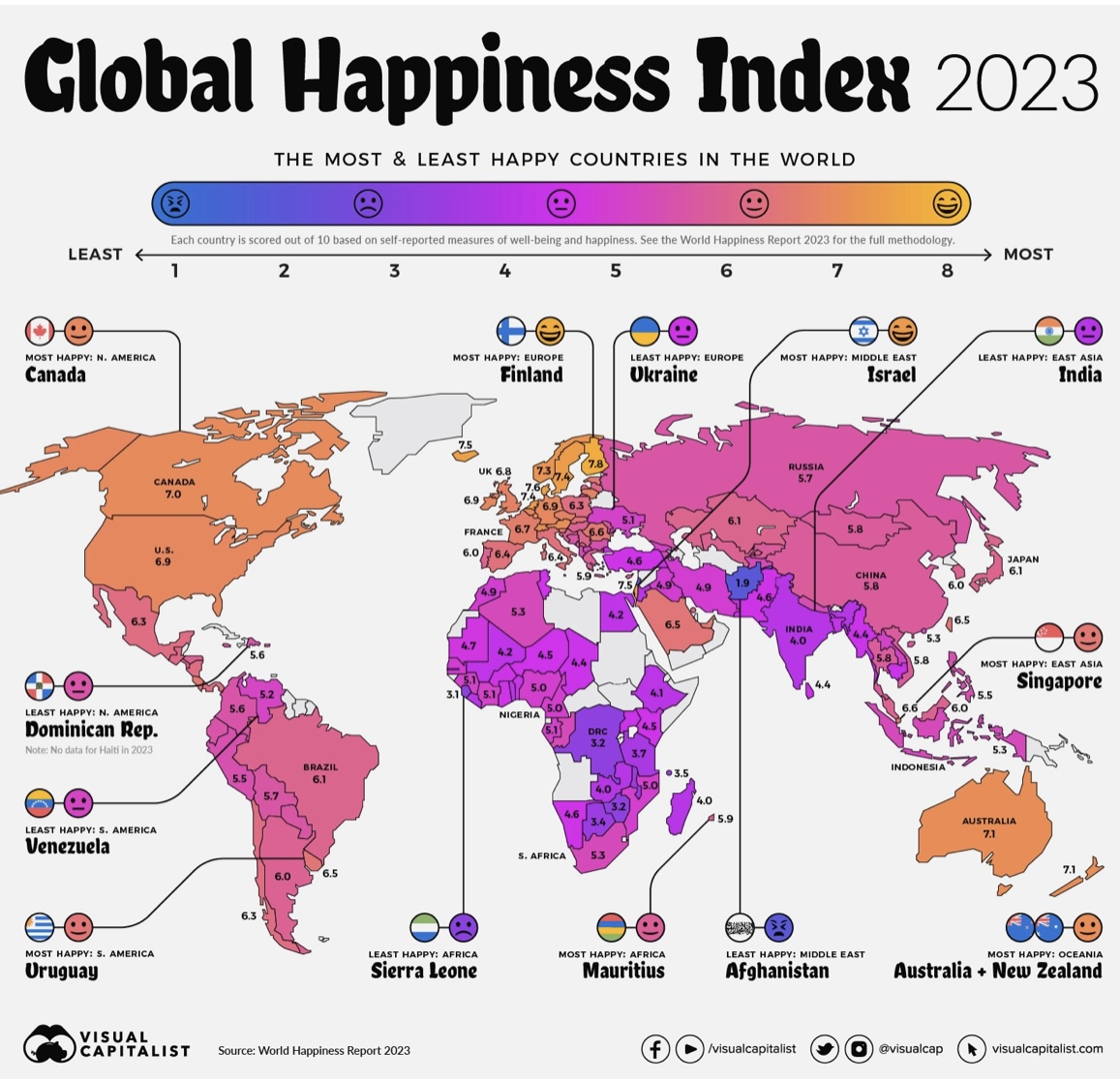
India occupies 126th position among 137 nations ranked in the World Happiness Report 2023 released by the Sustainable Development Solutions Network. In South Asia, Pakistan (score 4.555) ranks 108,  Sri Lanka 112, Bangladesh (4.282) 118 and India 126 (4.036). Only Taliban-ruled Afghanistan ranks worse at 137. Finland is the happiest nation in the world, followed by Denmark and Iceland in 2nd and 3rd place.

Least Happy Countries in 2023. Source: Quartz


Bottom Third Countries in World Happiness Rankings. Source: World Happiness Report


The latest country rankings show life evaluations (answers to the Cantril ladder question) for each country, averaged over a 3 year period from 2020-2022.  The Cantril ladder asks respondents to think of a ladder, with the best possible life for them being a 10 and the worst possible life being a 0. They are then asked to rate their own current lives on that 0 to 10 scale. The rankings are from nationally representative samples for the years 2020-2022.  


World Happiness Map 2023. Source: Visual Capitalist


Happiness Scores Trend:

After climbing to a high of  5.65 in 2019, Pakistan's happiness scores have declined in recent years, reaching a low of 4.52 during the Covid pandemic. The most recent value is 4.555 for 2023. 


Recent Happiness Scores in Pakistan. Source: The Global Economy


India's happiness scores have been declining every year since 2013, reaching a low of 3.78 during the Covid pandemic. The most recent value is 4.036 for 2023. 

Recent Happiness Scores in India. Source: The Global Economy


Causes of Unhappiness: 

Lack of social connections during covid lockdown, along with severe unemployment, high inflation and healthcare worries, took a toll on mental health of Indians, according to the experts quoted by the Indian media

Suicide Rates in India and Pakistan. Source: World Bank


Rising Suicides: 

Indian experts' observations are supported by the Indian government data showing a marked increase in suicide rate in India.  India saw the highest suicide rate (of 12 suicides per 100,000 population) since the beginning of this century, according to The Hindu.  Experts say a lot of suicides would have gone unreported and that the numbers and suicide rates could have gone up in 2022 as well. 

Suicide Rate in India. Source: The Hindu


High Unemployment: 

India's unemployment rate rose to 7.45% in February 2023 from 7.14% in the previous month, according to data from the Centre for Monitoring Indian Economy (CMIE).  CMIE’s weekly labor market analysis showed a marginal improvement in India’s labor participation rate to 39.92% in February compared to 39.8% in January 2023 resulting in an increase in the labour force from 440.8 million to 442.9 million.

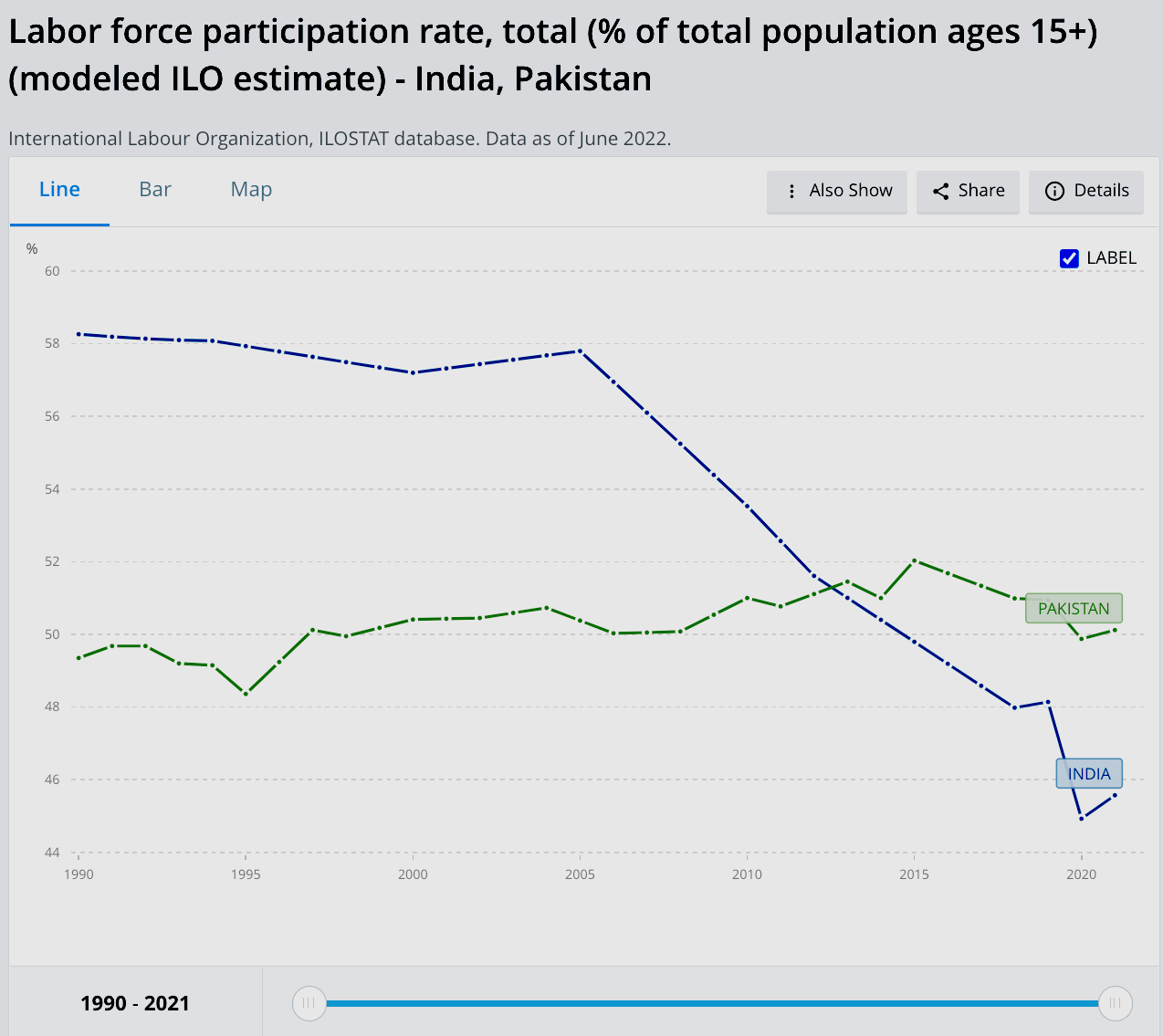
"India’s LPR is much lower than global levels. According to the World Bank, the modeled ILO estimate for the world in 2020 was 58.6 per cent. The same model places India’s LPR at 46 percent. India is a large country and its low LPR drags down the world LPR as well. Implicitly, most other countries have a much higher LPR than the world average. According to the World Bank’s modeled ILO estimates, there are only 17 countries worse than India on LPR. Most of these are middle-eastern countries. These are countries such as Jordan, Yemen, Algeria, Iraq, Iran, Egypt, Syria, Senegal and Lebanon. Some of these countries are oil-rich and others are unfortunately mired in civil strife. India neither has the privileges of oil-rich countries nor the civil disturbances that could keep the LPR low. Yet, it suffers an LPR that is as low as seen in these countries".
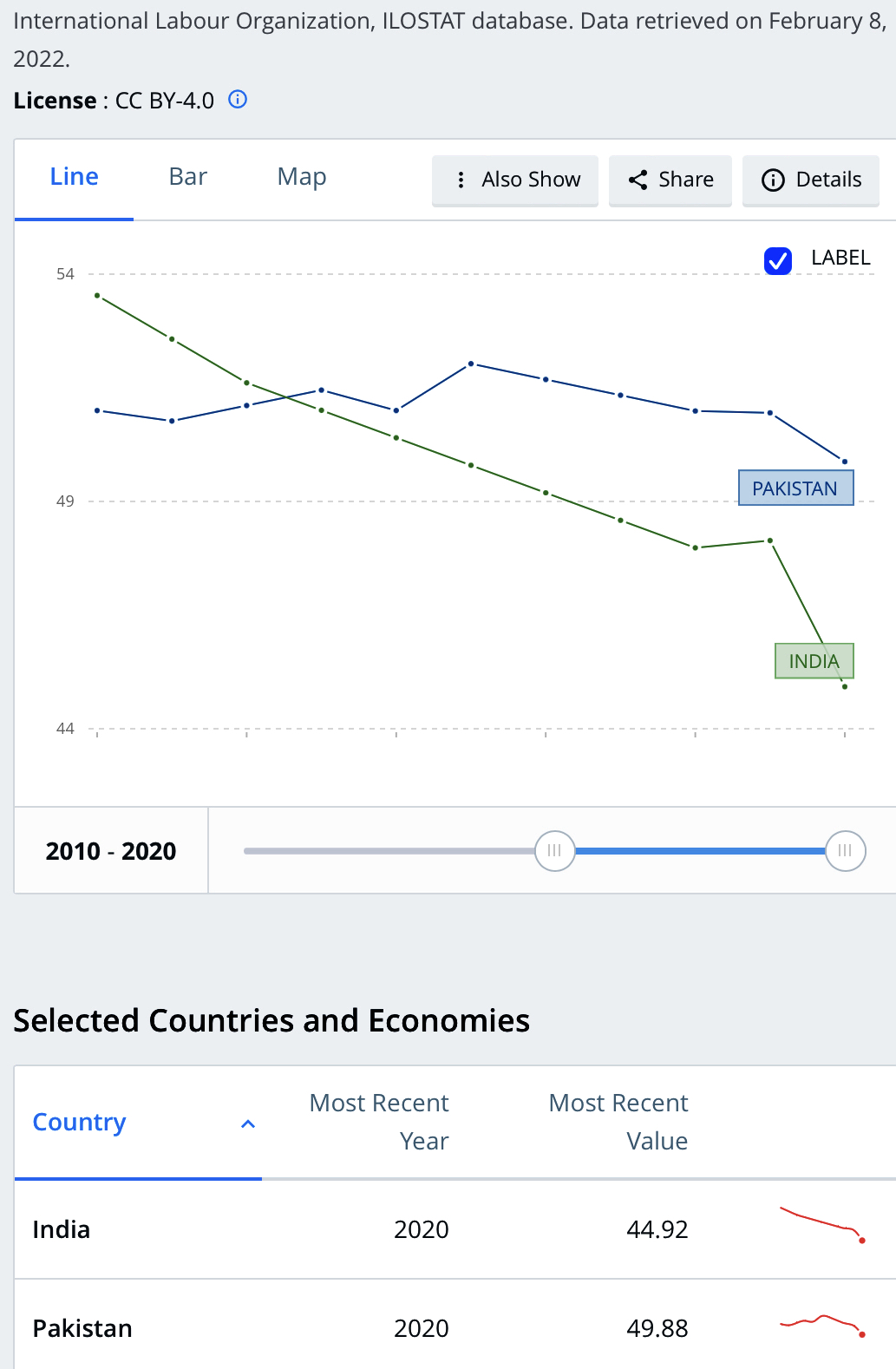
Labor Participation Rates in India and Pakistan. Source: World Bank/ILO


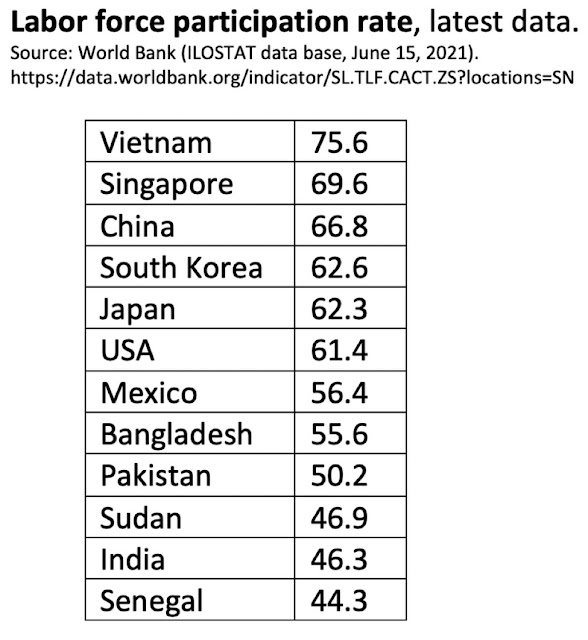
Labor Participation Rates for Selected Nations. Source: World Bank/ILO

Youth  unemployment for ages15-24 in India is 24.9%, the highest in South Asia region. It is 14.8% in Bangladesh 14.8% and 9.2% in Pakistan, according to the International Labor Organization and the World Bank.  

Youth Unemployment in Bangladesh, India and Pakistan. Source: ILO, WB


In spite of the headline GDP growth figures highlighted by the Indian and world media, the fact is that it has been jobless growth. The labor participation rate (LPR) in India has been falling for more than a decade. The LPR in India has been below Pakistan's for several years, according to the International Labor Organization (ILO). 

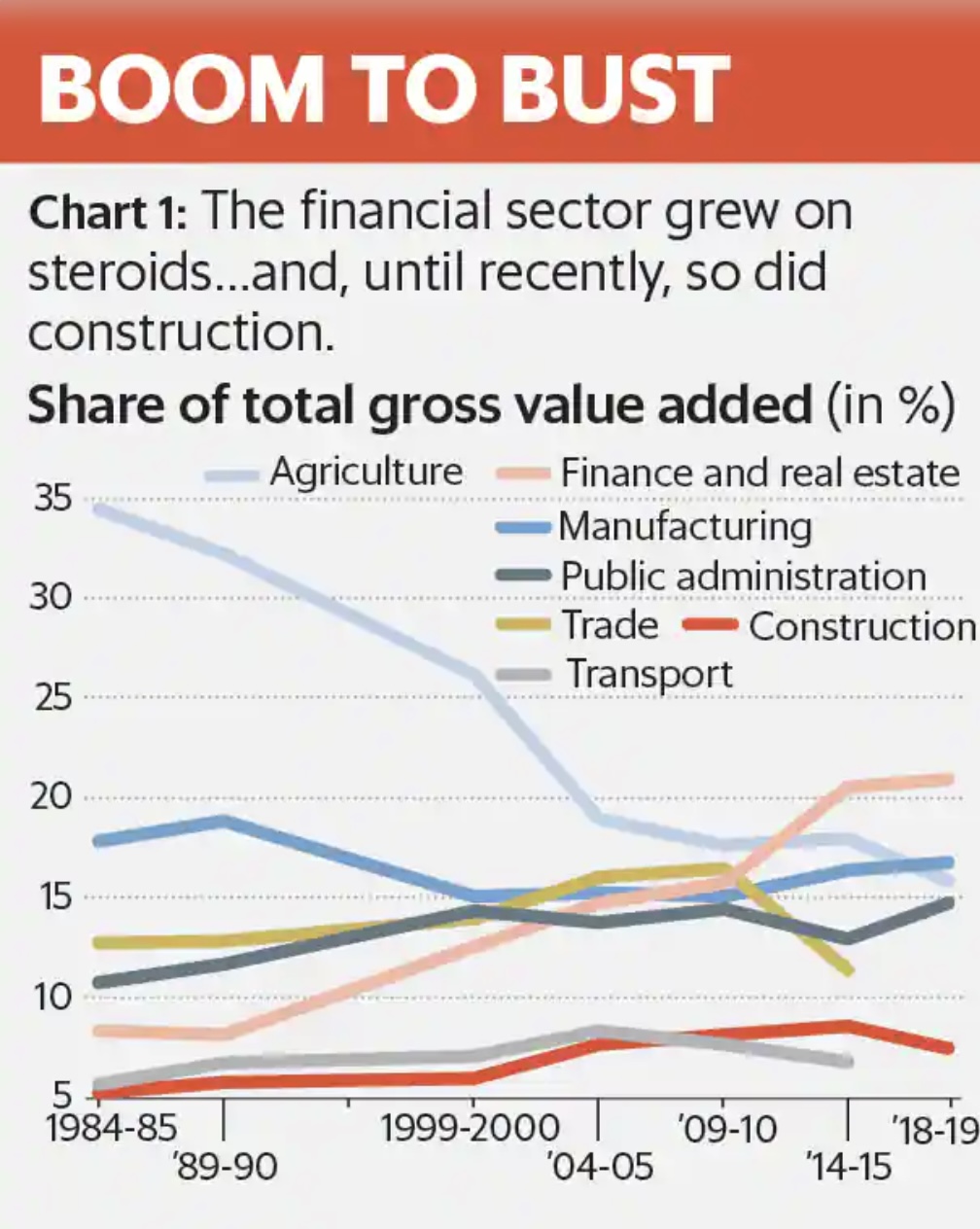
Indian GDP Sectoral Contribution Trend. Source: Ashoka Mody 

Even before the COVID19 pandemic, India's labor participation rate was around 43%, lower than its neighbors'. Now it has slipped further to about 40%. Meanwhile, the Indian government has reported an 8.4% jump in economic growth in the July-to-September period compared with a contraction of 7.4% for the same period a year earlier.  This raises the following questions: Has India had jobless growth? Or its GDP figures are fudged?  If the Indian economy fails to deliver for the common man, will Prime Minister Narendra Modi step up his anti-Pakistan and anti-Muslim rhetoric to maintain his popularity among Hindus?

Indian Employment Trends By Sector. Source: CMIE Via Business Standard


Hunger Crisis:
'
India ranks 94th among 107 nations ranked by World Hunger Index in 2020. Other South Asians have fared better: Pakistan (88), Nepal (73), Bangladesh (75), Sri Lanka (64) and Myanmar (78) – and only Afghanistan has fared worse at 99th place. The COVID19 pandemic has worsened India's hunger and malnutrition. Tens of thousands of Indian children were forced to go to sleep on an empty stomach as the daily wage workers lost their livelihood and Prime Minister Narendra Modi imposed one of the strictest lockdowns in the South Asian nationPakistan's Prime Minister Imran Khan opted for "smart lockdown" that reduced the impact on daily wage earners. China, the place where COVID19 virus first emerged, is among 17 countries with the lowest level of hunger. 

World Hunger Rankings 2020. Source: World Hunger Index Report


India Among Worst Hit: 

India has a 17.3% child wasting rate, the worst in the South Asia region. Child stunting is also extremely high across South Asia. “Data from 1991 through 2014 for Bangladesh, India, Nepal, and Pakistan showed that stunting is concentrated among children from households facing multiple forms of deprivation, including poor dietary diversity, low levels of maternal education, and household poverty,” the World Hunger Report said. China, the place where COVID19 virus first emerged, is among 17 countries with the lowest level of hunger. 

Hunger and malnutrition are worsening in parts of sub-Saharan Africa and South Asia because of the coronavirus pandemic, especially in low-income communities or those already stricken by continued conflict. 

India has performed particularly poorly because of one of the world's strictest lockdowns imposed by Prime Minister Modi to contain the spread of the virus. 


Related Links:


Haq's Musings

South Asia Investor Review

Pakistan Among World's Largest Food Producers

Naya Pakistan Housing Program

Food in Pakistan 2nd Cheapest in the World

Indian Economy Grew Just 0.2% Annually in Last Two Years

Pakistan to Become World's 6th Largest Cement Producer by 2030

Pakistan's 2012 GDP Estimated at $401 Billion

Pakistan's Computer Services Exports Jump 26% Amid COVID19 Lockdown

Coronavirus, Lives and Livelihoods in Pakistan

Vast Majority of Pakistanis Support Imran Khan's Handling of Covid19 Crisis

Pakistani-American Woman Featured in Netflix Documentary "Pandemic"

Incomes of Poorest Pakistanis Growing Faster Than Their Richest Counterparts

Can Pakistan Effectively Respond to Coronavirus Outbreak? 

How Grim is Pakistan's Social Sector Progress?

Pakistan Fares Marginally Better Than India On Disease Burdens

Trump Picks Muslim-American to Lead Vaccine Effort

COVID Lockdown Decimates India's Middle Class

Pakistan Child Health Indicators

Pakistan's Balance of Payments Crisis

How Has India Built Large Forex Reserves Despite Perennial Trade Deficits

Conspiracy Theories About Pakistan Elections"

PTI Triumphs Over Corrupt Dynastic Political Parties

Strikingly Similar Narratives of Donald Trump and Nawaz Sharif

Nawaz Sharif's Report Card

Riaz Haq's Youtube Channel

Sunday, June 12, 2022

Indian Women's Labor Force Participation Falls to Just 19%, Lower Than Pakistan's 21%

Female labor force participation rate in India has recently fallen to just 19%, the second lowest after Afghanistan's 15% in the South Asia region. By contrast, Pakistan's women's labor force participation rate is 21%, Sri Lanka's 31% and Bangladesh's 35%. Prime Minister Narendra Modi's mishandling of the COVID19 pandemic has hit Indian women particularly hard, with 90% of those who lost their jobs now shut out of the workforce. 

Female Labor Force Participation Rate in South Asia. Source: World Bank


The precipitous loss of women workers is disastrous news for India's economy, which had started slowing before the COVID19 pandemic, according to a Bloomberg report. Rosa Abraham, an economics professor at Azim Premji University in Bengaluru, tracked more than 20,000 people as they navigated the labor market during the pandemic.. She found that after the first lockdown, women were several times more likely to lose their jobs than men and far less likely to recover work after restrictions were lifted. "When men are faced with this kind of a huge economic shock, then they have a fallback option," Abraham told Bloomberg. "They can navigate to different kinds of work. But for women, there is no such fallback option. They can't negotiate the labor market as effectively as men do." 

Women accounted for less than 11% of all jobs in 2019-20. But, they accounted for nearly 52% of the 7 million job losses since then, according to the Center for Monitoring Indian Economy (CMIE).  It gets worse in urban India. Women accounted for only 9% of total employment in urban India but they accounted for a massive 76% of the job losses here. The impact of this is a sharp fall in the labor participation of women. The female labor force participation rate among urban women was abysmally low at 9.4% in 2019-20 and it has since fallen to 7% in 2021-22.

COVID19 Pandemic Impact on Employment in India. Source: Bloomberg

Modi government has underplayed the death toll and the negative impact of the COVID19 pandemic in India. But the World Health Organization estimates that India had 4.730 million COVID19-related  deaths in 2020-21, nearly a third of 15 million global excess deaths attributed to the pandemic. India is followed by Russia with 1.073 million deaths and Indonesia with 1.03 million deaths. The United States with 933,795 deaths and Brazil with 681,219 deaths round out the top 5 countries that suffered the heaviest losses of life believed to be related to the pandemic. Mexico (625,923 deaths), Peru (289,654 deaths), Turkey (264,279 deaths) Egypt (251,635 deaths) and South Africa (238,893 deaths) are ranked number 6 through 10 in the world for excess deaths in 2020-21 period. Although Pakistan too had 8 times the official figure, it still does not figure in WHO's top 10 list for total number of COVID deaths. 

It's not just Indian women who have suffered job losses. India's overall labor participation rate (LPR) fell to 39.5% in March 2022, as reported by the Center for Monitoring Indian Economy (CMIE). It dropped below the 39.9% participation rate recorded in February. It is also lower than during the second wave of Covid-19 in April-June 2021. The lowest the labor participation rate had fallen to in the second wave was in June 2021 when it fell to 39.6%. The average LPR during April-June 2021 was 40%. March 2022, with no Covid-19 wave and with much lesser restrictions on mobility, has reported a worse LPR of 39.5%.

Labor Participation Rates in India and Pakistan. Source: ILO/World Bank


Youth  unemployment for ages 15-24 in India is 24.9%, the highest in the South Asia region. It is 14.8% in Bangladesh 14.8% and 9.2% in Pakistan, according to the International Labor Organization and the World Bank.  

Youth Unemployment in Bangladesh, India and Pakistan. Source: ILO, WB


In spite of the headline GDP growth figures highlighted by the Indian and world media, the fact is that it has been jobless growth. The labor participation rate (LPR) in India has been falling for more than a decade. The LPR in India has been below Pakistan's for several years, according to the International Labor Organization (ILO). 

Indian Employment Trends By Sector. Source: CMIE Via Business Standard

Construction and manufacturing sectors in India have been shedding jobs while the number of people working in agriculture has been rising, according to CMIE. 

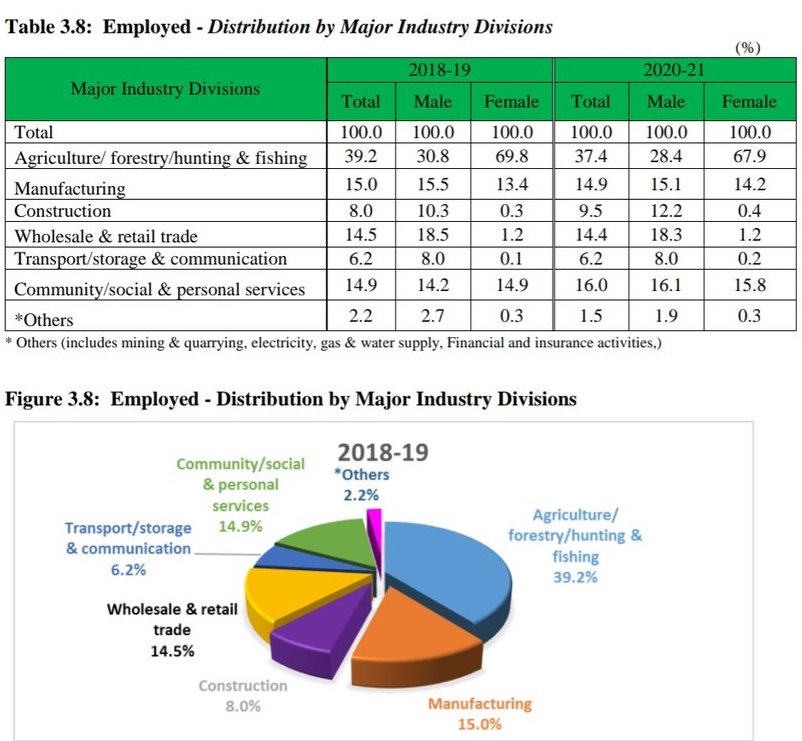
Pakistan Employment By Sectors. Source: PBS via Bilal Gilani

It is important to note that Pakistan’s economy has created 5.5 million jobs during the past three years – 1.84 million jobs a year, significantly higher than yearly average of new jobs created during the 2008-18 decade, according to the findings of Labor Force Survey (LFS) as reported by the Express Tribune paper. The biggest jump in share of employment (1.5%) was in the construction sector, spurred by Naya Pakistan construction incentives offered by the PTI government. 


Related Links:

Haq's Musings

South Asia Investor Review

Pakistan Among World's Largest Food Producers

Naya Pakistan Housing Program

Food in Pakistan 2nd Cheapest in the World

Indian Economy Grew Just 0.2% Annually in Last Two Years

Pakistan to Become World's 6th Largest Cement Producer by 2030

Pakistan's 2012 GDP Estimated at $401 Billion

Pakistan's Computer Services Exports Jump 26% Amid COVID19 Lockdown

Coronavirus, Lives and Livelihoods in Pakistan

Vast Majority of Pakistanis Support Imran Khan's Handling of Covid19 Crisis

Pakistani-American Woman Featured in Netflix Documentary "Pandemic"

Incomes of Poorest Pakistanis Growing Faster Than Their Richest Counterparts

Can Pakistan Effectively Respond to Coronavirus Outbreak? 

How Grim is Pakistan's Social Sector Progress?

Pakistan Fares Marginally Better Than India On Disease Burdens

Trump Picks Muslim-American to Lead Vaccine Effort

COVID Lockdown Decimates India's Middle Class

Pakistan Child Health Indicators

Pakistan's Balance of Payments Crisis

How Has India Built Large Forex Reserves Despite Perennial Trade Deficits

Conspiracy Theories About Pakistan Elections"

PTI Triumphs Over Corrupt Dynastic Political Parties

Strikingly Similar Narratives of Donald Trump and Nawaz Sharif

Nawaz Sharif's Report Card

Riaz Haq's Youtube Channel

Wednesday, May 11, 2022

WHO: India's 4.7 Million Excess Deaths Account For Nearly One-Third of the Global COVID Death Toll

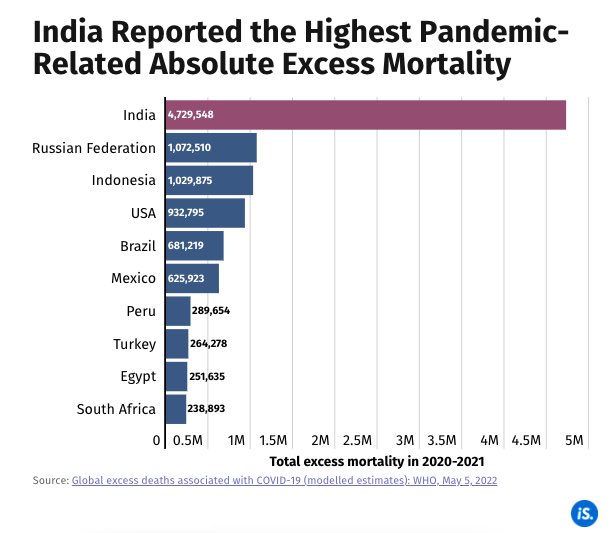
The World Health Organization estimates that India had 4.730 million COVID19-related  deaths in 2020-21, nearly a third of 15 million global excess deaths attributed to the pandemic. India is followed by Russia with 1.073 million deaths and Indonesia with 1.03 million deaths. The United States with 933,795 deaths and Brazil with 681,219 deaths round out the top 5 countries that suffered the heaviest losses of life believed to be related to the pandemic. Mexico (625,923 deaths), Peru (289,654 deaths), Turkey (264,279 deaths) Egypt (251,635 deaths) and South Africa (238,893 deaths) are ranked number 6 through 10 in the world for excess deaths in 2020-21 period. Although Pakistan too had 8 times the official figure, it still does not figure in WHO's top 10 list for total number of COVID deaths. 

Total Excess Deaths Recorded During the COVID-19 Pandemic in 2020-21. Source: WHO

Excess deaths measure how many more people died than expected compared with previous years. Although it is difficult to say with certainty how many of these deaths were due to Covid, they can be considered a measure of the scale and toll of the pandemic, according to the BBC. 

Although the government of Prime Minister Narendra Modi disputes the WHO estimates, the scenes of desperation and death all over India, including the streets of major cities during the pandemic, offer significant anecdotal evidence to support the WHO claim. Although Pakistan too had 8 times the official figure, it still does not figure in WHO's top 10 list for total number of COVID deaths. 

List of Countries with excess deaths during COVID19 pandemic. Source: WHO

Prime Minister Modi's mishandling of the COVID19 pandemic has left a lasting effect on India's economy. Akhil Bharatiya Pratinidhi Sabha (ABPS), the top decision-making body of India's Hindu right-wing RSS (Rashtriya Swayamsevak Sangh), says that “the young generation is suffering from unemployment and the pandemic has made things even grim... We cannot turn a blind eye to unemployment. It is a crisis and it needs to be addressed.” The RSS was apparently reacting to the falling labor participation rate in India relative to Pakistan and the global averages. The RSS leadership wants the government of Prime Minister Narendra Modi to focus on helping small and medium sized enterprises (SMEs) to create jobs.  RSS likes Modi government's ‘Make in India’ initiative “but it needs to be sharpened even more and get more investment.” The resolution is titled, ‘The need to promote work opportunities to make Bharat self-reliant’. The solution offered by ABPS resolution: Take agro-based local initiatives to promote rural areas and create jobs, according to Ram Madhav, a member of the RSS executive committee. 

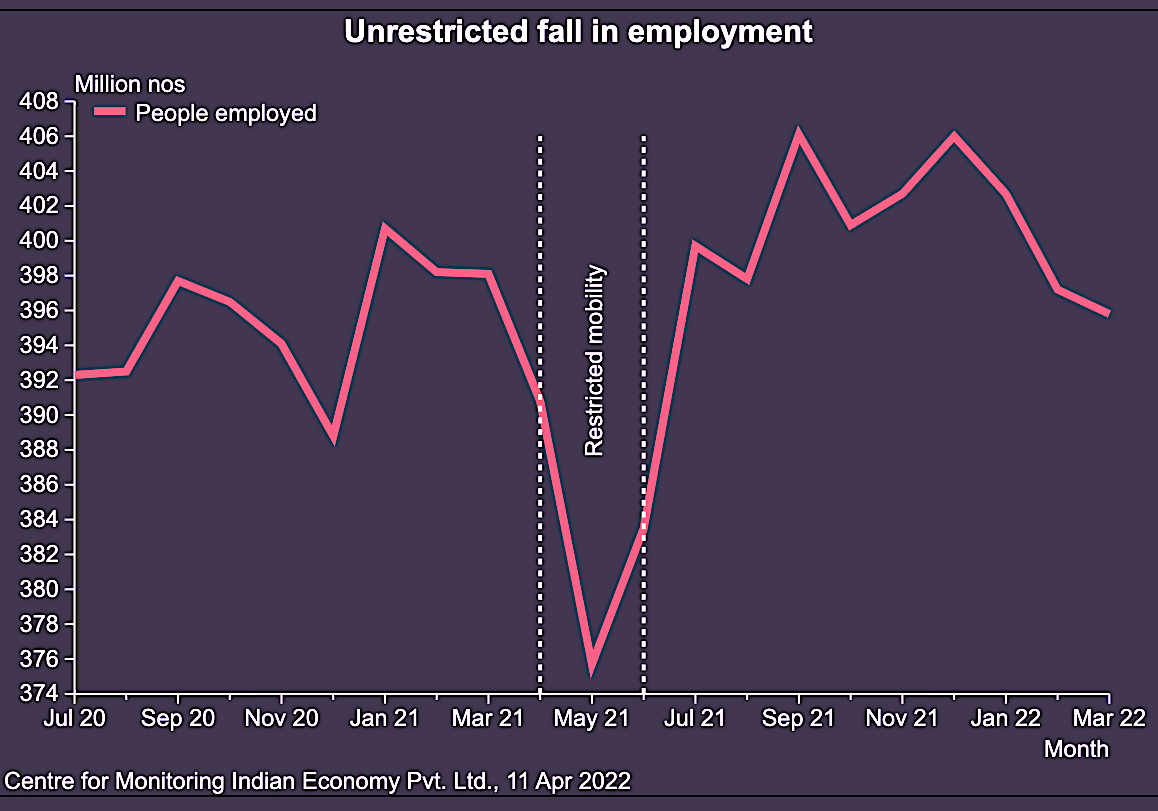
Falling Employment in India. Source: CMIE


India's labor participation rate (LPR) fell to 39.5% in March 2022, as reported by the Center for Monitoring Indian Economy (CMIE). It dropped below the 39.9% participation rate recorded in February. It is also lower than during the second wave of Covid-19 in April-June 2021. The lowest the labor participation rate had fallen to in the second wave was in June 2021 when it fell to 39.6%. The average LPR during April-June 2021 was 40%. March 2022, with no Covid-19 wave and with much lesser restrictions on mobility, has reported a worse LPR of 39.5%.

Labor Participation Rates in India and Pakistan. Source: ILO/World Bank

In spite of the headline GDP growth figures highlighted by the Indian and world media, the fact is that it has been jobless growth. The labor participation rate (LPR) in India has been falling for more than a decade. The LPR in India has been below Pakistan's for several years, according to the International Labor Organization (ILO). 

Indian Employment Trends By Sector. Source: CMIE Via Business Standard

Construction and manufacturing sectors in India have been shedding jobs while the number of people working in agriculture has been rising, according to CMIE. Job losses have caused a hunger crisis in India which now ranks 94th among 107 nations ranked by World Hunger Index in 2020. Other South Asians have fared better: Pakistan (88), Nepal (73), Bangladesh (75), Sri Lanka (64) and Myanmar (78) – and only Afghanistan has fared worse at 99th place. The COVID19 pandemic has worsened India's hunger and malnutrition. Tens of thousands of Indian children were forced to go to sleep on an empty stomach as the daily wage workers lost their livelihood and Prime Minister Narendra Modi imposed one of the strictest lockdowns in the South Asian nationPakistan's former Prime Minister Imran Khan opted for "smart lockdown" that reduced the impact on daily wage earners. China, the place where COVID19 virus first emerged, is among 17 countries with the lowest level of hunger. 


Related Links:

Haq's Musings

South Asia Investor Review

Pakistan Among World's Largest Food Producers

Naya Pakistan Housing Program

Food in Pakistan 2nd Cheapest in the World

Indian Economy Grew Just 0.2% Annually in Last Two Years

Pakistan to Become World's 6th Largest Cement Producer by 2030

Pakistan Reduced Poverty & Grew Economy During COVID Pandemic

Pakistan's Computer Services Exports Jump 26% Amid COVID19 Lockdown

Coronavirus, Lives and Livelihoods in Pakistan

Vast Majority of Pakistanis Support Imran Khan's Handling of Covid19 Crisis

Pakistani-American Woman Featured in Netflix Documentary "Pandemic"

Incomes of Poorest Pakistanis Growing Faster Than Their Richest Counterparts

Can Pakistan Effectively Respond to Coronavirus Outbreak? 

How Grim is Pakistan's Social Sector Progress?

Pakistan Fares Marginally Better Than India On Disease Burdens

Trump Picks Muslim-American to Lead Vaccine Effort

COVID Lockdown Decimates India's Middle Class

Pakistan Child Health Indicators

Pakistan's Balance of Payments Crisis

How Has India Built Large Forex Reserves Despite Perennial Trade Deficits

Conspiracy Theories About Pakistan Elections"

PTI Triumphs Over Corrupt Dynastic Political Parties

Strikingly Similar Narratives of Donald Trump and Nawaz Sharif

Nawaz Sharif's Report Card

Riaz Haq's Youtube Channel