Showing posts with label ILO. Show all posts

Thursday, June 18, 2026

Does Pakistan's Real GDP Exceed One Trillion US Dollars?

A 2024 joint study of the International Labor Organization and the Small and Medium Enterprise Development Authority  (SMEDA) estimated Pakistan's undocumented economy at $457 billion. While other South Asian nations, particularly Bangladesh and India, do include estimated undocumented GDP figures in their official GDP, Pakistan's official GDP figures do not include such estimates. If the Pakistani government decides to include estimates of the informal economy in its official figures, the country's GDP would jump to $1,059  billion in market exchange terms and over $4,000 billion in PPP terms. 

Pakistan's Total GDP, including Undocumented, Estimated at over $1 Trillion


In 2023 when the ILO-SMEDA study was conducted, Pakistan's official GDP was $340 billion (34% less than the undocumented GDP), bringing the total real GDP for 2023 to $797 billion. Pakistan's official GDP figure for 2025-26 is projected to be $452 billion. Assuming that the undocumented GDP has grown at the same rate as the official GDP, the undocumented GDP today works out to $607 billion, bringing the total GDP (documented and undocumented) to over $1 trillion. In terms of purchasing power parity, the total national economy, including the informal economy, is estimated to be over $4 trillion, which translates to over $16,000 per capita. 

Being the largest employer, Pakistan's undocumented sector acts as a critical shock absorber for the labor force and sustains millions of low-income households. But it also restricts the government tax collection which could be invested in education, healthcare and infrastructure development. There is a temptation in Pakistan to force documentation of the entire economy as the Indian government has attempted to do. However, it will create a mass unemployment problem as many small businesses would be forced to close. 

India is an example of what can go wrong in attempting to bring the informal sector into the tax net too quickly. Demonetization and GST taxes together have decimated the informal sector. But the Indian government continues to significantly overestimate its annual economic growth, particularly by misjudging the size and trajectory of the country's informal (undocumented) sector.  Because of these estimation errors, researchers, including India's former Chief Economic Adviser Arvind Subramanian, estimate that the absolute level of India's real GDP may be overstated by 22% to 31%. This implies the average citizen's actual standard of living is lower than official data suggests. 

Sunday, June 12, 2022

Indian Women's Labor Force Participation Falls to Just 19%, Lower Than Pakistan's 21%

Female labor force participation rate in India has recently fallen to just 19%, the second lowest after Afghanistan's 15% in the South Asia region. By contrast, Pakistan's women's labor force participation rate is 21%, Sri Lanka's 31% and Bangladesh's 35%. Prime Minister Narendra Modi's mishandling of the COVID19 pandemic has hit Indian women particularly hard, with 90% of those who lost their jobs now shut out of the workforce. 

Female Labor Force Participation Rate in South Asia. Source: World Bank


The precipitous loss of women workers is disastrous news for India's economy, which had started slowing before the COVID19 pandemic, according to a Bloomberg report. Rosa Abraham, an economics professor at Azim Premji University in Bengaluru, tracked more than 20,000 people as they navigated the labor market during the pandemic.. She found that after the first lockdown, women were several times more likely to lose their jobs than men and far less likely to recover work after restrictions were lifted. "When men are faced with this kind of a huge economic shock, then they have a fallback option," Abraham told Bloomberg. "They can navigate to different kinds of work. But for women, there is no such fallback option. They can't negotiate the labor market as effectively as men do." 

Women accounted for less than 11% of all jobs in 2019-20. But, they accounted for nearly 52% of the 7 million job losses since then, according to the Center for Monitoring Indian Economy (CMIE).  It gets worse in urban India. Women accounted for only 9% of total employment in urban India but they accounted for a massive 76% of the job losses here. The impact of this is a sharp fall in the labor participation of women. The female labor force participation rate among urban women was abysmally low at 9.4% in 2019-20 and it has since fallen to 7% in 2021-22.

COVID19 Pandemic Impact on Employment in India. Source: Bloomberg

Modi government has underplayed the death toll and the negative impact of the COVID19 pandemic in India. But the World Health Organization estimates that India had 4.730 million COVID19-related  deaths in 2020-21, nearly a third of 15 million global excess deaths attributed to the pandemic. India is followed by Russia with 1.073 million deaths and Indonesia with 1.03 million deaths. The United States with 933,795 deaths and Brazil with 681,219 deaths round out the top 5 countries that suffered the heaviest losses of life believed to be related to the pandemic. Mexico (625,923 deaths), Peru (289,654 deaths), Turkey (264,279 deaths) Egypt (251,635 deaths) and South Africa (238,893 deaths) are ranked number 6 through 10 in the world for excess deaths in 2020-21 period. Although Pakistan too had 8 times the official figure, it still does not figure in WHO's top 10 list for total number of COVID deaths. 

It's not just Indian women who have suffered job losses. India's overall labor participation rate (LPR) fell to 39.5% in March 2022, as reported by the Center for Monitoring Indian Economy (CMIE). It dropped below the 39.9% participation rate recorded in February. It is also lower than during the second wave of Covid-19 in April-June 2021. The lowest the labor participation rate had fallen to in the second wave was in June 2021 when it fell to 39.6%. The average LPR during April-June 2021 was 40%. March 2022, with no Covid-19 wave and with much lesser restrictions on mobility, has reported a worse LPR of 39.5%.

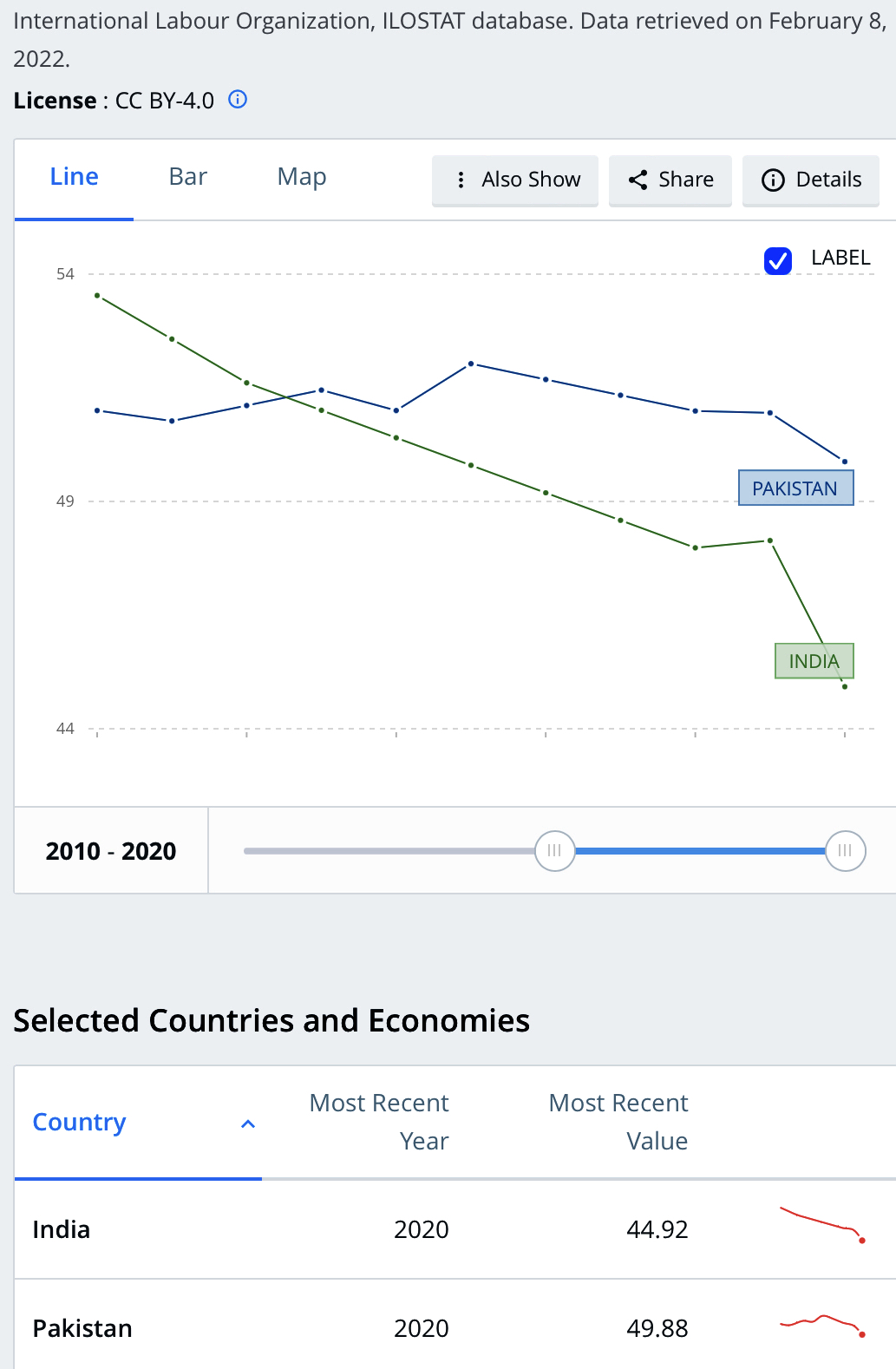
Labor Participation Rates in India and Pakistan. Source: ILO/World Bank


Youth  unemployment for ages 15-24 in India is 24.9%, the highest in the South Asia region. It is 14.8% in Bangladesh 14.8% and 9.2% in Pakistan, according to the International Labor Organization and the World Bank.  

Youth Unemployment in Bangladesh, India and Pakistan. Source: ILO, WB


In spite of the headline GDP growth figures highlighted by the Indian and world media, the fact is that it has been jobless growth. The labor participation rate (LPR) in India has been falling for more than a decade. The LPR in India has been below Pakistan's for several years, according to the International Labor Organization (ILO). 

Indian Employment Trends By Sector. Source: CMIE Via Business Standard

Construction and manufacturing sectors in India have been shedding jobs while the number of people working in agriculture has been rising, according to CMIE. 

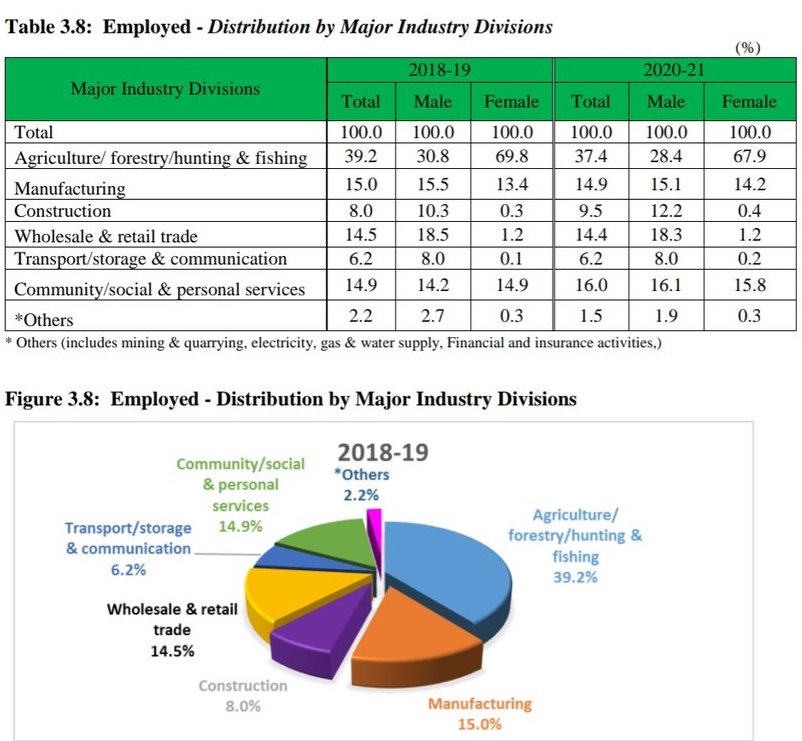
Pakistan Employment By Sectors. Source: PBS via Bilal Gilani

It is important to note that Pakistan’s economy has created 5.5 million jobs during the past three years – 1.84 million jobs a year, significantly higher than yearly average of new jobs created during the 2008-18 decade, according to the findings of Labor Force Survey (LFS) as reported by the Express Tribune paper. The biggest jump in share of employment (1.5%) was in the construction sector, spurred by Naya Pakistan construction incentives offered by the PTI government. 


Related Links:

Haq's Musings

South Asia Investor Review

Pakistan Among World's Largest Food Producers

Naya Pakistan Housing Program

Food in Pakistan 2nd Cheapest in the World

Indian Economy Grew Just 0.2% Annually in Last Two Years

Pakistan to Become World's 6th Largest Cement Producer by 2030

Pakistan's 2012 GDP Estimated at $401 Billion

Pakistan's Computer Services Exports Jump 26% Amid COVID19 Lockdown

Coronavirus, Lives and Livelihoods in Pakistan

Vast Majority of Pakistanis Support Imran Khan's Handling of Covid19 Crisis

Pakistani-American Woman Featured in Netflix Documentary "Pandemic"

Incomes of Poorest Pakistanis Growing Faster Than Their Richest Counterparts

Can Pakistan Effectively Respond to Coronavirus Outbreak? 

How Grim is Pakistan's Social Sector Progress?

Pakistan Fares Marginally Better Than India On Disease Burdens

Trump Picks Muslim-American to Lead Vaccine Effort

COVID Lockdown Decimates India's Middle Class

Pakistan Child Health Indicators

Pakistan's Balance of Payments Crisis

How Has India Built Large Forex Reserves Despite Perennial Trade Deficits

Conspiracy Theories About Pakistan Elections"

PTI Triumphs Over Corrupt Dynastic Political Parties

Strikingly Similar Narratives of Donald Trump and Nawaz Sharif

Nawaz Sharif's Report Card

Riaz Haq's Youtube Channel