Showing posts with label Modi. Show all posts

Saturday, September 12, 2026

BAPS in France: Modi's Hindu Supremacy Boasts Come Under Scrutiny

"When you claim that your civilization is superior, is older, is the mother of democracy, is the mother of science....you antagonize others".  Christophe Jaffrelot, French Political Scientist, speaking to Indian journalist Karan Thapar after expressions of outrage against BAPS Hindu leader’s recent visit to Eiffel Tower. 

In an article published by Carnegie Endowment, Jaffrelot explained that "the majoritarian inferiority complex is to some extent irrational—in India like elsewhere. The Hindu complex of inferiority vis-à-vis others (including the Muslims) crystallized in the 19th century when the British not only emphasized the division of Hindus along caste lines and sectarian lines but also invented communal stereotypes". He has noted that Indian Prime Minister Narendra Modi has close ties to BAPS which is building massive temples around the world. Many of these temples have been inaugurated by Mr. Modi.

BAPS Guru’s Photo at Eiffel Tower, Paris, France


There has been a powerful backlash against Indian Hindu groups in the West after BAPS, an Indian Hindu religious group, demanded that women be kept out of sight during the Eiffel Tower visit by their leader. Arnaud Bertrand, a French Journalist, expressed the outrage shared by many in the West in an X post, excerpted below: 

"Long story short, they just opened a new mega-temple in France - specifically in Bussy-Saint-Georges (30km away from Paris) - presented as "the biggest Hindu temple built in continental Europe in a traditional style". Their guru was there for the inauguration and, as you do, wanted to visit the Eiffel Tower while in France. But, thing is, his doctrine dictates that women must not be in his presence.  And here is where it gets unreal: when his entourage requested a private visit, the Eiffel Tower's management actually agreed to the terms and ordered all female employees - including subcontractors - to hide. This was on Saturday and, France being France (in a good way), on Monday the women who'd been told to make themselves invisible made themselves very, very visible: the staff went on strike and shut down the Eiffel Tower. So there you have it, unreal but true: the Eiffel Tower, symbol of the French Republic, is closed because a 93-year-old Hindu guru refuses to be in the presence of women". 

Another top Hindu Indian leader Mohan Bhagwat, the chief of Hindu Nationalist organization Rashtriya Swayamsevak Sangh (RSS), has also been in the news recently. He visited New York as part of his organization's outreach in the West.  During his August, 2026 North America tour, Bhagwat faced major accusations of duplicity and deception. Bhagwat delivered the keynote address at the "One World, One Humanity" interfaith event in New York City on August 29, 2026, as part of his multi-nation tour across the United States, Canada, and the United Kingdom. Various US faith leaders invited to meet him said they were misled into attending an RSS-affiliated event in New York.  Critics called his speech at Madison Square Garden (MSG) in New York hypocritical and a public relations strategy that contrasts sharply with the divisive politics and violence linked to Hindu nationalist groups in India. The RSS is considered the ideological parent organization of India's ruling BJP party. 

Multiple polls indicate that the Indian diaspora supports Prime Minister Modi and the RSS/BJP ideology. Hateful Hindutva ideology is spreading rapidly among the Indian diaspora. Individuals and organizations connected to the RSS (Rashtriya Swayamsevak Sangh) are actively working to promote India's divisive Islamophobic politics among the Non Resident Indians (NRIs) and their children. Hundreds of the RSS shakhas (branches) are now found in at least 39 countries around the world. Hindutva is a Hindu supremacist ideology inspired by 20th century Fascism and Nazism in Europe; it is very different from the ancient Hindu faith, according to American history professor Audrey Truschke who teaches Indian history at Rutgers University in the US state of New Jersey. Top Indian economists have raised alarm about it. 
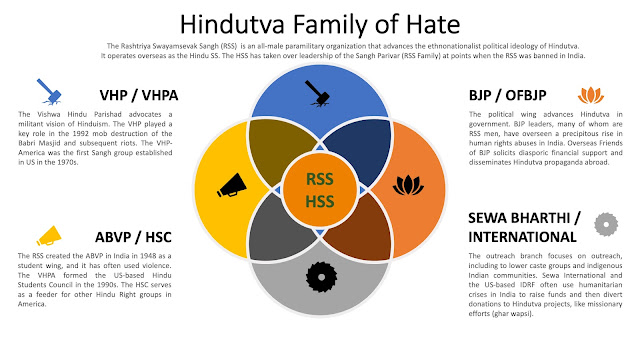
Global Hindutva Sangh Parivar. Source: Audrey Truschke

False narrative of victimhood underlies Hindutva ideology. Indian historian Aditya Mukherjee characterizes the Hindutva victimhood as follows: “The great achievements of the past are then contrasted with a false sense of victimhood, the concept of a great threat the majority is supposedly facing from the minority. This is how fascism works, globally".  "Hindutva was never meant to be understood as bounded by national borders; his (Savarkar's) ambition was always planetary", writes Vinayak Chaturvedi, author of "Hindutva and Violence". "He (Savarkar) gained notoriety for his programme to “Hinduise Politics and Militarise Hindudom” while also arguing for permanent war against Christians and Muslims", Chaturvedi adds. 

Prime Minister Modi's Hindutva rhetoric has influenced the behavior of the Indian diaspora in the US, UK and elsewhere. It has hurt India's international image.  In the United States, 45% of adults view India favorably while 50% view it unfavorably, according to the Pew Research Center Spring 2026 Global Attitudes Survey. The arrogance of the Indian diaspora was highlighted in 2024 when Vivek Ramaswamy, then a candidate for the Republican Party's presidential nomination,  said Americans don't have a good enough work ethic as American culture "venerated mediocrity over excellence." He offered it as a key justification to bring in more Indians to work in the United States. The backlash in the United States was immediate and strong.  The essence of the response to the Hindu supremacist criticism of the US culture went like this: People from India, a "shit-hole" country, are jealous of  America.  Earlier, Professor Amy Wax of University of Pennsylvania, told Tucker Carlsen that “the role of envy and shame in the way the third world [sic] regards the first world […] creates ingratitude of the most monstrous kind.” She also said that ‘Brahmin women’ of India are taught that they are better than everybody. 

Many liberal Indian intellectuals dismiss what is happening in India today under Hindu Nationalist Prime Minister Narendra Modi's leadership as a temporary aberration, not the norm. They long for a return to "Indian liberalism" which according to anthropologist Sanjay Srivastava "did not exist".  Others, such as Indian anthropologist Sanjay Srivastava, sum up the current situation as follows: 

"Our parents practiced bigotry of a quiet sort, one that did not require the loud proclamations that are the norm now. Muslims and the lower castes knew their place and the structures of social and economic authority were not under threat. This does not necessarily translate into a tolerant generation. Rather, it was a generation whose attitudes towards religion and caste was never really tested. The loud bigotry of our times is no great break from the past in terms of a dramatic change in attitudes – is it really possible that such changes can take place in such few years? Rather, it is the crumbling of the veneer of tolerance against those who once knew their place but no longer wish to accept that position. The great problem with all this is that we continue to believe that what is happening today is simply an aberration and that we will, when the nightmare is over, return to the Utopia that was once ours. However, it isn’t possible to return to the past that was never there. It will only lead to an even darker future. And, filial affection is no antidote for it".

In 2022, Dr Saiba Varma, Associate Professor of Anthropology at University of California in San Diego (UCSD), came under fire for hiding her familial ties to to a top RAW official while working on her book "The Occupied Clinic: Militarism and Care in Kashmir".  “As an upper-caste and upper-class Indian citizen and subject, I have actively and passively internalized anti-Muslim racism my entire life. I am complicit in the colonization of Kashmir and other regions forcibly incorporated into the Indian nation-state", she acknowledges in her book released in 2021.

In summary, what the world witnessing is a divide among the Indian elite over how India's identity should be projected abroad: whether its global prestige is best served by asserting its unique majoritarian civilizational heritage, or by reinforcing the pluralistic, secular democratic standards valued by international liberal institutions.


Monday, May 11, 2026

Is the India Growth Story Over?

In a television speech to the nation, Indian Prime Minister Narendra Modi urged his people to make sacrifices by spending less on fuel, fertilizer, and travel. He also asked them not to buy gold for a year. “To save foreign exchange, we must accept the challenge of patriotism,” he said. It appears that India's problems do not just stem from the effects of the US-Iran war; India's problems started well before that. Flight of foreign capital has put the Indian currency under tremendous pressure, with the Indian rupee falling nearly 10% in recent months. Many analysts believe that the Indian IT services exports could fall significantly as the artificial intelligence (AI) models begin to replace the IT workers. It could create a balance of payments crisis that could force India to seek the IMF bailout in the not too distant future.  Already, the Indian economy has slipped to the sixth-largest economy by nominal GDP, dropping from previous projections that had it at fourth.


Indian Economy Drops From 4th to 6th Rank. Source: IndMoneyApp

Energy Crisis:

India is facing a serious energy crisis driven by the closure of the Strait of Hormuz that has disrupted global oil and gas supplies. While the government has assured citizens that there are no immediate shortages of petroleum or natural gas, the escalating costs of imports are putting extreme pressure on the nation's foreign exchange reserves. 

AI Challenge: 

Indian IT firms are cutting staff to prepare for the expected disruption from the adoption of AI. For example, the IT services firm Cognizant is planning major workforce reductions that could impact between 12,000 and 15,000 employees globally, with India expected to account for the majority of the cuts, according to a report. 

A US-based investment research firm Citrini Research is forecasting a significant disruption to India's traditional IT services sector by 2027-2028, driven by the collapsing cost of AI coding agents. Here's an excerpt of the Citrini research report:

"The country’s IT services sector exported over $200 billion annually, the single largest contributor to India’s current account surplus and the offset that financed its persistent goods trade deficit. The entire model was built on one value proposition: Indian developers cost a fraction of their American counterparts. But the marginal cost of an AI coding agent had collapsed to, essentially, the cost of electricity. TCS, Infosys and Wipro saw contract cancellations accelerate through 2027. The rupee fell 18% against the dollar in four months as the services surplus that had anchored India’s external accounts evaporated. By Q1 2028, the IMF had begun “preliminary discussions” with New Delhi". 

Stocks Selloff: 

Sensing the growing crisis, Indian stock market investors are selling off their holdings. IN particular, foreign investors have accelerated their exit from Indian equities in early 2026, selling over $20 Billion in the first four months, driving 14-year low ownership levels. Triggered by Middle East conflicts, rising oil prices, and rupee depreciation, this record exodus—marking the worst quarterly selloff in March—was driven by outflows in banking, financial services, and IT.

Investors see the writing on the wall. The Indian economy has already dropped from the 4th to the 6th rank in the world. The Indian currency is under a lot of pressure. India's current account deficit will worsen with the loss of IT services exports. 

Related Links:


Haq's Musings

South Asia Investor Review

Builder.AI: Yet Another Global Indian Scam?

India's Ex Chief Economic Advisor: Indian GDP is 22% to 31% Smaller Than Official Claim

India's AI Spectacle of Chaos and Deception

Has the Modi Government's Politics Hurt India's International Image?

Pakistan's Official GDP Figures Ignore Fast Growing Sectors

India's "Firehose of Falsehoods"

State Bank Says Pakistan's Official GDP Under-estimated

Pakistan's Growing Middle Class

Pakistan's GDP Grossly Under-estimated; Shares Highly Undervalued

Fast Moving Consumer Goods Sector in Pakistan

Retail Investor Growth Drives Pakistan's Bull Market


Monday, March 16, 2026

Modi's Ex Chief Economic Advisor: India's Economy is 22% to 31% Smaller Than Official Claim

New research by several economists, including India's former Chief Economic Adviser Arvind Subramanian, finds that the country's GDP has been overstated by 22% to 31%. It says: "The level of (India's) real GDP is overstated by about 22% and the level of consumption by about 31%". "India's economy is thus smaller and the average standard of living significantly lower than official estimates indicate", it adds. The current GDP of India is less than $3 trillion, according to the authors. 

Indian GDP Overstated by 22% to 31%. Source: PIIE 


In a paper published by Peterson Institute for International Economics, the authors state that "India’s annual economic growth during the boom years between 2005 and 2011 may have been underestimated by about 1–1½ percentage points on average, and subsequent growth between 2012 and 2023 may have been overestimated by about 1½-2 percentage points".  It means that India's actual annual GDP growth during Prime Minister Modi's government has been closer to 4%, not 6% as officially claimed. Pakistan's GDP growth rate has been about 3.5% during this period. 

The authors explain that the estimation error is caused by two methodological issues. The first issue leading to the misestimation is that the economy’s formal sector has been used as a proxy for the vast informal sector, even though the latter was disproportionately hit after 2015 by demonetization, the introduction of the goods and services tax, and the COVID-19 pandemic. The second issue causing misestimation is that the deflators for many sectors have been based on commodity prices, which have moved sharply relative to others.

Ruling politicians in New Delhi continue to hype their country's economic growth even as the Indian currency hits new lows against the US dollar, corporate profits fall, electrical power demand slows, domestic savings and investment rates decline and foreign capital flees Indian markets. The International Monetary Fund (IMF) has questioned India's GDP and independent economists Professors Arun Kumar and Ashoka Modi and investment banker Ruchir Sharma have detailed why the Indian official data can not be trusted. It seems that the BJP-led government of Prime Minister Narendra Modi is fast losing credibility by politicizing the civilian bureaucracy and the military brass to project their economic and military failures as successes.

IMF Gives C Grade to India's GDP Data


Beyond the disputed claim of being the "fourth largest economy", the Modi government's failure on the national health and wellness front is also getting more attention. “Air is unbreathable. Water is undrinkable. Food is adulterated. What’s the point of becoming the 4th largest economy?” asked India-American technology entrepreneur Sabeer Bhatia in an X message recently. Gita Gopnath, Harvard professor of economics, said at the World Economic Forum in Davos this week that the economic impact of pollution on India is more severe than the effects of tariffs imposed on the country. “About 1.7 million lives are lost every year in India because of pollution. That’s 18% of the total deaths in India,” Gopinath said, quoting a World Bank study. “Even from an international investor’s perspective … the pollution holds you back.”

Unsafe Drinking Water in India Claimed as 4th Largest Economy. Source: DownToEarth


An international badminton tournament in India has brought global spotlight on the lack of basic hygiene in India.  Foreign players complained about dusty floors, dirty courts, bird droppings and unhygienic conditions at the India Open in New Delhi. “I think the floors are dirty. There is a lot of dirt on the courts. There’s bird excrement. There are birds flying around in the arena,” said  28 year-old Denmark women’s singles player Mia Blichfeldt. Andres Antonson, world number three badminton player, withdrew from the India Open Super 750 in New Delhi for the third consecutive year, choosing to pay a $5,000 fine. He cited "extreme" hazardous air pollution in Delhi as the reason for skipping the mandatory tournament, arguing it is not a safe place to hold the event. 

The IMF has recently expressed doubts about Prime Minister Narendra Modi's BJP government's GDP data. It has particularly questioned the government's statistical methodologies, inflation measurement, and the estimates of the informal economy used in reporting the country's gross domestic product. Professor Arun Kumar of Jawaharlal Nehru University believes the IMF's concerns are valid. He thinks the real size of India's economy is only half of what is officially claimed.  “The economy is almost 50% wrong – when the government says it’s $3.8 trillion, my estimate is it is probably still $2.5 trillion because we are overestimating the unorganized sector, which is actually declining. This is building up over a period of time,” Kumar told Indian journalist Karan Thapar. 

In its recent assessment, the International Monetary Fund (IMF) has given a "C" grade to India's national accounts. In particular, the IMF has raised the issue of the government using 2011-12 as the base year as being outdated, the discrepancy between production and consumption data and the use of Wholesale Price Index, and not a Producer Price Index, to deflate many economic activities to derive real GDP from nominal GDP. 

Indian Firms Falling Corporate Profits. Source: Bloomberg 


Corporate profits of Indian firms are growing at a much slower pace than the 8.2% GDP growth in its most recent quarter. Net income for Nifty 50 Index firms likely rose 1.1% in the three months through Dec. 31 from a year earlier, according to analyst estimates compiled by Bloomberg. That would be the slowest pace in five quarters, weighed down by deteriorating margins for banks. Falling profits and declining currency are causing foreign capital to flee Indian markets. Foreign Portfolio Investors (FPIs) pulled out over $20 billion from Indian equities in 2025, marking a severe, sustained withdrawal that has continued into 2026.  Net Foreign Direct Investment (FDI) has seen consecutive monthly outflows, including $1.67 billion in October and $446 million in November 2025. Investment banker Ruchir Sharma wrote about it in a Financial Times op ed titled "India needs to import more capital and export fewer workers". Ruchir wrote: "Most strikingly, corporate revenue normally grows (or shrinks) with the economy — in any country. But last year corporate revenue growth for listed companies in India decelerated to barely half the GDP growth rate"


Falling Indian Rupee. Source: Reuters


The source of the biggest error is the way India estimates the informal economy which, including agriculture, accounts for almost 45% of GDP. To do so, India uses the formal sector as a proxy to estimate the performance of the informal sector. But if the two sectors are moving in opposite directions, as has happened after demonetization, GST imposition and the pandemic, you could end up overestimating the unorganized sector.

Indian-American economist Ashoka Mody, author of "India is Broken", has argued that the current unemployment crisis in India is a direct result of the destruction of the informal sector, particularly the mom and pop stores that employed a large number of Indians. 

Questions about the veracity of India's official GDP figures are not new. These have been raised by many top economists. For example,  French economist Thomas Piketty argues in his best seller "Capital in the Twenty-First Century that the GDP growth rates of India and China are exaggerated.  Picketty writes as follows:

"Note, too, that the very high official growth figures for developing countries (especially India and China) over the past few decades are based almost exclusively on production statistics. If one tries to measure income growth by using household survey data, it is often quite difficult to identify the reported rates of macroeconomic growth: Indian and Chinese incomes are certainly increasing rapidly, but not as rapidly as one would infer from official growth statistics. This paradox-sometimes referred to as the "black hole" of growth-is obviously problematic. It may be due to the overestimation of the growth of output (there are many bureaucratic incentives for doing so), or perhaps the underestimation of income growth (households have their own flaws)), or most likely both. In particular, the missing income may be explained by the possibility that a disproportionate share of the growth in output has gone to the most highly remunerated individuals, whose incomes are not always captured in the tax data." "In the case of India, it is possible to estimate (using tax return data) that the increase in the upper centile's share of national income explains between one-quarter and one-third of the "black hole" of growth between 1990 and 2000. "


Related Links:

Haq's Musings

South Asia Investor Review

Builder.AI: Yet Another Global Indian Scam?

Is India Fudging GDP to Look Better Than China?

India's IT Exports Highly Exaggerated

Has the Modi Government's Politics Hurt India's International Image?

Pakistan's Official GDP Figures Ignore Fast Growing Sectors

India's "Firehose of Falsehoods"

State Bank Says Pakistan's Official GDP Under-estimated

Pakistan's Growing Middle Class

Pakistan's GDP Grossly Under-estimated; Shares Highly Undervalued

Fast Moving Consumer Goods Sector in Pakistan

Retail Investor Growth Drives Pakistan's Bull Market


Friday, February 27, 2026

India-Israel Axis Threatens Peace in South Asia

The bonhomie between Israeli Prime Minister Netanyahu, an indicted war criminal, and Indian Prime Minister Narendra Modi, accused of killing thousands of Muslims, was on full display this week in Israel. Both leaders committed to supporting the Afghan Taliban regime which is accused of facilitating cross-border terrorist attacks by the TTP in Pakistan. Mr. Modi was warmly welcomed by Mr. Netanyahu as a "brother". “You are a great friend of Israel, … Narendra. You are more than a friend. You are a brother,” Netanyahu told Modi when both leaders addressed the Israeli parliament in Jerusalem on Wednesday. In response, Mr. Modi said, “India stands with Israel, firmly, with full conviction, in this moment, and beyond" He was silent on the continuing genocide in Gaza, where the Israeli military has killed more than 72,000 Palestinians since October 2023. Currently, India is Israel’s largest weapons buyer, sending billions of dollars into Israel’s defense industry each year. In 2024 as Israel waged its war on Gaza, Indian weapons firms sold Israel rockets and explosives that killed Palestinians, according to an Al Jazeera investigation.

Indian PM Modi Hugs Israeli PM Netanyahu at Ben Gurion Airport in Tel Aviv. Source: AP

In October 2023, Mr. Modi became the first foreign leader to call Mr. Netanyahu and offer his full support to Israel after the Hamas terrorist attack in Israel. He  tweeted that he was "shocked by the news of terrorist attacks in Israel", adding that "We stand in solidarity with Israel at this difficult hour".  This tweet was posted immediately after the Hamas militants' unprecedented attack on Israel by air, land and sea. Modi's critics have noted that he has yet to tweet any condemnation of months-long killings of his fellow countrymen in Manipur which are continuing unabated. Nor has he issued any similar condemnation of the long and brutal Israeli military occupation of Gaza and the West Bank. To those who know Modi, his reaction makes sense given the similarities between Modi and Israeli Prime Minister Benjamin Netanyahu. Both leaders are extreme right-wing divisive politicians. Modi is a Hindu Supremacist and Netanyahu is a Jewish Supremacist. Both have a long history of murdering large numbers of Muslims living under their rule. Both are pursuing settler colonial policies; Modi in Kashmir and Netanyahu in Palestine


More Americans Than Indians Have Negative Views Israel. Source: Pew 


Meanwhile, the polls indicate that more Americans (53%) than Indians (29%) have negative view of Israel. Most Indians, particularly Hindu Nationalists, have suffered from what Shashi Tharoor calls "India's Israel Envy". Here's an excerpt of Tharoor's piece published in "Project Syndicate" in January 2009:  

"Yet, when Indians watch Israel take the fight to the enemy, killing those who launched rockets against it and dismantling many of the sites from which the rockets flew, some cannot resist wishing that they could do something similar in Pakistan. India understands, though, that the collateral damage would be too high, the price in civilian lives unacceptable, and the risks of the conflict spiraling out of control too acute to contemplate such an option. So Indians place their trust in international diplomacy and watch, with ill-disguised wistfulness, as Israel does what they could never permit themselves to do". 

In a piece titled "The Settler Colonial Alliance of India and Israel" published in The Nation, Indian journalist Deeksha Udupa interviewed Azad Essa,  author of “Hostile Homelands” – The new alliance between India and Israel". Here's what Essa told Udupa:  

"Kashmir is a perfect example of another region being turned into a sort of testing ground (for Israeli weapons and methods). Both India and Israel already share many tactics. They both attack journalists and criminalize civil society. They both exercise collective punishment on Palestinians and Kashmiris. They both maim protesters. In Palestine, protesters are shot in the limbs. In Kashmir, protesters are blinded by lead pellets. Israeli drones, sensors, surveillance, and machine guns are all there, and Israeli methods of controlling the population have long existed in Kashmir—so much so that India is now producing some of these Israeli weapons in factories across India.". 

Azad Essa argues that the Israeli occupation of Palestine has served as a model that Indians are replicating in Kashmir.  He says that Israeli weapons, developed and field tested on Palestinians, have been used in Kashmir.  Here are a couple of excerpts from his book "Hostile Homelands: The New Alliance Between India and Israel":   :

"So how did India, which once considered Zionism a form of racism, become Israel’s number one weapons trade buyer, accounting for 42% of Israel’s arms exports since Modi came to power in 2014?* How did India, the first non-Arab state to recognize the Palestinian Liberation Organization (PLO) and one of the leaders of the Non-Aligned Movement that opposed colonialism and apartheid, simultaneously maintain its colonial occupation of Kashmir since 1947 and metamorphose into extolling Israel’s settlements as a model to colonize Kashmir with its own Indian settlers?"

"In the days leading to August 5, 2019 and in the weeks and months to come, Kashmir became a site of unfathomable cruelty. Thousands of Kashmiris were detained; pro-India politicians were placed under house arrest, pro-freedom leaders as well as minors were rounded up and thrown in jail. Young boys were shipped off to Indian prisons 1,500km away in Agra and Varanasi. Foreign journalists and international human rights groups were banned from access to Kashmir. The region was placed under a complete communication blackout. Cellular phones, Internet, landline services, and even the postal services were dismantled. News traveled by word of mouth. Journalists compressed photos and video onto memory cards and smuggled them out with passengers en route to Delhi. Schools, offices, banks, and businesses were closed for months. Life came to a standstill". 

Here's India's JNU Professor speaking about illegal Indian occupation of Kashmir, Manipur and Nagaland:

https://youtu.be/KWp1E8xrY5E


Related Links:

Haq's Musings

South Asia Investor Review

Pakistan's Bilawal Bhutto Lashes Out at India's Jaishankar

Gaza Genocide

India-Pakistan Nuclear Arms Race

Kashmir: 700,000 Indian Soldiers vs 7 Million Kashmiris

Israeli Settler Colonialism

India Promotes Half Truths About UNSC Kashmir Resolutions

Pakistan-China-Russia Vs India-Japan-US

Total, Extended Lockdown in Indian Occupied Kashmir

What is India Hiding From UN Human Rights Team?

Indian JNU Professor on Illegal Indian Occupation of Kashmir, Manipur, Nagaland

Riaz Haq Youtube Channel

VPOS Youtube Channel


Sunday, January 25, 2026

Independent Economists Expose Modi's Fake GDP

Ruling politicians in New Delhi continue to hype their country's economic growth even as the Indian currency hits new lows against the US dollar, corporate profits fall, electrical power demand slows, domestic savings and investment rates decline and foreign capital flees Indian markets. The International Monetary Fund (IMF) has questioned India's GDP and independent economists Professors Arun Kumar and Ashoka Modi and investment banker Ruchir Sharma have detailed why the Indian official data can not be trusted. It seems that the BJP-led government of Prime Minister Narendra Modi is fast losing credibility by politicizing the civilian bureaucracy and the military brass to project their economic and military failures as successes.

IMF Gives C Grade to India's GDP Data


Beyond the disputed claim of being the "fourth largest economy", the Modi government's failure on the national health and wellness front is also getting more attention. “Air is unbreathable. Water is undrinkable. Food is adulterated. What’s the point of becoming the 4th largest economy?” asked India-American technology entrepreneur Sabeer Bhatia in an X message recently. Gita Gopnath, Harvard professor of economics, said at the World Economic Forum in Davos this week that the economic impact of pollution on India is more severe than the effects of tariffs imposed on the country. “About 1.7 million lives are lost every year in India because of pollution. That’s 18% of the total deaths in India,” Gopinath said, quoting a World Bank study. “Even from an international investor’s perspective … the pollution holds you back.”

Unsafe Drinking Water in India Claimed as 4th Largest Economy. Source: DownToEarth


An international badminton tournament in India has brought global spotlight on the lack of basic hygiene in India.  Foreign players complained about dusty floors, dirty courts, bird droppings and unhygienic conditions at the India Open in New Delhi. “I think the floors are dirty. There is a lot of dirt on the courts. There’s bird excrement. There are birds flying around in the arena,” said  28 year-old Denmark women’s singles player Mia Blichfeldt. Andres Antonson, world number three badminton player, withdrew from the India Open Super 750 in New Delhi for the third consecutive year, choosing to pay a $5,000 fine. He cited "extreme" hazardous air pollution in Delhi as the reason for skipping the mandatory tournament, arguing it is not a safe place to hold the event. 

The IMF has recently expressed doubts about Prime Minister Narendra Modi's BJP government's GDP data. It has particularly questioned the government's statistical methodologies, inflation measurement, and the estimates of the informal economy used in reporting the country's gross domestic product. Professor Arun Kumar of Jawaharlal Nehru University believes the IMF's concerns are valid. He thinks the real size of India's economy is only half of what is officially claimed.  “The economy is almost 50% wrong – when the government says it’s $3.8 trillion, my estimate is it is probably still $2.5 trillion because we are overestimating the unorganized sector, which is actually declining. This is building up over a period of time,” Kumar told Indian journalist Karan Thapar. 

In its recent assessment, the International Monetary Fund (IMF) has given a "C" grade to India's national accounts. In particular, the IMF has raised the issue of the government using 2011-12 as the base year as being outdated, the discrepancy between production and consumption data and the use of Wholesale Price Index, and not a Producer Price Index, to deflate many economic activities to derive real GDP from nominal GDP. 

Indian Firms Falling Corporate Profits. Source: Bloomberg 


Corporate profits of Indian firms are growing at a much slower pace than the 8.2% GDP growth in its most recent quarter. Net income for Nifty 50 Index firms likely rose 1.1% in the three months through Dec. 31 from a year earlier, according to analyst estimates compiled by Bloomberg. That would be the slowest pace in five quarters, weighed down by deteriorating margins for banks. Falling profits and declining currency are causing foreign capital to flee Indian markets. Foreign Portfolio Investors (FPIs) pulled out over $20 billion from Indian equities in 2025, marking a severe, sustained withdrawal that has continued into 2026.  Net Foreign Direct Investment (FDI) has seen consecutive monthly outflows, including $1.67 billion in October and $446 million in November 2025. Investment banker Ruchir Sharma wrote about it in a Financial Times op ed titled "India needs to import more capital and export fewer workers". Ruchir wrote: "Most strikingly, corporate revenue normally grows (or shrinks) with the economy — in any country. But last year corporate revenue growth for listed companies in India decelerated to barely half the GDP growth rate"


Falling Indian Rupee. Source: Reuters


The source of the biggest error is the way India estimates the informal economy which, including agriculture, accounts for almost 45% of GDP. To do so, India uses the formal sector as a proxy to estimate the performance of the informal sector. But if the two sectors are moving in opposite directions, as has happened after demonetization, GST imposition and the pandemic, you could end up overestimating the unorganized sector.

Indian-American economist Ashoka Mody, author of "India is Broken", has argued that the current unemployment crisis in India is a direct result of the destruction of the informal sector, particularly the mom and pop stores that employed a large number of Indians. 

Questions about the veracity of India's official GDP figures are not new. These have been raised by many top economists. For example,  French economist Thomas Piketty argues in his best seller "Capital in the Twenty-First Century that the GDP growth rates of India and China are exaggerated.  Picketty writes as follows:

"Note, too, that the very high official growth figures for developing countries (especially India and China) over the past few decades are based almost exclusively on production statistics. If one tries to measure income growth by using household survey data, it is often quite difficult to identify the reported rates of macroeconomic growth: Indian and Chinese incomes are certainly increasing rapidly, but not as rapidly as one would infer from official growth statistics. This paradox-sometimes referred to as the "black hole" of growth-is obviously problematic. It may be due to the overestimation of the growth of output (there are many bureaucratic incentives for doing so), or perhaps the underestimation of income growth (households have their own flaws)), or most likely both. In particular, the missing income may be explained by the possibility that a disproportionate share of the growth in output has gone to the most highly remunerated individuals, whose incomes are not always captured in the tax data." "In the case of India, it is possible to estimate (using tax return data) that the increase in the upper centile's share of national income explains between one-quarter and one-third of the "black hole" of growth between 1990 and 2000. "


Related Links:

Haq's Musings

South Asia Investor Review

Builder.AI: Yet Another Global Indian Scam?

Is India Fudging GDP to Look Better Than China?

India's IT Exports Highly Exaggerated

Has the Modi Government's Politics Hurt India's International Image?

Pakistan's Official GDP Figures Ignore Fast Growing Sectors

India's "Firehose of Falsehoods"

State Bank Says Pakistan's Official GDP Under-estimated

Pakistan's Growing Middle Class

Pakistan's GDP Grossly Under-estimated; Shares Highly Undervalued

Fast Moving Consumer Goods Sector in Pakistan

Retail Investor Growth Drives Pakistan's Bull Market


Sunday, November 30, 2025

IMF Questions Modi's GDP Data: Is India's Economy Half the Size of the Official Claim?

The Indian government reported faster-than-expected GDP growth of 8.2% for the September quarter. It came as a surprise to many economists who were expecting a slowdown based on the recent high-frequency indicators such as consumer goods sales and durable goods production, as well as two-wheeler sales. At the same time, The International Monetary Fund expressed doubts about the Indian government's GDP data. 


The IMF has recently expressed doubts about Prime Minister Narendra Modi's BJP government's GDP data. It has particularly questioned the government's statistical methodologies, inflation measurement, and the estimates of the informal economy used in reporting the country's gross domestic product. Professor Arun Kumar of Jawaharlal Nehru University believes the IMF's concerns are valid. He thinks the real size of India's economy is only half of what is officially claimed.  “The economy is almost 50% wrong – when the government says it’s $3.8 trillion, my estimate is it is probably still $2.5 trillion because we are overestimating the unorganized sector, which is actually declining. This is building up over a period of time,” Kumar told Indian journalist Karan Thapar. 

In its recent assessment, the International Monetary Fund (IMF) has given a "C" grade to India's national accounts. In particular, the IMF has raised the issue of the government using 2011-12 as the base year as being outdated, the discrepancy between production and consumption data and the use of Wholesale Price Index, and not a Producer Price Index, to deflate many economic activities to derive real GDP from nominal GDP. 

The source of the biggest error is the way India estimates the informal economy which, including agriculture, accounts for almost 45% of GDP. To do so, India uses the formal sector as a proxy to estimate the performance of the informal sector. But if the two sectors are moving in opposite directions, as has happened after demonetization, GST imposition and the pandemic, you could end up overestimating the unorganized sector.

Indian-American economist Ashoka Mody, author of "India is Broken", has argued that the current unemployment crisis in India is a direct result of the destruction of the informal sector, particularly the mom and pop stores that employed a large number of Indians. 

Questions about the veracity of India's official GDP figures are not new. These have been raised by many top economists. For example,  French economist Thomas Piketty argues in his best seller "Capital in the Twenty-First Century that the GDP growth rates of India and China are exaggerated.  Picketty writes as follows:

"Note, too, that the very high official growth figures for developing countries (especially India and China) over the past few decades are based almost exclusively on production statistics. If one tries to measure income growth by using household survey data, it is often quite difficult to identify the reported rates of macroeconomic growth: Indian and Chinese incomes are certainly increasing rapidly, but not as rapidly as one would infer from official growth statistics. This paradox-sometimes referred to as the "black hole" of growth-is obviously problematic. It may be due to the overestimation of the growth of output (there are many bureaucratic incentives for doing so), or perhaps the underestimation of income growth (households have their own flaws)), or most likely both. In particular, the missing income may be explained by the possibility that a disproportionate share of the growth in output has gone to the most highly remunerated individuals, whose incomes are not always captured in the tax data." "In the case of India, it is possible to estimate (using tax return data) that the increase in the upper centile's share of national income explains between one-quarter and one-third of the "black hole" of growth between 1990 and 2000. "


Related Links:

Haq's Musings

South Asia Investor Review

Builder.AI: Yet Another Global Indian Scam?

Is India Fudging GDP to Look Better Than China?

India's IT Exports Highly Exaggerated

Has the Modi Government's Politics Hurt India's International Image?

Pakistan's Official GDP Figures Ignore Fast Growing Sectors

India's "Firehose of Falsehoods"

State Bank Says Pakistan's Official GDP Under-estimated

Pakistan's Growing Middle Class

Pakistan's GDP Grossly Under-estimated; Shares Highly Undervalued

Fast Moving Consumer Goods Sector in Pakistan

Retail Investor Growth Drives Pakistan's Bull Market


Wednesday, November 5, 2025

Mayor-Elect Zohran Mamdani Makes History in New York City

"Ana minkum wa alaikum" declared Zohran Mamdani, the mayor-elect of New York City in his victory speech on November 4, 2025. The phrase translates to "I am from you and  and I am with you".  "New York will remain a city of immigrants, a city built by immigrants, powered by immigrants and, as of tonight, led by an immigrant", he added. Mamdani is the first Muslim and first immigrant of South Asian descent elected  New York City Mayor. At 34, he is not only the youngest but also the first mayor of the Big Apple who was born in Africa. 

Zohran Mamdani Speaking Outside the Bronx Islamic Center


With his landslide victory in the mayoral race, Mandani will join London Mayor Sadiq Khan to become the second Muslim mayor of a major western city.  Mamdani became the first New York mayoral candidate to win over a million votes since the 1960s — more than Rudy Giuliani or Mike Bloomberg ever received. Mamdani has received 50.4% of the votes counted so far. Cuomo is at 41.6%. Republican Curtis Sliwa is at 7.1%. Mayor Sadiq Khan is serving his third term as the mayor of London. He is of Pakistani descent, as are mayors of several other major British cities. 

Zohran Mamdani beat former New York Governor Andrew Cuomo twice, first in the primary and then in the general election, to win on Tuesday. He won in spite of the fact that many prominent Democrats, including Senate Minority Leader Chuck Schumer, the New York senator, refused to endorse him. Mamdani was also vastly outspent by Cuomo, who was backed by a group of Zionist billionaires. President Trump endorsed Cuomo and repeatedly threatened to cut off federal funds to New York if Mamdani won.

Mandani received strong support from Muslims in Silicon Valley and elsewhere. Muhammad Javed of AppLovin tech firm donated $251,500 to New Yorkers for Lower Costs, a super-PAC backing Zohran Mamdani. Omer Hasan gave $250,000 to this super PAC. Other Mamdani super PAC donors include Liz Simons, Philanthropist, and daughter of hedge-fund billionaire Jim Simons, who gave $250,000 and Unity & Justice Fund, the political arm of the Council on American-Islamic Relations CAIR, that gave $100,000. But the biggest support has come from small donors to the Mamdani campaign. It has received a lot more money from small-dollar donors.  In August 2025, Mamdani's campaign had raised over $1 million from more than 8,600 private donors, with half of the individual donations being less than $25. His campaign also got millions in public matching funds due to this strong small-dollar donor support. 

Mamdani was attacked by his opponents for his Muslim faith. In one appearance, Cuomo agreed with a racist radio host who suggested a Muslim elected official would ‘cheer’ another 9/11. In response, Mamdani made an emotional speech outside a mosque in which he said:  "I will not change who I am. I will not change how I eat. I will not change the faith that I am proud to belong to. But there is one thing I will change: I will no longer look for myself in the shadows".

It is particularly noteworthy that Zohran Mamdani, a pro-Palestinian candidate who accuses Israel of carrying out genocide in Gaza, won in New York City which has the world's second largest population Jews after Tel Aviv. During his mayoral campaign, the Zionist-dominated US media kept asking him and other candidates whether Israel would be their first foreign visit if they got elected. Mamdani said no, he would stay in New York City to serve the people. All other candidates in the race pandered to the powerful Israel lobby by saying Israel would be their first foreign visit. Mamdani's win shows that total unqualified support of Israel is not essential to win elections in the United States. 

Among the most vocal opponents of Mamdani are Zionist and Hindutva groups in America. This opposition is based on his strong criticism of Indian Prime Minister Modi and Israeli Prime Minister Netanyahu.  He has called Modi a "war criminal," drawing parallels between him and Netanyahu. He has repeatedly vowed that, if elected mayor, he would order the New York Police Department (NYPD) to arrest Netanyahu should the Israeli Prime Minister travel to New York. 

Related Links:


Haq's Musings

South Asia Investor Review

Muslim-Americans in San Francisco Bay Area

Gaza Genocide

Islamophobia in America

Silicon Valley Pakistani-Americans

Pakistani-American Leads Silicon Valley's Top Incubator

Silicon Valley Pakistanis Enabling 2nd Machine Revolution

Modi and Netanyahu: Two Sides of the Same Coin

Pakistani-American Ashar Aziz's Fire-eye Goes Public

Sadiq Khan Elected Mayor of London

Pakistani-American's Game-Changing Vision 

Minorities Are Majority in Silicon Valley 

Monday, September 15, 2025

Modi's Hindutva: Has BJP's Politics Hurt India's International Image?

The Indian cricket team's crass behavior after defeating the Pakistani team at the Asia Cup 2025 group encounter has raised eyebrows among sports fans around the world. Not only did Suryakumar Yadav, the Indian team captain, refuse to do the customary handshake before and after the match in Dubai but he also made controversial statements linking the match with the recent India-Pakistan conflict. “A few things in life are above sportsman’s spirit ......We stand with all the victims of the Pahalgam terror attack and with their families, and dedicate this win to our brave armed forces who took part in Operation Sindoor”, he said. 

Indian Prime Minister Narendra Modi


This latest incident in the UAE illustrates one of the reasons why there is a growing backlash against the Indian diaspora in Australia, Canada, Europe, the United Kingdom and the United States. All of these countries and regions have seen very public expressions of disgust at the behavior of Indians in these countries. This is in part attributed to the politics of Indian Prime Minister Narendra Modi has proclaimed his country as "Vishwaguru", meaning the world's guru. It is often seen as an expression of Hindu Supremacy and denigration of all others. 

The arrogance of the Indian diaspora was highlighted last year when Vivek Ramaswamy, then a candidate for the Republican Party's presidential nomination,  said Americans don't have a good enough work ethic as American culture "venerated mediocrity over excellence." He offered it as a key justification to bring in more Indians to work in the United States. The backlash in the United States was immediate and strong.  The essence of the response to the Hindu supremacist criticism of the US culture went like this: People from India, a "shit-hole" country, are jealous of  America.  Earlier, Professor Amy Wax of University of Pennsylvania, told Tucker Carlsen that “the role of envy and shame in the way the third world [sic] regards the first world […] creates ingratitude of the most monstrous kind.” She also said that ‘Brahmin women’ of India are taught that they are better than everybody. 

American social media, particularly Trump's MAGA base, have turned against India and Indians, making them the most hated diaspora in the United States.  They are getting a taste of the kind of hate that the BJP, India's ruling party, has been promoting against Muslims. Anti-Indian slurs like "pajeet", "dirty Indian" and "coolie" have become common. 

Ashley Tellis, a strongly pro-India analyst in the United States, recently published an essay for Foreign Affairs magazine titled "India's Great Power Delusions" in which he wrote that "the country (India) is shedding one of its main sources of strength—its liberal democracy—by embracing Hindu nationalism. This evolution could undermine India’s rise by intensifying communal tensions and exacerbating problems with its neighbors, forcing it to redirect security resources inward to the detriment of outward power projection. The country’s illiberal pivot further undermines the rules-based international order that has served it so well". 

The U.S. Embassy in New Delhi has warned Indians traveling to the United States they could have their American visas revoked if they commit serious crimes on American soil. The advisory was issued days after police bodycam footage of an Indian woman allegedly shoplifting goods worth around $1,300 from a Target store in Illinois was widely shared online, according to The Independent

In recent years, India has emerged as a major hub for global scams. The US government has alleged in court documents that a large enterprise originating from India was involved in stealing nearly $1.5 billion from elderly Americans. Recently, two Indian nationals, Pranay Mamindi and Kishan Patel, were found guilty of participating in a money laundering conspiracy, concealing the source of the money, and using the illegally gained money to further promote a criminal enterprise.  Six other defendants from India also pleaded guilty and are awaiting sentencing. 

These global scams appear to have started amid widespread unemployment in India. Many of the scammers previously worked in call centers where they learned to use computers and telecommunications networks to reach out and talk to Americans. In 2022, U.S. citizens fell victim to a massive loss of over $10 billion from phishing calls orchestrated by illegal Indian call centers, according to data from the Federal Bureau of Investigation (FBI). 

Indian-Americans, too, have been found guilty in a number of high-profile scams. A federal jury convicted former Theranos executive Ramesh "Sunny" Balwani, an Indian-American entrepreneur, on all 12 counts of fraud in 2022. Balwani was born in 1965 in Pakistan to a Sindhi Hindu family. His one-time girlfriend and partner Elizabeth Holmes, the founder of Theranos, was convicted on similar charges earlier that year. Both face up to 20 years in prison. 

Last year, a federal judge sentenced former Outcome Health CEO Rishi Shah, an Indian-American, to 7½ years in prison for a massive fraud scheme that prosecutors say enabled a “jet-set lifestyle” featuring private aircraft, yachts and a tony Chicago home.

In 2020, Dr. John Nath Kapoor, Indian-American CEO of Insys Therapeutics, was found guilty of conspiring to recklessly and illegally boost profits from the opioid painkiller Subsys, a fentanyl spray designed to be absorbed under the tongue, according to multiple media reports.

Rajat Gupta, an Indian-American former global head of McKinsey & Company, was convicted of insider trading in 2012. He was charged with passing on confidential business information about Goldman Sachs to hedge fund manager Raj Rajaratnam. Gupta was found guilty on multiple counts of conspiracy and securities fraud and served a two-year prison sentence. 

India Ranks Number One For Misinformation and Disinformation


Beyond the hub of scams and frauds, it seems that India has earned a reputation as the epicenter of misinformation and disinformation. According to experts surveyed for the World Economic Forum’s 2024 Global Risk Report, India was ranked highest for the risk of misinformation and disinformation.  This was on full display during the recent conflict with Pakistan. 

After the recent Pahalgam militant attack in Kashmir, the Indian government immediately blamed it on Pakistan without any investigation or evidence. More than a month later, the perpetrators have neither been clearly identified nor apprehended. And yet, the government of Prime Minister Modi proceeded with air strikes inside Pakistan. Pakistan retaliated and shot down several Indian fighter jets, including its most advanced French Rafales. The conflict began to quickly escalate with strikes and counter-strikes, with the world fearing a nuclear exchange. This prompted the United States and several other countries to intervene and force a ceasefire in less than 4 days of armed conflict. 

During this short 4-day period, the Indian mainstream media was filled with lies. Here's how the Washington Post reported this: "Times Now Navbharat reported that Indian forces had entered Pakistan; TV9 Bharatvarsh told viewers that Pakistan’s prime minister had surrendered; Bharat Samachar said he was hiding in a bunker. All of them, along with some of the country’s largest channels — including Zee News, ABP News and NDTV — repeatedly proclaimed that major Pakistani cities had been destroyed". 

It is unfortunate but true: Fraud and falsehood have become endemic in the Indian society.  Part of the blame falls squarely on the ruling BJP party which promotes falsehoods. In 2018, Indian Prime Minister Narendra Modi's right-hand man and home minister Amit Shah told his party's volunteers commonly known as Modi Bhakts: "We can keep making messages go viral, whether they are real or fake, sweet or sour". "Keep making messages go viral. We have already made a WhatsApp group with 32 lakh people in Uttar Pradesh; every morning they are sent a message at 8 am", Shah added, according to a report in Dainik Bhaskar, an Indian Hindi-language daily newspaper.

Related Links:


Haq's Musings

South Asia Investor Review

Indian-American COVID19 Researchers Face Fraud Charges

Indian-American Operator Charged With Fraud By US Federal Prosecutors

Lying Indian Media Caught Red Handed

India's Firehose of Falsehoods

Padlocked Grave Story Confirms Yet Again India's Status as the Hub of Fake News

H1-B Visa Abuse By Indian-American Body Shops

India: A Rogue State Ruled By Gangsters?

Riaz Haq's Youtube Channel


Monday, September 8, 2025

Trump's Tariffs on India: Can China or Russia Make Up For Lost Exports to US?

The United States is the biggest export market for India. Among its top 5 trading partners, the US is also the only country with which India runs a trade surplus. This surplus is now at risk with the 50% tariff recently imposed by President Donald Trump on imports from India. Can Prime Minister Narendra make up for it by cozying up to China and Russia? Recent trade data shows he can't. 


While India has enjoyed a significant surplus in trade with the US,  the South Asian nation has been running large trade deficits with China and Russia. Last year, for example, India had a $100 billion trade deficit with China and a $62 billion deficit with Russia. On the other hand, India ran over a $40 billion trade surplus with the US. Given these figures, it's hard to understand what India hopes to achieve by getting closer to Beijing and Moscow. The fact is that the US is the world's biggest economy that offers the largest and most profitable export market for most countries. Loss of the US export market spells major trouble for any economy in the world. President Donald Trump knows this and he is using it to make new trade deals to America's advantage. Europeans, Japanese and Koreans have essentially accepted higher tariffs in return for continued access to the US market, while China is negotiating a trade deal with Washington. 

The loss of the US export market also means heavy job losses in India's major sectors like textiles, shoes, gems and jewelry and shrimps exports. Christopher Wood, the global head of equity strategy at the investment bank Jefferies, puts the economic blow at £41 billion-£45 billion, according to the Guardian newspaper. He singles out textiles, footwear, jewelry and gems, all of which are highly labour-intensive, as “the most negatively impacted”. Tens of millions of jobs are at risk in these industries.  "The stakes for India’s government are political as well as economic. The prime minister, Narendra Modi, has pitched manufacturing as a way to provide jobs to the millions of young Indians who join the labour force each year. These industries employ tens of millions, directly and indirectly", the Guardian reports. 

Explaining the punitive India tariffs, US Treasury Secretary Scott Bessent has said: "India came to the table early. They’ve been slow rolling things. So I think that the president, the whole trade team has been frustrated with them. And also, you know, India, India has been a large buyer of sanctioned Russian oil that they then resell as refined products. So, you know, they have not been a great global actor". 

Indian Prime Minister Narendra Modi clearly misjudged what he needed to do with Trump 2.0. He continued business as usual, counting on his "bromance" with the US president to get a favorable deal. He thought the US policy of "strategic altruism" with India will continue as it had under the Trump 1.0 and Biden administrations. Modi let his billionaire friends Adani and Ambani rake in billions in profits on Russian oil trade. The discounted Russian oil Adani and Ambani bought was refined and exported for a huge profit to buyers around the world. Now the ordinary Indians are paying the price for Modi's folly. 

Worried about a slowing economy, the Modi government is now trying to stimulate domestic consumption by cutting GST (general sales taxes). It is a good move but it will not make up for dollars lost from the precipitous fall in exports to the US market. This fear is causing the Indian currency to fall against the US dollar. There are tough times ahead for the Indian economy. 

Related Links:

Haq's Musings

India's Unemployment Crisis

How Long Can Modi Escape Accountability For Murder? 

Modi-Trump Bromance Over

US Government Brackets Modi With Murderous Dictators

Asley Tellis Wants the US to Continue its Policy of Strategic Altruism with India

India Tariffs: Does Trump Have a Grand Strategy?

India's Ex Spooks Blame Kulbhushan Jadhav For Getting Caught

Ajit Doval Lecture on "How to Tackle Pakistan" 

Mohan Lal Bhaskar: An Indian Raw Agent in Pakistan