Showing posts with label Elections. Show all posts

Monday, January 8, 2024

India's Malign Influence in Bangladesh

Shaikh Hasina has won a 5th term in yet another sham election which saw a mere 40% voter turnout. Bangladesh Nationalist Party (BNP), the main opposition party, boycotted the election. Months leading up to the elections saw protests in the country suffering from economic slowdown, human rights violations and a crackdown on the opposition parties. Her longevity in office is believed to be largely orchestrated by India. Her own Foreign Minister Abdul Momen acknowledged this fact when he made a trip to New Delhi in 2022 and said,  "I've requested Modi government to do whatever is necessary to sustain Sheikh Hasina's government". 

Bangladesh PM Shaikh Hasina (L) with Indian PM Narendra Modi

Upon her return from India in 2022, Sheikh Hasina told the news media in Dhaka, "They (India) have shown much sincerity and I have not returned empty handed". It has long been an open secret that Indian intelligence agency RAW helped install Shaikh Hasina as Prime Minister of Bangladesh, and her Awami League party relies on New Delhi's support to stay in power. Bangladesh Foreign Minister Abdul Momen has described India-Bangladesh as one between husband and wife. In an interview with Indian newspaper 'Ajkal,' he said, "Relation between the both countries is very cordial. It's much like the relationship between husband and wife. Though some differences often arise, these are resolved quickly."  Both Bangladeshi and Indian officials have reportedly said that Sheikh Hasina "has built a house of cards". 

British Indian analyst Dr. Avinash Paliwal explains Shaikh Hasina's current dilemma as follows: "Politically reliant on New Delhi, she (Hasina) is finding it increasingly difficult to manage the ramifications of India's turn towards Hindu nationalism that misuses migration from Bangladesh and the Rohingya crisis for domestic electoral gain". Justice Surendra Kumar Sinha, Bangladesh's former Chief Justice,  has said India is backing Sheikh Hasina's autocratic government for its own interest. Here's how prominent Indian journalist SNM Abdi explains Indian intelligence agency RAW's influence in Bangladesh: "India wields more influence in Bangladesh than the Security Council’s five permanent members put together. The Research and Analysis Wing (RAW) is the most dreaded outfit in the neighboring country surpassing even the brutally unforgiving RAB (Rapid Action Battalion). Hasina lives in mortal fear of RAW. She knows that she will be toppled if she displeases India. So she has adopted the policy of pleasing India to retain power at any cost".

Bangladesh has received wide acclaim for its remarkable economic success under the authoritarian leadership of Shaikh Hasina over the last decade. She has jailed many of her political opponents and hanged others. She has tamed the country's judiciary and gagged Bangladeshi mainstream media. What has helped her retain power is the fact she has New Delhi's support and she has succeeded in delivering rapid economic growth that has helped improve the lives of ordinary Bangladeshis. However,  a combination of current global inflation and the resulting economic crisis is unravelling this formula. Ordinary Bangladeshis are being hit by high food and fuel prices. There is widespread discontent and anger among the people of Bangladesh against the Hasina government and its chief supporter India. 

Bangladesh's currency taka has depreciated by over 40% against the US dollar in the last two years, import bill has soared by nearly 44%, forex reserves have declined to $20 billion and the revenue from ready made garments export and remittances is not keeping pace with the fast rising imports. Bangladesh is receiving a $4.7 billion IMF bailout to cope with the situation. In addition, India has agreed to trade with Bangladesh in local currencies to reduce pressure on forex reserves. 

Falling Foreign Direct Investment in India. Source: NY Times

Bangladesh is not the only economy in trouble. The European Union, United Kingdom, Japan, Sri Lanka and Pakistan are also experiencing severe economic pain. India's forex reserves are falling and its current account deficit is rising as foreign direct investment declines. High energy prices and the strong US dollar are hurting most of the world economies. Food and energy prices have shot up due to the Russia-Ukraine war. The US currency driven by aggressive US Federal Reserve policy of rate hikes has reached new highs. A stronger dollar for the US means cheaper imports, a tailwind for efforts to contain inflation, and record relative purchasing power for Americans. But the rest of the world is straining under the dollar’s rise, according to the Wall Street Journal


Saturday, November 5, 2022

Attempt on Imran Khan's Life: Has Pakistan Army Lost Popular Support?

Multiple polls over the years have found that the Pakistani military has traditionally enjoyed widespread popular support in the country. This support has been particularly strong among the urban middle class Pakistanis who have now become the backbone of Imran Khan's Pakistan Tehreek-e-Insaf (PTI) party which has accused the Pakistani military of orchestrating an assassination attempt against the former Prime Minister. The events of the last several months, particularly this week's assassination attempt on the PTI chief's life, are forcing the people to choose sides. By-election results and huge attendance of the PTI rallies confirm that most of the people are supporting Imran Khan over the military.  

Pakistan's Ex PM Imran Khan and Current Army Chief General Bajwa

Some Pakistani political analysts have long speculated about the possibility of the loss of public support for the Pakistani military.  Back in 2019, I met Sohail Warraich, a senior journalist and political analyst as well as a popular host of "Ek Din Geo K Sath" aired on Geo TV channel. Warraich was visiting Silicon Valley to record an episode of "Ek Din Geo K Sath" with a successful Pakistani entrepreneur named Osman Rashid.  Warraich said he believes the rise of Imran Khan and Pakistan Tehreek e Insaf (PTI) were enabled by the support of the military and the middle class. Middle class support for the military will eventually fade and there will eventually be conflict between the two. It could lead to significant political changes in the country. 

Osman Rashid invited me and a few other Pakistani-American friends to meet Warraich over dinner at his Los Altos home.  In response to my question about about the current state of affairs in Pakistan, Warraich shared his insights below:

1. Pakistan's middle class is rising and increasingly asserting itself in politics.

2. The Pakistani military is the most dominant force in the country. It enjoys broad support among the middle class Pakistanis.

3. The rise of Imran Khan and Pakistan Tehreek e Insaf (PTI) have been enabled by the support of the military and the middle class.

4. Middle class support for the military will eventually fade and there will be conflict between the two. It could lead to significant political changes in the country. 

Will there be yet another Martial Law in the country? Past Martial Laws in Pakistan have had the support of the people. A Gallup poll conducted immediately after the 1999 coup showed that 75% of respondents supported the military takeover, while less than 10% supported restoring Mr. Nawaz Sharif's government. The situation today is very different.  It is more likely today that the Pakistani military will back down and concede to Imran Khan's demand for fresh elections. 

Related Links:


Wednesday, April 6, 2022

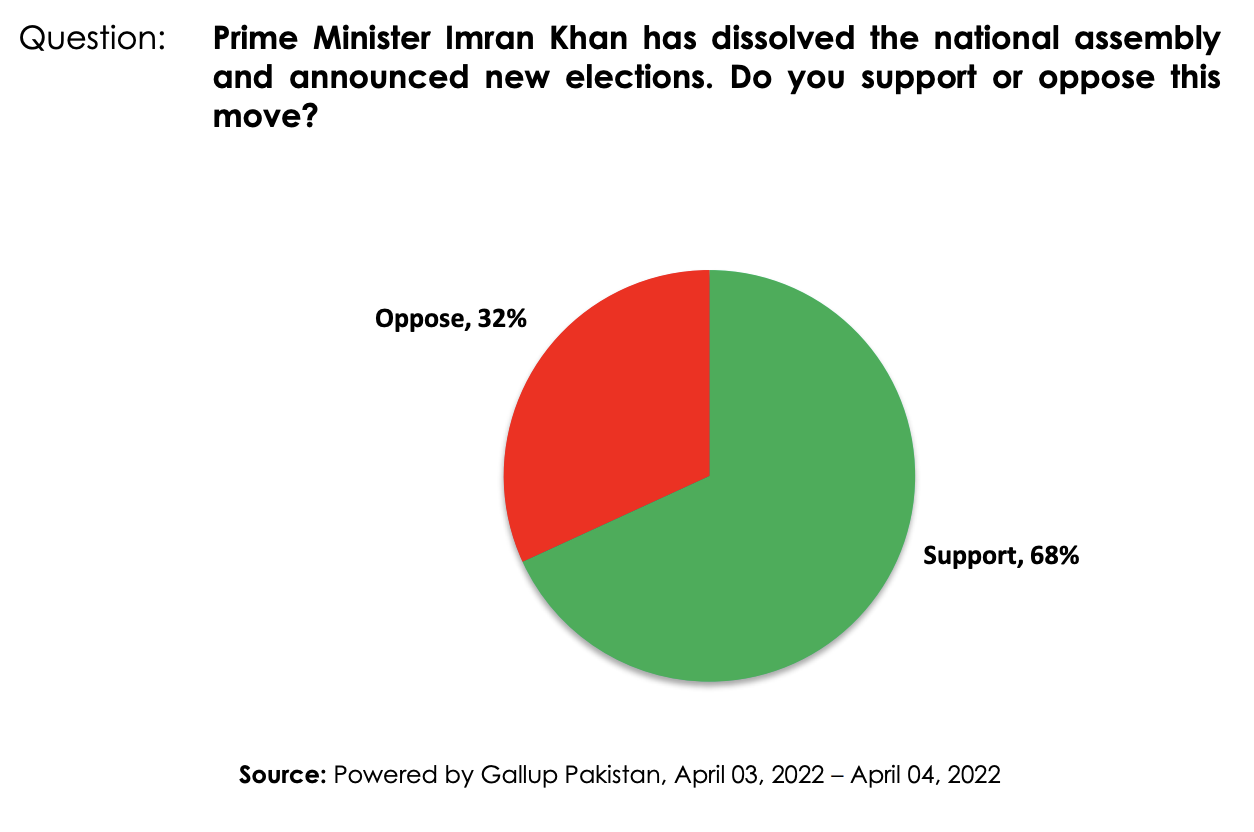
Gallup Pakistan Poll: Over Two-thirds Support Imran Khan's Decision to Dissolve National Assembly

A snap poll conducted by Gallup Pakistan on April 3 and 4 shows broad support for Prime Minister Imran Khan's decision to seek dissolution of the National Assembly and call fresh elections.  Support for the decision is nationwide with 66% in Punjab, 69% in Sindh and 78% in KPK province. It is the strongest among those identifying themselves as PTI voters with 95% of them approving the decision. Among the Opposition parties, 44% of PMLN voters and 50% of PPP voters agree with the decision.  

Source: Gallup Pakistan

Here are the key findings of the Gallup Pakistan Poll

1) Widespread support for dissolution of National Assembly in Pakistan

Respondents were asked ‘ PM has dissolved the national assembly and called for fresh elections. Do you Support or are you against this’ To this question a wide majority 68% say they support and 32% say they oppose PM Imran Khan’s move.

Source: Gallup Pakistan

2) Majority don’t believe in US Conspiracy to remove Imran Khan, although split exists along party lines.Significant majority 64% responded to this question and say that Imran Khan was being ousted because of inflation and not because of a foreign conspiracy.

3) Public Opinion split over performance of Imran Khan

Respondents were asked ‘ Imran Khan ruled for 3.5 years. Are you satisfied with the performance of their government or not satisfied?

To this question 54% said they are dissatisfied and 46% said they are satisfied’

4) Anti Americanism: Only 1 in 3 consider the US to be a friend

Respondents were asked: Some people think that America is a friend of Pakistan, and some people think it is an enemy. what is your opinion?

Almost 2 in 3 Pakistanis(72%) think US to be an enemy. Anti Americanism was highest among PTI Supporters (80% thought America was an enemy) and lowest among PML-N voters (65%) 

The poll included a random sample of 800 households (18+ males and females) interviewed by telephone on April 3 and 4, 2022. Provincial breakdown: 66% Punjab, 18% Sindh, 13% KPK and 4% Balochistan. Urban 34%, rural 64%. Margin of error: +-3-5%, 95% Confidence Level. 

Gallup Pakistan's note on Sample Size: The sample size used in this survey is quite adequate even in comparison to international standards. Gallup US Daily poll is 500 and the Gallup Poll Social Series is 1000, both having a track record of reliable predictability for the USA (a country nearly 100 million larger in population of Pakistan). According to Five Thirty-Eight, one of the most credible sources on polling in the US: "Surveying 2,000 voters substantially reduces error compared with surveying 400 of them, but surveying 10,000 voters will produce only marginal improvements in accuracy compared with the 2,000- person survey".

Related Links:


Tuesday, November 16, 2021

Hamtramck: First All-Muslim City Government Elected in US State of Michigan

Hamtramck, part of the greater Detroit area, has elected its first Muslim mayor and an all-Muslim city council this month. The newly elected council members will begin their term in January,2022, according to The Detroit Free Press.  The city's population is dominated by immigrants, including 19.7% Bangladeshi, 11% Pakistani, 10.9% Polish and 10% Arab. The rising Islamophobia in America has served as a wake-up call for all Muslim Americans to become more involved in political and civic affairs of the United States. They are now voting in large numbers and starting to win elections across the country. 


L to R: Nayeem Choudhury, Amanda Jaczkowski, Mohammad Hassan,  Mohammad Alsomiri, Khalil Refai and Adam Albarmaki


Nayeem Choudhury is the chairman of the Hamtramck city council while Amanda Jaczkowski, Mohammed Hassan, Mohammed Alsomiri, Khalil Refai and Adam Albarmaki  are city council members. Three of them are of Yemeni descent, two of Bangladeshi descent and one is white.


Foreign Born Americans' Origins. Source: Pew Research

Yemeni-American Amer Ghalib defeated current Hamtramck Mayor Karen Majewski by a huge margin.  Ghalib got 68.5% of the vote, while Majewski received 31.5%. 

 "It’s important to remember that although we all happen to be practicing Muslims, we are elected through the processes set forth by the United States, Michigan, Wayne County and Hamtramck," Amanda Jaczkowski, one of the three newly elected Muslims on the council, told the Detroit Free Press. "We will all take an oath ... to protect the Constitution of the United States, and that includes the concept of separation of church and state. I believe strongly in that separation, and although I will bring the Islamic values of honesty and integrity to the table, the policies that I promote and affirm will be what is best for all people of Hamtramck."

Muslim candidates have won seats in local elections in several US states this year. In New York, Bangladeshi American Shahana Hanif became the first Muslim woman on the City Council. Boston, where Muslims number fewer than 80,000, also got its first Muslim member of the City Council. Pakistani American Shama Haider, a former Tenafly councilwoman, become the first Muslim elected to the state Legislature. Another Pakistani American, Muhammad Umar, became the first Muslim elected to the Galloway Township in New Jersey.

In Boston, Cape Verde born Muslim-American Tania Fernandes Anderson won her city council seat by defeating Roy Owens, who had relied heavily on anti-Muslim rhetoric in his campaign. Elsewhere in Massachusetts, Etel Haxhiaj, an Albanian American, became the first Muslim elected to the Worcester City Council. In Pennsylvania,  Pakistani-American Taiba Sultana, won a seat on the Easton City Council. Azrin Awal, a Bangladeshi American immigrant, became the first Muslim elected to the Duluth City Council in Minnesota.  

L to R: Javed Ellahie, Yasmeen Haq, Riaz Haq and Sabina Zafar


There are several Muslims serving on city councils in Silicon Valley, including Javed Ellahie in Monte Sereno and Sabina Zafar in San Ramon. In a historic set of victories last year, six Muslim candidates won elections in Silicon Valley, including the first Muslim member of the Sunnyvale City Council. The new council member, Omar Din, is a 22-year old Pakistani American. Others include: Sam Hindi, Foster City City Council member and mayor; Aziz Akbari, Alameda County Water District board; Hosam Haggag, Santa Clara city clerk; Aliya Chisti, City College of San Francisco board member, and Maimona Afzal, Franklin-McKinley School District board member.   

Recently Elected Silicon Valley Muslim Americans 


Pew Research recently reported that anti-Muslim sentiments in the United States have doubled since 2001 from 25% to 50% of the respondents associating Muslims and Islam with violence. The rising Islamophobia has served as a wake-up call for Muslim Americans to become more involved in political and civic affairs of the United States. They are now voting in large numbers and starting to win elections across the country. 

Saturday, March 6, 2021

Asif Zardari: A Corrupt Master Manipulator?

The recent shock defeat of  Dr. Hafeez Shaikh, Prime Minister Imran Khan's nominee for the Senate, has former President Asif Ali Zardari's fingerprints on it. The former president and current co-chairman of the Pakistan Peoples Party orchestrated the buying of votes and arranged the hundreds of millions of rupees used for the purpose to ensure former Prime Minister Yusuf Raza Gilani's surprise victory in the recent Senate Elections. Zardari has been widely known to be "in his elements" when it comes to "money transactions". 

L to R: Khurshid Shah, Asif Ali Zaradri, Yusuf Raza Gilani


What Mr. Zardari pulled off is a reminder of what he did for Prime Minister Benazir Bhutto, his late wife who faced almost certain defeat in a no-confidence motion against her in November, 1989. In his recent book entitled "The Bhutto Dynasty", veteran British journalist Owen Bennet Jones offers several specific instances of how the Bhuttos used money for political gain. One such instance was when Benazir Bhutto's husband Asif Ali Zardari helped her defeat a no-confidence motion in 1989 that appeared to be all but certain to remove her from power. Here are the relevant excerpts of the book:

"Having seen politics close up when her father was in power, Benazir had long been aware that money played a part in Pakistani politics. But now it could not have been clearer: if one of her National Assembly members was being offered a bribe to switch to the opposition, she needed to be able to match it............As another of her political advisers later recalled, ‘Asif’s role became more prominent when she beat back the motion of no confidence. There was some wheeler dealing in that. Some buying of votes. The moment money transactions came into play, Asif was in his element.’ Asif Zardari has consistently denied any financial malpractice. During her second government, Benazir told an aide that you needed to have $200–300 million to go into an election so that you could fund your candidates and secure their loyalty. While many of her advisers gave her plenty of interesting suggestions about what to do, Zardari actually did things, proving himself to be a man she could rely on" 

Forms of Corruption and Impact. Source: Dr. Yuen Yuen Ang


Owen Bennet Jones has described in some detail how Zulfikar Ali Bhutto and his daughter Benazir Bhutto saw the role of money in Pakistani politics. Here's an excerpt of Benazir's candid admission that "kickbacks must be taken":

"In a surprisingly unguarded interview with the American Academy of Achievement in 2000 she (Benazir Bhutto) said, while denying personal involvement, that she wished she had done more to tackle corruption: ‘We all knew kickbacks must be taken . . . these things happen.’Politicians everywhere, she argued, made money. The difference was that while Western politicians did so after they left office, their counterparts in the developing world did not have that option".

Owen Bennet Jones has reported another instance in which Zulfikar Ali Bhutto gave away bundles of cash to a religious leader who was the last hold-out against the adoption of the 1973 constitution. Here is the excerpt:

"It was, by any standards, extraordinary that Zulfikar managed to push it through with no one in the National Assembly voting against it. Mubashir Hassan described how the final hold-out – a cleric – was persuaded to vote in favour with a payoff: ‘The amount was settled and Bhutto described the scene to me how when the fellow came to President’s House to collect the money, Bhutto threw a packet of notes on the floor and ordered him to pick it up. There the man was, moving over the carpet on all fours, picking a bundle from here and a bundle from there. Bhutto was mightily amused. By using all his political skills – bribery included – Zulfikar had made a significant contribution to Pakistan’s national story." 

Related Links:

Haq's Musings

South Asia Investor Review

Political Patronage in Pakistan

Zardari Corruption

Panama Papers

US Aid to Pakistan

1971 Debacle in East Pakistan

Is it 1971 Moment in Pakistan's History?

Mission RAW by RK Yadav: India in East Pakistan

Benazir Bhutto Gave Birth to Taliban

What if Musharraf Had Said No to US After 911?

Riaz Haq Youtube Channel

VPOS Youtube Channel

Tuesday, February 11, 2020

Who's Pete Buttigieg بو دجاج ? What Does He Stand For?

Thirty-eight year-old Mayor Pete Buttigieg (بو دجاج)  of a small Indiana town of South Bend has so far been the biggest surprise with his surge in Democratic Party primaries for the presidential nomination this year. His strong showing among the top two candidates in Iowa and New Hampshire has been as much of a shock to the pundits as the poor performance of former Vice President Joe Biden who is also seeking the nomination. Mayor Pete is now beginning to get more scrutiny by media pundits and commentators.

Mayor Pete's Last Name:

Mayor Pete Buttigieg, 38,  is Maltese-American. His last name literally means "father of chicken".  His parents came from Malta, a small Mediterranean island close to Sicily and North Africa.  His last name is in Maltese, a language strongly influenced by Arabic. It is attributed to settlers from Sicily where Siculo-Arabic was spoken after the island was conquered by the Fatimids from Egypt in the 9th century AD.

Buttigieg's Sexual Orientation:

Pete Buttigieg (بو دجاج) is the first openly gay leading candidate for the office of the President of the United States (POTUS). He has regularly introduced Chasten Glezman as his husband at his election rallies. Recent surveys show that two-thirds of Americans support gay marriage, an increase of more than 20 points since the turn of the century.

Mayor Pete's Corporate Background:

Pete Buttigieg is a graduate of Harvard and Oxford Universities. As a 20 year-old, he served as President of the Student Advisory Council at Harvard University’s esteemed Institute of Politics. He wrote twice-a-month columns in the Harvard Crimson.

After graduating, Pete Buttigieg worked for the elite management consulting firm McKinsey & Co. His work at McKinsey has been criticized by his opponents for helping corporate America move jobs overseas. Some have accused him of being corporations' favorite. He has received large contributions from the biggest US corporations.

Mayor Pete is Moderate:

As a millennial, Mayor Pete is the youngest candidate in a field dominated by senior citizens. He is openly gay, millennial and a veteran of the war in Afghanistan. Buttigieg served in Afghanistan for 7 months in 2014 as a lieutenant in US Navy Reserve. He speaks English, Norwegian, Spanish, French, Italian, Maltese, Arabic, and Dari.

He is close to the center of the Democratic Party when compared with his main rivals in the primary.
He opposes Medicare For All but supports universal health coverage. He favors granting citizenship to Dreamers, the people who were brought to the United States by their parents illegally when they were children.

Mayor Pete is for doubling federal minimum wage to $15 an hour. He wants to reverse 2017 corporate tax cuts and increase earned income tax credit (EITC).

Buttigieg's Israel Policy:

Unlike Bernie Sanders who wants to cut US aid to Israel, Buttigieg has said he would consider using it to “leverage” Israel to change its policies toward the Palestinians.

“I’m not going to commit now to all of the ways that that leverage can and should be used, but I will say that our policy goal will be to do what we do when a friend is moving in a way that you’re worried about, which is to put your arm around them and guide them somewhere better,” he said.

Summary:

Mayor Pete Buttigieg is the first openly gay presidential candidate in US history. He is also the youngest person to seek the nomination. His Maltese name Buttigieg  بو دجاج  is of Arabic origin. It means father of chicken.  He is a small town mayor from South Bend, Indiana, who has so far been the biggest surprise with his surge in Democratic Party primaries in Iowa and New Hampshire. He is considered a moderate in the Democratic field.  Even though he wants to reverse 2017 corporate tax cuts but some accuse him of being a corporate candidate and the recipient of large donations from the biggest US corporations. He supports increasing federal minimum wage to $15 an hour and favors universal health coverage. He also supports granting US citizenship to Dreamers, the people who were brought to the United States by their parents illegally when they were children.

Related Links:

Haq's Musings

South Asia Investor Review

Silicon Valley Indian-American Congressman Joins Pakistan Caucus

Muslim-Americans in San Francisco Bay Area

The Trump Phenomenon

Islamophobia in America

Silicon Valley Pakistani-Americans

Pakistani-American Leads Silicon Valley's Top Incubator

Silicon Valley Pakistanis Enabling 2nd Machine Revolution

Karachi-born Triple Oscar Winning Graphics Artist

Pakistani-American Ashar Aziz's Fire-eye Goes Public

Two Pakistani-American Silicon Valley Techs Among Top 5 VC Deals

Pakistani-American's Game-Changing Vision 

Minorities Are Majority in Silicon Valley 

Wednesday, February 6, 2019

US Prosecutors Scrutinizing Trump's Pakistani-American Donor

Imaad Zuberi, a Pakistani-American venture capitalist from California who gave $900,000 to President Trump’s inauguration committee in 2016, has been subpoenaed by federal prosecutors in New York's Southern District.

Imaad Zuberi and President Barack Obama
Zuberi's donation paid for a breakfast event, which featured Trump’s first National Security Adviser, Michael Flynn, among its 60 or so guests. It also included representatives from several countries around the world, according to media reports. Prosecutors suspect Zuberi funneled money from foreign donors which is a violation of the US Elections Laws, according to media reports.

Imaad Zuberi is vice chairman of private equity and venture capital firm Avenue Ventures. He has “closed over $15 billion in transactions” at the firm,  according to his Linked-in profile. His firm's clients include start-ups, major corporations and sovereign wealth funds.

Prior to donating to the Trump campaign, Zuberi is known to have also donated to Democratic Party candidates including former President Barack Obama and Secretary of State Hillary Clinton. In fact, Zuberi was a top fundraiser for President Obama’s 2012 reelection campaign and Hillary Clinton’s 2016 presidential campaign, according to data from Open Secrets.

He was born in 1970 in Albany, New York to a Pakistani father and an Indian mother.  He has an undergraduate  degree in business and finance from the University of Southern California and an MBA from Stanford University which he earned in 2006. He has kept up with the Pakistani community in Los Angeles, his home base, and as early as 2004 was raising money from them for John Kerry’s presidential campaign that year, to which he made his first contribution, a modest $1,000 donation, according to a story in Foreign Policy magazine.

Pakistani-American Billionaire Shahid Khan
Another high-profile Pakistani-American donor to Trump campaign is Jacksonville Jaguars' billionaire owner Shahid Khan who gave $1m in 2016.' Since Trump's election, Khan has criticized the president as one who has "shown leadership as the great divider".  Khan also spoke out Trump's travel ban on citizens of 7 Muslim countries.“You can’t confuse safety with religion or national origin,” Khan said. “That’s the point. But I have enough faith that things are going to eventually turn out well.”

There have been several Pakistani-American donors to US election campaigns in the news in recent years. Among them is Dr. Asad Qamar, a graduate of Lahore's King Edwards Medical College, who received $18.2 million in payments from US Medicare program in 2012, making him the second highest billing doctor in America. Dr. Qamar is a member of APPNA, Association of Physicians of Pakistani Descent in North America. He was a candidate for the presidency of APPNA in 2013.

Asad Qamar M.D.
Dr. Qamar, a Pakistani-American cardiologist, and his family have given at least $300,000 to politicians and political causes in the 2012 election cycle and in 2013, according to contribution disclosure records reported by Reuters. Dr. Asish Pal, a Florida-based Indian-American, is the second highest billing cardiologist in America. Dr. Pal was paid $4.5 million by Medicare.

Dr. Qamar has been subjected to lengthy reviews of his billing practices by US Department of Health and Human Services. He has complained to President Obama and other officials that the contractors conducting the reviews for the HHS were slow and unresponsive. Dr. Qamar told New York Times that his payments were high because his practice, which has 150 employees and a caseload of 23,000 patients, routinely handles complicated procedures like opening blocked arteries in the legs of older patients, which normally would be billed by a hospital.

Only Dr. Salomon Melgen, a Florida Ophthalmologist, billed Medicare for a larger amount than Dr. Qamar did in 2012. Dr. Melgen, too, is a major contributor to Democratic party. Dr. Melgen’s firm donated more than $700,000 to Majority PAC, a super PAC run by former aides to the Senate majority leader, Harry Reid, Democrat of Nevada. The super PAC then spent $600,000 to help re-elect Senator Robert Menendez, Democrat of New Jersey, who is a close friend of Dr. Melgen’s. Last year, Mr. Menendez himself became a target of investigation after the senator intervened on behalf of Dr. Melgen with federal officials and took flights on his private jet, according to The Times story.

Pakistani-American community is beginning to participate in the American political processes not only as donors but also as voters and candidates for public offices. In 2018 elections, Pakistani-American attorney Javed Ellahie was among 5 American Muslims elected to local office in the San Francisco Bay Area. It's a sign American voters are ready for diverse leadership despite troubling increases in hate crimes nationwide, according to the Council on American Islamic Relations. Across America, there are 55 American Muslim candidates who won election to public offices, 11 of them in California, according to CAIR. Two Muslim American women, Rashida Tlaib and Ilhan Omar, were elected to the United States Congress in 2018.

Related Links:

Haq's Musings

South Asia Investor Review

Muslim-Americans in San Francisco Bay Area

The Trump Phenomenon

Islamophobia in America

Silicon Valley Pakistani-Americans

Pakistani-American Leads Silicon Valley's Top Incubator

Silicon Valley Pakistanis Enabling 2nd Machine Revolution

Karachi-born Triple Oscar Winning Graphics Artist

Pakistani-American Ashar Aziz's Fire-eye Goes Public

Two Pakistani-American Silicon Valley Techs Among Top 5 VC Deals

Pakistani-American's Game-Changing Vision 

Minorities Are Majority in Silicon Valley 

Sunday, August 19, 2018

PTI Chief Imran Khan Inaugurated Pakistan's 22nd Prime Minister

Pakistan Tehreek e Insaaf (PTI) Chief Imran Khan became Pakistan's 22nd prime minister after his 22-year-long quest for the highest executive office in the land. What is the historic significance of this event for Pakistan's democracy? Has it finally ended the three-decade-long dynastic duopoly of the Pakistan Muslim League and the Pakistan People's Party which are controlled by Sharifs and Bhuttos? Will the emergence of the PTI as the 3rd political force likely reduce corruption and improve governance in Pakistan?

Is Imran Khan's nomination of Sardar Usman Buzdar as Punjab Chief Minister a mistake? Will Prime Minister Imran Khan make mistakes as he begins his tenure? Will his opponents jump at every opportunity to attack him when he makes mistakes? Should he be allowed to make mistakes as he learns on the job? Is he entitled to a honeymoon period?

 Do the Pakistani military and intelligence agencies call all the shots in Pakistan? Is the military's role in Pakistani electoral process highly exaggerated? Are there other forces including political parties and the voters which are as influential or even more influential in determining the outcome of elections? Does Imran Khan owe his victory to the alleged military support?

How is ISI different from other national intelligence agencies like CIA? Are Pakistani intelligence agencies unique in their influence on politicians and the political processes? Why does US President Trump think "Deep State" helped his opponents? Why did US Senator Charles Schumer warn Trump by telling MSNBC host Rachel Maddow: "they (intelligence agencies) have six ways from Sunday to get back at you"?

Viewpoint From Overseas host Misbah Azam discusses these questions with panelists Sabahat Ashraf and Riaz Haq (www.riazhaq.com)

https://youtu.be/X7smf1f4iN8


Related Links:

Sunday, July 15, 2018

Pakistan Elections 2018 Predictions; Nawaz Sharif's Future

What will be the impact of tragic terror attacks with mass casualties on Pakistan's July 25, 2018 general elections? How does the current situation compare with the situation in 2013 elections? Will the elections proceed as scheduled?

Pakistan Elections 2018 Forecast by  Intermarket and Exotix Investment Firms

Which party is likely to get the most votes and parliamentary seats in Pakistan's July 25, 2018 general elections? Will one party get a clear majority? Who will form the new government? Is PTI Chief Imran Khan likely to be the next prime minister of Pakistan? Will it be a coalition government? How can a weak coalition government implement a radical reform agenda proposed by Imran Khan?

Why did former prime minister of Pakistan Mr. Nawaz Sharif, convicted recently by a Pakistani court on charges of having assets beyond income, come back to Lahore to face certain arrest? What is his strategy? What is Nawaz Sharif's future in Pakistani politics after his conviction and arrest? How will PMLN fare in 2018 and future elections? Will the disgraced Sharif be able to rehabilitate himself and reclaim the mantle of national leadership? Will future judges of Pakistan Supreme Court set aide his conviction to clear the way for him to become Pakistan's prime minister for the fourth time?

Viewpoint From Overseas host Faraz Darvesh discusses these questions with panelists Misbah Azam and Riaz Haq (www.riazhaq.com)

https://youtu.be/4jcH3CMYc5w


Here's Urdu version streamed live on Facebook:

https://youtu.be/v9PQGN0Is50


Related Links:

Haq's Musings

South Asia Investor Review

Nawaz Sharif's Report Card 2013-18

CPEC Transforming Pakistan's Least Developed Regions

Pakistan: The Other 99% of the Pakistan Story

How Pakistan's Corrupt Elite Siphon Off Public Funds

Bumper Crops and Soaring Credit Drive Tractor Sales

Panama Leaks

How West Enables Corruption in Developing Countries

Declining Terror Toll in Pakistan

Riaz Haq's YouTube Channel

Saturday, June 23, 2018

Democracy in Pakistan: Headlines vs Trend-lines

With the country's parliament completing its second term since 2008, is Pakistan truly on the road to democracy? How do the headlines compare with the trend-lines? Are there any significant potholes in this road to democracy? Are the persistent negative headlines justified? Do oft-repeated dire forecasts about Pakistani state's survivability make sense?

Do Pakistani political party leaders practice democracy within their own parties? What accounts for attempts by the political party leaders and candidates to resist full financial and other disclosures? Why did they try to escape accountability by passing Election Act 2017?

Who are the "electables"? Why are political parties trying to recruit them to run as their candidates in the coming general elections scheduled for July 25, 2018? Can such "electables" bring about much needed reforms in the political parties? What are the downsides of putting up electables in terms of widening political participation and voter turnout?

Viewpoint From Overseas host Misbah Azam discusses these questions with Sabahat Ashraf and Riaz Haq (www.riazhaq.com)


https://youtu.be/Tx8hKH0Ae8U


Related Links:

Haq's Musings

South Asia Investor Review

Pakistan Elections Act 2017

US DoD 1999 Forecast: "Pakistan Disappears By 2015"

Democracy's Disappointing Report Card

Nawaz Sharif's Report Card 2013-18

CPEC Transforming Pakistan's Least Developed Regions

Pakistan: The Other 99% of the Pakistan Story

How Pakistan's Corrupt Elite Siphon Off Public Funds

Bumper Crops and Soaring Credit Drive Tractor Sales

Panama Leaks

How West Enables Corruption in Developing Countries

Declining Terror Toll in Pakistan

Riaz Haq's YouTube Channel

Friday, June 22, 2018

Pakistan's Rough Road to Democracy

Pakistan National Assembly has recently completed its 5-year term for the second time since 2008. A neutral interim government has assumed control to hold the general elections scheduled for July 25, 2018 to elect a new parliament. Media headlines about Pakistan are not good but the key trend-lines are definitely positive as the country continues its journey slowly but surely toward better democracy. While the party nomination processes for electoral candidates continue to be arbitrary, the protests erupting over party tickets are an indication of the rank and file members' yearning for internal democracy.  These complaints and protests will hopefully lead to internal reform in these parties and break the strangle-hold of their undemocratic, self-serving leaders and the "electables" who represent the status quo.

Who are the Electables?

Electioneering in Pakistan is rarely about debating issues and offering solutions; it's more about personalities, families and identities. Political parties and politicians are rarely judged based on their capabilities, ideas and performance. The focus is on recruiting "electable" candidates with a known vote bank of their ethnicity and "biradri" (clan).  

Pakistan's mainstream political parties continue to rely on the "electables" to win general elections. "Electables" are powerful, resourceful and wealthy, often land-owning individuals from certain families who have a greater chance of winning enough votes to get elected regardless of the party. Major political parties recruit them to run on their "tickets" as their nominees.  Winning more seats in the parliament helps parties form governments to gain control of the state's resources for the benefit of their leaders and their cronies. It is a good investment for the electables to be aligned with the party in power.

The preference for "electables" perpetuates the status quo and preserves the power of the privileged few. It denies the opportunity for new aspiring entrants to bring about any positive change.  It depresses new voter turnout and discourages wider participation in the political process.

Accountability and Transparency:

Pakistan Elections Act 2017 passed by the National Assembly removed the requirements for key disclosures relating to the ownership of assets, income taxes paid or owed, bank loan defaults, foreign residency (iqama) and  educational qualifications of the candidates for national and provincial legislatures in the upcoming elections. This came in October 2017 after several members of the national parliament were caught lying and subsequently disqualified by the courts under Articles 62 and 63 of Pakistan's constitution. Those disqualified include top politicians like former Prime Minister Nawaz Sharif of the PMLN party and PTI leader and parliamentarian Jahangir Tareen. 

The changes reducing disclosures were challenged in the courts and the Supreme Court ruled that all candidates have to file sworn financial declarations along with their nomination papers for the general elections in 2018. 

Headlines vs Trend-lines:

The worst 1% of the Pakistan story gets 99% of the media coverage, says Lahore-based Pakistani entrepreneur Monis Rahman. In the same vein, former US President Bill Clinton has said this about the media coverage of the continent of Africa: "Follow the trend lines, not the headlines".

As the Pakistani and the global mainstream media continue to headline Pakistan's multiple challenges and dire forecasts, the trend-lines in the country continue to be positive. 

Pakistan's difficult march toward better democracy is making steady progress. The country's National Assembly has recently completed its 5-year term for the second time since 2008. A neutral interim government has assumed control to hold the general elections scheduled for July 25 2018 to elect a new parliament.

Resilient people of Pakistan are overcoming multiple challenges stemming from the continuing war in Afghanistan and India's abiding hostility. Pakistanis are defying all the prophecies of doom and gloom and thriving against all odds. Pakistan's trillion dollar economy is among the top 25 largest in the world. Rising disposable incomes are reflected in Pakistan being the world's fastest growing retail market. The increasing share of income of the bottom 20% of households puts Pakistan among the less unequal countries in the world. Pakistan is indeed rising. 

Undemocratic Parties:

Major political parties in Pakistan are controlled by individuals and families at the helm. These individuals and families make all important decisions in an arbitrary manner.  The way these parties nominate their candidates for national and provincial assembly elections is symptomatic of the lack of democracy within these parties. 

In more developed democracies like the United States, the party candidates for elections are chosen by rank and file voters belonging to each party, not the party leaders. Hillary Clinton had to win the votes of the Democratic Party's registered voters to become her party candidate for the senate seat in New York and later to become a presidential candidate in general elections. Similarly George W. Bush in Year 2000 and his brother Jeb Bush in Year 2016 had to contest primary elections for their nomination as Republican candidates. George W. Bush succeeded in 2000 primaries and general elections while his brother Jeb failed to win the party nomination in 2016. 

Loud protests within Pakistan's political parties show lack of satisfaction of the rank and file members with the way the parties are being run by their leaders.  These complaints and protests will hopefully lead to reform within these parties and break the strangle-hold of the "electables" who represent the status quo. 

Summary: 

Pakistani parliament has recently completed its 5-year term for the second time since 2008. A caretaker government has assumed control to hold the general elections scheduled for July 25 2018 to elect a new parliament. Headlines are not always good but the key trend-lines are definitely positive as the country continues its journey slowly but surely toward a better democracy. While the party nomination processes for electoral candidates continue to be arbitrary, the protests erupting within parties are an indication of their rank and file members' yearning for democracy within the political parties.  These complaints and protests will hopefully lead to internal reform in these parties and break the strangle-hold of the self-serving leaders and "electables" who represent the status quo.

Here's a discussion on the subject of democracy in Pakistan:


https://youtu.be/Tx8hKH0Ae8U


Related Links:

Haq's Musings

South Asia Investor Review

Pakistan Elections Act 2017

US DoD 1999 Forecast: "Pakistan Disappears By 2015"

Democracy's Disappointing Report Card

Nawaz Sharif's Report Card 2013-18

CPEC Transforming Pakistan's Least Developed Regions

Pakistan: The Other 99% of the Pakistan Story

How Pakistan's Corrupt Elite Siphon Off Public Funds

Bumper Crops and Soaring Credit Drive Tractor Sales

Panama Leaks

How West Enables Corruption in Developing Countries

Declining Terror Toll in Pakistan

Riaz Haq's YouTube Channel

Sunday, June 3, 2018

Pakistan Among World's Top 10 Tax Losing Countries

Pakistan ranks among the top 10 countries in terms of tax revenue losses due to corporate tax avoidance, according to UN World Institute for Development Economics.  World Economic Forum estimates that the country lost $10.4 billion in taxes last year.


Top 10 Tax Losers:

The top 10 countries losing the most tax revenue in absolute terms as listed by the World Economic Forum are USA ($188.8 billion), China ($66.8 billion), Japan ($46.1 billion), India ($41.2 billion), Argentina ($21.4 billion), France ($19.8 billion), Germany ($15 billion), Pakistan ($10.4 billion), Indonesia ($6.5 billion) and the Philippines ($6.4 billion).


Pakistan and Argentina top this list of 10 in terms of tax revenue lost as percentage of GDP.  Both lose 3.5% of their GDP in corporate tax avoidance, according to World Economic Forum.

Tax Evasion at the Top:

Tax evasion in Pakistan starts at the top. A large number politicians, including ministers and party leaders in the nation's parliament, do not bother to file tax returns or pay taxes.

A study by the Center for Investigative Reporting in Pakistan (CIRP) identified 461 members in national and provincial assemblies who did not pay income taxes in 2015. This figure includes ministers and other prominent political leaders. Federal Board of Revenue found that many of the 550 lawmakers (54%) falsely claimed they paid taxes.

Elections Act 2017:

Whatever little accountability that exists is now being eroded by Elections Act 2017. 

The nomination forms of candidates for national and provincial assemblies in Pakistan have been redesigned this year to remove all questions on assets, income taxes paid or owed, bank loan defaults, foreign residency (iqama) and  educational qualifications.  This was done based on Pakistan Elections Act 2017 that became law on October 2, 2017 in the wake of several disqualifications from holding office or being a legislator. 

Many legislators from across the political spectrum have  been caught lying on their nomination forms filed in prior elections. Some have been disqualified for false financial declarations while others have been removed for lying about their foreign residency visas (iqama), dual nationality or education. 

Impact on National Development: 

Tax evasion in Pakistan exacerbates budget deficits and forces the government to borrow heavily. It also impacts critical spending on education, health and infrastructure. The result is slow economic growth and persistence of poor socioeconomic indicators. 

Summary:

Pakistan's tax revenue loss of $10.4 billion is ranked among the world's top 10 countries losing tax revenue. Losses of 3.5% of GDP in taxes put Pakistan at number 1 among these countries. Legislators, including government ministers, are among the most prominent tax evaders in the country. Elections Act 2017 limiting financial transparency makes it more difficult to hold the politicians accountable for tax evasion and other financial malfeasance. These developments don't augur well for development or democracy in the country. 

Here's World Economic Forum video on tax evasion:

https://youtu.be/Xe-GSM1k9Ag


Saturday, January 6, 2018

Trump's Troubles; Trump's Pakistan Tweet; 2018 Predictions

What are Pakistan's options after Trump's insulting tweet and US aid freeze? How much leverage does either side have over the other? How far will Trump go? How will Pakistan respond? Will Pakistan withhold all cooperation and cut off the crucial US Forces supply lines to Afghanistan through Pakistan? What do some of the analysts like Christine Fair, Ryan Crocker and Madiha Afzal are saying about it?

Courtesy Times of India

What does Michael Wolff say about Steve Bannon, Donald Trump and the Trump family in his book "Fire and Fury: Inside the Trump White House"? Are Jared Kushner and Donald Trump involved in "money laundering"? Was Don Jr's Tump Tower meeting with Russians "treasonous"? Is Ivanka Trump "dumb as a brick"? Will this lead to Special Counsel Robert Mueller indicting the Trump family on multiple charges relating to obstruction of justice and money laundering? Will President Trump be named as un-indicted co-conspirator in these indictments?

Chinese vs American Arms to Pakistan. Source: WSJ

What will happen in 2018? Will President Trump be named as an un-indicted co-conspirator by Robert Mueller in his obstruction of justice indictments of his close aides? Will Trump become even more erratic? Will Democrats take both houses of US legislature in 2018 elections? Will Trump be impeached? Will there be elections and new government in Pakistan? Who will be the winners and losers? Will there be a hung parliament and coalition government? Will India-Pakistan relations improve?

Viewpoint From Overseas host Faraz Darvesh discusses these questions with Misbah Azam and Riaz Haq (www.riazhaq.com)

https://youtu.be/djN-B4rw8Mk


Related Links:

Haq's Musings

Gen Petraeus Debunks Trump's Charge of "Lies and Deceit" Against Pakistan

Sec Robert Gates on Pakistan's "lies and deceit"

Is Trump Getting Advice on Pakistan Policy From Husain Haqqani?

Pakistan's Trump Card in Dealing With Trump

Trump's Russia Probe

Talk4Pak Youtube Channel

Riaz Haq's Youtube Channel