Monday, August 21, 2023

Pakistan's Political Crisis: Did Washington Cause "Regime Change" in Islamabad?

Did the U.S. make it clear to Pakistan in 2022 that Imran Khan was not acceptable as the prime minister of the South Asian country? Did the Pakistani military then use the Opposition parties led by Nawaz Sharif and Asif Ali Zardari to remove Imran Khan from power through a successful No-Confidence vote in the parliament? The answer to both of these questions appears to be a resounding "yes" based on the leaked contents of a secret diplomatic cable, the actions of the Opposition politicians and the attempts to dismantle the Pakistan Tehreek-e-Insaf (PTI) and the jailing of Imran Khan on trumped-up charges. These events have created significant political instability in the country and prompted former US National Security Advisor John Bolton to urge the Biden administration to take a clear position before the “terrorists, China and Russia take advantage” of the situation.

Former Prime Minister Imran Khan (L) and General Asim Munir

Diplomatic Cable:

A leaked diplomatic cable from Pakistani Ambassador Asad Majeed Khan quotes Donald Lu, Assistant Secretary of State for South Asia in the Biden Administration, as saying,  “I think if the no-confidence vote against the Prime Minister succeeds, all will be forgiven in Washington because the Russia visit is being looked at as a decision by the Prime Minister. Otherwise, I think it will be tough going ahead.”

In answer to a question at a recent press conference, the US State Department spokesman Mathew Miller has essentially confirmed the contents of the diplomatic cable. 

This appears to have been enough for the then Pakistan Army Chief General Bajwa to orchestrate the passage of the No-Confidence Motion against Prime Minister Imran Khan with the help of Nawaz Sharif, Asif Ali Zardari and other politicians who ganged up on Imran Khan. 

PTI Dismantled, Imran Khan Jailed:

The Pakistani military did not just content itself with removing Imran Khan from power. A campaign to dismantle Khan's political party, the largest party in the country that ruled the country and two of its four provinces, is in full swing. A Gallup poll in February this year reported that 61% of voters approved of Imran Khan. His support is the strongest among young people who make up the bulk of the population. 

The jailing of Imran Khan and mass arrests of his party members are sending a clear signal that Pakistan's most popular leader, based on recent polls, is no longer acceptable to the military. The US government has remained silent in the middle of this mass crackdown in Pakistan. Washington appears to be unconcerned about civil liberties and democracy in Pakistan. 

US Interests in South Asia:

Are the US interests in South Asia best served by destabilizing strategically-located nuclear-armed Pakistan? Polls indicate that Imran Khan remains the most popular politician in Pakistan. The removal of his government from power and the dismantling of his party are increasingly turning ordinary Pakistanis against the United States. 

In an interview with Voice of America (VOA) Urdu service this week, former National Security Advisor John Bolton said he “worries about” the Biden administration’s foreign policy about South Asia because “it’s not clearly defined”.  

Replying to another question asked by VOA, Mr Bolton said Biden administration officials “don’t know what their strategic imperatives are. And it’s been confused and inarticulate on the situation in Pakistan”.

Here's a video clip of US State Department Mathew Miller's Press Conference:

https://youtu.be/g6vvj2zveOQ


 Related Links:


Monday, August 14, 2023

Independence Day: Growing Share of Working Age Population in Pakistan

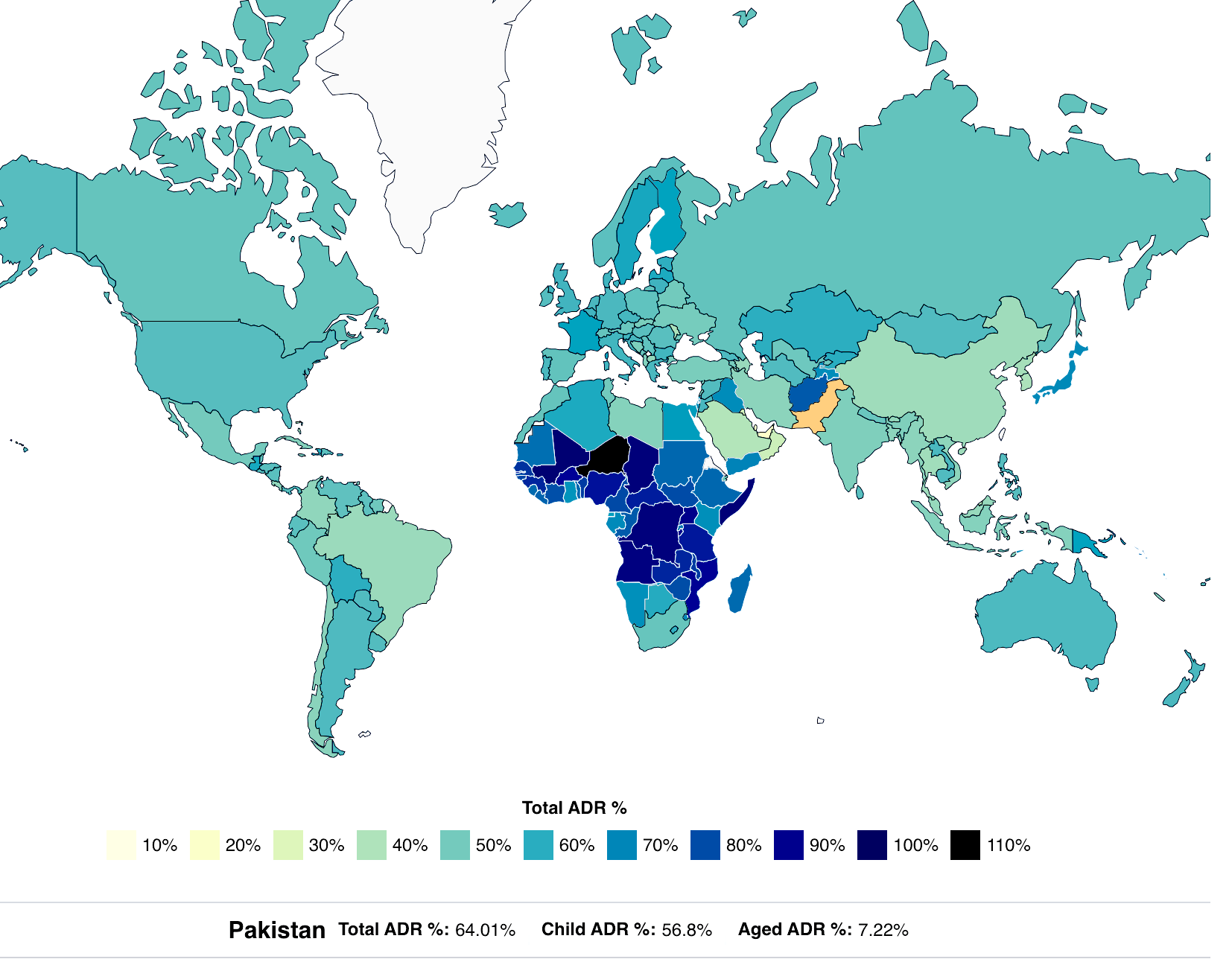
Dependency ratio, defined as the percentage of children and retirees to the working age population, is rapidly declining in Pakistan (current dependency ratio is 69.03%) and the rest of the developing nations of Asia and Africa. This demographic shift means that the world's richest and most powerful nations with the largest share of working populations will no longer be in Europe and North America by 2050. Among South Asian nations, Bangladesh has already joined the list of top 10 nations in terms of the largest share of the working age population. India and Pakistan are expected to join it by 2050. Increasingly better educated working age population is expected to significantly enhance their productivity and increase their incomes. 

Shift in Share of Working Age Populations. Source: NY Times

The total dependency ratio reported for Pakistan in 2022 is 69.03%, much higher than Bangladesh's 47.09% and India's 47.5%, according to the World Bank.  Dependency ratio for China is 44.96% but it is rapidly increasing.  China's share of the working age population will no longer be in the top 10 by 2050 due to its aging population, according to the UN projections. 
Declining Dependency Ratio in Pakistan. Source: Trading Economics/World Bank

Global Age Dependency Ratio Map. Source: World Population Review

New York Times' visual journalist Lauren Leatherby recently described this major demographic and economic shift in the following words: "The richest most powerful countries today have long had these really large working-age populations. And economists agree that that’s been a huge, huge advantage economically and geopolitically. And meanwhile, a lot of developing nations have had quite high dependency ratios having a high number of children compared to working-age people. And so, I think we know a lot of these storylines one by one, but putting it all together, it’s just like the world is going to shift really dramatically". 

Current Share of Working Age Populations. Source: NY Times

"And then I think what we see (rapidly aging population) in Japan today is only the tip of the iceberg. A lot of East Asia, China, Europe, South Korea will be much older than Japan is today, in just you know, 20 or 30 years. Some countries will have upwards of 40% of their population that are 65 or older in just two or three decades. And meanwhile, on the other end, you have a lot of these other countries that have long been, you know, hindered economically by their age structures. And suddenly a lot of them will start to enjoy the exact same age structures that Europe and East Asia, the U.S., that a lot of those countries have historically enjoyed", Leatherby added. 

Prijected Share of Working Age Populations in 2050. Source: NY Times


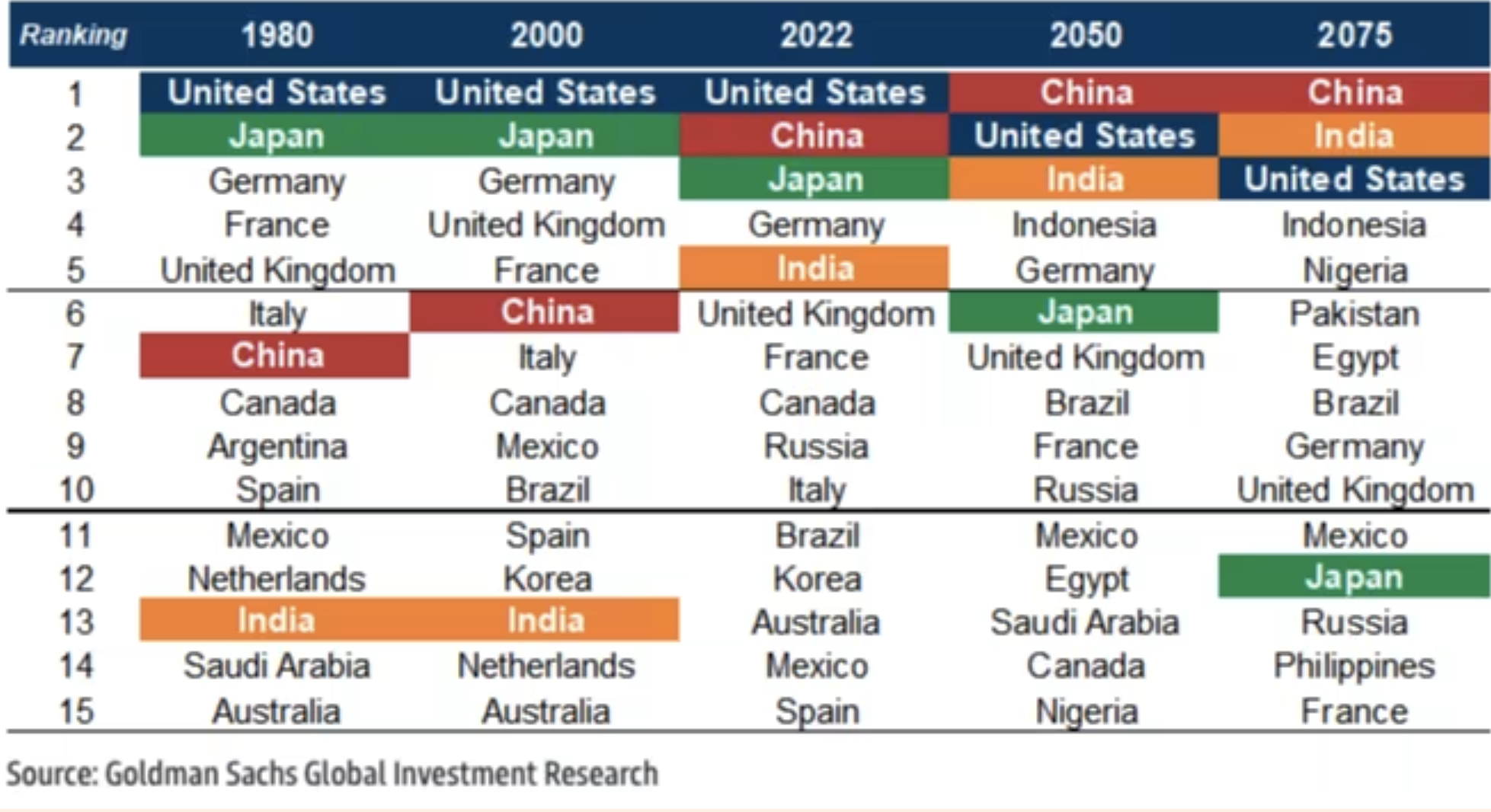
It is based on this demographic shift that Goldman Sachs analysts Kevin Daly and  Tadas Gedminas are projecting Pakistan's economy to grow to become the world's sixth largest by 2075.  In a research paper titled "The Path to 2075", the authors forecast Pakistan's GDP to rise to $12.7 trillion with per capita income of $27,100.  India’s GDP in 2075 is projected at $52.5 trillion and per capita GDP at $31,300.  Bangladesh is projected to be a $6.3 trillion economy with per capita income of $31,000.  By 2075, China will be the top global economy, followed by India 2nd, US 3rd, Indonesia 4th, Nigeria 5th and Pakistan 6th. The forecast is based primarily on changes in the size of working age populations over the next 50 years.  

GDP Ranking Changes Till 2075. Source: Goldman Sachs Investment Research 


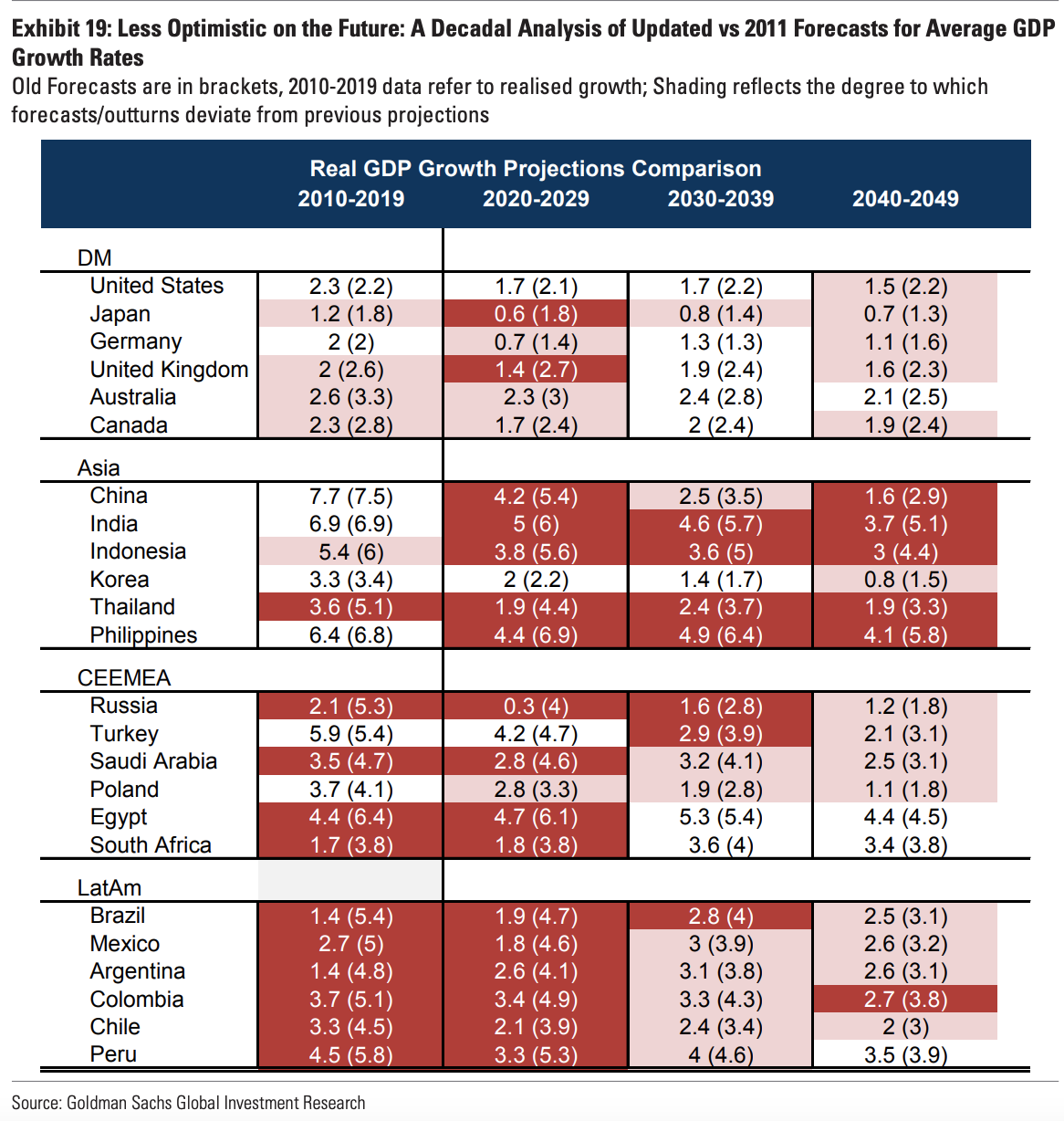
Economic Growth Rate Till 2075. Source: Goldman Sachs Investment Research 

Economic Impact of Slower Population Growth: 

Daly and Gedminas argue that slowing population growth in the developed world is causing their economic growth to decelerate. At the same time, the economies of the developing countries are driven by their rising populations.  Here are four key points made in the report:

 1) Slower global potential growth, led by weaker population growth. 

2) EM convergence remains intact, led by Asia’s powerhouses. Although real GDP growth has slowed in both developed and emerging economies, in relative terms EM growth continues to outstrip DM growth.

3) A decade of US exceptionalism that is unlikely to be repeated. 

4) Less global inequality, more local inequality. 

Goldman Sachs' Revised GDP Projections. Source: The Path to 2075

Demographic Dividend: 

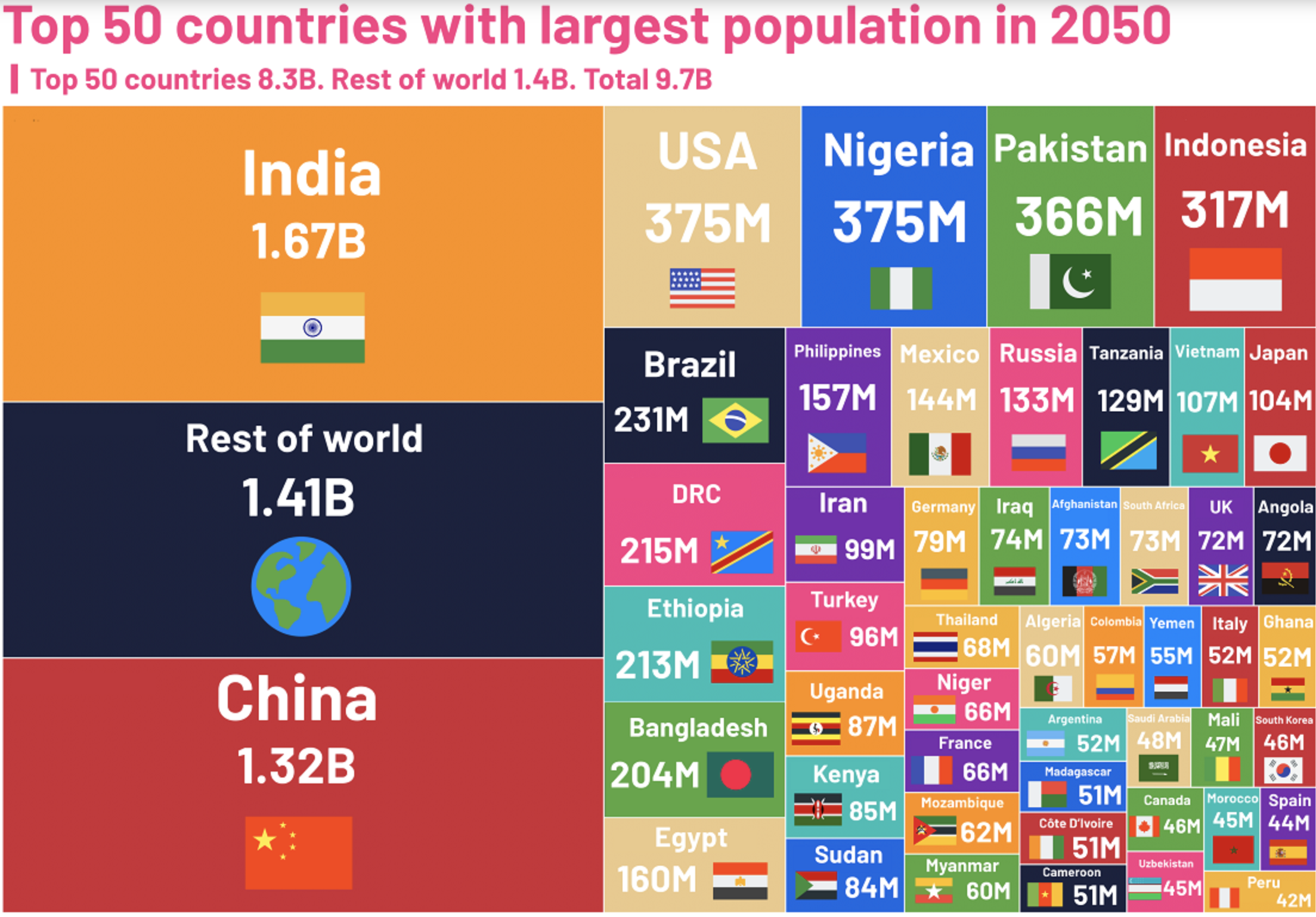
With rapidly aging populations and declining number of working age people in North America, Europe and East Asia, the demand for workers will increasingly be met by major labor exporting nations like Bangladesh, China, India, Mexico, Pakistan, Russia and Vietnam. Among these nations, Pakistan is the only major labor exporting country where the working age population is still rising faster than the birth rate. 

Pakistan Population Youngest Among Major Asian Nations. Source: Nikkei Asia

World Population 2022. Source: Visual Capitalist

World Population 2050. Source: Visual Capitalist

Over a million Pakistani university students are currently enrolled in STEM courses. Over 10 million Pakistanis are currently working/living overseas, according to the Bureau of Emigration. Before the COVID19 pandemic hit in 2020,  more than 600,000 Pakistanis left the country to work overseas in 2019. Nearly 700,000 Pakistanis have already migrated in this calendar year as of October, 2022. The average yearly outflow of Pakistani workers to OECD countries (mainly UK and US) and the Middle East was over half a million in the last decade. 

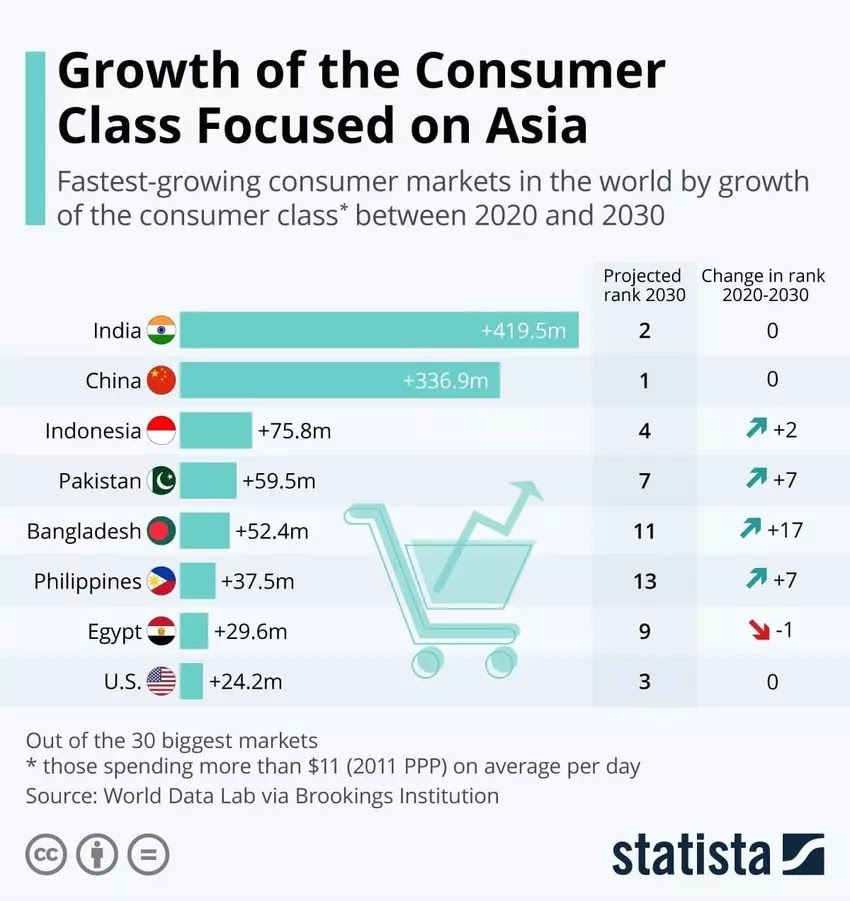
Consumer Markets in 2030. Source: WEF


World's 7th Largest Consumer Market:

Pakistan's share of the working age population (15-64 years) is growing as the country's birth rate declines, a phenomenon called demographic dividend. With its rising population of this working age group, Pakistan is projected by the World Economic Forum to become the world's 7th largest consumer market by 2030. Nearly 60 million Pakistanis will join the consumer class (consumers spending more than $11 per day) to raise the country's consumer market rank from 15 to 7  by 2030. WEF forecasts the world's top 10 consumer markets of 2030 to be as follows: China, India, the United States, Indonesia, Russia, Brazil, Pakistan, Japan, Egypt and Mexico.  Global investors chasing bigger returns will almost certainly shift more of their attention and money to the biggest movers among the top 10 consumer markets, including Pakistan.  Already, the year 2021 has been a banner year for investments in Pakistani technology startups

Record Remittances From Overseas Pakistanis:

Pakistan is already seeing high levels of labor export and record remittances of over $30 billion pouring into the country. Saudi Arabia and the United Arab Emirates(UAE) are the top two sources of remittances but the biggest increase (58%) in remittances is seen this year from Pakistanis in the next two sources: the United Kingdom and the United States.

Remittances from the European Union (EU) to Pakistan soared 49.7% in FY 21 and 28.3% in FY22, according to the State Bank of Pakistan. With $2.5 billion remittances in the first 9 months (July-March) of the current fiscal year, the EU ($2.5 billion) has now surpassed North America ($2.2 billion) to become the third largest source of inflows to Pakistan after the Middle East and the United Kingdom. Remittances from the US have grown 21%, second fastest after the EU (28.3%) in the first 9  months of the current fiscal year. 

Pakistan ranks 6th among the top worker remittance recipient countries in the world.  India and China rank first and second, followed by Mexico 3rd, the Philippines 4th, Egypt 5th and Pakistan 6th.  

Pakistan Demographics

About two million Pakistanis are entering the workforce every year. The share of the working age population in Pakistan is increasing while the birth rate is declining. This phenomenon, known as demographic dividend, is coinciding with declines in working age populations in developed countries. It is creating an opportunity for over half a million Pakistani workers to migrate and work overseas, and send home record remittances. 


Tuesday, August 8, 2023

USDA Forecasts Bumper Harvest of Major Crops in Pakistan For 2023/24

The United States Department of Agriculture (USDA) is forecasting bumper harvest of all major crops in Pakistan for 2023/24. Major crops in the country include wheat, rice, sugarcane, corn and cotton. These offer welcome relief for Pakistani farmers who suffered devastating losses in the epic floods of 2022.   

Major Crops Produced in Pakistan. Source: USDA

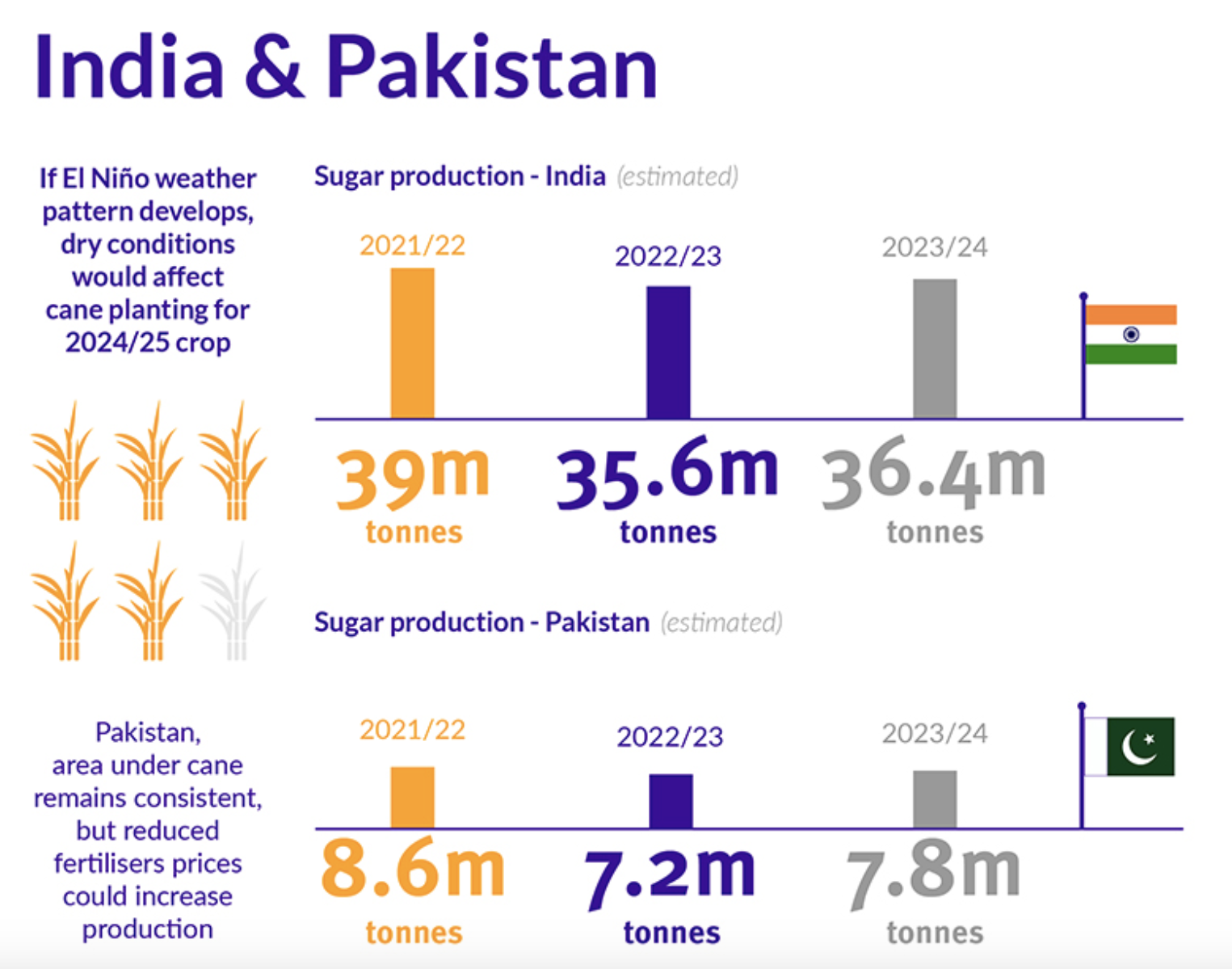
Pakistan is projected to produce 28 million tons of wheat,  10.5 million tons of corn (maize), 9 million tons of rice, 6.5 million bales of cotton, 7.8 million tons of sugar and 540,000 tons of rapeseed (canola) in 2023/24. Each of these production figures is significantly higher than last year's, and higher than the last 5-year average (2018-22) for the country. Potato production jumped 50% to 7.74 million tons in 2022, according to PotatoBusiness.  

Sugar Production in India and Pakistan. Source: Ragus


Pakistan will still need to import wheat but a lower amount than last year, according to a Global Agricultural Information Network report from the Foreign Agricultural Service (FAS) of the US Department of Agriculture. The record harvest will help lower the country’s forecasted import needs from 3 million to 2 million tons in 2023-24 even as total consumption grows to 30.2 million tonnes from 29.2 million tons. Pakistan imported 2.6 million tons last marketing year.

Higher cotton production in Pakistan will result in 2.3 million tons of cottonseed oil in 2023/24, a 34% increase over the 2022/23 output. This increase reflects expectations for a recovery in yield following the flood-damaged 2022/23 output. This will help reduce cooking oil imports, the country's largest food import, this year. Last year, Pakistan imported $4.5 billion worth of edible oil

Pakistan expects to export 5 million tons of rice worth $3 billion this year. India's ban on non-basmati rice exports will likely help Pakistani exporters fetch higher prices on the world market. 

Global Rice Market 2023. Source: Reuters


Pakistan's agriculture output is the 10th largest in the world. The country produces large and growing quantities of cereals, meat, milk, fruits and vegetables. Currently, Pakistan produces over 40 million tons of cereals (mainly wheat, rice and corn), 17 million tons of fruits and vegetables, 70 million tons of sugarcane, 60 million tons of milk and 4.5 million tons of meat.  Total value of the nation's agricultural output exceeds $50 billion. Improving agriculture inputs and modernizing value chains can help the farm sector become much more productive to serve both domestic and export markets.  

Related Links:


Haq's Musings

South Asia Investor Review

Chicken Cheaper Than Daal

Meat Industry in Pakistan

Pakistan Among World's Largest Food Producers

Meat and Dairy Revolution in Pakistan

Pakistan Floods of 2022

Eid ul Azha: Multi-Billion Dollar Urban-to-Rural Transfer

Pakistan's Rural Economy

Pakistan Leads South Asia in Agriculture Value Addition

Median Incomes in India and Pakistan

Friday, August 4, 2023

OpenAI ChatGPT: Generative AI Buzz in Pakistan

A Singapore-based cybersecurity firm Group-IB discovered in June that over 100,000 ChatGPT user accounts were compromised and their credentials found on the Dark Web. Among the accounts reported compromised, India topped with 12,632, followed by Pakistan with 9,217 and Brazil with 6,531. Bangladesh witnessed the fewest instances with 2,463. This report gave a glimpse of the high interest level of Indians and Pakistanis in generative AI.  Another report attributed to Similarweb, which tracks popularity of websites by number of visitors, ranked ChatGPT in Pakistan at number 7, ahead of Instagram, Twitter and TikTok. Globally ChatGPT website is ranked 17th. Prior to this, there was a series of news reports about the launch of Presidential Initiative for Artificial Intelligence and Computing (PIAIC) by President Arif Alvi, and then came the government's policy to train one million AI experts in the country by 2027. Pakistanis published 2,600 AI-related research papers from 2016 to 2020, according to Statista

Top 10 Countries by Number of ChatGPT Accounts Compromised. Source: Group IB


Back in 2017, then Prime Minister Shahid Khaqan Abbasi inaugurated a National Centre for Artificial Intelligence (NCAI) at the National University of Sciences & Technology (NUST) in Islamabad. It was followed by a Rs 1.1 billion budgetary allocation for select universities with AI research to be coordinated by NCAI. In 2020, Pakistan Air Force (PAF) set up a Center of Artificial Intelligence and Computing (CENTAIC). 

While OpenAI is the first to offer a Generative AI model trained on vast amounts of data, Google has also joined the generative AI race with its own offering. Google BARD appears to have capabilities similar to OpenAI's ChatGPT. Very little is known about the specific datasets used for training either of them, raising some trust issues about the results produced by them. 

Training/Using Generative AI Foundation Models. Source: Analytics Vidhya

Top global cloud operators Amazon, Google and Microsoft are now offering generative AI services to their clients for an additional fee. Cloud apps developers in Pakistan and elsewhere can train these base  models on their custom datasets to develop AI applications for agriculture, business, education, finance, healthcare, law etc. The AI market in Pakistan is currently estimated at $123 million by Statista Market Insights

Amazon Web Services (AWS) recently featured four Pakistani startups at the forefront of AI/ML: SalesFlo, Ozoned Digital, XpertFlow and Trukkr.  SalesFlo offers sales software for FMCG (fast moving consumer goods) companies.  Ozoned Digital caters to the technology needs of the insurance industry.  XpertFlow is an AI-powered preventative healthcare company.  Trukkr provides financial services and technology for logistics.  These and other startups are well positioned to take advantage of the new generative AI services being offered by cloud vendors. 

Related Links:


Wednesday, July 26, 2023

Greece Boat Tragedy: Are Pakistani Migrants Fleeing Hunger and Poverty?

The extensive news coverage of the loss of Pakistani migrants' lives in the recent Greece boat tragedy has linked it to "hunger" in Pakistan. The essence of these news stories is captured by a quote in a CNN headline: "We'll die of hunger anyway". It is attributed to a young man from the Pakistani town of Gujarat who is unfortunately believed to have drowned in the Mediterranean on his way to Greece.  These stories beg the following questions: Is it really true that Pakistani migrants are fleeing hunger and poverty? How can people suffering from hunger afford to pay thousands of dollars to human smugglers to leave for greener pastures?  

Pakistan Per Capita GDP. Source: World BankPakistan's GDP per capita is about $1,600

The above questions are answered by two recent studies released by the Center for Global Development as follows:  As GDP per capita rises, so do emigration rates. Emigration is seen as an investment as migrants are better-educated and richer than others. A similar 2010 study by the African Development Bank on emigration found that the share of migrants from sub-Saharan Africa remains low despite high levels of hunger and poverty in the region.  Pakistan's rates of emigration have been rising along with  GDP per capita growth over the last decade. It is currently about $1600 per person, according to the World Bank.  Pakistan's latest economic survey  reported that the per capita income in US dollar terms fell to $1,568 in FY23 from $1,766 in the previous year and $1,677 in FY21.


Outward Migration of Pakistani Workers. Source: Pakistan Bureau of Emigration


Two studies based on research by Michael Clemens and Mariapia Mendola released by the Center for Global Development (CGD) report that those who migrate are not among the world’s poorest. To the contrary, they find that migration is seen as an investment as migrants who are better-educated and richer than others. Here are the key points about migration as reported by the studies: 

1. As GDP per capita rises, so do emigration rates. This relationship slows after roughly US$5,000, and reverses after roughly $10,000 (i.e. low- to middle-income, or the level of China or Mexico).  Pakistan's current GDP per capita is about $1,600.  Pakistan's latest economic survey  reported that the per capita income in US dollar terms fell to $1,568 in FY23 from $1,766 in the previous year and $1,677 in FY21

.2. Successful, sustained economic growth in the low-income countries is therefore likely to raise the emigration rate, at least in the short-term. As incomes rise, so too does people’s ability to afford the investments that make migration easier.

3. These new migrants will not be among their countries poorest: in low-income countries, people actively preparing to emigrate have 30 percent higher incomes than the population on average, and 14 percent of these higher incomes come from more years of education.

“The world’s poorest are not the ones who migrate,” said co-author Mariapia Mendola, professor of economics the Università degli Studi di Milano Bicocca and Director of the Poverty and Development Program at Centro Studi Luca d’Agliano in Milan, according to the CGD.  “Migration is seen as an investment, just like higher education. You wouldn’t decide not to send your kids to college just because your family is getting wealthier. Similarly, families are not deciding to stay put as their incomes rise. Migration changes lives and economies for the better.”

“This pattern is not new, or something to fear,” Michael Clemens, director of Migration, Displacement, and Humanitarian Policy and senior fellow at CGD, says. “As a poor country gets richer, at first more people emigrate, until the process eventually slows and reverses itself. We’ve seen it with Sweden a century ago and Mexico a half century ago. We’re seeing it now in Central America, and we’ll hopefully see the pattern emerge in sub-Saharan Africa as that region gets richer.”

A similar 2010 study by the African Development Bank on emigration found that the share of emigration from sub-Saharan Africa remains low despite high levels of poverty. Here's an excerpt of it: 

"Results show that despite an increase in the absolute number of migrants, Africa, particularly SubSaharan Africa, has one of the lowest rate of emigration in the world .... Poorer countries generally have lower rates of emigration ......Bad socio-economic conditions generally seem to lead to higher rate of emigration by highly skilled individuals. Generally, migration is driven by motives to improve livelihoods with notable evidence of changes in labor market status."

Related Links:

Haq's Musings

South Asia Investor Review

Pakistan is the 7th Largest Source of Migrants in OECD Nations

Pakistani-Americans: Young, Well-educated and Prosperous

Pakistan is the Second Largest Source of Foreign Doctors in US & UK

Pakistan Remittance Soar 30X Since Year 2000

Pakistan's Growing Human Capital

Two Million Pakistanis Entering Job Market Every Year

Pakistan Projected to Be 7th Largest Consumer Market By 2030

Over 800,000 Pakistani Workers Migrated Overseas in 2022

Do South Asian Slums Offer Hope?


Saturday, July 22, 2023

Pakistani Students Account For Largest Share of Increase in Interest in Europe

Interest in studying in Europe  is growing in certain key markets like Pakistan and Bangladesh in particular, according to a recent report on foreign students coming to Europe. Although India generates the largest share of relative demand, this fluctuates drastically and has gradually declined overall in recent years, the report adds.  

Interest in Bachelor's Programs. Source: StudyPortals.com


The chart above shows the top origin countries for interest in Bachelor’s programs in Europe, as well as the evolution of that interest over the last four years. 

Interest in Bachelor's Programs. Source: StudyPortals.com


Bangladesh and Pakistan also show strong demand in Master’s programs, alongside students in Turkey and Iran. The report reveals widening European interest and shift towards STEM

Among 2,835 students from 143 countries selected for the Erasmus Mundus Joint Masters program, Pakistani students rank at the top with 192 scholarships, followed by India 174, Bangladesh 140, Mexico 118, and Nigeria 109, according to an EU tweet. Currently, there are 7.114 Pakistani students studying in Germany. 

The United Kingdom emerged as the top destination for Pakistani students with 28,188 student visas granted in 2022,  up 95% from the previous year. The UK has now surpassed China has the biggest draw for Pakistani students after the COVID19 pandemic.  Of the 486,868 UK student visas granted (to both main applicants and their dependents), 117,965 went to Indian nationals. This is an increase of 80,569 (+215%) compared to 2019, and slightly more than the 115,056 granted to Chinese nationals — but Pakistani nationals saw a bigger increase in approvals for their UK student visas at 377% compared to India’s 215%, according to Study International

Foreign Students in the US. Source: Open Doors


The US also reported a 17.4% increase in the number of Pakistani students studying in the United States during 2021-22. This brought their number to 8,772, according to Open Doors. The Open Doors Report identified China and India as the largest sources of international students to the United States. During 2021-22, China sent 290,086 students, which is 30.6% of the total number of international students in the US, a decline of 8.6% from the previous year. India, which sent 199,183 students this year — 21% of the total — saw a 19% year-over-year increase. Toge­ther, China and India make up more than half of all international students in the United States.

The number of Pakistani students studying in Australia has also increased 21% to 20,935 in 2022.  The number of first-time enrollments of Pakistanis jumped 71% in the year, according to ICEF Monitor

Offsetting a decline in Chinese enrollments in Australia (177,470 in 2022, down 11% y-o-y) and zero momentum from India (128,980, up .03%) were notable enrollment increases from:

Thailand, the 6th largest market, up 61% to 25,792

Nepal, the 3rd largest market, up 21% to 71,805

Colombia, the 4th largest market, up 21% to 28,435

Pakistan, the 9th largest market, up 21% to 20,935

Related Links:


Pakistani Students Biggest Winners of EU Scholarships Among 143 Countries

Pakistan Broadband Subscriptions Pass 100 Million

NED University Ranked Among World's Top 200 For Impact

Over a Million Pakistan University Students Enrolled in STEM Programs

Pakistan Gig Economy Among World's Fastest Growing

NED Alum Sells Silicon Valley Company For $7.5 Billion

Pakistani Student Team Among Top 3 Winners Invited to CERN

Over a Million Pakistani University Students Enrolled in STEM Education

State Bank Targets Fully Digital Economy in Pakistan

NED University Alum Raises $100 Million For His Silicon Valley Fintech Startup

Digital Pakistan: Broadband Penetration Reaches 90% of 15+ Population

Pakistan's Large and Growing Civil Nuclear Program

2021: A Banner Year For Pakistani Tech Startups

NED Alum's AI Startup Startup Named Most Innovative at RSA Conference

Karachi-Born NED Alum Leads Mercedes' Entry into Electric Vehicle Market

AI Research Funded by NED Alum at His Alma Mater

Riaz Haq's Youtube Channel


Saturday, July 15, 2023

Is the West Unwittingly Helping Modi Realize His Akhand Bharat Hindutva Dream?

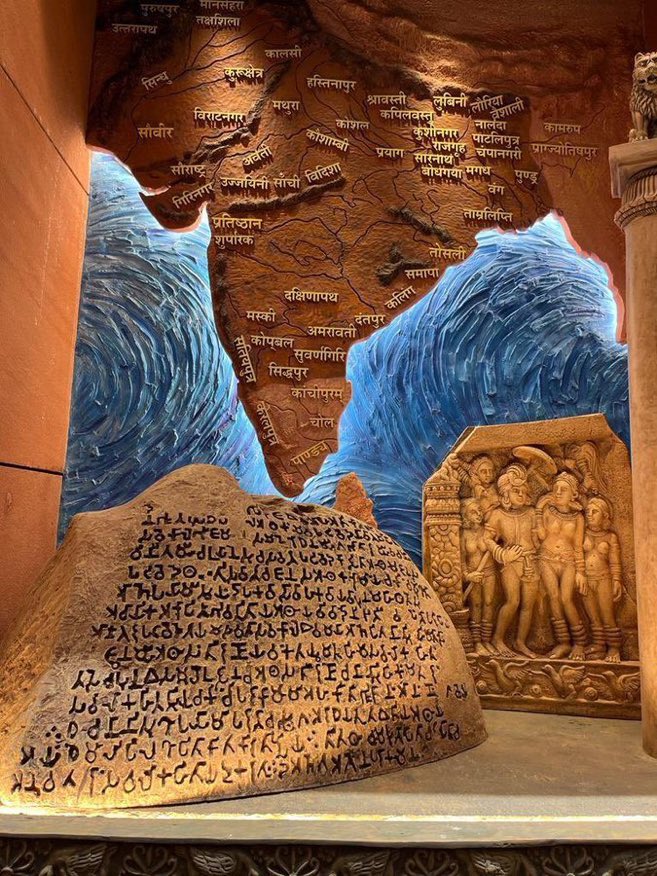
Indian Prime Minister Narendra Modi has recently opened a new parliament building in New Delhi. Prominently displayed in this new building is a provocative map of "Akhand Bharat" (Greater India) that includes neighboring nations of Nepal, Bhutan, Pakistan, Bangladesh and Sri Lanka as part of India. After the inauguration, Modi's parliamentary affairs minister Pralhad Joshi  tweeted a picture of the mural and wrote: “The resolve is clear – Akhand Bharat.”  Akhand Bharat is part of the Fascist Hindutva ideology of Modi's party.  In the last two months since this chauvinistic display, the tight embrace and arming of Modi by the West is raising fears of destabilizing South Asia. Pakistani officials have recently talked about a revision of the country's "full-spectrum" nuclear doctrine with the addition of "zero-range" nuclear weapons as a deterrent against western-armed Hindutva-fueled Indian aggression.

Akhand Bharat Mural in Indian Parliament. Source: Pralhad Joshi


Akhand Bharat: 

Earlier this year, Prime Minister Modi's ideological leader chief Mohan Bhagwat,  the head of the right-wing Hindu organization Rashtriya Swayamsevak Sangh (RSS), said ‘Akhand Bharat’ was the undisputed truth and a divided Bharat was a nightmare. 

Now the Akhand Bharat mural and its justification by an Indian minister have drawn condemnation from Bangladesh, Nepal and Pakistan. “The gratuitous assertion of ‘Akhand Bharat’ is a manifestation of a revisionist and expansionist mindset that seeks to subjugate the identity and culture of not only India’s neighboring countries but also its own religious minorities,” said Pakistani foreign office spokesperson Mumtaz Zahra Baloch.

Western Arms Deals:

Large arms deals have been recently announced during Prime Minister Modi's recent visits to Washington and Paris. New weapons acquisitions range from modern fighter jets to submarines. India is already the world's largest arms importer. India's defense budget ($81 billion) is the fourth largest in the world, according to Stockholm-based think tank SIPRI. Coming soon after the unveiling of  the Akhand Bharat mural,  these new modern lethal weapons' purchases by New Delhi are seen as a serious threat by India's neighbors. 

America's Bad Bet:

While the western nations are seeking an alliance with India to counter rising China, the Hindutva leadership of India has no intention of confronting China. In a piece titled “America’s Bad Bet on India”,  Indian-American analyst Ashley Tellis noted that the Biden administration had “overlooked India’s democratic erosion and its unhelpful foreign policy choices” in the hopes that the US can “solicit” New Delhi’s “contributions toward coalition defense”.

Earlier this year, India's External Affairs Minister S Jaishankar confirmed New Delhi's unwillingness to confront China in an interview: “Look they (China) are a bigger economy. What am I going to do? As a smaller economy, I am going to pick up a fight with bigger economy? It is not a question of being a reactionary; it is a question of common sense.”

Modi's India is driven much more by a desire to bring back what the right-wing Hindus see as the "glory days" of India through "Hindu Raj" of the entire South Asia region, including Pakistan. The arms and technology being given to Modi will more likely be used against India's smaller neighbors, not against China. 

Pakistan's Likely Response:

General Khalid Kidwai, Advisor to Pakistan’s National Command Authority and pioneer Director General of Pakistan’s Strategic Plans Division, has warned about the  ‘toxic mix of poisonous ideology’ posing a serious threat to strategic stability in South Asia. “I have no hesitation in stating that minimum Pakistani counter measures would be put in place if a reckless imbalance is induced in South Asia, it is not a warning, it's a contingency foreseen,” General Kidwai added, according to Pakistani media reports. 

In May this year, retired Lt. Gen. Khalid Kidwai provided new details of Pakistan’s nuclear doctrine. He has talked about "zero range" nuclear weapons. Prior to this, the officially acknowledged lowest range in Pakistan’s nuclear inventory was the Nasr, or Hatf-9 ballistic missile, with a range of 60 kilometers (about 37 miles).  Kidwai described two dimensions of Pakistan's Full Spectrum Deterrence: “horizontal,” which comprises of a robust land, air and sea inventory of a variety of nuclear weapons, and “vertical,” which encapsulates adequate range coverage of its vectors from “zero meters to 2,750 kilometers”with “destructive yields suited for strategic, operational, and tactical levels.” Such an elaborate arsenal, he argued, provides Pakistan with a “strategic shield”, blunting the extant conventional asymmetry with India. Most significant was his statement that “vertically the spectrum encapsulates adequate range coverage from 0 meters to 2,750 kilometers [about 1,700 miles] as well as nuclear weapons destructive yields at three tiers—strategic, operational, and tactical.”  Talking about "zero range" weapons, analyst Sitara Noor  explained it as follows in a recent article that appeared in Foreign Policy magazine:  

"Talk of zero-range weapons suggests that Pakistan is either going to develop artillery shells as the United States, Soviet Union, and United Kingdom did during the Cold War—raising questions of whether it is going to be an M28/M29 Davy Crockett-style recoilless rifle system, the smallest weapon in the U.S. nuclear arsenal, developed during the 1950s as a front-line weapon with yields as low as a fraction of a kiloton—or it could be a hint that Pakistan could possibly lay nuclear land mines across the India-Pakistan border to deter Indian advances. Observers, especially in India, are left wondering whether this statement is based on some existing scientific research and design testing and necessary doctrinal thought process. Kidwai’s statement does not provide any such details, and in the spirit of ambiguity that Pakistan seems to have benefited from, there is unlikely to be a follow-up soon to clear the air". 


Summary:

The West is making a "bad bet" on Modi's India as a check against rising China. Modi and his fellow right-wing Hindus have no interest in confronting China. They are much more obsessed in realizing their Hindutva dream of Akhand Bharat (Greater India) by attempting to subjugate their smaller neighbors.  This obsession could lead to a destabilization of the South Asia region, including an  India-Pakistan nuclear war

Saturday, July 8, 2023

Are India's Leaders Uneducated? What is Modi's Education Level?

Bollywood star Kajol has said at a recent event that Indian political leaders are uneducated. Though she did not name anyone, she is facing vicious attacks by Modi Bhakts, a label embraced by the staunch supporters of Indian Prime Minister Narendra Modi. Here's what she said, "Change especially in a country like India is slow. It’s very very slow because for one we are steeped in our tradition, steeped in our thought process and, of course, it has to be with tradition. You have political leaders who do not have educational system background. I’m sorry I’m going to go out and say that.”   “We are being ruled by leaders, so many of them, who do not have that viewpoint which I think education gives you”, she added. 


Copies of Modi's Degrees. Source: BJP


There have long been questions about the educational qualifications of Mr. Modi who has talked about his humble origins as chaiwalla (tea seller) . These questions have been stoked by contradictory assertions by Mr. Modi and his closest lieutenants in the BJP party. First, Mr. Modi allegedly said in a 1990s interview, well before he ascended to the office of the prime  minister, that he did not have any formal education. In multiple video clips that circulated on social media, most of them before the 2014 general election, Modi mocked himself for being ‘uneducated’.  But in 2016, Amit Shah and Arun Jaitley showed copies certifying that Mr. Modi was awarded a BA (division III) from Delhi University in 1978 and Gujarat University gave him an MA (division I) in Entire Political Science in 1983 as an external candidate. In response to an RTI (right to information) query, seeking a list of students who had qualified for a BA degree in 1978, the SOL (School of Open Learning) said, "The data is not maintained in the branch in the order as desired by the applicant." It should be noted that there's no such discipline as "Entire Political Science" offered at Gujarat University.  

Attempts by Delhi Chief Minister and Aam Admi Party (AAP) Chief Arvind Kejriwal to get Gujarat University to confirm the BJP leaders' claim have so far failed. The AAP chief has now filed a review petition after the High Court set aside an order from the Central Information Commission (CIC) that had directed the university to "search for information" regarding PM Modi's degree, according to ANI reports

In an open letter,  Aam Aadmi Party leader Manish Sisodia has warned that Prime Minister Narendra Modi’s “lack of educational qualification” was dangerous for India. “Modi does not understand science…” Sisodia alleged. “He does not understand the importance of education. It is necessary to have an educated prime minister for the progress of India.”

The Indian Prime Minister's poor education is reflected in his lack of understanding of the complexity of the idea of Indian nationhood and its long contentious history. It also shows in his poor decision-making processes in demonetization and nation-wide covid lockdown.  

Modi's attempts to forge India's new Hindutva identity as a Hindu Rashtra are raising serious doubts about maintaining its unity. Hatred against religious minorities,  particularly Muslims, has reached new heights. In a recent Op Ed,  Mr. Shashi Tharoor summed it up in the following words:  "The BJP’s belligerent Hindutva nationalism – which promotes a narrow interpretation of history and demonizes India’s minorities, particularly Muslims – can be likened to a toxin injected into the veins of Indian society". 

Gopal Krishna Pillai, one of India’s most highly regarded former home secretaries, says “secular Hindus are uncomfortable, frustrated” adding “and don’t know what should we do in Modi’s India”. He told Karan Thapar in a recent interview that India could be 10 years away from danger point which he described as “civil disturbance” if the present treatment of Muslims is not checked and reversed,  At one point in the interview he even briefly accepted that India could face “civil war”.

In a recent interview to CNN, former US President Barack Obama has pointed out the consequences of BJP's anti-Muslim policies. “If the (US) President meets with Prime Minister Modi, then the protection of the Muslim minority in a Hindu majority India is worth mentioning. If I had a conversation with Prime Minister Modi, who I know well, part of my argument would be that if you don't protect the rights of ethnic minorities in India, there is a strong possibility that India would at some point start pulling apart,” Obama had said. “We have seen what happens when you start getting those kinds of large internal conflicts. So that would be contrary to the interests of not only the Muslim India but also the Hindu India. I think it is important to be able to talk about these things honestly,” said Mr. Obama.

The poor handling of demonetization and the Covid pandemic by the Modi government have caused untold suffering for the Indian people, particularly the poor. Modi's attempts to accelerate the documentation of the Indian economy have killed the informal sector which employs the bulk of India's workers, causing persistently high unemployment.  Nationwide COVID lockdown has further exacerbated the situation for India's poor. It has resulted in worsening inequality in the country.  A recent survey found that the income of the poorest 20% of the country declined by 53% over the last 5 years. The survey, conducted by the People's Research on India's Consumer Economy (PRICE), a Mumbai-based think tank, also shows that in contrast, the same period saw the annual household income of the richest 20% grow by 39%, according to a report The Indian Express

Modi's false claims of India's glorious Hindu past seems to have been accepted by his followers without question. These claims include the inventions of computers, rockets, spacecraft, the internet, plastic surgery and nuclear weapons in ancient India—long before Western science came on the scene. Here's an excerpt of a report on Indian Science Congress held in 2019: 

"The most widely discussed talk at the Indian Science Congress..... celebrated a story in the Hindu epic Mahabharata about a woman who gave birth to 100 children, citing it as evidence that India's ancient Hindu civilization had developed advanced reproductive technologies. Just as surprising as the claim was the distinguished pedigree of the scientist who made it: chemist G. Nageshwar Rao, vice-chancellor of Andhra University in Visakhapatnam. "Stem cell research was done in this country thousands of years ago," Rao said". 

Hindutva ideologues are now in charge of school textbooks. They are deleting references to India's long Muslim history, particularly the Mughal period that produced top tourist attractions like the Taj Mahal in Agra and the Red Fort in Delhi. 

India has also dropped Darwin's theory of evolution and the periodic table of elements from some school textbooks, part of a widening campaign by Modi's Hindu nationalist government that has prompted warnings from educators about the impact on teaching and the country's vital technology sector, according to media reports

Prime Minister Modi's poor education was obvious when he addressed the joint session of the US Congress during his recent state visit to Washington D.C. He had trouble reading his speech from a teleprompter. He said "investigate" instead of "invest" in girls. He incorrectly read "optical" fiber as "political" fiber. He pronounced "relationship" as "relasonsippi". It's amazing how wildly popular he is with the Indian diaspora, particularly in the United States where Indians are considered to be the best educated ethnic group.