Wednesday, November 23, 2022

Nearly 700,000 Pakistani Workers Have Migrated Overseas So Far in Year 2022

Nearly 700,000 Pakistanis have left to work overseas in the first 10 months of the current calendar year, according to Pakistan's Bureau of Emigration Overseas Employment (BEOE). The worker migration from Pakistan had dipped to 225,000 in 2020 and 280,000 in 2021 due to Covid restrictions around the world. The yearly average for the last decade was over half a million Pakistanis migrating to other countries for work.  In August this year, the State Bank of Pakistan said in its "Half Year Report 2021-22" that “(t)he monthly flow of Pakistani workers (overseas) has reverted to pre-Covid levels (of 65,000 per month).” The data from International Organization for Migration (IOM) shows that a lot more of the Pakistan migrants are now skilled labor while the share of unskilled migrants is declining: "Pakistani migrant workers were skilled (42%) and involved in semi-skilled jobs such as welders, secretaries, masons, carpenters, plumbers and so on. Another proportion of the labour migration was composed of unskilled laborers (39%) such as agriculturists, laborers or farmers. Projections about future trends indicate that the number of Pakistani labour migrants will continue rising to reach 15.5 million in 2020 (Government of Pakistan, 2018". Larger and increasingly higher skilled diaspora is expected to sustain double-digit annual growth in overseas worker remittances to Pakistan. 
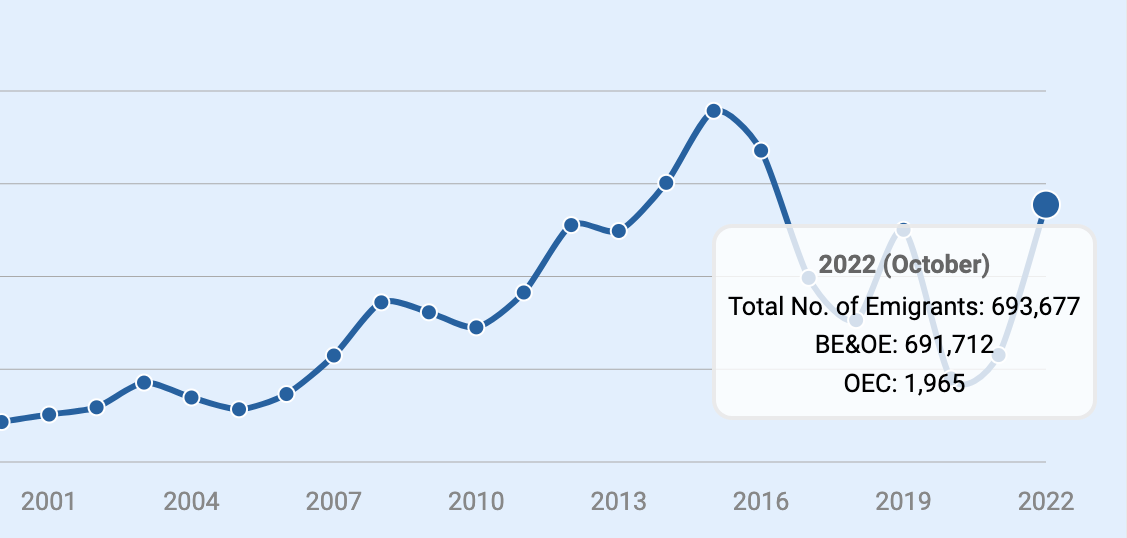
Pakistani Workers Going Overseas. Source: Bureau of Emigration

Demographic Dividend: 

With rapidly aging populations and declining number of working age people in North America, Europe and East Asia, the demand for workers will increasingly be met by major labor exporting nations like Bangladesh, China, India, Mexico, Pakistan, Russia and Vietnam. Among these nations, Pakistan is the only major labor exporting country where the working age population is still rising faster than the birth rate. 

Over 10 million Pakistanis are currently working/living overseas, according to the Bureau of Emigration. Before the COVID19 pandemic hit in 2020,  more than 600,000 Pakistanis left the country to work overseas in 2019. Nearly 700,000 Pakistanis have already migrated in this calendar year as of October, 2022. The average yearly outflow of Pakistani workers to OECD countries (mainly UK and US) and the Middle East was over half a million in the last decade. 
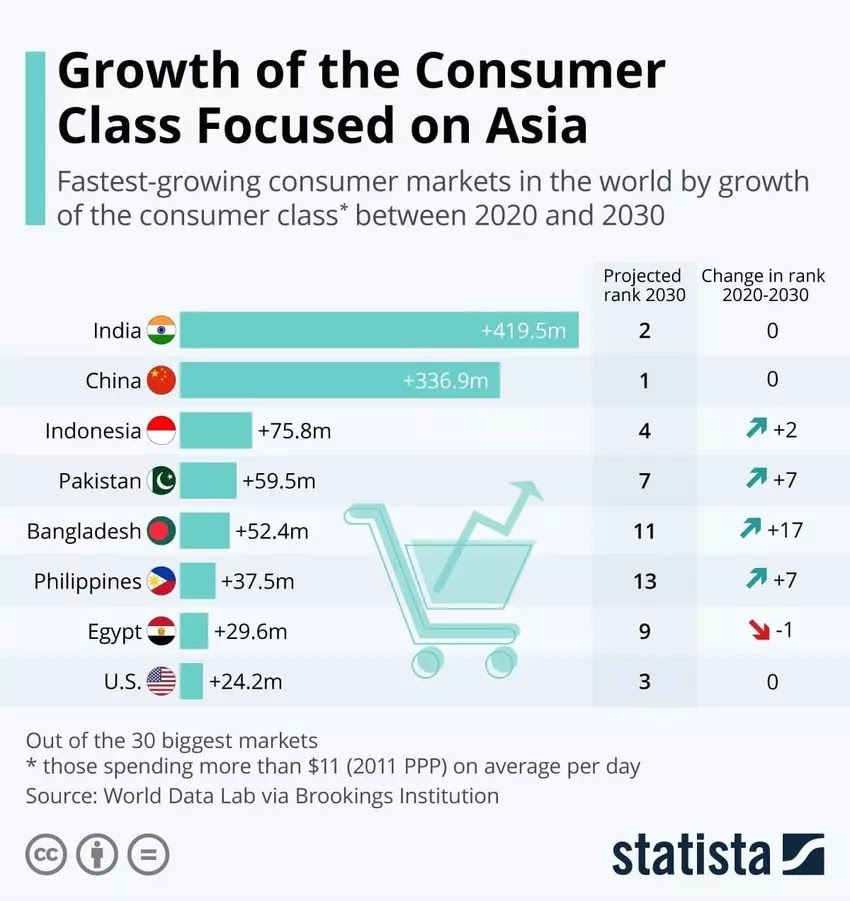
Consumer Markets in 2030. Source: WEF


World's 7th Largest Consumer Market:

Pakistan's share of the working age population (15-64 years) is growing as the country's birth rate declines, a phenomenon called demographic dividend. With its rising population of this working age group, Pakistan is projected by the World Economic Forum to become the world's 7th largest consumer market by 2030. Nearly 60 million Pakistanis will join the consumer class (consumers spending more than $11 per day) to raise the country's consumer market rank from 15 to 7  by 2030. WEF forecasts the world's top 10 consumer markets of 2030 to be as follows: China, India, the United States, Indonesia, Russia, Brazil, Pakistan, Japan, Egypt and Mexico.  Global investors chasing bigger returns will almost certainly shift more of their attention and money to the biggest movers among the top 10 consumer markets, including Pakistan.  Already, the year 2021 has been a banner year for investments in Pakistani technology startups

Record Remittances From Overseas Pakistanis:

Pakistan is already seeing high levels of labor export and record remittances of over $30 billion pouring into the country. Saudi Arabia and the United Arab Emirates(UAE) are the top two sources of remittances but the biggest increase (58%) in remittances is seen this year from Pakistanis in the next two sources: the United Kingdom and the United States.

Remittances from the European Union (EU) to Pakistan soared 49.7% in FY 21 and 28.3% in FY22, according to the State Bank of Pakistan. With $2.5 billion remittances in the first 9 months (July-March) of the current fiscal year, the EU ($2.5 billion) has now surpassed North America ($2.2 billion) to become the third largest source of inflows to Pakistan after the Middle East and the United Kingdom. Remittances from the US have grown 21%, second fastest after the EU (28.3%) in the first 9  months of the current fiscal year. 

Pakistan ranks 6th among the top worker remittance recipient countries in the world.  India and China rank first and second, followed by Mexico 3rd, the Philippines 4th, Egypt 5th and Pakistan 6th.  

Pakistan Demographics

About two million Pakistanis are entering the workforce every year. The share of the working age population in Pakistan is increasing while the birth rate is declining. This phenomenon, known as demographic dividend, is coinciding with declines in working age populations in developed countries. It is creating an opportunity for over half a million Pakistani workers to migrate and work overseas, and send home record remittances. 

Wednesday, November 16, 2022

World at 8 Billion: Pakistan is Fourth Largest Contributor to Last Billion

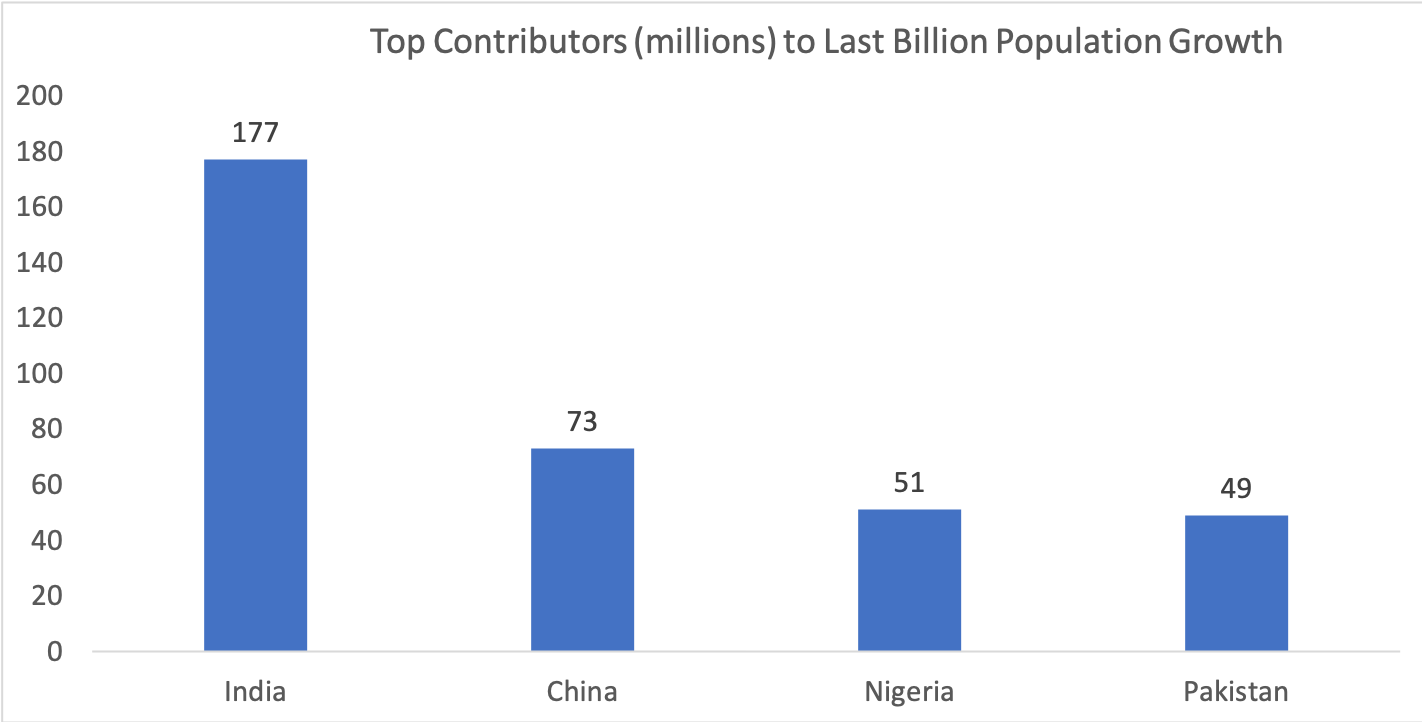
The global population increased by one billion over the last 12 years to reach 8 billion this year, according to the United Nations. Pakistan contributed 49 million people to the last billion, making it the fourth largest contributor after India (177 million), China (73 million) and Nigeria (51 million). Nigeria is expected to soon overtake Indonesia and Pakistan to become the world's 4th most populous nation. More than half of the projected increase in the global population up to 2050 will be concentrated in eight countries: the Democratic Republic of the Congo, Egypt, Ethiopia, India, Nigeria, Pakistan, the Philippines and the United Republic of Tanzania. Rising working age population is turning Pakistan into a major global consumer market. It is also fueling Pakistan's growing surplus labor exports and record overseas worker remittances. 

Pakistan Among Top 4 Contributors to Last Billion Population. Source: UN/Worldometers


World Population Visualization in 2022. Source: Visual Capitalist

World's 7th Largest Consumer Market:

Pakistan's share of the working age population (15-64 years) is growing as the country's birth rate declines, a phenomenon called demographic dividend. With its rising population of this working age group, Pakistan is projected by the World Economic Forum to become the world's 7th largest consumer market by 2030. Nearly 60 million Pakistanis will join the consumer class (consumers spending more than $11 per day) to raise the country's consumer market rank from 15 to 7  by 2030. WEF forecasts the world's top 10 consumer markets of 2030 to be as follows: China, India, the United States, Indonesia, Russia, Brazil, Pakistan, Japan, Egypt and Mexico.  Global investors chasing bigger returns will almost certainly shift more of their attention and money to the biggest movers among the top 10 consumer markets, including Pakistan.  Already, the year 2021 has been a banner year for investments in Pakistani technology startups

Consumer Markets in 2030. Source: WEF


World Population in 2050. Source: Visual Capitalist

Labor Exports: 

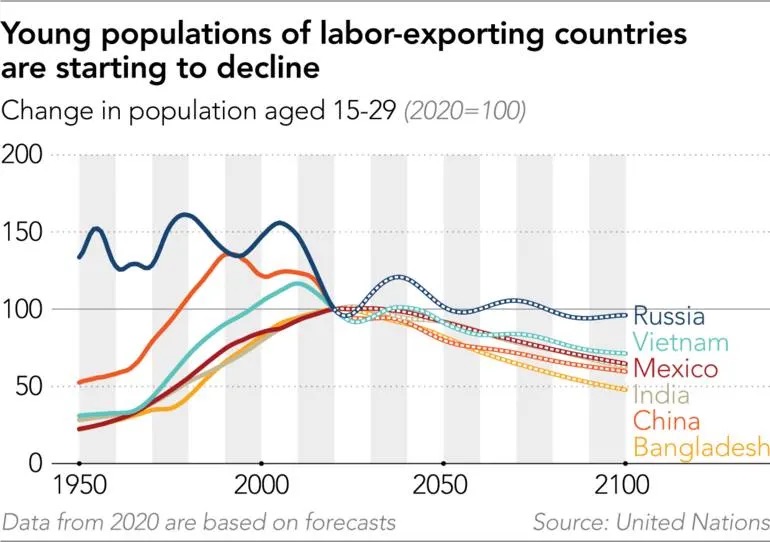
With rapidly aging populations and declining number of working age people in North America, Europe and East Asia, the demand for workers will increasingly be met by major labor exporting nations like Bangladesh, China, India, Mexico, Pakistan, Russia and Vietnam. Among these nations, Pakistan is the only major labor exporting country where the working age population is still rising. 

Working Age Population Declining Among Major Labor Exporters. Source: Nikkei Asia

Over 10 million Pakistanis are currently working/living overseas, according to the Bureau of Emigration. Before the COVID19 pandemic hit in 2020,  more than 600,000 Pakistanis left the country to work overseas in 2019. Nearly 700,000 Pakistanis have already migrated in this calendar year as of October, 2022. The average yearly outflow of Pakistani workers to OECD countries (mainly UK and US) and the Middle East was over half a million in the last decade. 

Pakistani Workers Going Overseas. Source: Bureau of Emigration


Record Remittances From Overseas Pakistanis:

Pakistan is already seeing high levels of labor export and record remittances of over $30 billion pouring into the country. Saudi Arabia and the United Arab Emirates(UAE) are the top two sources of remittances but the biggest increase (58%) in remittances is seen this year from Pakistanis in the next two sources: the United Kingdom and the United States.

Remittances from the European Union (EU) to Pakistan soared 49.7% in FY 21 and 28.3% in FY22, according to the State Bank of Pakistan. With $2.5 billion remittances in the first 9 months (July-March) of the current fiscal year, the EU ($2.5 billion) has now surpassed North America ($2.2 billion) to become the third largest source of inflows to Pakistan after the Middle East and the United Kingdom. Remittances from the US have grown 21%, second fastest after the EU (28.3%) in the first 9  months of the current fiscal year. 

Pakistan ranks 6th among the top worker remittance recipient countries in the world.  India and China rank first and second, followed by Mexico 3rd, the Philippines 4th, Egypt 5th and Pakistan 6th.  

Pakistan Demographics

About two million Pakistanis are entering the workforce every year. The share of the working age population in Pakistan is increasing while the birth rate is declining. This phenomenon, known as demographic dividend, is coinciding with declines in working age populations in developed countries. It is creating an opportunity for over half a million Pakistani workers to migrate and work overseas, and send home record remittances. 

Monday, November 7, 2022

COP27: Pakistan Leads Push For "Loss and Damage" Compensation at Sharm El-Sheikh

COP27, the United Nations climate summit,  opened in Egypt on Sunday with the addition of negotiations over funding to compensate nations for “loss and damage” as an official agenda item. Pakistan led the push for it with the support of 134 developing nations. Discussions at COP26 in Scotland were mainly focused on funding "mitigation" and "adaptation", not compensation for "loss and damage".  

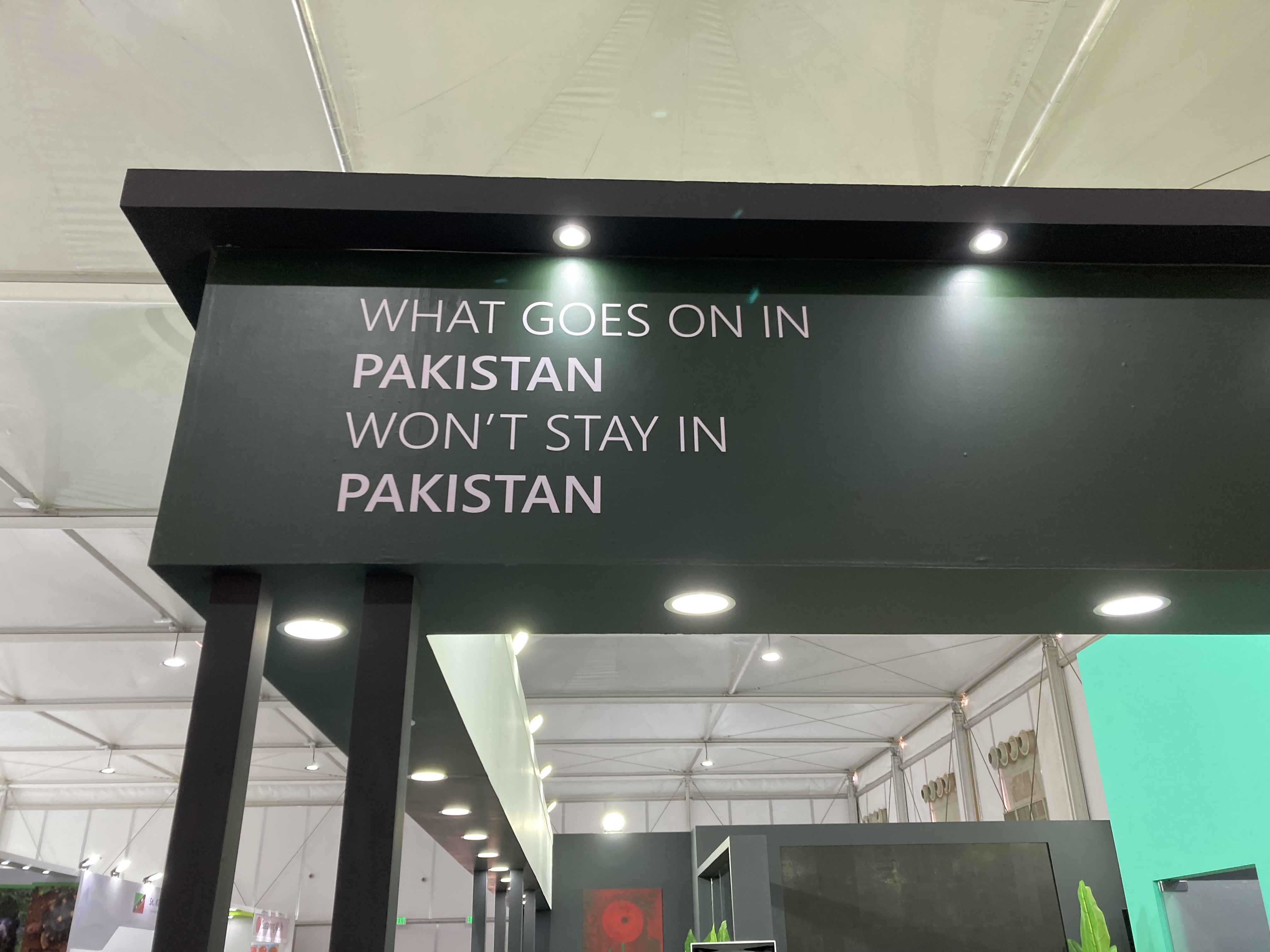
Pakistan Pavilion at COP27 Conference in Sharm Al-Sheikh, Egypt

The "loss and damage" agenda item was proposed by Pakistan during talks at Bonn after the country suffered heavy losses in unprecedented floods that hit a third of the country.  “My country, Pakistan, has seen floods that have left 33 million lives in tatters and have caused loss and damage amounting to 10% of the GDP,” said Ambassador Munir Akram, the 2022 chair of the G77—a group of 134 developing countries, at the opening session of COP27 at Sharm al-Sheikh, Egypt. 

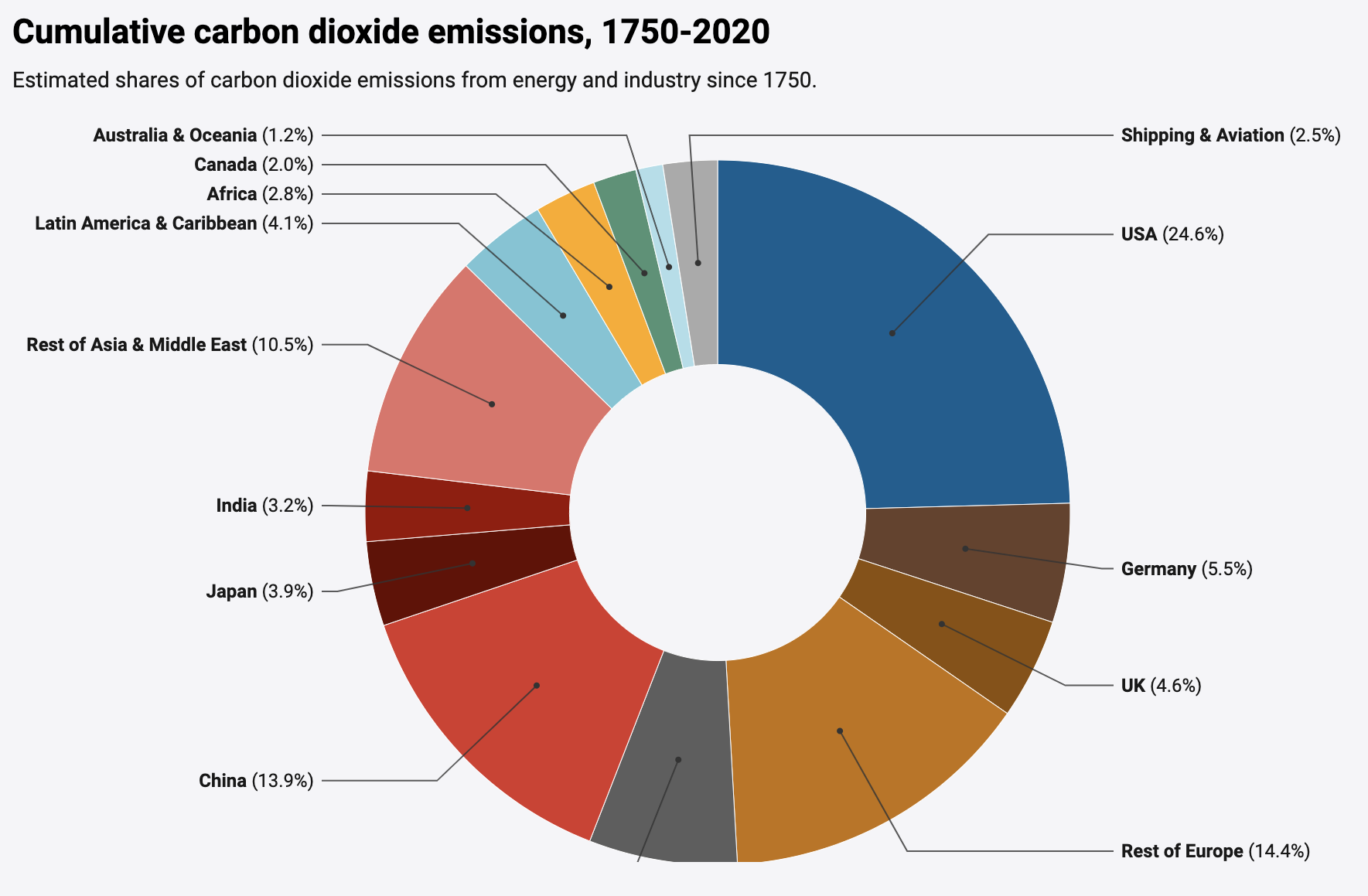
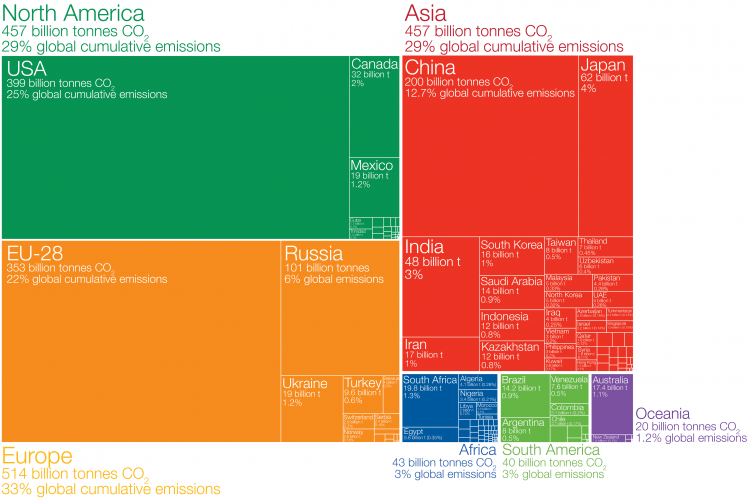
Cumulative CO2 Emissions By Country/Region. Source: The World

Pakistan has contributed only 0.28% of the CO2 emissions but it is among the biggest victims of climate change. The US, Europe, India, China and Japan, the world's biggest polluters, must accept responsibility for the catastrophic floods in Pakistan and climate disasters elsewhere. A direct link of the disaster in Pakistan to climate change has been confirmed by a team of 26 scientists affiliated with World Weather Attribution, a research initiative that specializes in rapid studies of extreme events, according to the New York Times

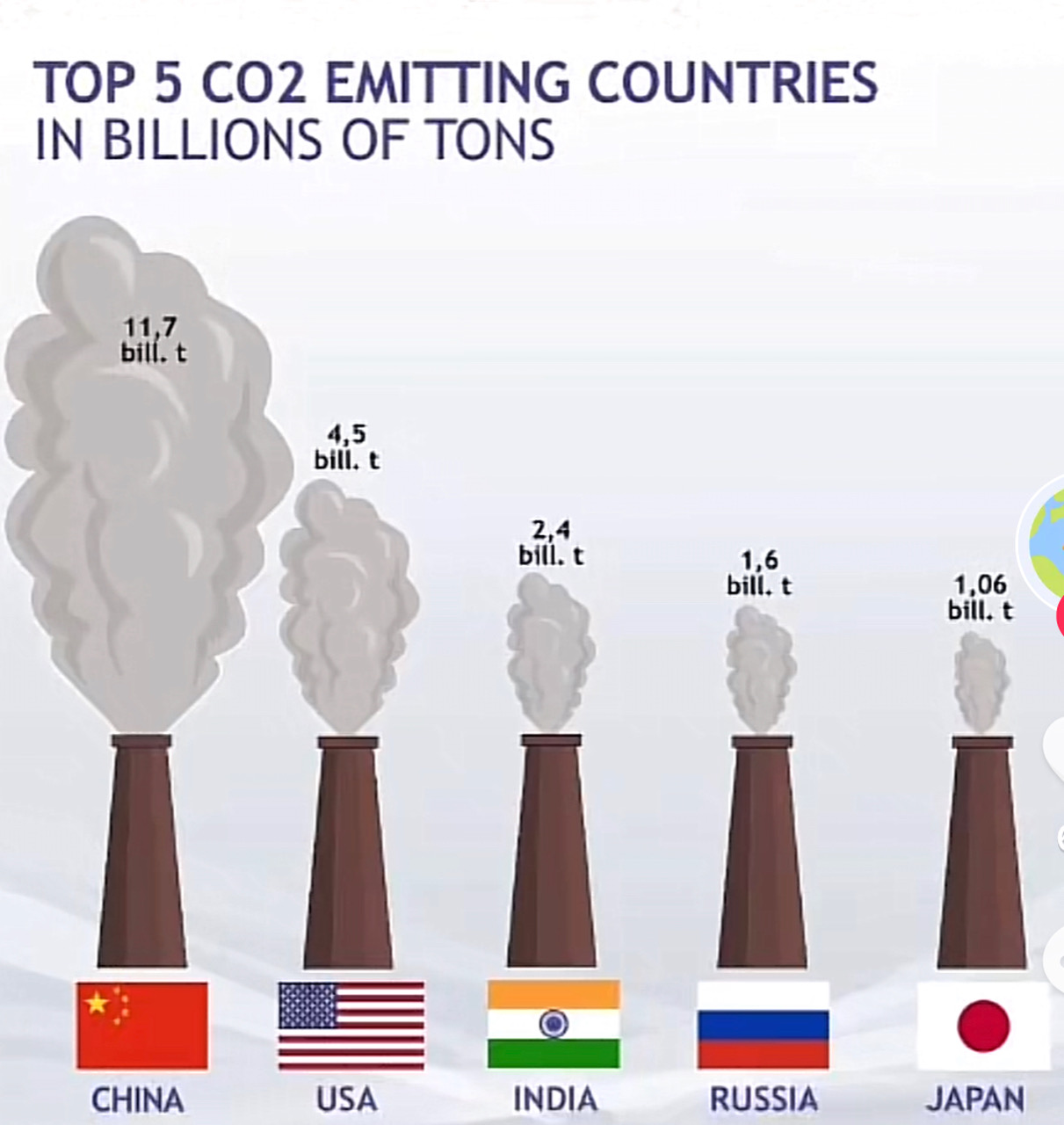
Top 5 Current Polluters. Source: Our World in Data


Currently, the biggest annual CO2 emitters are China, the US, India and Russia. Pakistan's annual CO2 emissions add up to just 235 million tons. On the other hand, China contributes 11.7 billion tons, the United States 4.5 billion tons, India 2.4 billion tons, Russia 1.6 billion tons and Japan 1.06 billion tons. 

Pakistan's Annual CO2 Emission. Source: Our World in Data

The United States has contributed 399 billion tons (25%) of CO2 emissions, the highest cumulative carbon emissions since the start of the Industrial Revolution in the late 18th century. The 28 countries of the European Union (EU28), including the United Kingdom, come in second with 353 billion tons of CO2 (22%), followed by China with 200 billion tons (12.7%). 

Cumulative CO2 Emissions. Source: Our World in Data

Pakistan's cumulative CO2 contribution in its entire history is just 4.4 billion tons (0.28%). Among Pakistan's neighbors, China's cumulative contribution is 200 billion tons (12.7%),  India's 48 billion tons (3%) and Iran's 17 billion tons (1%).  

Developing Asian Nations' CO2 Emissions. Source: Our World in Data

Pakistan has contributed little to climate change but it has become one of its biggest victims. In the 2015 Paris agreement on climate change, signatories agreed to recognize and “address” the loss and damage caused by those dangerous climate impacts, according to the Washington Post. Last year, at the major U.N. climate conference in Glasgow, Scotland, negotiators from developing countries tried to establish a formal fund to help the countries like Pakistan most affected by climate disasters. It was blocked by rich countries led by the Biden administration. Formal addition of "loss and damage" item at this year's COP27 conference agenda is a good start. Let's hope that a formal  fund is established by the world's top polluters to compensate Pakistan and other developing nations. 


Saturday, November 5, 2022

Attempt on Imran Khan's Life: Has Pakistan Army Lost Popular Support?

Multiple polls over the years have found that the Pakistani military has traditionally enjoyed widespread popular support in the country. This support has been particularly strong among the urban middle class Pakistanis who have now become the backbone of Imran Khan's Pakistan Tehreek-e-Insaf (PTI) party which has accused the Pakistani military of orchestrating an assassination attempt against the former Prime Minister. The events of the last several months, particularly this week's assassination attempt on the PTI chief's life, are forcing the people to choose sides. By-election results and huge attendance of the PTI rallies confirm that most of the people are supporting Imran Khan over the military.  

Pakistan's Ex PM Imran Khan and Current Army Chief General Bajwa

Some Pakistani political analysts have long speculated about the possibility of the loss of public support for the Pakistani military.  Back in 2019, I met Sohail Warraich, a senior journalist and political analyst as well as a popular host of "Ek Din Geo K Sath" aired on Geo TV channel. Warraich was visiting Silicon Valley to record an episode of "Ek Din Geo K Sath" with a successful Pakistani entrepreneur named Osman Rashid.  Warraich said he believes the rise of Imran Khan and Pakistan Tehreek e Insaf (PTI) were enabled by the support of the military and the middle class. Middle class support for the military will eventually fade and there will eventually be conflict between the two. It could lead to significant political changes in the country. 

Osman Rashid invited me and a few other Pakistani-American friends to meet Warraich over dinner at his Los Altos home.  In response to my question about about the current state of affairs in Pakistan, Warraich shared his insights below:

1. Pakistan's middle class is rising and increasingly asserting itself in politics.

2. The Pakistani military is the most dominant force in the country. It enjoys broad support among the middle class Pakistanis.

3. The rise of Imran Khan and Pakistan Tehreek e Insaf (PTI) have been enabled by the support of the military and the middle class.

4. Middle class support for the military will eventually fade and there will be conflict between the two. It could lead to significant political changes in the country. 

Will there be yet another Martial Law in the country? Past Martial Laws in Pakistan have had the support of the people. A Gallup poll conducted immediately after the 1999 coup showed that 75% of respondents supported the military takeover, while less than 10% supported restoring Mr. Nawaz Sharif's government. The situation today is very different.  It is more likely today that the Pakistani military will back down and concede to Imran Khan's demand for fresh elections. 

Related Links:


Friday, October 28, 2022

Law and Order Index 2022: Pakistan is Safer Than Bangladesh, India and Sri Lanka

Gallup Law and Order Survey 2021 shows that Pakistan (score 82) is safer than Bangladesh (79) and India (80) and Sri Lanka (80).  Gallup’s survey is based on responses to four questions to measure “people’s sense of personal security and their personal experiences with crime and law enforcement”. The questions are as follows: 1) In the city or area where you live, do you have confidence in the local police force?; 2) Do you feel safe walking alone at night in the city or area where you live?; 3) Within the last 12 months, have you had money or property stolen from you or another household member?; 4) Within the past 12 months, have you been assaulted or mugged?  Gallup interviewed 127,000 people in 120 countries to compile the report.

Gallup Law and Order Survey Results 2022. Source: Gallup


The survey, conducted by global analytics firm Gallup, ranks Singapore, Tajikistan, Norway, Switzerland and Indonesia as the safest countries in the world.  It ranks Sierra Leone, DR Congo, Venezuela, Gabon and Afghanistan as the least secure countries. 

Safety and quality of life global surveys at the city level regularly done by Numbeo support the findings of Gallup Law and Order Survey. Numbeo surveys are based on responses received from its website visitors.  Numbeo filters "surveys to eliminate potential spam, like people entering a large amount of data which are differentiating from the median value". Numbeo's Quality of Life Index captures purchasing power, cost of living, housing, health care, safety, traffic congestion and environmental pollution. The Pakistani capital of Islamabad ranks higher than New Delhi, Mumbai, London and New York in terms of safety and quality of life. 

Safety Score of Selected Cities. Source: Numbeo

In terms of safety in South Asia region, Islamabad (50) ranks the highest followed by Lahore (103), Colombo (110), Chennai (112), Hyderabad (130), Mumbai (140), Karachi (188), Bangalore (200), New Delhi (216) and Dhaka (232). 


Quality of Life Scores and Rankings of Selected Cities. Source: Numbeo

On quality of life in South Asia, Islamabad ranks 144 followed by  Bangalore 167, Hyderabad 195, Chennai 218, Lahore 219, Karachi 237, New Delhi 239, Mumbai 246, Colombo 251 and Dhaka 252. 

In 2019, India was ranked as the fifth most dangerous country in the world for expats, according to media reports. In a survey — Expat Insider 2019 — that covered and interviewed people who live and work abroad, India has been placed at 60 of 64 countries on safety and security. According to the survey which was conducted by InterNations, over four men in ten respondents reported negative feelings about the peacefulness in the country and 27% were displeased with their personal safety — three times the global average of 9%. “A US American expat, for example, does not like “always having to keep my guard up — as a female, I don’t feel safe. As a resident, I often feel taken advantage of at work and outside work,” the survey said. The expats also rated negatively to the question of political stability in India. “Almost double the global average (32% vs 17% worldwide) rate the political stability of the country negatively. An Australian expat shares that ‘politics has become hardline, and there are social tensions’,” the survey found.

Related Links:


Haq's Musings

South Asia Investor Review

Pakistan Among World's Largest Food Producers

India is Home 75% of World's Population Deprived of Basic Living Standards

Food in Pakistan 2nd Cheapest in the World

India in Crisis: Unemployment and Hunger Persist After COVID

Impact of Russia Sanctions on Food, Fuel Availability

Record Number of Indians Seeking Asylum in US

Pakistan Happiness Index Ranking

Incomes of Poorest Pakistanis Growing Faster Than Their Richest Counterparts

Pakistanis Consuming More Calories, Fruits & Vegetables Per Capita 

How Grim is Pakistan's Social Sector Progress?

Pakistan Fares Marginally Better Than India On Disease Burdens

COVID Lockdown Decimates India's Middle Class

Pakistan Child Health Indicators

Pakistan's Balance of Payments Crisis

How Has India Built Large Forex Reserves Despite Perennial Trade Deficits

Riaz Haq's Youtube Channel

Sunday, October 23, 2022

Multidimensional Poverty: India is Home to 75% of World's Population Deprived of Basic Living Standards

Over 75% of the world's poor deprived of basic living standards (nutrition, cooking fuel, sanitation and housing) live in India compared to 4.6% in Bangladesh and 4.1% in Pakistan, according to a recently released OPHI/UNDP report on multidimensional poverty.  Here's what the report says: "More than 45.5 million poor people are deprived in only these four indicators (nutrition, cooking fuel, sanitation and housing). Of those people, 34.4 million live in India, 2.1 million in Bangladesh and 1.9 million in Pakistan—making this a predominantly South Asian profile". 

Global Multidimensional Poverty Index 2022. Source: OPHI/UNDP

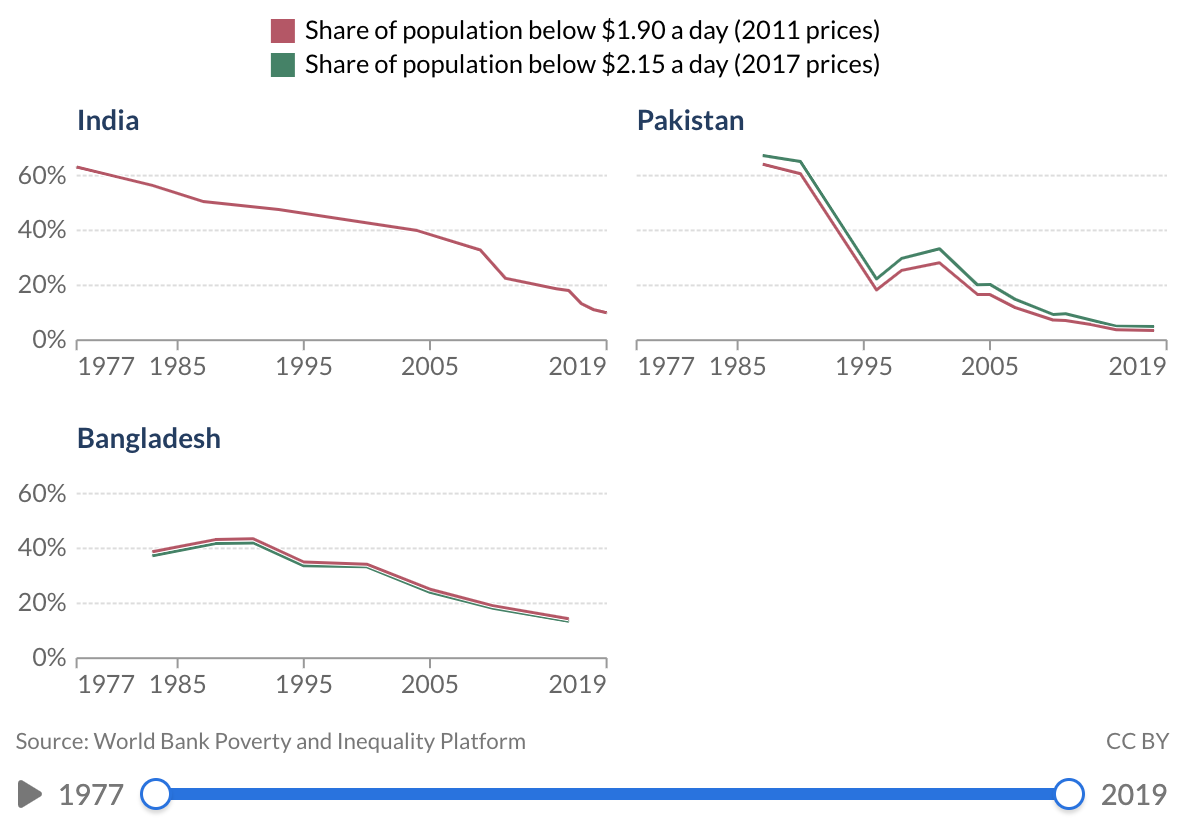
Income Poverty in Bangladesh, India and Pakistan. Source: Our World in Data


The UNDP poverty report shows that the income poverty (people living on $1.90 or less per day) in Pakistan is 3.6% while it is 22.5% in India and 14.3% in Bangladesh. In terms of the population vulnerable to multidimensional poverty, Pakistan (12.9%) does better than Bangladesh (18.2%) and India (18.7%)  However, Pakistan fares worse than India and Bangladesh in multiple dimensions of poverty. The headline multidimensional poverty (MPI) figure for Pakistan (0.198) is worse than for Bangladesh (0.104) and India (0.069). This is primarily due to the education and health deficits in Pakistan. Adults with fewer than 6 years of schooling are considered multidimensionally poor by OPHI/UNDP.  Income poverty is not included in the MPI calculations. The data used by OHP/UNDP for MPI calculation is from years 2017/18 for Pakistan and from years 2019/2021 for India. 

Multidimensional Poverty in South Asia. Source: UNDP

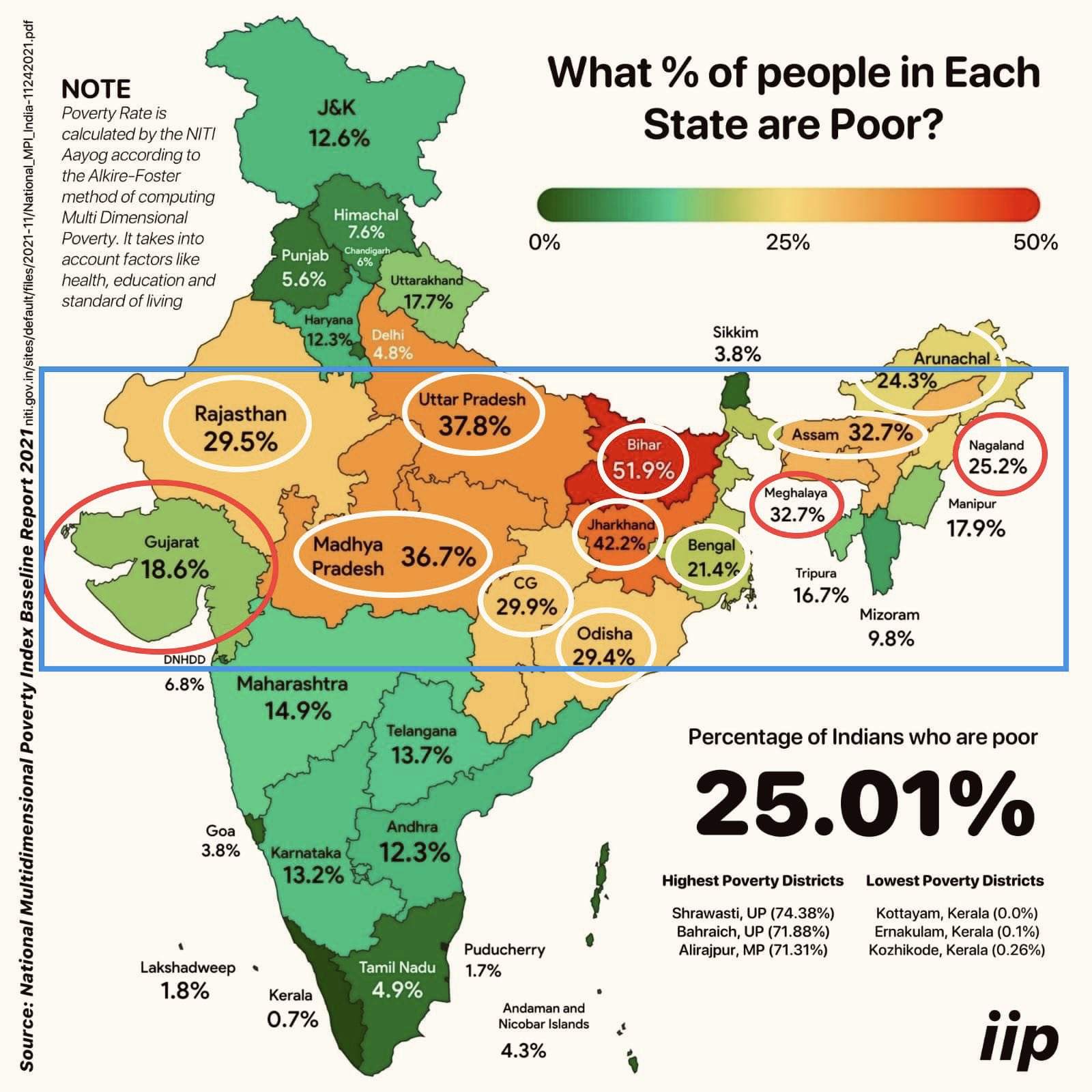
The Indian government's reported multidimensional poverty rate of 25.01% is much higher than the OPHI/UNDP estimate of 16.4%. NITI Ayog report released in November 2021 says: "India’s national MPI identifies 25.01 percent of the population as multidimensionally poor".

Multidimensional Poverty in India. Source: NITI Ayog via IIP

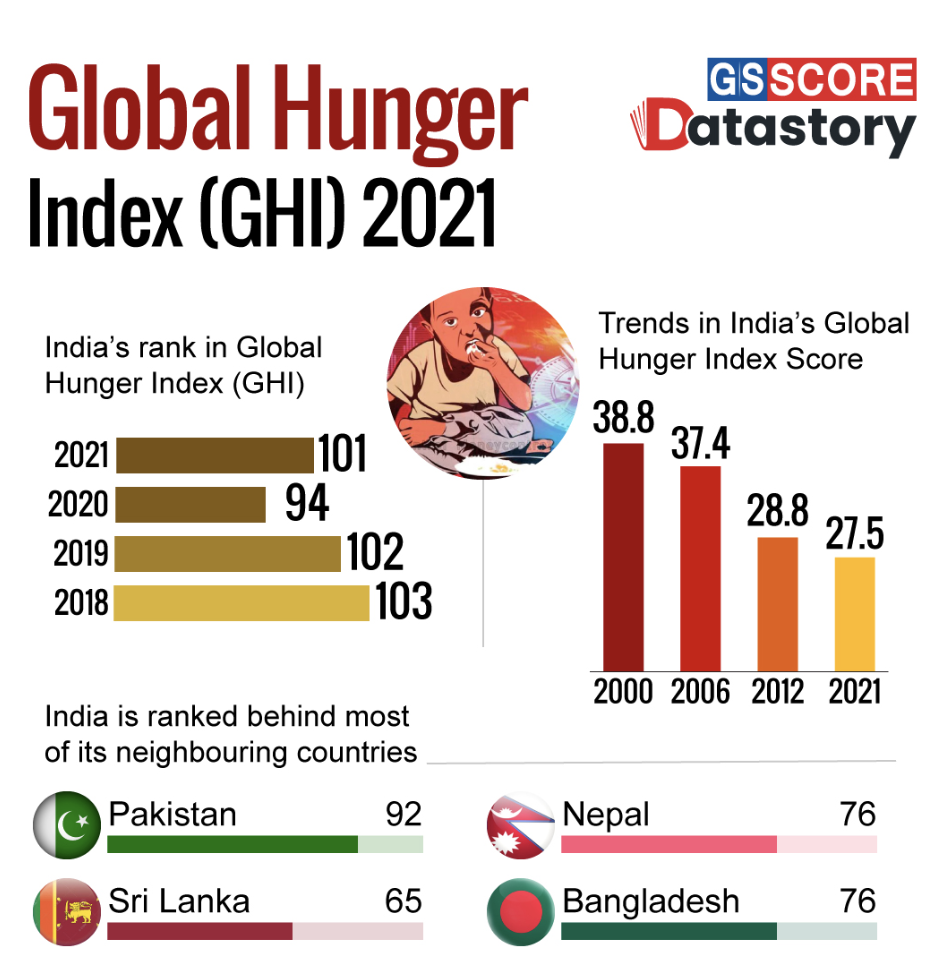
Earlier this year,  Global Hunger Index 2022 reported that  India ranks 107th for hunger among 121 nations. The nation fares worse than all of its South Asian neighbors except for war-torn Afghanistan ranked 109, according to the the report. Sri Lanka ranks 64, Nepal 81, Bangladesh 84 and Pakistan 99. India and Pakistan have levels of hunger that are considered serious. Both have slipped on the hunger charts from 2021 when India was ranked 101 and Pakistan 92.  Seventeen countries, including Bosnia, China, Kuwait, Turkey and UAE, are collectively ranked between 1 and 17 for having a score of less than five.

Related Links:


Haq's Musings

South Asia Investor Review

Pakistan Among World's Largest Food Producers

Pakistan Floods 2022

Food in Pakistan 2nd Cheapest in the World

India in Crisis: Unemployment and Hunger Persist After COVID

Impact of Russia Sanctions on Food, Fuel Availability

Record Number of Indians Seeking Asylum in US

Vast Majority of Pakistanis Support Imran Khan's Handling of Covid19 Crisis

Incomes of Poorest Pakistanis Growing Faster Than Their Richest Counterparts

Pakistanis Consuming More Calories, Fruits & Vegetables Per Capita 

How Grim is Pakistan's Social Sector Progress?

Pakistan Fares Marginally Better Than India On Disease Burdens

COVID Lockdown Decimates India's Middle Class

Pakistan Child Health Indicators

Pakistan's Balance of Payments Crisis

How Has India Built Large Forex Reserves Despite Perennial Trade Deficits

Riaz Haq's Youtube Channel

Thursday, October 20, 2022

Why Has Modi's India Failed to Internationally Isolate Pakistan Despite its Best Efforts?

Indian Prime Minister Narendra Modi's government has pursued a policy of internationally isolating Pakistan for the last 8 years. Indian diplomats and mainstream media have engaged in a concerted campaign to hurt Pakistan diplomatically and economically during this period. Even the sport of cricket has not been spared.  All of the available evidence suggests that this Indian campaign has failed.  

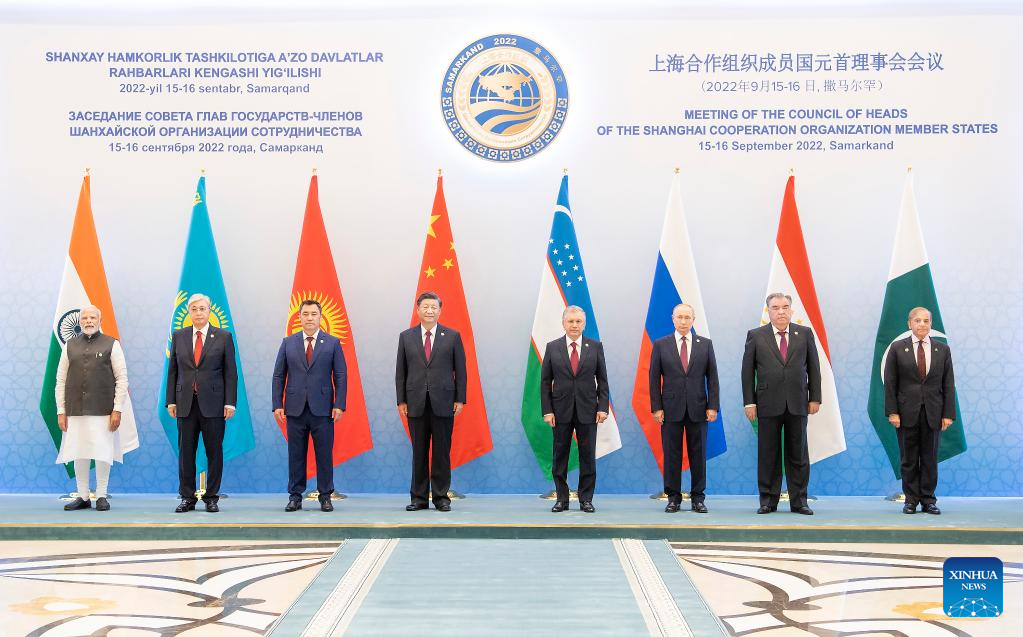
Pakistan PM with Other World Leaders at SCO Summit in Samarkand, Uzbekistan. Source: Xinhua

A prominent Indian journalist Shekhar Gupta has recently summarized the reasons for the Modi government's failure to achieve its objectives relative to Pakistan. Gupta argues that Pakistan is too important to be ignored or isolated by the international community. He says, "Pakistan is too big in terms of population, too powerful militarily, too Muslim, too nuclear and too well located to be isolated". 

Pakistan PM Shahbaz Sharif with President and Mrs. Biden. Source: White House

Here are some of the key points Shekhar Gupta makes in episode 1093 of his show Cut The Clutter : 

1.Pakistan is our most important neighbor. We must focus on Pakistan.

2, We can not ignore Pakistan in India because the world can not ignore Pakistan

3. The Western world has an intrinsic relationship with Pakistan which doesn't go away

4. The West does not see Pakistan as so useful to them today and yet Pakistan can not be isolated.

5. You can see all the indications that Pakistan is not isolated.

6. A lot of (Indian) TV channels say Pakistan is isolated but the evidence doesn't support it.

7. Pakistan FM visited Washington and met his counterpart Tony Blinken. 

8. Pakistan Army Chief has received a warm welcome at the US Defense Dept and met US Defense Secretary Lloyd Austin. Bajwa matters more than the Pakistan Defense Minister. Nobody knows his name.

9. US Ambassador to Pakistan Donald Blome, a career diplomat, has visited "Pakistan Occupied Kashmir" and called it Azad Kashmir...Azad means free.

10. When the chips are down in the region Pakistan is the ally Americans reach out to.

11. The US does not want Pakistan to drift to China.

12. German foreign minister Annalena Baerbock has spoken about Kashmir...the K word. She has asked for the UN to help solve the Kashmir issue.

13. Pakistan Army Chief General Bajwa is not a warmonger. He wants to normalize ties with India. He wants to trade with India. He doesn't want Faiz Hameed to succeed him. He used to be the ISI chief and took credit for the Taliban victory in Afghanistan. Do the Americans have leverage here?

14. Where does Pakistan's unique power come from? Why can't Pakistan be ignored? Why can't Pakistan be isolated?

15. The Indian public needs to understand it.

16. Pakistan is too big in terms of population, too powerful militarily, too Muslim, too nuclear and too well located to be isolated.

17. Pakistan has the 5th largest population and its population is growing fast. It could soon exceed Indonesia to become the largest Muslim nation in the world.

18. Pakistan has the 5th strongest military in the world.

19. In terms of nuclear weapons, Pakistan has the 4th largest nuclear arsenal in the world.

20. Pakistan is too well located to be isolated. It has geo-strategic location. Pakistan is the western gateway to China. Pakistan opened China's ties with the US. And then helped the US defeat the Soviet Union.

21. The factors that made Pakistan such a strong ally to US still exist. Don't blame the Pakistanis for it.

22. India is not willing to commit to an alliance with the US.

23. Imran Khan tried to change Pakistan's foreign policy to be more like India's but he failed.

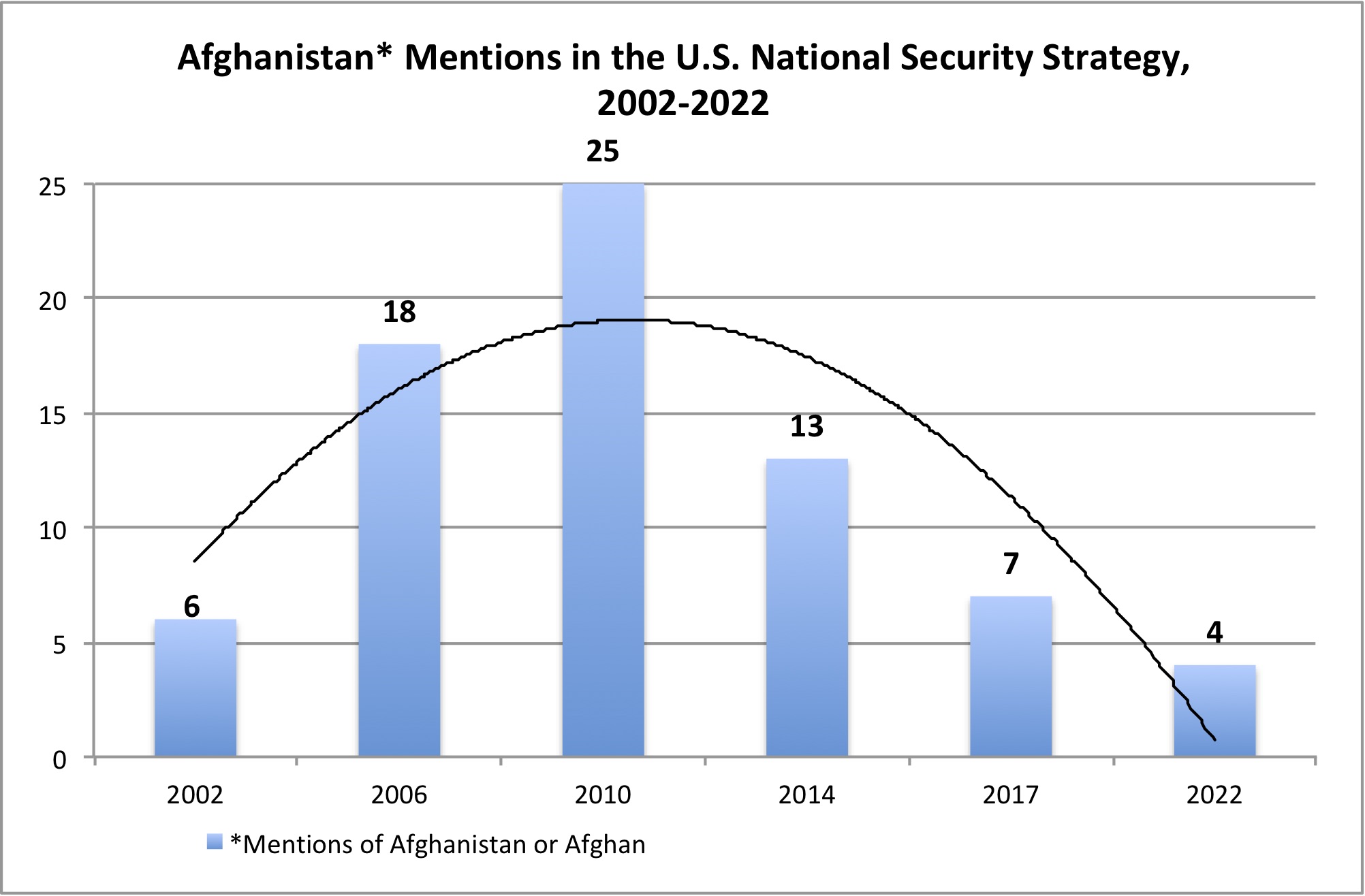
Mentions of Afghans and Afghanistan in US National Security Strategy via Sameer Lalwani 

Prime Minister Modi is getting similar inputs and advice from retired Indian diplomat Sharat Sabharwal. In his recently published book "India's Pakistan Conundrum", Sabharwal disabuses his fellow Indians of the notion that Pakistan is about to collapse. He also writes that "Pakistan has shown remarkable resilience in the face of adversity".  "Pakistan is neither a failed state nor one about to fail", he adds. He sees "limitations on India’s ability to inflict a decisive blow on Pakistan through military means". The best option for New Delhi, he argues, is to engage with Pakistan diplomatically. In an obvious message to India's hawkish Hindu Nationalist Prime Minister Narendra Modi, he warns: "Absence of dialogue and diplomacy between the two countries carries the risk of an unintended flare-up". Ambassador Sabharwal served as Indian High Commissioner to Pakistan from 2009 to 2013. Prior to that, he was Deputy High Commissioner in Islamabad in the 1990s.

Here's Shekhar Gupta's video titled "Gen Bajwa in DC, US envoy, German FM statements on Kashmir, show why Pakistan can’t be isolated."

https://youtu.be/NuXd4d_clf4

Related Links:

Haq's Musings

South Asia Investor Review

Modi's India: A Paper Elephant?

Can Washington Trust Modi's India as Key Ally in Asia?

US-Pakistan F-16 Deal: Indian Minister Jaishankar Throws a Tantrum

Ukraine's Lesson For Pakistan: Never Give Up Nuclear Weapons

Geopolitically Important Pakistan Brings Together China, Russia, US, UK For Joint Naval Drills

US and China Compete For Influence in Pakistan

Indian Diplomat on Pakistan's "Resilience", "Strategic CPEC"

Vast Majority of Indians Believe Nuclear War Against Pakistan is "Winnable"

Friday, October 14, 2022

World Food Day 2022: India Tops Hunger Charts in South Asia

India ranks 107th for hunger among 121 nations. The nation fares worse than all of its South Asian neighbors except for war-torn Afghanistan ranked 109, according to the Global Hunger Index 2022. Sri Lanka ranks 64, Nepal 81, Bangladesh 84 and Pakistan 99. India and Pakistan have levels of hunger that are considered serious. Both have slipped on the hunger charts from 2021 when India was ranked 101 and Pakistan 92.  Seventeen countries, including Bosnia, China, Kuwait, Turkey and UAE, are collectively ranked between 1 and 17 for having a score of less than five.

South Asia Hunger Rankings. Source: GHI/IASScore


India’s child wasting rate (low weight for height), at 19.3%, is worse than the levels recorded in 2014 (15.1%) and even 2000 (17.15), and is the highest for any country in the world and drives up the region’s average owing to India’s large population, according to The Hindu newspaper. The child hunger situation has gotten worse since Mr. Narendra Modi was elected Prime Minister of India in 2014.  Earlier this year, Prime Minister Modi offered to "feed the world" in the aftermath of the Ukraine war.  Within weeks of this pledge he ended making an about-face.  On World Food Day 2022, the United Nations World Food Program has warned of another year of global record hunger looms amid food and climate crisis. 

India Hunger Trends. Source: GHI


Pakistan Hunger Trends. Source: GHI

Pakistan has a score of 26.1 and ranks 99th out of the 121 countries on Global Hunger Index rankings. India's GHI score is 29.1 and it ranks 107th. Hunger could worsen in Pakistan in the aftermath of the worst-ever flooding that has destroyed wheat and rice crops in southern Sindh province. Flood waters have not yet drained from the fields and standing water is preventing planting of the Rabi (winter) crop now. Here's an excerpt of USDA Food and Grain report on the wheat situation in Sindh:

"Farmers normally begin planting the wheat crop in mid-October and November in Sindh and Punjab, respectively. Sindh province usually accounts for almost twenty percent of national wheat production. However, large areas of Sindh typically planted to wheat are still submerged, and it may be several months before the flood waters recede. With Sindh’s flat terrain, poor drainage, and current high-water table, flood waters are receding slowly. As a result, seeding the 2023/24 wheat crop in Sindh is likely to be delayed and some areas may possibly remain unseeded. Even where the waters recede, farmers are likely to face difficulties in wheat planting as the floods washed away on-farm wheat seed stock in many areas. Additionally, farmers’ purchasing power in the affected areas is severely compromised making it difficult for them to buy fertilizers and other inputs".  

The number of hungry people around the world has shot up from 282 million to around 345 million since the beginning of 2022, and by mid-year, according to the United Nations World Food Program. “We are facing an unprecedented global food crisis and all signs suggest we have not yet seen the worst”, said WFP Executive Director David Beasley. “For the last three years hunger numbers have repeatedly hit new peaks. Let me be clear: things can and will get worse unless there is a large scale and coordinated effort to address the root causes of this crisis. We cannot have another year of record hunger”.

Related Links:


Haq's Musings

South Asia Investor Review

Pakistan Among World's Largest Food Producers

Pakistan Floods 2022

Food in Pakistan 2nd Cheapest in the World

India in Crisis: Unemployment and Hunger Persist After COVID

Impact of Russia Sanctions on Food, Fuel Availability

Record Number of Indians Seeking Asylum in US

Vast Majority of Pakistanis Support Imran Khan's Handling of Covid19 Crisis

Incomes of Poorest Pakistanis Growing Faster Than Their Richest Counterparts

Pakistanis Consuming More Calories, Fruits & Vegetables Per Capita 

How Grim is Pakistan's Social Sector Progress?

Pakistan Fares Marginally Better Than India On Disease Burdens

COVID Lockdown Decimates India's Middle Class

Pakistan Child Health Indicators

Pakistan's Balance of Payments Crisis

How Has India Built Large Forex Reserves Despite Perennial Trade Deficits

Riaz Haq's Youtube Channel

Wednesday, October 12, 2022

Record Number of Indians Seeking Asylum in US at Mexico Border

In the current fiscal year that started last October, a record 16,290 Indian citizens have been taken into custody by US Border Patrol at the Mexican border. A substantial number of them are Muslims, Christians, Sikhs and Dalits who are escaping persecution in the country ruled by the Hindu Nationalist government of Prime Minister Narendra Modi. Genocide Watch has issued "India  Genocide Warning" stating as follows:  "Islamophobia is no longer a fringe sentiment in India. It has become a state-manufactured ideology. Prime Minister Narendra Modi’s Hindu nationalist Bharatiya Janata Party (BJP) has made Islamophobia central to its program for harassing India's 192 million Muslims and depriving them of their rights as Indian citizens".


Indian Asylum Seekers at US-Mexico Border. Source: BBC

Experts attribute the record increase in asylum seekers to a a number of factors, including rising discrimination in India, an end to pandemic-era restrictions, a perception that the current US administration is welcoming to asylum seekers and the ramping-up of previously established smuggling networks, according to the BBC.   

Of the roughly 3.5 million undocumented immigrants who entered the country between 2010 and 2017, 65 percent arrived with full permission stamped into their passports, according to new figures compiled by the Center for Migration Studies, a nonpartisan think tank. During that period, more overstayers arrived from India than from any other country, according to the New York Times

It's a similar story in the UK where Home Secretary Suella Braverman was recently quoted by the BBC as saying: "I have concerns about having an open borders migration policy with India because I don't think that's what people voted for with Brexit… The largest group of people who overstay are Indian migrants. We even reached an agreement with the Indian government last year to encourage and facilitate better cooperation in this regard. It has not necessarily worked very well."

India has also become the biggest source of illegal immigrants crossing into the United States.  In 2014 about 136,000 people came to the U.S. from India, about 128,000 from China and about 123,000 from Mexico, census figures show. As recently as 2005, Mexico sent more than 10 times as many people to the U.S. as China, and more than six times as many as India, according to the WSJ story.

United States Department of Homeland Security estimates that there were 12.1 million undocumented immigrants living in the United States as of 2014. The top countries of origin are:

Mexico = 6.6 million

El Salvador = 700,000

Guatemala = 640,000

India = 430,000

Honduras = 400,000

Philippines = 360,000


The rise of Hindutva forces is tearing India apart along caste and religious lines.  Hindu mobs are lynching Muslims and Dalits. A recent  Pew Research report confirms that the level of hostility against religious minorities in India is "very high", giving India a score of 9.5 on a scale from 0 to 10. Pakistan's score on this scale is 7 while Bangladesh's is 7.5.

Chart Courtesy of Bloomberg

Rising hostility against minorities is driving record numbers of asylum seekers to the United States. India has earned a score of 9.5 on a scale of 0-10 assessed by Pew Research. Genocide Watch attributes it the rise of Narendra Modi in India: "Modi rose to power by inciting Hindus with his time-tested politics of communal polarization. Beginning in 2014, Modi spent his first term as Prime Minister dehumanizing Muslims by passing laws preventing cow slaughter, restricting Muslim immigration, and purportedly countering Islamist terrorism. Modi's second term, beginning in 2019, has seen more brazen attempts by the BJP to turn India into a “Hindu Rashtra"."

Related Links:

Haq's Musings

Story of New York's Little Pakistan

Hateful Hindutva Ideology Infects Indian Diaspora

India Genocide Warning

Deep Divisions Tearing India Apart

India's Share of World's Poor Jumps to 33%

Caste Apartheid in India

Brahmins Dominate India

Female Genocide Unfolding in India

Riaz Haq Youtube Channel

VPOS Youtube Channel

Friday, October 7, 2022

Anti-Muslim Social Media Posts: India is the Epicenter of Global Islamophobia

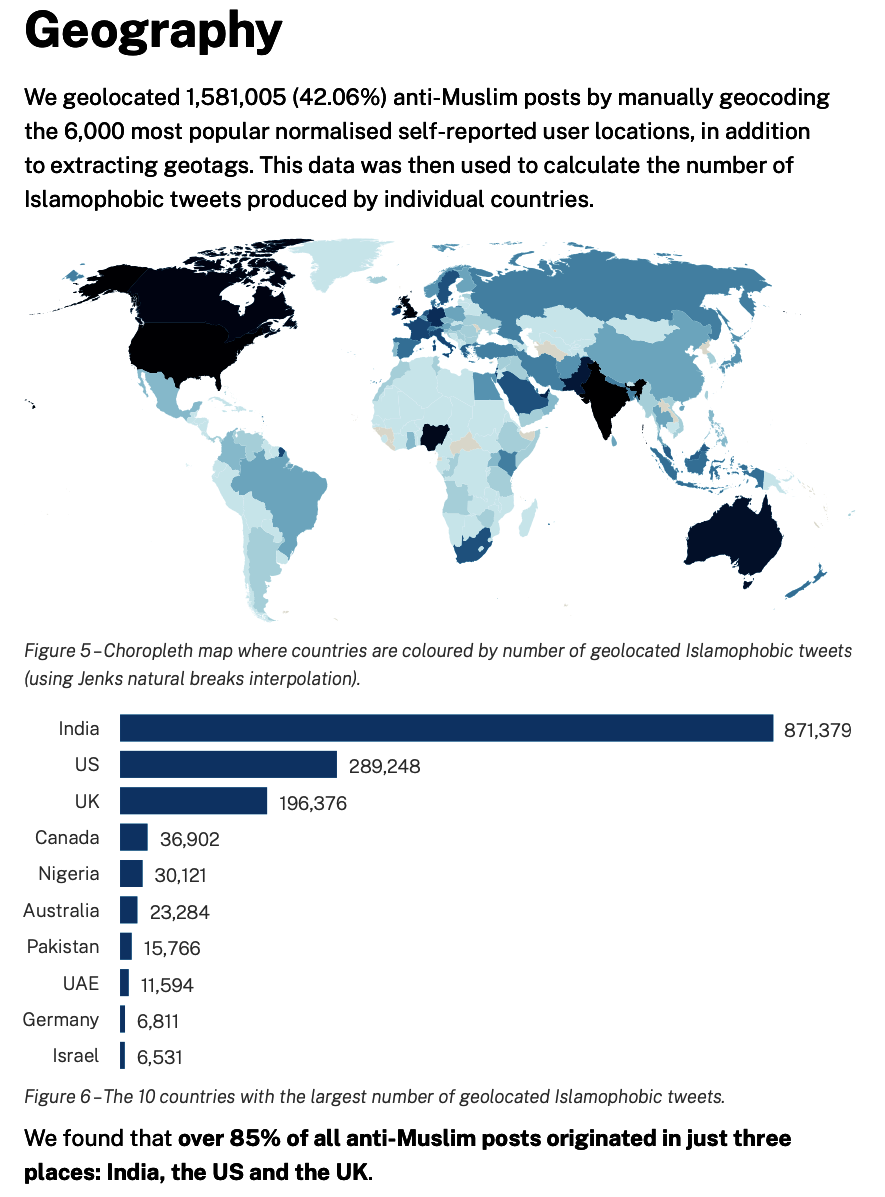
 India has just 5.75% of global Twitter users but the country accounts for 55% of all anti-Muslim tweets, according to a recent report entitled "Islamophobia in the Digital Age" published by the Islamic Council of Victoria (ICV). It also found that the US, the UK, and India contributed a staggering 86% of anti-Muslim content on Twitter during a three-year period. It should be noted that both the US and the UK have a sizable  Indian diaspora infected by hateful Hindutva ideology. 

India Accounts For 55% of Islamophobic Tweets. Source: ICV


Individuals and organizations connected to the RSS (Rashtriya Swayamsevak Sangh) are active users of social media. They are working to promote India's divisive Islamophobic politics among the Non Resident Indians (NRIs) and their children. Hundreds of the RSS shakhas (branches) are now found in at least 39 countries around the world. Hindutva is a Hindu supremacist ideology inspired by 20th century Fascism and Nazism in Europe; it is very different from the ancient Hindu faith, according to American history professor Audrey Truschke who teaches Indian history at Rutgers University in the US state of New Jersey. Top Indian economists have raised alarm about it.  

India has only 23 million Twitter users, 5.75% of 400 million Twitter users worldwide, but Indians generate more than half of all Islamophobic tweets in the world.  Numbers published in Twitter’s advertising resources indicate that Twitter had 3.40 million users in Pakistan in early 2022. ICV counted 15,766 Islamophobic tweets geolocated to Pakistan in a three year period.

Executives at Meta, the parent company of Facebook, recently told human rights groups that they wouldn’t release the full India Hate Speech study for their own security. An earlier 2020 company study concluded that Hindutva groups support violence against Muslims and Christians & should be banned from the platform, according to the Wall Street Journal. Here's an excerpt of the Wall Street Journal story:

"Meta has for years faced criticism from rights groups and has been probed by authorities regarding the presence of hate speech on its platforms in India, where more than 300 million people use Facebook and more than 400 million are on its WhatsApp messaging service. Meta has said it invests significantly in technology to find hate speech across languages in India. In 2020, Meta’s safety team concluded that a Hindu nationalist organization in India supported violence against minorities and likely qualified as an organization that should be banned from Facebook, the Journal reported that year. Facebook didn’t remove the group following internal security-team warnings that doing so might endanger both its business prospects and staff in India".