Showing posts with label Facebook. Show all posts

Friday, October 7, 2022

Anti-Muslim Social Media Posts: India is the Epicenter of Global Islamophobia

 India has just 5.75% of global Twitter users but the country accounts for 55% of all anti-Muslim tweets, according to a recent report entitled "Islamophobia in the Digital Age" published by the Islamic Council of Victoria (ICV). It also found that the US, the UK, and India contributed a staggering 86% of anti-Muslim content on Twitter during a three-year period. It should be noted that both the US and the UK have a sizable  Indian diaspora infected by hateful Hindutva ideology. 
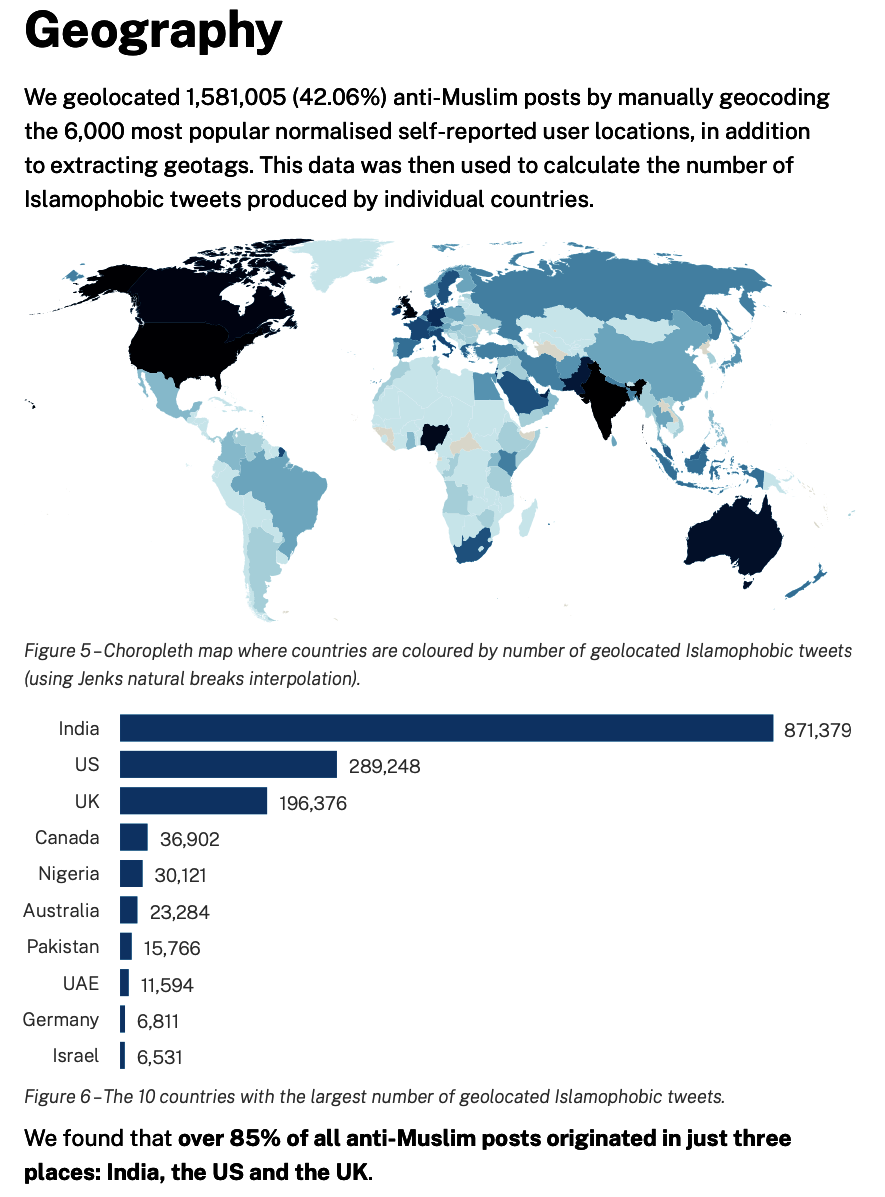
India Accounts For 55% of Islamophobic Tweets. Source: ICV


Individuals and organizations connected to the RSS (Rashtriya Swayamsevak Sangh) are active users of social media. They are working to promote India's divisive Islamophobic politics among the Non Resident Indians (NRIs) and their children. Hundreds of the RSS shakhas (branches) are now found in at least 39 countries around the world. Hindutva is a Hindu supremacist ideology inspired by 20th century Fascism and Nazism in Europe; it is very different from the ancient Hindu faith, according to American history professor Audrey Truschke who teaches Indian history at Rutgers University in the US state of New Jersey. Top Indian economists have raised alarm about it.  

India has only 23 million Twitter users, 5.75% of 400 million Twitter users worldwide, but Indians generate more than half of all Islamophobic tweets in the world.  Numbers published in Twitter’s advertising resources indicate that Twitter had 3.40 million users in Pakistan in early 2022. ICV counted 15,766 Islamophobic tweets geolocated to Pakistan in a three year period.

Executives at Meta, the parent company of Facebook, recently told human rights groups that they wouldn’t release the full India Hate Speech study for their own security. An earlier 2020 company study concluded that Hindutva groups support violence against Muslims and Christians & should be banned from the platform, according to the Wall Street Journal. Here's an excerpt of the Wall Street Journal story:

"Meta has for years faced criticism from rights groups and has been probed by authorities regarding the presence of hate speech on its platforms in India, where more than 300 million people use Facebook and more than 400 million are on its WhatsApp messaging service. Meta has said it invests significantly in technology to find hate speech across languages in India. In 2020, Meta’s safety team concluded that a Hindu nationalist organization in India supported violence against minorities and likely qualified as an organization that should be banned from Facebook, the Journal reported that year. Facebook didn’t remove the group following internal security-team warnings that doing so might endanger both its business prospects and staff in India". 


Thursday, January 28, 2021

Lina Khan: Pakistani-American Lawyer Fighting Big Tech Monopolies

Pakistani-American Lina Khan is seen as the front-runner for appointment to the US Federal Trade  Commission (FTC) as a commissioner in the  Biden administration.  She is a Columbia University Law professor who specializes in anti-trust law.  

Lina's 2017 seminal paper entitled "Amazon's Anti-trust Paradox" broke new ground in the application of anti-trust law against powerful technology monopolies like Amazon, Apple, Facebook, Google and Twitter. Traditionally, the US anti-trust actions have been focused on keeping consumer prices low. This narrow focus has helped big technology companies companies like Amazon, with its low prices, or Google and Facebook with their “free” services, to avoid anti-trust scrutiny.   

Lina was born in London in 1989 to Pakistani parents who migrated to the United States when she was 11. She graduated from Williams College with a BA degree and then studied law at Yale University. She is now an associate professor at Columbia Law School in New York City. 

Anti-Trust Scholar Lina Khan

US tech companies are facing increasing scrutiny in Washington over their growing size and power.  In October 2019, an investigation by the House Judiciary Committee issued a 449-page report. It accused the big technology companies of charging high fees, forcing smaller customers into unfavorable contracts and of using "killer acquisitions" to constrain competitors. "To put it simply, companies that once were scrappy, underdog startups that challenged the status quo have become the kinds of monopolies we last saw in the era of oil barons and railroad tycoons," it said. The appointment of Lina Khan as FTC commissioner would send a clear signal to the US tech giants that the Biden administration means business. 

Lina Khan acknowledges the popularity of the convenience and the free services offered by the large technology giants like Amazon, Facebook and Google but she worries about the longer-term implications of their anti-competitive behavior. “As consumers, as users, we love these tech companies,” she said. “But as citizens, as workers, and as entrepreneurs, we recognize that their power is troubling. We need a new framework, a new vocabulary for how to assess and address their dominance", she told the New York Times.     

Related Links:


Haq's Musings

New York's Little Pakistan

Pakistan is the 3rd Largest Source of Foreign Doctors in America

Pakistani-American Stars in "Big Sick" Movie

Pakistani-American Population Growth 2nd Fastest Among Asian-Americans

Silicon Valley Pakistani-Americans

A Dozen British Pakistanis in UK Pariament

Trump and Modi

OPEN Silicon Valley Forum 2017: Pakistani Entrepreneurs Conference

Pakistani-American's Tech Unicorn Files For IPO at $1.6 Billion Valuation

Pakistani-American Cofounders Sell Startup to Cisco for $610 million

Pakistani Brothers Spawned $20 Billion Security Software Industry

Pakistani-American Ashar Aziz's Fireeye Goes Public

Pakistani-American Pioneered 3D Technology in Orthodontics

Pakistani-Americans Enabling 2nd Machine Revolution

Pakistani-American Shahid Khan Richest South Asian in America

Two Pakistani-American Silicon Valley Techs Among Top 5 VC Deals

Pakistani-American's Game-Changing Vision 


Saturday, November 4, 2017

Social Media: Blessing or Curse for Pakistan?

Is the rapid growth of social media helping or hurting Pakistani state and society?

What are the consequences of the proliferation and abuse of the new media?

What about terrorist groups like ISIS using viral images and videos to radicalize young people?  Or the state-run intelligence agencies and their agents and bots using Facebook, Twitter and YouTube to spread disinformation to manipulate and divide people in countries and societies seen as hostile to their interests?

Is Pakistan being targeted by India's RAW and other hostile foreign intelligence agencies using social media to divide and manipulate Pakistanis by spreading fake news and doctored videos and images? Are they following the blueprint of the Russian intelligence troll farms that were used against America before, during and after the 2016 US presidential elections?

Should there be any codes of conduct or rules and regulations for social media users? Or should it be free-for-all?

ALKS host Faraz Darvesh discusses these questions with Riaz Haq (www.riazhaq.com)


https://youtu.be/zuPMy65O6-s


Related Links:

Haq's Musings

Indian BJP's Social Media Troll Farms

Social Media in Pakistan

CIA and ISIS

Is India Sponsoring Terror in Pakistan?

Tarek Fatah vs Riaz Haq

Husain Haqqani vs Riaz Haq

Talk4Pak Youtube Channel

Saturday, May 7, 2011

Can Bin Laden Raid Ignite Twitter Revolution in Pakistan?

Live tweets of the Abbottabad raid have brought instant fame to Pakistani blogger Sohaib Athar, and shined new light on the role of Facebook, Twitter and other social media in the country.

Dramatic expansion of the nation's middle class in the last decade has spawned telecom and media revolutions in Pakistan. Number of radio stations, television channels, mobile phone subscribers and Internet users have all experienced unprecedented growth since the turn of the century.


The level of Internet penetration is Pakistan is still low. In a population of 177 million, only 18.5 million (10.4 percent) are connected to the Internet, though government officials quote a slightly higher figure of 20 million. Although it's twice that of India's Internet penetration of about 5%, Pakistan's penetration percentage is less than those in Tunisia (33.4 percent) and Egypt (21.1 percent). However, Internet use in Pakistan is growing at a rapid rate, particularly in urban centers where 40% of the population lives, which are also home to the middle class which often forms the backbone of mass-scale uprisings. Mobile Internet use shot up 161 percent in 2010 alone.

Pakistan figures prominently in the population of users of Facebook and Twitter, two of the most popular social networking sites.

In terms of Facebook users in Asia, South Korea saw the largest increase of 65%, between March 01 2010 and June 01 2010. Other countries with double-digit growth rate are Thailand with 28.3%, India 27.7%, Japan 21%, Pakistan 12.9%, Malaysia 12.3%, and Vietnam 10.4%. Compared to figures extracted in March 2010, total Facebook users in Indonesia and Taiwan have shown decline, according to Grey Review.

According to Alexa, Twitter.com is the number twelve website in the world. It also ranks at number twelve in the United States. Outside the United States, Twitter is the eighth largest website in South Africa. The United Kingdom, Pakistan, and the Philippines all have Twitter as their tenth largest website, according to The Next Web.

Pakistan saw the beginnings of online civil and political activism in 2008-2009 when the lawyers, according to Woodrow Wilson Center's scholar Huma Yusuf, "used chat forums, YouTube videos, Twitter feeds, and blogs to organize the Long March, publicize its various events and routes, and ensure that citizen reporting live from the march itself can be widely circulated to counter the government-influenced coverage of the protest on mainstream media outlets (such as state-owned radio and private news channels relying on government-issue licenses".

With Pakistan's youth bulge and rapid growth in online user population, it is natural to ask if an Egyptian or Tunisian style youth-led revolution is on the horizon in the South Asian nation? Can the current disgust with the the failed political, military and intelligence establishment catalyze a mass youth uprising against the established order?

Here's a video titled "I Am Pakistan":


Related Link:

Haq's Musings

Pakistan's 50Mbps Broadband Rollout

Daily Carnage and Intelligence Failures in Pakistan

Pakistani Online Social Network

Telecom and Media Revolution in Pakistan

Middle Class Growth in Pakistan

Geo Sports Ban Amidst Youth Bulge

US Mining Twitter Feed Urdu Content

Obama's Success With Social Media

Obama on Urdu Poetry, Cricket, Daal, Keema

Case Against Wikileaks' Assange

PakAlumni-Pakistani Social Network

Media and Telecom Revolution in Pakistan

Pakistan's Telecom Boom

Pakistan Tops Text Message Growth

WiMax Rollout in Pakistan

Sunday, April 10, 2011

US Mining Urdu Content on Facebook and Twitter?

Why does the US government love social media and hate Wikileaks?

The answer is simple: Unlike Wikileaks that reveals unflattering information about its inner workings, the US government sees a treasure trove of detailed data on Facebook, twitter, blogs and other social media...particularly in Urdu and Arabic in light of recent developments in the Middle East and South Asia.


All of the stuff on digital social networks can be a great source of knowledge about user data and sentiments that governments and corporations love to exploit. It can be used not only to gather valuable intelligence for better product marketing and effective government propaganda, but also to tweak policies and offer products and services through crowd-sourcing to achieve desired outcomes.

The real challenge is how to make sense of the vast amount of information, discern meaningful patterns and use it as guide for action. The current application programming interfaces (APIs) and tools for social media monitoring and analysis are still evolving. The current tools focus mainly on sentiment analysis, giving governments and companies a general sense at best.

Among the various researchers tackling the challenge is an Indian-American computer scientist Rohini Srihari. She is working under a US grant to help mine and decipher data from Urdu social media. Her company, called Janya Inc., gets funding from the Pentagon for the project.

In a recent interview with NPR Radio, Srihari explained: "What I want is to determine who are the people, places and things being talked about; Is there an opinion being expressed? Is it a positive or negative opinion being expressed?"

If the ongoing social media data mining research efforts do succeed, the rich and powerful corporations and governments will be further strengthened to manipulate the opinions and preferences of the average consumers and voters. Such an outcome could lead to people being influenced to act against their own best self-interest in the name of freedom and democracy.

Here's a video clip titled "Urdu Enters the Digital Age" featuring Srihari explaining how her software works:


Related Links:

Haq's Musings

Obama's Success With Social Media

Obama on Urdu Poetry, Cricket, Daal, Keema

Case Against Wikileaks' Assange

PakAlumni-Pakistani Social Network

Media and Telecom Revolution in Pakistan

Pakistan's Telecom Boom

Pakistan Tops Text Message Growth

WiMax Rollout in Pakistan

Wednesday, August 27, 2008

Indian Brothers Lash Out at Facebook

Jayant and Rajat Agarwalla, the Calcutta-based developers of the Facebook application Scrabulous, have lashed out at Facebook for worldwide removal of their popular creation. With over half a million users, Scrabulous is likely the most popular online version of Scrabble (Hasbro's own Facebook version of Scrabble, which was released in July, has a little over 9,000 users). The Agarwalla brothers have a point: Why did Facebook yield to bullying by Mattel in the absence of a court order?

The Indian brothers are not alone in their criticism. Prof. Peter Fader, co-director of the Wharton Interactive Media Initiative, told the Knowledge@Wharton online business journal that Hasbro’s move was an “incredibly bad business decision.” Scrabulous “has been such a fabulously good thing for the Scrabble franchise [that] Hasbro should have been celebrating. ” The Wharton online article notes that Scrabulous in 2007 had about 1.3 million monthly users and had 600,000 players each day. Not only is Hasbro making a big PR blunder by alienating and angering Scrabulous’s fans, but it’s also missing a great opportunity to harness the online game’s popularity, Prof. Fader added.

The Wharton article goes on to note that many companies are too quick to pursue infringers – especially in today’s Web 2.0 world where viral expansion can greatly help, not hurt, a brand. Hasbro clearly didn’t like another outfit capitalizing on the household name it spent years building. But nowadays having such enormous popularity associated with your brand – even if it’s not technically authorized — might not be such a bad thing after all.

Facebook decision to take down Scrabulous does have consequences for its own future. If Mark Zuckerburg does not learn to fight off challenges like the Hasbro/Mattel challenge, Facebook will have to pay a price in terms of stunted growth of what Forbes describes as the Facebook economy.

The Scrabulous fight is just another manifestation of the traditional media and entertainment companies' inability to understand and exploit the new opportunities presented by rapidly growing online consumers of content including music, videos, games, etc. In this particular instance, for example, Hasbro instead could have formed a partnership with the Agarwalla brothers or bought the game from them.

As the battle of Scarbulous rages on, the India-based brothers are not standing still. They have developed another online spelling game that’s gaining traction.

Sunday, February 24, 2008

Obama Campaign's Success On Social Networks

Election Campaigns Transformation:
President John F. Kennedy's campaign in the early 1960s transformed the way the US presidential campaigns use Television as a medium to reach the American electorate. This year, Barack Husain Obama's campaign is re-writing the rules as it embraces Web 2.0 technologies to reach out to the young voters across the nation. The dramatic success of the Obama campaign among young, affluent voters and on college campuses has been quite a phenomenon. Obama has personally been a very active participant on Facebook. Obama's most passionate supporters and workers are mostly young, college students or recent university graduates who hang out on the social networks for hours on a daily basis. This passionate support of young men and women has translated into great success in terms of votes and campaign contributions. There are reports of both the Clinton and the McCain campaigns having money troubles, in spite of their appeal to the big establishment donors in both parties. Obama has had no such problems.

Online Campaign Statistics:
Here are some statistics published by The Mercury News that show the extensive use the online communities by all three camapaigns:

Facebook Supporters:Obama: 610,225; Clinton: 121,955; McCain: 71,079; Huckabee:65,664
YouTube Views: Obama: 22m; Clinton: 7m; Huckabee: 5m; McCain: 2m
Percent of campaign web traffic: Obama: 44%; Clinton: 26%; Huckabee: 16%; McCain: 8%

Fundraising:
Here are more excerpts from San Jose Mercury on Obama Fundraising success on the Internet:
"....the extent of Obama's online fundraising prowess - $28 million in January, with signs that total will be exceeded this month - has outstripped all competitors and stunned many political analysts. About 90 percent of that money came in donations of $100 or less, allowing donors to give again every few weeks - up to the limit of $2,300 each for the primary and general elections.
GOP strategist All said he knew Obama was onto something during a summer visit last year to a friend in Ohio who planned to contribute $10 or $15 a month to Obama. "That campaign understood ahead of everyone else that you don't need to rely on megabucks and bundlers, and I'm afraid some Republicans still don't get that," All said.
Obama's huge donor base, now approaching 1 million, allowed a long-shot campaign to grow into a national force, outspending Clinton in state after state. And it freed up Obama to campaign while Clinton had to spend time with fundraising events.
"This is a wonderful, new development," said Zephyr Teachout, a leader of the Howard Dean campaign in 2004, which raised a total of $27 million online over many months. "Instead of calling rich people for money, you can concentrate on your campaign."
The campaign invested early in Internet infrastructure, spending $2 million in 2007 on software and hardware. Some of Obama's new-media leaders, such as Joe Rospars, came from the Dean campaign and Blue State Digital, a consulting firm."

Election Campaigns in Pakistan:
Turning attention to Pakistan, this year we saw a dramatic increase in election campaigning on the multiple TV channels and networks in the recent elections. With the growth of the Internet access, we can expect a very active Pakistani blogosphere to play a bigger role in election campaigns of the future, particularly in urban Pakistan. Social networks such as PakAlumni Worldwide and Naseeb.com are also starting to grow and may become useful tools for election campaigns as well as growth in online commerce.

Thursday, January 10, 2008

Social Networking in Pakistan is Lagging

As the membership of social networks and the users of social media applications such as Facebook, MySpace, and Orkut grow dramatically to hundreds of millions in the US, Europe, Asia and Latin America, it seems that this phenomenon is still in very early infancy in Pakistan. As of now, there are about 117,000 Pakistanis on Facebook, about 100,000 on Orkut, and a few thousand on MySpace. There are smaller social networks such as Naseeb.com that have a few thousand Pakistani members as well. While Naseeb.com bills itself as a Muslim social network, it seems primarily focused on match-making. Pakistan's middle class is estimated to be about 25m people, larger than the population of several European countries and Australia. With such a large middle class population, only a small fraction is participating in the social networking phenomenon. The reasons cited for this minuscule participation include the lack of access to the PC and the Internet, lack of familiarity, and shyness standing in the way of appropriate public self-expression. While I acknowledge that these might be contributing factors, I believe the main factor is the lack of a socially and culturally appropriate content and welcoming environment that suits the Pakistani sensibility and taste. It is something hard to describe but it is something you know when you see it. A new social network called PakAlumni Worldwide has recently been launched to serve this exact need and to encourage Pakistanis to participate in larger numbers. It is still in its early days with about 700 members but growing rapidly. The membership includes a large number of Pakistanis living in the United States, Europe, the Middle East and various parts of Asia. The social connections made via PakAlumni can easily turn into business connections and bring the Pakistani diaspora together to grow closer and more prosperous and help Pakistan achieve greatness in the process while improving its civil society and image.

Bilawal Bhutto's Extra-curricular Activities at Oxford

In his high-profile role as the Chairman of one of Pakistan's largest political parties, there are enormous security threats for Bilawal Bhutto Zardari. In the words of John Giduck, a US security consultant, "The threat level is going to be inordinately high - you are dealing with a young man with an enormous target painted on him. It would take dozens of people and hard assets to keep this man safe". In addition to this security threat, Bilawal is dealing with the loss of his privacy with the British tabloids such as The Sun and The Daily Mail pursuing and finding more and more pictures of him with various male and female friends at various parties in Oxford. Bilawal is reportedly very popular on the Oxford campus and participates in many extra-curricular activities. The Daily Mail has discovered a number of Facebook comments including references to being hungover, his friendship with "Boozie Suzie" and the joys of free alcohol. This new found fascination of the British tabloids is likely to continue in spite of Bilawal's pleas for privacy.

For more on this, please take a look at PakAlumni website.

Saturday, January 5, 2008

Obama's History-Making Win and Implications for Pakistan

Barack Hussain Obama's historic win in Iowa caucuses clearly signals that desire for change in America is strong and all-encompassing. The scope of this change includes a new willingness to accept a black man as commander-in-chief, a break from the Bush policies such as the choice of military force over soft power and diplomacy in international affairs, and increasing concern to provide ordinary citizens with broader access to healthcare and education. The people of Iowa strongly endorsed Obama's message of change and rejected Hilary's message of experience as continuation of the business-as-usual rather than a strength. After the win, Obama said to a wildly cheering supporters, "They said this day would never come. They said our sights were set too high. Our time for change has come." Obama's victory speech carried live on national TV was widely well received. Some even compared it with the memorable speeches of FDR and MLK. The Obama candidacy has energized a lot of people, including a large number young men and women, and brought them into the electoral process. Just look at how large a presence Obama supporters have on Facebook and college campuses.

Here's what Obama wrote on his Facebook page right after his election win: "We just won Iowa, and I'm about to head down to talk to everyone.
Democrats turned out in record numbers tonight, and independents and even some Republicans joined our party to stand together for change.
Thank you for everything you've done to make this possible."

From this message, it is clear that Obama wants to tap the clamoring for change in America by all, including Republicans. He wants to be a unifier to lead this effort for positive change in America.

Regardless of the ultimate outcome of this race, Obama has already made history by winning in Iowa as the first black presidential candidate. The fact that it happened in Iowa, the first state to vote in primaries and the state with more than 90% whites, is particularly encouraging for those of us looking for big changes in the US.

Comparing the hard-fought primaries for the political parties here in the US with the political parties in Pakistan, the less said the better. In Pakistan, Hilary Clinton would have already been crowned the leader of her party for life. It would be quick and efficient and still be considered entirely "democratic".

Here's a video of Obama's widely-acclaimed speech after the Iowa win:


I have received a number of questions from my Pakistani friends on Obama's views from Pakistani perspective. Here is how I explain what Obama's win is likely to mean for Pakistan:

The US presidential elections are won mainly on domestic issues except
the last election in the aftermath of 911 where security issues figured
prominently and George W. Bush won.
Obama made statements about unilaterally sending US troops into Pak
that were widely ridiculed in the US. He has since backtracked on
those statements. US presidential candidates (with a few exceptions)
are not very knowledgeable about the world and rely mainly on experts
when the time comes to make policy. Obama will do the same, if he gets
any further from the first two or three primaries.
Democrats in general tend to favor democracy and human rights (since
the Carter administration) rather than dictators often favored by
Republicans. Democrats also tend to be more pro-India and pro-Israel
but usually are not pro-war. They are likely to emphasize
soft power and diplomacy if they win the White House.
A Democrat in the White House is not going to be good for President Musharraf,
unless Musharraf really changes his ways.
The Democrats will probably reach out more to the civil society and
political parties in Pakistan. The bottom line will still be to support secular
forces and weaken the religious elements. Maulana Fazlur Rahman may be
an exception to this. He is seen as someone who can help neutralize
the anti-US elements in NWFP and Baluchistan.

Thursday, January 3, 2008

Bilawal Bhutto Zardari in Devil Costume at a Halloween Party in Oxford

“We’re ready to bring hell on earth. . . waaahahahahahah.”

Here is a picture of Bilawal Bhutto Zardari (Facebook alias: Bilawal Lawalib) posing with a friend published by the UK tabloid The Sun. The Sun obtained it from Facebook. This picture reinforces the fact that Bilwawl is just a kid, enjoying life as college kids do in the West. Poor Bilawal. He's been pushed into this limelight by his father at such a young age. I just hope it does not invite the attention of the unsavory elements in society.