Showing posts with label Population. Show all posts

Tuesday, October 29, 2024

Will India Grow Old Before it Gets Rich?

India's population has aged faster than expected while its economic growth has slowed over the last decade. This raises the obvious questions: Will India get old before it gets rich? Is India getting poorer relative to its peers in the emerging markets? 

India's Population Aging. Source: Semafor

As India's birth rate declines rapidly, the proportion of people age 60 and over is rising in the general population. This is particularly true of the southern states like Kerala and Tamil Nadu. Meanwhile, the expected demographic dividend from the youth bulge in the country has yet to materialize. High youth unemployment is threatening to cause serious social instability in the world's most populous country. It is also causing a massive brain drain.  

India's GDP Per Capita Compared to Emerging Markets Average. Source: IMF

India is losing its best and brightest to the West, particularly to the United States, at an increasingly rapid pace. A 2023 study of the 1,000 top scorers in the 2010 entrance exams to the Indian Institutes of Technology (IIT) — a network of prestigious institutions of higher learning based in 23 Indian cities — revealed the scale of the problem. Around 36% migrated abroad, and of the top 100 scorers, 62% left the country, according to a report in the science journal Nature.  Nearly two-thirds of those leaving India are highly educated, having received academic or vocational training. This is the highest for any country, according to the Organization for Economic Co-operation and Development.

Annual Population Growth Rapidly Falling Across India. Source: Semafor

India has the lowest GDP per capita among the 5 BRICS nations. The country's GDP growth rate is much slower than the average for emerging markets. It means that India is becoming poorer relative to the rest of the developing world. 

GDP Per Capita Map 2024. Source: IMF
India's GDP Per Capita is Very Low. Source: BBC

The north-side geographic divide in India is growing. The southern five of India’s 28 states (Andhra Pradesh, Karnataka, Kerala, Tamil Nadu and Telangana) contain 20% of the population and contribute 31% of the GDP, according to The Economist magazine. Among startups, 46% of tech “unicorns” are southerners, particularly from Bangalore. The five southern states provide 66% of the it-services industry’s exports. The latest craze is for “global capability centers”, where multinationals assemble their global auditors, lawyers, designers, architects and other professionals: 79% of these hubs are in the south.

Indian Parliament Seats Based on Current Population. Source: National Herald

There has always been a north-south divide in India in terms of population and wealth. The south has been wealthier and less populous than the north. But the political power is still concentrated in the poorer and more populous northern states. This situation serves Prime Minister Narendra Modi and his BJP party well. But it also creates significant resentment in southern states. 

In his book "The Raisina Model", British Lord Meghand Desai says that India's breakup can not be ruled out. Specifically, he points to three issues that could lead to it:

1.  Cow protection squads are killing Muslims and jeopardizing their livelihoods.  The current agitation about beef eating and gau raksha is in the Hindi belt just an excuse for attacking Muslims blatantly. As most slaughterhouses in UP are Muslim-owned, owners and employees of these places are prime targets.

2. India has still not fashioned a narrative about its nationhood which can satisfy all. The two rival narratives—secular and Hindu nation—are both centered in the Hindi belt extending to Gujarat and Maharashtra at the most. This area comprises 51% of the total population and around 45% of the Muslims in India.

3. India has avoided equal treatment of unequal units. Representation in the Rajya Sabha (Upper House of Parliament) is proportional to population size. The larger states dominate both Houses of Parliament. It would be difficult for small states to object, much less initiate reform. In future, small states could unite to present their case for better treatment. 

Related Links:

Haq's Musings

South Asia Investor Review

Guess Why Pakistani Analyst Uzair Younus is Making Headlines in India!

Ambassador Kishore Mahbubani: America Does Not Respect India

World Happiness Report: India Among Saddest Nations of the World

Balakot and Kashmir: Fact Checkers Expose Indian Lies

WB Poverty Update: India Biggest Contributor to Increase in Poverty

India in Crisis: Unemployment, Hunger Persist After Waves of Covid

Modi's Blunders and Delusions 

India's Israel Envy: What If Modi Attacks Pakistan?

Project Azm: Pakistan to Develop 5th Generation Fighter Jet

Pakistan Navy Modernization

Pakistan's Sea-Based Second Strike Capability

Who Won the 1965 War? India or Pakistan?

Is the West Unwittingly Helping Modi Realize His Akhand Bharat Hindutva Dream?

Has Pakistan Lost All Wars? 


Wednesday, November 23, 2022

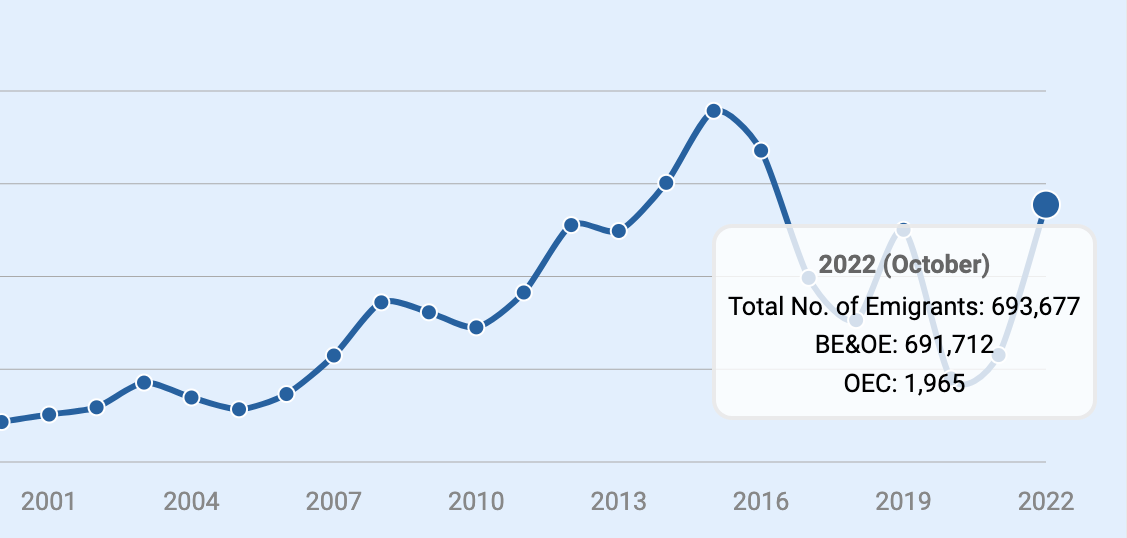
Nearly 700,000 Pakistani Workers Have Migrated Overseas So Far in Year 2022

Nearly 700,000 Pakistanis have left to work overseas in the first 10 months of the current calendar year, according to Pakistan's Bureau of Emigration Overseas Employment (BEOE). The worker migration from Pakistan had dipped to 225,000 in 2020 and 280,000 in 2021 due to Covid restrictions around the world. The yearly average for the last decade was over half a million Pakistanis migrating to other countries for work.  In August this year, the State Bank of Pakistan said in its "Half Year Report 2021-22" that “(t)he monthly flow of Pakistani workers (overseas) has reverted to pre-Covid levels (of 65,000 per month).” The data from International Organization for Migration (IOM) shows that a lot more of the Pakistan migrants are now skilled labor while the share of unskilled migrants is declining: "Pakistani migrant workers were skilled (42%) and involved in semi-skilled jobs such as welders, secretaries, masons, carpenters, plumbers and so on. Another proportion of the labour migration was composed of unskilled laborers (39%) such as agriculturists, laborers or farmers. Projections about future trends indicate that the number of Pakistani labour migrants will continue rising to reach 15.5 million in 2020 (Government of Pakistan, 2018". Larger and increasingly higher skilled diaspora is expected to sustain double-digit annual growth in overseas worker remittances to Pakistan. 

Pakistani Workers Going Overseas. Source: Bureau of Emigration

Demographic Dividend: 

With rapidly aging populations and declining number of working age people in North America, Europe and East Asia, the demand for workers will increasingly be met by major labor exporting nations like Bangladesh, China, India, Mexico, Pakistan, Russia and Vietnam. Among these nations, Pakistan is the only major labor exporting country where the working age population is still rising faster than the birth rate. 

Over 10 million Pakistanis are currently working/living overseas, according to the Bureau of Emigration. Before the COVID19 pandemic hit in 2020,  more than 600,000 Pakistanis left the country to work overseas in 2019. Nearly 700,000 Pakistanis have already migrated in this calendar year as of October, 2022. The average yearly outflow of Pakistani workers to OECD countries (mainly UK and US) and the Middle East was over half a million in the last decade. 

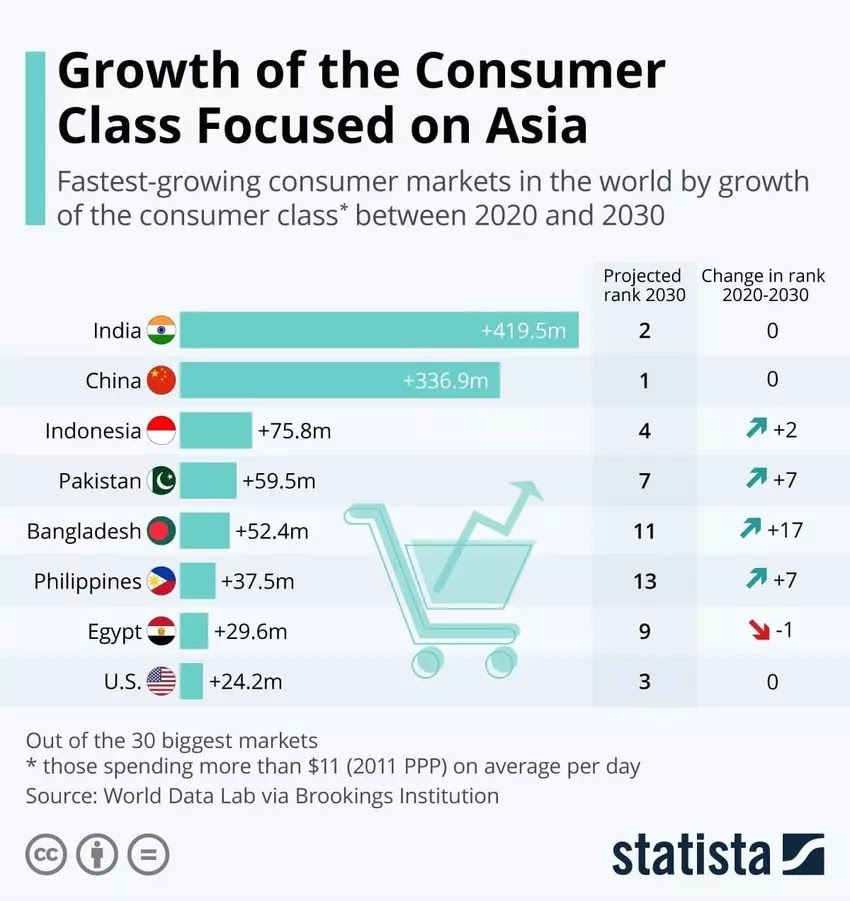
Consumer Markets in 2030. Source: WEF


World's 7th Largest Consumer Market:

Pakistan's share of the working age population (15-64 years) is growing as the country's birth rate declines, a phenomenon called demographic dividend. With its rising population of this working age group, Pakistan is projected by the World Economic Forum to become the world's 7th largest consumer market by 2030. Nearly 60 million Pakistanis will join the consumer class (consumers spending more than $11 per day) to raise the country's consumer market rank from 15 to 7  by 2030. WEF forecasts the world's top 10 consumer markets of 2030 to be as follows: China, India, the United States, Indonesia, Russia, Brazil, Pakistan, Japan, Egypt and Mexico.  Global investors chasing bigger returns will almost certainly shift more of their attention and money to the biggest movers among the top 10 consumer markets, including Pakistan.  Already, the year 2021 has been a banner year for investments in Pakistani technology startups

Record Remittances From Overseas Pakistanis:

Pakistan is already seeing high levels of labor export and record remittances of over $30 billion pouring into the country. Saudi Arabia and the United Arab Emirates(UAE) are the top two sources of remittances but the biggest increase (58%) in remittances is seen this year from Pakistanis in the next two sources: the United Kingdom and the United States.

Remittances from the European Union (EU) to Pakistan soared 49.7% in FY 21 and 28.3% in FY22, according to the State Bank of Pakistan. With $2.5 billion remittances in the first 9 months (July-March) of the current fiscal year, the EU ($2.5 billion) has now surpassed North America ($2.2 billion) to become the third largest source of inflows to Pakistan after the Middle East and the United Kingdom. Remittances from the US have grown 21%, second fastest after the EU (28.3%) in the first 9  months of the current fiscal year. 

Pakistan ranks 6th among the top worker remittance recipient countries in the world.  India and China rank first and second, followed by Mexico 3rd, the Philippines 4th, Egypt 5th and Pakistan 6th.  

Pakistan Demographics

About two million Pakistanis are entering the workforce every year. The share of the working age population in Pakistan is increasing while the birth rate is declining. This phenomenon, known as demographic dividend, is coinciding with declines in working age populations in developed countries. It is creating an opportunity for over half a million Pakistani workers to migrate and work overseas, and send home record remittances. 

Sunday, July 17, 2022

UN Report: Last Decade Saw 16.5 Million Pakistanis Migrate Overseas

Among 10 countries with the estimated net outflow of migrants exceeding 1 million over the period from 2010 through 2021, Pakistan saw 16.5 million migrants move overseas, the highest in the world, according to a report titled "World Population Prospects 2022" released by the United Nations Department of Economic and Social Affairs (UN DESA). 

Pakistani Workers' Overseas Migration Data (2010-2021). Source: Bureau of Emigration


In many of these countries with more than one million people leaving, the outflows were due to temporary labor movements, such as for Pakistan (net outflow of 16.5 million), India (3.5 million), Bangladesh, (2.9 million), Nepal (1.6 million) and Sri Lanka (1.0 million).  The report also said that India's population will surpass China's in 2023. Over half of the global population increase up to 2050 will be in just 8 countries: Democratic Republic of Congo, Egypt, Ethiopia, India, Nigeria, Pakistan, the Philippines & Tanzania.

Population Sizes of China, India and Pakistan 1950-2099. Source: Our World in Data

The figure of 16.5 million migrants outflow from Pakistan is much higher than the numbers reported by the Bureau of Emigration & Overseas Employment of the Government of Pakistan. A possible source of discrepancy is the uncounted numbers of the family members who accompany workers going abroad for work.  

Between 2010 and 2021, 40 countries or territories have experienced a net inflow of more than 200,000 migrants; in 17 of those, the total net inflow exceeded 1 million people. In 2020, Turkey hosted the largest number of refugees and asylum seekers worldwide (nearly 4 million),followed by Jordan (3 million), the State of Palestine (2 million) and Colombia (1.8 million). Other major destination countries of refugees, asylum seekers or other persons displaced abroad were Germany,  Lebanon, Pakistan, Sudan, Uganda and the United States of America. 

Top Remittance Receiving Countries in 2021. Source: World Bank

Pakistan has received nearly $31 billion in worker remittances in 2021, up a whopping 20% from the prior year, according to the World Bank. This is a new record representing nearly 10% of the country's gross domestic product (GDP). This money helps the nation cope with its perennial current account deficits. It also provides a lifeline for millions of Pakistani families who use the money to pay for food, education, healthcare and housing. This results in an increase in stimulus spending that has a multiplier effect in terms of employment in service industries ranging from retail sales to restaurants and entertainment. 

Remittances from the European Union (EU) to Pakistan soared 49.7% in FY 21 and 28.3% in FY22, according to the State Bank of Pakistan. With $2.5 billion remittances in the first 9 months (July-March) of the current fiscal year, the EU ($2.5 billion) has now surpassed North America ($2.2 billion) to become the third largest source of inflows to Pakistan after the Middle East and the United Kingdom. Remittances from the US have grown 21%, second fastest after the EU (28.3%) in the first 9  months of the current fiscal year. 

Pakistan's share of the working age population (15-64 years) is growing as the country's birth rate declines, a phenomenon called demographic dividend. This dividend is manifesting itself in high levels of worker exports and record remittances pouring into the country. Saudi Arabia and the United Arab Emirates(UAE) are the top two sources of remittances but the biggest increase (58%) in remittances is seen this year from Pakistanis in the next two sources: the United Kingdom and the United States. 

Over 10 million Pakistanis are currently working/living overseas, according to the Bureau of Emigration. Before the COVID19 pandemic hit in 2020,  more than 600,000 Pakistanis left the country to work overseas in 2019. The average yearly outflow of Pakistani workers to OECD countries (mainly UK and US) and the Middle East has been over half a million in the last decade. 

Pakistan ranks 6th among the top worker remittance recipient countries in the world.  India and China rank first and second, followed by Mexico 3rd, the Philippines 4th, Egypt 5th and Pakistan 6th.  

Pakistan Demographics

About two million Pakistanis are entering the workforce every year. The share of the working age population in Pakistan is increasing while the birth rate is declining. This phenomenon, known as demographic dividend, is coinciding with declines in working age populations in developed countries. It is creating an opportunity for over half a million Pakistani workers to migrate and work overseas, and send home record remittances. 

Projected Population Decline in Emerging Economies. Source: Nikkei Asia

common myth about emigration is that it is driven by poverty. But the fact is that the poorest and least developed people tend to stay put where they are; they do not migrate. It's only people who have a certain level of income and skills who are more likely to migrate to other countries for better opportunities. This fact has been well-established by multiple studies conducted in Africa.

Here's an except of African Development Bank report on migration:

"Results show that despite increase in the absolute number of migrants, Africa, particularly SubSaharan Africa has one of the lowest rate of emigration in the world .... Poorer countries generally have lower rate of emigration ......Bad socio-economic conditions generally seem to lead to higher rate of emigration by highly skilled individuals. Generally, migration is driven by motives to improve livelihoods with notable evidence on changes in labor market status. Often, self-employed or unemployed émigré ended up in wage employment. The paper outlines policy issues emerging from the migration trend in Africa."

Migration vs Human Development Source: Hein de Haas


Data shows that increased human and economic development is initially associated with increasing emigration. Any form of development in the poorest countries of the world is therefore likely to lead to accelerating emigration. Such findings contradict conventional thinking and force us to radically change our views on migration. Such rethinking can be achieved by learning to see migration as an intrinsic part of broader development processes rather than as a problem to be solved, or the temporary response to development “disequilibria”, according to The Conversation, a US publication.

Thursday, December 2, 2021

Why Are Muslim Births in Sharp Decline in Indian Occupied Kashmir?

Muslim women's fertility rate in Indian Occupied Kashmir has sharply declined to just 1.4, far below the replacement level of 2.1, according to India's latest National Family Health Survey (NFHS-5).  Is this the result of Indian Prime Minister Narendra Modi's oppression in Kashmir? Is it because of fewer Muslim young men in the occupied territory? Is it part of the Hindu Nationalist policy to change the demographics of Kashmir? Is it slow genocide

Kashmiris Demanding Azadi From India


Just over a week ago, India’s health ministry revealed that the country’s total fertility rate (TFR)—the average number of children that an Indian woman can expect to give birth to in her lifetime—has fallen below 2.1, which is to say below the “replacement” level at which births equal deaths. Muslim majority territory of Kashmir under Indian military occupation saw the biggest decline to just 1.4, the lowest TFR  reported by NFS-5. Hindu Nationalist politicians, including Prime Minister Modi, have rallied their Hindu voters by claiming that Muslims have too many babies. Legislation aimed at Muslims is being proposed to limit the size of families in the state of Uttar Pradesh led by Hindu priest Yogi Adityanath.  


India's Birth Rate Decline. Source: The Economist

The birth rates in Mr. Modi's BJP party's power base in the Hindi heartland continue to be much higher than those in the southern states. What this means is that the bulk of India's future voters and its workforce will continue to come mainly from the poor, less educated northern states. In 1971, Prime Minister Indira Gandhi froze the allocation of seats among India's states. As a result of this freeze, a member of parliament from Kerala now represents some 1.8 million voters while one from Uttar Pradesh represents nearly 3 million, according to a report in The Economist magazine. When the freeze on redistricting is lifted some time in the next decade, these disparities will mean that the northern states will have far more political power in the Union than they do now. 

The Indian military has kept Occupied Kashmir under extended and inhumane lockdown to prevent protests against New Delhi's reckless decision to scrap Article 370 of the Indian Constitution. The lockdown is being enforced by over 700,000 Indian troops deployed in Jammu and Kashmir.  People have been kept imprisoned in their homes for months. They were deprived of Internet, telephone or television for extended periods.  Delhi rules the region under Armed Forces Special Powers Act, the same law that was created and used by the British colonial power to try and crush Gandhi's Quit India movement. Thousands have died and more than 6,221 people received pellet gun injuries in the seven months following the July 2016 killing of Burhan Wani, according to the Jammu and Kashmir government as reported by The New Humanitarian.  Mr. Modi's actions are not only an affront to the people of Jammu and Kashmir but also in clear violation of India's international and bilateral obligations under United Nations charter and the Simla Accord.   It is time for all sane Indians and the rest of the world to wake up to the serious threats posed to peace in South Asia region and the wider world by Mr. Modi's fascist Hindutva project.

Monday, September 25, 2017

How Has Bangladesh Left Pakistan Behind in Per Capita Income?

A headline in the Economist magazine's recent issue screams: "Bangladesh's GDP per person is now higher than Pakistan's". Let's examine this development to understand its causes.

Per Capita GDP:

The Economist article explains its headline as follows: "Last month revealed a remarkable turnaround. Bangladesh’s GDP per person is now higher than Pakistan’s. Converted into dollars at market exchange rates, it was $1,538 in the past fiscal year (which ended on June 30th). Pakistan’s was about $1,470....Strange as it may sound, Bangladesh jumped ahead because of an advance in Pakistan. On August 25th Pakistan released the results of its census, updating earlier population estimates. They showed that the country has 207.8m people, more than 9m more than previously thought. It may now have the fifth biggest population in the world, surpassing Brazil’s. But the new count also lopped 4-5% off Pakistan’s GDP per person, the arithmetic consequence of revealing so many more people."

Savings Rate in Pakistan Source: State Bank of Pakistan

Pakistan Growth By Decades. Source: National Trade and Transport Facility

Economic Growth Trends:

One can quibble with the Economist on details of its report but the fact remains that Bangladesh's economy has been growing significantly faster than Pakistan's for about a decade. To understand why, it's important to look into savings and investments, population growth trends and security situation in the two countries. Let's examine each in a little more detail.

Investment as Percentage of GDP Source: State Bank of Pakistan

Savings and Investment:


There's a strong relationship between investment levels and gross domestic product. The more a country saves and invests, the higher its economic growth.  A State Bank of Pakistan report explains it as below:

"National savings (in Pakistan) as percent of GDP were around 10 percent during 1960s, which increased to above 15percent in 2000s, but declined afterward. Pakistan’s saving rate also compares unfavorably with that in neighboring countries: last five years average saving rate in India was 31.9 percent, Bangladesh 29.7 percent, and Sri Lanka 24.5 percent..... Similarly, domestic savings (measured as national savings less net factor income from abroad) also declined from about 15 percent of GDP in 2000s, to less than 9 percent in recent years. Domestic savings are imperative for sustainable growth, because inflow of income from abroad (remittances and other factor income) is uncertain due to cyclical movements in world economies, exchange rates, and external shocks".

Net Foreign Direct Investment Source: State Bank of Pakistan

Population Trends:

The total fertility rate (TFR) in Bangladesh has declined faster in Bangladesh than in Pakistan in the last few decades. Currently, Bangladesh is at 2.17 children per woman while Pakistan is at 2.62 children per woman.

As a result of reduced birth rates and more female labor participation rates, a larger percentage of Bangladeshi population is in the work force than Pakistan's. There are now more wage earners and fewer dependents in each Bangladeshi household. This demographic trend has helped boost Bangladesh's per capita income faster than Pakistan's. 

Rising working age population and growing workforce participation of both men and women in Pakistan will significantly boost domestic savings and investment. Increased foreign direct investment such as Chinese investment in China-Pakistan Economic Corridor over the next several decades will help fill the gap between the national savings rate and investments required to reach 7% annual GDP growth to create over 2 million jobs a year.

Security Issues:

Pakistan has paid a heavy price for its proximity to and involvement in "war on terror" in Afghanistan. It has cost Pakistan dearly in terms of loss of thousands of precious lives and lower investments due to investors' security concerns. Recent operations by Pakistan Army have helped turn the tide against terrorists, bringing more hope and greater confidence in Pakistan's future. Rising FDI in CPEC-related projects in the last couple of years are an indication of this confidence.

Future:

Pakistan is now experiencing the demographic dividend that Bangladesh has seen in the last few decades in terms of more of its population earning and fewer dependents. Pakistan's labor force is growing at 3.6% a year, much faster than its population growth rate of 2.34%. This should help boost Pakistan's per capita and its domestic savings rate.

At the same time, China-Pakistan Economic Corridor (CPEC) related projects are bringing more foreign direct investment, thereby speeding up the economic growth in the country. Pakistan's GDP growth is accelerating from less than 5% two years ago to 6% forecast for fiscal 2017-18.  In its latest economic growth projections, Kennedy School's Center for International Development (CID) at Harvard University expects Pakistan's annual GDP growth to average 5.97% over the next 8 years, ranking it as the world's 6th fastest growing economy. It is within the realm of possibility that economic growth in Pakistan could exceed 7% in the next couple of years.

Summary:

Pakistan has fallen behind Bangladesh and India in per capita income as its growth rates have slipped in recent years mainly due to declining savings and investment rates and security issues.  Demographic trends and improved security situation now favor Pakistan's future growth as its workforce grows and household sizes shrink.

Sunday, September 24, 2017

Pakistani-American to Fellow Overseas Pakistanis: Go Back and Visit

Guest Post by Rashid Ahmad

You should go back and visit. You would be surprised!

Pakistan in your mind may be frozen in time, but real Pakistan has moved on. Everything has changed.

Pakistani Capital Islamabad

You will find both familiarity and alienness there. It would appear to you like a dream. Or perhaps like being on Star Trek Holodeck, where things are familiar but there are new actors on the deck, and you are bit of a stranger.

First thing that would hit you would be the increase in population. Too many people every where, compared to the time you left Pakistan. Some areas that were farms and free spaces when you were there would now be occupied by new housing developments.

The physical appearances would have changed. There would not be any complete transformation to prosperity, but new buildings replacing the old ones, and new motorways, would change the physical reality.

You would find distances have shrunk. The places that seemed far away because you walked to them or went on bicycle, would appear to be so near because now you would travel by car.

Something would sting your heart a bit. Your home where you grew up, would now belong to someone else. When you were growing there, everybody knew it as your father's home, your home, but now if you were to ask directions to your home in your own Mohalla, they will refer to it as some strange family's home! It is your home only in your childhood memories.

You would meet someone, with white beard, bald head, missing teeth, and perhaps walking with a cane, who be introduced to you as your classmate. You would be blown away by the ravages of time, and be grateful for your own health.

A middle aged woman with young children would come to visit you. And she will turn out to be the daughter of a cousin or a friend, who was just an infant at the time you left Pakistan.

Almost anybody you meet would be younger than you!

And finally, as you relive the memories of your childhood, you may find a reason to visit again and again.

Author Rashid Ahmad is a Pakistani-American civil engineer with a Master's degree from UC Davis. Ahmad came to the United States in 1970 and has since been living in Sacramento-Davis area in California. 

Related Links:

Haq's Musings

Pakistani Diaspora in America

Pakistan's Modern Infrastructure

Rising College Enrollment Rate in Pakistan

Pakistan Population Bomb

Upwardly Mobile Pakistan

The Rise of Gated Communities in Pakistan

Rising Standards of Living in Pakistan

Sunday, September 10, 2017

Where's the Real Population "Disaster in the Making"? Pakistan or the West?

Multiple western newspaper headlines are screaming of a "disaster in the making" in Pakistan after the latest population census in the country. These headlines beg the following questions:  Is Pakistan's total fertility rate of 2.62 children per woman a bigger disaster than the sub-replacement level of less than 2 children per woman in the West? Are the rapidly aging western societies and declining working population less of a disaster than Pakistan with its younger population and a growing percentage of it in the work force?  To answer these questions, let's consider the following quote:

“So where will the children of the future come from? Increasingly they will come from people who are at odds with the modern world. Such a trend, if sustained, could drive human culture off its current market-driven, individualistic, modernist course, gradually creating an anti-market culture dominated by fundamentalism - a new dark ages.” ― Philip Longman, The Empty Cradle: How Falling Birthrates Threaten World Prosperity and What to Do About It

Fear of Population Bomb:

The above quote captures the true essence of the West's racist fears about what some of them call the "population bomb": East will dominate the West economically and politically for centuries if the growing colored populations of developing Asia and Africa turn the West's former colonies into younger and more dynamic nations with rising education and better living standards.

Much of the developed world has already fallen below the "replacement" fertility rate of 2.1.  Fertility rates impact economic dynamism, cultural stability and political and military power in the long run.

Pakistan Population Pyramid by Age/Gender. Source: Theodora via CIA

Pakistan Population Growth:

Pakistani women's fertility rates have declined significantly from about 4.6 in 2000 to 2.62 babies per woman in 2017, a drop of 43% in 17 years.  It is being driven drown by the same forces that have worked in the developed world in the last century: increasing urbanization, growing incomes, greater participation in the workforce and rising education.  Pakistan now ranks 65 among 108 countries with TFR of 2.1 (replacement rate) or higher.

The latest Census 2017 results show that Pakistan's population growth rate has declined to 2.34% between 1998 and 2017, down from 2.61% (from 1981 to 1998) and 3.4% (from 1961-81). Life expectancy has increased from about 62 years in 1998 to 66.5 years now. The total fertility rate has declined from 4.6 children per woman in 1998 to to 2.62 children per woman in 2017.  At the same time, Pakistan's labor force is growing at a rate of 3.6% a year, faster than the 2.34% overall population growth. Given Pakistan's human capital growth in recent years, it is a welcome situation that is expected to produce significant demographic dividend for the country.

Labor Force Expansion:


Pakistan's labor force expansion is the 3rd biggest in the world after India and Nigeria, according to UN World Population Prospects 2017. Rising working age population and growing workforce participation of both men and women in developing nations like Pakistan will boost domestic savings and investments, according to Global Development Horizons (GDH) report. Escaping the low savings low investment trap will help accelerate the lagging GDP growth rate in Pakistan, as will increased foreign investment such as the Chinese investment in China-Pakistan Economic Corridor. Increased savings and investments will not only enlarge the nation's tax base but also help create more jobs for the expected new entrants into the work force as it did in 2000-2010, according to a World Report titled "More and Better Jobs in South Asia".

Pakistan's Total Fertility Rate 2.62 Children Per Woman. Source: Washington Post 


Source: World Bank Report "More and Better Jobs in South Asia"

Pakistan's working age population in 15-64 years age bracket is expected to increase by 27.5 million people to 147.1 million in 10 years, according to Bloomberg News' analysis of data reported in UN World Population Prospects 2017.  Pakistan's increase of 27.5 million is the third largest after India's 115.9 million and Nigeria's 34.2 million increase in working age population of 15-64 years old. China's working age population in 15-64 years age group will decline by 21 million in the next 10 years.

Source: Bloomberg

Pakistan's labor force growth will continue by adding 80 million workers n 30 years' time, third only to India's 234 million and Nigeria's 130 million additional workers in 15-64 years age group. China's work force will decline by 171 million workers in this time period.

Source: Bloomberg

Savings, Investment and GDP Growth:

Currently, about a third of Pakistan's population is below the age of 15, dependent on working age adults. This high ratio of dependent population results in low savings, low investment and consequent slower economic growth and sub-par socio-economic development.

Source: State Bank of Pakistan

Pakistan's national savings was about 10% of GDP in 1960s. It increased to above 15% in 2000s in Musharraf years, but declined afterwards. It is well below the savings rates in South Asia region with India's 30%, Bangladesh's 28%, and Sri Lanka's 24.5%.

Source: State Bank of Pakistan

Higher levels of inequality in India, Bangladesh and Sri Lanka account at least partially for their higher savings rates than Pakistan's because people in higher income groups tend to save more of what they earn. But the other probably more important reason for Pakistan's lower savings rate is the larger percentage of children under the age of 15 who do  not work and depend on their parents' incomes.

Rising working age population and growing workforce participation of both men and women in Pakistan will boost domestic savings and investments, just as it has in other South Asian nations.

Projected World Population. Source: Nikkei 


Countries With Declining Populations:

115 countries, including China (1.55), Hong Kong (1.17),  Taiwan (1.11) and Singapore (0.8) are well below the replacement level of 2.1 TFR.  Their populations will sharply decline in later part of the 21st century along with the economic growth rates.

 United States is currently at 1.87 TFR, below the replacement rate but still better than China and other developed nations mainly due to immigration.  "We don't take a stance one way or the other on whether it's good or bad," said Mark Mather, demographer with the Population Reference Bureau. Small year-to-year changes like those experienced by the United States don't make much difference, he noted. But a sharp or sustained drop over a decade or more "will certainly have long-term consequences for society," he told Utah-based Desert News National.

Japan (1.4 TFR) and Russia (1.6 TFR) are experiencing among the sharpest population declines in the world. One manifestation in Japan is the data on diaper sales: Unicharm Corp., a major diaper maker, has seen sales of adult diapers outpace infant diapers since 2013, according to New York Times.

Median Age Map: Africa in teens, Pakistan in 20s, China, South America and US in 30s, Europe, Canada and Japan in 40s.


The Russian population grew from about 100 million in 1950 to almost149 million by the early 1990s. Since then, the Russian population has declined, and official reports put it at around 144 million, according to Yale Global Online.
Lancet Population Projection For Top 5 Countries


Reversing Trends:

Countries, most recently China, are finding that it is far more difficult to raise low fertility than it is reduce high fertility. The countries in the European Union are offering a variety of incentives, including birth starter kits to assist new parents in Finland, cheap childcare centers and liberal parental leave in France and a year of paid maternity leave in Germany, according to Desert News. But the fertility rates in these countries remain below replacement levels.

Summary:

Overzealous Pakistani birth control advocates need to understand what countries with sub-replacement fertility rates are now seeing: Low birth rates lead to diminished economic growth. "Fewer kids mean fewer tax-paying workers to support public pension programs. An "older society", noted the late Nobel laureate economist Gary Becker, is "less dynamic, creative and entrepreneurial." Pakistan's labor force growth is forecast to be the 3rd biggest in the world after India's and Nigeria's, according to UN World Population Prospects 2017. Rising working age population and growing workforce participation of both men and women in developing nations like Pakistan will boost domestic savings and investment, according to Global Development Horizons (GDH) report. Escaping the low savings low investment trap will help accelerate the lagging GDP growth rate in Pakistan as will increased foreign investment such as Chinese investment in China-Pakistan Economic Corridor over the next several decades.

Here's a discussion on this and other subjects:

https://youtu.be/ucopTLFQdKY


Related Links:

Haq's Musings

Pakistan's Labor Force Expansion on Saving, Investments and GDP Growth

Pakistan's Population Growth: Blessing or Curse?

Pakistan's Expected Demographic Dividend

World Bank Report on Job Growth in Pakistan

Underinvestment Hurting Pakistan's GDP Growth

China-Pakistan Economic Corridor

Musharraf Accelerated Growth of Pakistan's Financial and Human Capital

Working Women Seeding a Silent Revolution in Pakistan