Showing posts with label Birth Rate. Show all posts

Tuesday, May 14, 2024

Global Baby Bust: Pakistan is A Rare Bright Spot Among Most Populous Nations in Asia

There is an alarming rapid decline in fertility rates in both developed and developing nations, according to the United Nations.  Here is how the Wall Street Journal describes it: "The world is at a startling demographic milestone. Sometime soon, the global fertility rate will drop below the point needed to keep the population constant. It may have already happened". 

Total Fertility Rates in 12 Most Populous Nations. Source: Wall Street Journal


Birth rates are low and fertility is rapidly dropping for women across all levels of income, education and labor-force participation around the world. Fertility is falling among Pakistani women too but more slowly than elsewhere in Asia. In fact, Pakistani women have the third highest fertility rate (3.47) among the 12 most populous nations of the world. 

Pakistan Fertility Rate. Source: Data Commons


Birth rates have economic, social and geopolitical consequences. "The falling birthrates come with huge implications for the way people live, how economies grow and the standings of the world’s superpowers", says the Wall Street Journal report titled "Suddenly There Aren’t Enough Babies. The Whole World Is Alarmed". 

No challenge is greater than the irreversible decline in female fertility rates that China, Japan, South Korea and the West are now experiencing. It's an existential threat. Nations and civilizations with sub-replacement fertility rates will eventually cease to exist. Automation can not replace young curious minds responsible for new ideas, innovation and social and economic vitality. Nor can automation replace consumers needed to buy and pay for products and services produced by robots.
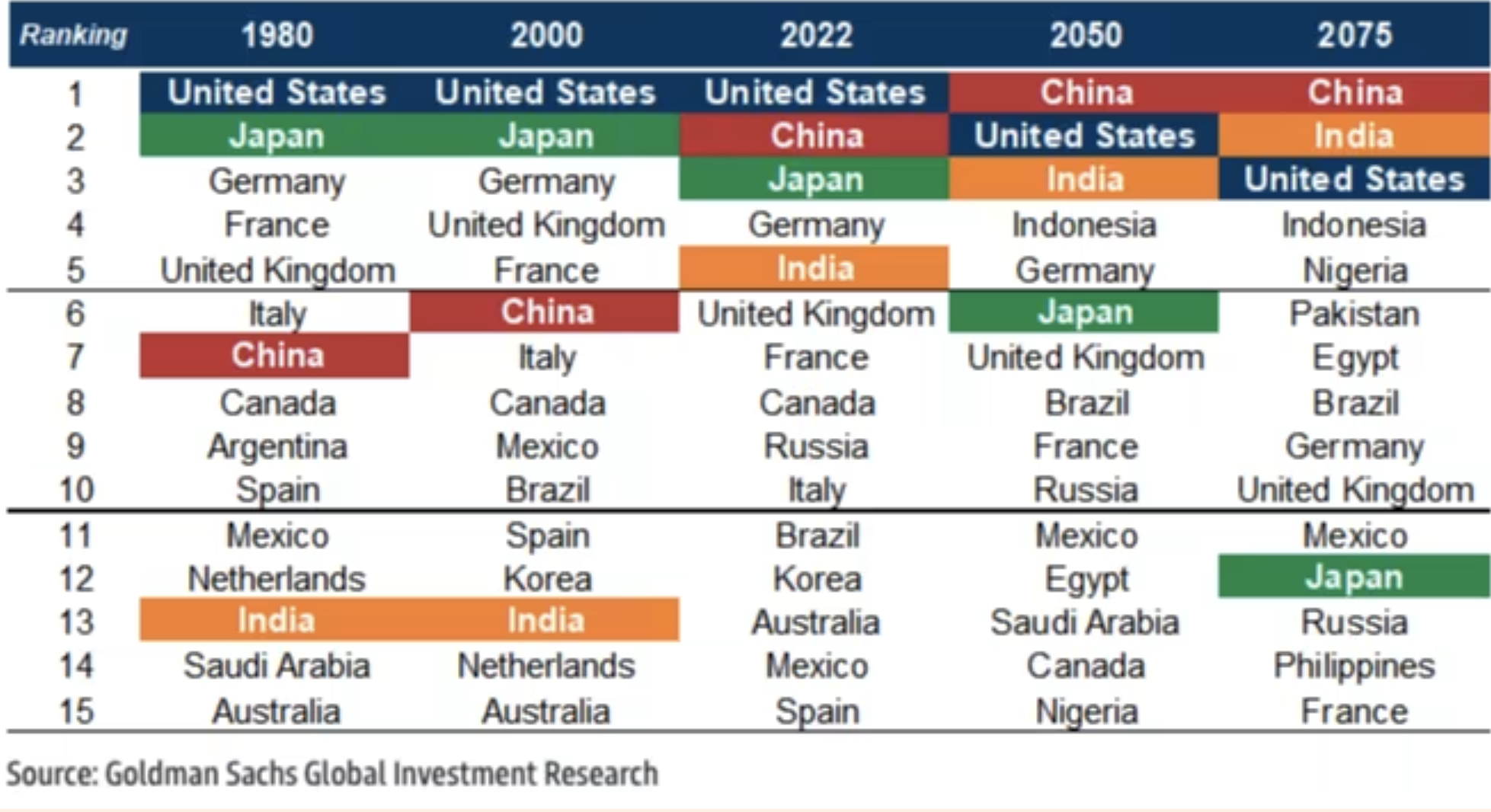

Back in 2022, Goldman Sachs analysts Kevin Daly and  Tadas Gedminas projected Pakistan's economy to grow to become the world's sixth largest by 2075.  In a research paper titled "The Path to 2075", the authors predicted Pakistan's GDP to rise to $12.7 trillion with per capita income of $27,100.  India’s GDP in 2075 is projected at $52.5 trillion and per capita GDP at $31,300.  Bangladesh is projected to be a $6.3 trillion economy with per capita income of $31,000.  By 2075, China will be the top global economy, followed by India 2nd, US 3rd, Indonesia 4th, Nigeria 5th and Pakistan 6th. The forecast is based primarily on changes in the size of working age populations over the next 50 years.  


Economic Growth Rate Till 2075. Source: Goldman Sachs Investment Research 

Economic Impact of Slower Population Growth: 

Daly and Gedminas argue that slowing population growth in the developed world is causing their economic growth to decelerate. At the same time, the economies of the developing countries are driven by their rising populations.  Here are four key points made in the report:

 1) Slower global potential growth, led by weaker population growth. 

2) EM convergence remains intact, led by Asia’s powerhouses. Although real GDP growth has slowed in both developed and emerging economies, in relative terms EM growth continues to outstrip DM growth.

3) A decade of US exceptionalism that is unlikely to be repeated. 

4) Less global inequality, more local inequality. 
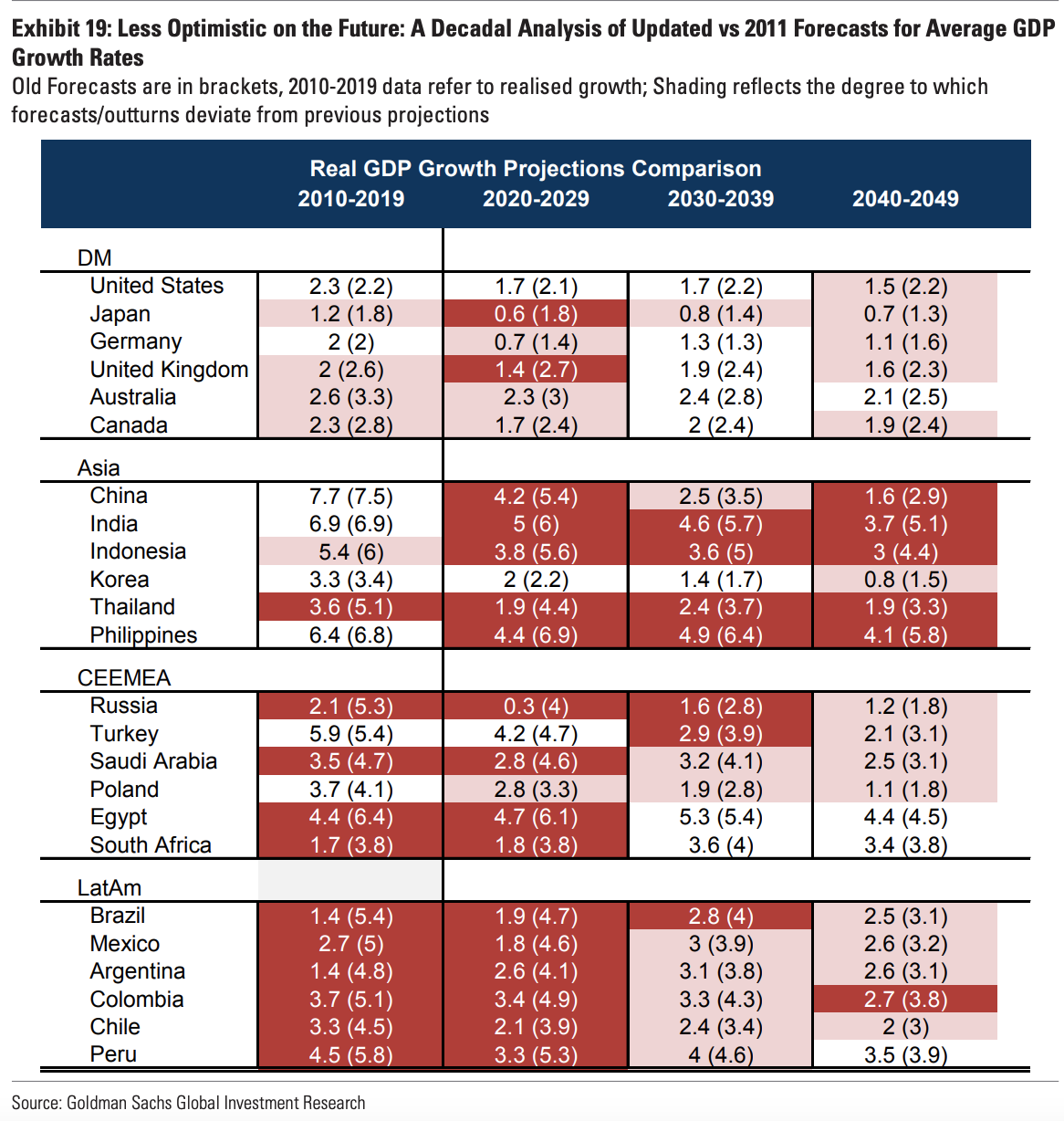
Goldman Sachs' Revised GDP Projections. Source: The Path to 2075

Demographic Dividend: 

With rapidly aging populations and declining number of working age people in North America, Europe and East Asia, the demand for workers will increasingly be met by major labor exporting nations like Bangladesh, China, India, Mexico, Pakistan, Russia and Vietnam. Among these nations, Pakistan is the only major labor exporting country where the working age population is still rising faster than the birth rate. 

Pakistan Population Youngest Among Major Asian Nations. Source: Nikkei Asia

World Population 2022. Source: Visual Capitalist

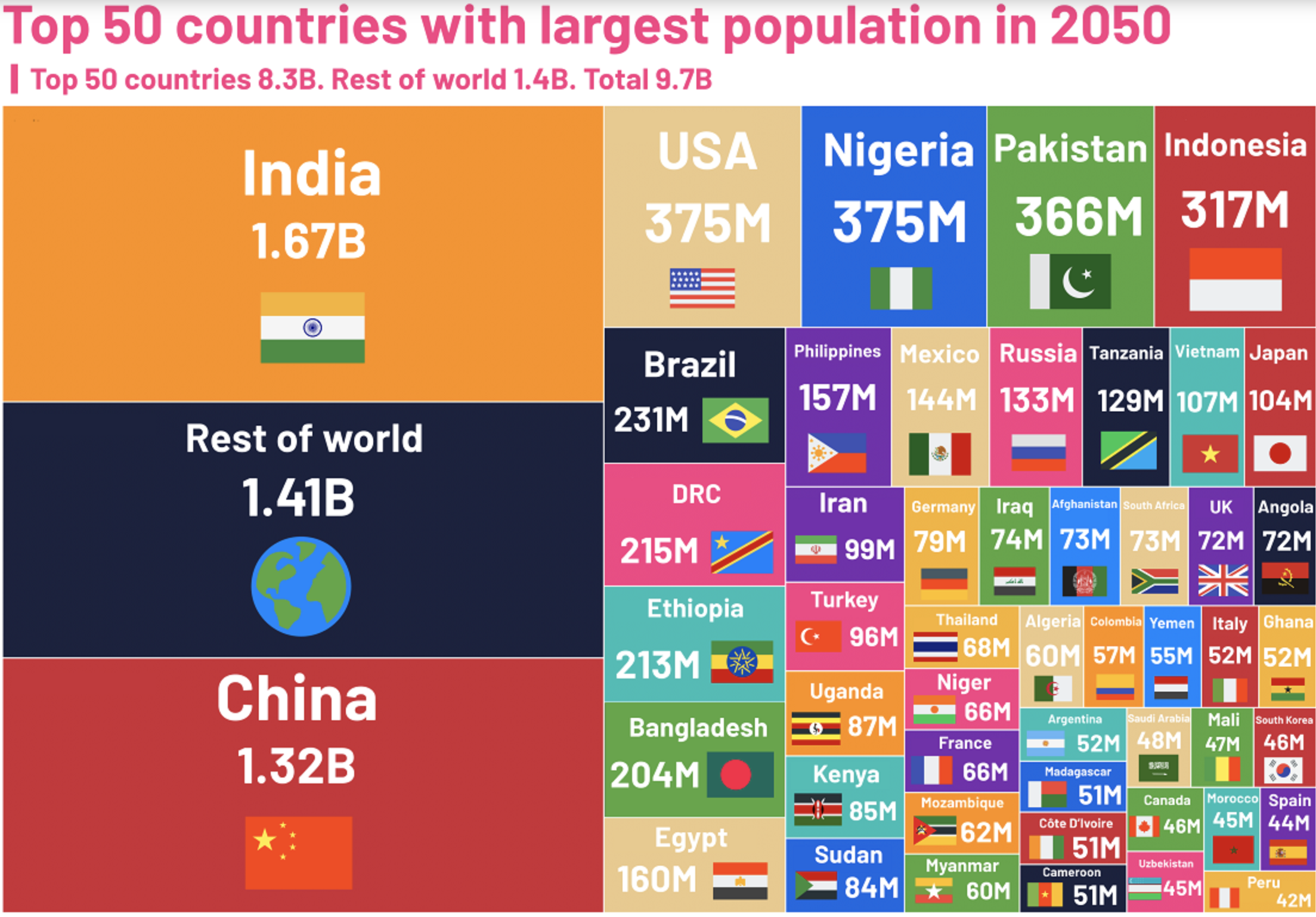
World Population 2050. Source: Visual Capitalist

Over 10 million Pakistanis are currently working/living overseas, according to the Bureau of Emigration. Before the COVID19 pandemic hit in 2020,  more than 600,000 Pakistanis left the country to work overseas in 2019. Nearly 700,000 Pakistanis have already migrated in this calendar year as of October, 2022. The average yearly outflow of Pakistani workers to OECD countries (mainly UK and US) and the Middle East was over half a million in the last decade. 
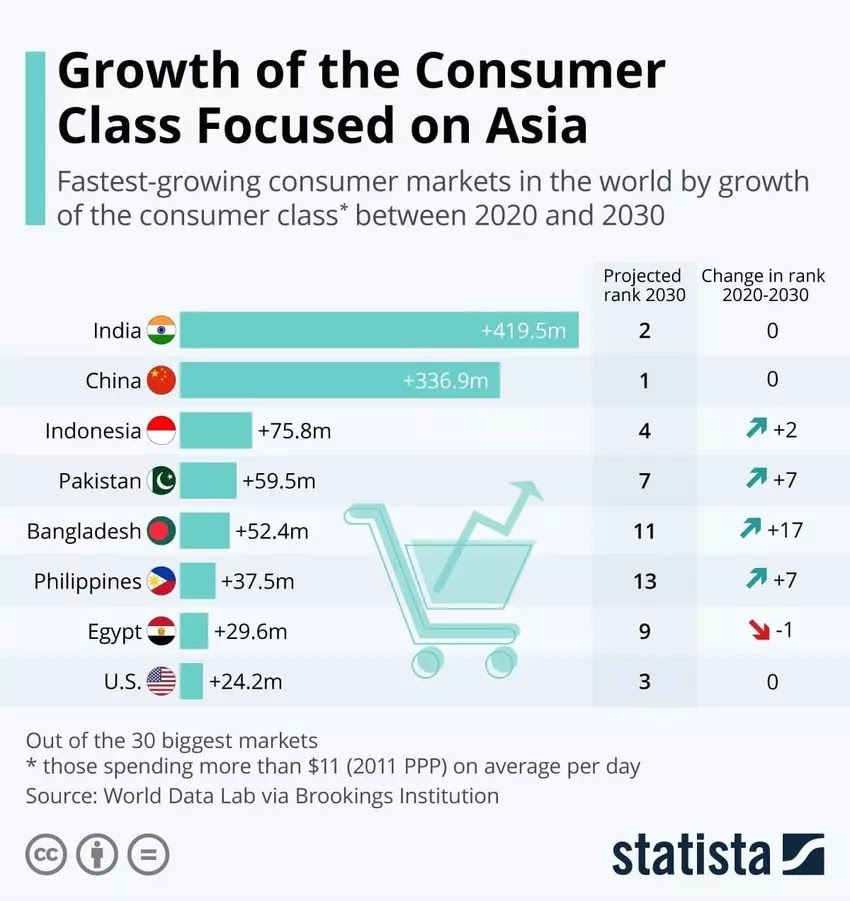
Consumer Markets in 2030. Source: WEF


World's 7th Largest Consumer Market:

Pakistan's share of the working age population (15-64 years) is growing as the country's birth rate declines, a phenomenon called demographic dividend. With its rising population of this working age group, Pakistan is projected by the World Economic Forum to become the world's 7th largest consumer market by 2030. Nearly 60 million Pakistanis will join the consumer class (consumers spending more than $11 per day) to raise the country's consumer market rank from 15 to 7  by 2030. WEF forecasts the world's top 10 consumer markets of 2030 to be as follows: China, India, the United States, Indonesia, Russia, Brazil, Pakistan, Japan, Egypt and Mexico.  Global investors chasing bigger returns will almost certainly shift more of their attention and money to the biggest movers among the top 10 consumer markets, including Pakistan.  Already, the year 2021 has been a banner year for investments in Pakistani technology startups

Record Remittances From Overseas Pakistanis:

Pakistan is already seeing high levels of labor export and record remittances of over $30 billion pouring into the country. Saudi Arabia and the United Arab Emirates(UAE) are the top two sources of remittances but the biggest increase (58%) in remittances is seen this year from Pakistanis in the next two sources: the United Kingdom and the United States.

Remittances from the European Union (EU) to Pakistan soared 49.7% in FY 21 and 28.3% in FY22, according to the State Bank of Pakistan. With $2.5 billion remittances in the first 9 months (July-March) of the current fiscal year, the EU ($2.5 billion) has now surpassed North America ($2.2 billion) to become the third largest source of inflows to Pakistan after the Middle East and the United Kingdom. Remittances from the US have grown 21%, second fastest after the EU (28.3%) in the first 9  months of the current fiscal year. 

Pakistan ranks 6th among the top worker remittance recipient countries in the world.  India and China rank first and second, followed by Mexico 3rd, the Philippines 4th, Egypt 5th and Pakistan 6th.  

Pakistan Demographics

About two million Pakistanis are entering the workforce every year. The share of the working age population in Pakistan is increasing while the birth rate is declining. This phenomenon, known as demographic dividend, is coinciding with declines in working age populations in developed countries. It is creating an opportunity for over half a million Pakistani workers to migrate and work overseas, and send home record remittances. 

Sunday, September 10, 2017

Where's the Real Population "Disaster in the Making"? Pakistan or the West?

Multiple western newspaper headlines are screaming of a "disaster in the making" in Pakistan after the latest population census in the country. These headlines beg the following questions:  Is Pakistan's total fertility rate of 2.62 children per woman a bigger disaster than the sub-replacement level of less than 2 children per woman in the West? Are the rapidly aging western societies and declining working population less of a disaster than Pakistan with its younger population and a growing percentage of it in the work force?  To answer these questions, let's consider the following quote:

“So where will the children of the future come from? Increasingly they will come from people who are at odds with the modern world. Such a trend, if sustained, could drive human culture off its current market-driven, individualistic, modernist course, gradually creating an anti-market culture dominated by fundamentalism - a new dark ages.” ― Philip Longman, The Empty Cradle: How Falling Birthrates Threaten World Prosperity and What to Do About It

Fear of Population Bomb:

The above quote captures the true essence of the West's racist fears about what some of them call the "population bomb": East will dominate the West economically and politically for centuries if the growing colored populations of developing Asia and Africa turn the West's former colonies into younger and more dynamic nations with rising education and better living standards.

Much of the developed world has already fallen below the "replacement" fertility rate of 2.1.  Fertility rates impact economic dynamism, cultural stability and political and military power in the long run.

Pakistan Population Pyramid by Age/Gender. Source: Theodora via CIA

Pakistan Population Growth:

Pakistani women's fertility rates have declined significantly from about 4.6 in 2000 to 2.62 babies per woman in 2017, a drop of 43% in 17 years.  It is being driven drown by the same forces that have worked in the developed world in the last century: increasing urbanization, growing incomes, greater participation in the workforce and rising education.  Pakistan now ranks 65 among 108 countries with TFR of 2.1 (replacement rate) or higher.

The latest Census 2017 results show that Pakistan's population growth rate has declined to 2.34% between 1998 and 2017, down from 2.61% (from 1981 to 1998) and 3.4% (from 1961-81). Life expectancy has increased from about 62 years in 1998 to 66.5 years now. The total fertility rate has declined from 4.6 children per woman in 1998 to to 2.62 children per woman in 2017.  At the same time, Pakistan's labor force is growing at a rate of 3.6% a year, faster than the 2.34% overall population growth. Given Pakistan's human capital growth in recent years, it is a welcome situation that is expected to produce significant demographic dividend for the country.

Labor Force Expansion:


Pakistan's labor force expansion is the 3rd biggest in the world after India and Nigeria, according to UN World Population Prospects 2017. Rising working age population and growing workforce participation of both men and women in developing nations like Pakistan will boost domestic savings and investments, according to Global Development Horizons (GDH) report. Escaping the low savings low investment trap will help accelerate the lagging GDP growth rate in Pakistan, as will increased foreign investment such as the Chinese investment in China-Pakistan Economic Corridor. Increased savings and investments will not only enlarge the nation's tax base but also help create more jobs for the expected new entrants into the work force as it did in 2000-2010, according to a World Report titled "More and Better Jobs in South Asia".

Pakistan's Total Fertility Rate 2.62 Children Per Woman. Source: Washington Post 


Source: World Bank Report "More and Better Jobs in South Asia"

Pakistan's working age population in 15-64 years age bracket is expected to increase by 27.5 million people to 147.1 million in 10 years, according to Bloomberg News' analysis of data reported in UN World Population Prospects 2017.  Pakistan's increase of 27.5 million is the third largest after India's 115.9 million and Nigeria's 34.2 million increase in working age population of 15-64 years old. China's working age population in 15-64 years age group will decline by 21 million in the next 10 years.

Source: Bloomberg

Pakistan's labor force growth will continue by adding 80 million workers n 30 years' time, third only to India's 234 million and Nigeria's 130 million additional workers in 15-64 years age group. China's work force will decline by 171 million workers in this time period.

Source: Bloomberg

Savings, Investment and GDP Growth:

Currently, about a third of Pakistan's population is below the age of 15, dependent on working age adults. This high ratio of dependent population results in low savings, low investment and consequent slower economic growth and sub-par socio-economic development.

Source: State Bank of Pakistan

Pakistan's national savings was about 10% of GDP in 1960s. It increased to above 15% in 2000s in Musharraf years, but declined afterwards. It is well below the savings rates in South Asia region with India's 30%, Bangladesh's 28%, and Sri Lanka's 24.5%.

Source: State Bank of Pakistan

Higher levels of inequality in India, Bangladesh and Sri Lanka account at least partially for their higher savings rates than Pakistan's because people in higher income groups tend to save more of what they earn. But the other probably more important reason for Pakistan's lower savings rate is the larger percentage of children under the age of 15 who do  not work and depend on their parents' incomes.

Rising working age population and growing workforce participation of both men and women in Pakistan will boost domestic savings and investments, just as it has in other South Asian nations.

Projected World Population. Source: Nikkei 


Countries With Declining Populations:

115 countries, including China (1.55), Hong Kong (1.17),  Taiwan (1.11) and Singapore (0.8) are well below the replacement level of 2.1 TFR.  Their populations will sharply decline in later part of the 21st century along with the economic growth rates.

 United States is currently at 1.87 TFR, below the replacement rate but still better than China and other developed nations mainly due to immigration.  "We don't take a stance one way or the other on whether it's good or bad," said Mark Mather, demographer with the Population Reference Bureau. Small year-to-year changes like those experienced by the United States don't make much difference, he noted. But a sharp or sustained drop over a decade or more "will certainly have long-term consequences for society," he told Utah-based Desert News National.

Japan (1.4 TFR) and Russia (1.6 TFR) are experiencing among the sharpest population declines in the world. One manifestation in Japan is the data on diaper sales: Unicharm Corp., a major diaper maker, has seen sales of adult diapers outpace infant diapers since 2013, according to New York Times.

Median Age Map: Africa in teens, Pakistan in 20s, China, South America and US in 30s, Europe, Canada and Japan in 40s.


The Russian population grew from about 100 million in 1950 to almost149 million by the early 1990s. Since then, the Russian population has declined, and official reports put it at around 144 million, according to Yale Global Online.
Lancet Population Projection For Top 5 Countries


Reversing Trends:

Countries, most recently China, are finding that it is far more difficult to raise low fertility than it is reduce high fertility. The countries in the European Union are offering a variety of incentives, including birth starter kits to assist new parents in Finland, cheap childcare centers and liberal parental leave in France and a year of paid maternity leave in Germany, according to Desert News. But the fertility rates in these countries remain below replacement levels.

Summary:

Overzealous Pakistani birth control advocates need to understand what countries with sub-replacement fertility rates are now seeing: Low birth rates lead to diminished economic growth. "Fewer kids mean fewer tax-paying workers to support public pension programs. An "older society", noted the late Nobel laureate economist Gary Becker, is "less dynamic, creative and entrepreneurial." Pakistan's labor force growth is forecast to be the 3rd biggest in the world after India's and Nigeria's, according to UN World Population Prospects 2017. Rising working age population and growing workforce participation of both men and women in developing nations like Pakistan will boost domestic savings and investment, according to Global Development Horizons (GDH) report. Escaping the low savings low investment trap will help accelerate the lagging GDP growth rate in Pakistan as will increased foreign investment such as Chinese investment in China-Pakistan Economic Corridor over the next several decades.

Here's a discussion on this and other subjects:

https://youtu.be/ucopTLFQdKY


Related Links:

Haq's Musings

Pakistan's Labor Force Expansion on Saving, Investments and GDP Growth

Pakistan's Population Growth: Blessing or Curse?

Pakistan's Expected Demographic Dividend

World Bank Report on Job Growth in Pakistan

Underinvestment Hurting Pakistan's GDP Growth

China-Pakistan Economic Corridor

Musharraf Accelerated Growth of Pakistan's Financial and Human Capital

Working Women Seeding a Silent Revolution in Pakistan


Saturday, July 11, 2015

Pakistan's Growing Population: Blessing or Curse?

“So where will the children of the future come from? Increasingly they will come from people who are at odds with the modern world. Such a trend, if sustained, could drive human culture off its current market-driven, individualistic, modernist course, gradually creating an anti-market culture dominated by fundamentalism - a new dark ages.” ― Philip Longman, The Empty Cradle: How Falling Birthrates Threaten World Prosperity & What to Do About It

Fear of Population Bomb:

The above quote captures the true essence of the West's racist fears about what some of them call the "population bomb": East will dominate the West economically and politically for centuries if the growing colored populations of developing Asia and Africa turn the West's former colonies into younger and more dynamic nations with rising education and better living standards.

Much of the developed world has already fallen below the "replacement" fertility rate of 2.1.  Fertility rates impact economic dynamism, cultural stability and political and military power in the long run.

Pakistan Population Growth:

Pakistani women's fertility rates have declined significantly from about 4.56 in 2000 to 2.86 babies per woman in 2014, a drop of 37% in 14 years.  In percentage terms, Pakistan population growth rate has come down from 2.3% in 2000 to 1.6% in 2014, a decline of about 30%. It is being driven drown by the same forces that have worked in the developed world in the last century: increasing urbanization, growing incomes, greater participation in the workforce and rising education.  Pakistan now ranks 65 among 108 countries with TFR of 2.1 (replacement rate) or higher.

Total Fertility Rate Per Pakistani Woman. Source: CIA World FactBook


Pakistan is already the most urbanized country in South Asia and its urbanization is accelerating. Pakistan has also continued to offer much greater upward economic and social mobility to its citizens than neighboring India over the last two decades. Since 1990, Pakistan's middle class had expanded by 36.5% and India's by only 12.8%, according to an ADB report titled "Asia's Emerging Middle Class: Past, Present And Future.

Pakistan Population Growth in Percentage Terms. Source: World Bank


Pakistan has the world’s sixth largest population, seventh largest diaspora and the ninth largest labor force with growing human capital. With rapidly declining fertility and aging populations in the industrialized world, Pakistan's growing talent pool is likely to play a much bigger role to satisfy global demand for workers in the 21st century and contribute to the well-being of Pakistan as well as other parts of the world.


With half the population below 20 years and 60 per cent below 30 years, Pakistan is well-positioned to reap what is often described as "demographic dividend", with its workforce growing at a faster rate than total population. This trend is estimated to accelerate over several decades. Contrary to the oft-repeated talk of doom and gloom, average Pakistanis are now taking education more seriously than ever. Youth literacy is about 70% and growing, and young people are spending more time in schools and colleges to graduate at higher rates than their Indian counterparts in 15+ age group, according to a report on educational achievement by Harvard University researchers Robert Barro and Jong-Wha Lee. Vocational training is also getting increased focus since 2006 under National Vocational Training Commission (NAVTEC) with help from Germany, Japan, South Korea and the Netherlands.


Pakistan's work force is over 60 million strong, according to the Federal Bureau of Statistics. With increasing female participation, the country's labor pool is rising at a rate of 3.5% a year, according to International Labor Organization.

With rising urban middle class, there is substantial and growing demand in Pakistan from students, parents and employers for private quality higher education along with a willingness and capacity to pay relatively high tuition and fees, according to the findings of Austrade, an Australian govt agency promoting trade. Private institutions are seeking affiliations with universities abroad to ensure they offer information and training that is of international standards.

Trans-national education (TNE) is a growing market in Pakistan and recent data shows evidence of over 40 such programs running successfully in affiliation with British universities at undergraduate and graduate level, according to The British Council. Overall, the UK takes about 65 per cent of the TNE market in Pakistan.

It is extremely important for Pakistan's public policy makers and the nation's private sector to fully appreciate the expected demographic dividend as a great opportunity. The best way for them to demonstrate it is to push a pro-youth agenda of education, skills developmenthealth and fitness to take full advantage of this tremendous opportunity. Failure to do so would be a missed opportunity that could be extremely costly for Pakistan and the rest of the world.

Growth Forecast 2014-2050. Source: EIU


In the high fertility countries of Africa and Asia family sizes are continuing to decline. And in low fertility countries family sizes will continue to remain below replacement levels. Why? Because the same juggernaut forces are operating: increasing urbanization, smaller and costly housing, expanding higher education and career opportunities for women, high financial costs and time pressures for childrearing and changing attitudes and life styles.

Source: BBC


Countries With Declining Populations:

115 countries, including China (1.55), Hong Kong (1.17),  Taiwan (1.11) and Singapore (0.8) are well below the replacement level of 2.1 TFR.  Their populations will sharply decline in later part of the 21st century.

 United States is currently at 2.01 TFR, slightly below the replacement rate.  "We don't take a stance one way or the other on whether it's good or bad," said Mark Mather, demographer with the Population Reference Bureau. Small year-to-year changes like those experienced by the United States don't make much difference, he noted. But a sharp or sustained drop over a decade or more "will certainly have long-term consequences for society," he told Utah-based Desert News National.

Japan (1.4 TFR) and Russia (1.6 TFR) are experiencing among the sharpest population declines in the world. One manifestation in Japan is the data on diaper sales: Unicharm Corp., a major diaper maker, has seen sales of adult diapers outpace infant diapers since 2013, according to New York Times.

Median Age Map: Africa in teens, Pakistan in 20s, China, South America and US in 30s, Europe, Canada and Japan in 40s.


The Russian population grew from about 100 million in 1950 to almost149 million by the early 1990s. Since then, the Russian population has declined, and official reports put it at around 144 million, according to Yale Global Online.

Reversing Trends:

Countries, most recently China, are finding that it is far more difficult to raise low fertility than it is reduce high fertility. The countries in the European Union are offering a variety of incentives, including birth starter kits to assist new parents in Finland, cheap childcare centers and liberal parental leave in France and a year of paid maternity leave in Germany, according to Desert News. But the fertility rates in these countries remain below replacement levels.

Summary:

Overzealous Pakistani birth control advocates need to understand what countries with sub-replacement fertility rates are now seeing: Low birth rates lead to diminished economic growth. "Fewer kids mean fewer tax-paying workers to support public pension programs. An "older society", noted the late Nobel laureate economist Gary Becker, is "less dynamic, creative and entrepreneurial."

Related Links:

Haq's Musings

Pakistan's Expected Demographic Dividend

Pakistan's Growing Human Capital

Upwardly Mobile Pakistan

Pakistan Most Urbanized in South Asia

Hindu Population Growth Rate in Pakistan

Do South Asian Slums Offer Hope?

How "Illiterate" Are Pakistan's "Illiterate" Cell Phone Users?