Showing posts with label Consumption. Show all posts

Tuesday, May 14, 2024

Global Baby Bust: Pakistan is A Rare Bright Spot Among Most Populous Nations in Asia

There is an alarming rapid decline in fertility rates in both developed and developing nations, according to the United Nations.  Here is how the Wall Street Journal describes it: "The world is at a startling demographic milestone. Sometime soon, the global fertility rate will drop below the point needed to keep the population constant. It may have already happened". 

Total Fertility Rates in 12 Most Populous Nations. Source: Wall Street Journal


Birth rates are low and fertility is rapidly dropping for women across all levels of income, education and labor-force participation around the world. Fertility is falling among Pakistani women too but more slowly than elsewhere in Asia. In fact, Pakistani women have the third highest fertility rate (3.47) among the 12 most populous nations of the world. 

Pakistan Fertility Rate. Source: Data Commons


Birth rates have economic, social and geopolitical consequences. "The falling birthrates come with huge implications for the way people live, how economies grow and the standings of the world’s superpowers", says the Wall Street Journal report titled "Suddenly There Aren’t Enough Babies. The Whole World Is Alarmed". 

No challenge is greater than the irreversible decline in female fertility rates that China, Japan, South Korea and the West are now experiencing. It's an existential threat. Nations and civilizations with sub-replacement fertility rates will eventually cease to exist. Automation can not replace young curious minds responsible for new ideas, innovation and social and economic vitality. Nor can automation replace consumers needed to buy and pay for products and services produced by robots.


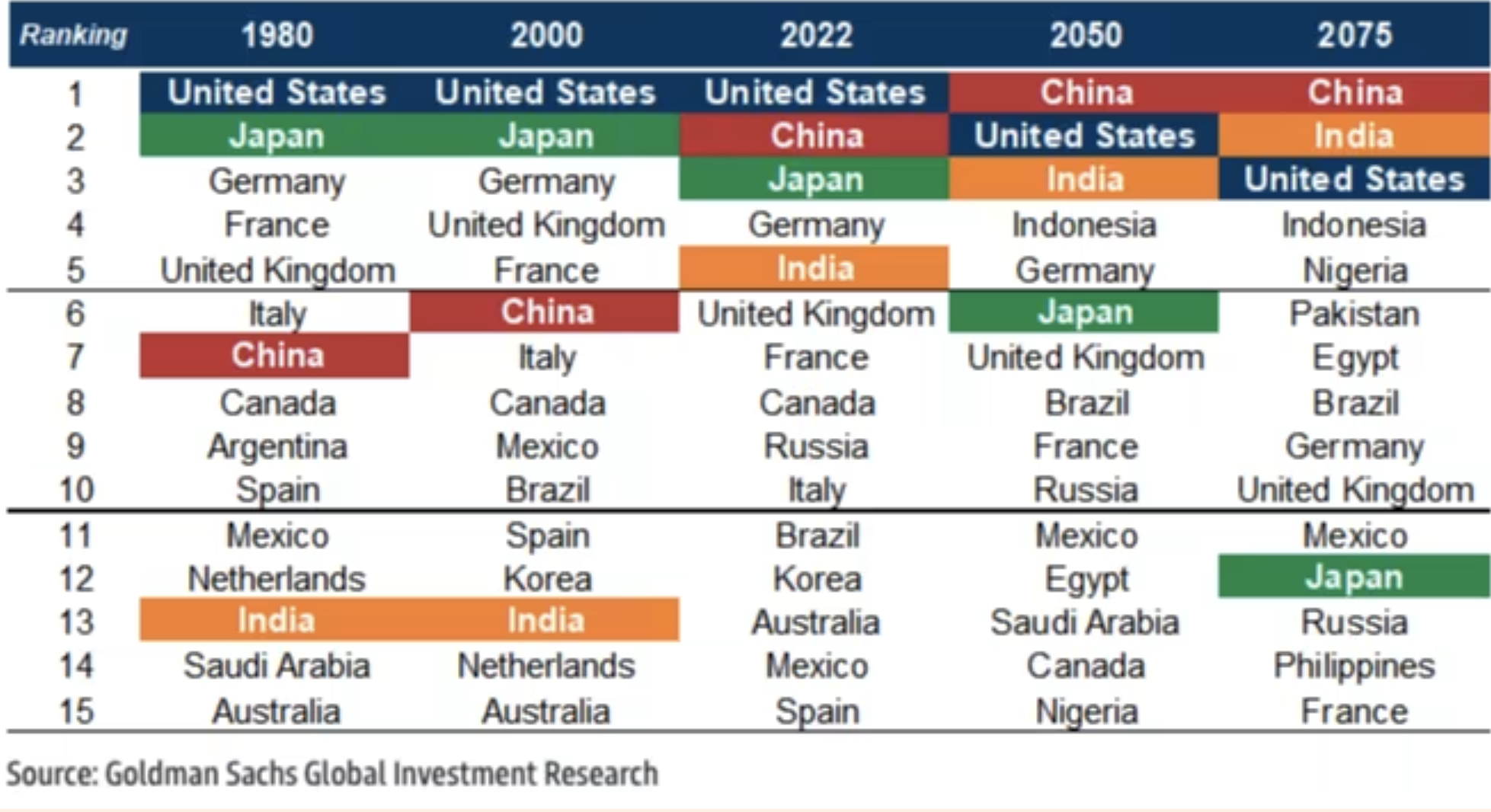
Back in 2022, Goldman Sachs analysts Kevin Daly and  Tadas Gedminas projected Pakistan's economy to grow to become the world's sixth largest by 2075.  In a research paper titled "The Path to 2075", the authors predicted Pakistan's GDP to rise to $12.7 trillion with per capita income of $27,100.  India’s GDP in 2075 is projected at $52.5 trillion and per capita GDP at $31,300.  Bangladesh is projected to be a $6.3 trillion economy with per capita income of $31,000.  By 2075, China will be the top global economy, followed by India 2nd, US 3rd, Indonesia 4th, Nigeria 5th and Pakistan 6th. The forecast is based primarily on changes in the size of working age populations over the next 50 years.  


Economic Growth Rate Till 2075. Source: Goldman Sachs Investment Research 

Economic Impact of Slower Population Growth: 

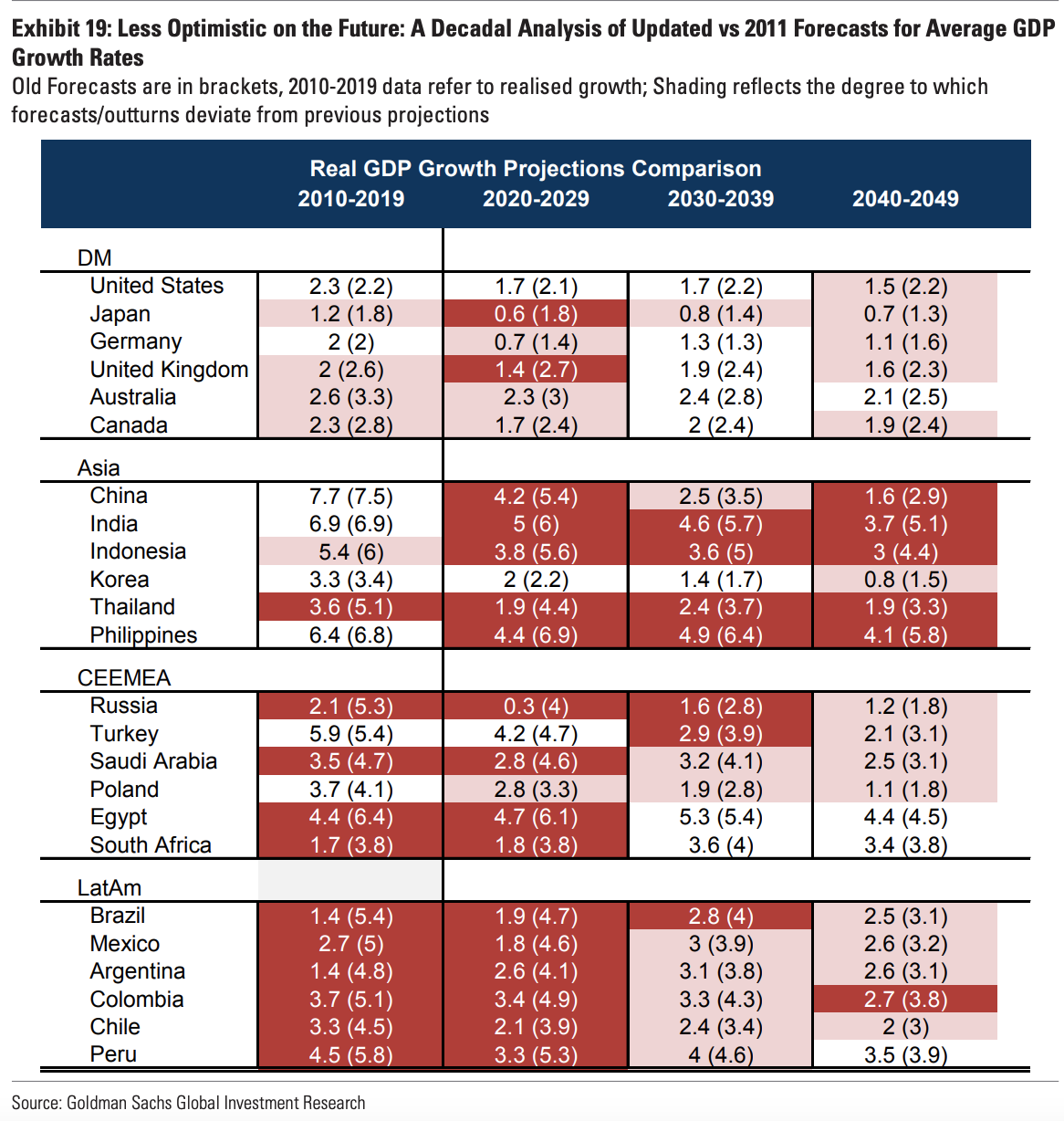
Daly and Gedminas argue that slowing population growth in the developed world is causing their economic growth to decelerate. At the same time, the economies of the developing countries are driven by their rising populations.  Here are four key points made in the report:

 1) Slower global potential growth, led by weaker population growth. 

2) EM convergence remains intact, led by Asia’s powerhouses. Although real GDP growth has slowed in both developed and emerging economies, in relative terms EM growth continues to outstrip DM growth.

3) A decade of US exceptionalism that is unlikely to be repeated. 

4) Less global inequality, more local inequality. 

Goldman Sachs' Revised GDP Projections. Source: The Path to 2075

Demographic Dividend: 

With rapidly aging populations and declining number of working age people in North America, Europe and East Asia, the demand for workers will increasingly be met by major labor exporting nations like Bangladesh, China, India, Mexico, Pakistan, Russia and Vietnam. Among these nations, Pakistan is the only major labor exporting country where the working age population is still rising faster than the birth rate. 

Pakistan Population Youngest Among Major Asian Nations. Source: Nikkei Asia

World Population 2022. Source: Visual Capitalist

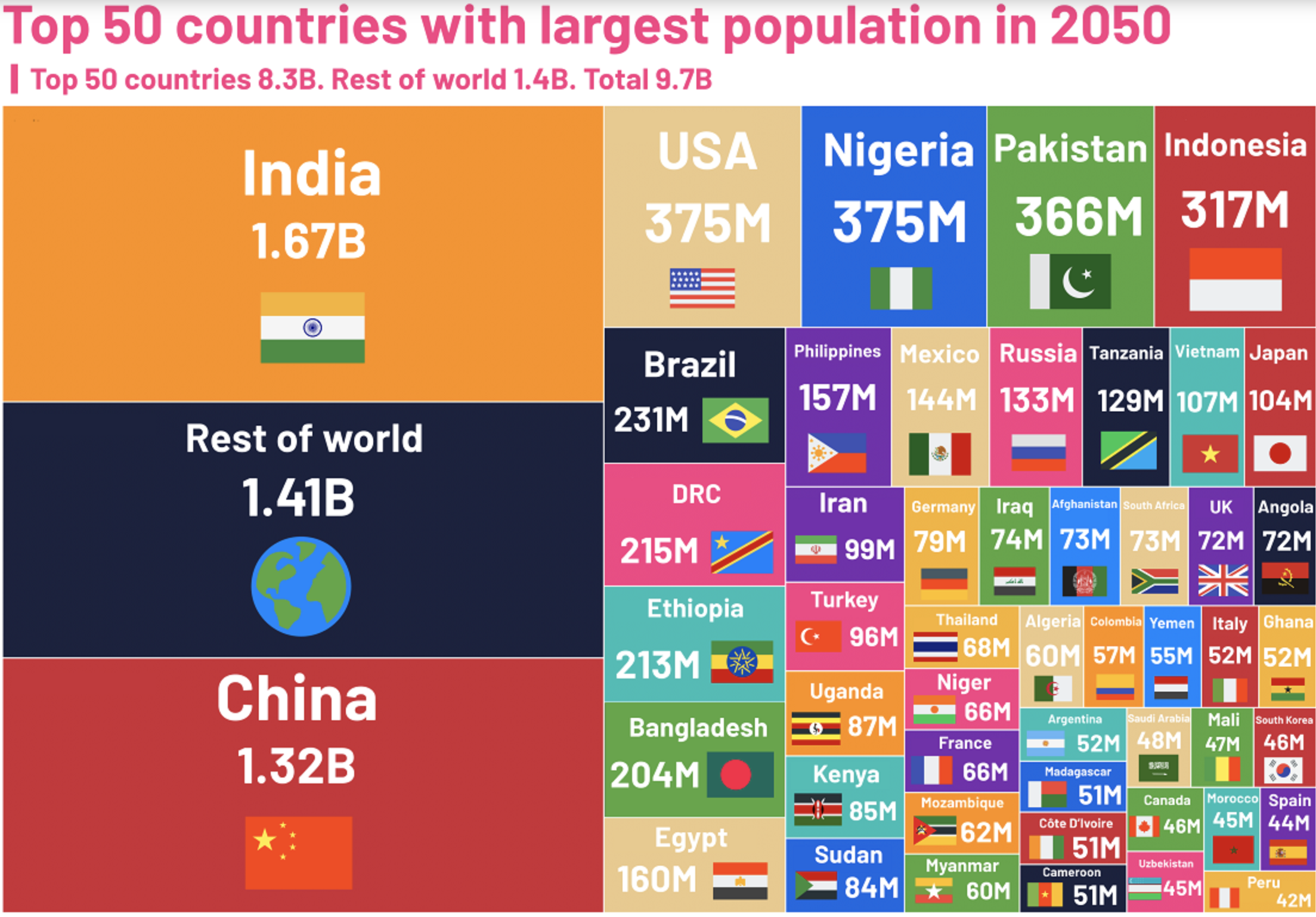
World Population 2050. Source: Visual Capitalist

Over 10 million Pakistanis are currently working/living overseas, according to the Bureau of Emigration. Before the COVID19 pandemic hit in 2020,  more than 600,000 Pakistanis left the country to work overseas in 2019. Nearly 700,000 Pakistanis have already migrated in this calendar year as of October, 2022. The average yearly outflow of Pakistani workers to OECD countries (mainly UK and US) and the Middle East was over half a million in the last decade. 

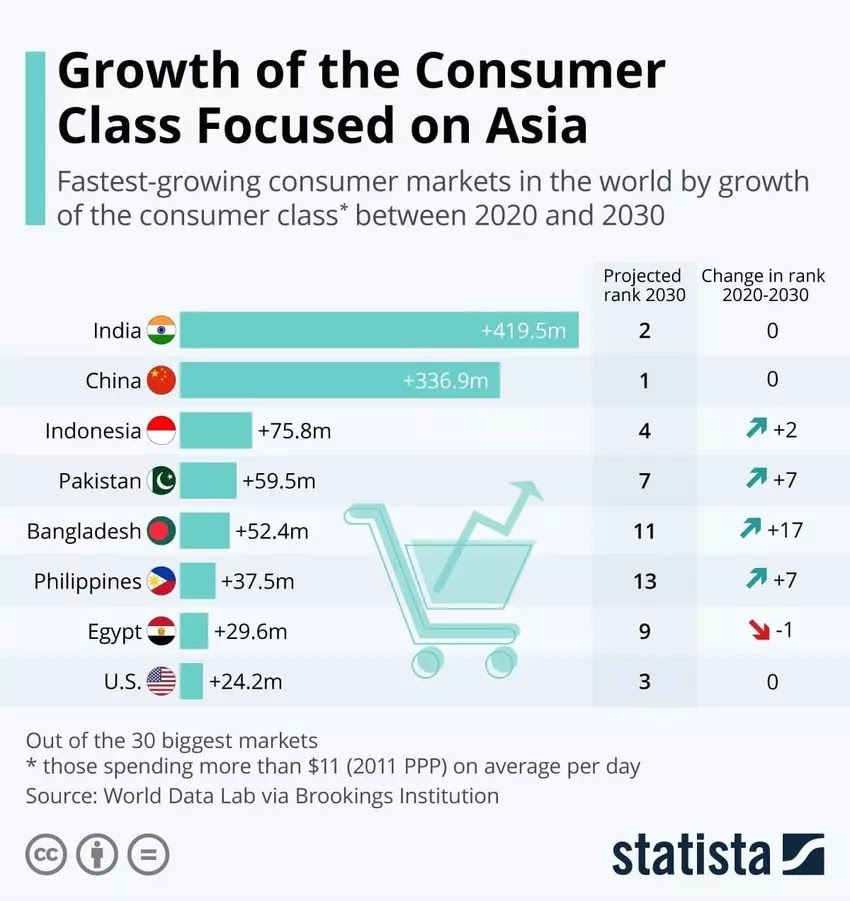
Consumer Markets in 2030. Source: WEF


World's 7th Largest Consumer Market:

Pakistan's share of the working age population (15-64 years) is growing as the country's birth rate declines, a phenomenon called demographic dividend. With its rising population of this working age group, Pakistan is projected by the World Economic Forum to become the world's 7th largest consumer market by 2030. Nearly 60 million Pakistanis will join the consumer class (consumers spending more than $11 per day) to raise the country's consumer market rank from 15 to 7  by 2030. WEF forecasts the world's top 10 consumer markets of 2030 to be as follows: China, India, the United States, Indonesia, Russia, Brazil, Pakistan, Japan, Egypt and Mexico.  Global investors chasing bigger returns will almost certainly shift more of their attention and money to the biggest movers among the top 10 consumer markets, including Pakistan.  Already, the year 2021 has been a banner year for investments in Pakistani technology startups

Record Remittances From Overseas Pakistanis:

Pakistan is already seeing high levels of labor export and record remittances of over $30 billion pouring into the country. Saudi Arabia and the United Arab Emirates(UAE) are the top two sources of remittances but the biggest increase (58%) in remittances is seen this year from Pakistanis in the next two sources: the United Kingdom and the United States.

Remittances from the European Union (EU) to Pakistan soared 49.7% in FY 21 and 28.3% in FY22, according to the State Bank of Pakistan. With $2.5 billion remittances in the first 9 months (July-March) of the current fiscal year, the EU ($2.5 billion) has now surpassed North America ($2.2 billion) to become the third largest source of inflows to Pakistan after the Middle East and the United Kingdom. Remittances from the US have grown 21%, second fastest after the EU (28.3%) in the first 9  months of the current fiscal year. 

Pakistan ranks 6th among the top worker remittance recipient countries in the world.  India and China rank first and second, followed by Mexico 3rd, the Philippines 4th, Egypt 5th and Pakistan 6th.  

Pakistan Demographics

About two million Pakistanis are entering the workforce every year. The share of the working age population in Pakistan is increasing while the birth rate is declining. This phenomenon, known as demographic dividend, is coinciding with declines in working age populations in developed countries. It is creating an opportunity for over half a million Pakistani workers to migrate and work overseas, and send home record remittances. 

Sunday, December 19, 2021

Has Bangladesh Really Left India and Pakistan Behind in Per Capita Income?

Is Bangladesh's officially reported GDP figure credible? Do consumption figures support Bangladesh's claim of higher per capita income than India and Pakistan?  Is it the recent rebasing of GDP that boosted Bangladesh's per capita income above India's and Pakistan's? If Bangladesh has higher GDP per capita, why is its per capita consumption of energy, cement and steel so much lower than India's and Pakistan's? Does Pakistan really have a much larger informal economy than Bangladesh or India do? How long has it been since Pakistan rebased its GDP calculations? Is there a lot more currency in circulation in Pakistan than in Bangladesh and India? Let us try and answer these questions! 

Rebasing GDP:

Bangladesh just rebased its GDP in 2020-21 to year 2015-16. This has boosted its per capita income by double digits for every year since 2015-16.  Bangladesh's per capita income for the 2015-16 fiscal year has now gone up to $1,737 from $1,465 in the old calculation. For the 2019-2020 fiscal, the per capita income has gone up to $2,335 from $2,024.  The new GDP estimate covers 21 sectors, up from 15 sectors previously.  India last rebased its GDP in 2015, a change that bumped up its per capita GDP by double digits. Nigeria's last rebasing in 2012 increased the size of its economy (GDP) by nearly 90%. Pakistan's current base year is 2005-6. Rebasing which is now long overdue will almost certainly increase Pakistan's per capita income by double digits. 

In its 2014 annual report, the State Bank of Pakistan talked about a number of new sectors that are either under-reported or not covered at all: "In terms of LSM growth, a number of sectors that are showing strong performance; (for example, fast moving consumer goods (FMCG) sector; plastic products; buses and trucks; and even textiles), are either under reported, or not even covered. The omission of such important sectors from official data coverage, probably explains the apparent disconnect between overall economic activity in the country and the hard numbers in LSM."

Pakistan's last economic census was done in 2003 and published in 2005, livestock census in 2006  and agriculture census in 2010. The country's economy has changed significantly since then, adding several new economic activities while others may have diminished.  The Quantum Index of Large Scale Manufacturing (QIM) with 2005-06 base year gives a weight to textiles of 20.9% (Yarn 13.7 and cloth 7.2). But the textile industry has significantly changed as reflected in its exports. The value added textiles (non-yarn and non-cloth) now make almost 80% of the total textile exports. These changes are not reflected in current GDP calculations. 


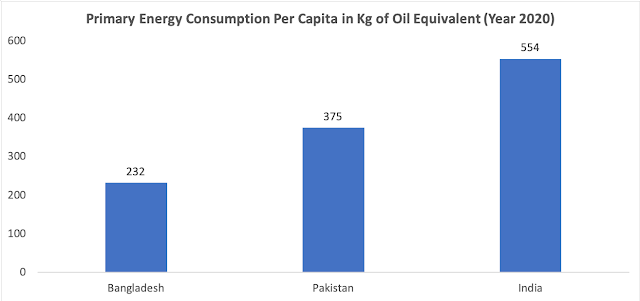
Primary Energy Consumption Per Capita. Source: British Petroleum Statistics 2021

Energy consumption:

Life in modern times is heavily dependent on energy. Per capita energy consumption, a key barometer of economic activity, is significantly lower in Bangladesh than in India and Pakistan.  Use of electricity per capita in Bangladesh is significantly less than in India and Pakistan. 

Energy Consumption Comparison in Bangladesh, India and Pakistan. Source: NationMaster

Commercial energy use (kg of oil equivalent per capita) above refers to apparent consumption, which is equal to indigenous production plus imports and stock changes, minus exports and fuels supplied to ships and aircraft engaged in international transport. It's only 142 Kg of oil per capita in Bangladesh, much lower than 463 Kg in Pakistan and 494 Kg in India.  

A more recent British Petroleum "Statistical Review of World Energy 2021" puts the per capita primary energy consumption at 9.7 Gigajoules (232 kilogram of oil equivalent) for Bangladesh, 15.7 Gj (375 kgoe) for Pakistan and 23.2 Gj (554 kgoe) for India. 

Per capita consumption of primary energy in Bangladesh has grown by 59% (6.1 Gj to 9.7 Gj) since 2010, much faster than 25% (18.2 Gj to 23.2 Gj) in India and just 6% (14.8 Gj to 15.7 Gj) in Pakistan, according to the British Petroleum's "Statistical Review of World Energy 2021". This indicates much faster economic growth in Bangladesh than India or Pakistan in the last decade. 

Cement Consumption:

Use of cement is another important indicator of economic and development activities, particularly in the infrastructure and housing construction sector.  China and the United States, the world's biggest economies, also have the highest consumption of cement. 

Cement Consumption. Source: International Cement Review

Steel Consumption:

Per capita steel consumption is another important indicator of economic activity in both construction and manufacturing sectors.  It goes into building housing and infrastructure as well manufacturing vehicles and home appliances. The United States and China, the world's biggest economies, are the largest consumers of steel. 

Per Capita Steel Consumption. Source: National Steel Advisory Council

Bangladesh is among the lowest consumers of steel products in the world. Per capita consumption of finished steel in Bangladesh (41 Kg) is lower than the regional peer Myanmar (40.5), India (75.3), Pakistan (45.7), Sri Lanka (53.5), according to the World Steel Association (WSA).

Pakistan's Informal Economy:  

 One way to estimate the size of the informal economy in any country is by looking at the amount of currency in circulation relative to overall money supply. This data is published regularly by all central banks in South Asia and elsewhere. Pakistan's currency in circulation to M2 ratio (about 30%) is more than double the ratios in Bangladesh (13%) and India (15%), indicating that the informal economy in Pakistan is much bigger.

Dr. Lalarukh Ejaz, an assistant professor at the Institute of Business Administration in Karachi, has estimated the size of Pakistan’s informal economy at 56% of the country’s GDP (as of 2019). This means that it’s worth around $180 billion a year, and that is a massive amount by any yardstick. 

Vehicles and home appliance ownership data analyzed by Dr. Jawaid Abdul Ghani of Karachi School of Business Leadership suggests that the officially reported GDP significantly understates Pakistan's actual GDP.  Indeed, many economists believe that Pakistan’s economy is at least double the size that is officially reported in the government's Economic Surveys. 

Back in 2014,  the State Bank of Pakistan stated in its Annual Report as follows: "In terms of LSM growth, a number of sectors that are showing strong performance; (for example, fast moving consumer goods (FMCG) sector; plastic products; buses and trucks; and even textiles), are either under reported, or not even covered. The omission of such important sectors from official data coverage, probably explains the apparent disconnect between overall economic activity in the country and the hard numbers in LSM."  Pakistan's GDP has not been rebased in more than a decade. It was last rebased in 2005-6 while India’s was rebased in 2011. The recent rebasing of Bangladesh GDP to year 2015 has boosted its per capita income of Bangladesh for year 2016-16 and all subsequent years . The per capita income for the 2015-16 fiscal year has now gone up to $1737 from $1465 in the old calculation For the 2019-2020 fiscal, the per capita income has gone up to $2335 from $2024. Just rebasing the Pakistani economy will result in double digit increases in GDP for the last several years. 

Estimates of Informal Economies in Asia in 2012. Source: IMF

A research paper by economists Ali Kemal and Ahmad Waqar Qasim of PIDE (Pakistan Institute of Development Economics) estimated in 2012 that the Pakistani economy’s size then was around $400 billion. All they did was look at the consumption data to reach their conclusion. They used the data reported in regular PSLM (Pakistan Social and Living Standard Measurements) surveys on actual living standards. They found that a huge chunk of the country's economy is undocumented. 

Currency in Circulation to M2 Ratio Trends. Source: Business Recorder


Pakistan's Service Sector: 

Pakistan's service sector which contributes more than 50% of the country's GDP is mostly cash-based and least documented. Compared to Bangladesh and India, there is a lot more currency in circulation as a percentage of overall money supply in Pakistan. According to the State Bank of Pakistan (SBP), the currency in circulation has increased to Rs. 7.4 trillion by the end of the financial year 2020-21, up from Rs 6.7 trillion in the last financial year,  a double-digit growth of 10.4% year-on-year.   Currency in circulation (CIC), as percent of M2 money supply and currency-to-deposit ratio, has been increasing over the last few years.  The CIC/M2 ratio is now close to 30%, according to the State Bank of Pakistan. The average CIC/M2 ratio in FY18-21 was measured at 28%, up from 22% in FY10-15. This 1.2 trillion rupee increase could have generated undocumented GDP of Rs 3.1 trillion at the historic velocity of 2.6, according to a report in The Business Recorder. In comparison to Bangladesh (CIC/M2 at 13%), Pakistan’s cash economy is double the size. Even a casual observer can see that the living standards in Pakistan are higher than those in Bangladesh and India. 

Exports as Percentage of GDP in South Asia. Source: World Bank

Exports:

Pakistan has performed poorly in exports growth relative to Bangladesh and India since about 2007. This has been the key source of its balance of payments crises and its repeated need for IMF bailouts. Pakistan's economic growth has essentially been constrained by its recurring balance of payment (BOP) crises as explained by Thirlwall's Law

Summary:

Bangladesh just rebased its GDP in 2020-21 to year 2015-16. This has boosted its per capita income by double digits for every year since 2015-16, raising it above India's and Pakistan's. Based on published data on energy, cement and steel consumption, Bangladesh's claim of having a per capita GDP higher than India's and Pakistan's does not seem credible. In this age of growing energy-intensive industrialization, it does not make sense to have significantly lower use of key inputs like energy to produce higher gross domestic product. For Pakistan, it is important for policymakers to promote ways of documenting more of the economy. It's also important for finance officials to rebase the country's GDP to a more recent year than the year 2006 when it was last done. 

Related Links:


Haq's Musings

South Asia Investor Review

Pakistan Among World's Largest Food Producers

Naya Pakistan Housing Program

Food in Pakistan 2nd Cheapest in the World

Indian Economy Grew Just 0.2% Annually in Last Two Years

Pakistan to Become World's 6th Largest Cement Producer by 2030

Pakistan's 2012 GDP Estimated at $401 Billion

Pakistan's Computer Services Exports Jump 26% Amid COVID19 Lockdown

Coronavirus, Lives and Livelihoods in Pakistan

Vast Majority of Pakistanis Support Imran Khan's Handling of Covid19 Crisis

Pakistani-American Woman Featured in Netflix Documentary "Pandemic"

Incomes of Poorest Pakistanis Growing Faster Than Their Richest Counterparts

Can Pakistan Effectively Respond to Coronavirus Outbreak? 

How Grim is Pakistan's Social Sector Progress?

Pakistan's Insatiable Appetite For Energy

Trump Picks Muslim-American to Lead Vaccine Effort

COVID Lockdown Decimates India's Middle Class

Pakistan to be World's 7th Largest Consumer Market by 2030

Pakistan's Balance of Payments Crisis

How Has India Built Large Forex Reserves Despite Perennial Trade Deficits

Conspiracy Theories About Pakistan Elections"

PTI Triumphs Over Corrupt Dynastic Political Parties

Strikingly Similar Narratives of Donald Trump and Nawaz Sharif

Nawaz Sharif's Report Card

Riaz Haq's Youtube Channel

Saturday, December 11, 2021

Pakistan Forecast to Become World's 7th Largest Consumer Market By 2030

The World Economic Forum forecasts that Pakistan will rise to become the world's 7th largest consumer market by 2030. Nearly 60 million Pakistanis will join the consumer class (consumers spending more than $11 per day) to raise the country's consumer market rank from 15 to 7 in the next 10 years. WEF forecasts the world's top 10 consumer markets of 2030 to be as follows: China, India, the United States, Indonesia, Russia, Brazil, Pakistan, Japan, Egypt and Mexico.  Global investors chasing bigger returns will almost certainly shift more of their attention and money to the biggest movers among the top 10 consumer markets, including Pakistan.  Already, the year 2021 has been a banner year for investments in Pakistani technology startups

Consumer Markets in 2030. Source: WEF


Here's Brookings Institution overview of the top 5 movers in the next 10 years:

1. Bangladesh (+17 positions), from place 28 to 11; future consumer class: 85 million (+50 million) Global share of consumer class: 0.8 percent (2020), 1.6 percent (2030). Bangladesh’s consumer class is projected to more than double by 2030: Today, 35 million people in Bangladesh spend more than $11 a day. By 2030, it will be 85 million! 

2. Pakistan (+8 positions), from place 15 to 7; future consumer class: 121 million (+56 million) Global share of consumer class: 6 percent (2020), 2.3 percent (2030). Pakistan will add 56 million new consumers by 2030, for a total of 121 million. This means that in 2030, for the first time, every other Pakistani will be able to spend more than $11 per day. 

3. Vietnam (+7 positions), from place 26 to 19; future consumer class: 56 million (+21 million) Global share of consumer class: 9 percent (2020), 1.1 percent (2030). Vietnam’s consumer class will grow from 35 million to 56 million within this decade, which is a success story particularly of the middle-aged generation: Consumers between 45 and 65 years of age will contribute nearly 25 percent of Vietnam’s spending, as opposed to 20 percent today. 

4. Philippines (+6 positions), from place 20 to 14; future consumer class: 79 million (+38 million) Global share of consumer class: 1 percent (2020), 1.5 percent (2030). The Filipino consumer class is projected to grow steadily, from 41 million today to 79 million in 2030. By then, more than two-thirds of the Filipino population will spend more than $11 per day. 

5. Indonesia (+2 positions), from place 6 to 4; future consumer class: 199 million (+76 million) Global share of consumer class: 2 percent (2020), 3.8 percent (2030). While Indonesia is only moving up two places, it is experiencing a large gain of consumer class growth. Starting from an already large base of 123 million, Indonesia will have almost 200 million consumers in 2030, making it the fourth-largest consumer market in the world.

Countries in Asia are expected to show the biggest growth of the consumer class among the world's 30 biggest consumer markets. The consumer class is defined as a group of people who spend more than $11 per day. Currently, 55% of the global consumer class live in Asia. 

World's Top 30 Consumer Markets. Source: World Data Lab's Market Pro 


Global investors chasing bigger returns will almost certainly shift more of their attention and money to the top 10 consumer markets, including Pakistan.  Already, the year 2021 has been a banner year for investments in Pakistani technology startups

Pakistan Population in 2030: 274 Million. Source: Our World in Data


Vehicles and home appliance ownership data analyzed by Dr. Jawaid Abdul Ghani of Karachi School of Business Leadership suggests that the officially reported GDP significantly understates Pakistan's actual GDP.  Indeed, many economists believe that Pakistan’s economy is at least double the size that is officially reported in the government's Economic Surveys. The GDP has not been rebased in more than a decade. It was last rebased in 2005-6 while India’s was rebased in 2011 and Bangladesh’s in 2013. Just rebasing the Pakistani economy will result in at least 50% increase in official GDP.  A research paper by economists Ali Kemal and Ahmad Waqar Qasim of PIDE (Pakistan Institute of Development Economics) estimated in 2012 that the Pakistani economy’s size then was around $400 billion. All they did was look at the consumption data to reach their conclusion. They used the data reported in regular PSLM (Pakistan Social and Living Standard Measurements) surveys on actual living standards. They found that a huge chunk of the country's economy is undocumented. 

Pakistan's service sector which contributes more than 50% of the country's GDP is mostly cash-based and least documented. There is a lot of currency in circulation. According to the State Bank of Pakistan (SBP), the currency in circulation has increased to Rs. 7.4 trillion by the end of the financial year 2020-21, up from Rs 6.7 trillion in the last financial year,  a double-digit growth of 10.4% year-on-year.   Currency in circulation (CIC), as percent of M2 money supply and currency-to-deposit ratio, has been increasing over the last few years.  The CIC/M2 ratio is now close to 30%. The average CIC/M2 ratio in FY18-21 was measured at 28%, up from 22% in FY10-15. This 1.2 trillion rupee increase could have generated undocumented GDP of Rs 3.1 trillion at the historic velocity of 2.6, according to a report in The Business Recorder. In comparison to Bangladesh (CIC/M2 at 13%), Pakistan’s cash economy is double the size. Even a casual observer can see that the living standards in Pakistan are higher than those in Bangladesh and India. 

Related Links:


Saturday, May 20, 2017

Pakistan Consumer Boom Driving Media Advertising Revenue

Rising buying power of rapidly expanding middle class in Pakistan drove the nation's media advertising revenue up 14% to a record Rs. 76.2 billion ($727 million), making the country's media market among the world's fastest growing for FY 2015-16. Half of this ad spending (Rs. 38 billion or $362 million) went to television channels while the rest was divided among print, outdoor, radio and digital media.

Media Ad Revenue by platform. Source: Aurora


Digital media spending rose 27% in 2015-16 over prior year, the fastest of all the media platforms. It was followed by 20% increase in radio, 13% in television, 12% in print and 6% in outdoor advertising, according to data published by Aurora media market research

HUM TV channel had the highest revenue at Rs. 3.84 billion, followed by ARY Digital's Rs. 3.802 billion, PTV Sports Rs. 3 billion, Geo Entertainment Rs. 2.93 billion, Geo News Rs. 2.6 billion, Urdu1 2.5 billion, PTV Home Rs. 2.5 billion, Samaa Rs. 1.9 billion, and Dunya News, ARY News and Express News Rs. 1.8 billion each.

The television channels with the highest revenue increases in 2015-16 were: Samaa (88%), Geo News (82%), Geo Entertainment (81%) and ARY News (76%).

Global Advertising Growth 2016. Source: Magna


The current media boom in Pakistan started in early 2000s when Pakistan had just one television channel, according to the UK's Prospect Magazine. Today it has over 100. Together they have begun to open up a country long shrouded by political, moral and religious censorship—taking on the government, breaking social taboos and, most recently, pushing a new national consensus against the Taliban. The birth of privately owned commercial media has been enabled by the Musharraf-era deregulation, and funded by the tremendous growth in revenue from advertising targeted at the burgeoning urban middle class consumers.

Pakistan has managed to significantly reduce poverty and rapidly grow its middle class since 2001 in spite of major political, security and economic challenges. The foundation for the rise of the middle class and the electronic media boom was laid on President Musharraf's watch by his government's decisions to invest in education and infrastructure projects and deregulate the media that led to the expansion of both human and financial capital. My hope is that the continued improvement in security situation and implementation of China-Pakistan Economic Corridor (CPEC) related projects will bring in higher long-term investments and accelerate Pakistan's progress toward prosperity for all of its citizens.

Related Links:

Haq's Musings

Credit Suisse Wealth Report 2016

Pakistan: A Majority Middle Class Country

Pakistan Mass Media Boom

State Bank: Pakistan's Actual GDP Higher Than Officially Reported

College Enrollment in Pakistan

Musharraf Accelerated Development of Pakistan's Human and Financial Capital

China-Pakistan Economic Corridor

Monday, August 1, 2011

Pakistan's Consumers Spending Again

First 9 months of fiscal 2010-2011 saw production of television sets jump 28.6% and automobile production increase by 14.6%, according to Economic Survey of Pakistan 2010-2011. From July 2010 to March 2011, production of cars, light commercial vehicles and two and three wheelers grew by 16.4%, 20.5% and 12.6% respectively. These figures confirm the return of Pakistanis' appetite for consumer durables after a significant drop from 2007-2008 to 2008-2009.

Automobile:

146,271 vehicles were produced in Pakistan in 8 months from July 2010 to February 2011, representing an increase of 9.2% y-o-y on the 133,918 units produced over the same period of FY09/10, according to figures from the Pakistan Automotive Manufacturers Association (PAMA). This consists of 85,924 units for passenger car production, 1,807 units truck production, 308 units bus production, 580 units jeep production, 12,000 units pick-up production and 45,652 units farm tractor production. Sales largely mirror production in Pakistan's auto market: the first eight months of FY10/11 saw a total of 143,785 new vehicles sold in the country, an increase of 7.1% y-o-y. Extrapolating the eight-month data across 12 months, total vehicle production would amount to 219,407 units, while total vehicle sales would register 215,678 units. This compares to the BMI forecast for the full fiscal year of just over 221,500 and just over 224,000 for production and sales respectively. However, these figures for FY10/11 aggregate sales and production are still considerably below the high watermark reached for both variables in FY07/08.


Although FY10/11 and FY09/10 have seen reasonably strong growth in y-o-y terms for both sales and production volumes, the industry is still recovering from a disastrous year in FY08/09, which was hit by a combination of the global economic downturn and severe internal political instability.

Consumer Electronics:

The media revolution of 24X7 news, entertainment and sports centered around rising number of television channels drove tv set sales up by 28.6% in 2010-2011.


Pakistan's consumer electronics market, including personal computers, mobile handsets and audio-video products, is now estimated at about $1.8 billion. BMI forecasts that this market will grow to $3 billion by 2015.

Computers accounted for about 20% of Pakistan's consumer electronics spending in 2010. BMI forecasts Pakistan's domestic market computer hardware sales (including notebooks and accessories) of $312 million in 2011, up from $292 million in 2010. Computer hardware CAGR for the 2011- 2015 period will be about 8%.

Mobile Handsets Pakistan's market handset sales are expected to grow at a CAGR of 16% to 29.5 million units in 2015, as mobile subscriber penetration reaches 70%. Revenues growth will be slower due to lower average selling prices (ASPs) of mobile handsets, with most handsets sold at less than $40. Another issue is the declining growth rate of mobile subscriber penetration, which is now more than 60%. 3G licenses are still expected to be awarded in 2011, but Pakistan's telecoms regulator has yet to confirm this.

Fast Moving Consumer Goods:

Fast moving consumer goods (GMCG) sector, including food, beverage and tobacco, grew by 9.3%, according to Economic Survey of Pakistan 2010-11. Adverting revenue from this sector has continued to drive proliferation of electronic mass media in Pakistan.

Conclusion:

The continuing growth in consumer spending is a testament to Pakistanis' resilience in the midst of multiple and very serious crises of energy shortages, continuing militancy and political violence and instability. The question is how long can this extraordinary resilience last if the corrupt and incompetent Pakistani politicians continue to persist in their mismanagement of the country and its economy.

Related Links:

Haq's Musings

Resilient Pakistan

Pakistan's Rural Economy Showing Strength

Pakistan's Exports and Remittances Rise to New Highs

Incompetence Worse Than Corruption

Sugar Crisis in Pakistan

Agricultural Growth in India, Pakistan and Bangladesh

Pakistan's Rural Economic Survey

Pakistan's KSE Outperforms BRIC Exchanges in 2010

High Cost of Failure to Aid Flood Victims

Karachi Tops Mumbai in Stock Performance

India and Pakistan Contrasted in 2010

Pakistan's Decade 1999-2009

Musharraf's Economic Legacy

World Bank Report on Rural Poverty in Pakistan

Copper, Gold Deposits Worth $500 Billion at Reko Diq, Pakistan

China's Trade and Investment in South Asia

India's Twin Deficits

Pakistan's Economy 2008-2010

Auto Industry in India, Pakistan and China

Media Revolution in Pakistan

Thursday, September 16, 2010

Pakistan Needs Exports and Investments to Drive Economy

Gross domestic product (GDP) is calculated by adding up public and private consumption, investments and net exports (exports-imports). Some of the major world economies, most notably Germany and China, are led by exports, while others, such as United States, United Kingdom, India and Pakistan, are primarily domestic consumption driven.

With almost 80% of its GDP from consumption, Pakistan has particularly heavy reliance on domestic public and private spending for its economic health. This is much higher than the US consumption accounting for over 70% of its economy, and India's 60%.

As Pakistan's GDP has more than doubled over the last decade, its FDI has increased dramatically and its exports have grown at 16% CAGR till 2007, the consumption component has continued to be stubbornly high at about 80%, with about 20% of it coming from investments and exports. By contrast, India's consumption component has declined from 80% to 60% with its investment and export components rising to more than 30% during the same period.

While the rest of the developed economies stagnate, the German formula seems to be working well, with exports driving the nation’s strong recovery. The German economy grew 2.2 percent in the second quarter from the first, yielding an annualized growth rate of about 9 percent that puts it on a footing with emerging markets like China and India.

In spite of the fact that about 80% of Pakistan's GDP depends on domestic consumption, the nation has been highly vulnerable to external shocks related to the need for imports, particularly the oil price volatility. Energy accounts for about a third of Pakistan's imports, and as the speculators drove oil prices to over $150 a barrel in 2008, the nation found itself unable to pay for imports, and sought bailout by the International Monetary Fund in 2008.

While the country was moving rapidly towards the IMF, former economic adviser Prof. Ashfaque Hasan Khan recalls that Pakistan's ministry of finance had prepared the plan to bring $4 billion by June 30, 2008 through four transactions. A kick-off meeting was scheduled on April 23, 2008 at the ministry to give a final touch to the various roadshows. These transactions were canceled on April 20, 2008. Who ordered the cancellation of $4 billion transaction? This cancellation prompted the latest balance of payment crisis and the rest became history.

Since the major missteps by the Zardari government in 2008, the economic crisis has worsened as the investors have pulled out and business confidence plummeted amidst serious security concerns raised by the Taliban insurgency in the country. It has also hurt Pakistan's exports. The recent devastating floods have added to the already serious economic woes. The only positive news has been the rising remittances by overseas Pakistanis which increased to nearly $9 billion last year.


Several East Asian and South East Asian nations faced a similar financial crisis in 1997 which required IMF bailout. Since the 1997 crisis, most of these Asian nations have significantly expanded their exports and built up large dollar reserves to deal with external shocks effectively. In addition, the Association of South East Asian Nations (ASEAN) has banded together with China, South Korea, and Japan to form the "ASEAN Plus Three" financial grouping. This arrangement is designed to enable member countries to swap reserves if speculators again target their currencies.

In addition to reviving the national economy from its current slump, the biggest long-term challenge for Pakistan's economic leadership is to improve the nation's ability to deal with external and internal shocks. This will require learning from the experience of India or other Asian economies in building sufficient internal revenue base for public expenditure, attracting greater foreign investment, expanding and diversifying exports and strengthening hard currency reserves. Inability to deal with these challenges will doom Pakistan to perpetual dependence on IMF and consequent loss of sovereignty to it.

Related Links:

Haq's Musings

Incompetence Worse Than Corruption in Pakistan

Pakistan's Circular Debt and Load Shedding

Pakistan Swallows IMF's Bitter Medicine

Shaukat Aziz's Economic Legacy

Structural Reform in Pakistan Economy

Pakistan's Energy Crisis

Soaring Food and Fuel Prices

Karachi Tops Mumbai in Stock Performance

India Pakistan Contrasted 2010

Pakistan's Foreign Visitors Pleasantly Surprised

After Partition: India, Pakistan and Bangladesh

The "Poor" Neighbor by William Dalrymple

Pakistan's Modern Infrastructure

Video: Who Says Pakistan Is a Failed State?

India Worse Than Pakistan, Bangladesh on Nutrition

UNDP Reports Pakistan Poverty Declined to 17 Percent

Pakistan's Choice: Talibanization or Globalization

Pakistan's Financial Services Sector

Pakistan's Decade 1999-2009

South Asia Slipping in Human Development

Asia Gains in Top Asian Universities

BSE-Key Statistics

Pakistan's Multi-Billion Dollar IT Industry

India-Pakistan Military Comparison

Food, Clothing and Shelter in India and Pakistan

Pakistan Energy Crisis

IMF-Pakistan Memorandum of Economic and Financial Policies