Showing posts with label Media. Show all posts

Sunday, June 8, 2025

Builder.AI: Yet Another Global Indian Scam?

A London-based startup builder.ai, founded by an Indian named Sachin Dev Duggal,  recently filed for bankruptcy after its ‘neural network’ was discovered to be 700 Indians coding in India. The company promoted its "code-building AI" to be as easy as "ordering pizza".  It was backed by nearly half a billion dollar investment by top tech investors including Microsoft. The company was valued at $1.5 billion. This is the latest among a series of global scams originating in India. 


In recent years, India has emerged as a major hub for global scams. The US government has alleged in court documents that a large enterprise originating from India was involved in stealing nearly $1.5 billion from elderly Americans. Recently, two Indian nationals, Pranay Mamindi and Kishan Patel, were found guilty of participating in a money laundering conspiracy, concealing the source of the money, and using the illegally gained money to further promote a criminal enterprise.  Six other defendants from India also pleaded guilty and are awaiting sentencing. 

These global scams appear to have started amid widespread unemployment in India. Many of the scammers previously worked in call centers where they learned to use computers and telecommunications networks to reach out and talk to Americans. In 2022, U.S. citizens fell victim to a massive loss of over $10 billion from phishing calls orchestrated by illegal Indian call centers, according to data from the Federal Bureau of Investigation (FBI). 

Indian-Americans, too, have been found guilty in a number of high-profile scams. A federal jury convicted former Theranos executive Ramesh "Sunny" Balwani, an Indian-American entrepreneur, on all 12 counts of fraud in 2022. Balwani was born in 1965 in Pakistan to a Sindhi Hindu family. His one-time girlfriend and partner Elizabeth Holmes, the founder of Theranos, was convicted on similar charges earlier that year. Both face up to 20 years in prison. 

Last year, a federal judge sentenced former Outcome Health CEO Rishi Shah, an Indian-American, to 7½ years in prison for a massive fraud scheme that prosecutors say enabled a “jet-set lifestyle” featuring private aircraft, yachts and a tony Chicago home.

In 2020, Dr. John Nath Kapoor, Indian-American CEO of Insys Therapeutics, was found guilty of conspiring to recklessly and illegally boost profits from the opioid painkiller Subsys, a fentanyl spray designed to be absorbed under the tongue, according to multiple media reports.

Rajat Gupta, an Indian-American former global head of McKinsey & Company, was convicted of insider trading in 2012. He was charged with passing on confidential business information about Goldman Sachs to hedge fund manager Raj Rajaratnam. Gupta was found guilty on multiple counts of conspiracy and securities fraud and served a two-year prison sentence. 

India Ranks Number One For Misinformation and Disinformation


Beyond the hub of scams and frauds, it seems that India has earned a reputation as the epicenter of misinformation and disinformation. According to experts surveyed for the World Economic Forum’s 2024 Global Risk Report, India was ranked highest for the risk of misinformation and disinformation.  This was on full display during the recent conflict with Pakistan. 

After the recent Pahalgam militant attack in Kashmir, the Indian government immediately blamed it on Pakistan without any investigation or evidence. More than a month later, the perpetrators have neither been clearly identified nor apprehended. And yet, the government of Prime Minister Modi proceeded with air strikes inside Pakistan. Pakistan retaliated and shot down several Indian fighter jets, including its most advanced French Rafales. The conflict began to quickly escalate with strikes and counter-strikes, with the world fearing a nuclear exchange. This prompted the United States and several other countries to intervene and force a ceasefire in less than 4 days of armed conflict. 

During this short 4-day period, the Indian mainstream media was filled with lies. Here's how the Washington Post reported this: "Times Now Navbharat reported that Indian forces had entered Pakistan; TV9 Bharatvarsh told viewers that Pakistan’s prime minister had surrendered; Bharat Samachar said he was hiding in a bunker. All of them, along with some of the country’s largest channels — including Zee News, ABP News and NDTV — repeatedly proclaimed that major Pakistani cities had been destroyed". 

It is unfortunate but true: Fraud and falsehood have become endemic in the Indian society.  Part of the blame falls squarely on the ruling BJP party which promotes falsehoods. In 2018, Indian Prime Minister Narendra Modi's right-hand man and home minister Amit Shah told his party's volunteers commonly known as Modi Bhakts: "We can keep making messages go viral, whether they are real or fake, sweet or sour". "Keep making messages go viral. We have already made a WhatsApp group with 32 lakh people in Uttar Pradesh; every morning they are sent a message at 8 am", Shah added, according to a report in Dainik Bhaskar, an Indian Hindi-language daily newspaper.

Related Links:


Haq's Musings

South Asia Investor Review

Indian-American COVID19 Researchers Face Fraud Charges

Indian-American Operator Charged With Fraud By US Federal Prosecutors

Lying Indian Media Caught Red Handed

India's Firehose of Falsehoods

Padlocked Grave Story Confirms Yet Again India's Status as the Hub of Fake News

H1-B Visa Abuse By Indian-American Body Shops

India: A Rogue State Ruled By Gangsters?

Riaz Haq's Youtube Channel


Sunday, April 30, 2023

Padlocked Grave Story Confirms Yet Again India's Status as the Hub of Fake News

The story of the padlocked grave has gone viral, thanks to the mainstream Indian news media ranging from the Times of India  to NDTV. The story links the image of a padlocked grave to rising necrophilia cases in Pakistan, with the claim that the image is an example of how parents lock their daughters’ graves in Pakistan in order to prevent rape. Alt News, a fact-check site run by Mohammed Zubair and Pratik Sinha, has found that the grave is in fact located in the Indian city of Hyderabad.  

Fake News in Indian Mainstream Media. Source: Alt News 


Indian news agency ANI Digital tweeted the image of the green padlocked grave with the claim. In its article titled ‘Pakistani parents lock daughters’ graves to avoid rape’, it cited a Daily Times article to report that parents in Pakistan protected their dead daughters against rape by putting padlocks on their graves. None made any attempt to verify it.  


Padlocked Grave Fake News Made Top Google Search Results For Pakistan on April 30, 2023

The media are no longer credible and independent. Instead of going after the Indian media for spreading fake news, the Indian government is cracking down on fact-checkers like Mohammad Zubair. Last year, Zubair was arrested and jailed for months for exposing fake news published in the Indian media. “People in power want to shut me up for exposing their propaganda, their lies and their hate campaigns,” ,said in an interview with the New York Times. “They want to scare other journalists and activists by targeting me.”

Here's a fact check on the padlocked grave location in India, not in Pakistan:

https://youtu.be/hZ_YAkagtps


 In 2018, Indian Prime Minister Narendra Modi's right-hand man and home minister Amit Shah told his party's volunteers commonly known as Modi Bhakts: "We can keep making messages go viral, whether they are real or fake, sweet or sour". "Keep making messages go viral. We have already made a WhatsApp group with 32 lakh people in Uttar Pradesh; every morning they are sent a message at 8 am", Shah added, according to a report in Dainik Bhaskar, an Indian Hindi-language daily newspaper.

Indian Fake News Peddlers Rahul Kanwal (L) and Arnab Goswami

Amit Shah's advice has been heeded by not only BJP trolls but also many in the Indian mainstream media, including Times of India, NDTV, India Today and Republic TV.  

After the 2019 aerial battle between Indian Air Force and Pakistan Air Force over Kashmir, India government and media claimed shooting down a Pakistani F-16.  India Today TV anchor Rahul Kanwal invited  Abhijit Aiyar Mitra, an Indian aviation expert, to confirm that the wreckage he was showing as evidence was that of a Pakistani F-16. 

Mr. Mitra embarrassed his host on live TV by debunking the claim and correctly stating that Pakistani F-16s are equipped with Pratt and Whitney engines and what the TV host was calling a Pakistani F-16 engine was made by a different manufacturer. Watch it here:

https://youtu.be/FJ8MmTvRZ8Q


In a recent airing of 'The Debate' on Republic World TV, host Arnab Goswami invited Indian analyst General G.D. Bakshi and PTI spokesperson Abdul Samad Yaqoob — to represent Pakistan.


Goswami to Yaqoob: "You go and check today ... on the fifth floor of the Serena Hotel, I am telling you, please check, fifth floor of the Serena Hotel in Kabul, how many Pakistani army officers are there?"


Yaqoob: " "What I got to know from my sources [is that] Serena has only two floors. There are no third, fourth or fifth floors." Watch it here:

https://youtu.be/9ZQ1NttzbZE


India with its massive disinformation campaign against Pakistan, as recently revealed by EU Disinfo Lab, appears to be following what a US think tank RAND calls "Firehose of Falsehood" propaganda model. It has over 750 fake media outlets covering 119 countries. There are over 750 domain names, some in the name of dead people and others using stolen identities. Pakistani policymakers charged with countering the Indian propaganda should read the RAND report "Firehose of Falsehoods" for its 5 specific recommendations to the US government to effectively respond to the Russian disinformation campaign. In particular they should heed its key advice: "All other things being equal, messages received in greater volume and from more sources will be more persuasive.......Don't expect to counter Russia's firehose of falsehood with the squirt gun of truth. Instead, put raincoats on those at whom the firehose is aimed" 

Tuesday, February 7, 2023

Remembering Pervez Musharraf (1943-2023): A True Patriot Who Made Pakistan Stronger

President Pervez Musharraf of Pakistan passed away this week. May his soul rest in peace. Amen. He was a true patriot who honestly served his country to the best of his ability. He strengthened his country's economy, society and military. Per capita incomes of Pakistanis doubled on his watch, lifting the country from a low-income to a middle-income country. His government liberalized media and telecommunications, leading to rapid growth in both industries.  President Musharraf dramatically accelerated his people's human development by investing heavily in education and healthcare. After what has transpired in recent years, most Pakistanis will remember his time in office as a golden age for the country. 

President Pervez Musharraf 1943-2023


Higher education reform backed by huge increases in spending led to a large increase in college and university enrollment and graduation rates. He halved Pakistan's debt burden and doubled exports during his 8 years in office. Pakistan built up credible nuclear deterrence by ensuring development of a variety of nuclear-capable missiles of various ranges. Pakistan developed the JF-17, its first indigenous fighter jet aircraft with China, and the Pakistan Air Force started deploying it during the Musharraf years.  He negotiated the upgrade of PAF F-16s and acquisition of dozens of new F-16s. 

Pakistan Debt and Fiscal Deficit Trend 2000-2020

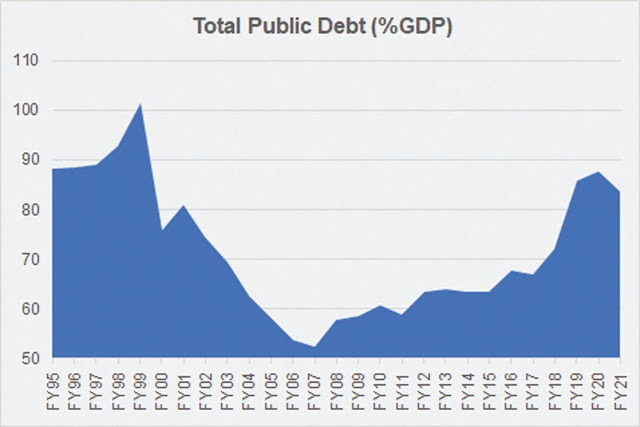
In 1999, President Pervez Musharraf inherited a massive debt of 100% of GDP run up by the Pakistan Peoples Party and the Pakistan Muslim League (Nawaz) governments in the 1990s. Musharraf's policies not only revived the bankrupt economy but also brought down debt to 52% of GDP by 2007. 

Pakistan Debt to GDP 1995-2021. Source: IMF


PPP Government's 2008 Letter to IMF:

In a letter to the International Monetary Fund in 2008, the PPP government hailed Musharraf's economic record without mentioning his name in the following words:

"Pakistan's economy witnessed a major economic transformation in the last decade (2000-2008). The country's real GDP increased from $60 billion to $170 billion, with per capita income rising from under $500 to over $1000 during 2000-07.....the volume of international trade increased from $20 billion to nearly $60 billion. The improved macroeconomic performance enabled Pakistan to re-enter the international capital markets in the mid-2000s. Large capital inflows financed the current account deficit and contributed to an increase in gross official reserves to $14.3 billion at end-June 2007. Buoyant output growth, low inflation, and the government's social policies contributed to a reduction in poverty and improvement in many social indicators". (see MEFP, November 20, 2008, Para 1).

Pakistan Manufacturing Value Added 2000-2021. Source: World Bank


Savings and Investments:

Domestic savings rate reached 18% of the GDP and foreign direct investment (FDI) hit a record level of $5.4 billion in 2007-8. This combination of domestic and foreign investments nearly tripled the size of the economy from $60 billion in 1999 to $170 billion in 2007, according to IMF. Exports nearly tripled from about $7 billion in 1999-2000 to $22 billion in 2007-2008, adding millions of more jobs. Pakistan was lifted from a poor, low-income country with per capita income of just $500 in 1999 to a middle-income country with per capita income exceeding $1000 in 2007.

FDI in the Musharraf years came in many sectors, ranging from telecommunications to manufacturing.
Several mobile phone and Internet service operators built networks worth billions of dollars. Without this telecom infrastructure, there would be no tech industry, no freelancers and no fast-growing tech exports today.

New cement plants met growing demand that more than doubled cement consumption, FMCG (fast moving consumer goods) sector took off to meet demand from growing middle class and production of cars and motorcycles jumped. 


Human Capital Development: 

In addition to the economic revival, Musharraf focused on the social sector as well. Pakistan's Human Development Index (HDI) score grew an average rate of 2.7% per year under President Musharraf from 2000 to 2007, and then its pace slowed to 0.7% per year in 2008 to 2012 under elected politicians, according to the 2013 Human Development Report titled “The Rise of the South: Human Progress in a Diverse World”.


Primary Enrollment Source: Economic Survey of Pakistan

Youth Literacy Rate Source: Economic Survey of Pakistan


Pakistan University Enrollment Jumped in Musharraf Years. Source: World Bank


Overall, Pakistan's human development score rose by 18.9% during the Musharraf years and increased just 3.4% under elected leadership since 2008. The news on the human development front got even worse in the last three years, with HDI growth slowing down as low as 0.59% — a paltry average annual increase of under 0.20 per cent. Going further back to the  decade of 1990s when the civilian leadership of the country alternated between PML (N) and PPP,  the increase in Pakistan's HDI was 9.3% from 1990 to 2000, less than half of the HDI gain of 18.9% on Musharraf's watch from 2000 to 2007.

R&D Spending Jumped 7-fold as % of GDP 1999-2007 Source: World Bank

Acceleration of HDI growth during the Musharraf years was not an accident.  Not only did Musharraf's policies accelerate economic growth, helped create 13 million new jobs, cut poverty in half and halved the country's total debt burden in the period from 2000 to 2007, his government also ensured significant investment and focus on education and health care. The annual budget for higher education increased from only Rs 500 million in 2000 to Rs 28 billion in 2008, to lay the foundations of the development of a strong knowledge economy, according to former education minister Dr. Ata ur Rehman. Student enrollment in universities increased from 270,000 to 900,000 and the number of universities and degree awarding institutions increased from 57 in 2000 to 137 by 2008. Government R&D spending jumped from 0.1% of GDP in 1999 to 0.7% of GDP in 2007. In 2011, a Pakistani government commission on education found that public funding for education has been cut from 2.5% of GDP in 2007 to just 1.5% - less than the annual subsidy given to the various PSUs including Pakistan Steel and PIA, both of which  continue to sustain huge losses due to patronage-based hiring.

Pakistan's High-Tech Exports Tripled as % of Manufactured Exports. Source: World Bank

Pakistan textile exports more than doubled from $5.2 billion to more than $11 billion during the Musharraf years. Exports soared 19.43% in 2001, 20% in 2004, 24.5% in 2005 and 11.23% in 2006, all on President Musharraf's watch, according to "The Rise and Fall of Pakistan's Textile Industry: An Analytical View" published by Javed Memon, Abdul Aziz and Muhammad Qayyum.     


Pakistan Textile Exports Growth. Source: Javed Memon

Pakistan experienced rapid economic and human capital growth in the years 2000 to 2008 on President Pervez Musharraf's watch. Savings, investments and exports hit new records and the rate of increase in human development reached new highs not seen before or since this period.  Without this human capital, there would be no tech industry, no freelancers and no fast-growing tech exports today.

Employment Growth in South Asia. Source: World Bank

Pakistan's employment growth was the highest in the South Asia region in 2000-2010, followed by Nepal, Bangladesh, India, and Sri Lanka in that order, according to a World Bank report titled "More and Better Jobs in South Asia".

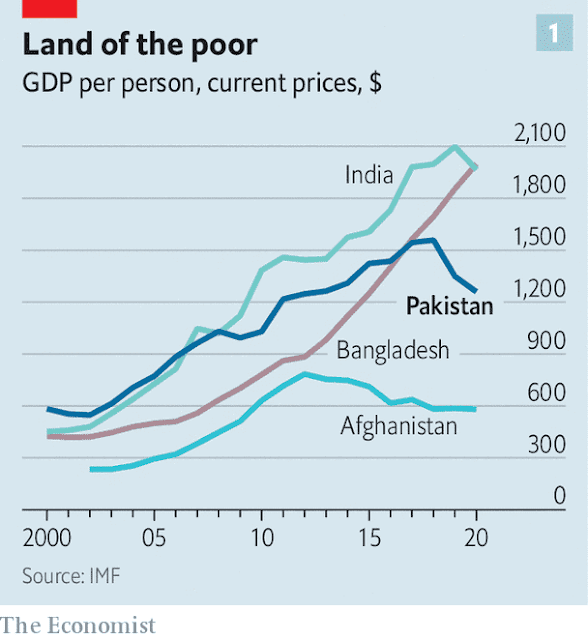
Comparing Per Capita GDP Trajectory in South Asia. Source: The Economist

Until 2010, Bangladesh was a laggard in the South Asia region. Its per capita income was about half of Pakistan's. Now Bangladesh's per capita GDP is higher than both India's and Pakistan's. What changed? The biggest change is Bangladeshi leader Shaikh Hasina's decision to stifle the unruly Opposition and the media to bring political and economic stability to the South Asian nation of 160 million people. It has eliminated a constant sense of crisis and assured investors and businesses of continuity of government policies. With development taking precedence over democracy, Shaikh Hasina followed the example of Asian Tigers  by focusing on export-led economic growth of her country. She incentivized the export-oriented garment industry and invested in human development. Bangladesh now outperforms India and Pakistan in a whole range of socioeconomic indicators: exports, economic growth, infant mortality rate, primary school enrollment, fertility rate and life expectancy.    

Related Links:


Sunday, September 26, 2021

Why Are Indians Unhappy With Modi's Reception in Washington?

Indian Prime Minister Narendra Modi visited Washington on September 23rd for a bilateral meeting with President Joseph R. Biden followed by a 4-nation summit involving Australia, India, Japan and the United States.  An unhappy meme of his visit went viral on social media as Mr. Modi wrapped up his visit to the United States. 

Modi Washington Visit Meme


It highlights four key complaints about how the Indian prime minister was treated by the White House:

1. President Biden did not receive Prime Minister Modi at the White House porch. This is in sharp contrast to the reception President Donald J. Trump gave Pakistani Prime Minister Imran Khan during the latter's visit in 2019. President Trump greeted Prime Minister Khan in the driveway as the latter emerged from his car. 


2. US media did not cover Modi's visit. (Pakistan's Imran Khan was on the Newsweek cover while Modi was in Washington). The media coverage Modi did receive in the US media was about lectures from the US leaders. 

3. Kamala Harris reminded Modi of the pressing need for real democracy in India. Here's an excerpts of the US Vice President's remarks released by the White House:  "Finally, as democracies around the world are under threat, it is imperative that we defend democratic principles and institutions within our respective countries and around the world and that we maintain what we must do to strengthen democracies at home. And it is incumbent on our nations to, of course, protect democracies in the best interest of the people of our countries". 

4. Joseph Biden lectured Modi on tolerance.  The President said to the Prime Minister: "As the world celebrates Mahatma Gandhi’s birthday next week, we’re all reminded that his message of non-violence, respect, tolerance matters today maybe more than it ever has". 

President Biden offered a back-handed compliment to the Indian media when he said at the White House: "The Indian press is much better behaved than the American press...And I think, with your permission, we should not answer questions because they won't ask any questions on point" . 

Biden may have said this to help Modi evade tough questions from the press that the Indian Prime Minister can not answer. He has never held an open press conference nor has he ever agreed to be interviewed by independent journalists. 

Here's a video clip of Biden's statement to the White House press corps before the beginning of the closed-door meeting with Mr. Modi:

https://youtu.be/scY3O3WM8Mg


Here's a video clip showing what Modi doesn't like about facing tough questions like why he didn't even express regret about massacre of Muslims in Gujarat:

 https://youtu.be/S5dkpUn5tNo


Is India a Paper Elephant?

Ambassador Kishore Mahbubani: America Does Not Respect India

Fareed Zakaria Never Misses Any Opportunity to Bash Pakistan

Retired Justice Markanday Katju on Modi's India

Lynchistan: India is the Lynching Capital of the World

73 Year After Independence, Caste-Ridden India Dominated By Brahmins

Lying Indian Media

Is Pakistan's Response to COVID19 Flawed?

Pakistan's Computer Services Exports Jump 26% Amid COVID19 Lockdown

Coronavirus, Lives and Livelihoods in Pakistan

Vast Majority of Pakistanis Support Imran Khan's Handling of Covid19 Crisis

Pakistani-American Woman Featured in Netflix Documentary "Pandemic"

Coronavirus Antibodies Testing in Pakistan

Can Pakistan Effectively Respond to Coronavirus Outbreak? 

Obama: Quickest Route to Indian Unity is Expressing Hostility Toward Pakistan

Pakistan Fares Marginally Better Than India On Disease Burdens

Trump Picks Muslim-American to Lead Vaccine Effort

Democracy vs Dictatorship in Pakistan

Pakistan Child Health Indicators

Pakistan's Balance of Payments Crisis

Panama Leaks in Pakistan

Conspiracy Theories About Pakistan Elections"

PTI Triumphs Over Corrupt Dynastic Political Parties

Strikingly Similar Narratives of Donald Trump and Nawaz Sharif

Nawaz Sharif's Report Card

Riaz Haq's Youtube Channel

Sunday, May 30, 2021

Pakistani Journalist Hamid Mir's Unhinged Response to Attack on Asad Toor

Hamid Mir, a primetime TV talk show host, has reacted angrily to an attack on fellow Pakistani journalist Asad Ali Toor this week. Without explicitly naming anyone in his emotional outburst against the Pakistan Army and the ISI (Inter-Services Intelligence Service), Mir has accused their leadership of cowardice in allegedly ordering attacks on journalists. Dredging up the name of "General Rani", believed to have been the mistress of former Army Chief and President Yahya Khan in the 1970s, Hamid Mir has threatened to reveal similar scandals of current Pakistan Army generals. “If you’re breaking into our homes to assault us, well, we cannot enter your homes as you have tanks and guns, but we can make things public, things from inside your homes,” Mir said at a journalists' rally in Islamabad.        

Hamid Mir (2nd from right) with Asad Toor


Pakistan ISI has denied any role in the attack on Toor.  A statement of the agency said: "The ISI believes that when the faces of the accused can be clearly seen on CCTV, there should be no hurdle in the investigation" It further added, "The continuation of such allegations shows that the ISI is being targeted [...] under an organized conspiracy".  

This entire episode has raised the following questions:

1. Why the attacks on journalists in Pakistan?  Are they specially targeted? Are other ordinary citizens subjected to similar but less publicized attacks? Is it a symptom of a larger phenomenon of failing criminal justice system?

2. Why are the Pakistani military and intelligence agencies automatically blamed without any investigation or evidence? Whose responsibility is it to carry out such investigations and prosecute perpetrators? 

3. Has Hamid Mir crossed the line between journalism and propaganda? Are some Pakistani journalists deliberately maligning Pakistani military and ISI leadership in the name of free speech? Should they be investigated for slander? 

4. Where do most Pakistanis stand vis-a-vis the military? Do they have greater confidence in the military or the politicians and journalists who blame the military for attacks? 

Please watch the following discussion on this subject:

https://youtu.be/-VuMWVKChE0


Friday, May 21, 2021

US Media Losing Control of the Middle East Narrative?

Citizen journalists armed with ubiquitous smartphones and access to social media platforms have challenged the western media reporting of the latest Israeli brutal assault on Gaza. While the established western media outfits have stuck to "Israel's right to defend itself" narrative, this new breed of young journalists has posted unfiltered images and videos of the Israeli war crimes against Palestinians. Some of these powerful posts have gone viral with many young people, including Jews, sharing them broadly on social media. People, particularly Americans, who share these posts see the Palestinian struggle as a civil rights struggle not unlike the recent Black Lives Matter movement in America. 

Pakistani Foreign Minister Shah Mahmood Qureshi on CNN

The western media, particularly the mainstream American media, are quick to accuse Israel's critics of being anti-semitic, a familiar tactic to distract from the Israeli crimes against humanity. A recent example is the CNN anchor Bianna Golodryga who labelled Pakistani Foreign Minister Shah Mahmood Qureshi's criticism of western media as anti-semitic, a charge that even President Jimmy Carter could not escape when he criticized Israel's Apartheid.  Here's what Mr. Qureshi  told the CNN anchor: 

“Israel is losing out (in spite of their) deep pockets, they are losing the media war despite their connections.. ..Well they are very influential people. I mean, they control media.....point is they have a lot of influence, and they get a lot of coverage. Now what has balanced that is the citizen journalist who has been reporting, sharing video clips and that has jolted people and that has woken up people, and people who were sitting on the fence are today speaking up.”

Golodryga interjected and said, “I would call that an antisemitic remark". I am not sure if Qureshi knows but it seems to me that phrases like "control media" and "deep pockets" hit close to home for Golodryga. She and her husband Peter Orszag are both Jewish. Golodryga is an influential media person while Orszag is an investment banking executive on Wall Street. 

The power of Jews in American media and finance is undeniable. Goldman Sachs is the most influential investment bank in the United States. It was founded by Jews in the nineteenth century. Most of its partners since then, almost all of its leaders, and its current CEO (Lloyd Blankfein) are Jews. Similarly, most of the top media executives and best-known US journalists are Jews. 

The role of money and media is particularly important for domestic politics in the United States. What Mr. Qureshi said is especially true of the powerful Israel lobby group American-Israeli Public Affairs Committee (AIPAC) that lobbies for Israeli interests in the United States. AIPAC is flush with cash contributed by rich American Jews. AIPAC has lots of friends in mainstream US media. 

Western media not only fail to accurately report current events in Palestine but they also do not contextualize such events. For example, the current crisis in the region started with attempts by some Israeli Jews to steal Palestinian homes in Jerusalem. A viral video shared on social media illustrates what is happening there. It shows a young Palestinian woman in the East Jerusalem neighborhood of Sheikh Jarrah saying to a Jewish man named Yakov, “You are stealing my house!” “If I don’t steal it, someone else will steal it,” he responds. 

Popular comedian John Oliver has called out the western media for promoting "both sides" narrative in the Middle East. Here's what he said:

“There’s a real tendency, particularly in America, to ‘both sides’ this situation, and I’m not saying that there aren’t some areas where that’s warranted. But it’s important to recognize there are also areas where it’s simply not...Both sides are firing rockets, but one side has one of the most advanced militaries in the world. Both sides are suffering heartbreaking casualties, but one side is suffering them exponentially.... Falling back on, convenient sanitized terms like ‘real estate disputes’ and ‘airstrikes on militants’ feels a little disingenuous when what you’re describing is forcing people from the homes they’ve lived in for decades and killing civilians, and children...And again, none of this frees Hamas from responsibility. But Hamas doesn’t represent all Palestinians just as what Israel is doing right now doesn’t represent all Israelis, or indeed Jewish people...Lots is complicated here, but some things are pretty simple...One side is suffering much more.”

Saturday, March 2, 2019

Balakot & Kashmir: Fact Checkers Expose Indian Lies

Indian government and media have made a series of false claims about Balakot "militant casualties" and "shooting down Pakistani F16". Both of these claims have been scrutinized and debunked by independent journalists, experts and fact checkers. There is no dispute about the fact that Squadron Leader Hasan Siddiqui of Pakistan Air Force (PAF), flying a Pakistan-made JF-17 fighter, shot down Wing Commander Abhinandan Varthaman of Indian Air Force (IAF) flying a Russia made MiG 21. Abhinandan was captured by Pakistan and then released to India.

Pakistani F-16:

PAF's Hasan Siddiqui (above) shot down IAF's Wing Commander Abhi (below)
Indian government and media claimed that an Indian Air Force pilot shot down a Pakistani F-16 on February 26, 2019 over Kashmir. This claim and the evidence offered were examined by Belling Cat, a fact-check site that successfully investigated the downing of a Malaysian passenger jet over Ukraine. Belling Cat's Veli-Pekka Kivimäkithere concluded that "no compelling evidence offered as of yet that an F-16 would have been shot down, and all signs point to MiG-21 wreckage having been on display thus far".

Abhijit Aiyar Mitra, an Indian aviation expert participating in an India Today TV Show, embarrassed the India TV show host Rahul Kanwal on live TV  when asked to identify a wrecked engine as being an F-16 engine. The expert correctly stated that Pakistani F-16s are equipped with Pratt and Whitney engines and what the TV host was calling a Pakistani F-16 engine was made by a different manufacturer.

Both Kivimäki and Mitra concluded that the image offered as evidence of Pakistani F-16 engine was in fact from a MiG 21 wreckage.

Balakot Casualties:

Announcing the Indian air strikes in Pakistan, Indian Foreign Secretary Vijay Gokhale claimed the strike killed “a very large number of Jaish-e-Mohammad terrorists, trainers, senior commanders, and groups of jihadis who were being trained for Fidayeen action were eliminated.” Another senior government official told reporters that about 300 militants had been killed.

The Indian government claim was soon followed by a video clip purportedly capturing a portion of that air strike on social media. Fact Check site snopes.com analyzed this video and declared the Indian claim "false".

Reuter reporters visited the target area in Balkot in Pakistan and talked to an eyewitness who said, “No one died. Only some pine trees died, they were cut down. A crow also died.” Here's an excerpt from the Reuter's report:

People in the area said Jaish-e Mohammad did have a presence, running not an active training camp but a madrassa, or religious school, less than a kilometer from where the bombs fell. “It is Taleem ul Quran madrassa. The kids from the village study there. There is no training,” said Nooran Shah, another villager.

Indian Warplane Down:

There is no dispute about the fact that Squadron Leader Hasan Siddiqui of Pakistan Air Force (PAF), flying a Pakistan-made JF-17 fighter, shot down Wing Commander Abhinandan Varthaman of Indian Air Force (IAF) flying a Russia made MiG 21. Abhinandan was captured by Pakistan and then released to India.

Summary:

All of the Indian claims about "JeM militant casualties" and shooting down of Pakistani F-16 have been debunked by independent fact-checkers and foreign media reporting on it.  Villagers in Balakot told Reuters that "Only some pine trees died, they were cut down. A crow also died.”  Belling Cat's Veli-Pekka Kivimäkithere and Indian analyst Abhijit Mitra have said that the images of the wreckage being offered as proof of downed F-16 are in fact from MiG-21. There is no dispute about the fact that Squadron Leader Hasan Siddiqui of Pakistan Air Force (PAF), flying a Pakistan-made JF-17 fighter, shot down Wing Commander Abhinandan Varthaman of Indian Air Force (IAF) flying a Russia made MiG 21. Abhinandan was captured by Pakistan and then released to India.

Here's a video clip of Indian aviation expert Abhijit Mitra embarrassing his India Today host:

https://youtu.be/FJ8MmTvRZ8Q


Sunday, December 9, 2018

Pakistan Media Crisis: Facts and Myths

Why are Pakistan media groups laying off employees and shutting down TV channels? Is it caused by Pakistan government cutbacks in advertising? Is it part of the PTI government's alleged efforts to censor media? Or part of the long overdue industry shake-out after almost two decades long un-interrupted media business expansion?

Pakistan Ad Spending. Source: Aurora/Dawn


How much was the Nawaz Sharif led PMLN government spending on advertising? Did Nawaz Sharif and Shahid Khaqan Abbasi increase media advertising budgets to buy favorable coverage at taxpayers' expense?

Are Pakistan government and national security establishment unique in wanting to manage media coverage? Do Western government manage media as well? If so, how? How do their media management techniques differ?

Global Advertising Growth 2016. Source: Magna

What is the future of media in Pakistan as the Internet penetration grows dramatically with 1-2 million more people coming online each month? Will greater spending on digital ads change journalism in Pakistan? Will more journalists take to social media and other online platforms as business?

Viewpoint From Overseas host Misbah Azam discusses these questions with panelists Sabahat Ashraf and Riaz Haq.


https://youtu.be/Nz1axuB5j-Q


Related Links:

Haq's Musings

FMCG Growth in Pakistan

Is Media Free?

Pakistan Retail Sales Growth

Advertising Revenue in Pakistan

Pakistan FMCG Market

The Other 99% of Pakistan Story

PSL Cricket League Revenue

E-Commerce in Pakistan

Fintech Revolution in Pakistan

Mobile Broadband Speed in Pakistan

Sunday, December 2, 2018

Pakistan Media Industry Shakeout Underway

Pakistan's 88 billion rupee media industry is in the midst of a major shakeout after a long period of rapid double-digit growth since the turn of the century. Hundreds of journalists and other staff have lost their jobs. At least one TV channel, Waqt News, has closed while several others are downsizing. While such consolidation was long overdue after nearly two-decade long period of explosive growth, the PTI government's decision to reduce advertising budget, which constitutes nearly a quarter of all ad spending in the country, appears to be the main trigger. Those affected by consolidation are accusing the government of exercising press censorship by cutting its ad spending.

Pakistan Ad Spending. Source: Aurora/Dawn

Rapid Growth:

Rising buying power of rapidly expanding middle class in Pakistan drove the nation's media advertising revenue up 14% to a record Rs. 76.2 billion 2016 and another 12% to Rs. 88 billion in 2017, making the country's media market among the world's fastest growing media markets.

Global Advertising Growth 2016. Source: Magna

Industry Shakeout:

Massive commercial media growth in Pakistan has been most apparent in terms of private TV channels growing from just one in Year 2000 to over 100 today after President Musharraf's deregulation of electronic and other media.

Explosive growth with many new entrants is the fundamental business reason for the recent wave of consolidation and shakeout. Shakeout is a business term used to describe the consolidation of an industry or sector after it has experienced a period of rapid growth in demand followed by oversupply.

At least one TV channel, Waqt News owned by Nawai-Waqt Media Group, has closed while several others are downsizing.  “We are trying to compile exact figures of the affected media persons. So far, we can say that around 1,000-1,500 workers have lost their jobs or faced cuts in salaries in the past few weeks,” Muhammad Afzal Butt, president of one the main factions of Pakistan Federal Union of Journalists (PFUJ) told  The News Sunday (TNS) this week.

Government Spending:

About a quarter of Rs. 80 billion ad revenue comes from federal and provincial government ads in the media. Some of the TV channels receive as much as 50% of their revenue from the government.

"The government has cut its media spend by more than 70% and companies by almost 50%", according to a leading advertising agency owner who spoke to Dawn.

Global Advertising Growth 2018. Source: Magna


"The (federal) government used to spend some Rs. 10 billion on advertisements annually, which was increased up to Rs35 billion in the last years of the (Nawaz Sharif's PMLN) government," Fawad Chaudhry,  federal minister of information,  told The News Sunday (TNS).  This tax-payers’ money, says the minister, was used by the previous government to bribe the media for favorable coverage.

Digital Adverstising:

Growing slice of the media ad spend is being claimed by online advertising with accelerating broadband penetration in Pakistan. Most recent data from Pakistan Telecommunications Authority shows that 62 million Pakistanis now subscribe to mobile broadband and this number is increasing by one to two million new subscribers each month.

Digital media spending rose 27% in 2015-16 over prior year, the fastest of all the media platforms. It was followed by 20% increase in radio, 13% in television, 12% in print and 6% in outdoor advertising, according to data published by Aurora media market research.

Summary:

Significant reduction in government spending on advertising has triggered a long-overdue shakeout after almost two decades of rapid media growth in Pakistan. About a quarter of Rs. 80 billion ad revenue comes from federal and provincial government ads in the media. Some of the TV channels receive as much as 50% of their revenue from the government.  Hundreds of journalists and other staff have lost their jobs. At least one TV channel, Waqt, has closed while several others are downsizing. Those affected by consolidation are accusing the government of exercising press censorship by cutting its ad spending.


Here's a video discussion on Pakistani media business with Misbah Azam, Sabahat Ashraf and Riaz Haq.


https://youtu.be/Nz1axuB5j-Q


Related Links:

Haq's Musings

FMCG Growth in Pakistan

Is Media Free?

Pakistan Retail Sales Growth

Advertising Revenue in Pakistan

Pakistan FMCG Market

The Other 99% of Pakistan Story

PSL Cricket League Revenue

E-Commerce in Pakistan

Fintech Revolution in Pakistan

Mobile Broadband Speed in Pakistan

Saturday, July 21, 2018

Pakistan Elections 2018 Conspiracy Theories

What conspiracy theories are being bandied about in Pakistani media coverage of general elections scheduled for July 25, 2018?

Why are Jang and Dawn, Pakistan's top 2 media houses, promoting Nawaz Sharif and his supporters' narrative?

Is there any evidence of a conspiracy between Pakistan's intelligence agencies and the top judges in the country?

Is the speculation based entirely on history? If these theories are correct, what will be the most likely outcome of these elections? Which party will emerge?  Will it be the "agencies" alleged favorite PTI?

What office would PTI chief Imran Khan want if his party wins? Prime Minister or President? Will possible restoration of article 58-2B of the constitution mean Imran Khan chooses to be president with real power?

Faraz Darvesh, Sabahat Ashraf and Riaz Haq discuss these questions. First streamed live on Facebook on July 21, 2018.

https://youtu.be/xjRHrinZw7Y


Related Links:

Haq's Musings

South Asia Investor Review

ISI Mea Cupla in 2002 Elections

Pakistan 2018 Elections Predictions

Free Speech: Myth vs Reality

Panama Leaks in Pakistan

Nawaz Sharif vs "Khalai Makhlooq"

"Genocide" Headline Skewed All East Pakistan Media Coverage in 1971

Strikingly Similar Narratives of Donald Trump and Nawaz Sharif

Ex CIA Official on Pakistan's ISI

Riaz Haq's Youtube Channel

Conspiracy Theories Dominate Media Coverage of Pakistan Elections 2018

Pakistani media coverage of the general elections scheduled for July 25, 2018 is dominated by discussion of conspiracy theories about the alleged involvement of Pakistan's "establishment" (euphemism for Pakistani military and intelligence agencies) to "rig" the vote to favor Pakistan Tehreek-e-Insaf (PTI) led by cricketer-turned-politician Imran Khan. Some in the media also accuse the "Deep State" of "worst ever censorship".

In a recent airing of BBC Hardtalk, the host Stephen Sackur challenged Pakistan Dawn Media Group's CEO Hameed Haroon to show evidence of Pakistani "Deep State" interference in the upcoming elections. Haroon responded by saying there's strong perception of it and said "it's all over social media". Sackur then told Haroon about the widely held view that Dawn Media Group is openly taking sides by supporting PMLN for the last two years and its now "convicted" leader Nawaz Sharif.

BBC's Hardtalk:

Mr. Hameed Haroon, Chief Executive of Pakistan's Dawn Media Group, claimed in a recent BBC interview that the Pakistani military and intelligence services were "orchestrating" July 25, 2018 general elections in favor of a particular political party. Here's an except of the interview with BBC's Stephen Sackur as the host:

Sackur: You are defenders of journalistic integrity, independence and impartiality in Pakistan but you are not seen as entirely neutral and impartial because over the last couple of years you are increasingly giving platform to one particular political player Nawaz Sharif who's run into an awful lot of trouble due to allegations of corruption ....you, the self-proclaimed impartial, independent, neutral media group covering Pakistani politics are now seen to be supporting and sympathetic to Nawaz Sharif and his daughter who it has has to be said are convicted criminals...

Haroon: There's an element of orchestration by military of a campaign against us...

Sackur: Where is your evidence of orchestration?

Haroon: If you look at the social media attacks on Dawn by the ISPR trolls....not just going after us but anybody who stands in their way.

Media Censorship:

Some in the media accuse the "Deep State" of "worst ever censorship". They say that their coverage is being limited and their distribution disrupted.

This claim of "worst ever censorship" is undercut by almost all media outlets widely covering all political speeches by leaders and candidates of all political parties, including Pakistan Muslim League (N) favored by Pakistan's two biggest media giants Jang and Dawn groups. The fact that there is a lot of discussion of "deep state" trying to "fix elections" reinforces the relative media freedom to show all points of view.

Orchestration vs Influence:

Those alleging "orchestration" of elections by Pakistani "establishment" cite documented history of involvement of Pakistani military and intelligence services in previous elections on behalf of one party or another.

For example, they mention the mea culpa by General Ehtisham Zamir, head of ISI political cell during 2002 elections.

It should be noted that the former Prime Minister Zulfikar Ali Bhutto issued the executive order creating a political cell within the Inter Services Intelligence (ISI) with the purpose of influencing political processes in Pakistan, according to Hien Kiessling, author of "Faith, Unity, Discipline: The Inter-Service-Intelligence (ISI) of Pakistan".

Bhutto's fateful decision in 1975 eventually brought about his own downfall when he used this cell to unnecessarily rig the 1977 elections and was overthrown and executed by General Zia-ul-Haq. It was also this cell that helped Nawaz Sharif , a protege of General Zia-ul-Haq, get elected as Prime Minister of Pakistan after the General's death in a mysterious air crash followed by a brief term in office by Benazir Bhutto. In 1990 the ISI received 140m rupees (US$2.2m at current values) to rig national elections, according to supreme court testimony by the then chief of army staff, General Mirza Aslam Beg.

While it is possible that the Pakistani military "establishment" is attempting to influence the outcome of the elections, there is scant evidence of "orchestration" as alleged by Hameed Haroon of Dawn Media Group and others. While the military is a key player and has the ability to tip the scales to some extent, it lacks the capacity to determine the outcome of the elections.

Orchestration, as alleged by Haroon and others, would challenge our credulity to believe all of the following:

1. Pakistan Army and Inter-Services Intelligence (ISI) colluded with the International Consortium of Investigative Journalists (ICIJ) to hack and leak Panama Papers.

2. The "establishment" made sure that Nawaz Sharif's family's undeclared assets were part of the leak.

3. Pakistan Army chief and ISI ordered NAB to investigate Panama leaks and Nawaz Sharif family's assets.

4. Pakistan Army Chief and ISI chief called a meeting of the top Supreme Court judges to hear the case, remove Nawaz Sharif and transfer trial to a NAB court. 5. Pakistan Army Chief and ISI ordered NAB court to render a guilty verdict.

Justice Shaukat Aziz Siddiqui:

Pakistani media have widely reported the remarks of  Justice Shaukat Aziz Siddiqui regarding the attempts to influence his decisions in cases pending in his court relating to Nawaz Sharif's recent conviction.

The broad coverage of Justice Siddiqui's remarks in Pakistani media appears to negate the claims of media censorship made by Dawn's Haroon and others.

Justice Shaukat Aziz Siddiqui is a right-wing judge who was a Jamaat e Islami candidate for elections in 2002. He represented Lal Masjid clerics after the Pakistani military cracked down on them  in Islamabad. He has become increasingly vocal against the military and his fellow judges since he was charged with misappropriating funds and hiring relatives to fill jobs at the Islamabad High Court. There’s a judicial reference pending against him.

Summary:

Media coverage of Pakistan's July 25, 2018 elections is dominated by conspiracy theories alleging "orchestration" of the election process by Pakistan's "Deep State". A recent episode of BBC's Hardtalk with Dawn Group's CEO showed that such allegations fail to withstand any serious scrutiny. The "orchestration" conspiracy theory challenges credulity by asking you to believe that everything starting with Panama Papers leak by International Consortium of Investigative Journalists (ICIJ) was managed by Pakistani intelligence agencies to oust Pakistan's ex prime minister Nawaz Sharif. Wide reporting of open criticism of the military and the judiciary by Justice Shaukat Aziz Siddiqui shows that the "worst ever media censorship" charge is not credible.

Here's a short video clip of BBC's Stephen Sackur's Hardtalk interviewing  Hameed Haroon of Pakistan's Dawn Media Group:

https://youtu.be/JQbt2QlVbwI


Related Links:

Haq's Musings

South Asia Investor Review

ISI Mea Cupla in 2002 Elections

Pakistan 2018 Elections Predictions

Free Speech: Myth vs Reality

Panama Leaks in Pakistan

Nawaz Sharif vs "Khalai Makhlooq"

"Genocide" Headline Skewed All East Pakistan Media Coverage in 1971

Strikingly Similar Narratives of Donald Trump and Nawaz Sharif

Ex CIA Official on Pakistan's ISI

Riaz Haq's Youtube Channel