Showing posts with label demographics. Show all posts

Friday, May 12, 2023

Pakistan Now: Darkest Before Dawn?

Pakistan is experiencing one of the darkest periods of its history. Political instability is eroding confidence in the nation's future. Declining economic growth and high inflation are hurting the people of all strata of society, particularly the poor whose numbers are rapidly rising. Is there any hope left for the country? Is it a case of the "darkest before dawn"? How do investors see it? 

Ex PM Imran Khan (R) with President Erdogan

Writing in the Time magazine immediately after the recent arrest of former Prime Minister Imran Khan, American investor, author and commentator Zachary Karabell who has invested in Pakistani startups sees rare hope for Pakistan. He sees Pakistan where Turkey was back in 2001-2003, "when a series of elections brought Recep Erdogan to power even as he was repeatedly disqualified by a military that was determined to retain control". Here's an excerpt of his article titled "The Contrarian Case for Pakistan" published in the current issue of Time Magazine: 

"To some degree, this is an argument of “well, it’s not as bad as they say.” But it’s also a way of highlighting that Pakistan today may be a case of darkest before the dawn. With elections schedule for the fall, and with Imran Khan the most likely victor of said elections unless is his arrest leads to his disqualification as a candidate, Pakistan is in a very similar position to where Turkey was in 2001-2003, when a series of elections brought Recep Erdogan to power even as he was repeatedly disqualified by a military that was determined to retain control. Imran Khan has many of the same strengths and weaknesses of Erdogan, who after championing Turkish democracy and economic reform, then turned into the very type of corrupt autocrat that he had once fought against. But he nonetheless unleashed massive economic potential in Turkey and has left its 80 million people materially better off over the past 20 years, even as hyperinflation and Erdogan’s recent economic ineptitude is now eroding that. Should Imran Khan return to the head the government, he may well usher in a similar period in Pakistan, even as he has his own authoritarian and demagogic tendencies". 

Here are some of the key points Karabell makes in his opinion piece:

1. Pakistan has a real and dynamic private sphere that is not only seeing a start-up and new business ecosystem that has attracted hundreds of millions of dollars a year for the past few years but operates freely in a way that would be inconceivable in many other countries. Compare it to Egypt, for example, which receives far less negative attention and more foreign money yet is almost entirely dominated by a military dictatorship. Or Algeria. And then there are countries which barely function at all, dominating a whole swath of Sub-Saharan Africa but also dot central Asia (Tajikistan anyone?).

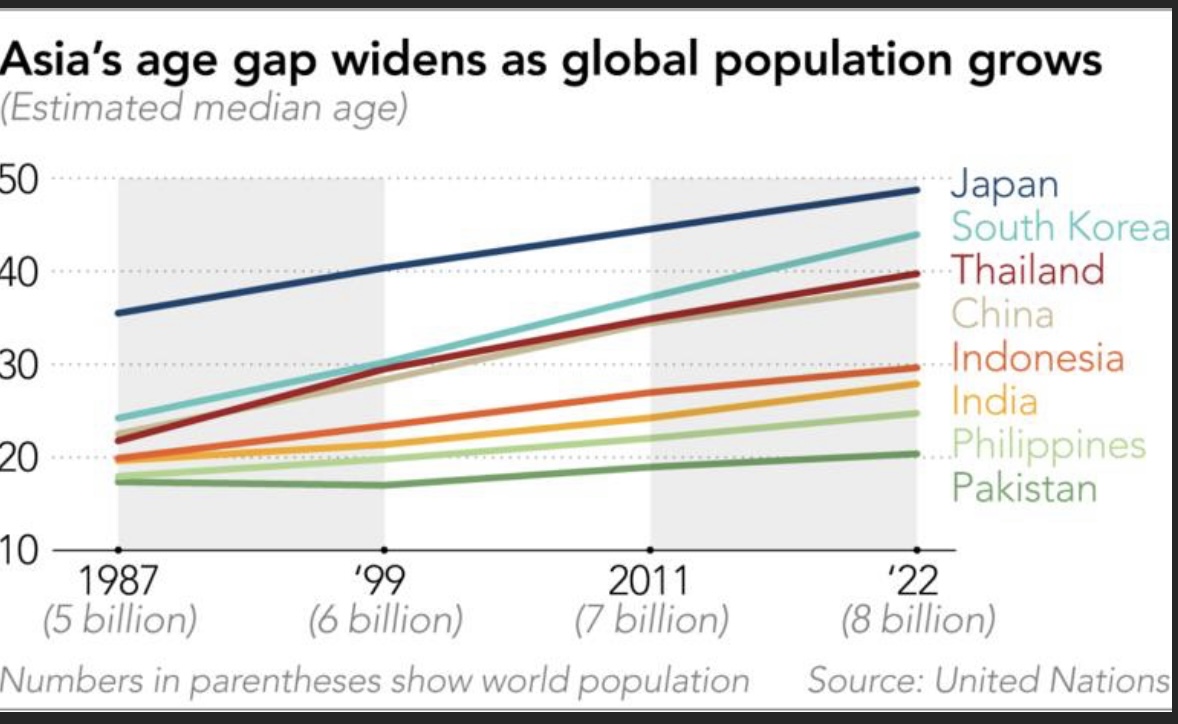
2. Pakistan is the fifth most populous country in the world with 230 million souls, a median age of barely 22 and two-thirds of the population under the age of 30. That means unlike most of the world, it has a favorable demographic future.

2. Unlike, say, Nigeria, where the ethnic divisions and decades of corruption mean that it well-nigh impossible to treat the country as one unified market for goods and services, Pakistan is one common market even with its various tribal divisions.

Pakistan Population Youngest Among Major Asian Nations. Source: Nikkei Asia

Karabell concludes with the following: 

Pakistan is on a cusp. We should honor the fact that whichever way the consensus believes it will go, the country is also poised to breakout on the upside. Which path will only be clear in retrospect, but we should pay more attention to the potential of things going right along with the legitimate focus on all that is going wrong.

Thursday, December 2, 2021

Why Are Muslim Births in Sharp Decline in Indian Occupied Kashmir?

Muslim women's fertility rate in Indian Occupied Kashmir has sharply declined to just 1.4, far below the replacement level of 2.1, according to India's latest National Family Health Survey (NFHS-5).  Is this the result of Indian Prime Minister Narendra Modi's oppression in Kashmir? Is it because of fewer Muslim young men in the occupied territory? Is it part of the Hindu Nationalist policy to change the demographics of Kashmir? Is it slow genocide

Kashmiris Demanding Azadi From India


Just over a week ago, India’s health ministry revealed that the country’s total fertility rate (TFR)—the average number of children that an Indian woman can expect to give birth to in her lifetime—has fallen below 2.1, which is to say below the “replacement” level at which births equal deaths. Muslim majority territory of Kashmir under Indian military occupation saw the biggest decline to just 1.4, the lowest TFR  reported by NFS-5. Hindu Nationalist politicians, including Prime Minister Modi, have rallied their Hindu voters by claiming that Muslims have too many babies. Legislation aimed at Muslims is being proposed to limit the size of families in the state of Uttar Pradesh led by Hindu priest Yogi Adityanath.  


India's Birth Rate Decline. Source: The Economist

The birth rates in Mr. Modi's BJP party's power base in the Hindi heartland continue to be much higher than those in the southern states. What this means is that the bulk of India's future voters and its workforce will continue to come mainly from the poor, less educated northern states. In 1971, Prime Minister Indira Gandhi froze the allocation of seats among India's states. As a result of this freeze, a member of parliament from Kerala now represents some 1.8 million voters while one from Uttar Pradesh represents nearly 3 million, according to a report in The Economist magazine. When the freeze on redistricting is lifted some time in the next decade, these disparities will mean that the northern states will have far more political power in the Union than they do now. 

The Indian military has kept Occupied Kashmir under extended and inhumane lockdown to prevent protests against New Delhi's reckless decision to scrap Article 370 of the Indian Constitution. The lockdown is being enforced by over 700,000 Indian troops deployed in Jammu and Kashmir.  People have been kept imprisoned in their homes for months. They were deprived of Internet, telephone or television for extended periods.  Delhi rules the region under Armed Forces Special Powers Act, the same law that was created and used by the British colonial power to try and crush Gandhi's Quit India movement. Thousands have died and more than 6,221 people received pellet gun injuries in the seven months following the July 2016 killing of Burhan Wani, according to the Jammu and Kashmir government as reported by The New Humanitarian.  Mr. Modi's actions are not only an affront to the people of Jammu and Kashmir but also in clear violation of India's international and bilateral obligations under United Nations charter and the Simla Accord.   It is time for all sane Indians and the rest of the world to wake up to the serious threats posed to peace in South Asia region and the wider world by Mr. Modi's fascist Hindutva project.

Tuesday, June 15, 2021

US Census: Pakistani-Americans Are Young, Well-educated and Prosperous

Over half a million Pakistani-Americans constitute the 7th largest Asian ethnic group in the United States. Pakistani-Americans are young, well-educated and prosperous. Median age for Pakistani-Americans is 31.7 years. 60% have at least a bachelor's degree. Their median household income is $87,510 a year.  The graph below shows that immigration into the United States significantly slowed down in Trump years.  Still, the remittances from Pakistani-Americans have jumped 58% to $2.75 billion in the current fiscal year.  

Pakistani-American Population Growth. Source: Pew Research


About 36% are US-born while the rest are foreign-born. Just under 80% are US citizens, both native and naturalized. Here are the key takeaways from US Census data recently published by USA Facts:

1. Median age of Pakistani-Americans is 31.7 years, below the 37.9 years for Asian-Americans and 38.5 for overall population. Median age is 34.8 for Indian-Americans and 32.7 for Bangladeshi-Americans. 

Median Age of Asian-Americans. Source: USA Facts

2. Median income of Pakistani-American households is $87.51K, below $97.3K for Asian-Americans but significantly higher than $65.71K for overall population. Median income for Indian-American households $126.7K, the highest in the nation. 

Median Income of Asian-Americans. Source: USA Facts


3. Sixty percent of Pakistani-Americans have at least a bachelor's degree, the second highest percentage among Asian ethnic groups. Indians are the best educated group with 76% having at least a bachelor's degree. The average for Asian-Americans with at least a bachelor's degree is 56%. 

Education Level of Asian-Americans. Source: USA Facts


4. About 36% of Pakistani-Americans are US-born while the rest are foreign-born. By comparison, 29.1% of Indian-Americans and 34.3% of Asian-Americans are native-born and the rest foreign-born. 


Citizenship Status of Asian-Americans. Source: USA Facts

There are 18.6 million Asian Americans living in the US, making up 6% of the US population, according to the latest available census data. The data shows that, on average, Asian Americans are younger, more likely to be born abroad, and live in households with higher income than the average American.

Here's a video clip of CNN analyst Van Jones talking about Pakistani-Americans:

https://www.youtube.com/watch?v=gr5cLv8Dj2I


Related Links:

Haq's Musings

South Asia Investor Review

Hindus and Muslim Well-educated in America But Least Educated Worldwide

What's Driving Islamophobia in America?

Pakistani-Americans Largest Foreign-Born Muslim Group in Silicon Valley

The Trump Phenomenon

Islamophobia in America

Silicon Valley Pakistani-Americans

Pakistani-American Leads Silicon Valley's Top Incubator

Silicon Valley Pakistanis Enabling 2nd Machine Revolution

Karachi-born Triple Oscar Winning Graphics Artist

Pakistani-American Ashar Aziz's Fire-eye Goes Public

Two Pakistani-American Silicon Valley Techs Among Top 5 VC Deals

Pakistani-American's Game-Changing Vision 

Minorities Are Majority in Silicon Valley 


Tuesday, August 22, 2017

Pakistani Diaspora Thriving in America

Nearly half a million people of Pakistani origin call America home. Pakistani-Americans' education and income levels are significantly higher than those of the general population of the United States. Among them are doctors, engineers, lawyers, accountants, journalists, politicians, business executives, professional sports team managers and owners, artists, actors, entrepreneurs, salespeople, policemen, soldiers, convenience store clerks and taxi, bus and truck drivers. United States is the 5th most popular destination for Pakistani-born international migrants and the 6th largest source of remittances to Pakistan. In addition to participating in local philanthropy and community activities, several Pakistani-American organizations help raise funds for schools, hospitals and other human welfare projects in Pakistan.

Pakistani-American Population:

Over 450,000 Pakistani immigrants and their children live in the United States as of 2013, according to a report compiled by Migration Policy Institute. Of these, 273,000 were born in Pakistan and the remaining 180,000 are US-born. Pakistani-American population has more than doubled in the last decade due to increased immigration, according to US Census data.

Origins of Foreign-Born Americans. Source: Pew Research


Pakistani-Americans (pop: 450,000) are the seventh largest community among Asian-Americans, behind Chinese (3.8 million),  Filipinos (3.4 million), Indians (3.2 million), Vietnamese (1.74 million),  Koreans (1.7 million) and Japanese (1.3 million), according to Asian-American Center For Advancing Justice . They are still a minuscule fraction of the overall US population.

Source: Migration Policy Institute 

Education and Income Levels:

56% of Pakistani-Americans have at least a bachelor's degree, much higher than 33% of Americans with college degrees. Among Pakistani-American college grads, 33% have a bachelor's degree while 23% have master's or Ph.Ds.

Median annual income of Pakistani-American households is $60,000, higher than the $50,000 median household income of all Americans. 33% of Pakistani-American households earn at least $90,000 while 18% earn more than $140,000.

Pakistani Doctors in America:

Pakistan is the third biggest source of foreign doctors who make up a third of all practicing physicians in the United States, according to OECD. Vast majority of Muslim doctors in America are of Pakistani origin.  Among them is Dr.Mark Humayun who was awarded top US medal for technology by President Barack Obama in 2016.

About 30% of the 800,000 doctors, or about 240,000 doctors, currently practicing in America are of foreign origin, according to Catholic Health Association of the United States. Predictions vary, but according to the American Association of Medical Colleges, by 2025 the U.S. will be short about 160,000 physicians. This gap will most likely be filled by more foreign doctors.

Foreign Doctors in US, UK. Source: OECD


As of 2013, there are over 12,000 Pakistani doctors, or about 5% of all foreign physicians and surgeons, in practice in the United States.  Pakistan is the third largest source of foreign-trained doctors. India tops with 22%, or 52,800 doctors. It is followed by the Philippines with 6%, or 14,400 foreign-trained doctors. India and Pakistan also rank as the top two sources of foreign doctors in the United Kingdom.

Pakistanis in Silicon Valley:

is home to 12,000 to 15,000 Pakistani Americans. Thousands of them are working at Apple, Cisco, Facebook, Google, Intel, Oracle, Twitter and hundreds of other high-tech companies from small start-ups to large Fortune 500 corporations. Pakistani-Americans are contributing to what Erik Brynjolfsson and Andrew McAfee describe as "The Second Machine Age" in a recent book with the same title.

A Representative Sample of Pakistani-American Entrepreneurs in Silicon Valley
Pakistani-Americans are the largest foreign-born Muslim group in San Francisco Bay Area that includes Silicon Valley, according to a 2013 study. The study was commissioned by the One Nation Bay Area Project, a civic engagement program supported by Silicon Valley Community Foundation, The San Francisco Foundation, Marin Community Foundation and Asian Americans/Pacific Islanders in Philanthropy.

 Overall, US-born Muslims make up the largest percentage at 34% of all Muslims in the Bay Area, followed by 14% born in Pakistan, 11% in Afghanistan, 10% in India, 3% in Egypt and 2% each in Iran, Jordan, Palestine and Yemen.

Pakistani-American entrepreneurs, advisers, mentors, venture capitalists, investment bankers, accountants and lawyers make up a growing ecosystem in Silicon Valley. Dozens of Pakistani-American founded start-ups have been funded by top venture capital firms. Many such companies have either been acquired in M&A deals or gone public by offering shares for sale at major stock exchanges. Organization of Pakistani Entrepreneurs (OPEN) has become a de facto platform for networking among Pakistani-American entrepreneurs in Silicon Valley. It holds an annual event called OPEN Forum which attracts over 500 attendees.

Entertainment and Sports:

Kumail Nanjiani, a Pakistani-American actor-comedian, recently made news with the successful release of his feature film The Big Sick on hundreds of screens across the United States.  It is a cross-culture romantic comedy based on actual events that breaks new ground by casting a brown-skinned Pakistani-American in a lead role in a movie produced and widely screened in the United States. Acquired by Amazon Studios for $12 million after a bidding war at Sundance film festival, the film has already grossed over $36 million so far.

Shahid Khan, a Pakistani-American engineer who made his multi-billion dollar fortune in auto industry, became only non-white owner of an NFL franchise team when he bought Jacksonville Jaguars for $760 million in 2011.

Major League Baseball's Los Angeles Dodgers franchise general manager is a Pakistani-American named Farhan Zaidi, an MIT and Berkeley-educated economist.

Kamala Khan is a new Ms. Marvel comic book character created by Pakistani-American Sana Amanat for Marvel Entertainment. Kamala is both female and Muslim. It is part of the American comic giant's efforts to reflect a growing diversity among its readers.

Academy Award winning Hollywood hits Frozen, Life of Pi and The Golden Compass have one thing in common:  Each used extensive computer-generated imagery (CGI) created by Pakistani-American Mir Zafar Ali who won Oscar statuettes for "Best Visual Effects" in each of them.

Pakistani-American Organizations:

Rockefeller Foundation-Aspen Institute Diaspora (RAD) program identified 79 Pakistani-American organizations. Of these, 5 organizations had revenue exceeding $1m while two had over $200,000 in their most recent fiscal year. The top organizations are The Citizens Foundation (TCF), the Association of Physicians of Pakistani Descent in North America (APNA) and the Organization of Pakistani Entrepreneurs (OPEN). Other large organizations are American Pakistan Foundation, Imran Khan Cancer Foundation and Human Development Foundation (HDF). These organization help raise funds for education, health care and other development and human welfare activities in Pakistan.

Trump's America:

Some Pakistani-Americans, like members of other ethnic and religious minorities, are alarmed by the increasing bigotry in America since the election of President Donald Trump. This is particularly true of places like New York's Little Pakistan were Pakistanis were targeted after 911 terrorist attacks. At the height of the sweep, over 20,000 people in Brooklyn’s South Asian communities left the United States, a COPO survey found, according to Gotham Gazette, a New York City publication. Many sought political asylum in Canada and Australia, and some returned to Pakistan and other countries. A number of them never returned. Many had their legitimate US immigration applications pending at the time. Others had their cases in immigration courts and they were waiting for disposition by judges.

Summary:

With few exceptions, most Pakistani-Americans, making up a tiny fraction of the US population, are thriving. They have significantly higher incomes and education levels than the general US population.  Pakistani-Americans are engaged in diverse occupations ranging from doctors, engineers and lawyers to large and small business owners and drivers. In addition to participating in local philanthropic and community activities, several Pakistani-American organizations help raise funds for schools, hospitals and other human welfare activities in Pakistan.

Related Links:

Haq's Musings

New York's Little Pakistan

Pakistan is the 3rd Largest Source of Foreign Doctors in America

Pakistani-American Stars in "Big Sick" Movie

Pakistani-American Population Growth 2nd Fastest Among Asian-Americans

Silicon Valley Pakistani-Americans

A Dozen British Pakistanis in UK Pariament

Trump and Modi

OPEN Silicon Valley Forum 2017: Pakistani Entrepreneurs Conference

Pakistani-American's Tech Unicorn Files For IPO at $1.6 Billion Valuation

Pakistani-American Cofounders Sell Startup to Cisco for $610 million

Pakistani Brothers Spawned $20 Billion Security Software Industry

Pakistani-American Ashar Aziz's Fireeye Goes Public

Pakistani-American Pioneered 3D Technology in Orthodontics

Pakistani-Americans Enabling 2nd Machine Revolution

Pakistani-American Shahid Khan Richest South Asian in America

Two Pakistani-American Silicon Valley Techs Among Top 5 VC Deals

Pakistani-American's Game-Changing Vision 


Saturday, July 11, 2015

Pakistan's Growing Population: Blessing or Curse?

“So where will the children of the future come from? Increasingly they will come from people who are at odds with the modern world. Such a trend, if sustained, could drive human culture off its current market-driven, individualistic, modernist course, gradually creating an anti-market culture dominated by fundamentalism - a new dark ages.” ― Philip Longman, The Empty Cradle: How Falling Birthrates Threaten World Prosperity & What to Do About It

Fear of Population Bomb:

The above quote captures the true essence of the West's racist fears about what some of them call the "population bomb": East will dominate the West economically and politically for centuries if the growing colored populations of developing Asia and Africa turn the West's former colonies into younger and more dynamic nations with rising education and better living standards.

Much of the developed world has already fallen below the "replacement" fertility rate of 2.1.  Fertility rates impact economic dynamism, cultural stability and political and military power in the long run.

Pakistan Population Growth:

Pakistani women's fertility rates have declined significantly from about 4.56 in 2000 to 2.86 babies per woman in 2014, a drop of 37% in 14 years.  In percentage terms, Pakistan population growth rate has come down from 2.3% in 2000 to 1.6% in 2014, a decline of about 30%. It is being driven drown by the same forces that have worked in the developed world in the last century: increasing urbanization, growing incomes, greater participation in the workforce and rising education.  Pakistan now ranks 65 among 108 countries with TFR of 2.1 (replacement rate) or higher.

Total Fertility Rate Per Pakistani Woman. Source: CIA World FactBook


Pakistan is already the most urbanized country in South Asia and its urbanization is accelerating. Pakistan has also continued to offer much greater upward economic and social mobility to its citizens than neighboring India over the last two decades. Since 1990, Pakistan's middle class had expanded by 36.5% and India's by only 12.8%, according to an ADB report titled "Asia's Emerging Middle Class: Past, Present And Future.

Pakistan Population Growth in Percentage Terms. Source: World Bank


Pakistan has the world’s sixth largest population, seventh largest diaspora and the ninth largest labor force with growing human capital. With rapidly declining fertility and aging populations in the industrialized world, Pakistan's growing talent pool is likely to play a much bigger role to satisfy global demand for workers in the 21st century and contribute to the well-being of Pakistan as well as other parts of the world.


With half the population below 20 years and 60 per cent below 30 years, Pakistan is well-positioned to reap what is often described as "demographic dividend", with its workforce growing at a faster rate than total population. This trend is estimated to accelerate over several decades. Contrary to the oft-repeated talk of doom and gloom, average Pakistanis are now taking education more seriously than ever. Youth literacy is about 70% and growing, and young people are spending more time in schools and colleges to graduate at higher rates than their Indian counterparts in 15+ age group, according to a report on educational achievement by Harvard University researchers Robert Barro and Jong-Wha Lee. Vocational training is also getting increased focus since 2006 under National Vocational Training Commission (NAVTEC) with help from Germany, Japan, South Korea and the Netherlands.


Pakistan's work force is over 60 million strong, according to the Federal Bureau of Statistics. With increasing female participation, the country's labor pool is rising at a rate of 3.5% a year, according to International Labor Organization.

With rising urban middle class, there is substantial and growing demand in Pakistan from students, parents and employers for private quality higher education along with a willingness and capacity to pay relatively high tuition and fees, according to the findings of Austrade, an Australian govt agency promoting trade. Private institutions are seeking affiliations with universities abroad to ensure they offer information and training that is of international standards.

Trans-national education (TNE) is a growing market in Pakistan and recent data shows evidence of over 40 such programs running successfully in affiliation with British universities at undergraduate and graduate level, according to The British Council. Overall, the UK takes about 65 per cent of the TNE market in Pakistan.

It is extremely important for Pakistan's public policy makers and the nation's private sector to fully appreciate the expected demographic dividend as a great opportunity. The best way for them to demonstrate it is to push a pro-youth agenda of education, skills developmenthealth and fitness to take full advantage of this tremendous opportunity. Failure to do so would be a missed opportunity that could be extremely costly for Pakistan and the rest of the world.

Growth Forecast 2014-2050. Source: EIU


In the high fertility countries of Africa and Asia family sizes are continuing to decline. And in low fertility countries family sizes will continue to remain below replacement levels. Why? Because the same juggernaut forces are operating: increasing urbanization, smaller and costly housing, expanding higher education and career opportunities for women, high financial costs and time pressures for childrearing and changing attitudes and life styles.

Source: BBC


Countries With Declining Populations:

115 countries, including China (1.55), Hong Kong (1.17),  Taiwan (1.11) and Singapore (0.8) are well below the replacement level of 2.1 TFR.  Their populations will sharply decline in later part of the 21st century.

 United States is currently at 2.01 TFR, slightly below the replacement rate.  "We don't take a stance one way or the other on whether it's good or bad," said Mark Mather, demographer with the Population Reference Bureau. Small year-to-year changes like those experienced by the United States don't make much difference, he noted. But a sharp or sustained drop over a decade or more "will certainly have long-term consequences for society," he told Utah-based Desert News National.

Japan (1.4 TFR) and Russia (1.6 TFR) are experiencing among the sharpest population declines in the world. One manifestation in Japan is the data on diaper sales: Unicharm Corp., a major diaper maker, has seen sales of adult diapers outpace infant diapers since 2013, according to New York Times.

Median Age Map: Africa in teens, Pakistan in 20s, China, South America and US in 30s, Europe, Canada and Japan in 40s.


The Russian population grew from about 100 million in 1950 to almost149 million by the early 1990s. Since then, the Russian population has declined, and official reports put it at around 144 million, according to Yale Global Online.

Reversing Trends:

Countries, most recently China, are finding that it is far more difficult to raise low fertility than it is reduce high fertility. The countries in the European Union are offering a variety of incentives, including birth starter kits to assist new parents in Finland, cheap childcare centers and liberal parental leave in France and a year of paid maternity leave in Germany, according to Desert News. But the fertility rates in these countries remain below replacement levels.

Summary:

Overzealous Pakistani birth control advocates need to understand what countries with sub-replacement fertility rates are now seeing: Low birth rates lead to diminished economic growth. "Fewer kids mean fewer tax-paying workers to support public pension programs. An "older society", noted the late Nobel laureate economist Gary Becker, is "less dynamic, creative and entrepreneurial."

Related Links:

Haq's Musings

Pakistan's Expected Demographic Dividend

Pakistan's Growing Human Capital

Upwardly Mobile Pakistan

Pakistan Most Urbanized in South Asia

Hindu Population Growth Rate in Pakistan

Do South Asian Slums Offer Hope?

How "Illiterate" Are Pakistan's "Illiterate" Cell Phone Users?

Thursday, May 24, 2012

Minorities Are Majority in America's Silicon Valley

The U.S. Census Bureau  has recently reported that the United States has reached a historic tipping point -- with Latino, Asian, mixed race and African American births constituting a majority of births for the first time. Minorities made up about 2 million, or 50.4%, of the births in the 12-month period ending July 2011. The latest figure was up from 49.5% reported in the 2010 census.

80386 CPU Design Team
Standing L to R: Riaz Haq, Jan Prak, Gene Hill, Pat Gelsinger, John Crawford
Sitting in Front: Dave Vannier
I  have personally witnessed Silicon Valley's racial mix change dramatically over the last several decades. When I arrived here to join Intel in 1981, there were few non-whites in the Valley. In fact, I was the only nonwhite person in a picture of the six-member award winning Intel 80386 CPU design team which was published by the PC Magazine in 1988.


My experience of the demographic changes in this high-tech valley is not just anecdotal. It's supported by data compiled by the local San Jose Mercury newspaper in 2010. The data shows that 49% of Intel employees are now Asian, a full 7% more than whites. In Silicon Valley, the difference is even more pronounced with Asians accounting for 53.9% of the employees versus 37.6% white workers.


 With Asians accounting for just 15.5% of the high-tech work force nationally, Silicon Valley's high-tech racial mix is also very different from the rest of the country. Silicon valley's employee pool also differs in terms of under-representation of Blacks, Hispanics and women relative the national averages.

 Among Asian-Americans, Pakistani-Americans are the 7th largest community in America, according to a report titled "A Community of Contrasts Asian Americans in the United States: 2011" published by Asian-American Center For Advancing Justice.  Pakistani-American population has doubled from 204,309 in 2000 to 409,163 in 2010, the second largest percentage increase after Bangladeshis' 157% increase in the same period.

Source:  TheAtlantic Cities


The total fertility rate in the United States is now at 2.06, just enough to maintain the current level of US population. It's possible mainly due to the history of relatively liberal US immigration policy. If US immigration policy is tightened in response to pressures from various labor organizations and the traditional anti-immigration groups, the US fertility rate is likely to dip and hurt the US economy which needs more workers to pay for the retiree benefits of the growing population of senior citizens. Already, many US multinational corporations have added 1.5 million workers to their payrolls in Asia and the Pacific region from 1999 to 2009, and 477,500 workers in Latin America, according to US Commerce Dept data as reported by the Wall Street Journal. If the businesses can not find workers in the United States, they are more likely to continue to accelerate moving jobs elsewhere, depriving the US government the revenue it needs to balance its budget.

Related Links:

Haq's Musings

Pakistani-American's Game-Changing Vision

US Firms Adding Jobs Overseas 

Pakistan's Demographic Dividend

Pakistanis Study Abroad

Pakistan's Youth Bulge

Pakistani Diaspora World's 7th Largest

Pakistani-American NFL Team Owner

Pakistani-American Entrepreneurs Catch the Wave

Pakistani Graduation Rate Higher Than India's

Thursday, December 15, 2011

Pakistani-American: First Non-White NFL Owner

NFL owners are the oldest and whitest of old white guy clubs. Drew Magary

Pakistani-American Shahid Khan made history this week by becoming the first minority owner of a National Football League team. All 31 other owners of NFL teams are white. The deal to purchase Jacksonville Jaguar is for an estimated $760 million and the ownership transfer will be complete Jan. 4, 2012, according to Associated Press. Earlier, Khan agreed in February 2010 to buy a controlling interest in the St. Louis Rams before billionaire Stan Kroenke exercised an option to purchase the 60 percent of the club he didn’t own.

NFL has highly lucrative business because of the extraordinary popularity of football in the United States. Over nine years, starting in 2014, CBS, Fox and NBC will together will pay an average of about $3 billion a year, more than 50 percent higher than their current deals, according to a report in New York Times. Altogether, the four networks, in addition to DirecTV, which pays $1 billion a year for its Sunday Ticket satellite package, will pay the N.F.L. more annually in TV rights than any sports league has ever been paid.


Shahid Khan, a mechanical engineering graduate of University of Illinois, Urbana-Champaign, made his fortune in the auto business. Almost two-thirds of all North American-built pick- up trucks and sports utility vehicles have bumper systems based on Khan’s designs, according to figures released by the Jaguars. Khan bought Flex-N-Gate in 1980 and the company now has more than 10,000 employees at 48 manufacturing plants with annual sales exceeding $3 billion.

Shahid Khan joins the illustrious list of Pakistani-Americans that includes Shering-Plough CEO Fred Hassan, Edible Arrangements Founder & CEO Tariq Farid, former CEO of Healthnet Dr. Malik Hasan, global hedge fund manager Mansoor Ijaz, Founder and Former CEO of AST Research Safi Qureshi, Mayor Haroon Saleem of of Granite Falls, Washington, Hilary Clinton aide Huma Abedin Weiner, novelists Bapsi Sidhwa and Daniyal Mueenuddin, Emmy nominee singer-songwriter Nadia Ali, and many other prominent Pakistani-American business executives, entrepreneurs, public servants, politicians and performers who have made their name in their adopted country.


Although Pakistani-Americans are still a miniscule fraction of the overall US population, their numbers have more than doubled in the last decade due to increased immigration, according to US Census 2010 data. With 100% increase since 2000, Pakistanis are the second fastest growing Asian immigrant group in the United States.


Here are some of the highlights of Pakistani-American data from US Census 2010 as gleaned from a report titled "A Community of Contrasts Asian Americans in the United States: 2011" published by Asian-American Center For Advancing Justice:

1. There are 409,163 Pakistani-Americans in 2010, the 7th largest Asian-American community in America.

2. Pakistani-American population doubled from 2000 (204,309) to 2010 (409,163), the second largest percentage increase after Bangladeshis' 157% increase in the same period.

3. 6% of Pakistani-American population is mixed race.

4. 65% of Pakistanis in America are foreign-born. 57% of foreign-born Pakistani-American population is made up of naturalized citizens.

5. There are 120,000 Pakistani legal permanent residents of which 42% are eligible to naturalize.

6. There were 69,202 immigrant visas issued to Pakistanis from 2001 to 2010, the 5th highest among Asian nations.

7. 28% of Pakistanis have limited English proficiency.

8. Average per capita income of Pakistani-Americans is $24,663.00

9. 15% of Pakistanis are classified as poor; only 1% of them are on public assistance.

10. 8% of Pakistanis are unemployed, a figure lower than the general population of Americans.

11. 55% of Pakistanis own their own homes.

12. 55% of Pakistanis have a bachelor's degree or higher.

13. Median age of Pakistanis in America is only 29 years, lower than most of the Asian groups and the national median age of 36.8 years.

Pakistani-American community is still relatively young when compared with other immigrant groups. More of the Pakistanis in America are college educated than the general population of whites and various immigrant groups. The youthful energy and higher education levels of Pakistani-Americans are opening doors for them to rise and shine in America, in spite of the current economic difficulties in their adopted land of opportunities.

Related Links:

Haq's Musings

Pakistani-American in $500 Million Deal to Buy St. Louis Rams

Edible Arrangements- A Pakistani-American's Success Story

Pakistani Diaspora World's 7th Largest

Pakistani-American's Game-Changing Vision

OPEN Forum 2010

Is Pakistan Too Big to Fail?

Pakistani-American Elected Mayor

Huma Abedin Calm Amid Twittergate

Silicon Valley Summit of Pakistani Entrepreneurs

Pakistan's Multi-Billion Dollar IT Industry

Media and Telecom Sectors Growing in Pakistan

Pakistan's Middle Class Growth in 1999-2009

Social Entrepreneurs Target India, Pakistan

Thursday, November 19, 2009

Pakistani-American Elected Mayor

Pakistani-American has been elected mayor of a town in Washington state by a landslide. The 54-year-old Mayor-elect Haroon Saleem admits that running the Timberline Bar and Cafe, with beer ads plastered everywhere, is not exactly a pious following of Islam, which forbids alcohol consumption.

The big win for a Muslim Pakistani-American is all the more surprising because Granite Falls is a small mining town of 800 mostly blue-collar whites, a result that residents say would have been inconceivable not long ago.

After 911 attacks in New York and Washington, Saleem told the Associated Press that community members reached out, letting him know he was one of them. No one seems to notice that his wife, Bushra, attends social events wearing a traditional shalwar-kamiz.

While Saleem is only the second American mayor of Pakistani origin after Dr. M. Ali Chaudry of New Jersey town of Basking Ridge elected in 2001, others have been elected to public offices in different parts of the country. Masroor Javed Khan, a fellow NEDian and a friend, serves on the city council in Houston, Texas. Saghir Tahir is a member of the New Hampshire State Assembly. Saqib Ali is a legislator in Maryland State.

Since the growth of immigration from Pakistan and other non-European nations starting in 1965, the Pakistani American community has not been particularly politically active, but this is now changing, with the community starting to contribute funds to their candidates of choice in both parties, and running for elected office in districts with large Pakistani American populations. In recent times, Pakistani American candidates have run for various offices across the nation. Because the community is geographically dispersed, the formation of influential voting blocs has not generally been possible, making it difficult to for the community to make an impact on politics in this particular way. However, there are increasing efforts on the part of community leaders to ensure voter registration and political participation.

The U.S. Census Bureau has indicated that there are about 210,000 U.S. citizens of Pakistani descent living in the United States, including permanent residents. The Census Bureau, however, excluded the population living in institutions, college dormitories, and other group quarters from all population groups. The Pakistani embassy estimates the number of people of Pakistani origin living in United States to be much higher, closer to 500,000.

According to estimates published by the Wikipedia, 50% of Pakistani Americans have origins in the Punjab Province of Pakistan. About 30% are Urdu-speaking "Muhajirs" and the rest is made up of other ethnic Groups from Pakistan. The most systematic study of the demography of Pakistanis in America is found in Prof. Adil Najam's book 'Portrait of a Giving Community' (Harvard University Press, 2006), which estimates a total of around 500,000 Pakistanis in America with the largest concentrations in New York and New Jersey states, each with around 100,000 Pakistani-Americans.

Here are a few demographic snapshots of Pakistani-Americans in different parts of the United States:

California:

A 2008 LA Times survey of Pakistani-Americans, conducted on the basis of 2000 Census, found that Californians of Pakistani descent numbered about 28,000, double the population of 1990. Community members say the figure now surpasses 40,000.

The data showed that 56 per cent had undergraduate or graduate degrees, the second-highest rate after Indian-Americans among 16 Asian subgroups examined. Nearly half were home-owners, with the median household income about $49,000, on par with the state-wide average. Two-thirds were immigrants, with a 46 per cent naturalization rate, and the majority were fluent English speakers.

Based on my own knowledge and experience of living in California for decades, the estimate of $49,0000 median household income of Pakistani-Americans appears to be too outdated and too low, particularly for the San Francisco Bay Area where I conservatively estimate it to be higher than $100,000.

New York:

Unlike California, New York City’s Pakistani Americans are mostly newer and less-educated immigrants. They tend to experience greater poverty, earn less, speak less English and live in larger households than city residents as a whole in 2000, according to a census analysis by the Asian American Federation of New York.

Key profile statistics (involving 2000 census data unless stated otherwise) include the following:

1.From 1990 to 2000, New York City’s Pakistani American population grew from 13,501 to 34,310, or 154 percent – surpassing increases of 9 percent for the city overall and 71 percent for all Asian New Yorkers.
2. More than one-third (34 percent) of Pakistani American children and more than one-fourth (28 percent) of all Pakistanis in New York City lived in poverty – exceeding 30 percent of all children and 21 percent of all residents in the city.
3. Pakistani New Yorkers’ per capita income was $11,992 – about half of the city-wide figure ($22,402).
4. Two out of 3 elderly Pakistani Americans (67 percent) and nearly half (48 percent) of all Pakistani adults in New York City had “Limited English Proficiency” – markedly surpassing 27 percent of all elderly New Yorkers and 24 percent of all city adults.
5. New York City’s Pakistani American households averaged 4.1 occupants – far more than 2.6 city-wide.
6. Almost one-third (32 percent) of Pakistani American adults in New York City had not finished high school – compared with 28 percent of all adult New Yorkers.
7. With a 79 percent foreign-born population, New York City’s Pakistani Americans were more than twice as likely to be immigrants as city residents overall, of whom 36 percent were born outside the United States.
8. Most Pakistani Americans in the city lived in Queens, with 45 percent of Pakistani New Yorkers (15,604 people), or Brooklyn, with 41 percent (14,221). The rest of the city’s Pakistani population was distributed about evenly among the Bronx, Manhattan and Staten Island.

Chicago:

According to the New York Times, the stretch of Devon Avenue in North Chicago also named for Muhammad Ali Jinnah, the founder of Pakistan, seems as if it has been transplanted directly from that country. The shops are packed with traditional wedding finery, and the spice mix in the restaurants’ kebabs is just right.

The 2000 federal census counted over 18,000 Pakistanis in metropolitan Chicago, one of the largest concentrations of Pakistanis in the United States. According to the Encyclopedia of Chicago, community estimates in the late 1990s, however, ranged from 80,000 to 100,000, most of whom were either Urdu- or Punjabi-speaking Muslims. Like other South Asians, Pakistanis have commonly tended to settle in and around major urban areas, especially on the two coasts near New York and Los Angeles. Chicago and other inland cities such as Houston have also developed large and visible Pakistani communities.

Nationwide, Pakistanis appear to be prospering. The census calculated that mean household income in the United States in 2002 was $57,852 annually, while that for Asian households, which includes Pakistanis, was $70,047. By contrast, about one-fifth of young British-born Muslims are jobless, and many subsist on welfare.

Hard numbers on how many people of Pakistani descent live in the United States do not exist, but a book published by Harvard University Press on charitable donations among Pakistani-Americans, “Portrait of a Giving Community by Professor Adil Najam,” puts the number around 500,000, with some 35 percent or more of them in the New York metropolitan area. Chicago has fewer than 100,000, while other significant clusters exist in California, Texas and Washington, D.C.

New York Times estimate of 109,000 Pakistani-born American workers' occupations include salesmen, managers or administrators, drivers, doctors and accountants as the top five categories.

Pakistani-Americans political participation remains woefully inadequate. But it's good to see some signs that it is starting to happen at various levels starting from from local communities to state legislatures.

Related Links:

Edible Arrangements--Pakistani-American's Success Story

Pakistani-Americans in Silicon Valley

HDF Fundraiser in Silicon Valley For Pakistan

Pakistani Diaspora in America

Asian-Americans: Contemporary Trends and Issues

New York City's Pakistani Population

Pakistani-Americans in NYC

NED Alumni Convention Draws 400

NEDians Convention 2007 in Silicon Valley

Muslim Demographics in America

Pakistanis in America

Pakistani-Americans Wikipedia Entry

Illegal Immigration From India to America Hits 125%

Pakistanis Find US Easier Fit than Britain

Portrait of a Giving Community

India's Washington Lobby

Occupations of Pakistani-Americans--New York Times
Saturday, May 2, 2009

Demographic Trends Favor Muslims in West?

As the Muslim population continues to grow in Europe and America, there are some Evangelical Christians worrying about the demographic trends, and issuing call to action to their membership to increase their birth rates and evangelize. Also, a number of Islamophobes and xenophobes are sounding alarms to restrict Muslim immigration or incite fear and hatred of Muslims and Islam that could potentially lead to violence. A blogger at Islam in the West blog urges European politicians to "take a stand: either they opt for the Islamization of their countries and accept the given demographic parameters, or they opt to stay pluralistic, yet predominantly non-Islamic societies and change those parameters".

With the exception of Germany where 47% of Muslims say they are thriving, Muslims in the rest of Europe are reporting much lower satisfaction ratings, according to a recent Gallup poll. In America, 41% of Muslims say they are thriving. Only 11% of British Muslims and a paltry 7% of Pakistanis say they are thriving.

While Muslims should welcome the predicted demographic changes favoring Islam in the West, it is important for the followers of Islamic faith to be prepared to deal with the backlash and hostility that is likely to come with it. It is important for the Muslim communities to step up their interfaith efforts and to show that they are part of the larger communities they live in and wish to make positive contribution to society, regardless of nationality, religion or race or ethnicity of their fellow citizens.


The video clip embedded below, produced by a Christian Evangelical group, highlights the following points:

* A culture can only maintain itself for more than 25 years if it has a fertility rate 2.11 or higher. Once the fertility falls below 1.9, it can not be reversed.

* The fertility rates in Europe are currently very low, but the population continues to grow mainly due to immigration from Muslim nations and birth of Muslim children.

* Fertility rates in Europe: France 1.8, England 1.6, Greece 1.3, Germany 1.3, Italy 1.2, Spain 1.1, European Union 1.38

* There are more mosques than churches in France. 30% of all children in France are Muslim.

* There are 23 million Muslims in Russia today. 1 out of 5 Russians is Muslim. 40% of Russian Army will be Muslim by 2020.

* One-third of all European children will be born in Muslim families by 2025.

* 52 million Muslims today in EU will double to 104 million by 2015.

* Canada's 1.6 fertility rate is not reversible.

* US has 1.6 fertility, Latinos increase it to 2.11. US Muslim population has grown from 100,000 in 1970 to about 9 million now.

* Muslim organizations are evangelizing in America through journalism, politics,
education and more to reach their goal of 50m Muslims in America

* Islam will be the dominant religion in the West by 2050.

* Islam will overwhelm Christendom unless Christians recognize the demographic
realities, begin reproducing again, and share the gospel with Muslims.

The above data has come under heavy criticism by many researchers and scholars as vicious propaganda against the Muslim minority in Europe. Gallup pollster Dalia Mogahed believes that the data in the video is highly exaggerated, and the truth is that the birth rates of Muslims immigrants who have been in Europe for a generation have similar birth rates as their non-Muslim counterparts. To put the above data in perspective, the total fertility rates in the world range from 7.19 in Niger to 1.0 in Hong Kong. TFRs in many Muslim Middle Eastern nations are already at sub-replacement level of below 2.1 TFR. For example, Turkey is at 1.87, Algeria is at 1.82, Tunisia is at 1.73 and Iran is at 1.71. Pakistan is among the exceptions, but its TFR has also been declining. Its current fertility rate is 3.52, down from over 4 earlier in the last decade.

In a book titled "The Empty Cradle", the author Philip Longman warns that the declining birth rates around the world will cause many social and economic problems. As a consequence of declining ferility, by 2050 the population of Europe will have fallen to what it was in 1950. Mr. Longman says this is happening all around the world: Women are having fewer children. It's happening in Brazil, it's happening in China, India and Japan. It's even happening in the Middle East. Wherever there is rapid urbanization, education for women and visions of urban affluence, birthrates are falling. Having and raising children is seen as an expense and a burden.

"So we have a "free rider" problem. You don't need to have children to provide for your old age -- but the pension systems need them." Says Longman, referring to the coming Social Security crunch as the number of retired people rises faster than the number of workers.

December 2009 Update:

A new Gallup poll that came out recently reveals that Muslims in Britain, Germany and France are well integrated into their communities. The report by Gallup and the Coexist Foundation says 77% of British Muslims identified with the UK, compared with 50% of the general public. There was a similar finding in Germany, the survey says.

The research - which focused mainly on European Muslims in Britain, France and Germany - polled around 500 Muslims and 1,000 members of the general public in each country.

In Britain, the report found that more than three-quarters of Muslims identified with the country and its institutions - far more even than the general population did.

But whereas the vast majority of British Muslims (82%) felt Muslims were loyal citizens, the general public remained suspicious of them.

In Germany, 40% of Muslims identified with the country against 32% of the wider public.

German Muslims were also found far more likely than the general public to have confidence in the judicial system, financial institutions and the honesty of elections.

They had higher levels of confidence in their national government than society as a whole, but much less faith in the media.

In France, 52% of Muslims identified with the country, compared with 55% of the general public.

However, the report found that French Muslims had much less confidence in the nation's institutions, including police.

The survey also said that European Muslims felt far more isolated than those living in the United States and Canada.


Related Links:

The Empty Cradle by Philip Longman

Are Muslim "Hordes" About to Overrun the West?

European Muslim Gallup Poll 2009

Integrating Islam in Europe

Total Fertility Rates For Countries of the World

Muslims Doing Well in America

Islamophobia Watch

The Muslim West Facts Project

Total Fertility Rates Ranking of Nations

America's Fastest Growing Faiths: Islam and Buddhism

India's Washington Lobby Emulates AIPAC

Gallup Poll of Muslim Americans

American Muslims Thriving, but Not Content

World Happiness Index Ranking