Saturday, June 8, 2024

Republican Congressman Exposes Powerful Israel Lobby's Bullying Tactics

In a rare act of courage by a serving congressman, Rep Thomas Massie of Kentucky has detailed strong-arm tactics of the Israel lobby to ensure unquestioning support for Israel. He said that the American Israel Public Affairs Committee (AIPAC), also known as the Israel lobby, is unique in that it has designated representatives (Massie calls them "AIPAC persons") assigned to each Republican member of Congress to ensure the lawmakers vote for bills Israel supports. Massie has now banned his assigned  "AIPAC Person" from his office. 

AIPAC Guy Threatening US Politician. Source: Jake Shields

In spite of working on behalf of a foreign government, "AIPAC persons" are not registered as foreign agents under FARA (Foreign Agents Registration Act). Others, such as Paul Manafort (working for Russia) and Ghulam Nabi Fai (representing Pakistan's interests), have been prosecuted, convicted and jailed for violating FARA. No other foreign country has such an organization focusing individually on each member of Congress. There is no British person or Russian person or Chinese person assigned to each member of Congress, Massie says.  He has so far defied and survived the onslaught of the Israel lobby which has spent hundreds of thousands of dollars in attack ads against him to defeat him in his district. He won over 70% of the votes cast in the recent primary against his Republican challenger funded by AIPAC. Massie is a serious technology entrepreneur and a businessman. He is a graduate of Massachusetts Institute of Technology (MIT) with several inventions to his credit. He is a libertarian who opposes all foreign aid to any country, not just Israel. 

Rep Thomas Massie (R-Ky)

When asked why other members of Congress do not talk about it, here's how Massie explained it to Tucker Carlson: "It doesn’t benefit anybody. Why would they want to tell their constituents that they’ve basically got a buddy system with somebody who’s representing a foreign country? It doesn’t benefit the congressman for people to know that. So they’re not going to tell you that".  

Massie said the current Congress has spent more time in support of Israel than on any other issues, including domestic issues, in the last year, raising the question as to who do these Congressmen really work for: the American people who sent them to Washington to solve their problems or a foreign government? 

Israel is the Largest Recipient of US Foreign Aid. Source: CFR


Massie cited several bills recently passed by the US Congress under pressure from AIPAC. Among them are billions of dollars in aid to Israel, the TikTok ban and the bill against anti-semitism which Massie describes as a ban on the New Testament that says "Jews killed Jesus". Massie has called the TikTok ban a "Trojan Horse" for First Amendment rights of free speech. 

Congressman Massie's Tweet. Source: X


Massie is also opposed to aiding Israel because, as he puts it: "Approximately 1% of Gaza’s CIVILIAN population has been wiped out by Israel in 7 months. We should not fund this war". 

US Military Aid to Israel. Source: CFR


Here's part of the exchange between Carlson and Massie that occurred on the Tucker Carlson show: 

MASSIE: It’s like your babysitter. Your AIPAC babysitter who is always talking to you for AIPAC. They’re probably a constituent in your district, but they are, you know, firmly embedded in AIPAC.

CARLSON: And every member has something like this.

MASSIE: Every Re– I don’t know how it works on the Democrats’ side. But that’s how it works on the Republican side. And when they come to D.C., you go have lunch with them. And they’ve got your cell number and you have conversations with them. So I’ve had like–

CARLSON: That’s absolutely crazy.

MASSIE: I’ve had four members of Congress say, “I’ll talk to my AIPAC person.” And like that’s clearly what we call them, my AIPAC guy. I’ll talk to my AIPAC guy and see if I can get them to, you know, dial those ads back.

CARLSON: Why have I never heard this before?

MASSIE: It doesn’t benefit anybody. Why would they want to tell their constituents that they’ve basically got a buddy system with somebody who’s representing a foreign country? It doesn’t benefit the congressman for people to know that. So they’re not going to tell you that.

The Israel lobby showers its friendly politicians with money from wealthy Jewish donors. It also works to ensure the defeat of those politicians who dare to speak out against Israeli policies in the Middle East. As one former Democratic senator, Ernest Hollings, put it on leaving office, ‘you can’t have an Israeli policy other than what AIPAC gives you around here.’ Or as Ariel Sharon once told an American audience, ‘when people ask me how they can help Israel, I tell them: “Help AIPAC.”’

President Jimmy Carter who helped broker peace between Israel and Egypt knows the Israel lobby well. He told Amy Goodman of "Democracy Now" many years ago: "I think it’s accurate to say that not a single member of Congress with whom I’m familiar would possibly speak out and call for Israel to withdraw to their legal boundaries or to publicize the plight of the Palestinians or even to call publicly and repeatedly for good faith peace talks.....  And I would say that if any member of Congress did speak out, as I’ve just described, they would probably not be back in the Congress the next term ". 

The fact that Republican Congressman Massie and several progressive Democratic Congresspeople are questioning the power of the Israel lobby in shaping the US Middle East policy is an indication of a growing rebellion against the strong-arm tactics used by AIPAC to bully US elected representatives to blindly support Israel. Could it be that the mortal fear of the AIPAC is just beginning recede in Washington DC? Or is it something similar to what is happening on the US college and university campuses? 

Here's a link to the full video of Tucker Carlson's interview with Rep Thomas Massie:

https://youtu.be/omBSEuFTYEo?si=8FF8UEwrwYS_IP82

Tuesday, May 28, 2024

Reko Diq: Value of Pakistan's Copper Deposits Soars Amid Surging Demand

The value of copper assets has surged 31.7% in the last six months, significantly surpassing the rise in tech stocks (20.2%) and gold (20%) in the same period. Growing demand for copper is mainly driven by increasing adoption of green technologies such as electric vehicles and growth in AI (artificial intelligence) data centers using the latest Nvidia chips. At current prices, the value of copper and gold deposits at Reko Diq in Balochistan province is nearly $200 billion.  

Comparing Asset Price Appreciation Over Last Six Months. Source: Wall Street Journal


Interest in developing Pakistan's Reko Diq copper and gold mines has also grown with widening gap between demand and supply of the metals. Dennis Mark Bristow, CEO of the Canadian mining giant Barrick Gold Corporation, has said the Reko Diq mining project in Balochistan province is “absolutely on track” and would be able to begin production by 2028, according to news reports. Bristow said Reko Diq is an “enormous project” in which the company would be investing $10 billion.

Growing Copper Supply-Demand Gap 


Clean Energy Driving Global Copper Demand. Source: IEA Via Nikkei


New infrastructure development is underway to connect Reko Diq with the national highway network. Barrick is building a link road to connect the mining project site with N-40 Quetta-Taftan national highway. Barrick chief says the company looks at the project as a “multi-generational investment,” adding that it wants all children under the age of 10 in the Reko Diq region to be in school by the end of 2024.  Similar infrastructure projects to support coal mining in Thar desert have brought socioeconomic improvements and human development for the local villagers. 

Reko Diq project is expected to employ thousands of workers during and after completion. Barrick has interviewed over 3,000 applicants from universities across Pakistan and selected 9 Baloch citizens, four women and five men, according to Bristow. “And they are now working on our mines in Argentina and they will go through a program of development and gaining experience from all our different operations around the world,” Bristow said, saying 30 such graduates would be employed in training programs with the company by the end of the year.  By Jan-Feb next year (2025), he said, 1,200 people would be employed, which would increase to 6,000 by 2026. “By the time we peak production, we will have employed 10,000 people,” Bristow told Arab News. 

Canadian mining giant Barrick Gold Corporation and the governments of Pakistan and Balochistan reached a deal to restart the Reko Diq mining project back in March 2022 on former Prime Minister Imran Khan's watch. Reko Diq is the world's 4th largest undeveloped copper-gold porphyry deposit with over 14 million tons of copper (worth $142 billion at $9,464 per ton) and 21 million ounces  (worth $50 billion at $2,367 per ounce) of gold. 

The project was abandoned in 2011 after a Pakistan Supreme Court bench headed by former Chief Justice Iftikhar Chaudhry canceled the mining license granted to Tethyan Copper Company (TCC), a joint venture between Canada's Barrick Gold and Antofagasta Minerals of Chile. TCC challenged the cancellation in the International Centre for Settlement of Investment Dispute (ICSID). On July 12, 2019, the ICSID Tribunal awarded TCC $5.894 billion plus interest of  $700,000 per day in damages against Pakistan. As of 1 March 2022, the award stood at $6.5 billion. The new agreement between Barrick Gold Corporation  and the governments of Pakistan and Balochistan does away with this award. It also increases the share of the project owned by Pakistan from 25% to 50%, brings in $10 billion investment, the largest single investment in the country, and creates 8,000 jobs. Reko Diq is part of the Tethyan metallogenic belt (TMB) that extends from the Balkans in Europe to Pakistan including Serbo-Macedonian, Anatolian, Takab, Kerman and Chagai metallogenic belts. It is believed to be rich in copper and gold deposits.

Related Links:

Haq's Musings

South Asia Investor Review

New Infrastructure Brings Socioeconomic Development to Thar Desert

Pakistan Revives Reko Diq Mining Project

Kachhi Canal and N-70 Projects Boost Pakistan's Balochistan

Iftikhar Chaudhry Scared Away Foreign Investors

Musharraf Earned Legitimacy by Good Governance

Vindictive Judges Pursue Musharraf

Rare Earths at Reko Diq?


Tuesday, May 14, 2024

Global Baby Bust: Pakistan is A Rare Bright Spot Among Most Populous Nations in Asia

There is an alarming rapid decline in fertility rates in both developed and developing nations, according to the United Nations.  Here is how the Wall Street Journal describes it: "The world is at a startling demographic milestone. Sometime soon, the global fertility rate will drop below the point needed to keep the population constant. It may have already happened". 

Total Fertility Rates in 12 Most Populous Nations. Source: Wall Street Journal


Birth rates are low and fertility is rapidly dropping for women across all levels of income, education and labor-force participation around the world. Fertility is falling among Pakistani women too but more slowly than elsewhere in Asia. In fact, Pakistani women have the third highest fertility rate (3.47) among the 12 most populous nations of the world. 

Pakistan Fertility Rate. Source: Data Commons


Birth rates have economic, social and geopolitical consequences. "The falling birthrates come with huge implications for the way people live, how economies grow and the standings of the world’s superpowers", says the Wall Street Journal report titled "Suddenly There Aren’t Enough Babies. The Whole World Is Alarmed". 

No challenge is greater than the irreversible decline in female fertility rates that China, Japan, South Korea and the West are now experiencing. It's an existential threat. Nations and civilizations with sub-replacement fertility rates will eventually cease to exist. Automation can not replace young curious minds responsible for new ideas, innovation and social and economic vitality. Nor can automation replace consumers needed to buy and pay for products and services produced by robots.


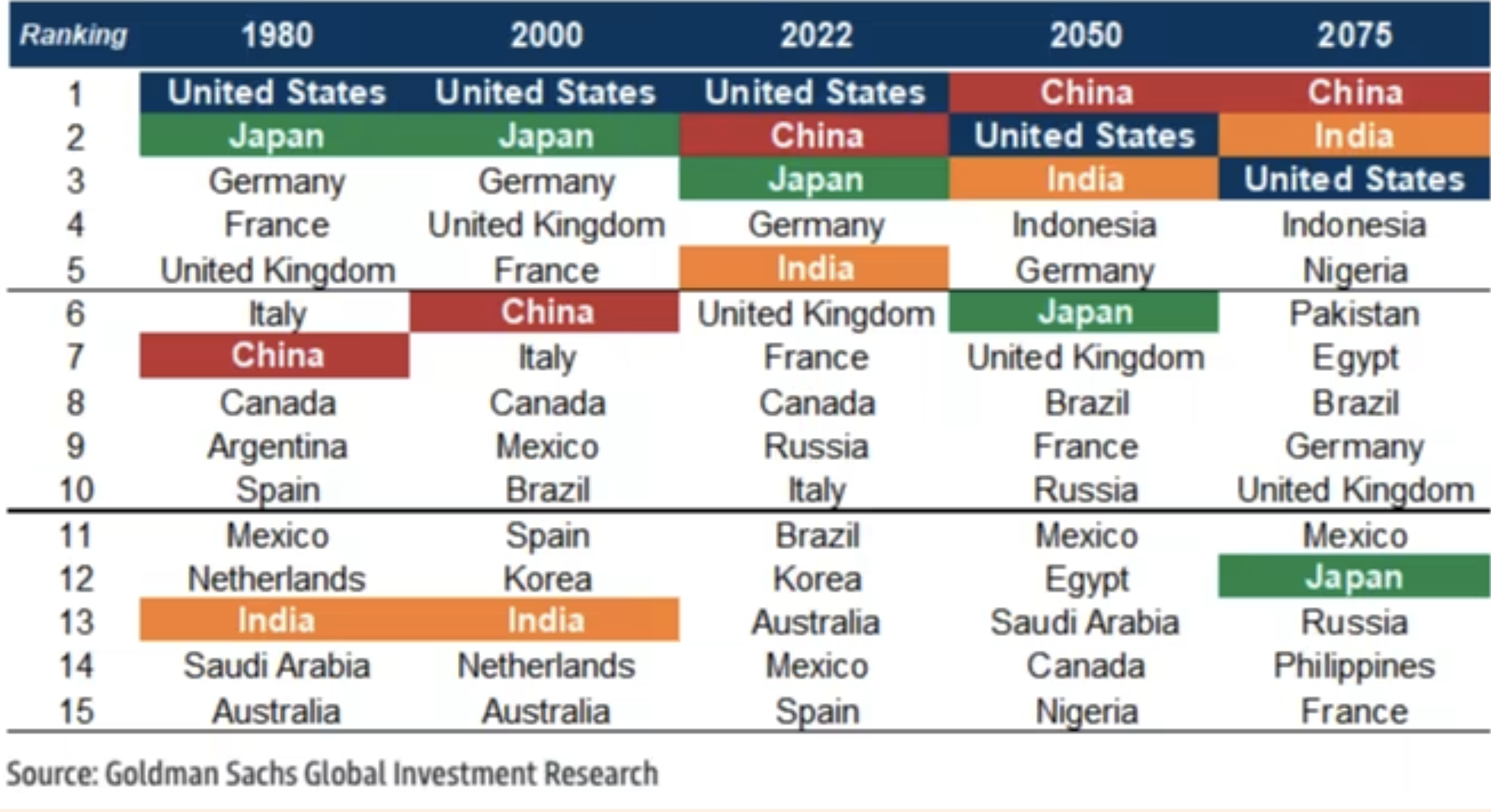
Back in 2022, Goldman Sachs analysts Kevin Daly and  Tadas Gedminas projected Pakistan's economy to grow to become the world's sixth largest by 2075.  In a research paper titled "The Path to 2075", the authors predicted Pakistan's GDP to rise to $12.7 trillion with per capita income of $27,100.  India’s GDP in 2075 is projected at $52.5 trillion and per capita GDP at $31,300.  Bangladesh is projected to be a $6.3 trillion economy with per capita income of $31,000.  By 2075, China will be the top global economy, followed by India 2nd, US 3rd, Indonesia 4th, Nigeria 5th and Pakistan 6th. The forecast is based primarily on changes in the size of working age populations over the next 50 years.  


Economic Growth Rate Till 2075. Source: Goldman Sachs Investment Research 

Economic Impact of Slower Population Growth: 

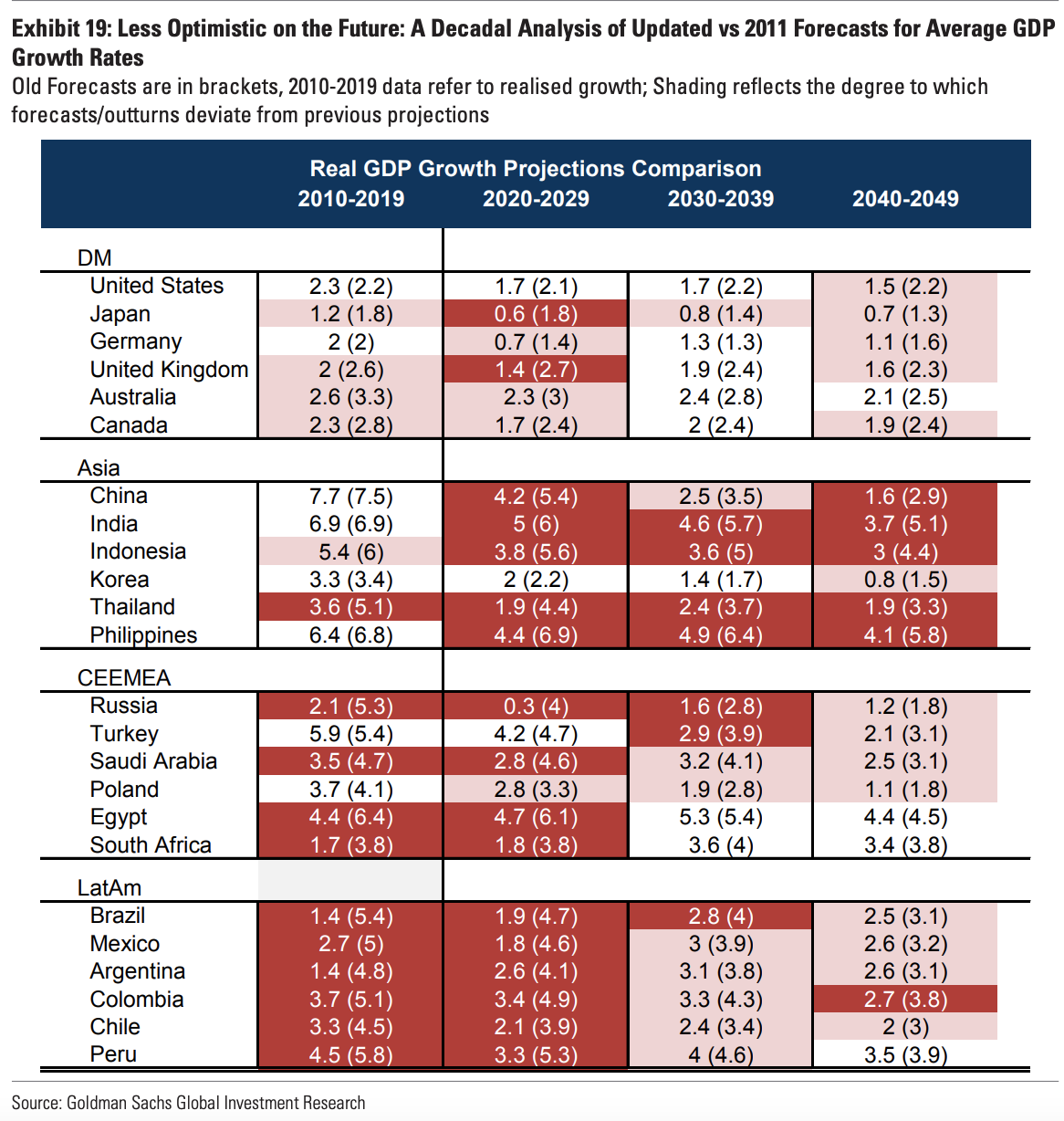
Daly and Gedminas argue that slowing population growth in the developed world is causing their economic growth to decelerate. At the same time, the economies of the developing countries are driven by their rising populations.  Here are four key points made in the report:

 1) Slower global potential growth, led by weaker population growth. 

2) EM convergence remains intact, led by Asia’s powerhouses. Although real GDP growth has slowed in both developed and emerging economies, in relative terms EM growth continues to outstrip DM growth.

3) A decade of US exceptionalism that is unlikely to be repeated. 

4) Less global inequality, more local inequality. 

Goldman Sachs' Revised GDP Projections. Source: The Path to 2075

Demographic Dividend: 

With rapidly aging populations and declining number of working age people in North America, Europe and East Asia, the demand for workers will increasingly be met by major labor exporting nations like Bangladesh, China, India, Mexico, Pakistan, Russia and Vietnam. Among these nations, Pakistan is the only major labor exporting country where the working age population is still rising faster than the birth rate. 

Pakistan Population Youngest Among Major Asian Nations. Source: Nikkei Asia

World Population 2022. Source: Visual Capitalist

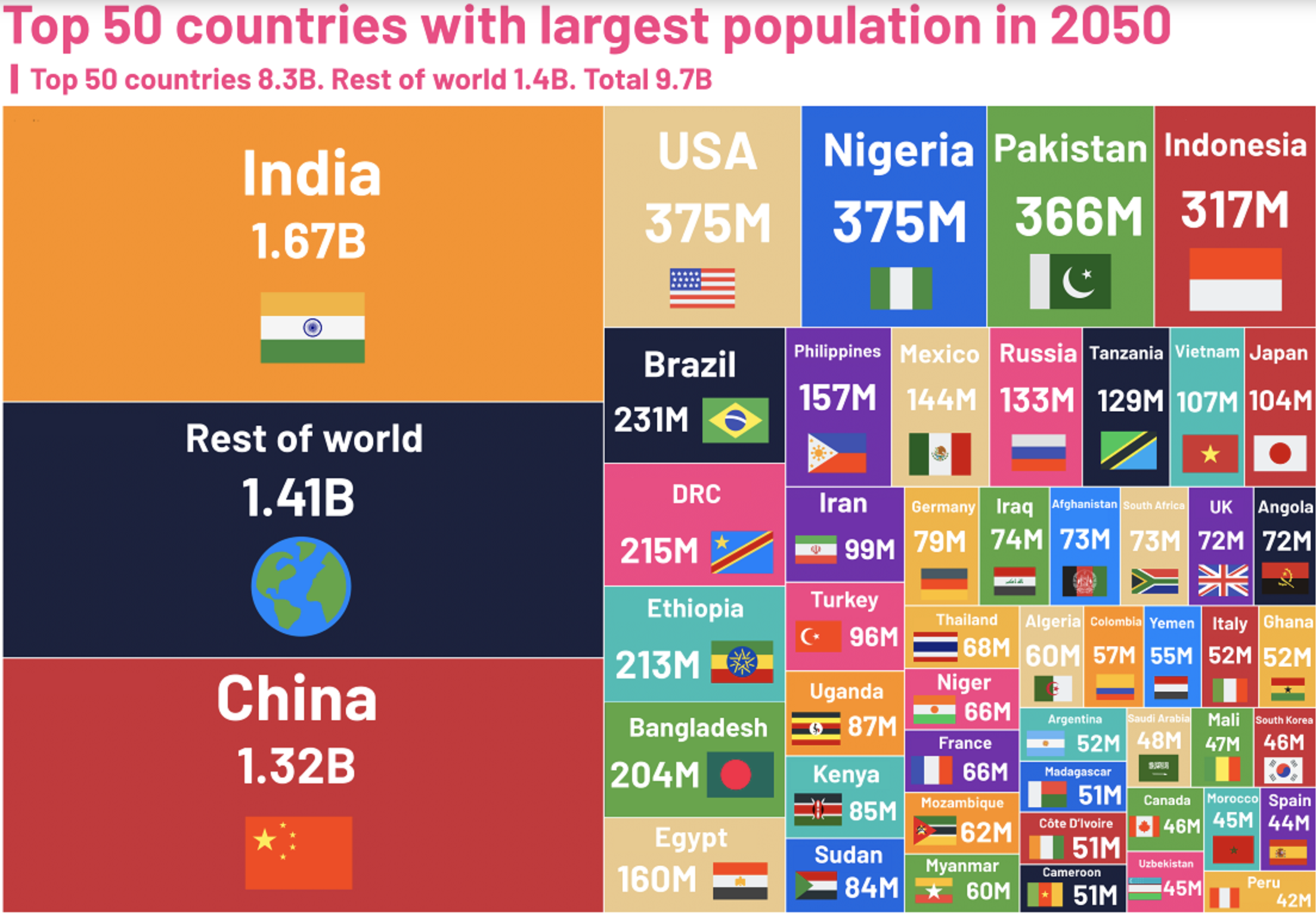
World Population 2050. Source: Visual Capitalist

Over 10 million Pakistanis are currently working/living overseas, according to the Bureau of Emigration. Before the COVID19 pandemic hit in 2020,  more than 600,000 Pakistanis left the country to work overseas in 2019. Nearly 700,000 Pakistanis have already migrated in this calendar year as of October, 2022. The average yearly outflow of Pakistani workers to OECD countries (mainly UK and US) and the Middle East was over half a million in the last decade. 

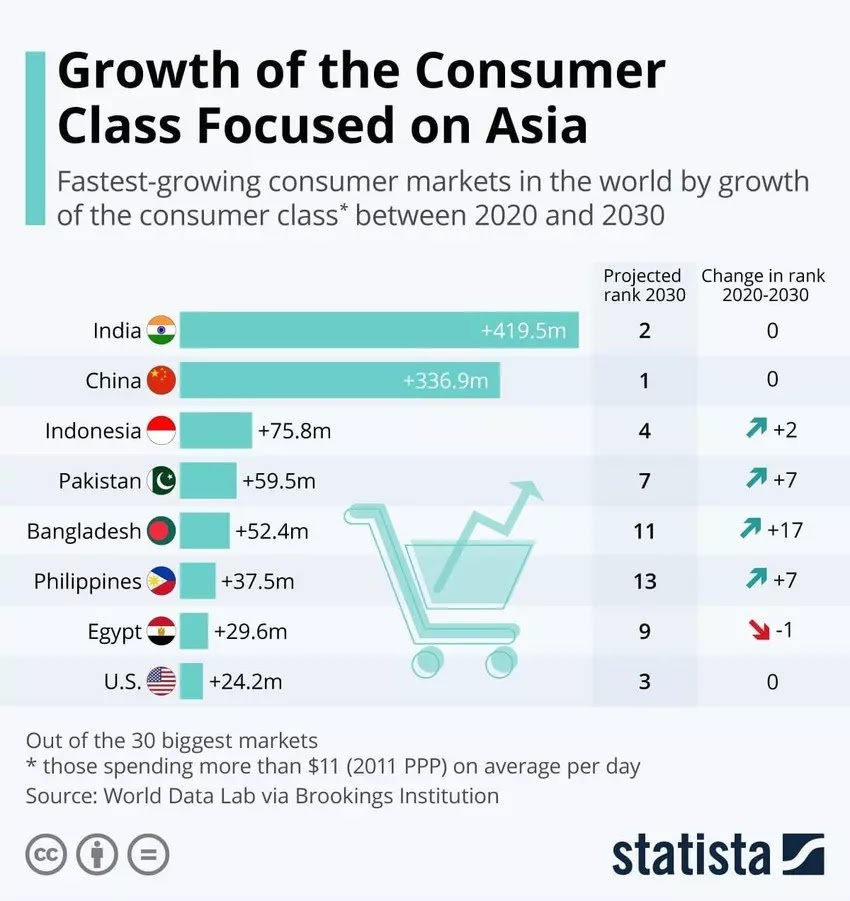
Consumer Markets in 2030. Source: WEF


World's 7th Largest Consumer Market:

Pakistan's share of the working age population (15-64 years) is growing as the country's birth rate declines, a phenomenon called demographic dividend. With its rising population of this working age group, Pakistan is projected by the World Economic Forum to become the world's 7th largest consumer market by 2030. Nearly 60 million Pakistanis will join the consumer class (consumers spending more than $11 per day) to raise the country's consumer market rank from 15 to 7  by 2030. WEF forecasts the world's top 10 consumer markets of 2030 to be as follows: China, India, the United States, Indonesia, Russia, Brazil, Pakistan, Japan, Egypt and Mexico.  Global investors chasing bigger returns will almost certainly shift more of their attention and money to the biggest movers among the top 10 consumer markets, including Pakistan.  Already, the year 2021 has been a banner year for investments in Pakistani technology startups. 

Record Remittances From Overseas Pakistanis:

Pakistan is already seeing high levels of labor export and record remittances of over $30 billion pouring into the country. Saudi Arabia and the United Arab Emirates(UAE) are the top two sources of remittances but the biggest increase (58%) in remittances is seen this year from Pakistanis in the next two sources: the United Kingdom and the United States.

Remittances from the European Union (EU) to Pakistan soared 49.7% in FY 21 and 28.3% in FY22, according to the State Bank of Pakistan. With $2.5 billion remittances in the first 9 months (July-March) of the current fiscal year, the EU ($2.5 billion) has now surpassed North America ($2.2 billion) to become the third largest source of inflows to Pakistan after the Middle East and the United Kingdom. Remittances from the US have grown 21%, second fastest after the EU (28.3%) in the first 9  months of the current fiscal year. 

Pakistan ranks 6th among the top worker remittance recipient countries in the world.  India and China rank first and second, followed by Mexico 3rd, the Philippines 4th, Egypt 5th and Pakistan 6th.  

Pakistan Demographics

About two million Pakistanis are entering the workforce every year. The share of the working age population in Pakistan is increasing while the birth rate is declining. This phenomenon, known as demographic dividend, is coinciding with declines in working age populations in developed countries. It is creating an opportunity for over half a million Pakistani workers to migrate and work overseas, and send home record remittances. 

Friday, May 3, 2024

India's Modi Brags About Ordering Transnational Assassinations

In a campaign speech on May 1, Indian Prime Minister Narendra Modi bragged about his campaign of transnational assassinations of individuals he has labeled "terrorists". “Today, India doesn't send dossiers to the masters of terrorism, but gives them a dose and kills them on their home turf", he is reported to have said, according to a tweet posted by his BJP party. Last month, Indian Defense Minister Rajnath Singh made a similar admission. “If any terrorist from a neighboring country tries to disturb India or carry out terrorist activities here, he will be given a fitting reply. If he escapes to Pakistan we will go to Pakistan and kill him there,” Singh said in an interview to Indian TV news network News18. 

Indian Prime Minister Narendra Modi at a BJP Campaign Rally. Source: BJP

Earlier, Pakistan government accused India of carrying out assassinations of Sikh and Kashmiri separatists on Pakistani soil. “We have documentary, financial and forensic evidence of the involvement of the two Indian agents who masterminded these assassinations,” Pakistan's Foreign Secretary Sajjad Qazi said at a news conference in Islamabad.

Pakistan is not alone in accusing India of assassinating dissidents overseas. Canada and the United States are also investigating murders allegedly carried out by Indian agents on their soil. Indian spies have also been kicked out of Australia after being caught monitoring Indian diaspora in the country. "They monitored their country's diaspora community, according to  the Australian Security Intelligence Organization (ASIO) Director-General Mike Burgess  as reported by the Australian Broadcasting Corp (ABC). "They asked a public servant to provide information on security protocols at a major airport."

Derek Grossman on India's Spy Agency RAW. Source: X

Commenting on the news fromAustralia, a US analyst Derek Grossman posted on X:  "Indian RAW gets exposed again, this time in Australia. Maybe, just maybe, they aren’t very good at the spy game". 

Gerry Shih of the Washington Post appears to concur with Derek Grossman's assessment of the incompetence of the Indian spy agencies. Referring to RAW's assassination plot against Sikh activist Gurpatwant Singh Pannun, a US citizen, Shih reported as follows: 

"After the plot against Pannun failed, the decision to entrust (Vikram) Yadav with the high-risk mission sparked recriminations within the agency, former officials said. Rather than joining RAW as a junior officer, Yadav had been brought in midcareer from India’s less prestigious Central Reserve Police Force, said one former official. As a result, the official said, Yadav lacked training and skills needed for an operation that meant going up against sophisticated U.S. counterintelligence capabilities". 

Back in 2018, India's former RAW officers, including one ex chief, have blamed Indian spy Kulbhushan Jadhav, arrested by Pakistan in 2016, for getting caught in Pakistan as a "result of unprofessionalism", according to a report in India's "The Quint" owned and operated by a joint venture of Bloomberg News and Quintillion Media. The report that appeared briefly on The Quint website was later removed, apparently under pressure from the Indian government.


Friday, April 26, 2024

Pakistanis' Insatiable Appetite For Smartphones

Samsung is seeing strong demand for its locally assembled Galaxy S24 smartphones and tablets in Pakistan, according to Bloomberg. The company said it is struggling to meet demand. Pakistan’s mobile phone industry produced 21 million handsets while its smartphone imports surged over 100% in the last fiscal year, according to media reports. The world's 5th most populous country has 192 million mobile phone users and 135 million broadband subscribers, according to the Pakistan Telecommunications Authority (PTA). It is the  world's 7th largest mobile phone market. 


Pakistan Telecom March 2024 Indicators. Source: PTA


Pakistani mobile phone manufacturers claim that almost all major mobile phone brands except iPhone are being assembled in Pakistan. “All mobile brands except iPhone are being manufactured in Pakistan and mobile phone import has been largely replaced with local manufacturing,” Aamir Allawala, vice chairman of the Pakistan Mobile Phone Manufacturers Association (PMPMA), told Arab News. 

Strong demand for mobile phones is driven by rapidly increasing number of digital apps being used across various sectors ranging from agriculture to e-commerce, education, finance, health and retail. This is underpinned by digital infrastructure development with thousands of kilometers of fiber optic cables being laid across the country.

Smartphones are boosting the government's Digital Pakistan initiative. It is backed by growing intellectual capital in the IT arena. Over a million students, about a third of total 3 million students (1.4 million women, 1.6 million men) enrolled in Pakistani universities and degree colleges, are currently studying science, technology, engineering and mathematics (STEM Education), according to data released by the country's Higher Education Commission (HEC). Of these students, 415,008 are studying natural sciences and mathematics, 276,659 are in information and communication technologies (ICT), 178,260 are in health sciences and 166,457 are in engineering. Pakistan produced 157,102 STEM graduates last year, putting it among the world's top dozen or so countries. About 43,000 of these graduates are in information technology (IT).  

Monday, April 1, 2024

Pakistani Student Enrollment in US Universities Hits All Time High

Pakistani student enrollment in America's institutions of higher learning rose 16% last year, outpacing the record 12% growth in the number of international students hosted by the country. This puts Pakistan among eight sources in the top 20 countries with the largest increases in US enrollment. India saw the biggest increase at 35%, followed by Ghana 32%, Bangladesh and Nepal at 28% each, Pakistan 16%, Colombia 13%, Italy 10% and Spain 5%. 

Top 8 Source Countries of Foreign Students in US. Source: IIE OpenDoors


"During 2022-2023, there were 10,164 Pakistani students, compared to 8,772 in the previous year, indicating an impressive 16% increase," according to IIE Open Doors Report for 2022-23. There has been an overall 33% increase in enrollment of Pakistani students in US colleges and universities. 

Major Destinations of Pakistanis Studying Abroad. Source: UNESCO

The most recent UNESCO data (2021) counts 71,865 Pakistani students abroad in higher education. More recent statistics published by government sources in various receiving countries show that the outbound student mobility from Pakistan was over 103,190 in 2022. There have been large increases in Pakistani students recorded recently in the UK, Australia, US, Canada, and Germany. The UK is now the top destination with over 23,000 Pakistani students, followed by Australia with nearly 16,000 students from Pakistan  in 2021/22, according to the ICEF Monitor. 

The most recent UNESCO data (2021) puts the total number of Indians studying abroad at 508,174. 

Pakistani Students in America. Source: IIE OpenDoors

Pakistan is ranked as the 16th biggest source of foreign students in America. China remains the top-sending country in 2022/23, with 289,526 students studying in the U.S. (-0.2% year-over-year). India, the second largest sending country, reached an all-time high of 268,923 international students in 2022/23, an increase of 35% year-over-year, according to the report.

Top 20 Sending Countries of International Students in America. Source: Statista

The United States is hosting over one million (1,057,188) international students in the 2022/2023 academic year, a 12% increase compared to the previous academic year. It is the fastest growth rate in more than 40 years. It is partly attributable to the end of the COVID19 pandemic which dramatically diminished international student mobility. 

Related Links:


Friday, March 29, 2024

Agriculture, Caste, Religion and Happiness in South Asia

Pakistan's agriculture sector GDP grew at a rate of 5.2% in the October-December 2023 quarter, according to the government figures. This is a rare bright spot in the overall national economy that showed just 1% growth during the quarter. Strong performance of the farm sector gives the much needed boost for about 37% of Pakistan's workforce engaged in agriculture. It helps the country's rural economy improve their living standards. In the same period, India's agriculture sector that employs 43% of the workforce slowed to 1.2% growth. This could be one possible contributing factor for Pakistan (rank108) significantly outperforming India (rank 126) on the World Happiness Index once again. 

World Happiness Map 2023. Source: Gallup

Pakistan has seen bumper crops of rice, corn, wheat, sugar and cotton this fiscal year after the devastation caused by massive floods in the prior year. During the first six months of the current fiscal year 2023-24, exports of agro and food products from Pakistan have soared by 64% as compared to the same period during 2022-2023. In the month of December alone, there was a growth of 118%, as $882 million of food was exported as compared  to $404 million in the same month in 2022-23. Pakistan's gains in the food export market have come at a time when India has had to limit or ban exports of rice, corn, sugar and other commodities due to crop failures.  

The World Happiness Report attributes India's poor ranking in the Index to widespread caste discrimination in the country. Older Indians belonging to upper castes, and “never experience[d] discrimination or ill-treatment” were “more satisfied with their lives”, according to the report.

Caste discrimination contributed “significantly to the caste-based discrepancies in life satisfaction”, the research showed. Caste backgrounds determined access to education, social services, health care or financial security in India.  Individuals with secondary or higher education, and those of higher social castes reported higher life satisfaction than those without access to formal education and those from Scheduled Castes (SC) and Scheduled Tribes (ST).

Another factor contributing to India's unhappiness is the ruling party's targeting of its minorities, including Christians, Muslims and Sikhs. Here's an excerpts from Rohit Khanna's piece in The Quint describing this issue:

"In recent years, 20 percent of India, our minorities, have been targeted – economically, socially, and physically. We have all seen multiple viral videos calling for the economic boycott of Muslims, of them being mob-lynched on the roads, of their homes being bulldozed, of inter-faith marriages being targeted as ‘love-jihad’ and more. We have seen videos of Christian pastors and congregations being roughed up, and of church buildings being vandalised. We have seen protesting Sikh farmers being vilified on communal lines as ‘Khalistanis’". 

Average MPCE (Monthly Per Capita Consumption Expenditure) for Indian Muslims is only Rs. 2,170.  Average MPCE for upper caste Hindus is Rs. 3,321, the highest of all groups. Lower caste Hindus fare much worse than upper caste Hindus, according to Indian government data. 

Average Monthly Per Capita Consumption Expenditure by Caste in India. Source: Hindustan Times

India is almost totally dominated by the upper caste Hindus. It is not just the 220 million Dalits (untouchables), or the 190 million Muslims, or the 110 million from “scheduled tribes” (Adivasis)  who are under-represented in positions of power and privilege, but also the 40-50% of Hindus who come from the widest tier of the pyramid, the shudras or laboring castes, known as Other Backwards Classes (OBCs), according to a report in The Economist Magazine.

Some Indians claim without evidence that the Indian Muslims are richer than Pakistani Muslims. The fact is that the average monthly per capita expenditure (MPCE) in Pakistan was PKR 5,959 in 2019-20, the year closest to the 2021-22 for which the Indian MPCE data is available. Using the 2019 average exchange rate of 2.136 PKR to INR, this works out to MPCE of INR 2,789 in Pakistan, higher than for Indian Hindus (INR 2,470) and Muslims (INR 2,170).  As to the cost of living in the two countries, Pakistan is 15.8% cheaper than India without rent and 20.1% cheaper with rent, according to Numbeo. 

While it is true the Pakistani currency has suffered significant devaluation in the last couple of years, there have been large increases in wages. Pakistan's minimum wage has increased 14 times since 2001, from 14% to 67%. The minimum wage for unskilled workers in 2023 is 32,000 Pakistani rupees per month, up from 25,000 rupees in 2022. The cost of living has been a key factor in determining the new rate. 

Income Poverty in Bangladesh, India and Pakistan. Source: Our World in Data


Over 75% of the world's poor deprived of basic living standards (nutrition, cooking fuel, sanitation and housing) live in India compared to 4.6% in Bangladesh and 4.1% in Pakistan, according to a recently released OPHI/UNDP report on multidimensional poverty.  Here's what the report says: "More than 45.5 million poor people are deprived in only these four indicators (nutrition, cooking fuel, sanitation and housing). Of those people, 34.4 million live in India, 2.1 million in Bangladesh and 1.9 million in Pakistan—making this a predominantly South Asian profile". 

Related Links:

Tuesday, February 27, 2024

Biden's Gaza Ceasefire Veto Defies American Public Opinion

Aaron Bushnell, an active serviceman in the United States Air Force, burned himself to death in front of the Israeli Embassy in protest against the US policy in Gaza. Before setting himself on fire in what he called an "extreme act of protest", he said he would "no longer be complicit in genocide". Polls show that the vast majority (63%) of Americans want an immediate end to the carnage being perpetrated by Israel in Gaza.  

USAF Engineer Aaron Bushnell


Although Bushnell resorted to this extreme form of protest against the Biden Administration's policy of unqualified support for Israel, he was not alone in opposing it. American public opinion polls confirm that the vast majority of Americans, including Jewish Americans, want an immediate end to the Gaza carnage. 

Gaza Ceasefire Poll. Source: ISPU


Overall, 63% of Americans support a ceasefire in Gaza, according to a recent poll conducted by the Institute for Social Policy and Understanding (ISPU). In terms of religions, 71% of Catholics, 61% of Non-Affiliated,  60% of Protestants, 58% of White Evangelicals, 50% of Jews and 75% of Muslims support an immediate ceasefire, according to the poll. 

Jewish and Muslim Democrats, like Democrats in the general public, favor an end to the violence in Gaza. The majority of Republicans in the general public also favor a ceasefire. 

So why is President Biden defying the will of the American people on Gaza?  The simple answer is AIPAC, the American Israel Public Affairs Committee (AIPAC), the most powerful lobby in Washington D.C. This Israel lobby has showered its friendly politicians with money from wealthy Jewish donors. It has also ensured the defeat of those politicians who dared to speak out against Israeli policies in the Middle East. As one former Democratic senator, Ernest Hollings, put it on leaving office, ‘you can’t have an Israeli policy other than what AIPAC gives you around here.’ Or as Ariel Sharon once told an American audience, ‘when people ask me how they can help Israel, I tell them: “Help AIPAC.”’

President Jimmy Carter who helped broker peace between Israel and Egypt knows the Israel lobby well. He told Amy Goodman of "Democracy Now" many years ago: "I think it’s accurate to say that not a single member of Congress with whom I’m familiar would possibly speak out and call for Israel to withdraw to their legal boundaries or to publicize the plight of the Palestinians or even to call publicly and repeatedly for good faith peace talks.....  And I would say that if any member of Congress did speak out, as I’ve just described, they would probably not be back in the Congress the next term ". 

Friday, February 16, 2024

Pakistan Elections: Imran Khan's Supporters Skillfully Used Tech to Defy Powerful Military

Independent candidates backed by the Pakistan Tehreek e Insaf (PTI) party emerged as the largest single block with 93 seats in the nation's parliament in the general elections held on February 8, 2024.  This feat was accomplished in spite of huge obstacles thrown in front of the PTI's top leader Imran Khan and his party leaders and supporters by Pakistan's powerful military to prevent their victory. 

Pakistan's Official Election Results 2024. Source: Aljazeera 

Imran Khan and his top party leaders were thrown in jail on trumped up charges, his party was denied a unified electoral symbol of cricket bat, his supporters' rallies were banned, the mainstream media were prevented from carrying PTI leaders' speeches and the Internet was repeatedly blocked when the party held online events. So how did they succeed in spite of it? The answer lies in how skillfully the PTI activists used technology to get the party's messages out to the country's young electorate. 

Well over 90% of Pakistan's adults have access to the Internet. This allows them to use a variety of  apps ranging from TikTok and YouTube to Facebook, Instagram and X. The PTI supporters used AI (Artificial Intelligence) to produce Imran Khan's speeches using his own voice and words and made them go viral. They used X Spaces to engage with the public. Here's how Uzair Younus, a Pakistani-American analyst at The Atlantic Council, a Washington-based Think Tank, describes what occurred:

"The result of PTI’s technological campaign strategy was a more engaged and informed electorate, which translated into significant electoral gains. Khan’s PTI managed to galvanize a significant part of the electorate, and the party’s success demonstrates the potential of digital tools to democratize political participation and challenge entrenched power structures". 

When it became clear that the PTI was headed for a massive victory with more than half of the 264 National Assembly seats as live results from the polling started to pour in on the evening of February 8, there was a sudden mysterious delay in real time reporting. Most political analysts in Pakistan believe that this delay was ordered by the Pakistani military to rig the results.  This belief is confirmed by the reports that the total votes reported cast for PTI  by the polling stations on "Form 45" add up to a lot more votes than those reported cast on "Form 47" for over 55 constituencies of the National Assembly. These 55 seats plus the officially reported 93 seats add up to 148 seats giving PTI more than half of the total 264 directly elected members in the National Assembly. 

Any coalition government formed by the PTI opponents is unlikely to be stable or long lasting. This unstable situation will likely prolong the deep economic crisis the country now faces. The best course of action for the Pakistani military is to release Imran Khan from jail and allow his party to form the next government. 

Related Links:


Friday, February 2, 2024

Soaring Illegal Immigration of Indians into the United States

Illegal immigration from India to the United States is soaring. A record 96,917 Indians were detained while attempting to enter the US illegally from October 2022 to September 2023, representing a 50% jump from the corresponding period in the prior year. Vast majority of the arrested Indians came from Prime Minister Modi's state of Gujarat while others came from the state of Punjab. There are about 725,000 undocumented Indian immigrants in the US – the third-largest population of illegal immigrants after Mexicans and El Salvadorans – according to a Pew Research Centre report. 

Illegal Immigration to the US From India. Source: Strait Times

The number of Indians attempting to cross into the United States illegally has accelerated in recent years on Prime Minister Modi's watch. These immigrants take the Latin American route to reach the US-Mexico border before making a run for the US. They cross the Darien Gap, a dangerous thick forest region between Colombia and Panama, taking three days to a week while taking huge risks ranging from lack of food and drinking water, wild animals and violent gangs. 

There are multiple drivers of mass illegal migration of Indians to other countries. These include increasing violence under Mr. Modi's Hindutva rule and lack of jobs for thee growing working-age population. Human traffickers are exploiting these conditions to profit from vulnerable groups most impacted by political and economic problems in the country. 

Christians, low caste Hindus, Muslims and Sikhs are among the main targets of the far-right Hindu mob attacks across India. In 2023, the Modi government’s discriminatory and divisive policies led to  growing violence against minorities, creating a pervasive environment of fear and a chilling effect on government critics, Human Rights Watch said in its World Report 2024. 

India's labor force participation rate (LPR) has been declining for several years. Centre For Monitoring Indian Economy (CMIE) data shows that the labor participation rate fell to 39.5% in 2022-23, from an already low 40.1% in 2021-22. This indicates that more than half of India’s working age population is not employed. This is especially the case for women 90% of whom are out of the labor force. India’s LPR is among the lowest in the world. The global average LPR is 60%.

Labor Participation Rate in India. Source: CMIE Via Reuters

The rapid GDP growth claimed by India is not creating enough jobs for its massive young population. The much-hyped "Make in India" initiative of the Modi government is just not working well enough to keep pace with the demand for jobs. Manufacturing’s contribution to India’s GDP has declined from 17% two decades ago to just 13% in 2022, according to the World Bank. India has added only 5 million factory jobs since Mr. Modi was first elected, for a total of 65 million such jobs now, according to the Wall Street Journal. Unable to find jobs in cities, a very large number of Indians are going back to subsistence farming to eke out a meager living.  

Indian economist Ritesh Kumar recently wrote a piece for Nikkei Asia titled "Few are benefiting from India's rapid GDP growth".  His conclusion: What India really needs is a growth trajectory that is inclusive, sustainable and can foster shared prosperity across all segments of the economy rather than benefiting only a privileged few.


Related Links: