Showing posts with label Artificial Intelligence. Show all posts

Friday, February 16, 2024

Pakistan Elections: Imran Khan's Supporters Skillfully Used Tech to Defy Powerful Military

Independent candidates backed by the Pakistan Tehreek e Insaf (PTI) party emerged as the largest single block with 93 seats in the nation's parliament in the general elections held on February 8, 2024.  This feat was accomplished in spite of huge obstacles thrown in front of the PTI's top leader Imran Khan and his party leaders and supporters by Pakistan's powerful military to prevent their victory. 

Pakistan's Official Election Results 2024. Source: Aljazeera 

Imran Khan and his top party leaders were thrown in jail on trumped up charges, his party was denied a unified electoral symbol of cricket bat, his supporters' rallies were banned, the mainstream media were prevented from carrying PTI leaders' speeches and the Internet was repeatedly blocked when the party held online events. So how did they succeed in spite of it? The answer lies in how skillfully the PTI activists used technology to get the party's messages out to the country's young electorate. 

Well over 90% of Pakistan's adults have access to the Internet. This allows them to use a variety of  apps ranging from TikTok and YouTube to Facebook, Instagram and X. The PTI supporters used AI (Artificial Intelligence) to produce Imran Khan's speeches using his own voice and words and made them go viral. They used X Spaces to engage with the public. Here's how Uzair Younus, a Pakistani-American analyst at The Atlantic Council, a Washington-based Think Tank, describes what occurred:

"The result of PTI’s technological campaign strategy was a more engaged and informed electorate, which translated into significant electoral gains. Khan’s PTI managed to galvanize a significant part of the electorate, and the party’s success demonstrates the potential of digital tools to democratize political participation and challenge entrenched power structures". 

When it became clear that the PTI was headed for a massive victory with more than half of the 264 National Assembly seats as live results from the polling started to pour in on the evening of February 8, there was a sudden mysterious delay in real time reporting. Most political analysts in Pakistan believe that this delay was ordered by the Pakistani military to rig the results.  This belief is confirmed by the reports that the total votes reported cast for PTI  by the polling stations on "Form 45" add up to a lot more votes than those reported cast on "Form 47" for over 55 constituencies of the National Assembly. These 55 seats plus the officially reported 93 seats add up to 148 seats giving PTI more than half of the total 264 directly elected members in the National Assembly. 

Any coalition government formed by the PTI opponents is unlikely to be stable or long lasting. This unstable situation will likely prolong the deep economic crisis the country now faces. The best course of action for the Pakistani military is to release Imran Khan from jail and allow his party to form the next government. 

Related Links:


Friday, August 4, 2023

OpenAI ChatGPT: Generative AI Buzz in Pakistan

A Singapore-based cybersecurity firm Group-IB discovered in June that over 100,000 ChatGPT user accounts were compromised and their credentials found on the Dark Web. Among the accounts reported compromised, India topped with 12,632, followed by Pakistan with 9,217 and Brazil with 6,531. Bangladesh witnessed the fewest instances with 2,463. This report gave a glimpse of the high interest level of Indians and Pakistanis in generative AI.  Another report attributed to Similarweb, which tracks popularity of websites by number of visitors, ranked ChatGPT in Pakistan at number 7, ahead of Instagram, Twitter and TikTok. Globally ChatGPT website is ranked 17th. Prior to this, there was a series of news reports about the launch of Presidential Initiative for Artificial Intelligence and Computing (PIAIC) by President Arif Alvi, and then came the government's policy to train one million AI experts in the country by 2027. Pakistanis published 2,600 AI-related research papers from 2016 to 2020, according to Statista

Top 10 Countries by Number of ChatGPT Accounts Compromised. Source: Group IB


Back in 2017, then Prime Minister Shahid Khaqan Abbasi inaugurated a National Centre for Artificial Intelligence (NCAI) at the National University of Sciences & Technology (NUST) in Islamabad. It was followed by a Rs 1.1 billion budgetary allocation for select universities with AI research to be coordinated by NCAI. In 2020, Pakistan Air Force (PAF) set up a Center of Artificial Intelligence and Computing (CENTAIC). 

While OpenAI is the first to offer a Generative AI model trained on vast amounts of data, Google has also joined the generative AI race with its own offering. Google BARD appears to have capabilities similar to OpenAI's ChatGPT. Very little is known about the specific datasets used for training either of them, raising some trust issues about the results produced by them. 

Training/Using Generative AI Foundation Models. Source: Analytics Vidhya

Top global cloud operators Amazon, Google and Microsoft are now offering generative AI services to their clients for an additional fee. Cloud apps developers in Pakistan and elsewhere can train these base  models on their custom datasets to develop AI applications for agriculture, business, education, finance, healthcare, law etc. The AI market in Pakistan is currently estimated at $123 million by Statista Market Insights

Amazon Web Services (AWS) recently featured four Pakistani startups at the forefront of AI/ML: SalesFlo, Ozoned Digital, XpertFlow and Trukkr.  SalesFlo offers sales software for FMCG (fast moving consumer goods) companies.  Ozoned Digital caters to the technology needs of the insurance industry.  XpertFlow is an AI-powered preventative healthcare company.  Trukkr provides financial services and technology for logistics.  These and other startups are well positioned to take advantage of the new generative AI services being offered by cloud vendors. 

Related Links:


Monday, March 6, 2023

International Women's Day: Growing Presence of Pakistani Women in Science and Technology

It is International Women's Day on March 8, and its theme is "DigitALL: Innovation and technology for gender equality". It's a day to highlight Pakistani women's participation in science and technology. Nearly half a million Pakistani women are currently enrolled in science, technology, engineering and mathematics courses at universities, accounting for nearly 46% of all STEM students in higher education institutions in the country. Several Pakistani women are leading the country's tech Startup ecosystem. Others occupy significant positions at world's top research labs, tech firms, universities and other science institutions. They are great role models who are inspiring young Pakistani women to pursue careers in science and technology. 

 
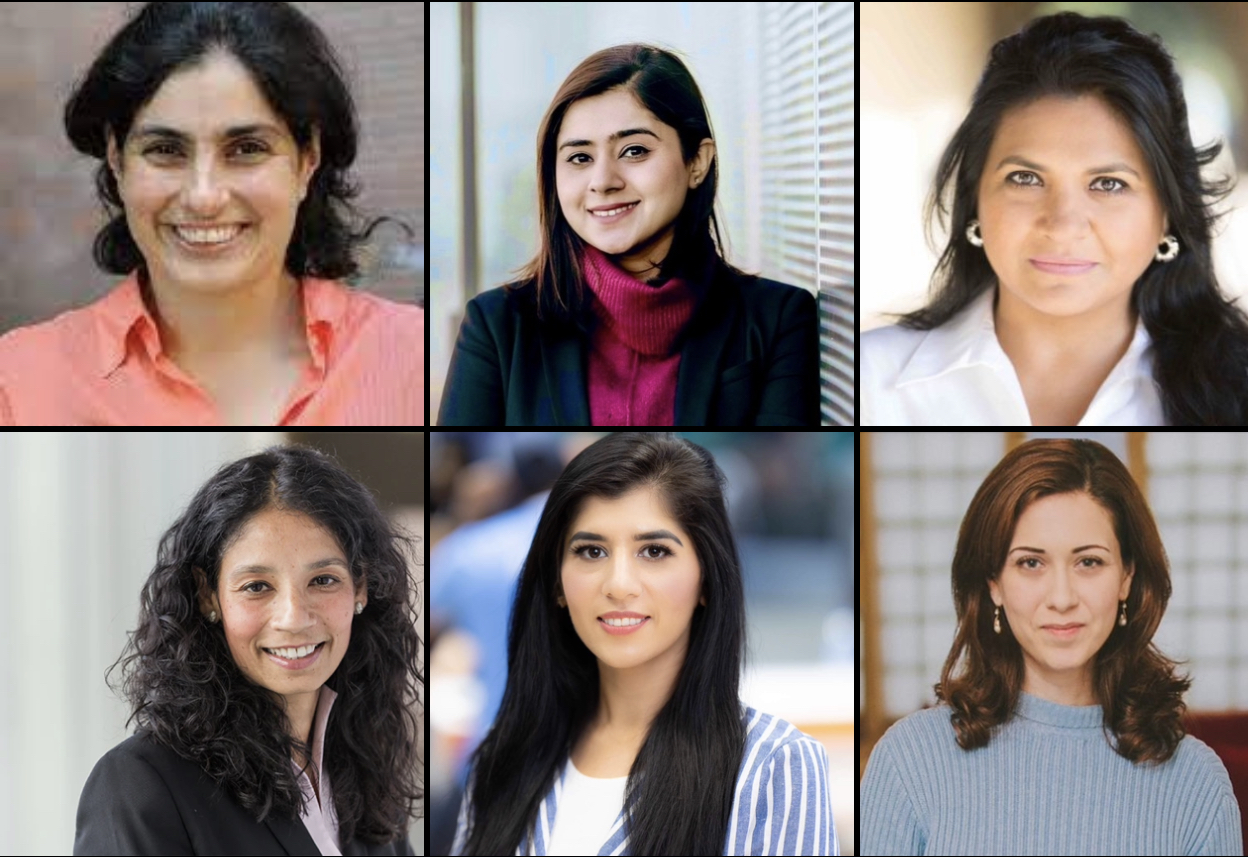
Clockwise From Top Left: Nergis Mavalvala, Maria Abrar, Maheen Adamson, Tasneem Zehra Husain, Sundas Khalid, Asifa Akhtar


Pakistani Women in Science: 

Growing numbers of Pakistani working women are making a contribution to science and technology. Some of the highest profile names include Dr. Nargis Mavalvala and Dr. Asifa Akhtar. Mavalvala is the dean of Harvard University's School of Science and Akhtar is a vice president of the prestigious Max Planck Society in Germany. Dr. Maheen Adamson is a senior research scientist at Stanford School of Medicine. Tasneem Zahra Husain is a theoretical physicist in Cambridge Massachusetts known for her work on string theory. Hibah Rahmani is a rocket engineer at NASA (US National Aeronautics and Space Administration).  Dr. Sania Nishtar is a former commissioner of the World Health Organization and she served as special assistant to the Prime Minister of Pakistan.  Dr. Syra Madad is an epidemiologist currently serving as the Senior Director of the System-wide Special Pathogens Program in New York City. 

Selected Women-Led Startups in Pakistan in 2022. Source: Katalyst Lab 

Pakistani Women in Technology: 

Maria Abrar is a data scientist at Reality Labs of Meta (Facebook), a research lab in Toronto, Canada. She has been ranked among Canada's top 25 women in artificial intelligence by ReWork, an Artificial Intelligence (Al) and deep learning content producer based in London, United Kingdom. 

Sundas Khalid is a data scientist at Alphabet (Google) in the United States. Forbes magazine has named her a "trailblazer" in its trailblazer series. 

Kalsoom Lakhani, a co-founder and general partner of i2i Ventures, is helping build Pakistani tech startups ecosystem. She and co-founder Misbah Naqvi are passionate advocates for women-led tech startups in the country.  So, too, is Jahan Ara, the head of Katalyst Lab accelerator. 

Several women-led startups have raised venture funds in Pakistan in 2022. These startups offer solutions in Fintech, Edtech, Healthtech, and Logistics, among others! These are led by Tania Aidrus of DBank, Maha Shahzad of Bus Caro, Vladimira Briestenska of Neem, Meenah Tariq of Metric, Saira Siddiqui of MedIQ, Aiman Bashir of Outclass, Anusha Shahid of OkayKer, and Fatimah Zafar of Remoty. 

Male-Female Ratio of University Students in Pakistan. Source: HEC


Pakistani Women Freelancers:

A 2020 global survey conducted by Payoneer, a global payments platform company based in Silicon Valley, showed that Pakistani women freelancers are earning $22 an hour, 10% more than the $20 an hour earned by men. While Pakistani male freelancers earnings are at par with global average, Pakistani female earnings are higher than the global average for freelancers. Digital gig economy is not only helping women earn more than men but it is also reducing barriers to women's labor force participation in the country. The survey also concludes that having a university degree does not help you earn more in the growing gig economy. The survey was conducted in 2015.

Freelancers Hourly Rate by Gender. Source: Payoneer


Male-Female Ratio of University Students in Pakistan: 

Nearly 46% of over 3 million students enrolled in Pakistani universities are female. The proportion of female enrollment has been rising over the last 5 years.  The ratio of female enrollees in STEM education is also about 46% of the student body. 

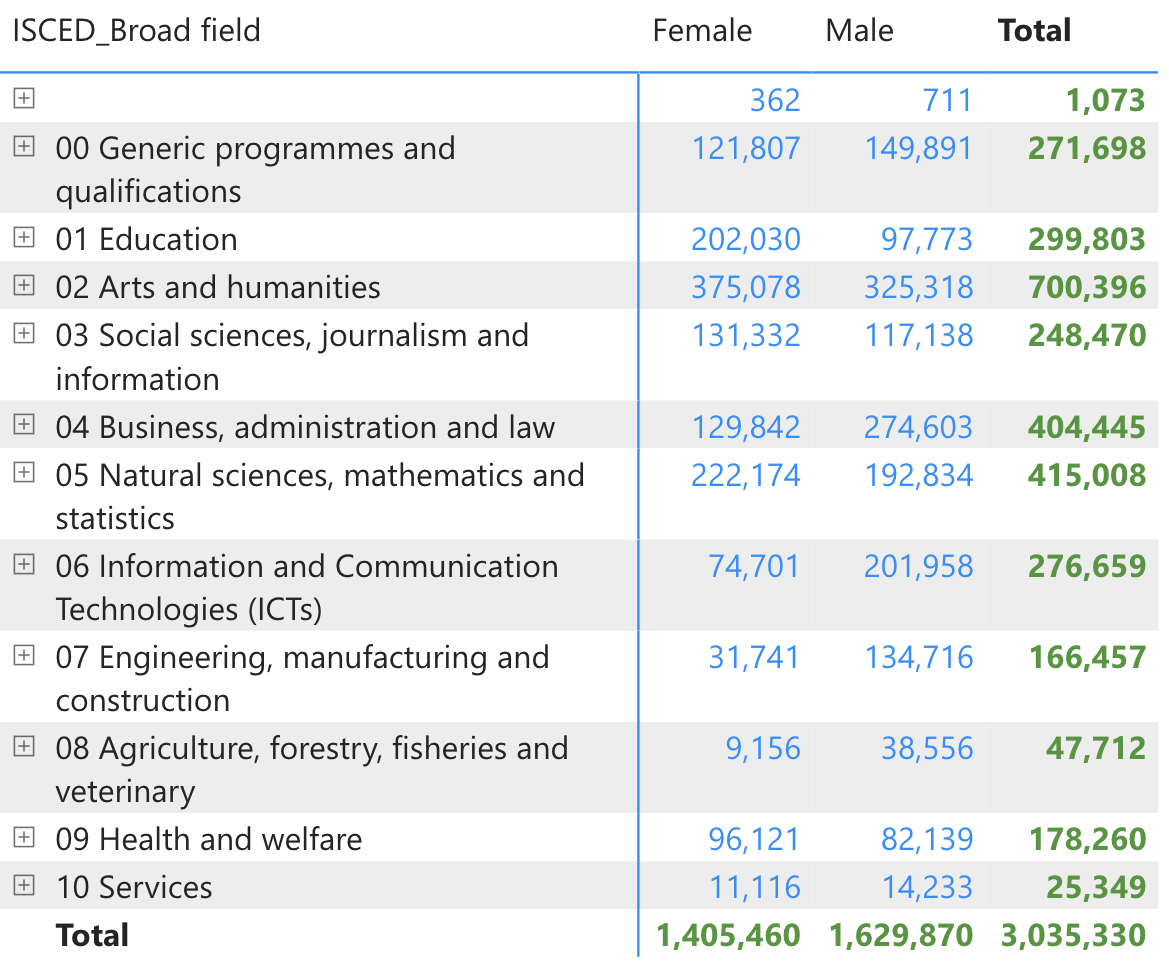
Over a million students, about a third of total 3 million students (1.4 million women, 1.6 million men) enrolled in Pakistani universities and degree colleges, are currently studying science, technology, engineering and mathematics (STEM Education), according to data released by the country's Higher Education Commission (HEC). Of these students, 415,008 are studying natural sciences and mathematics, 276,659 are in information and communication technologies (ICT), 178,260 are in health sciences and 166,457 are in engineering. Pakistan produced 157,102 STEM graduates last year, putting it among the world's top dozen or so countries. About 43,000 of these graduates are in information technology (IT). 

Student Enrollment By Field of Study at Pakistani Higher Education Institutions. Source: HEC


Acceptance Rates in University Admissions: 

Acceptance rate in Pakistani universities and degree colleges was just 13.5% last year. Only 541,043 students were accepted from 4,085,185 students who applied. The country produced 471,306 university graduates in 2020-21. Of these, 157,102 were in STEM fields, including 43,000 graduates in information technology (IT). 

Pakistan Higher Education Admission and Graduation Statistics. Source: HEC


In absolute terms, Pakistan probably ranks among the top dozen or so nations producing university graduates in STEM and IT fields. However, the country lags significantly behind its lower middle income peers in terms of percentage of students enrolled in universities. Only 12% of young people in the 18-25 age group are currently enrolled in higher education institutions. This is about half of the 25% average for South Asia. The data from the Word Bank shows that the higher education enrollment rate was extremely low in Pakistan until 2000 when late President Musharraf decided to significantly boost investment in building universities and hire faculty to rapidly increase access to higher education in the country. 


Tertiary Education Enrollment Rates. Source: World Bank


Summary: 

As Pakistan struggles with multiple serious crises,  there is a growing presence of women in science and technology. These young women and men now studying in the nation's universities and colleges offer hope for its bright future. In fact, the vast majority of Pakistanis, particularly women, feel that they have better lives than their parents did, and they think their children will have even better lives than theirs, according to a Gallup International Poll of 64 countries conducted from August to October last year. The poll asked two questions: 1) Do you feel your life is better, worse or roughly similar to that  of your parents? and 2) Do you think your children will have a better, worse or roughly the same life as you? The answers to these questions reveal that Pakistanis are among the top 5 most positive nations among 64 countries polled by Gallup International. Anecdotal evidence in terms of packed shopping malls and restaurants in Pakistan's major cities confirms it. Such positivity augurs well for Pakistan's prospects of successfully dealing with the current crises. It will drive the nation's recovery. 


Related Links:


Wednesday, August 19, 2020

Brothers From Rural Pakistan Teaching AI to American High-Schoolers

Haroon and Hamza Choudhry, born in rural Pakistan, are teaching artificial intelligence (AI) American high-schoolers. Twenty-something Choudhry brothers were 8 and 6 when they came from Pakistan to the United States in 1998. They have co-founded "AI For Anyone", a Brooklyn-based non-profit organization that sends volunteers to teach artificial intelligence to high school students. A recent study shows that Pakistani-Americans are among the top 5 most upwardly mobile groups in the United States. Other top most upwardly groups are Chinese-Americans from Hong Kong, Taiwan and People's Republic of China and Indian-Americans. Pakistani-Americans are known to volunteer for non-profit organizations like AIForAnyone to help the communities they live in. Several Pakistani-Americans are successful social entrepreneurs.

Hamza (right) and Haroon Choudhry in their village in Pakistan

Choudhrys lived with 9 relatives in a 2-bedroom apartment in Brooklyn, and later on a poultry farm in Maryland on the Eastern Shore of Maryland. Their father worked several different odd jobs to make ends meet, according to a CNBC report.

In addition to their volunteer work at AI For Anyone, both brother work in high tech positions. Here's how CNBC describes their education careers:

"Haroon won a Gates Millennium scholarship, which gave him a full ride (including tuition, housing, food and transportation) to both Penn State for undergrad and to University of California, Berkeley, where he got his masters in information and data science. After college, Haroon did data science work for Mark Cuban Companies and was a technology consultant at Deloitte Consulting. He is now a data scientist at Komodo Health. Hamza graduated magna cum laude from the University of Maryland. He previously worked at Facebook, and now works in business operations at WeWork."

A recent study shows that Pakistani-Americans are among the top 5 most upwardly mobile groups in the United States. Other top most upwardly groups are Chinese-Americans from Hong Kong, Taiwan and People's Republic of China and Indian-Americans. Pakistani-Americans are known to volunteer for non-profit organizations like AIForAnyone to help the communities they live in.

Knowledge of artificial intelligence (AI) is becoming increasingly important. Pakistan and Pakistanis can not afford to be left behind in the world of AI. Koshish Foundation, an organization funded primarily by NED University Alumni in Silicon Valley, helped fund Koshish Foundation Research Lab (KFRL) in Karachi back in 2014. It has since received additional funding from numerous national and international organizations including DAAD,  German Academic Exchange Service. The lab has been renamed RCAI- Research Center For Artificial Intelligence.

Artificial Intelligence (AI) Applications
In a letter addressed to NEDians Suhail Muhammad and Raghib Husain,  the RCAI director Dr. Muhammad Khurram said, "I would really like to thank you (and Koshish Foundation) who helped me in making things happen in the start. Still, a lot needs to be done."

Dr. Ata ur Rahman Khan, former chairman of Pakistan Higher Education Commission (HEC), believes there is significant potential to grow artificial intelligence technology and products. In a recent Op Ed in The News, Dr. Khan wrote as follows:

"Pakistan churns out about 22,000 computer-science graduates each year. With additional high-quality training, a significant portion of these graduates could be transformed into a small army of highly-skilled professionals who could develop a range of AI products and earn billions of dollars in exports."

It's notable that Pakistan's tech exports are growing by double digits and surged past $1 billion in fiscal 2018, according to State Bank of Pakistan.

Dutch publication innovationorigins.com recently featured a young Pakistani Tufail Shahzad from Dajal village in Rajanpur District in southern Punjab. Tufail has studied artificial intelligence at universities in China and Belgium.  He's currently working in Eindhoven on artificial intelligence (AI) projects as naval architect and innovation manager at MasterShip Netherlands.

There is at least one Pakistani AI-based startup called Afiniti, founded by serial Pakistani-American entrepreneur Zia Chishti. Afiniti has recently raised series D round of $130 million at $1.6 billion valuation, according to Inventiva. Bulk of the Afiniti development team is located in Thokar Niaz Baig, Lahore. In addition, the company has development team members in Islamabad and Karachi.

Afiniti uses artificial intelligence (AI) algorithms to enable real-time, optimized pairing of individual call center agents with individual customers in large enterprises for best results. When a customer contacts a call center, Afiniti matches his or her phone number with any information related to it from up to 100 databases, according to VentureBeat. These databases carry purchase history, income, credit history, social media profiles and other demographic information. Based on this information, Afiniti routes the call directly to an agent who has been determined, based on their own history, to be most effective in closing deals with customers who have similar characteristics.

This latest series D round includes former Verizon CEO Ivan Seidenberg; Fred Ryan, the CEO and publisher of the Washington Post; and investors Global Asset Management, The Resource Group (which Chishti helped found), Zeke Capital, as well as unnamed Australian investors. Investors in Afiniti's C series round included GAM; McKinsey and Co; the Resource Group (TRG); G3 investments (run by Richard Gephardt); Elisabeth Murdoch; Sylvain Héfès; John Browne, former CEO of BP; Ivan Seidenfeld; and Larry Babbio, a former president of Verizon. The company has now raised more than $100 million, including the money previously raised, according to VentureBeat's sources.

Drone is an example of artificial intelligence application. It now a household word in Pakistan. Drones outrage many Pakistanis when used by Americans to hunt militants and launch missiles in FATA. At the same time, drones inspire a young generation of students to study artificial intelligence at 60 engineering colleges and universities in Pakistan. It has given rise to robotics competitions at engineering universities like National University of Science and Technology (NUST) and my alma mater NED Engineering University. Continuing reports of new civilian uses of drone technology are adding to the growing interest of Pakistanis in robotics.

Dr. Ata ur Rehman Khan rightly argues in his Op Ed that AI should be an area of focus for research and development in Pakistan. He says that "the advantage of investing in areas such as artificial intelligence is that no major investments are needed in terms of infrastructure or heavy machinery and the results can become visible within a few years".  "Artificial intelligence will find applications in almost every sphere of activity, ranging from industrial automation to defense, from surgical robots to stock-market assessment, and from driverless cars to agricultural sensors controlling fertilizers and pesticide inputs", Dr. Khan adds.

Hamza and Haroon Choudhry brothers, co-founders of AIForAnyone, are an example of a recent study that shows that Pakistani-Americans are among the top 5 most upwardly mobile groups in the United States. Other top most upwardly groups are Chinese-Americans from Hong Kong, Taiwan and People's Republic of China and Indian-Americans. Pakistani-Americans are known to volunteer for non-profit organizations like AIForAnyone to help the communities they live in. Several Pakistani-Americans are successful social entrepreneurs.

Related Links:

Haq's Musings

South Asia Investor Review

NED Alum Raises $100 Million For FinTech Startup in Silicon Valley

Pakistani-Americans Among Top 5 Most Upwardly Mobile Ethnic Groups

NED Alum Raghib Husain Sells Silicon Valley Company for $7.5 Billion

Pakistan's Tech Exports Surge Past $1 Billion in FY 2018

NED Alum Naveed Sherwani Raises $50 Million For SiFive Silicon Valley Startup

OPEN Silicon Valley Forum 2017: Pakistani Entrepreneurs Conference

Pakistani-American's Tech Unicorn Files For IPO at $1.6 Billion Valuation

Pakistani-American Cofounders Sell Startup to Cisco for $610 million

Pakistani Brothers Spawned $20 Billion Security Software Industry

Pakistani-American Ashar Aziz's Fireeye Goes Public

Pakistani-American Pioneered 3D Technology in Orthodontics

Pakistani-Americans Enabling 2nd Machine Revolution

Pakistani-American Shahid Khan Richest South Asian in America

Two Pakistani-American Silicon Valley Techs Among Top 5 VC Deals

Pakistani-American's Game-Changing Vision 

Monday, May 20, 2019

Karachi Family Wins AI Championship in Silicon Valley

The Mayet Family from Karachi, Pakistan has won AI Family Challenge World Championship held in Silicon Valley, California on May 20, 2019.  The family's entry called "Cavity Crusher" uses artificial intelligence algorithm to monitor a child's brush time and determine their oral health habits to notify parents accordingly. It was organized by Iridescent, a global technology education nonprofit organization that empowers underrepresented young people to become self-motivated learners, inventors, and leaders.

Winners Salman Mayet, Yasir Salman and Fareeha Mapara. Photo courtesy Intel Corp

The AI Family Challenge partners with lifelong learning advocates and leading experts in AI, including those from Google.org, NVIDIA, Intel, and the Patrick J. McGovern Foundation.

The event was hosted at Intel's Santa Clara campus. It was the culmination of Iridescent's AI Family Challenge in which 7,500 people from 13 countries participated in a 15-week program that brings together families, schools, communities and industry mentors to create AI projects that solve local problems.

The family's journey to the AI Championship began in Karachi where Pakistan Science Club, in partnership with Iridescent brought this learning opportunity to Pakistan at two different sites. More than 40 families from Karachi participated in an 18-week long program. Through the AI Family Challenge program, the Mayet family learned about AI as it guided them through the identification of a problem in their community and applied what they learned to develop a solution for it using AI.


Related Links:

Haq's Musings

South Asia Investor Review

Pakistani Students Win First Place in Stanford Design Contest

Pakistan's Research Output Growing Fastest in the World

AI Research at NED University Funded By Silicon Valley NEDians

Pakistan Hi-Tech Exports Exceed A Billion US Dollars in 2018 

Pakistan Becomes CERN Member

Pakistani Tech Unicorns

Rising College Enrollment in Pakistan

Pakistani Universities Listed Among Asia's Top 500 Jump From 16 to 23 in One Year

Pakistani Students Win Genetic Engineering Competition

Human Capital Growth in Pakistan

Pakistan Joins 3D Print Revolution

Pakistan Human Development in Musharraf Years

Sunday, April 21, 2019

OPEN Forum 2019: Pakistani Entrepreneurs Summit in Silicon Valley

OPEN Forum 2019 drew hundreds of Pakistanis and Pakistani-Americans to Santa Clara Convention Center in Silicon Valley on Saturday April 20, 2019.  This year's conference featured a keynote by Karachi-born Mudassir Sheikha, co-founder of Careem ride-hailing service. In addition, there were sessions on artificial intelligence, blockchain technology, financial technology and entrepreneurship.  Careem has recently been acquired by Uber for $3.1 billion.  The attendees included entrepreneurs, technologists, business executives, investors, lawyers, accountants and others who make up the tech startup ecosystem of Silicon Valley.

Careem Co-Founder's Keynote:

Mudassir Shiekha, born and raised in Karachi, Pakistan, gave the morning keynote. He talked about his personal and entrepreneurial journey and the challenges he faced along the way. His first hand experience of riding roof-tops of buses in Karachi stayed with him and eventually led to the choice of starting up a ride-hailing service to ease public transit problems in the MENAP region that covers Middle East, North Africa and Pakistan.

Mudassir Sheikha, Pakistani Co-Founder of Careem

The first challenge Mudassir Sheikha and his fellow co-founders Magnus Olsson and Abdulla Elyas faced was raising capital for their new venture. Although there is no dearth of capital in the Arabian Gulf, the risk capital in the region tends to flow to Silicon Valley and San Francisco startups like Uber rather than to local entrepreneurs in MEAP region. Initially the trio were turned down by all five Middle East investors they approached. Somehow, they were able to persuade one of them to relent and give them a term sheet that they accepted.

Audience at OPEN Forum 2019

The second challenge was lack of good maps that Careem drivers needed to provide efficient and reliable service to their customers. The approached Google but they were told the company is focused on markets in Europe and North America. MENAP region was not a priority for them. So Careem had to take it upon itself to develop more complete and reliable street level maps. "We not only had to build mapping infrastructure, we had to build our own places database because Google was not complete nor reliable," Sheikha told the audience.  As of February 2019, Careem has mapped 45,000 miles of roads in MENAP region.  In addition, Careem has also had build its payment system that accommodates cash payments.

Mudassir said that acquisition of Careem by Uber is not the end of his journey.  Instead, it's a new chapter in his and Careem's lives. He sees great potential for Careem to serve a region with 700 million people. Only 2% of them afford Careem's service today but he sees the rest of the 98% as hid target. He sees delivery business with the growth of e-commerce as another major opportunity for Careem.

Artificial Intelligence:

The panel discussion on the current state, the promise and the future impact of artificial intelligence (AI) featured 5 AI experts, including 3 Pakistani-Americans: Professor Ali Minai, Professor Irfan Essa and Batool Arhamna Haider. All three are from Karachi. Ali and Batool are both my fellow alumni of NED University of Engineering and Technology. Batool, the sole woman on the panel, works as a scientist at Amazon's AI group. Irfan Essa teaches Georgia Tech in Atlanta, Georgia.  Abbas Rafii and Ahmad Abdelkader, both CTOs of the Silicon Valley companies they founded, were the remaining two panelists.

Panelists said the artificial intelligence (AI) software today serves as tools to aid people in getting basic things done.  Advances in sensor networks and availability vast amounts of data and neural networks will help advance machine learning as well as machine cognition and understanding.

The question going forward is whether AI will eventually be an entirely new autonomous species or serve to collaborate with humans in accomplishing higher level tasks in a variety of fields ranging from retail and manufacturing to education and health care. What eventually happens has huge implications for productivity and labor markets. Dr. Ali Minai used the example of Google translation of Urdu poet Ghalib's poetry to make the point that AI today lacks nuance.

Philz Coffee:

Philz (Faisal) Jaber sat for a fireside chat with Omar Siddiqui in the afternoon. Born in Ramallah in Palestine, Faisal has become a fixture in San Francisco over decades.  As an 8-year-old in Palestine he sold coffee beans door-to-door and spent afternoons at family gatherings where his grandma shared Turkish coffee.

Phil (Faisal) Jaber of Philz Coffee

Philz' is highly caffeinated coffee of choice in Silicon Valley. It is an expensive alternative to Starbucks and Pete's.  Philz fame shot up after he served coffee at Facebook founder Mark Zuckerberg's surprise wedding with Priscilla Chan. Here's how Forbes reported it:

"Everyone who arrived that Saturday afternoon, including the couple's parents, was taken aback when they saw Chan in a lace gown and the Facebook chief in a navy-blue suit. Everyone, that is, except Phil and Jacob Jaber. As the purveyors of Philz Coffee, San Francisco's alternative answer to Starbucks, father and son were among the few entrusted with Silicon Valley's biggest secret. On the day of the event they served their signature drinks, which were such a hit that Zuckerberg invited them to the postnuptial brunch the next day."

Summary:

Hundreds of Pakistani entrepreneurs met for OPEN Forum 2019 held at Santa Clara Convention Center in Silicon Valley. The event featured a keynote by Karachi-born Mudassir Sheikha, co-founder of Careem ride-hailing service, which was recently acquired by Uber for $3.1 billion. In addition, there were session on artificial intelligence, blockchain technology, financial technology and entrepreneurship.

Related Links:

Haq's Musings

South Asia Investor Review

Afiniti and Careem: Tech Unicorns Made in Pakistan

AI Research Lab and Startup Incubator at NED University

NED University Ranked Among World's Top 200 For Impact

NED Alum Raghib Husain Sells Silicon Valley Company for $7.5 Billion

Pakistan's Research Output Growth Among World's Fastest

Pakistani Universities Ranked Among Asia's Top 500 Up from 16 to 23 in 2018

Pakistan's Tech Exports Surge Past $1 Billion in FY 2018

NED Alum Naveed Sherwani Raises $50 Million For SiFive Silicon Valley Startup

OPEN Silicon Valley Forum 2017: Pakistani Entrepreneurs Conference

Pakistani-American's Tech Unicorn Files For IPO at $1.6 Billion Valuation

Pakistani-American Cofounders Sell Startup to Cisco for $610 million

Pakistani Brothers Spawned $20 Billion Security Software Industry

Pakistani-American Ashar Aziz's Fireeye Goes Public

Pakistani-American Pioneered 3D Technology in Orthodontics

Pakistani-Americans Enabling 2nd Machine Revolution

Pakistani-American Shahid Khan Richest South Asian in America

Two Pakistani-American Silicon Valley Techs Among Top 5 VC Deals

Pakistani-American's Game-Changing Vision 

Sunday, December 16, 2018

AI Research Funded By Silicon Valley NEDians at Their Alma Mater in Karachi

Koshish Foundation, an organization funded primarily by NED University Alumni in Silicon Valley, helped fund Koshish Foundation Research Lab (KFRL) in Karachi back in 2014. It has since received additional funding from numerous national and international organizations including DAAD,  German Academic Exchange Service. The lab has been renamed RCAI- Research Center For Artificial Intelligence.

Artificial Intelligence (AI) Applications
In a letter addressed to NEDians Suhail Muhammad and Raghib Husain,  the RCAI director Dr. Muhammad Khurram said, "I would really like to thank you (and Koshish Foundation) who helped me in making things happen in the start. Still, a lot needs to be done."

Dr. Ata ur Rahman Khan, former chairman of Pakistan Higher Education Commission (HEC), believes there is significant potential to grow artificial intelligence technology and products. In a recent Op Ed in The News, Dr. Khan wrote as follows:

"Pakistan churns out about 22,000 computer-science graduates each year. With additional high-quality training, a significant portion of these graduates could be transformed into a small army of highly-skilled professionals who could develop a range of AI products and earn billions of dollars in exports."

It's notable that Pakistan's tech exports are growing by double digits and surged past $1 billion in fiscal 2018, according to State Bank of Pakistan.

Dutch publication innovationorigins.com recently featured a young Pakistani Tufail Shahzad from Dajal village in Rajanpur District in southern Punjab. Tufail has studied artificial intelligence at universities in China and Belgium.  He's currently working in Eindhoven on artificial intelligence (AI) projects as naval architect and innovation manager at MasterShip Netherlands.

There is at least one Pakistani AI-based startup called Afiniti, founded by serial Pakistani-American entrepreneur Zia Chishti. Afiniti has recently raised series D round of $130 million at $1.6 billion valuation, according to Inventiva. Bulk of the Afiniti development team is located in Thokar Niaz Baig, Lahore. In addition, the company has development team members in Islamabad and Karachi.

Afiniti uses artificial intelligence (AI) algorithms to enable real-time, optimized pairing of individual call center agents with individual customers in large enterprises for best results. When a customer contacts a call center, Afiniti matches his or her phone number with any information related to it from up to 100 databases, according to VentureBeat. These databases carry purchase history, income, credit history, social media profiles and other demographic information. Based on this information, Afiniti routes the call directly to an agent who has been determined, based on their own history, to be most effective in closing deals with customers who have similar characteristics.

This latest series D round includes former Verizon CEO Ivan Seidenberg; Fred Ryan, the CEO and publisher of the Washington Post; and investors Global Asset Management, The Resource Group (which Chishti helped found), Zeke Capital, as well as unnamed Australian investors. Investors in Afiniti's C series round included GAM; McKinsey and Co; the Resource Group (TRG); G3 investments (run by Richard Gephardt); Elisabeth Murdoch; Sylvain Héfès; John Browne, former CEO of BP; Ivan Seidenfeld; and Larry Babbio, a former president of Verizon. The company has now raised more than $100 million, including the money previously raised, according to VentureBeat's sources.

Drone is an example of artificial intelligence application. It now a household word in Pakistan. Drones outrage many Pakistanis when used by Americans to hunt militants and launch missiles in FATA. At the same time, drones inspire a young generation of students to study artificial intelligence at 60 engineering colleges and universities in Pakistan. It has given rise to robotics competitions at engineering universities like National University of Science and Technology (NUST) and my alma mater NED Engineering University. Continuing reports of new civilian uses of drone technology are adding to the growing interest of Pakistanis in robotics.

Dr. Ata ur Rehman Khan rightly argues in his Op Ed that AI should be an area of focus for research and development in Pakistan. He says that "the advantage of investing in areas such as artificial intelligence is that no major investments are needed in terms of infrastructure or heavy machinery and the results can become visible within a few years".  "Artificial intelligence will find applications in almost every sphere of activity, ranging from industrial automation to defense, from surgical robots to stock-market assessment, and from driverless cars to agricultural sensors controlling fertilizers and pesticide inputs", Dr. Khan adds.


Related Links:

Haq's Musings

NED Alum Raghib Husain Sells Silicon Valley Company for $7.5 Billion

Pakistan's Tech Exports Surge Past $1 Billion in FY 2018

NED Alum Naveed Sherwani Raises $50 Million For SiFive Silicon Valley Startup

OPEN Silicon Valley Forum 2017: Pakistani Entrepreneurs Conference

Pakistani-American's Tech Unicorn Files For IPO at $1.6 Billion Valuation

Pakistani-American Cofounders Sell Startup to Cisco for $610 million

Pakistani Brothers Spawned $20 Billion Security Software Industry

Pakistani-American Ashar Aziz's Fireeye Goes Public

Pakistani-American Pioneered 3D Technology in Orthodontics

Pakistani-Americans Enabling 2nd Machine Revolution

Pakistani-American Shahid Khan Richest South Asian in America

Two Pakistani-American Silicon Valley Techs Among Top 5 VC Deals

Pakistani-American's Game-Changing Vision