Wednesday, June 1, 2022

Russia Sanctions: India Profiting From Russian Oil Trade by Exporting Refined Petroleum

India is defying western sanctions to buy millions of barrels of discounted Russian crude oil, hiding their origin and exporting refined petroleum products with a big markup to make a huge profit. China has yet to increase its oil imports from Russia, according to news reports. Meanwhile, India's neighbors Bangladesh and Pakistan are abiding by western sanctions and paying much higher market prices to buy oil for their domestic needs, and hurting their people. Such double standards are not going unnoticed. 
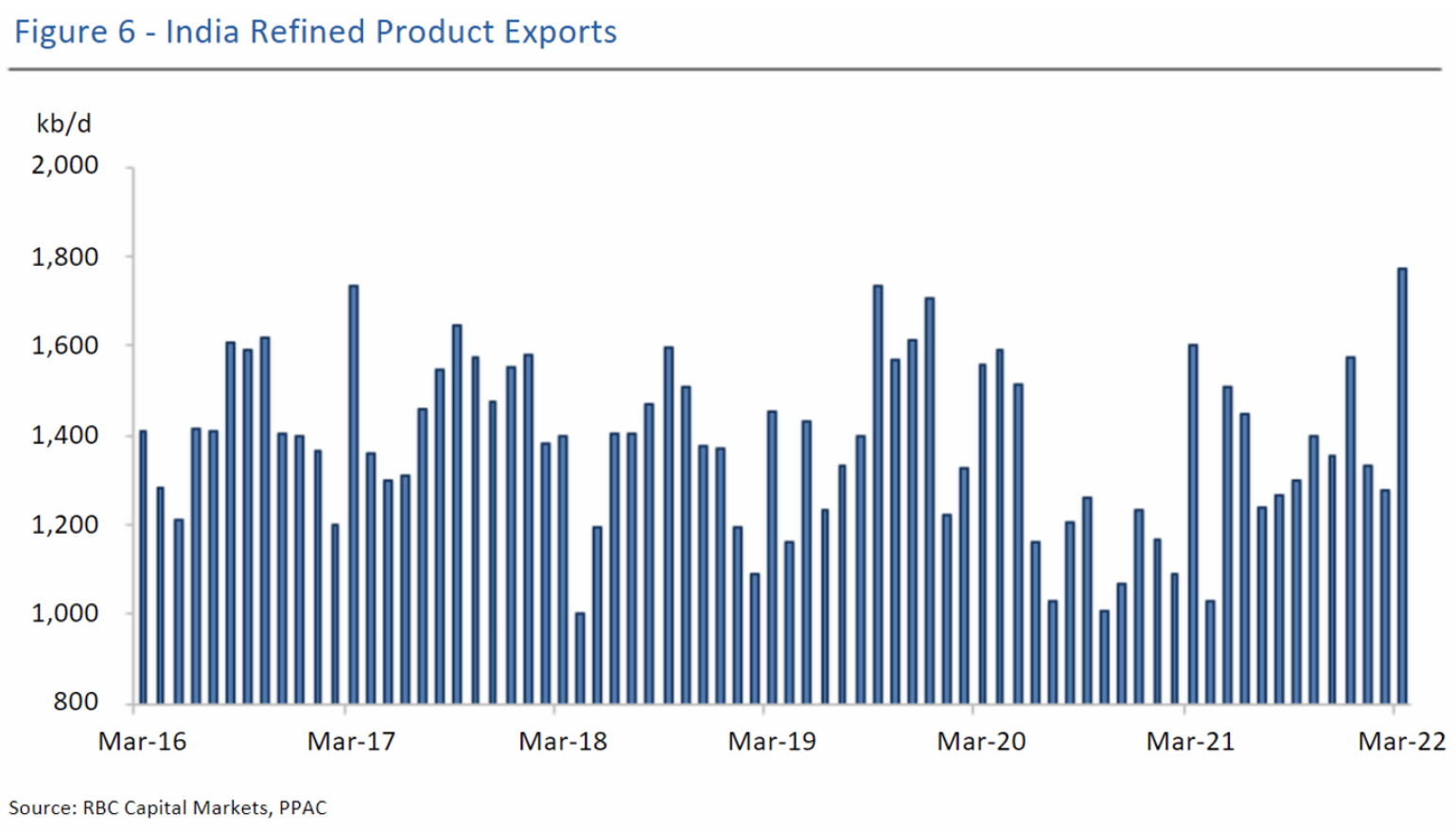
India's Refined Petroleum Exports.Source: MarketWatch


India is importing large amounts of deeply discounted Russian crude, running its refiners well above capacity, and capturing the economic rent of sky-high crack spreads and exporting gasoline and diesel to Europe, according to MarketWatch.  “As the EU weans from Russian refined products, we have a growing suspicion that India is becoming the de facto refining hub for Europe,” said Michael Tran, global energy strategist at RBC Capital Markets, in a Tuesday note. Here’s how the puzzle pieces fit together, according to Tran:

"India is buying record amounts of severely discounted Russian crude, running its refiners above nameplate capacity, and capturing the economic rent of sky-high crack spreads and exporting gasoline and diesel to Europe. In short, the EU policy of tightening the screws on Russia is a policy win, but the unintended consequence is that Europe is effectively importing inflation to its own citizens. This is not only an economic boon for India, but it also serves as an accelerator for India’s place in the new geopolitically rewritten oil trade map. What we mean is that the EU policy effectively makes India an increasingly vital energy source for Europe. This was historically never the case, and it is why Indian product exports have been clocking in at all-time-high levels over recent months". 

Bangladesh and Pakistan are afraid to buy Russian oil for fear of western sanctions while American ally India feels free to do so. As Pakistani Finance Minister Miftah Ismail told CNN's Becky Anderson in an interview, “It is very difficult for me to imagine buying Russian oil. At this point I think that it would not be possible for Pakistani banks to open LCs or arrange to buy Russian oil". Similarly, Bangladeshi Foreign Minister AK Abdul Momen told journalists: “You are seeing that they (western nations) keep bossing us and you (journalists) also encourage them. Every day, they come up with new issues. We used to call them development partners. They do not pay for the development but keep giving advice.” “We do not want to get into any problem. We want peace in the world,” Momen added. 

The West, particularly the United States, is turning a blind eye to India's actions when it comes to busting sanctions on Russia. Indian Prime Minister Narendra is openly funding the war in Ukraine by buying weapons and oil from Russia. At the same time, India's smaller neighbors feel intimidated by the threat of western sanctions if they follow Modi's example. Such double standards are not going unnoticed. 

Related Links:

Haq's Musings

South Asia Investor Review

Pakistani-American Banker Heads SWIFT, the World's Largest Interbank Payment System

Pakistani-Ukrainian Billionaire Zahoor Sees "Ukraine as Russia's Afghanistan"

Ukraine Resists Russia Alone: A Tale of West's Broken Promises

Ukraine's Lesson For Pakistan: Never Give Up Nuclear Weapons

Can the Chinese Yuan Replace the US Dollar?

Pakistan's Global Diaspora

Ukraine's Muslim Billionaire Akhmetov Holds Balance of Power

Ukraine's Muslims Oppose Russia


Saturday, May 28, 2022

Pakistan's Global Fashion Brands Creating Other Branded Exports Opportunities

Pakistan is moving to higher value-addition in textile sector with branding. Khaadi, Gul Ahmed, J. by Junaid Jamshed, Sapphire, Sana Safinaz and others growing into global brands by expanding into countries with large Pakistani diaspora. Other Pakistani companies that have gained international brand recognition include Shan Masala, Pakola, Tapal Tea and K&N Frozen Foods. These companies are helping boost much needed exports to narrow Pakistan's growing current account deficits. 

Pakistani Global Brands. Source: Pakistan & Gulf Economist


As the Pakistani diaspora has grown to nearly 10 million in recent years, several Pakistani clothing and food brands have entered markets in the United States, United Kingdom, European Union and the Middle East. These markets create opportunities to build more Pakistani global brands, create jobs and grow Pakistan's exports. 

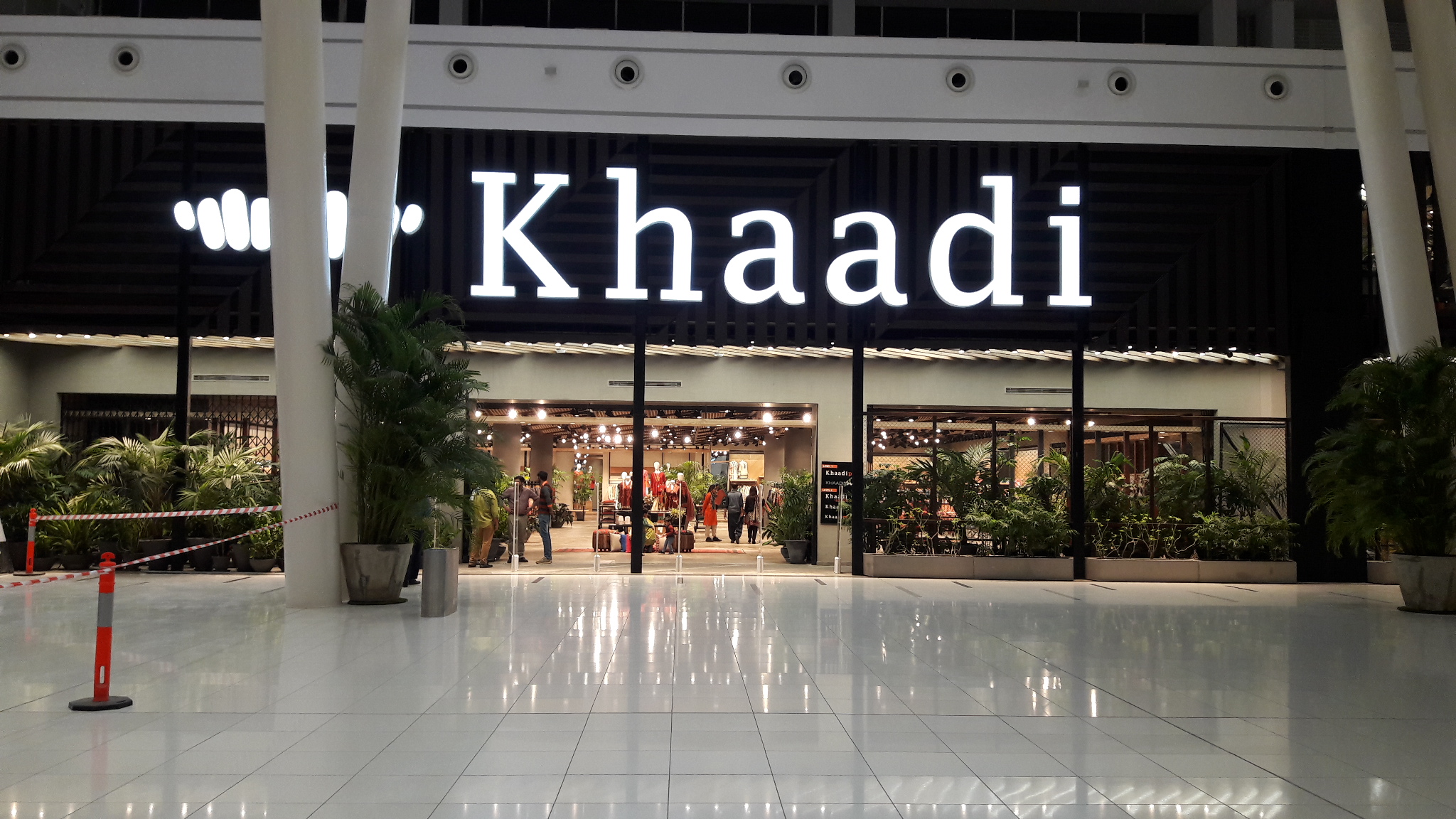
Khaadi Store, Package Mall, Lahore, Source: Wikimedia


Khaadi, which specializes in women's apparel, has attracted $25 million investment from International Finance Corporation (IFC) to help the company expand its business, create jobs, promote gender equality, and support the country’s crucial textiles sector after the COVID pandemic. Khaadi has established country-specific online stores for Canada, EU, Qatar, UAE, UK, US and Pakistan. In addition, the company has 57 physical retail outlets across Pakistan, UK and GCC countries. Investment Monitor, one of a network of 30+ proprietary B2B websites, has acknowledged the potential for Pakistani fashion brands in the following words:

"Despite its difficulties, Pakistan does have strong and innovative manufacturers, notably those developing their own apparel brands have emerged. Some of this has been based on advances in the Pakistan production of fine weave lawn cloth. And Pakistan consumers are becoming more brand conscious, being happy to seek out and wear local labels. Apparel brands, such as Khaadi (of Karachi); Sapphire (Lahore) and Sana Safinaz (Karachi), have focused on value addition and with Pakistan consumers prepared to pay for local quality, high profits have followed, including by developing exports".  

K&N Foods, a Pakistani branded poultry company, has recently started a poultry processing plant in New York. The company will sell Halal chicken products in the United States and Canada under the brand name of “K&N's Foods USA, LLC”. Beginning in the spring of 2013, the company invested more than $5 million in the purchase and renovation of a former Birds Eye plant which will employ almost 200 people in the Fulton area. Initially, K&N will focus on value-added processing of poultry purchased from other slaughter plants. The target market for these products will be specialty ethnic stores, supermarkets, and food service operations. 

Brands add value to the product being sold. This added value is effectively the difference between a product's price to consumers and the cost of producing it. Value can be added in several different ways, such as adding and promoting a brand name to a generic product or assembling a product in an innovative way. Brand marketing is done to create a consumer preference based on actual or perceived features or quality of what they buy from the store shelves. 

Developing countries like Pakistan manufacture products like ready-made garments for brand-name companies like Nike, Adidas, Levy's, etc. These garments are sold at a huge mark-up in the United States, and only tiny fraction of the money goes to Pakistan. 

Another global sector dominated by Pakistani manufacturers is surgical instruments. These precision instruments are sold by German companies under German labels with no mention of them having been made in Pakistan. Bulk of the money earned by selling goes goes into the pockets of German companies whose brand names appear on these surgical instruments. 

Manufacturers can earn much more by either building their own brands by spending a lot of money over a long time on advertising and marketing or by acquiring existing brands. Chinese manufacturers have been both in recent years to claim a much bigger share of profits generated by selling their products. Pakistani manufacturers can learn from the Chinese experience to do the same.

Related Links:

Haq's Musings

South Asia Investor Review

European Union: Fastest Growing Source of Remittances to Pakistan

Pakistani-Americans: Young, Well-educated and Prosperous

Ready-Made-Garments/Textile Boom in Pakistan

Fashion Week Karachi 2016

Pakistani Halal Meat Industry Experiencing Strong Growth

Over Half A Million Pakistanis Migrating Overseas Each Year

Pakistan Most Urbanized in South Asia

Pakistan Forecast to Become World's 7th Largest Consumer Market By 2030

Amazon Expands Pakistani Exports Opportunities


Monday, May 23, 2022

Chinese Public Opinion: 73% Have Positive View of Pakistan, Second Only to Russia

A recent public opinion survey conducted in China revealed that 73% of respondents have a positive view of Pakistan, second only to Russia which is seen positively by 80% of respondents.  About 18% of Chinese survey participants have a negative view of Pakistan while 9% are neutral. The results of this survey show that the oft-repeated talk of China and Pakistan being "iron brothers" is not just official rhetoric; it is actually supported by the Chinese people. It is also evident in the fact that the China-Pakistan Economic Corridor (CPEC) is transforming Pakistan's least developed area. 

Other nations enjoying favorable views among the Chinese include Singapore (66%), North Korea (62%), and Germany (61%). Most negatively perceived countries include the United States (90%), India (56%), Japan (54%), Vietnam (48%), South Korea (47%), and Ukraine (46%). 

Chinese Public Opinion Survey of 25 Countries. Source: CEIAS

The survey in China was conducted by the Central European Institute of Asian Studies (CEIAS), an independent think tank based in Bratislava, Slovakia. It sought the Chinese view of 25 countries included in the survey. The survey respondents see both the United States and Russia as powerful, but American power is seen mostly in negative terms, while Russia’s is almost exclusively positive. 

US Tag Cloud in Chinese Survey Responses. Source: CEIAS


The Chinese survey conducted in March this year reveals that the most common word association with the United States is “hegemon,” while other frequent expressions are “advanced,” “developed,” and “powerful,” but also “bossy,” “war,” “bandit,” and “sowing discord.” In the Russian case, the most common association is “warrior nation,” followed by words such as “Putin,” “vodka,” “vast,” “bears,” “powerful,” “war with Ukraine,” and “Sino-Russian friendship.”

Russia Tag Cloud in Chinese Survey. Source: CEIAS


The survey results show that Russia is among the most recommended countries for pursuing higher education among the Chinese, behind only China itself (83%), Singapore (56%), and the United Kingdom (55%). More than 52% of respondents recommend university study in Russia, while India and South Korea are the least recommended countries for university studies, with 63% and 42% of respondents not recommending them respectively. 

Another major finding of the survey is Chinese people’s confidence in China. When asked about how militarily and economically powerful they perceive relevant major powers, China is seen as the most powerful one, while China’s culture is also perceived as the most attractive and Chinese universities are the most recommended ones.

Related Links:

Haq's Musings

South Asia Investor Review

Pakistani-American Banker Heads SWIFT, the World's Largest Interbank Payment System

Pakistani-Ukrainian Billionaire Zahoor Sees "Ukraine as Russia's Afghanistan"

Ukraine Resists Russia Alone: A Tale of West's Broken Promises

Pakistanis in China

Has Intel's Indian Techie Risked US Lead in Semiconductor Technology?

US-China Tech Competition

CPEC Transforming Pakistan's Least Developed Areas

The Chinese Miracle


Saturday, May 21, 2022

International Tea Day: Pakistan is the World's Largest Tea Importer

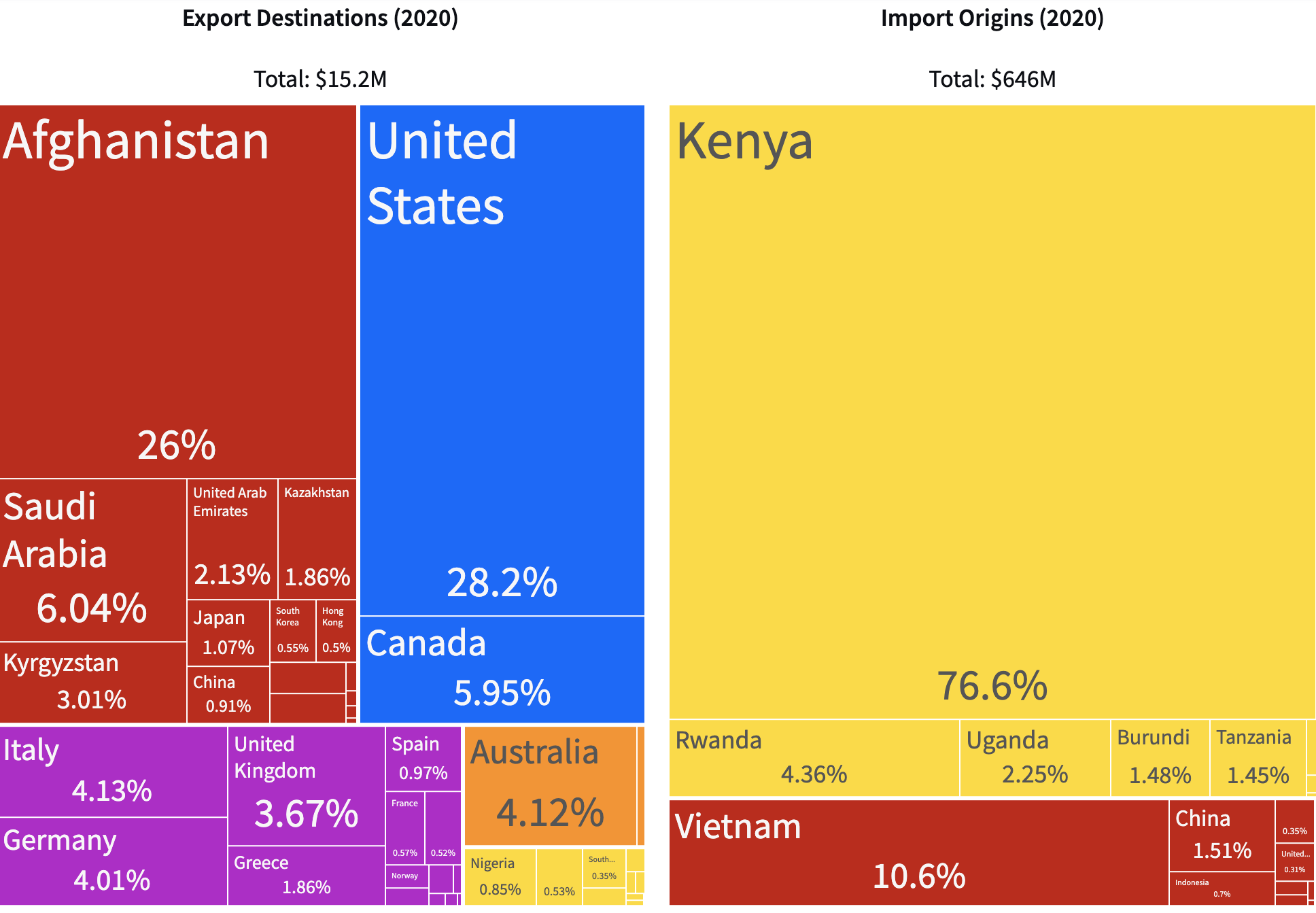
Pakistan does not produce tea but it is the most popular beverage among Pakistanis.  The country is ranked as its largest importer in the world.  In 2020, Pakistan imported $646 million (9% of global tea imports) worth of tea and exported $15.2 million in branded blends of tea such as Tapal Tea. Pakistan tea imports grew 19.8% from 2019 to 2020. 

Pakistan Tea Trade. Source: The Observatory of Economic Complexity


Other major tea importers in 2020 were as follows: United States: $473.8 million (7.1%) Russia: $412.2 million (6.2%) United Kingdom: $348.7 million (5.2%) Saudi Arabia: $243.6 million (3.7%) Iran: $236.3 million (3.5%) Hong Kong: $221.8 million (3.3%) Morocco: $202.3 million (3%) Egypt: $197.2 million (3%) Germany: $195 million (2.9%) China: $180 million (2.7%) France: $168.1 million (2.5%) United Arab Emirates: $164.9 million (2.5%) Japan: $156.6 million (2.4%) Iraq: $134.7 million (2%).  Global purchases of imported tea totaled US$6.7 billion in 2020. Of these countries, 4 markets for tea imports grew since 2019 namely: Hong Kong (up 19%), Pakistan (up 18.7%), Saudi Arabia (up 2.9%)  and France (up 0.7%).

Tea is popular in Pakistan and many other parts of the world for many reasons. A British study found that tea provides as much day-time stimulation as coffee, despite having half the caffeine. But tea was less likely to disrupt sleep. A Japanese study reported that plant compounds found in regular black tea – called theaflavins – were found to kill off oral bacteria linked with tooth and gum disease in a clinical trial with adults. A team of American scientists in Baltimore reviewed the evidence on tea and heart health, reporting that tea polyphenols have a direct impact on heart muscle contractions by controlling the flow of calcium ions into the muscle cells. The TAP (Tea Advisory Panel) data review reveals that more than half of Brits agree that tea is good for the heart.

World's Top Tea Importing Countries. Source: Statista

Last year, the PTI government headed by former Prime Minister Imran Khan decided to push domestic cultivation of tea in Pakistan with the help of Chinese experts. Already, trials have been conducted for growing tea in Mansehra, Battagram, Swat and Azad Kashmir regions which are considered to have the right climate for it. About 25,000 acres of government land has been allocated for tea cultivation along the China-Pakistan Economic Corridor (CPEC). 

“This year we are going to approve a project where we are growing tea on an area of 25,000 acres; we are creating history; we plan to complete the proposed tea plantations over the next five years,” said Special Assistant to Prime Minister on Food Security Jamshed Iqbal Cheema during his 2021 visit to the National Tea and High-Value Crops Research Institute (NTHRI) at Shinkiari, Mansehra in Khyber-Pakhtunkhwa province. Cheema said Pakistan has great potential for growing tea.  The country has 178,000 acres of tea cultivable land. “Pakistan can grow its own tea,” he said, adding that the country imported 30 million tonnes of tea each year from 15 different tea-producing countries.

Friday, May 20, 2022

Pakistanis Are Third Largest Foreign Investors in Dubai Real Estate

Pakistanis have invested $10.6 billion in Dubai real estate, ranking them as the third largest investors in the city on the Gulf. Indian investors lead Dubai real estate investments with $29.8 billion, followed by British investors' $14.7 billion investment. 

Wealth From Top 20 Countries Invested in Dubai Real Estate. Source: EU Tax Observatory

With at least $146 billion in foreign wealth invested, the Dubai property market is now the world's largest offshore investment market for foreign investors. It is now twice as large as the London real estate market in terms of wealth invested by foreigners through shell companies. There are nearly 20,000 unique foreign owners of Dubai real estate from Pakistan, the third largest number behind almost 35,000 Indian owners and about 23,000 owners from the United Kingdom, according to the EU Tax Observatory.


Unique Entities From Top 20 Countries Owning Dubai Real Estate. Source: EU Tax Observatory


The record flow of foreign wealth into Dubai real estate has drawn the attention of the FATF (the Financial Action Task Force), the global anti-money-laundering  watchdog. The UAE is now "under increased monitoring” (often referred to as the grey list) by the FATF.  It is widely accepted that real estate is used for money laundering and hiding wealth from tax authorities.

Money Laundering Risk. Source: FATF


Many rich Pakistanis, including top politicians and their family members, own real estate in Dubai, according to press reports. Most of the top politicians from Pakistani political parties like PPP, PML-N, ANP and MQM own Dubai real estate.  A 2020 Transparency International report said the following about Dubai's attraction to foreign unexplained wealth: 

"The UAE’s booming construction and real estate sector emerges as another major weakness. It accounts for a fifth of the Emirates’ GDP, but remains incredibly vulnerable to money laundering. Complex ownership structures can be used to obscure the identity of those buying property, as well as where their money is coming from".

"Despite the UAE’s role as a major international hub for finance and trade, the report concludes that authorities there are not cooperating with international partners. This could make the Emirates an attractive location in which “criminals could operate, maintain their illegal proceeds, or use it as a safe haven.”

"The FATF report confirms what investigative journalists, anti-corruption activists and whistleblowers have been saying for years: the UAE is a key piece in the global money-laundering puzzle. Its susceptibility to money laundering has seen it appear time and again in major cross-border corruption scandals". 

Monday, May 16, 2022

Pakistan: The Only Country in Asia With Birthright Citizenship

Pakistan is the only country in Asia that recognizes citizenship as a birthright. Only one in four nations in the world grant citizenship to all those born within their borders, according to a review of the nationality laws reviewed by EUI Global Citizenship Observatory.  Instead of birthright citizenship, the majority of countries today have citizenship by blood, in which children inherit citizenship from their parents. 

Citizenship as Birthright. Source: Quartz

Based on a review of the nationality laws of 174 nations, only 39, or about 1 in 4, grant citizenship to people born in the country, barring exceptions to children of diplomat parents, according to an article published in QUARTZ.  

Pakistan stands out as the only nation in Asia that grants citizenship as birthright.  It is the most common practice for the countries in the Americas: Canada, Mexico, Argentina, Brazil, among others, all follow this practice. Birthright citizenship is seen as a key measure of a nation's openness to immigrants.

Birthright citizenship didn’t exist in the US at the time of its founding. It was granted as part of the Civil Rights Act of 1866, followed by the Fourteenth Amendment and the 1898 Supreme Court decision in United States v. Wong Kim Ark, which led to the racial and ethnic diversity in the United States today.

The United Kingdom used to recognize birthright citizenship but the British government removed unconditional citizenship by birth in the British Nationality Act of 1981. Children born in the UK today can get citizenship only if they have at least one parent who’s a citizen or is a resident of the British territories. Germany loosened its policy in 2000, replacing the parent’s citizenship requirement with residency. Children born to a parent who has a German resident permit or has lived in Germany for at least eight years can get German citizenship.

Related Links:

Haq's Musings

South Asia Investor Review

Pakistan is the 7th Largest Source of Migrants in OECD Nations

Pakistani-Americans: Young, Well-educated and Prosperous

Inspirational Story of Karachi Rickshaw Driver's Daughters

Pakistan Remittance Soar 21X

Pakistan's Growing Human Capital

Two Million Pakistanis Entering Job Market Every Year

Pakistan Most Urbanized in South Asia

Hindu Population Growth Rate in Pakistan

Do South Asian Slums Offer Hope?


Sunday, May 15, 2022

Karachi Girl Students Win Top Prize at International Science Competition Held in Atlanta, Georgia

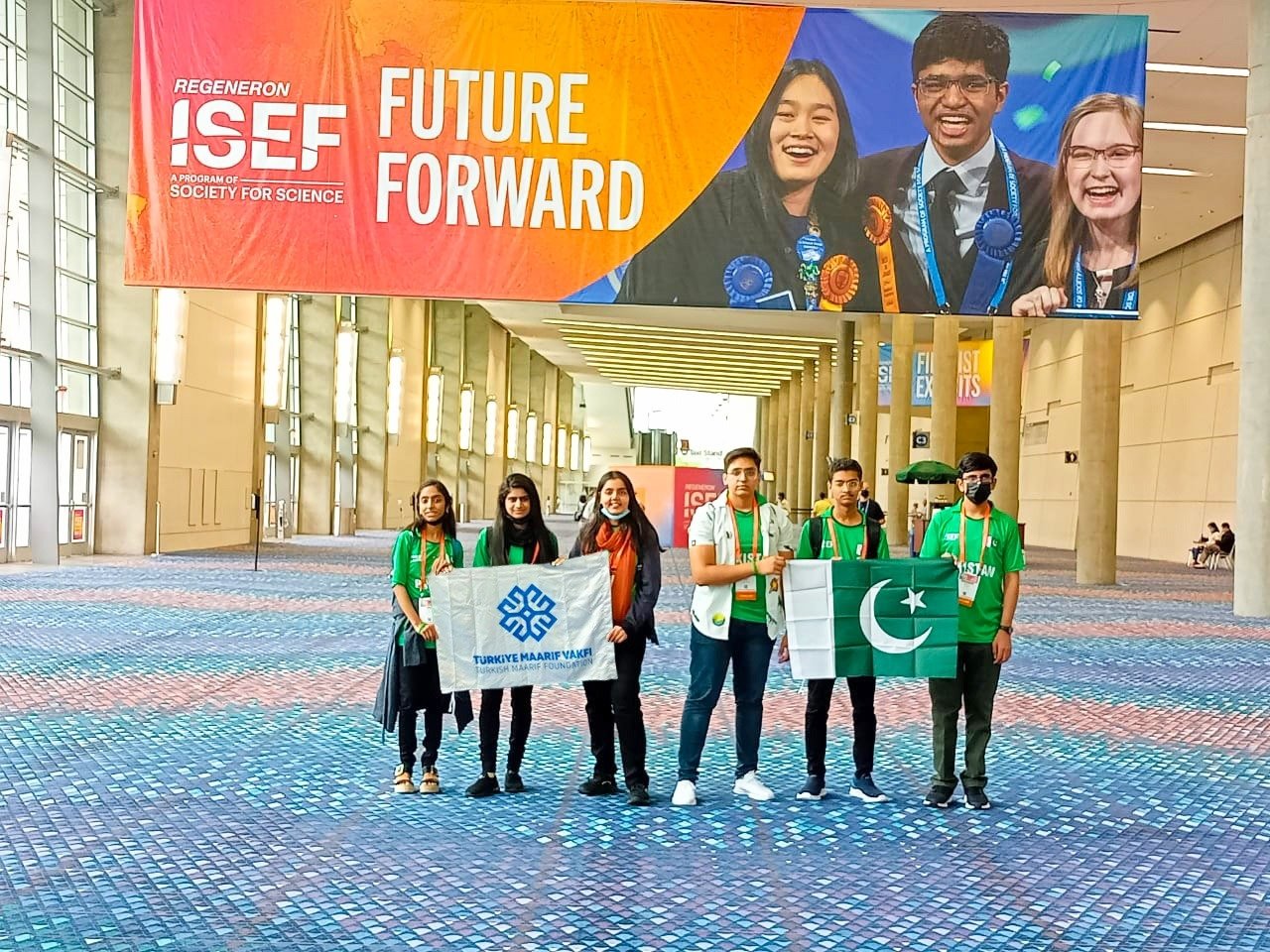
Two Pakistani girl students from Karachi have won the first physical science award of $1,500 each at Regeneron International Science and Engineering Fair (ISEF 2022) held May 7 through 13 in Atlanta, Georgia, United States. Ume Kulsoom and Talia Kusloom, the winners from Pakistan, are 12th grade students at Pak-Turk School in Gulshan-e-Iqbal, Karachi. 

Pakistani Student Participants at ISEF 2022 in Atlanta, Georgia, USA. Source: Maarif Foundation

Ume and Talia Kulsoom topped in the physical science category with their project titled "Vegan Leather Obtained from Cedrus Deodara (deodar tree)", according to an announcement by the Society for Science which organized the event. Regeneron ISEF is the world’s largest international science competition held annually. Each year, nearly 1,800 high school students from more than 63 countries participate to showcase their work.  

The winning project from Pakistan was completed under the supervision of Hira Bashir, a science teacher at the Pakistan-Turkey Maarif International Schools College in Karachi. "Our intelligent students believe in the green world and in the conservation of resources, which encouraged them to come up with this unique idea," the school said.

The ISEF is an annual event organized by the Society for Science and Engineering, a non-profit group headquartered in the US. The organization describes the event as "the world's largest international science competition," bringing together approximately 1,800 high school students from more than 63 countries each year. The Maarif Foundation has 28 schools and colleges across Pakistan that provide quality education to thousands of students in several cities, including Islamabad, Karachi and Lahore. 

Aqsa Ajmal, a graduate of Pakistan's National University of Science and Technology, was among six finalists for Lexus Design Award 2020 for industrial design. She won 3 million Yen (over $25,000) in funding and mentorship in an exclusive program in New York City under the guidance of prominent design leaders from a variety of design fields.

Pursewit Sewing Machine. Source: Lexus


The Mayet Family from Karachi, Pakistan won AI Family Challenge World Championship held in Silicon Valley, California on May 20, 2019.  The family's entry called "Cavity Crusher" uses artificial intelligence algorithm to monitor a child's brush time and determine their oral health habits to notify parents accordingly. It was organized by Iridescent, a global technology education nonprofit organization that empowers underrepresented young people to become self-motivated learners, inventors, and leaders.

In 2018, A team of undergraduate students representing Peshawar won a silver medal in a genetic engineering competition organized by the International Genetically Engineered Machine (iGEM) Foundation in Boston, Massachusetts.

Growing numbers of young Pakistanis are now participating and winning in international science and engineering competitions. Examples include Stanford Design Contest, AI Family Challenge World Championship and International Genetically Engineered Machine Competition. These wins offer increasing evidence of Pakistan's expected demographic dividend.


Related Links:

Haq's Musings

South Asia Investor Review

Pakistani Students Win First Place in Stanford Design Contest

Pakistanis Win AI Family Challenge in Silicon Valley

Pakistani Gamer Wins ESPN E-sports Player of the Year Award

Pakistan's Expected Demographic Dividend

Pakistan's Research Output Growing Fastest in the World

AI Research at NED University Funded By Silicon Valley NEDians

Pakistan Hi-Tech Exports Exceed A Billion US Dollars in 2018 

Pakistan Becomes CERN Member

Pakistani Tech Unicorns

Rising College Enrollment in Pakistan

Pakistani Universities Listed Among Asia's Top 500 Jump From 16 to 23 in One Year

Pakistani Students Win Genetic Engineering Competition

Human Capital Growth in Pakistan

Pakistan Joins 3D Print Revolution

Pakistan Human Development in Musharraf Years


Saturday, May 14, 2022

Bridge Collapse Amid Heat Wave in Pakistan Raises Fears of Massive Glacier Melt Flooding

Record-high temperatures in Pakistan caused Shisper glacier to melt rapidly, triggering the collapse of the Hassanabad Bridge along the Karakoram Highway last week.  With 7,253 known glaciers, Pakistan is home to more glacial ice than any other country on earth outside the polar regions. If these start melting in increasingly severe heat waves, there could be massive flooding in the country. Pakistan is among the most vulnerable to climate change. 

Hasanabad Bridge Collapse in Pakistan


India and Pakistan have been hit by a severe heat wave very early this summer.  Jacobabad, a city in Sindh province, hit 122ºF (50ºC) in April, one of the highest April temperatures recorded in the world. Dadu, another city in Sindh, recorded 117ºF (47ºC). "This is the first time in decades that Pakistan is experiencing what many call a 'spring-less year," Pakistan's Minister of Climate Change, Sherry Rehman said in a statement. The consequences of rising temperatures in South Asia could be very severe, ranging from crop losses, food shortages and floods. 

Record High Temperature in Jacobabad, Pakistan


Pakistan's contribution to global carbon emissions is less than 1% but it is still ranked among countries most vulnerable to climate change. The energy-hungry nation needs help to finance climate-friendly  development of clean energy sources and climate-resilient infrastructure. Last year at COP26 conference in Glasgow, Pakistan provided its NDCs 2021 (national determined contribution 2021) to the United Nations ahead. Some of Pakistan's NDC targets are voluntary while others are contingent upon the receipt of financial assistance from the rich nations most responsible for the climate crisis. Some of Pakistan's solution are nature-based such as its Billion Tree Afforestation Project (BTAP) while others require significant increase in low-carbon energy from wind, solar, hydro and nuclear.  

Pakistan NDCs (Nationally Determined Contributions) For Climate Goals. Source: UN


 Malik Amin Aslam, former Prime Minister Imran Khan's special assistant on climate change, said in an interview with CNN that his country is seeking to change its energy mix to favor green.  He said Pakistan's 60% renewable energy target would be based on solar, wind and hydro power projects, and 40% would come from hydrocarbon and nuclear which is also low-carbon. “Nuclear power has to be part of the country’s energy mix for future as a zero energy emission source for clean and green future,” he concluded. Here are the key points Aslam made to Becky Anderson of CNN:

1. Pakistan wants to be a part of the solution even though it accounts for less than 1% of global carbon emissions. . Extreme weather events are costing Pakistan significant losses of lives and property.

2. Pakistan is among the countries most vulnerable to the effects of climate change. 

3. Pakistan is moving towards renewable energy by converting 60% of its energy mix to renewable by 2030. Electric vehicle (EV) transition is also beginning in his country. 

4. Aslam said:  “We are one of the world leaders on nature based solutions. However, the World Bank (WB) in its Report yesterday came up with really good numbers in a comparison done of countries who are shifting their mainstream development towards environment friendly policies and Pakistan came atop among them,” the SAPM explained. 

Pakistan Power Generation Fuel Mix. Source: Third Pole

Here's a video of Malik Amin Aslam's interview with CNN's Becky Anderson:

https://youtu.be/Q_s4kQXChuM


Wednesday, May 11, 2022

WHO: India's 4.7 Million Excess Deaths Account For Nearly One-Third of the Global COVID Death Toll

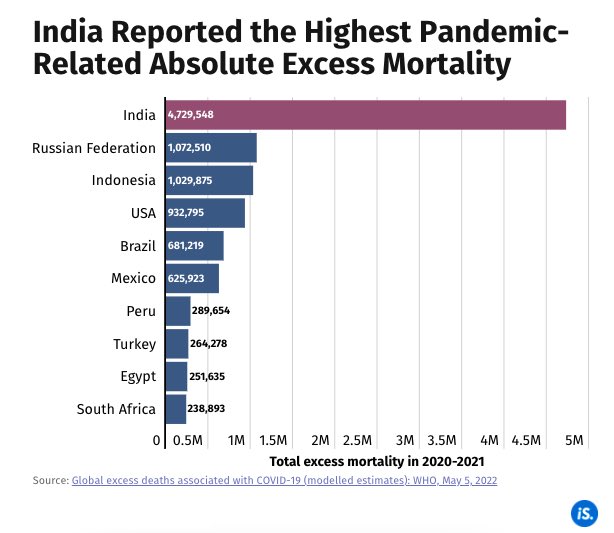
The World Health Organization estimates that India had 4.730 million COVID19-related  deaths in 2020-21, nearly a third of 15 million global excess deaths attributed to the pandemic. India is followed by Russia with 1.073 million deaths and Indonesia with 1.03 million deaths. The United States with 933,795 deaths and Brazil with 681,219 deaths round out the top 5 countries that suffered the heaviest losses of life believed to be related to the pandemic. Mexico (625,923 deaths), Peru (289,654 deaths), Turkey (264,279 deaths) Egypt (251,635 deaths) and South Africa (238,893 deaths) are ranked number 6 through 10 in the world for excess deaths in 2020-21 period. Although Pakistan too had 8 times the official figure, it still does not figure in WHO's top 10 list for total number of COVID deaths. 

Total Excess Deaths Recorded During the COVID-19 Pandemic in 2020-21. Source: WHO

Excess deaths measure how many more people died than expected compared with previous years. Although it is difficult to say with certainty how many of these deaths were due to Covid, they can be considered a measure of the scale and toll of the pandemic, according to the BBC. 

Although the government of Prime Minister Narendra Modi disputes the WHO estimates, the scenes of desperation and death all over India, including the streets of major cities during the pandemic, offer significant anecdotal evidence to support the WHO claim. Although Pakistan too had 8 times the official figure, it still does not figure in WHO's top 10 list for total number of COVID deaths. 

List of Countries with excess deaths during COVID19 pandemic. Source: WHO

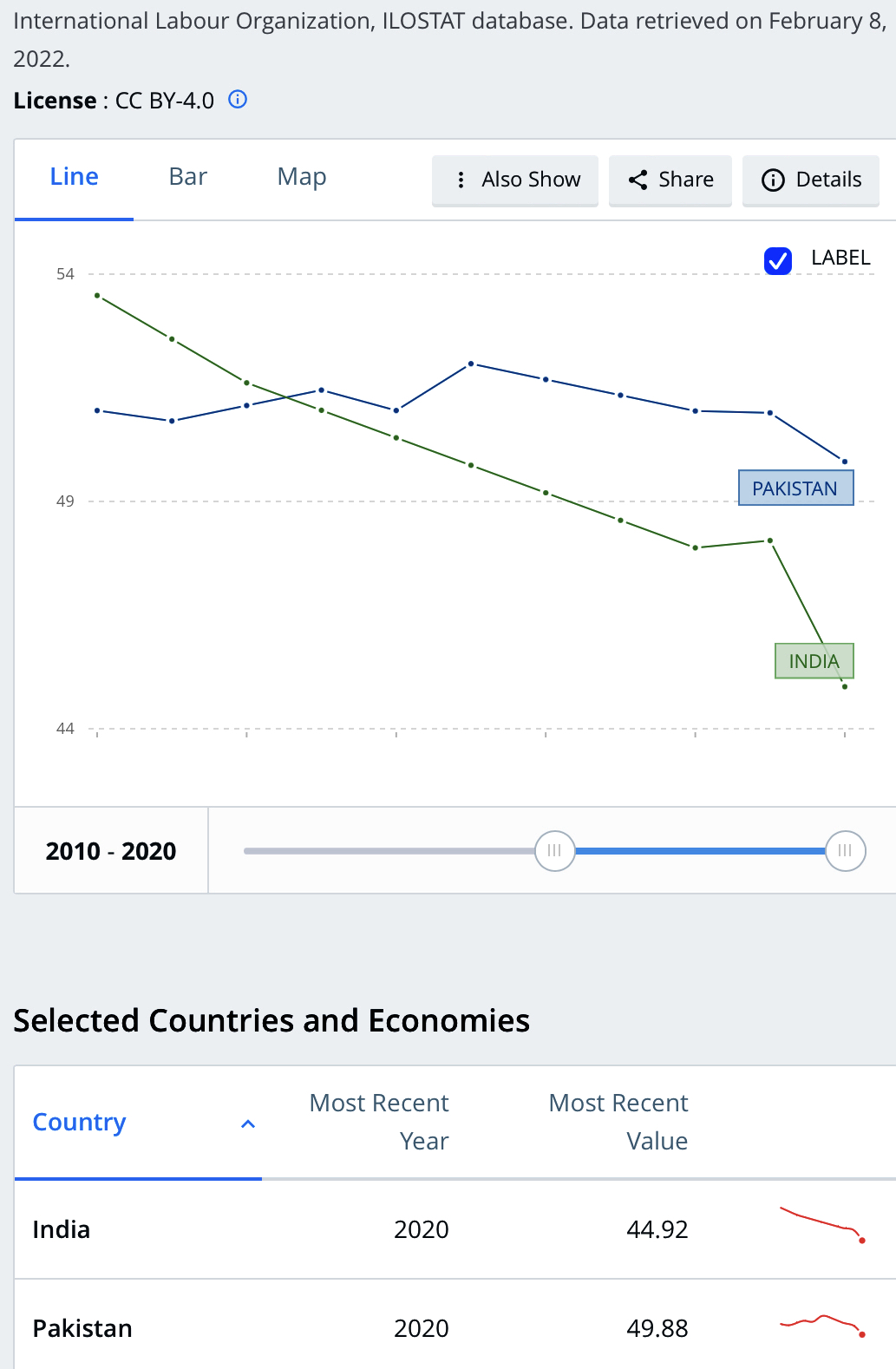
Prime Minister Modi's mishandling of the COVID19 pandemic has left a lasting effect on India's economy. Akhil Bharatiya Pratinidhi Sabha (ABPS), the top decision-making body of India's Hindu right-wing RSS (Rashtriya Swayamsevak Sangh), says that “the young generation is suffering from unemployment and the pandemic has made things even grim... We cannot turn a blind eye to unemployment. It is a crisis and it needs to be addressed.” The RSS was apparently reacting to the falling labor participation rate in India relative to Pakistan and the global averages. The RSS leadership wants the government of Prime Minister Narendra Modi to focus on helping small and medium sized enterprises (SMEs) to create jobs.  RSS likes Modi government's ‘Make in India’ initiative “but it needs to be sharpened even more and get more investment.” The resolution is titled, ‘The need to promote work opportunities to make Bharat self-reliant’. The solution offered by ABPS resolution: Take agro-based local initiatives to promote rural areas and create jobs, according to Ram Madhav, a member of the RSS executive committee. 

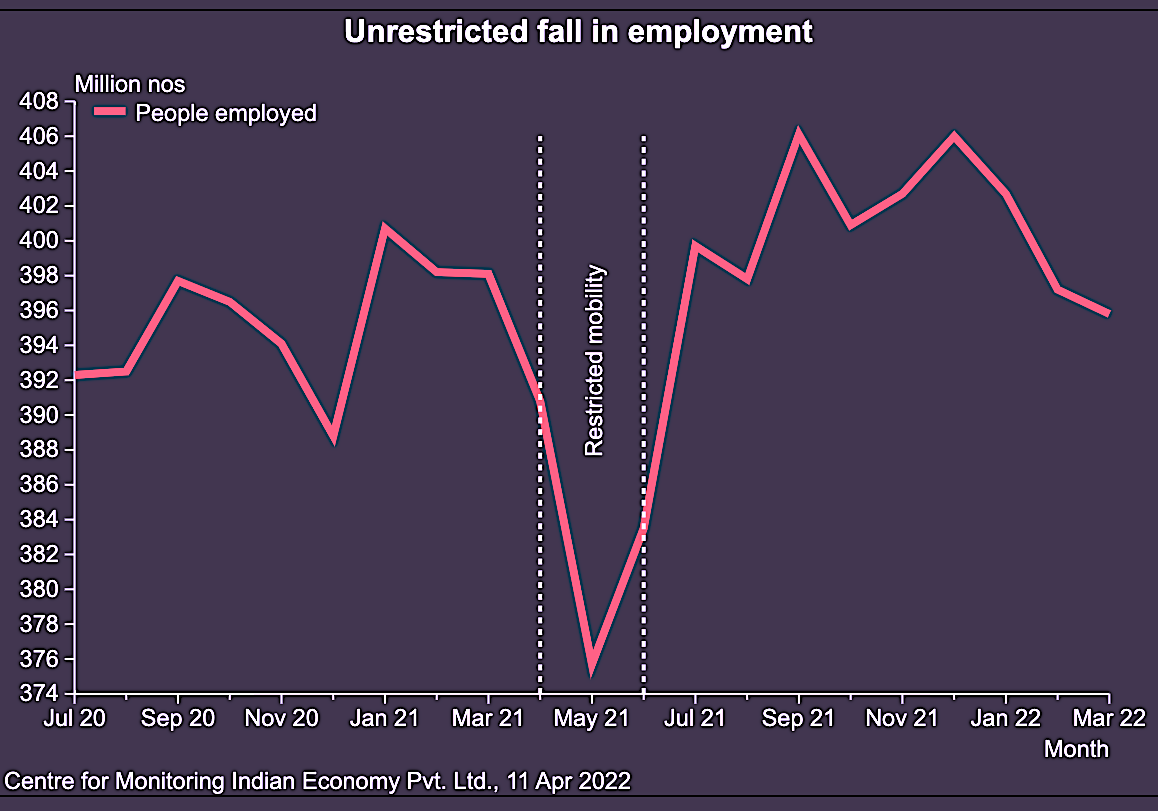
Falling Employment in India. Source: CMIE


India's labor participation rate (LPR) fell to 39.5% in March 2022, as reported by the Center for Monitoring Indian Economy (CMIE). It dropped below the 39.9% participation rate recorded in February. It is also lower than during the second wave of Covid-19 in April-June 2021. The lowest the labor participation rate had fallen to in the second wave was in June 2021 when it fell to 39.6%. The average LPR during April-June 2021 was 40%. March 2022, with no Covid-19 wave and with much lesser restrictions on mobility, has reported a worse LPR of 39.5%.

Labor Participation Rates in India and Pakistan. Source: ILO/World Bank

In spite of the headline GDP growth figures highlighted by the Indian and world media, the fact is that it has been jobless growth. The labor participation rate (LPR) in India has been falling for more than a decade. The LPR in India has been below Pakistan's for several years, according to the International Labor Organization (ILO). 

Indian Employment Trends By Sector. Source: CMIE Via Business Standard

Construction and manufacturing sectors in India have been shedding jobs while the number of people working in agriculture has been rising, according to CMIE. Job losses have caused a hunger crisis in India which now ranks 94th among 107 nations ranked by World Hunger Index in 2020. Other South Asians have fared better: Pakistan (88), Nepal (73), Bangladesh (75), Sri Lanka (64) and Myanmar (78) – and only Afghanistan has fared worse at 99th place. The COVID19 pandemic has worsened India's hunger and malnutrition. Tens of thousands of Indian children were forced to go to sleep on an empty stomach as the daily wage workers lost their livelihood and Prime Minister Narendra Modi imposed one of the strictest lockdowns in the South Asian nation. Pakistan's former Prime Minister Imran Khan opted for "smart lockdown" that reduced the impact on daily wage earners. China, the place where COVID19 virus first emerged, is among 17 countries with the lowest level of hunger. 


Related Links:

Haq's Musings

South Asia Investor Review

Pakistan Among World's Largest Food Producers

Naya Pakistan Housing Program

Food in Pakistan 2nd Cheapest in the World

Indian Economy Grew Just 0.2% Annually in Last Two Years

Pakistan to Become World's 6th Largest Cement Producer by 2030

Pakistan Reduced Poverty & Grew Economy During COVID Pandemic

Pakistan's Computer Services Exports Jump 26% Amid COVID19 Lockdown

Coronavirus, Lives and Livelihoods in Pakistan

Vast Majority of Pakistanis Support Imran Khan's Handling of Covid19 Crisis

Pakistani-American Woman Featured in Netflix Documentary "Pandemic"

Incomes of Poorest Pakistanis Growing Faster Than Their Richest Counterparts

Can Pakistan Effectively Respond to Coronavirus Outbreak? 

How Grim is Pakistan's Social Sector Progress?

Pakistan Fares Marginally Better Than India On Disease Burdens

Trump Picks Muslim-American to Lead Vaccine Effort

COVID Lockdown Decimates India's Middle Class

Pakistan Child Health Indicators

Pakistan's Balance of Payments Crisis

How Has India Built Large Forex Reserves Despite Perennial Trade Deficits

Conspiracy Theories About Pakistan Elections"

PTI Triumphs Over Corrupt Dynastic Political Parties

Strikingly Similar Narratives of Donald Trump and Nawaz Sharif

Nawaz Sharif's Report Card

Riaz Haq's Youtube Channel

Saturday, May 7, 2022

Olive Revolution: Pakistan Joins International Olive Council

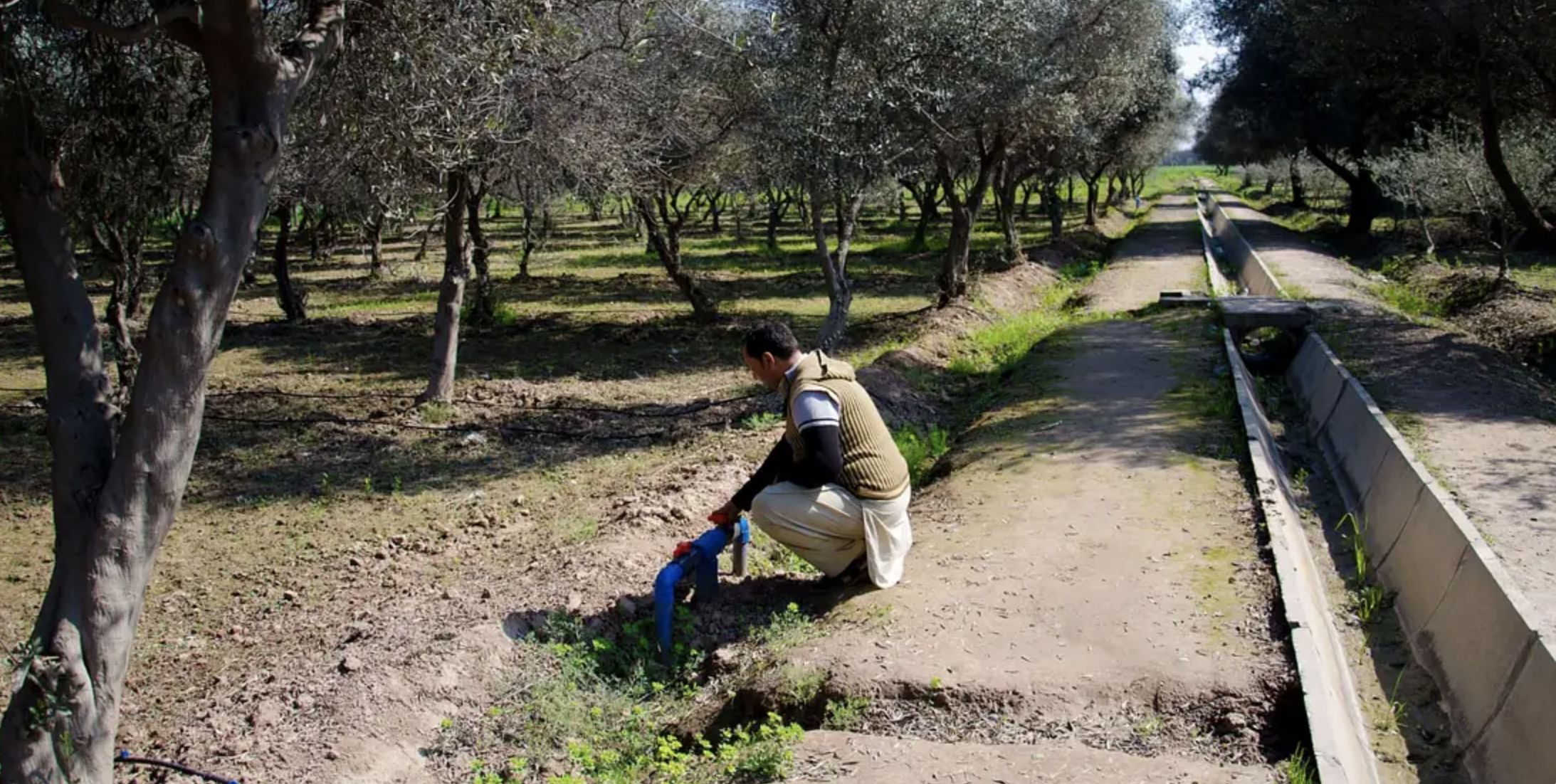
Pakistan's Ten Billion Tree Tsunami project launched in 2014 by the PTI government has sparked a silent olive revolution in the country.  Pakistan, now the 19th member of the International Olive Council, is producing about 1,500 tons of olive oil per year and 830 tons of table olives,  according to Juan Vilar Strategic Consultants. It is also helping tackle some of the effects of climate change such as soil erosion and desertification and bringing new opportunities to farmers. Olive cultivation was started as a pilot project in Potohar region by Punjab Chief Minister Shahbaz Sharif's government in 2014. The PTI government promoted it nationwide as a part of Prime Minister Imran Khan's Ten Billion Tree Tsunami initiative to bring about the olive revolution in the country.  

Olive Valley, Pakistan

Pakistan is the world's third largest importer of cooking oil. In 2020, Pakistan imported $2.1 billion worth of palm oil, behind only India's $5.1 billion and China's $4.1 billion in palm oil imports. Increasing olive oil production will help the country reduce its dependence on palm oil imports. Substituting imported palm oil with domestic olive oil may also help improve the heath of Pakistani consumers. 

The International Olive Council (IOC) has 18 members, mostly European and Middle Eastern nations located in the Mediterranean region. Pakistan has joined as its 19th member. The IOC members account for more than 98% of global olive production. The IOC has been headquartered in the Spanish capital Madrid since it was founded in 1959.  The organization specifies acceptable quality control testing methods and assures consumer transparency information, for example: hygiene standards along the supply chain, suitable packing materials and filling tolerances product labelling standards, identification of any food additives or allowable contaminants, recommendations for environmental protection in the use and disposal of olive products.  


Olive Plantation in Peshawar, Pakistan. Source: Olive  Oil Times

Welcoming Pakistan into the organization, Mr. Abdellatif Ghedira, the IOC’s executive director, told Olive Oil Times: “In Pakistan, olive oil culture is making inroads, and so are the opportunities related to that .....The council is a decisive player in contributing to the sustainable and responsible development of olive growing, and it serves as a world forum for discussing policymaking issues and tackling present and future challenges".  

Olive trees thrive in dry arid regions with rocky soils that are more challenging for traditional crops. Pakistan government officials believe that olive farming is an efficient answer both to reforestation needs and economic development. “A special focus in this phase will be given to underprivileged areas of the country, such as Southern Balochistan, Southern Punjab, the tribal areas of Khyber Pakhtunkhwa (KPK) and some parts of Sindh province,” Muhammad Tariq, national project director at the Ministry of National Food Security and Research, told Olive Oil Times. 

It is expected that traditional farming and modern techniques would make large tracts of barren land productive, creating new jobs and growing the economy. Drip irrigation systems are being deployed over 16,000 hectares and 3.6 million olive trees. The Pakistani public and private sectors currently maintain 26 olive oil extraction plants of different capacities, from 80 kilograms per hour to 600, according to Olive Times.

Pakistan has the potential to be a world leader in olive production. In the last decade,  PTI's Ten Billion Tree Tsunami initiative has spurred rapid olive cultivation in Pakistan with the import of 100,000 olive seedlings from top olive producing countries like Spain, Italy and Turkey. Pakistan’s climate is conducive for olive production, as the olive trees grow fast in regions with moderate winters following long hot summers.

Related Links:


Haq's Musings

South Asia Investor Review

Chicken Cheaper Than Daal

Meat Industry in Pakistan

Bumper Crops and Soaring Tractor Sales in Pakistan

Meat and Dairy Revolution in Pakistan

Pakistanis Are Among the Most Carnivorous

Eid ul Azha: Multi-Billion Dollar Urban-to-Rural Transfer

Pakistan Among World's Largest Food Producing Countries

Drip Irrigation: Can Pakistan Make its Deserts Bloom?

Pakistan's Agenda at COP26 Climate Conference