Showing posts sorted by date for query hydroelectric. Sort by relevance Show all posts

Thursday, October 10, 2024

Renewable Energy: Clean Electrification of Pakistan's Economy

Access to abundant and cheap electricity is essential for running a modern competitive economy. The rapidly growing power demand for generative AI data centers makes it even more important. The best way to ensure it is in switching to renewable energy sources. That is why Pakistan is in the midst of a renewable power boom. It is ramping up generation of clean energy with solar, hydro, wind and nuclear power. 13 gigawatts of solar panels have been imported in the first half of this year alone. Another 10 gigawatts of hydroelectric power projects are under construction for completion by 2030, bringing the total hydropower capacity to 20 gigawatts. Pakistan's total nuclear energy production capacity rose to 3,620 MW, when the country's sixth nuclear power plant opened two years ago. Pakistan and China have recently signed a $4.8 billion deal to build another 1,200 MW nuclear power plant. There are 36 private wind projects producing approximately 1,845 MW in the country.  Pakistan is phasing out old fossil fuel power plants. It has negotiated the termination of power purchase contracts with five independent fossil fuel power producers (IPPs), including Hubco, the largest IPP currently operating in the country. More negotiations are underway to terminate additional IPP contracts. Payments to these IPPs are a huge burden on the nation’s economy and ordinary consumers alike. There have been violent protests against high electricity rates across the country. 

Renewable Energy. Source: Easy-Peasy.AI

A number of auto companies have announced plans to manufacture electric vehicles. Pakistani automobile joint ventures with Chinese automakers BYD and Changan have recently launched several all-electric and plug-in hybrid models of automobiles in Pakistan. Honda Atlas Cars Pakistan Limited has announced plans to build a hybrid electric vehicles plant in the country. Other major brands like Toyota, Haval, and Hyundai are already offering similar models in the country. It all began with the 2019 electric vehicle policy approved by the government of Prime Minister Imran Khan to incentivize the electrification of the auto industry. Pakistan EV policy goal is to achieve 30% of new cars sales, 50% of new 2-wheeler and 3-wheeler sales and 30% of new truck sales by 2030. By 2040, the target is 90% of all new vehicle sales to be electric. The main incentive is the reduction of sales tax from 17% for internal combustion engine (ICE) vehicles to 1% for all-electric (EV) vehicles.

Pakistan is currently experiencing a huge economic drain in terms of fossil fuel imports. In the first two months of the current fiscal year, Pakistan's oil import bill increased by 23% compared to the same period in 2023. Paying for huge amounts of imported coal, gas, and oil in US dollars has become disastrous, particularly after 40% depreciation of Pakistani currency over the last two years. Switching to cheap renewable sources will have a salutary effect on the country's climate and economy. It will help grow the nation's exports by increasing its exporters' competitiveness. It will also make it easier to manage inflation and reduce the need for recurring IMF bailouts. 

The GenAI revolution is another factor that will dramatically increase global power demand. Wall Street investment bank Goldman Sachs forecasts that the new high-performance AI data centers alone will grow electricity demand by 160% by 2030. Pakistan needs to prepare for it if it wants to be competitive in this brave new world of generative artificial intelligence (Gen AI). 


Saturday, August 13, 2022

Pakistan At 75: Highlights of Economic and Demographic Progress Since Independence

Pakistan is a young nation with a lot of unrealized potential. As the country turns 75, it is important to recognize that all basic indicators of progress such as income, employment, education, health, nutrition, electricity use, telecommunications and transportation have shown significant improvements over the last seven and a half decades. These improvements can be accelerated if Pakistan can overcome its economic growth constraints from recurring balance of payments crises such as the one it is experiencing now. The only way to do it is through rapid expansion of exports and major reductions in reliance on imports such as fossil fuels and cooking oil. 

Income/GDP Growth:

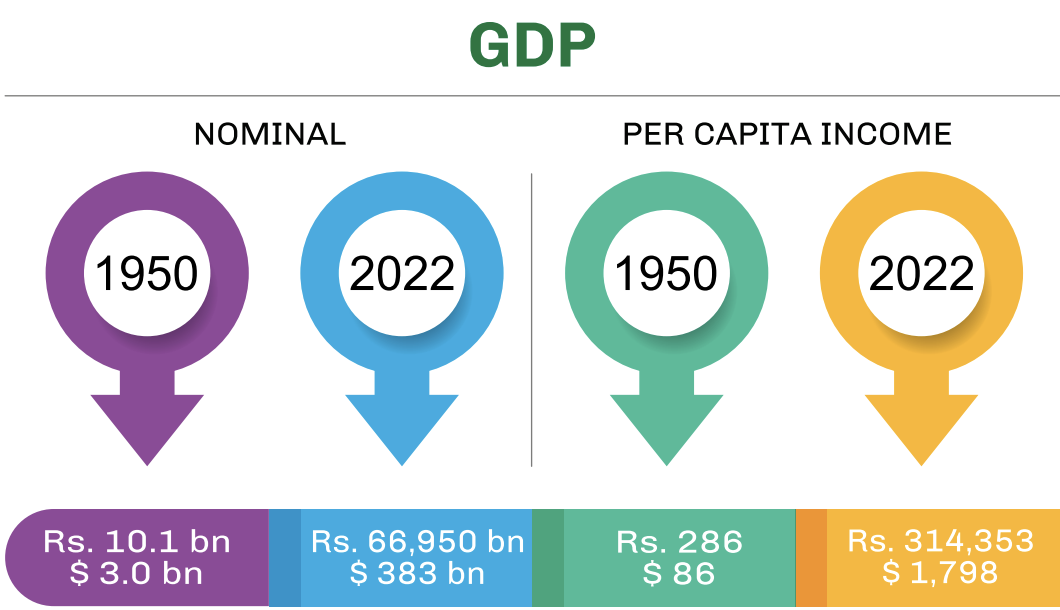
Economic Survey of Pakistan 2021-22 confirms that the nation's GDP grew nearly 6% in fiscal year 2021-22, reaching $1.62 Trillion in terms of purchasing power parity (PPP). It first crossed the trillion dollar mark in 2017. In nominal US$ terms, the size of Pakistan's economy is now $383 billion. The country's per capita income is $1,798 in nominal terms and $7,551 in PPP dollars.  

Pakistan GDP, Per Capita Income Growth. Source: 75 Years Economic Journey

Electricity Consumption:

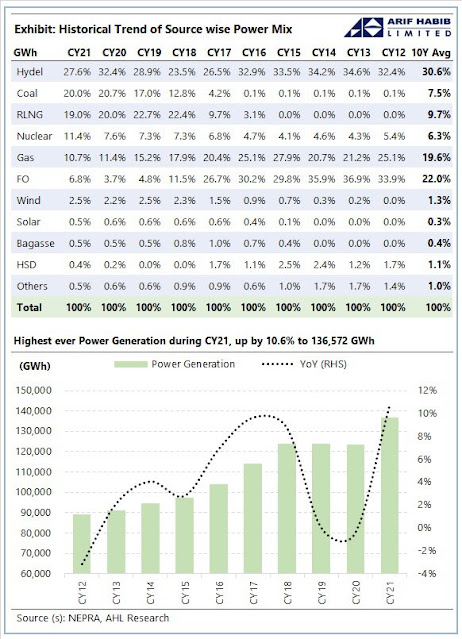
Pakistan's electricity consumption is an important indicator of economic activity and living standards. It has soared from 40 GWH in 1949 (1 KWH per capita) to 136,572 KWH in 2021 (620 KWH per capita). Last year, hydroelectric dams contributed 37,689 GWH of electricity or 27.6% of the total power generated, making hydropower the biggest contributor to power generated in the country. It was followed by coal (20%), LNG (19%) and nuclear (11.4%).  Nuclear power plants generated 15,540 GWH of electricity in 2021, a jump of 66% over 2020.  Overall, Pakistan's power plants produced 136,572 GWH of power in 2021, an increase of 10.6% over 2020, indicating robust economic recovery amid the COVID19 pandemic. 

Electricity Consumption


Installed Power Generation Capacity Growth. Source: Bilal Gilani of Gallup Pakistan

 Population Growth:

Pakistan's population has grown rapidly over the last 75 years. It is now 227 million, 6.7 times 34 million in 1951. However, the total fertility rate has declined from 6.5 babies  in 1950 to 3.3 babies per woman in 2021.  

Pakistan Population Growth

Pakistan Total Fertility Rate Per Woman of Child-Bearing Age. Source: UN via Macrotrends


Life Expectancy:

Improvements in access to healthcare have helped raise life expectancy in the country. It has increased from just 50 years in 1970 to 67.4 years in 2020. 

Life Expectancy

Employment:

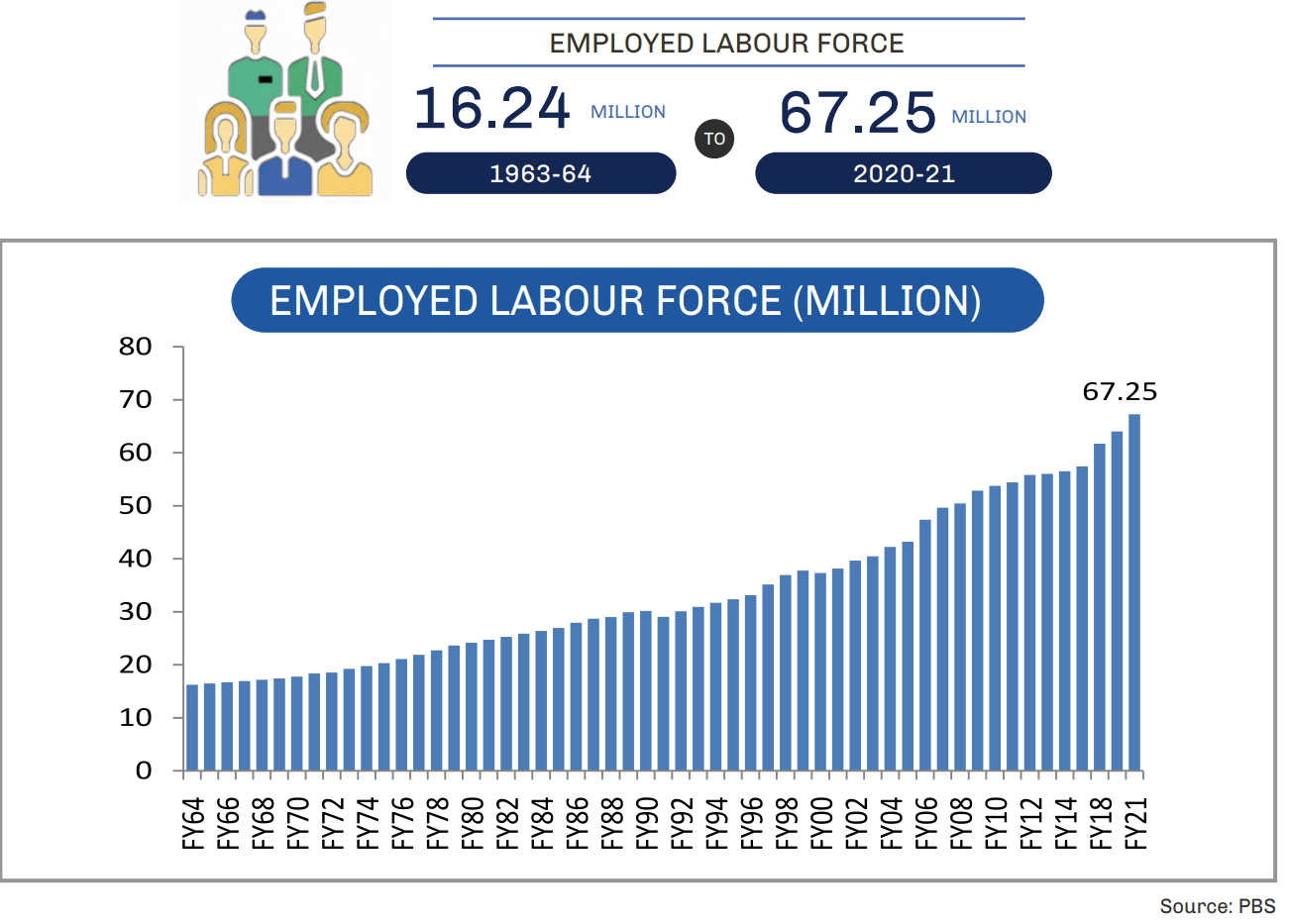
Pakistan's economy has generated tens of millions of jobs since the nation's independence. The employed workforce has grown from 16.24 million in 1963-64 to 67.25 million in 2020-21, according to government sources. Pakistan has created 5.5 million jobs during the past three years – 1.84 million jobs a year, significantly higher than the yearly average of new jobs created during the 2008-18 decade, according to the findings of the Labor Force Survey (LFS) as reported by the Express Tribune paper. The biggest jump in share of employment (1.5%) was in the construction sector, spurred by Naya Pakistan construction incentives offered by the PTI government. 


Pakistan Employment Growth

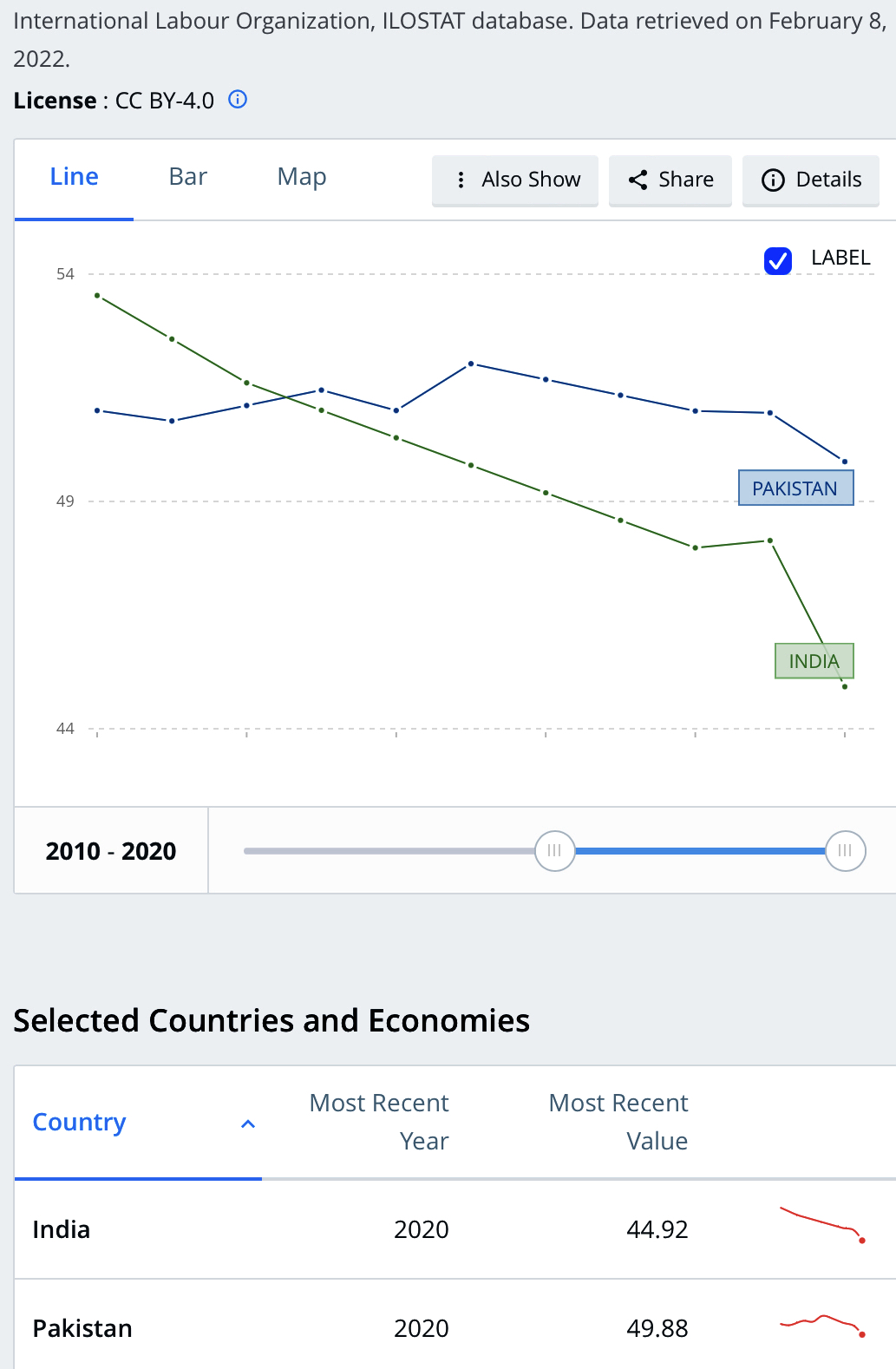
Unlike Pakistan's, India's labor participation rate (LPR) has been falling significantly in the last decade. It fell to 39.5% in March 2022, as reported by the Center for Monitoring Indian Economy (CMIE). It dropped below the 39.9% participation rate recorded in February. It is also lower than during the second wave of Covid-19 in April-June 2021. The lowest the labor participation rate had fallen to in the second wave was in June 2021 when it fell to 39.6%. The average LPR during April-June 2021 was 40%. March 2022, with no Covid-19 wave and with much lesser restrictions on mobility, has reported a worse LPR of 39.5%.

Labor Participation Rates in India and Pakistan. Source: ILO/World Bank


Youth  unemployment for ages 15-24 in India is 24.9%, the highest in the South Asia region. It is 14.8% in Bangladesh and 9.2% in Pakistan, according to the International Labor Organization and the World Bank.  

Poverty Reduction:

Pakistan has managed to significantly reduce poverty since its inception. 

Poverty Decline in Pakistan


Nutrition:

In terms of the impact of economic growth on average Pakistanis, the per capita average daily calorie intake jumped to 2,735 calories in FY 2021-22 from 2,457 calories in 2019-20. It has grown from 2250 calories in 1980 to 2780 calories in 2020. 

Pakistan Per Capita Daily Calorie Consumption. Source: Economic Surveys of Pakistan


Agriculture: 

Pakistan is among the world's largest food producers. It experienced broad-based economic growth across all key sectors in FY 21-22; manufacturing posted 9.8% growth, services 6.2% and agriculture 4.4%. The 4.4% growth in agriculture is particularly welcome; it helps reduce rural poverty.  

Production of Tractors in Pakistan


Wheat Production in Pakistan

Rice Production in Pakistan


Corn Production in Pakistan
Sugarcane Production in Pakistan
Meat Production in Pakistan


Milk Production in Pakistan

Cotton Production in Pakistan


Literacy and Education:

Literacy in Pakistan has increased from just 16.4% in 1950-51 to 62.8% in 2020-21. Male literacy is now at 73.4% but the female literacy lags at only 51.9%. The area of female literacy clearly requires greater attention and focus. 

Literacy Rate in Pakistan

Number of universities in the country has jumped from just 2 in 1947 to 233 in 2021. Enrollment in these colleges has gone up from 644 in 1947 to 1.96 million in 2021. Biggest increases have come since the higher education reform led by Dr. Ata ur Rahman on President Musharraf's watch. 

University Enrollment in Pakistan

Number of degree colleges in the country has jumped from 40 in 1960 to 3,872 in 2021. Enrollment in these colleges has gone up from 4,368 in 1947 to 758,000 in 2021. 

Enrollment in Degree Colleges in Pakistan


Telecommunications:

Telecommunication services and broadband subscriptions in Pakistan have rapidly grown, especially over the last two decades. The number of telephone and mobile users has increased from just 15,200 in 1947 to 194.2 million in 2021. 

Phone Users in Pakistan


Transportation: 

Expansion of road infrastructure and increasing vehicle ownership have contributed to the growth of the road transport sector. Number of registered vehicles in Pakistan has soared from 31,892 in 1947 to 32.4 million in 2021. Road length has grown from 26,300 Km in 1947 to 500,000 Km in 2021. 

Vehicle Ownership and Road Length in Pakistan

Pakistan has seen significant improvements in its population's living standards since independence in 1947. Average Pakistani has much higher income and greater access to food, healthcare, education, housing, transport, electricity and communication services. 

Acknowledgement: Charts and data in this blog post are sourced from 75 Years Economic Journey of Pakistan published by Pakistan's Ministry of Finance. 

Related Links:

Sunday, August 7, 2022

Pakistan Plans to Convert Coal-Fired Power Plants to Burn Domestic Thar Lignite

With a new 330 MW mine-mouth coal-fired power plant in Tharparkar, Pakistan has now reached 990 MW of power fueled by the local lignite. Thar coal production is being expanded and plans are in place to convert three more imported anthracite coal fired plants to burn domestic lignite as soon as its production is expanded and a rail link is completed to transport the fuel to the rest of the country. Plans call for using Thar coal in three coal-fired plants currently burning imported coal: Sahiwal Coal Power, China Hub Coal Power and Port Qasim Coal, each of 1,320MW installed capacity. These power plants may require some limited equipment changes to burn domestic lignite. It is worth noting that Pakistan contributes less than 1% of the global greenhouse-gas emissions. Using the higher polluting domestic Thar lignite is crucial to Pakistan's desperate need for cheap energy to spur industrialization for economic growth without running into recurring balance of payments crises. 

Pakistan Electric Power Generation Fuel MiX. Source: Arif Habib

 Last year, hydroelectric dams contributed 37,689 GWH of electricity or 27.6% of the total power generated, making hydropower the biggest contributor to power generated in the country. It was followed by coal (20%), LNG (19%) and nuclear (11.4%).  Nuclear power plants generated 15,540 GWH of electricity in 2021, a jump of 66% over 2020.  Overall, Pakistan's power plants produced 136,572 GWH of power in 2021, an increase of 10.6% over 2020, indicating robust economic recovery amid the COVID19 pandemic. 

Lucky power plant in Karachi has been designed to use Thar Lignite Coal when it is available in sufficient quantity.  Until that time, it will operate on imported lignite coal. Domestic lignite production is being expanded in a bid to replace costly fossil fuel imports that are depleting Pakistan's foreign exchange reserves and exacerbating circular debt in the power sector, according to Nikkei Asia.  

SECMC (Sindh Engro Coal Mining Company) has commissioned a study for converting the China-Pakistan Economic Corridor coal plants in Hub, Jamshoro and Sahiwal to indigenous lignite. A 105km long Thar Rail project is being planned to connect Thar coal fields with Main Line (ML-1) at the New Chhor Halt Station to transport lignite to the power plants in the rest of the country. The transportation of lignite by trucks to Karachi and Kallar Kahar shows its movement by road and rail is feasible and safe despite higher moisture.


Pakistan Electric Power Generation. Source: Arif Habib


Cost Per Unit of Electricity in Pakistan. Source: Arif Habib


Nuclear offers the lowest cost of fuel for electricity (one rupee per KWH) while furnace oil is the most expensive (Rs. 22.2 per KWH). 
 

Construction of 1,100 MW nuclear power reactor K2 unit in Karachi was completed by China National Nuclear Corporation in 2019, according to media reports. Another similar reactor unit K3 is now in operation. It will add another 1,100 MW of nuclear power to the grid in 2022. Chinese Hualong One reactors being installed in Pakistan are based on improved Westinghouse AP1000 design which is far safer than Chernobyl and Fukushima plants.  

The biggest and most important source of low-carbon energy in Pakistan is its hydroelectric power plants, followed by nuclear power. Pakistan ranked third in the world by adding nearly 2,500 MW of hydropower in 2018, according to Hydropower Status Report 2019.  China added the most capacity with the installation of 8,540 megawatts, followed by Brazil (3,866 MW), Pakistan (2,487 MW), Turkey (1,085 MW), Angola (668 MW), Tajikistan (605 MW), Ecuador (556 MW), India (535 MW), Norway (419 MW) and Canada (401 MW).

New Installed Hydroelectric Power Capacity in 2018. Source: Hydroworld.com


Hydropower now makes up about 28% of the total installed capacity of 33,836 MW as of February, 2019.   WAPDA reports contributing 25.63 billion units of hydroelectricity to the national grid during the year, “despite the fact that water flows in 2018 remained historically low.” This contribution “greatly helped the country in meeting electricity needs and lowering the electricity tariff for the consumers.”

Pakistan's Current Account Balance vs International Oil Prices. Source: Arif Habib


Recent history shows that Pakistan's current account deficits vary with international oil prices.  Pakistan's trade deficits balloon with rising imported energy prices. One of the keys to managing external account balances lies in reducing the country's dependence on foreign oil and gas. 


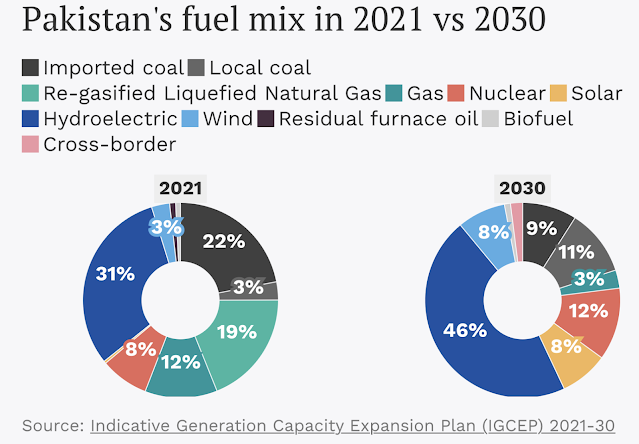
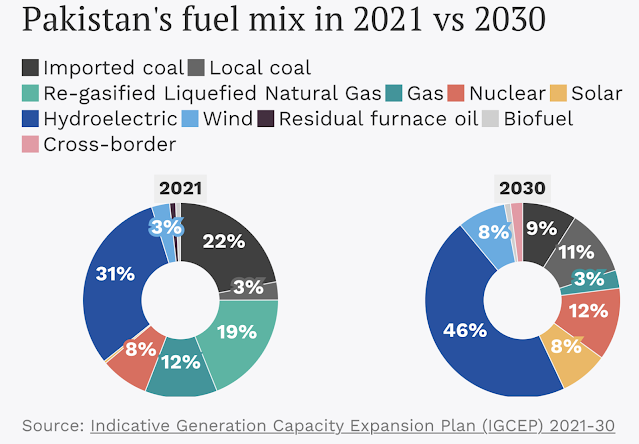
Pakistan Power Generation Fuel Mix. Source: Third Pole

It is true that Pakistan has relied on imported fossil fuels to generate electricity. The cost of these expensive imported fuels like furnace oil mainly used by independent power producers (IPPs) has been and continues to be a major contributor to the "exaggerated external demand driven by its rentier economy" referred to by Atif Mian in a recent tweet. However, Pakistan has recently been adding hydro, nuclear and indigenous coal-fired power plants to gradually reduce dependence on imported fossil fuels. 

Related Links:


Haq's Musings

South Asia Investor Review

Pakistan Among World's Largest Food Producers

Naya Pakistan Housing Program

Food in Pakistan 2nd Cheapest in the World

Indian Economy Grew Just 0.2% Annually in Last Two Years

Pakistan to Become World's 6th Largest Cement Producer by 2030

Has Bangladesh Surged Past India and Pakistan in Per Capita Income?

Pakistan's Computer Services Exports Jump 26% Amid COVID19 Lockdown

Coronavirus, Lives and Livelihoods in Pakistan

Vast Majority of Pakistanis Support Imran Khan's Handling of Covid19 Crisis

Pakistani-American Woman Featured in Netflix Documentary "Pandemic"

Incomes of Poorest Pakistanis Growing Faster Than Their Richest Counterparts

Can Pakistan Effectively Respond to Coronavirus Outbreak? 

How Grim is Pakistan's Social Sector Progress?

Double Digit Growth in Pakistan's Energy Consumption Confirms Economic Recovery


Trump Picks Muslim-American to Lead Vaccine Effort

COVID Lockdown Decimates India's Middle Class

Pakistan to be World's 7th Largest Consumer Market by 2030

Pakistan's Balance of Payments Crisis

How Has India Built Large Forex Reserves Despite Perennial Trade Deficits

Conspiracy Theories About Pakistan Elections"

PTI Triumphs Over Corrupt Dynastic Political Parties

Strikingly Similar Narratives of Donald Trump and Nawaz Sharif

Nawaz Sharif's Report Card

Riaz Haq's Youtube Channel

Friday, January 21, 2022

Pakistan Nuclear Power Generation Soared 66% in 2021

Nuclear power plants in Pakistan generated 15,540 GWH of electricity in 2021, a jump of 66% over 2020. Overall, Pakistan's power plants produced 136,572 GWH of power, an increase of 10.6% over 2020, indicating robust economic recovery amid the COVID19 pandemic. 

Pakistan Electric Power Generation. Source: Arif Habib


Hydroelectric dams contributed 37,689 GWH of electricity or 27.6% of the total power generated, making hydropower the biggest contributor to power generated in the country. It is followed by coal (20%), LNG (19%) and nuclear (11.4%). 


Cost Per Unit of Electricity in Pakistan. Source: Arif Habib

Nuclear offers the lowest cost of fuel for electricity (one rupee per KWH) while furnace oil is the most expensive (Rs. 22.2 per KWH). 
 
Pakistan Electric Power Generation Fuel MiX. Source: Arif Habib

Construction of 1,100 MW nuclear power reactor K2 unit in Karachi was completed by China National Nuclear Corporation in 2019, according to media reports. Fuel is being loaded in a similar reactor unit K3 which will add another 1,100 MW of nuclear power to the grid in 2022. Chinese Hualong One reactors being installed in Pakistan are based on improved Westinghouse AP1000 design which is far safer than Chernobyl and Fukushima plants.  

The biggest and most important source of low-carbon energy in Pakistan is its hydroelectric power plants, followed by nuclear power. Pakistan ranked third in the world by adding nearly 2,500 MW of hydropower in 2018, according to Hydropower Status Report 2019.  China added the most capacity with the installation of 8,540 megawatts, followed by Brazil (3,866 MW), Pakistan (2,487 MW), Turkey (1,085 MW), Angola (668 MW), Tajikistan (605 MW), Ecuador (556 MW), India (535 MW), Norway (419 MW) and Canada (401 MW).

New Installed Hydroelectric Power Capacity in 2018. Source: Hydroworld.com


Hydropower now makes up about 28% of the total installed capacity of 33,836 MW as of February, 2019.   WAPDA reports contributing 25.63 billion units of hydroelectricity to the national grid during the year, “despite the fact that water flows in 2018 remained historically low.” This contribution “greatly helped the country in meeting electricity needs and lowering the electricity tariff for the consumers.”

Pakistan's Current Account Balance vs International Oil Prices. Source: Arif Habib


Recent history shows that Pakistan's current account deficits vary with international oil prices.  Pakistan's trade deficits balloon with rising imported energy prices. One of the keys to managing external account balances lies in reducing the country's dependence on foreign oil and gas. 


Pakistan Power Generation Fuel Mix. Source: Third Pole

It is true that Pakistan has relied on imported fossil fuels to generate electricity. The cost of these expensive imported fuels like furnace oil mainly used by independent power producers (IPPs) has been and continues to be a major contributor to the "exaggerated external demand driven by its rentier economy" referred to by Atif Mian in a recent tweet. However, Pakistan has recently been adding hydro, nuclear and indigenous coal-fired power plants to gradually reduce dependence on imported fossil fuels. 

Related Links:


Haq's Musings

South Asia Investor Review

Pakistan Among World's Largest Food Producers

Naya Pakistan Housing Program

Food in Pakistan 2nd Cheapest in the World

Indian Economy Grew Just 0.2% Annually in Last Two Years

Pakistan to Become World's 6th Largest Cement Producer by 2030

Has Bangladesh Surged Past India and Pakistan in Per Capita Income?

Pakistan's Computer Services Exports Jump 26% Amid COVID19 Lockdown

Coronavirus, Lives and Livelihoods in Pakistan

Vast Majority of Pakistanis Support Imran Khan's Handling of Covid19 Crisis

Pakistani-American Woman Featured in Netflix Documentary "Pandemic"

Incomes of Poorest Pakistanis Growing Faster Than Their Richest Counterparts

Can Pakistan Effectively Respond to Coronavirus Outbreak? 

How Grim is Pakistan's Social Sector Progress?

Double Digit Growth in Pakistan's Energy Consumption Confirms Economic Recovery


Trump Picks Muslim-American to Lead Vaccine Effort

COVID Lockdown Decimates India's Middle Class

Pakistan to be World's 7th Largest Consumer Market by 2030

Pakistan's Balance of Payments Crisis

How Has India Built Large Forex Reserves Despite Perennial Trade Deficits

Conspiracy Theories About Pakistan Elections"

PTI Triumphs Over Corrupt Dynastic Political Parties

Strikingly Similar Narratives of Donald Trump and Nawaz Sharif

Nawaz Sharif's Report Card

Riaz Haq's Youtube Channel


Tuesday, January 18, 2022

Pakistan Economy "Not in a Good Place"? Atif Mian's Gloom Justified?

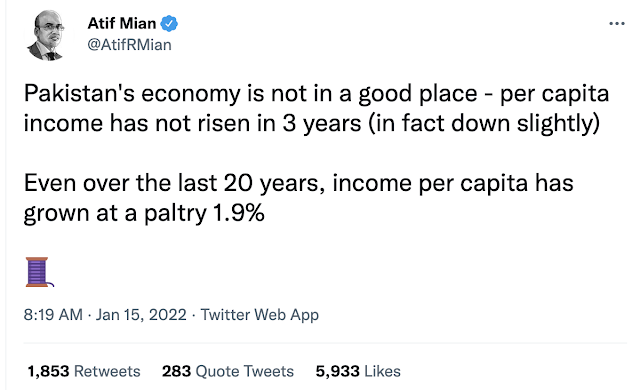
Pakistani-American economist Atif Mian has recently analyzed Pakistan's economy in a series of tweets. He has said "Pakistan's economy is not in a good place", adding that the nation's "per capita income has not risen in 3 years (in fact down slightly)". He has particularly mentioned the country's "exaggerated external demand driven by its rentier economy", "flawed energy policy" and "a broken economic decision system" among the main causes for poor economic performance.  Is Atif Mian's diagnosis correct? Is the official reported data Atif Mian using accurate? What is the current PTI government doing or not doing to correct the problems identified by Mr. Mian? Let's try and assess the situation. 

Economist Atif Mian's Tweet on Pakistan Economy


Per Capita Income:

Pakistan's officially reported GDP and per capita incomes are grossly understated. These are based on the last economic census that was done from April 2003 to December 2003 and published in 2005. The last agriculture census was in 2010, and livestock census in 2006, according to Dr. Ishrat Husain, former governor of The State Bank of Pakistan. The country's economy has changed significantly since then, adding several new economic activities while others have become less important.  For example, the Quantum Index of Large Scale Manufacturing (QIM) with 2005-06 base year gives a weight to textiles of 20.9% (Yarn 13.7 and cloth 7.2). But the textile industry has moved up to higher value added products as reflected in its exports. The value added textiles (non-yarn and non-cloth) now make almost 80% of the total textile exports. These changes are not reflected in current GDP calculations. 

In its 2014 annual report, the State Bank of Pakistan talked about a number of new sectors that are either under-reported or not covered at all: "In terms of LSM growth, a number of sectors that are showing strong performance; (for example, fast moving consumer goods (FMCG) sector; plastic products; buses and trucks; and even textiles), are either under reported, or not even covered. The omission of such important sectors from official data coverage, probably explains the apparent disconnect between overall economic activity in the country and the hard numbers in LSM."

Bangladesh just rebased its GDP in 2020-21 to 2015-16. This has boosted its per capita income by double digits for every year since 2015-16.  Bangladesh's per capita income for the 2015-16 fiscal year has now gone up to $1,737 from $1,465 in the old calculation. For the 2019-2020 fiscal, the per capita income has gone up to $2,335 from $2,024.  The new GDP estimate covers 21 sectors, up from 15 sectors previously.  India last rebased its GDP in 2015, a change that bumped up its per capita GDP by double digits. Nigeria's last rebasing in 2012 increased the size of its economy (GDP) by nearly 90%. Pakistan's current base year is 2005-6. Rebasing which is now long overdue will almost certainly increase Pakistan's per capita income by double digits. 

In this age of big data, it is important for Pakistan to ensure that its bureaucracy at Pakistan Bureau of Statistics (PBS) keeps the national economic data as current as possible. PBS should release the results of the Census of Manufacturing Industries CMI 2015-16 and the finance ministry should rebase Pakistan's economy to year 2015-16 to better reflect the current economic realities. This data is extremely important for businesses, investors, lenders and policymakers. 

Energy Mix:

It is true that Pakistan has relied on imported fossil fuels to generate electricity. The cost of these expensive imported fuels like furnace oil mainly used by independent power producers (IPPs) has been and continues to be a major contributor to the "exaggerated external demand driven by its rentier economy" referred to by Atif Mian. However, Pakistan has recently been adding hydro, nuclear and indigenous coal-fired power plants. 

Pakistan Power Generation Fuel Mix. Source: Third Pole


Construction of a 1,100 MW nuclear power reactor K2 unit in Karachi has been completed by China National Nuclear Corporation, according to media reports. A similar reactor unit K3 will add another 1,100 MW of nuclear power to the grid, bringing the total nuclear power installed capacity of Pakistan to 3,630 MW (12% of total power) by the end of 2022.  Hualong One reactors being installed in Pakistan are based on improved Westinghouse AP1000 design which is far safer than Chernobyl and Fukushima plants.  In addition, Pakistan is also generating  9,389  MW (about 28% of total power) of low-carbon hydroelectric power in response to rising concerns about climate change. 

Hydroelectric dams contributed 37,689 GWH of electricity or 27.6% of the total power generated, making hydropower the biggest contributor to power generated in the country. It is followed by coal (20%), LNG (19%) and nuclear (11.4%). 


Cost Per Unit of Electricity in Pakistan. Source: Arif Habib

Nuclear offers the lowest cost of fuel for electricity (one rupee per KWH) while furnace oil is the most expensive (Rs. 22.2 per KWH). 


Pakistan Exports Trend 2011-21. Courtesy of Ali Khizer


External Accounts Balance:

Pakistan is the world's sixth largest labor exporter with nearly 10 million Pakistanis working overseas. These workers sent home $31 billion in remittances calendar year 2021 (CY2021), up 19% from CY2020. In addition, Pakistan merchandise exports hit a new record of $28.3 billion in CY2021. Together, Pakistan's merchandise exports and overseas worker remittances added up to nearly $60 billion in 2021. 

Pakistan Textile Exports Trend 2011-21. Courtesy of Ali Khizer


Exports of textiles that make up the bulk of Pakistani exports jumped 32% from $13.1 billion in CY2020 to $17.3 billion in CY2021. The country's technology exports soared 40% to $2.5 billion in CY2021.  “So far, (the) country’s exports of non-traditional products, including information technology, have grown by 60 percent in the last four months," says Special Assistant to the Prime Minister on Commerce and Investment Abdul Razak Dawood. 

Pakistan's Higher Value Added Exports. Source: Dr. Ishrat Husain


Pakistan's textile manufacturing and exports are moving from yarn and fabric toward higher value added products like readymade garments. The value added textiles (non-yarn and non-cloth) now make almost 80% of the total textile exports, according to Dr. Ishrat Husain. 

Pakistan's Current Account Balance vs International Oil Prices. Source: Arif Habib


Recent history shows that Pakistan's current account deficits vary with international oil prices.  Pakistan's trade deficits balloon with rising imported energy prices. One of the keys to managing external account balances lies in reducing the country's dependence on foreign oil and gas. 

Summary:

Professor Atif Mian's criticism of Pakistan's economy is partially valid but his pessimism is unwarranted. He is working with flawed data based on an economic census conducted more than 15 years ago.  This data does not truly reflect current economic activities, per capita incomes and productivity. Pakistani bureaucracy needs to ensure that the underlying data for GDP and productivity is regularly updated to inform businessmen, investors, lenders and policymakers. Pakistan is also significantly boosting its foreign exchange earnings through exports and remittances from overseas workers. The issue of reliance on expensive fossil fuel imports is also being addressed by building more hydro, nuclear and renewable energy. At the same time, indigenous coal-fired power plants are also being added. Unlike Atif Mian, I do see light at the end of the tunnel. 

Related Links:


Haq's Musings

South Asia Investor Review

Pakistan Among World's Largest Food Producers

Naya Pakistan Housing Program

Food in Pakistan 2nd Cheapest in the World

Indian Economy Grew Just 0.2% Annually in Last Two Years

Pakistan to Become World's 6th Largest Cement Producer by 2030

Has Bangladesh Surged Past India and Pakistan in Per Capita Income?

Pakistan's Computer Services Exports Jump 26% Amid COVID19 Lockdown

Coronavirus, Lives and Livelihoods in Pakistan

Vast Majority of Pakistanis Support Imran Khan's Handling of Covid19 Crisis

Pakistani-American Woman Featured in Netflix Documentary "Pandemic"

Incomes of Poorest Pakistanis Growing Faster Than Their Richest Counterparts

Can Pakistan Effectively Respond to Coronavirus Outbreak? 

How Grim is Pakistan's Social Sector Progress?

Double Digit Growth in Pakistan's Energy Consumption Confirms Economic Recovery


Trump Picks Muslim-American to Lead Vaccine Effort

COVID Lockdown Decimates India's Middle Class

Pakistan to be World's 7th Largest Consumer Market by 2030

Pakistan's Balance of Payments Crisis

How Has India Built Large Forex Reserves Despite Perennial Trade Deficits

Conspiracy Theories About Pakistan Elections"

PTI Triumphs Over Corrupt Dynastic Political Parties

Strikingly Similar Narratives of Donald Trump and Nawaz Sharif

Nawaz Sharif's Report Card

Riaz Haq's Youtube Channel


Tuesday, May 12, 2020

Renewable Energy in Pakistan: 15.2% of Households Use Solar

Solar panel installations in Pakistani homes are rising rapidly. Pakistan PSLM/HIES 2018-19 survey results reveal that 15.2% of all households are using solar panels as a source of energy for their homes.  Khyber-Pakhtunkhwa province leads the nation with 40% of all households using solar energy. Rural Pakistan is embracing solar power at a faster rate than Urban Pakistan. Adoption of solar in rural areas of KP is at 43%, Sindh 33.9%,  Balochistan 20.4% and Punjab 7.9%. Rapid decline in cost of solar panels appears to be driving the adoption of solar in Pakistan's rural areas where grid power is either unavailable or unreliable. Pakistan is starting to join the clean energy revolution with increasing adoption of solar and recent announcement of National Electric Vehicle Policy. Covid19 pandemic may temporarily slow it down but the upward trend will likely continue.
Pakistan Solar Panel Imports in Millions of US Dollars. Source: FBS Via Pakistan Today

Solar Panels in Pakistan: 

Imports of solar panels have increased at 15.9% annually in US dollar terms and 22.6% in Pakistan rupee terms in the last years. Solar panel imports have jumped from just $1 million in 2004 to a peak of $772 million in the fiscal year ending June 30, 2017, then declined to  $343 million in 2018 and then rose again to $409 million in 2019.  Covid19 pandemic may temporarily slow it down but the upward trend will likely continue.
Households Using Solar Panels. Source: PSLM/HIES 2018-19 Via Bilal Gilani of Gallup
Solar panel installations in Pakistani homes are rising rapidly. Pakistan PSLM/HIES 2018-19 survey results reveal that 15.2% of all households are using solar panels as source of energy for their homes. 

Government survey data shows that 20% of rural households are  using solar panels, significantly ahead of just 7.7% urban households in the country. Khyber-Pakhtunkhwa province leads with 40% of households using solar energy, followed by Balochistan 25.7%, Sindh 20.5% and Punjab 6.4%.

Rural Pakistan is leading the nation into wider use of solar power.  Adoption of solar in rural areas of KP is at 43%, Sindh 33.9%,  Balochistan 20.4% and Punjab 7.9%. Rapid decline in cost of solar panels appears to be driving adoption of the solar energy in Pakistan's rural areas where grid power is either unavailable or unreliable.

Pakistan Electric Vehicle Policy:

Pakistan has a low level of motorization with just 9% of the households owning a car. Nearly half of all households own a motorcycle. Motorization rates in the country have tripled over the last decade and a half, resulting in nearly 40% of all emissions coming from vehicles. Concerns about climate change and environmental pollution have forced the government to to take a number of actions ranging from adoption of Euro6 emission standards for new vehicles with internal combustion engines (ICE) since 2015 and announcement of a national electric vehicle (EV) policy this year.

Private vehicle ownership in Pakistan has risen sharply over the last 4 years. More than 9% of households now own cars, up from 6% in 2015. Motorcycle ownership has jumped from 41% of households in 2015 to 53% now, according to data released by Federal Bureau of Statistics (FBS) recently. There are 32.2 million households in Pakistan, according to 2017 Census.


Vehicle Ownership in Pakistan. Source: PBS

Pakistan's National EV Policy is a forward looking step needed to deal with climate concerns from growing transport sector emissions with rapidly rising vehicle ownership. It offers tax incentives for buyers and sellers. It also focuses on development of nationwide charging infrastructure to ease adoption of electric vehicles.

Low Carbon Energy Growth:

In recent years,  Pakistan government has introduced a number of supportive policies, including feed-in tariffs and a net metering program to incentivize renewables. These have been fairly successful, and renewables capacity in the country surged substantially over 2018 when 1245 MW was added, of which 826MW was contributed by the solar sector, according to Fitch Solutions.

Non-Hydro Renewables in Pakistan. Source: Fitch Solutions

Pakistan’s Alternative Energy Development Board (AEDB) recently signed deals for projects that will see the country expand its wind power capacity by 560 MW.  Fitch Solutions forecasts Pakistan's solar capacity to grow by an annual average of 9.4% between 2019-2028, taking total capacity over 3.8GW by the end of our forecast period.

Sindh government has recently signed a deal for 400MW solar park at Manjhand, 20MW rooftop solar systems on public sector buildings in Karachi and Hyderabad, and 200,000 solar home systems for remote areas in 10 districts of the province. The project is estimated to cost USD105million, with the World Bank funding USD100 million.

The biggest and most important source of low-carbon energy in Pakistan is its hydroelectric power plants. Pakistan ranked third in the world by adding nearly 2,500 MW of hydropower in 2018, according to Hydropower Status Report 2019.  China added the most capacity with the installation of 8,540 megawatts, followed by Brazil (3,866 MW), Pakistan (2,487 MW), Turkey (1,085 MW), Angola (668 MW), Tajikistan (605 MW), Ecuador (556 MW), India (535 MW), Norway (419 MW) and Canada (401 MW).

New Installed Hydroelectric Power Capacity in 2018. Source: Hydroworld.com

Hydropower now makes up about 28% of the total installed capacity of 33,836 MW as of February, 2019.   WAPDA reports contributing 25.63 billion units of hydroelectricity to the national grid during the year, “despite the fact that water flows in 2018 remained historically low.” This contribution “greatly helped the country in meeting electricity needs and lowering the electricity tariff for the consumers.”

Chinese BYD in Pakistan:

Multiple media reports suggest that China's BYD is about to enter Pakistan market following the announcement of Pakistan National EV Policy.   These reports indicate that Toyota, one of the largest automakers in Pakistan, has signed a deal with BYD to manufacture electric vehicles.

Other reports indicate that Pakistan's Rahmat Group is in talks with BYD to set up an electric vehicle plant at Nooriabad in Sindh province.

Minister for Science and Technology Fawad Chaudhry has claimed that in three years Pakistan will become the first country to manufacture electric buses, which will be driven by an electric motor and obtains energy from on-board batteries.

Summary: 

Pakistan is starting to join the clean energy revolution with increasing adoption of solar and recent announcement of National Electric Vehicle Policy.  Solar panel installations in Pakistani homes are rising rapidly. Pakistan PSLM/HIES 2018-19 survey results reveal that 15.2% of all households are using solar panels as source of energy for their homes.  The country has set targets for renewable energy growth and announced National Electric Vehicle Policy.  In recent years,  Pakistan government has introduced a number of supportive policies, including feed-in tariffs and a net metering program to incentivize renewables. These have been fairly successful, and renewables capacity in the country surged substantially over 2018 when 1245 MW was added, of which 826MW was contributed by the solar sector, according to Fitch Solutions.  High-capacity battery pack costs have dropped nearly 40% since 2015, according to Wood Mackenzie data as reported by Wall Street Journal.  Cost reductions are expected to continue to only $8 to $14 per MW-hour by 2020, or about a penny per kW-hour. While production and use of renewable energy are growing, the electric vehicles in Pakistan have yet to find traction. Hopefully, the National EV policy will encourage production and adoption of electric vehicles in the country.  Covid19 pandemic may temporarily slow it down but the upward trend will likely continue.

Related Links:

Haq's Musings

South Asia Investor Review

Clean Energy Revolution in Pakistan

Pakistan Electric Vehicle Policy

Nuclear Power in Pakistan

Recurring Cycles of Drought and Floods in Pakistan

Pakistan's Response to Climate Change

Massive Oil and Gas Discovery in Pakistan: Hype vs Reality

Renewable Energy for Pakistan

Digital BRI: China and Pakistan Building Fiber, 5G Networks

LNG Imports in Pakistan

Growing Water Scarcity in Pakistan

China-Pakistan Economic Corridor

Ownership of Appliances and Vehicles in Pakistan

CPEC Transforming Pakistan

Pakistan's $20 Billion Tourism Industry Boom

Riaz Haq's YouTube Channel

PakAlumni Social Network