Showing posts with label Power. Show all posts

Tuesday, March 18, 2025

Pakistan Purchasing Managers Index (PMI) Points to Growth in Manufacturing

Pakistan Purchasing Managers Index (PMI), jointly launched by Habib Bank (HBL) and S&P Global, is showing sustained growth in manufacturing for the last several months.  It has been consistently above 50, indicating expansion. This indicator disagrees with contraction reported by Pakistan Bureau and Statistics (PBS) Large Scale Manufacturing (LSM) indicator. What accounts for this discrepancy? Is it because the LSM tracks only a subset of industries tracked by PMI? Is there a difference in methodology? 

Pakistan PMI Trend. Source: S&P Global

Here's one plausible explanation offered by analyst Humaira Qamar at HBL: "As per the Pakistan Bureau of Statistics, Large scale manufacturing (LSM) contracted 1.8% in the latter half of 2024. However, excluding the hefty decline in the low-weight furniture segment, LSM trended positively. Our PMI release suggests that the recovery has extended into 2025, with demand-side conditions taking cue from a sharp reduction in the policy rate". 

Another possible explanation for the discrepancy between PMI and LSM can be seen in the fact that power generation for the grid, a key component of the LSM indicator, is in constant and substantial decline. However, the power generation data tracked by PBS excludes rapidly rising solar electricity production by consumers, including industrial consumers in the country.  Pakistan's grid-connected electricity production and electricity consumption are given as around 110 TWh for 2024, but appear to be declining compared to 2023, which contradicts expectations of increasing demand, but could be a sign of the massive expansion of solar energy, according to an article in PV magazine titled  ‘The Solar Blitz’: How crisis-ridden Pakistan is leading the world on the ‘Solar March’.  Based on rather imprecise Chinese solar panel export figures and extensive satellite imagery, Bloomberg energy analyst Jenny Chase has concluded that rapid solar expansion in Pakistan is real. 

In August 2024, Chase tweeted as follows: "Pakistan's energy regulator, NEPRA, notes that power consumption is down 9.1% year on year in 2023. NEPRA attributes the drop mainly to high power prices cutting economic activity and making residential consumers curb consumption, with rooftop solar only a third factor. But NEPRA doesn't know how much solar the country has, either. We think it has about 12.7GW of solar already (compared with 50GW on-grid power capacity) and will add 10-15GW of solar in 2024". 

In addition to the decline in grid power generation, the reported drag in LSM growth is primarily due to a few low-weight sub-sectors, which have more than offset positive momentum in key sub-sectors such as textiles, pharmaceuticals, automobiles, and POL (petroleum, oils and lubricants), according to the State Bank of Pakistan, as reported by the Express Tribune

Pakistan Manufacturing Orders, Output and Employment. Source: S&P Global


High-frequency data like monthly PMI help in gauging real time economic activity in terms of orders, output and employment in the manufacturing sector. Here's an excerpt of the HBL/S&P Global PMI report for February 2025 published in March:

Manufacturers in Pakistan also responded to strengthened operating conditions by raising their staffing levels in February, marking the second increase in as many months. Several firms commented that they required additional capacity in response to higher production requirements, while others mentioned longer operating hours. Increased capacity allowed firms to stay on top of outstanding business in February, as indicated by a sustained and steeper fall in backlogs of work. The latest depletion was the most pronounced in five months. Finally, companies expressed confidence in the future path for output during February, with optimism remaining marked overall. This optimism was underpinned by hopes for further new product launches and improvements in product quality, alongside expectations of softer price pressures.

Related Links:

Friday, January 21, 2022

Pakistan Nuclear Power Generation Soared 66% in 2021

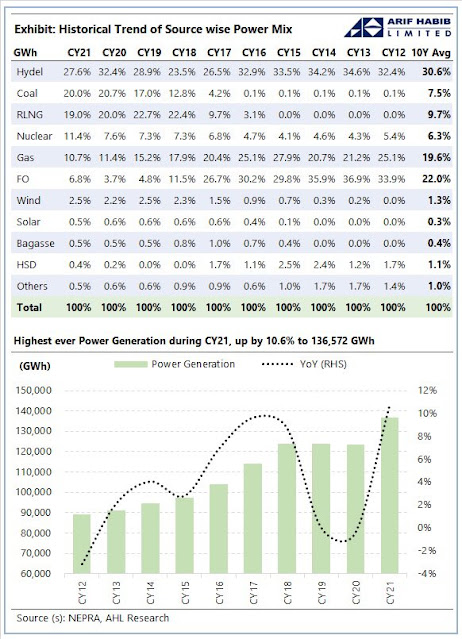
Nuclear power plants in Pakistan generated 15,540 GWH of electricity in 2021, a jump of 66% over 2020. Overall, Pakistan's power plants produced 136,572 GWH of power, an increase of 10.6% over 2020, indicating robust economic recovery amid the COVID19 pandemic. 

Pakistan Electric Power Generation. Source: Arif Habib


Hydroelectric dams contributed 37,689 GWH of electricity or 27.6% of the total power generated, making hydropower the biggest contributor to power generated in the country. It is followed by coal (20%), LNG (19%) and nuclear (11.4%). 


Cost Per Unit of Electricity in Pakistan. Source: Arif Habib

Nuclear offers the lowest cost of fuel for electricity (one rupee per KWH) while furnace oil is the most expensive (Rs. 22.2 per KWH). 
 
Pakistan Electric Power Generation Fuel MiX. Source: Arif Habib

Construction of 1,100 MW nuclear power reactor K2 unit in Karachi was completed by China National Nuclear Corporation in 2019, according to media reports. Fuel is being loaded in a similar reactor unit K3 which will add another 1,100 MW of nuclear power to the grid in 2022. Chinese Hualong One reactors being installed in Pakistan are based on improved Westinghouse AP1000 design which is far safer than Chernobyl and Fukushima plants.  

The biggest and most important source of low-carbon energy in Pakistan is its hydroelectric power plants, followed by nuclear power. Pakistan ranked third in the world by adding nearly 2,500 MW of hydropower in 2018, according to Hydropower Status Report 2019.  China added the most capacity with the installation of 8,540 megawatts, followed by Brazil (3,866 MW), Pakistan (2,487 MW), Turkey (1,085 MW), Angola (668 MW), Tajikistan (605 MW), Ecuador (556 MW), India (535 MW), Norway (419 MW) and Canada (401 MW).

New Installed Hydroelectric Power Capacity in 2018. Source: Hydroworld.com


Hydropower now makes up about 28% of the total installed capacity of 33,836 MW as of February, 2019.   WAPDA reports contributing 25.63 billion units of hydroelectricity to the national grid during the year, “despite the fact that water flows in 2018 remained historically low.” This contribution “greatly helped the country in meeting electricity needs and lowering the electricity tariff for the consumers.”

Pakistan's Current Account Balance vs International Oil Prices. Source: Arif Habib


Recent history shows that Pakistan's current account deficits vary with international oil prices.  Pakistan's trade deficits balloon with rising imported energy prices. One of the keys to managing external account balances lies in reducing the country's dependence on foreign oil and gas. 


Pakistan Power Generation Fuel Mix. Source: Third Pole

It is true that Pakistan has relied on imported fossil fuels to generate electricity. The cost of these expensive imported fuels like furnace oil mainly used by independent power producers (IPPs) has been and continues to be a major contributor to the "exaggerated external demand driven by its rentier economy" referred to by Atif Mian in a recent tweet. However, Pakistan has recently been adding hydronuclear and indigenous coal-fired power plants to gradually reduce dependence on imported fossil fuels. 

Related Links:


Haq's Musings

South Asia Investor Review

Pakistan Among World's Largest Food Producers

Naya Pakistan Housing Program

Food in Pakistan 2nd Cheapest in the World

Indian Economy Grew Just 0.2% Annually in Last Two Years

Pakistan to Become World's 6th Largest Cement Producer by 2030

Has Bangladesh Surged Past India and Pakistan in Per Capita Income?

Pakistan's Computer Services Exports Jump 26% Amid COVID19 Lockdown

Coronavirus, Lives and Livelihoods in Pakistan

Vast Majority of Pakistanis Support Imran Khan's Handling of Covid19 Crisis

Pakistani-American Woman Featured in Netflix Documentary "Pandemic"

Incomes of Poorest Pakistanis Growing Faster Than Their Richest Counterparts

Can Pakistan Effectively Respond to Coronavirus Outbreak? 

How Grim is Pakistan's Social Sector Progress?

Double Digit Growth in Pakistan's Energy Consumption Confirms Economic Recovery


Trump Picks Muslim-American to Lead Vaccine Effort

COVID Lockdown Decimates India's Middle Class

Pakistan to be World's 7th Largest Consumer Market by 2030

Pakistan's Balance of Payments Crisis

How Has India Built Large Forex Reserves Despite Perennial Trade Deficits

Conspiracy Theories About Pakistan Elections"

PTI Triumphs Over Corrupt Dynastic Political Parties

Strikingly Similar Narratives of Donald Trump and Nawaz Sharif

Nawaz Sharif's Report Card

Riaz Haq's Youtube Channel


Saturday, August 1, 2020

Pakistan: Hopes Rise For Cheap and Abundant Electricity

Pakistani power sector is continuing its march toward cheap indigenous sources of electricity. Hydropower component has increased 22%, coal 57% and nuclear 8% while oil is down 54% and natural gas and LNG are down 32% and 15% respectively, according to Bloomberg. These changes in power mix are expected to help significantly reduce power subsidies that run into hundreds of billions of rupees contributing to large annual budget deficits.

Data From NEPRA. Courtesy Pakistan Today

Coal's contribution to power mix now stands at just 21%, in spite of 57% increase in use of coal in Fiscal Year 2020. It is still almost half of the global average of 38% of electricity produced from coal. Overall, the contribution of fossil fuels in electricity generation is now about 54%, down from nearly 66% a few years ago.

Pakistan Power Generation Mix. Source: Bloomberg

Hydropower and natural gas now contribute 32% each, making them the biggest sources of electricity in Pakistan. Coal comes next at 21%, followed by nuclear at 8%.

Pakistan Power Generation Plan 2019-2040. Courtesy of World Economic Forum

One of the biggest economic challenges Pakistan faces is it growing debt and deficit from subsidies to the power sector. Often referred to as "circular debt" in Pakistan, the government owes Rs. 1.6 trillion ($7.2 billion) to power sector at the end of June 2019. Pakistan government is now is committed to improving the situation by its development of an Indicative Generation Capacity Expansion Plan (IGCEP) that runs until 2040.


Change in Sources of Electricity in 2020. Source: Bloomberg

Pakistan recent efforts to diversify its fuel mix for cost reduction are raising hopes for cheap and abundant electricity needed for its industries and residential consumers.  Already, the electricity generation cost is down 11% and current account deficit has declined 78%. There is a plan called "Indicative Generation Capacity Expansion Plan" in place. Execution is the key to making the power sector greener, cheaper and more reliable.

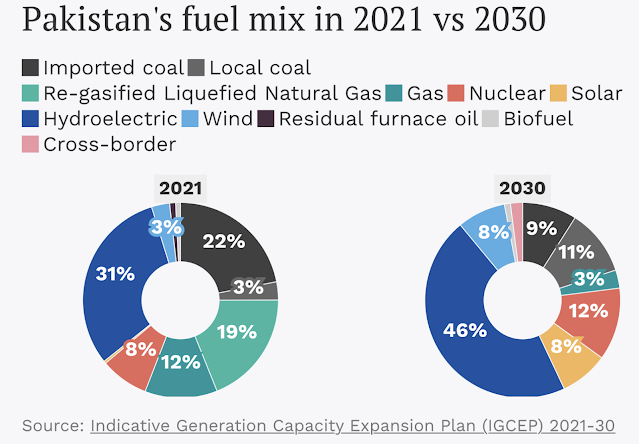
Fuel Mix For Power Generation in Pakistan. Source: Third Pole

Thursday, December 28, 2017

GE Turbine Problems Hit Power Generation at 3 Pakistani Plants

Pakistan's Central Power Purchasing Agency's report shows that General Electric's 9HA-Class turbines produced only half of their capacity this August, according to Reuters. Power executives and government officials in the country said the GE turbines had operational issues like long outages and production delays.

GE Turbine Problems:

Bhikki Power Plant, Punjab, Pakistan
The GE turbine problems affected three key plants – Bhikki of Punjab government and Balloki and Haveli Bahadur Shah of the federal government – with a total capacity of 3,600MW that are considered crucial to end load shedding within the ruling PMLN's 5-year term ending middle of 2018.

Consequences For Pakistan:

Pakistan's government is failing to deliver on its promise to end load-shedding this year because of serious issues with GE's 9HA-Class turbine.

"It had terrible consequences because we lost a lot of power which would have come to the grid during the peak summer," Yousuf Naseem Khokhar, a top official in Pakistan's Energy Ministry's power division, told Reuters. "It is now up to General Electric to rise to the challenge and to take care of these issues ... before next summer starts," he said.

Pakistan is recognized as a major growth market for power turbine makers because its booming economy has a well-developed gas infrastructure. General Electric has lost a lot of credibility after its failure to deliver in Pakistan. The country awarded its most recent power contract to Siemens, after bidding by several companies, including GE.

Impact on GE Business:

General Electric claims its 9HA-Class turbines are highly efficient turbines which have secured place in the Guinness World Records of 2016, for the amount of electricity they have produced from natural gas at a power plant in Bouchain, France. The Bouchain plant has had 26 forced outages in the 15 months ending November, according to data published by operator Electricite de France (EDF).

JPMorgan analyst Stephen Tusa has warned GE's Pakistan problems could affect other plants around the world, where GE has already "sold" 30 units. GE dismissed criticism, saying the turbines were merely experiencing setup challenges. But the problem could be another setback in a year of plunging stock and "horrible" third-quarter results for the company whose stock has already suffered a major decline this year.

Summary: 

General Electric 9HA-Class gas turbines are not delivering the power Pakistan was counting on to end unscheduled power outages in the country.  These problems could hurt election prospects for Pakistan's ruling PMLN party if they are not fixed soon and the party fails to keep its promise to end electricity load-shedding.

Related Links:

Haq's Musings

Pakistan Among Fastest Growing LNG Markets

PMLN to End Load Shedding 

CPEC to Create 2 Million New Jobs

Pakistan's Booming Economy


Wednesday, July 19, 2017

CPEC Financing: Is Pakistan Being Ripped Off By China?

Is China ripping off its all-weather friend Pakistan by charging high interest rates on loans and exorbitant guaranteed returns on investments in China Pakistan Economic Corridor (CPEC) projects?  That's a question that is being asked on a frequent basis by Pakistan's friends and foes alike. While friends of China-Pakistan ties are concerned about an undue burden on Pakistanis, the foes see CPEC as an opportunity to create a lot of fear, uncertainty and doubt about it and its benefits for Pakistan's economy and society. Who's right? Who's wrong? Why? Let's dive into it.

CPEC Projects in Pakistan

Claims by CPEC Detractors:

Many Western and Indian opponents claim that the cost of CPEC financing will be so high that Pakistan will not be able to bear it. They assert that China is attempting to catch Pakistan in a debt trap from which the country will not be able to escape, eventually turning it into a Chinese colony. The financing costs for Chinese loans and investments they claim are in high teens.

Misguided Pakistani Analysts' View:

Many well-meaning Pakistanis, including serious economists, seem to echo detractors' claims without any serious examination or comparison with prevailing bench-marks. They do not mention how similar projects in other parts of the world are financed and what sort of interest rates and return-on-equity are guaranteed.

CPEC Finance Rates vs Benchmarks:

About two-thirds of Chinese CPEC funding is for power projects while one-third is for infrastructure projects like roads, rail lines and ports.

The Chinese soft loans for CPEC infrastructure projects carry an interest rate of just 1.6%, far lower than similar loans offered by the World Bank at rates of 3.8% or higher.

Chinese companies investing in Pakistan power sector are getting loans from Chinese banks at commercial interest rates. These loans will be repaid by the Chinese companies from their income from these investments, not by Pakistani taxpayers.

The rate of return guaranteed by Pakistan power regulators to the Chinese power companies is about 17%. Is it too high, as some claim? Let's compare it to the US market considered among the safest investments in the world.

Rate of Return in United States: 

The average return on equity for almost 8,000 US firms is 14.49%. The power utility companies – with an average of 10.13% – are on the lower end of the spectrum because they are viewed as less risky investments.

In the United States, rate of return varies significantly from state to state, as each state regulator has exclusive authority to regulate utility operations as they choose.

In Advance Energy Economy (AEE) Power Portal database, which tracks ROE for over 100 investor-owned utilities across the country, the highest allowed ROE belongs to Alabama Power Co., at 13.75% while the lowest belongs to United Illuminating Co. (CT) at 9.15%.

Within the US states, Alabama being seen as relatively less safe for investment, offers 13.75% return. So why is it such a surprise to see Pakistani regulator offer Chinese investors a higher rate of return of 17%?

Growing Infrastructure Gap:

Development of physical infrastructure, including electricity and gas infrastructure, is essential for economic and social development of a country such as Pakistan. China-Pakistan Economic Corridor financing needs to be seen in the context of the large and growing infrastructure gap in Asia that threatens social and economic progress.

 Rich countries generally raise funds for infrastructure projects by selling bonds while most developing countries rely on loans from international financial institutions such as the World Bank and the Asian Development Bank to finance infrastructure projects.

The infrastructure financing needs of the developing countries far exceed the capacity of the World Bank and the regional development banks such as ADB to fund such projects. A recent report by the Asian Development Bank warned that there is currently $1.7 trillion infrastructure gap that threatens growth in Asia. The 45 countries surveyed in the ADB report, which covers 2016-2030, are forecast to need investment of $26 trillion over 15 years to maintain growth, cut poverty and deal with climate change.

Pakistan Country Report in Shanghai Business Review Feb/March 2016


Summary:

China is financing CPEC projects at rates that are comparable to similar projects elsewhere. Chinese loans for infrastructure projects such as rails, roads and ports are at rates (2% or less) below those (3.8%) offered by the Asian Development Bank and the the World Bank. The rate of return on power project investments under CPEC is 17%, somewhat higher than the 13.75 offered by much safer US state of Alabama.

Development of physical infrastructure, including electricity and gas infrastructure, is essential for economic and social development of a country such as Pakistan. China-Pakistan Economic Corridor financing needs to be seen in the context of the large and growing infrastructure gap in Asia that threatens social and economic progress.

An unrelenting campaign of fear, uncertainty and doubt (FUD) about China-Pakistan Economic Corridor (CPEC) has been unleashed in the media in recent weeks. This strategy harkens back to the aggressive marketing techniques used by the American computer giant IBM in the 1970s to fight competition. Part of the motivation of those engaged in FUD against CPEC appears to be to check China's rise and Pakistan's rise with its friend and neighbor to the north. As in IBM's case, the greatest fear of the perpetrators of FUD is that CPEC will succeed and lift Pakistan up along with rising China.  Their aim is to preserve and protect the current world order created by the Western Powers led by the United States at the end of the second world war.   Pakistani government should respond to the FUD campaign against CPEC by countering it with facts and data and increasing transparency in how CPEC projects are being financed, contracted and managed. 

Related Links:


Friday, May 24, 2013

Pakistanis Suffer Load-shedding While Power Companies' Profits Surge

Pakistan's installed generating capacity is about 20,000 MW. It exceeds current demand of 17,000 MW and actual supply of just 10,000 MW. The capacity utilization is only 50% mainly because the producers do not buy sufficient fuel and choose to operate at only 50% of capacity and still enjoy soaring profits. A third of the installed generating capacity is owned by the independent power producers (IPPs). The current IPP contracts guarantee payments and profits with no requirement for fuel efficiency.


Most private investors have built oil-powered inefficient plants because of their low construction costs and short lead times, and the oil price has skyrocketed since these plants were built in 1990s. The result is 18-20 hours of load shedding across most of Pakistan in the scorching summer heat in spite of the fact the taxpayers have shelled out billions of dollars in subsidies to the power sector since 2008.

According to an AP report, the Pakistan's government has assumed $3.6 billion of the power industry's debt. The government-owned power grid owes another $2.5 billion to private-sector generators, even as the government, according to Finance Ministry figures, spent at least $7.4 billion on electricity subsidies during the 2008-2010 period.


Here's Arif Habib Securities investment analysis of the IPPs sector:

All power companies from Arif Habib Limited research coverage witnessed surprising growth (36-58%) in net profitability. HUBC led the flock with 58% YoY jump in profit after tax, attributable to the growing indexation factors and ROE component. On the other hand, lower payables to fuel supplier and resultantly lower penal interest provided major support to KAPCO, pushing the net profitability up by 36% YoY. As far as Nishat group companies are concerned, rising fuel cost magnified the impact of fuel efficiency, which combined with O and M savings further improved the profitability. However, dividend from KAPCO and NPL disappointed the optimistic investors. Arif Habib Limited believes the dividends to rise in 2HFY13 for these companies, providing investor with greater value at the financial year end.


Source: IMF Pakistan


Pakistani government buys electricity from IPPs at a rate of Rs. 12.50 per KWhr while the consumers pay an average of Rs. 9.00, leaving a short-fall of Rs 3.50 per unit which is subsidized by the taxpayers. It adds up to hundreds of billions of rupees a year. Power subsidy target for FY 2012-13 was set at Rs 185 billion, 60 percent lower than the actual subsidy provided during FY12. The subsidy provided year-to-date (YTD) is Rs 311 billion, already having exceeded the target by 68 percent, according to PakTribune.

A significant part of the problem is the IPP contracts which guaranteed a 12 to 15 per cent annual return (indexed in dollars, not rupees), gave tax breaks and paid interest on private funding – more expensive for the government than providing the funding itself.  In addition, there are no incentives for the private power producers to produce power efficiently.

In a blog post published in Financial Times, Dr. Kamal Munir of Cambridge University's Judge Business School blames the IPP contracts signed as part of the power privatization in 1990s.

“The 1994 privatization of the energy sector offered investors generous returns and created pricey overcapacity,” he told Financial Times. “This created an expensive legacy which is the real problem of today’s energy crisis.” Unless that problem is dealt with, he sees no light at the end of the energy tunnel.

He says Pakistan’s government, helped by the World Bank, “sweetened” its energy privatisation with attractive conditions, fearing it wouldn’t be able to attract investors otherwise. It guaranteed a 12 to 15 per cent annual return (indexed in dollars, not rupees), gave tax breaks and paid interest on private funding – more expensive for the government than providing the funding itself. ”The deal was too good to be true for investors,” Munir says.

Munir says the model turned out to be badly constructed in terms of creating value for the government and people of Pakistan. Even in an environment of economic growth and efficient energy generation, it would have been hard for the government to finance the plan. But since both have been absent, it became nearly impossible to pay for privatised energy.

Since there were no incentives to be fuel-efficient, most private investors chose to build  plants using furnance oil as fuel because of their low construction costs and short lead times. This backfired as the oil price has trebled since the 1990s. Variable costs, and therefore prices to consumers, are at unsustainable levels. “No wonder many consumers can’t afford to pay their bills,” Munir says.

To make things worse, the government neglected to step on the brakes when its generous conditions attracted too many investors. Assuming economic growth would continue, it allowed too much capacity to be built and guaranteed the same return on that extra capacity, whether it was used or not.

Munir says the government should develop new power plants using cheaper fuels, and that this shouldn’t be a problem in a country with an abundance of coal, waterways and sun.

But Pakistan must first escape its vicious payment cycle.

“We need to get out of the the current deals,” says Munir. But at what cost, and does this imply default? “Your guess is as good as mine,” the academic admits.

Still, he felt it was time to make his point. “I’m not defending people who don’t pay bills and I’m not promoting government subsidies to keep prices low,” Munir says. “But why isn’t anyone talking about the policy that led to this situation to begin with?”

Fuel Cost per million BTU
The key to solving the problem is to renegotiate the old IPP contracts with new terms that reward lower fuel costs and higher efficiency. In addition to that, Pakistan's incoming government of Prime Minister Nawaz Sharif's has to explore multiple fuel options to meet the nation's growing energy needs. Some of the fuel options are as follows:

1. Developing its shale gas reserves estimated 51 trillion cubic feet near Karachi in southern Sindh province. The US experience has shown that investment in shale gas can increase production quite rapidly and prices brought down from about $12 per mmBTU in 2008 to under $2 per mmBTU recently. Pursuing this option requires US technical expertise and significant foreign investment on an accelerated schedule.


 2. Increasing production of gas from nearly 30 trillion cubic feet of remaining conventional gas reserves. This, too, requires significant investment on an accelerated schedule.

3. Converting some of the idle power generation capacity from oil and gas to imported coal to make electricity more available and affordable.

4. Utilizing Pakistan's vast coal reserves in Sindh's Thar desert.

5. Hydroelectric and other renewables including wind and solar. Several of these projects are funded and underway but it'll take a while to bring them online to make a difference.

In my view, the newly-elected government should pursue all of the above options with options 1, 2 and 3 as a priority for now. Its best interests will be served by developing its own cheap domestic shale gas on an accelerated schedule with Saudi investment and US tech know-how.

Related Links:

Haq's Musings

Comprehensive Energy Policy for Pakistan

IPP Contracts in Pakistan

Pakistan Needs Shale Gas Revolution

US Census Bureau's International Stats 

Pakistan's Vast Shale Gas Reserves

US AID Overview of Pakistan's Power Sector

US Can Help Pakistan Overcome Energy Crisis

Abundant and Cheap Coal Electricity

US Dept of Energy Report on Shale Gas

Pakistan's Twin Energy Crises

Pakistan's Electricity Crisis

Pakistan's Gas Pipeline and Distribution Network

Pakistan's Energy Statistics

US Department of Energy Data

Electrification Rates By Country

CO2 Emissions, Birth, Death Rates By Country

China Signs Power Plant Deals in Pakistan

Pakistan Pursues Hydroelectric Projects

Pakistan Energy Industry Overview

Water Scarcity in Pakistan

Energy from Thorium

Comparing US and Pakistani Tax Evasion