Showing posts with label balance of payments. Show all posts

Tuesday, July 22, 2025

Which Country is a Bigger Beggar? India or Pakistan?

Most countries in the world today borrow money from various sources to finance their budget deficits. So do India and Pakistan. So why is it that only Pakistan's borrowing money gets labeled "begging"? Is it not begging when India borrows a lot more money than does Pakistan? Or is it that only borrowing money from the IMF qualifies as "begging"? Let's look into this double standard.  Currently, India's public debt to GDP ratio is 80% while Pakistan's is about 74%. India's private debt to GDP ratio is 17%, twice that of Pakistan. Do these figures mean that India is a bigger beggar than Pakistan? 


Debt-to-GDP Ratios Around the World. Source: Visual Capitalist


India is consistently among the largest borrowers from International Financial Institutions (IFIs), particularly the World Bank and the Asian Development Bank (ADB). It has been the top debtor to the World Bank for several years and a major borrower from the ADB.  India’s outstanding loan balance with the World Bank is almost double that of the next biggest debtor, Indonesia, which owed the bank $22.2 billion. Pakistan and Bangladesh followed with just short of $20 billion and $19.8 billion, respectively.  India is also the largest borrower from the Asian Development Bank (ADB). Since 1986, when ADB began lending to India, it has approved many loans, grants, and technical assistance totaling $55.3 billion.


Top Debtors to World Bank 2025. Source: Visual Nerd

One key difference between the two South Asian neighbors is the frequency with which Pakistan has been borrowing from the International Monetary Fund, known as the lender of last resort.  Pakistani economic managers have had a poor track record of managing hard currency reserves that the country needs to import what it lacks. Pakistani exports have failed to keep pace with its rising imports. This situation creates a crisis situation every few years and it forces the country to ask the IMF to lend its US dollars.  Currently, Pakistan ($6.3 billion) is IMF's 5th highest debtor after  Argentina ($31.1 billion), Ukraine ($10.19 billion), Egypt ($8.6 billion) and Ecuador ($6.6 billion). The only saving grace is the rapid growth in remittances from the Pakistani diaspora. In the last fiscal year that ended in June, 2025, overseas Pakistanis sent home $38.3 billion, representing 27% growth from the prior fiscal year. It helped Pakistan achieve a current account surplus of $2.1 billion, compared to a current account deficit of $2.1 billion in the previous fiscal year. 


Global Income Levels By Country. Source: Visual Capitalist


Top IMF Debtor Nations. Source: IntelPoint


Pakistan's average economic growth of 5% a year has been faster than the global average since the 1960s, it has been slower than that of its peers in East Asia. It has essentially been constrained by Pakistan's recurring balance of payment (BOP) crises as explained by Thirlwall's Law. Pakistan has been forced to seek IMF bailouts 14 times in the last 75 years to deal with its BOP crises. This has happened in spite of the fact that remittances from overseas Pakistanis have grown 38X since 2000. Every time Pakistan has faced a balance of payments crisis, the result has been massive currency devaluation, high inflation and slower growth for a period of multiple years. The best way for Pakistan to accelerate its growth beyond 5% is to boost its exports by investing in export-oriented industries, and by incentivizing higher savings and investments. 

Related Links:

Haq's Musings

South Asia Investor Review

New Infrastructure Brings Socioeconomic Development to Thar Desert

Pakistan Revives Reko Diq Mining Project

Kachhi Canal and N-70 Projects Boost Pakistan's Balochistan

Iftikhar Chaudhry Scared Away Foreign Investors

Musharraf Earned Legitimacy by Good Governance

Vindictive Judges Pursue Musharraf

Rare Earths at Reko Diq?


Sunday, August 7, 2022

Pakistan Plans to Convert Coal-Fired Power Plants to Burn Domestic Thar Lignite

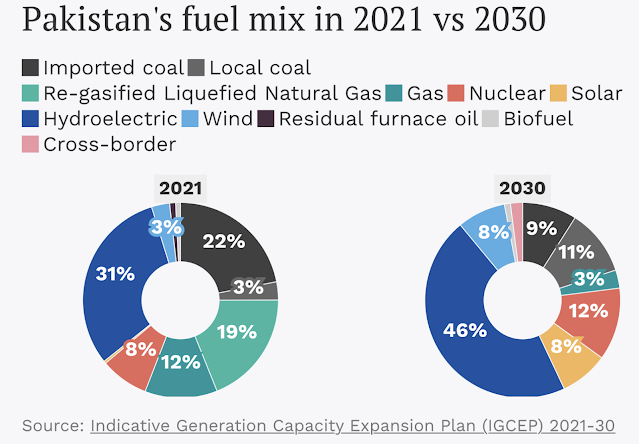
With a new 330 MW mine-mouth coal-fired power plant in Tharparkar, Pakistan has now reached 990 MW of power fueled by the local lignite. Thar coal production is being expanded and plans are in place to convert three more imported anthracite coal fired plants to burn domestic lignite as soon as its production is expanded and a rail link is completed to transport the fuel to the rest of the country. Plans call for using Thar coal in three coal-fired plants currently burning imported coal: Sahiwal Coal Power, China Hub Coal Power and Port Qasim Coal, each of 1,320MW installed capacity. These power plants may require some limited equipment changes to burn domestic lignite. It is worth noting that Pakistan contributes less than 1% of the global greenhouse-gas emissions. Using the higher polluting domestic Thar lignite is crucial to Pakistan's desperate need for cheap energy to spur industrialization for economic growth without running into recurring balance of payments crises. 

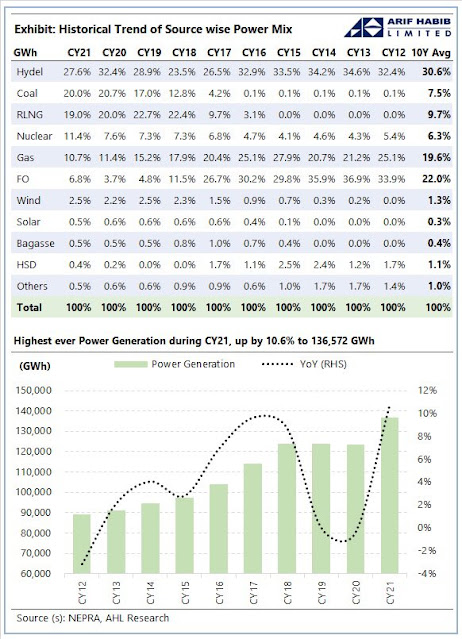
Pakistan Electric Power Generation Fuel MiX. Source: Arif Habib

 Last year, hydroelectric dams contributed 37,689 GWH of electricity or 27.6% of the total power generated, making hydropower the biggest contributor to power generated in the country. It was followed by coal (20%), LNG (19%) and nuclear (11.4%).  Nuclear power plants generated 15,540 GWH of electricity in 2021, a jump of 66% over 2020.  Overall, Pakistan's power plants produced 136,572 GWH of power in 2021, an increase of 10.6% over 2020, indicating robust economic recovery amid the COVID19 pandemic. 

Lucky power plant in Karachi has been designed to use Thar Lignite Coal when it is available in sufficient quantity.  Until that time, it will operate on imported lignite coal. Domestic lignite production is being expanded in a bid to replace costly fossil fuel imports that are depleting Pakistan's foreign exchange reserves and exacerbating circular debt in the power sector, according to Nikkei Asia.  

SECMC (Sindh Engro Coal Mining Company) has commissioned a study for converting the China-Pakistan Economic Corridor coal plants in Hub, Jamshoro and Sahiwal to indigenous lignite. A 105km long Thar Rail project is being planned to connect Thar coal fields with Main Line (ML-1) at the New Chhor Halt Station to transport lignite to the power plants in the rest of the country. The transportation of lignite by trucks to Karachi and Kallar Kahar shows its movement by road and rail is feasible and safe despite higher moisture.


Pakistan Electric Power Generation. Source: Arif Habib


Cost Per Unit of Electricity in Pakistan. Source: Arif Habib


Nuclear offers the lowest cost of fuel for electricity (one rupee per KWH) while furnace oil is the most expensive (Rs. 22.2 per KWH). 
 

Construction of 1,100 MW nuclear power reactor K2 unit in Karachi was completed by China National Nuclear Corporation in 2019, according to media reports. Another similar reactor unit K3 is now in operation. It will add another 1,100 MW of nuclear power to the grid in 2022. Chinese Hualong One reactors being installed in Pakistan are based on improved Westinghouse AP1000 design which is far safer than Chernobyl and Fukushima plants.  

The biggest and most important source of low-carbon energy in Pakistan is its hydroelectric power plants, followed by nuclear power. Pakistan ranked third in the world by adding nearly 2,500 MW of hydropower in 2018, according to Hydropower Status Report 2019.  China added the most capacity with the installation of 8,540 megawatts, followed by Brazil (3,866 MW), Pakistan (2,487 MW), Turkey (1,085 MW), Angola (668 MW), Tajikistan (605 MW), Ecuador (556 MW), India (535 MW), Norway (419 MW) and Canada (401 MW).

New Installed Hydroelectric Power Capacity in 2018. Source: Hydroworld.com


Hydropower now makes up about 28% of the total installed capacity of 33,836 MW as of February, 2019.   WAPDA reports contributing 25.63 billion units of hydroelectricity to the national grid during the year, “despite the fact that water flows in 2018 remained historically low.” This contribution “greatly helped the country in meeting electricity needs and lowering the electricity tariff for the consumers.”

Pakistan's Current Account Balance vs International Oil Prices. Source: Arif Habib


Recent history shows that Pakistan's current account deficits vary with international oil prices.  Pakistan's trade deficits balloon with rising imported energy prices. One of the keys to managing external account balances lies in reducing the country's dependence on foreign oil and gas. 


Pakistan Power Generation Fuel Mix. Source: Third Pole

It is true that Pakistan has relied on imported fossil fuels to generate electricity. The cost of these expensive imported fuels like furnace oil mainly used by independent power producers (IPPs) has been and continues to be a major contributor to the "exaggerated external demand driven by its rentier economy" referred to by Atif Mian in a recent tweet. However, Pakistan has recently been adding hydronuclear and indigenous coal-fired power plants to gradually reduce dependence on imported fossil fuels. 

Related Links:


Haq's Musings

South Asia Investor Review

Pakistan Among World's Largest Food Producers

Naya Pakistan Housing Program

Food in Pakistan 2nd Cheapest in the World

Indian Economy Grew Just 0.2% Annually in Last Two Years

Pakistan to Become World's 6th Largest Cement Producer by 2030

Has Bangladesh Surged Past India and Pakistan in Per Capita Income?

Pakistan's Computer Services Exports Jump 26% Amid COVID19 Lockdown

Coronavirus, Lives and Livelihoods in Pakistan

Vast Majority of Pakistanis Support Imran Khan's Handling of Covid19 Crisis

Pakistani-American Woman Featured in Netflix Documentary "Pandemic"

Incomes of Poorest Pakistanis Growing Faster Than Their Richest Counterparts

Can Pakistan Effectively Respond to Coronavirus Outbreak? 

How Grim is Pakistan's Social Sector Progress?

Double Digit Growth in Pakistan's Energy Consumption Confirms Economic Recovery


Trump Picks Muslim-American to Lead Vaccine Effort

COVID Lockdown Decimates India's Middle Class

Pakistan to be World's 7th Largest Consumer Market by 2030

Pakistan's Balance of Payments Crisis

How Has India Built Large Forex Reserves Despite Perennial Trade Deficits

Conspiracy Theories About Pakistan Elections"

PTI Triumphs Over Corrupt Dynastic Political Parties

Strikingly Similar Narratives of Donald Trump and Nawaz Sharif

Nawaz Sharif's Report Card

Riaz Haq's Youtube Channel

Thursday, August 4, 2022

Pakistan's Biggest Food Import: Edible Oil Worth $4.5 Billion Worsens Trade Deficit

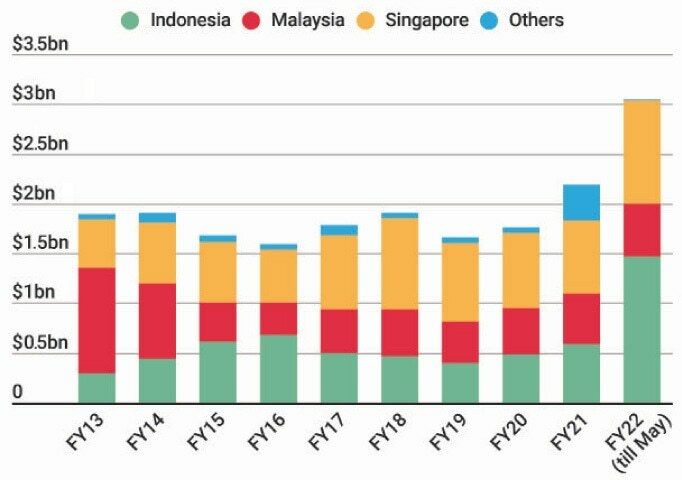
Rising demand and soaring prices of cooking oil raised Pakistan's edible oil import bill to $4.5 billion in fiscal year 2021-22, according to government sources. Pakistan is the world's third largest importer of palm oil after India and China. Total cooking oil imports add up to 3.7 million tons while the total annual edible oil consumption is about 5 million tons. Pakistan's palm oil imports are the second biggest commodity import after more than $20 billion in energy imports, accounting for a significant chunk of Pakistan's growing trade and current account deficits.  

Sources of Palm Oil Imports in Pakistan. Source: Dawn


Pakistan Palm Oil Consumption Growth. Source: NationMaster


Pakistan's edible oil consumption has been rising over the years. It is now about 24 Kg per person which is among the highest in the world, according to analysts quoted by Dawn newspaper.  Combined with rising prices, the total imports of palm oil could exceed $6 billion next year. It could further worsen the country's balance of payments problems. Is Pakistan doing anything to try to grow oil palms in the country? Researchers at the Institute of Business Administration (IBA) in Karachi have studied it and reported the following: 

"Based on our research, visits and interviews it was determined that in Pakistan there are ample opportunities and favorable conditions for growing oil-palm trees. Report findings suggest that the coastal belt of Sindh has proven capability of growing oil-palm trees with a per acre yield comparable to that in major oil palm growing countries due to plenty of fertile land, irrigation water courses, supply of fertilizers, and skilled farmers available in this part of land".  

Pakistan Food Imports. Source: TDAP


Sindh Coastal Development Authority (CDA) has recently announced plans to plant 60,000 oil palm trees on an area of 1,000 acres in the current fiscal year.  An earlier project in 2020 showed that the oil content of palm fruit from Sindh's plantation in Thatta is 2% higher than the world average. 

Per Capita Wheat Consumption in Pakistan vs World. Source: Abdul Mottaleb et al


Per Capita Edible Oil Consumption in Pakistan. Source: Pakistan Growth Story


Southern Indian state of Telangana has launched a much more ambitious project to plant palm oil trees on 2 million acres of land in the next four years.  To achieve this goal, the state has plans to build large dams and irrigation canals and import millions of germinated sprouts.

Related Links:

Tuesday, October 12, 2021

Soaring Prices of Imported LNG Threaten Pakistan's Economic Recovery

Soaring LNG prices are adversely affecting Pakistan's balance of payments and threatening the nation's post-COVID economic recovery.  Pakistan's trade deficit has widened to nearly $12 billion in July-September 2021 quarter, up more than 100% from the same period last year. The nation's heavy reliance on expensive imported energy has been the main cause of prior balance of payments crises that have forced it to seek IMF bailouts more than a dozen times in the last 70 years. 


Global LNG Prices. Source: The Peninsula Qatar 


Pakistan: World's Fastest Growing LNG Market. Source: Bloomberg


Global Commodity Price Increases


The average LNG price for November delivery into Northeast Asia was estimated at about $32 per metric million British thermal units (mmBtu), up nearly 20 percent from the previous week, according to the Peninsula Qatar publication. Price agency S&P Global Platts said on Thursday that its Japan-Korea-Marker, which is widely used as a benchmark for spot LNG contracts, rose to $34.47 per mmBtu.       

Pakistan Trade Stats. Source: Topline Securities

Rising LNG prices have forced power generating companies in Pakistan, Bangladesh and the Middle East to start switching fuels pushing oil prices higher.  About 60% of Pakistan's current LNG needs are covered by long-term contracts at significantly lower prices than the current spot prices. US crude closed above $80 for the first time since late in 2014, bringing its climb since the end of last October to 125%, according to the Wall Street Journal

Pakistan Coal Power Plants Under CPEC. Source:China's Global Power Database

All Pakistani Power Plants Under CPEC. Source: China's Global Power Database


The key to Pakistan managing its current accounts lies in reducing reliance on imported energy and dramatically increasing its exports. Pakistan already faces climate change pressures forcing it to change its energy mix to reduce the use of fossil fuels. 

Pakistan's Malik Amin Aslam with CNN's Becky Anderson 

Malik Amin Aslam, Pakistan Prime Minister Imran Khan's special assistant on climate change, said recently in an interview with CNN that his country is seeking to change its energy mix to favor green.  He said Pakistan's 60% renewable energy target would to be based on solar, wind and hydro power projects, and 40% would come from hydrocarbon and nuclear which is also low-carbon. “Nuclear power has to be part of the country’s energy mix for future as a zero energy emission source for clean and green future,” he concluded. Here are the key points Aslam made to Becky Anderson of CNN:

1. Pakistan wants to be a part of the solution even though it accounts for less than 1% of global carbon emissions. 

 2. Extreme weather events are costing Pakistan significant losses of lives and property. Pakistan is among the countries most vulnerable to the effects of climate change. 

3. Pakistan is moving towards renewable energy by converting 60% of its energy mix to renewable by 2030. Electric vehicle (EV) transition is also beginning in his country. 

4. Aslam said:  “We are one of the world leaders on nature based solutions. However, the World Bank (WB) in its Report yesterday came up with really good numbers in a comparison done of countries who are shifting their mainstream development towards environment friendly policies and Pakistan came atop among them,” the SAPM explained. 

900 MW Zonergy Solar Park in Bhawalpur, Pakistan


To a question on Pakistan’s capacity to make investments in nature based solutions, he said, “We cannot afford not to do it….that’s a cliche in our country and we are living that cliche in Pakistan. We are not just talking the climate talk rather doing climate action in Pakistan.” 

1,100 MW Karachi Nuclear Power Plant Unit 2


To a question on the 26th Conference of Parties (COP-26) under the United Nations Framework Convention on Climate Change, Amin said his country’s revised "national determined contributions" (NDCs) are going to be released next week. “….that’s going to clearly tell the world that this (money) we had spent in nature and could do further and that was also our direction,” he added. The SAPM informed that Pakistan was going to COP 26 with a very clear message that the country has been affected by climate change, climate injustice, adding, “but we are one of the countries that are leading the way to nature based solutions.” 

Pakistan Among Top 3 Countries For Newly Installed Hydro


He cited the WB Report and said 44% of the country’s mainstream development was climate friendly investment and it had doubled in the past one year. He said 60% renewable energy target would to be based on solar, wind and hydro power projects, and 40% would come from hydrocarbons and nuclear which is also low-carbon. “Nuclear power has to be part of the country’s energy mix for future as a zero energy emission source for clean and green future,” he concluded.

Installed Wind Power in Pakistan. Source: Modor Intelligence 


It's noteworthy that Pakistan's neighbor India currently generates 70% of its electricity from coal extracted from Indian coal mine.  It is aiming for renewables and nuclear energy to account for 40% of its installed electricity capacity by 2030.   

Pakistan NDCs (Nationally Determined Contributions) For Climate Goals. Source: UN


Here's a video of Malik Amin Aslam's interview with CNN"s Becky Anderson:

https://youtu.be/Q_s4kQXChuM


Saturday, September 12, 2020

Thirlwall Law: Why Hasn't Pakistan's GDP Grown Faster Than 5% Average Since 1960s?

Pakistan's economy has grown at a compounded annual growth rate (CAGR) of about 5% since the 1960s. While Pakistan's average 5% annual economic growth rate is faster than the global average, it falls significantly short of its peer group in Asia. The key reason is that, unlike Pakistan's, the East Asian nation's growth has been fueled by rapid rise in exports. History shows that Pakistan has run into balance of payments (BOP) crises whenever its growth has accelerated above 5%. These crises have forced Pakistan to seek IMF bailouts 13 times in its 73 year history. Pakistan's current account deficits would be a lot worse without 23X growth in remittances from overseas Pakistanis since year 2000.  What Pakistan has experienced is BOP-constrained growth as explained in 1979 by Thirlwall Law, a law of economics named after British economist Anthony Philip Thirlwall.  Another reason why Pakistan has lagged its Asian peers in terms of economic growth is its lower savings and investment rates. Every time Pakistan has faced a balance of payments crisis, the result has been massive currency devaluation, high inflation and slower growth for a period pf multiple years. This is is exactly what Pakistan's current government led by Prime Minister Imran Khan is dealing with right now.  This pain is the result of years of flat exports, soaring imports and excessive debt taken on during former Prime Minister Nawaz Sharif's PMLN government from 2013 to 2018. The best way for Pakistan to accelerate its growth beyond 5% in a sustainable manner is to boost its exports by investing in export-oriented industries, and by incentivizing higher savings and investments. 

History of Pakistan's IMF Bailouts

Economic Growth Since 1960: 

The World Bank report released in June, 2018 shows that Pakistan's GDP has grown from $3.7 billion in 1960 to $305 billion in 2017, or 82.4 times. In the same period,  India's GDP grew from $37 billion in 1960 to $2,597 billion in 2017 or 71.15 times. Both South Asian nations have outpaced the world GDP growth of 60 times from 1960 to 2017.

While Pakistan's GDP growth of 82X from 1960 to 2017 is faster than India's 71X and it appears impressive, it pales in comparison to Malaysia's 157X, China's 205X and South Korea's 382X during the same period.


Thrilwall's Model: 

Thrilwall's BOP-constrained growth model says that no country can sustain long-term growth rates faster than the rate consistent with its current account balance, unless it can finance its growing deficits. Indeed, if imports grow faster than exports, the current account deficit has to be financed by borrowing from abroad, i.e., by the growth of capital inflows. But this cannot continue indefinitely. Here's how Jesus Felipe, J. S. L. McCombie, and Kaukab Naqvi describe it in their May 2009 paper titled "Is Pakistan’s Growth Rate Balance-of-Payments Constrained? Policies and Implications for Development and Growth"  published by Asian Development Bank: 

"The reason is straightforward. If the growth of financial flows is greater than the growth of GDP, then the net overseas debt to GDP ratio will rise inextricably. There is a limit to the size of this ratio before international financial markets become distinctly nervous about the risk of private and, especially in less developed countries, public default. If much of the borrowing is short-term, then there is danger of capital flight, precipitating the collapse of the exchange rate. Not only will this cause capital loses in terms of foreign currency (notably United States [US] dollars) of domestic assets owned by foreigners (the lenders), but it will also cause severe domestic liquidity problems. This is especially true of many developing countries as overseas borrowing by banks and firms is predominantly denominated in a foreign currency, normally US dollars. As the exchange rate plummets, so domestic firms have difficulty finding domestic funds to finance their debt and day-today operations, often with disastrous consequences."

Investment as Percentage of GDP Source: State Bank of Pakistan 


Pakistan's Rising Current Account Deficit:

Pakistan's external debt has been rising rapidly in recent years to fund its ballooning twin deficits of domestic budget and external accounts. It pushed the external debt service cost to $12 billion in fiscal 2019-20, and added to the trade deficit of nearly $24 billion. Remittances of $21 billion from Pakistani diaspora reduced the current account deficit to $11 billion, but still forced the new PTI government to seek yet another IMF bailout with its stringent conditions to control both fiscal and current account deficits. These conditions resulted in dramatic slow-down in the country's GDP growth. 

Pakistan's External Debt. Source: Wall Street Journal


Pakistan's Exports: 

Pakistan’s exports have continued to lag behind that of its South Asian competitors since the early 1990s. Bangladesh’s exports have increased by 6.2 times compared to Pakistan’s, measured in terms of exports per capita, and that of India by 6.8 times, according to Princeton's Pakistani-American economist Atif Mian. 

Exports Per Capita in South Asia. Source: Dawn 


Balance of Payments Crises:

Every time Pakistan has faced a balance of payments crisis, the result has been massive currency devaluation, high inflation and slower growth for a period of multiple years. This is is exactly what Pakistan's current government led by Prime Minister Imran Khan is dealing with right now.  This pain is the result of years of flat exports, soaring imports and excessive debt taken on during former Prime Minister Nawaz Sharif's PMLN government from 2013 to 2018. 

Export Growth in South Asia. Source: WSJ

Savings and Investment: 

The second reason why Pakistan lagged its Asian peers in terms of economic growth is its lower savings and investment rates. There's a strong relationship between investment levels and gross domestic product. The more a country saves and invests, the higher its economic growth.  A State Bank of Pakistan report explains it as below:

"National savings (in Pakistan) as percent of GDP were around 10 percent during 1960s, which increased to above 15 percent in 2000s, but declined afterward. Pakistan’s saving rate also compares unfavorably with that in neighboring countries: last five years average saving rate in India was 31.9 percent, Bangladesh 29.7 percent, and Sri Lanka 24.5 percent..... Similarly, domestic savings (measured as national savings less net factor income from abroad) also declined from about 15 percent of GDP in 2000s, to less than 9 percent in recent years. Domestic savings are imperative for sustainable growth, because inflow of income from abroad (remittances and other factor income) is uncertain due to cyclical movements in world economies, exchange rates, and external shocks".

Net Foreign Direct Investment Source: State Bank of Pakistan

21X Remittance Growth Since Year 2000:

Remittance inflows from Pakistani diaspora have jumped 21-fold from about $1 billion in year 2000 to $24 billion in 2020, according to the World Bank. In terms of GDP, these inflows have soared nearly 7X from about 1% in year 2000 to 6.9% of GDP in 2018.


Meanwhile, Pakistan's exports have declined from 13.5% of GDP in year 2000 to 8.24% of GDP in 2017.  At the same time, the country's import bill has increased from 14.69% in year 2000 to 17.55% of GDP in 2017.  This growing trade imbalance has forced Pakistan to seek IMF bailouts four times since the year 2000.  It is further complicated by external debt service cost of over $6 billion (about 2% of GDP) in 2017. Foreign investment in the country has declined from a peak of $5.59 billion (about 4% of GDP) in 2007 to a mere $2.82 billion (less than 1% of GDP) in 2017. While the current account imbalance situation is bad, it would be far worse if Pakistani diaspora did not come to the rescue.

Summary:

Pakistan's average economic growth of 5% a year has been faster than the global average since the 1960s, it has been slower than that that of its peers in East Asia. It has essentially been constrained by Pakistan recurring balance of payment (BOP) crises as explained by Thirlwall's Law. Pakistan has been forced to seek IMF bailouts 13 times in the last 70 years to deal with its BOP crises. This has happened in spite of the fact that remittances from overseas Pakistanis have grown 24X since year 2000. Every time Pakistan has faced a balance of payments crisis, the result has been massive currency devaluation, high inflation and slower growth for a period pf multiple years. This is is exactly what Pakistan's current government led by Prime Minister Imran Khan is dealing with right now.  This pain is the result of years of flat exports, soaring imports and excessive debt taken on during former Prime Minister Nawaz Sharif's PMLN government from 2013 to 2018.   The best way for Pakistan to accelerate its growth beyond 5% is to boost its exports by investing in export-oriented industries, and by incentivizing higher savings and investments. 

Related Links:

Haq's Musings

South Asia Investor Review

Pakistan's Debt Crisis

Declining Investment Hurting Pakistan's Economic Growth

Brief History of Pakistan Economy 

Can Pakistan Avoid Recurring IMF Bailouts?

Pakistan is the 3rd Fastest Growing Trillion Dollar Economy

CPEC Financing: Is China Ripping Off Pakistan?

Information Tech Jobs Moving From India to Pakistan

Pakistan is 5th Largest Motorcycle Market

"Failed State" Pakistan Saw 22% Growth in Per Capita Income in Last 5 Years

CPEC Transforming Pakistan

Pakistan's $20 Billion Tourism Industry Boom

Home Appliance Ownership in Pakistani Households

Riaz Haq's YouTube Channel

PakAlumni Social Network

Saturday, August 4, 2018

"Naya Pakistan": Key Challenges for PTI Chief Imran Khan

"Naya Pakistan" led by Pakistan Tehreek e Insaf Chief Imran Khan faces multi-dimensional challenges of governance, economy, security and ties with the United States and India.

The first and most pressing challenge is the severe balance of payments crisis. It will force Imran Khan to beg and/or borrow billions of US dollars to shore up the country's reserves. It must deal with the geopolitical challenge of potential US veto of the IMF bailout of Pakistan.

In addition to dealing with the looming bop crisis, the PTI government must address the issue of exports that have halved from 16% of GDP in 2003 to about 8% of GDP in 2017-18. It needs to make concerted efforts to promote exports by making the domestic industry more export-oriented. It must help exporters understand the requirements of foreign markets and use its diplomats to promote Pakistani products and services in international markets.

Pakistan must overcome the civil-military divide and build consensus to develop policies vis-a-vis the United States and India while at the same time maintaining close ties with China. The new leadership needs to use institutional processes such as regular national security council meetings attended by by top civilian, military and intelligence officials.

Azad Labon Ke Sath host Faraz Darvesh discusses these challenges with Misbah Azam and Riaz Haq (www.riazhaq.com)

https://youtu.be/CQ41Qt_2XQM


Related Links:

Tuesday, July 31, 2018

Can Pakistan Avoid Recurring BoP Crises Requiring IMF Bailouts?

Every country needs US dollars to import products because the US dollar is the international trade and reserve currency. Only the United States can print dollars; all others must acquire them through exports and capital inflows like investments, remittances and loans. Pakistan has had serious problems in acquiring sufficient amount of dollars for its needs through trade and investments over the last several decades. It has been forced to seek IMF bailouts repeatedly.

China, India and East Asia:

China and other East Asian nations have built up large dollar reserves by running massive trade surpluses mainly through exporting lots of products and services to the rest of the world.

Others, such as India, have built up significant US dollar reserves in spite of running large trade deficits. India relies mainly on foreign investments, remittances from non-resident Indians and foreign debt for its dollar reserves.

India is consistently ranked among the top recipients of foreign direct and portfolio investments as percentage of its GDP.

Pakistan's Foreign Investment and Trade:

Like India, Pakistan also runs large trade deficits. It also depends on foreign investments, remittances from overseas Pakistanis and foreign debt for its dollar reserves.  So why does Pakistan have serious recurring balance of payments crises?

Unlike India,  Pakistan ranks very low among recipients of foreign direct and portfolio investments as percentage of its GDP. .  Part of it is the perception of insecurity since 911. The real security situation has dramatically improved in the last few years but the perception continues to lag.

Pakistan's exports have also lagged behind India's as percentage of gross domestic product (GDP). In fact, Pakistan's exports have halved from about 16% of GDP in 2003 to 8% of GDP in 2017. India's exports have increased from 15% to 19% of GDP in the same period, according to the World Bank.

Exports as Percentage of GDP. Source: World Bank


Export-Orientation of Industries:

Pakistan has a fairly diverse industrial sector which caters to its domestic market.  People running these businesses and industries have little or no knowledge of the customer needs and regulatory requirements of foreign markets where their products or services could be sold to boost Pakistan's exports and dollar earnings.

Pakistan's economic attaches posted at the nation's embassies need to focus on all export opportunities in international markets and help educate Pakistani businesses on the best way to take advantage of them. This needs to be a concerted effort involving various government ministries and departments working closely with industry groups.

Composition of Pakistan's Imports. Source: World Integrated Trade Solutions

Illicit Capital Flows:

Pakistan's new government led by the Pakistan Tehreek e Insaf Chief Imran Khan needs to urgently crack down on illicit outflow of dollars. One of the ways large amounts of money moves across international borders is through trade misinvoicing.

Global Financial Integrity (GFI) defines trade misinvoicing as "fraudulently manipulating the price, quantity, or quality of a good or service on an invoice submitted to customs" to quickly move substantial sums of money across international borders.

How does trade miscinvoicing work? Here's an example:

Let's say an exporter in Pakistan exports goods worth $1 million to a foreign country and invoices it at $500,000 through an offshore middleman.  The middleman invoices and collects $1 million from the end customer, sends $500,000 to Pakistan and deposits $500,000 in an offshore account. The result: Pakistan is deprived of the $500,000 in foreign exchange.

Similarly, imports of goods worth $1 million to Pakistan are overinvoiced at $1.5 million through an offshore middleman and the difference is kept in an overseas account. The result: Pakistan loses another $500,000 in foreign exchange. Meanwhile, the Pakistani traders and the officials facilitating misinvoicing together pocket $1 million or 50% on the two trades.  Pakistan's trade and current account deficits grow and the foreign exchange reserves are depleted, forcing Pakistan to go back to the International Monetary Fund (IMF) for yet another bailout with tough conditions.


Terror and Drug Financing:

It is not just greedy politicians, unscrupulous businessmen and corrupt officials in developing countries who rely on fraudulent manipulation of trade invoices; all kinds of drug traders, terrorists and criminals also use what is called TBML (trade-based money laundering).

John A. Cassara, former US intelligence official with expertise in money laundering, submitted written testimony for a US Congressional hearing on “Trading with the Enemy: Trade-Based Money Laundering is the Growth Industry in Terror Finance” to the Task Force to Investigate Terrorism Financing Of the House Financial Services Committee February 3, 2016. Here's an except from it:

"Not long after the September 11 attacks, I had a conversation with a Pakistani entrepreneur. This businessman could charitably be described as being involved in international grey markets and illicit finance. We discussed many of the subjects addressed in this hearing including trade-based money laundering, terror finance, value transfer, hawala, fictitious invoicing, and counter-valuation. At the end of the discussion, he looked at me and said, “Mr. John, don’t you know that your adversaries are transferring money and value right under your noses? But the West doesn’t see it. Your enemies are laughing at you.”"

Summary: 

Pakistan needs to find a way to build up and manage significant dollar reserves to avoid recurring IMF bailouts. The best way to do it is to focus on increasing the country's exports that have remained essentially flat in per capita terms. Pakistan's economic attaches posted at the nation's embassies need to focus on all export opportunities in international markets and help educate Pakistani businesses on the best way to take advantage of them. This needs to be concerted effort involving various government ministries and departments working closely with industry groups. At the same time, the new government needs to crack down on illicit outflow of dollars from the country.

Azad Labon Ke Sath host Faraz Darvesh discusses Imran Khan's challenges with Misbah Azam and Riaz Haq (www.riazhaq.com)

https://youtu.be/CQ41Qt_2XQM


Related Links:

Haq's Musings

South Asia Investor Review

Money Laundering Through Trade Misinvoicing

Pakistan Economy Hobbled By Underinvestment

Raymond Baker on Corruption in Pakistan

Can Indian Economy Survive Without Western Capital Inflows?

Culture of Corruption in Pakistan

Chinese Yuan to Replace US $ as Reserve Currency?

Remittances From Overseas Pakistanis

Politics of Patronage in Pakistan

Why is PIA Losing Money Amid Pakistan Aviation Boom?