Showing posts sorted by date for query Trump phenomenon. Sort by relevance Show all posts

Friday, September 19, 2025

Silicon Valley Pakistani-Americans Among Top Donors to Mamdani Campaign

Omer Hasan and Mohammad Javed are the top donors to Zohran Mamdani’s mayoral campaign in New York City, according to media reports. Both are former executives of Silicon Valley technology firm AppLovin. Born and raised in Silicon Valley, Omer is the son of a Pakistani-American couple who are long-time residents of Silicon Valley, California. 

Omer Hasan, Top Donor to Mamdani Campaign


Muhammad Javed donated $251,500 to New Yorkers for Lower Costs, a super-PAC backing Zohran Mamdani. Omer gave $250,000 to this super PAC. Other Mamdani super PAC donors include Liz Simons, Philanthropist, and daughter of hedge-fund billionaire Jim Simons, who gave $250,000 and Unity & Justice Fund, the political arm of the Council on American-Islamic Relations CAIR, that gave $100,000. But the biggest support has come from small donors to the Mamdani campaign. It has received a lot more money from small-dollar donors.  In August 2025, Mamdani's campaign had raised over $1 million from more than 8,600 private donors, with half of the individual donations being less than $25. His campaign also got millions in public matching funds due to this strong small-dollar donor support. 

Andrew Cuomo, Mamdani's main rival, is bankrolled by Republican Zionist billionaires like Bill Ackman, a hedge fund manager who backs Israeli Prime Minister Benjamin Netanyahu's genocidal war in Gaza. Mamdani has called Netanyahu a "war criminal". He has promised to order the New York Police Department to arrest the Israeli Prime Minister if he is elected. 

Mother Jones reported that Cuomo's super PAC Fix The City got huge contributions from the rich and powerful donors like  DoorDash ($1 million), along with Ackman ($500,000), and former mayor Michael Bloomberg ($8.3 million). Media mogul Barry Diller and Netflix chairman Reed Hastings gave a quarter of a million. Home Depot co-founder and Republican mega-donor Ken Langone gave $100,000. Pro-Trump hedge-funder Dan Loeb gave $350,000. James and Kathryn Murdoch offered $50,000 apiece. So did Stephen Ross, who lives in the borough of West Palm Beach, Florida and owns the Miami Dolphins. Alice Walton, of the Bentonville, Arkansas Waltons, pitched in with a humble offering of $100,000. Both Greenwich, Connecticut’s Jeff Wilpon, and the man he sold the New York Mets to—Stamford’s Steve Cohen—were good for $25,000.

Cuomo continues to significantly lag Mamdani in the polls in spite of having a huge funding advantage. A CBS News/YouGov poll (September 7–13) put Mamdani at 43% to Cuomo's 28%, a 15-point lead. A Marist survey the same week showed Mamdani ahead 45% to 24%, while Quinnipiac gave him a 22-point lead at 45% to 23%. An Emerson College poll for PIX11 and The Hill had a nearly identical 43% to 28% margin, and a New York Times/Siena poll (September 2–6) showed Mamdani leading 46% to 24%, according to Newsweek. 

Related Links:

Haq's Musings

South Asia Investor Review

Muslim-Americans in San Francisco Bay Area

The Trump Phenomenon

Islamophobia in America

Silicon Valley Pakistani-Americans

Pakistani-American Leads Silicon Valley's Top Incubator

Silicon Valley Pakistanis Enabling 2nd Machine Revolution

Karachi-born Triple Oscar Winning Graphics Artist

Pakistani-American Ashar Aziz's Fire-eye Goes Public

Two Pakistani-American Silicon Valley Techs Among Top 5 VC Deals

Pakistani-American's Game-Changing Vision 

Minorities Are Majority in Silicon Valley 

Thursday, February 6, 2025

US Deports Indian Illegal Immigrants in Handcuffs and Chains Aboard Military Aircraft

 A US Air Force transport plane landed in India today with 104 illegal Indian immigrants in handcuffs and shackles, according to media reports. Speaking with reporters, a deportee said: “For 40 hours, we were handcuffed, our feet tied with chains and were not allowed to move an inch from our seats. After repeated requests, we were allowed to drag ourselves to the washroom. The crew would open the door of the lavatory and shove us in.”

Illegal Indian Immigrants Deported in Handcuffs and Chains. Source: News18

The inhumane treatment meted out to citizens of India, a US ally, has sparked a lot of anger against Prime Minister Narendra Modi's government. The critics are citing the example of Colombia, a small South American nation, whose president protested similar treatment of its citizens by the Trump administration. Colombian President Gustavo Petro turned back the US military planes carrying deportees and then sent his own aircraft to transport them back home in Colombia. 

Illegal immigration from India to the US has dramatically increased on Prime Minister Modi's watch. A Pew Research Center report said that as of 2022, India ranked third, after Mexico and El Salvador, on the list of countries with the largest number of undocumented immigrants — 725,000 — living in the U.S.

India has a serious unemployment problem, particularly for the young people entering the job market by the millions each year. This problem is concealed by headline  economic growth figures highlighted by the Modi government. At the same time, India is losing its best and brightest in a massive brain drain. 

"Leave India! It's High Time!!" screams out a recent Reddit post that has gone viral! The poster who claims to be an Indian entrepreneur warns of impending "terrible economic collapse" with a "massive depreciation of the Indian rupee".  

The now-deleted post, written by a user named ‘u/anonymous_batm_an,’ urges high-earning professionals, especially innovators, to leave India for countries with better opportunities and governance, as reported by the Times of India.  It recommends the UAE or Thailand as alternative destinations . The sentiments expressed in the post are already resonating with a large number of Indians.  The non-resident Indians now constitute the world's largest overseas diaspora. Every year, 2.5 million Indians leave their country of birth, making India the nation with the highest annual number of emigrants in the world. 

New Company Registrations in Dubai. Source: Khaleej Times


Indian investors continued to top the list of new non-Emirati companies joining the Dubai Chamber of Commerce during the first nine months of 2024. A total of 12,142 new Indian companies joined the chamber during the period, data showed on Monday, according to the Khaleej Times. Pakistan ranked second on the list with 6,061 new companies joining between Q1-Q3 2024, while Egypt followed with 3,611 new companies registering as members of the chamber. The number of new Syrian companies joining the chamber during the first nine months of the year reached 2,062, placing the country fourth among the top nationalities of new member companies.

India is losing its best and brightest to the West, particularly to the United States, at an increasingly rapid pace. A 2023 study of the 1,000 top scorers in the 2010 entrance exams to the Indian Institutes of Technology (IIT) — a network of prestigious institutions of higher learning based in 23 Indian cities — revealed the scale of the problem. Around 36% migrated abroad, and of the top 100 scorers, 62% left the country, according to a report in the science journal Nature.  Nearly two-thirds of those leaving India are highly educated, having received academic or vocational training. This is the highest for any country, according to the Organization for Economic Co-operation and Development.

Example of The Great Indian Brain Drain. Source: Boston Political Review

Brain drain is defined as the loss of precious human capital of a nation. It is a “consequence of an education system designed for ‘selecting’ the best and brightest in an economy that is still too controlled and cannot create opportunities for its best and brightest”, according to Indian economist Shruti Rajagopalan. High-profile examples of India's human capital loss include Satya Nadella (Microsoft), Sundar Pichai (Google), Shantanu Narayen (Adobe), Arvind Krishna (IBM) and Ajay Banga (World Bank). 

Foreign-Born STEM Workers in America. Source: American Immigration Council


Growing number of Indian students are going abroad for higher education each year and 90% of them never return home after completing their studies.  In 2022, the number of Indian students leaving the country for higher education reached a six-year high of 770,000. And a 2021 report estimated that around two million Indian students would be studying abroad by 2024. 

Many developing countries are experiencing brain drain. But India is losing its best brightest at a much faster rate than others. Some call it "The Great Indian Brain Drain". This is the reason why Indians in the United States are the best educated and the highest earning group.  In a recently published book titled "The Other One Percent", authors Sanjoy Chakravorty, Devesh Kapur and Nirvikar Singh explain this phenomenon. 

Related Links:

Haq's Musings

South Asia Investor Review

Guess Why Pakistani Analyst Uzair Younus is Making Headlines in India!

Ambassador Kishore Mahbubani: America Does Not Respect India

World Happiness Report: India Among Saddest Nations of the World

Balakot and Kashmir: Fact Checkers Expose Indian Lies

WB Poverty Update: India Biggest Contributor to Increase in Poverty

India in Crisis: Unemployment, Hunger Persist After Waves of Covid

Modi's Blunders and Delusions 

India's Israel Envy: What If Modi Attacks Pakistan?

Project Azm: Pakistan to Develop 5th Generation Fighter Jet

Pakistan Navy Modernization

Pakistan's Sea-Based Second Strike Capability

Are Some Pakistanis Feeding Modi's Delusions of Grandeur?

Is the West Unwittingly Helping Modi Realize His Akhand Bharat Hindutva Dream?

Has Pakistan Lost All Wars? 


Thursday, December 23, 2021

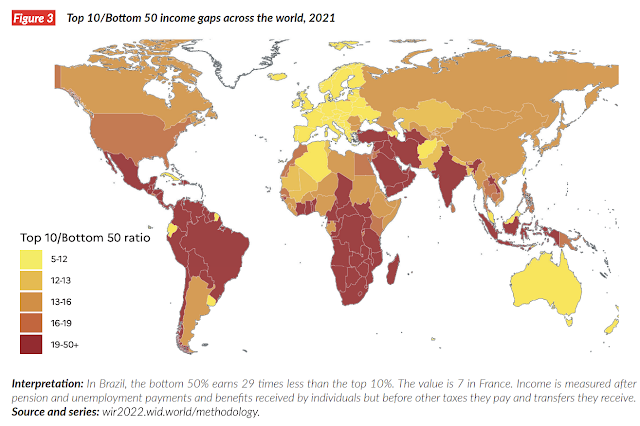
India Is Among The World's Most Unequal Countries

India is one of the most unequal countries in the world, according to the World Inequality Report 2022. There is rising poverty and hunger. Nearly 230 million middle class Indians have slipped below the poverty line, constituting a 15 to 20% increase in poverty. India ranks 94th among 107 nations ranked by World Hunger Index in 2020. Other South Asians have fared better: Pakistan (88), Nepal (73), Bangladesh (75), Sri Lanka (64) and Myanmar (78) – and only Afghanistan has fared worse at 99th place. Meanwhile, the wealth of Indian billionaires jumped by 35% during the pandemic. 

Income Inequality Map. Source: World Inequality Report 2022

Unemployment Crisis: 

India lost 6.8 million salaried jobs and 3.5 million entrepreneurs in November alone. Many among the unemployed can no longer afford to buy food, causing a significant spike in hunger. The country's economy is finding it hard to recover from COVID waves and lockdowns, according to data from multiple sources. At the same time, the Indian government has reported an 8.4% jump in economic growth in the July-to-September period compared with a contraction of 7.4% for the same period a year earlier.  

Income Inequality By Regions. Source: World Inequality Report 2022


Income & Wealth Inequality. Source: World Inequality Report 2022


Rising Poverty:

Nearly 230 million middle class Indians have slipped below the poverty line, constituting a 15 to 20% increase in poverty since Covid-19 struck last year, according to Pew Research. Middle class consumption has been a key driver of economic growth in India. Erosion of the middle class will likely have a significant long-term impact on the country's economy. “India, at the end of the day, is a consumption story,” says Tanvee Gupta Jain, UBS chief India economist, according to Financial Times. “If you never recovered from the 2020 wave and then you go into the 2021 wave, then it’s a concern.”

Increasing Hunger:  

India ranks 94th among 107 nations ranked by World Hunger Index in 2020. Other South Asians have fared better: Pakistan (88), Nepal (73), Bangladesh (75), Sri Lanka (64) and Myanmar (78) – and only Afghanistan has fared worse at 99th place. The COVID19 pandemic has worsened India's hunger and malnutrition. Tens of thousands of Indian children were forced to go to sleep on an empty stomach as the daily wage workers lost their livelihood and Prime Minister Narendra Modi imposed one of the strictest lockdowns in the South Asian nation. Pakistan's Prime Minister Imran Khan opted for "smart lockdown" that reduced the impact on daily wage earners. China, the place where COVID19 virus first emerged, is among 17 countries with the lowest level of hunger. 

Rich Getting Richer:

The wealth of Indian billionaires increased by 35% during the lockdown and by 90 per cent since 2009 to $422.9 billion, ranking India sixth in the world after the US, China, Germany, Russia, and France, according to Oxfam. 

India’s 100 top billionaires saw their fortunes increase by Rs 12,97,822 crore since March last year when the Covid-19 pandemic hit the country and this amount is enough to give 138 million poorest Indians a cheque for Rs 94,045 each, according to a report in The Business Standard. 

Share of Income of Richest 1% in South Asia
Inequality in Pakistan:

A United Nations report on inequality in Pakistan published in April 2021 revealed that the richest 1% Pakistanis take 9% of the national income.  A quick comparison with other South Asian nations shows that the 9% income share for the top 1% in Pakistan is lower than 15.8% in Bangladesh and 21.4% in India. These inequalities result mainly from a phenomenon known as "elite capture" that allows a privileged few to take away a disproportionately large slice of public resources such as public funds and land for their benefit. 

Income Distribution by Quintiles in Pakistan. Source: UNDP

Elite Capture:

Elite capture, a global phenomenon,  is a form of corruption. It describes how public resources are exploited by a few privileged individuals and groups to the detriment of the larger population. 

A recently published report by the United Nations Development Program (UNDP) has found that the elite capture in Pakistan adds up to an estimated $17.4 billion - roughly 6% of the country's economy. 

Pakistan's most privileged groups include the corporate sector, feudal landlords, politicians and the  military. The UN Development Program's NHDR for Pakistan, released last week, focused on issues of inequality in the country of 220 million people. 

Ms. Kanni Wignaraja, assistant secretary-general and regional chief of the UNDP, told Aljazeera that Pakistani leaders have taken the findings of the report “right on” and pledged to focus on prescriptive action. “My hope is that there is strong intent to review things like the current tax and subsidy policies, to look at land and capital access", she added. 

Inequality in Pakistan. Source: UNDP

Income Inequality:

The richest 1% of Pakistanis take 9% of the national income, according to the UNDP report titled "The three Ps of inequality: Power, People, and Policy". It was released on April 6, 2021. Comparison of income inequality in South Asia reveals that the richest 1% in Bangladesh and India claim 15.8% and 21.4% of national income respectively.

In addition to income inequality, the UNDP report describes the inequality of opportunity in terms of access to services, work with dignity and accessibility. It is based on exhaustive statistical analysis at national and provincial levels, and includes new inequality indices for child development, youth, labor and gender. Qualitative research, through focus groups with marginalized communities, has also been undertaken, and the NHDR 2020 Inequality Perception Survey conducted. The NHDR 2020 has been guided by a diverse panel of Advisory Council members, including policy makers, development practitioners, academics, and UN representatives.

Summary:

Neoliberal policies in emerging markets like India have spurred economic growth in last few decades. However, the gains from this rapid growth have been heavily skewed in favor of the rich. The rich have gotten richer while the poor have languished. The average per capita income in India has tripled in recent decades but the minimum dietary intake has fallen. According to the World Food Program, a quarter of the world's undernourished people live in India. The COVID19 pandemic has further widened the gap between the rich and poor. 

Related Links:

Haq's Musings

South Asia Investor Review

Pakistan Among World's Largest Food Producers

Naya Pakistan Housing Program

Food in Pakistan 2nd Cheapest in the World

Indian Economy Grew Just 0.2% Annually in Last Two Years

Pakistan to Become World's 6th Largest Cement Producer by 2030

Pakistan's 2012 GDP Estimated at $401 Billion

Pakistan's Computer Services Exports Jump 26% Amid COVID19 Lockdown

Coronavirus, Lives and Livelihoods in Pakistan

Vast Majority of Pakistanis Support Imran Khan's Handling of Covid19 Crisis

Pakistani-American Woman Featured in Netflix Documentary "Pandemic"

Incomes of Poorest Pakistanis Growing Faster Than Their Richest Counterparts

Can Pakistan Effectively Respond to Coronavirus Outbreak? 

How Grim is Pakistan's Social Sector Progress?

Pakistan's Sehat Card Health Insurance Program

Trump Picks Muslim-American to Lead Vaccine Effort

COVID Lockdown Decimates India's Middle Class

Pakistan Child Health Indicators

Pakistan's Balance of Payments Crisis

How Has India Built Large Forex Reserves Despite Perennial Trade Deficits

India's Unemployment and Hunger Crises"

PTI Triumphs Over Corrupt Dynastic Political Parties

Strikingly Similar Narratives of Donald Trump and Nawaz Sharif

Nawaz Sharif's Report Card

Riaz Haq's Youtube Channel


Friday, December 17, 2021

Second Generation Pakistani-American's Health Tech Startup Raises $130 Million in Series C

Luma Health, co-founded by Adnan Iqbal, a second generation Pakistani American, raised $130 million in series C funding. Adnan's fellow co-funders include Dr. Tashfeen Ekram, a Pakistani-American and Aditya Bansod, an Indian-American. The latest round has brought Luma's total funding to $160 million.  "I have had a life of privilege. I have been to the right institutions. I have played collegiate sports. I check all the boxes. But I have a recognizable Pakistani Muslim name. I would have raised twice the amount of money in half the time if I was a white guy. That's just the honest truth", he told an interviewer. 

Luma Health Co-founders


San Francisco-based Luma’s platform is designed to centralize and automate scheduling and communication with patients. The company’s tech integrates with more than 80 types of electronic health records (EHRs) across the healthcare IT stack. Luma has served more than 30 million patients across the U.S. and is used by more than 550 health systems, hospitals and clinic networks nationwide, according to the company.

Telehealth services supported by Luma  have been particularly useful during the COVID19 pandemic. Digital outreach has helped remind patients of their vaccination appointments, which has reduced no-shows. Digitization has minimized physical contact and increased the speed of operations. 

Adnan Iqbal is currently serving as the CEO of Luma. He studied Biology at UC Berkeley, then got his master's degree at Cambridge University in England before working at Genentech — a large US biotech company. He then went to the Stanford Graduate School of Business, and that’s where he and his co-founder Tashfeen Ekram (a medical doctor) started working on Luma. 

Talking with Dr. Mustafa Sultan, a British Pakistani doctor,  Adnan described what it is like to be a Pakistani young man in Silicon Valley. He recognizes that there is an increasing number of high-profile entrepreneurs and executives with immigrant backgrounds in America but he said "it is much harder to raise capital if you are not a white guy..that's just the honest truth".  "I have had a life of privilege. I have been to the right institutions. I have played collegiate sports. I check all the boxes. But I also have a recognizable Pakistani Muslim name. I would have raised twice the amount of money in half the time if I was a white guy. That's just the honest truth", he added.    

Here's a video clip of CNN analyst Van Jones talking about Pakistani-Americans:

https://www.youtube.com/watch?v=gr5cLv8Dj2I


Related Links:

Haq's Musings

South Asia Investor Review

Hindus and Muslim Well-educated in America But Least Educated Worldwide

What's Driving Islamophobia in America?

Pakistani-Americans Largest Foreign-Born Muslim Group in Silicon Valley

The Trump Phenomenon

Islamophobia in America

Silicon Valley Pakistani-Americans

Pakistani-American Leads Silicon Valley's Top Incubator

Silicon Valley Pakistanis Enabling 2nd Machine Revolution

Karachi-born Triple Oscar Winning Graphics Artist

Pakistani-American Ashar Aziz's Fire-eye Goes Public

Two Pakistani-American Silicon Valley Techs Among Top 5 VC Deals

Pakistani-American's Game-Changing Vision 

Minorities Are Majority in Silicon Valley 


Thursday, September 9, 2021

Islamophobia in America Has Doubled in 20 Years After 911 Terrorist Attacks

Muslims in America and the rest of the world have suffered the most since the September 11, 2001 terrorist attacks in the United States. Washington responded to the attacks by launching its "global war on terror" that has been seen by many Muslims as "global war on Muslims". People in Afghanistan, Iraq, Pakistan, Syria, Libya and many other parts of the world have seen their lives upended. American Muslims, too, have been the victims of hate crimes. Countries like India and Israel have taken advantage of the "global war on terror" to try to crush genuine independence movements in Kashmir and Palestine.  

Anti-Muslim Sentiments Survey. Source: Pew Research


Pew Survey Results: 

Pew Research has recently reported that anti-Muslim sentiments in the United States have doubled since 2001 from 25% to 50% of the respondents associating Muslims and Islam with violence. Islamophobia among Republicans is up from 32% to 72% in last two decades. Among Democrats, Islamophobia has risen from 23% to 32% in this period.     

The FBI data shows that anti-Islamic hate crimes rose from 28 incidents in the year 2000 to 481 in 2001. That's a 1,617% increase in just one year. 20 years later, those numbers are still high. In 2019, anti-Islamic hate crimes made up 13.3% of all religion-based attacks in the U.S. Muslims make up about 1% of the US population. 


Islamophobia Goes Mainstream: 
 
Islamophobia is no longer extreme; the year 2017 saw it go mainstream in Europe, India, the United States and several other parts of the world.

Openly Islamophobic Donald J. Trump was inaugurated as president of the United States in 2017. India's largest state of Uttar Pradesh elected rabidly anti-Muslim chief minister Yogi Adiyanath who was hand-picked by Muslim-hating Prime Minister Narendra Modi in 2017.  Neo-Nazis made significant electoral gains with their anti-Islam rhetoric in several European nations while Burma and Israel continued to get away with the murder of  innocent Muslim civilians in 2017.

These alarming trends are reminiscent of the rise of Nazi Party led by Germany's Adolf Hitler who brought disaster to Europe and the rest of the world less than a century ago.

Trump's Muslim Ban:

The year of Islamophobia began in earnest on January 20, 2017 with the inauguration of President Donald J. Trump who called for "total and complete shutdown" of  Muslims entering the United States during his successful electoral campaign. Among the first executive orders he signed was a "Muslim Ban" from seven predominantly Muslim countries.

Then came an avalanche of a large number of Islamophobic tweets and retweets from Trump's twitter account. Some recent Trump retweets were of tweets from Britain First's Jayda Fransen. These tweets and retweets were swiftly denounced by top British and Dutch officials. Trump did not apologize.

Trump developed a pattern of using terror attacks to tweet against Muslims while ignoring similar or worse terror attacks by others.

Trump closed the year with recognition of Jerusalem as Israel's capital, a recognition that prior US administrations had withheld pending negotiations and final settlement of the issues between Israelis and Palestinians.

Hindu Nazis in India:

Yogi Adiyanath, known for his highly inflammatory anti-Muslim rhetoric, was hand-picked by Prime Minister Narendra Modi to head India's most populous state of Uttar Pradesh.

Yogi wants to "install statues of Goddess Gauri, Ganesh and Nandi in every mosque”.  Before his election, he said, “If one Hindu is killed, we won’t go to the police, we’ll kill 10 Muslims”.  He endorsed the beef lynching of Indian Muslim Mohammad Akhlaque and demanded that the victim's family be charged with cow slaughter.

In an op ed titled "Hitler's Hindus: The Rise and Rise of India's Nazi-Loving Nationalists" published by leading Israeli newspaper Haaretz, author Shrenik Rao has raised alarm bells about "large and growing community of Indian Hindu Nazis, who are digitally connected to neo-Nazi counterparts across the world".


Rao talks about Nagpur, a town he describes as the "epicenter of Hindu Nationalism", where he found  ‘Hitler’s Den’ pool parlor "that shocked me on a round-India trip 10 years ago was no outlier. Admiration for Nazism – often reframed with a genocidal hatred for Muslims – is rampant in the Hindu nationalist camp, which has never been as mainstream as it is now".

Hindu nationalists in India have a long history of admiration for the Nazi leader, including his "Final Solution". In his book "We" (1939), Madhav Sadashiv Golwalkar, the leader of the Hindu Nationalist RSS (Rashtriya Swayamsevak Sangh) wrote, "To keep up the purity of the Race and its culture, Germany shocked the world by her purging the country of the Semitic races -- the Jews. Race pride at its highest has been manifested here. Germany has also shown how well-nigh impossible it is for races and cultures, having differences going to the root, to be assimilated into one united whole, a good lesson for us in Hindusthan to learn and profit by."

Golwalkar, considered the founder of the Hindu Nationalist movement in India, saw Islam and Muslims as enemies. He said: “Ever since that evil day, when Moslems first landed in Hindusthan, right up to the present moment, the Hindu Nation has been gallantly fighting to shake off the despoilers".

Islamophobia in Europe:

Dutch expert Cas Mudde, an associate professor at the University of Georgia summed up the rise of Islamophobes in Europe well when he said: "The far right in Europe is more popular today than it was at any time in postwar history".

Alternative für Deutschland (AFD), a modern re-incarnation of Hitler's Nazi Party, stunned the world by becoming the third largest party in German Bundestag in 2017.

Last year, AFD's anti-Islam policies replaced its anti-EU focus with the slogan “Islam is not a part of Germany” emerging from the party’s spring 2017 conference.

In Austria, far-right Freedom Party candidate Sebastian Kurz was recently elected chancellor on the party's anti-Islam platform.

Earlier in 2017, the Dutch anti-Islam Freedom Party of Geert Wilders became the second largest force in parliament.

The French National Front (FN) of Marine Le Pen received nearly 34 percent of votes in the May 2017 presidential run-off that was won by Emmanuel Macron.

Neo-Nazis and Hindu Nazis on Social Media:

The advent and growth of online social media have enabled a large and growing community of Indian Hindu Nazis connected to neo-Nazi counterparts in Europe and America.  This came to light a few years ago when the Norwegian white supremacist terrorist Anders Behring Breivik's manifesto against the "Islamization of Western Europe" was heavily influenced by the kind of anti-Muslim rhetoric which is typical of the Nazi-loving Hindu Nationalists like late Madhav Sadashiv Golwalkar (1906-1973), and his present-day Sangh Parivar followers and sympathizers in the Bharatiya Janata Party (BJP) who currently rule several Indian states. This Hindutva rhetoric which infected Breivik has been spreading like a virus on the Internet, particularly on many of the well-known Islamophobic hate sites that have sprouted up in Europe and America in recent years. In fact, much of the Breivik manifesto is cut-and-pastes of anti-Muslim blog posts and columns that validated his worldview.

"It is essential that the European and Indian resistance movements learn from each other and cooperate as much as possible. Our goals are more or less identical," Breivick wrote in his manifesto. The Christian Science Monitor has reported that "in the case of India, there is significant overlap between Breivik’s rhetoric and strains of Hindu nationalism – or Hindutva – on the question of coexistence with Muslims. Human rights monitors have long decried such rhetoric in India for creating a milieu for communal violence, and the Norway incidents are prompting calls here to confront the issue."

Indian Textbooks Praise Nazis:

Adulation for Hitler has found its way into Indian textbooks to influence young impressionable minds. Here's how Rao describes it:

In 2004, when now-Indian Prime Minister Narendra Modi was the Chief Minister of Gujarat, school textbooks published by the Gujarat State Board portrayed Hitler as a hero, and glorified fascism.

The tenth-grade social studies textbook had chapters entitled "Hitler, the Supremo," and "Internal Achievements of Nazism." The section on the "Ideology of Nazism" reads: "Hitler lent dignity and prestige to the German government. He adopted the policy of opposition towards the Jewish people and advocated the supremacy of the German race." The tenth-grade social studies textbook, published by the state of Tamil Nadu in 2011 (with multiple revised editions until 2017) includes chapters glorifying Hitler, praising his "inspiring leadership," "achievements" and how the Nazis "glorified the German state" so, "to maintain a German race with Nordic elements, [Hitler] ordered the Jews to be persecuted."

Mein Kampf has also gone mainstream, becoming a "must-read" management strategy book for India’s business school students. Professors teaching strategy lecture about how a short, depressed man in prison made a goal of taking over the world and built a strategy to achieve it.

Modi and Trump:

Prime Minister Narendra Modi of India has built his entire political career on the intense hatred of  Muslims. US President Donald Trump built his successful presidential campaign on Islamophobia and xenophobia. That's what the two men have in common.

Just as white racists form the core of Trump's support base in America, the Modi phenomenon in India has been fueled by Hindu Nationalists whose leaders have praised Adolph Hitler for his hatred of Jews.

M.S. Golwalkar, a Hindu Nationalist who Mr. Modi has described as "worthy of worship" wrote the following about Muslims in his book "We":

 "Ever since that evil day, when Moslems first landed in Hindustan, right up to the present moment, the Hindu Nation has been gallantly fighting on to take on these despoilers. The Race Spirit has been awakening.”

"To keep up the purity of the Race and its culture, Germany shocked the world by her purging the country of the Semitic races -- the Jews. Race pride at its highest has been manifested here. Germany has also shown how well-nigh impossible it is for races and cultures, having differences going to the root, to be assimilated into one united whole, a good lesson for us in Hindusthan to learn and profit by."

Summary:

Pew Research has recently reported that anti-Muslim sentiments in the United States have doubled since 2001 from 25% to 50% of the respondents associating Muslims and Islam with violence. Countries like India and Israel have taken advantage of the "global war on terror" to try to crush genuine independence movements in Kashmir and Palestine. The simultaneous rise of Neo Nazis in the West and the Hindu Nazis in India represents a very serious and growing threat to world peace. Their combined menace can lead to a devastating third world war with nuclear weapons if these trends are not halted and reversed soon. I hope good sense prevails among the voters in these countries to pull the world back from the brink of human catastrophe.

Here's retired US General Wesley Clark revealing post-911 inside Pentagon information on plans to finish off 7 Muslim countries in 5 years: 

https://youtu.be/4cYCqf1LkAE


Thursday, July 29, 2021

Racial Slurs Hurled at Pakistani-American Doctor in a Public Hearing in St. Louis, Missouri

St. Louis County Health Director Dr. Faisal Khan, a Pakistani American, was subjected to racial abuse at a St. Louis County Council meeting, according to multiple media reports. He apparently got caught up in the middle of a fierce, angry debate on new mask mandates amid surging infections attributed to the Delta variant of the COVID19 virus that originated in India. The anti-mask crowd is particularly strong in Republican states that voted for former President Donald J. Trump.  

Dr. Faisal Khan


Dr. Khan was subjected to racial slurs and physically assaulted after defending a new mask mandate to combat COVID-19.  In response to the abuse, he raised his middle finger at a crowd gathered at a St. Louis County Council meeting, according to a Wednesday letter obtained by the St. Louis Post-Dispatch. “After being physically assaulted, called racial slurs and surrounded by an angry mob, I expressed my displeasure by using my middle finger toward an individual who had physically threatened me and called me racist slurs,” Khan wrote to Councilwoman Rita Heard Days who led the meeting.

“You asked us to stay home,” Rita Heard Days, the council chairwoman, told the director of the county’s public health department before voting to lift the mask mandate. “You asked us to put on masks. You asked us to stay six feet apart,” she said. “We have followed your orders, and yet we are still in a predicament. So something is not working.”  In an apparent reference to the rapid spread of the highly transmissible delta variant in the United States, Dr. Faisal Khan told her that the virus has changed.

While testifying, Dr. Khan said members of the crowd mocked his accent. As he left, Khan said he was shoulder-bumped, then surrounded by a crowd and called a racial slur. He also called out Councilman Tim Fitch for what Khan described as a xenophobic dog-whistle in asking Khan about his credentials. “Dr. Khan, we certainly have heard of your background before, but most here have not,” Fitch said during the meeting. “Can you tell us why you’re called Dr. Khan? Are you a physician in the United States?”

Dr. Faisal Khan is among thousands of Pakistani-American doctors who have been at the forefront of saving lives in the middle of the devastating COVID19 pandemic that has taken over half a million American lives so far. Among them is Dr. Syra Madad, Pakistani-American head of New York City’s Health and Hospitals System-wide Special Pathogens Program, who is featured in a 6-part Netflix documentary series "Pandemic: How to Prevent an Outbreak".
Pakistani-American doctors are the 3rd largest among foreign-educated doctors in America. Among the notable names of Pakistani-American doctors engaged in the fight against Covid-19 are: Dr. Saud Anwar in Connecticut, Dr. Gul Zaidi in New York and Dr. Umair Shah in Texas. Their work has received positive media coverage in recent weeks.

Dr. Saud Anwar, a Connecticut pulmonologist and state senator, came up with a ventilator splitter to deal with the shortages of life-saving equipment. Dr. Gul Zaidi, an acute-care pulmonologist in Long Island, was featured in a CBS 60 Minutes segment on how the doctors are dealing with unprecedented demands to save lives. Dr. Umair Shah was interviewed about his work by ABC TV affiliate in Houston, Texas.

Related Links:

Haq's Musings

South Asia Investor Review

Ex US Treasury Sec Praises Pakistan's COVID Response

Pakistani-American Health Expert Featured in Netflix Documentary "Pandemic"

Pakistan is the 3rd Largest Source of Foreign Doctors in America

Van Jones on "Geniuses from Pakistan"

Obama Honors Pakistani-American Doctor With Top Technology Medal

Hindus and Muslim Well-educated in America But Least Educated Worldwide

What's Driving Islamophobia in America?

Pakistani-Americans Largest Foreign-Born Muslim Group in Silicon Valley

The Trump Phenomenon

Islamophobia in America

Silicon Valley Pakistani-Americans

Pakistani-American Leads Silicon Valley's Top Incubator

Silicon Valley Pakistanis Enabling 2nd Machine Revolution

Karachi-born Triple Oscar Winning Graphics Artist

Pakistani-American Ashar Aziz's Fire-eye Goes Public

Two Pakistani-American Silicon Valley Techs Among Top 5 VC Deals

Pakistani-American's Game-Changing Vision 


Tuesday, June 15, 2021

US Census: Pakistani-Americans Are Young, Well-educated and Prosperous

Over half a million Pakistani-Americans constitute the 7th largest Asian ethnic group in the United States. Pakistani-Americans are young, well-educated and prosperous. Median age for Pakistani-Americans is 31.7 years. 60% have at least a bachelor's degree. Their median household income is $87,510 a year.  The graph below shows that immigration into the United States significantly slowed down in Trump years.  Still, the remittances from Pakistani-Americans have jumped 58% to $2.75 billion in the current fiscal year.  

Pakistani-American Population Growth. Source: Pew Research


About 36% are US-born while the rest are foreign-born. Just under 80% are US citizens, both native and naturalized. Here are the key takeaways from US Census data recently published by USA Facts:

1. Median age of Pakistani-Americans is 31.7 years, below the 37.9 years for Asian-Americans and 38.5 for overall population. Median age is 34.8 for Indian-Americans and 32.7 for Bangladeshi-Americans. 

Median Age of Asian-Americans. Source: USA Facts

2. Median income of Pakistani-American households is $87.51K, below $97.3K for Asian-Americans but significantly higher than $65.71K for overall population. Median income for Indian-American households $126.7K, the highest in the nation. 

Median Income of Asian-Americans. Source: USA Facts


3. Sixty percent of Pakistani-Americans have at least a bachelor's degree, the second highest percentage among Asian ethnic groups. Indians are the best educated group with 76% having at least a bachelor's degree. The average for Asian-Americans with at least a bachelor's degree is 56%. 

Education Level of Asian-Americans. Source: USA Facts


4. About 36% of Pakistani-Americans are US-born while the rest are foreign-born. By comparison, 29.1% of Indian-Americans and 34.3% of Asian-Americans are native-born and the rest foreign-born. 


Citizenship Status of Asian-Americans. Source: USA Facts

There are 18.6 million Asian Americans living in the US, making up 6% of the US population, according to the latest available census data. The data shows that, on average, Asian Americans are younger, more likely to be born abroad, and live in households with higher income than the average American.

Here's a video clip of CNN analyst Van Jones talking about Pakistani-Americans:

https://www.youtube.com/watch?v=gr5cLv8Dj2I


Related Links:

Haq's Musings

South Asia Investor Review

Hindus and Muslim Well-educated in America But Least Educated Worldwide

What's Driving Islamophobia in America?

Pakistani-Americans Largest Foreign-Born Muslim Group in Silicon Valley

The Trump Phenomenon

Islamophobia in America

Silicon Valley Pakistani-Americans

Pakistani-American Leads Silicon Valley's Top Incubator

Silicon Valley Pakistanis Enabling 2nd Machine Revolution

Karachi-born Triple Oscar Winning Graphics Artist

Pakistani-American Ashar Aziz's Fire-eye Goes Public

Two Pakistani-American Silicon Valley Techs Among Top 5 VC Deals

Pakistani-American's Game-Changing Vision 

Minorities Are Majority in Silicon Valley 


Tuesday, April 27, 2021

First Generation Pakistani-Americans Divorce Rate is the Third Lowest in the United States

Divorce rate among foreign-born Pakistani-Americans with children is the third lowest of all immigrants in the United States, according to research recently published by the US-based Institute of Family Studies. Foreign-born Indian-Americans' marriages tend to be the most stable, followed by those of Bangladeshis and Pakistanis living in America.  On the other end of the spectrum, the divorce rates among immigrants from Latin-America are the highest of all ethnic groups. 


Immigrants Marriage Stability. Source: IFS


Immigrants from Taiwan, Korea, China, and Japan, also have greater family stability than native-born Americans, as do immigrants from the Middle East and South America, according to the IFS report. Here’s the list of top 20 immigrant groups in the US leading in marriage stability: 


1. India - 94% 
2. Bangladesh - 90% 
3. Pakistan - 87% 
4. Taiwan - 86% 
5. Korea - 85% 
6. China - 84% 
7. Japan - 83% 
8. Poland - 80% 
9. Iran - 78% 
10. Canada - 78% 
11. Ukraine - 77% 
12. Vietnam - 77% 
13. Philippines - 76% 
14. United Kingdom - 74% 
15. Brazil - 73% 
16. Germany - 72% 
17. Venezuela - 72% 
18. Nigeria - 71% 
19. Russia - 68% 
20. Mexico - 68%

There are 326,709 foreign-born Pakistani immigrants of working age (18-64) in the United States, according to figures cited by the Institute of Family Studies. Of these, 87% have been married only once and are still married while 10% are on their second marriage, 2.4% are divorced while 0.6% never married. 

The Institute of Family Studies (IFS) is an advocacy group. The IFS mission is to "strengthen marriage and family life, and advance the well-being of children through research and public education".

Related Links:

Haq's Musings

South Asia Investor Review

Ex US Treasury Sec Praises Pakistan's COVID Response

Pakistani-American Health Expert Featured in Netflix Documentary "Pandemic"

Pakistan is the 3rd Largest Source of Foreign Doctors in America

Van Jones on "Geniuses from Pakistan"

Obama Honors Pakistani-American Doctor With Top Technology Medal

Hindus and Muslim Well-educated in America But Least Educated Worldwide

What's Driving Islamophobia in America?

Pakistani-Americans Largest Foreign-Born Muslim Group in Silicon Valley

The Trump Phenomenon

Islamophobia in America

Silicon Valley Pakistani-Americans

Pakistani-American Leads Silicon Valley's Top Incubator

Silicon Valley Pakistanis Enabling 2nd Machine Revolution

Karachi-born Triple Oscar Winning Graphics Artist

Pakistani-American Ashar Aziz's Fire-eye Goes Public

Two Pakistani-American Silicon Valley Techs Among Top 5 VC Deals

Pakistani-American's Game-Changing Vision 


Sunday, April 11, 2021

Cultural Psychologist Michele Gelfand on American and Pakistani Stereotypes

Americans see Pakistanis as "aggressive and violent" while Pakistanis say Americans are "loose, immoral and arrogant", according to research study findings of American cultural psychologist Michele Gelfand. She told an interviewer that the American media portrayed Pakistanis as "big bad wolf".  Gelfand is a distinguished professor at the University of Maryland. She studies why different cultures accept different levels of rule-making. 

Cultural Psychologist Michele Gelfand, Author of Rule Makers, Rule Breakers


In an interview with Kara Swisher of Recode, Gelfand said Americans and Pakistanis usually "meet in the media". In other words, their perceptions of each other are based on media stereotyping of the two nations. "Pakistanis think Americans are half naked all the time. They don’t just think we’re loose, they think we’re exceedingly loose", she said.  Gelfand found that Americans "don’t think about Pakistanis as playing sports or reading poetry. They think about them as excessively tight". Here's an excerpt of Gelfand's book titled "Rule Makers, Rule Breakers": 

"My research similarly shows that creating spaces for empathy can prove invaluable for combating intergroup hostility. In 2015, my research assistants and I interviewed Americans and Pakistanis on their views of each other’s culture. We found that both groups held highly negative beliefs and stereotypes about the other. Pakistanis didn’t just see Americans as loose, but as immoral and arrogant. Americans saw Pakistanis as overly constrained, but also aggressive and violent. As impressions are often formed through the media, which thrives on caricature, such extreme stereotyping is perhaps not surprising. What’s more, we tend to live in our own echo chambers. Even on Twitter and Facebook, we communicate with those we know and those who share our views, rather than engaging with people from other cultures. In our study, we wondered if we could lessen intergroup intergroup hostility by giving each group a more realistic window into each other’s lives. We didn’t have the budget to fly Pakistanis to the United States or vice versa. But what if Americans were able to read the actual daily diaries of Pakistanis, and Pakistanis were able to read the diaries of Americans, over the course of a week? Would this exposure to one another’s day-to-day lives change their attitudes? To find out, my collaborator Joshua Jackson and I had American and Pakistani students write about their everyday experiences for one week. We then gave a new group of participants, including a hundred American and a hundred Pakistani students, a set of these diary entries to read over the course of a week. The results of this low-cost intervention were striking: As compared with participants who read diary entries from members of their own culture, participants who read diary entries written by members of the other culture viewed the two cultures as being much more similar. What’s more, Pakistani participants who read Americans’ diaries viewed Americans as more moral and as having less of a sense of superiority over other cultures. And, by the end of this intervention, our American participants who read diaries written by Pakistanis viewed Pakistanis as less violent and more fun-loving. “I don’t know many Pakistanis personally, but the diary entries helped me learn about the everyday life of someone in Pakistan,” one American participant wrote at the study’s end. “I think that they tend to be a bit more religious than the people in America, but have similar life patterns and personalities to us.” Likewise, a Pakistani participant remarked, “Americans may be different than us in moral, ethical, or religious values, but the lives of students in America are very similar to the life of a student here . . . They are law-abiding citizens, which is one of the reasons the system in America is working smoothly.” As these quotes show, interventions that improve our understanding of people from other cultures hold tremendous promise for defusing stereotypes, heading off conflict, and resolving intercultural disputes. Every day, citizens are finding meaningful ways to interact with people far outside their own social circles. In 2017, the Washington Post reported that, in a Dairy Queen in Dallas, Texas, two American-born men decided to have a sit-down over burgers and fries to untangle their mutual suspicion. On one end, there was David Wright, a white man who had founded a militia called the Bureau of American Islamic Relations (BAIR) with the mission of rooting out Islamic terrorists in Texas. At the other end was Ali Ghouri, a member of a local mosque where Wright and his coalition had protested twice with weapons and signs reading “Stop the Islamization of America.” Against the advice of other members of his mosque, Ghouri confronted the protesters, saying, “I have a weapon. You have a weapon. I’m not scared of you.” Five months later, Wright and Ghouri met at the Dairy Queen. Each man brought a friend—and a gun". 

The study by Michele Gelfand and Joshua Conrad Jackson, a PhD students at the University of North Carolina, started with 10 Americans and 10 Pakistanis — who were about 24 years old on average — submitting diaries over a one-week period. Gelfand and Jackson then recruited 100 Pakistanis and 100 Americans — who were about 21 years old on average — to read a Pakistani or American diary every day for one week, telling the participants the diaries were for a social memory study. Before and after reading the diaries, the participants rated how much they believe a particular stereotype about the opposite culture. If a participant read a diary from their own culture, they rarely changed their attitudes about the other culture. But when participants read diaries from the opposite culture, researchers found they felt less prejudice toward it — results Gelfand called “amazing.” “They tended to see each other as more human, as more similar,” Gelfand said. “They still saw each other as different, but they really, really changed the way that they viewed each other.” 

Gelfand and Jackson's diary reading intervention helped both Pakistanis and Americans have a better understanding of each other. Here's how she describes it in her book "Rules Makers, Rules Breakers": "Pakistani participants who read Americans’ diaries viewed Americans as more moral and as having less of a sense of superiority over other cultures. And, by the end of this intervention, our American participants who read diaries written by Pakistanis viewed Pakistanis as less violent and more fun-loving". 

Here's a video clip of CNN analyst Van Jones talking about Pakistani-Americans:

https://www.youtube.com/watch?v=gr5cLv8Dj2I


Related Links:

Haq's Musings

South Asia Investor Review

Hindus and Muslim Well-educated in America But Least Educated Worldwide

What's Driving Islamophobia in America?

Pakistani-Americans Largest Foreign-Born Muslim Group in Silicon Valley

The Trump Phenomenon

Islamophobia in America

Silicon Valley Pakistani-Americans

Pakistani-American Leads Silicon Valley's Top Incubator

Silicon Valley Pakistanis Enabling 2nd Machine Revolution

Karachi-born Triple Oscar Winning Graphics Artist

Pakistani-American Ashar Aziz's Fire-eye Goes Public

Two Pakistani-American Silicon Valley Techs Among Top 5 VC Deals

Pakistani-American's Game-Changing Vision 

Minorities Are Majority in Silicon Valley