Riaz Haq writes this data-driven blog to provide information, express his opinions and make comments on many topics. Subjects include personal activities, education, South Asia, South Asian community, regional and international affairs and US politics to financial markets. For investors interested in South Asia, Riaz has another blog called South Asia Investor at http://www.southasiainvestor.com and a YouTube video channel https://www.youtube.com/channel/UCkrIDyFbC9N9evXYb9cA_gQ
Pakistan is currently classified as a lower middle-income country, with the ambition to become a high-income country. Its policymakers now recognize that no country has transitioned from middle-income to high-income status without generating substantial electricity at affordable rates. The link between energy and prosperity has been well-established since the advent of the Industrial Revolution. The AI Revolution has further reinforced it. Can Pakistan make the transition to a high-income country by developing indigenous energy resources to minimize dependence on expensive imports amid geopolitical uncertainty?
Pakistan Developing Indigenous Energy Sources
All high-income countries are high-energy countries. Empirical data from the Energy for Growth Hub confirms that high-income, low-energy nations do not exist. A strong positive correlation (R² ≈ 0.83) ties per capita income and electricity consumption globally, meaning economic development requires scaling up energy availability.
Recognizing the importance of scaling up electricity generation, Pakistan is undergoing a major transformation in its power sector. Driven by the need to combat a volatile import bill and stabilize its finances, the nation is aggressively shifting away from expensive imported fuels toward a mix grounded in clean energy (solar, hydro, nuclear and wind) and domestic coal.
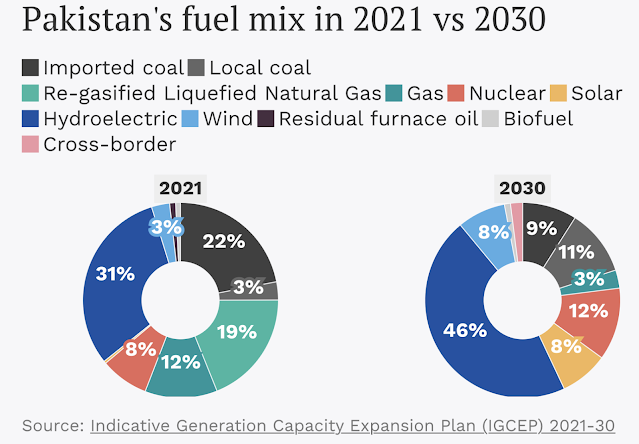
Currently, about one-half of the installed base consists of clean and low-carbon sources while the other half relies on fossil fuels. The actual power generation relies more heavily on clean sources. For example, hydropower contributes 36.6% of total generation, while coal generates 26.3% overall, split between local Thar coal and imported coal. Nuclear adds14.3% of the output and solar and wind account for approximately 4.3% on-grid, though private behind-the-meter installations have surged exponentially in recent years.
To reduce dependence on fossil fuel imports, Pakistan is tapping into the massive lignite coal reserves in the Thar Desert. Projects operating in Block I and Block II utilize domestic mining to provide reliable baseload power without draining foreign exchange reserves.
Major hydropower facilities like the Tarbela 5th Extension and ongoing mega-projects like Dasu and Diamer-Bhasha are expanding generation potential past 11,600+ MW. The Karachi Nuclear Power Plant (KANUPP K-2 and K-3) reactors supply crucial emissions-free base-load power to the southern grid network. Prompted by steep tariff hikes, private rooftop solar installations continue to surge across the industrial, agricultural and household sectors.
Pakistan has no choice but to make electricity cheap and plentiful to increase the productivity of its people. It is the best way for it to transition from a lower middle-income country to a high-income country.
After installing over 50 GW of solar panels as of early 2026, Pakistanis are now adding batteries at a rapid pace. The country has imported nearly 7.6 GWh of batteries, with nearly 60% of that total arriving during 2025 alone. Pakistanis are now installing batteries at a rate exceeding 5 GWh annually, according to a recent report by Renewable First. Batteries enable consumers to store excess solar electricity generated during daylight hours for use at night and to smooth out demand on the grid. Batteries also contribute to national grid stability, reducing costs and improving overall energy security for energy-import-dependent Pakistan.
By FY25, 7.3 million households in Pakistan had solar installed on their rooftops; out of a total 40 million households in the country, that makes nearly 1 in 5 of all Pakistani homes, the report says. With the battery boom gaining pace, around 282,000 solarized households, roughly 4%, now have BESS storage installed at home. That's 1 in every 26 solarized households, a share that is rising fast as storage costs continue to fall.
Battery prices have declined about 75% over the past decade, from over $460 per kWh in 2015 to approx. $110 per kWh in 2024, with forecast of further declines through 2027. The introduction of sodium-ion technology is likely to further accelerate widespread adoption of battery storage. Sodium-ion batteries are expected to replace lithium-ion (specifically low-cost LFP) batteries in most stationary (non-ev) applications by reducing prices by 30% to 50%.
A big chunk of Pakistan's import bill goes to pay for energy imports. Last fiscal year, which ended in June, 2026, Pakistan imported oil and gas worth $17 billion, exacerbating the current account deficit. By one estimate, Pakistan avoided over $12 billion in oil and gas import costs between 2021 and February 2026 because of its consumer-led solar revolution. A further ~$6.3 billion hydrocarbon import savings are projected by the end of 2026. Energy imports are the most volatile part of Pakistan's imports because of oil shocks such as the one created by the US-Iran war and the resulting closure of the Strait of Hormuz.
The ongoing solar revolution and battery boom in Pakistan will help reduce energy costs, improve energy security and help deal with the impact of climate change. Pakistan government policies should fully support this consumer-led movement toward the country's energy independence.
Pakistan is experiencing soaring demand for electricity across all of the sectors of its economy. The new demand is being met by rapidly growing deployment of distributed solar, estimated at 38 GW as of June, 2025. In 2025, 44% of solar deployment was residential, followed by industry (26%), agriculture (21%) and commercial users (9%). The expansion of distributed solar has enhanced electrification across the economy, lifting Pakistan's electrification rate to 21.7% in FY2025 from 17% in FY2023, close to the global average of 22%. This surge to over 200 terawatt-hours of electricity is not reflected in official data, according to a report by Ember Energy titled "The solarization of Pakistan's energy economy".
The solar energy revolution in Pakistan is led by consumers. Driven by soaring electricity costs, unreliable grid infrastructure, and cheap imported solar panels, millions of households and businesses have installed rooftop solar. This rapid transition to solar has transformed the country's energy landscape. According to the report, Pakistan’s total electricity demand increased by 33 terawatt-hours (TWh) between fiscal years 2023 and 2025. Distributed solar generation alone grew by 36 TWh during the same period, making it the primary driver of electricity demand growth and offsetting declines elsewhere in the power system.
"Pakistan has a thirst for energy, and solar is providing it," said Dave Jones, Chief Analyst at Ember. "Distributed solar is so fast and cheap to build, that it is actually driving up electricity demand." The newly added solar capacity has saved more than US$12 billion in oil and gas imports by February, 2026, Ember said, as well as enabling growth in the agriculture, industrial and commercial parts of Pakistan’s economy.
The report shows that net metered solar is a “minority” of Pakistan’s current capacity, with far more behind-the-meter and off-grid capacity than registered net metering solar. Distributed solar has ramped up rapidly. In just two years, 27 GW of distributed solar was installed, the same amount of operating coal, gas and oil plants built in Pakistan ever. Distributed solar is also cheaper — residential solar with a medium battery makes electricity at around PKR 20/KWh, half the PKR 40 price for grid electricity. The government statistics only capture the net-metered part of the solar electricity.
During the first nine months of 2025-26 fiscal year, Pakistan’s energy sector saw steady improvement, with hydro, renewable and nuclear sources overtaking fossil-fuel-based thermal power in installed generation capacity for the first time, according to the Pakistan Economic Survey for 2025-26.
Falling solar panel prices and soaring rates for grid electricity are driving a renewable power boom in Pakistan. A second factor spurring the growth in clean energy installations is the requirement of major western apparel brands for garments and textile manufacturers to switch to clean energy. As a result, the solar panel imports in the country jumped from 2,800 MW in 2022 to 5,000 MW in 2023, in spite of stringent import controls imposed by the government. Solar imports are on track to reach 12,000 MW in 2024, according to solar installers. The total current installed generation capacity in Pakistan is around 40,000 MW. Grid electricity demand in Pakistan plunged in 2023 by nearly a sixth and a decline in 2024 would mark the first time in 16 years that annual electricity use has fallen consecutively, data from energy think tank Ember showed, according to Reuters.
Omar Malik, the CEO of Shams Power, a major solar system contractor in Pakistan, was recently quoted by PV Magazine as saying: “In 2022, 2.8 GW of solar panels were imported into Pakistan. In 2023, about 5 GW, despite the import controls, and this year the prediction is for up to 12 GW”.
Aamir Hussain, chairman Pakistan Alternative Energy Association, told Arab News that solar panels of around 1,800 MW were purchased and installed last year, which was expected to jump to 3,000 MW this year due to the lower prices of the panels and increased customer demand.
“Pakistan will be spending over $3.5 billion [this year] on solar panel imports only as this doesn’t include import of batteries, inverters and other auxiliary items,” Hussain said. “Pakistan needs to follow consistent policies regarding renewable energy to meet its national and international obligations for the greenhouse gas emissions.”
Japanese publication Nikkei Asia recently reported seeing residential building rooftops covered with solar panels in Islamabad. It also reported proliferation of rooftop solar in small towns and villages across the country. In particular, the Nikkei story mentioned the remote village of Kardigap with a population of 5,000, in Balochistan province, where solar panels are becoming more common on the rooftops of houses.
Responding to western apparel brands' demand for sustainability, a number of large Pakistani textile manufacturers are switching to clean energy, particularly solar. Tayyab Group of Industries (TGOIs), a major textile manufacturer, has recently signed an MOU to install a 20 MW solar system for its needs. Gul Ahmed Textile Mills Limited announced recently that it will install a 17.1 MW roof-top solar power plant to meet its energy needs.
While rapid uptake of solar is good news for the planet, it does create a major fiscal issue for the Pakistani government struggling to pay for power produced by the independent power producers (IPPs). The IPPs, many of them Chinese, secured a guaranteed return on investment indexed to the U.S. dollar, plus payment for fixed capacity charges -- covering their debt servicing and other fixed costs -- regardless of whether the power plants are operational, according to Nikkei Asia. As the demand for the grid power from the IPPs declines with rising solar, the taxpayers are still on the hook for the unused installed capacity charges running into billions of dollars. Higher power tariffs and taxes will only make the situation worse.
Capping Net Metering power and reducing payments for supplying excess power to the grid are not going to solve the problem either. It will only encourage more consumers to switch to rooftop solar and use less electricity from the grid. Self consumption of the rooftop solar power saves significant energy costs for the consumer.
It seems the only way forward for the Pakistan government is to renegotiate the terms with the IPPs to significantly reduce grid power costs to address the growing cost gap between rooftop solar and the grid power.
With a new 330 MW mine-mouth coal-fired power plant in Tharparkar, Pakistan has now reached 990 MW of power fueled by the local lignite. Thar coal production is being expanded and plans are in place to convert three more imported anthracite coal fired plants to burn domestic lignite as soon as its production is expanded and a rail link is completed to transport the fuel to the rest of the country. Plans call for using Thar coal in three coal-fired plants currently burning imported coal: Sahiwal Coal Power, China Hub Coal Power and Port Qasim Coal, each of 1,320MW installed capacity. These power plants may require some limited equipment changes to burn domestic lignite. It is worth noting that Pakistan contributes less than 1% of the global greenhouse-gas emissions. Using the higher polluting domestic Thar lignite is crucial to Pakistan's desperate need for cheap energy to spur industrialization for economic growth without running into recurring balance of payments crises.
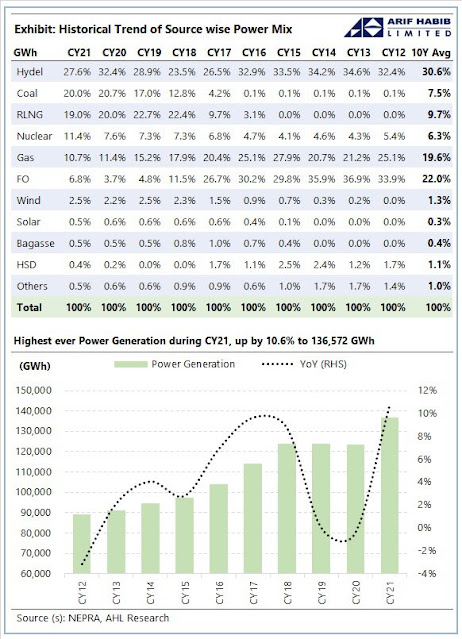
Pakistan Electric Power Generation Fuel MiX. Source: Arif Habib
Last year, hydroelectric dams contributed 37,689 GWH of electricity or 27.6% of the total power generated, making hydropower the biggest contributor to power generated in the country. It was followed by coal (20%), LNG (19%) and nuclear (11.4%). Nuclear power plants generated 15,540 GWH of electricity in 2021, a jump of 66% over 2020. Overall, Pakistan's power plants produced 136,572 GWH of power in 2021, an increase of 10.6% over 2020, indicating robust economic recovery amid the COVID19 pandemic.
Lucky power plant in Karachi has been designed to use Thar Lignite Coal when it is available in sufficient quantity. Until that time, it will operate on imported lignite coal. Domestic lignite production is being expanded in a bid to replace costly fossil fuel imports that are depleting Pakistan's foreign exchange reserves and exacerbating circular debt in the power sector, according to Nikkei Asia.
SECMC (Sindh Engro Coal Mining Company) has commissioned a study for converting the China-Pakistan Economic Corridor coal plants in Hub, Jamshoro and Sahiwal to indigenous lignite. A 105km long Thar Rail project is being planned to connect Thar coal fields with Main Line (ML-1) at the New Chhor Halt Station to transport lignite to the power plants in the rest of the country. The transportation of lignite by trucks to Karachi and Kallar Kahar shows its movement by road and rail is feasible and safe despite higher moisture.
Nuclear offers the lowest cost of fuel for electricity (one rupee per KWH) while furnace oil is the most expensive (Rs. 22.2 per KWH).
Construction of 1,100 MW nuclear power reactor K2 unit in Karachi was completed by China National Nuclear Corporation in 2019, according to media reports. Another similar reactor unit K3 is now in operation. It will add another 1,100 MW of nuclear power to the grid in 2022. Chinese Hualong One reactors being installed in Pakistan are based on improved Westinghouse AP1000 design which is far safer than Chernobyl and Fukushima plants.
The biggest and most important source of low-carbon energy in Pakistan is its hydroelectric power plants, followed by nuclear power. Pakistan ranked third in the world by adding nearly 2,500 MW of hydropower in 2018, according to Hydropower Status Report 2019. China added the most capacity with the installation of 8,540 megawatts, followed by Brazil (3,866 MW), Pakistan (2,487 MW), Turkey (1,085 MW), Angola (668 MW), Tajikistan (605 MW), Ecuador (556 MW), India (535 MW), Norway (419 MW) and Canada (401 MW).
Hydropower now makes up about 28% of the total installed capacity of 33,836 MW as of February, 2019. WAPDA reports contributing 25.63 billion units of hydroelectricity to the national grid during the year, “despite the fact that water flows in 2018 remained historically low.” This contribution “greatly helped the country in meeting electricity needs and lowering the electricity tariff for the consumers.”
Recent history shows that Pakistan's current account deficits vary with international oil prices. Pakistan's trade deficits balloon with rising imported energy prices. One of the keys to managing external account balances lies in reducing the country's dependence on foreign oil and gas.
Pakistan Power Generation Fuel Mix. Source: Third Pole
It is true that Pakistan has relied on imported fossil fuels to generate electricity. The cost of these expensive imported fuels like furnace oil mainly used by independent power producers (IPPs) has been and continues to be a major contributor to the "exaggerated external demand driven by its rentier economy" referred to by Atif Mian in a recent tweet. However, Pakistan has recently been adding hydro, nuclear and indigenous coal-fired power plants to gradually reduce dependence on imported fossil fuels.
Nuclear power plants in Pakistan generated 15,540 GWH of electricity in 2021, a jump of 66% over 2020. Overall, Pakistan's power plants produced 136,572 GWH of power, an increase of 10.6% over 2020, indicating robust economic recovery amid the COVID19 pandemic.
Hydroelectric dams contributed 37,689 GWH of electricity or 27.6% of the total power generated, making hydropower the biggest contributor to power generated in the country. It is followed by coal (20%), LNG (19%) and nuclear (11.4%).
Nuclear offers the lowest cost of fuel for electricity (one rupee per KWH) while furnace oil is the most expensive (Rs. 22.2 per KWH).
Pakistan Electric Power Generation Fuel MiX. Source: Arif Habib
Construction of 1,100 MW nuclear power reactor K2 unit in Karachi was completed by China National Nuclear Corporation in 2019, according to media reports. Fuel is being loaded in a similar reactor unit K3 which will add another 1,100 MW of nuclear power to the grid in 2022. Chinese Hualong One reactors being installed in Pakistan are based on improved Westinghouse AP1000 design which is far safer than Chernobyl and Fukushima plants.
The biggest and most important source of low-carbon energy in Pakistan is its hydroelectric power plants, followed by nuclear power. Pakistan ranked third in the world by adding nearly 2,500 MW of hydropower in 2018, according to Hydropower Status Report 2019. China added the most capacity with the installation of 8,540 megawatts, followed by Brazil (3,866 MW), Pakistan (2,487 MW), Turkey (1,085 MW), Angola (668 MW), Tajikistan (605 MW), Ecuador (556 MW), India (535 MW), Norway (419 MW) and Canada (401 MW).
Hydropower now makes up about 28% of the total installed capacity of 33,836 MW as of February, 2019. WAPDA reports contributing 25.63 billion units of hydroelectricity to the national grid during the year, “despite the fact that water flows in 2018 remained historically low.” This contribution “greatly helped the country in meeting electricity needs and lowering the electricity tariff for the consumers.”
Recent history shows that Pakistan's current account deficits vary with international oil prices. Pakistan's trade deficits balloon with rising imported energy prices. One of the keys to managing external account balances lies in reducing the country's dependence on foreign oil and gas.
Pakistan Power Generation Fuel Mix. Source: Third Pole
It is true that Pakistan has relied on imported fossil fuels to generate electricity. The cost of these expensive imported fuels like furnace oil mainly used by independent power producers (IPPs) has been and continues to be a major contributor to the "exaggerated external demand driven by its rentier economy" referred to by Atif Mian in a recent tweet. However, Pakistan has recently been adding hydro, nuclear and indigenous coal-fired power plants to gradually reduce dependence on imported fossil fuels.
Pakistani power sector is continuing its march toward cheap indigenous sources of electricity. Hydropower component has increased 22%, coal 57% and nuclear 8% while oil is down 54% and natural gas and LNG are down 32% and 15% respectively, according to Bloomberg. These changes in power mix are expected to help significantly reduce power subsidies that run into hundreds of billions of rupees contributing to large annual budget deficits.
Coal's contribution to power mix now stands at just 21%, in spite of 57% increase in use of coal in Fiscal Year 2020. It is still almost half of the global average of 38% of electricity produced from coal. Overall, the contribution of fossil fuels in electricity generation is now about 54%, down from nearly 66% a few years ago.
Hydropower and natural gas now contribute 32% each, making them the biggest sources of electricity in Pakistan. Coal comes next at 21%, followed by nuclear at 8%.
One of the biggest economic challenges Pakistan faces is it growing debt and deficit from subsidies to the power sector. Often referred to as "circular debt" in Pakistan, the government owes Rs. 1.6 trillion ($7.2 billion) to power sector at the end of June 2019. Pakistan government is now is committed to improving the situation by its development of an Indicative Generation Capacity Expansion Plan (IGCEP) that runs until 2040.
Pakistan recent efforts to diversify its fuel mix for cost reduction are raising hopes for cheap and abundant electricity needed for its industries and residential consumers. Already, the electricity generation cost is down 11% and current account deficit has declined 78%. There is a plan called "Indicative Generation Capacity Expansion Plan" in place. Execution is the key to making the power sector greener, cheaper and more reliable.
Pakistan National Electric Power Regulatory Authority (NEPRA) has cut electricity price by 2.99 rupees (2.7 U.S. cents) per unit under the fuel adjustment for the month of December, 2017, according to news reports. This reduction brings the price per kilowatt-hour to Rs. 5.11 (4.60 US cents), down from Rs. 8.10 (7.30 US cents).
Power Rate in Pakistan:
Reduction brings the price per kilowatt-hour to Rs. 5.11 (4.60 US cents), down from Rs. 8.10 (7.30 US cents). The CPPA (Central Power Purchasing Authority) said total energy was generated at the cost of Rs. 25.24 billion, or Rs. 3.52/unit for the month of November, 2017.
The reduction in the actual generation cost is mainly because of a decline in fuel prices, zero use of high-speed diesel in the power plants and higher contribution from the cheapest source – hydropower. The furnace oil (Rs. 9.03 per unit) has been replaced by domestic natural gas at Rs. 4.49 per unit and liquified natural gas (LNG) at Rs. 6.33 per unit.
This decision will not affect K-Electric consumers which is privately owned and generates its own power for residents of Karachi. K-Electric currently charges significantly higher rates of Rs. 12.77 per unit (11.50 US cents per unit).
Comparison With India:
Across the border in India, the nation's Central Electricity Regulatory Commission (CERC) has set the national average power purchase cost (APPC) at INR 3.48 (5.43 cents), barring a few states for open access. The APPC will apply during the financial year (FY) 2017-18 and until further orders for deviation settlement with respect to open access, according to Indian media reports.
The latest round of power rate cuts in Pakistan has brought the average electricity unit price (4.60 US cents) lower than that in neighboring India (5.43 US cents).
Future Power Rates:
The average cost per unit of power produced by new power plants being built in Pakistan as part of CPEC will likely be higher. It's mainly due to higher depreciation cost of new plant and equipment and higher guaranteed return on equity (ROE) of 17% for Chinese IPPs (Independent Power Producers). The 17% return on equity in Pakistan is higher than 4% to 15% ROE for power companies in India.
The average return on equity for almost 8,000 large US firms is 14.49%. The power utility companies – with an average of 10.13% – are on the lower end of the spectrum because they are viewed as less risky investments.
In the United States, the rate of return varies significantly from state to state, as each state regulator has exclusive authority to regulate utility operations as they choose.
In Advance Energy Economy (AEE) Power Portal database, which tracks ROE for over 100 investor-owned utilities across the country, the highest allowed ROE belongs to Alabama Power Co., at 13.75% and the lowest to United Illuminating Co. (CT) at 9.15%.
Within the US states, Alabama being seen as relatively less safe for investment, offers 13.75% return. So why is it such a surprise to see Pakistani regulator offer Chinese investors a higher rate of return of 17%?
Summary:
The current per unit average cost of electricity to consumers in Pakistan is 4.60 US cents while the average in India is 5.43 US cents. Per unit cost of electricity in Pakistan is likely to be bit higher with new capacity being built as part of China Pakistan Economic Corridor due to higher guaranteed rates of return offered to attract Chinese investors. However, plentiful supply of electricity from CPEC power projects will significantly boost economic growth and create millions of new jobs.
China and Pakistan have agreed to finance and build two mega dams in Gilgit-Baltistan region of Pakistan. A memorandum of understanding (MoU) for this development was signed by the leaders of the two countries on the sidelines of the Belt and Road Initiative (BRI) summit in Beijing.
The two dams, called Bunji and Diamer-Bhasha projects, will have the capacity to generate 7,100MW and 4,500MW of electricity respectively. China will provide $27 billion to fund the construction of the two dams, according to media reports.
Pakistan's Hydropower Potential:
Pakistan has the potential to generate 59,000MW of hydropower, according to studies conducted by the nation's Water and Power Development Authority (WAPDA). Currently, it's generating only 6,600MW of hydroelectric power, about 11% of the estimated potential. Media reports indicate that China is prepared to finance and build another 40,000MW capacity as part of the development of the Northern Indus Cascade region which begins in Skardu in Gilgit-Baltistan and runs through to Tarbela, the site of Pakistan’s biggest dam, in Khyber-Pakhtunkhwa province.
Diamer-Bhasha Water Storage:
Diamer-Bhasha project is located on Indus River, about 200 miles upstream from the existing Tarbela Dam, 100 miles downstream from the Northern Area capital Gilgit in Gilgit-Baltistan region. It will generate 4,500 MW of electricity and its reservoir will hold so much water that it could have averted recent devastating floods that affected large parts of Pakistan. It would also provide enough electricity to end Pakistan's crippling shortages, according to a report in the Guardian newspaper. The Diamer-Bhasha reservoir would be 50 miles long, holding 8.5 MAF (million acre feet) of water.
Response to Climate Change:
Pakistan has made only a small contribution to climate change through carbon emissions. And yet, it counts among the dozen or so nations considered most vulnerable to its damaging effects. These include rising temperatures, recurring cycles of floods and droughts and resulting disruption in food production.
One of the ways Pakistan can help reduce carbon emissions is by realizing its full hydroelectric potential by building more dams. The development of the Northern Indus Cascade region to generate 40,000MW of hydropower is a significant part of this effort.
Prerequisite for Economic Development:
Availability of abundant and cheap electricity has historically preceded rapid economic development in America, Europe and East Asia. Pakistan has an opportunity to meet this prerequisite by generating large amounts of clean renewable hydropower to meet its hunger for energy required for rapid economic growth in all sectors of the economy ranging from agriculture to manufacturing and services.
Summary:
Pakistan is endowed with significant amount of water and power resources that can be harnessed to enable rapid economic growth in all sectors of its economy. It appears that the Chinese investment, as part of China-Pakistan Economic Corridor, is now putting this goal within reach. Tens of thousands of megawatts of added electricity and millions of acre feet of additional water will hopefully transform Pakistan's economy and bring prosperity to its people.
China's state-owed banks will finance Chinese companies to fund, build and operate $45.6 billion worth of energy and infrastructure projects in Pakistan over the next six years, according to Reuters.
Major Chinese companies investing in Pakistan's energy sector will include China's Three Gorges Corp which built the world's biggest hydro power project, and China Power International Development Ltd.
Prime Minister Nawaz Sharif and President Xi Jinping
Under the agreement signed by Chinese and Pakistani leaders at a Beijing summit recently, $15.5 billion worth of coal, wind, solar and hydro energy projects will come online by 2017 and add 10,400 megawatts of energy to the national grid. An additional 6,120 megawatts will be added to the national grid at a cost of $18.2 billion by 2021.
Starting in 2015, the Chinese companies will invest an average of over $7 billion a year until 2021, a figure exceeding the previous record of $5.5 billion foreign direct investment in 2007 in Pakistan.
With over $7 billion a year, it will still, however, barely match the prior record of 3.75% of GDP set in 2007.
The biggest upside of this investment will be the generation of over 16,000 MW of additional electricity which should revitalize Pakistan's business and industry sectors and significantly boost its GDP.
The deal can be win-win for both if the Chinese companies coming in as independent power producers (IPPs) enjoy significant returns of 17% to 27% a year on their investment while Pakistan actually alleviates the nation's crippling electricity crisis to get its economy moving again. The assumption here is that Pakistan has learned from and corrected the prior mistakes in its existing cost-plus IPP contracts which guarantee significant profits to IPPs regardless of costs, efficiency and amount of power supplied to the grid.
Rapid increase in power generation is a well understood pre-requisite for accelerating industrialization and major improvements in productivity in this day and age. Pakistan needs sustained sharp focus on increasing electricity availability to improve productivity and living standards of its people.