Showing posts with label IMF. Show all posts

Monday, May 11, 2026

Is the India Growth Story Over?

In a television speech to the nation, Indian Prime Minister Narendra Modi urged his people to make sacrifices by spending less on fuel, fertilizer, and travel. He also asked them not to buy gold for a year. “To save foreign exchange, we must accept the challenge of patriotism,” he said. It appears that India's problems do not just stem from the effects of the US-Iran war; India's problems started well before that. Flight of foreign capital has put the Indian currency under tremendous pressure, with the Indian rupee falling nearly 10% in recent months. Many analysts believe that the Indian IT services exports could fall significantly as the artificial intelligence (AI) models begin to replace the IT workers. It could create a balance of payments crisis that could force India to seek the IMF bailout in the not too distant future.  Already, the Indian economy has slipped to the sixth-largest economy by nominal GDP, dropping from previous projections that had it at fourth.


Indian Economy Drops From 4th to 6th Rank. Source: IndMoneyApp

Energy Crisis:

India is facing a serious energy crisis driven by the closure of the Strait of Hormuz that has disrupted global oil and gas supplies. While the government has assured citizens that there are no immediate shortages of petroleum or natural gas, the escalating costs of imports are putting extreme pressure on the nation's foreign exchange reserves. 

AI Challenge: 

Indian IT firms are cutting staff to prepare for the expected disruption from the adoption of AI. For example, the IT services firm Cognizant is planning major workforce reductions that could impact between 12,000 and 15,000 employees globally, with India expected to account for the majority of the cuts, according to a report. 

A US-based investment research firm Citrini Research is forecasting a significant disruption to India's traditional IT services sector by 2027-2028, driven by the collapsing cost of AI coding agents. Here's an excerpt of the Citrini research report:

"The country’s IT services sector exported over $200 billion annually, the single largest contributor to India’s current account surplus and the offset that financed its persistent goods trade deficit. The entire model was built on one value proposition: Indian developers cost a fraction of their American counterparts. But the marginal cost of an AI coding agent had collapsed to, essentially, the cost of electricity. TCS, Infosys and Wipro saw contract cancellations accelerate through 2027. The rupee fell 18% against the dollar in four months as the services surplus that had anchored India’s external accounts evaporated. By Q1 2028, the IMF had begun “preliminary discussions” with New Delhi". 

Stocks Selloff: 

Sensing the growing crisis, Indian stock market investors are selling off their holdings. IN particular, foreign investors have accelerated their exit from Indian equities in early 2026, selling over $20 Billion in the first four months, driving 14-year low ownership levels. Triggered by Middle East conflicts, rising oil prices, and rupee depreciation, this record exodus—marking the worst quarterly selloff in March—was driven by outflows in banking, financial services, and IT.

Investors see the writing on the wall. The Indian economy has already dropped from the 4th to the 6th rank in the world. The Indian currency is under a lot of pressure. India's current account deficit will worsen with the loss of IT services exports. 

Related Links:


Haq's Musings

South Asia Investor Review

Builder.AI: Yet Another Global Indian Scam?

India's Ex Chief Economic Advisor: Indian GDP is 22% to 31% Smaller Than Official Claim

India's AI Spectacle of Chaos and Deception

Has the Modi Government's Politics Hurt India's International Image?

Pakistan's Official GDP Figures Ignore Fast Growing Sectors

India's "Firehose of Falsehoods"

State Bank Says Pakistan's Official GDP Under-estimated

Pakistan's Growing Middle Class

Pakistan's GDP Grossly Under-estimated; Shares Highly Undervalued

Fast Moving Consumer Goods Sector in Pakistan

Retail Investor Growth Drives Pakistan's Bull Market


Thursday, December 25, 2025

PIA Privatization: Can it Bring Back Pakistan National Airline's Glory Days?

After decades of failed attempts, the Government of Pakistan has finally privatized the Pakistan International Airline (PIA) under intense pressure from the International Monetary Fund (IMF). Nonetheless, it is a deal that will give the national airline not only a chance to survive but to thrive in the long run. As part of structuring the sale for Rs. 135 billion, the government has assumed Rs. 654 billion in debt and pension obligations. The government gets only Rs. 10 billion in cash but it gives the new owners a clean balance sheet in return for a commitment to invest Rs. 125 billion of the Rs. 135 billion sale price in the carrier. 

PIA Privatization Deal Structure. Source: Standard Capital Securities Pvt Ltd.


Pakistani politicians have used state-owned enterprises like the PIA as a vehicle for doling out political patronage. They have given jobs, including top jobs, to political cronies who have neither the experience nor the inclination to run these PSUs like businesses. Their focus has been on extracting as much financial gains as possible, and sharing some of these gains with their political patrons. 

Privatization will save Pakistan’s taxpayers tens of billions of rupees each year, and raise the prospect of the PIA becoming a contributor rather than a continuous drain on the national  treasury. Prior experience with privatizations of state-owned units like banks and the telecom company has shown that this is a realistic expectation. Taxpayer money saved can be used to fund education, healthcare and critical infrastructure. 

The PIA has a huge potential to succeed as an airline business. It has lucrative routes and landing rights which it is currently unable to fully utilize. It has a small aging fleet of 32 aircraft. Half of the fleet is out of service at any given time due to maintenance issues. 

Arif Habib, the head of the buying consortium which was advised by New York-based Seabury Aviation Partners, has committed to hiring a professional management team to run the PIA as a business to serve its customers and shareholders. He has announced plans to grow the PIA fleet from around 15-18 operational aircraft to 38 in the first phase, then potentially reaching 64-65 aircraft within a few years, essential for reclaiming international routes and improving service by adding more planes and restoring operational strength. 

Pakistan has the world's 6th largest diaspora. In addition, millions of Pakistanis travel for Hajj and Umrah pilgrimage to Saudi Arabia each year. Majority of the overseas Pakistanis and pilgrims would choose to travel by PIA if it offered convenient schedules and better service with direct flights to Pakistan. 

A successful national airline can make a significant contribution to the nation's economy by improving connectivity for tourism, trade and investment in the country. Business people, in particular, value their time.  Operating direct, non-stop flights to destinations in Pakistan from major international airports are essential for serving this customer base. 

Related Links:

Haq's Musings

South Asia Investor Review

Pakistan Air Travel Market

Pakistan $20 Billion Tourism Industry Booming

Saving PIA, Railways and Education in Pakistan

Pakistan: Political Patronage Trumps Public Policy

Riaz Haq's Youtube Channel


Sunday, November 30, 2025

IMF Questions Modi's GDP Data: Is India's Economy Half the Size of the Official Claim?

The Indian government reported faster-than-expected GDP growth of 8.2% for the September quarter. It came as a surprise to many economists who were expecting a slowdown based on the recent high-frequency indicators such as consumer goods sales and durable goods production, as well as two-wheeler sales. At the same time, The International Monetary Fund expressed doubts about the Indian government's GDP data. 


The IMF has recently expressed doubts about Prime Minister Narendra Modi's BJP government's GDP data. It has particularly questioned the government's statistical methodologies, inflation measurement, and the estimates of the informal economy used in reporting the country's gross domestic product. Professor Arun Kumar of Jawaharlal Nehru University believes the IMF's concerns are valid. He thinks the real size of India's economy is only half of what is officially claimed.  “The economy is almost 50% wrong – when the government says it’s $3.8 trillion, my estimate is it is probably still $2.5 trillion because we are overestimating the unorganized sector, which is actually declining. This is building up over a period of time,” Kumar told Indian journalist Karan Thapar. 

In its recent assessment, the International Monetary Fund (IMF) has given a "C" grade to India's national accounts. In particular, the IMF has raised the issue of the government using 2011-12 as the base year as being outdated, the discrepancy between production and consumption data and the use of Wholesale Price Index, and not a Producer Price Index, to deflate many economic activities to derive real GDP from nominal GDP. 

The source of the biggest error is the way India estimates the informal economy which, including agriculture, accounts for almost 45% of GDP. To do so, India uses the formal sector as a proxy to estimate the performance of the informal sector. But if the two sectors are moving in opposite directions, as has happened after demonetization, GST imposition and the pandemic, you could end up overestimating the unorganized sector.

Indian-American economist Ashoka Mody, author of "India is Broken", has argued that the current unemployment crisis in India is a direct result of the destruction of the informal sector, particularly the mom and pop stores that employed a large number of Indians. 

Questions about the veracity of India's official GDP figures are not new. These have been raised by many top economists. For example,  French economist Thomas Piketty argues in his best seller "Capital in the Twenty-First Century that the GDP growth rates of India and China are exaggerated.  Picketty writes as follows:

"Note, too, that the very high official growth figures for developing countries (especially India and China) over the past few decades are based almost exclusively on production statistics. If one tries to measure income growth by using household survey data, it is often quite difficult to identify the reported rates of macroeconomic growth: Indian and Chinese incomes are certainly increasing rapidly, but not as rapidly as one would infer from official growth statistics. This paradox-sometimes referred to as the "black hole" of growth-is obviously problematic. It may be due to the overestimation of the growth of output (there are many bureaucratic incentives for doing so), or perhaps the underestimation of income growth (households have their own flaws)), or most likely both. In particular, the missing income may be explained by the possibility that a disproportionate share of the growth in output has gone to the most highly remunerated individuals, whose incomes are not always captured in the tax data." "In the case of India, it is possible to estimate (using tax return data) that the increase in the upper centile's share of national income explains between one-quarter and one-third of the "black hole" of growth between 1990 and 2000. "


Related Links:

Haq's Musings

South Asia Investor Review

Builder.AI: Yet Another Global Indian Scam?

Is India Fudging GDP to Look Better Than China?

India's IT Exports Highly Exaggerated

Has the Modi Government's Politics Hurt India's International Image?

Pakistan's Official GDP Figures Ignore Fast Growing Sectors

India's "Firehose of Falsehoods"

State Bank Says Pakistan's Official GDP Under-estimated

Pakistan's Growing Middle Class

Pakistan's GDP Grossly Under-estimated; Shares Highly Undervalued

Fast Moving Consumer Goods Sector in Pakistan

Retail Investor Growth Drives Pakistan's Bull Market


Tuesday, July 22, 2025

Which Country is a Bigger Beggar? India or Pakistan?

Most countries in the world today borrow money from various sources to finance their budget deficits. So do India and Pakistan. So why is it that only Pakistan's borrowing money gets labeled "begging"? Is it not begging when India borrows a lot more money than does Pakistan? Or is it that only borrowing money from the IMF qualifies as "begging"? Let's look into this double standard.  Currently, India's public debt to GDP ratio is 80% while Pakistan's is about 74%. India's private debt to GDP ratio is 17%, twice that of Pakistan. Do these figures mean that India is a bigger beggar than Pakistan? 


Debt-to-GDP Ratios Around the World. Source: Visual Capitalist


India is consistently among the largest borrowers from International Financial Institutions (IFIs), particularly the World Bank and the Asian Development Bank (ADB). It has been the top debtor to the World Bank for several years and a major borrower from the ADB.  India’s outstanding loan balance with the World Bank is almost double that of the next biggest debtor, Indonesia, which owed the bank $22.2 billion. Pakistan and Bangladesh followed with just short of $20 billion and $19.8 billion, respectively.  India is also the largest borrower from the Asian Development Bank (ADB). Since 1986, when ADB began lending to India, it has approved many loans, grants, and technical assistance totaling $55.3 billion.


Top Debtors to World Bank 2025. Source: Visual Nerd

One key difference between the two South Asian neighbors is the frequency with which Pakistan has been borrowing from the International Monetary Fund, known as the lender of last resort.  Pakistani economic managers have had a poor track record of managing hard currency reserves that the country needs to import what it lacks. Pakistani exports have failed to keep pace with its rising imports. This situation creates a crisis situation every few years and it forces the country to ask the IMF to lend its US dollars.  Currently, Pakistan ($6.3 billion) is IMF's 5th highest debtor after  Argentina ($31.1 billion), Ukraine ($10.19 billion), Egypt ($8.6 billion) and Ecuador ($6.6 billion). The only saving grace is the rapid growth in remittances from the Pakistani diaspora. In the last fiscal year that ended in June, 2025, overseas Pakistanis sent home $38.3 billion, representing 27% growth from the prior fiscal year. It helped Pakistan achieve a current account surplus of $2.1 billion, compared to a current account deficit of $2.1 billion in the previous fiscal year. 


Global Income Levels By Country. Source: Visual Capitalist


Top IMF Debtor Nations. Source: IntelPoint


Pakistan's average economic growth of 5% a year has been faster than the global average since the 1960s, it has been slower than that of its peers in East Asia. It has essentially been constrained by Pakistan's recurring balance of payment (BOP) crises as explained by Thirlwall's Law. Pakistan has been forced to seek IMF bailouts 14 times in the last 75 years to deal with its BOP crises. This has happened in spite of the fact that remittances from overseas Pakistanis have grown 38X since 2000. Every time Pakistan has faced a balance of payments crisis, the result has been massive currency devaluation, high inflation and slower growth for a period of multiple years. The best way for Pakistan to accelerate its growth beyond 5% is to boost its exports by investing in export-oriented industries, and by incentivizing higher savings and investments. 

Related Links:

Haq's Musings

South Asia Investor Review

New Infrastructure Brings Socioeconomic Development to Thar Desert

Pakistan Revives Reko Diq Mining Project

Kachhi Canal and N-70 Projects Boost Pakistan's Balochistan

Iftikhar Chaudhry Scared Away Foreign Investors

Musharraf Earned Legitimacy by Good Governance

Vindictive Judges Pursue Musharraf

Rare Earths at Reko Diq?


Friday, January 3, 2025

Pakistan Stock Market Among World's Best Performers in 2024

Pakistan's KSE-100 index soared 86% in 2024, making it the second best among major indexes, according to Bloomberg News. The 2024 performance of KSE-100 represents its best year since 2002 when it shot up 112%. The top 3 performing stock markets in 2024 were Argentina (114%), Pakistan (88%) and Kenya (79%), according to Topline Securities. The US markets posted double digit gains with the AI-driven tech-heavy NASDAQ-100 up 27.6%. Small and medium US companies performed well with the Russell 2000 Index edging out India's Sensex with an 8.9% return.  

Pakistan Among Top Performing Stock Markets in 2024. Source: Bloomberg


Clearly, the $7 billion IMF program helped restore some investor confidence in Pakistan's economy in 2024. It was also boosted by remittances from overseas Pakistanis in  July-October 2024 which soared nearly 35% YoY to $11.8 billion as compared to $8.8 billion in July-Oct 2023. The fact that the KSE100 shares valuations relative to earnings still remain at historic lows (PE ratio of just 5.9) is an indication that investors have doubts about the sustainability of the economic improvements in the country. Among the top investor concerns appear to be worsening internal security situation and rising political instability. 


History of Pakistan's KSE-100 Returns Since 1995. Source: Bloomberg


Pakistan's macroeconomic indicators have significantly improved in 2024. Inflation has come down dramatically, from 29.7% in December 2023 to 4.1% in December 2024, resulting in aggressive monetary easing of 900 bps by the State Bank of Pakistan (SBP). The current account deficit has turned into a surplus of $729 million in November 2024 and the currency has remained stable.  In spite of the run-up, the KSE-100 2025 forward PE ratio of 5.9x is still substantially below the 10-year average P/E of 8.2x. 

Pakistan Shares Index PE Ratio. Source: Arif Habib

Pakistan's exports grew to $16.56 billion, an increase of 10.52% in July-Dec period in 2024 over the same period in 2023, while  imports grew 6.11% to $27.73 billion in this period. Pakistan's textile exports grew 9.7% in the first six months of the current fiscal year. The trade deficit in July-December FY25 increased 0.18% to $11.17 billion from $11.15 billion over the prior year. In December, the deficit jumped 34.80% to $2.44 billion from $1.82 billion in December 2023. The trade gap contracted to $24.08 billion in FY24 from $27.47 billion in the preceding year. The current account improvement was helped by remittances from overseas Pakistanis in  July-October 2024 which soared nearly 35% YoY to $11.8 billion as compared to $8.8 billion in July-Oct 2023.

Pakistan Textile Exports. Source: Arif Habib


In 2024, Pakistan began to make some progress to resolve the economic impact of high electricity rates and rising debt (PKR 2.1 trillion) owed to the independent power producers (IPPs). While the government terminated or renegotiated power purchase contracts (PPAs) with some IPPs, the consumers took matters into their own hands and started an unprecedented solar energy revolution

As a result of the latest round, PPAs with five IPPs were terminated as a first step. Two of the five IPPs took haircut deals, accepting a discount of up to PKR 20 billion. 18 other IPPs face possible conversion to take-and-pay contracts, whereby the state-owned off-taker will only be liable to pay for energy consumed by the grid, eliminating capacity charges, according to a report by the Institute for Energy Economics and Financial Analysis. 

Pakistan Solar Projects Seen From Satellites. Source: Atlas Via Bloomberg


High power prices are fueling a massive solar buildout across Pakistan, according to a Yale360 report. Solar imports from China so far this year have already outstripped imports across all of last year, Bloomberg reports. Panels purchased in 2024 amount to 17 gigawatts of capacity, enough to raise Pakistan's total power capacity by a third. A satellite data analysis done in April by Norwegian firm Atlas revealed around 400 solar plants across the country, clustered mostly in industrial hubs. But many more installations went undetected, the geospatial analysis firm said. Most panels have been deployed almost equally across homes, factories, and farms, solar distributors say. 

Related Links:

Thursday, September 26, 2024

Investors Celebrate Pakistan's Continuing Economic Recovery

Pakistan's benchmark KSE-100 index hit an all-time high after the announcement of the $7 billion IMF bailout deal today. Economic indicators such as inflation, exports and remittances are also showing significant improvement as well. Speaking to reporters after the IMF deal,  the Fund Managing Director  Kristalina Georgieva acknowledged progress made by Pakistan. She said  "The economy is on the sound path. Growth is up and inflation is down". The KSE-100 index rose in early trade to a record high of 82,905.73 points, before giving up those gains later in the day to close 0.7% down at 81,657. It still represents an annual gain of nearly 100%. 

Pakistani Stock Market Outperforms Asian Peers. Source: Bloomberg


Pakistan rupee has remained essentially stable at around Rs. 277 to a US dollar over the last year. Inflation has come down from 37% last year to less than 10% this year.  Exports have climbed 10.54% ($2.921 billion) to $30.645 billion during the fiscal year 2023-24 compared to $27.724 billion in the corresponding period of 2022-23. Overseas workers' remittances have surged 44% to $5.94 billion in the first two months (July-August) of the current fiscal year 2024-25, compared to the same period last year.  Current account deficit has declined to $681 million in FY24 from $3.275 billion in FY23. The budget deficit for the 2023–2024 fiscal year has been reduced to 6.8% of GDP from 7.7% in the previous year. 

The stock market gains are driven primarily by the increasing profitability of the firms making up the index, in addition to improvement in macroeconomic indicators. The companies listed on Pakistan’s KSE-100 Index have reported their highest-ever earnings of Rs1.7 trillion in FY24, marking a 25% year-on-year increase from Rs1.3 trillion in FY23. In US dollar terms, profits after tax (PAT) rose 10% to $5.8 billion during the same period, according to data compiled by brokerage firm Topline Securities.  Dividend payouts soared 30% as banking, fertilizer, and cement sectors led growth, according to media reports. 

Pakistan has a long tough road ahead to carry out the reforms promised to the IMF in the latest bailout deal. Renegotiating unsustainable IPP (Independent Power Producers) contracts and carrying out long-delayed  privatization of state-owned enterprises to reduce major drain on the taxpayers will not be easy, Boosting tax collection is not easy either. Offering incentives for savings, investments and exports while reducing budget deficits is a difficult feat. It will take a lot of fortitude, finesse and political will to get the results to improve the economy. Pakistani leaders' biggest challenge is to find a way to grow the economy to create enough jobs for the country's growing working age population. Failure to do so could cause major social unrest in the nuclear-armed country of 240 million people. 

Related Links:

Thursday, July 4, 2024

Pakistani Stock Market is the World's Best Performing Market in 2024

Pakistan's KSE-100 shares index topped 80,000 points on Wednesday as stocks climbed more than 600 points, making it the world's best performing stock market. The benchmark KSE-100 index has posted an annual return of 89% during FY24 (July 2023-June 2024) in PKR terms while in US dollar terms, the return was 94%, as the Pakistani rupee appreciated against the US dollar, according to Pakistani media reports.  This outstanding market performance is generally being seen as a consequence of a series of unpopular decisions  by the military-backed government of Prime Minister Shahbaz Sharif to carry out economic reforms to win the IMF support. 

Pakistani Stock Market Outperforms Asian Peers. Source: Bloomberg

Specifically, some analysts attribute the record increase in Pakistani share prices to multiple factors, ranging from the government's investor-friendly budget to the expectation of closing a longer term IMF deal. Others believe the relatively low price-earnings (P/E) multiples of Pakistani stocks make them attractive to investors. 

Awais Ashraf, director of research at AKD securities, attributed the stocks upward momentum to “expected entry into the larger IMF program and expected monetary easing boosting investor confidence in equities”, according to Dawn newspaper

“The majority increase in return is attributed to re-rating of Price to Earning (PE) from 2.2-2.4x in June 30, 2023 to 3.94x in Jun 28, 2024,” said a Pakistani investment firm Topline Securities in its report. It attributed the PE multiple re-rating to “improving economic indicators, i.e. increase in exports and remittances by 11% and 9%, respectively in 11MFY24, decline in inflation from peak of 38.0% in May-23 to 11.8% in May 2024.”

Foreign portfolio investors are coming back to Pakistan’s debt and equity markets after a prolonged absence, marking a significant shift in market sentiment, according to a report in The Express Tribune newspaper. The short-term external investment has surged by a remarkable 84%, catapulting to a 30-month high, now standing at Rs 501.30 billion (US$ 1.8 billion) .

There is a distinct difference in how the new budget, compliant with the IMF requirements, has been received by the ordinary public compared to the investor class. Higher taxes on consumption in the new budget have angered most consumers but the prospects of  lower fiscal deficits and significant macro-economic improvements are generally being welcomed by investors. The government, backed by the Pakistani military, sees the need to improve the macro-economic indicators as essential to improving the long-term health of the national economy

Related Links:

Monday, January 8, 2024

India's Malign Influence in Bangladesh

Shaikh Hasina has won a 5th term in yet another sham election which saw a mere 40% voter turnout. Bangladesh Nationalist Party (BNP), the main opposition party, boycotted the election. Months leading up to the elections saw protests in the country suffering from economic slowdown, human rights violations and a crackdown on the opposition parties. Her longevity in office is believed to be largely orchestrated by India. Her own Foreign Minister Abdul Momen acknowledged this fact when he made a trip to New Delhi in 2022 and said,  "I've requested Modi government to do whatever is necessary to sustain Sheikh Hasina's government". 

Bangladesh PM Shaikh Hasina (L) with Indian PM Narendra Modi

Upon her return from India in 2022, Sheikh Hasina told the news media in Dhaka, "They (India) have shown much sincerity and I have not returned empty handed". It has long been an open secret that Indian intelligence agency RAW helped install Shaikh Hasina as Prime Minister of Bangladesh, and her Awami League party relies on New Delhi's support to stay in power. Bangladesh Foreign Minister Abdul Momen has described India-Bangladesh as one between husband and wife. In an interview with Indian newspaper 'Ajkal,' he said, "Relation between the both countries is very cordial. It's much like the relationship between husband and wife. Though some differences often arise, these are resolved quickly."  Both Bangladeshi and Indian officials have reportedly said that Sheikh Hasina "has built a house of cards". 

British Indian analyst Dr. Avinash Paliwal explains Shaikh Hasina's current dilemma as follows: "Politically reliant on New Delhi, she (Hasina) is finding it increasingly difficult to manage the ramifications of India's turn towards Hindu nationalism that misuses migration from Bangladesh and the Rohingya crisis for domestic electoral gain". Justice Surendra Kumar Sinha, Bangladesh's former Chief Justice,  has said India is backing Sheikh Hasina's autocratic government for its own interest. Here's how prominent Indian journalist SNM Abdi explains Indian intelligence agency RAW's influence in Bangladesh: "India wields more influence in Bangladesh than the Security Council’s five permanent members put together. The Research and Analysis Wing (RAW) is the most dreaded outfit in the neighboring country surpassing even the brutally unforgiving RAB (Rapid Action Battalion). Hasina lives in mortal fear of RAW. She knows that she will be toppled if she displeases India. So she has adopted the policy of pleasing India to retain power at any cost".

Bangladesh has received wide acclaim for its remarkable economic success under the authoritarian leadership of Shaikh Hasina over the last decade. She has jailed many of her political opponents and hanged others. She has tamed the country's judiciary and gagged Bangladeshi mainstream media. What has helped her retain power is the fact she has New Delhi's support and she has succeeded in delivering rapid economic growth that has helped improve the lives of ordinary Bangladeshis. However,  a combination of current global inflation and the resulting economic crisis is unravelling this formula. Ordinary Bangladeshis are being hit by high food and fuel prices. There is widespread discontent and anger among the people of Bangladesh against the Hasina government and its chief supporter India. 

Bangladesh's currency taka has depreciated by over 40% against the US dollar in the last two years, import bill has soared by nearly 44%, forex reserves have declined to $20 billion and the revenue from ready made garments export and remittances is not keeping pace with the fast rising imports. Bangladesh is receiving a $4.7 billion IMF bailout to cope with the situation. In addition, India has agreed to trade with Bangladesh in local currencies to reduce pressure on forex reserves. 

Falling Foreign Direct Investment in India. Source: NY Times

Bangladesh is not the only economy in trouble. The European Union, United Kingdom, Japan, Sri Lanka and Pakistan are also experiencing severe economic pain. India's forex reserves are falling and its current account deficit is rising as foreign direct investment declines. High energy prices and the strong US dollar are hurting most of the world economies. Food and energy prices have shot up due to the Russia-Ukraine war. The US currency driven by aggressive US Federal Reserve policy of rate hikes has reached new highs. A stronger dollar for the US means cheaper imports, a tailwind for efforts to contain inflation, and record relative purchasing power for Americans. But the rest of the world is straining under the dollar’s rise, according to the Wall Street Journal


Sunday, August 7, 2022

Pakistan Plans to Convert Coal-Fired Power Plants to Burn Domestic Thar Lignite

With a new 330 MW mine-mouth coal-fired power plant in Tharparkar, Pakistan has now reached 990 MW of power fueled by the local lignite. Thar coal production is being expanded and plans are in place to convert three more imported anthracite coal fired plants to burn domestic lignite as soon as its production is expanded and a rail link is completed to transport the fuel to the rest of the country. Plans call for using Thar coal in three coal-fired plants currently burning imported coal: Sahiwal Coal Power, China Hub Coal Power and Port Qasim Coal, each of 1,320MW installed capacity. These power plants may require some limited equipment changes to burn domestic lignite. It is worth noting that Pakistan contributes less than 1% of the global greenhouse-gas emissions. Using the higher polluting domestic Thar lignite is crucial to Pakistan's desperate need for cheap energy to spur industrialization for economic growth without running into recurring balance of payments crises. 

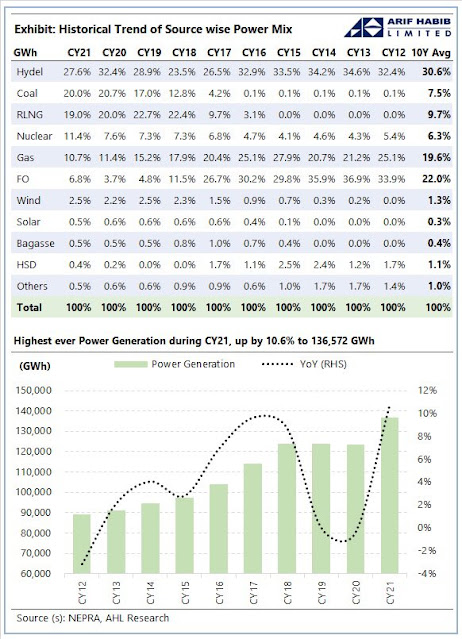
Pakistan Electric Power Generation Fuel MiX. Source: Arif Habib

 Last year, hydroelectric dams contributed 37,689 GWH of electricity or 27.6% of the total power generated, making hydropower the biggest contributor to power generated in the country. It was followed by coal (20%), LNG (19%) and nuclear (11.4%).  Nuclear power plants generated 15,540 GWH of electricity in 2021, a jump of 66% over 2020.  Overall, Pakistan's power plants produced 136,572 GWH of power in 2021, an increase of 10.6% over 2020, indicating robust economic recovery amid the COVID19 pandemic. 

Lucky power plant in Karachi has been designed to use Thar Lignite Coal when it is available in sufficient quantity.  Until that time, it will operate on imported lignite coal. Domestic lignite production is being expanded in a bid to replace costly fossil fuel imports that are depleting Pakistan's foreign exchange reserves and exacerbating circular debt in the power sector, according to Nikkei Asia.  

SECMC (Sindh Engro Coal Mining Company) has commissioned a study for converting the China-Pakistan Economic Corridor coal plants in Hub, Jamshoro and Sahiwal to indigenous lignite. A 105km long Thar Rail project is being planned to connect Thar coal fields with Main Line (ML-1) at the New Chhor Halt Station to transport lignite to the power plants in the rest of the country. The transportation of lignite by trucks to Karachi and Kallar Kahar shows its movement by road and rail is feasible and safe despite higher moisture.


Pakistan Electric Power Generation. Source: Arif Habib


Cost Per Unit of Electricity in Pakistan. Source: Arif Habib


Nuclear offers the lowest cost of fuel for electricity (one rupee per KWH) while furnace oil is the most expensive (Rs. 22.2 per KWH). 
 

Construction of 1,100 MW nuclear power reactor K2 unit in Karachi was completed by China National Nuclear Corporation in 2019, according to media reports. Another similar reactor unit K3 is now in operation. It will add another 1,100 MW of nuclear power to the grid in 2022. Chinese Hualong One reactors being installed in Pakistan are based on improved Westinghouse AP1000 design which is far safer than Chernobyl and Fukushima plants.  

The biggest and most important source of low-carbon energy in Pakistan is its hydroelectric power plants, followed by nuclear power. Pakistan ranked third in the world by adding nearly 2,500 MW of hydropower in 2018, according to Hydropower Status Report 2019.  China added the most capacity with the installation of 8,540 megawatts, followed by Brazil (3,866 MW), Pakistan (2,487 MW), Turkey (1,085 MW), Angola (668 MW), Tajikistan (605 MW), Ecuador (556 MW), India (535 MW), Norway (419 MW) and Canada (401 MW).

New Installed Hydroelectric Power Capacity in 2018. Source: Hydroworld.com


Hydropower now makes up about 28% of the total installed capacity of 33,836 MW as of February, 2019.   WAPDA reports contributing 25.63 billion units of hydroelectricity to the national grid during the year, “despite the fact that water flows in 2018 remained historically low.” This contribution “greatly helped the country in meeting electricity needs and lowering the electricity tariff for the consumers.”

Pakistan's Current Account Balance vs International Oil Prices. Source: Arif Habib


Recent history shows that Pakistan's current account deficits vary with international oil prices.  Pakistan's trade deficits balloon with rising imported energy prices. One of the keys to managing external account balances lies in reducing the country's dependence on foreign oil and gas. 


Pakistan Power Generation Fuel Mix. Source: Third Pole

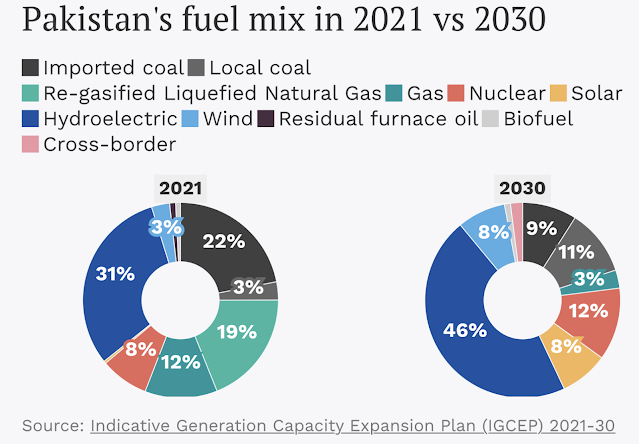
It is true that Pakistan has relied on imported fossil fuels to generate electricity. The cost of these expensive imported fuels like furnace oil mainly used by independent power producers (IPPs) has been and continues to be a major contributor to the "exaggerated external demand driven by its rentier economy" referred to by Atif Mian in a recent tweet. However, Pakistan has recently been adding hydronuclear and indigenous coal-fired power plants to gradually reduce dependence on imported fossil fuels. 

Related Links:


Haq's Musings

South Asia Investor Review

Pakistan Among World's Largest Food Producers

Naya Pakistan Housing Program

Food in Pakistan 2nd Cheapest in the World

Indian Economy Grew Just 0.2% Annually in Last Two Years

Pakistan to Become World's 6th Largest Cement Producer by 2030

Has Bangladesh Surged Past India and Pakistan in Per Capita Income?

Pakistan's Computer Services Exports Jump 26% Amid COVID19 Lockdown

Coronavirus, Lives and Livelihoods in Pakistan

Vast Majority of Pakistanis Support Imran Khan's Handling of Covid19 Crisis

Pakistani-American Woman Featured in Netflix Documentary "Pandemic"

Incomes of Poorest Pakistanis Growing Faster Than Their Richest Counterparts

Can Pakistan Effectively Respond to Coronavirus Outbreak? 

How Grim is Pakistan's Social Sector Progress?

Double Digit Growth in Pakistan's Energy Consumption Confirms Economic Recovery


Trump Picks Muslim-American to Lead Vaccine Effort

COVID Lockdown Decimates India's Middle Class

Pakistan to be World's 7th Largest Consumer Market by 2030

Pakistan's Balance of Payments Crisis

How Has India Built Large Forex Reserves Despite Perennial Trade Deficits

Conspiracy Theories About Pakistan Elections"

PTI Triumphs Over Corrupt Dynastic Political Parties

Strikingly Similar Narratives of Donald Trump and Nawaz Sharif

Nawaz Sharif's Report Card

Riaz Haq's Youtube Channel

Sunday, February 21, 2021

Imran Khan Government's Midterm Review: Economy and Foreign Policy

Imran Khan's government has completed about half of its 5-year term it won in 2018. What are its accomplishments? Where has it failed in terms of economy and foreign policy. 

Economy:

Imran Khan inherited a serious balance of payments crisis cased by flat exports and record high imports in 2013-2018 period under Pakistan Muslim League (Nawaz) government. while the PTI government was still dealing with it, the country and the world were hit by COVID19 pandemic that devastated the global economy. 

Pakistan's Trade July2020-Jan2021. Source: Arif Habib


The 2019 International Monetary Fund's bailout required the PTI government to significantly devalue the Pakistani rupee to make exports competitive, and to raise interest rates to slow down imports. These actions triggered inflation, particularly food inflation, as energy and fertilizer prices rose. 

Export Growth in South Asia. Source: Wall Street Journal

The global COVID19 pandemic hit Pakistan and the world while the PTI government was still trying to stabilize the economy. The global economy slowed down as a result of lockdowns imposed around the world to slow the spread of the novel coronavirus. It impacted South Asian economies but Pakistan was thankfully spared the worst of it. 
Pakistan Vehicle Sales 1H FY20-21. Source: Arif Habib


Now Pakistani economy is finally stabilizing and a strong recovery is underway. The recovery is led particularly by the construction and manufacturing sector as evident from double digit increases in cement consumption and large scale manufacturing growth. 

Cement Sales in Pakistan. Source: Bloomberg


Foreign Policy:

One of Pakistan's key foreign policy successes is the US-Taliban Peace Deal. But now there is uncertainty surrounding it with the inauguration of President Joseph Biden. Biden's election and the growing rivalry between US and rising China have changed the calculus in South Asia and the Middle East regions, impacting Pakistan. Former President Trump's erratic behavior has also contributed to it. 

Based on Biden's record as Obama's vice president, it is expected that the new US president will continue to support a stable Pakistan. A suggestion that has been made by former State Department officials Shumaila Chaudhry and Vali Nasr is for the US to take advantage of Pakistan's free trade deal with China by setting up value-added re-export units in the country. 

Please watch this discussion with Faraz Darvesh as host and Dr. Owais Saleem, Sabahat Ashraf and Riaz Haq as panelists:

https://youtu.be/Cse9j72H1cU


Related Links:


How "Illiterate" Are Pakistan's "Illiterate" Cell Phone Users?


Saturday, September 12, 2020

Thirlwall Law: Why Hasn't Pakistan's GDP Grown Faster Than 5% Average Since 1960s?

Pakistan's economy has grown at a compounded annual growth rate (CAGR) of about 5% since the 1960s. While Pakistan's average 5% annual economic growth rate is faster than the global average, it falls significantly short of its peer group in Asia. The key reason is that, unlike Pakistan's, the East Asian nation's growth has been fueled by rapid rise in exports. History shows that Pakistan has run into balance of payments (BOP) crises whenever its growth has accelerated above 5%. These crises have forced Pakistan to seek IMF bailouts 13 times in its 73 year history. Pakistan's current account deficits would be a lot worse without 23X growth in remittances from overseas Pakistanis since year 2000.  What Pakistan has experienced is BOP-constrained growth as explained in 1979 by Thirlwall Law, a law of economics named after British economist Anthony Philip Thirlwall.  Another reason why Pakistan has lagged its Asian peers in terms of economic growth is its lower savings and investment rates. Every time Pakistan has faced a balance of payments crisis, the result has been massive currency devaluation, high inflation and slower growth for a period pf multiple years. This is is exactly what Pakistan's current government led by Prime Minister Imran Khan is dealing with right now.  This pain is the result of years of flat exports, soaring imports and excessive debt taken on during former Prime Minister Nawaz Sharif's PMLN government from 2013 to 2018. The best way for Pakistan to accelerate its growth beyond 5% in a sustainable manner is to boost its exports by investing in export-oriented industries, and by incentivizing higher savings and investments. 

History of Pakistan's IMF Bailouts

Economic Growth Since 1960: 

The World Bank report released in June, 2018 shows that Pakistan's GDP has grown from $3.7 billion in 1960 to $305 billion in 2017, or 82.4 times. In the same period,  India's GDP grew from $37 billion in 1960 to $2,597 billion in 2017 or 71.15 times. Both South Asian nations have outpaced the world GDP growth of 60 times from 1960 to 2017.

While Pakistan's GDP growth of 82X from 1960 to 2017 is faster than India's 71X and it appears impressive, it pales in comparison to Malaysia's 157X, China's 205X and South Korea's 382X during the same period.


Thrilwall's Model: 

Thrilwall's BOP-constrained growth model says that no country can sustain long-term growth rates faster than the rate consistent with its current account balance, unless it can finance its growing deficits. Indeed, if imports grow faster than exports, the current account deficit has to be financed by borrowing from abroad, i.e., by the growth of capital inflows. But this cannot continue indefinitely. Here's how Jesus Felipe, J. S. L. McCombie, and Kaukab Naqvi describe it in their May 2009 paper titled "Is Pakistan’s Growth Rate Balance-of-Payments Constrained? Policies and Implications for Development and Growth"  published by Asian Development Bank: 

"The reason is straightforward. If the growth of financial flows is greater than the growth of GDP, then the net overseas debt to GDP ratio will rise inextricably. There is a limit to the size of this ratio before international financial markets become distinctly nervous about the risk of private and, especially in less developed countries, public default. If much of the borrowing is short-term, then there is danger of capital flight, precipitating the collapse of the exchange rate. Not only will this cause capital loses in terms of foreign currency (notably United States [US] dollars) of domestic assets owned by foreigners (the lenders), but it will also cause severe domestic liquidity problems. This is especially true of many developing countries as overseas borrowing by banks and firms is predominantly denominated in a foreign currency, normally US dollars. As the exchange rate plummets, so domestic firms have difficulty finding domestic funds to finance their debt and day-today operations, often with disastrous consequences."

Investment as Percentage of GDP Source: State Bank of Pakistan 


Pakistan's Rising Current Account Deficit:

Pakistan's external debt has been rising rapidly in recent years to fund its ballooning twin deficits of domestic budget and external accounts. It pushed the external debt service cost to $12 billion in fiscal 2019-20, and added to the trade deficit of nearly $24 billion. Remittances of $21 billion from Pakistani diaspora reduced the current account deficit to $11 billion, but still forced the new PTI government to seek yet another IMF bailout with its stringent conditions to control both fiscal and current account deficits. These conditions resulted in dramatic slow-down in the country's GDP growth. 

Pakistan's External Debt. Source: Wall Street Journal


Pakistan's Exports: 

Pakistan’s exports have continued to lag behind that of its South Asian competitors since the early 1990s. Bangladesh’s exports have increased by 6.2 times compared to Pakistan’s, measured in terms of exports per capita, and that of India by 6.8 times, according to Princeton's Pakistani-American economist Atif Mian. 

Exports Per Capita in South Asia. Source: Dawn 


Balance of Payments Crises:

Every time Pakistan has faced a balance of payments crisis, the result has been massive currency devaluation, high inflation and slower growth for a period of multiple years. This is is exactly what Pakistan's current government led by Prime Minister Imran Khan is dealing with right now.  This pain is the result of years of flat exports, soaring imports and excessive debt taken on during former Prime Minister Nawaz Sharif's PMLN government from 2013 to 2018. 

Export Growth in South Asia. Source: WSJ

Savings and Investment: 

The second reason why Pakistan lagged its Asian peers in terms of economic growth is its lower savings and investment rates. There's a strong relationship between investment levels and gross domestic product. The more a country saves and invests, the higher its economic growth.  A State Bank of Pakistan report explains it as below:

"National savings (in Pakistan) as percent of GDP were around 10 percent during 1960s, which increased to above 15 percent in 2000s, but declined afterward. Pakistan’s saving rate also compares unfavorably with that in neighboring countries: last five years average saving rate in India was 31.9 percent, Bangladesh 29.7 percent, and Sri Lanka 24.5 percent..... Similarly, domestic savings (measured as national savings less net factor income from abroad) also declined from about 15 percent of GDP in 2000s, to less than 9 percent in recent years. Domestic savings are imperative for sustainable growth, because inflow of income from abroad (remittances and other factor income) is uncertain due to cyclical movements in world economies, exchange rates, and external shocks".

Net Foreign Direct Investment Source: State Bank of Pakistan

21X Remittance Growth Since Year 2000:

Remittance inflows from Pakistani diaspora have jumped 21-fold from about $1 billion in year 2000 to $24 billion in 2020, according to the World Bank. In terms of GDP, these inflows have soared nearly 7X from about 1% in year 2000 to 6.9% of GDP in 2018.


Meanwhile, Pakistan's exports have declined from 13.5% of GDP in year 2000 to 8.24% of GDP in 2017.  At the same time, the country's import bill has increased from 14.69% in year 2000 to 17.55% of GDP in 2017.  This growing trade imbalance has forced Pakistan to seek IMF bailouts four times since the year 2000.  It is further complicated by external debt service cost of over $6 billion (about 2% of GDP) in 2017. Foreign investment in the country has declined from a peak of $5.59 billion (about 4% of GDP) in 2007 to a mere $2.82 billion (less than 1% of GDP) in 2017. While the current account imbalance situation is bad, it would be far worse if Pakistani diaspora did not come to the rescue.

Summary:

Pakistan's average economic growth of 5% a year has been faster than the global average since the 1960s, it has been slower than that that of its peers in East Asia. It has essentially been constrained by Pakistan recurring balance of payment (BOP) crises as explained by Thirlwall's Law. Pakistan has been forced to seek IMF bailouts 13 times in the last 70 years to deal with its BOP crises. This has happened in spite of the fact that remittances from overseas Pakistanis have grown 24X since year 2000. Every time Pakistan has faced a balance of payments crisis, the result has been massive currency devaluation, high inflation and slower growth for a period pf multiple years. This is is exactly what Pakistan's current government led by Prime Minister Imran Khan is dealing with right now.  This pain is the result of years of flat exports, soaring imports and excessive debt taken on during former Prime Minister Nawaz Sharif's PMLN government from 2013 to 2018.   The best way for Pakistan to accelerate its growth beyond 5% is to boost its exports by investing in export-oriented industries, and by incentivizing higher savings and investments. 

Related Links:

Haq's Musings

South Asia Investor Review

Pakistan's Debt Crisis

Declining Investment Hurting Pakistan's Economic Growth

Brief History of Pakistan Economy 

Can Pakistan Avoid Recurring IMF Bailouts?

Pakistan is the 3rd Fastest Growing Trillion Dollar Economy

CPEC Financing: Is China Ripping Off Pakistan?

Information Tech Jobs Moving From India to Pakistan

Pakistan is 5th Largest Motorcycle Market

"Failed State" Pakistan Saw 22% Growth in Per Capita Income in Last 5 Years

CPEC Transforming Pakistan

Pakistan's $20 Billion Tourism Industry Boom

Home Appliance Ownership in Pakistani Households

Riaz Haq's YouTube Channel

PakAlumni Social Network