Showing posts with label Forex Reserves. Show all posts

Monday, September 19, 2022

Hasina Seeks Modi's Help to Survive Bangladesh's Economic Crisis

Shaikh Hasina, the Prime Minister of Bangladesh, recently visited New Delhi to seek political and economic assistance from the Indian Prime Minister Narendra Modi. This summit was preceded by Bangladesh Foreign Minister Abdul Momen's trip to India where he said,  "I've requested Modi government to do whatever is necessary to sustain Sheikh Hasina's government".  Upon her return from India, Sheikh Hasina told the news media in Dhaka, "They (India) have shown much sincerity and I have not returned empty handed". It has long been an open secret that Indian intelligence agency RAW helped install Shaikh Hasina as Prime Minister of Bangladesh, and her Awami League party relies on New Delhi's support to stay in power. Bangladesh Foreign Minister Abdul Momen has described India-Bangladesh as one between husband and wife. In an interview with Indian newspaper 'Ajkal,' he said, "Relation between the both countries is very cordial. It's much like the relationship between husband and wife. Though some differences often arise, these are resolved quickly."  Both Bangladeshi and Indian officials have reportedly said that Sheikh Hasina "has built a house of cards". 

Bangladesh PM Shaikh Hasina (L) with Indian PM Narendra Modi

 British Indian analyst Dr. Avinash Paliwal explains Shaikh Hasina's current dilemma as follows: "Politically reliant on New Delhi, she (Hasina) is finding it increasingly difficult to manage the ramifications of India's turn towards Hindu nationalism that misuses migration from Bangladesh and the Rohingya crisis for domestic electoral gain". Justice Surendra Kumar Sinha, Bangladesh's former Chief Justice,  has said India is backing Sheikh Hasina's autocratic government for its own interest. Here's how prominent Indian journalist SNM Abdi explains Indian intelligence agency RAW's influence in Bangladesh: "India wields more influence in Bangladesh than the Security Council’s five permanent members put together. The Research and Analysis Wing (RAW) is the most dreaded outfit in the neighboring country surpassing even the brutally unforgiving RAB (Rapid Action Battalion). Hasina lives in mortal fear of RAW. She knows that she will be toppled if she displeases India. So she has adopted the policy of pleasing India to retain power at any cost".

Bangladesh has received wide acclaim for its remarkable economic success under the authoritarian leadership of Shaikh Hasina over the last decade. She has jailed many of her political opponents and hanged others. She has tamed the country's judiciary and gagged Bangladeshi mainstream media. What has helped her retain power is the fact she has New Delhi's support and she has succeeded in delivering rapid economic growth that has helped improve the lives of ordinary Bangladeshis. However,  a combination of current global inflation and the resulting economic crisis is threatening to unravel this formula.  

Bangladesh's currency has lost 11% of its value against the US dollar in just one week, import bill has soared by nearly 44%, forex reserves of $37 billion are falling and the revenue from ready made garments export and remittances is not keeping pace with the fast rising imports. Bangladesh is now seeking a $4.5 billion loan to cope with the situation. In addition, India has agreed to trade with Bangladesh in local currencies to reduce pressure on forex reserves. 

Bangladesh is not the only economy in trouble. The European Union, United Kingdom, Japan, Sri Lanka and Pakistan are also experiencing severe economic pain. India's forex reserves are falling and its current account deficit is rising as foreign investors pull out. High energy prices and the strong US dollar are hurting most of the world economies. Food and energy prices have shot up due to the Russia-Ukraine war. The US currency driven by aggressive US Federal Reserve policy of rate hikes has reached new highs. A stronger dollar for the US means cheaper imports, a tailwind for efforts to contain inflation, and record relative purchasing power for Americans. But the rest of the world is straining under the dollar’s rise, according to the Wall Street Journal. 


Sunday, August 7, 2022

Pakistan Plans to Convert Coal-Fired Power Plants to Burn Domestic Thar Lignite

With a new 330 MW mine-mouth coal-fired power plant in Tharparkar, Pakistan has now reached 990 MW of power fueled by the local lignite. Thar coal production is being expanded and plans are in place to convert three more imported anthracite coal fired plants to burn domestic lignite as soon as its production is expanded and a rail link is completed to transport the fuel to the rest of the country. Plans call for using Thar coal in three coal-fired plants currently burning imported coal: Sahiwal Coal Power, China Hub Coal Power and Port Qasim Coal, each of 1,320MW installed capacity. These power plants may require some limited equipment changes to burn domestic lignite. It is worth noting that Pakistan contributes less than 1% of the global greenhouse-gas emissions. Using the higher polluting domestic Thar lignite is crucial to Pakistan's desperate need for cheap energy to spur industrialization for economic growth without running into recurring balance of payments crises. 

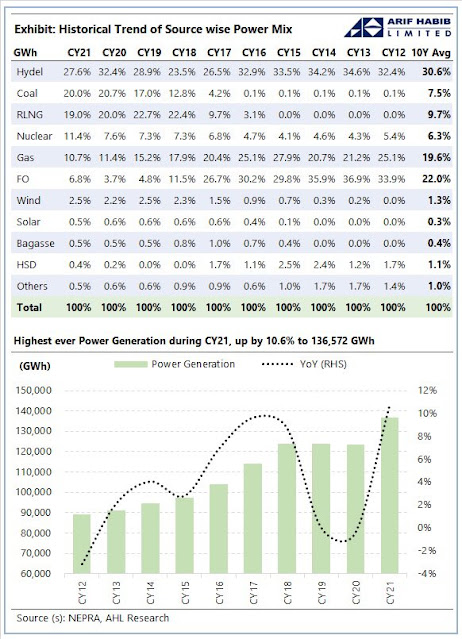
Pakistan Electric Power Generation Fuel MiX. Source: Arif Habib

 Last year, hydroelectric dams contributed 37,689 GWH of electricity or 27.6% of the total power generated, making hydropower the biggest contributor to power generated in the country. It was followed by coal (20%), LNG (19%) and nuclear (11.4%).  Nuclear power plants generated 15,540 GWH of electricity in 2021, a jump of 66% over 2020.  Overall, Pakistan's power plants produced 136,572 GWH of power in 2021, an increase of 10.6% over 2020, indicating robust economic recovery amid the COVID19 pandemic. 

Lucky power plant in Karachi has been designed to use Thar Lignite Coal when it is available in sufficient quantity.  Until that time, it will operate on imported lignite coal. Domestic lignite production is being expanded in a bid to replace costly fossil fuel imports that are depleting Pakistan's foreign exchange reserves and exacerbating circular debt in the power sector, according to Nikkei Asia.  

SECMC (Sindh Engro Coal Mining Company) has commissioned a study for converting the China-Pakistan Economic Corridor coal plants in Hub, Jamshoro and Sahiwal to indigenous lignite. A 105km long Thar Rail project is being planned to connect Thar coal fields with Main Line (ML-1) at the New Chhor Halt Station to transport lignite to the power plants in the rest of the country. The transportation of lignite by trucks to Karachi and Kallar Kahar shows its movement by road and rail is feasible and safe despite higher moisture.


Pakistan Electric Power Generation. Source: Arif Habib


Cost Per Unit of Electricity in Pakistan. Source: Arif Habib


Nuclear offers the lowest cost of fuel for electricity (one rupee per KWH) while furnace oil is the most expensive (Rs. 22.2 per KWH). 
 

Construction of 1,100 MW nuclear power reactor K2 unit in Karachi was completed by China National Nuclear Corporation in 2019, according to media reports. Another similar reactor unit K3 is now in operation. It will add another 1,100 MW of nuclear power to the grid in 2022. Chinese Hualong One reactors being installed in Pakistan are based on improved Westinghouse AP1000 design which is far safer than Chernobyl and Fukushima plants.  

The biggest and most important source of low-carbon energy in Pakistan is its hydroelectric power plants, followed by nuclear power. Pakistan ranked third in the world by adding nearly 2,500 MW of hydropower in 2018, according to Hydropower Status Report 2019.  China added the most capacity with the installation of 8,540 megawatts, followed by Brazil (3,866 MW), Pakistan (2,487 MW), Turkey (1,085 MW), Angola (668 MW), Tajikistan (605 MW), Ecuador (556 MW), India (535 MW), Norway (419 MW) and Canada (401 MW).

New Installed Hydroelectric Power Capacity in 2018. Source: Hydroworld.com


Hydropower now makes up about 28% of the total installed capacity of 33,836 MW as of February, 2019.   WAPDA reports contributing 25.63 billion units of hydroelectricity to the national grid during the year, “despite the fact that water flows in 2018 remained historically low.” This contribution “greatly helped the country in meeting electricity needs and lowering the electricity tariff for the consumers.”

Pakistan's Current Account Balance vs International Oil Prices. Source: Arif Habib


Recent history shows that Pakistan's current account deficits vary with international oil prices.  Pakistan's trade deficits balloon with rising imported energy prices. One of the keys to managing external account balances lies in reducing the country's dependence on foreign oil and gas. 


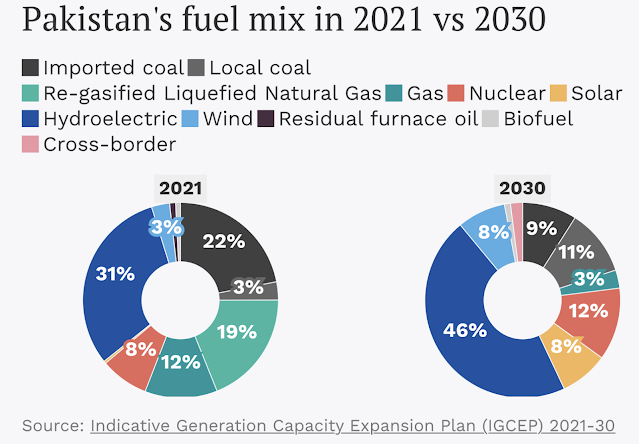
Pakistan Power Generation Fuel Mix. Source: Third Pole

It is true that Pakistan has relied on imported fossil fuels to generate electricity. The cost of these expensive imported fuels like furnace oil mainly used by independent power producers (IPPs) has been and continues to be a major contributor to the "exaggerated external demand driven by its rentier economy" referred to by Atif Mian in a recent tweet. However, Pakistan has recently been adding hydro, nuclear and indigenous coal-fired power plants to gradually reduce dependence on imported fossil fuels. 

Related Links:


Haq's Musings

South Asia Investor Review

Pakistan Among World's Largest Food Producers

Naya Pakistan Housing Program

Food in Pakistan 2nd Cheapest in the World

Indian Economy Grew Just 0.2% Annually in Last Two Years

Pakistan to Become World's 6th Largest Cement Producer by 2030

Has Bangladesh Surged Past India and Pakistan in Per Capita Income?

Pakistan's Computer Services Exports Jump 26% Amid COVID19 Lockdown

Coronavirus, Lives and Livelihoods in Pakistan

Vast Majority of Pakistanis Support Imran Khan's Handling of Covid19 Crisis

Pakistani-American Woman Featured in Netflix Documentary "Pandemic"

Incomes of Poorest Pakistanis Growing Faster Than Their Richest Counterparts

Can Pakistan Effectively Respond to Coronavirus Outbreak? 

How Grim is Pakistan's Social Sector Progress?

Double Digit Growth in Pakistan's Energy Consumption Confirms Economic Recovery


Trump Picks Muslim-American to Lead Vaccine Effort

COVID Lockdown Decimates India's Middle Class

Pakistan to be World's 7th Largest Consumer Market by 2030

Pakistan's Balance of Payments Crisis

How Has India Built Large Forex Reserves Despite Perennial Trade Deficits

Conspiracy Theories About Pakistan Elections"

PTI Triumphs Over Corrupt Dynastic Political Parties

Strikingly Similar Narratives of Donald Trump and Nawaz Sharif

Nawaz Sharif's Report Card

Riaz Haq's Youtube Channel

Sunday, July 10, 2022

India's Forex Reserves Fall As Foreign Investors Head For The Exits

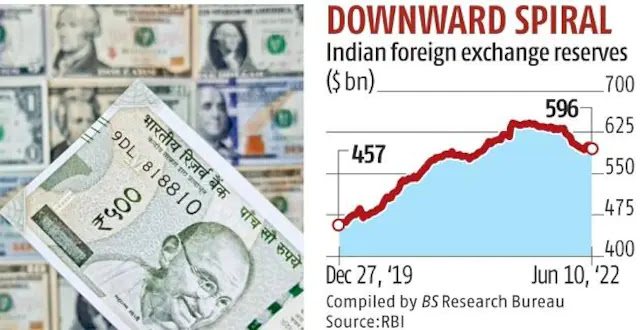
India's foreign exchange reserves are falling rapidly as foreign investors flee and the country's trade and current account deficits widen. More than $267 billion worth of India's external debt of the total $621 billion is due for repayment in the next nine months. This repayment is equivalent to about 44% of India's foreign exchange reserves. This combination of investors' exodus, widening twin deficits and short-term debt repayments has caused the Indian rupee to hit new lows. Unlike China and other nations that have accumulated large reserves by running trade surpluses, India runs perennial trade and current account deficits. The top contributor to India's forex reserves is debt which accounts for 48%. Portfolio equity investments known as “hot” money or speculative money flows account for 23% of India's forex reserves, according to an analysis published by The Hindu BusinessLine. 

India's Declining Forex Reserves. Source: Business Standard


Investor Exodus: 

Foreign portfolio investors have pulled out a whopping $33.5 billion from equity and $2.1 billion from debt segments of Indian financial markets, for a total net outflow of $35.6 billion from October 2021 to June 2022,  according to data compiled by the National Securities Depository Limited. In the first half of this calendar year, the total net outflows were $29.7 billion. 

It's not just the FPIs leaving India; a number of multinational companies are also pulling foreign direct investment (FDI) from India. Several big names including German retailer Metro AG, Swiss building-materials firm Holcim, US automaker Ford, UK banking major Royal Bank of Scotland, US motorcycle manufacturer Harley-Davidson and US banking behemoth Citibank have chosen to pull the plug on their operations in India or downsize their presence in recent years. 

Widening Deficits: 

India's finance ministry has warned of a growing twin deficit problem, with higher commodity prices and rising subsidy burden leading to an increase in both the fiscal and current account deficits. India's June trade deficit widened to a record high of $25.63 billion, mainly due to a rise in crude oil and coal imports, from $9.61 billion a year earlier.  India's April-May fiscal deficit was $25.8 billion. 

Summary:

India's current level of forex reserves is enough for less than 10 months of imports projected for 2022-23. But the country has had a structural current account deficit which has been funded by large capital inflows. The accumulation of forex reserves has been due to surplus in the capital account. Since late February, the foreign exchange reserves have declined by $36 billion. India still has large forex reserves but its economy is in the same boat as other emerging markets that run large and worsening trade and current account deficits. With declining forex reserves, India is likely to face headwinds as the US Federal Reserves raises interest rates to fight inflation. 

Related Links:


Haq's Musings

South Asia Investor Review

India in Crisis: Unemployment and Hunger Persist After COVID waves

Naya Pakistan Housing Program

Food in Pakistan 2nd Cheapest in the World

Western Money Keeps Indian Economy Afloat

Pakistan to Become World's 6th Largest Cement Producer by 2030

How Has India Accumulated Large Forex Reserves Despite Perennial Trade Deficits?

Pakistan's Computer Services Exports Jump 26% Amid COVID19 Lockdown

Coronavirus, Lives and Livelihoods in Pakistan

Vast Majority of Pakistanis Support Imran Khan's Handling of Covid19 Crisis

Pakistani-American Woman Featured in Netflix Documentary "Pandemic"

Incomes of Poorest Pakistanis Growing Faster Than Their Richest Counterparts

Can Pakistan Effectively Respond to Coronavirus Outbreak? 

How Grim is Pakistan's Social Sector Progress?

Pakistan Fares Marginally Better Than India On Disease Burdens

Trump Picks Muslim-American to Lead Vaccine Effort

Democracy vs Dictatorship in Pakistan

Pakistan Child Health Indicators

Pakistan's Balance of Payments Crisis

Panama Leaks in Pakistan

Conspiracy Theories About Pakistan Elections"

PTI Triumphs Over Corrupt Dynastic Political Parties

Strikingly Similar Narratives of Donald Trump and Nawaz Sharif

Nawaz Sharif's Report Card

Riaz Haq's Youtube Channel