Friday, August 30, 2024

New Net Metering Policy: Is Pakistan's Solar Boom in Jeopardy?

Recent experience in California has shown that changes in incentives have a huge impact on residential adoption of solar power technology. Since the introduction of NEM 3.0 last year, new rooftop solar business in California has dramatically slowed. New residential solar installation applications have plunged 80%, according to Cal Matters. This has driven many solar installers out of business. The business that remains is mostly focused on adding batteries to existing solar installations. 

Impact of California NEM 3.0 on Solar Business. Source: Cal Matters

California Net Energy Metering (NEM 3.0) was launched last year after heavy lobbying by the state's utility companies like PGE and SoCal Edison. It has reduced payments for the excess power exported by the consumer to the grid by 75%. This change means that the consumer is better off with storage batteries to maximize self-consumption of the power generated by the solar panels. Companies such as Tesla Solar with its PowerWall 3 battery are the main beneficiaries of this change. 


With rapidly falling solar panel prices, Pakistan is experiencing a solar power boom. The country imported some 13 gigawatts of solar modules in the first six months of the year, making it the third-largest destination for Chinese exporters, according to Bloomberg.   In addition, there is approximately 2.2 gigawatts (GW) of net-metered rooftop solar PV capacity connected to the grid by June 2024, according to IEEFA

What is likely to happen to this solar boom as Islamabad considers changes to its net metering policy? A recent study published by the Institute for Energy Economics and Financial Analysis (IEEFA) attempts to answer this question. 

Net Metering vs Net Billing Payback Period in Pakistan. Source: IEEFA


There are several proposals under consideration by the Pakistani government to change its net metering policy. All are designed to significantly reduce payments to the consumer for energy exported to the grid. One of these proposals likely to be adopted is to switch from "Net Metering" to "Net Billing". 

Net metering transactions are usually one-to-one, so the credits are often equal to the retail rate of electricity (aka what you pay). Net billing credits are often equal to the wholesale rate of electricity (aka what your utility pays), which is less than the retail rate, according to Energy Sage. Utilities tend to oppose net metering programs, so alternative compensation programs are increasingly being used. 

Analysis by Haneea Isaad, an Energy Finance Specialist at IEEFA, shows that the switch from net metering to net billing would still reduce the payback period for 5kW to 25kW solar systems combined with 50% to 70% self-consumption. She concludes that the payback period will be well under 4 years for a system that has a life of 25 to 30 years. It is better than the 5-year payback period in California under NEM 3.0. 

Would consumers without solar be stuck with high electricity bills? It is quite likely because capacity charges paid to independent power producers (IPPs) accounted for 62% of energy expenditure in Pakistan for the 2023-2024 fiscal year. For the 2024-2025 fiscal year, 64% of the total power purchase price is expected to be fixed capacity costs. Lower consumption of grid electricity will result in a disproportionate impact on consumers who rely entirely on grid power.  

Higher levels of self-consumption closer to 100% would require larger batteries which are still quite expensive in Pakistan. This is likely to change as traditional lead-acid battery makers switch to lithium ion batteries in the country. Recent launches of electric vehicle assembly plants in Pakistan are expected to boost the lithium-ion battery production and bring down prices in the country in the coming years, according to Mordor Intelligence

Sunday, August 25, 2024

Following the Money: Insights into Pakistan's Budget 2024-25

A look at Pakistan's current fiscal year 2024-25 budget helps gain insights into how the country is run. It shows the money flows from the key sources of revenue and the nation's spending priorities. Total planned federal spending for the current fiscal year is Rs.18,900 billion (about 69 billion U.S. dollars). This figure does not include the transfer of Rs. 7,438 (US$ 26 billion) from the federal government to the provinces. Under the 18th amendment passed in 2010, the federal government is obligated to share 57.5% of its revenue with the provinces. The federal government is primarily responsible for defense, foreign affairs, debt servicing, foreign trade, ports and shipping, and development programs, while food and agricultureeducation, healthcare and housing are devolved to the provinces. There still appears to be some overlap of domestic responsibilities between the federation and the provinces. 

Pakistan's Budget 2024-25 at a Glance. Visualization Courtesy of Prof Adil Najam


The federal government's total revenue is expected to be Rs. 17, 815 billion (US$ 65 billion). In addition, Islamabad plans to borrow Rs. 8,470 billion ($31 billion) during the fiscal year. Interest payments of Rs. 9,775 billion ($ 36 billion) will account for more than half of the federal budget this year.  Debt servicing costs will also exceed the planned borrowing (of Rs. 8,470 billion) for the year. In other words, all of what the government plans to borrow this fiscal year will be used to service the current debt on the books.  

Detailed Budget Visualization By Dr. Adil Najam via Dawn


Federal debt servicing costs (Rs. 9,775 billion or $35 billion, 9.3% of current GDP) have spiked in recent years due to the State Bank's tight monetary policy designed to fight persistent double digit inflation. In fact, interest payments on debt are by far the biggest single federal expenditure line item, far surpassing the Rs. 2, 122 billion ($7.7 billion or 2% of current GDP) defense spending. Higher interest rates have also dramatically slowed down the economy. 

Pakistani provinces raise some of their own revenue on top of the transfers from the federal government. For example, Punjab, the largest of the four provinces, plans to spend an estimated Rs. 4,643.4 billion ($17 billion); including the federal transfer of Rs. 3,683.1 billion and about Rs. 960 billion ($3.5 billion) of provincial tax revenue. 

Sind, the second largest province, has a Rs. 3,056 ($11 billion) budget that includes Rs. 1,854 billion from the federal government, and Rs. 1,202 billion ($4.35 billion) from its revenue sources. KP, the third largest province,  has a Rs1,754 billion ($6.4 billion) budget, including Rs. 1,222 billion from the federal government and Rs. 532 billion ($1.9 billion) provincial revenue. Balochistan's budget is Rs. 956 billion ($3.5 billion) that includes Rs. 667 billion from the federal government and Rs. 290 billion ($1 billion) from its resources.

Altogether, the federal and provincial governments expect to raise about $75 billion in revenue, representing 20% of $375 billion GDP for fiscal year 2023-24. This is not bad for a developing country like Pakistan.  The defense allocation of Rs. 2,122, the second largest federal expenditure, is a mere 2% of the current GDP.  The biggest expenditure this year will be the interest payments of Rs. 9,775, accounting for over 50% of the federal budget and 9.3% of the current GDP. These debt servicing costs will hopefully come down as the State Bank cuts its interest rates this year and next. Lower interest payments in future years should free up money for other more pressing needs in the areas of education, healthcare, energy and infrastructure. 

Related Links:

Haq's Musings

South Asia Investor Review

Solar Power Boom in Pakistan

Pakistan Electric Vehicle Policy

Nuclear Power in Pakistan

Can Urban Forests Beat the Heat in Pakistani Cities

Pakistan's Response to Climate Change

IPP Contacts Bankrupting Pakistan

Renewable Energy for Pakistan

Net Metering in Pakistan

Pakistan's Digital Public Infrastructure Transforming Lives

My Family's Contribution to Climate Action

China-Pakistan Economic Corridor

Ownership of Appliances and Vehicles in Pakistan

CPEC Transforming Pakistan

Pakistan's $20 Billion Tourism Industry Boom

Riaz Haq's YouTube Channel

PakAlumni Social Network

Sunday, August 18, 2024

Pakistan EV Launches to Accelerate Clean Energy Transition

Pakistani automobile joint ventures with Chinese automakers BYD and Changan have recently launched several all-electric and plug-in hybrid models of automobiles in Pakistan. Earlier, Honda Atlas Cars Pakistan Limited announced plans to build a hybrid electric vehicles plant in the country. Other major brands like Toyota, Haval, and Hyundai are already offering similar models in the country. It all began with the 2019 electric vehicle policy approved by the government of Prime Minister Imran Khan to incentivize the electrification of the auto industry. Pakistan EV policy goal is to achieve 30% of new cars sales, 50% of new 2-wheeler and 3-wheeler sales and 30% of new truck sales by 2030. By 2040, the target is 90% of all new vehicle sales to be electric. The main incentive is the reduction of sales tax from 17% for internal combustion engine (ICE) vehicles to 1% for all-electric (EV) vehicles.


BYD EV. Source: CNBC


BYD Launch:

Chinese electric vehicle giant BYD has announced plans to open an EV production plant in Karachi.  It will start selling three EV models in Pakistan through a partnership with Mega Motors. Mega Motors is a unit of Pakistan's largest private utility Hub Power Co Ltd (HPWR.PSX), known as Hubco. 

"Our entry into the Pakistani market is not just about bringing advanced vehicles to consumers," said Liu Xueliang, BYD's general manager for Asia Pacific, according to Reuters. "It's about driving a broader vision of environmental responsibility and technological innovation." "We will establish Pakistan's first NEV assembly plant... dedicated to producing BYD's cutting-edge new energy vehicles," said Hubco Chief Executive Kamran Kamal, who described the deal as a "landmark investment".

The BYD factory will be built near Karachi’s Port Qasim area that already houses assembly plants for other automobile companies including Toyota, Suzuki Motor Corp. and Kia Corp.’s local units. It will be completed in the first half of 2026, according to Bloomberg. 

Last year, BYD’s total production – comprising battery-only powered cars as well as hybrids – was more than 3 million and surpassed Tesla’s production of 1.84 million cars for a second straight year, according to CNBC

A BYD model comparable to Tesla Model Y is $10,000 cheaper and has more features, according to news reports

Changan Launch: 

Master Changan Motors Limited (MCML), a joint venture between Pakistan's Master Group of Industries and China's Changan International, launched Changan’s electric-first brand, DEEPAL, this month in Karachi, Pakistan.  The joint venture unveiled the brand Deepal with 2 models, L07, the pure electric sports luxury sedan and S07 the pure electric premium SUV. 

Both Changan models offer 250 HP and 320 Nm of instant torque, going from  0-100 km/hr in just 5.9 seconds. The Ternary Lithium battery by CATL has a capacity of 66.8 kWh and provides an exceptional range of up to 540 km in L07 and 485 km in S07. The cars are designed in Italy in Changan’s R&D center and have won the German RedDot design award in 2023 with its futuristic design, according to media reports

Changan has sold 45,000 cars in Pakistan in the last 5 years. 

Honda Atlas:

Last month Honda Atlas Cars Pakistan Limited (HACPL) announced its plan to invest Rs. 5 billion in a cutting-edge hybrid vehicle production facility in Pakistan. This investment will support the local manufacturing and assembly of hybrid electric vehicles (HEVs). 

The company recently reported a 324% jump in sales, totaling Rs. 15.97 billion compared to Rs. 3.77 billion in the same period last year. The company reported a gross profit of Rs. 1.01 billion for the first quarter of FY25.

Two and Three Wheelers:

Prior to the BYD and Changan EV launches, Pakistan granted EV manufacturing licenses to 32 local companies under the EV Policy 2019, according to the Business Recorder newspaper.  Metro Electric Bikes, VLEKTRA and Sazgar Engineering Works are among the key names leading the two and three wheeler EV manufacturing in Pakistan. 

“Motorcycle buyers have started to inquire about electric bikes, scooty, and scooters options. I believe many have postponed buying a normal two-wheeler with expectations that an electric two-wheel model may soon enter the market that is closer to their need,” said Sabir Sheikh, who is also the Chairman, Association of Pakistan Motorcycle Assemblers (APMA), according to media reports. 

Charging Infrastructure: 

A number of investors, including ADM Group, Hashoo Group and Hubco are planning to invest in building a nationwide EV charging stations network. The EV policy provides incentives for it by reducing import duty on charging equipment imports to just 1% and lower power tariffs. It also ensures uninterrupted power supply on feeders fir charging stations. 

Hubco said it will setup fast-charging stations across major cities, motorways and highways to enhance Pakistan's charging infrastructure, according to Reuters.  The EV policy calls for at least one fast DC charging station per 3km by 3km area in all major cities as well as DC fast chargers on all motorways every 15-30 km.

Soaring Imports of Chinese Solar Panels in Pakistan. Source: Bloomberg


Solar Power Boom:

With rapidly falling solar panel prices, Pakistan is experiencing a solar power boom in the country. The country imported some 13 gigawatts of solar modules in the first six months of the year, making it the third-largest destination for Chinese exporters, according to Bloomberg.

Rapid increase in solar power generation complements Pakistan's push to a clean energy economy and EV adoption. This may encourage some of the charging station operators to go solar with batteries to reduce their cost of power purchases from the grid. 

Climate Action:

Pakistan has contributed only 0.28% of the CO2 emissions but it is among the biggest victims of climate change. The US, Europe, India, China and Japan, the world's biggest polluters, must accept responsibility for the catastrophic floods in Pakistan and climate disasters elsewhere. A direct link of the disaster in Pakistan to climate change has been confirmed by a team of 26 scientists affiliated with World Weather Attribution, a research initiative that specializes in rapid studies of extreme events, according to the New York Times

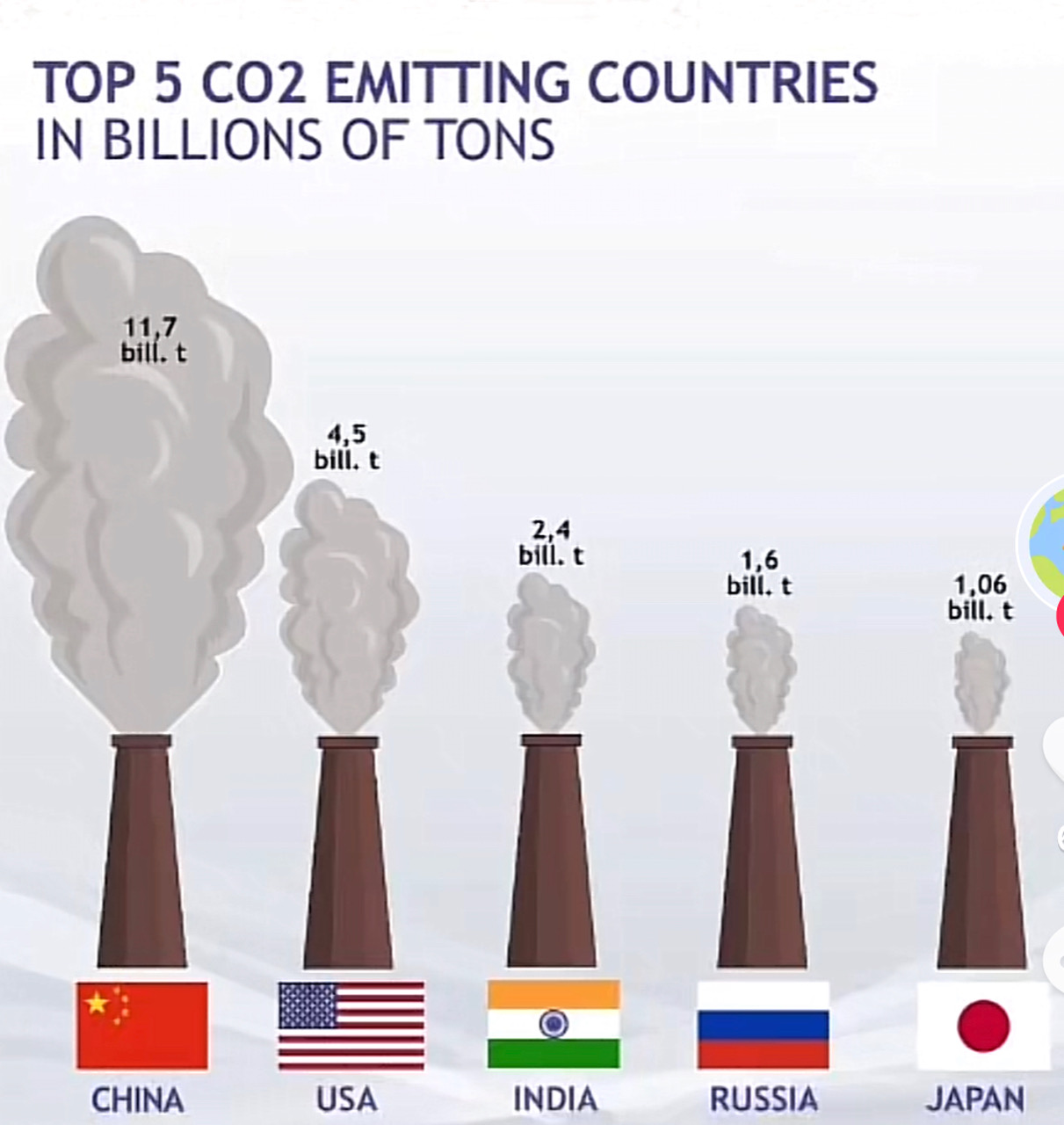
Top 5 Current Polluters. Source: Our World in Data


Currently, the biggest annual CO2 emitters are China, the US, India and Russia. Pakistan's annual CO2 emissions add up to just 235 million tons. On the other hand, China contributes 11.7 billion tons, the United States 4.5 billion tons, India 2.4 billion tons, Russia 1.6 billion tons and Japan 1.06 billion tons. 

Pakistan's Annual CO2 Emission. Source: Our World in Data

The United States has contributed 399 billion tons (25%) of CO2 emissions, the highest cumulative carbon emissions since the start of the Industrial Revolution in the late 18th century. The 28 countries of the European Union (EU28), including the United Kingdom, come in second with 353 billion tons of CO2 (22%), followed by China with 200 billion tons (12.7%). 


Thursday, August 15, 2024

Exodus From Pakistan: 1.62 Million Emigrated in 2023

Pakistan had a net negative migration of 1.6 million people, the highest of all countries in 2023, according to the World Population Prospects 2024 report released by the United Nations. Other Asian nations like India (-980,000), China (-570,000), and Bangladesh (-550,000) are also far up the ranking. Pakistan's figure of 1.62 million includes 541,000 Afghans who were expelled from the country last year. Net migration is the net total of migrants during the period, that is, the number of immigrants minus the number of emigrants, including both citizens and noncitizens.

Top Countries Losing People to Emigration. Source: Visual Capitalist


Pakistan Bureau of Emigration and Overseas Employment data shows that 862,625 Pakistanis went to work overseas, mostly to Gulf Arab nations, in 2023. The US government granted 16,320 immigrant visas to Pakistani nationals. Another 11,861 immigrant visas were given to Pakistanis by the Canadian government in the same period.  The total number of new Pakistani immigrants admitted as permanent residents in North America in 2023 was 28,181. It is likely that a similar number of Pakistani migrants arrived in Europe last year. Altogether, the total number of Pakistanis emigrants adds up to about a million. The remaining 600,000 are most likely non-citizens deported from Pakistan. 

With a growing share of the working age and insufficient job opportunities, South Asian nations of India, Pakistan and Bangladesh are among the largest labor exporters in the world. 

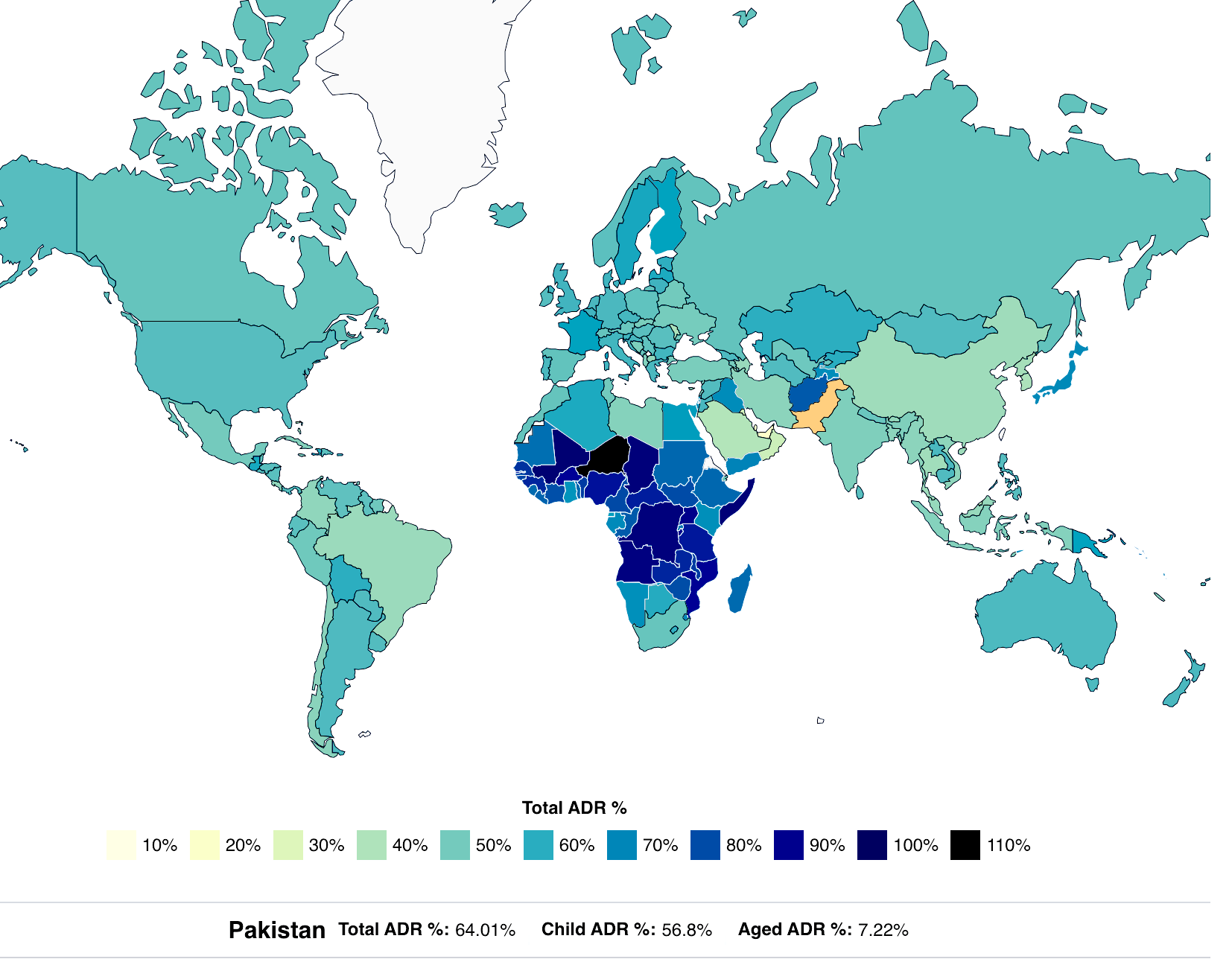
Dependency ratio, defined as the percentage of children and retirees to the working age population, is rapidly declining in Pakistan (current dependency ratio is 69.03%) and the rest of the developing nations of Asia and Africa. This demographic shift means that the world's richest and most powerful nations with the largest share of working populations will no longer be in Europe and North America by 2050. Among South Asian nations, Bangladesh has already joined the list of top 10 nations in terms of the largest share of the working age population. India and Pakistan are expected to join it by 2050. Increasingly better educated working age population is expected to significantly enhance their productivity and increase their incomes. 

Shift in Share of Working Age Populations. Source: NY Times


The total dependency ratio reported for Pakistan in 2022 is 69.03%, much higher than Bangladesh's 47.09% and India's 47.5%, according to the World Bank.  Dependency ratio for China is 44.96% but it is rapidly increasing.  China's share of the working age population will no longer be in the top 10 by 2050 due to its aging population, according to the UN projections. 
Declining Dependency Ratio in Pakistan. Source: Trading Economics/World Bank


Global Age Dependency Ratio Map. Source: World Population Review

New York Times' visual journalist Lauren Leatherby recently described this major demographic and economic shift in the following words: "The richest most powerful countries today have long had these really large working-age populations. And economists agree that that’s been a huge, huge advantage economically and geopolitically. And meanwhile, a lot of developing nations have had quite high dependency ratios having a high number of children compared to working-age people. And so, I think we know a lot of these storylines one by one, but putting it all together, it’s just like the world is going to shift really dramatically". 

Current Share of Working Age Populations. Source: NY Times

"And then I think what we see (rapidly aging population) in Japan today is only the tip of the iceberg. A lot of East Asia, China, Europe, South Korea will be much older than Japan is today, in just you know, 20 or 30 years. Some countries will have upwards of 40% of their population that are 65 or older in just two or three decades. And meanwhile, on the other end, you have a lot of these other countries that have long been, you know, hindered economically by their age structures. And suddenly a lot of them will start to enjoy the exact same age structures that Europe and East Asia, the U.S., that a lot of those countries have historically enjoyed", Leatherby added. 

Prijected Share of Working Age Populations in 2050. Source: NY Times


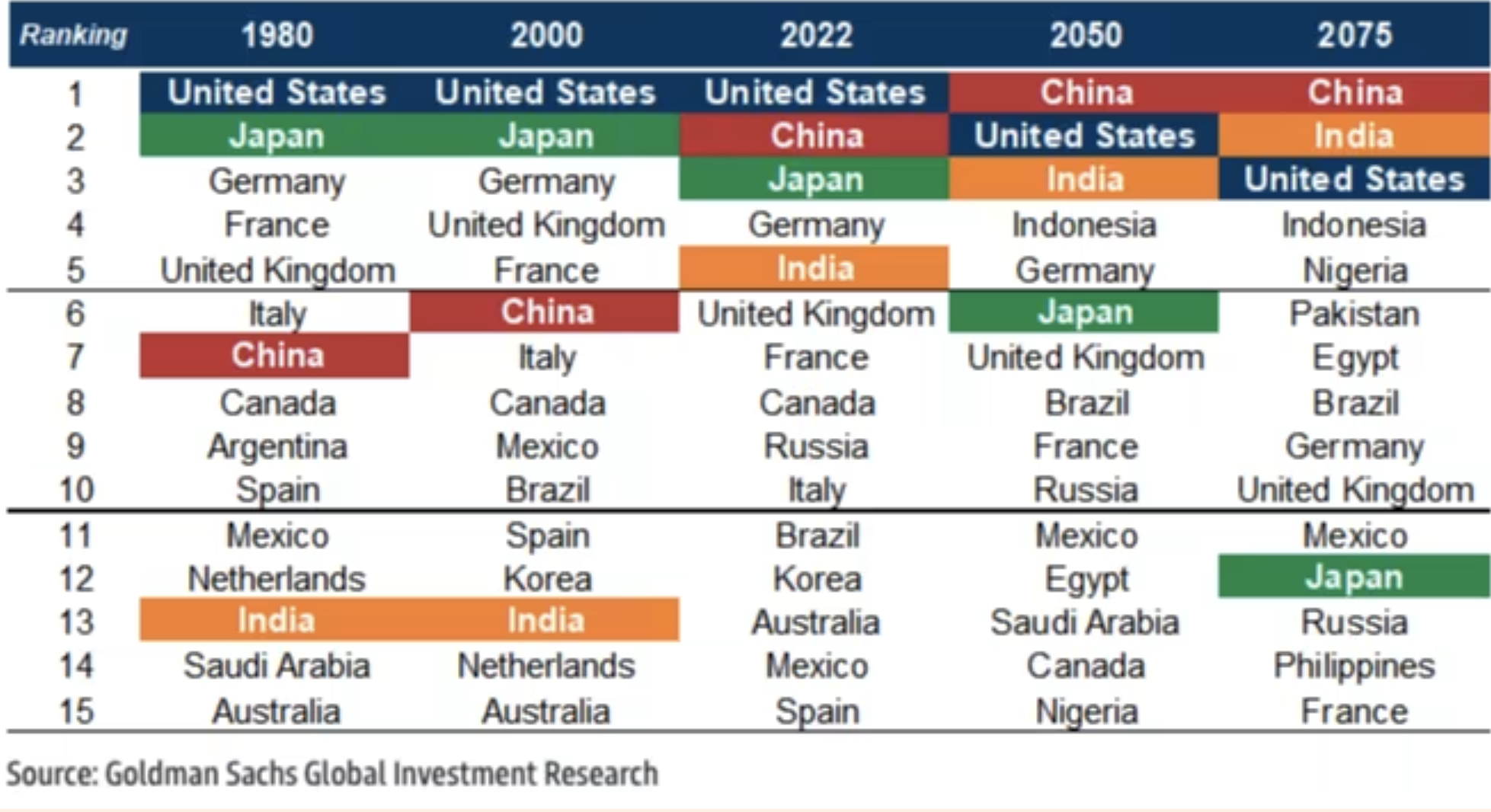
It is based on this demographic shift that Goldman Sachs analysts Kevin Daly and  Tadas Gedminas are projecting Pakistan's economy to grow to become the world's sixth largest by 2075.  In a research paper titled "The Path to 2075", the authors forecast Pakistan's GDP to rise to $12.7 trillion with per capita income of $27,100.  India’s GDP in 2075 is projected at $52.5 trillion and per capita GDP at $31,300.  Bangladesh is projected to be a $6.3 trillion economy with per capita income of $31,000.  By 2075, China will be the top global economy, followed by India 2nd, US 3rd, Indonesia 4th, Nigeria 5th and Pakistan 6th. The forecast is based primarily on changes in the size of working age populations over the next 50 years.  

GDP Ranking Changes Till 2075. Source: Goldman Sachs Investment Research 


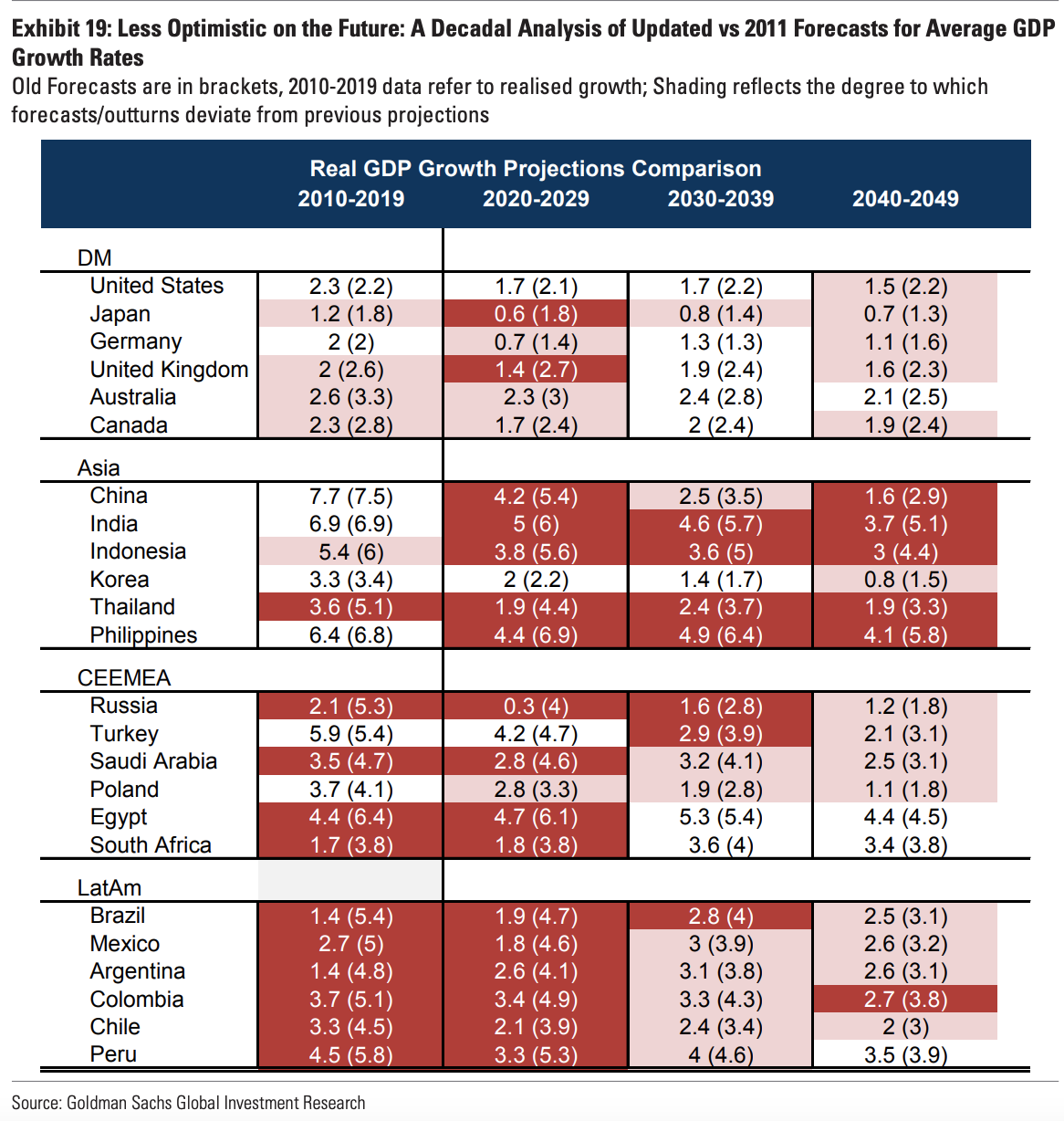
Economic Growth Rate Till 2075. Source: Goldman Sachs Investment Research 

Economic Impact of Slower Population Growth: 

Daly and Gedminas argue that slowing population growth in the developed world is causing their economic growth to decelerate. At the same time, the economies of the developing countries are driven by their rising populations.  Here are four key points made in the report:

 1) Slower global potential growth, led by weaker population growth. 

2) EM convergence remains intact, led by Asia’s powerhouses. Although real GDP growth has slowed in both developed and emerging economies, in relative terms EM growth continues to outstrip DM growth.

3) A decade of US exceptionalism that is unlikely to be repeated. 

4) Less global inequality, more local inequality. 

Goldman Sachs' Revised GDP Projections. Source: The Path to 2075

Demographic Dividend: 

With rapidly aging populations and declining number of working age people in North America, Europe and East Asia, the demand for workers will increasingly be met by major labor exporting nations like Bangladesh, China, India, Mexico, Pakistan, Russia and Vietnam. Among these nations, Pakistan is the only major labor exporting country where the working age population is still rising faster than the birth rate. 

Pakistan Population Youngest Among Major Asian Nations. Source: Nikkei Asia

World Population 2022. Source: Visual Capitalist

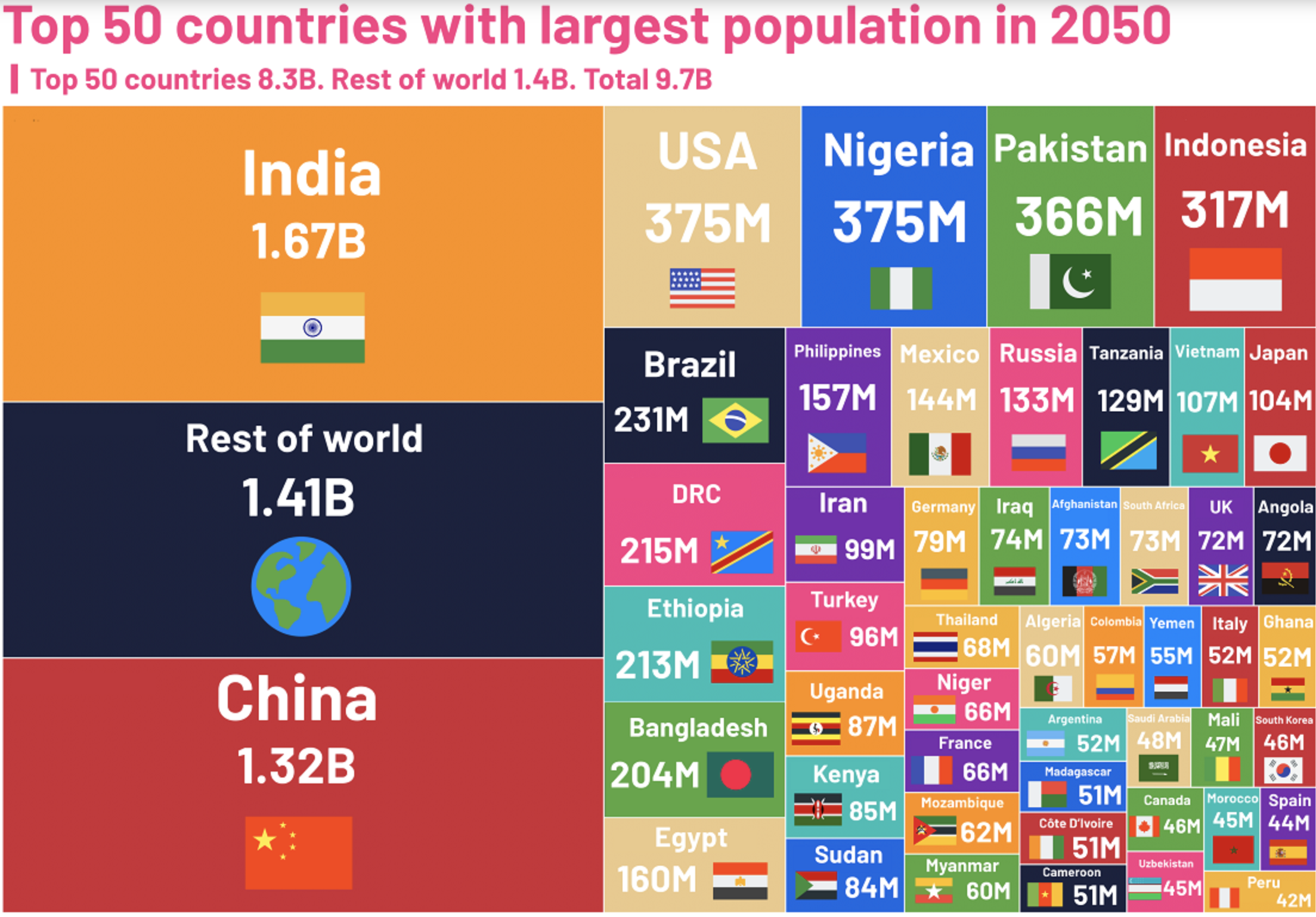
World Population 2050. Source: Visual Capitalist

Over a million Pakistani university students are currently enrolled in STEM courses. Over 10 million Pakistanis are currently working/living overseas, according to the Bureau of Emigration. Before the COVID19 pandemic hit in 2020,  more than 600,000 Pakistanis left the country to work overseas in 2019. Nearly 700,000 Pakistanis have already migrated in this calendar year as of October, 2022. The average yearly outflow of Pakistani workers to OECD countries (mainly UK and US) and the Middle East was over half a million in the last decade. 

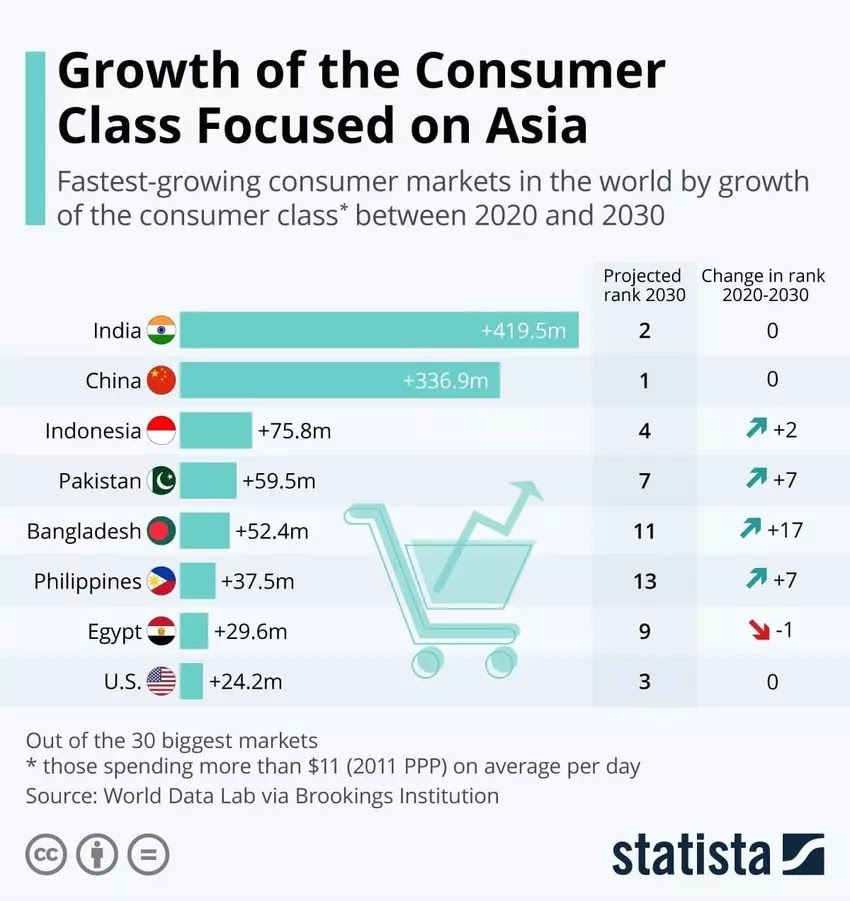
Consumer Markets in 2030. Source: WEF


World's 7th Largest Consumer Market:

Pakistan's share of the working age population (15-64 years) is growing as the country's birth rate declines, a phenomenon called demographic dividend. With its rising population of this working age group, Pakistan is projected by the World Economic Forum to become the world's 7th largest consumer market by 2030. Nearly 60 million Pakistanis will join the consumer class (consumers spending more than $11 per day) to raise the country's consumer market rank from 15 to 7  by 2030. WEF forecasts the world's top 10 consumer markets of 2030 to be as follows: China, India, the United States, Indonesia, Russia, Brazil, Pakistan, Japan, Egypt and Mexico.  Global investors chasing bigger returns will almost certainly shift more of their attention and money to the biggest movers among the top 10 consumer markets, including Pakistan.  Already, the year 2021 has been a banner year for investments in Pakistani technology startups

Record Remittances From Overseas Pakistanis:

Pakistan is already seeing high levels of labor export and record remittances of over $30 billion pouring into the country. Saudi Arabia and the United Arab Emirates(UAE) are the top two sources of remittances but the biggest increase (58%) in remittances is seen this year from Pakistanis in the next two sources: the United Kingdom and the United States.

Remittances from the European Union (EU) to Pakistan soared 49.7% in FY 21 and 28.3% in FY22, according to the State Bank of Pakistan. With $2.5 billion remittances in the first 9 months (July-March) of the current fiscal year, the EU ($2.5 billion) has now surpassed North America ($2.2 billion) to become the third largest source of inflows to Pakistan after the Middle East and the United Kingdom. Remittances from the US have grown 21%, second fastest after the EU (28.3%) in the first 9  months of the current fiscal year. 

Pakistan ranks 6th among the top worker remittance recipient countries in the world.  India and China rank first and second, followed by Mexico 3rd, the Philippines 4th, Egypt 5th and Pakistan 6th.  

Pakistan Demographics

About two million Pakistanis are entering the workforce every year. The share of the working age population in Pakistan is increasing while the birth rate is declining. This phenomenon, known as demographic dividend, is coinciding with declines in working age populations in developed countries. It is creating an opportunity for over half a million Pakistani workers to migrate and work overseas, and send home record remittances. 


Sunday, August 11, 2024

Pakistani Athlete Wins Olympic Gold After 32-Year Drought

Pakistani javelin thrower Arshad Nadeem shattered a world record to win a gold medal at the Paris Olympics 2024. Nadeem is now inspiring a new generation of Pakistani sportsmen and women to excel in athletics. Thousands of fans, including government ministers, came to Lahore Airport to greet Arshad Nadeem when he returned to the country. 

Aeshad Nadeem's gold medal in the Paris Olympics came 32 years after Pakistan won a bronze medal in field hockey at Barcelona, Spain. It's also the first Olympic gold medal won by Pakistanis in 40 years. Pakistan has won a total of 11 medals since it started participating in the Olympic Games in 1948. India has won 41 medals since it began its participation in the Olympics in 1900. Five of India's 41 medals were won prior to 1948. This year, Pakistan has won just one medal, a gold in Javelin throw, while India has won 6 medals, including a silver in Javelin throw and 5 bronzes in other sports. 

Gold Medal Winner Arshad Nadeem at Paris Olympics. Source: Olympics.com


Of the 11 olympics medals won by Pakistan since 1948, only three, including that of Paris 2024 champion Arshad Nadeem are individual medals. Two other individual medals are bronze in men's boxing and wrestling.  The rest are team medals awarded to the Pakistan field hockey teams. 

2024 Paris Olympics Table. Source: Google


South Asian nations, including Afghanistan, Bangladesh, India, Nepal and Pakistan, rank low on this year's medals tables. Pakistan ranks 62 and India 69. The top of the table is dominated by rich nations from East Asia, North America and Western Europe. Over 50 countries and territories have never won an Olympic medal, either in the Summer or Winter Games, according to a report in Newsweek

Olympic Medals Winners Map. Source: Newsweek


Bangladesh is among the nations that have never won any olympic medals. Others include Angola, Bhutan, Bolivia, Chad, Democratic Republic of Congo, Honduras, Libya, Mali, Mauritania, Myanmar, Nepal, Oman, Papua New Guinea, Somalia, South Sudan and Yemen. 

Total Olympic Medals Won By Most Populous Countries 1896-2024 


Here's how The Economist magazine summarized the results of the 2024 Paris Olympics:

 "This year around 45% of participating countries won at least one medal. In 1992, the equivalent figure was 38%. Albania, Cape Verde, Dominica and St Lucia won their first-ever medals in Paris; Botswana and Guatemala secured their first golds. The improvement reflects the greater number of medals on offer, as more events are added, as well as sport’s globalisation, which has allowed techniques and knowledge to spread further and faster. Ultimately, however, serious Olympic success is determined by the wealth and population of a country. Rich, big countries have more resources to invest and deeper pools of talent. The share of countries with more than 20 medals has remained largely unchanged since 1992. That makes a minnow’s success all the more special". 

Share of Olympic Medals Won By Countries. Source: The Economist


Olympics are not just a huge international sporting spectacle; these games are highly lucrative for the organizers who rake in billions of dollars in sponsorships and media rights. NBC alone paid $7.75 billion for broadcasting rights for the United States. 

Rich industrialized nations have well-funded athletics development programs which can be credited with their Olympic success. The National Collegiate Athletics Association (NCAA) is an example of one such program. It earned $1.28 billion in revenue in 2022-2023, with about $1 billion coming from March Madness alone. 

This summer in Paris 2024, 75% of Team USA's Olympic athletes will have a collegiate background as part of their journey to Team USA, according to a report. This includes NCAA programs, junior colleges, NAIA and clubs. Of those, 65% (385 of 592) have competed in NCAA collegiate sports across all three divisions. In total, 151 NCAA schools from 45 conferences will have one or more Team USA Olympic athletes competing in Paris. 

The medals won by athletes from poor nations like India and Pakistan are primarily due to the individual's own initiative, hard work and determination. Arshad Nadeem, for example, had so little help from the Pakistani government or private sector that he had trouble finding the money to buy a javelin.  He ended up doing crowd-funding to buy it for the Paris Olympics 2024. Even after winning a Commonwealth Games gold and World Championship silver in 2022 and 2023, Arshad had to plead for a new javelin before the Paris Olympics as his old one had worn out after years of use, according to a news report. 

It is heartening to see that Arshad Nadeem is now being showered with effusive praise and money from both the government and private sector to continue his passion. Hopefully, he will use his celebrity and money to help fund an athletics academy for aspiring young men and women in Pakistan.  


Related Links:


Haq's Musings

India, Pakistan and Johnson-Ali Model

Field Hockey: Pakistan's Race to the Bottom

India Ranks Below China, Pakistan in Global Hunger Index

Low Status of Indian Women

India's Commonwealth Games Mess

Pakistan Cricket Board's Budget

UNESCO Education For All Report 2010

India's Arms Build-up: Guns Versus Bread

South Asia Slipping in Human Development

Ambani's Extravagant Wedding

Challenges of 2010-2020 in South Asia

India and Pakistan Contrasted 2010

Food, Clothing and Shelter in India and Pakistan

Introduction to Defense Economics

Riaz Haq's Youtube Channel

Friday, August 2, 2024

Growing Demand For Pakistani Workers in Gulf Arab Kingdoms

Millions of Pakistani workers have been participating in the development of Saudi Arabia, United Arab Emirates and other Gulf nations over many decades. They have been doing so in spite of the almost complete absence of basic human rights and harsh working conditions. A recent Pakistani government report appears to negate their enormous contribution to the Arab Gulf region. Instead of highlighting their positive role and defending their rights, the report by the secretary of Ministry of Overseas Pakistanis and Human Resource De­­velopment reinforces the bigoted negative stereotypes of overseas Pakistanis. 

Emigration of Pakistani Workers. Source: Pakistan Bureau of Emigration


This report and other past unfounded negative statements seem to indicate that Pakistani officials are the worst enemies of their own people. An example of such reckless behavior of Pakistani officials came in 2020 when a Pakistani minister claimed without evidence or investigation that most Pakistani pilots had fake pilot licenses. While the statement was later proved to be wrong, it caused enormous damage to the PIA, Pakistani flag carrier, when its flights were banned in Europe and North America. 

The claim by Pakistan's labor secretary about the Gulf nations not wanting Pakistani workers is contradicted by the government's own data showing that 426,951 Pakistanis were hired by Saudi employers in 2023-24.  During the same period, another 230,000 Pakistanis were offered jobs in the UAE and 60,000 Pakistanis found employment in Qatar.  

Year-wise, the number of Pakistanis hired by Saudi employers declined from 514,725 in 2022 to 426,951 in 2023. But those recruited in UAE increased from 128,477 in 2022 to 229,894 in 2023, according to the Bureau of Emigration. Overall, in 2022, 832,339 Pakistanis went to work abroad, which increased to 862,625 in 2023, according to the Bureau of Emigration and Overseas Employment.

These Pakistani workers in the Gulf region are also making a huge contribution to Pakistan's economy by sending home large remittances. Pakistanis in the UAE remitted $3.7 billion during the July-March 2024 fiscal year. Saudi led with $5.1 billion, followed by the UK ($3.2 billion), the US ($2.5 billion), other GCC countries ($2.3 billion), EU ($2.6 billion), Australia ($0.5 billion) and other countries ($1.3 billion).

Pakistan's weak economy is not creating enough jobs for the nation's growing working age population. Overseas employment helps relieve the pressure. There are over 10 million Pakistanis working overseas and growing. To ensure that this avenue of employment remains open, the Pakistani leaders should be promoting, or at least not denigrating, Pakistanis working overseas. 

The story of Pakistanis' pivotal role in the development of UAE is illustrated by two high-profile examples: Emirates Airline and Burj Khalifa.  

Emirates Airlines flights numbers are preceded by EK which harkens back to the carrier's first flight from Emirates to Karachi. Flight EK600 was flown by Captain Fazl Ghani Mian on 25 October 1985. PIA provided technical and management assistance to the new carrier and leased a new Boeing 737—300 and an Airbus A300B4-200. 

Burj Khalifa, the  world's tallest building, was designed using software developed by Ashraf Habibullah, a fellow NED University alumnus who founded Computer Structures Inc of Berkeley, California.  The Dubai landmark was built by thousands of construction workers from Pakistan. 


Related Links:


Friday, July 26, 2024

Can Urban Forests Beat the Heat in Pakistani Cities?

Recent heat-sensing satellite images of Lahore posted by NASA show that "green spaces such as wooded areas, grassy areas, parks, and farm fields were significantly cooler than densely developed areas".  NASA experts explain it as follows: Vegetation and bodies of water do not absorb and re-emit heat as easily as common building materials such as concrete, asphalt, and steel.

Lahore Vegetation (Left) and Surface Temp (Right). Source: NASA

A NASA post titled "Beating the Heat in Pakistan" says that "Differences in surface temperatures between developed and natural areas, known as surface urban heat islands, tend to be more pronounced than temperature differences associated with atmospheric heat islands, particularly during the daytime".    “Surface urban heat islands exacerbate air temperatures by trapping heat and releasing it slowly, especially at night,” explained Muhammad Nasar-u-Minallah, a geographer at the University of the Punjab in Lahore. “The lack of green spaces and vegetation in urban settings further limits natural cooling mechanisms, such as shade and evapotranspiration, intensifying the heat.”

Rapid urbanization and intense development activities in Pakistani cities have worsened the effects of climate change by making the summer heat unbearable.  In response, several urban forest plantation  campaigns have been launched in major Pakistani cities like Lahore and Karachi by both government and non-government entities. 

Nestlé Pakistan launched its first urban forest tree plantation activity at Allama Iqbal Interna­tional Airport with 25,000 trees, under its Nestlé Cares initiative to support endeavors to reduce carbon footprint in its ambition to achieve net zero by 2050, according to media reports.  Leading the volunteer effort, Jason Avanceña, Chief Execu­tive Officer, Nestlé Pakistan has said, “Forests are the lungs of our planet, playing a crucial role in mitigating climate change and preserving biodiversity. How­ever, deforestation and urban­ization have led to the loss of green spaces, impacting our en­vironment and the well-being of our communities. It is our re­sponsibility to reverse this trend and create a more sustainable and livable future.” “We will ac­complish this with additional plantation activities in Lahore, Kabirwala and Sheikhupura. Our strategy aims to help restore for­ests and protect natural habitats while promoting sustainable livelihoods,” he added.

A rundown park in Clifton district of Karachi has seen a new urban forest thriving in the middle of Pakistan's largest city, according to Euronews. "Transformed into a haven for wildlife, the urban forest now boasts 55 different species of plants within just over a hectare of land", says a report published in Euronews. 

The Urban Forest team that planted the Clifton urban forest says they have already created eight mini tree-filled hubs in Karachi and a further 2 in Lahore. And they have plans to expand to other cities in the country. Families living near the forest were among those that offered financial support alongside companies and the German and US consulates in Karachi.

In addition to the urban forests, Pakistan is also planting the world's largest man-made mangrove forest known as Delta Blue Carbon Project. This mangroves plantation will eventually cover 350,000 hectares of Tidal Wetlands on the south-east coast of Sindh. Currently, Pakistan is estimated to have 600,000 hectares of mangrove forest. Mangroves absorb hundreds of millions of tons of atmospheric carbon, reduce the impact of storms on human lives and economic assets, and provide a habitat for fish, birds and other plants supporting biodiversity. It is funded by sales of carbon credits to global polluting industries such as those involved in fossil fuels trade. 


Friday, July 19, 2024

Pakistan's Digital Public Infrastructure (DPI) Initiative Transforming Lives

Pakistan's journey to build a digital public infrastructure (DPI) began in March 2000 with the establishment of NADRA, the National Database and Registration Authority. The Gates Foundation defines DPI as follows: "DPI is a digital network that enables countries to safely and efficiently deliver economic opportunities and social services to all residents. DPI can be compared to roads, which form a physical network that connects people and provides access to a huge range of goods and services...... strong DPI has three foundational systems—identity, payments, and data exchange—that together can make life easier in important ways". 


Digital Public Infrastructure. Source: World Economic Forum


Transformational Impact:

An article recently published on the World Economic Forum website sheds light on how Pakistan's digital public infrastructure is transforming lives in rural Pakistan. Here's how it begins: 

"On a scorching day with temperatures soaring to 42 degrees, Manzoora, a mother from the flood-stricken district of Shaheed Benazirabad, rural Sindh, Pakistan, made a significant leap: she withdrew cash from her own bank account for the very first time. This milestone was made possible through a mobile cash transfer programme initiated by the Sindh government, which partnered with digital service providers to empower citizens like Manzoora. This is just one example of how DPI is changing the lives of millions of Pakistanis". 

An earlier UNDP report  titled "DigitAll: What happens when women of Pakistan get access to digital and tech tools? A lot!" written by Javeria Masood has also described the socioeconomic impact of technology in Pakistan in the following words:

"The world as we know it has been and is rapidly changing. Technology has proven to be one of the biggest enablers of change. There has been a significant emphasis on digital training, tech education, and freelancing in the last several years especially during the pandemic, through initiatives from the government, private and development sectors. Covid-19 acted as a big disrupter and accelerated the digital uptake many folds. In Pakistan, we saw the highest number of digital wallets, online services, internet-based services and adaptability out of need and demand". 

Digital Identity: 

NADRA launched Computerized National Identity Card (CNIC) the same year it was established. It uses biometric data and personal information to confirm the identity of the cardholder as a citizen of Pakistan. The CNIC card is used across the country for voting in elections, opening bank accounts, issuing passports, getting driver's licenses, registering marriages and divorces, completing real estate transactions, participating in social safety net programs like Benazir Income Support, obtaining mobile phone numbers/sims, purchasing tickets for airlines and railways, etc etc. 

The introduction of CNIC was a "foundational change, positioning Pakistan among a select group of nations equipped to manage comprehensive digital identities for over 240 million citizens", according to the World Economic Forum. Within four years of launching the Benazir Income Support Program (BISP) – a social protection initiative to alleviate poverty – CNIC issuance to adults increased by 72%. 

Pakistan Instant Payment System. Source: State Bank of Pakistan


Payments:

Digital identity enables payments from the government to citizens as well as financial transactions among individuals, businesses and government entities. The introduction of RAAST, an instant low-cost payment system launched in 2021 by the State Bank of Pakistan, has spurred digital payments in the country.  It seamlessly and securely connects government entities, a variety of banks, including microfinance banks (MFBs),  electronic money institutions (EMIs) and State Bank authorized payment service providers (PSPs). 

QR Codes: 

This year, the State Bank of Pakistan has launched P2M (Person to Merchant) services. These allow people with electronic wallets in their mobile phones to pay for goods and services using merchants' QR codes. “The P2M service will enable payment acceptance by businesses using quick response (QR) codes, Raast Alias, IBAN and request to pay (RTP),” the Central Bank said in an announcement. 

"All REs (regulated entities) shall enable…capabilities for processing P2M transactions via their delivery channels including mobile apps, internet banking portals and USSD channels (where applicable) by March 01, 2024." The central bank asked Raast merchant service providers (MSPs) to ensure that customers are not charged any fee on their purchases, by merchants or third parties.

"MSPs may…charge a reasonable fee from merchants for the services provided; however, they are encouraged to initially waive off such charges to promote merchant adoption."

RAAST Uptake:

Raast, the State Bank of Pakistan's Instant Payment System, is playing an important role in facilitating free, convenient and secure real-time transactions across the country, according to a report published by the State Bank of Pakistan. During Q3 of FY24,  Raast processed 140 million transactions totaling Rs. 3,437 billion.

Digital transactions took center stage in Pakistan's financial landscape during Q3 FY 2023-24, capturing a commanding 83% of 844 million total retail payments processed by Banks and Electronic Money Institutions (EMIs), while the remaining 17% were Over-the-Counter (OTC) transactions at banks’ branches, reports Mettis Global

Pakistan National Socioeconomic Registry. Source: Maintains

National Socioeconomic Registry:

The National Socio-economic Registry has been created . It will be regularly updated to keep it current and deliver services to the Pakistanis most in need. The effort started in earnest in 2020 to hand out Rs. 12,000 per family to 3 million most affected by the COVID19 lockdown. Here's how a Pakistani government website describes the digital registry architecture:

"The Cognitive API architecture for Ehsaas’ National Socio-Economic Registry 2021 is one of the six main pillars of ‘One Window Ehsaas’. With the survey, which is building the registry currently 90.5% complete nationwide, Ehsaas is firming up its plans to open data sharing and data access services for all executing agencies under the Poverty Alleviation and Social Safety Division (PASSD). Data sharing will be done through the Cognitive API Architecture approach. The deployment of Ehsaas API architecture for data sharing will allow executing agencies to access data from the unified registry in real-time to validate beneficiary information. This will empower them to ascertain eligibility of potential beneficiaries". 

DPI Future Plans:

In future, Pakistan is set to launch several ambitious DPI initiatives, including expanding the RAAST payment system, implementing a nationwide digital health records system, and launching a blockchain-based land registry. These projects promise to drive efficiency and transparency across multiple sectors, positioning Pakistan as a pioneer in the global digital landscape, according to a report by the World Economic Forum